8th June 2025: Atienza & its Drove of Horses (Spain)

Though today Atienza is a remote village with fewer than 500 inhabitants, during the Middle Ages it was an important fortified villa. It was a strategic site in Castile, close to the frontiers to both Aragon and Muslim-controlled areas.

When Sancho III of Castile died in 1158, his eldest son became Alfonso VIII of Castile, being three years old at the time. It was a time of instability, a civil war broke between the two most important Castilian noble families, and the neighbouring kingdoms took over territories and cities taking advantage of the situation. The young king was hidden in several towns to protect him from “the enemies” by several “allies” – who the loyal guys were depends on the story you read. One of the hiding spots was the villa of Atienza.

The king of León besieged Atienza in order to retrieve Alfonso. In order to get him out of the city, on Pentecost Sunday 1162, the Brotherhood of Muleteers requested permission to hold a short pilgrimage (romería) to the small hermit church outside the walls. The attacking army agreed – religion is weird, I guess – and the muleteers snuck the royal child out of the villa. The fastest riders then galloped for seven days to get the king to safety in Ávila. The scheme worked, and Alfonso lived until 1214.

Nowadays, the Brotherhood of the Holy Trinity Cofradía de la Santísima Trinidad carries out a similar pilgrimage, in traditional clothes, on Pentecost Sunday to “honour their ancestors and their feat”. There are several events: a cavalcade – the romería on horseback – a mass at the hermit church, a communal meal, dancing, and at the end of the day, a joust tournament. The whole festival is called “Drove of Horses of Atienza” Caballada de Atienza. As I was driving past the village on Saturday I thought that maybe my sibling would be interested in dropping by, and could do the driving.

On the way, now that I knew where to park, we could stop for a little while next to the reservoir Embalse de Alcorlo, whose dam was opened back in March so it became part of the reason the river Río Henares had so much water. The reservoir was still pretty full.
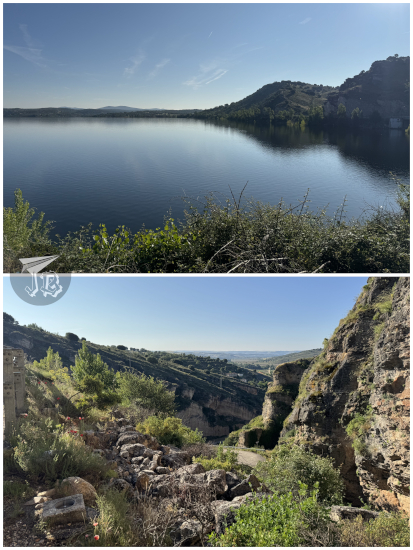
Alcorlo Reservoir, bustling with water

It was clear from the get-go that we would only stay for a couple of hours. Since we were improvising, staying for the whole thing, without lunch reservations or a definite plan, in the heat, would not have been a great idea. I just wanted to get the gist of how the festival went and how many people there were. Surprisingly, not as many as I thought. We dropped the car off at the entrance of the village and followed the signs towards the centre. We knew we were going in the right direction when we started seeing horses.
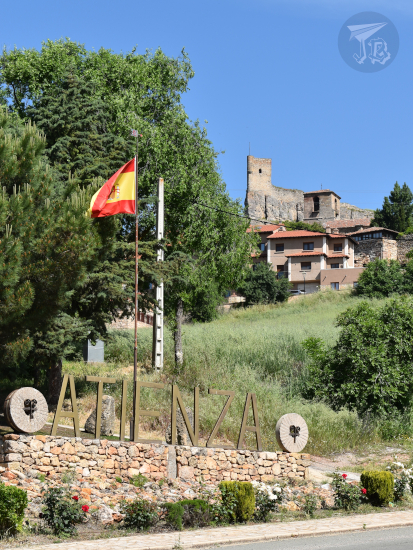
Entrance to the Medieval village of Atienza, with the name of the village, the Spanish flag and a castle in the background.

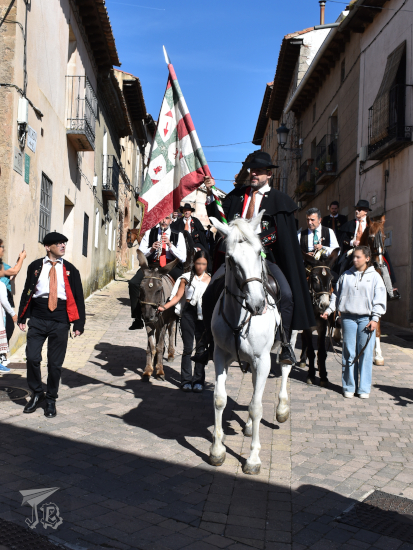
The festival starts at 10:00. The Brotherhood is called into order and they bid to carry the flag and open the pilgrimage behind the musicians. The brothers wear black suits and some are allowed to wear capes – not sure how the horses feel about that. This happens in a narrow street with way too many people and nervous horses. We decided it was safer to stay at the corner rather than trying to approach the scene – we had already witnessed a couple of them getting spooked by oblivious passers-by.
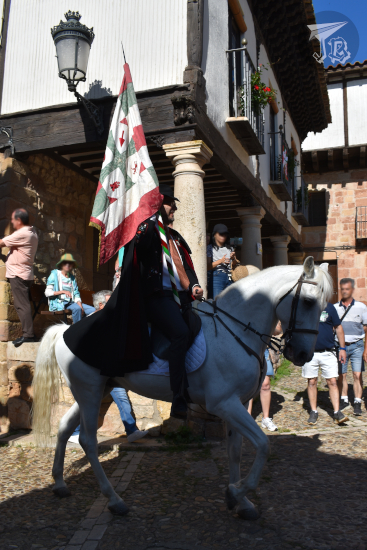
Caballada de Atienza: Horse parade in a Medieval Village. Senior brother carrying the flag

Caballada de Atienza: Horse parade in a Medieval Village. Three riders with to hats and black capes.

Caballada de Atienza: Horse parade in a Medieval Village. Senior brother with the flag, followed by musicians on mules.

Caballada de Atienza: Horse parade in a Medieval Village. Two lines of brothers along a street.

We watched the departure of the pilgrimage, and then jogged to a couple of other places for photos. We decided not to follow the cavalcade to the hermit church, because the return would have been at noon – way too hot. We waved the riders goodbye next to the remains of St. Francis’ convent, the ruins of a Gothic apse Ábside gótico del convento de San Francisco.

After the romería rode off towards the hermit church, we decided to explore the village a little. We went back to the Old Town Casco Antiguo de Atienza to have a look at the local monuments. We crossed the Medieval wall Muralla de Atienza through the arch Arco de la Virgen.

Atienza Medieval Walls

The Main Square is called Plaza del Trigo (Wheat Square), surrounded by traditional architecture, including the old council houses, a covered gallery, and the church of Saint John The Baptist Iglesia de San Juan Bautista. The current church was erected in Renaissance style in 16th century by architect Juan de la Sierra, to serve as substitute as the previous Romanesque parish.

Atienza Main Square: Plaza del Trigo, in severe Castilian architecture

Church of St John the Baptist, with a baroque altarpieceand rebuilt plaster vaults

Next to the church, serving as an exit from the square, stands the arch Arco de Arrebatacapas, the cape-stealing arch. Due to the configuration of the two squares it joins, a wind tunnel forms in the small alley – known to blow away capes or any other unsecured piece of clothing.

Medieval arch in Atienza

From an alleyway we got a good view of the castle – I’ll leave the visit for another time, when all the museums are open, and it is less hot. On the way out, we had a great view of the whole villa before we drove back for Chinese food and cold drinks.

Ruins of the Atienza Castle

17th February 2024: Hita, Medieval villa (Spain)

Today, Hita is barely more than a hamlet at the foot of a hill, lost in the middle of the Spanish central plateau, in the Guadalajara region. Its origins date back to pre-Roman times, and the settlement was first recorded in Roman roadmaps. The area later became part of the Caliphate until 1085, when it was conquered by king Alfonso VI and the town was incorporated to the Crown of Castile. The town flourished in the Middle Ages. In the 14th century, a then-famous poet, known as Juan Ruiz, the Archpriest of Hita (Arcipreste de Hita), wrote one of the most important literary works in Spanish-speaking history, the Libro del Buen Amor (Book of Good Love), a bit of a parody of the local society of the times in poem form.

Also in the 14th century, the lord Íñigo López de Mendoza took over the region. He rebuilt the castle from the ruined Moorish alcazaba and erected a wall around the settlement. However, the village eventually lost its importance, inhabitants, and vineyards, as the feudal system evolved. It was mostly destroyed during the Civil War in the 20th century. In 1961, historian Manuel Criado de Val wrote a play based on the Book of Good Love and it was played in the town square. People liked the idea, which eventually grew into the town’s Medieval Theatre Festival. It revitalised the village a little, and the first summer of June, the town fills up with plays, a marketplace, tournaments and jousts, and people dressing in period clothing. Today, Hita has fewer than 300 inhabitants, and it’s trying to build a reputation as a picturesque day trip “Medieval villa” – it has even built a visitors’ parking lot.

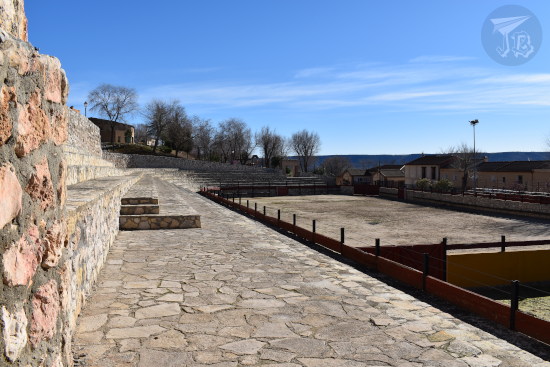
We arrived around 11:00, and left the car at the entrance of the village, in said parking lot. By 11:20 we had walked by all the whole historical centre – which, given how the town is promoted as a Medieval marvel, was a little underwhelming. We parked in front of the area named stockade or palisade, Palenque, where the medieval tournaments are carried out. Its construction is fairly recent, so it does not hold any historical importance outside the festival.

Stockade in Hita.

Next to the Palenque stands one of the remaining sections of the medieval walls Muralla Medieval that still remain around the village. There is also the sculpture of a semi-mythical figure – Álvar Fañez de Minaya. Minaya was Rodrigo Díaz de Vivar, El Cid’s, right-hand man. El Cid’s deeds are known from the Spanish epic poem Cantar de Mío Cid, which presents him as someone akin a Round Table knight. Though he probably did exist – along with his lieutenant – he was probably more of a mercenary and a warlord than the legendary hero.

Sculpture of Minaya in front of the medieval wall

The access to the historical centre is done through the stone gate Puerta de Santa María, the only one of the wall entrances that has survived – although it has been heavily restored. It was originally an arch, in civilian gothic; today the upper part is completely reconstructed, with two turrets. In front of the gate stands the pillory Picota, which signals that in medieval times there was a justice department.

St. Mary's gate into the town of Hita.

The village is small, and mostly uphill. There is a main square, some ruins, and a church. Since the church was closed and we could not snoop around, we decided to visit the local museum and sign up for the guided visit that was offered, as they would open the visitable monuments up.

The museum, Casa Museo del Arcipreste, multitasks as archaeological display, ethnographic museum, festival promotion, and recreation of the Archpriest’s writing chamber, with some facsimiles of the pages. There are masks from the festivals, and the town’s botargas.

Hita - local museum

When the guided visit started, we first overlooked the landscape. We got a commentary of the location of the village and its historical importance, and the kind of soil and crops that used to and still are grown in the area. I had chosen the weekend because the weather was going to be nice, and it was – especially no wind, which would have made things awkward.

We then visited the ruins of Saint Peter’s church Ruinas de la Iglesia de San Pedro. Originally a Romanesque temple turned mudéjar, it was blown up during the Civil War. Today, only the altar stands, and it is used as stage for cultural acts. As a memento of its original mission, the town has kept the tombstone of the last governor of the castle before it was destroyed, still on the ground.

Hita - Ruins of St Peter's church

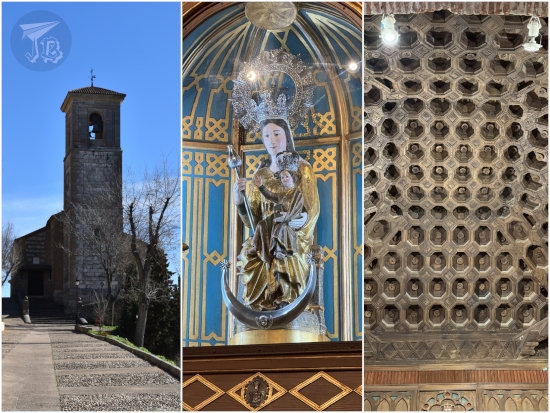
We moved onto the church Iglesia de San Juan Bautista. The building was erected in the mudéjar style throughout the 14th and 15th century. The tower is herrerian, erected in the 16th century. Inside, the most remarkable detail are the wooden ceilings, also dating from the 16th century. The floor is sprinkled with gravestones that used to be in the other church. There are two baptism fountains, and a small statue of the Virgin Mary with the Child, carved halfway between Romanesque and Gothic styles. Then she was embellished with baroque jewellery.

Hita - Church of St John the Baptist

Thankfully, we only looked at the ruins of the castle,and did not climb up to it – today, only a wall and the base of a tower stand, high up the hill that in the Medieval Age controlled the whole plain.

Ruins of the castle in Hita

Instead, we were invited to peer into a bodego, a traditional cave-house. The one we saw was restored, but it felt pretty authentic. There was a bedroom, a kitchen, and the end of the dwelling was more cave-like, working as stable and barn. The smell was damp, and it was good that they’ve put electric lights on it, because the tiny windows would have made it a little claustrophobic.

Cave house in Hita

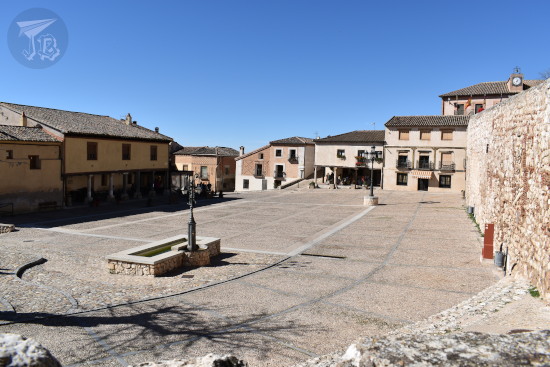
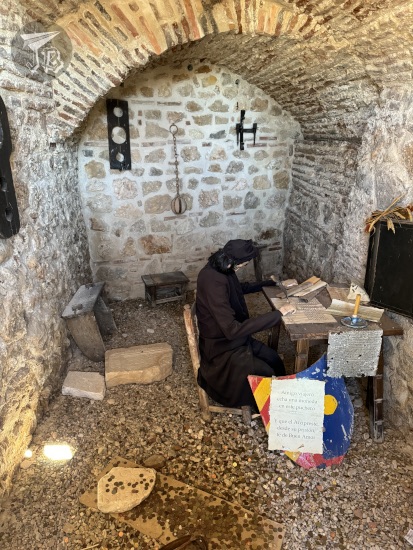
We then descended towards the main square Plaza Mayor, which was the old marketplace and even older synagogue. A hollow on the wall has been used to recreate a cell where the Archpriest was imprisoned. Opposite the wall, there are popular architecture houses, with typical porticos.

Main square in Hita

The Archpriest's cell

To end the visit, we looked at the gate Puerta de Santa María, and then were invited to see a traditional wine cellar excavated into the medieval wall. Though wine production was abandoned long ago, the cellar Bodega de Doña Bellida still exists with its traditional structure and huge clay vessels. It was excavated into the mountain, just like the bodego.

Wine cellar and jars

There was not much more to see in the village, so we just headed off afterwards. I was a bit underwhelmed about the whole thing, I am not going to lie.