
31st March 2025: More Modernisme and the way back {FFVII Barcelona 2025}

For our final day in Barcelona, I had planned some more architectural visits. I had adjusted my planning considering the underground issues the previous day, but it turned out, it had been a Sunday-only thing. We had breakfast and on check-out, the manager asked how the stay had been. To his merit, when we told him about the issue with the air-conditioning, he apologised and offered us free breakfast in compensation. After we declined – timed entry visit – he advised us to write a complaint letter for a discount next time. I didn’t think it was necessary.

Since the station we had to change at was open, there was no issue with the underground, so we were half an hour early. I had booked a locker for the luggage in the centre of town, as the hotel is very convenient for attending a concert at CCIB, but quite far from… everything else, really. The locker system was convenient: you book online and get a code which opens both the place and your assigned locker. I found it more trustworthy than leaving the bags in a random shop which “looks after luggage”. However, about a month later, there was a complete outage in Spain, which made me second-guess the convenience of these things, as I heard about a lady who could not go home because her luggage was inside one of those lockers. We’ll see whether I dare use them again.

We were to continue on my Modernisme route, visiting one of the works of Antoni Gaudí (1852 – 1926), considered the peak representative of the style – to the point that some of his works have been declared Unesco Heritage by themselves as Works of Antoni Gaudí. Gaudí originally found inspiration in orientalism and Neo-Gothic, but as he became more and more established, he turned to nature forms – seeds, branches, bones, catenary shapes… The UNESCO work we wanted to see was Casa Milà, a building commissioned to Gaudí by lawyer Pere Milà in 1906. The building itself was erected between 1906 and 1910, and it was nicknamed “The Quarry” La Pedrera. It is an eight-floor apartment building with a self-supporting façade, electricity, running and hot water. The building was designed around a central patio, and it has a very particular roof-terrace. Some people claim that Casa Milà does not even fit into the Modernisme category, but it should be classified as “organic naturalism”, or even “expressionism” all by itself.

La Pedrera, exterior

I found the building… underwhelming. We had a combined ticket for Sant Pau and Casa Milà at 39 €, but the normal ticket price for the building is 40 €, and this is only for one of the floors with a “recreated apartment”, the attic, and the terrace. At least you get to see the patio as you have to walk past it so you reach the tiny lift in which they cram you to take you to the 7th floor. The experience felt… like… not enough. I was for sure expecting something more.
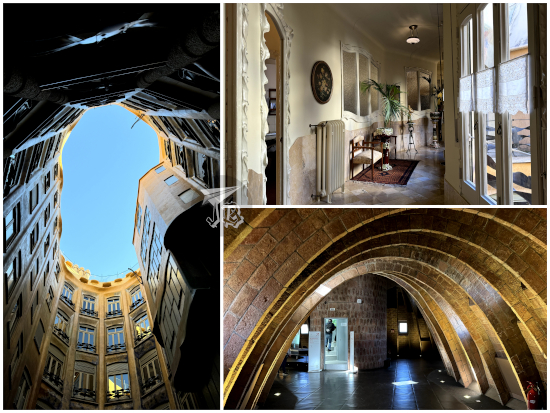
La Pedrera, Interior

Do not get me wrong, the house is extremely cool, but you get to see really little in comparison to how big the place is. So even if it is pretty, it feels crowded and small, with way too many gift shops crammed in. The terrace is fun, with chimneys that look like ancient warriors – some people say they represent chess pieces, others that they hide religious undertones – Gaudí was very spiritual. Reportedly, they also inspired the stormtroopers’ helmets in Star Wars.

La Pedrera, terrace

Afterwards, we walked to the music hall Palau de la Música Catalana part of the Unesco Heritage Site Palau de la Música Catalana and Hospital de Sant Pau, Barcelona. The so-called Palace of Music was designed by Lluís Domènech i Montaner a couple of years after projecting the hospital.
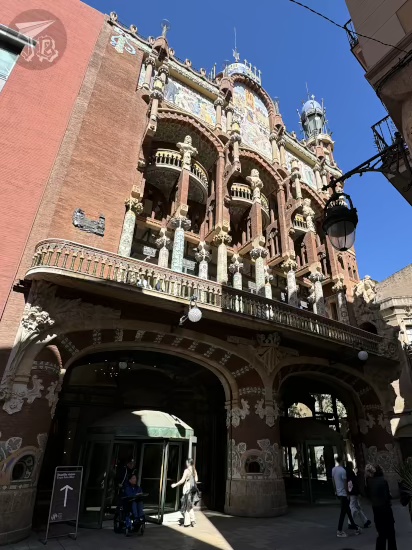
Palau de la Música Catalana

Everything that Casa Milá came short, the Palace passed with full marks. The building has an original entrance designed by Domènech, in dark brick with extensive decoration. The interior is laced with tiles and glass, and tinted-glass windows. The concert hall is amazing. At first, we could not access it, because there was an educative concert for children going on, but we were later allowed to sit at the paradise. There is a huge skylight / lamp in coloured glass, pegasus statues. The concert was incredible too, with four to six musicians playing classical music and… running around the stage too. Lady trotting up the stairs while playing the cello, you have my admiration. I loved everything about the palace, to be honest, except the creaky chairs.
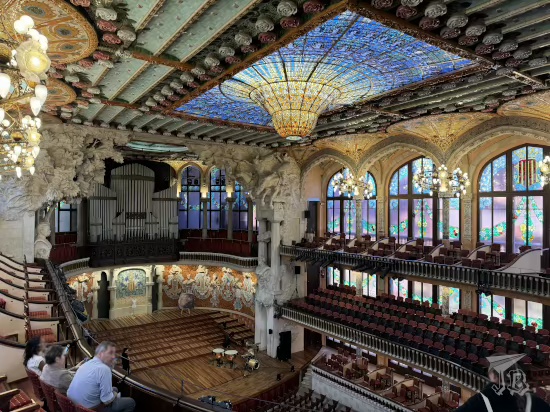
Palau Música Catalana

Once we were done in the Palau, we walked to the market Mercat de Sant Josep (St. Joseph’s market), known as La Boquería (The Butcher’s). It used to be a regular marketplace, but now it has turned a touristic attraction. The main entrance is also part of the Modernisme route, designed by architect Antoni de Falguera, who also created the inner metal cover. Though I had half a mind about eating there, the prices were ridiculous, so we ended up at an Asian place a couple of streets down. On the way, I had been excited about the “Barcelona Aqueduct”, but it turns out it’s a modern construction with old ashlars, nothing historical in it at all.
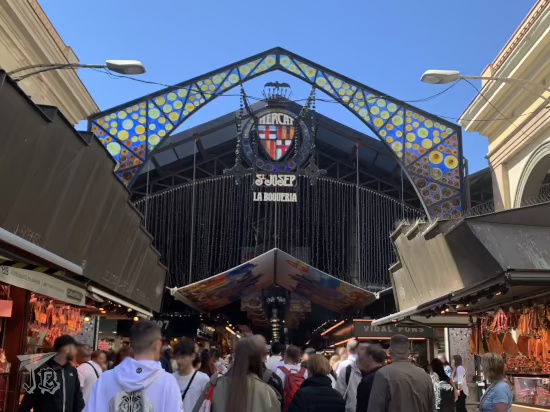
Market La Boquería

After lunch, we had about an hour to kill, and we decided to try our luck in the hobby-shops area. The Norma Comics shop was open, and we spent a while looking at the books there. Then, we headed back to pick up our luggage and commute to the station.

We had to change trains, and there was an announcement that any passengers with a connection shorter than 30 minutes would be escorted to their train. Of course, that’s only PA, and you’re on your own – I asked a worker, who tried to divert us to the suburban trains, not our connection. From that conversation, I think that we were supposed to go out of the system and get our tickets scanned again, but we found our train before that. There was no one else to consult with, so I decided that we would get on it. My sibling was mortified, but we were not doing anything wrong. If anyone checked on us, we had a valid ticket. They had not lived up to their part of the agreement anyway – and I would have told them exactly that, had anyone even thought of scolding us.

But we made it, as I predicted nobody gave us any grief, and the drive from the train station was uneventful. All in all, it was an intense weekend – though I feel I could have squeezed in a monument or two more had we skipped the sit-down meals, but my sibling can’t handle that. All in all, I think everything worked out rather well.
30th March 2025: Sant Pau, Verne & a chocobo {FFVII Barcelona 2025}

The Barcelona hotel charged 20 € per day and person or breakfast, and I was not willing to pay for that, and so I told my sibling. They had no option but to accept since they had decided to delegate all planning and credit-card’ing on me. Instead of booking with breakfast, I brought cold latte bottles and snacks – good for taking headache medicine, which I did. After a quick breakfast, we set off. As we left, I asked at reception if they could do something about the air conditioning.

We headed towards the underground. It should have been an easy twenty-five-minute commute, but one of the stations was half-closed. We had to go outside and walk towards the other entrance to change lines, which was strange and consumed a ridiculous amount of time. We had to be at the ticket booth of our booked visit ten minutes before the allotted time, and we barely made it – though they did not seem to care. When I was looking at tickets, I found a combined ticket that saved us 10 € for two iconic buildings in town that I had not visited before. That however implied exchanging vouchers for tickets, thus the extra time.

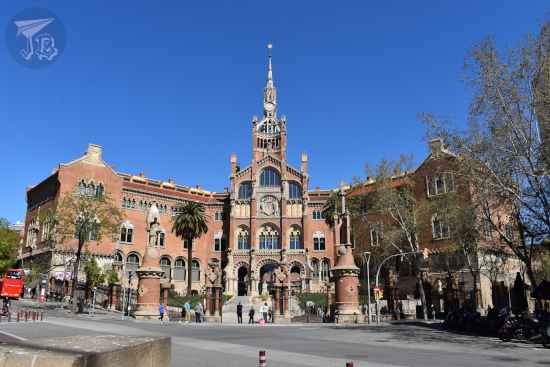
We reached the former hospital of Saint Paul Sant Pau Recinte Modernista ten minutes after I had anticipated, right at the time we had to be there. Sant Pau is a huge hospital complex erected between 1901 and 1930 by architect Lluís Domènech i Montaner (1849 – 1923). Domènech favoured Modernisme, and is considered one of the most influential architects in shaping it. He designed buildings which balanced functionality and decoration, with lots of mosaics and polychrome. Though the precinct had been a hospital since the Middle Ages, it was completely redeveloped for the early 20th century project. Today, it is half of the Unesco Heritage Site Palau de la Música Catalana and Hospital de Sant Pau, Barcelona.

Hospital San Pau from the street

The hospital is considered one of the most important, and largest, complexes in the local Modernisme style. The complex was designed with 26 buildings, 12 of them pavilions for patients, separated by sexes and kind of disease. The pavilions were connected by underground tunnels, leaving space for gardens and open spaces between structures. It was originally conceived to be self-sufficient, closed off to protect the rest of the city.

Hospital San Pau, outside

The buildings are erected in brick, and decorated with ceramics both inside and outside, some of them forming complex mosaics on the roofs and ceilings. After a new hospital was built next to the original one in 2009, the complex was recovered as a museum in 2014. We could visit the pavilions, the tunnels, and the administrative building. The whole enclosure is magnificent, and incredibly large. It took over two hours to see everything we were allowed to visit and I loved every second of it. Well, except the pavilion with political propaganda.

Hospital San Pau, interior

Afterwards, we headed out towards a fun restaurant I had found online – Verne Barcelona, decorated simulating Captain Nemo’s Nautilus from the novel Twenty Thousand Leagues Under the Sea by French writer Jules Verne. We shared a cone of tempura vegetables and I ordered a “Submarine” – a sandwich made from toasted brioche bread – called Turtle, with battered squid, sauce and salsa (I just don’t understand how they are supposed to resemble a submarine…).

Verne Barcelona

We headed back towards the hotel, stopping at a Starbucks for a coffee – a matcha in my case – because I helped my sibling dress up for the concert. We had been carrying the cosplay after all, of course they were going to wear it!

We were in Barcelona to attend the Final Fantasy VII Rebirth Orchestra World Tour, to be held in the CCIB – Centre de Convencions Internacional de Barcelona. Final Fantasy is an expanded video game anthology which set off in 1987. Since then, it has spawned 16 main games and countless spin-offs, media, plushies, and remakes. One of the most famous games is the seventh instalment, Final Fantasy VII, released in 1997. The game is set in a cyberpunk dystopia where energy is obtained by draining the Planet’s life-force. Gameplay follows the adventures of a party which opposes the system, embodied by the electric company Shinra, while at the same time trying to stop the main antagonist – mad soldier Sephiroth – from destroying the Planet itself.

Since 2015, Final Fantasy VII has been under redevelopment into a trilogy using modern graphics. The first game was Final Fantasy VII Remake, released in 2020, whose music had its very own World Tour in 2021. The second instalment, Final Fantasy VII Rebirth came out in 2024, and its music event – Final Fantasy VII Rebirth Orchestra World Tour – began almost immediately, ending precisely with our concert.

We were at the queue already when doors opened, but not early enough, so we needed to line again for the merchandise booth, almost an hour. It was in that queue where something amazing happened. When we attended the previous concert Final Fantasy Distant Worlds 35th Anniversary – Coral –, we were stuck at the merchandise queue for about an hour too and by the time we reached the front, they had ran out of most of the items. That included what I wanted the most – the chocobo plushies. Chocobo are a recurring species in the Final Fantasy franchise, large birds that can be ridden in-game, and in real life be sewn into cutesy toys.

It turned out that in 2023 the last chocobo plush had been bought by the guy who was sitting behind me. I might have made some jokes about stealing it and running away, and he promised to get me one for the next concert. I of course filed that under “one encounter silliness” and forgot all about it.

Well, he did not.

In that queue, two years later, he found me, and he gave me a chocobo plush. He actually found my sibling, who was easier to identify due to the cosplay. I was absolutely flabbergasted. Gobsmacked. Never in a million years would I have expected something like that to happen. Just… figure that everything that went on afterwards was coloured by a feeling of puzzlement and amazement at this stranger’s kindness over a silly plush I wasn’t able to buy two years before.

Chocobo!

We got to the front of the line over an hour later, almost at the time of start. I only wanted a programme, and we were seated around 20:50. I am good at choosing seats, by the way. We were dead centre at a great distance from the stage.

Setlist:
  First part:
  1. The Unknown Journey Continues
  2. FFVII Rebirth Opening
  3. Main Theme of FFVII – Battle Edit
  4. A New Journey Begins: Grasslands / Junon / Mt. Corel
  5. Crossing the Planet: Corel Desert / Gongaga / Nibel
  6. Queen’s Blood
  7. Stamp – Rebirth Medley
  8. Rufus’s Welcoming Ceremony – A New Leader
  9. Costa del Sol – Fun in the Sun
  10. Custom Valkyrie
  11. End of the World Medley
  12. Cosmo Canyon – Sanctum of Planetology
  13. Bare Your Soul
  14. Welcome to the Gold Saucer
  Second part:
  15. Loveless Symphonic Suite – Gift of the Goddess
  16. No Promises to Keep – Loveless Ver.
  17. Galian Beast
  18. J-E-N-O-V-A Lifeclinger
  19. Sephiroth Reborn Symphony
  Encore:
  20. One-Winged Angel – Rebirth Medley
  21. Aerith’s Theme – Return to the Planet Medley

Final Fantasy VII Rebirth orchestra playing

The orchestra was directed by Eric Roth. It was all right, I enjoyed it. However, I don’t think it was as powerful as the first one I saw, but that one was the first post-Covid event so it was emotional in other ways. Then again, I am not a gamer. I just watch gameplays on the Internet… I was a bit disappointed by the arrangement of One-Winged Angel, it felt… too elegant. What I love about the song is the pure chaos it represents, after all.

In attendance was composer Masashi Hamauzu [浜渦 正志 | Hamauzu Masashi]. He started working for Square Enix in 1996 under Nobuo Umematsu, the main composer of Final Fantasy VII music. Hamauzu’s first direct work related to the saga was the Chocobo’s Mysterious Dungeon soundtrack in 1997. He was in charge music for the Final Fantasy VII spin-off Dirge of Cerberus and alongside Mitsuto Suzuki, he has worked in both Final Fantasy VII Remake and Final Fantasy VII Rebirth.

After the concert, we joined the VIP queue for pictures and autographs. Though I had brought the CD from the time before – when I did not get the pamphlet – I was equipped this time. And I even managed the Spanish – English – Japanese cacophony without messing up either of them. That’s a first for me, I think. I got my programme autographed on the setlist page, and then my sibling and myself headed back to the hotel. For 179 €, I keep thinking the VIPs should at least get their own merch queue, or an item to get signed. I guess there are lots of people to get paid…

Eric Roth and Masashi Hamauzu signing autographs

Something that surprises me a lot about this area of Barcelona is that not even the McDonald’s at the shopping centre is open after 23:00, so I always make sure we buy something to snack after the concerts. The room was at least not freezing, though not particularly welcoming either. I had a hot shower, and that finally got rid of my headache, just in time for bed…