I planned a little escapade to Madrid. There was nothing really special going on, it was just going to be a sunny day with no rain forecast and I could go to a museum and have lunch. When I say nothing special was going on, I mean there were a couple of exhibits I wanted to see, but it would have been just as easy to visit them the previous or following day. I just timed it for the best weather forecast of the week.
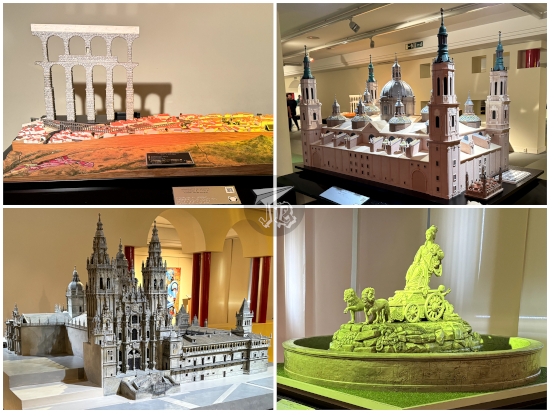
I had a small work-related thing early in the morning so I ended up leaving the house half an hour later than I would have liked. The trains were around 10 minutes late and the underground was packed, but none of that is news. I reached my first stop, the Museum for the Blind Museo Tiflológico de la ONCE, around 11:30. This museum hosts models or miniatures of famous monuments in Spain and around the world, designed to be seen with one’s hands. That way, people with low or no vision can get an idea of how they are. It is part of the ONCE inclusion program for the blind, and I think it is a brilliant idea.
ONCE stands for Spanish National Organisation of the Blind in the local language, Organización Nacional de Ciegos Españoles. Its history and works are a bit convoluted, but keeping it short, the Organisation was established in 1938 with the goal of providing equal opportunities for the blind and people with visual impairments. One of its main income sources is the lottery known as El Cupón de la ONCE.
While the museum itself is free to enter and very relaxed, when you arrive at the building you have to fill out a questionnaire, for statistical purposes, I guess. I did find it a bit off putting that I was outright asked why I wanted to see the exhibition. Because I’m curious, all right?
The museum has three distinct sections – one with the reproductions of the monuments, one with works by low vision, blind, or artists with other disabilities, and a historical area. In turn, the monuments are divided in national (Spanish) and international landmarks. The models are faithful to their smallest detail, and just like the Eiffel Tower is made out of metal, the Taj Mahal is made out of marble! Some of the monuments were reproduced in different scales, such as the Alhambra in Granada or the Aqueduct in Segovia. This should give an idea of both scale and detail. However, I don’t think I would ever be able to imagine something like that without being able to see it.
There were lots of sculptures by artists with disabilities, with a disturbing amount of naked ladies, but whatever. I also saw paintings and a homage to Braille that was sort of abstract but was really cool. The historical section hosted a number of items to learn and write Braille through the years, general studying tools such a 3D map of Spain, and a few historical runs of the lottery ran by ONCE. In general, it was a fascinating visit.

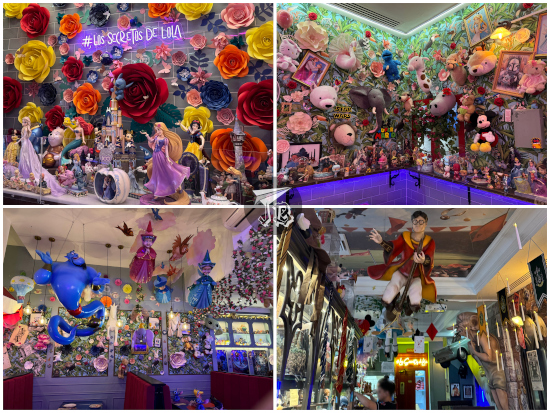
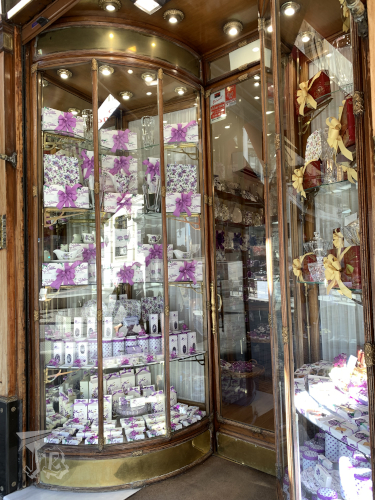
I did some shopping afterwards, and while the sales lady was really nice, she worked rather leisurely- That, and all the pedestrian lights being red on the fifteen-minute walk, put me seven minutes behind for my lunch reservation – and I swear, they phoned me. I was reaching the door of Comic Planet at 13:07 and they were already calling to check I was coming. People wonder why I’m paranoid about reservation times with them… They decided to change my table to “a more private one” to keep me away from a family with toddlers, and I had no problem.
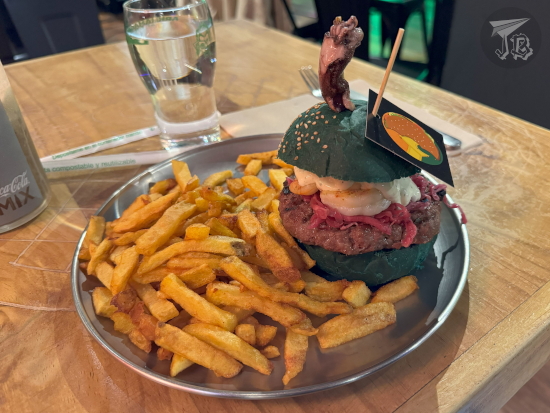
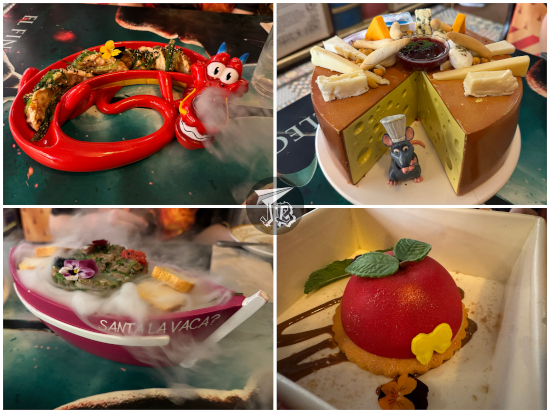
I got to try the last item that I wanted to try from their menu – the Aquaman Burger, which had caused me some morbid fascination when I first read about it– Beef and king prawns? Garlic and pickles mayonnaise? It could be… either really good or really bad, I thought, and I really wanted to check it out. It was all right, I guess. There was much less of a flavour contrast than I expected, so it was most of a normal burger with a bit of an edge. And the edge was that the buns were blue. I also ordered a Vanilla Coke just because I could, and the waiter was nice enough to offer me tap water when I asked for some too. Cool.
After lunch, I took the underground towards Fundación Telefónica which is running an exhibition called “Echoes of the ocean”, Ecos del Océano. I liked the idea better when I did not know that half of it was done using AI. It was – or tried to be – an exhibit centred around cetacean vocalisations. The first room was a mindfulness thingy in which a lady told you to become one with the ocean and then called you fat – “your body enlarges. You’re huge. You’re a humpback whale”. It made me laugh as it broke all the concentration thing. I also cackled when the voice told me that I went “deeeeep” as a sperm whale and met leopard seals there.
Then there were several huge screens with computer-generated graphs that imitated a sea prairie, dolphins and whales. That was the part that was made using AI, and it could have been a CGI or an actual video just as easily. The important part was that the images on the screen moved along the sounds of actual cetacean vocalisations. A room at the end hosted two actual underwater microphones, and headphones to listen to recordings of different creatures – sperm whales, seals, humpback whales – and ice sliding (this is important because for a long time, the sound of ice on the ocean was unidentified and it yielded to a lot of wild explanations / conspirancy theories).

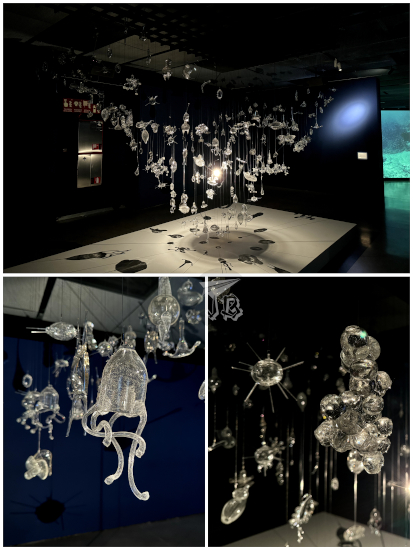
On the way out, there was a sculpture with glass reproductions of different microorganisms that love in the ocean: diatoms, anabaena, coccolithophores, dinoflagellates… Yes, this was totally me geeking out and identifying all the tiny little critters. The final room had to do with some photograph and schematics of a particular blue whale that had been tracked by the organisers.
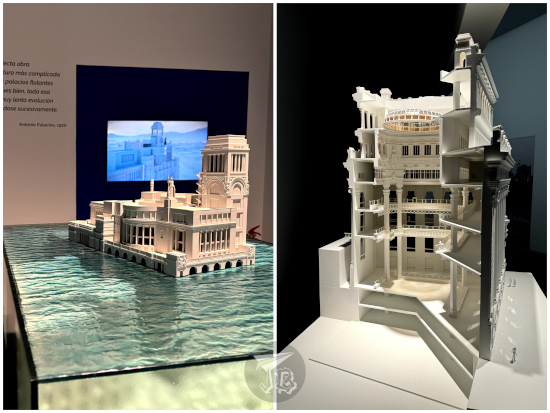
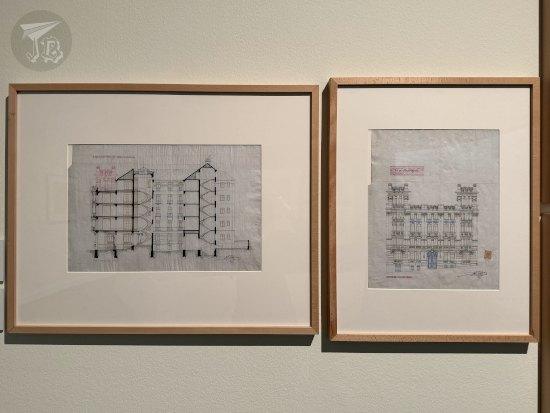
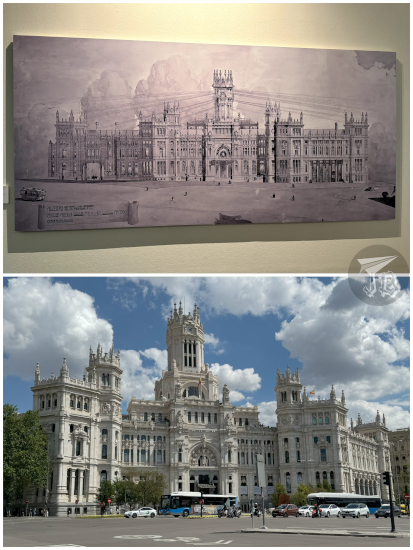
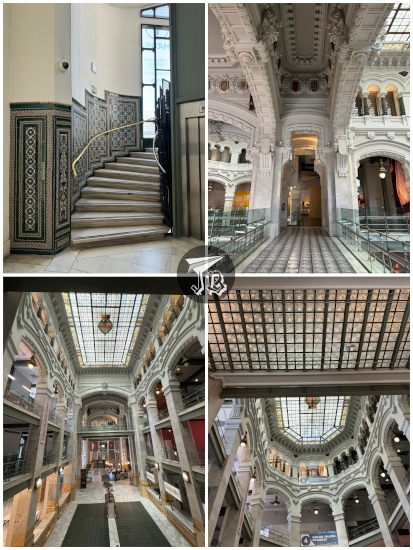
I left the building and headed towards Palacio de Cibeles, which this time, was running an exhibit on its own architect Antonio Palacios. The exhibition is aptly named “An architect’s dream: Madrid as a metropolis” Madrid metrópoli. El sueño de Antonio Palacios. It uses photographs, designs, and models to present the works Palacios projected for Madrid – the ones that were built, the ones that were not, and the ones that have disappeared. It was an interesting collection, and the visit was free! Of course, I wandered the building a little before heading to the train station.
On the way, there was a classic book fair Feria del Libro Antiguo y de Ocasión, but everything was way too expensive for me. I guess that in general it was a very budget-friendly day – three free exhibitions – if you do not count tiny shopping spree in-between, and it was around 20 €.










 JBinnacle – A Travel Logbook