For the last few years, I’ve tried to do (or visit) something cool on my birthday, especially when it fell on a long weekend. In 2024 I could not plan anything big despite the long weekend,. Instead, I broke it off into a small outing with my sibling and a little road trip. There are a couple of places not too far away that I wanted to see, but the roads are not so great. One of my parents is keen on driving anyway, so they were happy to oblige, and I could get away with not driving the curves myself.
Our first stop was the Cistercian monastery Monasterio de Santa María de Huerta. The Order of Cistercians are a Catholic religious order. A group of Benedictine monks founded the new order in 1098, as they wanted to strictly adhere to Rule of St. Benedict, and felt that the other had “relaxed” too much. Cistercian monks are credited with creating very “pure” churches as they believed that ornamentation was superfluous and distracting from prayer.
The monastery is located in the village of Santa María de Huerta, which actually grew around its walls at the side of Jalón River. The building dates back from 1162, though the order had been in Spain for two decades at the time. Most of the building was erected halfway between Romanesque and Gothic styles, with some add-ons from more recent times, mostly the Herrerian cloister and a Baroque altarpiece – which distorts a little the idea of the “pure Cistercian lines” and no extra decoration. But then again, I am not a fan of Baroque decoration.
Entry is from the side of the church to the Gothic cloister Claustro de los Caballeros, around which all the dependences can be accessed. The first one is the church, the first area to be built. There are still some of the original paintings, and a baroque organ. The monks’ refectory is the most important room, built from 1215. It has large pointed-arched windows which allow light to come in, and it is communicated with the kitchen. There is a second refectory, more Romanesque, for the lay brothers who took religious vows but were not actual monks. The last cloister, in the Herrerian style, is severe and impressive. As we were leaving, there was a black out, not sure what that could have meant…

We went back to the car and we drove towards the town of Medinaceli, which has a couple of monuments I wanted to see. Reputed for dating back to Roman times, it has a free-standing arch Arco Romano de Medinaceli, the only one in Spain with three arches. It is a triumphal arch built in reddish sandstone during the first century, at an altitude of 1200 m, where it rains, snows, and so. It feels like a miracle that a small structure (around 13 metres long, eight metres high and two metres wide) has withstood two thousand years.

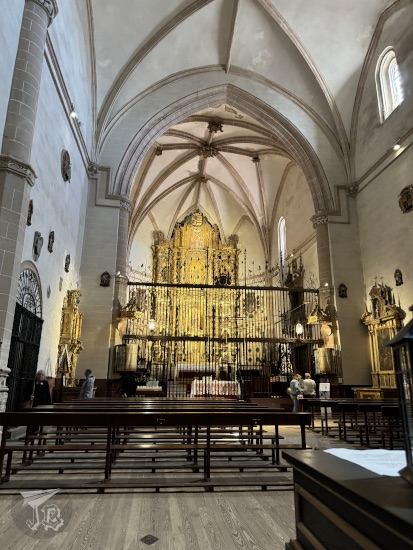
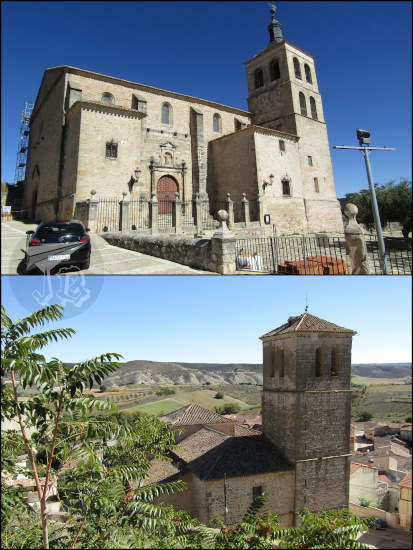
We saw the collegiate church Colegiata de Santa María de la Asunción, built in a late Gothic style. Artistically, the most important item is the iron grating in front of the altar. Religiously, there is a figure of Christ, which is called Cristo de Medinaceli, a wooden sculpture from the 16th century (though the most famous sculpture with that name is in Madrid). It was a little underwhelming, and most of the sculptures were not pretty.
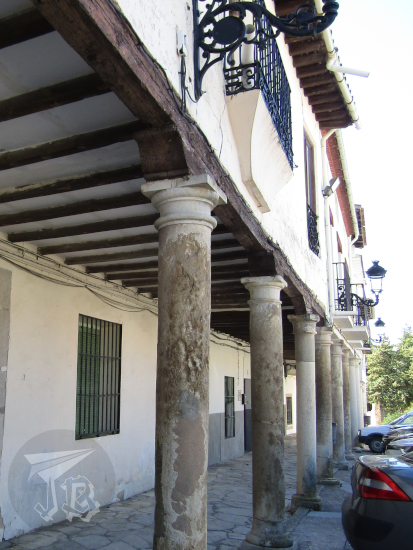
Afterwards we visited the main square of the village Plaza Mayor de Medinaceli. To one side stands a 16th-century building called La Alhóndiga, current town hall and former prison, with rounded arches on the ground floor and a balcony all along the façade on the first floor.

To another side, the palace of the former dukes Palacio de los Duques de Medinaceli, which was saved from the ruin turning it into a semi-private art gallery. Inside, the most important part is the Roman mosaic. The palace was built around 1430, and today only the Renaissance yard stays undisturbed. I am not a big fan of modern art, so I just can say that some of it was colourful and pretty. The entry ticket included entrance to a rural-house-turned-erotic-art-exhibition which… was weird. The whole house was painted pink, and the works were neither interesting and nor felt artistic at all. So 10 bucks to in the end see a Roman mosaic was a bit steep.

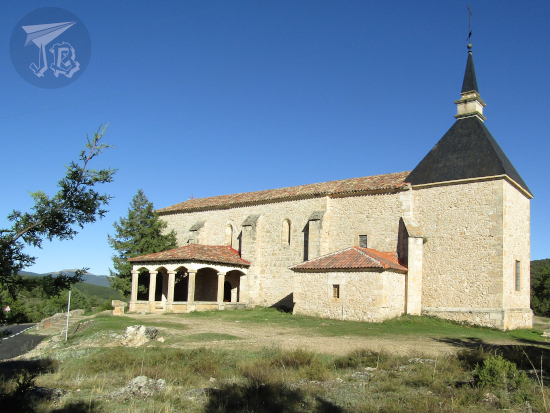
We decided not to stay in town for lunch, but – almost in a bit of a joke – we drove off to have lunch at what is probably the most iconic roadside restaurant in the centre of Spain – Área 103, a brasserie that is over 125 years old. It includes a small hermit-church built for truckers, Capilla de los Conductores.

It might have not been a glamorous birthday, but hey, along with the escapade on Tuesday, I guess I spent it doing what I like – discovering new things.



 JBinnacle – A Travel Logbook