26th November 2023: A Bunker and a Greenhouse (Madrid, Spain)

I have been to the park Parque del Capricho in Madrid before, and I was not really impressed. As it is considered a “hidden gem” in town, I expected something… I don’t know… more grand? It has different “attractions” such as a bee hive, a casino, ponds, fountains, statues… quite into the Romantic spirit of the times it was built, but I really did not connect with its design. I have to admit though that when I first visited I did not register the locked-down door with the word “bunker” surrounded by a brick structure next to the palace. It turns out, there is a Civil War bomb refuge 15 metres underneath the grass (I did see a machine gun spot in the grounds of the nearby castle, which was actually installed there to protect the military position). The refuge is a place you can only visit through the town hall’s Pasea Madrid program, as it is usually closed to the public.

The park was built as a recreational garden between 1787 and 1839 at the whim of the 12th Duchess (and Countess) of Osuna, who placed a summer house Palacio de los Duques de Osuna, in the centre of it. It became wildly popular among the high classes at the time – just like walking around cemeteries had become popular in France and England. However, at the turn of the 20th century the park had dwindled in fame. It changed hands, and after the 1929 crash it became all but abandoned. With the advent of the Spanish Civil War, the palace became an orphanage first, and it was later confiscated by the Republican government to be used as military operation centre. General José Miaja was in charge of defending Republican Madrid from the military coupists and moved the emergency command centre from downtown to the so-called Posición Jaca in the outskirts. The park was chosen because it is close to the airport, and it was easy to deploy defence batteries. Some of the most important battles in central Spain were “supervised” from there.

The day started dark and gloomy, so I picked up a thick coat – the webpage also noted that the temperature in the refuge is around 15 ºC. Public transport was just not feasible – round trip would have been about four hours by train – so I took the 40-minute drive and parked in the main avenue, a few minutes away from the park entrance. I had calculated a wide berth of time because I was not sure how easy it would be to park, but I apparently got there before the family weekend-makers. I was early for the 11:00 tour, so I just hung out the park for a little. By the time I walked in, the weather was nice and sunny.

One of the buildings in the park is a miniature farming house that today has an equally-tiny orchard with cabbages, cauliflowers and… a pumpkin patch. I swear, I had never seen a pumpkin patch before, not one so… colourful. I walked around for a little, then waited for the guide to arrive.

Pumpkin patch in El Capricho

The Civil War bunker or refuge Búnker del Capricho was built next to the palace where the command was set, excavated into and down the small hill. It was designed to withstand bombings, and protect its occupants from chemical attacks – people were rightfully freaked out as World War I had yielded to the development of chemical weapons. Building the refuge was commissioned to miners-turned-soldiers, who were able to finish it within the first few months of 1937. In case of an attack, the palace would be evacuated from the doors and windows, the personnel would go down into the refuge and close and lock the doors. Once operational, the refuge could host 200 people for up to two of weeks.

The bunker is dug between 14 and 16 metres into the ground. The walls could withstand most bombs designed at the time, with some of them being over two metres thick. The thirty-metre gallery could be sealed with submarine-like doors – designed by marine engineers – and keep out any toxic gas. There is a ventilation system and different wards on the sides, one of them identifiable as an operating theatre, another as a shower room. The floors are tiled, with different patterns for different rooms – the theory is that the patterns would allow anyone to know where they were even in low visibility conditions. The gallery is tiled too, but in white, and it has round ceilings, also painted white – also in theory, this is to counteract the claustrophobia from being underground; this idea was also applied when the first underground stations were built in Madrid.

Upon entering the bunker, there are two flights of stairs at a ninety-degree angle to each other. Then, there is another right-angle turn to enter the actual refuge. There are two metal doors that could be hermetically shut, now peeled-off and rusty, but which really look like ship or submarine safety doors. This design minimises shock waves and blocks any gas that could be used against the Republican Command. The structure is bigger and wider than I thought it would be.

Underground refuge in el Capricho Park

I guess it is part of the Spanish history, so good enough to see once and then move on – know about history not to repeat it, but do not dwell in it. Which is what I did. Once the guided visit was over, I wandered the park for a little. I found the park miniature fortress, the lake with its black swans, and the small casino. I was hoping for some nice autumn colours like I saw a couple of weeks before in Retiro Park, but there was not much on that front. I however did come across a few bees hard at work.

Black swan feeding

Honey bee on purple flower

I left the El Capricho and went across the avenue to walk into the neighbouring, bigger park Parque Juan Carlos I. I wanted to see the so-called Estufa Fría – just a fancy name to call a greenhouse. The greenhouse did have some pretty autumn colours in the Japanese garden, as the small maples (Acer palmatum) had started turning gold and red. The structure hosts palm trees, ferns, a small “bamboo grove” and an autochthonous forest that was composed of mostly evergreen plants and ivy. I had no idea that the Estufa Fría even existed until a few days before, so I guess I’ll need to keep it on my radar for future springtime visits – I want to see the blooming cherry trees in that park anyway.

Estufa fría or cold greenhouse in Juan Carlos I park

It was not much of an outing, barely a few hours, and I was home for a late lunch. I did not want to stay out long, as that evening I had tickets for the opera.
13th March 2022: The outskirts of Madrid (Spain)

I’m usually rather enthusiastic when I visit new places, but if there is a place that I’ve found kind of over-hyped, that has been the park Parque del Capricho, in Madrid. “Capricho”, which means whim or folly – in its architectural meaning of an often extravagant picturesque building erected to suit a fanciful taste, or building erected for decoration, typical of the French and English decorative gardens from the 18th century. The park is located in Madrid, and the only romantic garden that remains in Madrid. It was promoted by the 12th Duchess of Osuna between 1787 and 1839, and became a recreational area for the nobility of the time. Some of the most important gardeners and landscapers of the time worked on its design. It was declared Historical Garden in 1934 and restored in 1999.

So it is a garden, with some plants, some flowers, and a bunch of weird-looking decorative items, that takes itself a bit too seriously. It won’t accept pets and you can’t bring any food inside (it has some cage-looking “lockers” were you can leave your stuff). There is a strict capacity control which does nothing for it not to feel ridiculously crowded on a regular nice-weather Sunday. Maybe it improves in spring / summer, and with fewer people, but I had some stuff to do in the area and that is why I made time to visit today.

It had been raining all week, so I had mostly scrapped my plans. It was a great sunny day though so in the end I decided to get there. Parking the car was ridiculously easy – though the parking spot was maxed out, I found a very easy one in the avenue next to the park – good, it was close as I would not put my sandwich in the crappy-looking lockers and preferred taking it back to the car. Then I walked in, and explored for a couple of hours – and don’t tell anyone, but I ate a piece of candy, just to be rebellious (≧▽≦) (and to make sure I did not sugar crash without any food around, but that does not really make for a good story).

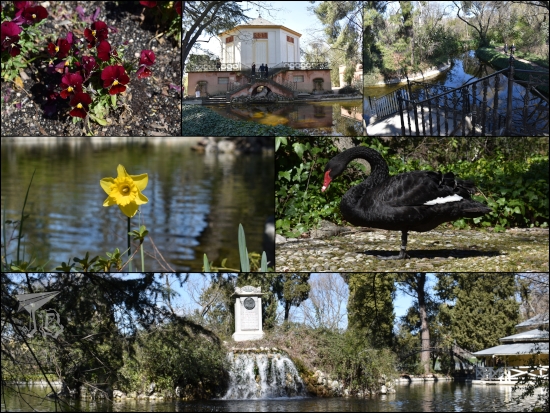
While I of course did not expect everything to be blooming and colourful and green… I hoped that it would have at least maintained through winter. No such luck. A bunch of areas were fenced off, the footpaths were swamped with puddles, and the water in the ponds was not as clean as it should have been. Exploring the 14 hectares took me about an hour and a half, considering that I did go into all the little paths, but all the buildings were closed and / or under constructions. There is a Civil War bunker in the park too, but that is only open through pre-booked guided visit and I did not know I was going to do this 30 minutes before I jumped on the car. The few flowers that had already bloomed included the garden pansies (Viola × wittrockiana, which are after all winter flowers), and the yellow and white daffodils (narcissus, maybe the subspecies jonquil Narcissus jonquilla). There were a couple of black swans (Cygnus atratus) at the main pond, and mallards (Anas platyrhynchos) on every second water body, including fountains.

Pond in the park. There are some flowers and buildings around it, and a black swan sunbathing.

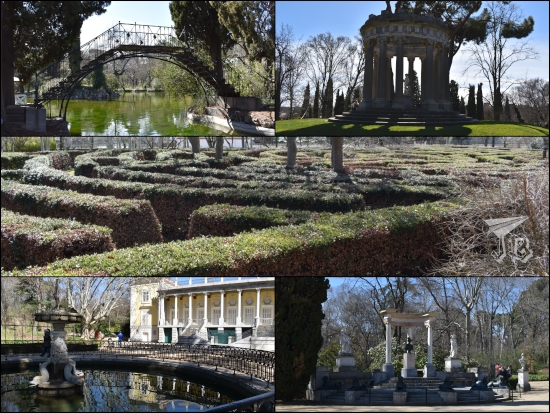
Collage of different park decoration: a bush labyrinth, a fountain, and some decoration reminding of Greek temples.

Afterwards, I took a small detour to see if any of the Japanese cherry trees in the park opposite the street Parque Juan Carlos I had started blossoming. The answer was not at all. But the point was heading to the restored castle Castillo de la Alameda. The castle dates back to the 15th century, though there are older remains underneath, and it is thought that its presence is the one that got all the aristocrats to flock to the area, as it switched from defensive castle to palace.

The remains of the castle feature an irregular moat with lobe-like structures in the corners, and the restored keep, which stands up to the first floor, though it must have been much higher. An interesting characteristic of the castle is that it was built using a kind of mortar made from flint. I have to say it was a nice surprise, free to visit.

A clover-shaped castle ruins, all white. There is not much of the castle left, but the moat is almost intact, though empty

To the side of the castle there is a casemate – a fortified machine gun emplacement from the Spanish Civil War, called Nido de Ametralladoras (Machine gun nest), a semi buried cement block for snipers of sorts to defend the position.

Concrete block that was used as a machine-gun base

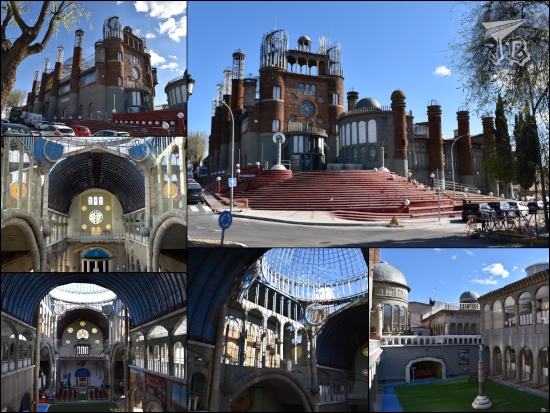
Then I moved onto Mejorada del Campo a little town near Madrid that only has one tourist attraction – a… handmade cathedral. Of sorts – Catedral de Justo Gallego .

Justo Gallego was born in 1925. Deeply Catholic, he became a young monk-in-training but had to leave the monastery when he contracted tuberculosis. He made a vow to erect a cathedral to the Virgin Mary in her “Lady of the Pillar” avocation, and he sort of did. Throughout the next 60 years he worked on building the cathedral, using recycled material, and on his own. His work came to fame when a soft-drink company made him the star of an advertising campaign, which made him and his work famous.

The cathedral has 12 towers, a crypt, two cloisters, a baptistery, and the main nave is 20×50 metres, with a 35 metres high dome. Most of it was done by hand, using discarded items such as tubes and bicycle wheels. It is garish and childish in its decoration, but I found it to have some strange allure. The cathedral has drawn the attention of international artists and institutions, and apparently Gallego built it without any blueprints or knowledge of construction. Upon his death, an architectural studio started working on “legalising” the cathedral (from an urbanistic point of view; it is not an official Christian building) and is it is now under management from an NGO. It was just a bizarre thing to see, but interesting since I was in the area (sort of. Construction made the route stupidly long), glad I’ve visited it at least once. I did catch a European white stork (Ciconia ciconia ciconia) coming home to one of the towers.

Cathedral made out of recycled items: pipes, plastic bottles, irons... there is a dome and a nave, in bizarre colours.

A stork approaches one of the towers of the cathedral

I drove off afterwards, and I have to say the weather that day was amazing – just in-between two piss-poor ones, so yay spring escapade.

Walking distance: 11.18 km (16916 steps)