20th December 2023: Brilla Madrid Zoo (Madrid, Spain)

After an unwarranted amount of stress in the morning, I decided to take a little escapade in the evening to see some lights. The city of Torrejón is known as one of the local “Christmas hubs”, but it was “family day” and tickets were free, so there was no way to get a same-day entrance. I was a bit bummed, because that was convenient to reach by public transport. Instead, I resolved to go to Madrid instead – there was a light show on the topic of animals which had a small same-day discount – with it, I could get the skip the queue “upgrade”, the ticket itself, and the processing fees for the price of a nominal ticket. The downside was that I had to drive there. I booked entrance for the 18:40 timeslot, and left about 17:15, anticipating the traffic jams on my way to the park Parque Juan Carlos I. Traffic on the motorway was rather aggressive and all the exits were jammed. Thus, instead of driving to the main entrance to the park, I decided to drop the car off near one of the side entrances, and walk the last couple of kilometres instead of driving them. When I strolled by the parking lot, I saw that it was full and there were emergency vehicles there – I would have had to go to the inner parking lot, which means walking almost as much, and I saved one merging into the highway and one exit. I don’t mind driving, but I’m not a fan of other drivers.

As I walked into the park, I ran into the first sign reading Brilla Madrid Zoo (Madrid Shining Zoo). They had placed signs all along my path – rather convenient. I walked for about 15 minutes and I was at the gate just past the 18:20 timeslot. Since it was a schoolday, and quite cold, it was almost empty and the staff had no problem letting me through. Brilla Madrid Zoo is a project by Brilla Events, who claim that there are over 500 light figures – I did not count – in a path that takes about 1.3 kilometres.
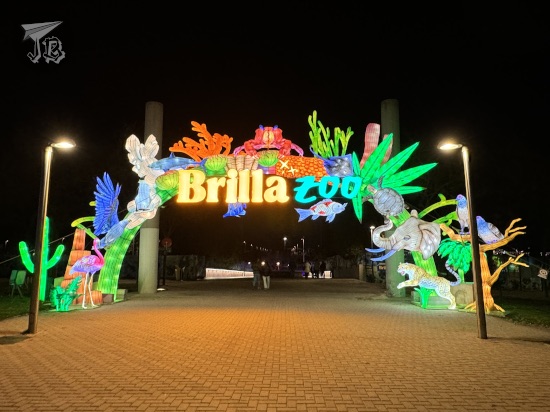
Brilla Madrid Zoo entryway

After the entrance arch, you go down to the actual ticket control. I had bought the skip-the-queue ticket which allowed me to see an “extra” exhibit in a tent, called Pollinators (Polinizadores). The whole Brilla Madrid Zoo exhibit has a “take care of the earth” kind of message, but it gets old really quickly as each “animal” repeats the same few words every couple of minutes. The Pollinators area had giant displays of a hummingbird, a bee, a butterfly, a bloom, and a bat for some reason. There was a screen with “Gaia” addressing the crowd, and it would have been creepy if not for the kiddos running and screaming around.

Brilla Madrid Zoo Giant hummingbird

As I went in, I was greeted by giant giraffe necks, then I moved into the Savannah (Sabana), with lions, leopards, zebras, hyenas, antelopes and elephants. Afterwards, there was the Jungle (Jungla) with gorillas, capybaras, jaguars… From there, after a turn, there was Australia, with echidnas, koalas, dingos, kangaroos.

Brilla Madrid Zoo Giraffes, Jungle, Australia, Whale

The entrance to the Ocean area (Océanos) could be done through a whale. Along the fountains / ponds of the park stood sharks (great whites and hammerheads), lionfish, turtles, clown fish (a.k.a. Nemo), blue tangs (a.k.a Dori), barracudas, koi carps, corals… There were also two real geese who seemed to be enjoying the exhibit too. It was really hard to take straight pictures as there was very little reference outside the actual animal.

Brilla Madrid Zoo Ocean

As I got close to the River areas (Ríos), there were otters and frogs. The coastal biomes were represented by the Swamp (Pantanos) and the Mangroves (Manglares). There were crocodiles, anacondas, Venus flytraps… for the first, and a flock of birds for the latter – flamingoes, pelicans, herons…

Brilla Madrid Zoo Rivers, Mangroves, Swamps

Then there was a bit of an avenue flanked by Flamingoes (Flamencos) to reach the Butterfly zone (Mariposas) and the Peacocks (Pavos reales). After another turn, there was the area dedicated to Nocturnal Animals (Nocturnos), with lemurs, bats, owls, and a wolf howling at the moon, perched on a dolmen.

Brilla Madrid Zoo flamingoes, butterflies, peacocks and wolf

After the dolmen, I found the Reptiles (Reptiles), with more frogs, iguanas, chameleons, a cute Komodo dragon… The path lead to what I guess is China by any other name: the Tiger (Tigre) and Pandas (Pandas). The Extinct Animal section (Extintos) was sad – with a dodo, a Tasmanian tiger, a white rhino, a Yangtze dolphin, a species of emu…

Brilla Madrid Zoo Reptiles, Panda, Tiger, Extinct animals

But then came the fantastical animals: Griffon (Grifo), Dragon (Dragón), Alicorns (Alicornios) – winged unicorns – and a Phoenix (Fénix).

Brilla Madrid Zoo griffon, dragon, alicorn and phoenix

Once outside the area, you find the Ice figures (Hielo), with seals, Arctic foxes and penguins. There was a tent with a souvenir shop and some food stalls, but I did not go inside. I thought I would just walk back through the park before it became too late – and colder.
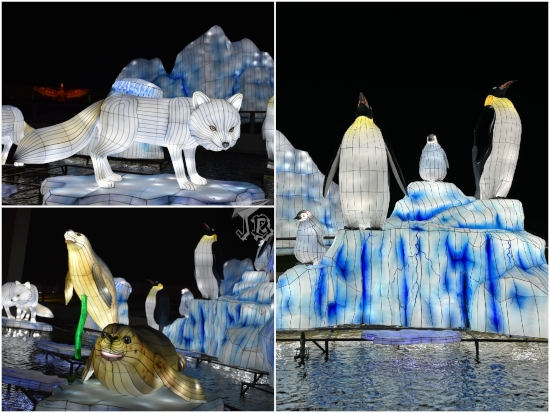
Brilla Madrid Zoo Ice

I liked Brilla much better than this year’s Naturaleza Encendida, to be honest. It was quite cold though, and a bit windy. I ran into another jam on the way back, this time caused by an accident. I have a theory regarding signals in this country – half of the drivers don’t use them, and out of the ones who do, yet another half think that signalling gives them immediate preference, even when what they are doing is illegal…

26th November 2023: A Bunker and a Greenhouse (Madrid, Spain)

I have been to the park Parque del Capricho in Madrid before, and I was not really impressed. As it is considered a “hidden gem” in town, I expected something… I don’t know… more grand? It has different “attractions” such as a bee hive, a casino, ponds, fountains, statues… quite into the Romantic spirit of the times it was built, but I really did not connect with its design. I have to admit though that when I first visited I did not register the locked-down door with the word “bunker” surrounded by a brick structure next to the palace. It turns out, there is a Civil War bomb refuge 15 metres underneath the grass (I did see a machine gun spot in the grounds of the nearby castle, which was actually installed there to protect the military position). The refuge is a place you can only visit through the town hall’s Pasea Madrid program, as it is usually closed to the public.

The park was built as a recreational garden between 1787 and 1839 at the whim of the 12th Duchess (and Countess) of Osuna, who placed a summer house Palacio de los Duques de Osuna, in the centre of it. It became wildly popular among the high classes at the time – just like walking around cemeteries had become popular in France and England. However, at the turn of the 20th century the park had dwindled in fame. It changed hands, and after the 1929 crash it became all but abandoned. With the advent of the Spanish Civil War, the palace became an orphanage first, and it was later confiscated by the Republican government to be used as military operation centre. General José Miaja was in charge of defending Republican Madrid from the military coupists and moved the emergency command centre from downtown to the so-called Posición Jaca in the outskirts. The park was chosen because it is close to the airport, and it was easy to deploy defence batteries. Some of the most important battles in central Spain were “supervised” from there.

The day started dark and gloomy, so I picked up a thick coat – the webpage also noted that the temperature in the refuge is around 15 ºC. Public transport was just not feasible – round trip would have been about four hours by train – so I took the 40-minute drive and parked in the main avenue, a few minutes away from the park entrance. I had calculated a wide berth of time because I was not sure how easy it would be to park, but I apparently got there before the family weekend-makers. I was early for the 11:00 tour, so I just hung out the park for a little. By the time I walked in, the weather was nice and sunny.

One of the buildings in the park is a miniature farming house that today has an equally-tiny orchard with cabbages, cauliflowers and… a pumpkin patch. I swear, I had never seen a pumpkin patch before, not one so… colourful. I walked around for a little, then waited for the guide to arrive.

Pumpkin patch in El Capricho

The Civil War bunker or refuge Búnker del Capricho was built next to the palace where the command was set, excavated into and down the small hill. It was designed to withstand bombings, and protect its occupants from chemical attacks – people were rightfully freaked out as World War I had yielded to the development of chemical weapons. Building the refuge was commissioned to miners-turned-soldiers, who were able to finish it within the first few months of 1937. In case of an attack, the palace would be evacuated from the doors and windows, the personnel would go down into the refuge and close and lock the doors. Once operational, the refuge could host 200 people for up to two of weeks.

The bunker is dug between 14 and 16 metres into the ground. The walls could withstand most bombs designed at the time, with some of them being over two metres thick. The thirty-metre gallery could be sealed with submarine-like doors – designed by marine engineers – and keep out any toxic gas. There is a ventilation system and different wards on the sides, one of them identifiable as an operating theatre, another as a shower room. The floors are tiled, with different patterns for different rooms – the theory is that the patterns would allow anyone to know where they were even in low visibility conditions. The gallery is tiled too, but in white, and it has round ceilings, also painted white – also in theory, this is to counteract the claustrophobia from being underground; this idea was also applied when the first underground stations were built in Madrid.

Upon entering the bunker, there are two flights of stairs at a ninety-degree angle to each other. Then, there is another right-angle turn to enter the actual refuge. There are two metal doors that could be hermetically shut, now peeled-off and rusty, but which really look like ship or submarine safety doors. This design minimises shock waves and blocks any gas that could be used against the Republican Command. The structure is bigger and wider than I thought it would be.

Underground refuge in el Capricho Park

I guess it is part of the Spanish history, so good enough to see once and then move on – know about history not to repeat it, but do not dwell in it. Which is what I did. Once the guided visit was over, I wandered the park for a little. I found the park miniature fortress, the lake with its black swans, and the small casino. I was hoping for some nice autumn colours like I saw a couple of weeks before in Retiro Park, but there was not much on that front. I however did come across a few bees hard at work.

Black swan feeding

Honey bee on purple flower

I left the El Capricho and went across the avenue to walk into the neighbouring, bigger park Parque Juan Carlos I. I wanted to see the so-called Estufa Fría – just a fancy name to call a greenhouse. The greenhouse did have some pretty autumn colours in the Japanese garden, as the small maples (Acer palmatum) had started turning gold and red. The structure hosts palm trees, ferns, a small “bamboo grove” and an autochthonous forest that was composed of mostly evergreen plants and ivy. I had no idea that the Estufa Fría even existed until a few days before, so I guess I’ll need to keep it on my radar for future springtime visits – I want to see the blooming cherry trees in that park anyway.

Estufa fría or cold greenhouse in Juan Carlos I park

It was not much of an outing, barely a few hours, and I was home for a late lunch. I did not want to stay out long, as that evening I had tickets for the opera.

7th November 2023: A Jurassic amount of Lego (Madrid, Spain)

The fact that I like dinosaurs would come to no one’s surprise by now. To be honest, the older I turn, the more I think of them in the mind frame of the xkcd comic “Grownups”. Dinosaurs are silly fun, and it’s not like I’ve got a few million dollars lying around to buy a whole T-Rex skeleton anyway. What I do have is a silly knack to find things to do that are related to them – selective perception, if you wish. On this occasion, I heard that Madrid would be hosting the European Premiere of Jurassic World Exhibition by Brickman.

It is widely known that Jurassic Park and Jurassic World are part of a widely successful franchise. However, what or who is Brickman? In order to answer that question, we need to find out what a LEGO Certified Professional is: a person whose business model is working with LEGO blocks, making stuff for publicity, for example, and they are so good at it that they actually become LEGO-affiliates. The Brickman is a team of people who are led by Australian LPC Ryan ‘The Brickman’ McNaught – basically, they get paid to play with LEGO all day, and are commissioned things to build (which I think is awesome, in case you had any doubt). The Brickman Team have under their collective belt six exhibitions touring the world, and some of the largest and more detailed LEGO models ever built.

I came across the Jurassic World LEGO exhibition by pure chance, but once I knew about it, I worked on timing. The exhibition kicked off on the 30th of September and it will be there until the 14th of January – and it turned out that Tuesdays are cheaper. I bought a ticket for the opening timeslot at 11:00, and planned my day. I had to go to Madrid’s IFEMA Espacio 5.1, where I had already seen The Dino World Expo. It took 25 minutes to drive there and 35 to find a parking spot at the end of the world, then walk to the venue. Only when I was right by IFEMA, I saw that the paid parking lot was open – it is usually not when I am at IFEMA. Since it was a schoolday, I hoped to see the exhibition without many people – and kids – around so I could have fun with pictures.

As the name hints, the whole exhibition is based around LEGO-built Jurassic World items and scenes. Most of the rooms have brick buckets for you to put together whatever you want, freely or with instructions / missions. I did not build anything, but I had a lot of fun, once I managed to get in. When I arrived at 11:05, the ticket reader was not working, but the person at the door let people in anyway. He even offered to take your picture with the doors to Isla Nublar, which are already made from LEGO and actually really open. They recreate the gates shown in the first Jurassic Park films, but they read “Jurassic World” instead. Once inside, I asked a staff member if they had any stamps for the LEGO passport, and she had absolutely no clue what I was talking about – I think she thought I was weird, but oh well. The first room has “smaller” exhibits in comparison with others. There is a working monorail, a few aircraft and a life-sized 3D map of the island. It was weird to hear the Spanish dub from the films when a lot of the screens were still in English.

Jurassic World by Brickman entrance

The second room has a DNA strand and an amber collection site, and a shelf with lots of “hybrid” creatures. Some of them were cool, others just made me giggle – you were encouraged to build your own hybrid. The third room was “baby dinosaurs” under a huge brachiosaurus (171,150 bricks; apparently is one of the largest models in the world). There were some hatching eggs, too. In this room there were bigger LEGO bricks for the youngest kids to play and build stuff with.

Jurassic World by Brickman - LEGO baby dinosaurs

Then came a sort of control room – where visitors can track the escaped dinosaurs while some flying reptiles lurk from the ceiling, somehow recreating the alert in the first Jurassic World instalment. After that, there is a set up of the JW velociraptors, Blue and Delta having escaped and Echo and Charlie still in their pens. I had seen a LEGO Blue before, for the Jurassic World: Fallen Kingdom promotion in the Natural History Museum in London, but this one was much cooler, and scaled 1:1 to the film – 58,227 bricks.

Jurassic World by Brickman - LEGO Velociraptors

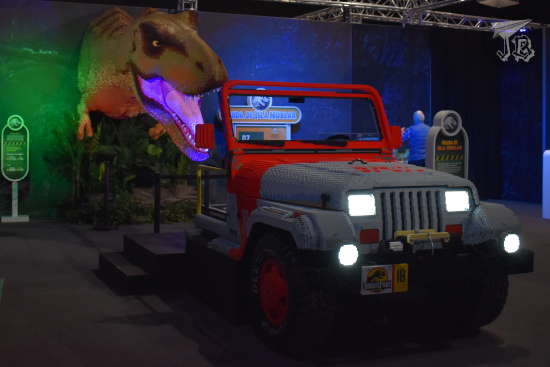
Despite all the promotion and toys she gets, Blue is probably not the fan-favourite dinosaur from the films. She is not mine for sure – that would be Rexy, the T-Rex. And after a mural of the mosasaur (number two on my list) hunting down a great white shark, Rexy finally comes into view, in one of her most glorious scenes from the original Jurassic Park: chasing the Jeep after Dr Sattler and Muldoon have just rescued Ian Malcolm. The Jeep was built using 227,098 bricks (which makes it even more complex than the brachiosaurus), and Rexy 128,763. One thing I noticed was that they had changed the jeep’s number, from 10 to 18, I’m guessing there is some inside joke there. They even recreated her reflection on the rear-view mirrors, which was pretty neat.

Jurassic World by Brickman - LEGO jeep being chased by the T-rex

The exhibit was fun for the discounted price, but the shop was crazy expensive. When I finished, I walked back to the parking spot. I had to walk through part of the park Parque Juan Carlos I. In the middle of the so-called Southern Pond Estanque Sur there is a hideous sculpture made of wrought iron, which is called “Walk between two trees” Paseo entre dos árboles by sculptor Jorge Castillo . As I was staring at it trying to figure out what it meant (and even after reading up on the symbolism, I don’t get it), I approached the edge of the water. A flock of mallard ducks swam over to see if I had any food, and I noticed something that was neither a duck nor a goose – a great cormorant (Phalacrocorax carbo). I had never seen cormorants in Madrid before. Seagulls, yes, but not cormorants, and I actually saw three of them.

Juan Carlos I Park, Southern Pond

I headed off for lunch at La Vaguada, a shopping centre not far away from IFEMA, though the Sat-Nav went weird and I took forever. I actually had a couple of things to do in that area, not least of all drop by the LEGO Store La Vaguada to actually get a small stamp – or three – for the rally. I mean, I had already been to the exhibition, I was going to be there, I had taken the LEGO passport just in case…

La Vaguada LEGO shop

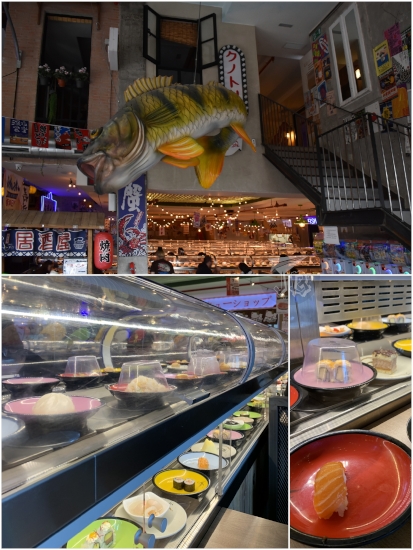
Serious things taken care of, I looked for the restaurant Running Sushi In Market, a call-back to a kaizensushi – small-plates of sushi on a conveyor belt – in an all-you-can-eat business model part of a franchise. It is more of an “Asian” place than a sushi restaurant and you have a range of recipes, from actual sushi to baos, skewers, noodles, dumplings, sausages… You are given a table for one hour to eat as much as you want, and pay a fixed rate plus drinks. It was not bad at all, though for the cheap price, tuna was too much to ask for. The decoration is extremely kitsch, but they had absolutely no problem giving me a five-people table for myself, and I stayed about 25 minutes, plus some pictures. But I forgot to sign up for the loyalty program…

Running Sushi In Market restaurant

The shopping centre has a ticketless parking lot that you can use for free for two hours, and when you are going to pay you just have to type your licence plate. I was there for 1 hour and 58 minutes in the end, so I did not have to pay anything, which was great. Then, unfortunately, I ran into a huge traffic jam, as it was get-out-of-work time, and there had been an accident on the motorway. Even though, I made it home before tea-time. However, I did not eat anything else that day. I might have overdone it with the last small dish of lichee fruit…