3rd February 2024: The Botarga Parade (Guadalajara, Spain)

There is no reason to doubt the folk / pre-Christian origins of Carnival (Shrovetide). Scholars trace it back to Greek Anthesteria to honour Dyonisius and the Roman Saturnalia – Romans liked adapting everything from everyone after all, especially if a party could be had. It might even be related to Imbolc, an ancient Irish festival celebrated halfway between Winter Solstice and Spring Equinox (similar to how Hallowe’en is the night between Autumn Equinox and Winter Solstice). In the European Middle Ages, it was around this time when people consumed all the meat they had from the winter slaughter before it went bad – and then they would have no “good” food for a while. This eventually led to the idea of fasting during Lent, when the Christian church decided to hijack the celebrations.

A lot of what we consider “Carnival” today can be traced back to Medieval Italy – it started the masquerade balls, dressing up, and the carnal parades. The most important event was the Carnival of Venice. From there, it spread into Europe and with the Spanish and Portuguese empires to the Caribbean and Latin America.

Going back to its origins, it seems clear that the celebrations were rooted in nature, especially the coming of spring. Just as Hallowe’en marks the beginning of winter, it is around Imbolc (Christians call it Candlemas, and celebrate it on the 2nd of February) that you start really noticing that the days have grown longer. They are about an hour longer than on the Winter Solstice – at Stonehenge, one of the most natural / mystical points in the world, sunset on the 2nd of February 2024 was at 16:59, while on the Winter Solstice it was 16:02. Like Hallowe’en brings out spirits and monsters, Inbolc starts conjuring spring and nature-related folklore “creatures”.

Looking at Europe, there seem to be a lot of analogous characters in Carnival traditions. The German characters Hooriger Bär (hairy bear) and Strohbär (straw bear) wear a… camouflage / leaves suit covering all its body which looks eerily similar to the English Whittlesea, the Polish niedźwiedź zapustny, the Italian Hermit (tree-man), or even the Slovenian Korant. When one looks at the Korant, it can be seen the “leaves” are actually fur (sheepskin to be precise), which would make it in turn similar to the Hungarian busós, horned and more animal-like. All these appear to represent a connection to nature, only enhanced by the German Hopfennarr, which looks like one would draw a spirit of spring. It would be easy to reach the conclusion that all these characters are indeed related to the advent of spring – both for plants and animals.

As Italy (and especially Venice) made carnival a thing in Medieval Europe, they “exported” the concept of costumes “done right” and “proper” masks. This influenced older characters, giving them a more similar look to the archetypes in the Commedia dell’arte, with colourful clothes and expressive masks. These are more generic, masked, characters as those found in Venice, though in this city every character has its own name and story.

Some of these characters – both newer masked and older nature-linked characters – seem to have their representatives in the current Spanish Carnival folklore. They seem to have been especially important in the centre of the country, more dependent on agriculture and nature cycles than those areas close to the sea. They were popular in the past, and switched from the pagan festival to the Christian one. They were stifled during Franco’s Dictatorship (with the ban on Carnival), and have been recently re-popularised by folklore enthusiasts – some of them have been “rescheduled” to more touristic times than around Carnival. It is considered that the origin of these characters lies in fertility rituals and symbols – such as the orange – and dances from pre-Roman Spain, with some authors daring to call them Neolithic.

I attended the parade Tradicional Desfile de Botargas in Guadalajara which gathered these characters from the town and several other villages in the province. The main and more general name of the characters in this area is botarga. However, there are different characters according to what they look like: botargas, vaquillones, diablos, mascaritas, chocolateros, danzantes, and mascarones. These characters and their recovered traditions were declared Intangible Cultural Asset in 2022. The parade was a big day when most of the characters in the region came together. The parade used to take place on a Thursday before, and it was changed to the Saturday before Carnival so more people could enjoy it.

The term botarga derives from the Italian bottarga, which refers to colourful clothes related to Medieval performances and the Commedia dell’arte (aside from fish roe). The original clothes seem to have taken their name from the 16th-century actor Stefanello Bottarga, who used to wear wide pants, and play one of the archetypical characters, the vecchi (old geezers or masters). Under the name “botarga”, the province has recovered (or reinvented) a few traditions, and up to 36 single characters and groups walked the parade in Guadalajara.

The proper botarga is a usually single character, who wears a mask and garish clothes in bright colours. The masks can be made of many materials, some of them even esparto. The botarga usually carries some kind of staff, and it chases the onlookers, and sometimes pokes them for luck or fertility. Vaquillas (heiferettes) and vaquillones (literally, big male heiferettes) are characters which cover their faces with sackcloth or a similar material; they carry horns, and often cowbells; they represent cattle and are sometimes accompanied by “shepherds” (with staffs – there is a pattern there). The danzantes are dancers, and Diablos means Devils, pretty self-explanatory – some of the latter also wear horns, and a few are covered in black soot, and enjoy “marking” the onlookers with black smudges. Mascaritas and Mascarones both derive from the word mask, and could be translated as “small masks” and “big masks”; the mascaritas are the most common character, usually women in traditional clothes covering their faces with plain white masks.. Finally, the chocolateros or chocolatiers offer the treat (which they… carry in a chamberpot) to whomever they meet – and if they are declined, they use it to “attack” their victim.

There is actually a project called The Botarga Route, with a calendar so one can see each botarga in the original village. Most come out between New Year’s Day and the end of February, but some have been “moved” to the main day of the summer festivals. The great thing about the parade I attended in Guadalajara was that it concentrated a lot of the region’s botargas and further characters, and one “guest” from another region – it was the Desfile de Botargas, Vaquillones, Diablos, Mascaritas, Chocolateros, Danzantes y Mascarones de la Provincia de Guadalajara.

Characters posing in front of Espacio TYCE Guadalajara

The host botarga, Botarga from Guadalajara (Botarga de Guadalajara) is a team of four. They chase teens and and lightly hit them when they catch them. They play a traditional Carnival game similar to bobbing-for-apples, alhiguí. A dry fig is hung from a sort-of fishing pole, and onlookers can try and catch the fruit – the trick is that one has to use their mouth, not their hands hands. Meanwhile the botargas sing “tothefig, tothefig, not with the hands, yes with the mouth” (alhiguí, alhiguí, con las manos, no, con la boca, sí). Originally, there was only one character that came out on the 17th of January and played alhiguí with the children around the church of Santiago – El Manda (the Order-giver). Later, two more were added – Los Mandaneros (the Order-receivers), and since the custom was recovered in 1998, a new character, Botarguilla (Little Botarga) carries the basket with the figs.

First, all the characters met at Espacio TYCE, then they marched down to the Main Square in front of the town hall Plaza Mayor for the Carnival opening speech, and back.

The host botarga opened the parade. Music was provided by three teams of musicians: Grupo Dulzaineros from Guadalajara, Dulzaineros Pico del Lobo (their main instrument being the dulzaina, an instrument similar to an oboe) and Gaiteros from Villaflores (pipers). Although the parade did not take long to devolve into a lot of chaotic fun, it was organised in three bodies – single botargas, couple botargas, and teams. The signs reading “individual”, “couples” and “teams” were carried by characters wearing full-body costumes that made them look like walking grass-made men. Since I know the town a little, could I watched the parade from three spots, short-cutting from the TYCE area to the square Plaza de Bejanque , and then to Main Street Calle Mayor. Then I walked along towards Plaza Mayor Main Square, where the botargas one by one, or group by group, came on stage as the character was explained.

Botargas de Guadalajara

Aside from the music, there was a very distinctive sound – a lot of the botargas carry cowbells on their belts. The local botargas that participated in the parade are (in alphabetical order of the village they come from, and how they were called onto the stage):

  • Botarga de Alarilla: Botarga from Alarilla. It comes out on the 1st of January to greet the new year and send the evil spirits away. When it is not scaring little kids or getting frisky with the single ladies, it gives out little satchels of nuts.
  • Botarga de Aleas: Botarga from Aleas. The character used to come out on the 3rd of January, now it comes out on the 15th of August, for the village’s festival. The botarga and a number of dancers go around asking for money and food – especially sweets and wine.
  • Botargas y Mascaritas de Almiruete: Botargas and Little Masks from Almiruete. They come out on Shrove Saturday. The botargas throw straw and the mascaritas confetti. There are three other characters – the bear, its trainer, and the heiferette.
  • Botarga de Cabanillas del Campo: Botarga from Cabanillas del Campo. The two characters come out on the 3rd of February, sounding bells and cowbells to bother people and summon spring.
  • Chocolateros de Cogolludo: Chocolatiers from Cogolludo. They come out on Ash Wednesday to tempt people to break the religious fast. They carry a chamberpot with creamy chocolate, and sponge cakes dipped in it. If they don’t manage to tempt the onlookers, they smear the chocolate on their faces.
  • Botarga de Fuencemillán: Botarga from Fuencemillán. On the closest Saturday to the 25th of January, it dances in front of the image of Saint Peter, and chases people to get rid of the bad spirits.
  • Vaquillas de Grajanejos: Vaquillas from Grajanejos. They look more like shepherds and farmers than actual cattle.
  • Botarga de Hita: Botarga from Hita. Though today the two characters come out during the town’s Medieval festival in July, they are clearly Carnival characters. They represent the struggles of personified Carnival and Lent – though they dress so similarly, I could not tell who’s who.
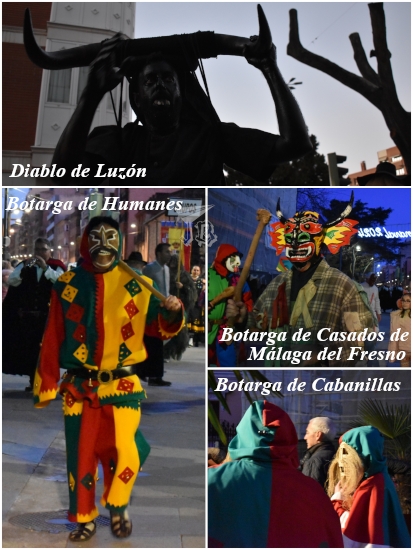
  • Botarga de Humanes: Botarga from Humanes. It comes out on the 1st of January and knocks on doors to wish a happy new year. It wears a colourful costume with 31 tinker bells and seven bells. It blocks entry to the church unless it is given a coin.
  • Diablo y Vaquillas de Luzaga: Devil and Heiferettes from Luzaga. Nowadays, they come out on Shrove Saturday. The heiferettes wear red capes, a mask of sackcloths, a hat, and carry bull horns. They toll the cowbells and chase the onlookers. The devil throws straw to symbolise riches and fertility.
  • Diablos y Mascaritas de Luzón: Devils and Little Masks from Luzón. The devils carry horns on their heads and cowbells on their waists. They paint their body black and use a piece of potato to feign huge teeth. They “attack” onlookers with a mixture of ash and oil. They are accompanied by the Little Masks, who are safe from their actions, wearing the typical clothing of the area and white face coverings. They come out on Shrove Saturday.
  • Botarga de Majaelrayo: Botarga from Majaelrayo. This is one of the characters that comes out “off season”, on the first weekend of September, though the original festival was the third Sunday of January. It is one of the few (if not the only) unmasked ones, and it leads traditional dancing on Sunday.
  • Botarga de Casados de Málaga del Fresno: Botarga of Married Couples from Málaga del Fresno. The original botarga came out on the first of January. It stopped for a while and when the tradition was picked up, the festival moved to the 24th of January, and two more masked characters, the mojigangas were added. The botarga carries a staff and a bag of candy and chases people who go and come out from mass.
  • Botarga de Mazuecos: Botarga from Mazuecos. On the 23rd of January, they chase the young and hit them with their poles.
  • Vaquillas de Membrillera: Heiferettes from Membrillera. They wear two tunics in different colours, a collar of bells, and horns on their waists. They come out on Shrove Saturday to chase the youth.
  • Botarga de Mohernando: Botarga from Mohernando. This duo of botarga and buffoon come out on the closest Sunday to the 20th of January. Though they participate on the religious activities in a serious fashion, they chase kids and teens, and play pranks.
  • Botarga de Montarrón: Botarga from Montarrón. It comes out around the 20th of January, and panhandles through the village for food and drink that is later consumed by the inhabitants. It is one of the few botargas to attend mass, leaving its bells and mask outside.
  • Botarga de Muduex: Botarga from Muduex. This botarga has just been recovered, so it is writing its own tradition. It will come out on the local festival in July.
  • Botarga de Peñalver: Botarga from Peñalver. It chases young men and if it caches them, it will ask them a question, and only let them go if it likes the answer. It comes out the first Sunday after the 3rd of February.
  • Botarga de Puebla de Beleña: Botarga from Puebla de Beleña. This horned character takes part in the religious ceremonies to honour Saint Blaise (3rd of January) and chases people to hit them with its staff. He also knocks on doors and makes its cowbells toll to call people to mass.
  • Botarga de Razbona: Botarga from Razbona. Considered a symbol of prosperity and fertility, it comes out on the closest Saturday to the 25th of January. It picks up donations for charity and cultural acts. It used to attack people who did not cooperate with ash, now it gives out candy for those who donate. However, as it is regarded as a pagan character, it won’t step into the church.
  • Botarga de Retiendas: Botarga from Retiendas. It comes out on the closest Sunday to Candlemas. It dances and chases people to the beat of a drum, and takes part in the religious ceremonies.
  • Vaquilla de Riba de Saelices: Heiferette from Riba de Saelices. It comes out on Carnival Saturday (though originally it was Shrove Tuesday), charging people and getting mock-stabbed in return.
  • Vaquilla de Ribarredonda: Heiferette from Ribarredonda. The heiferette comes out on Shrove Sunday, tolling its cowbells. In the village, shepherds who cover their faces with sackcloth masks keep it in check with their staffs – the person playing the heiferette wears a helmet for protection.
  • Botarga de Casados de Robledillo de Mohernando: Botarga of Married Couples from Robledillo de Mohernando. It comes out on the 1st of January and enters the houses to wish a happy new year and wake people up with tolls and chimes from the bells it carries.
  • Botarga Infantil de Robledillo de Mohernando: Child Botarga from Robledillo de Mohernando. The only child group in the area, they come out on the closest Sunday to the 24th of January. There is a child botarga, musicians and basket-carriers. They don’t wear masks and they perform traditional dances.
  • Vaquillones de Robledillo de Mohernando: Big-Male-Usherettes from Robledillo de Mohernando. Completely clad in sackcloths and carrying horns and cowbells, they charge the onlookers on Shrove Saturday.
  • Botarga de Romanones: Botarga from Romanones. They come out on the last Saturday before Carnival (which was technically the day of the parade so… not sure when). The Little Masks throw confetti or flour at the ladies. They are accompanied by a shepherd and a bull – the bull is “fought and killed” a few times, as it can come back to life with a sip of “magic wine”.
  • Botarga de Salmerón: Botarga from Salmerón. A group of Little Masks comes out on Shrove Saturday. They throw confetti as a fertility charm. A botarga, Tío Alhiguí (Uncle Tothefig) comes with them to play the game with children.
  • Botarga de Taracena: Botarga from Taracena. It comes out on the 23rd of January. Alongside musicians, it walks through the town streets, chasing people towards the church.
  • Botarga de Tórtola de Henares: Botarga from Tórtola de Henares. It comes out in the morning of Christmas Eve, knocking on doors for food. It also comes out on the 6th of January and, along the Little Masks, during Carnival.
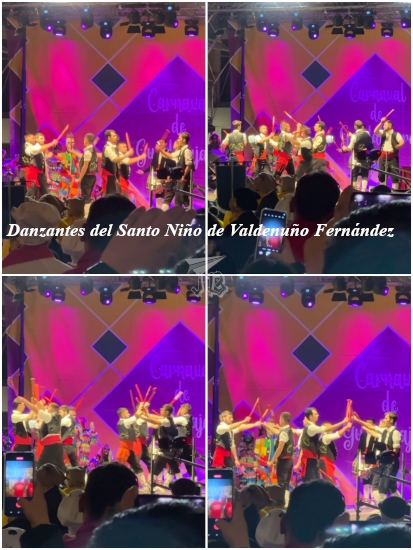
  • Botarga y Danzantes del Santo Niño de Valdenuño Fernández: Botarga and Danzantes of the Holy Child from Valdenuño Fernández. They come out the first Sunday after the 6th of January. There are records that a child got lost in 1721 everyone in the village looked for him. The botarga and the dancers recreate this event, and dance in exchange of oranges. One of the dances, the paloteo, involves the group of eight dancers clashing batons with each other.
  • Botarga de Valdesaz: Botargas from Valdesaz. This group chases each other and onlookers on Shrove Saturday.
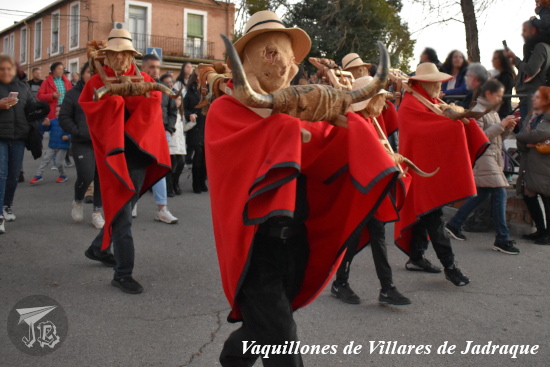
  • Vaquillones de Villares de Jadraque: Big-Male-Usherettes from Villares de Jadraque. They come out on Shrove Saturday, wearing orange capes, horns and a hat, chasing anyone they come across.
  • Botarga de Villaseca de Uceda: Botarga from Villaseca de Uceda. Recovered in 2023, this botarga comes out the first Saturday after the Epiphany. Its design is modern, and it has mane-looking hair.
  • Botarga de Yélamos de Abajo: Botarga from Yélamos de Abajo. It is the only botarga that comes out during Holy Week (Easter) – but it actually looks a bit like a devil. On Spy Wednesday, villagers light a bonfire in front of the church, and summon the botarga with rattles. The botarga uses the bonfire to light its broom, and dances until the broom goes out. On Holy Thursday the botarga is summoned again, and asks for money. The money-giver says a prayer, the botarga kneels and a coin is inserted in the money-box hidden in the botarga’s hump. On Black Saturday, a dummy botarga is burnt in the bonfire.

Botargas from different villages

Vaquillones de Villares de Jadraque

Furthermore, the four botargas from Guadalajara walked (and ran) after the kids and teenagers at the head of the parade. The Mascarones (Big Masks) from Guadalajara – a cultural association which has worked really hard on the recovery of the botargas – were clad in colourful rags – a lot of them were accompanied by their kids and toddlers in marching suits, with the children handing out candy to both enthusiastic and terrified onlooking kids. The botarga from Muduex, just recovered, received a lot of attention. The kids who were part of the parade often went to give child onlookers candy.

Every year there is a “guest botarga” in the parade. In 2024, the guests are the Hamarrachos de Navalacruz, a group of very druidic-like characters, preceded by their very own flagpole. Navalacruz is a village in the Ávila region, and they have a whole party of creatures – three types: the ones covered in oak leaves, the ones covered in a hay sack, and the ones covered in fur. They seem to represent ancient winter spirits (big Hogfather vibes).

Hamarrachos de Navalcruz Characters

Funnily enough, I was “attacked” three times – twice by the Devils from Luzón Diablos de Luzón. They paint their bodies black and carry cowbells on their belts, horns on their heads and big teeth made from potatoes – they painted my forehead and jawline black in two different occasions. Another time, one of the Vaquillones from Robledillo de Mohernando Vaquillones de Robledillo de Mohernando mock-charged at me. I startled and he was mortified. But it was all good. Oh, and at some other point one of the Mascaritas dumped a handful of confetti on me – I had found a great spot to take pictures: right in front of a potted plant on main street. I was not in the way, since they had to ditch the plant, but I could take pictures of the characters up front.
Botargaas Parade, different characters

Once the parade made it to Main Square, they were called by groups onto the stage. The child botarga did a little dance to show off their skills. The most impressive moment on that stage came with the exhibition of the Dancers of the Holy Child Danzantes del Santo Niño de Valdenuño Fernández. They carry batons that they use when they dance, slamming them against the batons that others carry in a very impressive display of coordination.

Botargas on the stage

Danzantes del Santo Niño clashing batons

The speech of the major had nothing of interest, just the usual political stuff. Mementos were handed to the recovered botarga, and the guests, and then came the Proclamation to open up the Carnival period. The speaker was someone I’ve never heard of – Pepe Sanz, president of a local Vespa and Lambretta motorbikes club. I think.

Unfortunately, as I had been following the parade, I had a horrible spot in Main Square, I could not see the stage at all – but I could use my phone above my head for pictures and videos, while the people in front of me blocked the barriers and played with their phones. I can’t even. After all the speeches, welcoming the Carnival and so on, all the botargas and characters headed back to where came from. I did not stay for the backtracking, because it was cold and it was time to get back home.

14th December 2021: Navilandia (Guadalajara, Spain)

Back when I visited Torrejón de Ardoz in November, they were already preparing their Christmas display, which is famous in the area. In a smart way to curve attendance though, this year the town hall decided to charge non-locals to enter. Towns around quickly noted this and decided to organise their own magnificent displays, and in the case of Guadalajara, give a hand to the people who live off the carnivals and fairs, as most regional summer festivals have been cancelled for the last two years. They called it Navilandia (Christmasland), the biggest “Christmas Theme Park” in the region.

The “theme park” is divided in several areas. The first one is the palace Palacio del Infantado, its gardens and the adjacent square. The Palace features the same Christmas tree as last year, and the gardens have been decorated with lights, Disney characters, a Zeus sculpture, music and… dinosaurs. I have no idea what dinosaurs have got to do with Christmas, but you won’t hear me complaining about dinosaurs. They are called the magical gardens Jardines Mágicos del Infantado. There is also a small flea market.

A gothic façade with a Christmas Tree made out of green and gold lights in front, along with some more decorations: Felices Fiestas, another tree, a reindeer made out of light

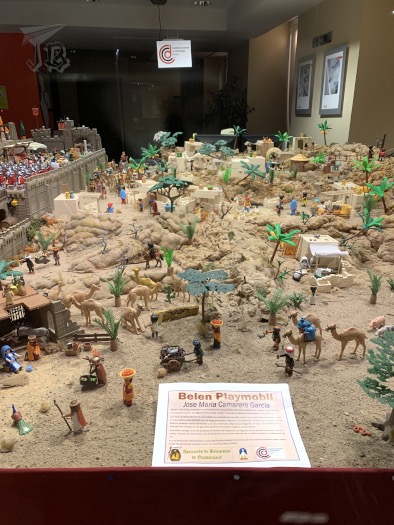
As I walked up Main Street I saw the traditional Playmobil Nativity they always set in one of the shops. However… I’ve never been able to spot the actual Nativity scene here. It is rather cool, though.

A Nativity made out of Playobil figurines, the stable is on the left and a bunch of toys are coming towards it through the desert. There a lots of dromedaries.

The second “Christmas hotspot” is the town hall square Plaza Mayor had a tasteful light decoration, a childish representation of the Three Wise Men, and a very beautiful – and lit up – carousel. I really wanted to ride it, but there were too many toddlers. It would have looked… weird. I need to find out when it closes so I sneak in after the kiddies have gone home (≧▽≦).

A caroussel with bright lights on in a square. Hanging above the square there are lots of lights and stars in gold colours. There are also four Christmas trees

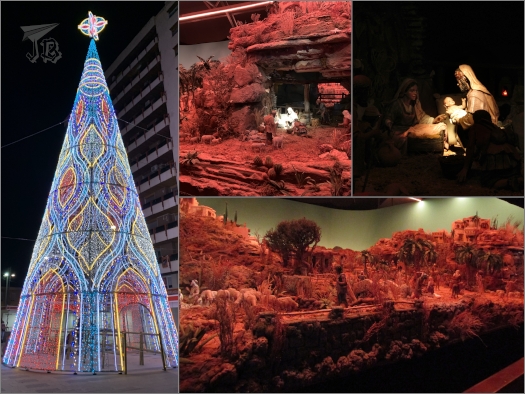
Third spot was half-closed but that is okay. The square Plaza de Santo Domingo hosts another flea market, that was not open – they are setting three rotating markets there, basically one each weekend, and we were between them. There was a big walk-in Christmas tree and the “monumental Nativity” there.

Collage: A Christmas tree made out of eye-shaped lights in blue, purple, red and yellow. A picture of the classical nativity with realistic figures. The Holy Family is illuminated in white - Joseph is placing the Child on a crib that Mary is holding.

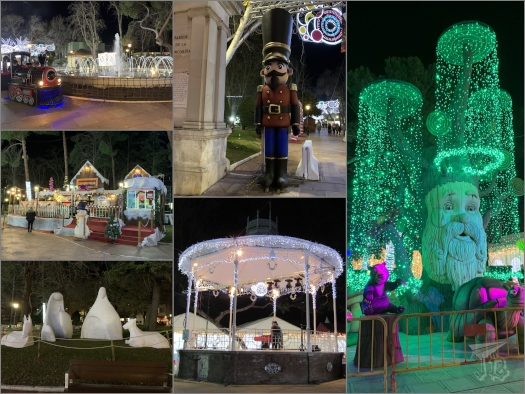
The final area extends along the parks Parque de la Concordia and Parque de las Adoratrices. The entrance is flanked by two nutcrackers; it hosts a talking tree, lights, food trucks, yet another flea market, and rides that again… are only Christmassy by name. There is another Nativity, this time an “abstract one”, a cute train and a “Polar Express” ride, some lights and… a “talking tree”, which broke into telling some tales out all of a sudden. Then, there was a bunch of rides, but they looked like your average travelling carnival rides, and I was not going to go onto any of those, so I made my way back. Also, I was strong and did not buy any cotton candy nor similar treats, though I was tempted to get some roasted chestnuts.

Bizarre Christmas decorations and motifs in the park: A giant nutcracker / soldier, an abstract nativity, some gingerbread-house-shaped shops, a Polar Express mini train, and a... something that looks like a tree with a face on the trunk and leaves made from green lights.

It was weird because for the second time in a couple of months I’ve been asked if I’m an actual photographer. True, this time it was a drunk guy who then proceeded to yell fascist slogans. I decided it was the right time to call it an evening and go home for the day…

6th November 2021: Torrejón de Ardoz & Guadalajara (Spain)

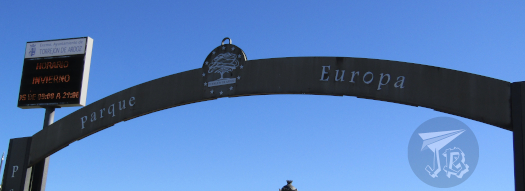
No matter how much some people demonise it, one true thing is that a great chunk of the Spanish general income is dependent on tourism. That’s why when the 2008 recession hit the country, many areas or municipalities tried to fabricate tourist attractions where there used to be none. Torrejón de Ardoz is one of these places – despite shouldering a huge debt, it gambled a couple of tourist lure. One is a huge winter lights (Christmas) display, which runs from November through January. The other is a huge park in a former slum, called Parque Europa, Europe Park.

Parque Europa was described as “Pharaonic” upon its inauguration in 2010. It covers a whooping 23 hectares of trees, bushes, ponds, rides for kids and replicas of different European monuments and landmarks, both real and art depictions. I can’t be sure if in the end the park managed to break a profit, but the reviews online do sound like it did.

In winter, the park opens at 9.00 am, and I thought that if I managed to get there relatively early in the morning, I might find a free parking spot around the area. Online reviews do talk about limited parking space aimed to fill the pay-per-car parking lot close to the entrances, so I thought I’d try to leave the park in the streets of the industrial complex nearby. After a couple of Sat-Nav mishaps – human-caused aka I forgot the adapter for it to work in the car (≧▽≦) – I was on my way and I reached the neighbourhood a bit before 10.00 am. As I was driving towards my intended parking spot I caught a glimpse of the Eiffel Tower, so when I turned and found a random parking spot, I decided to just ditch the car. There were many double-parked cars ahead so I thought the rest of the street would be packed. At that time in the morning, I could have just parked in front of one of the access gates without problems, apparently. So I had to walk two whole extra minutes!! In the end though, that parking spot was even closer than the ones I planned to look for – so it was all good.

I wanted something to do in the morning outside the house so I did not have a plan per se (to be honest, I had long made the afternoon plans and I wanted something to do in the morning to make the most out of the disposable contacts). However, as the fountains were turned on at noon, I wanted to leave them for last. Fortunately, most of them are in the same area of the park – which is shaped like a ham of sorts. At that time most of the children rides were closed, and I was mostly alone except for people jogging or walking their dogs, and it was rather chilly. But I wanted to see the replicas, so that was all right.

These are the monument replicas that are hosted in the park, in the order I saw them, turning clockwise from the entrance I used:

  • Puerta de Alcalá (Gate to Alcalá), Madrid, Spain. Neoclassical gate to the former walls in Madrid. Today it is considered World Heritage as part of the “Paisaje de la Luz”.
  • Torre de Belém (Belém Tower), Lisbon, Portugal. Officially named Torre de São Vicente (Tower of Saint Vincent), a 16th-century port fortification for Portuguese explorers, with high symbolism and ceremony.
  • Tower Bridge, London, United Kingdom. Crossing the River Thames, it is one of the most iconic London landmarks.
  • Kinderdijkse molens, the Windmills of Kinderdijk, Netherlands. The original windmills were designed as part of water drainage to drain the excess water in the Alblasserwaard polder.
  • Brandenburger Tor (Brandenburg Gate), Berlin, Germany. It is one of the most characteristic landmarks in the country, a monument built in the place of a former wall gate in the 18th century.
  • Den lille Havfrue (The Little Mermaid), Copenhagen, Denmark. This small sculpture is displayed on a rock in the a promenade in Copenhagen, and depicts the mermaid in Hans Christian Andersen’s tale becoming human.
  • La tour Eiffel (The Eiffel Tower), Paris, France, built for the entrance to the 1889 World’s fair and one of the most visited monuments of the world.
  • Michelangelo’s David, Florence, Italy. One of the masterpieces of the Renaissance sculpture, standing 5.17 m of white marble. This replica I didn’t get to see because it had been either stolen or taken away for restoration.
  • Fontana di Trevi (Trevi Fountain), Rome, Italy. Dating back from 1762, the fountain is a “more dramatic” version of a previous one at the end of one of the Roman aqueducts. The fountain was turned on at noon and it had just a little water.
  • Manneken Pis (“Little Pissing Man”), Brussels, Belgium. It is a bronze fountain sculpture depicting a naked little boy peeing into the basin, dating back from the 17th century.
  • Atomium, Brussels, Belgium. This stainless steel building was constructed for the 1958 Brussels World’s Fair, and renovated between 2004 – 2006. It stands 102 metres high and some of the spheres are open to the public and hosts exhibitions.

There are also “adaptations” or monuments that you can “sort of” identify but have been more freely reproduced.

  • Greek Theatre, based on the Athens one, with the Winged Victory of Samothrace watching over in a bit of an artistic license move I guess, considering it was a ship figurehead. The actual one is in the Louvre Museum in Paris. The theatre is built into the slope of the central pond of the park so visitors can see the light and sound show in said pond when they are held.
  • Plaza de España (Square of Spain). The centre of the square is the famous “Puerta del Sol” in Madrid and the older Post office. Its back represents the Main Square of the city. Other houses represent different regional buildings throughout Spain that I was unable to recognise.
  • Viking Ship fountain. There is not much I can say about this. It was one of the fountains, and this one was turned before any of the others.

Inspired by paintings, there are two other monuments.

  • The Three Graces. While the park’s webpage claims that the sculpture is a copy of the one that Antonio Canova created, it looks like it was sculptured using Ruben’s painting as inspiration. This one was the first monument I saw.
  • Van Gogh’s bridge”, a wooden bridge inspired by Vincent van Gogh’s painting “The Langlois Bridge at Arles”. I missed it at first so I had to backtrack and I did not find a good angle to see it from the side.

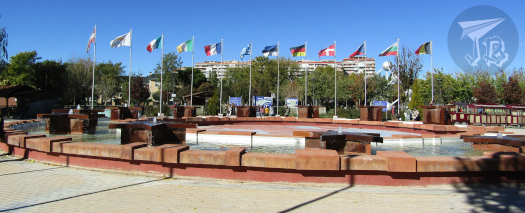
An original piece is the fountain called Plaza de Europa, Europe Square, a circular square with stars forming little fountains. This was one of the fountains I had to wait till noon to see and to be honest, I was… underwhelmed, expecting way more by the pictures on the website. I’m not sure if it was just “winter fountain” or whether the sprouts were set on low because it was a bit windy.

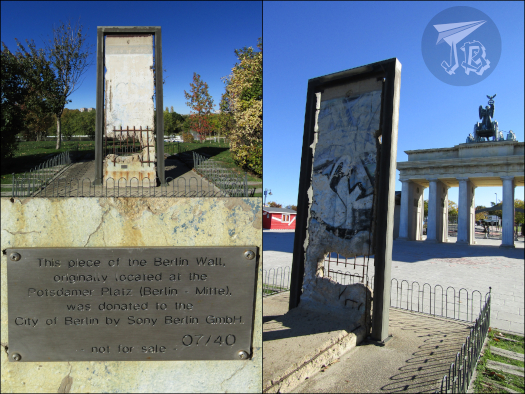
What was interestingly impressive was the original piece of the Berliner Mauer, the Berlin Wall. During the Cold War, after WWII, Berlin was partitioned into West Germany and East Germany with the erection of the wall in 1961 (in what was called the Berlin Crisis of 1961). It was all built within the eastern border as it was the USSR who decided to put it up. The Wall separated the city halves for decades, there were even deaths as people from the east tried to defect to the west. The wall officially but metaphorically fell in November 1989 as the political powers who had driven its building agonised. The piece that stands in Parque Europa originally stood in Postdamer Platz and was ceded to Torrejón by the city of Berlin and it stands behind the Brandenburg Gate.

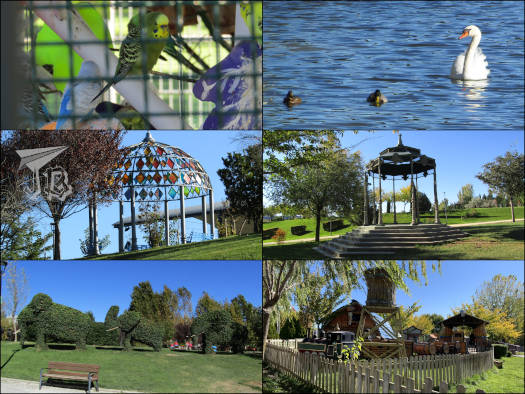
There are many other areas and activities for kids. A number of them were already opening up by the time I left, others seemed to be on hold due to pandemic concerns. The park has different things to draw attention too, such a giant bird cage (mostly full of parakeets), three life-sized elephants made out of bush, gardens, or an artificial waterfall – which did not get turned on. I saw a lot of birds too – magpies, swans, mallards and some very territorial Egyptian geese (I think that they were Egyptian geese. I’m absolutely sure they were territorial).

I left Torrejón at around 12:30, I think. I took care of some errands on the way, had lunch, and then I headed off to the second part of my self-imposed day off. A late-Halloween activity that ran throughout the month of November: Arquitectura y escultura funeraria in Guadalajara: a walking tour with a focus on the funerary architecture and sculpture in town. Well, at least with a stop at those places that are directly controlled by the town hall, missing those that are not. Yes, I voluntarily signed up for a guided visit! Unfortunately, information on Guadalajara is rather difficult to find, so I thought there might be interesting knowledge to be gathered (Narrator’s voice: there wasn’t).

The tour started at the local cemetery Cementerio Municipal Virgen De La Antigua, where we saw several tombs and pantheons dating from the 19th century and the early 20th century. These included:

  • Panteón de la Tropa, the “Troop mausoleum”, a communal grave for soldiers who died in the African campaigns, where supposedly some of the Civil Wars victims were buried. It actually is not the place, but legends are legends, I guess.
  • Panteón de los Marqueses de Villamejor – a neoclassical mausoleum where a noble family was interred.
  • Monumento funerario de la Familia Cuesta Sanz, a creepy obelisk-looking tomb.
  • Some smaller mausoleums (or big graves) Panteón de María Luisa García Gamboa, Panteón de la Familia Chavarri, Panteón de Josefa Corrido de Gaona, and Panteón de la familia de Ripollés Calvo. All these are stone tombs with a rounded roof that drains off rainwater.
  • Panteón de los Condes de Romanones, the place of eternal rest of another noble family, whose head was the son of the previous one.
  • Kittens

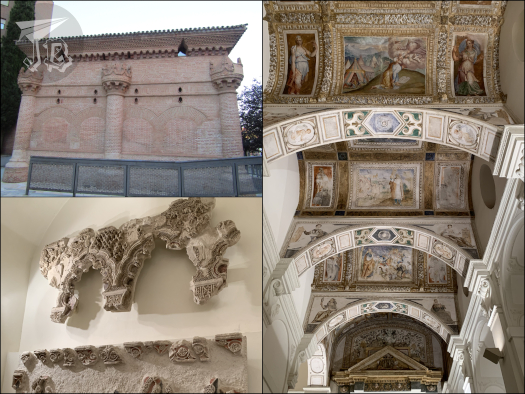
We then walked off towards the chapel Capilla de Luis de Lucena. Luis de Lucena was a doctor and a priest who was born in the 15th century. He died in Rome as he worked as a doctor for the Pope, but he expected to be buried in this chapel, adjacent to a now-disappeared church. The outer area is built in brick, and the inner ceilings have several frescoes, even if they are rather deteriorated as the town had no money to take care of the art during the 90s and the early 2000s. The chapel was never used as a burial place, and now it is a tiny museum that keeps rests of other disappeared churches in town, especially the funerary sculptures.

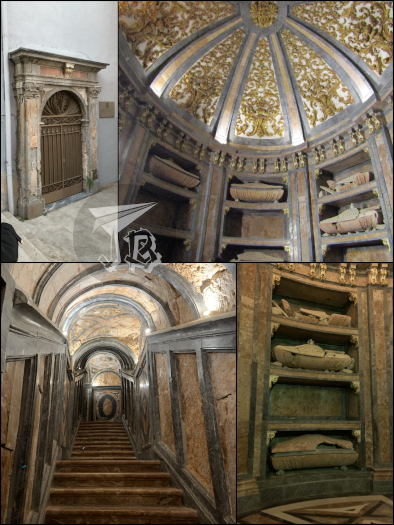
The final spot was the crypt of the church of St. Francis – Cripta de la Iglesia de San Francisco, built in dark marble and similar to the one in El Escorial. This is where the Mendoza duchy family members were buried, but the area was ransacked by the French during the Napoleonic wars and the remains were taken to Pastrana afterwards, so the crypt is currently empty. Which is good considering the way some of the tombs are shattered…

This concluded the tour so I was free to go. I saved up the entry fee on the chapel and the crypt as the tour was free. Most of the tour was just crawling from one point to the other and there was not that much new information to be learnt. Maybe there is jut not enough information to be found…

Driven distance: around 83 km.
Walking distance: 13.14 km

8th & 9th January 2021: Guadalajara & Filomena (Spain)

Since 2017, Spain (alongside Portugal and France) has taken up the custom of naming bad storms, and this season we are up to ‘F’, the 6th bad storm. In this case, the storm, named Filomena, entered Spain from the south west and collided with a polar air mass that happened to be coming from the north. The result – snow. Lot’s of it, with low temperatures and snow-heights not seen in a very long time. Some call it “the snowfall of a lifetime”.

As Covid-19 has made travelling impossible – or at least pretty unsafe / irresponsible (choose your pick), plans have been pushed back again, and plain cancelled. While truth be told I still hold tickets for the Saint Seiya event in Paris in late May, I have no hope I will be able to attend. Even if the Covid crisis fades away, there’s the extra issue of the economic blow 2020 caused.

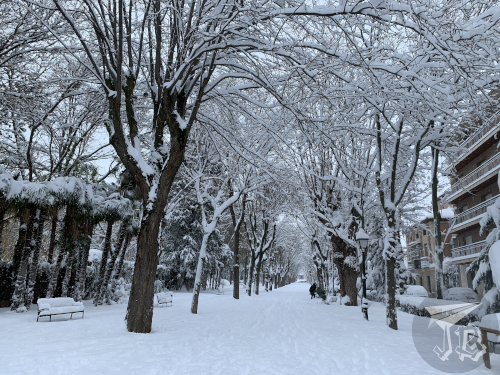
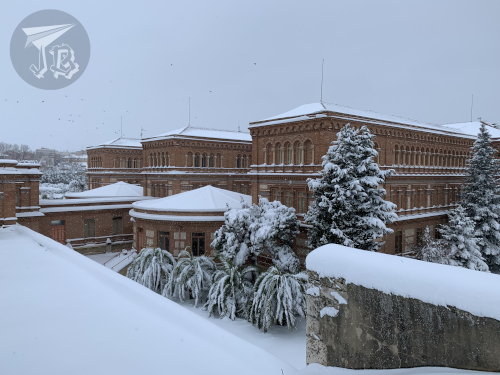
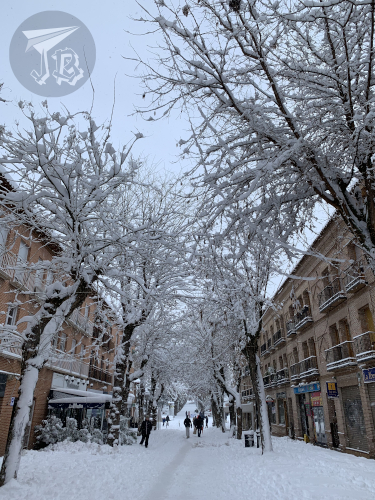
Anyway, back to Filomena – it brought something that is rarely seen in these parts. Snow. Lots of it. So before everything went to hell, I just decided to ignore the stay at home recommendation and took a couple of walks around Guadalajara for a rare sight – the monuments covered with snow. Furthermore, as the snow is expected to freeze into ice plates, I had to go out when the snow was still fresh.

I took two different walks. On the eight of January, Friday, as soon as I got out of wok I put on my snow boots (perks from the time living in Scotland) and winter coat, then threw my raincoat over it – it was a tricky movement, but I managed not to dislocate my shoulder doing so. By this time there was a coverage of a few centimetres, and I decided to head out to the outer area of town where I could sneakily take my mask off if my glasses fogged too much, which I had to do when I crossed the road, because there’s no actual crossing.

There was a surprising amount of people around! Fortunately I was able to keep my distance, especially at the times when I tried to breathe – even if I went out with the smaller glasses, at points I had to take them and the mask off to be able to breathe and see anything.

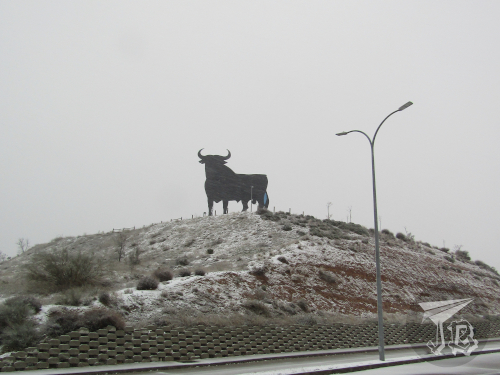
I walked up to the Toro de Osborne a winery-billboard-turned-item-of-cultural-and-visual-interest which as you can see is shaped as a bull – representing the species used in bred for bullfighting, because the Osborne winery is located in an area also famous for the livestock. It is made of metal and measures around 14 metres high, one of the 91 that remain around Spain. It stands in an area that was supposed to become urbanised but never did, so it has several unfinished alleys and corners. There has been a statue there since 1975, called El Abrazo, (The Hug), which has always reminded me of a decomposing DNA strand. It was erected by Francisco Sobrino, the most famous sculptor from the town.

I went back right before sundown, and the roads were already difficult. It continued snowing throughout the night, and when I woke up on Saturday morning, no cars could run, there were no buses, trains had been stopped and some trees had collapsed under the weight of the strongest snowfall in decades. But… temptation won. I only wanted to peek around the corner a little, but then I decided that as there was a good chance I would run into people, I could not cheat on mask policy – so I put my contacts on. That warranted for a longer walk as those are disposable, and… not cheap (≧▽≦).

First I walked down the Avenida del Ejército, one of the main arteries in town, which had already been somewhat cleaned of snow, which was good, because… well, there was a bit more of a cover than the day before

I reached the park built after the ancient Arab structure, Parque de la Huerta de San Antonio. To the left stands one of the towers of the old walls, Torreón de Alvar Fáñez.

I saw the snowed Palacio del Infantado. This palace was built in the late Renaissance style, designed by Juan Guas and commissioned by the Marquis of Santillana. Although the main construction happened between 1480 and 1497 but has been reformed in several occasions, even recently as it was turned from public library into monument and museum. Infantado is a name related to the concepts of infante or infanta, which are the Spanish terms that designate the children of monarchs who are not the direct heirs (so no the crown prince or princess). The most important feature is the main façade built with sand-coloured rocks and diamond protuberances as decoration. It was suspected to have suffered from aluminosis concrete a couple of years back, but after a small political struggle, it the palace was deemed healthy again. Magic, I guess.

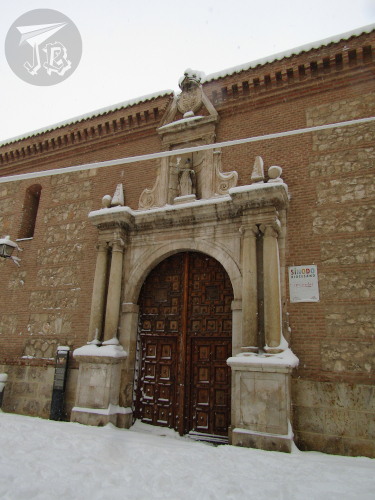
Up the central street of the old town, I took a small detour to check the Iglesia de Santiago Apóstol to the left. The church, built in bricks, used to belong to a now-gone convent.

In front of the church stands the convent-turned-palace-turned-high-school Convento de la Piedad / Palacio de Antonio de Mendoza. The convent-palace represents the start of the Renaissance influence in Spain, especially the former grand entrance.

At the end of the street stands the main square and Ayuntamiento, the town hall, and main square, where the street turns into the main street, Calle Mayor. The town hall, built at the beginning of the 20th century, sports an interesting bell tower in iron.

The square Plaza del Jardinillo (square of the little garden) where the Baroque church Iglesia de San Nicolás el Real stands. You can’t really recognise him under all the snow, but there is a Neptune standing in the middle of the fountain in the square.

Main Street continues until the square Plaza de Santo Domingo. The square is half park-like, half built, and one of the trees that died in the park area was carved into a book-stash sculpture.

On the other side of the road stands another church, Iglesia de San Ginés, built in the 17th century with two towers and a Romanesque-looking entrance.

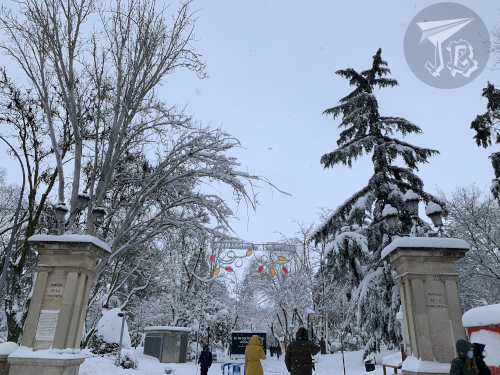
The police tape around the main town park, Parque de la Concordia, had been partially taken down and I interpreted (wrongly) by the sheer number of people inside that it was allowed to walk in. Only when I reached the other side I realised that the park was considered unsafe, and of course I did not risk any other trespassing. The park dates to mid-19th century, and hosts a gazebo-like structure built in brick and iron by Francisco Checa in 1915.

I went on to the Paseo de San Roque, only on the street area, as the more park-like one was taped off. This is one of the most diverse parks in town, and some say that it could / should have been considered a botanical garden.

I walked alongside, peeked into the park Parque de las Adoratrices, but it was packed, so I continued on. Although this park is rather recent, opened in 2009, the walls and fences were built a century earlier. The town festival used to be celebrated here, but it was moved away to the outskirts as the town grew.

At the end of the street stands the chapel Ermita de San Roque , which originally was outside the town when it was built in the 17th century, in the typical brick of the area.

I walked around the walled area of the Colegio de las Adoratrices, with some really cool views of the pantheon that stands there, Panteón de la Duquesa de Sevillano, the school building and the church Iglesia de Santa María Micaela. This whole area used to belong to the Duchess, who commissioned the architectural complex in the 19th century. The pantheon is a particular example of the eclectic architecture, with a purple dome. The church is a mixture of different styles, out of which maybe neo-Gothic would be the most prominent one.
The street I wanted to go along next was a) taped off and b) waaaay too steep for a safe climb-up, so I decided to turn towards another of the important squares in town, Plaza de Bejanque. You can guess the old fortress Fuerte de San Francisco behind it, but it was also full of people, so I walked fast.

One of the features of the square is the old gate from the walls, Puerta de Bejanque, one of the access gates through the 14th century wall. This used to be part of a house that was built around it, and it was unearthed, so to speak, in the 90s.

I went down towards the co-cathedral Concatedral de Santa María. Originally built in the 13th century, this catholic church has been redesigned and rebuilt in several styles. It is best characterised by the horse-shoe arches in the main façade.

And sneaked up towards the chapel Capilla de Luis de Lucena, a small and compact chapel built like a tiny fortress that used to be an oratory part of a larger church.

I walked past the old palatial house Palacio de la Cotilla, a palatial house from the 15th century.

The convent Convento de las Carmelitas de San José. This convent, where cloistered nuns still live (tradition says that couples that are going to marry should bring them eggs for sun on the day of the wedding) was built in 1625, and the inside is decorated in the Baroque style.

And finally reached the lookout over the park built within the old torrent, Parque del Barranco del Alamín.

I finally saw the former church Iglesia de los Remedios. Today it is used as the grand hall for the nearby university, but it was originally a Renaissance temple, with three characteristic arches guarding the entrance.

And turned back towards the Palacio del Infantado from the square Plaza de España.

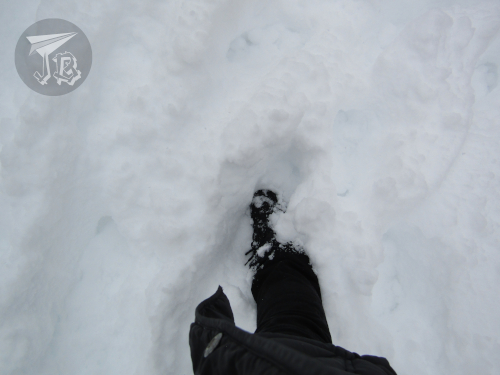
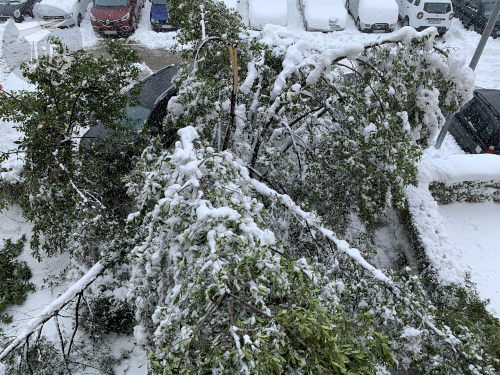
It had started snowing more heavily by then and my legs were getting tired. The sloshy snow on the roads had become frozen so it was slippery, and when I was walking on the actual snow, it was up to my mid-shins, so I was feeling the strain in my legs and my back. Thus, I decided to go back home and not to return in the afternoon again because the trees had lost more and more branches under the weight of the snow. The temperature going down also meant that the snow was going to freeze and it would be more slippery as it became ice…

I mean, this is the tree that used to stand in front of my balcony… So better safe than sorry. But all in all, the snowfall of a lifetime in these latitudes!