17th November 2025: Nice is nice! {France & Monaco, November 2025}

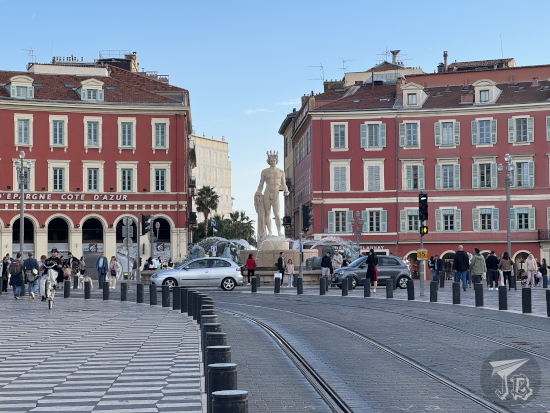
Yes, I’m sure the joke has been made before – ad nauseam. It still describes my experience pretty well. I was up and ready to go almost an hour earlier than planned, so I left my luggage at the hotel and set off towards Place Garibaldi, one of the hip places in town. Nice was waking up, people heading to work on a Monday morning. I walked by some interesting buildings, amongst them the Modern and Contemporary Art Museum (MAMAC), Musée d’Art Moderne et d’Art Contemporain, which, along with the Natural Science Museum, is closed for renovation. The square Place Garibaldi hosts a statue to the man in the middle, it’s surrounded by Baroque buildings with arcades, and crterminaiss-crossed by tram lines.
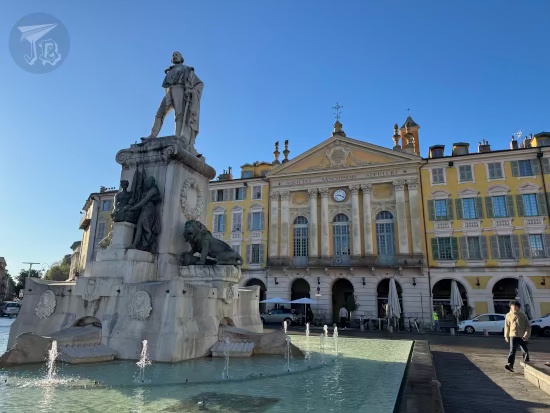
Place Garibaldi, with a statue and Italian-style buildings.

I continued towards the marina Nice Port and went along the Promenade a bit further north. All the private beaches along the Mediterranean Sea coast were closed off due to high waves. Despite that, it was not even 10:00 yet, and it was already warm. The temperature would reach 21 ºC. In late November. I guess that explains all the holidaymakers that crowded the area – the whole French Riviera got its reputation from mild winters, and today was a great example of that, even after the deluge on Sunday. I walked along the marina and Castle Hill at the Promenade level, going around Pointe de Rauba-Caupe, where the memorial Monument aux morts de Rauba-Caupe-Nice stands to commemorate the fallen in World War I. It didn’t take long to reach familiar territory, Quai des États-Unis, which I walked along until it turned into the even-more-famous Promenade des Anglais. I had taken off my coat by then, and the beaches, protected from the open sea, were again open.
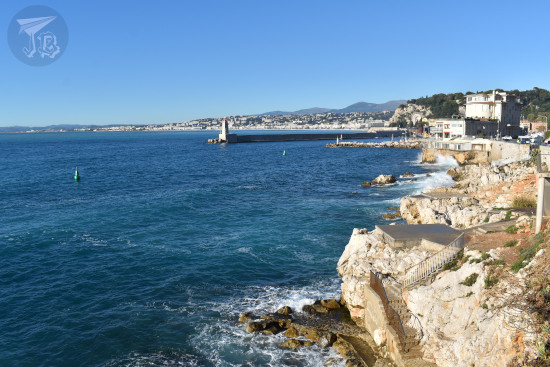
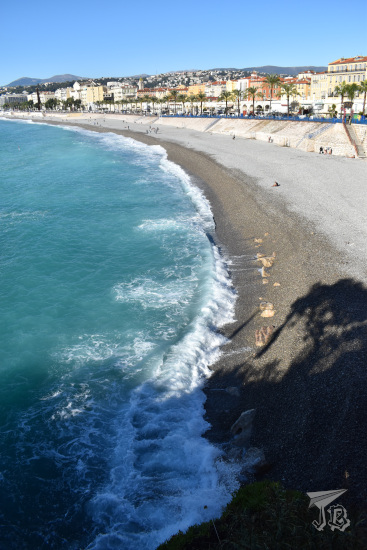
The rocky coast of Nice.

Nice beaches, with waves breaking.

When I reached the luxury hotel Le Negresco, I walked into the city, looking for the Orthodox cathedral, Cathédrale Orthodoxe Russe de Saint-Nicolas de Nice, colloquially known as the Russian cathedral. It is an early-20th-century building, erected in a modern take of the Old Russian style by architect Mikhail Preobrazhensky. It was later declared Historic Monument due to its uniqueness.
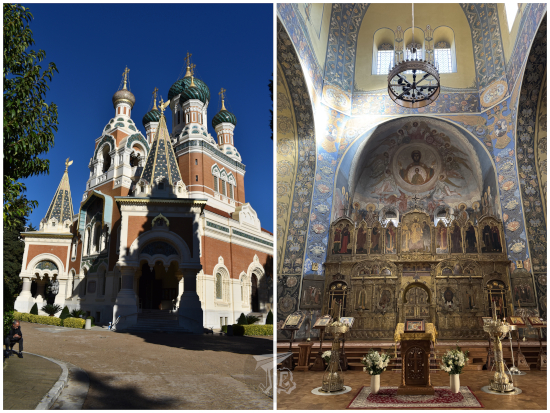
St Nicholas orthodox cathedral

Afterwards, I headed towards the area of Cimiez, and after a couple of wrong turns, I finally reached the hill it comprises. Strolling by gated communities, up I went. I wanted to see the Belle Époque Ancien Hôtel Régina. Though today it’s an apartment complex, it was originally built as a hotel to host Queen Victoria of England when she spent time in town. A bit past it, I reached the top of the mountain. There is a green area there, Jardin des Arènes de Cimiez, home to several buildings, museums and ruins.

My first stop was the Roman amphitheatre Arènes de Cimiez. It was erected in the first century CE, with a capacity for around 4,000 spectators, in the Roman town of Cemenelum. Though it was abandoned in the 4th century, it was never completely forgotten, but it was not until the late 1800s that the ruins were first addressed scientifically.
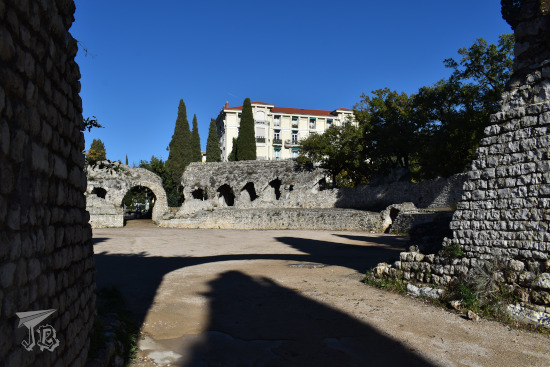
Ruins of Roman amphitheatre Arenes de Cimet

A bit further away stands the Monastery of Cimiez, along with its church, Monastère de Cimiez. This religious place dates back from the 9th century, it was originally a Benedictine abbey, which was later turned into a Franciscan monastery. The current building dates from the 14th century, and in the 19th century Neo Gothic façade was added. The interior is decorated with frescoes from the 13thcentury, and the wooden altar gilded with gold.
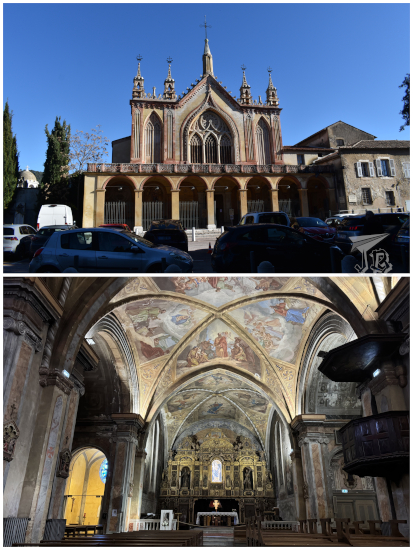
Monastery of Cimet - gothic looking and with frescoes on the inside.

I then backtracked towards the archaeological museum Musée d’Archéologie de Nice / Cimiez. The museum itself is small, but entrance gives you access to the whole archaeological site Thermes romains de Cimiez, the Roman baths that served Cemenelum between the 1st and 4th centuries. The museum holds both original artefacts and reconstructions, and I was particularly smitten by a small sculpture of a faun.
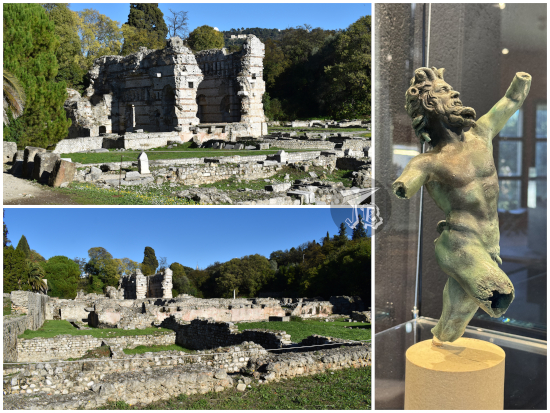
Roman ruins of Cimet, Nice, and a small sculpture of a naked faun-

By the time I left the museum it was about 14:15. I headed back into town to pick up my luggage at the hotel and buy some lunch (I did remember this time to do it before I got to the transport hubs!). I took the train towards the area where the Aéroport Nice Côte d’Azur airport is. My flight boarded at 18:25, and I am just not used to airports having things to do around them. But this one did – there was a museum and a botanical / animal park nearby. I found the entrance to the latter, called Parc Phœnix, and walked into the glasshouse that hosts the tropical plants and animals. There were terrariums with reptiles, including crocodiles, pythons, and lots of tortoises. There was a cactus area, and after the orchid ward I suddenly saw a pink reflection – there was a flock of flamingos basking in the warmth of the glasshouse, in a small pond made for them.

There is an insectarium sprinkled with small Ghibli figures to adorn the different habitats. There also lived the axolotls and the koi fish. I then went to the outside area, where I was able to have my sandwich. In the garden, I could see the aviaries, and the free peafowls. I caught a glimpse of a wallaby, but probably the most exotic animal over there was the huge rat I spotted. And some very fun greater rhea (Rhea americana) who were very interested in the shiny camera.
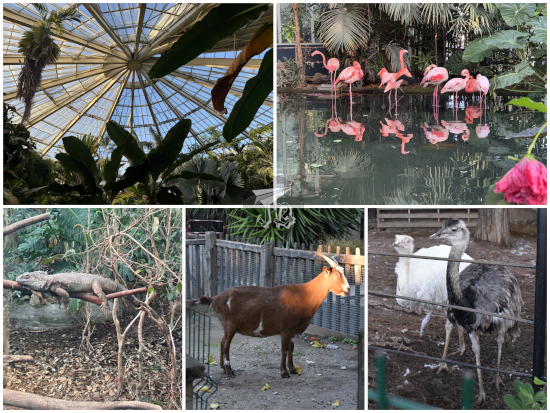
Parc Phoenix - the glasshouse, flamingoes, an iguana, a goat and some greater rhea.

I spent a bit over an hour there, and even if I did not see all the animals, it was nice to have something to do which did not involve waiting at an airport lounge. It took me 15 minutes to reach the terminal from the door of the park. And for some reason, they have a sculpture of a wooden shark hanging from the airport ceiling.

Security went smoothly and boarding was fast and efficient. Since it was a regional flight, all trolleys became checked at the gate. I was carrying a backpack so I was allowed right through. It was the smallest aircraft I’ve flown in lately, and it surprised me that the trip was much faster than the one to Paris. Of course, I should have realised I was quite closer, after having crossed a good chunk of France by train on Saturday.

Once I left the terminal, I had to wait for the shuttle to take me to the parking lot. At first, I waited for a couple of minutes at the wrong stop – I guess I was a bit more tired than I thought. Then, when I was a the correct stop, the mini van stopped further than the road and left before I could reach it, until around 21:30 I finally got on board. I reached the car, and saw with relief that nobody had bust the window to steal my 2010 Sat-Nav which I had forgotten on the copilot’s seat.

Traffic was not too bad, so I was home within the hour. I got some food in me, had a shower and went to bed, still giddy from everything I had lived in such a short period of time. My only regret was wasting money on a new Lonely Planet guide, which was pretty much useless – it did point out all the hip spaces and places to eat and drink, but the information on historical sites was lacking… I miss the old guidebooks.
15th November 2025: The Côte d’Azur {France & Monaco, November 2025}

D****e was leaving Paris about an hour earlier than myself, so I decided to tag along to her station and then backtrack to mine (hey, it was extra friend-time). I’m not good at going back to sleep after waking up, anyway. Thus, we checked out of the hotel together, and I rode with her, then changed platforms towards Paris Gare de Lyon to take my long-distance train. The ride across France was six hours, but it was very cheap, and not much longer than I would take flying from home to my destination.

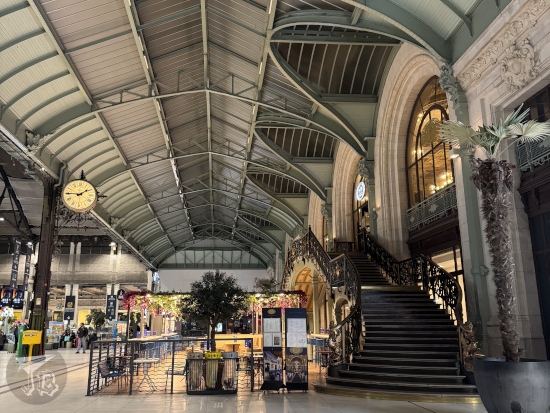
The current iteration of the Paris Gare de Lyon station was erected following designs of Marius Toudoire around 1900, so it was ready for the World Fair. It features a clock tower and an inner ironwork structure combined with decorative details typical of the Belle Époque design. The station was bustling even early in the morning – I arrived before 7:00 for my 8:21 departure. My ticket said that I would have to leave through hall 3, but there was an announcement from hall 1, where I waited.

Inner platform of Gare de Lyon station.

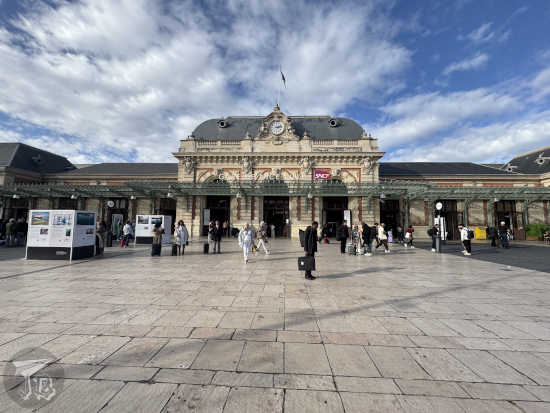
Since the previous day I had been tired and had not thought to buy food for the day, I had to pay the price of travel-hub lunch. I got myself some cookies, a Coke and a sandwich – chicken in traditional sauce. I also decided to start a Christmas ornament collection, and got myself a shiny Paris bauble. Access to the train opened ten to fifteen minutes before departure, and it was a bit chaotic. My seat was in the low 500s, and for some reason you could not go from one carriage to another (or at least from my carriage to another?) so I’m happy I got the right door on the first try. The train left on time, at 8:21 sharp, and I slept for the first couple of hours. Around 11:00 I was hungry, so I decided to pull out my sandwich… which ended up being “tandoori sauce”, not “traditional sauce”. Take that, caffeine-deprived brain. For a second, I considered not eating it, fearing it would upset my stomach. However, I was hungry enough that I did not really care, and it was not too spicy. I had another nap afterwards again, and before I knew it I had arrived at the Gare de Nice-Ville station in Nice, in the south-east of France, the area known as the Côte d’Azur (Azure Coast) or French Riviera.

Gare de Nice station from outside.

The first hominids may have roamed the area as far as 400,000 years ago. However, the city was founded around the 350 BCE by settlers of Greek origin, naming it after Nike, goddess of victory. There was a nearby Gallic-then-Roman settlement, Cemenelum, which was eventually absorbed by the growing Nice. During many years throughout history, it could be considered that the region was part of Italy in one way or another. In 1860, the territory was given to France, though not all the Niçoises were happy about that. The Italy sympathisers were repressed without much success.

After the annexation to France and the modernisation of the railway network, Nice became popular amongst the English aristocracy, who enjoyed spending winter there. Holiday-makers included Queen Victoria, for whom a full hotel was built, and her son Edward VII. This would eventually lead to the city’s economy boom during the second half of the 20th century, after it was liberated from the WWII occupation.

In 2021, Unesco recognised the uniqueness of Nice declaring it World Heritage as Nice, Winter Resort Town of the Riviera, with emphasis on the winter part. The development of winter resorts was different from the summer ones, creating layer upon layer of new structures. The so-called Belle Époque architecture became popular, but all in all, the layout of the city is quite complex, due to both history (grand hotels near Roman ruins) and geography (beaches and cliffs).

I headed out to the hotel, which was very near the station, dropped off my stuff and went on exploring. The weather was great, so I could forego one of my layers, even. I was starting to understand the “mild winter” reputation. I first headed down the Avenue Jean Médecin, the main commercial artery of the town, until I reached the promenade.

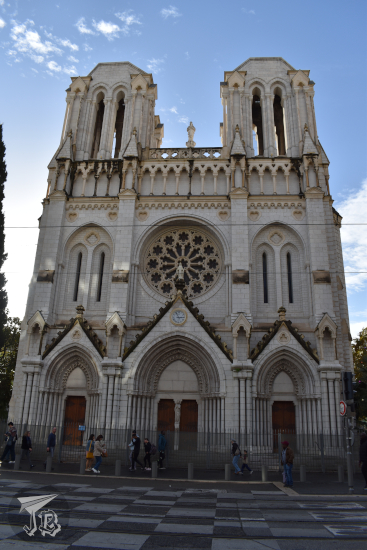
On the way, I stopped at the basilica-church Basilique Notre-Dame de l’Assomption, a Neo Gothic building designed by Charles Lenormand and erected in the 1860s, after the city was incorporated to France, as gothic was (is?) considered a “very French style” (thanks, Viollet-Le-Duc) and more “French architecture” was desired in the city. The building was not open, so I continued down the avenue until I reached the large Place Masséna, the main square of the city. It is surrounded by red buildings of Italian architecture, and a fountain called Fontaine du Soleil, the fountain of the sun, representing the Greek god Apollo.

Neo-gothic basilica.

Place Masena with Italian-architecture building and a monumental fountain.

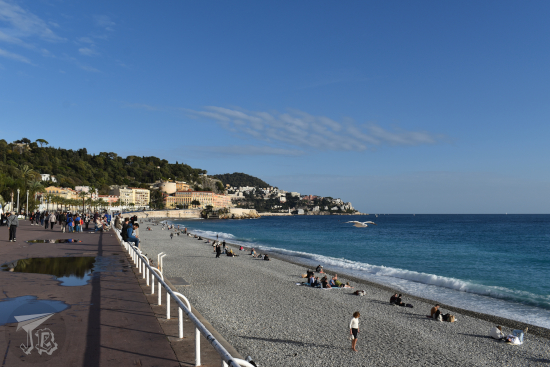
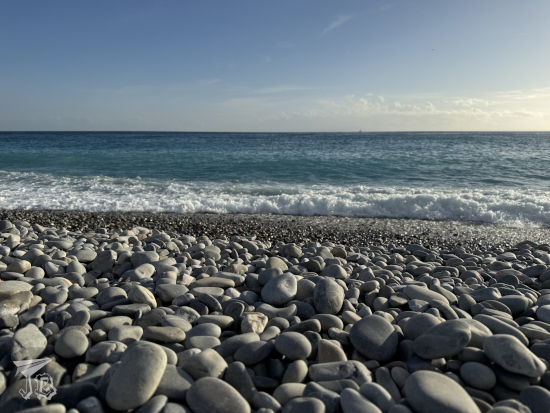
After crossing the Esplanade Georges Pompidou and leaving behind an ugly monument thing Neuf lignes obliques, I found myself at the famous Nice promenade and the Mediterranean Sea. In front of me, a line of private and public beaches made of rounded boulders. On my right, the Promenade des anglais (the Walkway of the English), and on my left the Quai des États-Unis (United States Quay). I turned left, but I could not prevent getting distracted by the beaches. Leaving behind the opera house Opéra de Nice, where nothing was on, I spent some time sitting by the ocean before I continued my way.

Etats-Unis quai and the beach.

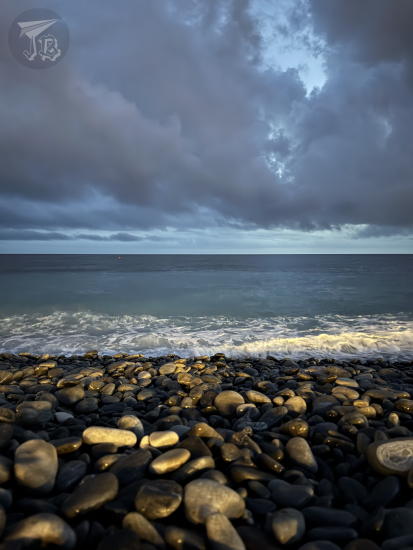
Waves on a pebble-and-stone beach.

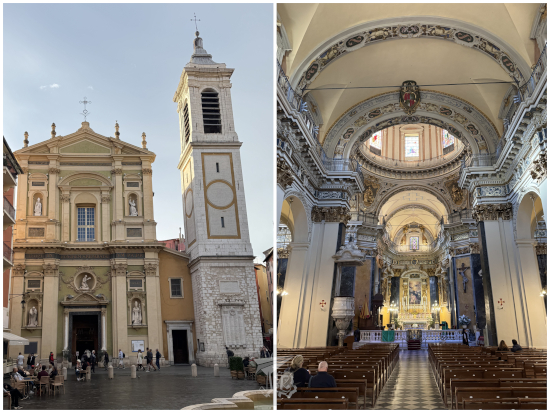
I diverted a little back into the old town to visit the cathedral Cathédrale Sainte-Réparate de Nice – Cathedral of Saint Reparata. Construction started in 1650 in the Baroque style, and it went on for centuries until it was declared complete in 1949. The building has one bell tower and ten lateral chapels. It enshrines the relics of Saint Reparata, which arrived in Nice in 1690.

Catholic cathedral of Nice, a Baroque building.

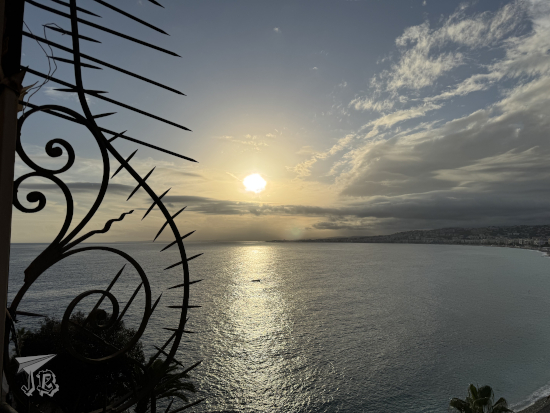
After wandering Old Nice for a bit, I started the climb up the historic park Colline du Château, where the old Nice castle and cathedral stood. Today it offers panoramic views, ruins, playgrounds and… cemeteries for some reason. There is a “free” lift, but someone stood at the entrance, looking very much like they were charging a fee. I wanted to climb up the stairs on foot for the views anyway. Though it was before 16:00, the sky was already in sunset mode.

Sunset over the sea.

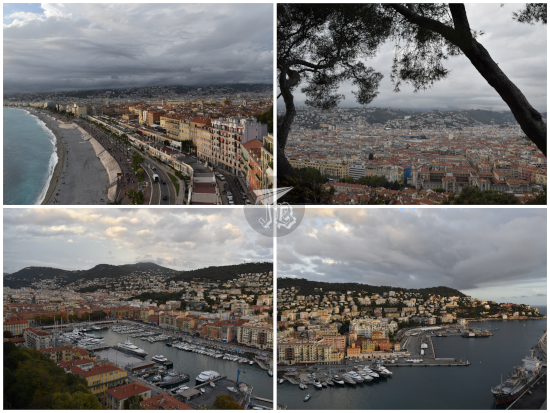
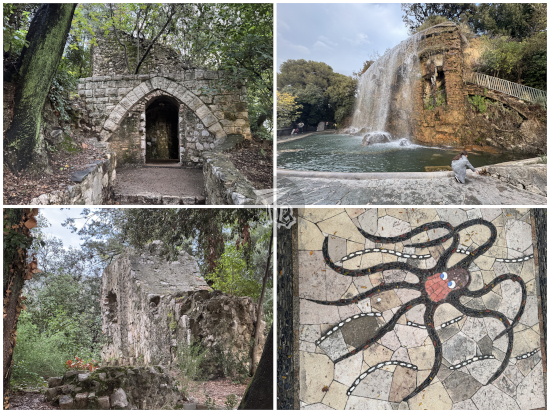
The ascent was not difficult, three or four flights of stairs before I reached the small building that tops the tower Tour Bellanda, the first viewpoint. The structure was originally a medieval defensive structure, but it was destroyed and rebuilt as a place to enjoy the views. I continued on, through the hill / park / historical site. There are several viewpoints towards both sides of the city, along with historical ruins, mosaic decorations, fountains, even the aforementioned cemeteries… All in all I had a lot of fun exploring.

Views of Nice - roofs, coast and ocean.

Collage of the Chateau de Nice: ruins, a waterfall and an octopus-shaped collage.

It had become dark by the time I left the parks, and I somehow ended up re-entering the city down some historical stairs which landed me right into the Medieval quarter again. After going back to the beach for some more wave sounds, I undid my path towards the hotel, taking the exact same route.

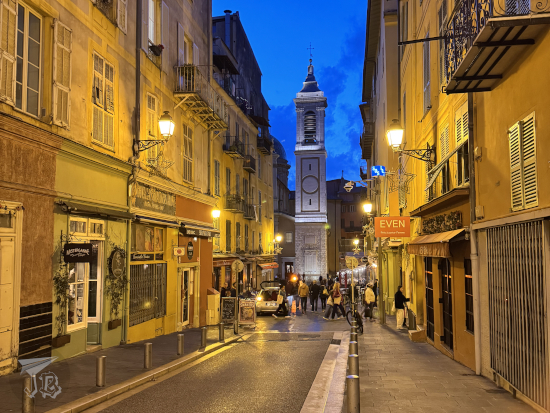
Medieval Nice at night, with the cathedral tower at the end.

Waves on a pebble beach at sunset.

There was a bookshop on the way, and I really wanted to stop and buy a book I knew was out that weekend, but honestly? D****e had brought so many presents for me that it would not have fit into the backpack… What I did buy was dinner and breakfast for the following day at the supermarket in front of the hotel – read: coffee and a sandwich. Oh, and a smoothie because it looked awesome.

I spent the last couple of hours of the evening in the hotel, watching bad creature films on YouTube before I went to bed.