We had a silly day-and-a-half and it turned out that for some reason a commuting train to Madrid took about as long as a high-speed train to Zaragoza, a town in the area of Aragón that we scratched off our summer route because there are lots of curves in the Pyrenees and time was limited.
22nd October 2021: Churches, Museums and a Palace
The train to Zaragoza arrives at the Delicias station, which is a bit away from the centre of the town, so we took a taxi to the hotel. This was around 9 am so we were of course not expecting any room, what with check-in being 2 pm – we just wanted to drop off the overnight bag. Not being able to give us a room seemed to upset the receptionist quite worried, and he promised to call as soon as a room was available. Honestly, I just set my phone to flight mode because we were starting to visit monuments right away, as the hotel was just by the most important square in town Plaza del Pilar.
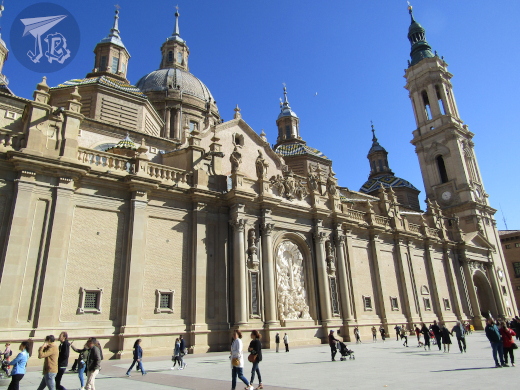
Zaragoza is home to one of the most important Christian icons in Spain, the Virgin Mary of the Pillar, Virgen del Pilar. The image is hosted in Catedral-Basílica de Nuestra Señora del Pilar. The bulk of the current cathedral-basilica was built between 1681 and 1686 in the Baroque style, but was later modified quite a few times and it was finalised in 1872. Interesting items in the church include, aside from the virgin image, some frescoes painted by Goya, the main altarpiece, and two bombs that fell within the church during the Spanish Civil War (1936-1939). Zaragoza is very anti pictures inside so I had to sneak them in. Sorry, not sorry.


After a small detour to say good morning to the river, Río Ebro, and the Puente de Piedra (stone river), the second building we visited was the Old Market Exchange building – Lonja de Zaragoza. This was the first Renaissance building erected in Zaragoza, dedicated to commerce, with an amazing Gothic-imitation ceiling. Today it is used for exhibits, such as paintings or sculptures.

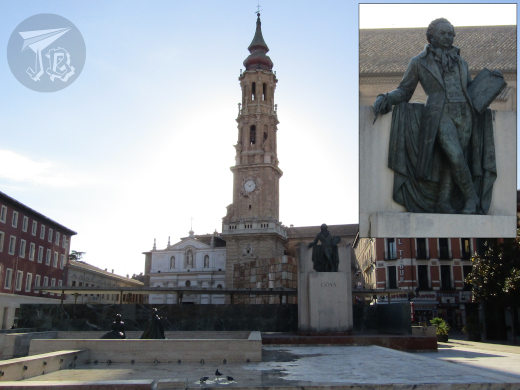
Coming out, we almost walked into one of the fountains in the square, Monumento a Francisco de Goya, featuring the artist – a brilliant Spanish painter from the Romantic times. He was as brilliant as bad-tempered though. Behind the fountain stands the cathedral, for which we had tickets for 11 am, and it was still early for that.
Thus, we started the route of the Caesaraugusta Museums. Zaragoza was founded in Roman times under this name (where an Iberian dwelling used to be) and in the latest decades, this Roman past has started being dug up. We first visit the museum focused on the original forum, Museo del Foro de Caesaraugusta where we could see the foundations of the old city and walk into the sewers (yeah, it’s cooler than it sounds). The Roman ruins date back from emperors Augustus and his successor Tiberius’ reigns.

After that it was almost time for our reservation to visit the Catedral del Salvador also known as La Seo de Zaragoza, the other cathedral of the town, literally at the end of the same square as the other one. The cathedral mixes several architectonic styles: Romanesque, Gothic and Mudéjar, these last tow being among my favourite styles, so a total win – Renaissance and Baroque elements were added, including the towers. The cathedral has a tapestry museum with a lot of works, not exactly “pretty” but rather impressive.

Following the cathedral we walked towards the rest of the Roman museums, but we made a small detour to look at the Mudéjar tower of the church of Mary Magdalene, Iglesia de Santa Magdalena.

Then we reached the museum of the Bathhouse, which was open but closed – let me explain. They run an “Audiovisual” and close the museum door for as long as it runs. It runs every half hour so finding the thing open seems to be hard. Thus, we moved onto the next archaeological site, related to the old Roman Theatre Museo del Teatro de Caesaraugusta. The theatre was apparently discovered by accident in the early 1970s, and it is apparently one of the biggest Roman theatres in Spain.

We tried our luck with the Bathhouse Museum again Museo de las Termas Públicas de Caesaraugusta. Unfortunately, just like before, we walked up to it while the audiovisual was running, and the concierge made a very studious effort not to see us – so we just peered over the glass roof to see what is left of the main bath.

More impressive was the river port museum Museo del Puerto Fluvial de Caesaraugusta, which keeps the foundations and some of the clay amphorae that were used for import / export.

And believe it or not, we did all that before lunch!! Therefore, we decided it was the right time for a break. We headed back to the hotel to see if we could wash our hands (and take off our facemasks for a while). To our surprise, the hotel had given us an upgrade to a junior suite, so we had a sitting room, a full bathroom and a bedroom – and a balcony that went all along the three. When I opened the window I could hear people playing the piano on the street, as there was some kind of festival going round. Believe it or not… I got to listen to Queen’s Bohemian Rhapsody and Rufus Wainwright’s Hallelujah.
We had lunch outside in a place that my companion enjoyed called La Lobera de Martín – not a cheap place, honestly! However, we splurged a little. We shared a smoked fish salad and I had a side of fresh Foie. As a main, ordered steak tartare, which to my surprise, was prepared for me next to the table! For dessert I tried the home-made berry yoghurt. I have to admit that I was totally planning on having a tiny dinner (or completely skip it!) at that time.

After lunch we walked along one of the main arteries of the town, Paseo de la Independencia, to find the Basílica Menor Parroquia de Santa Engracia, to at least see the outside, since we could not fit visiting the interior and the crypt with our tight schedule. One of the most interesting things about this church is how its façade is built like an altarpiece.
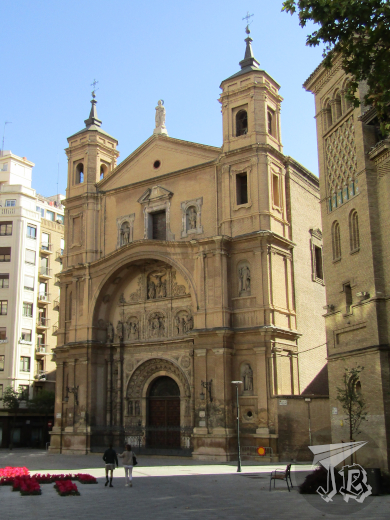
Next to the church stands the neo-Mudéjar post office, built in typical bricks from the area – Oficina de Correos de Zaragoza.

And finally, we looked at the current Science Museum, Museo de Ciencias Naturales, the former Medicine University. Why? Because that’s where my parents met *cue romantic music*!

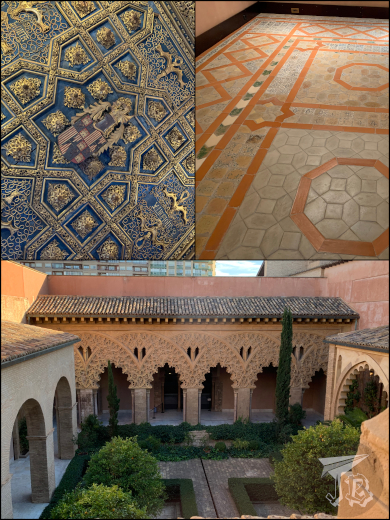
We did not go in though, because we needed a break and had booked a ticket for 5pm somewhere else, so we decided to raise our feet a little for a while in the hotel room – the sitting area was nice though unfortunately there was no more sun on the balcony, else I would have totally impersonated a lizard there (I did scare a pigeon away though, even if the startle was mutual). Our next target was the Medieval palace called Palacio de la Aljafería – a fortress that combines Islamic architecture and ulterior Christian elements. The Moorish palace was built around 1065 – 1081, and it holds a magnificent garden called the Golden Hall with a portico made out of interlocking mixtilinear arches (I totally looked the word up, and will forget it promptly). The palace was taken over by the Christians 1118 and became a palace for the monarchs of Aragón. It was not modified until the 14th century, and in the 15th Century the Catholic Monarchs extended it further into the Mudéjar Palace. Today it is the meeting site for the local government. I adored it, to be honest, I loved the Golden Hall most of all, but the original ceilings in the Christian palace were also really cool.

We walked back towards the Plaza del Pilar (probably through some streets we probably shouldn’t have, hindsight is 20/20 they say), and we reached the church of St. Paul Iglesia Parroquial de San Pablo. The restored interior leaves a bit to be desired, but the exterior, built between the 13th and 14th centuries in the Mudéjar style – it has an octagonal tower in dark tones, with the upper roof added in the 17th century with richly decorated with tiles and windows. It is worth mentioning here that several Mudéjar buildings in Zaragoza, along with others of singular architecture, are declared Unesco World Heritage Site.

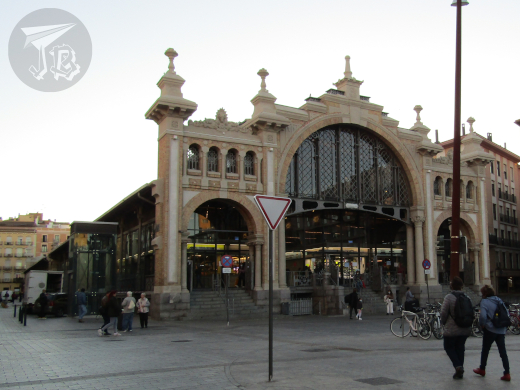
Between the church and the square we walked by the central marketplace Mercado Central de Zaragoza in the late 19th and early 20th century, in a combination of stone and iron-and-glass architecture.
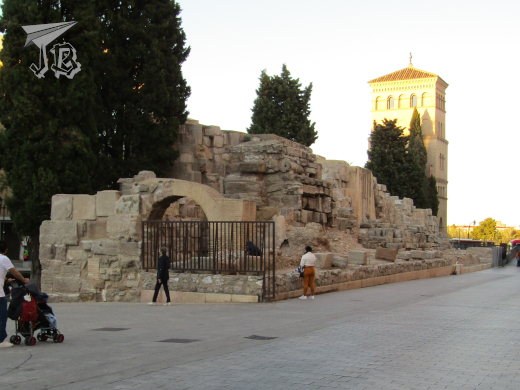
Close to it we could see some of the ruins of the original Roman walls Antiguas Murallas de Romanas de Zaragoza, which are actually sprinkled all through the town and mixed with the Medieval ones at points. There, a lady was happily chatting on the phone while her child climbed the walls – so in case it is not evident, here’s a social clue: if there is any kind of barrier / signage around something, it should not be climbed on.
To finish off the day we visited the Museum dedicated to Goya Museo Goya. Goya, whose complete name was Francisco José de Goya y Lucientes (1746 – 1828) was a painter and printmaker from the Romantic age. He is probably one of the most important artists in Spanish history. He was a royal portraitist, fresco decorator, and also painted and printed many critical and fantasy works. To be honest, the museum was a bit underwhelming – with few of the minor works, and one of the least impressive major works, the Christ portrait. There was however a whole room full of prints.

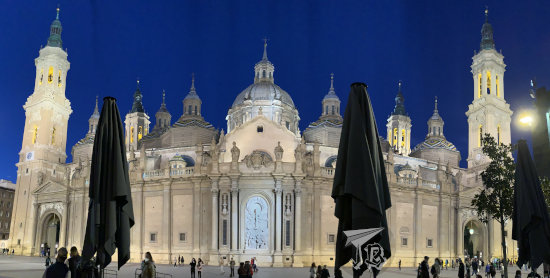
After one more visit to the square, where I managed my only complete picture of the whole (night-lit) Basílica del Pilar from that angle, we just headed to the hotel. There was a sandwich shop at the entrance, so we took one each and had a late light dinner as we watched Night at the Museum in the hotel bathrobes – because it was cozier than turning up the heating. I did not sleep too well as the fire alarm was right on top of the bed and it kept flashing – at one point I thought that an electric storm had hit, but it was just the alarm…
23rd October 2021: Papercraft and walks
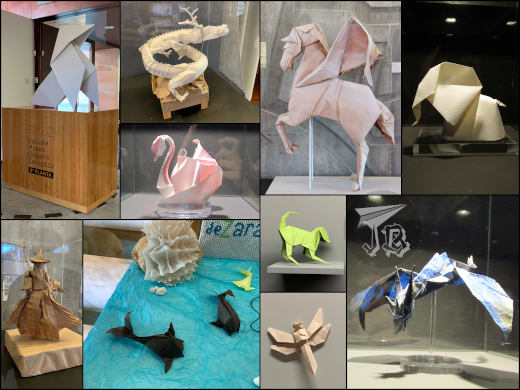
The next morning we had breakfast and headed off to the origami museum and workshop EMOZ: Escuela Museo Origami Zaragoza, located in the “Stories Museum” Centro de Historias. I remembered the exhibition from a few years back in Museo Cerralbo in Madrid, with an actual-size hippo, so I have to admit this time I was a little… underwhelmed, probably because the temporary exhibit ended up being “abstract” paper folding…
However, in the very same building there was a very fun exhibition about the evolution of household appliances throughout the 20th century. That was cute!

As we got ready to draw a close to our day-and-a-half getaway we went to say goodbye to the river Río Ebro. We walked by the modern Puente de Zaragoza bridge, and crossed over the Puente de Piedra, the traditional stone river of the town. The current one dates back (although reconstructed) from 1440, but there are records that a previous Roman one stood in its place and was destroyed in the 9th Century. Between the two bridges a flock of cormorant seemed to be sunbathing.

From Puente de Piedra I took my last picture of the Basílica del Pilar before we had a nice milkshake, then headed back to the station to take our train back. By the way – I find it ridiculous that the stations have blocked 60% of the seats while they’re filling up the platforms and the trains as normal…

Total walked distance: 8.69 km




 JBinnacle – A Travel Logbook