28th November 2024: Parallel Universes (Madrid, Spain)

Whenever a Marvel film comes out, my parent always comments on how they used to read the comics when they were young – probably they belonged to the first generation of comic readers in this country (and I have to confess over the years I salvaged quite a few “relics” from the attic at the old house). Thus, when the exhibition Marvel: Universe of Superheroes opened, I thought I would bring them along. I booked us tickets on the 28th of November at 10:00 for the event, which was happening in the convention centre IFEMA in Madrid.

By pure chance, my parents received an invitation to Feriarte, a collectionism fair – that is what we thought at that moment. They were not particularly into it, so I asked if I could have the invitation. When I checked it out, I realised that we could visit Feriarte on the same day as Marvel: Universe of Superheroes, since the dates overlapped, and it was also at IFEMA, just a couple of pavilions down. My parent agreed after some coaxing. Finally, I offered to take them to a “fun place” for lunch, and we had a plan.

Marvel has traditionally been one of the most important comic publishing houses in the US. Its key writer / creator was Stan Lee, who came up with some of the most iconic characters in the medium – Spiderman, Thor, Iron Man… It is true that the first superheroes to succeed on the big screen belonged to Marvel’s competition, DC – Christopher Reeve’s Superman in the 1970s and Michael Keaton’s Batman the following decade. However, Marvel kicked off a golden age of cinema superheroes. While DC festered in the darkest, more depressed Batman, Marvel released Iron Man, which took superhero films in a new direction – they turned from fun-for-fans to funny-for-all (of course, purists would never be satisfied, but what are you going to do?). Robert Downing Jr. had a lot to do with this boom, dominating the scene whether the film carried the name of his character – Iron Man – or not. For about a decade, Marvel dominated the blockbuster season, with explosions, one-liners and good-triumphs-over-evil plots. Eventually the bubble burst, as they always do, and things went downhill. However, companies are still willing to milk out any cash cow, and as long as Marvel makes money, it will be producing stuff.

Less known than the film boom is the fact that with the launching of Marvel Studios, the parent company also became a transmedia master. The idea of transmedia is not new, and refers to tying stories in different publishing methods (Hasbro was doing this with GI Joe back in the 80s already). However, Marvel has it down to an art. Samuel L. Jackson was cast as Nick Fury because a comic artist based the revamped character on him, so now Nick Fury statuettes look like Samuel L. Jackson. Since Disney acquired Marvel Studios, the so-called MCU (Marvel Cinematic Universe) is so interwoven with the Disney+ shows that neither can be followed on its own. Funnily enough, this has not washed over to the comics that much, save for the special Alligator Loki that I kept looking for in London earlier in 2024.

Well, one of the many facets of Marvel’s outreach octopus is organising exhibitions. I suspect that they are all the same under different names though. The one which took place in the IFEMA convention centre in Madrid was Marvel: Universe of Superheroes. The exhibition runs through the history of Marvel from its beginning, hailing the works of Stan Lee and running through the influence of the Comics Code Authority (CCA), which censored the content of the media – and made the evolution of American and European comics diverge forever. The pages from that time are mostly lost, so elements like the first issue of a Marvel comic ever, or original Spiderman and Fantastic Four dating back from the 60s are kind of amazing – and belong to private collectors who have lent (or rented out, one guesses) them to the organisers. Most of the exhibition, however, focuses on the MCU, with quite a few costumes and items from the films and Disney+ series. There were life-sized statues, too – or at least to scale for characters like The Thing or Hulk. There was an interactive game where an on-screen you would wear Iron Man’s suit and practice-shoot with it.

We hilariously ran into a preschool day trip, with the teacher completely made things up as she went and kept trying to keep a bunch of rowdy kids in line – without much success.

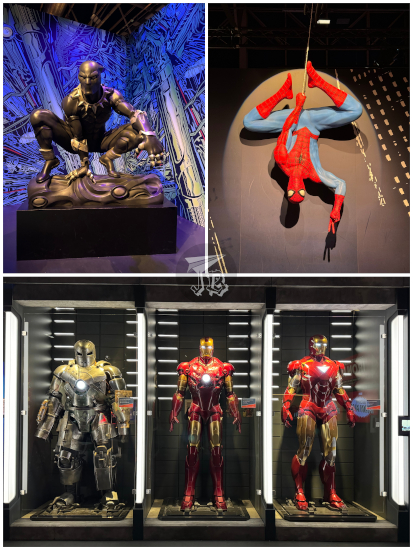
The first area ran through the history of American comics and Marvel itself, purely as a comic publisher. Then, it moved into the film area, starting with Black Panther, revindicating his status as the first black superhero. Then there was a room on Spiderman, one of the most beloved characters, even if he was almost not made because editors thought a spider-related superhero would not sell. This was probably the last room focusing heavily on comics. Hulk got a small room to share with She-Hulk. Afterwards, the MCU took over, with film memorabilia of Iron Man, Thor and Captain America. The following area was a bit of a mix, with Wandavision, X-Men, Daredevil, Luke Cage, Moon Knight, Ghost Rider… which ended in a very psychedelic room for Doctor Strange. The final room was “Marvel in Space”, with The Marvels (Captain Marvel, Monica Rambeau and Ms. Marvel) and Guardians of the Galaxy. Considering the huge hit that Agatha All Along was, I was surprised not to find any references to it, but then I realised that the exhibition predates the series.

Marvel Universe of Superheroes

Marvel Universe of Superheroes: Black Panther, Spiderman, Iron Man

Marvel Universe of Superheroes: Doctor Strange, Mighty Thor, Groot

I would have wanted a memento, but none of the items in the shop appealed to me. Besides, everything was too expensive, I thought. I had no idea. We left the exhibit and marched into the inner pavilion where Feriarte took place. Feriarte is way more than the collectionism event I had originally thought – it is an antiques and art fair, with items that range from archaeological artefacts to the most modern pieces. Our minds were blown. There were 64 art galleries and archaeology specialists from all over the world carrying prehistoric items, Egyptian mortuary artefacts (including a whole sarcophagus), Grecian sculptures and vases, Japanese samurai armours and weapons, paintings, contemporary art (Miró, Dalí, Chillida, Sorolla…), furniture, jewellery and watches, reproductions of Medieval manuscripts… And I thought that the Marvel shop was expensive! I could have afforded… a tiny Egyptian scarab smaller than the nail on my little finger. I was shocked when I saw the first three paintings by Miró (a surrealist painter from the beginning of the 20th century), but it turns out they sell like doughnuts among the collectors…

There was a “collectionism for beginners” area, with tips to “start collecting with pieces under 5,000 €”. When thinking about private collections, I’ve often gone with Indiana Jones’ line “it belongs in a museum”, but lately, with the attacks on art by climate activists, and the fact that most of Marvel’s memorabilia was recovered from private collectors… I’m not so sure. I might have started changing my mind. Then again, not really, because when the original fossil of Tyrannosaurus rex Stan was auctioned and I was sad it would end up in private hands and I would never seen it – good news, it was sold to a museum, though I’m not sure I’ll ever make it to the soon-to-open Natural History Museum Abu Dhabi. Needless to say, we left Feriarte empty-handed, and very amused that you go through security and X-ray when you go out, not when you go in. A couple of days after, I read that an organised gang had stolen jewels and watches worth 390,000 €…
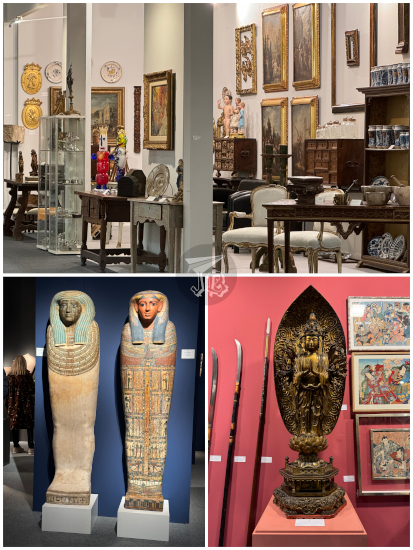
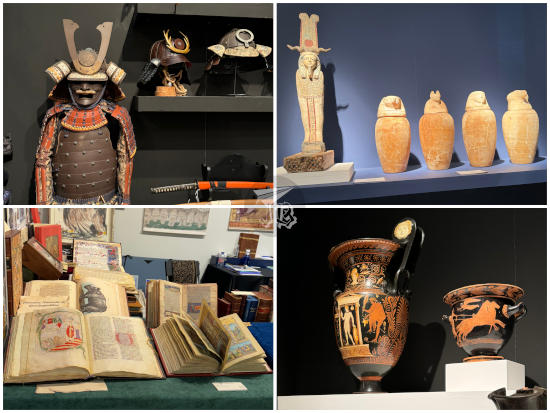
Feriarte 2024

Feriarte 2024

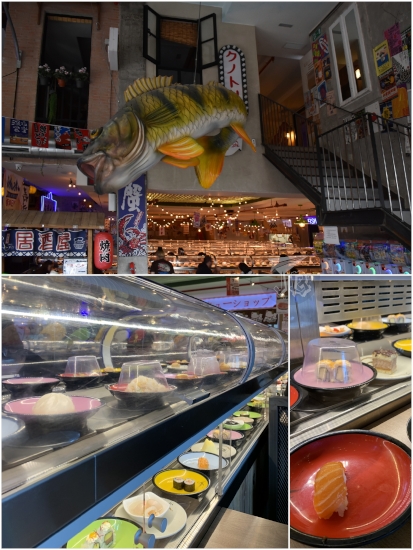
We retrieved the car, and got lost trying to get to the shopping centre La Vaguada to have lunch at Runni In Market, the first of the Running Sushi franchise I visited (and got lost trying to get there too, so… maybe it’s just difficult). My parent loved the concept. However, I was peeved that the table before us kept getting all the lychee and mochi when the time came for dessert. Mean!

Runni Sushi In Market

We left afterwards to head home, having caught a glimpse of the secret life of superheroes and what kind of décor rich people have in their houses. Parallel universes indeed…

3rd December 2023: Sushi, I“k”ons, Goddesses and Light Bugs (Madrid, Spain)

I had evening plans in Madrid with my sibling, and they wanted to have lunch in town and make a day trip out of it. Since I had previously ascertained that the Running Sushi franchise was all right and fun, I proposed to check out another of the locations. They agreed and I had booked a 13:00 slot at Running Sushi in Akihabara, near Plaza de España. It was even more fun than the one I had checked out before, with Godzilla, Taito Station signs, Pacman, neon, anime graffiti in the toilets, and Japanese music playing. From the outside, the restaurant is shaped like a train carriage, and the sliding doors relay the same message they do when Tokyo JR stops at the station at Akihabara. In general, Running Sushi Akihabara offered the same food as the In Market restaurant, but this time there was tuna. I don’t know if it is because of the location, or because it was a weekend – and thus more expensive. Reservation was a great idea, because though I had no problem booking for 13:00, there were plenty other people with and without bookings, and when 14:00 – standard Spain lunch time – approached, the place became almost crowded. We stayed for the whole hour since we had a late start due to missing chopsticks and napkins, and I own up that the last takoyaki might have been excessive. This time, I remembered to ask for the membership card – you get a reward if you visit all the restaurants in the holding, something I’m considering to aim for.

Running Sushi Akihabara

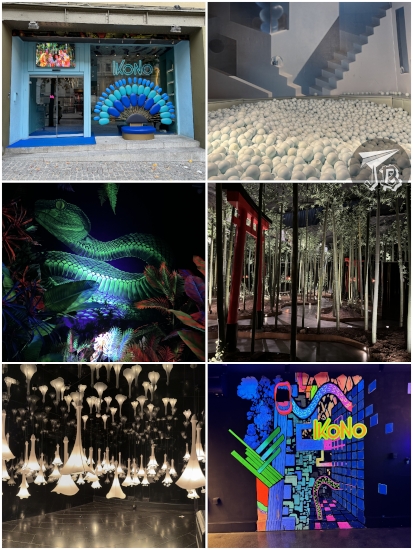
After lunch, we had a 14:50 ticket for a place called IKONO. I have to say I’m warming up more and more to these Instagrammable places – I’ve recently read one of them described as a “fun house” and I think it’s a more than accurate idea. I like them because they’re silly places for, quite literally, kicks and giggles. According to themselves, IKONO was born as a leisure option alternative to “restaurants, shopping and clubbing” for young people – I disagree with the “young people” take though. Out of the permanent establishments of its kind in Madrid, it is probably my favourite.

The IKONO mood kicks off even before you go in, with a peacock-like armchair just outside the main entrance. Spread over three floors, the venue has 15 different experiences / things to do. Once your tickets have been checked, the first “door” you go through is a thick wall of foil fringe curtains in a gradient of shiny colours,which felt like going through the Stargate! (I know, I know, niche comment). All through the place, there is bouncy music playing.

Once you have crossed the curtain – I somehow ended up in a weird inner space instead of where I was supposed to reach, but that’s just me – the first room is a ball pit, and a deep one at that. It was quite hard to move there. There are quite fewer rules than in other ball pits too – you can jump in, and throw balls up. Once you manage to drag yourself out of the ball pit, you get to go upstairs, what I’ve mentally named the “paper floor”. It has three rooms – the landing one has a pretty origami tree and some wings for you to take pictures with. There is a “psychedelic” ward with black-and-white décor and a blue-and-pink confetti cannon. The third one is a dark “jungle scenery” with glow-in-the dark colourings and paintings that I really loved – the frogs were adorable, and the serpent god quite impressive.

Back on the ground floor, the following room is a Japanese-style bamboo forest with wooden lanterns and a torii [鳥居], the traditional entryway to a Shinto shrine. As you may imagine, this was my favourite area. The room walls are covered in mirror, so it looks like a long path, that ends in the following room, a “bamboo forest” which a felt a little underwhelming in comparison. According to the website, the idea of IKONO cemented while visiting the Japanese Arashiyama bamboo grove, and these two rooms are a homage to that place.

Then we walked downstairs, to the “lights area”, with a few more rooms, including some hanging bellflower-shaped lamps, and another with lights made with marbles that went on and off to the music, some modern art inspired by The Last Supper, and a cube of infinite light dots. Back upstairs, there were a couple more panels for photo-ops, and a small souvenir shop. The staff offered a small present if we left a Google review, so we did. Oh, and they had a cloak option for coats, which was amazing.

IKONO Madrid highlights

We walked outside towards our following spot Caixa Forum Madrid, where there are two exhibitions at the moment. The one I really wanted to see was Veneradas y Temidas: el poder femenino en el arte y las creencias, “Worshipped and Feared: Feminine power in art and beliefs”, an exhibit on the female presence in the religion and spirituality of different cultures. The other one was Horizonte y Límite: Visiones del Paisaje. Colección de Arte contemporáneo, “Horizon and Limits: Views / visions of Landscape. Collection of Contemporary Art”, which I had not read about beforehand – because I am biased.

Veneradas y Temidas: el poder femenino en el arte y las creencias is a British Museum’s touring exhibition, Feminine power: the divine to the demonic (which I feel is a more appropriate name, but that’s just me and my problem with translations). It is a collection of artefacts (most of them not exhibited anywhere else) originating from different cultures, trying to convey the “female spiritual power”, though it also has snippets of erotism and homosexuality. One of the most important and impressive pieces include a copy of the Campo Iemini Venus, a “modest Venus”, halfway though covering herself – a copy of the Capitoline Venus, it was found in an Italian Roman villa in 1792. Aphrodite / Venus was the Greek / Roman goddess of Goddess of beauty, love, lust, passion, pleasure, and sexuality. Other Ancient Greece and Rome pieces include Hecate / Trivia (goddess of boundaries, crossroads, ghosts, magic, necromancy, transitions, and the New Moon), Athena / Minerva (Goddess of handicraft, warfare, and wisdom) or Eros / Cupid (God of desire, love, lust, and sex). There are several pieces of pottery, both red and black, depicting different scenes of various… degrees of erotism.

Halfway between Athena and Aphrodite, the goddess Ishtar, Queen of Heaven, and goddess of love and sexuality was worshipped in Mesopotamia (modern Iraq). Though according to the mythology, she had many lovers and was responsible for creation, she was not considered a “mother goddess”, and one of her advocations is the goddess of war.

The Divine to the Demonic: Greece and Mesopotamia

The first thing we saw from Asia were three masks. There was Taraka [Tāṭakā], a Hindu spirit, whose rage upon the murder of her husband turned her turned into a man-eating ogre (ogress?). From Bali, there was Rangda, the demon queen, antagonist of the forces of good, leader of an army of evil witches, and child-eater. From Japan there was a hannya [般若], the jealous vengeful spirit of a scorned woman.

Also from Hinduism, there is a creepily fantastic (or fantastically creepy?) devotional icon (murti [मूर्ति]) of Kali [काली], goddess of death, doomsday and time. The sculpture is the advocation Dakshina Kali – depicted with four arms, a scimitar, a collar made of heads of her slain enemies, and Shiva at her feet. The murti represents a passage in which Kali goes on a rampage after fighting demons, having lost control, and her consort Shiva throws himself at her feet hoping to calm her down.

Theatre masks and Indian Goddess Kali

Among the Egyptian representations, there was Sekhmet, the warrior goddess, represented as a lioness, who was also the goddess of medicine and one of the sun deities. There were also Bastet, who started off similar to Sekhmet but became more of a protector figure, represented as a cat. There were also references to the cosmic goddess Nut, who symbolises the sky, stars, astronomy, the universe, and mothers.

From China, there was a gorgeous Guanyin [觀音] as the Goddess of Compassion, a very different style from the one I had seen in either the British Museum and the Victoria and Albert Museum. There was also a Shiva porcelain which was astonishing.

Egyptian Sekhmet and Chinese Guaiying

From Meso- and South America, there was a beautiful sandstone of Toci, the “mother of the gods” who is depicted with bare breasts and her hands on her belly. There was also a statue of a Mexican cihuateotl. The cihuateteo were spirits of women who died in childbirth, and received the same honours as the warriors who died in combat. There were other references, such as the Hawai’ian goddess of the sea Na-maka-o-Kaha’i, talismans of sex and love (because the Victorians were a bunch of perverts), references to the Mesopotamian demon Lamashtu, Egyptian protection sculptures, funerary steles… and some modern art kind of thing, like a lady sitting down with a ball python slithering on her because… yeah? I really enjoyed the exhibition, though I have to admit I ignored the interactive art a little, to focus on the mythological aspect.

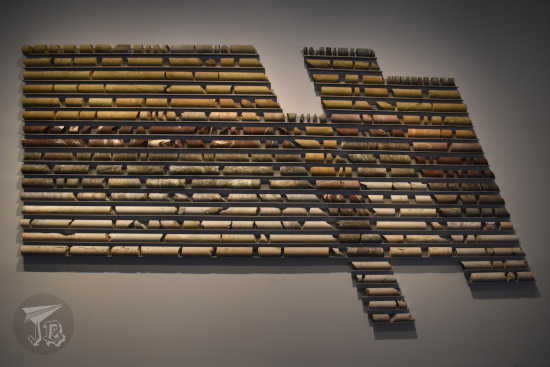
Afterwards, we visited the contemporary art exhibition Horizonte y Límite, which focuses on different… I’m not sure because I know squat about contemporary art (see above comment about the lady and the snake). There were paintings, imaginary photographs, a piece made from different geological cores representing a fault, a panel with postcards, a glass box filled with smoke to represent climate change… Pleasant, but not really my thing. Except the geology cores, they were cool.

Art piece fromthe exhibition Horizonte y Límite: Visiones del Paisaje

After seeing both exhibitions, we headed off towards our next stop. We took a break and sat down for a while to have a great banana-and-strawberry smoothie of all things. Then we walked towards the park Parque Enrique Tierno Galván, where we had tickets for the light show Naturaleza Encendida: Insectos “Lit-up nature: Insects”. The Naturaleza Encendida show used to take place in the Botanical Garden, which is smaller. This year, it has been relocated this year for “reasons unknown” and it feels a bit too long and almost unconnected. All that without taking into account that the idea of a larger-than-me butterfly and giant spiders is a bit creepy to be honest. We had premium tickets which gave us access to the enclosure at any time between 18:00 and 19:00 without queueing, and decided to arrive there around 18:30 as it would already be dark. We had also ordered a cute “magic lantern” – a bunch of sparkling LED filaments – for the giggles.

After an entrance of archways and carpets of light, there is a swarm of dragonflies as a centrepiece. You walk around it, and enter the zig-zagging path. Along the route, you encounter butterflies of different kinds, a line of hard-working ants, bees, grasshoppers, more bees, mosquitoes and flies, more bees, eggs, more grasshoppers, disco balls, larvae (I think? If I had to hazard a guess I’d call them anemones), beetles, ladybugs, spiders and a row of differently-coloured Christmas trees. There were “light corridors” in-between, hive-like hexagons projected onto the trees, and lots of artificial smoke. There are supposed to be some praying mantises somewhere but… I did not see those?

Naturaleza Encendida Insectos figures

All in all, Naturaleza Encendida: Insectos felt too spread out, as if trying to justify the bigger space. Though we had a premium ticket, there was no special premium-only area, and the only benefit was having an hour to go in, without having to queue – which is already enough in my books. I think you really have to be into the topic – we came across a lady who was very freaked out and mostly running so she could get away from the bugs. I have been to three editions of Naturaleza Encendida, and the only one I really enjoyed was the sea-creatures one, Explorium. I thought that the bad weather last year had damped the experience – literally – but I’m going to stop holding my hopes high.

Finally, we headed back to the train station. My morning train had had a five-minute delay, which by the early evening had progressed to the upper 40s. Joy. I’m hoping that when free ticketing is over, service will improve, but I’m not holding my hopes too high…

7th November 2023: A Jurassic amount of Lego (Madrid, Spain)

The fact that I like dinosaurs would come to no one’s surprise by now. To be honest, the older I turn, the more I think of them in the mind frame of the xkcd comic “Grownups”. Dinosaurs are silly fun, and it’s not like I’ve got a few million dollars lying around to buy a whole T-Rex skeleton anyway. What I do have is a silly knack to find things to do that are related to them – selective perception, if you wish. On this occasion, I heard that Madrid would be hosting the European Premiere of Jurassic World Exhibition by Brickman.

It is widely known that Jurassic Park and Jurassic World are part of a widely successful franchise. However, what or who is Brickman? In order to answer that question, we need to find out what a LEGO Certified Professional is: a person whose business model is working with LEGO blocks, making stuff for publicity, for example, and they are so good at it that they actually become LEGO-affiliates. The Brickman is a team of people who are led by Australian LPC Ryan ‘The Brickman’ McNaught – basically, they get paid to play with LEGO all day, and are commissioned things to build (which I think is awesome, in case you had any doubt). The Brickman Team have under their collective belt six exhibitions touring the world, and some of the largest and more detailed LEGO models ever built.

I came across the Jurassic World LEGO exhibition by pure chance, but once I knew about it, I worked on timing. The exhibition kicked off on the 30th of September and it will be there until the 14th of January – and it turned out that Tuesdays are cheaper. I bought a ticket for the opening timeslot at 11:00, and planned my day. I had to go to Madrid’s IFEMA Espacio 5.1, where I had already seen The Dino World Expo. It took 25 minutes to drive there and 35 to find a parking spot at the end of the world, then walk to the venue. Only when I was right by IFEMA, I saw that the paid parking lot was open – it is usually not when I am at IFEMA. Since it was a schoolday, I hoped to see the exhibition without many people – and kids – around so I could have fun with pictures.

As the name hints, the whole exhibition is based around LEGO-built Jurassic World items and scenes. Most of the rooms have brick buckets for you to put together whatever you want, freely or with instructions / missions. I did not build anything, but I had a lot of fun, once I managed to get in. When I arrived at 11:05, the ticket reader was not working, but the person at the door let people in anyway. He even offered to take your picture with the doors to Isla Nublar, which are already made from LEGO and actually really open. They recreate the gates shown in the first Jurassic Park films, but they read “Jurassic World” instead. Once inside, I asked a staff member if they had any stamps for the LEGO passport, and she had absolutely no clue what I was talking about – I think she thought I was weird, but oh well. The first room has “smaller” exhibits in comparison with others. There is a working monorail, a few aircraft and a life-sized 3D map of the island. It was weird to hear the Spanish dub from the films when a lot of the screens were still in English.

Jurassic World by Brickman entrance

The second room has a DNA strand and an amber collection site, and a shelf with lots of “hybrid” creatures. Some of them were cool, others just made me giggle – you were encouraged to build your own hybrid. The third room was “baby dinosaurs” under a huge brachiosaurus (171,150 bricks; apparently is one of the largest models in the world). There were some hatching eggs, too. In this room there were bigger LEGO bricks for the youngest kids to play and build stuff with.

Jurassic World by Brickman - LEGO baby dinosaurs

Then came a sort of control room – where visitors can track the escaped dinosaurs while some flying reptiles lurk from the ceiling, somehow recreating the alert in the first Jurassic World instalment. After that, there is a set up of the JW velociraptors, Blue and Delta having escaped and Echo and Charlie still in their pens. I had seen a LEGO Blue before, for the Jurassic World: Fallen Kingdom promotion in the Natural History Museum in London, but this one was much cooler, and scaled 1:1 to the film – 58,227 bricks.

Jurassic World by Brickman - LEGO Velociraptors

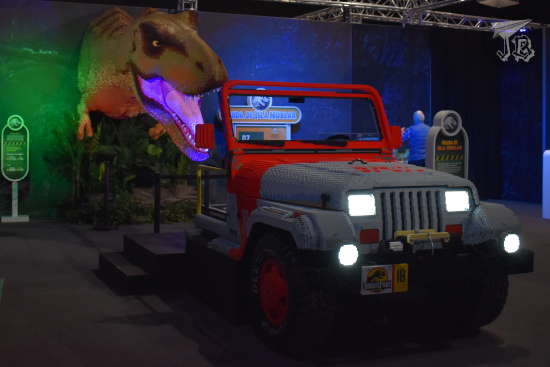
Despite all the promotion and toys she gets, Blue is probably not the fan-favourite dinosaur from the films. She is not mine for sure – that would be Rexy, the T-Rex. And after a mural of the mosasaur (number two on my list) hunting down a great white shark, Rexy finally comes into view, in one of her most glorious scenes from the original Jurassic Park: chasing the Jeep after Dr Sattler and Muldoon have just rescued Ian Malcolm. The Jeep was built using 227,098 bricks (which makes it even more complex than the brachiosaurus), and Rexy 128,763. One thing I noticed was that they had changed the jeep’s number, from 10 to 18, I’m guessing there is some inside joke there. They even recreated her reflection on the rear-view mirrors, which was pretty neat.

Jurassic World by Brickman - LEGO jeep being chased by the T-rex

The exhibit was fun for the discounted price, but the shop was crazy expensive. When I finished, I walked back to the parking spot. I had to walk through part of the park Parque Juan Carlos I. In the middle of the so-called Southern Pond Estanque Sur there is a hideous sculpture made of wrought iron, which is called “Walk between two trees” Paseo entre dos árboles by sculptor Jorge Castillo . As I was staring at it trying to figure out what it meant (and even after reading up on the symbolism, I don’t get it), I approached the edge of the water. A flock of mallard ducks swam over to see if I had any food, and I noticed something that was neither a duck nor a goose – a great cormorant (Phalacrocorax carbo). I had never seen cormorants in Madrid before. Seagulls, yes, but not cormorants, and I actually saw three of them.

Juan Carlos I Park, Southern Pond

I headed off for lunch at La Vaguada, a shopping centre not far away from IFEMA, though the Sat-Nav went weird and I took forever. I actually had a couple of things to do in that area, not least of all drop by the LEGO Store La Vaguada to actually get a small stamp – or three – for the rally. I mean, I had already been to the exhibition, I was going to be there, I had taken the LEGO passport just in case…

La Vaguada LEGO shop

Serious things taken care of, I looked for the restaurant Running Sushi In Market, a call-back to a kaizensushi – small-plates of sushi on a conveyor belt – in an all-you-can-eat business model part of a franchise. It is more of an “Asian” place than a sushi restaurant and you have a range of recipes, from actual sushi to baos, skewers, noodles, dumplings, sausages… You are given a table for one hour to eat as much as you want, and pay a fixed rate plus drinks. It was not bad at all, though for the cheap price, tuna was too much to ask for. The decoration is extremely kitsch, but they had absolutely no problem giving me a five-people table for myself, and I stayed about 25 minutes, plus some pictures. But I forgot to sign up for the loyalty program…

Running Sushi In Market restaurant

The shopping centre has a ticketless parking lot that you can use for free for two hours, and when you are going to pay you just have to type your licence plate. I was there for 1 hour and 58 minutes in the end, so I did not have to pay anything, which was great. Then, unfortunately, I ran into a huge traffic jam, as it was get-out-of-work time, and there had been an accident on the motorway. Even though, I made it home before tea-time. However, I did not eat anything else that day. I might have overdone it with the last small dish of lichee fruit…