The Archaeology and Palaeontology museum in Alcalá de Henares is running a temporary exhibition on the history of digging dinosaur bones, called “Dragon Hunters”. I was drawn to it because well… dinosaurs. Driving in the city centre is a nightmare, so I left the car in an easy-to-park area a bit away, and walked downtown.
I had been trying to see the cathedral of the Magistral Cathedral of Saint Justus and Saint Pastor Santa e Insigne Catedral-Magistral de los Santos Justo y Pastor, but it was always either locked, booked for events, or “closed to visitors”. This time around, I was able to finally see it – and it was honestly a bit underwhelming. Though I generally enjoy Gothic buildings, I guess I was so hyped after trying so many times, that reality did not live up to expectations. Furthermore, I dislike when places do not advertise that part of the visit is closed / unavailable, so I guess I’m still pretty out of luck with this one cathedral. I missed the chance to climb up the tower and see the views of the town due to construction, but oh well.
Legend has it that catholic Saints Justus and Pastor were martyrized in the year 304, near the Roman city of Complutum. In the year 414, a chapel was built to keep their remains in the place where the martyrdom happened. The current building was erected by architects Antón Egas and Enrique Egas in late Gothic and Renaissance styles around 1446. The tower, by Rodrigo Gil de Hontañón and Rodrigo Argüello, is Herrerian. The interior has three naves with pointed arches, and to one side stands the cloister, with access to the museum, and – when it is open – the tower. It was a bit of a bummer not to even be able to step into the open part of the cloister. Underneath the altar there is a crypt with a gold-and-silver urn with the remains of the Saints, and the stone where they were killed.

Afterwards, I continued on towards my real destination, the local Archaeology and Palaeontology museum Museo Arqueológico y Paleontológico de la Comunidad de Madrid, MARPA. They are currently running the exhibition Cazadores de Dragones (Dragon Hunters). The exhibit summarises the historical hits of palaeontology, starting with prehistoric and classical references and theories about them, such as a the phoenix having been inspired by Protoceratops skeletons, or the bones of giants being actually dinosaur fossils. This area has a few replicas and small statuettes – running from the originally-made ones to the newest reconstructions.

The exhibit name-drops a few of the big figures in dinosaur-digging history such as William Buckland, the man who described Megalosaurus as an antediluvian creature; Gideon Mantell, who tried to reconstruct an Iguanodon from a tooth (now in the Natural History Museum in London); Georges Cuvier, who proposed the idea of extinction, and named animals such as Megatherium, Pterodactyl or Mosasaurus; and Richard Owen, who “invented” the word “dinosaur”, meaning “terrible lizard” – though today we know that a lot of dinosaurs had more in common with birds than with reptiles, down to protofeathers and even feathers.
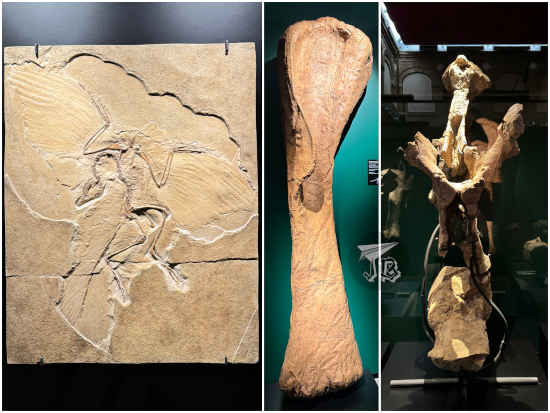
The following section follows the “Bone Wars” – Charles Marsh and Edward Cope were two palaeontologists who raced through the Morrison Formation (Montana, USA) to discover up to 30 species of dinosaurs – they were not always honest in their competition, and it did not help that Cope messed up a reconstruction of an Elasmosaurus, placing the skull at the end of the tail. The Morrison formation was (is) in the middle of nowhere, and digging during the 19th century had its risks. This concept ties with the idea of “the adventurer” à la Indiana Jones, mentioning Roy Chapman Andrews and Barnum Brown, the man who excavated the first Tyrannosaurus. And then you turn a corner and are greeted by a replica of a T-Rex. Of course, I stayed a while here – trying to take pictures without the security guard in them.

After World War II, palaeontology hits moved from the USA to Mongolia and the Gobi desert, with new species being discovered every so often. Later, in the last years of the 20th century, the idea of “the avian dinosaur” arrived, and there is a replica of a Deinonychus, with screens showing recreations of the creature looking “like a lizard” and looking “like a bird”, feathered and all.
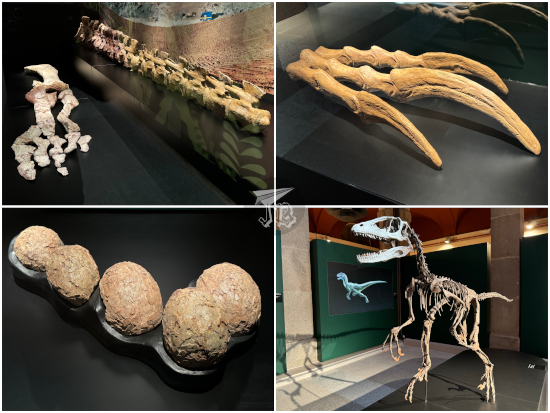
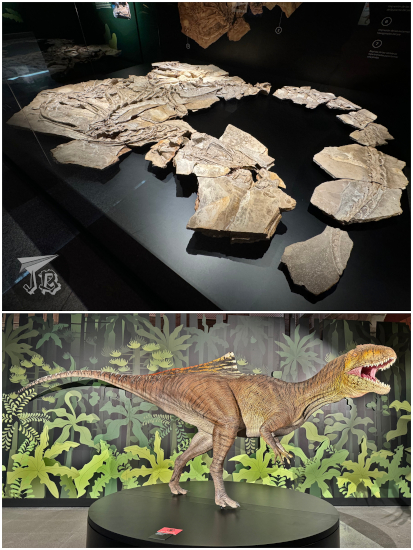
Finally, there are the local dinosaurs: a tail and part of a foot from Qunkasaura pintiquiniestra, a nest from the Poyos Site (Guadalajara), and the star of the show – the original fossil holotype of Concavenator (Concavenator corcovatus), a theropod found in Cuenca. The fun part? The museum which holds the holotype, Museo de Paleontología de Castilla-La Mancha, bans pictures – so I took my sweet time with this. There is also a life-size reproduction, with colours tuned down to more realistic than the originally proposed blue and red.
Afterwards, I wandered around MARPA, mostly to go to the palaeontology room, as I have explored the museum extensively before. The palaeontology ward is relatively new, and it has quite a few nice reproductions and… even if I have explored that one too. I also dropped by the shop to get the exhibition book. Finally, I went back to run through the Dinosaur exhibit again, just because I could, before I headed home. I had thought I’d look for a nice restaurant for lunch, but nothing drew my attention.





 JBinnacle – A Travel Logbook