3rd November 2018: Samurai Spirit in Madrid (Spain)

I booked tickets to see the show Kamui x Mika Kobayashi: Utakatana Sekai – Samurai Spirit in Madrid. In a last-minute change, my parents decided to tag along, so we just drove there in time for the show. It took place in the theatre Teatro Fernando de Rojas, one of the halls in the Círculo de Bellas Artes building.

Publicity poster with the show's date

Samurai Artist Kamui [剱伎衆かむゐ, Kengishuu Kamui] is a “samurai sword artist troupe” . They perform stories through “samurai communication” using music, sound and light to work on the atmosphere, along with of course, Japanese sword – katana – performances. The founder and leader of the troupe is Tetsuro Shimaguchi [島口哲朗], who played a part in Quentin Tarantino’s Kill Bill vol.1, a film for which he also served as choreographer for the swordfighting.

Mika Kobayashi [小林未郁] is a singer, pianist, and songwriter from Hiroshima. She is known for her vocals on anime, such as Attack on Titan or Gundam UC, and video games like Final Fantasy XI. She established her own style and record label in 2016 and has been doing her own thing since then.

The collaboration Kamui x Mika Kobayashi: Utakatana Sekai – Samurai Spirit seems to be designed for touring overseas as there is no trace of that name in Japanese. Utakatana Sekai would roughly translate as “the world of singing swords”. It features Kobayashi as singer and pianist providing the background voice for the show.

Through artistic sword-fighting and music, the performance conveys a story about the old samurai ways giving way to a new world. Short self-contained scenes tell the story of a samurai warrior who gives way to the new generation – played by a lady. A bit subversive from the Japanese traditional way, I guess.

The show has three parts. The first act comprises fights and individual actors showing off their individual skills. Younger or less experienced fighters, who get “swordsman #4” roles end up being killed two or three times. I liked a short story about a blind samurai better than the romantic ones. Unfortunately, I was a bit to the side – I only bought the tickets with a week or so when I found out – and my angle was awkward at times. I could see the gaps between the swords when they did not clash for real.

During the interlude / break, they brought two volunteers from the public to learn some moves and get the mood lightened up. This showed off Shimaguchi’s language and teaching skills, along with a flair for the dramatic, and it was really funny.

Different scenes from the show

The last part was more spectacular, full of stunts and coordinated exhibition acts. That was the part I enjoyed the most. All in all, the whole ninety-minute show was very fun. Mika Kobayashi’s melodic voice and piano tunes fit really well with the whole theme, and everybody seemed to have fun, and at the same time take their jobs very seriously. However, I’d need a better seat next time, in order to keep the suspension of disbelief and not see all the stunts as… stunts.
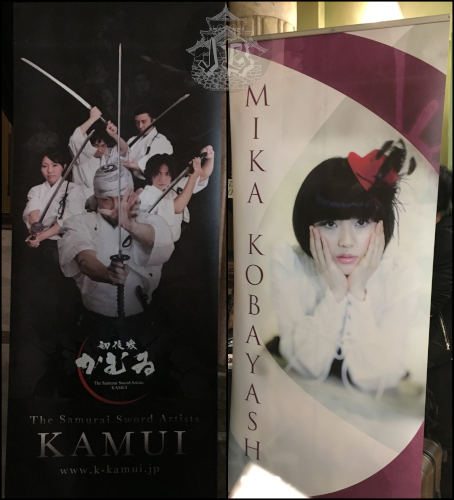
Artists’ publicity banner

Afterwards, many artists came out to take pictures with the audience. We got to take pictures with Mika Kobayashi too, and I bought a signed CD of hers.

Mika Kobayashi's signed CD

22nd May 2016: Kabuki at the CBA (Madrid, Spain)

I made a short escapade to the theatre Teatro Fernando de Rojas in the Círculo de Bellas Artes, in Madrid. It was my first time watching kabuki [歌舞伎], a type of Japanese theatre. The play was called Tsumoru koi yuki no seki no to [積戀雪関扉], something akin to “The Snowbound Barrier” and translated into Spanish as “En los límites de Osaka, bajo la nieve del amor” (In the Outskirts of Osaka, under the love snow). It is a dance-drama kabuki written in the 9th century, and deals with the spirit of a black cherry tree turning into a courtesan to extract revenge. Before the play, there was a small conference to explain some details about kabuki and that was really interesting.

Afterwards I just had to run for the trains so… no much time to hang around.

2nd April 2016: Círculo de Bellas Artes & Tsugaru-shamisen music (Madrid, Spain)

Círculo de Bellas Artes (CBA) is a Spanish cultural and artistic association founded in 1880, and they had partnered with The Japan Foundation to hold a concert by Kenichi Yoshida [吉田 健一], a famous Tsugaru-shamisen [津軽三味線] player / artist.

I got to Madrid in the late afternoon, with enough time to get to one of the most hidden Starbucks in the city, which was rather crowded as it was Saturday. Fortunately I found myself a table to spend the extra time (public transport transport paranoia, maybe. But it’s not paranoia if they’re really after you and you have been stuck in Spain commuter trains for hours already). And well, a Starbucks a year and all that… And I mean, I was planning to skip dinner so a Vanilla Frappuccino would keep me going.

The concert was to be held at the Círculo de Bellas Artes building, located in downright in the middle of Madrid. It was designed by the Spanish architect Antonio Palacios and erected in the early 1920s. From the outside, I had always thought it looked pretty weird.

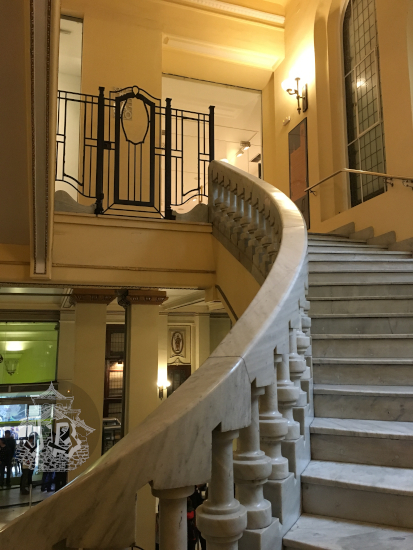
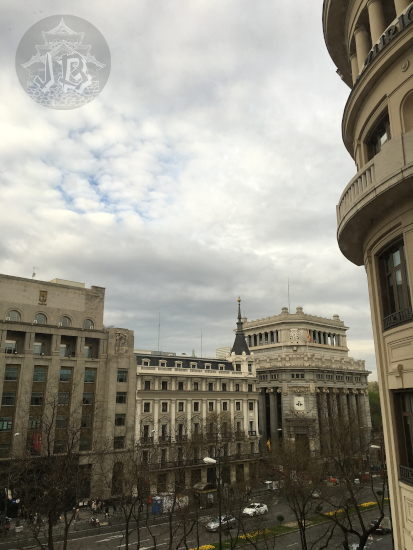
Inside, however, it was a different feeling. I had never imagined the inside of the building was going to be this neat! The CBA Headquarters has a neat staircase, an impressive ballroom, and a reportedly-cool observatory at the top. Unfortunately, getting to the observatory required lining and I was not willing to do so either before or after the concert. However, I did get some views from the second-floor windows!

The concert was in the inner theatre Teatro Fernando de Rojas, a fully-functioning theatre on that second floor, with about 400 chairs, and I had got a fairly good seat so I was happy and could sneak up a couple of pictures.

The concert in itself was amazing. Kenichi Yoshida, the younger brother in the Yoshida Brothers band, comes regularly to Spain to teach shamisen – a classical Japanese string instrument – in Barcelona. Oftentimes he makes the most out of his time and organises recitals and other activities. The concert was a mixture of old and new melodies, played along some drumming. The concert lasted for about an hour, and it felt very short. As Yoshida is a frequent visitor, he can speak a tiny bit of Spanish, too, and he tried that. It was a lovely touch.