13th August 2022: Smoothness in Chaos {England, August 2022}

As rail strikes rolled out both in London and the rest of England, I was thankful I had found out in advance. The hotel internet was patchy and I would have had trouble booking a coach ticket for the airport. I decided not to try and cram more than I had already on my plate for the day, and stick to my booked tickets and original timing.

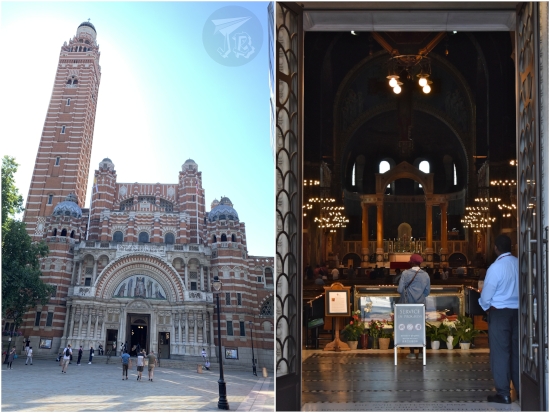
I took an underground line to Victoria railway station, from which I went to find out where my airport coach would leave from. After that, I walked from Victoria coach station towards Westminster, stopping at Westminster Cathedral, a rather out-of-place Neo-Byzantine building, which serves as the Catholic cathedral. Designed by John Francis Bentley, it was completed in 1903. It was closed for service, unfortunately.

Westminster Cathedral, a Chrsistian neo-byzantine building: a view of the exterior, in white and red brick, and the open doors showing the inner altar from afar

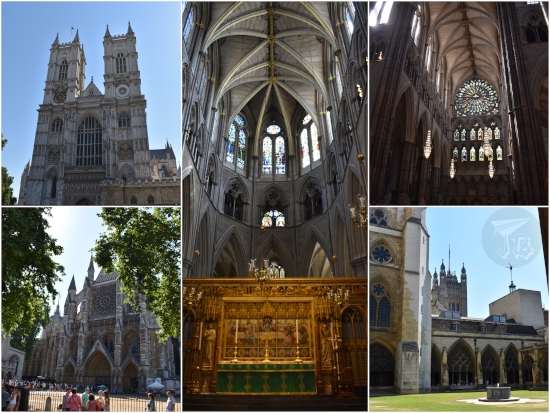
Due to the strikes and potential issues, Westminster Abbey had rearranged its opening hours, and waived all the “entry times”. So basically it was a bit on the chaotic side, though I arrived for my own timeslot, as I had calculated that would be all right for the tour I had signed up for. The abbey is officially called Collegiate Church of Saint Peter at Westminster. It was a originally a Benedictine abbey, and William the Conqueror, in 1066 made it the “official coronation ceremony” place, and many Royal Weddings have occurred there. It is built in the Gothic style, with Neo-Gothic towers. Furthermore, most British monarchs were buried there, along with a number of personalities that were either earthed there, or had memorials erected – Darwin, Newton, Hawkins, Shakespeare… The Abbey features a 19th-century wooden choir in the middle, and an outer cloister in early Gothic style. It was bustling with people fighting the audio guide and extremely hot though. However, this completed my tour of the Unesco World Heritage Site of “The Palace of Westminster, Westminster Abbey and St Margaret’s Church”

Westminster Abby, a Gothic Protestant Cathedral. Collage showing the towers and main entrance, the inner Norman altar in golden wood, the ceiling in the nave, and the cloister

Before the train strikes and the chaos in English airports, I had booked a 12:15 “Westminster Abbey hidden highlights” tour as my last activity in London before taking the Stansted Express to the airport. The change of plans meant I had to take the 14:00 h coach instead of the 15:00 h train to be at the airport by 16:00, to make sure that I would have plenty of time to go through security. That meant that I unfortunately had to cut the tour short. Event then, I got to see St Margaret’s Church, the old Medieval sacristy, the inner chambers of Samaria and Jerusalem, and got close to coronation chair. Not bad at all, even if I unfortunately had to miss the library to walk back to the station.

A collage showing an archaeological excavation (very professional holes on the ground, some showing a hint of brick foundations); the Coronation Chair and the hanging flag over it; ornate wooden ceilings; and a mythological-themed tapestry hanging from a wall

I have to say that the return was exhausting. Even with one hour difference, I got on the coach for the airport at 14:00 and did not land until 22:00. However, flying out of Stansted always has a good thing – goodbye sushi!

Tray of sushi and sashimi

All in all, this non-weekend weekend was an amazing mental break! Even if the last day did not work as originally organised, I had a heads up in order to prepare my contingency plans. I got to see something that I always wanted to see – and even if Stonehenge was smaller than I thought, it was not disappointing. Also, I checked that entering the UK after Brexit is pretty much the same as before, so I can organise more escapades in the future, because I still need to go to Jurassic Coast…

Walking distance: 11.27 km / 16672 km

12th August 2022: Stones, the reason for the trip. Lots of Stones {England, August 2022}

I was convinced I’d sleep like the dead and set a couple of alarms. Unfortunately, laundry and house service got going at 6:30, and woke me up. At least, the room had a kettle and some instant coffee which, along with one of the sandwiches I had procured the previous day, got me going. I made sure that the camera was charged, put everything I needed into the backpack and strolled off. My hotel was close to Earl’s Court, and I was walking to South Kensington to check out sandwich and coffee shop. And – to my eternal surprise – to queue for a museum! I don’t think I’ve ever seen so many people waiting for a museum to open in my life.

I’m referring to the Natural History Museum, one of my favourite ones. This time, it was a must, so I booked free entry with the special exhibition – “Dippy is Back”. Dippy is the diplodocus cast replica that used to stand in the middle of the museum, the Hintze Hall (where now the whale skeleton hangs). Dippy was the first of its kind to go on display in the world. The original skeleton was discovered in 1898 by railroad workers in an area called Sheep Creek, in Wyoming, USA. At the time, Andrew Carnegie had made a fortune in the American steel industry, and become one of the most important philanthropists in the US and the British Empire. He paid for casts of the bones to be made (some sources also say that he bought the actual skeleton, some that he had sponsored the dig) and sent to museums in Europe and South American. For the first time the public got to see a whole dinosaur skeleton, which was actually named Diplodocus carnegii after Carnegie. Dippy was gifted to the National History Museum in 1905, and was exhibited there until it went “on tour” around the United Kingdom in 2017.

Here is a little trip down memory lane: back in the mid-nineties I was a teenager in London with my English class. We had free time and they wanted to go to Harrods, so… instead I got myself into the Tube to go to the Natural History Museum just to see this dinosaur (I also ditched the group in the British Museum, but that’s another tale). The point was that I was around 14 or 15, bouncing through London by myself, on my way to see this very cool dinosaur! And I did not have to listen to people being rowdy, nor try to keep the peace in group – I was alone (scared out of my skin, true), but I was free by myself. And for me, that was very important, even if I would not come to realise that until recently.

The fossilised skeleton of a diplodocus, seen from the front. Lots of people are trying to take pictures with it

I saw Dippy again in 2011 when I went to London, but I was surprised when he was not there in 2018, shipped around the country in a travelling exhibition. For some reason, knowing that it was there made me really, really want to see it again. Since the pandemic, you need to reserve at ticket at the Natural History Museum, even if it’s free, so I booked mine for 10:00, to be there first thing as they opened – thus the queuing-before-opening.

Originally a gallery of the British Museum, the Natural History Museum was first designed by civil engineer Captain Francis Fowke, and then it was revised by Alfred Waterhouse, who redesigned the façades in a Romanesque-like style, with architectural terracotta tiles to withstand the British weather. These tiles have flora and fauna decoration and reliefs. The building was finished in 1880, and all the material had been moved by 1883. In the 20th century, the museum rebranded itself as a separate entity from the British Museum, and in recent years different areas and expansions have been opened.

Anyhow. The gates opened a little before 10:00 (If I lived in London I would totally be a member and stroll the museum before opening hours), and the queue started moving. There were lines for ticket holders and non-ticket holders, but my ticket was not even checked. Thus, I just moved towards the area where Dippy was and spent a while there. I felt a little emotional, thinking that, in a way, I owe that dinosaur one.

After seeing Dippy, I wandered around the dinosaur gallery for some time, then I went to buy a sandwich and have a coffee and a painkiller, because I had a long day ahead of me and my head was buzzing a little – I needed to get that under control beforehand. At 11:40 I took a coach with a company called Anderson Tours for an organised day trip: Stonehenge Special Access – Evening. Even though I am not too keen on guided tours, I will admit that they can be handy at some particular circumstances. They will never become my preferred choice of travel, in this case, choosing a tour was the best option.

Regarding Stonehenge, if you want to get up close and personal with the stones, you need a VIP ticket, which means you have to be there before they open to the general public, or after they close, and for that you need transportation – either a taxi, or renting a car, and a hotel as close as possible. The Stonehenge VIP ticket is around £50, and I booked my tour for £135, a full-day tour, including coach, Stonehenge at sunset, and two other destinations, with pick up and drop-off near my London hotel. In the end, that was cheaper than a taxi or a rental plus a hotel near the site (I did a lot of maths before deciding to book this). Anderson Tours offers different combinations of “Stonehenge and…”, with places like Bath or Bristol. However, those are easily reachable by train, and I can explore them on my own. Nevertheless, there was a particular trip that interested me – it went along two or three spots that are a bit off the beaten track, and related to the theme – a Neolithic tomb and another stone circle. This particular tour happens only on certain specific Fridays, thus why my “weekend” away was not such a weekend, as I had to make sure I was in London on the 12th.

The first stop of the day was West Kennet Long Barrow. A long barrow is an elongated prehistoric (3800 – 3500 BCE) stone monument that has been linked to the worship of the dead and the ancestors. Sometimes, human remains have been found in them. If one imagines what Great Britain was at that time, the south-east area would be the one with less tree coverage, and therefore the best option for primitive people who had started to settle and use agriculture. The counties of Gloucestershire, Wiltshire, Somerset and Dorset have a lot of chalk-rich soil (the Salisbury Plain), which makes it difficult for tress to root and grow. Thus, it would have been easy for the primitive humans to settle and build their villages and monuments. Today, the whole area is known as Stonehenge and Avebury World Heritage Site, listed by Unesco in 1986, and it includes over 700 prehistoric monuments from the Neolithic and Bronze Age.
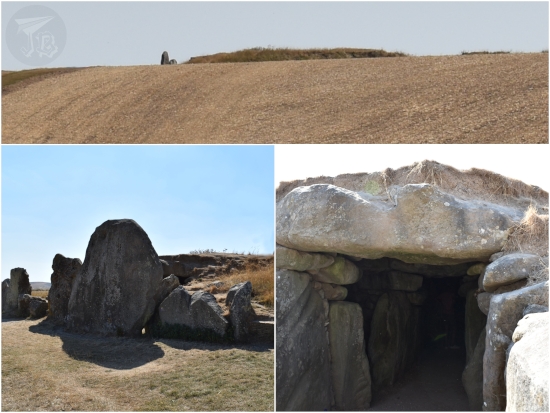
Collage: elongated mound of dirt on top. On the borrom, the gate. On the left the protective slabs, standing upright, and on the right, the entrance. It is a construction of vertical walls made from grey slabs and another slab on top. The interior is dark.

West Kennet Long Barrow is situated in the middle of a farm. There is a tiny parking lot to the side of the road, and a fifteen-minute walk to the barrow itself. It is one of the largest built in Britain, and around 50 sets of remains have been identified, along with pottery, beads and other personal items. Around 2000 BCE, it was closed down and barricaded, then discovered in the 19th century and scientifically excavated and restored in 1956. It is private property under the care of British Heritage. Apparently, all these sites have become a point of pilgrimage for neo-pagans, and on this day, there was a bunch of them chanting inside the barrow…

On the opposite side of the road from the barrow stands Silbury Hill, a mound or artificial mountain. It stands 30 metres high, with 160 metres in diameter wide, and it is estimated that half a million tonnes of material (mostly local chalk) were used to build it throughout several generations of humans. It cannot be climbed, due to a collapse a while back, that would have been neat!

View of a small hill and dry grass.

After that, we headed off to the village of Avebury, which hosts the largest Neolithic stone circle, with smaller circles inside. It originally had over 100 stones, and it might have built between 2850 and 2200 BCE. Today there is a village in the area, with a few shops and museums in the centre, and a lot of sheep grazing the area. Around three quarters of the circle is still standing, along the henge (long ditch that used to be built with the stones in Neolithic circles).

We had two and a half hours in Avebury – a bit too much, I would say – to explore the Avebury Stone Circle and Henge and its sheep. The guide told us about ley lines and trees that were supposed to have inspired Tolkien’s Ents from “The Lord of the Rings”, and I needed to ask about the geology of the stones – here I learnt that they are made out of sarsen, like the Stonehenge ones. Sarsen refers to silicified sandstone blocks, common in the area, and it has been proven that the ones used in the megaliths come from Marlborough Downs, some 25 km away (35 km from Stonehenge). Once we were dismissed for our “free time”, I walked along the three fourths of stone circle remaining.

A collage showing different megaliths from the Avebury stone circle. Small pillars mark the spots where the stones have been lost. There are some sheep grazing on dry grass.

There are other places to visit in town, such as a Medieval manor with a dovecote. The stables of the manor are the site of the archaeological museum is hosted, and here I made a mistake. I should have got in, but I wanted to visit the church, and by the time I was done, the museum was closing down. Live and learn. There is also a tiny chapel, and a lot of souvenir and “crystal” shops.

The Church of Saint James dates back to the 1000s, though later centuries saw the addition of many items, such as the aisles and the 15th-century wooden roof. The nave and the chancel are separated by a one-of-a-kind wooden rood / screen with an original 13th century base. There are Saxon windows and a Norman font. It is a fantastic little church.
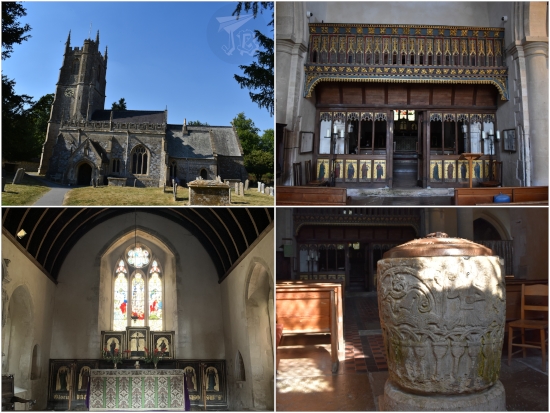
Gothic church, from the outside. The inside shows a wooden Normand altar, the standard altar, and a carved stone baptismal font

Finally, the time came. At 17:30 we met up on the way to the coach, and then we started off towards the highlight of the day – Stonehenge. Stonehenge was erected between 3000 and 2000 BCE – the primitive human somehow got the sarsen stones into Salisbury plain and planted them so they stood in a circle. They measure up to four metres long, and some of them are arranged in the shape of trilithons – two large vertical stones (posts) support a third one (lintel) which is set horizontally on top of them, with carved studs so the structure fits like a snap. There is a tear-shaped monolith standing a few metres away called “Heel stone”, which marks the entrance.

Some of them are indeed collapsed now and some are covered in lichen – there is a special type of lichen that only grows in three places in the world, and that is one of them. For thousand of years, these stones have remained standing, and the first historical study of them dates from 1666, carried out by an English antiquary, natural philosopher and writer John Aubrey, and has been restored a several times, especially during the 20th century, when they were roped off and a fee charged for entry.

Currently, the stone circle belongs to the Queen of England, and according to the British Ancient Monuments Bill, it cannot be touched or altered in any way that is not to preserve its current status. In 2020, a core taken from the stones during the 1958 restoration was returned. This allowed researchers to analyse the composition and prove that the megaliths are indeed sarsen from the Malborough area.

The rules when you are allowed into the stone are “simple”: do not touch the stones, do not step on the stones, do not hug the stones, do not lick the stones, do not get naked among the stones. Judging by the tone in the guide’s voice, all that has happened before. Apparently, there are a lot of ley-line believers, neopagans and neodruids wanting to “connect” with the earth energy there (there is even a “yoga at sunset group”). In a kind of compromise, they allow you to take off your shoes and socks – which I did not do.

According to archaeologists, Stonehenge was designed in alignment the Winter Solstice sunset. The site was probably a celebration of the end of the worst of the winter before days started getting longer again. Other theories propose that it was originally a burial site that became a place to worship the ancestors.

The great thing about the after-hours tour is that you get to see the sunset around the site. Our timing was 18:45 – 19:45. The guide was nice too, and gave us “permission” to wander around and did not expect to listen to him all the time – don’t tell me twice. I explored and wandered to my heart’s content. We stayed there for about an hour, and it was really cool. I mean, not magical or “I feel the magic of the earth” or anything, but the circle is a fantastic piece of engineering, especially considering it was built five thousand years ago, before writing was even invented. Sometimes, humans are neat.

Stonehenge collage. Two shots of the megaliths standing on dry grass, from the outside; the sun shines between the darkened stones. One shot from the inside of the circle, showing the megaliths circling inwards.

It was over sooner than I would have liked, but about an hour later we were back on the bus after hitting the souvenir shop – where I got a guidebook – and we arrived in London around 22:00. When I got off the bus I just walked to the hotel, had my sandwich. Good thing I had left the window open, too, as it made the temperature slightly more tolerable – I own up though, I slept with the fan on, but… like a rock. Or a stone.

Walking distance: 11.96 km / 18742 steps
Coach distance: 317 km
11th August 2022: 21 hours straight of ups and downs in London {England, August 2022}

The first thing I had to do was waking up for a 6:30 flight – though considering I did not sleep very much that night due to the heat, I’m not sure if that it counts as waking up. The previous day, the airline had sent warning emails about arriving at the airport early – three hours before the flight would have meant being there at 3:30, so… not really. I arrived at the airport around 5:10, and I was at the gate by… 5:20, I’m not even kidding. While I normally do not queue to enter planes – the advantages of backpacks, I just kick them under the seat – I had been assigned seat 1A, which meant I had to put my luggage into the overhead compartment. I had decided to take a small backpack too, because I would be carrying it around for a while, and it would get searched in a couple of places.

Surprisingly, despite Brexit, the Ryanair strikes, airport chaos, and the fact that apparently the automatic passport reader cannot cope with my new look, I made it into the United Kingdom first and straight to London without a glitch. Not only that, I managed to get my Oyster recharged without any problems, and as soon as I had bought some food, I was on my way to the first stop of the day: Crystal Palace Park, for which I got to ride the shiny new underground line, the Elizabeth Line, then the Overground. Even though there are another couple of landmarks (that might warrant a visit when / if the restoration project finally goes through), what interested me in Crystal Palace was a collection of Victorian sculptures – the Crystal Palace Dinosaurs.

Though Ancient Greek already knew about fossils before the current era, it was in the 19th century when it hatched as a “science”, according to some spurred by Darwin’s “On the Origin of Species”. Fossil hunters ran amok, excavating and spoiling the North American badlands. In England itself, Mary Anning kept discovering cool things. There was a sort of a “Dinosaur fever” – the Victorians became fascinated with all things prehistoric. In 1852, a number of extinct animal reconstructions were commissioned to be erected in the gardens of the Crystal Palace, after the World Exhibition. Using the knowledge available at the time, Benjamin Waterhouse Hawkings, a natural history illustrator and sculptor, who did his best according to scientific knowledge at the time.

Not all the animals represented are real dinosaurs, but the nickname stuck. From today’s standards, most of the reproductions are extremely inaccurate, with some exceptions, such as the ichthyosaur (discovered by Mary Anning around 1811), and the plesiosaur (of which Mary Anning also found a skeleton in 1823, and then another in 1830 – I love that woman). Today, the park is organised in several “islands” where you can see the sculptures, though the water was a bit down due to the heatwaves:

  • Amphibians and therapsids: Dicynodon and Labyrinthodon
  • Marine reptiles: Ichthyosaur, Mosasaurus, Plesiosaur and Teleosaurus
  • Dinosaurs and pterosaurs: Hylaeosaurus, Iguanodon, Megalosaurus and Pterosaur
  • Mammals: Palaeotherium, Anoplotherium, Megaloceros and Megatherium

I have been aware of these sculptures for a long time – since I was a child and started liking dinosaurs. However, only recently did I find out that they really existed, and where they were. I arrived at Crystal Palace station a little after ten (making whole travel from the airport about two hours). I walked by a small farm with typical fauna such as… an alpaca, then I ate my sandwich overseeing the first island.

A collage showing differet statues of prehistoric creatures. Some try to be dinosaurs, and they look almost comically wrong, like giant iguanas or chameleons. There is one plesiosaurus looking rather acurate - it has a long neck and flipers. Finally, some mammals: a deer with huge antlers and a tiny horse-looking creature

I walked around for about an hour and then I set on my way back. Though I had planned to have a relaxed day at first, I had to adjust due to cancellations and train strikes. It was around that time that I calculated that I could actually cram my original Thursday and Saturday plans onto Thursday, plus the alternative plans I had made if I tweaked the time a little. So I back-rode for another hour towards the city.

Near Tower Hill stands the Sky Garden, on the 35th floor of the 20 Fenchurch Street building, designed by Rafael Viñoly. Sky Garden is considered the highest garden in London, and a fantastic viewpoint of the city. I almost accidentally came across the option to book a free access ticket for this – while I had not wanted to pay for any morning / early afternoon activities in case my plane was delayed, I figured out that I could book this for free, especially as they go stupidly fast! I made my 12:30 timeslot with a few minutes to spare, but I was let in after a queue, ID check, X rays and metal detection.

The Sky Garden features two terraces full of plants (landscaped by Gillespies), a couple of restaurants and bars, and an “open” gallery which has glass above your head so the feeling of opening dissipates – the glass is stained and scratched. It was one of the “must-do’s” in London I had never visited before, so I thought it would be a good opportunity. Fortunately, they have relaxed the rules on no bottles because of the unusual high temperatures.

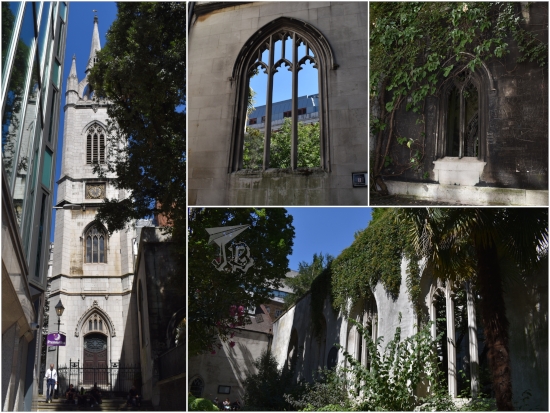
After wandering around for a bit, I continued onto Saint Dunstan in the East Church Garden, the ruins of an old Wren church destroyed by The Great Fire of London and destroyed again during the Blitz (World War II bombings). Dating back to the 1100s, it was opened as a public park in 1970. Aside from being a very cute building park I wanted to see for a while, a music video by the band VAMPS was filmed there.

Ruins of a gothic church turned garden, with hanging ivy and bushes overgrowing the walls and windows

As it was lunchtime, the park was bustling with people, so I just had to move on rather quickly, and went back to the underground to get to the area of Westminster. I had originally booked tickets for Saturday (back in May) but then they were cancelled due to “repair work” going on that day (I do wonder if it was a security measure related to the strikes though).

But of course, first I feasted my eyes on the very new Elizabeth Tower clock tower aka Big Ben – though Big Ben is one of the bells in the tower, but nobody really cares about that any more.

Elizabeth Tower, shining gold with the restoration. It almost looks fake. The clock marks Quarter to two.

The Palace of Westminster or Houses of Parliament is the centre of the United Kingdom’s turbulent political life. The current palace was built after the previous one was destroyed by a fire in 1834. The new palace was erected in the Neo-Gothic style, and it was mostly finished by 1860, although it did open to be used in 1835. There was a competition regarding the design, which was won by sir Charles Barry. The Palace of Westminster holds the two chambers where the British government meets – the House of Lords and the House of Commons – alongside the Norman Porch, St. Stephen’s chapel, and the different corridors where the MPs vote or discuss state matters. I’ll forever be amused that “for security reasons, photography is not permitted in these chambers with dozens of cameras for TV broadcasting and Internet streaming”, but alas. The woodwork on the Norman Porch ceiling is fantastic, and some of the decoration choices, such as Churchill’s sculpture are… interesting. It is noteworthy that it is part of the Unesco Heritage Site “Palace of Westminster, Westminster Abbey and St Margaret’s Church”.

Collage: a view of the houses of parliament (London), with the Elizabeth Tower on the left. Two shots of the Norman Hall, a huge ward with an intrincate design of wooden ceiling. A gothic corridor with a wooden door and some coloured glass panels

Afterwards, I just found my way to the hotel – though I had to wander a little to find the nearby supermarket, bugger those never-ending attached-house neighbourhoods, rested for a little and then went to the station to go to the theatre – I wanted some extra time to check out where my airport coach would leave, so I gave myself 45 minutes for a 22-minute trip. It turns out there was train trouble and I was barely on time, taking an alternative route instead of the direct one.

When I realised my flight timing would give a free evening in London, I booked tickets for the Apollo Victoria Theatre to watch the “Wicked”. This musical tells the story of “The Wonderful Wizard of Oz” from the point of view of the witches, and somehow gives the “Wicked Witch from the West”, Elphaba, an amazing personality and backstory that resonates a lot with me. For the same price as the ticket I was eyeing back in the day, I found a VIP upgrade just one seat over, so I was entitled to a drink and “snacks”, an early entry, along with access to the “Ambassador Lounge”, a tiny reception hall with access to a private restroom.

“Wicked” was great. The actress who plays the main character, Elphaba (Lucie Jones) came out a little yelly though in her solos. The duets with the other female singer (Glinda, Helen Woolf) were fantastic, and the male love interest’s (Fiyero, Ryan Reid) song was absolutely great, even though he is a character I have never cared for.

Apollo Victoria Theatre: the inner theatre, showing a dragon and a closed curtain showing a map of Oz. The outer theatre: there is a sign reading Apollo Victoria Wicked, and everything is lit green. The VIP lounge, with a glass of soda, and some chairs. The cast at the end of the show, taking their goodbye bows.

By the time I was out, the trains were running again, and one-to-three-minute delay on a line that runs every five minutes or so, and I was at the hotel by 23:00, absolutely beat. The room was extremely hot, because London is absolutely not ready for heat, so I had a snack in front of the fan, took a shower and then got some sleep – 21 hours on the go were over. Funnily enough, by the time I went to bed, I had that wobbly-world jet-lag feeling I have after my first day in Japan. It must have been the barely sleeping the night before. I fell asleep very fast.

Walking distance: 30.52 km / 46192 steps

11th – 13th August 2022: Non-weekend weekend in England

When, back in May, I decided to book this trip, I was surely not anticipating the chaos in the European airports this year, nor for sure the England transport strikes. I did not foresee that the Palace of Westminster would suddenly cancel my visit, nor that it would be through my Westminster Abbey reservation that I would be informed of trains cancellations. I did not know that I would have to buy a last-minute bus ticket and miss half of a tour… Lots of things went almost wrong, but in the end, most everything worked out.