17th November 2025: Nice is nice! {France & Monaco, November 2025}

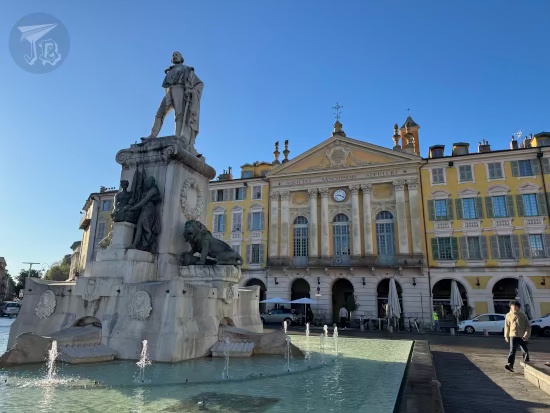
Yes, I’m sure the joke has been made before – ad nauseam. It still describes my experience pretty well. I was up and ready to go almost an hour earlier than planned, so I left my luggage at the hotel and set off towards Place Garibaldi, one of the hip places in town. Nice was waking up, people heading to work on a Monday morning. I walked by some interesting buildings, amongst them the Modern and Contemporary Art Museum (MAMAC), Musée d’Art Moderne et d’Art Contemporain, which, along with the Natural Science Museum, is closed for renovation. The square Place Garibaldi hosts a statue to the man in the middle, it’s surrounded by Baroque buildings with arcades, and crterminaiss-crossed by tram lines.

Place Garibaldi, with a statue and Italian-style buildings.

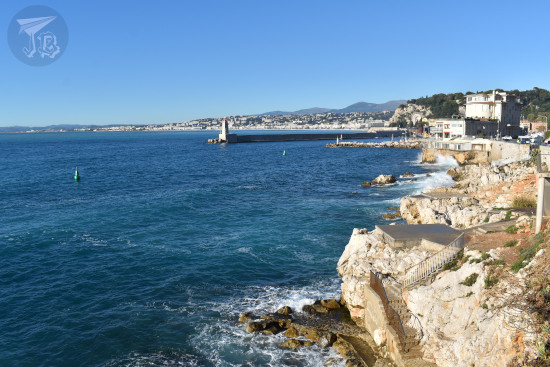
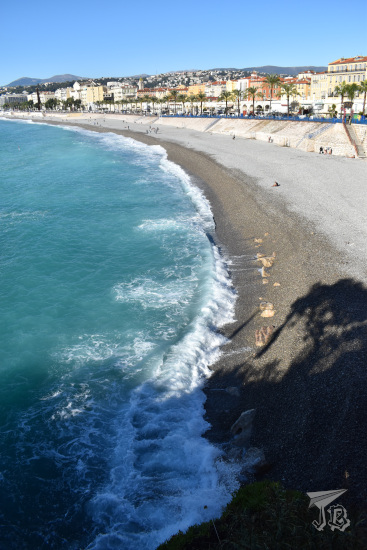
I continued towards the marina Nice Port and went along the Promenade a bit further north. All the private beaches along the Mediterranean Sea coast were closed off due to high waves. Despite that, it was not even 10:00 yet, and it was already warm. The temperature would reach 21 ºC. In late November. I guess that explains all the holidaymakers that crowded the area – the whole French Riviera got its reputation from mild winters, and today was a great example of that, even after the deluge on Sunday. I walked along the marina and Castle Hill at the Promenade level, going around Pointe de Rauba-Caupe, where the memorial Monument aux morts de Rauba-Caupe-Nice stands to commemorate the fallen in World War I. It didn’t take long to reach familiar territory, Quai des États-Unis, which I walked along until it turned into the even-more-famous Promenade des Anglais. I had taken off my coat by then, and the beaches, protected from the open sea, were again open.

The rocky coast of Nice.

Nice beaches, with waves breaking.

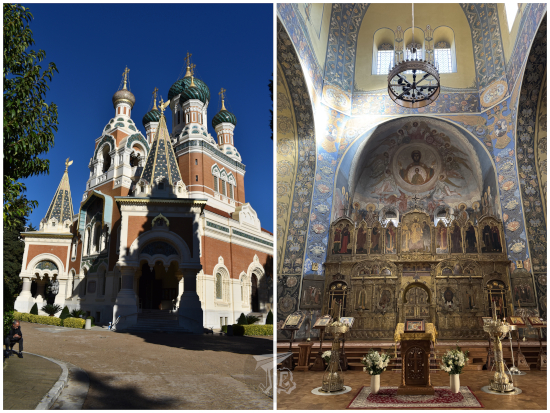
When I reached the luxury hotel Le Negresco, I walked into the city, looking for the Orthodox cathedral, Cathédrale Orthodoxe Russe de Saint-Nicolas de Nice, colloquially known as the Russian cathedral. It is an early-20th-century building, erected in a modern take of the Old Russian style by architect Mikhail Preobrazhensky. It was later declared Historic Monument due to its uniqueness.

St Nicholas orthodox cathedral

Afterwards, I headed towards the area of Cimiez, and after a couple of wrong turns, I finally reached the hill it comprises. Strolling by gated communities, up I went. I wanted to see the Belle Époque Ancien Hôtel Régina. Though today it’s an apartment complex, it was originally built as a hotel to host Queen Victoria of England when she spent time in town. A bit past it, I reached the top of the mountain. There is a green area there, Jardin des Arènes de Cimiez, home to several buildings, museums and ruins.

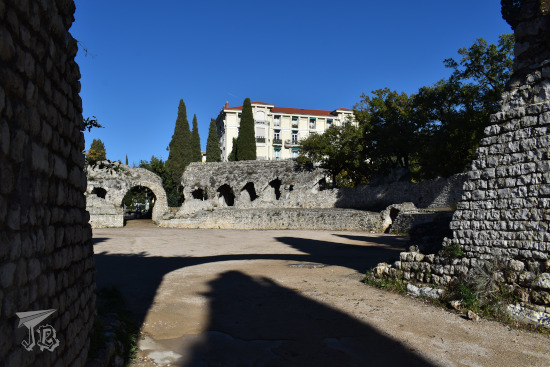
My first stop was the Roman amphitheatre Arènes de Cimiez. It was erected in the first century CE, with a capacity for around 4,000 spectators, in the Roman town of Cemenelum. Though it was abandoned in the 4th century, it was never completely forgotten, but it was not until the late 1800s that the ruins were first addressed scientifically.

Ruins of Roman amphitheatre Arenes de Cimet

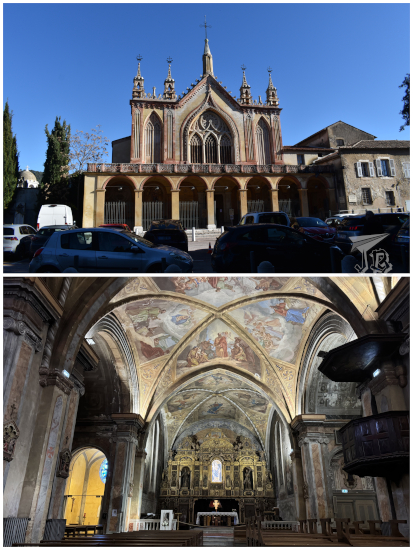
A bit further away stands the Monastery of Cimiez, along with its church, Monastère de Cimiez. This religious place dates back from the 9th century, it was originally a Benedictine abbey, which was later turned into a Franciscan monastery. The current building dates from the 14th century, and in the 19th century Neo Gothic façade was added. The interior is decorated with frescoes from the 13thcentury, and the wooden altar gilded with gold.

Monastery of Cimet - gothic looking and with frescoes on the inside.

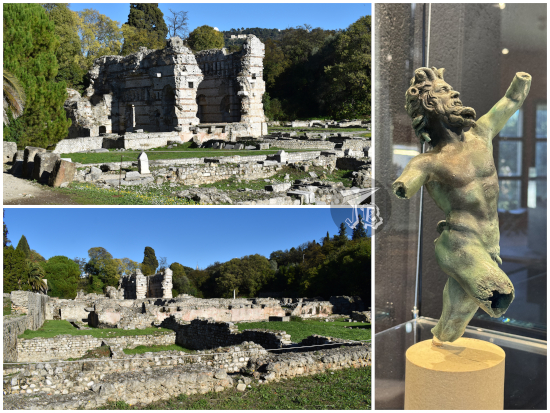
I then backtracked towards the archaeological museum Musée d’Archéologie de Nice / Cimiez. The museum itself is small, but entrance gives you access to the whole archaeological site Thermes romains de Cimiez, the Roman baths that served Cemenelum between the 1st and 4th centuries. The museum holds both original artefacts and reconstructions, and I was particularly smitten by a small sculpture of a faun.

Roman ruins of Cimet, Nice, and a small sculpture of a naked faun-

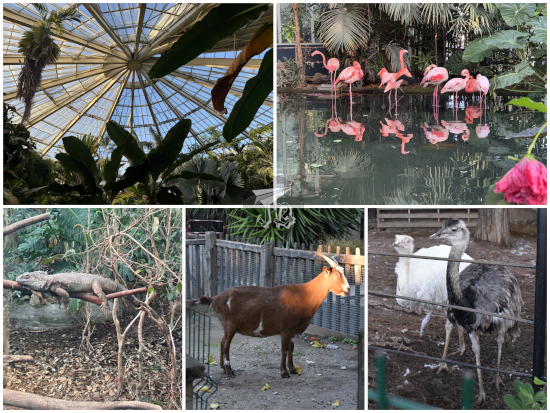
By the time I left the museum it was about 14:15. I headed back into town to pick up my luggage at the hotel and buy some lunch (I did remember this time to do it before I got to the transport hubs!). I took the train towards the area where the Aéroport Nice Côte d’Azur airport is. My flight boarded at 18:25, and I am just not used to airports having things to do around them. But this one did – there was a museum and a botanical / animal park nearby. I found the entrance to the latter, called Parc Phœnix, and walked into the glasshouse that hosts the tropical plants and animals. There were terrariums with reptiles, including crocodiles, pythons, and lots of tortoises. There was a cactus area, and after the orchid ward I suddenly saw a pink reflection – there was a flock of flamingos basking in the warmth of the glasshouse, in a small pond made for them.

There is an insectarium sprinkled with small Ghibli figures to adorn the different habitats. There also lived the axolotls and the koi fish. I then went to the outside area, where I was able to have my sandwich. In the garden, I could see the aviaries, and the free peafowls. I caught a glimpse of a wallaby, but probably the most exotic animal over there was the huge rat I spotted. And some very fun greater rhea (Rhea americana) who were very interested in the shiny camera.

Parc Phoenix - the glasshouse, flamingoes, an iguana, a goat and some greater rhea.

I spent a bit over an hour there, and even if I did not see all the animals, it was nice to have something to do which did not involve waiting at an airport lounge. It took me 15 minutes to reach the terminal from the door of the park. And for some reason, they have a sculpture of a wooden shark hanging from the airport ceiling.

Security went smoothly and boarding was fast and efficient. Since it was a regional flight, all trolleys became checked at the gate. I was carrying a backpack so I was allowed right through. It was the smallest aircraft I’ve flown in lately, and it surprised me that the trip was much faster than the one to Paris. Of course, I should have realised I was quite closer, after having crossed a good chunk of France by train on Saturday.

Once I left the terminal, I had to wait for the shuttle to take me to the parking lot. At first, I waited for a couple of minutes at the wrong stop – I guess I was a bit more tired than I thought. Then, when I was a the correct stop, the mini van stopped further than the road and left before I could reach it, until around 21:30 I finally got on board. I reached the car, and saw with relief that nobody had bust the window to steal my 2010 Sat-Nav which I had forgotten on the copilot’s seat.

Traffic was not too bad, so I was home within the hour. I got some food in me, had a shower and went to bed, still giddy from everything I had lived in such a short period of time. My only regret was wasting money on a new Lonely Planet guide, which was pretty much useless – it did point out all the hip spaces and places to eat and drink, but the information on historical sites was lacking… I miss the old guidebooks.

16th November 2025: Day trip to Monaco {France & Monaco, November 2025}

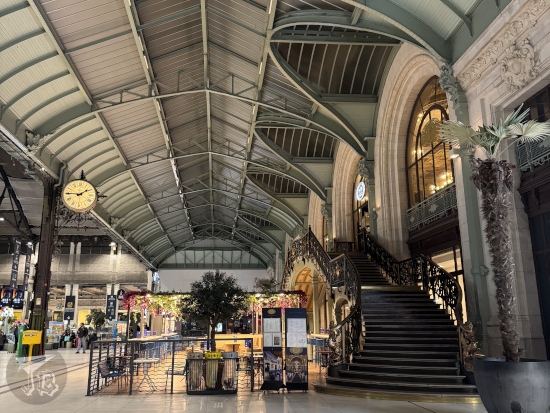
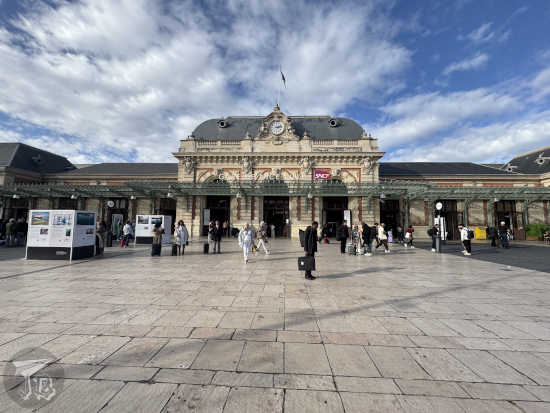
Ready to brave a 100% chance of rain, I woke up, drank my coffee, and left my hotel in Nice to head to the station. At that point, Nice was in weather alert for storms, rain, flooding, waves, winds, and landslides. However, my destination, Monaco – less than a half-hour by train – was chill. It was drizzling when I stepped onto the street, but not enough to even need an umbrella. When I reached the station, I set to fight the ticket machines, which were so confusing that I missed my train while trying to finish the transaction. Fortunately, with a frequency of 30 minutes, it was a train I could afford to miss. I spent the time taking pictures of Gare de Nice-Ville. The station is a typical example of the use of iron as building material at the end of the 19th century. It was designed by architect Louis-Jules Bouchot in the Louis XIII style, inspired by Parisian buildings. Though it originally sat outside the city, now it is right in the middle of it, and it has been in service since 1864.
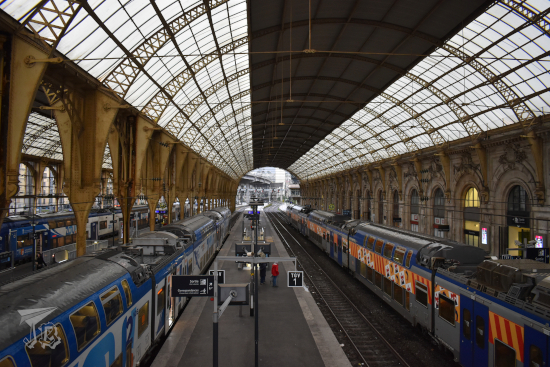
In the train shed of Gare de Nice - glass ceilings and wrought iron beams.

When my train arrived, it was only 20 minutes or so to reach the principality Principauté de Monaco, a city-state that spans little over 2 square kilometres in area – it qualifies as a microstate, and it is the second smallest state in the world, with not even 10,000 nationals. However, almost 38,500 people live there, making it very highly populated – think Malta on steroids.

Monaco has been ruled by the House of Grimaldi since around 1300, when the family conquered the territory. It was annexed by France after the French Revolution, but after the defeat of Napoleon it was given to the Kingdom of Sardinia. When Sardinia became part of Italy in the 19th century, Monaco regained its sovereignty by conceding outer territories to France, with independence being achieved by the Franco-Monégasque Treaty of 1861. At this time, it had become a tourist giant, establishing hotels and a famous casino. Nowadays, the city-state is considered one of the most expensive and wealthiest places in the world – around 30% of its residents are millionaires. It has no personal income-tax and low business taxes, which makes it a tax heaven and money-laundering hub, while still using the euro though it is not part of the European Union – hello there, unexpected Internet roaming charges!

Most of the city is in levels due to the slopes of the French Alps plummeting right into the Mediterranean Sea. Though originally there were different municipalities in the country, today Monaco is basically one big city – with a lot of parks, for sure. In 2015, it literally ran out of space for houses, so it began a project to create “land in the sea”, using concrete blocks as foundation. This is one of the nine administrative wards, the most important – or famous – of them being Monaco-Ville (the technical capital) and Monte Carlo.

Besides tourism and money-laundering, one of the most important industries in Monaco is gambling. The casino Le Grand Casino de Monte Carlo single-handedly makes so much money that it is the reason Monegasques don’t need to pay taxes besides social-insurance ones. Since 1929, the country has held the Monaco Grand Prix on an annual basis, along with other major races, on a “designated” circuit Circuit de Monaco, which is part of the actual town’s streets and roads.

I reached Monte Carlo station half an hour later than intended, but well within my self-impose timetable. I followed the signs to the casino and walked through steep streets lined with manors in the Belle Époque architecture style. After ten minutes or so, with just a few droplets of drizzle in the air, I reached the park Jardins du Casino de Monte Carlo, composed of two different gardens (Jardins des Boulingrins and Jardins de la Petite Afrique), with a beautiful classic merry-go-round within, and some ducks frolicking in puddles. The gardens lead to the Place du Casino and of course the casino itself – Le Grand Casino de Monte Carlo. I am not a gambler, but the architectural interest of the building attracted me, and cultural visits can be carried out in the morning. However, these cannot be booked online, and time was quite limited. Thus, I had chosen to make it my first visit.
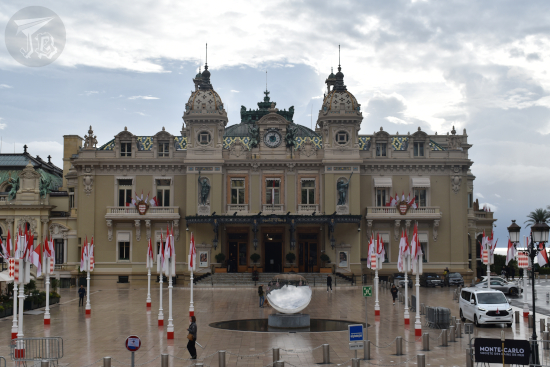
Outside the Casino de Montecarlo.

The two security guards – metal detectors in hand – smiled at me and waved me through. I must not look like a casino risk (which also made me chuckle remembering how I had been so thoroughly checked in the Paris Palaeontology Gallery, maybe they saw me as suspicious for some reason?). When buying my ticket, I understood why you could not book online. When you purchase the cultural visit, you are given the chance to “invest” that money into a voucher for playing slots once the casino opens for actual business. I declined, citing that I was not dressed for that. I later learnt that there is a gaming room for the “rabble” before getting into the actual high-class room – but the cultural visit allows you to snoop almost everywhere.

I was not interested in gambling anyway, so I went on my merry way to do the aforementioned snooping. The casino is owned by a public company controlled by the government and the Grimaldi house, and it is only open to foreigners. It was established in 1863, and the architectural style of the current building is a bit on the eclectic side. Architect Charles Garnier combined elements of Baroque, Renaissance, Belle Époque, some Art Nouveau… to create a luxury environment. Some of the classical games gambled on include poker, craps, blackjack and baccarat, along with different kinds of roulettes. However, the sheer amount of slot machines for different games threw me off. They looked completely out of place in the classical environment. The two halls with only classic games were my favourite, and I saw that some of the tables had a minimum bet in the hundreds of euros.
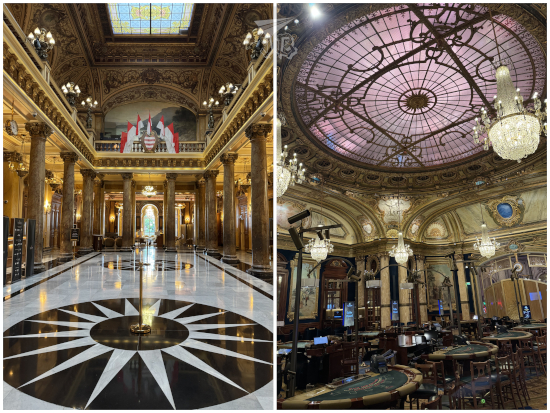
Lavish interior of the Monte Carlo casino - everything is gold and golden!

Not having run into James Bond (the casino was featured in Never Say Never Again and Golden Eye), I left the casino and headed to the real reason I had been wanting to visit Monaco since May 1992. I am not even kidding.

Probably the Universal Expo in Seville in 1992 was my first big trip. I was just a child, so my parents organised everything, but I’m told I behaved like a trooper. One of the pavilions we visited then was the Monaco one, where there was a giant aquarium with an underwater tunnel. I was immediately smitten, and promised myself that one day I would visit Monaco and the Oceanographic Museum there. Today was that day.

The Musée Océanographique de Monaco was the brainchild of Prince Albert I of Grimaldi, who ruled the principality between 1889 and 1922. While he cannot be considered the father of oceanography, one could say that he was one of its main early-adopters. He owned four research vessels, studied ocean currents, and collected biological specimens and soil samples – he did a lot of cool stuff. After his death, the most famous diver in the world, Jacques-Yves Cousteau, became director of the museum between 1957 and 1988.

However, before I entered the building, I had to get there. Adjacent to the Le Grand Casino de Monte Carlo stands the Opéra de Monte Carlo. To the other side, one of the most famous stretches of the racing circuit Circuit de Monaco, the Fairmont Hairpin Curve. I snuck into a hotel terrace for a good picture, but left before any security guard could come to kick me out.

Afterwards, I explored a park with ocean views, where there was a seagull on duty to make noises at tourists. I am glad I entered the park using the entry I did, thus I was not confused by the footprints left there. When I saw “Maradona” and “Pelé” I realised that the park was dedicated to footballers. It makes sense that it is called The Champions Promenade – but if I had used any other entrance, I would have had zero idea who those people were.
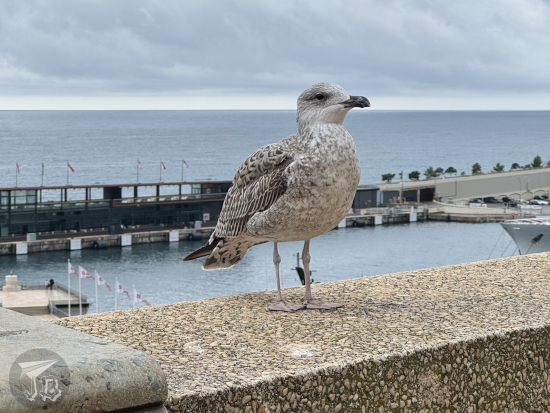
Young seagull standing at the pier.

I walked past the already-getting-ready Christmas market, and walked around, and headed south along the Mediterranean Sea coastline. I strolled past interesting buildings such as the Auditorium Rainier III and some monuments to famous racers – William Grover Monument and Statue de Juan Manuel Fangio. On the other side of the road I spotted the small chapel Église de Sainte-Dévote, the patron-saint of Monaco.

The Quai Albert 1er had been taken over by a funfair, so I could only snoop around the commercial gallery. I finally tackled the ascent to the ward of Monaco-Ville, the highest part of the city, I think. I went up through pretty stairs through a park until I reached the historical Rampe de la Major which, through the Medieval Gate Porte d’entrée au Rocher lead me into the heart of Monaco – Rocher de Monaco, the area known as “The Rock”, in the ward of Monaco-Ville.

There stands the palace, the Old Town, the cathedral and the museum which was my destination. I stopped for some panoramic views and photos of the Monte Carlo area, and them I scurried through the narrow traditional streets, now turned into restaurants and souvenir shops. I stopped to take a couple of photos of the cathedral, since it was not raining yet, and continued on. A few minutes later I was walking up the stairs of the Baroque Revival building, which perches over a cliff – the Musée Océanographique de Monaco.

My inner child squealed. My outer adult might have too. We both headed downstairs to visit the Aquarium first. The central ocean tank hosts turtles, sharks, and tropical fish, while smaller aquariums focus on species from different ocean regions: Mediterranean on one ward, Tropical on the other. It was actually smaller than other aquariums I’ve visited before but there was something special about this one.
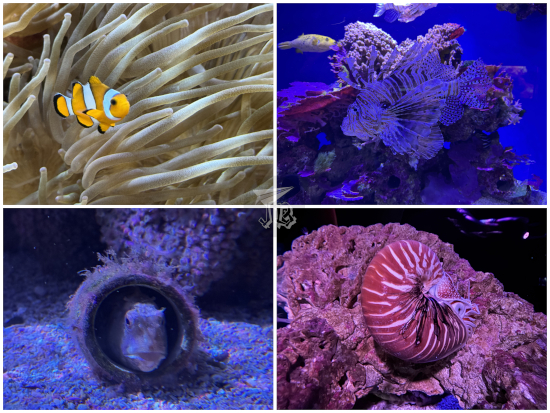
Oceanographic Museum of Monaco aquarium - clownfish, nautilus, scorpion fish and gobid hiding in a pipe.

I then went up to the first floor, which hosts the main exhibit rooms. As I got there, I was greeted by a model of a giant squid, after having some fun with the giant clams decorating the stairs. The central ward of that floor is named Océanomania. It hosts specimens from all the oceans around the world, including a polar bear model and a huge walrus skeleton. Smaller but in no way less cool, there were shells, fish in formaldehyde, and a taxidermied / mummified mermaid. I kid you not. Of course, it’s a souvenir made in Japan using the body of an ape and the tail of a fish, but for a while those were considered the real thing.

In the middle of the room there was a sculpture of a sperm whale breaching. On the right stands the Whale Room Salle de la Bailene, whose ceiling is populated by a few skeletons of cetaceans. There is an immersive temporary exhibition there, Méditerranée 2050 L’Exposition. It is some sort of virtual reality, playing with how a submersible dive would look in 2050 in the Mediterranean if we somehow managed to solve all our problems with pollution immediately. I sat through the English version, and the animation was beautiful.
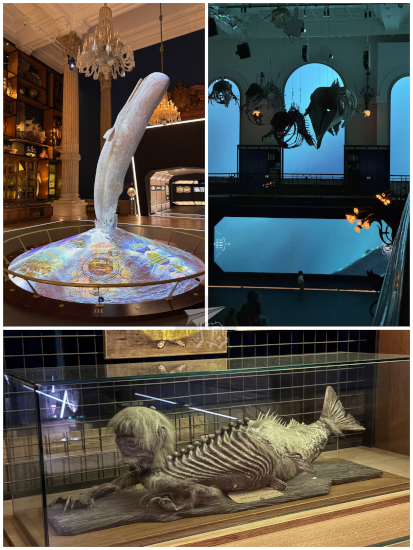
Oceanographic Museum of Monaco exhibits - a sculpture of a breaching sperm whale, cetacean skeletons and a fake mermaid skeleton made from the remains of a monkey and a fish.

Before exploring the left ward Monaco and L’Océan (Monaco and the Ocean), I decided to go up to the Terrace Restaurant and have some lunch. It was underwhelming, but convenient. I was given the worst table – though it was for four people – next to the door (which people forgot to close all the time) and the waiter was pretty unfriendly. But I sat down for 30 minutes, got some warm food into me – faux-fillet sauce au Roquefort (rib eye steak with blue cheese sauce) with chips.

When it was time to leave the restaurant, it was raining hard, and I had to walk across the building actual terrace to get to the door again. I hurried through, protecting the cameras, and got down to see the remaining ward. There stands a replica of a research ship and interactive exhibits of oceanographic instruments, along with the discoveries made by Prince Albert I.

To finish off, I left through the shop. Throughout the museum there are little machines where you can purchase souvenir coins, and I hoped that they also had them in the shop – I did not have enough change for all of them. If they had not had the coins, there was a machine outside, quite literally next to the Yellow Submarine where I would have bought one. Since they had them in the shop I got… all five.

It was still early, and the rain was back to a manageable drizzle, so I wandered the gardens Jardins Saint-Martin, a bit of a botanic garden with views of the ocean, the Musée Océanographique de Monaco, and the harbour Port de Fontvieille.
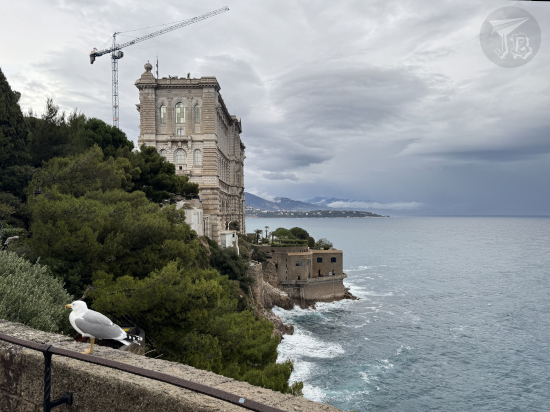
Oceanographic Museum of Monaco standing above the waves, with a seagull in the front of the picture.

The 100% chances of rain were still holding, and it didn’t feel like the weather gods would favour me for much longer. I reached the Cathedral of our Lady Immaculate, a Neo Romanic building which – luckily – had the altar lit up. Actress / Princess Grace Kelly is reportedly buried there, but most of the graves were covered by carpets and I was unable to find hers. What I did find was a commemorative coin machine. By the time I left the building, I had run out of favour from the gods. I pulled my umbrella and marched on towards the Place du Palace, where the Palace Principier, the official residence of the head of state is. The Palace can sometimes be visited but it’s at the moment closed. But do you know what it had? Commemorative coins.
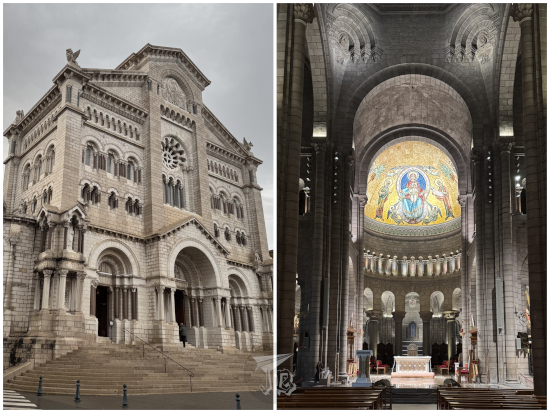
Cathedral of Monaco - neoromanesque building, inside and outside.

One of my (albeit silly) goals for the day had been walking from the south to the north borders of the city-state. Imagine the bragging rights, crossing a country from west to east (I had done that from the station to the ocean border), going from the lowest point (the harbour) to the highest (the Oceanographic Museum terrace), and from south to north. However, it was raining in earnest now, so my umbrella and I headed to the private collections of cars that the Prince owns La Collection Automobiles de S.A.S. le Prince de Monaco. I went down towards Monte Carlo using the same stairs I had used before, which had turned into a bit of a waterfall. I was not far from the car collection, but the straight line was blocked by the funfair I had seen before. I had to stop under a roof to throw my rain poncho on.
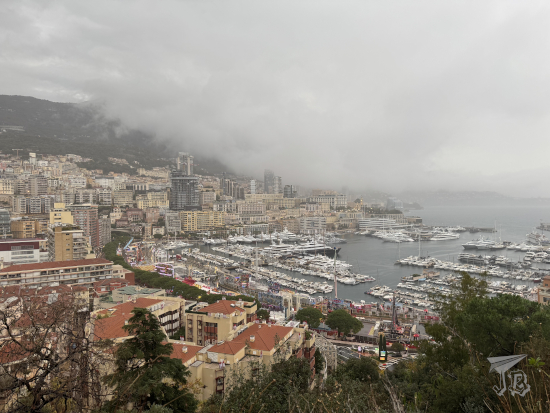
View of Monaco in the middle of a stormcloud, showing the marina and the tall buildings on the coastline.

The Private Cars Collection of HSH Prince of Monaco is quite impressive, containing ancient cars, classical ones, modern machines and quite a few F1 engines. I saw Fords from the first batch of Fords ever built, Rolls Royces, Aston Martins, Ferraris, Lamborghinis… I even inspected the sub-collections of helmets. This time I didn’t buy the commemorative coin, but a casino chip imitation.
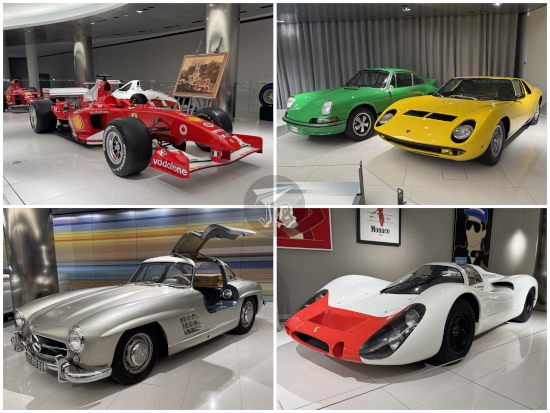
Some cars in the Prince's collection - racing and luxury Ferraris.

I undid my way from the morning. The storm was now pretty bad, and water ran down the streets. I decided to take one last picture of the Casino de Monte Carlo, lit up, and then head back to the station. Of course, when I got there, the rain stopped. However, my shoes were waterlogged, and so were my jeans up to my knees. I decided to head back to Nice anyway, and give up my cross-country endeavour.
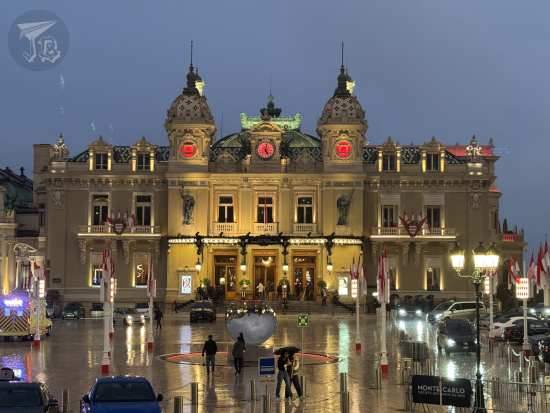
Casino de Montecarlo in the evening while it rains.

Trains were delayed due to rain, but one came shortly after I had reached the platform. On the train, I reflected that my inner child was extremely happy. My inner adult too. My outer adult was pretty drenched. Upon arriving at Gare de Nice-Ville, I stopped at the supermarket for supplies and went back to the room. As soon I reached the hotel, the skies opened again. However the meteorological alert had already passed. I had to talk to reception to get a working remote for my air conditioning machine, because the previous evening had been okay, but today I was going to need some extra heat. I had a shower, changed into my PJs and devised a strategy to dry off my shoes, trousers, and maybe socks, using the hair dryer without overheating the machine. I was mostly successful. Socks had to come back in a separate bag, wetter than merely damp, though.

The shoes were pretty okay (though the inner soles will never be the same), and the trousers fine. Around midnight, I left the former wrapped in a towel and the latter hanging, and went to bed to dream about seahorses.
15th November 2025: The Côte d’Azur {France & Monaco, November 2025}

D****e was leaving Paris about an hour earlier than myself, so I decided to tag along to her station and then backtrack to mine (hey, it was extra friend-time). I’m not good at going back to sleep after waking up, anyway. Thus, we checked out of the hotel together, and I rode with her, then changed platforms towards Paris Gare de Lyon to take my long-distance train. The ride across France was six hours, but it was very cheap, and not much longer than I would take flying from home to my destination.

The current iteration of the Paris Gare de Lyon station was erected following designs of Marius Toudoire around 1900, so it was ready for the World Fair. It features a clock tower and an inner ironwork structure combined with decorative details typical of the Belle Époque design. The station was bustling even early in the morning – I arrived before 7:00 for my 8:21 departure. My ticket said that I would have to leave through hall 3, but there was an announcement from hall 1, where I waited.

Inner platform of Gare de Lyon station.

Since the previous day I had been tired and had not thought to buy food for the day, I had to pay the price of travel-hub lunch. I got myself some cookies, a Coke and a sandwich – chicken in traditional sauce. I also decided to start a Christmas ornament collection, and got myself a shiny Paris bauble. Access to the train opened ten to fifteen minutes before departure, and it was a bit chaotic. My seat was in the low 500s, and for some reason you could not go from one carriage to another (or at least from my carriage to another?) so I’m happy I got the right door on the first try. The train left on time, at 8:21 sharp, and I slept for the first couple of hours. Around 11:00 I was hungry, so I decided to pull out my sandwich… which ended up being “tandoori sauce”, not “traditional sauce”. Take that, caffeine-deprived brain. For a second, I considered not eating it, fearing it would upset my stomach. However, I was hungry enough that I did not really care, and it was not too spicy. I had another nap afterwards again, and before I knew it I had arrived at the Gare de Nice-Ville station in Nice, in the south-east of France, the area known as the Côte d’Azur (Azure Coast) or French Riviera.

Gare de Nice station from outside.

The first hominids may have roamed the area as far as 400,000 years ago. However, the city was founded around the 350 BCE by settlers of Greek origin, naming it after Nike, goddess of victory. There was a nearby Gallic-then-Roman settlement, Cemenelum, which was eventually absorbed by the growing Nice. During many years throughout history, it could be considered that the region was part of Italy in one way or another. In 1860, the territory was given to France, though not all the Niçoises were happy about that. The Italy sympathisers were repressed without much success.

After the annexation to France and the modernisation of the railway network, Nice became popular amongst the English aristocracy, who enjoyed spending winter there. Holiday-makers included Queen Victoria, for whom a full hotel was built, and her son Edward VII. This would eventually lead to the city’s economy boom during the second half of the 20th century, after it was liberated from the WWII occupation.

In 2021, Unesco recognised the uniqueness of Nice declaring it World Heritage as Nice, Winter Resort Town of the Riviera, with emphasis on the winter part. The development of winter resorts was different from the summer ones, creating layer upon layer of new structures. The so-called Belle Époque architecture became popular, but all in all, the layout of the city is quite complex, due to both history (grand hotels near Roman ruins) and geography (beaches and cliffs).

I headed out to the hotel, which was very near the station, dropped off my stuff and went on exploring. The weather was great, so I could forego one of my layers, even. I was starting to understand the “mild winter” reputation. I first headed down the Avenue Jean Médecin, the main commercial artery of the town, until I reached the promenade.

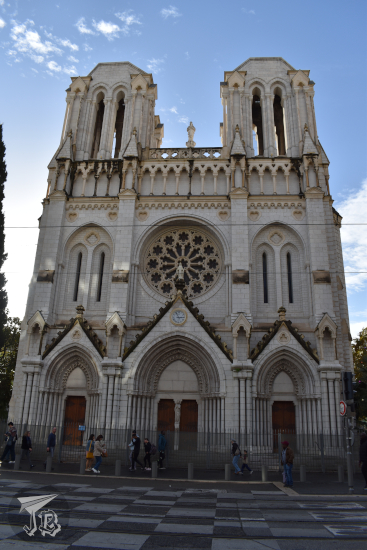
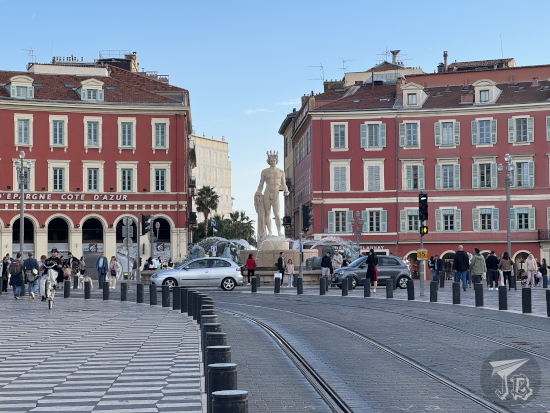
On the way, I stopped at the basilica-church Basilique Notre-Dame de l’Assomption, a Neo Gothic building designed by Charles Lenormand and erected in the 1860s, after the city was incorporated to France, as gothic was (is?) considered a “very French style” (thanks, Viollet-Le-Duc) and more “French architecture” was desired in the city. The building was not open, so I continued down the avenue until I reached the large Place Masséna, the main square of the city. It is surrounded by red buildings of Italian architecture, and a fountain called Fontaine du Soleil, the fountain of the sun, representing the Greek god Apollo.

Neo-gothic basilica.

Place Masena with Italian-architecture building and a monumental fountain.

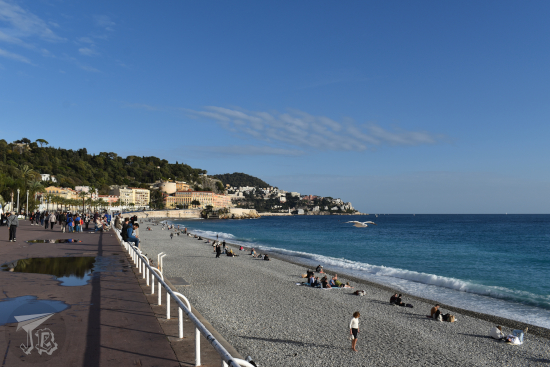
After crossing the Esplanade Georges Pompidou and leaving behind an ugly monument thing Neuf lignes obliques, I found myself at the famous Nice promenade and the Mediterranean Sea. In front of me, a line of private and public beaches made of rounded boulders. On my right, the Promenade des anglais (the Walkway of the English), and on my left the Quai des États-Unis (United States Quay). I turned left, but I could not prevent getting distracted by the beaches. Leaving behind the opera house Opéra de Nice, where nothing was on, I spent some time sitting by the ocean before I continued my way.

Etats-Unis quai and the beach.

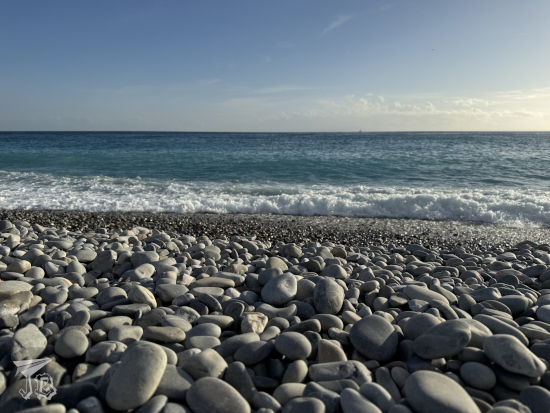
Waves on a pebble-and-stone beach.

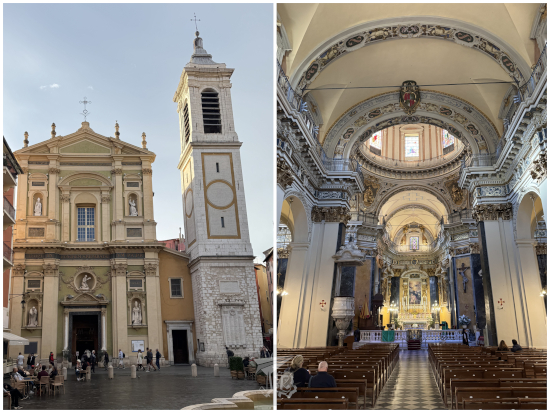
I diverted a little back into the old town to visit the cathedral Cathédrale Sainte-Réparate de Nice – Cathedral of Saint Reparata. Construction started in 1650 in the Baroque style, and it went on for centuries until it was declared complete in 1949. The building has one bell tower and ten lateral chapels. It enshrines the relics of Saint Reparata, which arrived in Nice in 1690.

Catholic cathedral of Nice, a Baroque building.

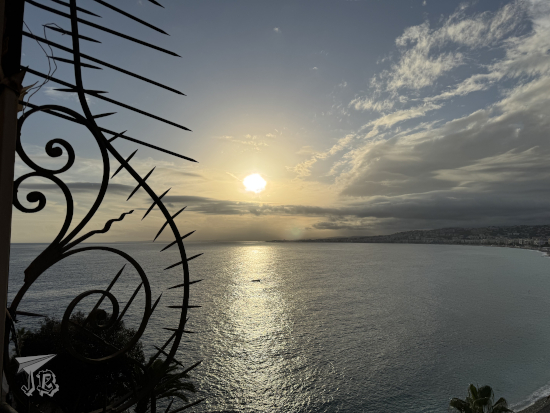
After wandering Old Nice for a bit, I started the climb up the historic park Colline du Château, where the old Nice castle and cathedral stood. Today it offers panoramic views, ruins, playgrounds and… cemeteries for some reason. There is a “free” lift, but someone stood at the entrance, looking very much like they were charging a fee. I wanted to climb up the stairs on foot for the views anyway. Though it was before 16:00, the sky was already in sunset mode.

Sunset over the sea.

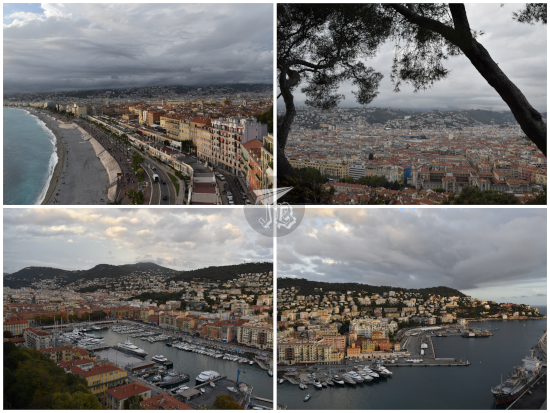
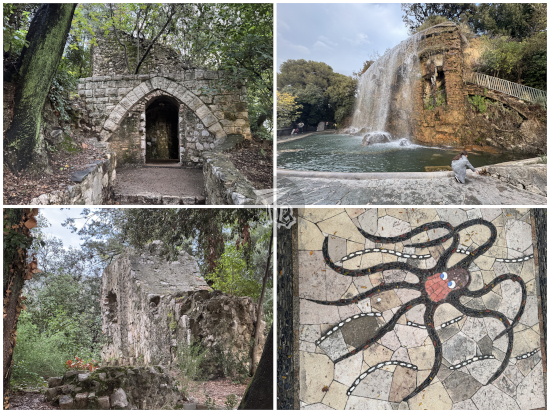
The ascent was not difficult, three or four flights of stairs before I reached the small building that tops the tower Tour Bellanda, the first viewpoint. The structure was originally a medieval defensive structure, but it was destroyed and rebuilt as a place to enjoy the views. I continued on, through the hill / park / historical site. There are several viewpoints towards both sides of the city, along with historical ruins, mosaic decorations, fountains, even the aforementioned cemeteries… All in all I had a lot of fun exploring.

Views of Nice - roofs, coast and ocean.

Collage of the Chateau de Nice: ruins, a waterfall and an octopus-shaped collage.

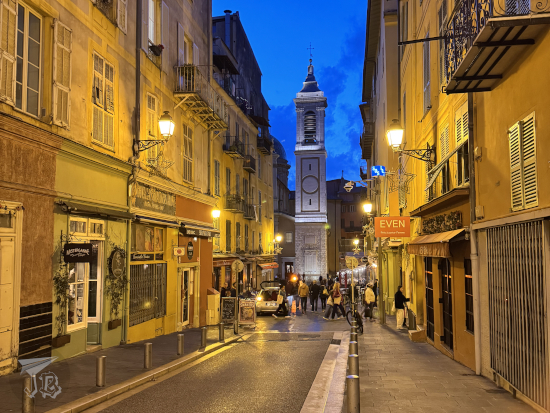
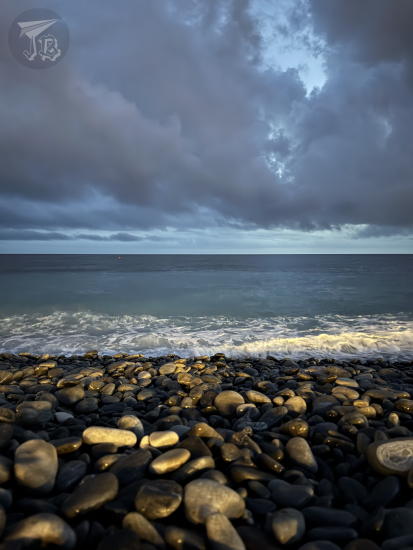
It had become dark by the time I left the parks, and I somehow ended up re-entering the city down some historical stairs which landed me right into the Medieval quarter again. After going back to the beach for some more wave sounds, I undid my path towards the hotel, taking the exact same route.

Medieval Nice at night, with the cathedral tower at the end.

Waves on a pebble beach at sunset.

There was a bookshop on the way, and I really wanted to stop and buy a book I knew was out that weekend, but honestly? D****e had brought so many presents for me that it would not have fit into the backpack… What I did buy was dinner and breakfast for the following day at the supermarket in front of the hotel – read: coffee and a sandwich. Oh, and a smoothie because it looked awesome.

I spent the last couple of hours of the evening in the hotel, watching bad creature films on YouTube before I went to bed.

14th November 2025: Hyde [Inside] Live 2025 World Tour {France & Monaco, November 2025}

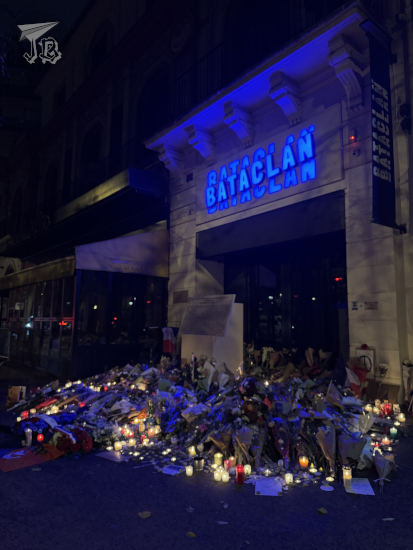
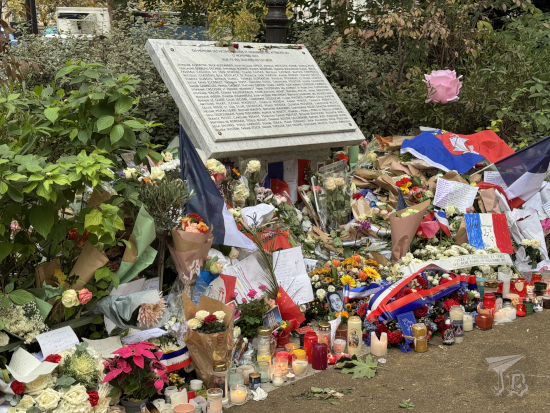
The sun was not even up yet when we reached the queue (I refused to learn what time D****e had set the alarm clock) for Hyde [Inside] Live 2025 World Tour at Le Bataclan, which was a couple of minutes away from our accomodation. We stepped out of the hotel, and had to walk right back inside for umbrellas and raincoats, because just as we set a foot on the street it started raining. The line had already been started, and in front of the venue door stood a stone memorial, flowers and candles. It was eerie. Throughout the morning, Paris cleaning services came to take care of the tributes. I had never stopped to think about what happened to mementos that people put up for vigils and memorials. In this case, the flowers were very carefully arranged in baskets and carried away to the permanent memorial in the park opposite the venue. The candles were also moved, still lit, there.

Flowers and candles in front of the Bataclan venue at night.

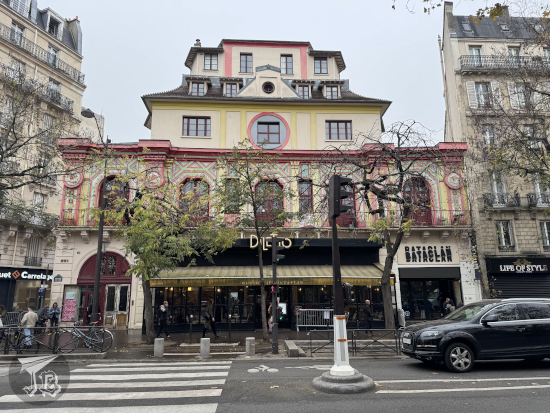
Origins of Le Bataclan can be traced back to 1864, when architect Charles Duval designed it as a theatre in the Chinoiserie architectural style, a current that depicts European interpretations of China’s artistic tradition, which was popular between the 17th and 19th centuries. The original name of the venue was Grand Café Chinois, and it was a typical Belle Époque establishment, known as a café-concert, with a theatre, a dance hall and a café. It became popular for its vaudevilles and went on to change hands, appearance, and functions several times. In 1969, starting with the band Soft Machine, it became today’s modern concert venue, featuring artists such as Velvet Underground, Ramones or Iron Maiden. In the 1980s, it was dubbed “the temple of hip-hop”. In the 21st century, it was revamped and repainted to resemble its original appearance and started catering to techno events.

Le Bataclan Building

After the massacre in 2015 during a concert of Eagles of Death Metal, Le Bataclan was closed for a year, with bands such as U2 cancelling their acts. The venue rose from its own ashes 364 days later with a minute of silence for the victims and an exclusive show by Sting. Aside from the tragic memory attached to the mass shooting, the building itself has been considered a historical monument since 1991.

One expects that a venue with such history, experience and tragedy would be able to smoothly manage a queue, right? Wrong. This was probably the most disastrous line I’ve ever had the displeasure to be part of.

The first security team arrived around 8:00, and they were obviously displeased. The queue at that time was about 20 or 30 people, who were sitting by the walls to brave the cold and drizzle, and respecting the doors of the nearby shops and houses. We were minding our own business checking out the doggies on walks when the staff started putting out barriers. No issue there.
Mid-morning, D****e and I went for breakfast and a toilet break, along with a visit to the Memorial to the victims in the park Jardin May Picqueray, where all the flowers and candles had been taken. It felt weird to take a picture of that, but I wanted to remember the image, the feelings it caused within me.

Memorial in front of the Bataclan concert venue, with a plaque and hundreds of flowers.

It was around 13:00 when the security guard had his power trip. The line was relaxed at this time. Some people were sitting, others were standing to the side, but the “expert concert goers” knew that it was around the time the band would be coming in, probably with the chance of spotting Hyde. The staff started putting out more and more barriers, forcing people to crowd behind them, so the whole concept of queue went to hell. Fortunately, a few locals who spoke both French and English were able to bring the queue, at leas the first hundred VIPs or so, to a resemblance of order.

It did not help that the soundcheck would be watched from the upper floor, and then we had to make it back to the main floor if we wanted arena spots. It was a damn mess. Then they started checking us in for the VIP experience – which I didn’t understand. Fine, the VIP tickets had our names on them so they could not be resold. But they did not ask for ID, which beats the whole purpose of it.

When they finally opened doors, we were subjected to a fast pat down, then we went upstairs. We had a few minutes of relaxing of sorts then – presumably to buy merch – but in the end it was stupidly stressful. What was the point of queueing for hours if when it mattered, we were back to a crowd? In the end, some fans managed to negotiate that the French and Japanese staff would allow people to step down the stairs in the order we had arrived – supported by the numbers we had written on our hands.

The soundcheck, which started at 18:00, lasted around 10 minutes was… lacking. There were three song bits and that was it. Whether that and “stress free” merch shopping justified the price… I honestly don’t think so. Early entry? Maybe. I mean, Hyde is a huge artist in Japan, where your entrance to the venue is determined by the number in your ticket. Fanclub members will always get the best numbers, so they are the only ones with a chance to do first row. This was my one and only time in a Hyde – or Hyde-adjactent project – when I was able to get barrier, and that was only because of D****e’s knowledge of the Japanese fandom and what time they would head there. I don’t think I’ll ever do that early of a queue ever again, even though we were extremely lucky with the weather. Besides a bit of drizzle early in the morning, the weather was stunning, especially for mid-November in Paris.

The concert was scheduled to start at 20:00, and it did so around 20:10. We were at the barrier around 18:15, and it turned out that the background flag was too big for the stage. All this time, I was trying really hard to concentrate on what was to come and not the flowers outside and what they meant. Maybe that atmosphere spoiled the concert a little. Maybe I’ve lost my passion. Or maybe it was the fact that I did something stupid, queued for too long, the next day I went off sightseeing, and a week after returning I had not completely recovered. I’m not sure. But I lack the normal fuzzy feeling I used to get after concerts. I thought not having that after The Raven Age was normal, because I was just checking them out. However, Hyde used to be one of my big artists.

Hyde was born Hideto Takarai in Wakayama, Japan, in 1969. He has been active since the late 1980s. In 1991, Hyde formed the rock band L’Arc~En~Ciel [ラルク アン シエル, Laruku an Shieru, Laruku for short] alongside bassist Tetsuya, a music ensemble that went on to sell 40 million records. From 2001, the band has been more or less separated, coming together on and off to launch a single or do a live in order to remain relevant.

During the period of inactivity, Hyde launched his solo career, often collaborating with arranger and guitarist KAZ from Oblivion Dust, with whom he formed the rock band VAMPS in 2008. VAMPS was active until in 2017 it went “on hiatus” with a press release in Japanese and English, and nothing was ever heard of them again.

Hyde went back to his solo activities right away, with a tour in summer of 2018, which felt a bit lacking. He collaborated with other artists such as Yoshiki and Starset. For a little while he was part of the “supergroup” The Last Rockstars alongside Yoshiki, Miyavi and Sugizo. The current tour Hyde [Inside] Live 2025 World Tour is the promotion of Hyde’s 2024 album Inside, so most of the songs from the setlist came from there, with some “old hitters” he holds the rights to, and a couple of covers.

The concert was good. Objectively good. I enjoyed it. But it was not that deep, belly-felt enjoyment I had before with songs like The Jolly Roger (during VAMPS times), or the one-and-only time I’ve seen L’Arc~En~Ciel.

Setlist:
1. Let it out
2. After Light
3. Defeat
4. Devil Side (VAMPS)
5. Taking them down
6. On my own
7. 夢幻 [Mugen, Fantasy]
8. 永久 –トコシエ [Tokoshie, Eternity, but written with weird kanji]
9. Faint (Linkin Park)
10. 6or9
11. Mad Qualia
12. Social Virus
13. Midnight Celebration II
14. Last Song
15. Pandora
16. Honey (L’Arc~en~Ciel)
17. Glamorous Sky
18. Sex Blood Rock N’ Roll (VAMPS)

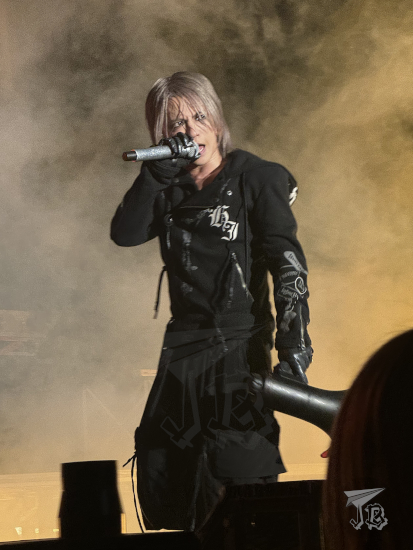
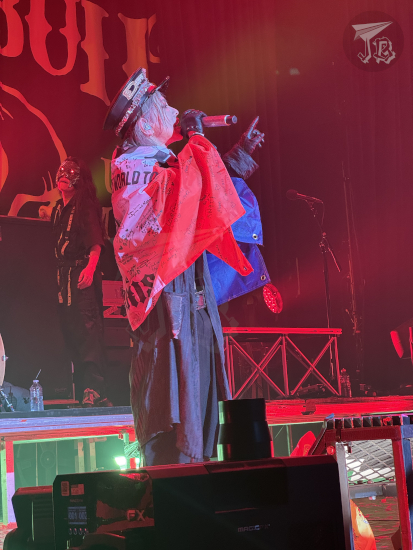
HYDE: Inside concert in Le Bataclan. Hyde singing

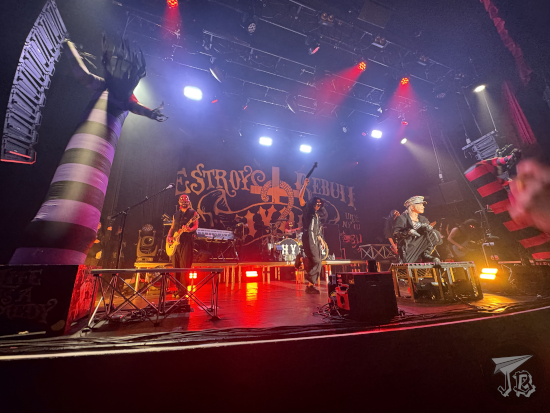
The concert started at 20:10 with Hyde perched up a high tower. He was supported by guitarists Yas Nomura (Yas) and Julian, keyboardist Hiko (Hikonyan), drummer Shuntaro Kado (Kadoshun) and bassist Tomohiro Miki (Miki-T), all wearing masks – Hyde included, for the first couple of songs. The music was powerful, and the delivery impeccable.

HYDE: Inside concert in Le Bataclan. Hyde close-up

Hyde knows how to own his stage. For 6or9 he wanted us to crouch and jump and… no. I was holding onto the barrier, and there was no way I’d make a jump. I hid a little and then stood up. He also tried some French. He managed quite well with ça va? (“what’s up?” of sorts), but merci beacoup (“thank you very much”) sounded hilariously like the English word “mercy” and the Japanese standard-male I boku [僕]. He also enjoyed yelling swear words around.

HYDE: Inside concert in Le Bataclan. View of the whole stage.

On other concerts, Hyde has poured a bottle of fake blood on his head towards the end. Knowing what had happened in that venue, I am extremely happy he did not do such thing. During the goodbye, he sent “his condolences to those who passed away in this venue”. That almost broke me, honestly.

HYDE: Inside concert in Le Bataclan. Hyde wrapped in the French flag as he gives his condolences for the terrorist attack ten years prior.

All in all, it was a really good concert, and I enjoyed it a lot but… in a different way from I used to. More like I enjoy Starset. I thought it was just that I had a different connection to them, but I now believe it’s a change within me since the Pandemic. I just do not live concerts in the same way any more. I think I am okay with that. I really liked the aforementioned 6or9, Midnight Celebration II and, somehow, Glamorous Sky, which was a song I had never really felt a connection with before.

After the concert, we went through the typical Japanese ritual of waving goodbye to the artists as they leave, and someone from the flats above through a bucket of water at the car. They must have been annoyed by the noise, though it was a Friday and not even 23:00, along with it being a busy boulevard with lots of bars and restaurants around. D****e and I made a short pit stop at the nearby convenience store, which apparently was open beyond its usual time to carter to the concertgoers (I love when they do that). I got a sandwich and a coffee for the next morning, but I never thought about buying lunch too. Afterwards, I took a shower and we went to sleep (or try to) for a few (very few) hours.

13th November 2025: Notre Dame, twice {France & Monaco, November 2025}

I left the house a little earlier than 6:30, and I reached the parking lot at 7:50, though the theory is a 38-minute drive – the joys of mid-week rush-hour traffic. But I made it, and it was only a few minutes’ wait for the shuttle-bus, so I got to the terminal pretty quickly after that. Security was smooth, boarding went well, and I got to snooze on my 9:45 plane. Pretty good jump, all things considered. We landed at Charles de Gaulle airport a few minutes early, and I was at the train station relatively fast. It was a short walk away, and it looked familiar – I had done it to get to my first-night hotel for the Saint Seiya Symphonic Adventure Weekend. I needed to buy a Navigo transport card too, on top of the price of the ticket, but after wrestling the machine, I just took the RER, and was downtown Paris around 13:00. I stepped out of the underground stop right in front of Cathédrale Notre-Dame de Paris.

Notre-Dame (Our Lady) is the Catholic cathedral of Paris. It was founded in 1163, and its construction spanned about a century. It was repeatedly modified afterwards, with some reconstruction. The building is considered one of the most important examples of the French Gothic architecture, including innovations such as the flying buttresses, rib vault, and the rose window above the gate.

The cathedral was damaged during the French Revolution (1789 – 1799), and converted into a secular “temple of reason” – the Cult of Reason tried to take over Christianity during the period. In 1831, Victor Hugo’s novel The Hunchback of Notre-Dame (original title: Notre-Dame de Paris) was published, and it sparked renewed interest in the building. Around this time, architect Eugène Viollet-le-Duc was promoting gothic as the purest form of architecture, so he took up the refurbishing of the cathedral. He had a vision of restoration which implied “doing what the Medieval Builders would do with modern technology”, an approach that has earned contempt with time. He placed a spire on the roof of the cathedral, despite the original having been lost centuries before.

This spire was later destroyed during a fire in 2019. While the cause of the blaze has not been disclosed, flames ravaged the structure during 15 hours, destroying most of the wooden parts of the cathedral, and damaging the upper walls. The fire broke out around 18:20, and due to problems or mistakes, the firefighting brigade was not notified until almost 19:00. Paris firefighters had trained extensively to prevent a disaster in the building, but the old wood had been burning for 40 minutes when they arrived. Most of the extinction work was carried out within the walls of the building itself – I clearly remember that there were fears that a tower would collapse on the brigade.

Fortunately, the stone structure of the ceiling and walls withstood the blaze, and the building did not cave in. The cathedral holds relics important to Christianity, including the purported Crown of Thrones, and those were taken out for safekeeping. Furthermore, a number of artworks had been removed because there was restoration going on. When I was in the area in February 2020, just before the Covid lockdowns, I was shocked that the site still reeked of smoke.

Though the Catholic church as exclusive and perpetual right to use the building, Notre-Dame belongs to the French Government. It was declared historical monument in 1862, and it has been part of the Unesco Heritage Site Paris, Banks of the Seine since 1991. All these characteristics protected it from “daring” post-fire projects such as modernist windows or alternative spires. The first phase of reconstruction were consolidation projects, to make sure the water had not damaged the stone, building scaffolds which have not been completely taken down yet. Then the debris was taken out, and finally rebuilding work would start in 2021. Though some experts predicted decades of reconstruction, the cathedral safely opened for Advent in 2024, though there are still works going on.
Despite having a timed ticket for peace of mind, I did not need it. There were barriers to optimise a queue, but I only had to walk through. I went to show my backpack to the security guards, and they were extremely nice and laid-back. When I said I was coming from the airport, they waved me through after a quick visual inspection.

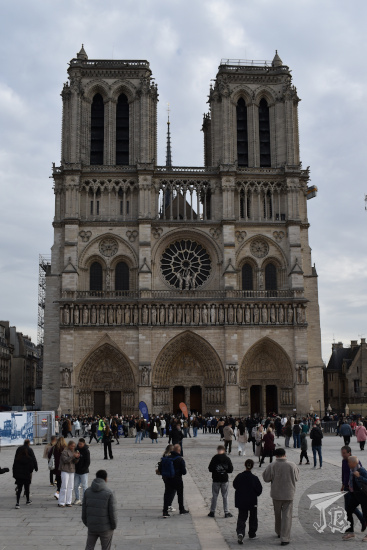
Exterior of Notre Dame.

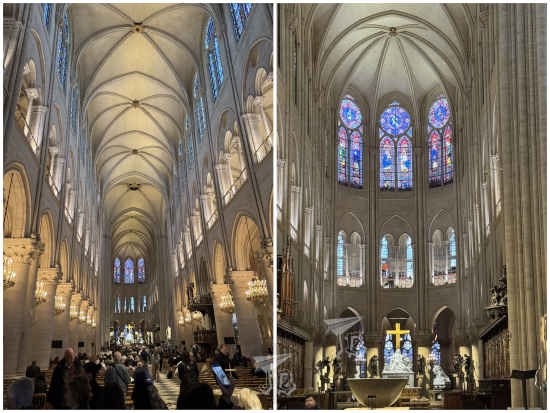
My feeling when I got inside was “woah, white”. The walls were treated with a special solution that not only removed the soot, also did away with centuries’ worth of patina. The building was packed, so it was hard to wander around and enjoy, but Notre-Dame is one of my favourite pieces of architecture, and I loved being able to walk inside once more. Nevertheless, I preferred the old, greyish interior. To collaborate with the cathedral’s maintenance – or so I tell myself – I bought a commemorative coin. Then I decided I needed the second one (do keep score, this whole thing with the coins was to become a pattern in this trip).

Interior of Notre Dame.

I could see people working on the second floor behind the altar, it was a bit surreal. After I had walked the inside, I went around the building to check out the construction, then moved on along the Seine towards another of my favourite places in Paris, the Gallery of Palaeontology and Comparative Anatomy, Galerie de Paléontologie et d’Anatomie comparée, part of the French National Museum of Natural History, Muséum national d’Histoire naturelle. The gallery is going to be “closed for refurbishing”, which I fear will make it lose its charm, so I really had to visit this time around.

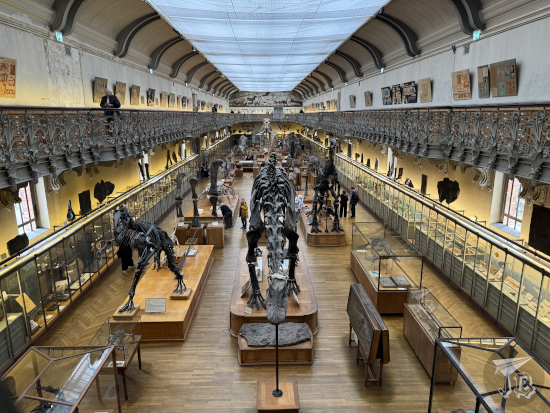
The French National Museum of Natural History was established in 1793. However, the project that would eventually lead to this gallery did not start until the Gallery of Zoology had been inaugurated, in 1889. The building was designed by architect Ferdinand Dutert, with two floors and three levels, alongside a few balconies. It was erected between 1893 and 1898, when it was inaugurated. The structure is stupidly impressive and beautiful – the outside is made of brick and the interior has mainly metal and wood. Most of the second floor is actually a mezzanine, which originally held the collection of anthropology, and now the plant fossils. The first floor holds the palaeontology specimens, and at ground level stands the compared anatomy collection. It is a museum of its time, with that charm that contemporary ones do not hold.
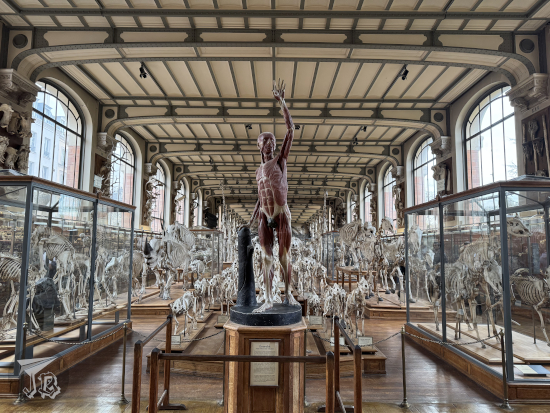
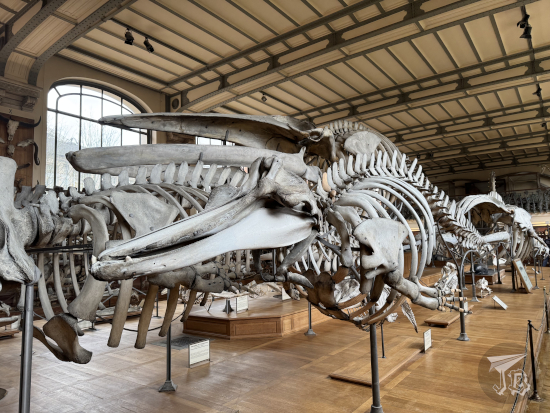
Upon entering, my backpack was thoroughly checked – the guard even made me use my phone to give him light as he went through my stuff before he let me in. I paid my fee and stepped into the ground floor, with its cavalcade of skeletons. As you enter, a human figure greets you, and behind him stand hundreds of mounted skeletons, the Gallery of Comparative Anatomy, following a very specific order – and one day I hope to know enough French to understand. First there are the pinnipeds and land carnivores, then herbivores and after a small separation, the cetacean group. On the cases along the walls, birds and smaller mammals are protected. The the far right corner, there is a small (but creepy) collection of “aberrations”.

Gallery of Paleontology and Comparative Anatomy: model human in front of the skeletons of mammals.

Gallery of Paleontology and Comparative Anatomy: skeletons of modern cetaceans.

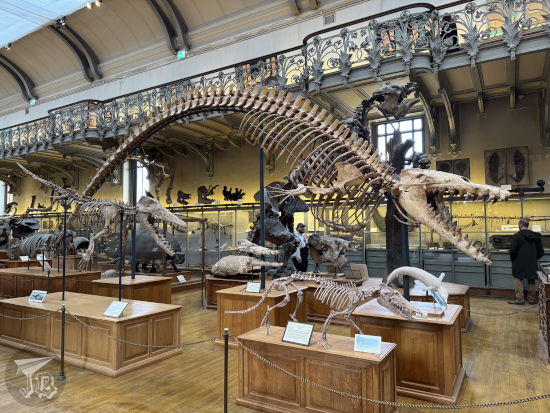
The first floor, which is accessed through a stone staircase, holds the Palaeontology Gallery, with casts of the specimen of diplodocus, a T-Rex, allosaurus, a replica of one of the Bernissart iguanodons, allosaurus, pterosaur, sarcosuchus… On the other side of the ward stands an impressive mammoth, known as Le mammoth de Durfort (the Durfort Mammoth). Discovered in 1869, it is one of the largest of its kind (Mammuthus meridionalis) ever assembled. It has been recently restored, too, so it looks rather impressive. To its side stands the only authentic skeleton of the only woolly mammoth (Mammuthus primigenius) preserved outside Russia.

Gallery of Paleontology and Comparative Anatomy: second floor looking at the dinosaurs and the gallery.

There is also a skeleton of a Cynthiacetus peruvianus, a toothed whale, one of the oldest cetaceans ever discovered. This creature lived around 37 million years ago, in the Late Eocene. The whole gallery is fascinating, if also a bit unsettling, especially the ground floor. I could’ve stayed there for hours, but my friend D****e’s plane had landed a little early and I had promised to meet her at the station.

Gallery of Paleontology and Comparative Anatomy: skeletons of toothed whale, giant sloth and early quadrupedal mammals.

I then ran into a problem in the underground. It turns out that you cannot put a ticket in a Navigo pass that you have used for the airport (at least on the same day), so I had to purchase yet another pass! We managed to meet and headed to the hotel, where we only got one room card because it was strictly not taking it out. They were very upset with me for not speaking French – I can speak a bit of it, and I read it pretty well when it’s simple (so no detailed anatomy explanations) and I’ve got time, but I can’t understand much beyond the super-basics to save my life.

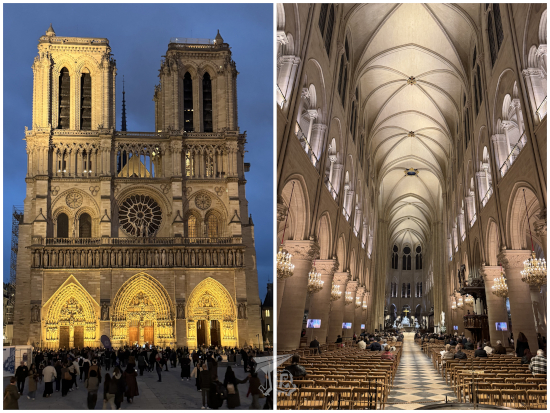
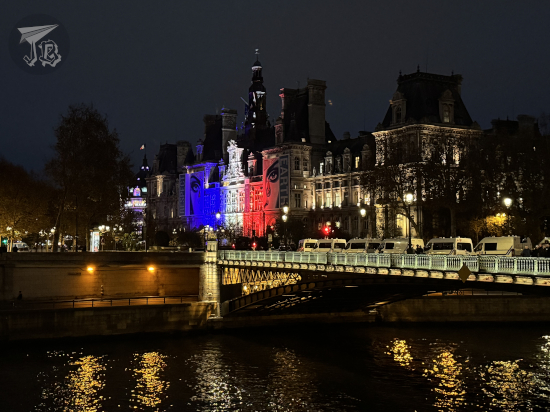
D****e suggested going out for a walk, and we headed off. The street where Le Bataclan was closed off as there was a remembrance ceremony for the victims of the terrorist attacks. We then headed further towards Cathédrale Notre-Dame de Paris (yes, again. No, I did not complain). We were shocked about the number of police officers that were around, but later we learnt that there was another ceremony at the nearby town hall, which was lit in the colours of the French flag, like the Palais de la Cité opposite Notre-Dame. There was again no queue to enter the cathedral, and the building was open late, so we took another tour inside, as it was artificially lit. On top it being Thursday, there was a mass, maybe for the victims of the attack too. The night felt pretty heavy, to be honest.

Notre Dame cathedral, outside and inside, at dusk.

Paris town hall at night with the French flag projected on the façade.

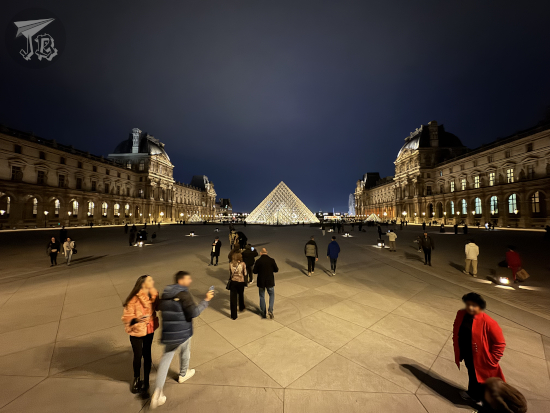
We walked a bit further, strolling along the Seine. We passed by the church Saint-Germain-l’Auxerrois on our way to take silly pictures with the Louvre Pyramid Pyramide du Louvre, the polemic skylight entrance designed by architect I. M. Pei and installed in 1989. Back then, it was incredibly controversial, especially due to how it clashed with the French Renaissance style of the square and buildings around it. I personally think the structure is ugly, but it has been there for most of my life, I can’t remember the Louvre without it.

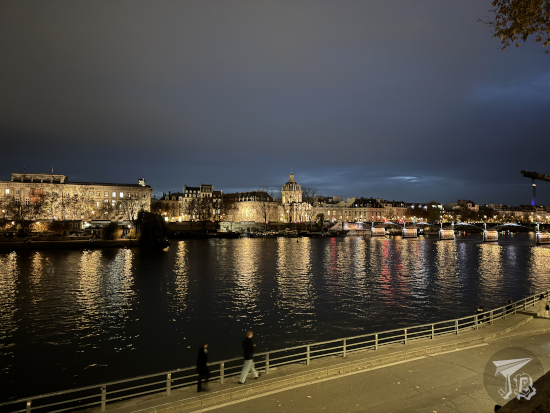
Paris and the Seine riverbank at night.

Louvre Pyramid at night.

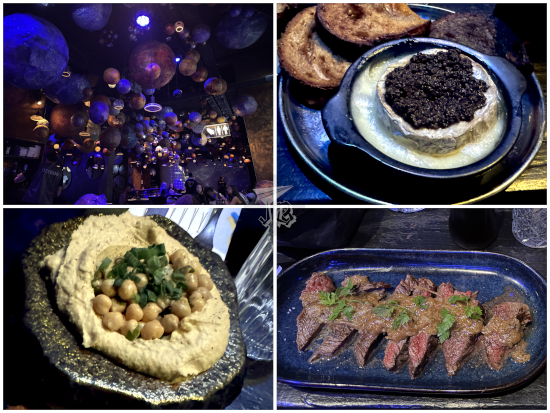
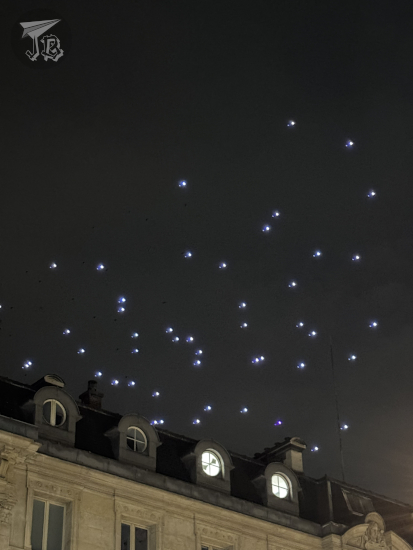
We then headed back towards the hotel area. We walked back by the memorial service at the town hall, they had launched drones up to the sky. For dinner, I had found a fun place called Stellar which reminded me of the rock band Starset, and booked it. I figured that if she was too jet-lagged, we could always cancel, but that way we had a secured spot. Stellar is managed by the group Ephemera, which creates “immersive restaurants”, and this particular place is “set in space”. The light is low, there are planets and stars hanging from the ceiling, and the solar system slowly slides around you in giant screens. It was really cool, and they were happy to help us in English.

Drones in the Paris night sky to commemorte the 13 November 2015 attacks.

Stellar makes a point of telling you where their dishes, recipes and ingredients come from. We chose three items to share: Truffle baked Camembert (from France), Galactic houmous (from the Middle East, but with a Mediterranean twist – olives), and Shallot flank steak (medium-rare, also from France, though the actual meat was Irish) with fries. The houmous was a bit too heavy, but everything was delicious. The decoration was amazing too, and we had a great time as planets and moons floated around us. Once you book, you have a table for 75 minutes, and they were so efficient that it did not even feel short – we were waiting for food for a very short time. We forewent desserts because we were full – even if I had somehow managed to skip lunch. That was not a great idea… I think I’ll try to chase a couple more of the immersive restaurants if / when I come back to Paris.

Food at Stellar in Paris.

We headed back to the hotel for an early night, though I did not sleep that much, if at all, and the night was very short.

13th – 17th November 2025: City breaks in France & Monaco {France & Monaco, November 2025}

When back in May 2025, Hyde announced his [Inside] Live 2025 World Tour with several stops in Europe, I wished that I could feel the excitement that used to take over before the pandemic. But truth be told, both Japan and JRockers have made a bunch of questionable decisions as of late. It fell kind of flat, to the point I even considered not going. Hyde himself has said and done a few things I can’t agree with, and I did not know if I wanted to give him money. I was in Malta when the ticket sales started, and I decided something – if the concert was not sold out when I came back, I would go to the show in Paris, France (and see a friend or two, hopefully).

I found tickets upon my return, even VIP options. Though apparently there were a lot of issues with the upgrades, I was able to purchase a VIP package without a hiccup. Not that it had many perks – early entry, priority merch shopping, and soundcheck. However, French fans are hardcore, and I thought being a VIP gave me more leeway to find a safe spot in the venue.

Once that was taken care for, I started organising the trip. The concert was on a Friday in November, a month when I have usually finished work season, so I could take off for a few days. I fumbled with dates a little, and – just for kicks and giggles – I looked for things to do outside Paris. I found an insanely cheap train ticket for Nice, and it turned out that flying round trip to Paris was about the same price as flying to Paris, then taking this train, and flying back from Nice. Furthermore, I found a Nice hotel at a great price.

You might wonder about the sudden Nice idea. Nice was not the goal here (though I ended up enjoying it more than expected), Monaco was. Since I was a little child, there is one place I’ve always wanted to visit, but the stars never aligned for it – the Oceanographic Museum of Monaco. This time around, everything seemed to be fitting in flawlessly. I know I cannot afford to stay in Monaco, but Nice is about 20 minutes away using public transport.

I locked planes and trains. I found a hotel near the Paris venue to share with a friend, booked tickets for the Oceanographic Museum, bought a small Nice and Monaco guidebook, and turned on about a hundred alarms to remember to book free tickets for Notre Dame (three days before in May, two when I actually got down to it in November). It kind of looked like a trip like any other.

France & Monaco, November 2025

It was not.. There is something else I feel I need to address beforehand. Hyde’s concert was in the venue called Le Bataclan on the 14th of November. Ten years prior, on the 13th November 2015, 90 people died there.

During 2015, France suffered a number of terror attacks, linked – by self-claim – to the Islamic State, or IS. Thriving between 2013 and 2017, IS was designated as a terrorist organisation by the United Nations, as it enforced an extreme version of the Islamic Law and the war against the infidel. They stated they had control over worldwide Muslims, though most of them refused. On the 13th of November, a terror operation was launched in Paris, ending the lives of 130 innocents and 7 attackers.

Three suicide bombers attacked the stadium Stade de France, though they could not gain access. Another group ran rampart shooting at cafés and customers downtown. Around 22:00, a third cell broke into the Bataclan, shot at the 1500 concergoers, and took the survivors hostage. The attackers claimed to be avenging airstrikes against IS. Police attempted to enter the building twice, and tried to negotiate for 50 minutes, until there was a full-blown charge shortly after midnight.

Most of the victims died in the first few minutes of each attack, but some took their own lives at later dates due to PTSD. On top of the 130 casualties, there were 416 injured, about a hundred in serious condition. The attacks sparked rejection by thousands of people – there were vigils all over the world, social media campaigns spread like wildfire, and monuments were lit with the colour of the French flag. In Paris, a state of emergency was declared, people were urged to stay home, and residents opened their doors to those who became stranded and couldn’t go back to their own places due to lack of public transport. Schools and universities did not open on the 14th, sports events were cancelled, and the army was deployed in town. Even Disneyland and the Eiffel Tower closed down. On the 15th, the French Air Force launched its largest operation against IS, carrying out airstrikes in their claimed territories, mostly in Iraq and Syria.

French President François Hollande declared a nationwide state of emergency, which was extended until mid 2016. But then, the Nice attacks happened – around 22:30 on Bastille day (14th July) 2016, a man drove a truck into crowd celebrating at the promenade, killing 86 people and injuring 458 others. IS also claimed responsibility for the attack, and the state of emergency was extended again until 26th January 2017.

Thus on this trip, a lot of this was weighing on my mind, especially in Paris, as we were there during the ten-year anniversary. We saw the police officers, the candles and the flowers. People coming and going, people who might have been there that day. People who lost someone.

So thank you, Hyde, for foregoing your act of singing drenched in blood, because that would have been traumatising. On my account, nothing further from my intention than exploiting the pain of so many people, or making it about me, but there is no way I can describe those two days in Paris without referencing the memorials and vigils. I’ll do my best to do it in the most respectful and caring way possible. However, as I look back on the unadulterated joy my inner child felt in the Oceanographic Museum of Monaco, I wish I could return to that actual innocence, and not have to think about how the world can be a scary place sometimes…

Before the trip I did try not to read up much on the attacks and remind myself of what I had heard a decade before. My plane was scheduled to land in Paris Charles de Gaulle around noon, so I hoped to be downtown around 13:30. Though the RER is only about 45 minutes, the last time I landed there, we had to wait 40 minutes for buses to get to the terminal. Since people had been complaining about the queues at Notre Dame, I booked a free entry ticket for 14:15. I actually was up at midnight two days before to secure the entrance spot (and one the following day for emergencies).

I also purchased my Oceanographic Museum ticket in Monte-Carlo, and tried to find out how to book at the Casino, though whenever I tried, I ended up at the luxury items page. Don’t get me wrong, I would have loved a tour on a Ferrari through Monte-Carlo, or – even if I have no idea about car racing – a ride on the circuit. But I don’t have the budget for that, even in the lowest low season. Oh, and I bought a raincoat because the weather app forecast rain with a 95% chance on Saturday, and 100% on Sunday…

Thus, here are my adventures in Paris, Nice and Monaco in November 2025.