25th July 2022: Half a day {Salamanca, July 2022}

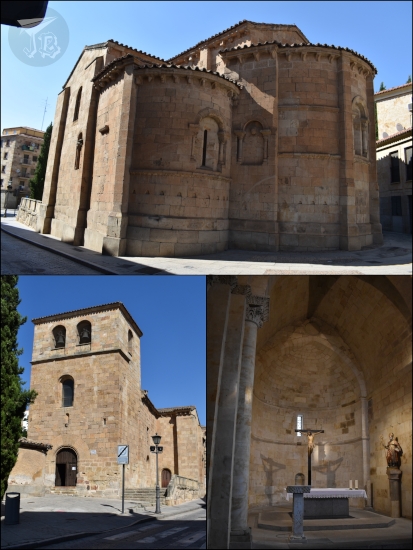
Mondays are always tricky because a lot of things close then. We reprised our latte/croissant and visited the Tourist information office that claimed that everything was open – which… was incorrect. My companion wanted to see Iglesia de San Marcos, a Romanesque church which has an interesting circular shape, probably built in the 11th century (that we had found in the book we got from the cathedral).

A Romanesque church. It has a round nave and a short bell tower with two bells.

We saw the local market Mercado Central de Salamanca, designed by the same architect as the Casa Lis. As this is a public building, it was in working order – though funnily enough, all the fishmongers were closed – no fish in Salamanca on Mondays! The building is modernist, with iron structures and colourful windows.

A Modernist building with colourful glass windows

To finish off the morning we went to visit the palace Palacio de la Salina, also a public building so also open. The architect in the project was Rodrigo Gil de Hontañón (who also designed the University building in Alcalá de Henares). It was built in 1538, mainly in Plateresque style, with some Italian elements.

The patio of a Plateresque palace, in gold tones with a lot of decoration on the stonework

Right across the park from the palace there is a lonely Renaissance tower Torre del Clavero. It was a 15th-century defence tower, with a square base that turns octagonal in height.

A

We walked around for a while longer, had lunch, and our train back left around 3:30. It was a rather uneventful trip full of gothic, modernism and iron, which I really enjoyed. I keep trying to get to like guided visits, and I have somehow got fond of climbing up towers.

Walking distance: 11737 steps / 7.31 km

24th July 2022: Up, up and down {Salamanca, July 2022}

After a latte and the best croissant I’ve had in a long time, we went over to see the gothic palace Casa de las Conchas, which was built between 1493 and 1517. The façade is decorated with sandstone-carved shells (concha, in Spanish). The exterior sports ironwork-protected windows, and the interior a patio with artistic arches.

The gothic palace called House of Shells. There are hundreds of them carved on the façade. The inner patio is carved in golden stone, with very thin columns and lots of decoration

It was still early for our visit to Palacio de Monterrey, a 16th-century Renaissance palace inspired in the Italian style of the time, combined with Plateresque decoration, which was heavily imitated later on in the 19th century. The building currently belongs to the House of Alba, probably the most prominent Spanish noble family. The House opened the palace to the public, and the inner area cannot be photograph – it was weird anyway, with some antiques and art pieces, but all of it was… prepared and staged, though the carpets were rolled out of the way. In this case the only option to sneak out a picture was from the tower, as a member of the staff followed us all the time.

Monterrey palace, built in golden-like masonery. The roofs and towers are decorated, and there is a row of windows alongside the upper floor.

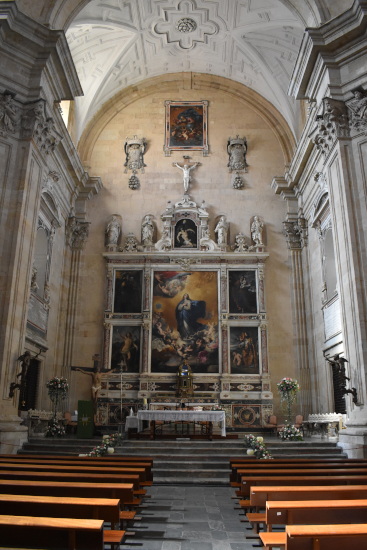
Next, just in front the palace, we visited the 17th-century church Iglesia de la Purísima, in Italian Baroque style. Its altarpiece is considered to have one of the best images of the Virgin Mary in her Immaculate Conception advocacy.

A Catholic altar showing the Inmaculate conception in the centre, she is dressed in blue, and standing in front of golden clouds, with angels around her. The back of the altar is built in white stone, and ornate.

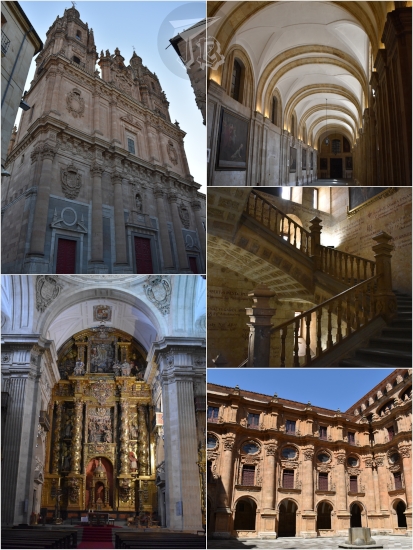
Our next spot was the second university of Salamanca, the see of the Universidad Pontificia de Salamanca, a building called La Clerecía. As the original university went secular, the Jesuits built a clerical university. The building, built in Baroque style between the 17th and 18th centuries is composed of a church, a cloister, a patio and a magnificent staircase, forming the complex (read: guided tour) called Vita Ignatii.

Collage: On the left, a very baroque church from the outside, also showing the gold inner altar. On the right, some shots of the upper and lower cloister, the patio is ornate and reddish, the staircase is made completely out of stone.

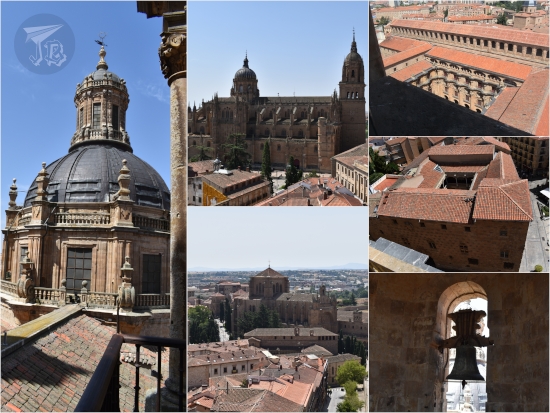
Then there are two towers that give out really awesome views of the town, named Scala Coeli, the stairs to the Sky.

Views of Salamanca from the above: the dome of the church from the outside, the cathedral, the House of Shells, and the bells.

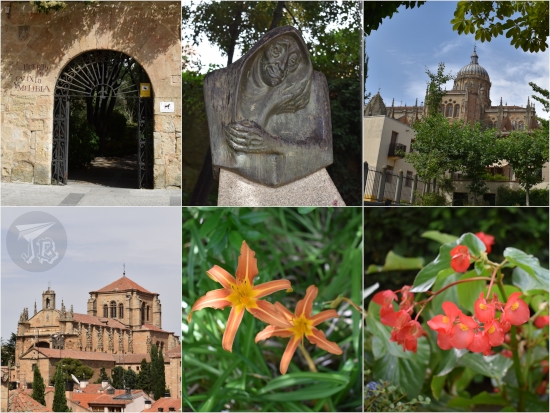
It was rather hot, so we had some unremarkable lunch and went to the hotel to wait out the blunt of it. It did not really work, and we eventually tried our luck with some more sightseeing. The first stop was the garden known as Huerto de Calixto y Melibea, based on a literature work Tragicomedia de Calisto y Melibea or La Celestina. It is considered the first Renaissance writing in Spanish, and it echoes with Romeo (Calisto or Calixto) and Juliet (Melibea), with an extra character, the old matchmaker Celestina, who is a horrible person trying to break the lovers up to marry Melibea to someone else. Though the writing does not have a firm setting, some say that it is probably Salamanca, where the author attended university. It was nicely shaded and had nice views.

Gate to the gardens, a bust of Celestina (the fictional character), from the cathedral, and some flowers: star-shaped and orange, bell-shaped and red.

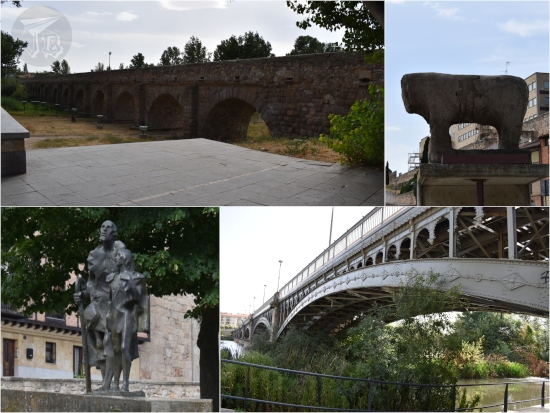
Then, we wandered off to see the bridges over the river Río Tormes again: both Puente de Enrique Estevan and Puente Romano. Next to the Roman bridge there is a statue of a verraco (ancient Celtic sculpture) Verraco del Puente Romano, which is supposed to have been there since the 16th century. A bit to the side, there is yet another literary monument, which represents the book El Lazarillo de Tormes, Lazarillo being the word for “guide dog (for the blind)” in Spanish (such an eye-seeing dog). Also written in the 16th century, it is considered another of the peak writings in Spanish, telling the story of a young lad who learns to survive by gathering street-smarts and shedding off any morals he ever had, finally settling in Salamanca with his unfaithful wife: Monumento al Lazarillo de Tormes.

Collage. The historical bridges in Salamanca: the Roman one, made from stone with wide archs, and the iron-architecture one, in greyish-green. Sculptures: Lazarillo with his master, and a prehistoric bull or pig, with a flat head

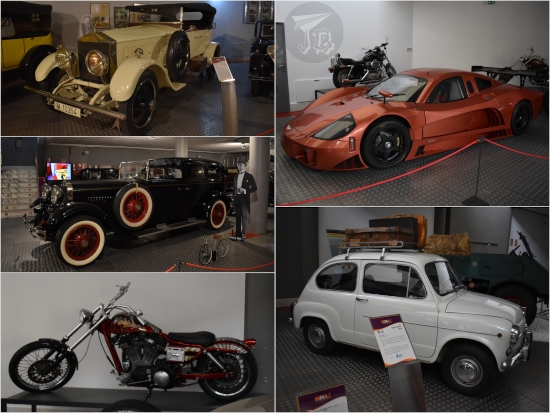
Then we found a very air-conditioned and interesting place – the automobile museum Museo de la Historia de la Automoción (which reminded me a little of the Megaweb Toyota City Showcase and History Garage in Tokyo). It has a lot of classic cars, and some historical pieces such as vehicles that belonged to dictator Francisco Franco or the writer Camilo José Cela (and air-con).

A collage of some cars: A Rolls-Royce, a Ferrari, a Wolkswagen 600; and a Harley-Davidso

I had then booked myself an evening visit around sunset time, to go up the towers of the cathedral, an experience called Ieronimus, with the hope to see some cool sunset and night views. It makes sense, right? Wrong. I should have realised when it turned out to be a guided visit that most of it would be inside, listening to the guy fanboy his own city – then he started speaking about the Lisbon earthquake and its effects in Salamanca and gave out wrong information. I stopped listening to him at that point. There was a light/music show in the cathedral, and I did get some neat pictures, but honestly? The choir concert in the old cathedral would have been a much better choice, had we known about it.

Views of Salamanca at night, with the gothic architecture highlighted by the illumination. The city looks Romantic and mysterious.

Walking distance: 13017 steps / 8.00 km

23rd July 2022: Plateresque Salamanca {Salamanca, July 2022}

Officially in western Spain, Salamanca stands next to the Tormes river and sports a Unesco World Heritage title for its old town. I was five or six the first time I was there, so it’s not like I remembered anything from it, except memorising excerpts from the book El Estudiante de Salamanca (José de Espronceda), my favourite Spanish Romantic poet.

Salamanca is known due to its university, which is considered one of the best in the teaching of Spanish as a second language, the oldest Spanish university and one of the oldest in Europe, founded in 1218. There are actually two universities, but we shall get to that later.

There is a period in Spanish history referred to as the Gold Century, Siglo de Oro (Not an actual century, the given dates are between 1492 – the year when the Catholic monarchs finished conquering the country, Europeans realised America existed, and the first book on Spanish grammar was published – and 1659 – when the Pyrenees treaty was signed after the war with France). It was throughout this period when Salamanca thrived, especially late-time Gothic styles and early Renaissance ones. Then of course Baroque later on, but you know my stance on Baroque by now I guess… The mixture of late-gothic and Renaissance gave way to a unique style, Plateresque – with a strong Gothic base and a blend of Mudéjar, Flamboyant Gothic, Lombard and Tuscan Renaissance elements and decorations. Plateresque is characterised by heavy decorations sculpted onto the main architecture, especially in the typical fusion of doors and altarpieces. The motifs are plants, animals, shields and medallions… All and all, an impressive style considering we are talking about carving stuff on stone – in the case of Salamanca, a lot of it is sandstone, which gives the old city a golden tone.

We had to take a couple of trains, but and made it to Salamanca around 10:30, and were in the city centre a few minutes later. After dropping the luggage at the hotel – I had been requested the hotel to be near the cathedral and I found one which was literally across the street from one of the flanks. Then again, here’s the thing – Salamanca has not one but two cathedrals: the Old Cathedral Catedral Vieja de Santa María and the New Cathedral Catedral Nueva de la Asunción de la Virgen. Apparently, instead of building over the old one, they decided to keep both, making the historical complex unique in the country.

The New Cathedral was built mainly in Gothic style with later Baroque add-ons, with an ornate Plateresque façade. It was commissioned by king Ferdinand V of Castile, and built between the 16th and 18th century, in the Gothic style, even though this was at time when Gothic was already in decline. However, the town authorities wanted it to “match” the old Romanesque cathedral. A cupola and a choir were added in the Baroque period, and the façades were decorated in the Plateresque way (in a 20th-century restoration, someone thought it would be funny to add an astronaut to the decoration, causing some hoaxes to pop up afterwards). The most important architect who worked in the new cathedral was José de Churriguera, one of the leading Baroque architects / sculptors / urbanists.

A very ornate Gothic cathedral. The entrance has so many carvings that it actually looks organic, if not for the fact that it is made out of golden / reddish stone

The New Cathedral connects to the old Cathedral, which is late Romanesque / early Gothic in style (I know, it’s confusing. Historically, the old cathedral is between Romanesque and Gothic, and the new one between Gothic and Renaissance – and this is the reason why the Gothic makes the two cathedral “match”). It was built between the 12th and 14th centuries. The most impressive thing in the Old Cathedral is the altarpiece, in which the highest-quality paintings were made by the Italian Dello Delli. On the way out, I let myself be tempted by a paper guidebook of the city – which was helpful because we had to remake all of our plans a couple of times.

Interior of a Romanesque church - the nave has very high and severe-seeming columns

Afterwards, we headed off to the main university building Universidad de Salamanca, the first university building. The university was founded by King Alfonso XI in 1218, which makes it the oldest university in the whole Spanish-speaking world. The most important building today is the Escuelas Mayores, the upper school, built between 1411 and 1533. The façade, which looks towards the newly-discovered New World is sculpted in the Plateresque style, with a ton of decoration – and the most famous motif is the frog that stands on top of a skull. The university was built around a cloister for the students of old, and it has the most amazing library I have seen in a long while – selfishly (I’m joking of course) closed to the public. There is also a chapel and the classroom where the Spanish academic Fray Luis de León, who was famously jailed for four years, and picked up his lectures with “as we were saying yesterday”. The cloister has two floors since the 19th century, and in the centre there is a small giant sequoia (which I thought was a simple fir). There are chapels, and halls, and areas where university holds events.
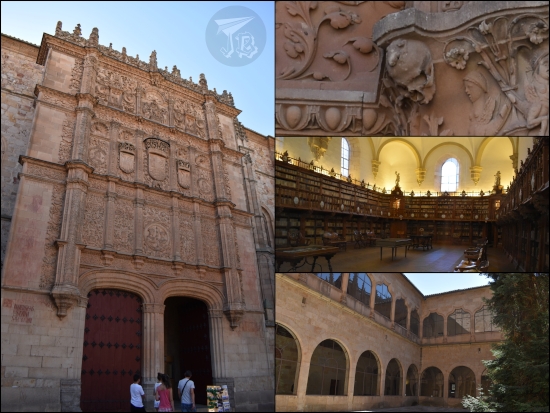
Very ornate entrance to a building. there are two doors (four or five times as tall as a person) and the decoration, all carved in stone, is on top. Three floors of decoration, with columns and shields. A close-up shows a frog on top of a skull.

The problem with Salamanca is that the entries and exits of the building make you have to backtrack a lot (and the horrible street lights), but I love Gothic so I did not mind wandering around anyway. After the Escuelas Mayores, we went to another university building the lesser school or Escuelas Menores. Today, there is a cloister which dates from 1428 with a Baroque upper veranda. In one of the side halls there is a fresco panting that used to be in the library and that was moved over in 1950. The fresco represents a night sky was used in teaching.

Gothic patio and a suck picture of a fresco painting, showing stars and the representation of constellations

We had lunch, then we went to the Dominican monastery Convento de San Esteban and its church. The current monastery dates from 1524-1610, and it was built over the previous one. The façade of the church is considered the best example of Plateresque, and José de Churriguera also worked in the main altarpiece. The monastic building has a portico with Italian loggias, typical of the Renaissance. The cloister is mainly Renaissance with Gothic features, and a small temple in the middle. The ambulatory in the cloister has beautiful Gothic columns and nerves on the ceiling.
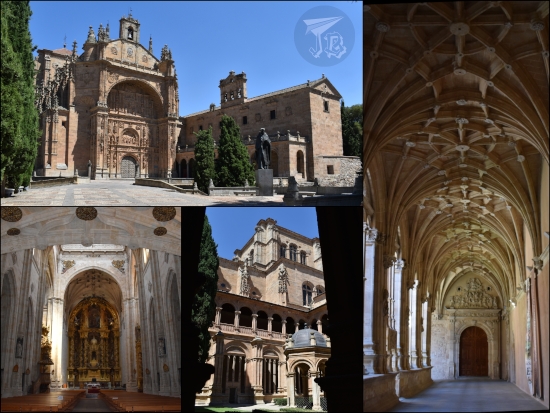
A convent, built in ornate gotic style. The covered corridor around the cloister shows pointed arches and rich decorations

Right in front of the monastery stands the Dominican convent Convento de las Dueñas. The building is Baroque, and before being a convent it used to be a palace – which has caused the convent to have some eclectic elements of architecture, such as the Mudéjar arch mosaic or doors. The inner cloister is Plateresque and full of roses and flowers.

A Baroque building. The inner patio is decorated with plants and Moorish-seeming blinded arches

Next, we found the tiny Romanesque church Iglesia de Santo Tomás Cantuariense, where I happily sicced the oh-so-bored guide onto my companion.
Small Romanesque church in reddish-gold stone. It has a tiny bell tower.

After a stop for a cold drink we went to the Art Nouveau and Art Déco Museum Museo de Art Nouveau y Art Déco Casa Lis, which is one of those places that takes itself very seriously and does not allow photographs. I got scolded for having my camera to my side even closed – but I have to admit that I did sneak up a few things with the phone, mostly because I wanted a record of the central hall with the glass ceiling, and the green windows from the inside, more than the decorative details, though some of them were pretty nice. The Lis house was built by Andalusian architect Joaquín de Vargas towards the end of the 19th century for the first owner, Miguel de Lis.

A Modernist building with brightly-coloured glass in the ceiling and walls.

We headed to the main square Plaza Mayor for dinner, and then to see the pretty lights. On the way we found the other university Universidad Pontificia and the palace Casa de las Conchas, which we would visit the following day.

The main square was another of the city landmarks first designed by Alberto Churriguera, and later one of his nephews – it seems that the Churriguera family claimed dibs on doing stuff in Salamanca. The square is fantastic by day but when night fell and the lights were turned on, it was unbelievable. We had some local sausages and cheese for dinner at one of the street tables in the square.

A plate of sausages and cheese, and two views of the Main Square in Salamanca, one in daylight, one at night, and lit up. The square buildings have a lot of windows and arches on the ground floor

Afterwards, I wandered alone for a while, to revisit some of the sights at night, and a couple of new ones.

Salamanca at night. The cathedral is lit and the ornamets almost shine. The Modernist house is lit in green and blue lights.

I headed off to the riverside of Río Tormes, which as any river has bridges. The first one I found is the Puente de Enrique Estevan, commissioned in 1891 in order for the town to be ready for the new cars. It has six iron arches and at night it is lit in bluish light. A few minutes downstream stands the older stone bridge Puente Romano, which according to the legend was built by Hercules – it dates back to the first century, but it has been heavily rebuilt and reconstructed through the years, especially after it was damaged by a flood in the 17th century.

A collage showing an iron bridge, and a stone bridge, both lit in the dark

Finally, around midnight, I went back to the hotel for a shower and sleep.

Walking distance: 17269 steps / 10.76 km