Attending special exhibitions in Madrid is a way to see spaces that are otherwise private and / or closed off. Such a chance was Thomas Houseago. Esculturas (Thomas Houseago. Sculptures), organised by the investing corporation / bank Banca March. They own a large building in town, along with a private garden that is rarely open to the public. However, it would be accessible to attend this exhibit, which only ran Thursday evenings and Fridays / Saturdays in the early afternoon. Though it was running till October, I thought that spring would be a cool moment to see a… garden.
The train system was running horribly, so I decided I would book at noon, just as they opened, and head to Madrid in the morning. According to when I managed to make it, I would fit in other things I wanted to see or do before or after the exhibition. I also booked lunch at a small (tiny) restaurant I had been wanting to visit for a while, but I was never in the correct area.
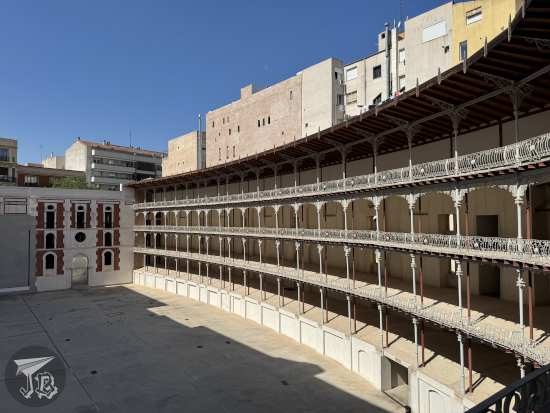
When I reached Madrid, I walked to the former sports facilities known as Frontón Beti-Jai, originally used to play Basque pelota (pelota vasca). In this game, the players hit a small hard ball, either with their hand or some type of racket or bat, and make it bounce on the walls of the frontón. It was included in the 1900 Olympics, but not as competition, only as exhibition sport.
Nowadays, pelota is popular in just a few areas of France, Latin America and Spain. In the 19th century, however, it was the thing to be into in the latter country. Hence, architect Joaquín Rucoba was commissioned to build a frontón in Madrid, inspired by the one in San Sebastián, but better. The architect designed a Neoclassical façade towards the street (to fit the manors and palaces around it), and a Neo Mudéjar access and exterior of the facilities (to honour a traditional architectural style in town). There are three floors of stands with white cast iron pillars and balustrades, and the playing area is plain concrete. Construction started in 1893, the building opened in 1894 and was used to play until 1919. Eventually, the sport fell out of fashion, and the frontón was given new life, or several of them – aeronautical experiments, car repairs, motorbike sales, political meetings, movie filming, bread baking…
With time, nobody knew what to do with the building. It was abandoned – though still considered “structure of interest”. It was finally bought by the town hall, restored and opened, first only to guided visits, and eventually to free exploring. I took the chance to snoop around for a while, and was able to climb up the upper floor balconies, which were closed to the public before – most of it is still not open, but at least you can get a panoramic of the whole thing, including the different decorations on the iron-cast columns in the three floors.
Afterwards, I took a walk towards the archaeological museum Museo Arqueológico Nacional (MAN). It is one of my favourite museums, and every now and then they run special exhibitions on the ground floor to showcase artefacts that are not on display. These are usually free, too.
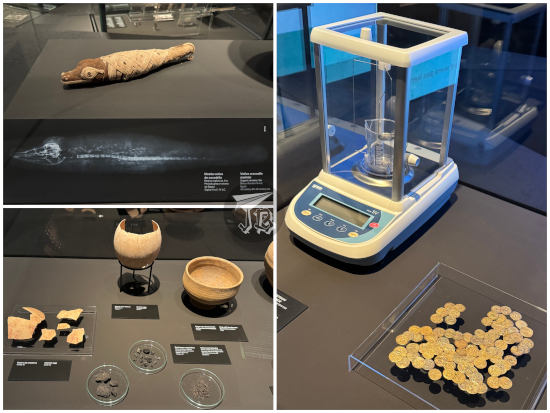
The current one was called “Mysteries of Matter, Heritage Science in MAN’s collection” – Misterios de la materia. Ciencia del patrimonio en las colecciones del MAN. It is an interesting display of artefacts along with explanations on what kind of scientific studies can be done on them in order to learn about their history, such as carbon dating, DNA analysis, X-rays, tomography, fluorescent, conservation and restoration… According to the goal, different procedures are used. A bit too technical, maybe, but still interesting. Something I saw was the treasure found in Recópolis, whose golden coins had been… weighed. I had not expected a scale to be prominently displayed in the exhibition.
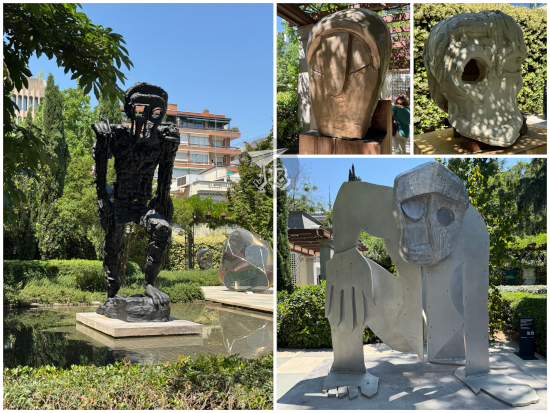
I moved onto towards the Edificio Banca March and its private garden, where seven pieces by British sculptor Thomas Houseago were on display. Houseago uses discarded materials (mostly plaster, wood or metals) to make his works, some of them gigantic, a bit on the grotesque side. The exhibited pieces were:
- Large Walking Figure I (Leeds), a five-metre bronze giant, frozen mid-step, which had been placed in the middle of the pond. This was my favourite piece, and the first one I saw when I walked into the garden. It was impressive, a bit disturbing, and even in its stillness, it gave me the impression of movement, as if it were looming.
- Moon Figure I, made out of plaster, hemp and rebar: a crouching figure with a blank moon-face, a bit on the unnerving side, as even without eyes it was almost staring at you.
- Janus (Mirror Figure), in wood, plastic and rebar. It’s a figure that resembles a walking figure, but it’s forward and backward at the same time, having two faces (and one very prominent… butt).
- Venice Head (Cave II), plaster, hemp, rebar and wood – a sort of melted skull.
- Cave / Rock Head III: a bronze “helmet” that I’ve seen described as “reminiscing of Star Wars”, I can’t say it’s completely inaccurate.
- Classical Head I, in bronze and wood, reminded me of Pericles’ helmet, from Classical Greece.
- Aluminium construction No.1 (giant) in cast aluminium: a distorted crouching figure that is creepily endearing.
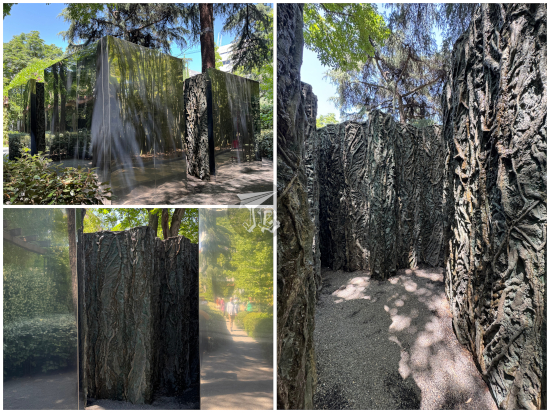
The mysterious garden has a small bar and a weird mix of sculpture, installation and fountain called “Wet Room” – Laberinto húmedo (Habitación vegetal XVIII) by Spanish sculptor Cristina Iglesias. It is a bit of a maze with an exterior made out of reflective metal, an an interior that feels like vegetation which drips water. It was pretty cool, probably my favourite of the works of art there… It would work to cool down the atmosphere during the summer for sure.
I sat in the garden for a while – it was smaller than I imagined – and eventually went off for lunch. There is this tiny Chinese Restaurant nearby called Little Dragón [小笼] (Serrano branch), which specialises in baozi [包子], a type of bun or dumpling with different fillings. It is a tiny place and I think I only got a reservation because I booked early in the afternoon – 13:30.
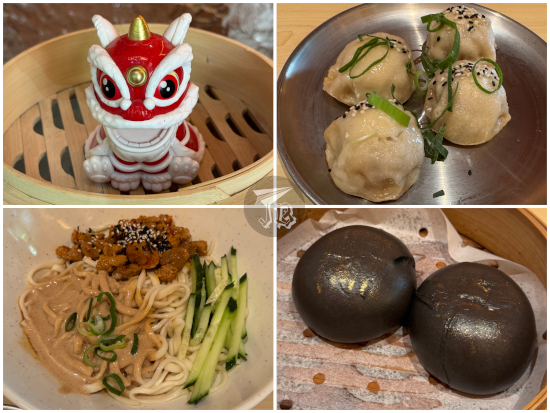
I wanted to try the dumplings, of course, particularly the xiăolongbāo [小笼包] – steamed in their little bamboo basket. I decided to order what they considered their specialities, so I started with Shenjiangbāo [生煎包], which are filled with pork and vegetables, steamed, and then the base is seared in a pan. They were absolutely delicious. I also ordered Hēi jīn liú shā bāo [黒金流沙色] – steamed black buns filled with egg yolk cream, halfway between savoury and sweet, but before those, I went with some noodles lāmiàn [拉麵], one of the restaurant’s specialities: Má Jiàng Bàn Miàn [麻酱拌面] – handmade noodles with marinated pork and peanut and sesame sauce. Everything was delicious, but I do need to work on my Chinese pronunciation (not that I have any…).
After lunch, I took a detour on my way home in order to visit a friend who had an operation early in May. And I got a surprise birthday mini-party from them and their family! With cheesecake and dinosaurs!! All in all, it was a great day, even if weird and eclectic.

