5th September 2025: Ara Malikian. Conciertos de la Muralla, Alcalá de Henares (Spain)

The “Wall Concerts” Conciertos de La Muralla is a late-summer music festival that takes place in Alcalá de Henares. As far as I have learnt, it has been going on for almost a decade, with “artists of the highest level”. I’ve only heard about a handful of the musicians that have played there, but I’m not much into the Spanish music scene. A while back, I read that violinist Ara Malikian would be making a stop in town as part of his promotional tour Intruso.

When checking for tickets, I found a lonely fifth-row empty seat in the arena, too good not to be bought. The show was to be held in the outdoors area known as Huerta del Obispo, where Alcalá de Henares also carries out its RenFair. Since tickets and seats were numbered, there was no need to queue or be there early. Though the show was outside and I was prepared for chill, it turned out to be just a bit windy so I did not need the extra layers of clothing I had brought with me.

Born in Lebanon to an Armenian family, Ara Malikian started playing violin in early childhood. He was good enough to give his first concert and 12 and be invited to study in Germany at 14. He went on to play with and for the best orchestras in the world. He has published 30 albums, composes, and covers classical and modern pieces.

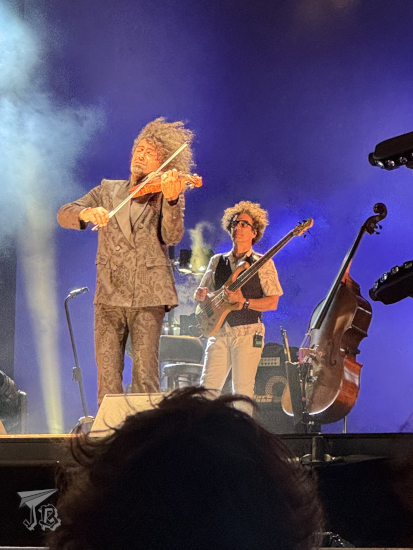
His stage persona is outlandish, with crazy hair and clothing. He tells stories on stage that are a little real and very embellished with fantastic details, to the point that you’re not even sure if the outrageous titles he’s quoting for the setlist are even the actual ones beyond the covers of famous composers and musicians.

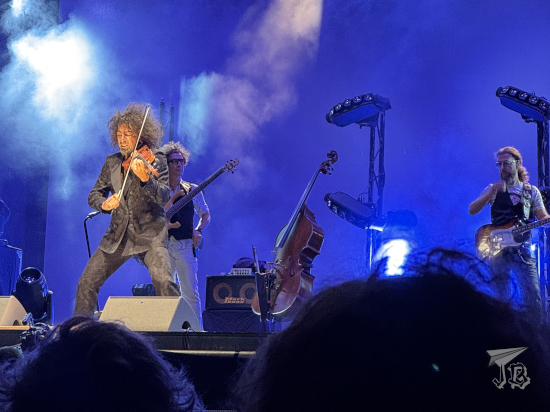
Ara Malikian playing violin

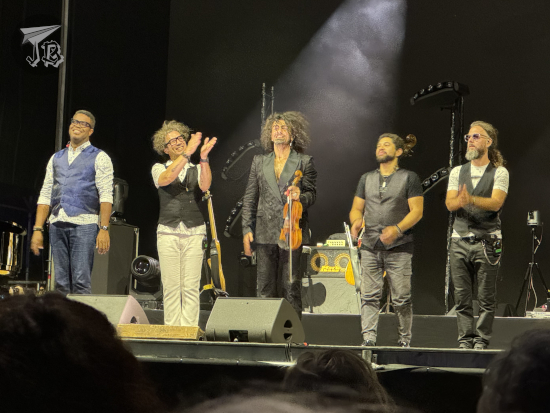
For this gig, Malikian was accompanied by drums, piano, guitar / bass and cello. He played alongside a quartet of Cuban musicians, whom he claims met in Havana 30 years ago. After he received a scholarship to go to Cuba to play a “contemporary piece” he did not prepare, he met these young artists who had not rehearsed either. Together, they decided to improvise while the composer yelled “imposters” and “pigs” at them, thus the piece being now called “Concert of Pigs and Imposters” Concierto para cerdos e impostores. The ensemble comprised Iván “Melon” Lewis on piano, who almost died a couple of times choking on his own laughter due to the bizarre stories that the violinist told; Ivan Ruiz Machado on classical double bass and regular bass; Georvis Pico, specialised on jazz, on drums; and finally Dayán Abad García on guitar.

Ara Malikian playing violin

Thus, Ara Malikian claims such titles as the aforementioned “Concert for Pigs and Imposters” or “Ratboy” (Niño Rata) or “Rhapsody of not doing anything” (Concierto Rapsódico de No Hacer Nada). The first comes with a tale of a quartet of musicians improvising with him on stage in spite of the composer of the piece they were supposed to play hurled insults at them. The second derives from a crazy story about being hired to stand in a bar and not doing anything to create curiosity amongst the patrons.

Ara Malikian playing violin

There were covers of famous composers, both classical – such as variations of Niccolò Paganini’s Caprice No. 24 in A minor – and more modern, like Paco de Lucía’s Zyryab. The concert ended with a beautiful song called Nana Arrugada (Wrinkled Cradle Song). All in all, I enjoyed the concert very much – though I could not find a believable setlist to compare my information anywhere.

Ara Malikian and his support musicians performing

My seat was honestly fantastic, and not even the wind could spoil the sound or the ambience. If any complaints, the fact that people seem not to understand that if they enter the area at 20:00 and drink a huge glass of beer, they are going to need a toilet before the concert is over – making everyone around them stand. Also, a concert might not be the best place for random people to yell political slogans…

Ara Malikian and his support musicians waving at the audience after the concert

I had a good time, and when the show was over, I walked around the city centre to see if there were any monuments lit up. There were some, and the main street was packed with people enjoying the last days of summer. I thought I would get some frozen yoghurt, but there was a queue. Thus, I decided to wait until I got to the ice-cream parlour a bit further up the street. Even a longer queue. And at the last parlour, it was even longer than both of the other two combined.

Façade of the classical University of Alcalá de Henares under a full moon

It became less crowded when I left the pedestrian area, but there were enough people so it did not feel dangerous to walk to the car – despite the town having been on the news due to violence a few times in the few previous weeks.

I was home before midnight, not even extremely tired. Since I had to do some shopping before the concert, I decided not to combine it with any visits or anything. And as there had been no ice-cream for me, I ended up having some home-grown watermelon I had been gifted…

26th July 2025: Gladiators in Alcalá de Henares (Spain)

I am weird. Give me an exhibition of things I’ve seen (from the MAN) or I’m planning to eventually see (from the Roman Museum in Mérida), and – even if it is nearby – I won’t feel like coming. Add a thirty-minute historical recreation, limited-time only and I’ll be all in. The archaeological museum Museo Arqueológico y Paleontológico de la Comunidad de Madrid MARPA, in Alcalá de Henares, was running an exhibition on gladiators from Hispania called ¡Hispano! Gladiadores en el Imperio Romano (“Hispanian! Gladiators in the Roman Empire”. I have no clue what the exclamation mark is doing there). It’s not like I was not interested, it was just… not really drawn to it.
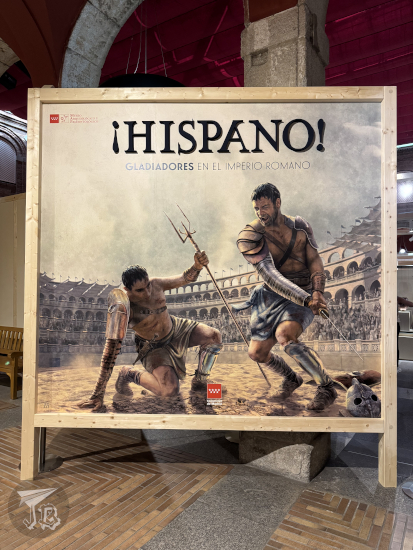
Gladiator exhibition poster, showing two Roman fighters in the Colosseum

However, I did hear about the historical recreation just about it was going to end. And you know how I am with “now or never” feelings. The way it was organised made it a bit of a challenge though – tickets were free but handed over at 15:00 for three sessions: 16:00, 17:00 and 18:00, and I had no idea when people would queue or whatever. I arrived at the museum around 13:30, and asked at reception. They told me that people usually started queueing around 14:30, and thus I decided to head there around 14:15 to secure entry.

Meanwhile, I checked the exhibition out. The majority of the pieces were reproductions, but there were a few originals. The most important real artefacts came from the Mérida Roman Museum, which as far as I know is closed at the moment. There was a guided visit going on, and I reasoned that a bunch of those people would also want to see the recreation.

The collection included reliefs, mosaics, and some sculptures. There was also a copy of the Roman Law from the MAN. In glass cases, helmets and weapons – most of them real – were displayed. In the centre there was a round amphitheatre where the recreation would take place. It was a small exhibition.
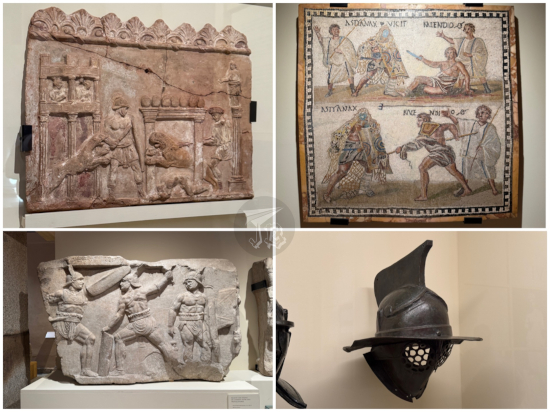
Exhibits in the Gladiator show: reliefs and a mosaic showing men fighting, and a helmet.

Afterwards, I wandered the rest of the museum for a bit, and around 14:15 I went to queue, displeasing the security guard who said that lining started at 14:30. That was not what I had been told. I offered to move, but he muttered “never mind”. What is with security suddenly going weird when there is queueing involved? I’d never had any kind of problem with the MARPA staff before.

At 14:55, I got my free ticket and headed outside the museum for a quick bite. I had planned to try a typical pastry, but all the patisseries close from 14:00 to 16:00, which was inconvenient. I ended up having yoghurt ice-cream instead. I had never seen the main street Calle Mayor or square Plaza de Cervantes so empty, but I guess that was because of the heat. Afterwards, I walked towards Puerta de Madrid, an 18th-century monumental gate that took the place of the actual wall gate. Coincidentally, the structure shows up in the 1960 gladiator film Spartacus.

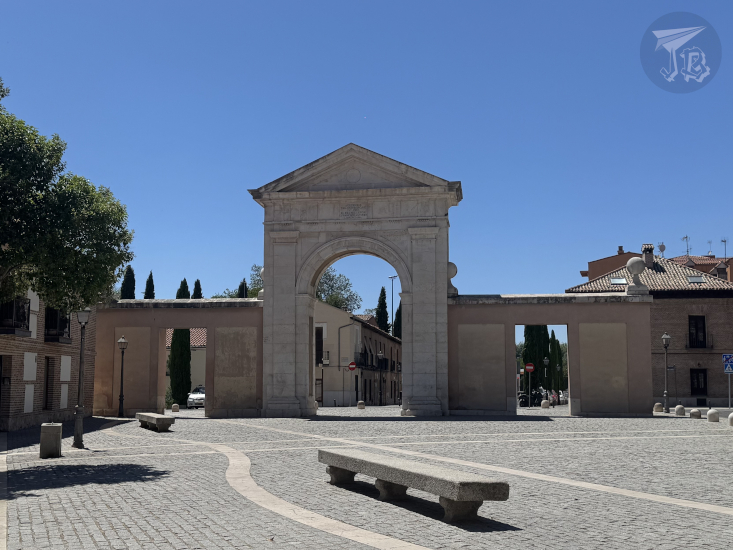
Main street in Alcalá de Henares, during summer mid-day. The only shadows is under the covered area behind the columns at the sides

Puerta de Madrid - monumental entrance to Alcalá de Henares

I went back to the museum and we were soon admitted into the “theatre” that doubled as arena. The recreation was carried out by the historical recreation group Antiqva Clio. There were three actors: the lanista, and two gladiators. There was a kid running around too, but he was sort of the mascot, and a lady in plain clothes helping out.

The recreation started introducing the concept of ludus (plural ludi): a gladiatorial school, where the gladiators were housed (kept) and trained. The owner or lanista selected the fighters – slaves, criminals or free men – and assigned them to a category, either heavy-weight or light-weight.

The lanista was the owner of the school. He invested in the gladiators and their training. Gladiators who were slaves or criminals could eventually buy their freedom if they won enough fights. Once the gladiator entered the ludus, they took the “Gladiatorial oath”, which was akin to “we accept to be hit, burnt, chained and killed by the sword”. Which… was not the expected one, right? To get it out of the way from the get-go, apparently the whole Ave Caesar! Morituri te salutant (Hail, Caesar, those who will die salute you), was popularised in the 19th century, and there is only evidence that it was said in real life as Avē Imperātor, moritūrī tē salūtant, once. It was in the year 52 CE on Lake Fucinus (not even a circus), where a group of criminal and prisoners sentenced to death were to fight on a naumachia (mock naval encounter) until there were no survivors.

Anyway, back to what I learnt. After swearing the oath, gladiators chose a fighting name, and got right into the fray. They trained together and became a sort of family, even taking care of each other and their relatives. Gladiators tended to specialise, as there were different classes with styles and weapons, and the ones who fought each others were different from those trained to hunt beasts. Fighters trained with weighed weapons so the fight would seem much smoother on the show. They were well-fed and even a little chubby so there could be wounds and blood without jeopardising their lives too much. As a matter of fact, when a gladiator died, his lanista had the right to monetary compensation for “loss of investment”.

The standard Roman circus games, ludi circenses, were sponsored by an editor, a sort of promoter who paid for everything. He hired the gladiator schools ludi to offer free entertainment to the people around him. The games started with Wild Beast Hunts (a fighter who was trained in this was called a venator or a bestiarii), then came executions, then the gladiatorial fights (munera) happened.

The gladiators who fought each other were paired: a light-weight versus a heavy-weight, and each fight took about ten minutes. There were different classes of gladiators, and we had an example of a murmillo (Leandrus) and a hoplomachus (Pintaius). The murmillo was a heavy weight-gladiator, equipped with a large shield and a sword. He was the defensive party. The hoplomachus was the light-weight and thus the aggressor. He carried a spear and a small shield. In general, one was “too armed to move” and the other one was “not armed enough” to somehow balance their differences. Both wore helmets with bad visibility in order to increase the drama.

Gladiator in fight pose, hiding behind a large shield

Gladiator with a small shield and a spear

There were two more figures in the games, the rudis, sort of a referee, and the lorarius, who made sure the fighters gave everything they could using a whip to motivate them. Though there was a risk that fighters might die during the fights, it was not the common thing. The winner received a laurel crown, a palm, a purple coat, a silver tray, and a bag of money. The loser could be pardoned or killed, but the whole thumbs-up, thumbs-down thing? That is not historically accurate either. If a winner gladiator was ordered to kill a loser who came from the same ludus, he made sure to do it as quickly as possible.

When a gladiator had won 10 fights, he had enough money buy his freedom and leave the life completely, though he could continue fighting and even assume another role in the ludus, such as a trainer or doctor of sorts. There is no historical information about how a fight was refereed, but here they did a first-to-reach-three-hits scheme. The lanista divided us in two groups to cheer for each gladiator, and the one on my side lost. Apparently Antiqva Clio‘s fights are not staged. The members of the recreation group actually train (with non lethal weapons of course) to learn how to fight, and whomever wins has won. No idea, but I felt sorry for the guys, who had to do it again in 30 minutes, and they were exhausted.
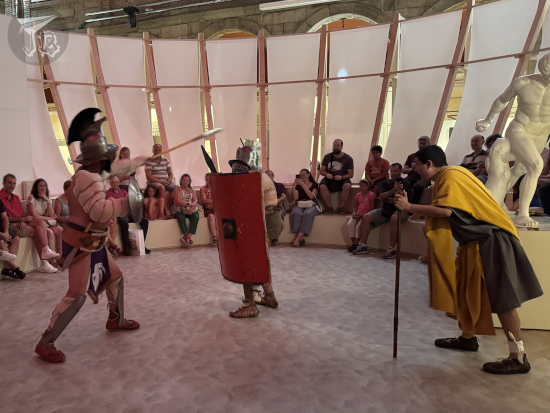
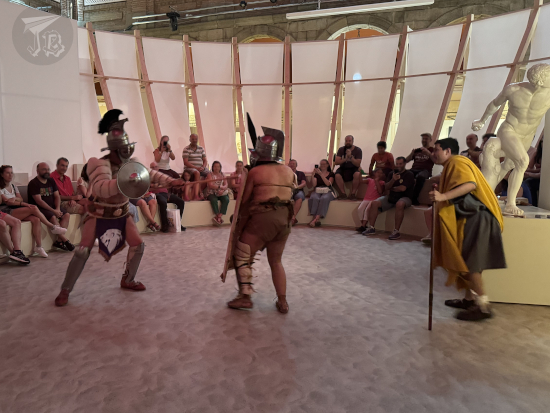
Gladiators fighting. The light-weight is launching his spear forward

Gladiators fighting. The light-weight's spear has made contact with the heavy-weight's shield.

Afterwards, we could take pictures with the gladiators – and they let me hold the weapons, since “my mum was not around to grant or deny permission”. In the end, I just headed home. The walk to the car was a bit scorching though… The price you have to pay for an easy parking spot is a ten-minute walk that… gets hard towards the end of July.

But there was a limited-edition activity and I had got to do it. Good job me.

4th January 2025: Bye Bye, Murderbird. MARPA, Alcalá de Henares (Spain)

While it was great to have the Concavenator fossil (a.k.a. Murderbird in my headspace) in the Dragon Hunters exhibit in Alcalá de Henares close enough to visit at will, the time had come to see it move on. Just in case there was any information I was missing, I decided to book a guided visit to the exhibit. As it was scheduled for 12:00, I decided to look for something to do beforehand, and I found guided visits to the monastery Monasterio de San Bernardo at 10:00. I had seen the building before, as it stands next to the MARPA, I just had never given it much of a thought.

The monastery was established under the patronage of Cardinal Bernardo Sandoval y Rojas around 1620. He bought land cheap because it was near the Moorish quarter. The church was erected in brick with decoration in stone on the outside. The inside has an elliptical dome, and it was heavily damaged in a fire during the Civil War, so it had to be restored – the work on it was a Rehabilitation prize in 2019. Most of the decoration of the church was lost and today walls and roof are just white and gold. The building is attributed to architect Juan Gómez de Mora.

There is a free-standing ciborium in gold, with a number of sculptures of Saints instead of an altarpiece. Behind the altar and ciborium, there are a number of paintings – they were created by Italian artist Angelo Nardi. Nardi was born in the late 16th century, and studied in Venice before moving to Madrid, where he became a Court Painter. His style evolved from late-Renaissance (mannerism) to Baroque, and he is known for his expressive faces. He was friends with Velázquez, and famous for being quite kind, though his style eventually fell out of grace. He painted most of the pictures in the church, although some of them are now out of order as they were moved during the Civil War.

The visit was interesting albeit a little underwhelming. It felt a bit weird to be the only visitor and having the whole thing explained to me – that has only happened once before, in Recópolis. However, that was epic, because I ended up getting the whole archaeological place for myself. The monastery was more of a serious experience – and it did not rain on me. But still it felt… colder. And like being in an exam, the guide kept asking me questions about history, architecture and hagiography.
Monastery of San Bernardo in Alcalá de Henares

I had a bit of time before my following visit, so I decided to run to the Sala Museográfica de la BRIPAC, a tiny museum about the history of the Army’s Parachuting Brigade. The Brigade was created in 1953, and the parachuters participated in combat for the first time in 1957. In its origin, it was established in Alcalá, so there is a historical connection there. The hall hosts uniforms, flags, medals, and reports about the peace missions in the 1990s. I am not much of a fan of Armed Forces museums, but today the BRIPAC is considered a peace corps. The museum opened in February 2023, on the 70th anniversary of the foundation.

BRIPAC exhibit

I still had a bit of time, so I dropped by Plaza Cervantes, which was full with Christmas lights and shoppers at the small market. There were food stalls, a small bookshop, some rock shops… Nothing really caught my eye though.

Plaza de Cervantes Christmas

I finally headed back towards the Archaeology and Palaeontology museum MARPA Museo Arqueológico y Paleontológico de la Comunidad de Madrid. It was one of the last chances to see the exhibition on the history of palaeontology “Dragon Hunters” Cazadores de Dragones with a guided visit, and I figured out that maybe I could learn anything new – despite the fact that I’ve been there a few times and bought the book. We had a nice fun guide who relied a lot on asking questions to her audience. Apparently I was the only one with… some knowledge of… anything she asked – what’s with guides in Alcalá de Henares trying to have you do their job? I felt a bit sorry for her so I answered her questions – with a higher success rate than the ones from the Monastery, to be honest. She did not impress me with the depth of her knowledge, to be honest. She actually looked at me a bit panicky when I asked her t confirm that the T-Rex replica was a cast of the famous Stan.

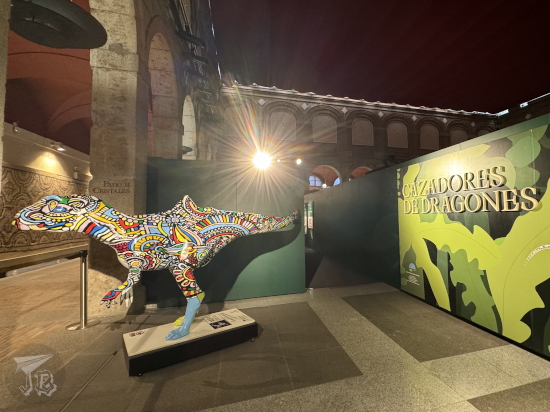
Cazadores de Dragones entry in the cloister of the MARPA

I stayed back for a bit longer after the visit ended. I’ve ranted on and on about the Concavenator before, both the fossil slab and the actual-size reconstruction. I just loved having both so at hand. When I was young, the scientific community came to the conclusion that “birds descend from dinosaurs” but today it is actually believed that birds are actual dinosaurs. And since the poor beast has such a ridiculous name, I’ve just been calling it “Murderbird” or “Murderchicken”, for kicks and giggles.

There were these two little kids who kept grilling their dad about the skeletons, and the poor man was a bit overwhelmed. I decided to give him a hand with the questions and explained a little. I thought that was it, but the smallest child pointed at the Concavenator and blurted out “can you tell us more things about that one??” He was so eager that I just took the family to see it and told them a few things further. The family was on their merry way in five minutes – four-year-olds only have so much attention span. The kids were happy, the parents were relieved and I got to geek out about dinosaurs with appreciative public. I think the interaction was an all-around win.

Murderbirds: T-rex and Concavenator

At first I had thought that I would be staying in Alcalá for an exotic lunch, but I was not really feeling up to it. With great sadness, I said goodbye to the Concavenator and moved on to drive home.

26th November 2024: Another Concavenator visit (Alcalá de Henares, Spain)

I had to run some errands in Alcalá de Henares in the afternoon, so I decided I would get there in the morning, and walk to the Archaeology and Palaeontology museum Museo Arqueológico y Paleontológico de la Comunidad de Madrid, MARPA. The exhibition “Dragon HuntersCazadores de Dragones was still running and since it was a random weekday morning, I thought it would be empty.

I was right, it was deserted enough that the security guard looked at me weirdly. Yes, I’ve been there before. Twice. I hope to be back at least once more before the exhibit closes in January 2025. The security guard should not be remembering me, I did nothing weird. Taking a few hundred photographs of a fossil is completely normal.
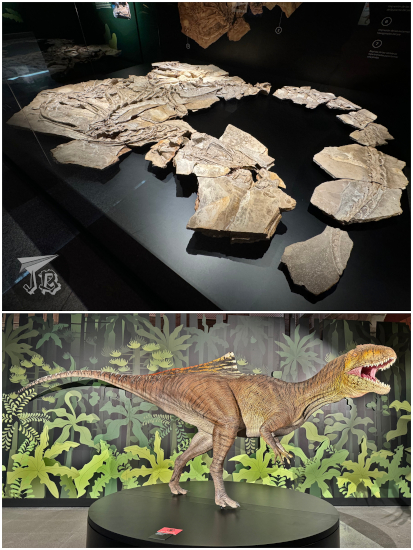
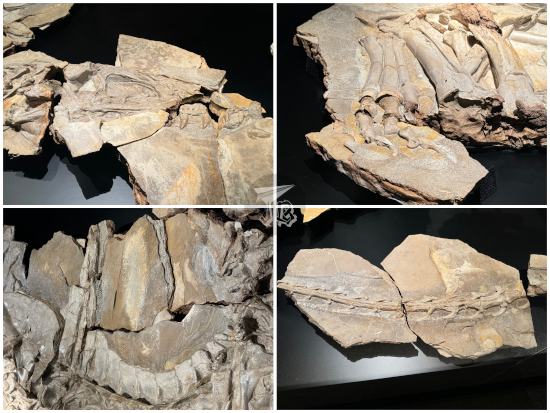
Why am I so obsessed about the Concavenator? Well, one does not always have such a unique fossil so handy, and for free. Furthermore, the usual home of the Concavenator does not allow pictures. And lastly, I’m a nerd. The species Concavenator corcovatus was described in 2010 by Francisco Ortega, Fernando Escaso, and José Luis Sanz from a single skeleton found at Las Hoyas site in 2003. The specimen was officially catalogued as MCCM-LH 6666. The animal was a medium-sized carcharodontosaurid. Carcharodontosauria, which included the likes of Giganotosaurus, Mapusaurus or Carcharodontosaurus, were a group of large theropods from the Cretaceous period. The skeleton was almost complete, with the tail and neck contorted in rigor mortis. The fossil shows two things that make it special – a hump or sail created by the spines of the back vertebrae, and the fact that some pigments were found on the fossil. Not unique but rare enough findings include impressions of skin and scales, and smaller bones in the belly area, rests of undigested dinner. On the arm bones there are insertions for ligaments similar to those that modern birds have at the insertion of feathers.

Concavenator corcovatus

The Concavenator lived around 125 million years ago, in an area of wetlands. Its teeth, general shape (it walked on its two hindlegs and had small-ish arms), along with the remains of animals that it had eaten, tell us it was a carnivore, and its placement in the carcharodontosaurid family, that it was a predator. However, no large predator is known for rejecting a good scavenging feed. The spikes or hump on its back, above the hips, can be clearly seen on the fossil, but nobody has any idea of what it was for – speculations have been made for communication means, fat deposits and thermoregulation. When alive, the animal would have been around 5 metres long, two metres tall, and 450 kilograms heavy.

Concavenator corcovatus details

All that to end up being dug up and named… Pepito, which is the diminutive of the diminutive of the Spanish version of Joseph. The equivalent of Joseph would be José, nicknamed Pepe, and changing the last “e” into “ito” – the suffix for small – would yield to something like Joey. So this magnificent predator was either named after a mini-mini-Joseph, or a small meat sandwich, which is also referred to as a pepito. Seriously, what happened to the illustrious tradition of Boaty McBoatface? This would have been a glorious Toothy McToothface (“Spanishised” as Dientito Caradientez or something).

Anyway, after the visit I dropped by the museum shop to buy myself some Concavenator-related merchandise. When was there the first time, I bought the exhibition catalogue, but since then they had received some silly cute items – I bought a pin, a badge, and a magnet, just because I could. Maybe as the exhibit draws closer to the end there will be discounts on other things…

I left the museum and decided that since it was way past 14:00, I should grab a bite to eat. As I had parked my car next to a shopping centre, I headed there with the idea of some Asian food. However, there is a burger joint that usually has a long queue and that some friends had told me was really good – as good as fast food can be, I guess. It is called TGB – The Good Burger. It is supposed to serve “NYC style gourmet hamburgers”. The place was empty, so I decided to give it a try.

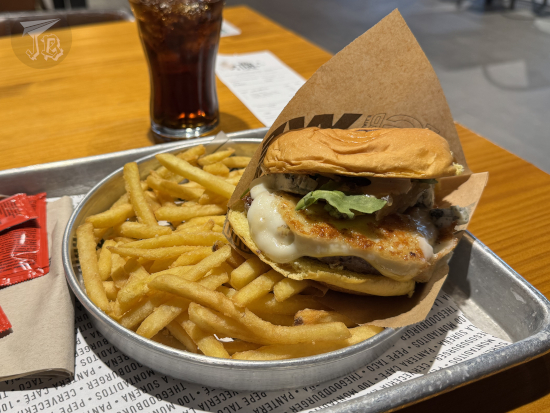
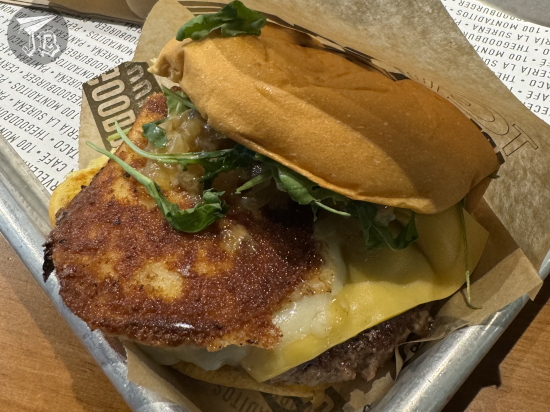
I ordered a “Cheese Lovers” burger, which consisted of a beef patty, American cheese, goat cheese, Gorgonzola, sautéed onions, arugula and honey mustard sauce. It was… very cheesy. It was nice, but nothing I feel I must try again, especially when there are cheaper options in the shopping centre. And sushi. But at least, I satisfied my curiosity before I went off towards all my dull, grown-up errands which I shall not bore you with…

The Cheese Lovers burger

13th October 2024: Mercado Cervantino de Alcalá de Henares (Spain)

Alcalá de Henares was the birthplace of writer Miguel de Cervantes, author of Don Quixote, one if not the most important novel in the Spanish speaking world – often considered the first modern novel in Western literature. Thus, a lot of the town activities are presented in relation to Cervantes, one way or another.

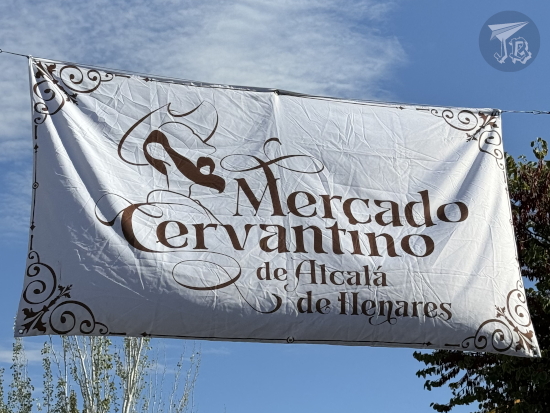
Renaissance Fairs are getting popular in the centre of Spain, and Alcalá has dubbed its own “Cervantine Market” Mercado Cervantino as part of a week-long celebration of Cervantes’ christening Semana Cervantina. I missed most of it since I was in Türkiye, but on the last day I was able to drop for a couple of hours with my sibling.

Mercado Cervantino

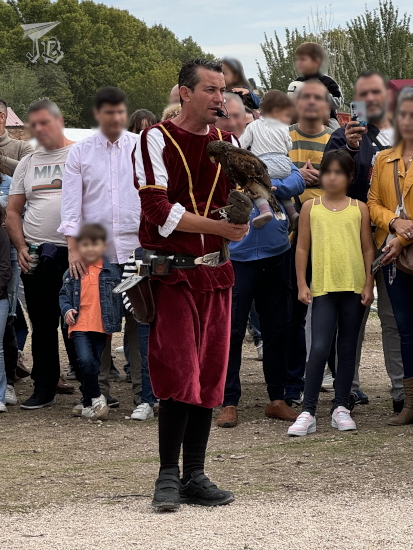
We reached the market around 11:30, too late to hear the cannons. It being a Sunday, everything was packed. We got to see Don Quixote and his sidekick Sancho, a horde of orcs, and a falconry exhibition by Francisco Miranda and his Harris’ hawk.

Don Quixote

An orc

Falconer

Harry's eagle mid-flight

Afterwards, I talked my sibling into dropping by the nearby Archaeology and Palaeontology museum Museo Arqueológico y Paleontológico de la Comunidad de Madrid, MARPA. The exhibition Cazadores de DragonesDragon Hunters – is still on, and I was not going to waste the chance to see the Concavenator (Concavenator corcovatus). I realised they had brought some extra merch for the exhibition, and I decided to drop by in the near future.

Concavenator Skull

We went off for a late lunch afterwards, and later I just drove off.

7th May 2024: “Dragon Hunters” in Alcalá de Henares (Spain)

The Archaeology and Palaeontology museum in Alcalá de Henares is running a temporary exhibition on the history of digging dinosaur bones, called “Dragon Hunters”. I was drawn to it because well… dinosaurs. Driving in the city centre is a nightmare, so I left the car in an easy-to-park area a bit away, and walked downtown.

I had been trying to see the cathedral of the Magistral Cathedral of Saint Justus and Saint Pastor Santa e Insigne Catedral-Magistral de los Santos Justo y Pastor, but it was always either locked, booked for events, or “closed to visitors”. This time around, I was able to finally see it – and it was honestly a bit underwhelming. Though I generally enjoy Gothic buildings, I guess I was so hyped after trying so many times, that reality did not live up to expectations. Furthermore, I dislike when places do not advertise that part of the visit is closed / unavailable, so I guess I’m still pretty out of luck with this one cathedral. I missed the chance to climb up the tower and see the views of the town due to construction, but oh well.

Legend has it that catholic Saints Justus and Pastor were martyrized in the year 304, near the Roman city of Complutum. In the year 414, a chapel was built to keep their remains in the place where the martyrdom happened. The current building was erected by architects Antón Egas and Enrique Egas in late Gothic and Renaissance styles around 1446. The tower, by Rodrigo Gil de Hontañón and Rodrigo Argüello, is Herrerian. The interior has three naves with pointed arches, and to one side stands the cloister, with access to the museum, and – when it is open – the tower. It was a bit of a bummer not to even be able to step into the open part of the cloister. Underneath the altar there is a crypt with a gold-and-silver urn with the remains of the Saints, and the stone where they were killed.

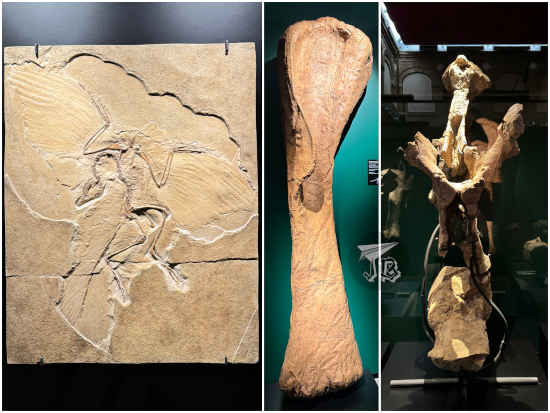
Afterwards, I continued on towards my real destination, the local Archaeology and Palaeontology museum Museo Arqueológico y Paleontológico de la Comunidad de Madrid, MARPA. They are currently running the exhibition Cazadores de Dragones (Dragon Hunters). The exhibit summarises the historical hits of palaeontology, starting with prehistoric and classical references and theories about them, such as a the phoenix having been inspired by Protoceratops skeletons, or the bones of giants being actually dinosaur fossils. This area has a few replicas and small statuettes – running from the originally-made ones to the newest reconstructions.

Exhibit entrance, protoceratops, corridor

The exhibit name-drops a few of the big figures in dinosaur-digging history such as William Buckland, the man who described Megalosaurus as an antediluvian creature; Gideon Mantell, who tried to reconstruct an Iguanodon from a tooth (now in the Natural History Museum in London); Georges Cuvier, who proposed the idea of extinction, and named animals such as Megatherium, Pterodactyl or Mosasaurus; and Richard Owen, who “invented” the word “dinosaur”, meaning “terrible lizard” – though today we know that a lot of dinosaurs had more in common with birds than with reptiles, down to protofeathers and even feathers.

Archaeopteryx, titanosaur

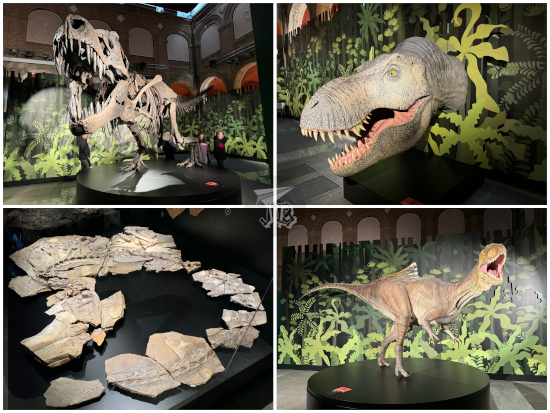
The following section follows the “Bone Wars” – Charles Marsh and Edward Cope were two palaeontologists who raced through the Morrison Formation (Montana, USA) to discover up to 30 species of dinosaurs – they were not always honest in their competition, and it did not help that Cope messed up a reconstruction of an Elasmosaurus, placing the skull at the end of the tail. The Morrison formation was (is) in the middle of nowhere, and digging during the 19th century had its risks. This concept ties with the idea of “the adventurer” à la Indiana Jones, mentioning Roy Chapman Andrews and Barnum Brown, the man who excavated the first Tyrannosaurus. And then you turn a corner and are greeted by a replica of a T-Rex. Of course, I stayed a while here – trying to take pictures without the security guard in them.

Tyrannosaurus rex replica

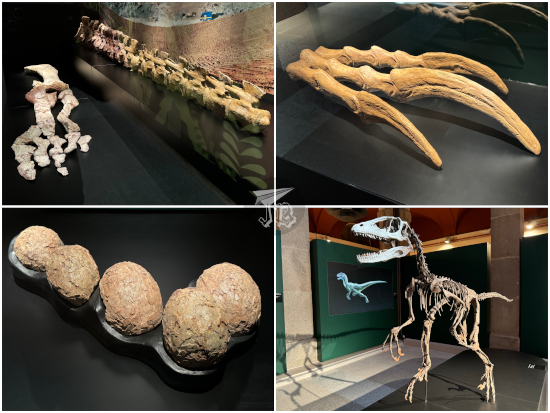
After World War II, palaeontology hits moved from the USA to Mongolia and the Gobi desert, with new species being discovered every so often. Later, in the last years of the 20th century, the idea of “the avian dinosaur” arrived, and there is a replica of a Deinonychus, with screens showing recreations of the creature looking “like a lizard” and looking “like a bird”, feathered and all.

Titanosaur, therizinosaurus, eggs, deinonychus

Finally, there are the local dinosaurs: a tail and part of a foot from Qunkasaura pintiquiniestra, a nest from the Poyos Site (Guadalajara), and the star of the show – the original fossil holotype of Concavenator (Concavenator corcovatus), a theropod found in Cuenca. The fun part? The museum which holds the holotype, Museo de Paleontología de Castilla-La Mancha, bans pictures – so I took my sweet time with this. There is also a life-size reproduction, with colours tuned down to more realistic than the originally proposed blue and red.

Concavenator fossil and reproduction

Afterwards, I wandered around MARPA, mostly to go to the palaeontology room, as I have explored the museum extensively before. The palaeontology ward is relatively new, and it has quite a few nice reproductions and… even if I have explored that one too. I also dropped by the shop to get the exhibition book. Finally, I went back to run through the Dinosaur exhibit again, just because I could, before I headed home. I had thought I’d look for a nice restaurant for lunch, but nothing drew my attention.

15th April 2023: Madrid for Sweet Space Museum (Spain)

My friend D****e and I met for a fast day packed with activities. We reached Madrid at 10:40 and had tickets to visit an interactive museum called Sweet Space. It markets itself as a “colourful experience which mixes sweets and modern art”. I just thought it would be a fun thing to do with a friend that would give into quirky pictures and a couple of hours of giggles. It actually fulfilled both. If you take the place seriously, it’s plainly not worth the visit – modern art in general is questionable at best, and this could be seen like a bit on the childish side – and regular tickets are 18 €. The place’s best-selling point is “get cool pics for your social media”, and we had decided to just be silly about it and enjoy ourselves.

The “museum”, located in the ABC Serrano shopping centre, gives the vibes of an oversized (maybe overpriced) playground, and just like Monasterio de Piedra, the number of people you encounter weighs a hugely in your experience. Although we had an 11:30 ticket, we were lucky enough to be admitted at 11:15 with a family that lost us on the third room, so we had quite a lot of time on our own, until the group that came afterwards caught up. We did take a lot of pictures, to be honest, and missed no opportunity to fool around – which was the mindset we had.

Since the museum’s flagship idea is mixing sweets and modern art, when you enter some of the rooms you are given a treat – a gummy or a piece of chocolate or a tiny bit of ice-cream. You cannot backtrack, so the route gets a bit weird at points – you go up to the second floor on stairs, but down using a slide… The museum has nine different rooms and a few of them are refurbished over time. Unfortunately, I forgot to track down the artists because it was stupidly fun – I mean, at one point I got to ride a carousel-style flamingo. Back in the day in the day, I would have never dared do such a thing, but I guess I’ve changed a little in the last ten years.

  • Room 1: Palm trees with marshmallow trunks (Antonyo Marest). This was a fun way to start the whole thing and set the mood. It is literally a room with tree trunks that look like colourful marshmallows, with leaves on top.
  •  
  • Room 2 (corridor): Flowers in the dark – a dark room with bright plastic flowers. It was pretty, but probably the less surprising room.
  •  
  • Room 3: Mirrors and hanging pink balloons, inspired by Tokyo’s TeamLab. It was hard to take a good picture that did not catch anyone’s reflection!
  •  
  • Room 4 (corridor): Mirrors and neon graffiti (Álvaro Linares) with Star Wars inspired references. This was one of the coolest areas (though I’m not sure how… legal that Darth Vader painting would be). One of the sides had a throne-like chair you could sit on and feel like an evil mastermind.

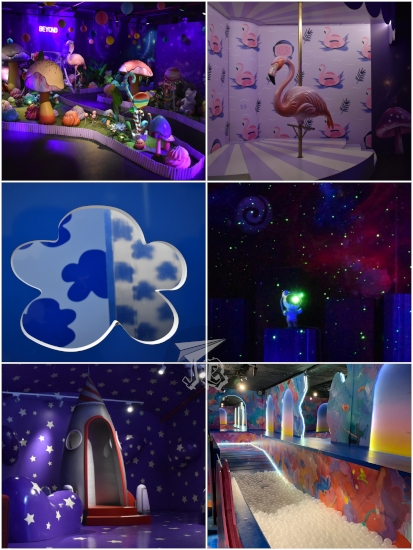
Collage. Sweet Space museum. Palm trees whose trunks resemble marshmellows, neon-coloured flowers and grafitti, pink balloon-like lamps hanging in a mirror-wall room

  • Room 5: Ice-cream parlour “Töto Ice Cream”, including little kart and refrigerator you can step into, giving off a strong 1950’s aura. A lot of pink, I’d say – I did not dare walk into the fridge (for some reason it gave me the creeps), but D****e did; I “drove” the little kart instead. We took silly pictures there with the installed iPad camera, just for the hell of it.
  •  
  • Room 6: Fairytale landscape (Christian Escribá and Patricia Schmidt), a-la Hansel and Gretel or Alice in Wonderland (though it was officially inspired by Wizard of Oz), with a swing and flamingo that you can ride. When I saw that one online, I really, really hoped that it was not only one of those things that only influencers get to do. I got to ride the flamingo. I don’t know why it drew me so much, maybe it was the pure surrealism of it all, but it made me giddy. The rest of the room was fun too – oversized mushrooms, teddy-bears, and colourful decoration.
  •  
  • Room 7 (upstairs): Sky with clouds (Agatha Ruiz de la Prada) painted and carved into sliding doors, a starry rocket (Ivanna Gautier), a bouncing area, a mural where you could take a 3D video for TikTok, and a “planetarium”, with tiny lamp-robots and tons of stars made from light dots. I liked this last one a lot, too. In order to leave the floor and go back to the lower floor, you have to go down a spiral slide, which I was not a fan of – it was difficult to get into it without putting weight on my bad wrist. However, I managed to go down unscathed.
  •  
  • Room 8 (Misterpiro): It held a ball pit with a “staircase to heaven” (or to nowhere). We did not go into the pit, but we climbed the stairs for pictures too.

Collage - fantasy worlds from Sweet Space museum. Overgrown mushrooms, a flamingo, a cloud, a universe made out of green neon dots with a little robot peering out, a cartoonish rocket in front of a starry background, a colourful ballpit full of white balls.

Finally, we reached the shop, where we purchased the pictures we had taken at the ice parlour (8 € for two magnets with four photographs, the downloadable version, and a gif). We were supposed to get a sweet in each room, and we ended up with three or four gummies, a chocolate, and a tiny scoop of ice cream. My favourite was the skull-shaped sweet&sour gummy we got upstairs, but they did not have it at the shop (though it is advertised online). The whole experience was a bit on the expensive side, but I had a discount that helped knock 10 € off the official price. The recommended time I had seen recommended for the museum was an hour and a half, but even if we took a long time, we were done in about an hour.

I had reserved lunch at 14:30 based on the time I expected us to be in the museum (and the availability of the restaurant), so we had some time to kill. We walked by the open-air museum of modern sculpture Museo de Escultura al Aire Libre de La Castellana, but it did not catch our fancy. Too much modern art in one day?

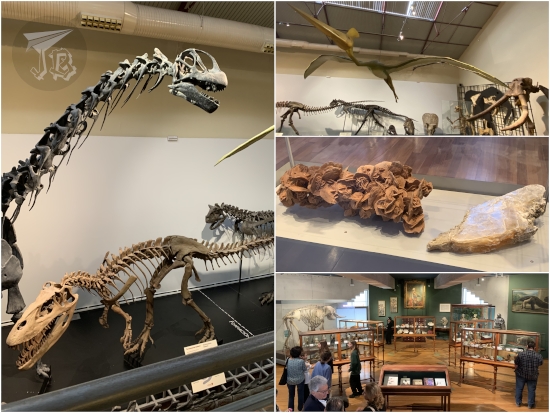
The place we would invest most of that extra time was the museum of Natural History Museo Nacional de Ciencias Naturales to see some dinosaurs and the gabinete de curiosidades, the 18th and 19th century collection of taxidermy specimens. I’d been there before, and it mostly has replicas (and holy molly, prices have gone up). This time there was an exhibit on the Moon landing, and the gardens had been open. The taxidermy collection is not as good as other museums, but at least it got us out of the heat.

Collage. Dinosaur fossil casts and reconstructions, both carnivores and long-neck herbivores. A flying reptile with some mammooth fossils in the background. Rocks. The old collection dating from the 19th century - a number of glass cases with people looking at them and a painting of king Carlos III overlooking the place.

We left the museum and headed for lunch at one of the franchised establishments of New York Burger, which markets itself as a “gourmet burger” place. It was all right, and the servings were huge. After lunch, we hung around the area known as Nuevos Ministerios, a complex originally designed by Secundino Zuazo Ugalde around 1930. We hung out under the eastern archway for a while.

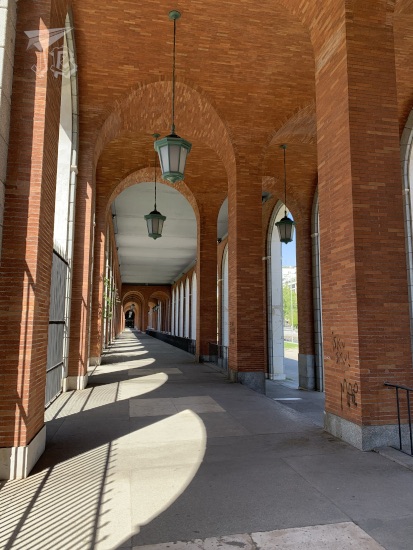
The archway in Nuevos Ministerios, built in reddish brick and white plaster

Afterwards, we took the train to Alcalá de Henares. We stopped at one of the shopping centres just outside town, Quadernillos, where the comic event Krunch! 2023 was taking place. We did not stay for long as most stands sold bootleg and plagiarised stuff, and I did not find any legit shop, but we had ice cream and D****e did take the chance to do some shopping in the mall before we headed home for the evening.

24th September 2022: Manzanares el Real & Alcalá de Henares (Spain)

My friend, whom I had not seen since January 2020 as the pandemic kept us apart, dropped by for a visit as she was in the area. Since the weather forecasting had not been promising, I had not booked anything, but given her a bunch of options to do. She was particularly taken by the castle in Manzanares El Real, a town in the Madrid area, so we drove there.

The palace-castle Castillo Nuevo de Manzanares El Real was built in the late 15th century as a replacement of the previous one by the House of Mendoza. The noble family was given control over the area the previous century, and after a hundred years living in the older castle, the new one was commissioned to Juan Guas, who designed the building in a on a Romanesque-Mudejar style. It was built in granite stone, with Isabelline Gothic decoration, mixing defensive / military, palatial and religious architecture. It was inhabited for about a century before it was abandoned. The castle was declared a Cultural Monument in 1931, and it has undergone several restorations. In 1961, it was used as shooting location for Charlton Heston and Sophia Loren’s “El Cid” film.

Considered one of the best-preserved castles in the Madrid area, the building it has four towers, six floors, and a central patio. It holds a collection of tapestries, and most of it can be walked. Unfortunately, the towers cannot be climbed, but you can walk around the walls, both in the terraced gallery and outside. It was a bit overpriced, but well-worth the visit.

Collage showing the castle. It is reddish with hard corners and rounded towers. The decoration is white and ornate.

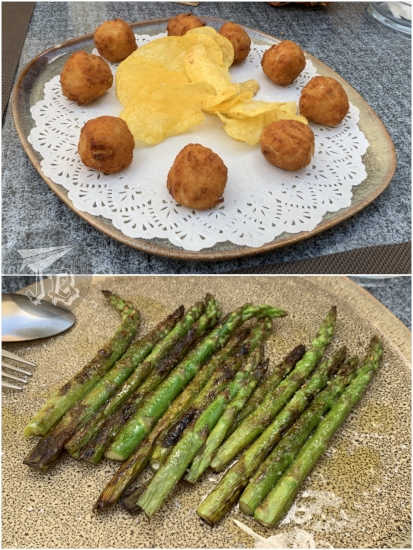
We made a pause for lunch and tried the best wild asparagus (Asparagus acutifolius) that I have had in ages – just grilled with salt and lemon. We had some croquettes too.

Plate of perfectly-round croquettes and some crisps in the middle + plate of roasted green wild asparagus

As we had walked into the village for lunch, we only had to walk a little further to find the ruins of the original castle Castillo Viejo de Manzanares el Real. At the moment, only the foundations can be seen, though it is similar to the new one. The archaeological excavation started in the year 2022, but nothing much is known of it, except this one was an actual military fortress that predates the new castle. From there, the views of the new castle and the local church make a nice skyline of sorts.

Foundations of the old castle. Not much is seen, there is a sign reading "Old Castle Archaeological Excavation"

View of Manzanares el Real, showing modern roofs, the church tower, and the castle in the furthest background

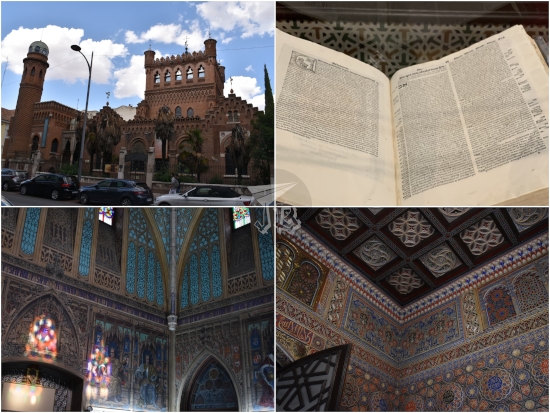
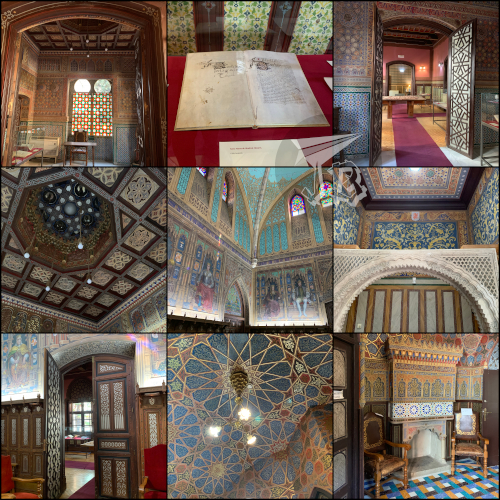
It was still early in the afternoon, so I suggested stopping by Alcalá de Henares. I wanted to make a stop at a shop to check for something, but after a quick visit to the shopping centre, we moved on to what is, in my opinion, one of the most interesting buildings in town – the small palace house Palacete Laredo. Built in the Neo-Mudejar style, it is a bizarre combination of mosaics, moorish-like decorations, and vibrantly-coloured windows that somehow work, somehow. Though only about half of the building can be visited, I just find it bizarrely alluring. My friend loved it. Furthermore, the building has a few Complutensian Polyglot Bibles in display – the first polyglot edition of the Christian Holy book, published in the 16th century under the patronage of the Cardinal Cisneros, a key figure in local history.

Palacete Laredo: exterior and interior decorations + close up of the open bible, in Latin and Hebrew

We continued on, and walked round the city. We saw two back-to-back weddings at the cathedral Santa e Insigne Catedral-Magistral de los Santos Justo y Pastor – that meant we could not snoop into the cathedral, but we did see one of the brides arrive in a Rolls Royce.

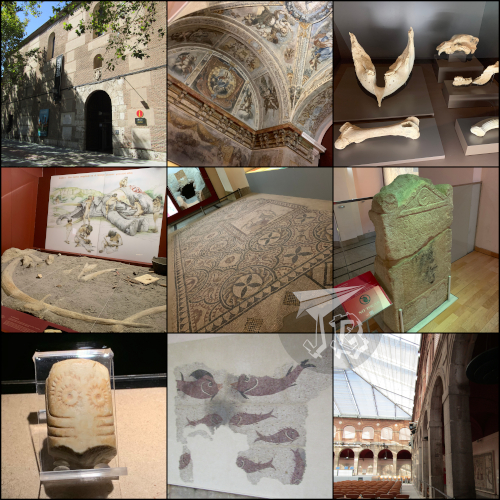
Finally, we dropped by the archaeological museum Museo Arqueológico Regional, which has opened a very interesting new palaeontology ward – holding reproductions and real fossils of animals that used to live in the Madrid area, with a few coming from the palaeontological site of Cerro de los Batallones – most interestingly a Tetralophodon longirostris and a Machairodus aphanistus sabretooth cat.

Skeletons and skulls: mastodon, giant prehistoric giraffe that looks similar to a humongous goat, and sabretooth cat

We did a little more shopping afterwards, and eventually we drove off into the sunset… and the traffic. We ended up walking for 12.47 km (19078 steps), and driving for a good three hours, though M40 was so busy it actually felt like much much longer.

14th October 2021: Roman city of Complutum (Alcalá de Henares, Spain)

Around this time in 2020 I took a small tour around Alcalá de Henares. However, the Roman ruins were not near the town centre, and we exchanged walking there for a walking tour the university and the archaeological museum. This time I exclusively drove to the ruins (or tried to, somehow my phone and my GPS have different layouts, so ended up parking 15 minutes away when I should have parked… right by it).

Complutum was founded as a Roman town in the first century BCE, when the locals moved in looking for fertile lands for crops and cattle. The area, near the Roman road and at the bank of the river, was great – and who cared about the original Iberian settlers anyway? The city grew and a newer town started being built in the first century CE. Soon, the town became a religious (dedicated to the goddess Diana and the water nymphs), economic and strategic hub, so that several Roman roads (viae Romanae) started and died there. The town’s influence expanded for kilometres until the 8th century, when the Islamic population took over the city and the population re-settled to what is now the centre of Alcalá.

The city was eventually lost as the town developed around and over it, but part of it was excavated in the 19th century. The modern excavation was organised in the 1970s trying to salvage as much as could be from the urban developments. Most of the mosaics from the archaeological museum are from this time, apparently.

In the 1980s, the city of Alcalá decided to protect and excavate the town and as of now there are two areas that can be visited. However, they are separated and you have to walk or drive from one to the other.

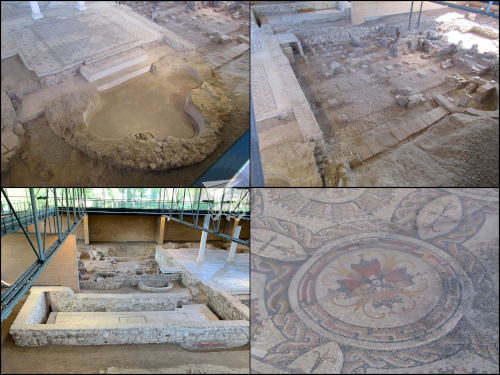
I first visited a building called Casa de Hippolytus, Hippolytus’ House, which was a school dormitory for boys. The building hosts a thermal area, a bathroom, and a garden.

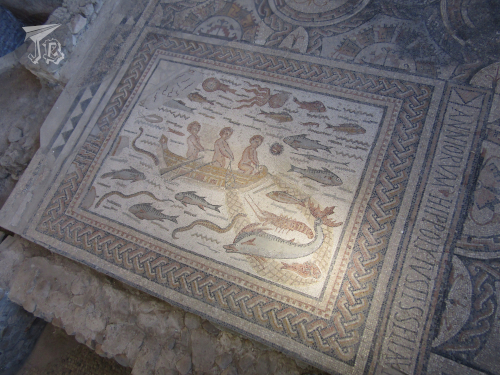
The key part of the house is the “fish mosaic”, commissioned by the rich family who sponsored the school (Anios) to the merchant Hippolytus, who signed the mosaic. The mosaic. is thought to have been a teaching tool as it depicts with a lot of detail a number of aquatic species from the Mediterranean Sea (in contrast with the people in the boat) – there is a dolphin, a sea urchin, a lobster, a cuttlefish, a moray eel, a sea bream…

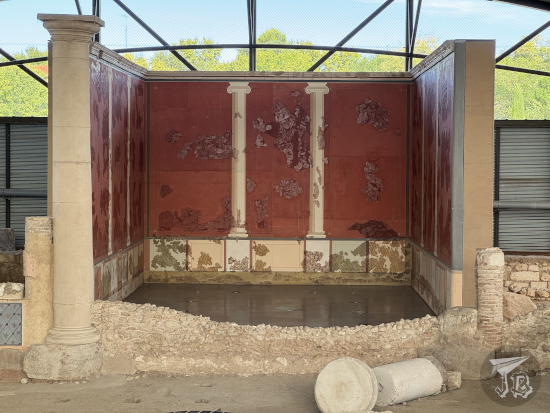
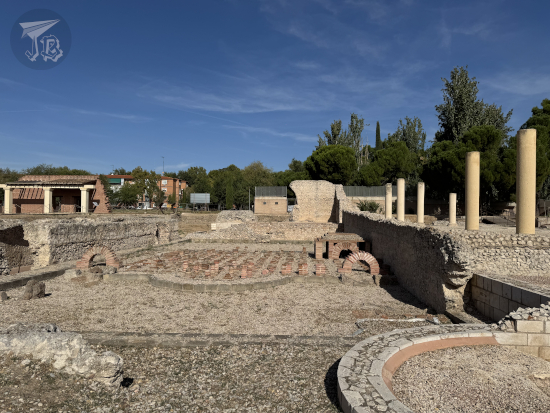
I walked to the other site afterwards, Foro y Regio II, and it’s divided in several parts – it has a residential neighbourhood, some public buildings (therms, curia, basilica…), and the oracle building, along with remains of the sewers and water supplies.

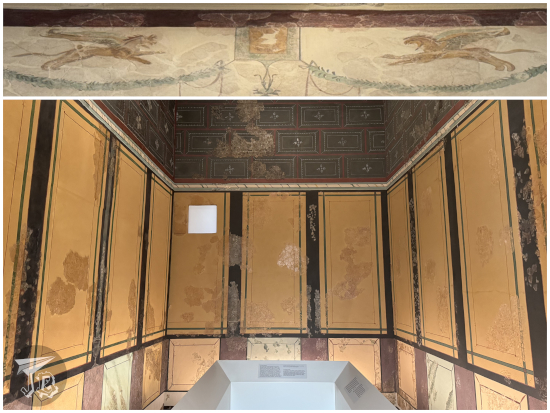
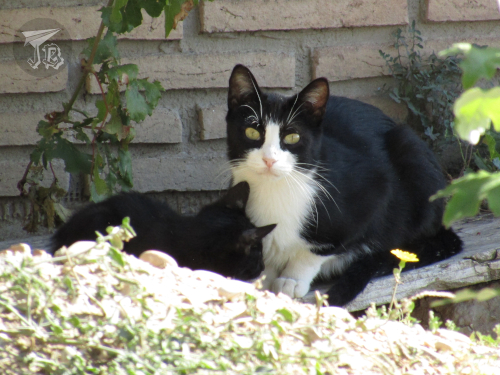
The most important building, called ‘the house of griffin’ due to to the decoration, was unfortunately closed. But you can be sure that the place is kept safe by the kitty queen on call and her dutiful apprentice.

Driving distance: around 64 km
Walking distance: 6.79 km

4th September 2020: Alcalá de Henares (Spain)

After looking for a place to park the car for 12 minutes, I left the car and I went off on foot towards the centre with a relative who is living in Alcalá de Henares. The town centre has been a Unesco World Heritage Site since 1998.

Our first stop, at 10:30 almost sharp was the Palacete Laredo, a small palace built in the Neo-Mudéjar style, a type of Moorish Revival architecture. It was designed and built between 1880 and 1884 by the Spanish artist Manuel José de Laredo y Ordoño. After a century in private hands, it passed to the town hall, which allows the university to use it as a museum, showing a collection of ancient documents.

The palace is built in brick, it has two floors and a minaret-like tower. The inside is decorated with coloured-glass window, tiles and paintings. The visible ceilings on the first floor are wooden artesonado (decorative beams joined together). There is also a garden, but it was closed.

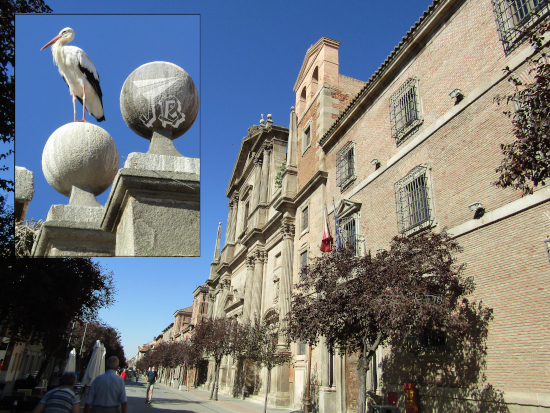
Afterwards, we headed off towards the centre. We walked by the church Parroquia de Santa María la Mayor and is inhabitant the stork on photo duty.

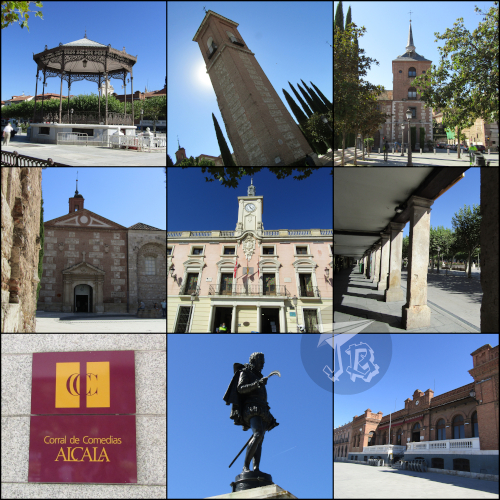
We had tickets to see the Corral de Comedias, a theatre built in the site of an ancient “theatrical courtyard”. These were open-air theatres that were common during the late middle ages and exploded in popularity in the 16th century. The Corral in Alcalá de Henares was built in 1601 by Francisco Sánchez, member of the Carpenters Guild. It suffered several changes – the ceiling was built in the 18th century, then it became a cinema, and eventually was “lost” in the 1970s. In the 1980s, it was rediscovered, restored, and finally opened as working theatre in 2003.

Alas, we were too late for the 12:00 visit to the university, so we wandered around the town’s main square Plaza de Cervantes – Alcalá de Henares was Cervantes’ birthplace. Miguel de Cervantes was a 16th century Spanish writer, most renown for his novel “The Ingenious Gentleman Don Quixote of La Mancha”, which many authors consider “the first modern novel” and “the best literary work ever written” (though… I disagree). The square features a bandstand, the statue of Cervantes, and is surrounded by several buildings of importance – the ruins of the church Iglesia de Santa María, the Town Hall and the Círculo de Contribuyentes, former casino, and the Corral de Comedias.

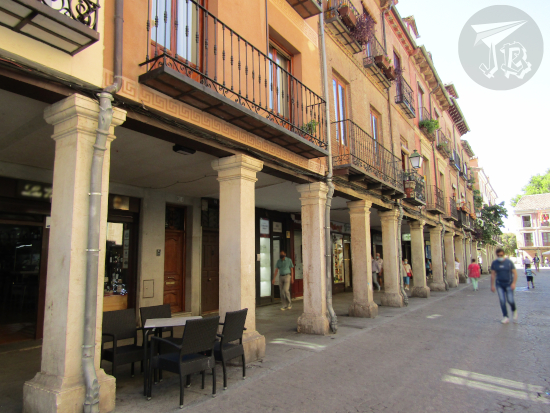
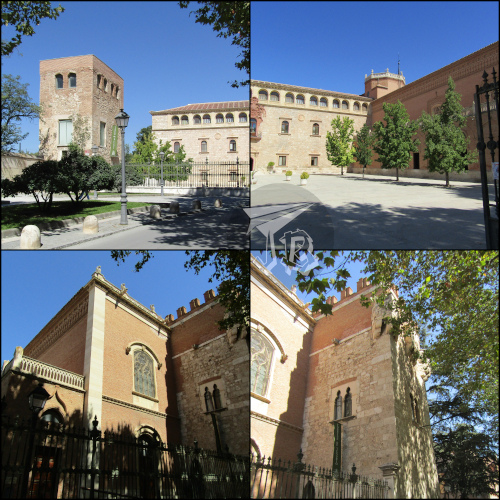
Then we walked down Main Street Calle Mayor, until we got down to the Obispado de Alcalá de Henares, the bishopric, with two towers from the former wall at their sides. That reminds me – we did not visit the cathedral or any religious buildings because they were all closed to tourism.

At 13:00 we took the guided visit to one of the university buildings, the Colegio Mayor de San Ildefonso. The university was established in 1499 by Cardinal Cisneros, an influential Spanish religious and statesman in the time of the Catholic Monarchs. A colegio mayor is basically a dignified “classic” dormitory. The façade was built between 1537 and 1559 in the Plateresque style, an architectural style that developed in Spain between the late Gothic and the early Renaissance. The architect was Rodrigo Gil de Hontañón.

Inside, we saw the cloisters and yards, the gate of honour (from where the successful students left the university), the classroom where the students defended their final thesis, and the chapel, with the tomb of the founding Cardinal (but not his body, which is in the cathedral).

We had a reservation to have lunch at the Parador de Alcalá de Henares, which is a rather modern building and not a historical one, but a stamp was needed (≧▽≦). Lunch was a looong affair because our waiter might not have been the… most efficient. We tried the combos with a little bit of everything to share (entrées and desserts), and some bull tail. Oh and coffee. Yay coffee. (Also, kudos to me for cutting that nut in half.)

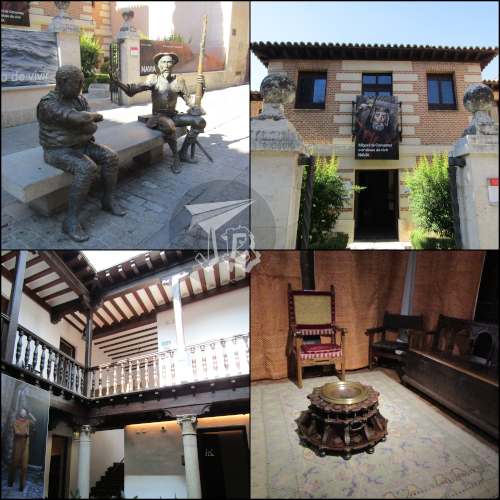
After lunch, we walked down the Calle Mayor again and we made a stop at what is supposed to be the house where Cervantes was born, or at least a reconstruction, with a bunch of ancient objects thrown in – the Museo Casa Natal de Cervantes. There was also a photography exhibition. To be honest, it had a great quality-price relation. It was free, and the quality was… lacking. Or maybe I’m old and I have seen most of the stuff they showed in action, and used a few.

We continued on to the regional archaeological museum Museo Arqueológico Regional, located in the old Archiepiscopal palace. That was unexpectedly good, with the fossil record and the old Roman mosaics.

Pending for a future visit to Alcalá de Henares: Roman and Medieval areas, and the religious buildings, as the day finished up doing some necessary and work-related shopping before I drove back home.

Driven distance: Around an hour? I dumped the car as soon as I could and we walked the hell out of the town (≧▽≦)
Walked distance: 14.61 km

9th January 2013: Inside the Zoology Lab in the University of Alcalá de Henares (Spain)

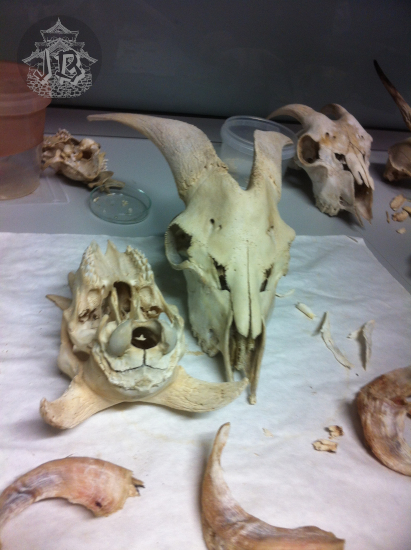
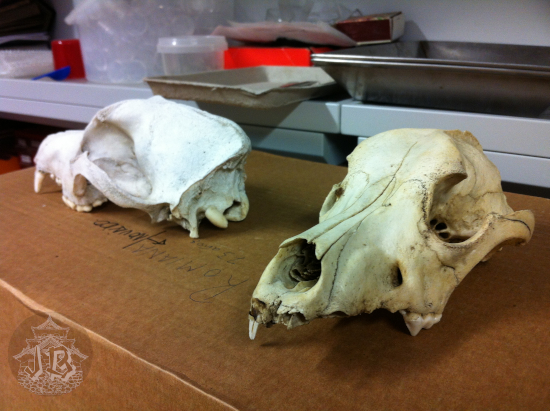
The biology building in the University of Alcalá de Henares has a small collection of Zoology and Anthropology specimens. For a number of reasons, I was invited to see it, even if it is usually only opened to researchers. Taking pictures in the Gallery Collection was not allowed, but it was all right in the laboratory where they prepare and preserve the bones. Or I was sneaky. Take your pick ☆⌒(ゝ。∂)