15th November 2025: The Côte d’Azur {France & Monaco, November 2025}

D****e was leaving Paris about an hour earlier than myself, so I decided to tag along to her station and then backtrack to mine (hey, it was extra friend-time). I’m not good at going back to sleep after waking up, anyway. Thus, we checked out of the hotel together, and I rode with her, then changed platforms towards Paris Gare de Lyon to take my long-distance train. The ride across France was six hours, but it was very cheap, and not much longer than I would take flying from home to my destination.

The current iteration of the Paris Gare de Lyon station was erected following designs of Marius Toudoire around 1900, so it was ready for the World Fair. It features a clock tower and an inner ironwork structure combined with decorative details typical of the Belle Époque design. The station was bustling even early in the morning – I arrived before 7:00 for my 8:21 departure. My ticket said that I would have to leave through hall 3, but there was an announcement from hall 1, where I waited.
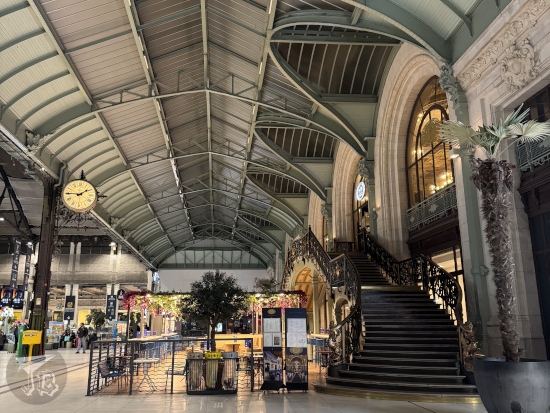
Inner platform of Gare de Lyon station.

Since the previous day I had been tired and had not thought to buy food for the day, I had to pay the price of travel-hub lunch. I got myself some cookies, a Coke and a sandwich – chicken in traditional sauce. I also decided to start a Christmas ornament collection, and got myself a shiny Paris bauble. Access to the train opened ten to fifteen minutes before departure, and it was a bit chaotic. My seat was in the low 500s, and for some reason you could not go from one carriage to another (or at least from my carriage to another?) so I’m happy I got the right door on the first try. The train left on time, at 8:21 sharp, and I slept for the first couple of hours. Around 11:00 I was hungry, so I decided to pull out my sandwich… which ended up being “tandoori sauce”, not “traditional sauce”. Take that, caffeine-deprived brain. For a second, I considered not eating it, fearing it would upset my stomach. However, I was hungry enough that I did not really care, and it was not too spicy. I had another nap afterwards again, and before I knew it I had arrived at the Gare de Nice-Ville station in Nice, in the south-east of France, the area known as the Côte d’Azur (Azure Coast) or French Riviera.
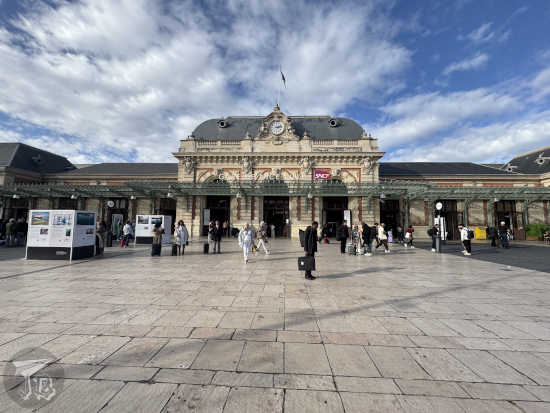
Gare de Nice station from outside.

The first hominids may have roamed the area as far as 400,000 years ago. However, the city was founded around the 350 BCE by settlers of Greek origin, naming it after Nike, goddess of victory. There was a nearby Gallic-then-Roman settlement, Cemenelum, which was eventually absorbed by the growing Nice. During many years throughout history, it could be considered that the region was part of Italy in one way or another. In 1860, the territory was given to France, though not all the Niçoises were happy about that. The Italy sympathisers were repressed without much success.

After the annexation to France and the modernisation of the railway network, Nice became popular amongst the English aristocracy, who enjoyed spending winter there. Holiday-makers included Queen Victoria, for whom a full hotel was built, and her son Edward VII. This would eventually lead to the city’s economy boom during the second half of the 20th century, after it was liberated from the WWII occupation.

In 2021, Unesco recognised the uniqueness of Nice declaring it World Heritage as Nice, Winter Resort Town of the Riviera, with emphasis on the winter part. The development of winter resorts was different from the summer ones, creating layer upon layer of new structures. The so-called Belle Époque architecture became popular, but all in all, the layout of the city is quite complex, due to both history (grand hotels near Roman ruins) and geography (beaches and cliffs).

I headed out to the hotel, which was very near the station, dropped off my stuff and went on exploring. The weather was great, so I could forego one of my layers, even. I was starting to understand the “mild winter” reputation. I first headed down the Avenue Jean Médecin, the main commercial artery of the town, until I reached the promenade.

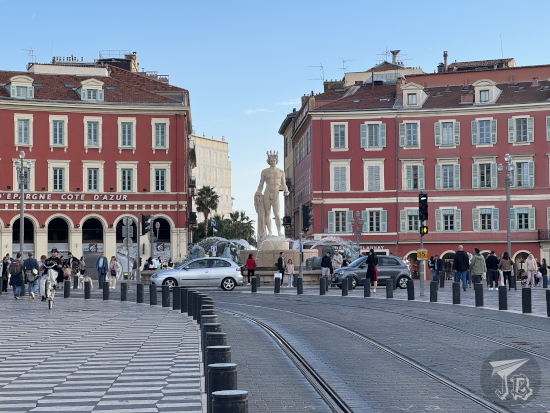
On the way, I stopped at the basilica-church Basilique Notre-Dame de l’Assomption, a Neo Gothic building designed by Charles Lenormand and erected in the 1860s, after the city was incorporated to France, as gothic was (is?) considered a “very French style” (thanks, Viollet-Le-Duc) and more “French architecture” was desired in the city. The building was not open, so I continued down the avenue until I reached the large Place Masséna, the main square of the city. It is surrounded by red buildings of Italian architecture, and a fountain called Fontaine du Soleil, the fountain of the sun, representing the Greek god Apollo.
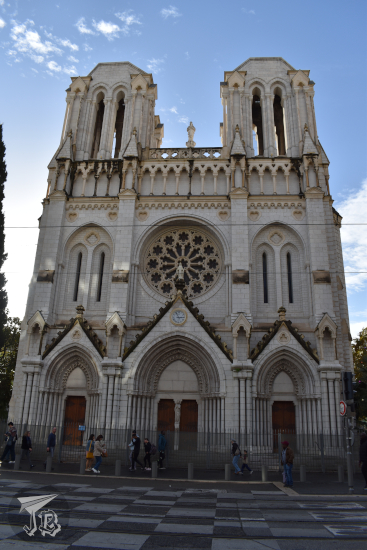
Neo-gothic basilica.

Place Masena with Italian-architecture building and a monumental fountain.

After crossing the Esplanade Georges Pompidou and leaving behind an ugly monument thing Neuf lignes obliques, I found myself at the famous Nice promenade and the Mediterranean Sea. In front of me, a line of private and public beaches made of rounded boulders. On my right, the Promenade des anglais (the Walkway of the English), and on my left the Quai des États-Unis (United States Quay). I turned left, but I could not prevent getting distracted by the beaches. Leaving behind the opera house Opéra de Nice, where nothing was on, I spent some time sitting by the ocean before I continued my way.
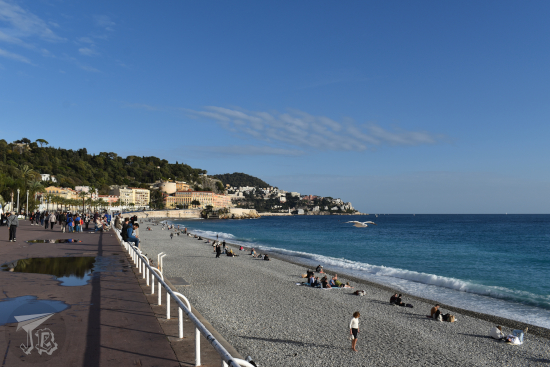
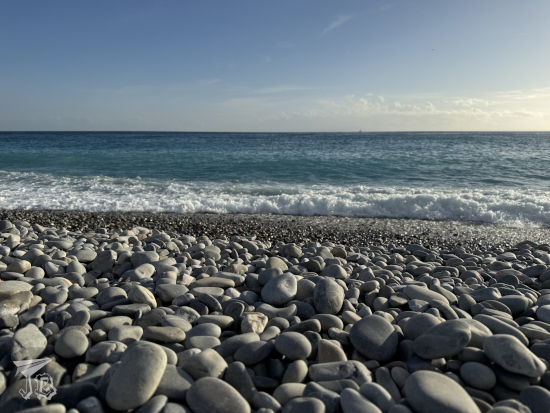
Etats-Unis quai and the beach.

Waves on a pebble-and-stone beach.

I diverted a little back into the old town to visit the cathedral Cathédrale Sainte-Réparate de Nice – Cathedral of Saint Reparata. Construction started in 1650 in the Baroque style, and it went on for centuries until it was declared complete in 1949. The building has one bell tower and ten lateral chapels. It enshrines the relics of Saint Reparata, which arrived in Nice in 1690.
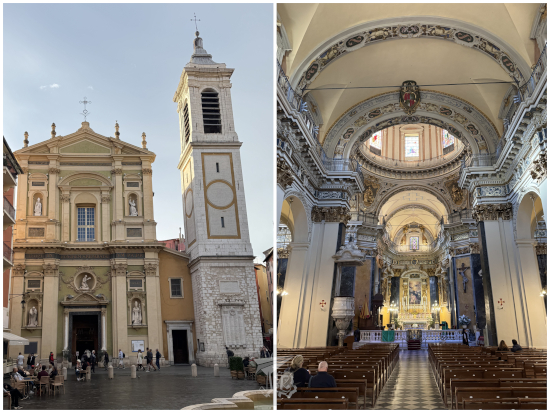
Catholic cathedral of Nice, a Baroque building.

After wandering Old Nice for a bit, I started the climb up the historic park Colline du Château, where the old Nice castle and cathedral stood. Today it offers panoramic views, ruins, playgrounds and… cemeteries for some reason. There is a “free” lift, but someone stood at the entrance, looking very much like they were charging a fee. I wanted to climb up the stairs on foot for the views anyway. Though it was before 16:00, the sky was already in sunset mode.
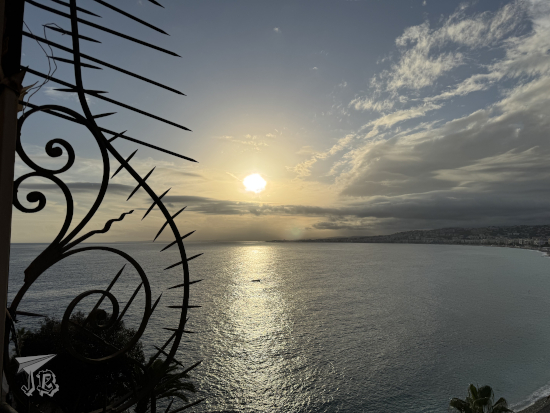
Sunset over the sea.

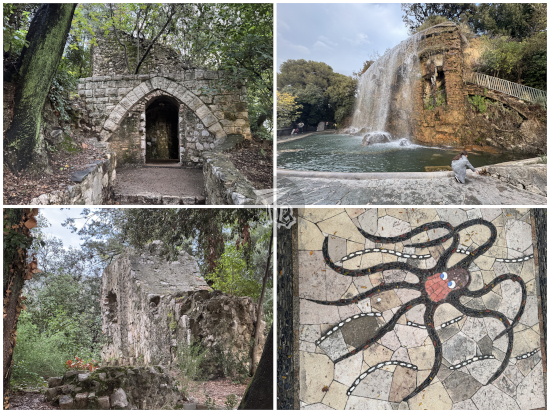
The ascent was not difficult, three or four flights of stairs before I reached the small building that tops the tower Tour Bellanda, the first viewpoint. The structure was originally a medieval defensive structure, but it was destroyed and rebuilt as a place to enjoy the views. I continued on, through the hill / park / historical site. There are several viewpoints towards both sides of the city, along with historical ruins, mosaic decorations, fountains, even the aforementioned cemeteries… All in all I had a lot of fun exploring.
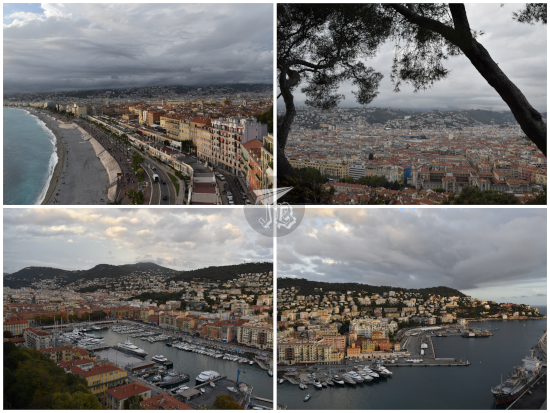
Views of Nice - roofs, coast and ocean.

Collage of the Chateau de Nice: ruins, a waterfall and an octopus-shaped collage.

It had become dark by the time I left the parks, and I somehow ended up re-entering the city down some historical stairs which landed me right into the Medieval quarter again. After going back to the beach for some more wave sounds, I undid my path towards the hotel, taking the exact same route.
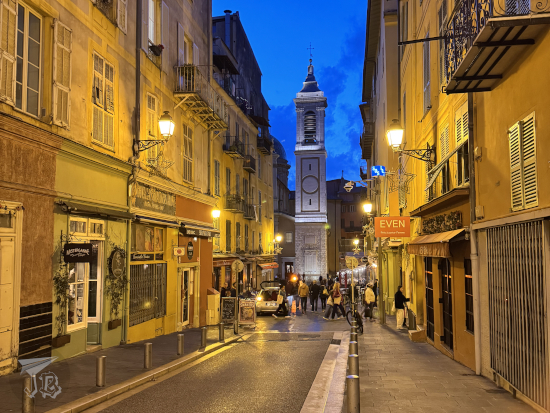
Medieval Nice at night, with the cathedral tower at the end.

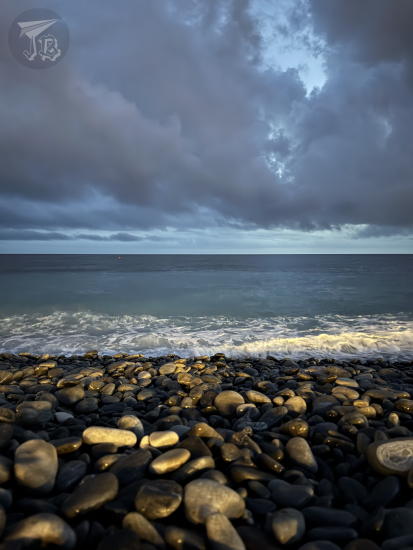
Waves on a pebble beach at sunset.

There was a bookshop on the way, and I really wanted to stop and buy a book I knew was out that weekend, but honestly? D****e had brought so many presents for me that it would not have fit into the backpack… What I did buy was dinner and breakfast for the following day at the supermarket in front of the hotel – read: coffee and a sandwich. Oh, and a smoothie because it looked awesome.

I spent the last couple of hours of the evening in the hotel, watching bad creature films on YouTube before I went to bed.
12th September 2024: Cádiz {Escapade to Cádiz, September 2024}

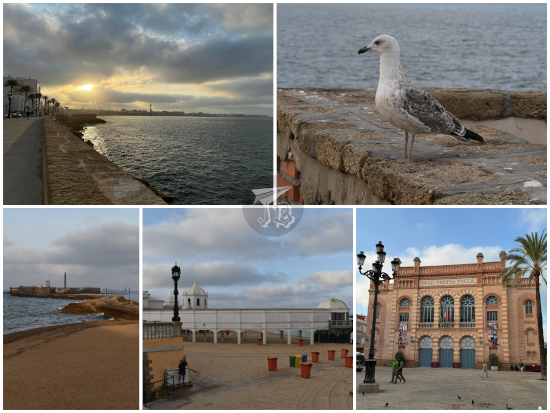
My paperwork-related appointment was at 9:30 in Cádiz itself, and I got up around 7:30. I left the hotel, but unfortunately the café where I had expected to have breakfast was closed. Thus, I instead headed out towards the promenade Paseo del Vendaval to see the ocean again. I turned to my right, in the opposite direction from the previous night, and I walked towards the central beach in town – Playa de la Caleta, a mostly-rocky area with tidal ponds and a long bridge called Puente del Hierro which leads to an old castle Castillo de San Esteban. I chased a few birds on the way for photographs. They were not at all cooperative.

I reached the former bathhouse Balneario de Nuestra Señora de la Palma y del Real, built in 1926 from an original design by Enrique García Cañas with one main access and two corridors that form a semicircle towards the ocean, and end in domes. It was build directly onto the beach, in reinforced concrete, with a style gravitating among Art noveau, eastern historicism and local decoration with azulejo tiles. It was abandoned in the 1970s, but restored for administrative use in the 1990s.

I ventured away from the ocean into the narrow streets of Cádiz downtown until I got to the town’s theatre Gran Teatro Falla, in the Neomudejar style. It was built between 1884 and 1905, on and off due to lack of funds, after a design by Adolfo Morales de los Ríos and Adolfo del Castillo Escribano. The theatre is one of the key spots during Carnival festivities. The Cádiz Carnival is one of oldest and most famous in Spain, known for its groups of people who parade the town in costume to sing simple songs that make fun of every- and anything, normally current affairs – coros, cuartetos, comparsas and chirigotas. The great Carnival contest is celebrated in the theatre, and prizes are awarded in each of the categories. The carnival brings in about 400,000 visitors each year. I tried to get to visit the theatre, but I did not manage to do so.

Paseo del Vendaval & Gran Teatro Falla Cádiz

Around 09:15 I decided to try my luck with the paperwork issue, even if it was early for my appointment, and I was successful. Since it was an important document, I ran back to the hotel to drop it there, and then headed off to the square Plaza de La Mina, where the local museum Museo de Cádiz stands.

It is said that Cádiz is the oldest Western city, founded around the 9th century BCE. Mythologically, it is associated with Hercules’ Columns and the city of Tarsis. The oldest archaeological remains date back to the 7th century BCE. The now-peninsula was originally a small archipelago where the Phoenicians settled down as it was a strategic point for commerce and mining of copper and tin, naming the settlement Gadir. It was later conquered by Carthaginians, whose march to Rome led by Hannibal started there. When Carthage lost the war, the city was taken over by Romans and became Gades in the 2nd century BCE.

As the Roman Empire declined, the city was invaded by the Visigoths, then the Byzantine Empire, and again by the Visigoths. In the year 710 CE, it was the first stronghold to fall to the Moorish conquest of Spain. After the Christians took it over again, it became a key point in commerce with the American territories.

In 1755, Cádiz was damaged by a three-wave tsunami caused by the so-called “Lisbon Earthquake”, 8.5 degrees in the Richter scale. In 1812, during the Napoleonic Wars, the Spanish patriots wrote the first Spanish Constitution, and throughout the 19th century, it was key in the numerous wars and battles through the return of Alfonso VII, the Republic and the Restoration of the Monarchy periods. However, during the 20th century, the city decayed suffering from lack of infrastructures, and rampant unemployment. Thus, it is happy to focus on tourism and the money it brings.

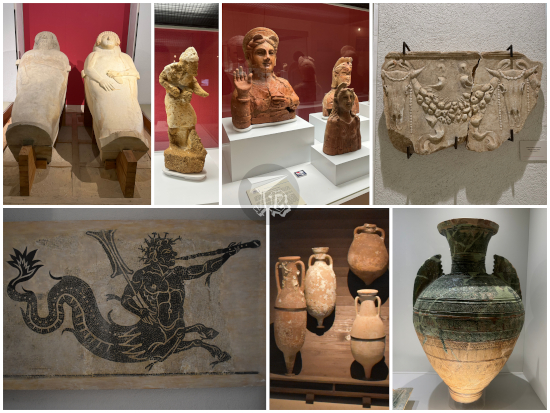
The Museo de Cádiz tries to follow this trail of history, but only the archaeological floor was open. The most important artefacts date from the Phoenician, Roman and Moorish periods. Of particular interest are two Phoenician sarcophagi which were found in completely different areas, but are presented as a couple of sorts, and a complete dowry. From Roman times, they exhibit a few dozen amphorae, sculptures and columns. Finally, the remains from the Moorish domination are quite colourful in comparison with everything else. The second floor of the museum was closed, so I was done earlier than expected.

Cádiz Museum

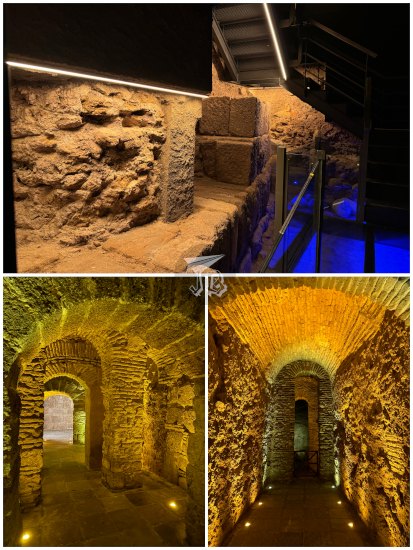
Thus, I decided to push my luck a little and try to get to the archaeological site called Cueva del Pájaro Azul for the 10:30 visit in English. The place is a former flamenco tavern built within the repurposed dry docks of the Phoenician Gadir. Most of the structure has been covered in brick and barely the original shape can be traced back, enough to calculate that the dry docks served war ships. While building new stairs, they did find part of the original Phoenician harbour though, the most important remain that survives. The tavern itself might be considered of minimal historical importance as it was a considerable cultural hub in the 1960s.

Archaeological site Cueva del Pájaro Azul

To keep in the mood, I decided to visit the archaeological site Yacimiento Arqueológico de Gadir, making a stop for a coffee first. Unfortunately, the site was closed that day. Thus, I decided to check out the Roman Theatre Teatro Romano de Cádiz – it might feel a little back and forth, but distances in central Cádiz are small and I wanted to prioritise Phoenician remains (I said I lived in the area, but all these archaeological remains are newly discovered). The theatre is the second largest one in what was Hispania, and dates from the 1st century BCE. It could host up to 10,000 people, and the stage, stands and the vomitorium (corridor underneath the seats) can be visited. There is an extra room with miniatures of the different stages of the history of the theatre.

Roman Theatre Cádiz

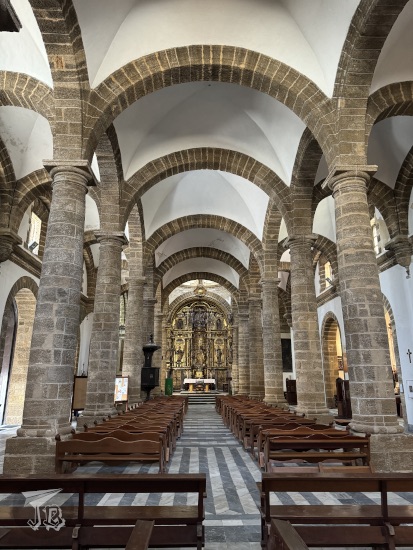
I left behind something called “The Elf’s Alley” Callejón del Duende, the narrowest street in town, now closed off. Very near both the alley and the theatre, I found the old cathedral Catedral Vieja de Cádiz officially Parroquia de Santa Cruz. This was the original cathedral of the town, commissioned by king Alfonso X around 1262. The original building was destroyed during the scuffles between the Spanish and the English at the end of the 16th century, and a new one was erected a few years later in a mixture of the Renaissance and the Baroque styles.

Former cathedral of Cádiz

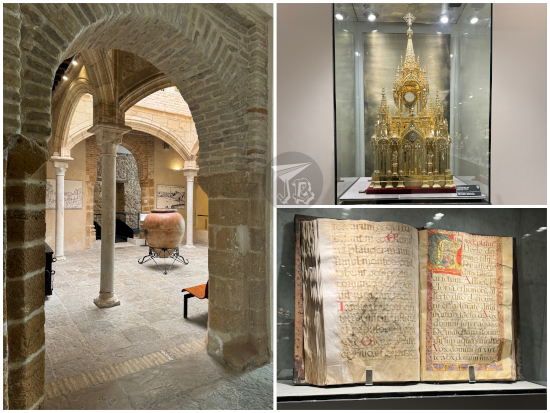
Next to the old cathedral stands the museum of the cathedral Casa de la Contaduría. The museum comprises a number of rooms disseminated in a conglomerate of buildings dating back from the 16th century – including the tower of the old cathedral and a Mudejar courtyard. The museum holds – obviously – religious items: paintings, sculptures, mass paraphernalia, codexes…

Cathedral Museum Cádiz

Afterwards, I crossed the city centre all over again, and reached the park Parque Genovés, a sort of botanical garden and the largest park in the old town. It has a small lake with a waterfall and a man-made cave with a lookout of the town and the ocean.

Park Parque Genovés in Cádiz

Then, I had booked lunch in the café of the Parador de Cádiz – Hotel Atlántico, a cute not-so-little place called La Tacita del Atlántico. I had set my heart on a grilled urchin dish – erizo de mar relleno y gratinado con huevos de arenque ahumado which I combined with a salmorejo (a creamy soup with a base of tomato and bread, garnished with ham and hard boiled eggs), though the dish had a local twist salmorejo cordobés, huevo y mojama. The urchins were delicious, but the salmorejo was lacking. I liked the idea of exchanging the ham for salt-cured tuna (mojama), but overall I found the food overpriced and the service mediocre. On my way out, I stopped by reception to get my stamp for the Red de Paradores rally.

Lunch at La Tacita del Atlántico

I stayed at Parque Genovés for a bit after lunch, then headed out towards the “new” cathedral Catedral de la Santa Cruz. The cathedral was built between 1722 and 1838, in a mixture of styles – Baroque, Rococo and Neoclassicism. It was erected in an assortment of materials, from noble marble to the humble local piedra ostionera, a sedimentary rock with a high concentration of seashells (biocalcarenite). The interior has three naves, and a Latin cross floor plan, over whose crossing there is a has dome, covered by golden tiles on the outside. The main altar is neoclassical.

Underneath the cathedral stands the crypt, and one of the towers can be ascended, leading to a great view of the town. The tower has very few stairs, most of the way is done on a ramp. Unfortunately, though, the cathedral is in rather poor state, and a net is cast under the ceiling to prevent debris from falling. I also climbed the tower since it was included in my combo ticket.

Cathedral of the Holy Cross in Cádiz

View of Cádiz from the cathedral tower

Behind the cathedral, I found myself back at the promenade Paseo del Vendaval, and I walked towards the beach Playa de la Caleta. In historical times, it was the natural port for Phoenician, Carthaginian and Roman shops, now it is a small-ish beach in the heart of the city. It is located between two of the castles of the old city, and its most characteristic structure is the bath house I saw in the morning.

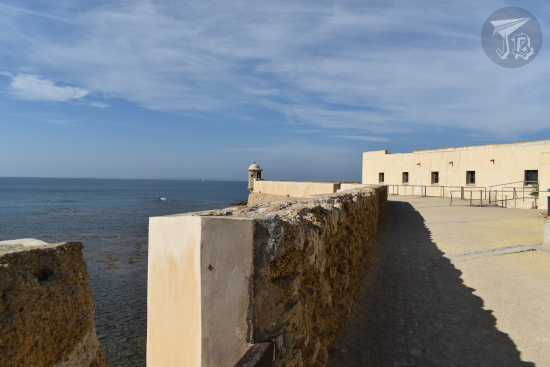
The beach has a sand area where most people sunbathe, but there is a long bridge separated in two sections – one directly built upon rock, Puente de Hierro and the other with arches to let the water flow through, Puente Canal. At the end of the half-kilometre of bridges, stand the ruins of the castle Castillo de San Sebastián, which today includes a working lighthouse, and an archaeological site. The first structure in the ancient island dates back from 1457, and the castle itself was built in 1706. Though it was warm and sunny, I walked the bridges and around the castle walls.

La Caleta Beach Cádiz & San Sebastián Castle

Upon my “return to mainland”, I passed by the bath house again and I reached a second castle, Castillo de Santa Catalina. The outpost, in the shape of a five-point star, was built towards the end of the 16th century to defend the city form sea warfare. In later years, a church and a sacristy were added, and from the 18th century onwards it was used as a prison. Today, it mostly hosts cultural or cinema-related events.

Santa Catalina Castle, Cádiz

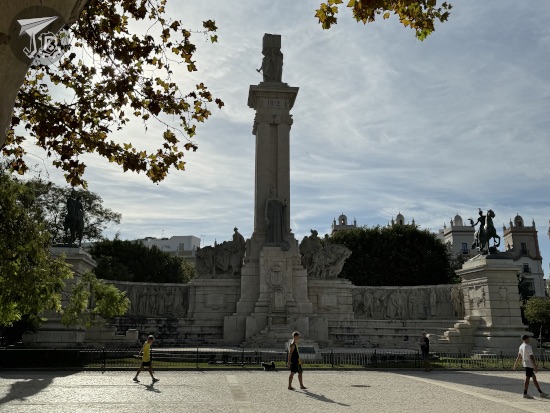
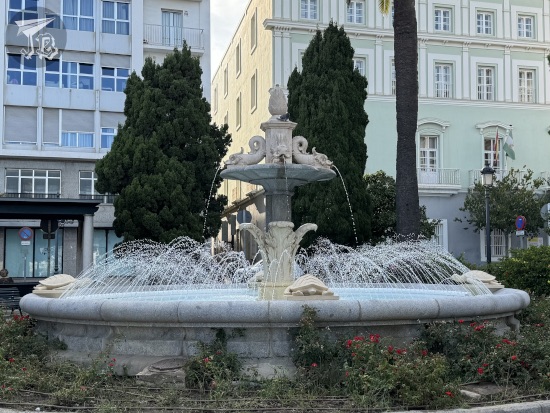
I continued on my walk around the city, left behind a knee cramp, the Parador de Cádiz and Parque Genovés until I reached the bulwark Baluarte de la Candelaria and the park Jardines Clara Campoamor. From there, I went on towards a second bulwark and the remains of the city walls Baluarte y Murallas de San Carlos. The bulwark was built towards the end of the 18th century to protect the harbour. Not far from there stands the square Plaza de España with the monument to the 1812 Constitution Monumento a la Constitución de 1812, the political response to the Napoleonic invasion. A bit further away stands the fountain Fuente de la Plaza de las Tortugas, with lots of cute turtles as decoration.

San Carlos Bulwark and Walls Cádiz

Monument to the 1812 Constitution Cádiz

Turtle fountain in Cádiz

At this time I decided to get an early dinner around 18:30, so I bought some fast food to take to the hotel. That is when the ant invasion started. It was something I was not expecting – one or two bugs is workable, but this was a whole nest out for my fries. It was not nice. I decoyed them into bathroom and decided to have the room cleaned the next morning.

I set off again about 20:15 to look for a place to watch the sunset at the beach Playa de la Caleta, which did not disappoint, and I sat there until the sun disappeared beyond the water line. Luckily, I made it today, as it would be ridiculously windy the following day.

Sunset at La Caleta, Cádiz

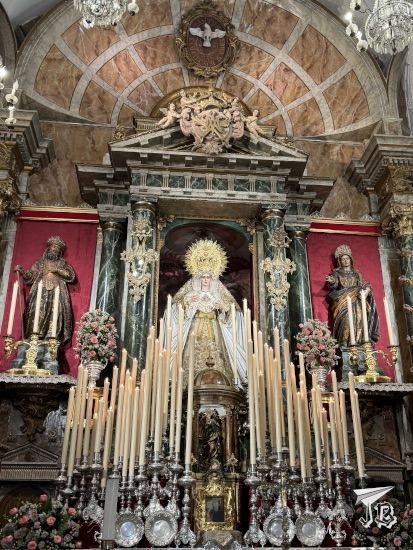
I then found the street Calle the la Virgen de la Palma, at whose end stands the small church Parroquia de Nuestra Señora de la Palma. It was built in the 18th century and it hosts a sculpture of the Virgin Mary credited with stopping the waters during the 1755 tsunami. In the street, there is a signal marking the highest water point, but there were so many restaurants and people that it was impossible to find it!

Sculpture of the Virgin Mary

I went back to the hotel afterwards to have some sleep – I was beat. I did manage to make a stop at a supermarket to buy coffee and pastries for breakfast the following morning though. Because one late latte per trip is enough.