29th July 2025: Birds with great PR (Madrid, Spain)

The National Museum of Natural Science Museo Nacional de Ciencias Naturales in Madrid announced that they were having an exhibit called Dinosaurios entre Nosotros / Dinosaurs among us, a collaboration with the American Museum of Natural History (though the original exhibition was apparently called Dinosaurs among us: The ancestry of birds, which feels slightly more accurate).

When I was young, it was believed that dinosaurs came from birds. With the new definition of what a dinosaur is, it turns out that birds are dinosaurs. The key features used to define a dinosaur is that the animal belongs to the clade (natural group) archosauria, and it has hind limbs which are erect underneath the body – as opposed to growing sideways and bent. Currently, two groups of archosauria exist: crocodilians (with bent legs) and birds (with straight legs). I think if you ever look into an emu or a cassowary’s eyes, you’ll understand what a deinonychus’ (the real species of the Jurassic Park velociraptor) prey might have seen.
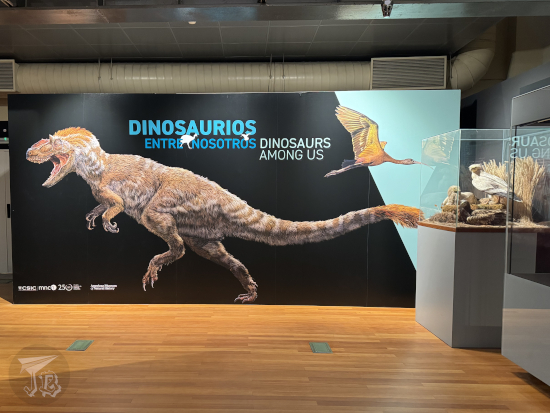
Dinosaurs among us sign, showing a feathered T-rex

The characteristic that originally defined archosauria was the hinge-like ankle structure. As time went on, protofeathers developed and some animals adopted a straight-legged stance, which is the start of the real dinosaurs – first the ornithischians (triceratops), then the sauropods (patagotitan or diplodocus), and the theropods (tyrannosaurus), the first with a wish bone. Then the forelimb became wing-like (deinonychus), yielding to the Avialae clade, which developed flapping flight. Some scientists declare that all Avialae are already birds. Others claim that birds are the subgroup Aves.

I took the train to Madrid and walked to the museum Museo Nacional de Ciencias Naturales. It took a second to be admitted because their computer system was down, but I was carrying cash, so I could was able to purchase my ticket (I had not bought it in advance because entry is timed, and I did not trust public transport delays). It was around 10:30, still early enough so that the museum was not crowded even during the school holidays. I headed directly to the exhibition, which, mostly through panels, taxidermy, and mounted birds, summarised how dinosaurs behaved similarly to today’s birds – laying eggs, brooding those eggs, protecting the nests… The biology and anatomy of birds and dinosaurs, especially theropods, are very similar.
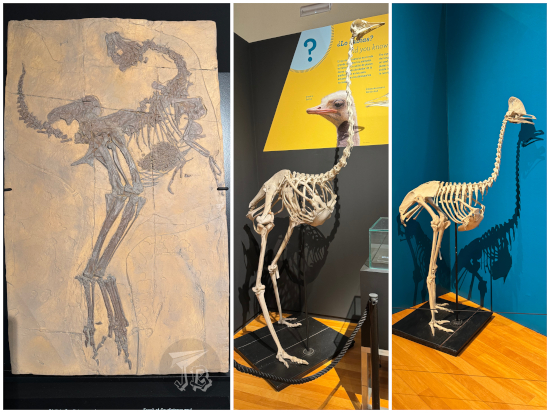
Fossil of Caudipteryx zoui (replica) and skeletons of a cassowary and an ostrich. They all share uncanny similarities, except the fossil is about one metre long and the current birds are larger

There was a very special exhibit – and no, it was not the Tyrannosaurus rex skull they’ve got. It was the original (and only) fossil of Iberomesornis romerali, a holotype from the MUPA, which you cannot photograph at its home, but you can here (just like my photography spree with the Concavenator at MARPA). Iberomesornis was the sparrow of the Early Cretaceous. There was a reconstruction of how it would look in real life (though I’ve read some texts that say it’s an outdated view?).

Iberomesornis romerali fossil and recreation. It was a crossing between a sparrow and a crocodile.

Similarly, there was a model of Archaeopteryx, the first ever-discovered feathered bird-like dinosaur. With only 13 specimens ever found, it was key in palaeontological studies before more avialans were discovered. This one was a replica, I’ve only seen one real slab ever in the London Museum of Natural History (I hope I can see the Berlin one at some point). The model was so ugly, the poor thing, but somewhat endearing.
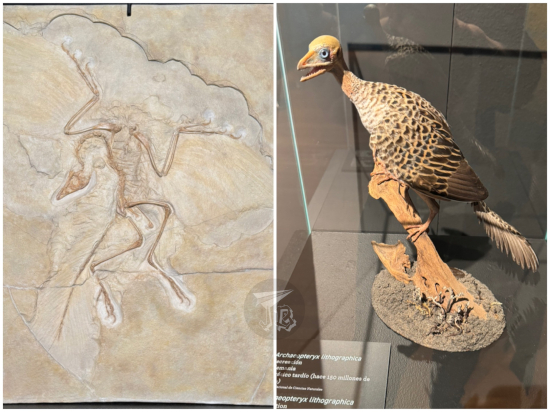
Archaeopteryx fossil (replica) and life-sized recreation. It looks like a bald nightmare with a beak and teeth.

There was also a model of Anchiornis Huxleyi, discovered in China and named after Thomas Henry Huxley, the biologist who in 1869 suggested that maybe birds were related to dinosaurs. He did this comparing the hip of a Megalosaurus and an ostrich (for a while, dinosaurs were classified using “bird hip” and “reptile hip” criteria) amongst other similarities, and of course he used Archaeopteryx as evidence. Unfortunately, the poor guy is more often remembered for being a Darwin fanboy – he was even nicknamed “Darwin’s bulldog”. Palaeontologist Xu Xing described the species in 2009, and chose to call it “Huxley’s almost bird”. It has allowed to rebuild almost completely the colours of dinosaur feathers.
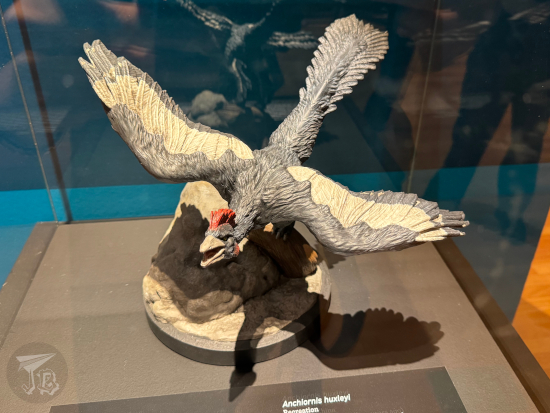
Anchiornis Huxleyi, proof that dinosaurs evolved into birds. Something between a rooster and a lizard

The rest of the exhibition was most… modern birds, sprinkled with children’s disappointed “Where are the dinosaurs?” wonderings. Truth be told, at the end of the exhibit there was a life-sized reconstruction of Velociraptor mongoliensis, the “real” one, not the presented in Jurassic Park, along with the explanation that Michael Crichton found the name cooler than Deinonychus, which is the animal he described in his book.

Taxidermy bird collection

Reconstruction of a Velociraptor mongoliensis, with a crocodilian face, long arms with proto-feathers and powerful claws.

So in the end, the exhibit was a lot of information about birds, hyped up with the buzzword “dinosaur”. Interesting enough but… not really what it was pumped to be. That’s what good PR does, I guess. And erasing half of the exhibition’s original title…

Back to Darwin though, the museum has a bit on him in its gallery of biodiversity – which is just a way to… continue exhibiting the old taxidermy specimens that they already had, some of them… made with more success than others – while some of the works they’ve got are extremely realistic, some others are… horror shows – such as the famous giant panda that the Zoo Aquarium first hosted.

One of the most interesting parts of this museum is the science cabinet Gabinete Científico, which recreates Carlos III’s scientific collection. It shows a glimpse of how science was understood at the time (though the human skeletons it used to host have been quietly removed).
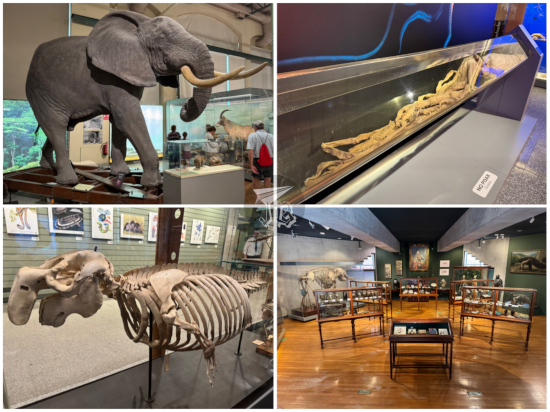
Natural Science Museum Madrid - Diversity collection: elephant, giant squid, manatee skeleton, 19th century cabinet

Recently, the museum became the custodian of Santiago Ramón y Cajal’s legacy, including his Nobel Prize certificate and medals. Ramón y Cajal was a Spanish doctor considered the father of modern neuroscience. In 1888, he discovered how nervous cells work, even before they were called neurons, and that they were separate entities that created the nerves and the brain, explaining how impulses are transmitted through the nervous system. He described characteristics that could only be observed in real life almost a century after he wrote abut them. In 1906, amongst many other awards, he received the Medicine Nobel Prize alongside Camillo Golgi, who designed the methodology to colour cells, a process that allowed many of Ramón y Cajal’s discoveries. The museum exhibits microscopes, drawings, and his original office and library. For some reason, next to the ocean display and the giant squid.

Santiago Ramón y Cajal legacy: reconstruction of his office and Nobel Prize

This was all in the first ward of the museum. The second one is on the other side of the building that it shares with the Industrial Engineering School. To get there, you have to follow the dinosaur footprints, but I took a couple of detours. First, I got a bit distracted trying to figure out the “Mediterranean Forest” garden, but honestly it was too hot to stay there for long. Maybe some other time with better weather.

My other stop was at the Engineering School, Escuela Técnica Superior de Ingenieros Industriales (UPM). I had recently discovered that its main hall hosts an 1832 steam engine, built by the company David Napier & Son Limited. The machine was designed to power coin minting, and it was one of the first machines to arrive in Spain, purchased by the Royal Mint. It is not clear in the description if it was designed by James Watt, or just similar to his models, but it seemed a piece of history worth seeing – and the janitor was distracted while I snooped around. The engine was donated to the Engineering School in 1914, when the Mint replaced it.

Watts Machine

I reached the second building of the science museum Museo Nacional de Ciencias Naturales, which is the palaeontology, geology and anthropology ward. Nothing had changed there that much since my last visit. Here’s a funny story though – they have a replica of a Diplodocus carnegii, of Dippy, exactly the same one that the London Museum of Natural history has – albeit on tour. Why am I so obsessed with the London one, having another replica so close? I think it’s because the “care” the NHM gave it, while in Spain it has just been set against a wall, mixed with all the other dinosaurs from whichever age. It actually took me a while to realise they were the same cast…

The original Dippy fossil was unearthed in 1898, and soon Andrew Carnegie bought it for his new museum in Pittsburgh, hence the name of the species. In 1902, King Edward VII convinced Carnegie to donate the original cast to the NHM while the skeleton was still unmounted (there was no museum to house it yet). In later year, Carnegie would donate a few more casts to other museums in the world, including Madrid, Paris and Vienna.

This time around (call it selective perception, or plain looking out for them) I spotted the trilobites from the Murero palaeontological site, one of whose characteristics are how deformed they are, due to the earth’s internal forces and movement. The museum has a large mineral collection too, but I think it lacks something. Maybe it’s me mentally comparing to other natural history museums in Europe, or even other incredible museums in Madrid itself, such as the Geomineralogical museum nearby. It is missing… loving, in a way. I think the Natural History Museum is a bit of an ugly duckling in the cultural system, because even if it’s considered a “national museum”, it is not part of the national network, so there is something weird going on there.
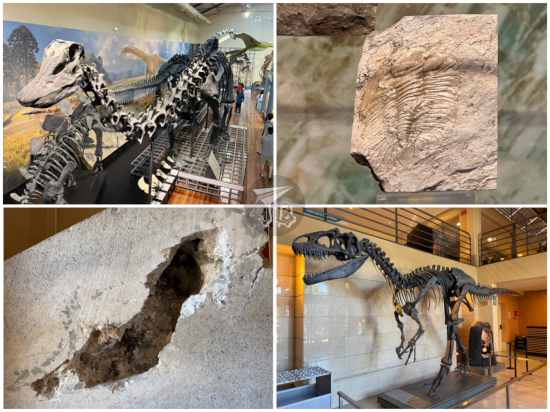
Natural Science museum Madrid - diplodocus, deformed trilobite from Murero, allosaurus, geode

As I left the museum, it was incredibly hot. It was early for Spanish lunch, but some places had already started opening. I had been looking at an “Asian Market” called Oiko, but then I read that you have to order through a machine (okay) and input your phone number so they call you on WhatsApp when your order is ready, and I get too many spam calls already. I was not planning on giving out my phone number to anyone who does not need it. Even if they had taiyaki desserts.

Instead, I found a burger joint called Steakburger, which self-describes as a gourmet burger restaurant, trying to become a franchise. I later realised that they are not 100% upfront with their prices, as the online menu lists one price, but the details shows another – and the desserts don’t even come with prices. It might also be a coding issue, since once you’ve checked the details, the correct price shows everywhere. Also, the machine translation is awful. Anyway, I had seen that they carried a burger with matured Angus and a topping of raclette – red cheddar, Gouda and mozzarella which were poured onto the burger, alongside Batavia lettuce and tomato, La melting cheese madurada. Honestly? It was good but not worth the price. The desserts looked decadent, but the burger was enough for me.
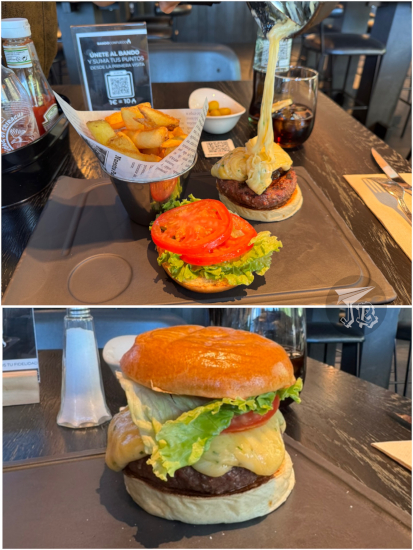
Hamburger being bathed over with melted cheese.

Afterwards, I just headed off to the station to take a train back, and for once I was there when a train was about to arrive. It was just too hot to look for something else to do, and during August a lot of things close at 15:00.

8th March 2025: Wiener Sängerknaben Spain Tour, half of a weekend’s plan (Madrid, Spain)

Where should I get to see the Vienna Boy’s choir Wiener Sängerknaben? Vienna? Of course not! Madrid, of course. We did try to see them in their home town, but it did not work out, because they sang before we arrived, and while we were on our way to the airport on the day we left. However, chance wanted that their Schubert Choir Schubertchor would be touring Spain in March, and Madrid would be their first stop. We got good tickets by a hair’s breadth, because my parents do not believe in booking in advance – nor in me booking for everyone – but we got them, literally last row of stalls.

Nobody knows exactly when the historical Wiener Sängerknaben was established, but there are records of boys singing at the Imperial Chapel back in 1296, even before the chapel was in Vienna. The Boys Choir just performed for the Court until 1918, when the Austria-Hungary Empire collapsed. In 1924, the institution was re-established as a private non-profit. It remained boys-only until 2004, when the Girls Choir Wiener Chormädchen was founded.

The boys attend their own campus from primary to senior high school. There are 100 choristers divided in four choirs (Bruckner, Haydn, Mozart and Schubert), each of which tours for around 10 weeks per school year. They perform High Mass in the chapel of the Imperial Palace every Sunday as part of an ensemble called Hofmusikkapelle (Court Music Orchestra), formed by the boys and members of the choir and orchestra of the Vienna State Opera (Wiener Staatsope).

As part of those ten-week tours, it was announced that in 2025 the Schubert Choir would tour South Korea, Spain, Switzerland and Italy. In Spain, they were to perform four special concerts in Madrid, Seville, Alicante and Valencia. The Madrid show took place at 11:00 in the national auditorium Auditorio Nacional de Música. The auditorium was designed by architect José María García de Paredes and it opened in 1988. The largest music hall can host over 2400 spectators.

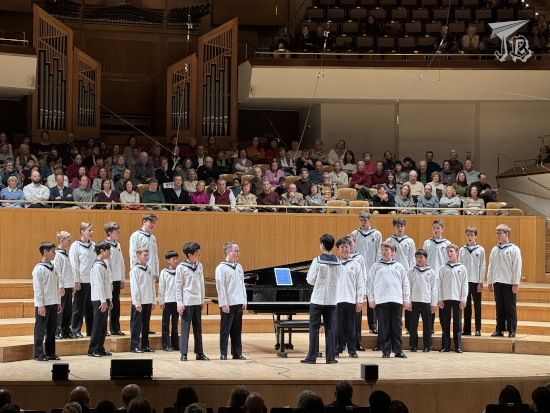
Auditorio Nacional, inside and out

The Schubertchor has 22 members from all over the world – though most are Austrian, others come from China, Croatia, the Czech Republic, England, Germany, Hungary, Japan, South Korea and Ukraine. The boys’ names are not released, but they were touring with Peruvian conductor Andy Icochea Icochea, who had previously worked in the Wiener Sängerknaben between 2005 and 2011. Icochea seems to have specialised in training young choristers, and has had a long career with different choirs and orchestras, even with a music charity. He has collaborated with other directors such as Riccardo Muti, who conducted the 2024 Silvesterkontzert / 2025 New Year’s concert in Vienna.

The day of the concert started raining buckets, but we had decided to try public transport instead of driving to the area where the Auditorio Nacional de Música stands. Afterwards, we wanted to have lunch and head to Expominerales, which was held that same weekend. We arrived with plenty of time, and we had to find a café to pass the time until doors opened. Once that happened, it was a bit of a chaos of umbrellas and everybody trying to push in at the same time. If you think young people get excited before a concert, they’ve got nothing on senior citizens.

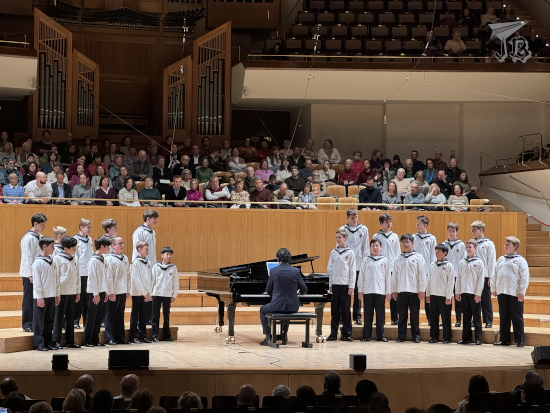
At 11:00 sharp, even before the hall had completely filled up – doors had opened kind of late in my opinion, less than half hour in advance – the children and the director came out. People were still being admitted during for the first couple of songs, and the auditorium staff were harassing patrons about where they had placed their jackets, or whether they were in their correct seats, well into the show. It was weird, and a bit disrespectful, those details should have been sorted beforehand. However, the concert itself were amazing. Most of it was sung a capella, and only a piano was used for accompanying the choristers in several songs, played by Icochea himself.

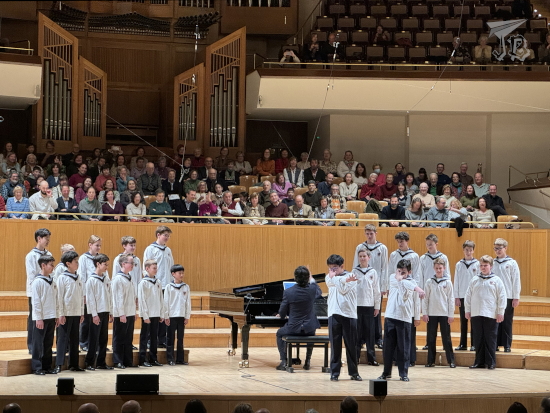
Vienna Boys' Choir Madrid

Setlist:
  First part:
    1. Kaiser-Walzer, Op. 437 (Emperor Waltz), composed by Johan Strauß II, with lyrics by Victor Gombocz and arranged by Gerald Wirth.
    2. Der Wassermann (The Water Genie), composed by Robert Schumann, with lyrics by Justinus Kerner.
    3. Hebe deine Augen auf zu den Bergen (Lift thine eyes), trio from Elias, Op. 70 (The Prophet Elijah), composed by Felix Mendelssohn from the lyrics of Psalm 121:1-4.
    4. Die Meere, Op. 20 No. 3 (The Seas), composed by Johannes Brahms
    5. Psalm 23, D.706, composed by Franz Schubert with Germany lyrics by Moses Mendelssohn.
    6a. Nun stehen die Rosen in Blüte (Now the roses have bloomed) from Der Jungbrunnen, Op. 44 (The Fountain of Youth) composed by Johannes Brahms with lyrics by Paul Heyse.
    6b. Die Berge sind spitz (The mountains are pointed) from Der Jungbrunnen, Op. 44 (The Fountain of Youth) composed by Johannes Brahms with lyrics by Paul Heyse.
    6c. Am Wildbach die Weiden (The willows beside the stream) from Der Jungbrunnen, Op. 44 (The Fountain of Youth) composed by Johannes Brahms with lyrics by Paul Heyse.
    6d. Und gehst du über den Kirchhof (And if you walk across the churchyard) from Der Jungbrunnen, Op. 44 (The Fountain of Youth) composed by Johannes Brahms with lyrics by Paul Heyse.
    7. Inclina Domine aurem tuam ad me, Op. 118 (Incline your ear, Lord, to me), Josef Gabriel Rheinberger (Psalm 86).
    8. Erlkonig (The Elven King) composed by Franz Schubert, with lyrics by Johann Wolfgang von Goethe, arranged by Oliver Gies.
    9. Sängerslust, Polka française, Op. 328 (Singer’s Joy, French Polka), composed by Johann Strauß II with lyrics by Joseph Weil.
    10. Wiener Blut, Walzer Op. 354 (Viennese Spirit), composed by Johann Strauß II, arranged by Helmuth Froschauer.
  Second part:
    11. 아리랑 [Arirang] (impossible to translate, but it might have meant “My beloved one” in Ancient Korean), arranged by Gerald Wirth, a traditional Korean love song from the Kyonggi Do province, with over 60 variations.
    12. Vreneli abem Guggisberg (Vreneli from Guggisberg), Swiss folk song arranged by Gerald Wirth.
    13. Müsle gang ga schlofa (Go to sleep, little mouse). Cradle song from Vorarlberg, Austria with lyrics by Walter Weinzierl, arranged by Gerald Wirth.
    14. Unz Wättr isch winti (Until the weather is windy), written by Luis Stefan Stecher like an Italian folk song, with music by by Ernst Thoma.
    15. O more duboko (Oh, deep sea), Croatian folk song, arranged by Gerald Wirth.
    16. La Paloma (The Dove), Spanish habanera by Sebastián Yradier, arranged by Gerald Wirth.
    17. Chim Chim Cher-ee from Mary Poppins (1964 film), by Richard M. Sherman and Robert B. Sherman, arranged by Christi Cary Miller.
    18. What Was I Made For? from Barbie (2023 film), by Billie Eilish O’Connell and Finneas O’Connell, arranged by Jennifer Lucy Cook.
    19. Under the Sea from The Little Mermaid (1989 film), by Alan Menken and Howard Ashman, arranged by Kirby Shaw.
    20. For ever, Polka schnell, Op. 193 (Forever, Fast Polka) by Josef Strauß, arranged by Gerald Wirth with English lyrics by Tina Breckwoldt.
    21. An der schönen blauen Donau, Op. 314 (The Blue Danube), composed by Johann Strauß II, with lyrics by Franz von Gernerth (1821-1900) and arranged Gerald Wirth.
  Encore
    22. Radetzky-Marsch, Op. 228 (Radetzky March), by Johann Strauß I, arranged by Gerald Wirth.
    23. Un Elefante Se Balanceaba (An elephant swung), Spanish children counting song, probably arranged by Icochea.

Charming does not even come close to describing the show. I’d never understood the concept of “angelic voices” until now, and I found it really unfair that you can’t actually find out the names of the boys. I don’t know whether it is to protect their privacy as they are minors, but it would have been great to at least know the names of the soloists, because the powerful voices from those little bodies was amazing.

The children were organised by tone of voice, which was similar to size, with the highest voices (smallest boys) on the front left and the lowest voices (biggest kids) on the back right. They sang most of their numbers towards the stalls, but for one song they turned to the people behind them, to both sides of the organ. Highlights included any time a child sang a solo – particularly the first one during the Emperor Waltz, as people were still coming in. During another song, Icochea left the stage for another boy to direct.

Vienna Boys' Choir Madrid

The oldest boy was in charge of having the audience clap during the Radetzky March, just like in the New Year’s Concert – and he looked right at that age when teens are all knees and elbows and awkwardness, but he seemed to be extremely proud of himself (well deserved!).

The last song of the encore was a total surprise. Before it started, the director invited us to “sing along if we were familiar with it”. This unexpected performance was a Spanish counting song, Un Elefante Se Balanceaba (An elephant swung), which goes “one elephant swung on a spiderweb – as it saw it did not fall down, it went to call another elephant. Two elephants swung on a spiderweb – as they saw they did not fall down, they went to call another elephant. Three elephants…” you get the idea – not precisely a philosophical song, but way less traumatic than say Hush little baby. One of the boys walked to the front and made a sort of trunk with one of his arms as he “swung” to the music. One by one, the others joined him until the proverbial spiderweb snapped and down to the floor all the children went. It was absolutely hilarious, and adorable.

Vienna Boys' Choir Madrid

Vienna Boys' Choir Madrid singing the elephant song

It was still raining heavily when we left the auditorium. It was 13:15, so no real time to get to Expominerales before it closed between 14:00 and 16:00. Had the weather been nicer (decent, at the very least), I would have found something else to do before it re-opened. But it was still raining cats and dogs – and maybe some ice – so we just decided to call it a (half) day.

7th November 2024: The Spanish Cultural Heritage Institute (Madrid, Spain)

I know you do not believe me when I say I don’t like guided visits, but they are the only way to do some stuff – such as stepping into the Stonehenge circle, or basically anything managed by the Madrid city hall. The Spanish Cultural Heritage Institute Instituto del Patrimonio Cultural de España IPCE is a governmental organisation whose functions are preservation and conservation of cultural items, research, communication, and safekeeping of the documents in its archive. It can only be visited on certain dates, by appointment, and with a guided visit. I managed to secure a free Thursday visit at noon, so I headed out to Madrid. Surprisingly, neither trains nor underground had issues, so I was over an hour early on site. The IPCE is located in its own building in the area known as “University City” (Ciudad Universitaria), close to the Fine Arts faculty – by design – and the President’s official residence – by chance.

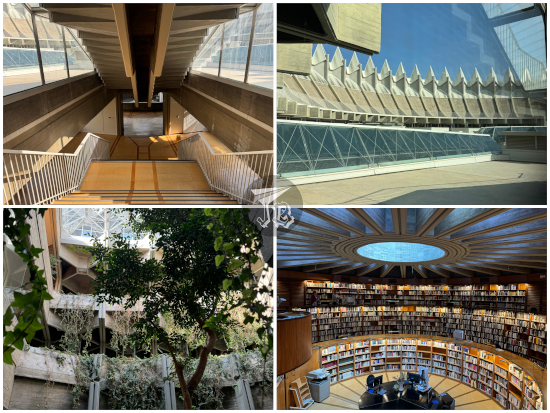
The headquarters building was commissioned in 1965 to architects Fernando Higueras and Antonio Miró. The architects’ original project had to be severely modified, but it became a very different structure. Construction was stalled for years, and the building was not usable until 1985 – when new remodelling was tackled. The building is circular, nicknamed the “Crown of Thorns” (La Corona de Espinas) because at the top there are “spikes” of sorts. Top-view, the structure is divided in 30 sectors, with 56 semi-sectors and four empty ones for the main access staircase and gate. It has four floors and at least one basement. It was built in concrete and glass, with some cork floors, but lacking plaster or any kind of concealment for the structural items. The centre of the building is an open space with a glass dome, and serves as reception. Unlike the original project, this space is covered with a glass vault. The interior has a lot of plants, even three small “gardens” mainly with hanging plants. The building is considered an important cultural asset BIC (Bien de Interés Cultural), and these plants are protected along with the structure.

Spanish Cultural Heritage Institute building

The visit consisted of an introduction to the building and the work which is carried out there. We saw the model of the original project – the only similarity is that it was also vaguely circular. We climbed the stairs to the upper floors to snoop at the rooftop and the “thorns”, and then rode the lifts down to the basements to see some X-rays of paintings and sculptures. Back on the main floor, we were shown into painting restoration workshop – they were working on Maerten de Vos’ Abundance, having repaired the work and erased some extra (puritan) clothing to make the goddess Ceres look less… naked. Finally, we were invited into the library, which is round and has three levels. It has natural light due to its own skylight, a decorative glass dome in the middle of the main open area.

Spanish Cultural Heritage Institute inside

The visit started at noon, and it lasted two hours. Heading out to the centre of Madrid would take around half an hour of walking and underground. Thus, it gave me the opportunity to book a late 15:00 lunch. Since I was lucky with my connections, I was in the Cuzco neighbourhood almost half an hour in advance.

It was the perfect opportunity to go get some groceries at the Chinese supermarket Ibero China Madrid in the street Calle General Margallo. While I needed some items, I was distracted as I walked the “geek” fizzy drink aisle. There is a company called Ocean Bomb which makes sodas – sparking water, yoghurt drinks and bubble milk tea with “creative packaging”. I was aware of them because a friend collects the Sailor Moon ones and we checked for them in London in 2023. Well, now I went and found myself some Saint Seiya sodas – Gemini Saga (grape yoghurt flavour) Aries Mu (apple yoghurt flavour) and Virgo Shaka (peach yoghurt flavour). They were out in 2023, but I had not heard about them, it is the first time I saw them. And of course, I bought them (I have no idea if they are official or not, but the publicity I found afterwards has the Toei stamp on it, so I’m hoping they are).

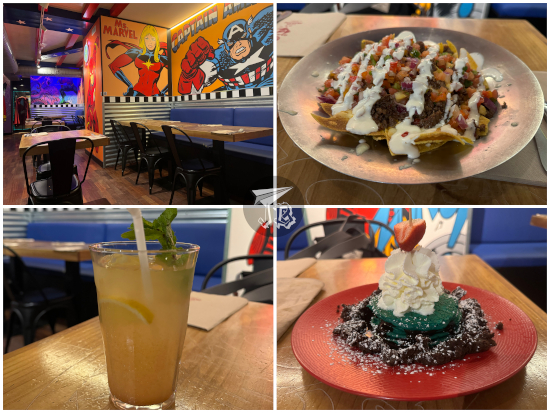
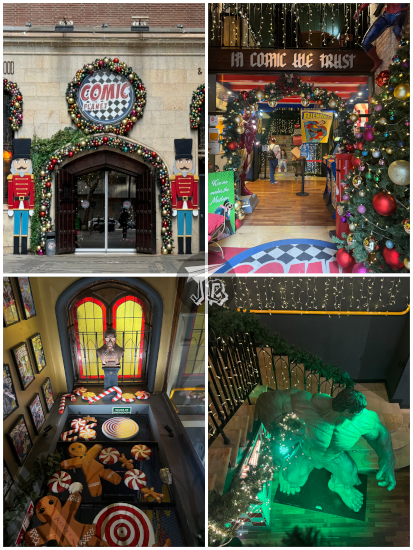
For lunch, I had a reservation at Comic Planet. Last time I was there, a member of the party was late, so in order to keep the table, we ordered appetizers. They were great, but afterwards there was no stomach-space for dessert. And dammit, I wanted some dessert – particularly, I wanted pancakes. I had been looking at coming back to Comic Planet for a while just to have them, but it never worked out. This was finally my moment. I had a lemonade, some nachos – which were delicious – and I finally got to eat my pancakes – which are green and called Hulkcakes, and come with whipped cream, brownie and shortcake crumbles , and around ¾ of a strawberry. I ended up extremely full, but happy.

Comic Planet lunch

Oh, and I was confused because it was early November but… already Christmas in Comic Planet!

Comic Planet Christmas decoration

I left the restaurant and headed towards the archaeological museum Museo Arqueológico Nacional, which is running a temporal exhibit regarding Nature in Ancient Greece “Between Chaos and Cosmos: Nature in Ancient Greece” Entre Caos y Cosmos. Naturaleza en la Antigua Grecia. It hosts over one hundred pieces of classical Grecian art. Most belong to the museum’s own collection, acquired from the 19th century collector Marquis of Salamanca, and some are national and international loans. Since a large percentage of items were original and not replicas, it was really cool. Then again, I have to admit I have a thing for Grecian vases, especially with mythological motifs.

Entre Caos y Cosmos. Naturaleza en la Antigua Grecia

The exhibition was not big, so later I used my National Museums card Tarjeta de Museos Estatales to go and take a walk around the permanent exhibition. There is a loaned exhibit from the Mont’e Prama archaeological site in Sardinia, Italy. Mont’e Prama was discovered in 1974, unearthing remains from the Nuragic culture (1800 – 700 BC). This Bronze Age civilisation created large sculptures called the Giants if Mont’e Parma (Giganti di Mont’e Prama), depicting wrestlers, archers, warriors and boxers. One of these colossi Il Pugilatore (The Boxer) has been brought to the MAN for display for a few months. Boxers were characterised for having a glove with metal reinforcements on their right hands. Il Pugilatore is the largest sculpture, two metres tall and 300 kilograms heavy – which has been travelling across the world to promote the archaeological site. There was… something imposing about the whole thing, and not even its size. Some kind of… presence there. It made me want to visit Sardinia, to be honest (and it is much, much affordable than Easter Island…), so I guess the promotion… worked?

Il Pugilatore

I took a stroll through the permanent collection afterwards, especially the Iberian and Talayotic areas, because I am fascinated with them these days – and I shall make the most out of my pass for as long as I can. It was getting dark though, and the commute to the IPCE had taken long, so I headed back.

Museo Arqueológico Nacional

22nd March 2024: Trail of the 1808 Uprising, Comic Planet and Genesis (Madrid, Spain)

Among the activities organised by the Pasea Madrid program (Walk Madrid), there was one about painter Francisco de Goya. Goya was probably the most important painter towards the end of the 18th century. He was born in 1746 and died in 1828, having lived through four Bourbon Kings, the Peninsular War, the postwar and the Bourbon restoration.

Goya started his career in Madrid drawing bucolic cartons to be woven into tapestries. He eventually became popular painting portraits for the aristocracy first, the royal family later, until he was appointed court painter. Sometime along his career he contracted an illness that left him deaf, and his character soured. He started experimenting with other media besides canvas and mural paintings, and started creating prints, which are darker and fantastical. During the Peninsular War against Napoleon’s forces, he created paintings about the uprising, and prints showing the most awful part of human condition during armed conflict – the horrors of war. He did not become any more cheerful after the conflict, depicting famine and illness. His last set of art pieces are called the black paintings, black-and-ocre coloured nightmarish pieces which contrast with the life of his initial bucolic scenes and one of his most famous painted – the naked lady La maja desnuda.

In 1807, Napoleon tricked the Spanish king into abdicating and allowing his troops to march towards Portugal. Instead, the French just… stayed in Spain. Madrid was occupied on the 23rd of March 1808. On the 2nd of May, there was an uprising in town, carried out by plain citizens and a very small percentage of the Spanish soldiers. The rebellion was squashed and the rebels shot to death – where “rebel” meant “everyone caught with a weapon”, and weapons had been stones, knives and even plant pots. While the uprising was unsuccessful, it sparkled the Peninsular War, known in Spanish as the War of Independence. Goya, originally open to the French ideas of Illustration, painted two canvasses about the events. The first was “The charge of the Mamelukes” El dos de mayo de 1808 o La carga de los Mamelucos depicting one of the French units charging Madrid’s people; the second was “The third of May Shootings” El tres de mayo de 1808 o Los fusilamientos del tres de mayo, showing the executions in central Madrid.

After I arrived in Madrid, I started off the day with a Starbucks’ Iced Strawberry Matcha Tea Latte, a new flavour introduced this month. I had plans for a nicer breakfast, but my train was delayed so I had to get something to go, so it was this and a cookie. I really liked the drink, I hope it stays. I grabbed both and went towards the meeting point.

Starbucks' Iced Strawberry Matcha Tea Latte

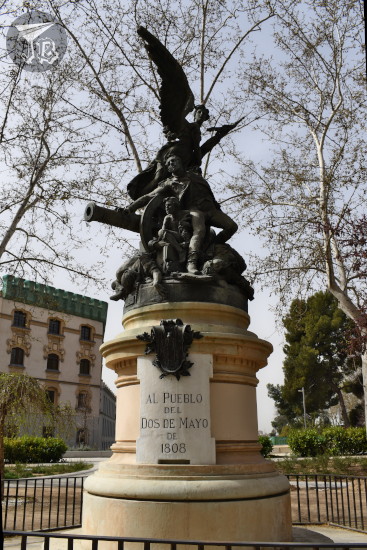
The visit I attended was called “Goya and La Florida” (La Florida being a small hermit church the painter did murals for), but it was more of an exaltation of the May 1808 uprising. We met the guide next to the Royal Palace, where she summarised Goya’s life. Then, we moved on to a placard next to the palace that memorialises the uprising, and she described the event. We continued on towards the area of Príncipe Pío, saw yet another memorial to the uprising Monumento al Pueblo del dos de Mayo de 1808 and the archaeological remains of one of the forts.

Monument to the second of May

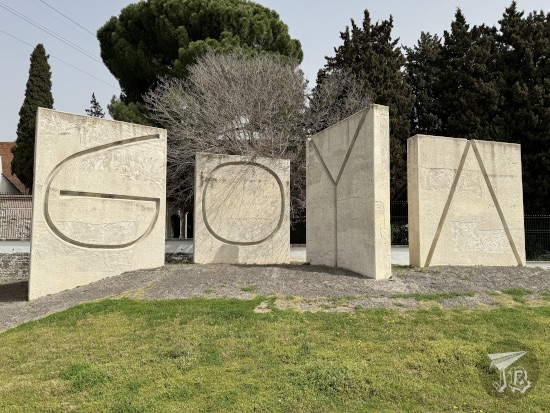
We went up the park Príncipe Pío – next to the Temple of Debod – and the guide explained the military shootings, and read a document. We continued towards the graveyard where the rebels were buried Cementerio de La Florida, next to which stands a monument to Goya Monumento a Goya: four stones, each one with a letter to form the word “Goya.”

Monument to Goya

We finally reached the hermit church Ermita de San Antonio de la Florida, where Goya painted the ceiling frescoes. Over time, they became so degraded that an identical second hermit was built to be used religiously, and the original one kept as a museum and the painter’s pantheon. The ceiling has a dome in which the artist painted St. Anthony’s miracle – as his father had been accused of murder, he resurrected the victim, who could identify the real criminal. The murals are done in al fresco technique, painted on fresh plaster, directly on the walls.

Hermit church of St Anthony

After I left the hermit church, I headed off towards Príncipe Pío station, where I met my relative. There’s this restaurant that I’d been wanting to try for a while, but I needed two other people to tag along in order to get the table I wanted – yes, I wanted a specific table in the restaurant, more on that later. We had a reservation for a late lunch at 15:00, since my guided visit finished at 13:00. We took the underground and alighted at the area of Cuzco, with still some time left.

While checking out how to get to the restaurant, I had came across an Asian supermarket nearby – and that led me to discover Calle General Margallo, a little cluster of Asian supermarkets and stores. We went into Ibero China Madrid and I was happy to buy a bunch of things at a very decent price, mostly Japanese (curry and miso), but I also bought some Filipino Sky Flakes Crackers that I used to get from an acquaintance and had not found for years. Afterwards, we headed to the restaurant.

Comic Planet is an American-food eatery set around the superhero theme – murals on the walls, actual-size figures from DC and Marvel films, and even some prop reproductions. The dishes are “inspired by” superheroes and villains, with a lot of colourful additions.

When making the reservation, I was luckily able to book the table I wanted – and lacking any John Constantine decoration, who is my favourite “almost mainstream” comic character, the table I aimed for was the Aquaman one; I liked Aquaman before Jason Momoa made him officially cool. To be honest, even if I really wanted to check the restaurant out, I was a bit limited on what I could order – way too much coriander. I wanted a burger and a dessert – and a coke chilled with vanilla ice-cream (Coke & Vainilla Ice 1923). Unfortunately, our third party member was almost forty minutes late, so in order to keep the table we needed to exchange desserts for a starter. When the three of us were there, we ordered our mains.

Our starter (for two) was the “Infinity Gauntlet”: cheese sticks wrapped in dough (tequeños) with five sauces – tartar, spicy, mango, BBQ and comic special “cocktail”. The name of the dish refers a weapon created by Thanos, villain in the Marvel comics Avengers, made famous by the films.

My main was a Cat Burger (a reference to Batman’s Catwoman) – a “snobbish” beef patty with caramelised onion, duck foie gras and melted Brie cheese, with regular chips. My relatives ordered a Super Comic Burger (Grilled beef with egg, Oldenburger cheese, fried plantain, guanciale and “kryptonite” – whatever that is. The bread was… blue, and the chips red) and a Hellboy brioche (smoked and spiced pork, natural tomato, Edam cheese, egg, red onion pickled in lime, coriander, mustard and sugar), a reference to Dark Horse Comics’ Hellboy, one of the few creator-owned characters out there.

Comic Planet Madrid Food

One of the greatest things of the restaurant is that you get to hang around and take pictures with and of everything. The restaurant has two floors, and you are free to explore them. Aside from the murals and real-life figures, there are busts of bad guys, and even a homage to one of the most prolific comic-creators in history, Stan Lee. They also have a store with a bunch of merch (surprisingly… no actual… comics).

Comic Planet Madrid decoration

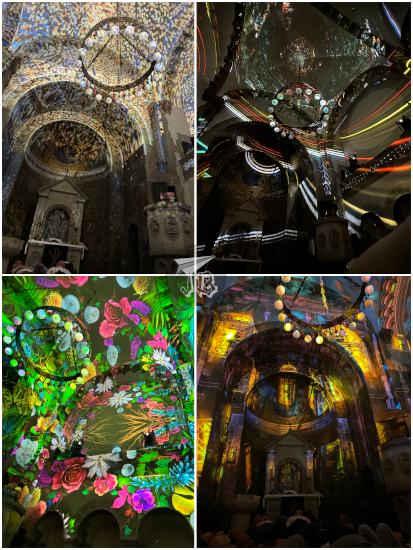
Afterwards, because the weather was nice and the forecast was rain all the following week, we walked down to the Comunidad Evangélica de Habla Alemana – Friedenskirche (German-Speaking Evangelical Community – Church of Peace), who were running a video mapping show in their church, Genesis.

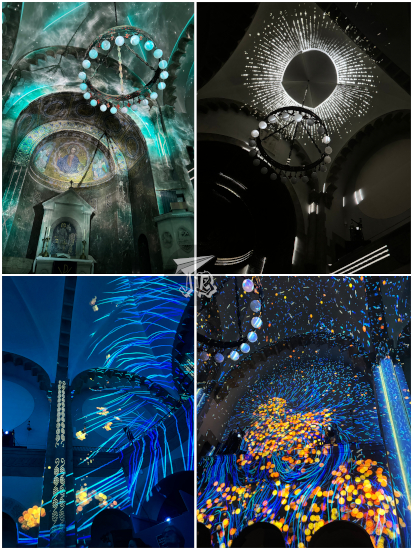
The show follows the first three days described in the Christian Bible’s Book of Genesis, as God creates the earth. On the first day, God separated light from darkness; on the second day, God created Heaven (the sky in some versions), and on the third, he created the lands, seas and vegetation (nature in some translations). The church is a Neoromanesque building with mosaics which helps the otherworldly aura of the experience.

The show, designed by the company Enoarium has five parts: First Day: Light; Second Day: Sky; Third Day, first part: Water and Land; Third Day, second part: Nature; Meditation. When we went in, there were already lights on, a pretty universe-like lighting. There were pouffes to sit / lean on the floors and chairs. I chose a pouffe, thinking that it would be hard to stand up later, but oh well. I had about an hour to get round to it. It was a really good idea, because watching the ceiling was much more comfortable than having to look up.

It was a bit difficult to notice when the one day became the next, because the lights flowed really nicely and one theme faded into another. First, the whole church went dark, and there was a bit of light in the centre of the ceiling that became wider and wider. The white light started mixing with blue, which first was the sky and eventually turned into the sea. Gold / brown bits after a while represented the land, then more blue / purple as more sea, and when it turned green we had reached the creation of vegetation, which exploded in tons of colourful flowers. Eventually, everything dissolved into candles and lamps. The music was nice, too, mostly coral in Latin, I think.

Genesis Madrid stills

Genesis Madrid stills

Afterwards, we separated and I headed off to the train which – what else is new – was stupidly delayed, so I was stuck at the station for almost 40 minutes until my train came. The only good thing was that another in the same general direction came three minutes before, so most people got onto that, and mine was pretty empty.

9th March 2024: Minerals, fossils & trains (Madrid, Spain)

I might not be the most people-person ever, but if there is something that makes conventions extra fun, it is seeing attendees unapologetically geek out about what they love – in the case of Expominerales, that would be… rocks. Of course, this is an over-simplification. Expominerales is held yearly in the mine and energy engineering school Escuela Técnica Superior de Ingenieros de Minas y Energía (ETSIME) in Madrid. The year 2024 marks the 43rd edition of the event, which is considered one of the most important fairs in Spain in the topic of Earth Sciences – minerals, fossils, gems, and meteorites are widely available to the public. Aside from the small historical museum Museo Histórico-Minero Don Felipe de Borbón y Grecia, there were dozens of exhibitors with all kinds of items for sale, ranging from a few euro to several thousands. These year there were a few lectures, too, and coincidentally, the two of them I was most interested in happened on Saturday, one after the other.

I arrived at the ETSIME around 11:00, and I walked around the stands a couple of times. I have to say that I wanted everything, but I set a budget and I was able to stay around it, after shopping and lunch. At noon, I settled to listen to the lectures – one about the rehabilitation of an ancient gypsum mine in a hamlet called Hornillos de Cerrato, in the area of León. The other one versed about the uses of an already-rehabilitated one in the south of Spain, home to a huge geode. Both of them were pretty interesting, though the conference room was freezing. Someone had forgotten to turn on the heater there, it seemed…

Expominerales 2024 at ETSIME

After the two conferences, I had a last round to buy a last thing, so in the end I bought an iron-meteorite pendant, a fossilised shark tooth pendant, a plesiosaur tooth, and a soil sample of the K–T boundary. A plesiosaur was a marine reptile with flippers, a short tail and a long neck. The K–T boundary (now named the Cretaceous–Palaeogene (K–Pg) boundary) is the theoretical layer of iridium-rich black sand that was formed by the meteorite that caused the extinction of non-avian dinosaurs – and basically most life at the time, in one of the great world-wide extinctions in the history of Earth.

Shopping from Expominerales

At 14:30, I had a reservation for lunch at a Japanese franchise called Ramen Shifu. While I had originally been looking forward to trying the ramen (and I got my hopes pumped up when I read that they were Hakata ramen style), the noodles were rather disappointing. Fortunately, the okonomiyaki – Japanese pizza of sorts, made with a base of cabbage and topped with sauce and bonito flakes, was all right. On top of everything, paying was stupidly difficult because they did not have change.

Shifu Ramen ponzano - okonomiyaki and ramen

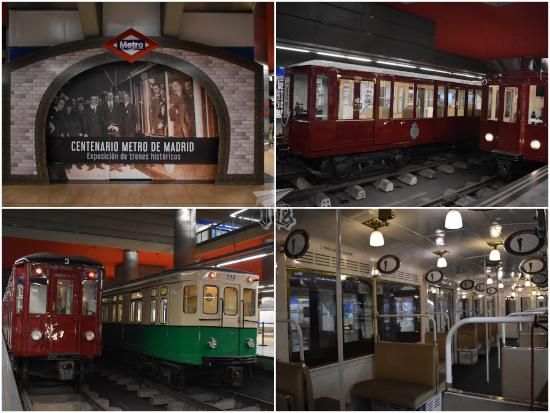
When I came out of the restaurant though, it was raining like crazy. I pulled out my umbrella and hopped towards the closest underground station, as my next destination was inside the metro system – one of the Underground’s museum network Museos de Metro de Madrid the collection of classic trains Estación de Chamartín: Exposición trenes históricos, inside the Chamartín stop. The exhibition displays four historical trains, restored from among the first ones that ran under the city, and some memorabilia. It was a bit underwhelming – more like false advertisement. I hoped I would be able to snoop inside the trains, since that was the photograph that opened the webpage, but unfortunately they were cordoned off. There was however a map with the works by Antonio Palacios in Madrid, which will become handy eventually.

Classical Train Exhibition Madrid

Afterwards, I just headed off towards the train station and got back home.

15th April 2023: Madrid for Sweet Space Museum (Spain)

My friend D****e and I met for a fast day packed with activities. We reached Madrid at 10:40 and had tickets to visit an interactive museum called Sweet Space. It markets itself as a “colourful experience which mixes sweets and modern art”. I just thought it would be a fun thing to do with a friend that would give into quirky pictures and a couple of hours of giggles. It actually fulfilled both. If you take the place seriously, it’s plainly not worth the visit – modern art in general is questionable at best, and this could be seen like a bit on the childish side – and regular tickets are 18 €. The place’s best-selling point is “get cool pics for your social media”, and we had decided to just be silly about it and enjoy ourselves.

The “museum”, located in the ABC Serrano shopping centre, gives the vibes of an oversized (maybe overpriced) playground, and just like Monasterio de Piedra, the number of people you encounter weighs a hugely in your experience. Although we had an 11:30 ticket, we were lucky enough to be admitted at 11:15 with a family that lost us on the third room, so we had quite a lot of time on our own, until the group that came afterwards caught up. We did take a lot of pictures, to be honest, and missed no opportunity to fool around – which was the mindset we had.

Since the museum’s flagship idea is mixing sweets and modern art, when you enter some of the rooms you are given a treat – a gummy or a piece of chocolate or a tiny bit of ice-cream. You cannot backtrack, so the route gets a bit weird at points – you go up to the second floor on stairs, but down using a slide… The museum has nine different rooms and a few of them are refurbished over time. Unfortunately, I forgot to track down the artists because it was stupidly fun – I mean, at one point I got to ride a carousel-style flamingo. Back in the day in the day, I would have never dared do such a thing, but I guess I’ve changed a little in the last ten years.

  • Room 1: Palm trees with marshmallow trunks (Antonyo Marest). This was a fun way to start the whole thing and set the mood. It is literally a room with tree trunks that look like colourful marshmallows, with leaves on top.
  •  
  • Room 2 (corridor): Flowers in the dark – a dark room with bright plastic flowers. It was pretty, but probably the less surprising room.
  •  
  • Room 3: Mirrors and hanging pink balloons, inspired by Tokyo’s TeamLab. It was hard to take a good picture that did not catch anyone’s reflection!
  •  
  • Room 4 (corridor): Mirrors and neon graffiti (Álvaro Linares) with Star Wars inspired references. This was one of the coolest areas (though I’m not sure how… legal that Darth Vader painting would be). One of the sides had a throne-like chair you could sit on and feel like an evil mastermind.

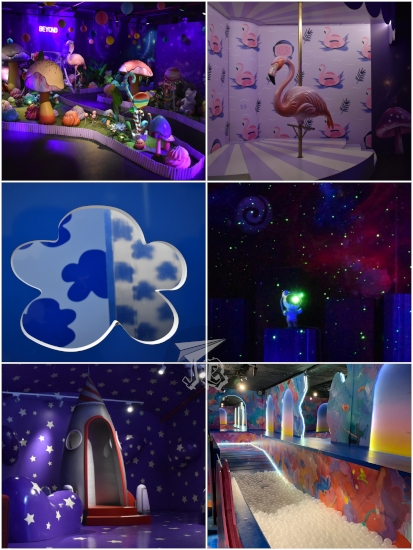
Collage. Sweet Space museum. Palm trees whose trunks resemble marshmellows, neon-coloured flowers and grafitti, pink balloon-like lamps hanging in a mirror-wall room

  • Room 5: Ice-cream parlour “Töto Ice Cream”, including little kart and refrigerator you can step into, giving off a strong 1950’s aura. A lot of pink, I’d say – I did not dare walk into the fridge (for some reason it gave me the creeps), but D****e did; I “drove” the little kart instead. We took silly pictures there with the installed iPad camera, just for the hell of it.
  •  
  • Room 6: Fairytale landscape (Christian Escribá and Patricia Schmidt), a-la Hansel and Gretel or Alice in Wonderland (though it was officially inspired by Wizard of Oz), with a swing and flamingo that you can ride. When I saw that one online, I really, really hoped that it was not only one of those things that only influencers get to do. I got to ride the flamingo. I don’t know why it drew me so much, maybe it was the pure surrealism of it all, but it made me giddy. The rest of the room was fun too – oversized mushrooms, teddy-bears, and colourful decoration.
  •  
  • Room 7 (upstairs): Sky with clouds (Agatha Ruiz de la Prada) painted and carved into sliding doors, a starry rocket (Ivanna Gautier), a bouncing area, a mural where you could take a 3D video for TikTok, and a “planetarium”, with tiny lamp-robots and tons of stars made from light dots. I liked this last one a lot, too. In order to leave the floor and go back to the lower floor, you have to go down a spiral slide, which I was not a fan of – it was difficult to get into it without putting weight on my bad wrist. However, I managed to go down unscathed.
  •  
  • Room 8 (Misterpiro): It held a ball pit with a “staircase to heaven” (or to nowhere). We did not go into the pit, but we climbed the stairs for pictures too.

Collage - fantasy worlds from Sweet Space museum. Overgrown mushrooms, a flamingo, a cloud, a universe made out of green neon dots with a little robot peering out, a cartoonish rocket in front of a starry background, a colourful ballpit full of white balls.

Finally, we reached the shop, where we purchased the pictures we had taken at the ice parlour (8 € for two magnets with four photographs, the downloadable version, and a gif). We were supposed to get a sweet in each room, and we ended up with three or four gummies, a chocolate, and a tiny scoop of ice cream. My favourite was the skull-shaped sweet&sour gummy we got upstairs, but they did not have it at the shop (though it is advertised online). The whole experience was a bit on the expensive side, but I had a discount that helped knock 10 € off the official price. The recommended time I had seen recommended for the museum was an hour and a half, but even if we took a long time, we were done in about an hour.

I had reserved lunch at 14:30 based on the time I expected us to be in the museum (and the availability of the restaurant), so we had some time to kill. We walked by the open-air museum of modern sculpture Museo de Escultura al Aire Libre de La Castellana, but it did not catch our fancy. Too much modern art in one day?

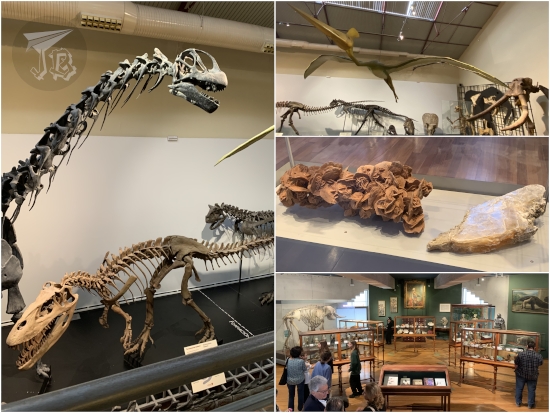
The place we would invest most of that extra time was the museum of Natural History Museo Nacional de Ciencias Naturales to see some dinosaurs and the gabinete de curiosidades, the 18th and 19th century collection of taxidermy specimens. I’d been there before, and it mostly has replicas (and holy molly, prices have gone up). This time there was an exhibit on the Moon landing, and the gardens had been open. The taxidermy collection is not as good as other museums, but at least it got us out of the heat.

Collage. Dinosaur fossil casts and reconstructions, both carnivores and long-neck herbivores. A flying reptile with some mammooth fossils in the background. Rocks. The old collection dating from the 19th century - a number of glass cases with people looking at them and a painting of king Carlos III overlooking the place.

We left the museum and headed for lunch at one of the franchised establishments of New York Burger, which markets itself as a “gourmet burger” place. It was all right, and the servings were huge. After lunch, we hung around the area known as Nuevos Ministerios, a complex originally designed by Secundino Zuazo Ugalde around 1930. We hung out under the eastern archway for a while.

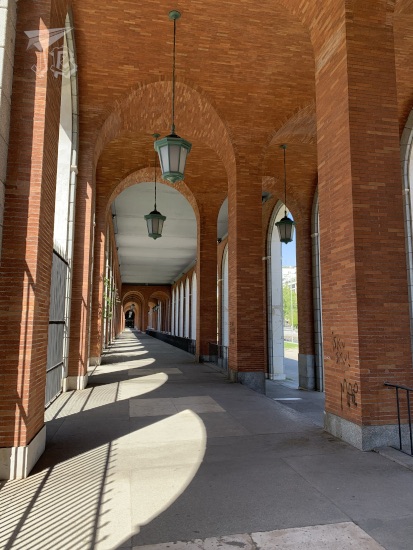
The archway in Nuevos Ministerios, built in reddish brick and white plaster

Afterwards, we took the train to Alcalá de Henares. We stopped at one of the shopping centres just outside town, Quadernillos, where the comic event Krunch! 2023 was taking place. We did not stay for long as most stands sold bootleg and plagiarised stuff, and I did not find any legit shop, but we had ice cream and D****e did take the chance to do some shopping in the mall before we headed home for the evening.