9th March 2025: Expominerales 2025, the other half of the weekend’s plans (Madrid, Spain)

Since I had to be in Madrid to watch the fantastic concert by the Wiener Sängerknaben, the plan had been to attend the yearly Expominerales mineral fair in the Mine and Energy Engineering School Escuela Técnica Superior de Ingenieros de Minas y Energía (ETSIME) that same day. However, the fair closes on Saturdays between 14:00 and 16:00 for a lunch break, so since the weather was so horrid, I decided not to wait. On Sunday, the weather forecast was slightly less miserable, and in the end I was lucky with only some gentle rain as I walked between the train station and the Engineering School, nothing like the sleet deluge the previous day.

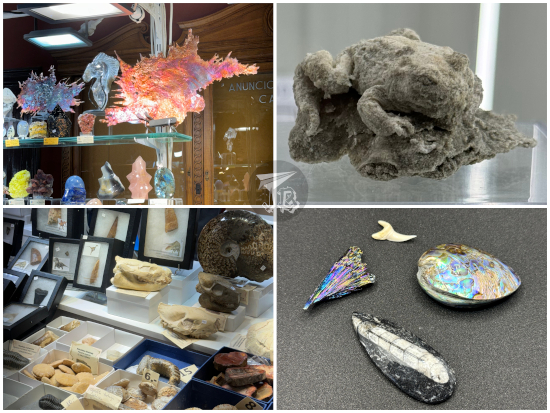
Expominerales fills the ETSIME with stalls selling minerals, fossils and crystals offered by reputable sellers. Here I’ve seen the biggest megalodon teeth in my life, held a plesiosaur vertebra – which I regret not buying when I had the chance – and discovered that moldavite exists – and which I regret not buying when I had the chance… do you spot a pattern here? I did not break it anyway, because in the end I cannot afford most of what is sold, and I already own most of what I can…

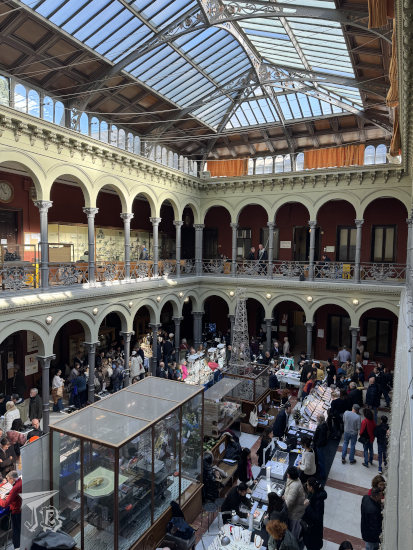
Overlook of ETSIME during Expominerales

I arrived at the School shortly after the exhibit opened around 10:00, and the area was still pretty empty. There were fewer stands than the previous years I’ve been there, and the moldavite stand was not there. Actually, there were very few meteorite-related stands this time around. I did see amazing modern-times frog fossils from Owens Lake. Owens Lake is called Patsiata in the Mono Native American language. In 1913, the lake dried out when the water from the Owens River was redirected and with years it has become a deadly salt flat, a source of alkali sand storms with a side of carcinogen materials. One of the minerals found in Owens Lake is trona, a crystal formed by the precipitation of sodium carbonate, making it a type of evaporite. In 2023, an atmospheric river caused floods in California, filling the lake up for the first time in over a century. The floods damaged infrastructure and created a surge of floodwater to the lake, which eroded surfaces and dragged a lot of small hibernating animals towards the lake, where they were killed instantly. Their soft tissues were quickly replaced by trona salt before the bodies even decomposed, creating a perfect cast of the poor critters. There were two on display at Expominerales and they were creepy!

Something else that caught my eye (and was actually within my doable price range) was a polished abalone shell. The Korean abalone (Haliotis discus) has been used for centuries in the art of najeonchilgi [나전칠기], which refers to decorating items with mother of pearl. The abalone can be polished in full, creating a whole iridescent body of nacre. These mollusks used to be collected by haenyeo [해녀], traditional female divers from the Jeju province, but most of them are farmed for food today. A small polished abalone came home with me.

Items from Expominerales

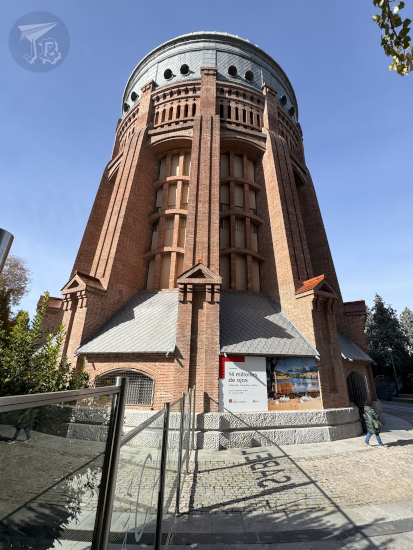
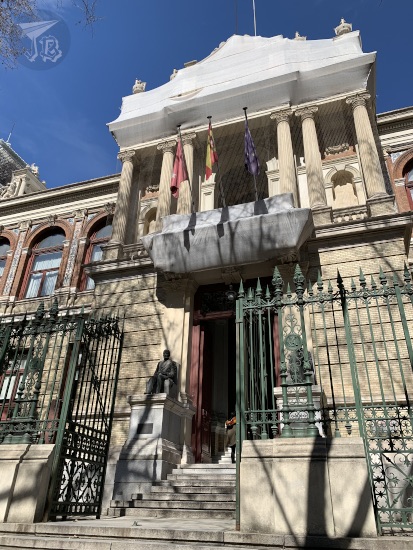
The School opens its classic museum during the exhibit, and I always enjoy visiting it. However, after wandering around for a bit (and spending some money), I moved onto what basically is the next building over to the ETSIME, the Spanish Mining and Geology Institute IGME – Instituto Geológico y Minero de España, which hosts the Geomineral Museum Museo Geominero. The original design of the building was conceived by Francisco Javier de Luque, and work started in 1921. Though a congress was held there in 1925, construction went on until 1941. The building has not been extensively restored, but it presents deviations from the original plans, and even from subsequent ones.

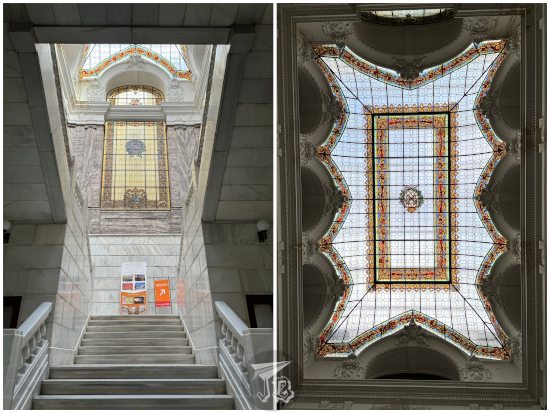
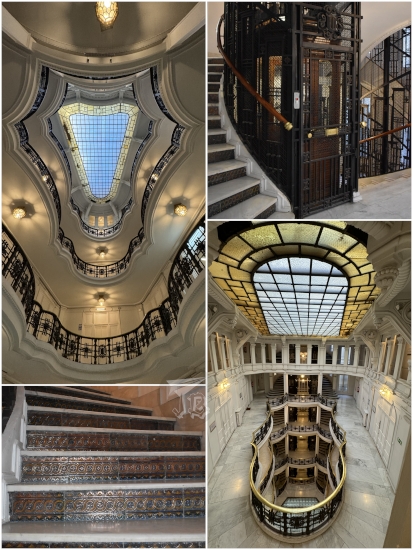
The museum is hosted in the former hall, and to get there, first you have to go through a very bored security guard – who first asked if I was sure I wanted to be there. Once inside the building, one goes up the main staircase towards the gallery underneath a glass-and-iron skylight with the logo of the Mining Institute. It was designed by Luque himself and created by the Madrid workshop La Veneciana, a glassware shop dating from 1876 and which, under a different name, still exists today.

Entrance staircase to the Geomineralogical museum

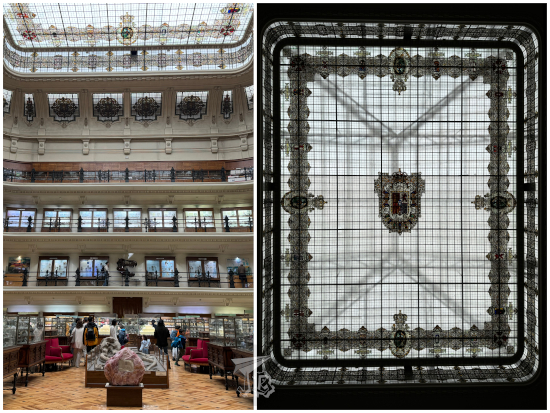
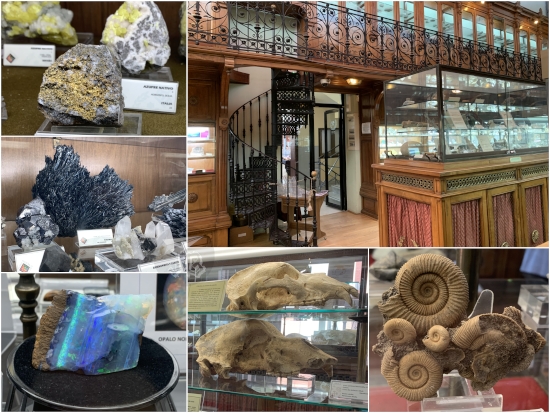
The museum is an open area, located underneath another incredible skylight. The displays are hosted in wooden cabinets in the main floor. The upper balconies can be accessed through spiral staircases and are protected by metalwork railings. One of the details I absolutely adore are the glassworks displaying geological sample cores of different surveys. I’ve never seen the library, but I was once part of a group which was allowed to play with some of the “lesser value” items they have as part of a training session, and that was super fun. The museum is probably one of my favourite spots in town.

The Geomineralogical Museum

From the architecture point of view, I like the building and the skylights. However, there are way more things to love in the museum, such as the wooden cabinets, full with samples of minerals, fossils and meteorites. The museum’s collection are divided into “Mineralogy and Petrology”, “Flora and Invertebrate fossils from Spain”, “Vertebrate fossils from Spain”, “Foreign fossils”, “Systematic invertebrate palaeontology”, “Micro-palaeontology”, “Fossil resin”, “Fossil tracks”, “Stromatolites”, and the “special exhibits”. One of these is a complete cavern bear (Ursus spelaeus), another one is an Ibex (Capra ibex). The last two have honour spots, with their own display.

When you come into the museum, one of the first things that you see, in front of the door, up on the first-floor balcony, is the cast of the most complete Tyrannosaurus rex skull ever found – Stan. Specimen BHI 3033, Stan, was found in 1987 and excavated in 1992, in South Dakota’s Hell Creek Formation. Stan lived around 65 million years ago, in the Cretaceous period. We know he fought for his life more than once – his ribs were broken and healed, two vertebrae were fused together, and he suffered a bite to his snout. Stan remains one of the most complete skeletons ever found, and probably the most-often cast. The skeleton made mainstream news when it was auctioned at Christie’s in New York due to money disputes among partners of the original owner-firm, Black Hills Institute. An anonymous buyer paid $31.8 million for it in October 2020. In 2022 it was disclosed that the Department of Culture and Tourism of Abu Dhabi had bought Stan for their projected new Natural History Museum.

On the ground floor there is a mastodon fossil Anancus arvernensis found in the 1990s. These animals related to modern elephants lived throughout the Miocene and went extinct in the Early Pliocene (two million years ago). The could have been around the size of a modern African bush elephants, but their tusks were mostly straight. They would have lived in steppe with dry and warm climate, but close to water. The fossilised bones were recovered are dated around 3.2 million years ago, and were dug from the Las Higueruelas site between 1948 and 1991.

Exhibits at the Museo Geominero

After I wandered the museum for a while, I left towards my train which was delayed… 43 minutes. Fortunately, so were the ones that had to pass before, so I ended catching one in the right direction after only a twenty-minute wait. And then I got junk food, because some days have to end in junk food…

9th March 2024: Minerals, fossils & trains (Madrid, Spain)

I might not be the most people-person ever, but if there is something that makes conventions extra fun, it is seeing attendees unapologetically geek out about what they love – in the case of Expominerales, that would be… rocks. Of course, this is an over-simplification. Expominerales is held yearly in the mine and energy engineering school Escuela Técnica Superior de Ingenieros de Minas y Energía (ETSIME) in Madrid. The year 2024 marks the 43rd edition of the event, which is considered one of the most important fairs in Spain in the topic of Earth Sciences – minerals, fossils, gems, and meteorites are widely available to the public. Aside from the small historical museum Museo Histórico-Minero Don Felipe de Borbón y Grecia, there were dozens of exhibitors with all kinds of items for sale, ranging from a few euro to several thousands. These year there were a few lectures, too, and coincidentally, the two of them I was most interested in happened on Saturday, one after the other.

I arrived at the ETSIME around 11:00, and I walked around the stands a couple of times. I have to say that I wanted everything, but I set a budget and I was able to stay around it, after shopping and lunch. At noon, I settled to listen to the lectures – one about the rehabilitation of an ancient gypsum mine in a hamlet called Hornillos de Cerrato, in the area of León. The other one versed about the uses of an already-rehabilitated one in the south of Spain, home to a huge geode. Both of them were pretty interesting, though the conference room was freezing. Someone had forgotten to turn on the heater there, it seemed…

Expominerales 2024 at ETSIME

After the two conferences, I had a last round to buy a last thing, so in the end I bought an iron-meteorite pendant, a fossilised shark tooth pendant, a plesiosaur tooth, and a soil sample of the K–T boundary. A plesiosaur was a marine reptile with flippers, a short tail and a long neck. The K–T boundary (now named the Cretaceous–Palaeogene (K–Pg) boundary) is the theoretical layer of iridium-rich black sand that was formed by the meteorite that caused the extinction of non-avian dinosaurs – and basically most life at the time, in one of the great world-wide extinctions in the history of Earth.

Shopping from Expominerales

At 14:30, I had a reservation for lunch at a Japanese franchise called Ramen Shifu. While I had originally been looking forward to trying the ramen (and I got my hopes pumped up when I read that they were Hakata ramen style), the noodles were rather disappointing. Fortunately, the okonomiyaki – Japanese pizza of sorts, made with a base of cabbage and topped with sauce and bonito flakes, was all right. On top of everything, paying was stupidly difficult because they did not have change.

Shifu Ramen ponzano - okonomiyaki and ramen

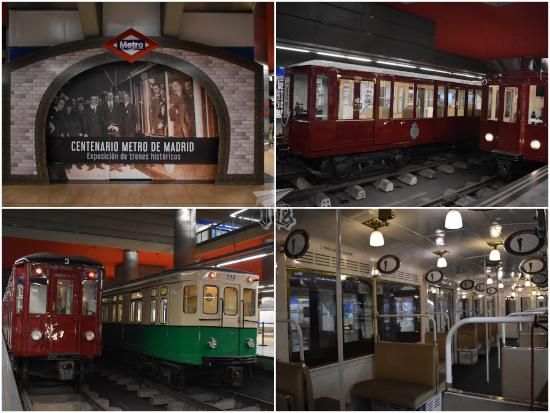
When I came out of the restaurant though, it was raining like crazy. I pulled out my umbrella and hopped towards the closest underground station, as my next destination was inside the metro system – one of the Underground’s museum network Museos de Metro de Madrid the collection of classic trains Estación de Chamartín: Exposición trenes históricos, inside the Chamartín stop. The exhibition displays four historical trains, restored from among the first ones that ran under the city, and some memorabilia. It was a bit underwhelming – more like false advertisement. I hoped I would be able to snoop inside the trains, since that was the photograph that opened the webpage, but unfortunately they were cordoned off. There was however a map with the works by Antonio Palacios in Madrid, which will become handy eventually.

Classical Train Exhibition Madrid

Afterwards, I just headed off towards the train station and got back home.

16th December 2023: A day out of ExpoGema (Madrid, Spain)

Since the mineral expo ExpoMinerales back in February was all cool and fun, I decided to attend its shinier (and unbeknownst to me, way more unaffordable) sibling, the gem expo ExpoGema, and make a day out of it. Thus, I headed out for Madrid on the 9:00 train with temperatures below zero – I was not made for winter. It was not much better when I arrived, but for once the train ride was uneventful, I actually made my connection, and it seems that after a chaotic year, the underground train tunnels are finally open. Everything going smoothly gave me some unexpected 45 minutes to wander around as the square Puerta del Sol slowly became fuller and fuller with people.

I had booked a guided visit through the company Madrid en Ruta, who has the exclusive concession to show the business centre Casa Comercial Palazuelo. Located in downtown Madrid, it was designed by architect Antonio Palacios. The promoter, Demetrio Palazuelo, bought the lot left behind by a fire, and commissioned the building with the goal of renting it out to shops and professionals – it was thus the first office building in Spain conceived as such, and not repurposed from a manor or an apartment building. Palacios drew inspiration from the Chicago School commercial architecture and used iron to stabilise the building, which allowed him for bright interiors using lots of glass. The office building was erected between 1919 and 1921, and the offices are still rented out today, with the only caveat that the beautiful interior translucent-glass doors have been painted white – to either protect privacy or hide the fact that today the house seems to be almost empty – at least according to the building’s own directory.

The exterior façade could be considered eclectic – the main frame tends to neoclassicism with huge glass windows framed in black iron. The interior tends towards Art Deco and modernism. The offices are distributed around a central indoor patio, with curved balconies that overlook it and lots of lights mainly due to the skylight. There are two classical lifts which are the original ones, in peartree wood. When we went up, I took the stairs, which have white treads, and the riser is made out dark green ceramics. I have seen these in other works by Antonio Palacios.. The interior, with the iron balustrades and its curvy design, was really cool, but I think it is really a pity they painted over the glass.

Interior of Casa Palazuelo

The visit started at 11:00. We spent the first fifteen minutes outside getting context, roughly half an hour inside, and the last twenty minutes on the roof of the building, waiting for the clock of the Puerta del Sol to strike 12:00, then we were ushered out. I really wish we could have wandered the house a little bit, even if we could not go into the offices. The ten euro we paid surely did not feel like we were paying customers, but more like we were sneaking around like unwanted guests – which we probably were anyway.

Puerta del Sol from the roof of Casa Palazuelo

I grabbed a quick snack then and headed off towards the engineering school Escuela Técnica Superior de Ingenieros de Minas y Energía (ETSIME) for the sixth edition of the gem fair ExpoGema. The fair itself was neat, but most everything was way above my budget range. I was there at the typical Spanish lunchtime, there were few people, and most were at the stands. Thus, I had the museum Museo Histórico-Minero Don Felipe de Borbón y Grecia almost completely to myself. I really like old-style museums, and this one has a huge amount of specimens, most of them are minerals, but there are also fossils and a collection of cave bear skulls and bones. I had decided not to book any guided visit or activity as none happened within the couple of hours of lunch downtime.

Geology Museum at Etsime

I bought an ammonite pendant, a small pyrite with almost perfect right angles, and another pendant made with a small meteorite from Campo del Cielo, along with a tiny extra piece. Campo del Cielo is an area in Argentina where four or five thousand years ago an iron meteorite fell. The meteorite shattered upon entering the atmosphere and, when it impacted the surface, the different created up to 26 craters. About 100 short tonnes of a fragmented iron meteorite have been recovered to date, and I now own around four grammes of it – yay me. I did not buy any precious stone though since the pretty shiny rocks were way out of my budget.

Expogema 2023

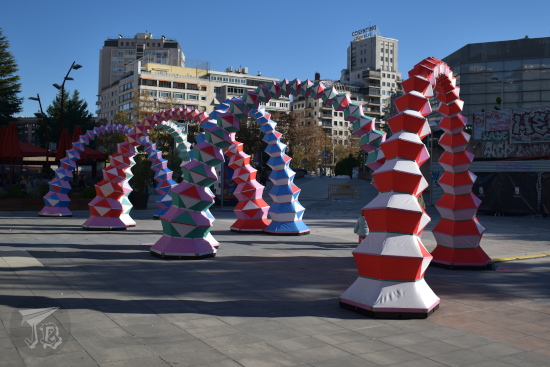
I left the ETSIME and I walked towards the square Plaza Pablo Ruiz Picasso, where there is a temporary art installation called El Regalo (The present) by Amigo&Amigo, a studio specialising in art installations. The artwork comprises a few arches that end in pads that can be stepped on – when they are, music sounds. The day was still bright, so the artwork was not shining, but a bunch of kids jumped on the pads to keep the music playing.

El Regalo artwork

Afterwards, I took a train and headed off towards central Madrid again. I had a reservation for an afternoon tea at NuBel, an “avant-garde gastronomy space” in the modern art museum Museo Reina Sofía. I had been drawn to the place due to the “freshly-baked scones” they advertised.

The experience was beyond disappointing. First, I had to wait to get seated, but then the person who checked me in forgot to notify that I was there – this is what I assume happened, I was literally told that “the kitchen had forgotten about me”. The set menu took 40 minutes to come out, and the scone was cold anyway, so not even freshly-made. I had got a decaf latte that was also cold when the food came.

The menu, 16€ as I don’t drink alcohol, consisted of: two mini-sandwiches – the two of them had been made from the same bread slice, so you can imagine the size, with some kind of mayonnaise filling which was not bad but rather unidentifiable; one shot-sized glass of (pre-made) gazpacho; one scone; a piece of red velvet cake; a piece of carrot cake; one chocolate brownie; a side of cheese cream, butter and jam; and in my case the already-stone cold decaf latte.

Nubel afternoon Tea

The scone was cold – so much for freshly-made, the only thing that had kept me waiting. Furthermore, the cheese cream, albeit nice, did not fit it like at all, so I had to use butter on it. I laughed to myself thinking about “the horror!” while I clutched my metaphorical pearls. The red velvet was probably the best, but in general the cakes were too sweet – good thing the menu included free tap water. Afterwards, I was comped another free decaf as an “apology for the delay”. However, when I tried to pay, more drama ensued. First the card-reading machine was not working, then they could not take cash because they were balancing the register, then they could bring the machine to the table. All in all, I spent almost hour and a half there – about five minutes waiting to be seated, forty minutes waiting for the tea set, and twenty minutes trying to pay. I’m sorry to say I did not tip, nor do I plan to ever come back.

I missed my train due to the paying delay, and I had to wait almost half an hour for another one. I hung out the Christmas market for a bit, and looked at the lights around Puerta de Atocha station. As it was cold, I walked in and went to check out the original train station, now turned botanical garden. I had never stopped to look at the iron ceiling, just at the plants – and the tortoises people used to dump there – but there had been an old photograph during the Casa Palazuelo visit that made me want to look at the building itself, and I recognised that old station in today’s building, with its wrung iron columns. Funny, how you can look at the same old things and recognise them.

11th March 2023: Rocks from the land and fish from the sea (Madrid, Spain)

Back in 2018, when going to Madrid’s Geomineral Museum (Museo Geominero), I stumbled upon an event in the Mining Engineering University – something called Expominerales. At the time, I did not have time to explore it, and only later did I realise what I had missed – an international fair for the trade of minerals, rocks and fossils. I made a mental note to check the event out the following year, but something came up and I completely forgot about the whole thing. In 2020 the pandemic struck, and finally in 2023, almost five years to the day, I went back to this event held in Madrid.

Expominerales is held yearly at the working engineering school Escuela Técnica Superior de Ingenieros de Minas y Energía (ETSIME), which offers the bachelor’s degree in Mining Engineering, and the one in Energy Engineering (whatever this last one is). The first weekend of every month, the school organises a “mineral-world flea market”, and the second weekend of March, it hosts an international mineral, gem and fossil fair, with shopping stands and different workshops and activities. After a few cancellations due to Covid, it returned in 2022 and it’s back to its former glory in 2023 – Expominerales XLII, the 42th edition of the fair.

The ETSIME in Madrid. Pink-and-white building from the 19th century, accessible through stairs, with flags hanging over the door

Mining Engineering became a formal education path in Spain in 1777, originally in the town of Almadén, a mercury hub. The school was moved to Madrid in 1835 and a two-building campus was ordered. The historical building in the ETSIME (M1) was designed by architect Ricardo Velázquez Bosco, and decorated by ceramist Daniel Zuloaga between 1884 and 1893. The second building (M2) was damaged during the Civil War, and has suffered several modifications to accommodate classrooms and laboratories. The premises also include a reproduction of a mine, Mina Museo Marcelo Jorissen, however this one is closed for renovation – a lot of that seems to be going on around the university, since part of the decorations of the buildings are also covered.

The M1 historical building has a central cloister with an ironwork colonnade. The building is rectangular, and on the short sides there are two symmetrical wards. One holds the historical mining museum, the other one the historical library. The central cloister is the main area where Expominerales is held, on the ground and first floor. On Saturday, the exhibit opened at 10:00, and we were there a bit later in order to sign up for the first guided visit at 11:00 (3€) – we wanted to take it so we had access to several rooms that would otherwise be closed to us. The idea was being there before families with kids started arriving and the activities became overcrowded – it turned out in the end that most the activities were indeed organised for children, so it did not really make a difference. Furthermore, the visit we feared full only had 6 attendees.

We had one hour before the guided visit that we spent looking at the stands on the ground floor on the M1 building. The guide was a student who might have been partying the previous night, because he sounded a little out of it – forgetting info and words, even things related to his own degree.

First, we went to see the mineral collection, the origin of the historical museum in the M1 building, Museo Histórico-Minero Don Felipe de Borbón y Grecia. The mineral collection was started in 1831, and throughout the years it was increased with new minerals donated by different institutions. It was later expanded to cover palaeontology and historical artefacts related to mining and other earth sciences. Though a lot of the displays are scattered throughout he building, the original museum dates from the 19th century, and it has four sections: the mineral collection, the fossil collection, the cave bear collection and the mining archaeology section, totalling over 10,000 items.

The historical mining museum at ETSIME Madrid. It is a large ward with cedar wood shelves from floor to ceiling, filled with rocks and fossils. The picture also shows some close-ups of rocks, two cave bear skulls, and a cluster of fossilised snail-like animals

Today, the museum is named after King Felipe VI, who visited the museum in the late 1980s after the university reached out to him to propose the name. The then prince came to visit then, and the name “the king’s stairs” was given to the set of side stairs he used – Escaleras del Rey.

We also visited the small hall where candidates read their theses, a little hall with spectacular ceramic tiles by Zuloaga, and finally the historical library, with obsolete but cool volumes. The library also dates back from the 19th century, with the walls covered in wooden shelves, with a small metal staircase to access the upper balcony. Unfortunately both this one and the one in the museum were cordoned off.

Library in ETSIME. It is a large room with cedar wood shelves from floor to ceiling, and a spiral staircase.

The visit ended at the lecture hall on building M2, one of the few remaining areas of the original design. It is a marble room with wooden benches and decorated windows that represent the original subjects taught to Mining Engineers. After we were left off, we sat down at the cafeteria for a drink.

Lecture hall in ETSIME (Madrid). It's a marble room, rather dark, with smoked windows representing different subjects of the Mining Engineering Degree

We recharged batteries, and then we had a look at the stands on the first floor of the M1 building, alongside the collection of apparatus that they had. Afterwards, we decided to separate in order to do shopping. Expominerales hosted over 30 stands, national and international.

Expominerales. A view of the ETSIME cloister from the second floor, showing different stands and lots of people peering curiously

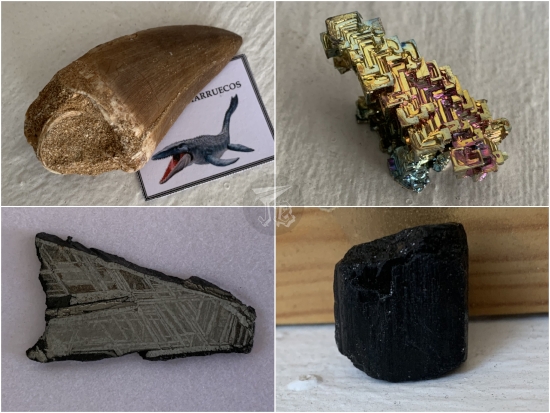
I, being the nerd that I am, got myself a tiny slice of iron meteorite (from Geoterra Minerals), a mosasaur fossilised tooth (from Carlos Hammann, who also had amazing megalodon teeth that I will never be able to afford), a decent-sized of recrystallised bismuth (from Rossell Minerals), and a small piece of black tourmaline (from The MineralShop) – all for 51€.

Collage: a fossilised tooth, a bit of mineral in metallic colours, a slice of meteorite with silver orthogonal markings, and a bit of shiny black rock

When we met again, it was a bit past 13:30. There were too many people by then – families had started arriving, so we decided to leave. We had booked at a nearby restaurant for lunch, and they did not mind accommodating us a little earlier. The restaurant, called DeAtún Ponzano specialises in tuna dishes – particularly Atlantic bluefin tuna (Thunnus thynnus), sustainably caught in the Straight of Gibraltar.

Before overfishing was even a thing, Phoenicians settled in the south-west of Spain somewhere between the 9th and 7th centuries BCE – the city of Cádiz, credited as being the longest-standing city in Europe, may have been the first port. The Phoenicians observed that the bluefin tuna migrated from the Atlantic to the Mediterranean every year around the same dates, and later they came back to the ocean. These guys came up with a very simple technique – that was later developed further by the Romans and perfected in the Islamic period: the almadraba.

An almadraba is a portable but complex net which is lowered for the migration period. The bigger fish are funnelled into a box-like construction, and the smaller ones swim right through it. Once the almadraba is full, a number of fishing boats lift it in a process called levantada (raising). Expert fishermen walk onto the nets, discard any small specimen that might have been trapped, and choose the tuna that will be sold, generally individuals heavier than 200 kg.

Since the fish are selected on a case by case basis, the amount of both the catch and by-catch is small in comparison to other fishing methods. Both the seasonality and craftsmanship of the whole process make it much more sustainable than others – of course, this also causes fewer pieces in the market, which in turn increases the price. Furthermore, all the fish are wild, hand-picked, and only bled out when they are loaded onto the ship. Thus, the quality is extremely high. Another factor that makes almadraba-caught tuna more expensive is the fact that walking onto the levantada is dangerous. Fishermen have been seriously hurt by struggling tuna, as some of the fish might weigh up to 500 kg.

Working almost exclusively high-quality tuna means that DeAtún is not a restaurant on the cheap side of things. I’ve actually traced down their tuna provider and the prices are rather cost-adjusted for almadraba-caught tuna. There’s another thing to consider, too, which is that the Spanish law forces restaurants to freeze fish that is going to be served either raw or quasi-raw, at least for 24 hours at a temperature under -20 ºC – this is done to destroy a fish parasite called Anisakis, which can cause stomach distress and serious allergic reactions. Apparently, the perfect temperature to keep the tuna properties is -60 ºC. So yay Anisakis-safe almadraba-caught tuna all year round (though it’s true that the freezing law makes it impossible to eat fresh tuna raw).

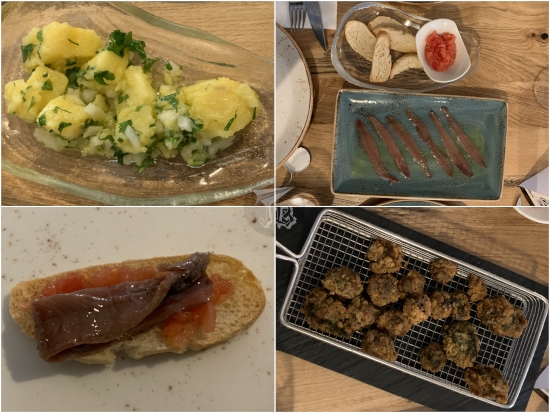
We got a welcome tapa of boiled potatoes with olive oil and herbs (“papas aliñás”), a favourite from southwestern of Spain, the same area where the almadraba tuna are caught. We shared some European anchovies (Engraulis encrasicolus) “anchoas del Cantábrico” with tomato and toasted bread. These anchovies are salted for at least six months, cleaned, and stored in olive oil. They have a strong flavour, and are not everyone’s cup of tea, but I adore them. We also shared a portion of “ortiguillas” (Mediterranean snakelocks sea anemone Anemonia sulcata, battered and fried), also typical of the south-west – I’ve never been much of a fan though.

Lunch at DeAtún. Collage with a potato salad, anchovies and battered seafood balls

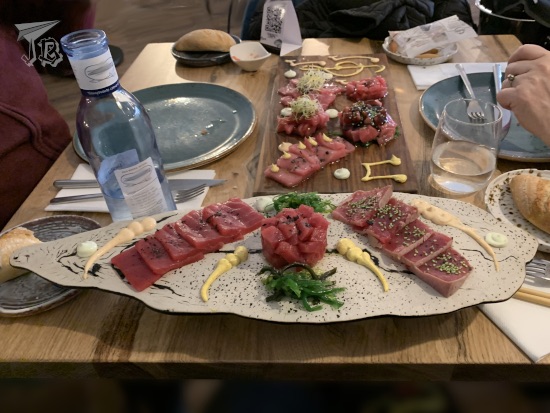
Finally, as my tuna preference is raw, I was wondering whether I wanted sashimi or tartar. In the end, I decided to try a combo (“trio DeAtún”): tuna sashimi (slices), tuna tartar (dice) and tuna tataki (heat-sealed slices), with a side taste of different sauce emulsions – wasabi, kimchi and curry. The tuna cuts used for these preparations (descargamento and tarantelo) would be the otoro or toro Japanese cuts, which are appropriate for raw preparations – technically the best ones, fatty or very fatty meat. I don’t love tataki, thus my original reticence to try this combo, but it was good. My favourite bit was the sashimi though, the tartar was missing a bit of spice.

I was offered chopsticks to eat the dish, and I accepted – easier to handle the fish. That apparently made the maître think that I had been the one choosing the restaurant, because in his words I “seemed to be an expert, chopsticks and all”. That was hilarious – I mean, why offer chopsticks if you don’t expect them to be accepted? For the record, although I booked the table, I did not choose the restaurant – it would have been a little on the “too fancy” side for me. The truth is, there were a bunch of very-elaborated dishes that we decided to give a miss, and we went for the raw tuna.

Lunch at DeAtún. A plate with three tuna cuts. The centre is round, and rose-like, and the sides are extended on a line. The fish is uncooked and it looks dark red. There's a similar dish in the background, with more cuts

Desserts were okay, but not the reason we had chosen this place. The point was eating tuna – raw tuna in my case – and the restaurant delivered. I was however amused by tables around us refusing the raw options even when the chef himself came out to greet them and recommend the dishes (someone over there must have been an acquittance, I don’t really know). Finally, we set back home to compare treasures and plot going back to Expominerales in its 2024 edition – at a time where we can snatch some discounted rocks.