I was on break for Easter, and my sibling, who works in Madrid, proposed to “have lunch and whatever”. That usually means that they want me to find a good place for lunch, and a plan for “whatever” afterwards. The original plan was Monday, but way too many things were closed on that day, hence we rescheduled for Tuesday. I organised two “whatevers” – one for myself, one to do with them.
I took the train towards Casa de Campo, and I actually made an earlier train than I had calculated. I was at the final underground stop around 9:15, so I had 45 minutes to explore around before my 10:00 ticket. The park known as Casa de Campo was established as royal hunting grounds in 1561, under the reign of Felipe II (Philip II). It was at the time designed by Juan Bautista de Toledo, who divided the area in three parts – orchards, gardens and the actual hunting grounds. In 1656, engineer Pietre Jansen established the large pond in the centre, Lago de la Casa de Campo. Later royals would add modifications for their own enjoyment until the area was open as a public park in 1931, during the Second Republic. In 1997, it was declared historical park (Parque histórico). Today, the Madrid Zoo and the Amusement Park are located within its grounds. It also hosts an area for travelling exhibitions, Escenario Puerta del Ángel.
I’ve always wanted to explore the park a little, and this was my chance. There are several constructions of historical importance there. Beside the lake, which was already teeming with sportspeople, the first one I found was the aqueduct Acueducto de la Partida, a former waterway that carried water from the lake to one of the orchards. I also saw the former house to breed pheasants in, and the forest around it – La Faisanera and Bosque de la Faisanera – but mostly, I wandered around, scaring a bunny or two.
Eventually, I headed towards Escenario Puerta del Ángel where Euphoria, a new exhibit by the Balloon Museum had just opened. The first time I had been to one of their exhibits I had not known what to expect, but this time around I was ready. The Balloon Museum specialises in immersive artworks (each of them can take up a whole room), most of them created with inflatables and light. You can touch and play and be silly with a lot of them too.
The artworks displayed, and a bit about them, are:
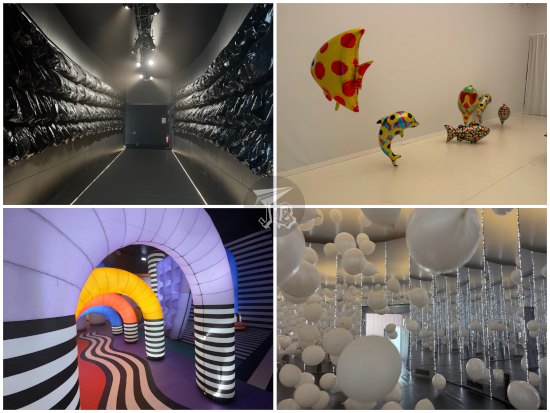
- One Hundred and Twenty by Nils Völker. A short corridor flanked with garbage bags that inflate and deflate as if they were breathing. A bit unsettling, so I am glad that was the first one and I could leave it behind.
- My Room Is Another Fish Bowl by Philippe Parreno. A room full of helium balloons in the shape of fish and seahorses that you could play with as they floated gently along the room. This was very cute – but I guess I like fish.
- Follow Me, I Think I Know the Way by Camille Walala. It was like a kid’s monkey jungle but made of inflatables. I wish I were younger and could climb on them.
- Invisible Ballet by Hyperstudio. A room full of balloons that floated around at the centre. You could stand amongst them as they move and turn and the wind messes with your head (and the balloons hit you on the face, of course). This had a very pretty, but mostly hilarious, effect.
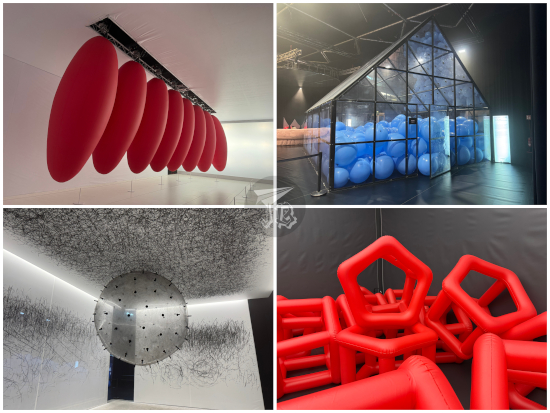
- Ovoids by SpY. A bunch of egg-like giant… things that gently swayed from the ceiling, making it a bit (actually very)… creepy.
- Work No. 3883: Half the air in a given space by Martin Creed. A greenhouse full of huge blue balloons that you had to cross, it was like an adventure. Of course I went in, who do you think I am?
- Our Floating by Alex Schweder. A round bed-like structure you could sit and lie on as it inflated and deflated randomly so you kept falling and rising. A welcome break, and giddy fun to flop down on.
- ADA by Karina Smigla-Bobinski. A big… bouncy ball with charcoal pencils attached to it. You could push it or let it float around, and as it hit the walls it drew random lines on them. This was stupidly fun, but it did stain your hands – and whatever else it came in contact with, if you were not careful.
- Crazy Love for Polygons by Cyril Lancelin. Hexahedral balloons that you could stack to make shapes with – unfortunately this was hijacked by toddlers who did not want to share with the rest of the attendees.
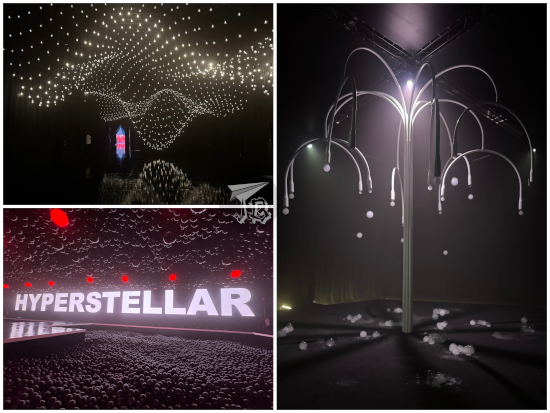
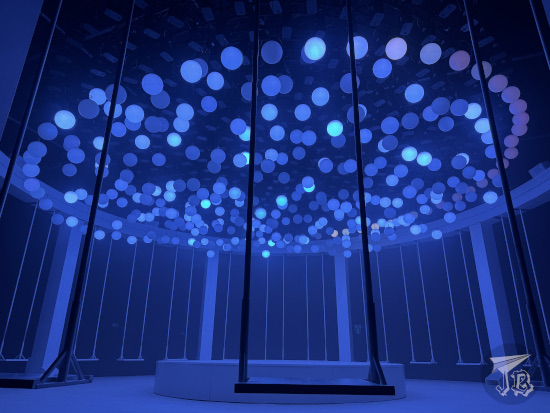
- Pulse Topology by Rafael Lozano-Hemmer. A lot of lightbulbs hung from the ceiling in some sort of wave shape. You could put your hand under a sensor and the bulbs pulsated along your heartbeat. When you took your hand off, one of the bulbs remembered the rhythm and kept pulsing. It was a pretty intense feeling, to be honest, though I am not even sure why.
- New Spring by A.A. Murakami. The installation resembled a cherry tree, but instead of cherry blossoms, it shed bubbles of pinkish mist that popped into scented vapour if poked or when they hit the ground. The scent was rather beautiful, too.
- Hyperstellar by Hyperstudio with Quiet Ensemble and Roman Hill. A huge ball pit with a light and sound show. This is pretty similar to the Hyperstudio artwork I had seen the first time around, so I guess it is a signature kind of work.
- Kaleidoscope by Karina Smigla-Bobinski. There were three tables in the middle of the room, and when you touched them, the liquid on top moved around, changing colour. That reflected or was projected on the walls… I didn’t quite get the idea.
- 10 Agosto (10th of August) by Hyperstudio. A circle of swings looking at big round lightbulbs that turned on and off, and moved along the rhythm. It was quite relaxing even if the music was not designed for it.
At the end of the tour there was a gift shop, where I got myself a sweatshirt, because at some point, I had a wardrobe malfunction and the zipper of my sweater had dislodged. I thought that was a sign. It was all good because the weather was weird – the wind was cold, but it was nice out in the sun.
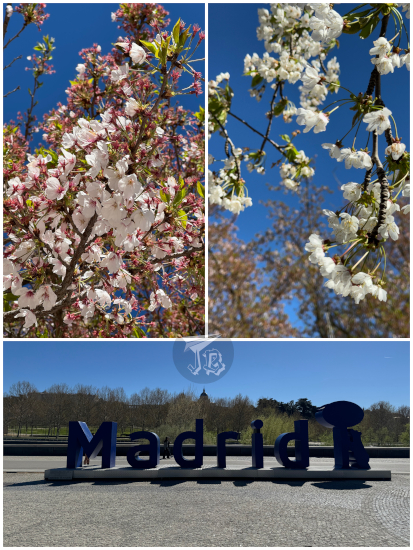
I left the museum and walked out of the park and into a wide avenue. There, I found a “trail” of trees in bloom, until I reached the edge of the park, which takes the name of Huerta de la Partida, strolled by the Madrid Sign and crossed over the river Río Manzanares. I headed into the former station, now shopping centre Estación de Príncipe Pío, where I tried the seasonal Starbucks drink – I did not like it too much – before I reached the royal gardens Campo del Moro. There, the Spanish Heritage management, has restored and sort of opened the historical Túnel de Bonaparte.
I feel the need to keep “opened” in quotation marks because I was expecting to be able to walk from one side to the other – but it turns out that no, only the first few metres are accessible – the rest are locked down (and the closed-off area is not even the historical part, but a reconstructed concrete bunker of sorts). The tunnel was conceived to be an underground connection the two parks – Campo del Moro and Casa de Campo. It was designed by Juan de Villanueva under orders from Napoleon’s brother, Joseph Bonaparte. Only the first few metres are the restored original, built in brick and open to visitors. It was a bit anticlimactic, because it would have been a nifty way to cross the busy avenue overhead.

I walked across Campo del Moro, emerged near Plaza de España and found Casa Gallardo, one of the few true Art Nouveau buildings in town. A restaurant has opened there, and there’s a part of me tempted to go for lunch some day so I can see the interior, but I don’t really think it would really be worth it. The house / palace was built between 1911 and 1914, and its architect, Federico Arias Rey, was awarded the “best house of 1915” recognition for it. The roofs are black slate, and the white façade features rounded balconies are uncommon in Madrid. Today, everything is private or residential, so no snooping around.
After wandering around for a bit, I finally walked into the underground to meet my sibling at the Tetuán stop, for our lunch reservation at Shanghai Mama (Infanta Mercedes), part of the group China Crown, whose first eatery tackled trying to tear down the Spanish idea that Chinese food was all cheap and greasy, or fried rice (and yet, our waiter was very surprised that we did not order any rice). We shared Crunchy duck bundles with plum sauce (Paquetitos de pato crujiente con salsa de ciruela | 缤纷鸭卷), Xiaolongbao filled with Iberian pork secreto (a shoulder blade cut, one of the best parts of the animal, apparently), mushroom and foie (Xiaolongbao relleno de secreto ibérico, setas y foie | 鹅肝鲜肉小笼包), Prawn chop suey (Chop suey de langostinos | 什锦炒大虾) and Lacquered duck magret with orange sauce (Magret de pato laqueado en salsa de naranja | 香橙酥鸭胸肉). Everything was delicious, but especially the chop suey. I had not had chop suey in years, so I was really happy it was so good. The duck was incredible too.
We did not have dessert, because I wanted to try the nearby Muua Bubble Tea. Spain came into the bubble tea fad a bit late, and while the place was pretty, the tea was extremely sweet. They were extremely generous with the tapioca, too, and very friendly.

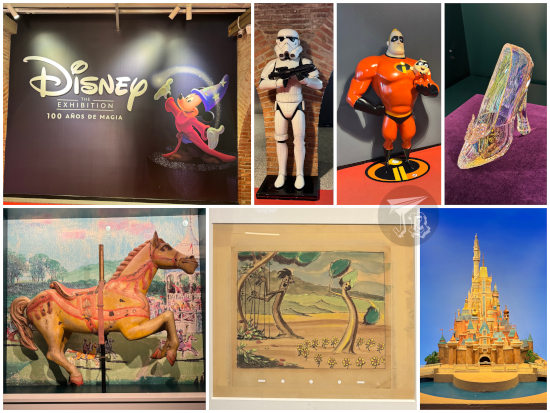
Afterwards, we walked up towards Sala Castellana 214, one of the exhibition halls that Fundación Canal manages. They were running an exhibit by the Walt Disney Company’s Archives – Disney: The Exhibition – 100 Años de Magia (Disney: The Exhibition – 100 Years of Magic), which was half price for Easter. While I’m not a big Disney person, my sibling is.
The displays claim to honour 100 years of Disney’s creativity (103, actually, as the century-mark was 2023, when the original exhibit was held in the USA). I have a couple of problems with the way it was presented. I was honestly expecting that they would focus on the actual “Disney” work, as we were greeted by a lady from the “Disney Archives”, not stuff created by other people than Disney later bought. So in my opinion, Indiana Jones, Star Wars and all the Marvel stuff were an add-on.
The first room was an introductory video, and the second had a bit of an introduction to the company and the first films, including the birth of Mickey Mouse. In the upcoming areas, there were props like Cinderella’s shoe (from the live action film), one of the carousel horses from Mary Poppins (my sibling is rather sure it’s Bert’s), an original Winnnie the Pooh puppet (quite creepy, if you ask me)… I really liked a reproduction of the book from Sleeping Beauty, which projected the scenes on a screen. Other “not Disney in my head” props included an Indiana Jones outfit, Star Wars paraphernalia (a BB8, a prog, a lightsaber handle), Marvel’s suits and accessories (Captain America’s shield, one of Black Widow’s outfits, Avengers’ helmets…). There were also items from live action films such as The Little Mermaid and Cruella.
Another room focused on music, with a big screen projecting iconic songs, Mickey dressed as an orchestra conductor, or the outfit of the actor who played Mufasa in the Broadway version of The Lion King. There were also examples of how to create different sound effects. Further, there were items used in parks and films and an interactive Rocket Racoon that was not working.
Finally, there were references to the Disney Parks, a collaboration with National Geographic, and some more projections and a kids’ activity zone. Oh, and of course the shop. You can’t go wrong with a shop, especially when a good part of the attendees are going to be under the age of nine.
We had a bit of a bad connection as Metro has closed down a few stops on Line 10, but we were lucky enough to catch the courtesy bus service that took us right to our station – for free, even. The train ride back was okay, there were issues with the carriage filling up and almost catching someone at the doors, but in the end everything worked out.