23rd February 2024: Zorita de Los Canes & Recópolis (Spain)

Zorita de los Canes is a hamlet at the bank of River Tagus, in the middle of nowhere in the Spanish Central Plateau. It was founded as an Almoravid dynasty fortress (alcazaba), however the stones that erected the castle are much, much older. The fortress was built around the 12th – 13th centuries, and although ruined, it used to be visitable – not at the moment though. The stones to build the castle were quarried from an even older settlement, which today is known as the archaeological site of Recópolis.

During the Middle Ages, Zorita was extremely disputed. After the Moors built the alcazaba, the town was taken over by the Christians, then recovered by the Almoravid dynasty, until it was conquered by Christian king Alfonso VII. The village was entrusted to the Order of Calatrava, the first military order to be founded in the Kingdom of Castile, who were to defend it against the Almohad Caliphate.

I’d been wanting to go to Recópolis for a while, and I found out that the archaeological sites in the area are free until the end of the year, so I thought it would make a nice mini-trip. I booked the ticket a few days in advance as it seemed that the weather would be cold but dry, albeit windy. I thought it could be a good chance before fuel prices go up again.

I had an early lunch and drove off with the idea to get to the archaeological site around quarter to three, as I was booked for three o’clock and the ticket said to arrive ten minutes in advance. The drive was a bit faster than I thought, but the Sat-Nav sent me on a completely different route than Google had, which made me a bit insecure about timings. That’s why, even if I saw a couple of villages that looked interesting, I decided not to stop and explore them, I could do it on my way back. Suddenly, the ruined castle came into view. I pulled over in a safe place to admire it and checked the time – I was good. Thus, I drove into Zorita de Los Canes and stopped at a small parking lot at the entrance of the village. I parked next to the river Tagus Río Tajo, which gave me a couple of nice views.

Castle in Zorita de los Canes, atop a hill

Part of the Medieval wall still stands, and access to hamlet’s core is done through an ancient gate, which I was happy to cross on foot. There was a small church, and at the summit of the peak stands the derelict castle Castillo de Zorita de los Canes. I decided not to climb as I knew it was closed, and after a few minutes, I got back into the car and drove off.

River Tagus and Castle in Zorita de los Canes

All in all, I was in town for about a quarter of an hour, and did not drive for longer than three or four minutes before I parked at the entrance of the archaeological site Parque Arqueológico de Recópolis. The interpretation centre was empty and locked, and I was the only car in the parking lot. The time was around 14:30 at that point and I decided to wander around for a bit, as there was what looked like a hiking trail amongst the fields. I found a nice lookout of the castle, but not the ruins themselves.
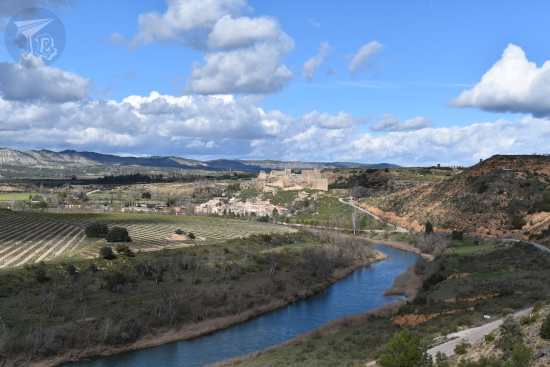
Zorita de los Canes from far away

The discovery of Recópolis is credited to Juan Catalina García López in 1893. Juan Cabré Aguiló started the excavation in 1945, and found a “little treasure” (tesorillo) of coins from looting (one of them fake). Of Visigoth origin, it predates the Moorish town by a few centuries. It was erected around the year 578 by king Leovigildo in honour of his son Recaredo, who would go on to become the first of the Christian kings of Spain.

The city followed the byzantine pattern. There were two perpendicular streets, one of which lead to the palatial area, with shops to the side. Recópolis became important enough to mint its own coins, but the crisis of the Visigoth state lead to it conquest by the Moors in the 8th century. The city was slowly abandoned and became a quarry for the nearby settlement of Zorita. Later, in the 11th century, Christian settlers built a church and a small village, which had been abandoned by the 15th century.

The whole archaeological area spreads 30 hectares, out of which eight have been excavated. The interpretation centre has a few replicas of artefacts that have been found – due to security concerns, no originals are kept on site. To be honest, I was not surprised – I could have walked into the site and left without anyone stopping or even seeing me. When I arrived, it was me and the vultures, and I had a bit of a flashback to that time at the cave Cueva de los Casares, and even fantasised a little about being alone to explore the site. The guide arrived on time and opened the centre, and I was still the only one there, which was weird – I know for a fact that there were a bunch of reservations for 15:00, but only I showed up. Maybe the others became discouraged because of the weather?

The nice tour guide suggested waiting for a few minutes to give time for others to arrive, and offered me the VR experience. I accepted, of course – I’m not going to turn down such a thing. It was really fun, because you could pick up objects as the local goddess and a little child showed you around a reconstruction of the town, the palace and a glass workshop.

Afterwards, we headed off towards the ruins – nobody else had shown up. The guide offered to let me stay after the tour to take all my pictures so I decided to just listen to him as he explained and pointed to some very interesting details – a bit giddy inside. Would I really be alone eventually? He showed me the church, the palace and the grain silos in the ground, where grain was stored. He also took me to the palace and pointed out the main streets, and taught me how to differentiate the Moorish construction (criss-crossed materials) from the original Visigoth one (parallel architectural stones).

We also chatted a little and I mentioned I hoped it did not rain – he said that it had been threatening rain all week, but it would be all right. I eyed the black cloud approaching and hoped he was right.

Spoiler alert: he was not.

After finishing the guided visit, I was left alone indeed. I went around the main area of the archaeological site, and when I was in the church, the storm broke out. I had an umbrella, but I still got drenched. Interestingly though, even if it was raining and windy, it was suddenly not as cold as before. However, I had to give up eventually, since taking pictures was too difficult. As I decided to return to the visitor centre, the cloud finally moved through, and rain slowed down. I was heading down the hill towards the visitors’ centre when it finally cleared completely. I stopped, wondering whether to leave or come back, and when I looked up I saw a rainbow, sprouting right out of the castle. There were even vultures flying against the retreating cloud. It was really cool.

Rainbow hitting the castle, and a vulture flying

I felt motivated again, so I went back to the ruins of the city to take a few more pictures – after all, it was really cool to be all alone in the archaeological site. I wandered among the houses where it was allowed, and went to the edge of the site to take it all in, then I walked back. As I was in the middle of the street, a griffon vulture circled me a couple of times, maybe wondering if I was food – I think staying where I was taking pictures did not help? It eventually left, and I headed back to the centre, where I arrived just in time to watch the little video documentary about the Visigoth town.
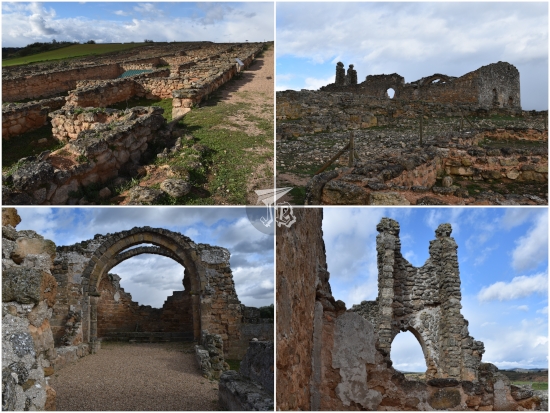
Ruins of Recópolis

Recopolis ruins

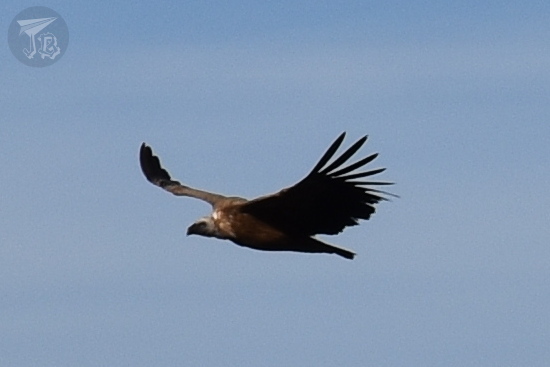
Griffon vulture mid-flight

I left afterwards, and I got caught in the storm again – thus I did not stop in any village on the way. The first half of the drive was miserable in the rain, but then it cleared out, and the rest of it was all right. Fortunately, I did not run into too many other cars either. I got home around sunset and went to bed early since I had to wake up early the following day.

Nevertheless, now I’ve got a VIP (VOP? Very only person?) experience, alone in an archaeological site, which is added value to the whole thing and I loved every second of it, even with the rain.
21st September 2023: Puy du Fou España (Toledo, Spain)

Puy du Fou is a project which started in France in 1977, when Philippe de Villiers decided to create a show in the ruins of a Renaissance castle in Les Epesses, a village about an hour away from Nantes. Initially, the show, named Cinéscénie was not too successful, but it increased in popularity as spectacular elements with horse riding and sword fighting acrobatics were added. A theme park was built around the show in 1989, and the venture went on to become one of the most popular parks in France, after Disneyland and Parc Astérix. Between 2019 and 2021, the French project was exported to Spain and turned into Puy du Fou España, located in the central city of Toledo, one of Spain’s most historical towns. Toledo is close enough to Madrid that the park can be visited on a day trip from there, and the land around it were probably on the cheap side.

Regardless of the logistics, Puy du Fou España markets itself as a historical theme park. It does not have rides, and instead, it focuses on shows, restaurants and shops. There is a day-ticket and a night-show ticket and we combined both on the same day. We reached the parking lot about twenty or thirty minutes after the park opened and had to walk for about ten minutes until we reached the entrance. We had booked a “fast pass” called Pase Emoción, which guaranteed access to all the shows at specific times, and the walk-throughs without having to queue. We had also reserved lunch, though by the time we bought tickets, the lunch-show was already sold out – we knew we risked this, but the weather had been unpredictable, and we did not want to be caught in a bad storm so we waited until the previous week to decide. While we did have some drizzle during our visit, it mostly found us indoors, so aside from the hassle of putting the camera out and having to pull it out again (and again, and again), it was not a real problem.

Summary of bookings (times three; four tickets per person):

  • Experience 1 day: Park + Night show: Parque + El Sueño de Toledo Ubicación Plata – Entrada 1 día Adulto, 68.00 € (non-weekend, non-high-season price) separated into:
    • Park ticket: Parque 1 día Adulto, 27.20 €.
    • Night show: Espectáculo Nocturno “El Sueño de Toledo” (best seating available), 40.80 €.
  • Fast pass: Pase Emoción, 20.00 €.
  • Lunch: Menú Hospedería de Santiago – Adulto (first course, second course, dessert and drink, saving a couple of bucks from the on-site price): 22.05 €. We decided to book lunch because we thought it would be harder to find a spot, and that for dinner we could grab a sandwich or something. In the end, we had a snack and a drink in the evening, which came up to around 11 € / person, bringing the total spent in the park to 121.05 € (no souvenirs, no extras).

We visited the park on a September Thursday, so we were not expecting many people. The first surprise was the number of buses in the parking lot – yes, there were quite a few people, though not “crowds” as no doubt they have during summer season. We were directed to the private-car parking lot, on the other side of the area and closer to the entrance, but we were “late” enough so that eight double-lines of cars had already been filled. We walked the kinda-long road to the park and picked up our fast passes, which were already prepared on a lanyard, and we were given times for four shows, along with the two others to do “whenever”, which turned out to be walk-throughs.

Thus, according to the bookings and the pass, we had the following schedule and in theory no queues:

  • 12:45, show: A pluma y espada.
  • 14:00, lunch at Hospedería de Santiago.
  • 15:45, show:El Último Cantar.
  • 16:30, show: Cetrería de Reyes.
  • 17:30, show: El misterio de Sorbaces.

Puy du Fou España Historical Village Puebla Real

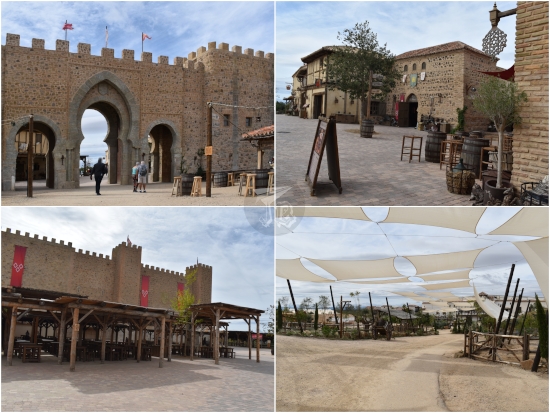
The park is organised to look like a Medieval village – castle included – with both Christian and Moor flavours (using the word “Moor” to refer to the different Muslim groups that populated Al-Andalus in the Middle Ages). the different shows are scattered throughout the park and there are small clusters of shops, restaurants or activities. The distances are long and though there is some protection, it would not protect from rain nor sun / heat. There were “watering points” but no fountains at them? I think that’s where people selling water bottles stand in summer. I probably should have done more research on the whole thing, but I was just tagging along someone who really was curious about it and I was happy to let them take over the organisation. Instead of wandering around a little, they decided to go inside the theatre that hosted the first show almost at the time doors opened to let people without the fast pass in. Thus, we waited for about half an hour until the show started.

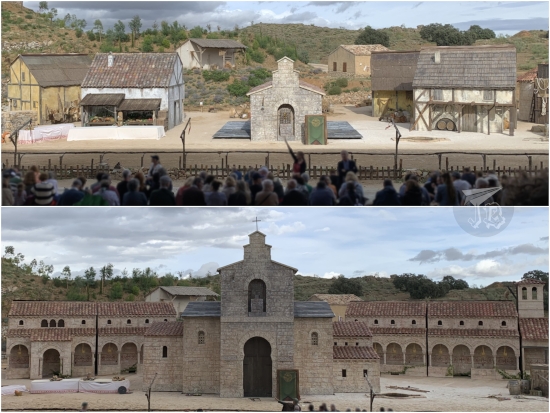
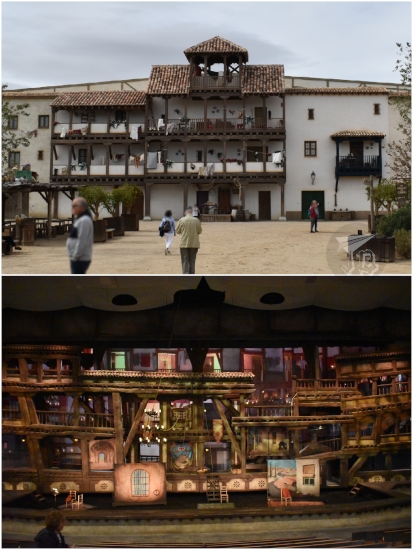
A pluma y espada, “With quill and sword” is an adaptation of one of the French shows, about Musketeers. That makes more sense than the Spanish version – which follows 16th-century playwright Lope de Vega as he tries to foil a conspiracy to kill the king. The stage changes from an open theatre to a prison, to a ship, to the roofs of Toledo as scenes follow one another. After the happy ending, there is a pretty ballet / flamenco dance on the water, along horse riding, which was really cool.

Theatre exterior and stage

We went out and our designated guide got lost, getting us into the complete opposite direction from where he wanted to go. We finally turned around and found our way, though it started raining. We decided to try our luck in the restaurant to see if we could grab lunch early, and we were lucky enough to do so. Actually, we had to be in the restaurant 10 minutes before the reservation, but we had to queue because a bunch of groups before us had issues ordering and understanding how the restaurant worked – never mind that it was easy: flat rate with a choice each from three first courses, three second courses, three desserts, and one drink. Finally, we reached the front of the line and found our table, got our lunch, and sat down.

The food was okay, though value-for-money was a little on the low side (captive audience and all. Though you can take your own food into the park, it might just not a good idea to carry a heavy backpack considering distance and queueing). I had a goat-cheese salad with honey-mustard sauce, a vegetable parmentier – which had pepper instead of the announced mushrooms and upset my stomach for a while – and rice pudding.

In general, the park feels too big, probably with the idea of filling it up as the park generates revenue (though I’m sure that when it’s crowded during summer season it does not feel as empty). My impression that I had was that as long as you were lucky and everything ran smoothly, it would be okay, but anything going wrong could ruin your experience. Just a couple of weeks earlier, the park had to be evacuated due to torrential rains, and people complained about being denied refunds. We would have a little inconvenience later.

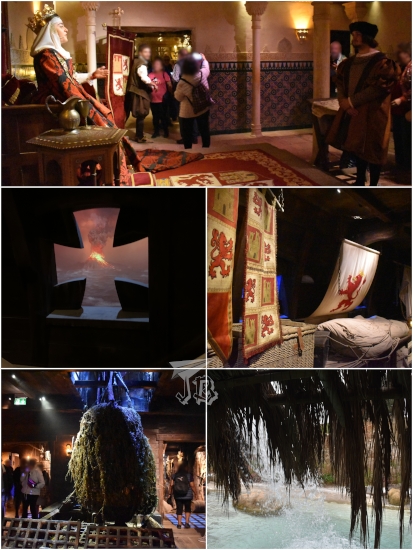
After lunch it had almost cleared, and we headed off to Allende la Mar Océana, “Beyond the Ocean Seas”, which is a walk-through. You “enter” a medieval palace to see Queen Isabel I of Castile (Isabella the Catholic) meeting with Christopher Columbus, as the latter convinces her to fund his expedition to the Indies. Then you get to see different stages of Columbus’ trip with a fictionalised voice diary, with the most important stages: setting sail, navigating near Tenerife, where one of the volcanos had erupted, losing hope in the Sargassum Seas, and finally reaching America – complete with Amerigo Vespucci crying “land ahoy” and walking out to a paradise beach with white sand and palm trees. Some of the areas have live actors interpreting scenes. Not too impressive, and too many people decided to get in the way of my pictures, However, the queen smiled at me.

Puy du Fou España Allende La Mar Océana

We had time to check out the other walk-through De tal palo…. The Spanish expression de tal palo, tal astilla means “like parent like child” or “the apple does not fall far from the tree”, literally “from this stick, that splinter”. The idea is to stop to listen to different generations of the same family which have partaken in key episodes in the history of Spain: the resistance in Numancia against the Romans, Medieval clashes between Christians and Moors, and so on. It was probably the weakest show, but truth be told my companions were not really in the mood for it, and we ended up seeing only two complete tales, and two halves. The rain stopped around this time, too.

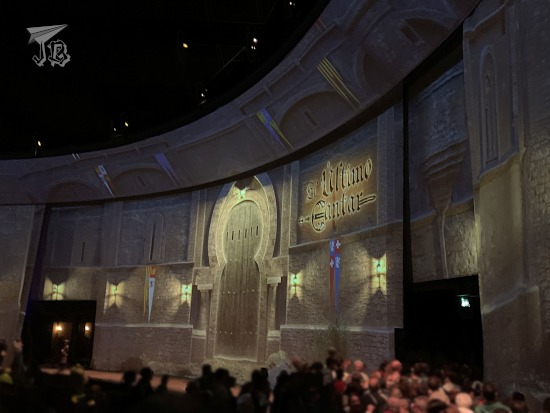
Afterwards, we backtracked to El Último Cantar “The last Song” or “The last Romance” which tells an extremely sanitised story of one of the warlords of Medieval Spain. Rodrigo Díaz de Vivar, El Cid, was a 10th-century mercenary whose life was later composed into a book-long romance. He’s sort of the classical hero of Spain, with an extremely idealised view – imagine, this is the first compulsory book to read in school when you’re around 10. The show was even more romanticised. It was held inside, in a circular stage, and the stands turned to face the different scenes. It had work with horses, and even sort of a just. The problem was that this show finished past 16:15, and we had to be at the exact opposite side of the park before 16:30 (16:25, as they closed the doors). My companions told me to make a run for it, because they knew it was the show I’d be more keen on. I literally ran halfway through the park and made it just before doors closed – the person managing entrance was extremely rude, too.

Puy du Fou España El último cantar stage

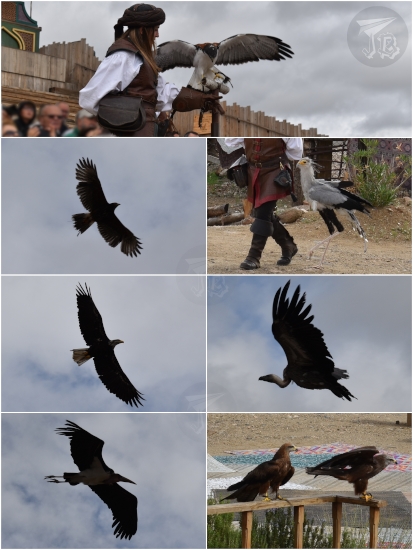
This show was Cetrería de Reyes, “Kings’ falconry”. I did not follow the plot much, to be honest, I was focused on the birds. It is supposed to be an encounter between a Muslim king and a Christian knight during the Middle ages, and they decide to… measure each other up by showing off their birds of prey. There are barn owls, sparrowhawks, caracaras, falcons, eagles and griffin vultures trained to attack on command, fly to specific places, and “hunt” mid-air. More exotic species include a secretary bird (Sagittarius serpentarius) and a marabou stork (Leptoptilos crumenifer) which were cool just for being there. At the end of the show, they let out a lot of the flying birds that flock all over the show. It was really cool.

Puy du Fou España falcorny show

I got to see the whole show since I sprinted. The other two people were lead in later, as most of the fast pass holders did not make it. They were admitted in small groups around one third into the show. It felt like really bad organisation, to sell something that is almost impossible for most of the pass holders. Furthermore, at the end, we were ushered out through different gates, and could not meet up amidst the crowd. We reunited at the final show.

El misterio de Sorbaces, “Mystery in Sorbaces”, tells a fictionalised tale of how the king Recaredo I, the first Visigothic King in Hispania who converted into Roman Christianity in 587. His brother marries a Roman girl in a Christian ceremony, and the festivities include a lot of horse riding acrobatics. Then the goths come to destroy the village, but they are stopped by the “miracle” of a chalice turning a pond into fire. Recaredo converts and the whole stage is turned into a monastery. Besides the horse riding, the background moving and changing, and the fire special effects are the more impressive thing of this show.

Puy du Fou España El Misterio de Sorbaces initial and final stages

We just hung around the park a bit longer for a while after that. The shops were pretty expensive, and though the eagle plushies were adorable, they cost too much money. So were the handwritten scrolls, even though they were fantastic. We grabbed supper in one of the fast food restaurants – a toast and a drink, a bit on the unremarkable side. Finally, we set off towards the outdoor theatre for the night show El Sueño de Toledo, “Toledo Dream”. It was getting cold so people were waiting in the corridors of the theatre, then the staff kicked us out to line, and they created a bit of chaos – despite assigned seating. They wanted guests to be there with an hour’s time, and in the end we had to wait around 50 minutes until the show started, in front of a backdrop of the city of Toledo. We had paid extra for “silver” tickets, and I was very surprised how they were spaces that I found much better, but were not considered “silver”.

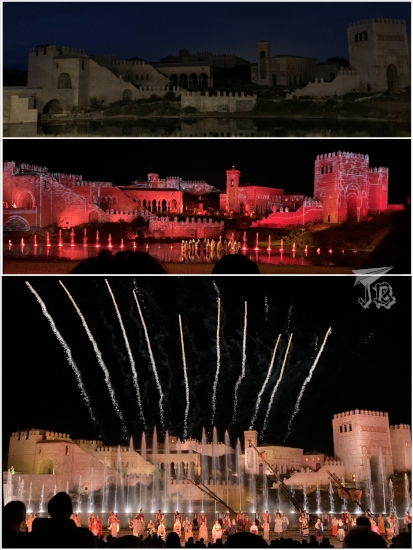
As the sun sets, the story starts with an old water bearer coming in – he represents the memory of Toledo as a metaphor of the history of Spain. He comes and talks to a young lady at the gate of the walled town, and together they reminisce about the key episodes of Spanish and Toledo’s history. The first stage is the Moors leaving town to battle the Christians in Al-Andalus (though Toledo probably existed before as a Roman encampment, it was the Umayyad civilisation who made it great). The Christians attack the town and conquer it, then lose it again. When they once more enter the town, one of the churches has kept a candle burning in front of a walled-off crucifix (famous Toledo legend). The show is presented with lots of light, acrobatics, horse riding, and dancing, even on the shallow water that forms the stage. The sultan’s glass palace comes out of the water, and the cathedral is created with water spurts and light effects.
Time passes. The Catholic monarchs receive Columbus back from America and his ship also emerges from the water. The revolt of the Comuneros comes and goes. Toledo loses its importance and becomes a town of farmers. Then the Napoleonic armies ride in on white horses – the men walk into war and are killed, and the women take over from them. Peace comes, prosperity: the 20th century, the train, the Roaring Twenties – and then the Civil War in the 1930s. The singing girl cries out that her brothers killed each other in battle. In a final dance of hope and healing women dressed with the traditional attire of the different autonomous communities come and dance with her (a bit… dismissive… considering recent events and tensions). Then instead of ending in a happy note, everything goes downhill as the water bearer claims that he is a dream and he’s fading away and the children won’t hear of him and the stories he has to tell, as the whole cast comes to wave goodbye – and it’s about 200 of them, not counting horses, sheep, goats, oxen…

Puy du Fou España night show El Sueño de Toledo

When it was over, we walked back to the parking lot and drove off. It was a bit chaotic and we ended up going in the opposite direction we wanted to – because there was nowhere to turn around until we reached the motorway. We drove to the hotel and crashed in the rooms. If we had been just one floor or two higher, I would have had awesome views of Toledo, but most of it was hidden behind trees.

All in all, the experience was okay – for one time. The price was steep, not even counting petrol and accommodation. I have read online that people go back four or five times, I don’t get the need to do so, even if I know that we missed most of the street shows. We were pretty lucky with the weather, because the park is not prepared for either heat nor heavy rain – and Castille is known for its scorching summers and its temperamental thunderstorms.

The next morning, we had breakfast – hotel was good, but the breakfast there was quite expensive, so I had brought some canned coffee and pastries. We drove back without much traffic, making this a 24-hour-ish adventure. Maybe it would have been cool to try the spa at the hotel, but driving back later would have meant running into the heavy traffic around Madrid at the start of the weekend, and we preferred not to do so.

16th September 2023: Archaeological Site of “Los Casares” (Spain)

I took an almost two-hour drive to the municipality of Riba de Saelices, which involved having to fill up the tank in the middle of nowhere – ouch. It was early in the morning, and once I got off the motorway I saw a bunch of roe deer grazing dawn away. A couple of them got spooked by the noise of the engine and jumped towards the road, and another was uncomfortably close to the asphalt, but I was careful not to run any of them over – of course!

I went past the village and took a turn at an unpaved road, and reached the parking spot of the site, 3.5 km later, around 9:10, which was great for my free 9:30 visit. . My main interest in the archaeological site Conjunto Arqueológico de Los Casares was the cave Cueva de los Casares, which can only be visited by appointment and in small groups. Post Covid recovery plans have made some archaeological sites free until the end of the year, and I wanted to visit before the end of good weather. The cave holds important carvings from the Upper or Median Palaeolithic period. However, the site also comprises the remains of a Muslim village, a defensive tower, and an ancient oven, with the latest findings dating from the 14th century.

I found the parking spot – a clearing at the foothill of the area. The whole place was empty except for a kettle of griffon vultures (Gyps fulvus) circling up above. It was a bit creepy, I’ll be honest, and I joked with myself that maybe the webpage for the archaeological site was just the way the vultures ordered food. From the parking lot I saw a small clearing with tables, and up the hill, a small tower, which I thought was the tower from an old Muslim castle. Since I had some time I decided to climb up and I found the entrance to the cave, with a notice that visits started there. By then it was already 9:30 so I thought maybe my ticket was wrong and the winter timetable had already started so the visit was at 10:00. A bit before 9:40 I saw two cars approaching – yay.

Vultures flying

Archaeological site Los Casares: cave, ruins, and tower

Finally, the guide arrived and she told me that the visitors in the other car had lost their way, so she had had to guide them down the track. We started late as the group also took a while to come up. We stayed at the entrance of the cave for a little as the guide explained about the civilisation that inhabited the area in the Palaeolithic, and a bit about the cave bears that used it as a lair before them.

The cave Cueva de los Casares was inhabited by Neanderthals some 60,000 to 40,000 years ago. The stonework and industry have been classified as the European Mousterian; among objects found inside the cave there are flint points, arrow tips, scrapers, and even pottery. Animal remains, both from predatory events and human consumption have also been recovered. The most important archaeological items found in the cave are the carvings on the walls. Though there are carvings from later periods, some experts think that the cave holds the oldest anthropomorphic carvings in the Iberian peninsula – not carved by Homo sapiens (modern humans) but the previous Homo neandertalensis.

Entrance to the cave Cueva de los Casares

Only the first third of the cave can be visited, and we got to see horses, cattle and the human-like figures. Once you know what you’re looking for, it gets easier to identify the shapes. One characteristic about the human depictions of the period is that humans are represented to have weird heads, though nobody really knows why – possibly animal attributes to represent their qualities. The humanoids are represented alone and in groups, and sometimes they are one above another. There are families, activities – such as diving – and copulation (apparently this is important because the carving in question might be the first ever recorded). It is an interesting experience, though no pictures are allowed inside, there are some on the official page – you don’t get to see half of them anyway. I’m disappointed we were not shown any mammoth carvings either, those are restricted to the expert-only area, but at least I saw something, and it was original.

After the cave, I climbed up the gully to the hilltop and the Berber tower – called Torre atalaya (“Watchtower tower”) – which hangs above the entrance to the cave to look at it. On the way up I also had a good view of the Muslim settlement underneath, Poblado Hispano-musulman. I also looked down the gorge and the valley called Valle de los Milagros, which I may or may not hike in the near future in search for fossils. However, I really did not feel like staying at that point, so I just drove back.

Watchtower Los Casares

Muslim village of Los Casares

Valley Valle de los Milagros from above

9th June 2023: Arribes del Duero & Ciudad Rodrigo {WNW Spain, with a splash of Portugal, June 2023}

We set off from Zamora in order to drive up towards the Portuguese town of Miranda do Douro, though we were not due to reach the town itself. We were heading to the International Biological Station, which organises environmentally-friendly cruises up River Douro.

The drive was to take around one hour, and we stopped at the reservoir Embalse de Ricobayo, which has a dam and a hydroelectric central. We stumbled upon a nice little outlook above the reservoir to see both the dam and the meandering river. It was not long before we noticed the vultures – a kettle of Eurasian griffon vultures (Gyps fulvus), and even some solitary birds that showed off (or were trying to find breakfast, who knows?).

Meander and Dam of Ricobayo

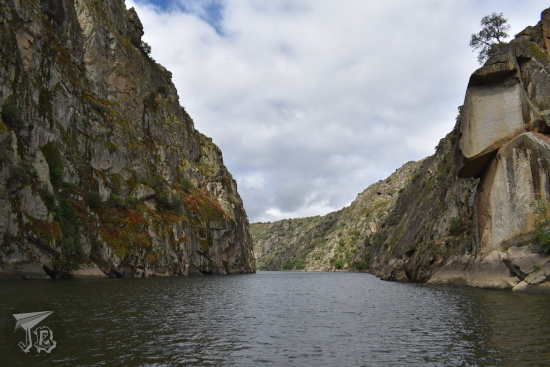
We reached the International Biological Station Estación Biológica Internacional | Estação Biológica Internacional (EBI) in time to swap our 12:00 tickets for 11:00 tickets, and the little boat took off. The cruise runs up the area of River Douro Río Duero called Arribes del Duero, a gorge nor dissimilar to the Galician gorge of River Sil. It was an hour-long course where we got to see some more birds of prey, a few nests, lychens and local flora, but none of the wild otters that are supposed to swim on the river. The guide collected some water to observe under the microscope and show us copepods and water fleas. At the end of the boat ride, we saw the “emotional therapy otters” (Lutra lutra) that the EBI keeps at the entrance. Oh, and had a sip of Porto wine. I was not too keen on the whole thing though, despite the pretty landscapes.

Arribes del Duero

Otter playing in the water

We “boycotted” Miranda do Douro as the ascent road from the river to the town looked horrible and full of curves. Thus, we headed off to Ciudad Rodrigo, in the Spanish region of Salamanca. We had booked at the local Parador Parador de Ciudad Rodrigo, Castillo de Enrique II de Trastámara. It is a really cool building – a castle from the 14th century, commissioned by the King . The main feature of the building is the keep, which you cannot climb (technically you can, but you have to know that you need to ask beforehand), but you can walk around the walls to have a look at the skyline. In front of the Parador stands a pre-Roman sculpture of a verraco – a granite animal, maybe a pig or a boar, dating back from the Vettones (3rd century BCE – 1st century CE).

Parador of Ciudad Rodrigo

There was a mishap with our reservation, so instead of getting a three-person room, we got the doggy-friendly room. I’ve been long-supporting of pet-friendly travel, but this made me rethink my stance. The room did have a pull-out sofa bed, but the layout made it awkward to share it among three people. Furthermore, it smelt and there were a bunch of flies and fruit-flies at the windows. That was a bit of a bummer.

We went to walk around town and found the tourist office in the mansion called Palacio de los Águilas, a 16th century Renaissance building erected by the family in charge of the castle upkeep. It has two patios with arches, and an exhibition area about the role that the town had in the war against Napoleon’s armies in the 19th century.

Palacio de los Aguila

We wandered around the town for a little, but then it started pouring. Thus, we hurried towards the cathedral Catedral de Santa María de Ciudad Rodrigo. The original building dates back from the early 12th century, and it was in construction and reconstruction until the 18th century. The main building was finished in the 14th century, but the tower collapsed after the Lisbon Earthquake in 1755. One of the most important features of the cathedral is the Romanesque portico Pórtico del Perdón, similar to the one in the cathedral in Santiago de Compostela. The gothic cloister is really nice, and it holds frescoes from the Romanesque period.

Cathedral of Ciudad Rodrigo

Cloister in the Cathedral at Ciudad Rodrigo

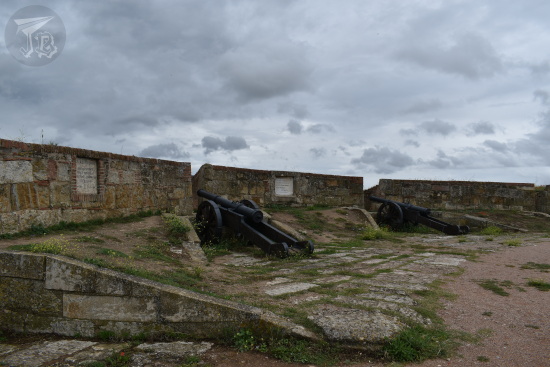
By the time we finished, the storm was over. I climbed up the remains of the town’s defensive walls Adarve Juan Martín Zermeño.

Ciudad Rodrigo: wall

We ditched the chamberpot museum (yes, it is really a thing) and to end the day we walked around the town for a little to find the traditional buildings – the manors Casa de la Marquesa de Cartago and Palacio de los Miranda, the square Plaza del Buen Alcalde, the old army HQ Antiguo Cuartel de Artillería,–the churches Iglesia de Cerralbo and Capilla de la Venerable Orden Tercera, and the main square Plaza Mayor.

Ciudad Rodrigo typical buildings

25th September 2022: Ruta de las Caras (Buendía, Spain)

As I had a visitor, I proposed a hiking route I had heard about as a silly adventure. The area around the reservoir Pantano de Buendía is home to an… interesting hiking route.

In the early 1990s, a couple of friends called Eulogio Reguillo and Jorge Juan Maldonado, a builder and a pottery maker, got the idea to create a sculpture on the rock. That, which in other circumstances could have be just been considered “defiling nature” became a Land art project – the two “artists” have carved gigantic faces into the sandstone, and the route has become a tourist spot – the Route of the Faces or Ruta de las Caras.

The route has been on my radar for a while (but I’d been feeling lazy about the drive) and I thought it would be a fun bizarre thing we could do together. It did not disappoint. You can do the complete route from the nearby village of Buendía, which is around 9 km, or drive up to the beginning of the route at the edge of the reservoir and hike around 2 km. We decided to do this, as the complete route did not offer much else to do / see.

The route features a lot of official and unofficial sculptures, along with graffiti on the rocks. It is circular and runs through a pine forest which makes it suitable for both warm and cold weather – as long as the roads to get to the village are not frozen. Though temperature had plopped down compared to the previous day, it was still mostly over 20 ºC, so nice enough to be out in a sweatshirt.

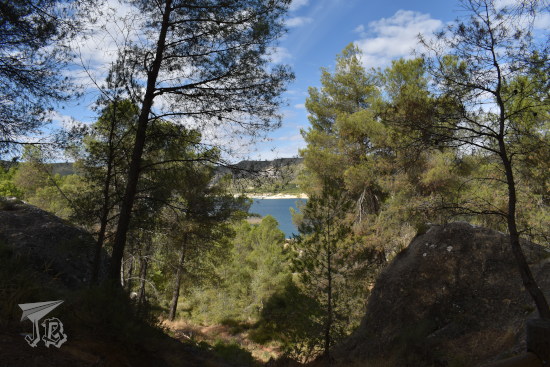
Pine trees with a bit of water in the background - the reservoir

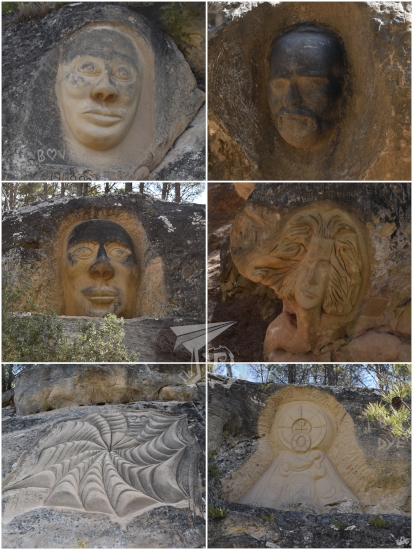
The rock carvings vary in size, style and elaboration. There are some religious motives, such a couple of Christian Virgin Marys, and some figures from Indian (Hindu and Buddhist) inspiration, but the ideas are so all over the place that they probably just let the artists do whatever they felt like. While the first carvings date from the 1990s, the route is still being carved, and we missed one of the faces as it is in a “new” area which is still not signalled. Some of the sculptures we did see include:

  • Moneda de Vida – The Coin of Life
  • Cruz Templaria – Templar Cross
  • Krishna (Hindu deity)
  • Maitreya (future Buddha in Buddhist eschatology)
  • Arjuna (a character in one of the Hindu epics)
  • Espiral del brujo – The Male Witch’s Spiral
  • Chemary (short for the name “José María”, Joseph Mary)
  • Sin nombre – Unnamed (and unfinished)
  • La monja – The nun
  • Chamán – Shamman
  • Beethoven (the composer, yes)
  • Duende de la grieta – Goblin in the Crack
  • Dama del pantano – Lady of the Reservoir
  • Virgen de la flor de Lis – Virgin of the Fleur-de-lis
  • Virgen de las caras – Virgin of the Faces

Different faces and shapes carved in sandstone

Different faces and shapes carved in sandstone

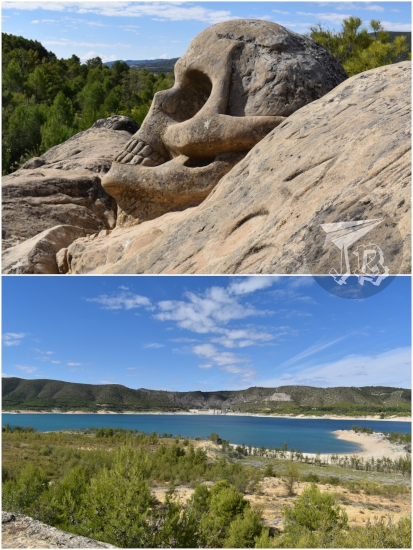
Our favourite was the skull overlooking the reservoir, called De muerte – Deadly – which one could actually climb – noooot absolutely sure it was “legal”, but the rules only said “do not carve or alter the rocks” and the sculptures are coated in a protective liquid. And after all, this started as a random art-vandalism thing.

Large skull carving (top) + the look from the viewpoint - the reservoir is pretty depleted, there is a lot of sand, but also some green trees (bottom)

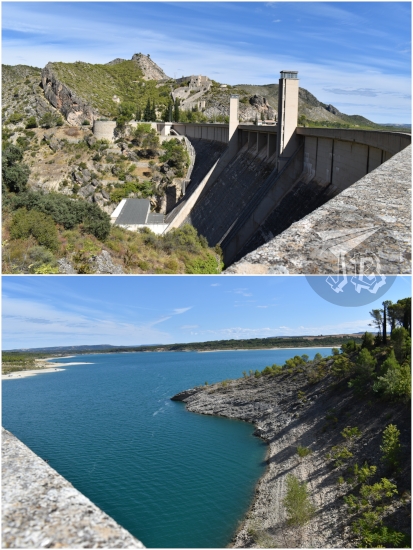
On the way back we stopped at the dam that closes off the Reservoir Presa del Pantano de Buendía, where we played with the echo.

Massive concrete dam, and the water behind it, a rich azure. The water looks cool.

Then, we moved on and once again stopped at the dam in the Entrepeñas reservoir Presa del Pantano de Entrepeñas – and I got the exit wrong again afterwards, exactly like the previous time. We saw a flock of vultures, and as they were circling in search for prey, they were a ‘kettle’.

The silhouette of two vultures circling

To end the day with befor my friend was off to the airport, we headed back and stopped to have lunch at a tiny Mexican place in the shopping centre on our way. And there I discovered that yes, there is such a thing as too much cheese on nachos. In the end, we walked around 4.11 km (6464 steps), so I think we were allowed to deal with the junk-y food.

Nachos + tacos. Everything looks a bit greasy.

21st January 2018: Zoology at the Zoo (Guadalajara, Spain)

This was just a stroll down the Zoológico Municipal de Guadalajara, the local town zoo. I just thought I could look up some of the animals I came across and see if I learn any interesting facts. It was not as easy as I thought!

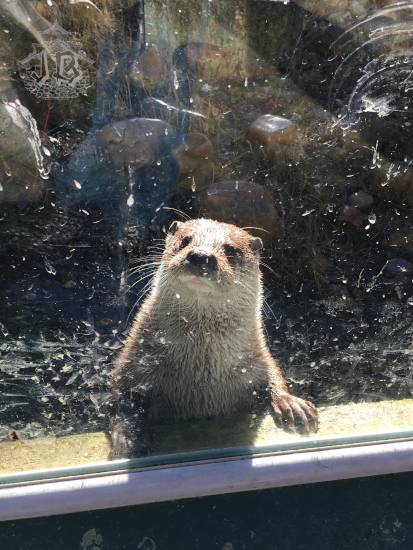
Eurasian otter (Lutra lutra): it is a semiaquatic mamal that is fortunately not threatened. It lives near rivers and coasts in Europe and Asia. It mainly eats fish. They are pretty smart and playful, but they are also very territorial, so they usually live alone. They have webbed claws for swimming and catching fish. Mother otters teach the kits to fish by a game of “catch and release” the fish.

Peafowl (Pavo cristatus ): technically “peacock” is the male (colourful) and “peahen” is the female (brown). The male has long tail feathers that he displays when he wants to impress a female or another male. In India, it was used as ‘guardian animal’ as it screams when tigers approach and it can eat young cobra snakes. Now, that’s pretty cool, and here I thought he was just a pretty tail!

Fallow deer (Dama dama): Fallow deer are native to Europe, and have been introduced to many other places. The bucks (males) are very aggressive and competitive during mating season, and they use their horns to fight. The does (females) do not have horns.

Iberian red deer (Cervus elaphus): The imagery of the red deer has been so powerful in the human psyche that some it can be found in paintings dating 40,000 years back. Normally the males and the young create big family groups. Males create smaller groups that cooperate.

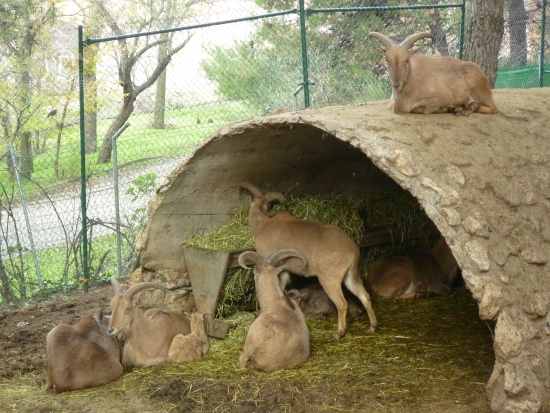
Barbary sheep (Ammotragus lervia). Also called arrui, it is an African mountain goat which lives in arid mountains and canyons and graze grass, bushes and lichens. They were artificially introduced in Southern Europe and became a bit of an invasive species. However, the truth is that they look super chill and zen.

European mouflon (Ovis orientalis musimon): It was originally a mountain creature but it moved to the forest when humans started bothering them. They thrive in rocky areas, though. They tend to live in herds with a lead female.

Wild boar (Sus scrofa): This is the omnivore animal by its own right. It can and will eat anything – from fruit to berries to even baby deer (O_O)!. Many old Indo-European cultures considered the boar a symbol of warrior virtues. In Greek mythology, the hero Herakles had to capture a boar as one of his Labours. In the east, it is considered a symbol of determination and even recklessness.

Iberian wolf (Canis lupus signatus): Unfortunately, the Iberian wolf is a vulnerable species and culling is still legal in Spain (•̀ω•́ ). The Iberian wolf is brown-grey and had a characteristic white area around its mouth. They also have black vertical lines along the front legs, and other dark marks on the leg and the tail. They are predators and prefer hunting big animals, especially deer. Wolves are social creatures, they live and hunt in groups.

Something really cool about wolves in general is that when they run, they place their hind legs on the footprint created by the front paw. Talk about coordination. Wolves have a very bad reputation in Spain, but there have not been confirmed attacks on cattle, much less on people, in recent years. Pictograms of the Iberian wolf have been found in archaeological artefacts from the tribes that lived in Spain before the Romans.

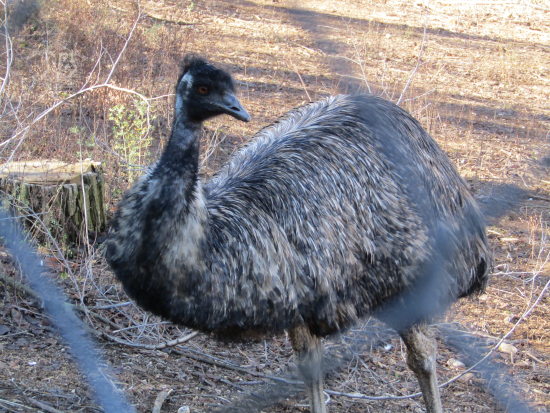
Emu (Dromaius novaehollandiae): Yay for another non-threatened animal. Emu originated in Australia, and are the second-biggest bird in existence after the ostrich. They are flightless, and they eat plants, grasses, insect and arthropods, depending the seasonal availability. Because females can lay several clutches of egg in one season after mating with different males, the male takes care of the incubation, and the chick-rearing. According the mythology of some aboriginal tribes of what now is called New South Wales, the sun had been created by throwing an emu egg into the sky.

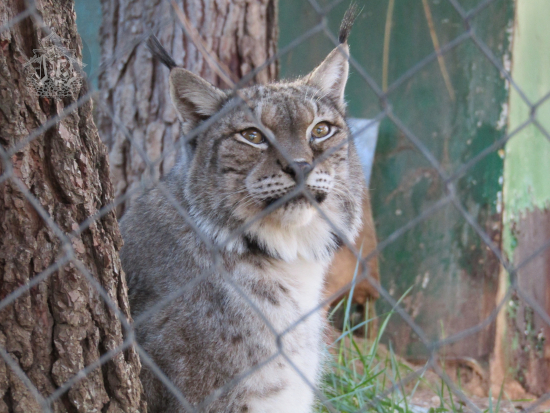
Eurasian lynx (Lynx lynx): Native of Europe and Asia, it is widely distributed, which lowers its conservation concerns. The Eurasian lynx is mainly a nocturnal predator, and tends to live solitarily as an adult, although hunting areas may overlap for several individuals. They can hunt small animals, but they are known to prefer bigger prey, such as roe deer and common deer. Conversely, they may be hunted by wolves.

Red fox (Vulpes vulpes): The red fox is one of the animals with the widest habitat range in the whole world. It can be found almost everywhere in the northern Hemisphere, including many cities in Europe. It is an invasive species in Australia, where it was introduced in the 19th century. In European mythology it’s considered symbol of deceit. In Asian mythology it has two-faces, some of them are messengers of the gods, some are tricksters and dangerous. Arab folklore considers the fox cowardly and weak. Native American mythology considers it a crafty creature that steals the coyote’s food – in all cultures however, it seems to be intellingent and able to trick other animals or people. Interesting.

Griffon vulture (Gyps fulvus): A scavenger bird of prey, it feeds mostly off the carcasses of dead animals. It tends to live in flocks or colonies and makes nests on rocky walls. Even if they have a bad rep, they are very cool animals.

White stork (Ciconia ciconia): Credited with bringing babies from Paris, storks used to be long-distance migrants, which lived in North Africa in winter and returned to Europe in summer to breed. For the last twenty years or so, the storks have stayed, at least in Spain. They are also famous for making nests on belfries and other man-made structures, and because they are considered a good omen they have rarely been chased away – until the weight of the nest has made belltowers collapse!

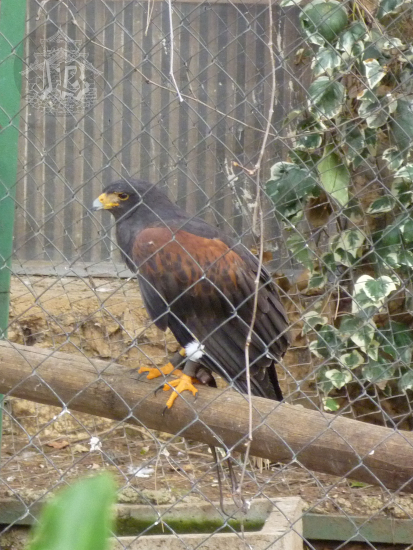
Common kestrel (Falco tinnunculus), I think. Feel free to correct me if I’m wrong. The best thing about the small zoo is the work they carry out recovering injured birds of prey. The birds are nursed back to health and if everything works out they are released into the wild. I really hope this little guy can leave soon! ⋛⋋( ‘◇’)⋌⋚