28th May 2024: Architecture and a niche restaurant (Madrid, Spain)

I was talking to an acquaintance whose child likes superheroes – so does the acquaintance, actually – about Comic Planet. After exchanging experiences, they mentioned that their spouse also enjoyed another thematic restaurant, and I decided that it could be a fun thing to do – and since they don’t take reservations for one, I roped my sibling into tagging along. And of course, since we were braving the horribly-working trains, I felt we should fill the day out. We could not leave early in the morning as I would have liked because I had this stupid bureaucracy appointment I had to get out of the way first.

We arrived in Madrid around 12:30, and our first stop was the Casa de Correos, an iconic building in the middle of the square Puerta del Sol. I did not even know you could just visit that building, nor that they ran exhibitions. It was a cool opportunity to check it out. Furthermore, the exhibition was actually something that I was quite keen on – the architect Antonio Palacios, commemorating the 150th anniversary of his birth. The exhibition, called “the Metro architect” Antonio Palacios, el arquitecto de Metro, is part of the network of museums managed by the underground company Metro. It consists mostly of photographs, a few of them by photographer Luis Lladó, an original model of Palacio’s project to renovate Puerta del Sol, and a modern model of a now-lost station, including lifts. It was a bit underwhelming, but still worth it – and free, so it was good either way.

Exhibition Antonio Palacios El Arquitecto de Metro

Afterwards, we headed out to the restaurant for our 13:30 reservation. The place is called Los Secretos de Lola (Lola’s Secrets ). It used to be just another bistro-grill in a street full of them, but some time after the pandemic, it reinvented itself. The restaurant has slowly turned into a Mecca of childhood mementos – Disney princesses, teddy bears, Harry Potter, Funko Pops… and crazy fun references like a Möet&Chandon spray to clean the tables. A lot of the food comes in a special piece of dishware – most of it Disney, but I can’t tell whether it’s actually licenced or a bunch of knock-offs. It was hilarious anyway. Though I am not much of a Disney person (my sibling is), my favourite film of theirs would be Mulan, and I just about lost it laughing when I checked the menu beforehand – I saw that they served gyoza in a Mushu-like dish, and decided we needed to order that. I was open to negotiation about anything else, really, but not the gyoza. The pasta in the Lady and the Tramp dish was also hysterical, but I could do without.

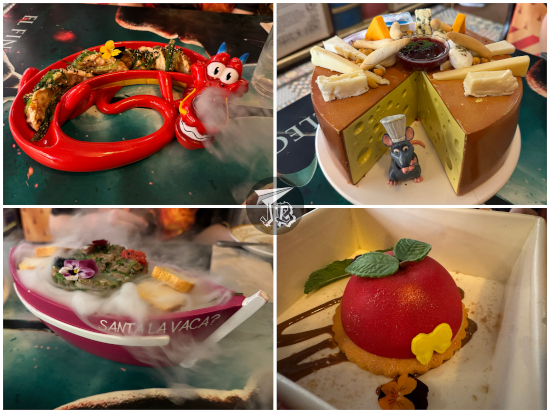
We reached the restaurant on point, and the owner directed us inside. We got a really cute Stitch table, but my sibling was not comfortable on high chairs, so we were accommodated at a Harry Potter one. We shared the non-negotiable teriyaki prawn-and-vegetable gyoza with wakame and bean sprouts, served on a Mushu-plate: Gyozas de gambas y vegetables al teriyaki, a plate of cheese Tabla de quesos variados (Blue cheese, Havarti, Mimolette, Emmental, Basilio, butter and breadsticks, on a Ratatouille’s Remy plate, which I had also found adorable) and a bluefin tuna tartar Tartar De Atún Rojo (on a little boat – I asked for no mango, and it was honoured; this was probably the weakest dish though). Finally, I tricked my sibling into a dessert called “Snowhite magic apple” Manzana Encantada Blanca Nieves: red chocolate capsule with white Kinder and a heart of caramel sauce, which came in an adorable “present box”.
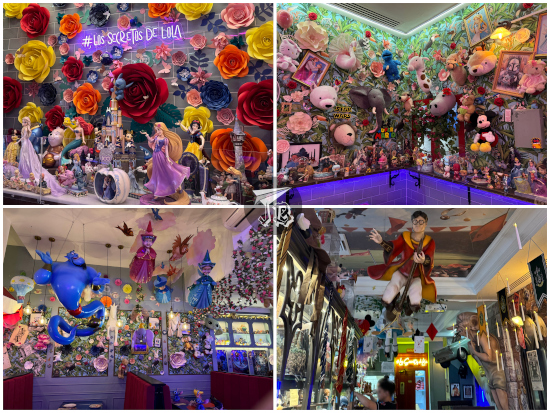
Decoration: Los Secretos de Lola

Food Los Secretos de Lola

The food was good, and I really like themed restaurants, I guess, even if they are not “my” theme. We did not stay for the two hours, I think we were on our way after an hour and a half – and when we asked for the check, it came in a Frozen music box. Then, we left towards Palacio de Cibeles, the old “communication palace” of Madrid, designed by Antonio Palacios and Joaquín Otamendi, and erected between 1907 and 1919. It is considered one of the first and most important Modernist buildings in Spain, constructed in biocalcarenite, with three stained-glass skylights, catwalks on the third floor, and a magnificent lookout on the rooftop. Part of the building is being used by the town hall, the other by the public entity CentroCentro, which runs cultural activities in the open spaces – mostly conferences and exhibitions.

Palacio de Cibeles

We arrived a bit before 16:00. Since we had a ticket for one of the exhibitions at 17:30, we checked whether we could find a ticket for the rooftop. We found available slots at 16:30, which was great. Before the viewpoint access, we had time to wander around. Most of the free exhibitions were of modern art, and not that interesting, and I was more focused on the building itself. There is one dedicated to the World Heritage site Paisaje de la Luz, explaining why the area deserves its UNESCO place.

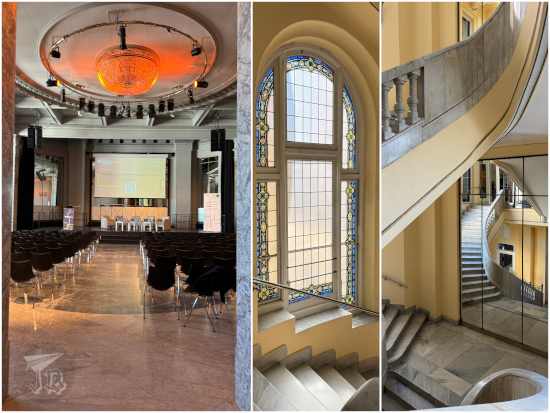
We found the staircase to one of the towers and we used it to move it through the different floors. It is a spiral staircase around the lift, with Palacios’ typical green tiles similar to the ones he used at Maudes hospital and Chamberí station. The catwalks were paved with glass tiles, and it was quite impressive above all. I loved the building, but after all, Palacios is one of my favourite architects, so it was to be expected.
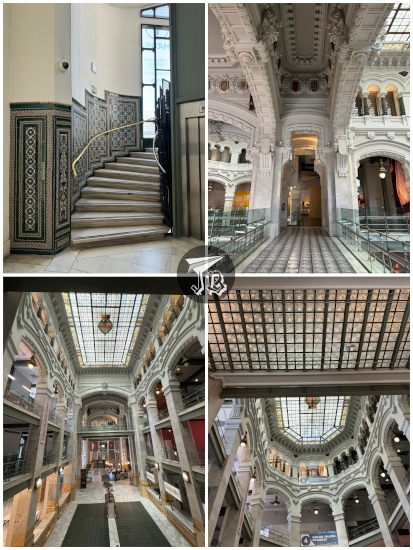
Inside Palacio de Cibeles

Then, we went up to the rooftop, where we could have a view of all of Madrid around us, most interestingly one of the main arteries of the city – Gran Vía. The weather was great, maybe a bit too bright. The turns were 30 minutes, but we were done in about half the time, after taking two walks around the middle tower.

Lookout on the rooftop of Palacio Cibeles

We went down and sat for a little before we headed down to the basement to see “Notre-Dame of Paris: The Augmented Exhibition” Notre-Dame de Paris: l’Exposition Augmentée. It was only 3€, so I was not expecting much, but it actually blew my mind.

The experience was created by the company Histovery, which specialises in “virtual exhibitions” through an interactive tablet called “HistoPad”. The Public Entity in Charge of the Conservation and Restoration of Notre-Dame de Paris cooperates with the event, and the beauty company l’Oreal is a sponsor. The exhibition (which is simultaneously running in several parts of the world) follows the history of the Parisian cathedral Notre-Dame de Paris – it starts with the 2019 fire, which is a bit heart-wrenching, and then it covers a few key moments in the history of the cathedral, using a mixture of written information, videographs and a “treasure hunt” where you have to find pieces of a puzzle hidden within the virtual information. This is done using the tablet to scan 21 “time portals” that take you to a particular point in history.

Around 1160. The Dream of a Builder. At that time, Bishop Maurice de Sully came up with the idea to build a new, better, cathedral in Paris. The previous one was a smaller, Romanesque building, but the goal was a larger, architecturally impressive building. In this room (the second, actually, but the first chronologically), you find out about the “treasure hunt” – you need to find a number of hidden “light spots” to build a “stained glass window”.

Around 1180. The Gothic choir. This makes a small overview of the kinds of workers that helped in the construction, the kinds of stones, building materials – quarries, forests. I was extremely disappointed at this point when I came across a dog in the virtual quarry, but the program did not let you pet it.

1241. The Holy Relics: Louis IX, the future Saint Louis, bought the Crown of Thrones in Jerusalem and brought it to Paris. There was a great procession into Notre-Dame, where the relics were to be kept. Here there’s a spectacular recreation of the gates with the original polychrome sculptures and decoration.

1645. The Royal Promise: Widowed Queen of France explained to her son, future Louis XIV, that he was to renovate the choir of the cathedral and build a new altar, dedicated to the virgin Mary. This was the original splendour of Notre-Dame, before the French revolution broke out – the church was one of the targets of the revolutionaries, and a lot of the art was damaged and / or destroyed.

1804. The Imperial Coronation. After the French Revolution, Napoleon crowned himself “Emperor”, but a very “equal and revolutionary” Emperor. He held a ceremony for himself in Notre-Dame, with the presence of the Pope and everyone who was anyone in the totally equal new society.

1857. The Spire. Enter Viollet-Le-Duc, a major architect and restorer in France’s 19th century, whose theories influenced countless others. He revalorised gothic style in the country, managing to turn it into a “national style”. The man had the goal to restore and create buildings in “the gothic style that would have been if the Medieval workers had had the technology he had access to”. Historians have not been kind to him, accusing him of “inventing” stuff instead of “restoring” but kudos to him, he managed to make a lot of buildings survive to our time. In Notre-Dame, he is responsible for putting back a lot of the sculptures that were destroyed during the French Revolution. He also built the spire that famously collapsed in the 2019 fire.

2019-2021 (first and last rooms). A description of the restoration works that have been happening in and outside the cathedral since the fire, with special attention to the Paris firefighters who worked the incident. There is a very interesting part about safely removing debris and the original scaffolding, and the fact that there was a lot of lead in the cathedral that the workers had to be safe around. They also homage the “vertical workers” who had to remove collapsed pieces from the ground… hanging from ropes.
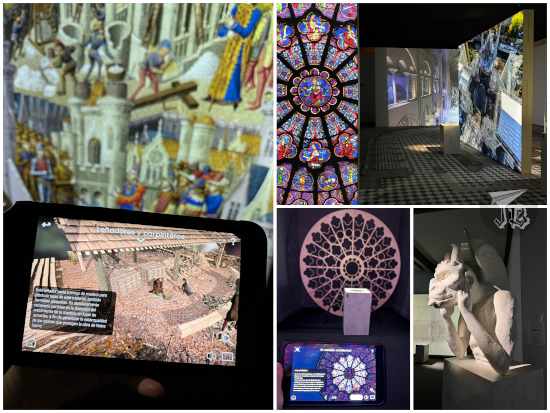
Notre-Dame the Augmented Exhibition

We completed the stained-glass window and signed up to get a diploma. The fun part is that most of the exhibition was not really… even physical. There were a few posters, a reproduction of one of the chimaeras, some small models… Nevertheless, it was extremely interesting – possibly the best “virtual exhibition” I’ve seen to date. The length of the experience is said to be 60-90 minutes… we stayed from 17:30 to 19:45, much longer than I had anticipated! Thus, we had to forfeit the last plan of the day to go back to the train system – which of course was experimenting delays. It took forever to get home. Because what else is new?

Time-traveller diploma after completing the treasure hunt in Notre-Dame the Augmented Exhibition

20th March 2024: Mundo Pixar (Madrid, Spain)

Due to some kind of weird… extended family thing, we ended up with some vouchers for Pixar World Spain Mundo Pixar, happening in IFEMA in Madrid. It would have been a pity to waste all of the tickets, so there we went, on a Wednesday morning, to at least redeem a couple of them. This immersive exhibit comprises several rooms with life-sized scenarios and characters based on Pixar films.

Mundo Pixar Madrid - outside

Pixar is an American animation studio which started off as part of the Lucasfilm computer division back in 1979. For over a decade, the group collaborated with graphic design and CGIas a third-party, until it was properly founded as an independent company in 1986. Pixar collaborated with Disney creating computer animations, and kept developing the technology, until it was finally able to pitch its first feature film to Disney – Toy Story, which was also the first-ever completely computer-animated film. Released for the 1995 Christmas season, it was a world-wide hit. Pixar became part of Disney in 2006.

The studio’s films have received 23 Academy Awards, eleven times for Best Animated Feature (a category added in 2001). One of the characteristics of Pixar films is their layering – though they are marketed as children’s entertainment, they tend to have a deeper, more adult-oriented subtext that… kids don’t even grasp. Something weird is that despite its successes, Pixar always seems on the brink of bankruptcy…

We had tickets for 11:00, and thought we had plenty of time until we got caught in a huge traffic jam due to a fair in another part of IFEMA. We had over 45 minutes of leeway, and ended up taking half an hour just to be able to get into the parking lot from the roundabout 650 metres away. That was wild.

We finally got into the queue around 10:50, and it took a while to get in. Mundo Pixar is organised in a U-shaped circuit, so that you can get round to the shop before or after seeing the exhibit. For a weekday, it was packed – not only by families, a bunch of random friend groups and tourists, too. Interesting.

We accessed through a tunnel to the first space, which is a bit of a self-promotion video mixed with the rules of the game – mostly, the one that people seemed unable to follow: do not touch. The immersive experience takes you to recreated scenarios from several films by the studio, to the slightest detail. The rooms are supposed to have different smells, but we only perceived a few. And of course, people kept touching.

Rooms 1 & 2: Up. This films tells the story of an old widower who goes on a last “adventure” to Paradise Falls, where his late wife would have loved to live. To do this he… floats his house away with thousands of balloons. He meets kid Russel and dog Dug. The rooms include a view of the whole house, and one of the interior. The living room is a perfect reconstruction of the one in the film, down to the pictures and the armchairs where Ellie and Carl sit, and the device Carl builds to steer the house while it flies.

Room 3: Monsters Inc.. This is a take on a widespread childhood obsession, the monster in the closet. In another dimension, energy is powered by the screams of frightened children from our world – thus, monsters sneak into kids’ rooms using magic doors to their wardrobes. Sully and Mike are the top-scary team until they run into a toddler who turns their lives upside down. The room has different bits from the film, including the scream factory doors and the two main characters waving awkwardly, recreating a scene where Mike and Sully are made to pose for a picture – I kinda expected them to move.

Pixar World Spain: Entrance, Up, Monster Inc.

Room 4: Toy Story. A bunch of toys which / who become sentient when they are not being played with get a new companion, who does not know he’s actually a toy. Enter a house-move, a bully neighbour, and a nasty dog. Chaos (and a trio of sequels) ensues. The fun part of this room is that it’s built so you see the room from one of the toys’ perspective, everything is high up, and the toys themselves are scaled.

Room 5: Elemental. This is a coming-of-age romantic comedy which focuses on overcoming differences. You walk into a train car with the two characters – a water element and a fire element, awkwardly sitting next to each other.

Room 6: Inside Out. In this coming-of-age comedy-drama, every person (and cat) has five basic feelings: Joy, Sadness, Anger, Disgust and Fear. They control a person’s life using a big console, and they collect “core memories” to help with their job. A young girl’s Joy and Sadness must learn to work together to overcome moving to another city. The room shows a perfect life-size reproduction of Sadness and Joy at the console and all the core memories.

Room 7: Ratatouille. This films follows the adventures and misadventures of the rat Remy, struggling to become a chef – to do this he hides in the hat of a young man and “guides” his cooking. The title is a pun between the word rat and a French recipe. The room is a huge kitchen, and you see Remy cooking inside a huge chef hat.

Pixar World Spain: Toy Story, Elemental, Inside Out, Ratatouille

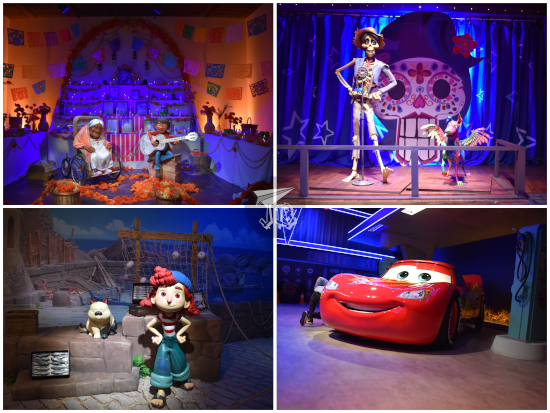
Room 8 & 9: Coco. Set around Mexico’s Day of the Dead (Día de los Muertos), this film sees a young boy, Miguel, explore his family roots and his love of music. The first room shows Miguel and his grandmother, and the second area holds skeleton Héctor, a dead musician who accompanies Miguel in his adventures.

Room 10: Luca. This film tells the story of two sea-monster children (Luca and Alberto) and a human child (Giulia), and deals with friendship and acceptance in the Italian Riviera in 1959. The room hosts the size-appropriate children, with Giulia – and her cat – getting the most prominent set.

Room 11: Cars. The film is set in a world populated only by anthropomorphic vehicles. Arrogant young racing car Lightning McQueen learns about humility, sportsmanship and friendship. There was a nice staff member taking pictures of visitors in this room, with the film’s main character.

Pixar World Spain: Coco, Luca and Cars

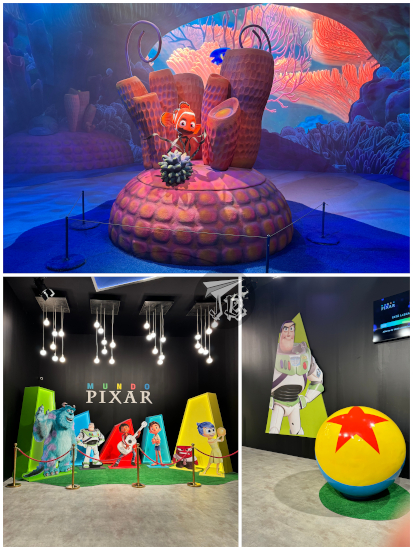
Room 12: Finding Nemo. Nemo is a little clownfish, the only survivor from a barracuda attack in which his overprotective father, Marlin, lost his wife and all their other fertilised eggs. When Nemo gets “fished”, Marlin embarks on a crazy journey to find him, meeting amnesic surgeon fish Dory, wannabe-vegetarian shark Bruce, and surfer turtle Crush. To be honest, finding Nemo in this room was easy. He was in the middle of it, surrounded by marine mist, with jellyfish and the rest of the characters on a screen behind him. I was severely disappointed there was no Bruce whatsoever in the room.

This was the last room; afterwards there was the shop, and a small photocall with a giant Luxo (a yellow bouncing ball with a blue band and a red star), back at the beginning. I am not sure this area actually counted as a room, because we were told there were thirteen rooms? No clue.

Pixar World Spain: Finding Nemo, photocall, Pixar ball

Fortunately, when we left, the traffic jam had dissipated. Unfortunately, I had to go work in the evening, which did not feel great. I obviously enjoyed the rooms dedicated of films I had watched (and liked) more than the others – I personally find the first ten minutes of Up heart-wrenching, but Finding Nemo was my favourite (both as a film and a room). I still uphold my protests about shark discrimination though!

12th March 2024: A free afternoon – the bullring & Pompeii Exhibition (Madrid, Spain)

Due to life being weird sometimes, I was summoned to a work-related event in Madrid on the morning of the 12th. The event took place in one of the buildings erected by Antonio Palacios, the cultural centre Círculo de Bellas Artes (CBA). The centre hires out its facilities for conventions, gatherings and theatre plays. In our case, we were there for the presentation of a new product in the Column Hall Sala de Columnas on the fourth floor.

Interior of the Círculo de Bellas Artes

After all the necessary chatting, networking, and a disappointing (and rather questionable) choice of canapés, the event was over at 14:30. I ditched my companion then and headed out to Plaza de Toros de Las Ventas, the local bullring. I am not a bullfighting fan – my personal view is that it is not an art, nor a “fair fight” as it is presented, and I hope we humans evolve to phase it out. And while I would not attend an event, I was curious to get to know the building and its architecture.

Las Ventas bullring, outside

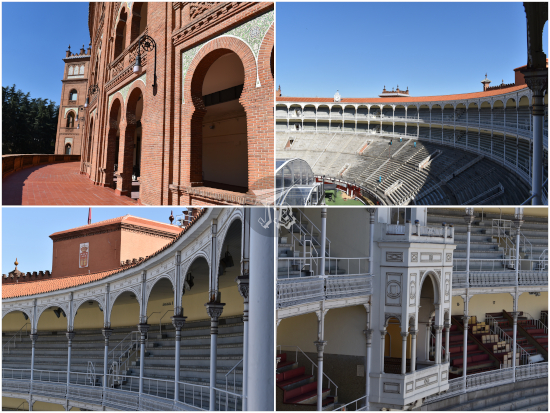
The ring is the largest of its kind in Spain. It was designed by José Espelius in the neo-mudéjar style and erected between 1919 and 1931. The central ring is just over 60 m in diameter, with a metallic structure holding the stands around it, and a façade of reddish brick and porcelain tiles. Aside from bullfighting, it is also used for concerts and other events.

I took a self-guided tour with an audio-guide Las Ventas Tour Experience, because I actually know nothing about bullfighting – I learnt that it actually has “rules”, I thought it was just taunting and hurting the bull. The passes have names, and there is a whole colour code of handkerchiefs – I had no idea. The tour takes you past the “Great Gate” through which bullfighters come out through when they are deemed to have done a great job. Then you climb up to the first floor balconies, and you can even go up to the highest point to have a panoramic view. You see the outside of the Royal Box, the gate through which the dead bull is brought out through, and then you walk down to the ring itself. There you can stand in the areas where the bullfighters and their helpers wait, and peer towards the stables, the closed door to the infirmity and finally the chapel. There are two VR experiences too that I did not care for, so instead of the expected 75 minutes, I took a bit less than an hour to do the whole tour.

Inside the bullring of LasVentas

Afterwards, I was curious to check out an immersive exhibition regarding Pompeii called “the last days of Pompeii” Los Últimos Días de Pompeya in the cultural hub Matadero Madrid. It was designed by Madrid Artes Digitales, the same company which organised the Tutankhamun one. At first I was not overly interested in it, but when I went to Recópolis the guide mentioned an actual VR tour, and I became curious (read: it was totally FOMO in the end).

The exhibit has a couple of replicas of archaeological artefacts, but it’s mostly a digital display. The first time I went to the Madrid Artes Digitales building I thought they had rented the place, but now I saw that they might actually own the warehouse and design the exhibits into it. There is a huge room where they project a sort-of film on the walls, a small circuit that you walk doing different activities, and a sitting VR ward, where you get to see a fictional world in 3D.

Of course, there were replicas of the Pompeii casts, and a copy of the novel The Last Days of Pompeii, written by Edward Bulwer-Lytton, which has inspired the exhibit. The novel, in turn, was sparkled by the painting The Last Day of Pompeii. The projection recreated a few passages from the book, then Mount Vesuvius erupted and you were taken “into” the crater, seeing lava bubbling and lightning bolts. Then one was back in the city as the pyroclastic cloud rolled into the city, along with volcanic bombs falling into buildings.

Last Days of Pompeii exhibition

The circuit was a VR walk-through that took you though a house, both in ruins and reconstructed, as a woman led you through it. Walking with the VR glasses was a new experience, I have to admit, but going through doors was strange. Unfortunately, my set had a finger print in one of the lenses which spoiled the view a little. In the final ward, there was a representation of a circus fight with gladiators and tigers that turned into a naumachia (ship games in the amphitheatre) while Mount Vesuvius erupted in the background. All in all, it was a bit weird, and maybe… a tad on the morbid side, if you ask me.

Afterwards I just headed off, and I was lucky to make it into the train, it was so full! The car emptied out enough to sit down after a few stops, but just wow.

3rd December 2023: Sushi, I“k”ons, Goddesses and Light Bugs (Madrid, Spain)

I had evening plans in Madrid with my sibling, and they wanted to have lunch in town and make a day trip out of it. Since I had previously ascertained that the Running Sushi franchise was all right and fun, I proposed to check out another of the locations. They agreed and I had booked a 13:00 slot at Running Sushi in Akihabara, near Plaza de España. It was even more fun than the one I had checked out before, with Godzilla, Taito Station signs, Pacman, neon, anime graffiti in the toilets, and Japanese music playing. From the outside, the restaurant is shaped like a train carriage, and the sliding doors relay the same message they do when Tokyo JR stops at the station at Akihabara. In general, Running Sushi Akihabara offered the same food as the In Market restaurant, but this time there was tuna. I don’t know if it is because of the location, or because it was a weekend – and thus more expensive. Reservation was a great idea, because though I had no problem booking for 13:00, there were plenty other people with and without bookings, and when 14:00 – standard Spain lunch time – approached, the place became almost crowded. We stayed for the whole hour since we had a late start due to missing chopsticks and napkins, and I own up that the last takoyaki might have been excessive. This time, I remembered to ask for the membership card – you get a reward if you visit all the restaurants in the holding, something I’m considering to aim for.

Running Sushi Akihabara

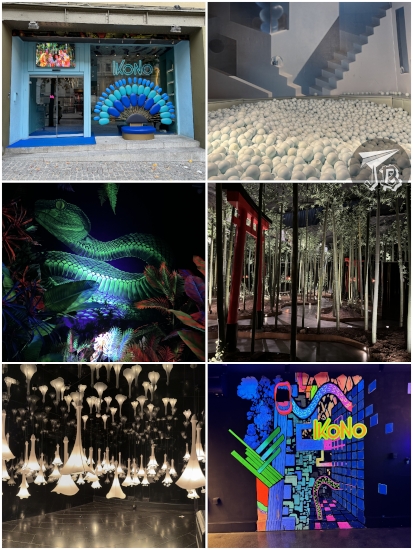
After lunch, we had a 14:50 ticket for a place called IKONO. I have to say I’m warming up more and more to these Instagrammable places – I’ve recently read one of them described as a “fun house” and I think it’s a more than accurate idea. I like them because they’re silly places for, quite literally, kicks and giggles. According to themselves, IKONO was born as a leisure option alternative to “restaurants, shopping and clubbing” for young people – I disagree with the “young people” take though. Out of the permanent establishments of its kind in Madrid, it is probably my favourite.

The IKONO mood kicks off even before you go in, with a peacock-like armchair just outside the main entrance. Spread over three floors, the venue has 15 different experiences / things to do. Once your tickets have been checked, the first “door” you go through is a thick wall of foil fringe curtains in a gradient of shiny colours,which felt like going through the Stargate! (I know, I know, niche comment). All through the place, there is bouncy music playing.

Once you have crossed the curtain – I somehow ended up in a weird inner space instead of where I was supposed to reach, but that’s just me – the first room is a ball pit, and a deep one at that. It was quite hard to move there. There are quite fewer rules than in other ball pits too – you can jump in, and throw balls up. Once you manage to drag yourself out of the ball pit, you get to go upstairs, what I’ve mentally named the “paper floor”. It has three rooms – the landing one has a pretty origami tree and some wings for you to take pictures with. There is a “psychedelic” ward with black-and-white décor and a blue-and-pink confetti cannon. The third one is a dark “jungle scenery” with glow-in-the dark colourings and paintings that I really loved – the frogs were adorable, and the serpent god quite impressive.

Back on the ground floor, the following room is a Japanese-style bamboo forest with wooden lanterns and a torii [鳥居], the traditional entryway to a Shinto shrine. As you may imagine, this was my favourite area. The room walls are covered in mirror, so it looks like a long path, that ends in the following room, a “bamboo forest” which a felt a little underwhelming in comparison. According to the website, the idea of IKONO cemented while visiting the Japanese Arashiyama bamboo grove, and these two rooms are a homage to that place.

Then we walked downstairs, to the “lights area”, with a few more rooms, including some hanging bellflower-shaped lamps, and another with lights made with marbles that went on and off to the music, some modern art inspired by The Last Supper, and a cube of infinite light dots. Back upstairs, there were a couple more panels for photo-ops, and a small souvenir shop. The staff offered a small present if we left a Google review, so we did. Oh, and they had a cloak option for coats, which was amazing.

IKONO Madrid highlights

We walked outside towards our following spot Caixa Forum Madrid, where there are two exhibitions at the moment. The one I really wanted to see was Veneradas y Temidas: el poder femenino en el arte y las creencias, “Worshipped and Feared: Feminine power in art and beliefs”, an exhibit on the female presence in the religion and spirituality of different cultures. The other one was Horizonte y Límite: Visiones del Paisaje. Colección de Arte contemporáneo, “Horizon and Limits: Views / visions of Landscape. Collection of Contemporary Art”, which I had not read about beforehand – because I am biased.

Veneradas y Temidas: el poder femenino en el arte y las creencias is a British Museum’s touring exhibition, Feminine power: the divine to the demonic (which I feel is a more appropriate name, but that’s just me and my problem with translations). It is a collection of artefacts (most of them not exhibited anywhere else) originating from different cultures, trying to convey the “female spiritual power”, though it also has snippets of erotism and homosexuality. One of the most important and impressive pieces include a copy of the Campo Iemini Venus, a “modest Venus”, halfway though covering herself – a copy of the Capitoline Venus, it was found in an Italian Roman villa in 1792. Aphrodite / Venus was the Greek / Roman goddess of Goddess of beauty, love, lust, passion, pleasure, and sexuality. Other Ancient Greece and Rome pieces include Hecate / Trivia (goddess of boundaries, crossroads, ghosts, magic, necromancy, transitions, and the New Moon), Athena / Minerva (Goddess of handicraft, warfare, and wisdom) or Eros / Cupid (God of desire, love, lust, and sex). There are several pieces of pottery, both red and black, depicting different scenes of various… degrees of erotism.

Halfway between Athena and Aphrodite, the goddess Ishtar, Queen of Heaven, and goddess of love and sexuality was worshipped in Mesopotamia (modern Iraq). Though according to the mythology, she had many lovers and was responsible for creation, she was not considered a “mother goddess”, and one of her advocations is the goddess of war.

The Divine to the Demonic: Greece and Mesopotamia

The first thing we saw from Asia were three masks. There was Taraka [Tāṭakā], a Hindu spirit, whose rage upon the murder of her husband turned her turned into a man-eating ogre (ogress?). From Bali, there was Rangda, the demon queen, antagonist of the forces of good, leader of an army of evil witches, and child-eater. From Japan there was a hannya [般若], the jealous vengeful spirit of a scorned woman.

Also from Hinduism, there is a creepily fantastic (or fantastically creepy?) devotional icon (murti [मूर्ति]) of Kali [काली], goddess of death, doomsday and time. The sculpture is the advocation Dakshina Kali – depicted with four arms, a scimitar, a collar made of heads of her slain enemies, and Shiva at her feet. The murti represents a passage in which Kali goes on a rampage after fighting demons, having lost control, and her consort Shiva throws himself at her feet hoping to calm her down.

Theatre masks and Indian Goddess Kali

Among the Egyptian representations, there was Sekhmet, the warrior goddess, represented as a lioness, who was also the goddess of medicine and one of the sun deities. There were also Bastet, who started off similar to Sekhmet but became more of a protector figure, represented as a cat. There were also references to the cosmic goddess Nut, who symbolises the sky, stars, astronomy, the universe, and mothers.

From China, there was a gorgeous Guanyin [觀音] as the Goddess of Compassion, a very different style from the one I had seen in either the British Museum and the Victoria and Albert Museum. There was also a Shiva porcelain which was astonishing.

Egyptian Sekhmet and Chinese Guaiying

From Meso- and South America, there was a beautiful sandstone of Toci, the “mother of the gods” who is depicted with bare breasts and her hands on her belly. There was also a statue of a Mexican cihuateotl. The cihuateteo were spirits of women who died in childbirth, and received the same honours as the warriors who died in combat. There were other references, such as the Hawai’ian goddess of the sea Na-maka-o-Kaha’i, talismans of sex and love (because the Victorians were a bunch of perverts), references to the Mesopotamian demon Lamashtu, Egyptian protection sculptures, funerary steles… and some modern art kind of thing, like a lady sitting down with a ball python slithering on her because… yeah? I really enjoyed the exhibition, though I have to admit I ignored the interactive art a little, to focus on the mythological aspect.

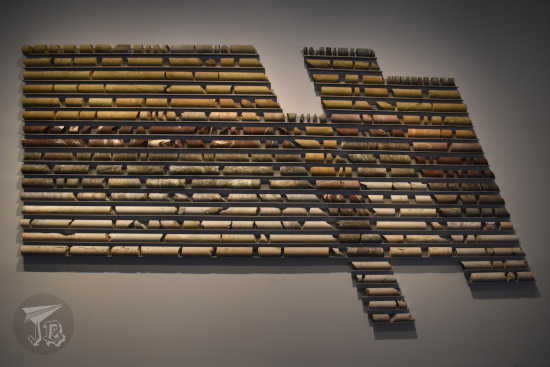
Afterwards, we visited the contemporary art exhibition Horizonte y Límite, which focuses on different… I’m not sure because I know squat about contemporary art (see above comment about the lady and the snake). There were paintings, imaginary photographs, a piece made from different geological cores representing a fault, a panel with postcards, a glass box filled with smoke to represent climate change… Pleasant, but not really my thing. Except the geology cores, they were cool.

Art piece fromthe exhibition Horizonte y Límite: Visiones del Paisaje

After seeing both exhibitions, we headed off towards our next stop. We took a break and sat down for a while to have a great banana-and-strawberry smoothie of all things. Then we walked towards the park Parque Enrique Tierno Galván, where we had tickets for the light show Naturaleza Encendida: Insectos “Lit-up nature: Insects”. The Naturaleza Encendida show used to take place in the Botanical Garden, which is smaller. This year, it has been relocated this year for “reasons unknown” and it feels a bit too long and almost unconnected. All that without taking into account that the idea of a larger-than-me butterfly and giant spiders is a bit creepy to be honest. We had premium tickets which gave us access to the enclosure at any time between 18:00 and 19:00 without queueing, and decided to arrive there around 18:30 as it would already be dark. We had also ordered a cute “magic lantern” – a bunch of sparkling LED filaments – for the giggles.

After an entrance of archways and carpets of light, there is a swarm of dragonflies as a centrepiece. You walk around it, and enter the zig-zagging path. Along the route, you encounter butterflies of different kinds, a line of hard-working ants, bees, grasshoppers, more bees, mosquitoes and flies, more bees, eggs, more grasshoppers, disco balls, larvae (I think? If I had to hazard a guess I’d call them anemones), beetles, ladybugs, spiders and a row of differently-coloured Christmas trees. There were “light corridors” in-between, hive-like hexagons projected onto the trees, and lots of artificial smoke. There are supposed to be some praying mantises somewhere but… I did not see those?

Naturaleza Encendida Insectos figures

All in all, Naturaleza Encendida: Insectos felt too spread out, as if trying to justify the bigger space. Though we had a premium ticket, there was no special premium-only area, and the only benefit was having an hour to go in, without having to queue – which is already enough in my books. I think you really have to be into the topic – we came across a lady who was very freaked out and mostly running so she could get away from the bugs. I have been to three editions of Naturaleza Encendida, and the only one I really enjoyed was the sea-creatures one, Explorium. I thought that the bad weather last year had damped the experience – literally – but I’m going to stop holding my hopes high.

Finally, we headed back to the train station. My morning train had had a five-minute delay, which by the early evening had progressed to the upper 40s. Joy. I’m hoping that when free ticketing is over, service will improve, but I’m not holding my hopes too high…

5th August 2023: Prints, Sharks, Mice and Neon (Madrid, Spain)

I won’t say that the Southern Italy trip was a bad one, but due to the planning blunder, the heatwave and the general not-so-relaxing atmosphere, I kind of needed a low-stakes day out. And what can be lower-stakes than a silly giant shark film? I got myself a ticket to watch Meg 2: The Trench at noon – I’ve found out that my non-dubbed cinema has started doing matinée shows at a reduced price – and planned my day in Madrid around that.

I took the train and arrived in Madrid on time for my ideal connection. Unfortunately the local public transport is chaotic this summer, with both the train system and the underground going through construction, outages and closed stations. As fortunately the city was between heat waves, I decided to walk for 20 minutes instead of waiting for 17 for a train that might or might not come to take me to where I wanted to go.

My first stop was Imprenta Municipal – Artes del Libro, a local free museum dedicated to the history of book printing and binding. The exhibition is hosted in a dedicated building with two levels. The ground floor focuses on the invention and development of the print, both for text and images, and the art of binding and decorating books. There are printing “machines” from the 16th century on, for copying books and texts, and the whole thing gives off a retro feeling – a video actually shows how the machines work even today.

Collage Imprenta Municipal Artes del Libro

The second floor held an exhibition about “Asian Writings” Trazos de Oriente: imágenes, objetos y caligrafías de Asia. It hosts Arabic documents, Mongolian drawings, Chinese writing instruments and Myanma and Hindu praying books, along with items like ex libris and schoolbooks. All very cool.

Exhibition about writing in Asia

I had a little bit of time before the film, so I got a snack, then headed to the nearby Yelmo Cines Ideal to watch my film. Something I’ve learnt is that matinées attract a weird crowd – when I went to watch Jurassic World: Fallen Kingdom, I sat next to someone who narrated the whole film, and this time there was a lady who would tut whenever any of the sharks was on screen. I read the Meg: a novel of deep terror by Steve Alten a lifetime ago, and I enjoyed its albeit-very-liberal adaptation to film, especially because it did have a self-parody tone. It was fun because it was implausible, and it knew it was so. The second and current film, Meg 2: The Trench, has tried to become more of an action-like blockbuster and it takes itself way too seriously in my opinion. But there are three giant prehistoric sharks on screen at times, and I’m simple in that regard. Bigger and more teeth, I’m all for that.

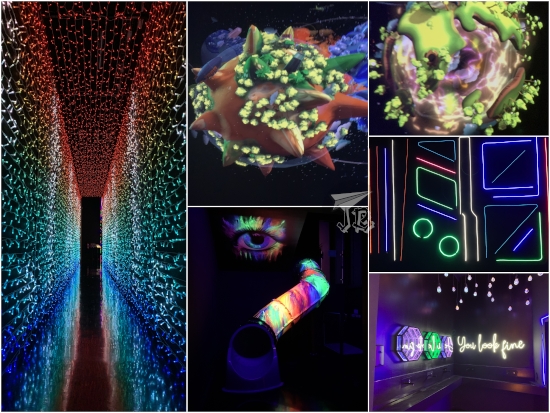
The film finished around 14:00. I was not hungry, so I just grabbed myself a drink at Starbucks. I had a ticket at 15:00 at the Nomad Museo Inmersivo (and it was bad timing I guess, because just a couple of days later they opened a new exhibit). When I first read about it, the idea reminded me of Mori TeamLab Museum, since the art is all digital. The museum is staged in two floors. The lower one hosts the immersive projection ward and the shop. The upper one hosts the entrance and the “activities”. I thought that I’d ask if I could come in early, and they had absolutely no problem with that, so I entered around 14:35.

As you climb down the stairs, you have a very cool corridor with mirrors and lights that lead to the projection area. I had a ticket with entrance and “iris picture”, so an employee took me to get that one (I guess because the photographer was about to go on a break). We had to try a couple of times as it was hard to force my eyelid open under the bright light of the flash. The photographer was very patient with me and we were done in a few minutes.

Interactive Museum Nomad access corridor

I found my way back to the beginning – the museum is surprisingly small. The immersive projection is shown on the four walls and the floor. The projection I watched was called Utopia 1.0, where millions of digital blocks work as a tridimensional Lego set that sort of “build” a surreal world with dragons, deer, sculptures, whales, high rises, dinosaurs… The whole thing takes around 20 minutes and you can watch sprawled on the floor, or sitting up on a pouf – I chose this last option as it allowed me to turn around.

Interative Museum Nomad: Utopia projection

Following the projection, I went upstairs to do the activities. There’s a virtual reality experience where you get to travel the cosmos and see a lot of “space cetaceans”. I wonder why digital artists are so keen on whales… Another of the activities consists on “painting” planets with a giant brush as they float on a wall, and when you colour them all, you get to see penguins on a rocket or something… I did not catch it well because a bunch of kids burst in and took over. On another wall, there is a bunch of neons that you can play with using an app that you download on your phone, and blast music so they pulsate with that. Finally, the nice attendant is at the ready to take your picture at some stairs photo call (I think it is the glorified emergency exit), and you can go back down using a spiral slide.

There is finally a last corridor with lights and you end up at the shop, where you can start all over again, as there is no limit about how long you can stay in the museum. I really liked the first corridor, so I went back there for a while. Then I walked into the projection area again just in time to watch the dinosaurs roam once more. A fun detail is that even the toilets are “in character” with neon and messages.

Interactive Museum Nomad exhibits

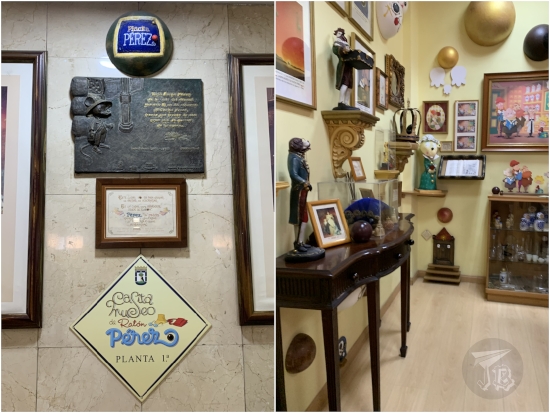
On my way out, I bought myself a shark glass at the shop. There was also a very fun pufferfish cocktail glass, but I thought it would be awful to clean after use – not that the shark one is going to be much easier though… I left and headed off to a place I’ve always tangentially felt curious about, even if I’m not really the target public for it – it’s called Casita-Museo del Ratón Pérez.

Ratón Pérez or Mouse Pérez (also called Ratoncito Pérez, Little Mouse Pérez) is the equivalent of the Tooth Fairy in Spanish-speaking tradition. In 1894, writer Luis Coloma was commissioned with writing a tale for the future King Alfonso XIII, who had lost his first tooth. This tale penned the folklore mouse into print. According to the story, Mouse Pérez lived in central Madrid, in a biscuit box in the patisserie Prast, situated in number 8 of Madrid’s Calle Arenal. The town hall installed a plaque to commemorate the place and when the shopping centre in that building became almost empty, someone came up with the idea of building a “museum-house” dedicated to the mouse.

Museum-House of Mouse Pérez

The kids had a blast for sure, the visit is a forty-minute activity 100% dedicated to them . The guide has them running round looking for stuff and going into small doors. I snooped around and found it an interesting business model – though it falters when you pay a bit of attention to detail: books like 1984 or anatomy guides may very well be interesting, but a bit out of place in a children’s museum. At the end of the visit, the guided asked me what I was doing there and I told him I… wanted to see what the fuss was about, what kind of things they did in such “alternative” museums. We chatted away for a bit before I left.

To end the day, I did some shopping and I headed back home – the trains were delayed, but I eventually made it home and had a pizza dinner, because I suck at staying fed on day trips. Truth be told, I wanted to step by a famous bar to eat a calamari sandwich, but it… was complicated, with lots of signage on where to stand and wait to be seated, but there was nobody around, so in the end I decided I did not care enough for the calamari. Some other day – I’ve been saying that for months now though…

11th July 2023: Museum of Dreamers in Madrid (Spain)

After I had so much fun in the Balloon Museum, I decided that I also wanted to see the Museum of Dreamers, which is something similar. Furthermore, it Madrid exhibit will close down at the end of July, too.

After I finished French school in Madrid, I headed headed off to the Japanese fusion restaurant Nomo Braganza, part of the Nomo Group. Nomo was established in 2007 under the culinary direction of Japanese chef Naoyuki Haginoya. I have to say that I don’t really trust the Spanish-Japanese fusion too much, but in this case, it really panned out. I met my sibling for a late lunch, because I was curious about the chef’s menu, what in Japanese would be called omakase [お任せ], which means leaving the choice of food to the chef. The menu was was a whooping 12 small-sized courses for 50€ – drinks not included, and considering it was 39 ºC outside, we ended up ordering a few rounds of water.

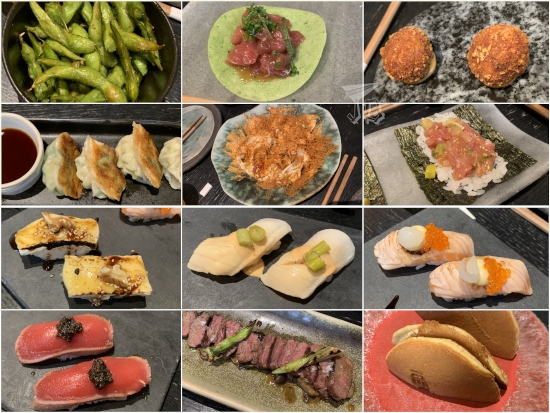
The menu, which changes periodically, comprised in July 2023:

  • Age Edamame Truffle – fermented edamame beans fried with white truffle scent. I personally prefer my edamame boiled, but the truffle scent was a nice touch.
  • Sukiyaki Croquette – oxtail croquette breaded with panko breadcrumbs. This was surprisingly good – and the actual flavour was strong.
  • Maguro Taco – mini taco of tuna tartar with wasabi and shiso (the “taco” was weirdly… not taco-shaped, more like cracker-shaped). The tuna was really good, albeit the base was a bit strange.
  • Gyu Niku Gyoza – aged beef dumplings with caramelised onion and yuzu, two of them per person. It was all right.
  • Ebi Chili – spicy king prawns and fried egg on kataifi noodles, mixed at the table. When we are talking spicy, it means… really spicy. The prawn bits were sizeable, but this was really something I would not miss should it disappear from the menu.
  • Toro Tartar No Temaki – tuna tartar prepared at the table: raw tuna belly mixed with Japanese onion, turnip, egg yolk, chilli pepper and wasabi on a bed of nori and rice so you can roll it yourself (spoiler: you really can’t). This was probably one of my favourite items – but I guess that after all I am a raw tuna fan.
  • Brie Nigiri – flamed Brie cheese nigiri with honey and walnuts. This was probably the weakest sushi bite, but it was still good.
  • Butter Fish Nigiri – butterfish nigiri with kimchi and chilli peppers. Butterfish is only good raw anyway.
  • Aburi Salmon Nigiri – flamed Norwegian salmon nigiri, with Japanese mayonnaise, salmon roe and onion. I still prefer raw salmon, but the flame was light so it was barely perceptible.
  • Maguro Tataki No Nigiri Trufa Nose – tuna tataki nigiri with soy and black truffle sauce. This was also really good.
  • Gyu Niku No Tataki – aged beef tataki with caramelised mushrooms and miso sauce. The combination of meat and the mushroom was strange, but when taken separately it was all good.
  • Caramel dorayaki – two halves of a dorayaki filled with salty caramel paste. Unexpected, because the menu listed something else, but it is not as if it was bad at all!

Chef's choice menu at Nomo Madrid

My sibling ordered some green tea out of the menu, and in the end, the drinks did not add as much to the price as I expected. Also, I have to give a shout-out to the pickled ginger we got. Really good.

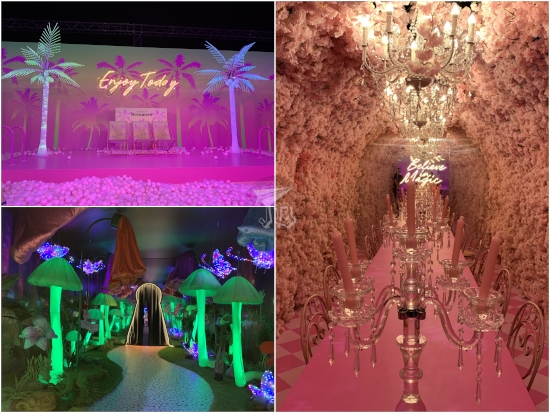
After having lunch, we took a train towards the Museum of Dreamers, which is stands in Espacio Ibercaja Delicias, a place that seems to always look somewhat abandoned, even when it is stupidly hot and sunny. The exhibit was designed by sisters Elena and Giulia Sella, founders of Postology, an agency specialised in “phygigal” experiences. This concept merges the words “physical” and “digital”, allowing for a number of immersive and surreal experiences. The Museum of Dreamers is one of those things that you have to see with an open mind to have some fun. It comprises sixteen interactive installations which are basically photo-ops – after all, the word instagrammable has been officially accepted on dictionaries. I guess it is a new niche that can be exploited, and to be honest, I can get behind that, because some of these activities are hilarious.

Entry is timed, but they do not hold a very strict waiting policy – at least not on a Tuesday at 17:00 and 39 ºC. There were no timed exhibits or performances either. The first installation is a dark room with a starry sky of sorts, designed maybe to isolate the rest of the exhibition from the outside, maybe as a metaphor (100 Dreamers). Then you get to a semi open space that opens to the smaller installations that allow for fun pictures. All through the space there are motivational sentences and “rules” for safety in the different installation.

There is some kind of cosmic tube with mirror that was dizzying to walk into (Free your power), a tunnel made of hearts with an encouraging message at the end (Do what you love), an upside down room (Change perspective), an downside down bedroom with a giant plush and fun bed covers (Never stop dreaming), one full of disco lamps (Sparkle more), and a neon staircase flanked by colourful palm trees (Step by Step).

Museum of Dreamers exhibits

Afterwards, there is a ball pit – you know, it’s not like I had ever stepped into one before Friday, and now that’s twice in one week – with a “relaxing island” in the middle (Enjoy Today). In front of that, a tunnel made of fake pink flowers with a long table, set for a tea party (Believe in Magic). That managed to make you think of Alice in Wonderland imprint on your brain. Thus, you are in the right mindset for the following room, full of giant mushrooms and flowers that open up at will – theirs, for sure, not the visitors – whole giant butterflies hang around with their wings made out of lights (Wonder).

Museum of Dreamers exhibits

The final part of the exhibit consists on a second row of booths – a colour wheel, a door that opens to a fantasy scenery, a VR experience (Choose your Way), a stage (The stage is yours), some pink telephones (Your Dreams are Calling you), bright lights commanding you to DREAM (Be Bright)… There were two more rooms, one with a sky background and swings (Sky is not the limit), and the other with punching bags reading FEAR, STRESS, ANXIETY and so on (Never Give Up). I can’t punch, but I can strangle, so I choked the hell out of these last two.

Museum of Dreamers exhibits

That was the end of the escapade. It was a fun half-day out.

7th July 2023: Balloon Museum “Pop Air” in Madrid (Spain)

Part of this summer’s plans involved a three-week French course-and-stay in Montpellier, but I ended up changing my mind – too many hidden costs on top of the already-steep price, and a generalised bad feeling that I could not really define. I decided to take a course in Madrid and use up the evenings to do some exploring in town.

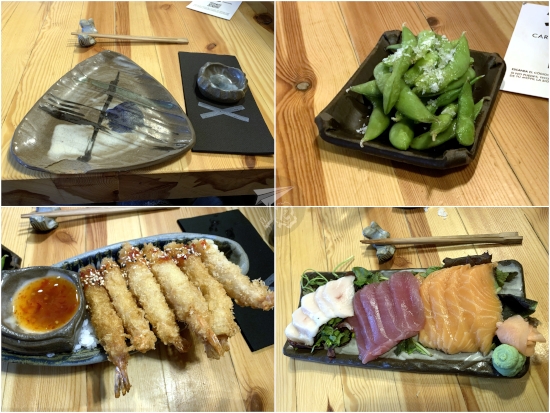
After class, I booked a table at the Chueca shop of the Japanese restaurant chain Sibuya Sushi Bar, which claims to offer a new concept of sushi. Most of what they offer felt pretty normal to me, except some random baos and the desserts. I browsed the website before booking, so when I arrived I had a pretty good idea of what I wanted. Somehow, the waiter did not expect that and was thrown off track. I ordered some ebi furai and a sashimi mix – I have to admit that the size of the sashimi portion did surprise me a little, as I did not expect such a generous serving. Luckily, I had hold on ordering dessert, because the two dishes were more than enough.

Lunch at Sibuya Madrid

There were two temporary exhibits I wanted to check out, and I chose the one that closed down earlier. I checked as I had lunch, and there were tickets available online. I decided to take the underground and buy the tickets in person instead of stressing about making it on time for a particular timeslot. I reached the Balloon Museum on time for the 15:45 entry. The exhibition Pop Air runs from March to July 2023 in the Escenario Puerta del Ángel in Madrid’s Casa de Campo.

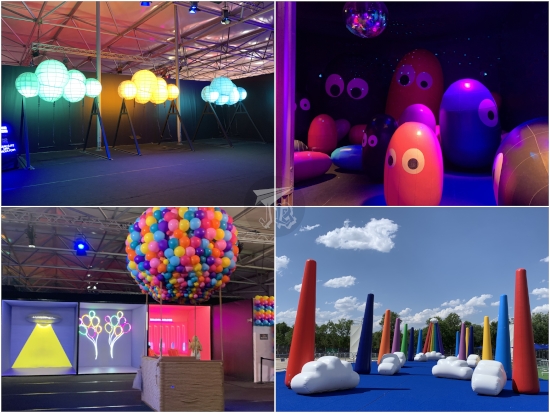
Still considered a noon slot, the exhibition was not too crowded at the time I entered, I even had a couple of rooms for myself before I reached a point in which you had to be admitted because the performance was timed. The Ballon Museum‘s Pop Air exhibit is a collection of art pieces that use air and light as their main vehicle.

Artworks:

  • The Goof by Filthy Luker (2021). They are a bunch of “friendly monsters” that observer the world feeding off surprise and happiness. They look… just adorable, as if they were made of giant inflated latex gloves in different colours with huge eyes.
  • Aria, The Breath Immersive Experience by Pepper’s Ghost (2022). A room full of mirrors and digitally-created colourful spheres that spreads to infinite and beyond.
  • Airship Orchestra by Eness (2020). More adorable creatures made out of air, some resembling Japanese peaches, other bunnies, or cacti.
  • Ballon Museum exhibits. The Goof, Aria, Airship orchestra

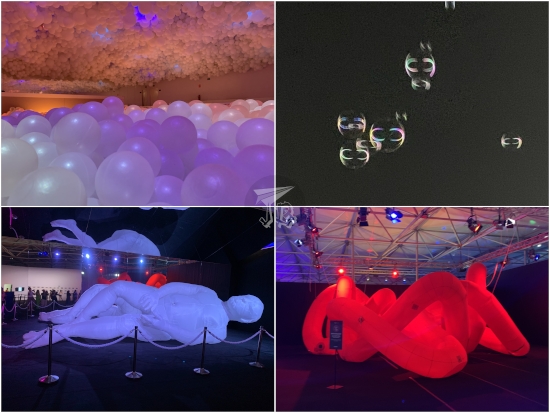
  • Hypercosmo by Hyperstudio (2021), which is basically a huge ball pit with a show of music and lights.
  • A Quiet Storm by Quiet Ensemble (2022). A dark room where cannons shoot bubbles.
  • Silenus by Max Streicher (2002). A giant, breathing… person… sleeping. It’s a bit creepy, to be honest.
  • Knot by Cyril Lancelin (2017). It is an inflatable… knot, literally a 3D knot made out of a tube.
  • Balloon Museum exhibits: Hypercosmo, A quiet storm, Silenis, Knot

  • Polyheadra by Karina Smigla-Bobinski (2022). It is a room full of balloons with small magnets which you can stick to the wall and the ceiling, and even to each other.
  • Never Ending Story by Motorefisico (2021). Music: Gentle Music by Plume (Netlabel). A lot of decorative balls in a small room full of mirrors and light.
  • Tholos by Plastique Fantastique (2022). A giant black ball surrounded by a plastic structure that imitates the archaeological tholos tombs.
  • Canopy by Pneuhaus & Bike Powered Events (2019). Four palm-tree-like structures that open up and glow if you bike them into life.
  • Balloon Museum Exhibits. Polyheadra, Never ending story, Tholos, Canopy

  • Cloud Swing by Lindsay Glatz with Curious Form (2019). Cute swings held by colourful “clouds” of light.
  • The GINJOS by Rub Kandy (2022). They’re blobs of air with eyes. When I saw them my first impression was “they’re squishy and unstable. I have found my people”. I also found the song hilarious, especially the reference that “GINJOS are not Barbapapa”.
  • Into the Rainbow by Ultravioletto. A VR experience out of which one cannot really take pictures. A white sphere travels through the colours of the rainbow and its symbols – orange candy, yellow rubber duckies, green trees, blue whales, purple… cows(?) and amethyst crystals
  • A number of cute photo booths for picture opportunities, without credit to any particular artist.
  • Parcobaleno by Stefano Rossetti (2020), is a large “inflatable park” for “all the family” (i.e. for kids), which was empty as it was way too hot for any playing.

Ballon Museum exhibits. The swings, the Ginjos, Parcobaleno

All in all, it was a really silly but fun experience. I headed back home afterwards, because even if exploring Casa de Campo is on my list, it was way too hot and I did not have any cold drinks on me. I made an amazing underground-train connection though, which was great because the Casa de Campo stop is pretty far away by public transport – and rather horrible to drive to.

6th December 2022: Tim Burton’s Labyrinth (Madrid, Spain)

Despite having decided that immersive exhibits were not for me and the fact that I’m not a Tim Burton fan, here I found myself in Madrid to see this one: Tim Burton’s Labyrinth El Laberinto de Tim Burton. Truth be told, I was only there because my sibling asked me to accompany them. I did not find premium tickets for any of the dates either of us was available, but the 6th of December is a national holiday in Spain, and I calculated that if we were there at opening times it might not be too busy, and we would not come across too many kids.

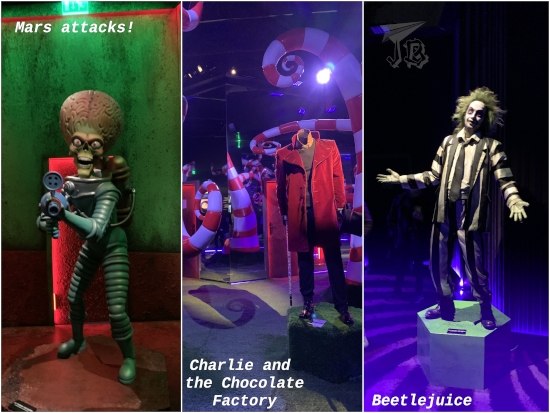
Tim Burton is an American film-maker born in 1958. His first “hit” may have been Stalk of the Celery Monster, which he wrote, directed and animated when he was a student in the California Institute of Arts, in 1979. It presumably earned him a good grade, but more importantly, an animator’s apprenticeship at Disney Animation Studios. With time, he developed a shrill eerie style, with lots of colours and creepy designs that have increased as years have passed, sometimes defined as “gothic fantasy” – I would refer to it as strident and macabre at times, to be honest. His greatest or most famous works include Beetlejuice, Charlie and the Chocolate Factory, Edward Scissorhands, The Nightmare before Christmas, and the first two Batman films.

The exhibition is hosted in a weird place in Madrid, Espacio Ibercaja Delicias, which might look less… abandoned… when it hasn’t been raining for days, I guess. The space consists on a big tent – where we were not going, it might be designed for circuses or so, some kind of bar / cafeteria, and the monster-like building that hosts the exhibit. It is called a labyrinth because out of the thirty-ish wards, you have to go around choosing doors to see different rooms of the exhibit, insomuch that you would need four rounds to see the complete thing. In the end, you choose 15 rooms to see, out of which some are common, and you reach them from whichever previous place you were in. Others are “less common” and you can reach them through several doors, but not all. You enter the labyrinth through a toothy monster’s mouth, then there’s a big button that “decides” on the first room for you.

Collage: exterior of the Labyrinth, which looks like a one-eyed tentacle monster, and the inner entrance monster whose mouth is the curtain you have to cross to enter the different rooms.

In the rooms there are sculptures that represent the characters, some of them with the original clothes that were designed for them (if the film is a live-action), the plain clothes, and on the walls sketches and animations, some original, some “inspired”, and some made specifically for the exhibit. Some rooms are small and rather empty, others are decorated like the movie sets. There are tricks with lights, and some mirrors, but nothing “immersive” about it, and way too many people around considering the size of some rooms.

The idea of a labyrinth is interesting, but I don’t think the price warrants just seeing half of the exhibit, especially considering the big “misses” of not seeing all the The Nightmare before Christmas. We took about 40 – 45 minutes to go through the 15 rooms.

What I am aware we saw included:

  • Beetlejuice
  • Edward Scissorhands
  • Batman and Batman returns
  • Mars attacks!
  • Charlie and the Chocolate Factory
  • Alice in Wonderland or Alice Through the Looking Glass
  • Corpse Bride
  • Frankenweenie
  • Jack from The Nightmare before Christmas

Collage of Tim Burton's characters: Batman's Pengun, Edward Scissorhands, Emily from Corpse Bride

Collage of Tim Burton's characters: Alien from Mars Attack; the clothing from the Chocolatier (I think) in Charlie and the Chocolate factory, surrounded by twirling candy canes; Beetlejuice

Collage of Tim Burton's characters: Jack from The Nightmare before Christmas; The Mad Hatter from Alice in Wonderland, with some giant mushrooms behind; the boy and the dog of Frankenweenie

I think this is an exhibit for die-hard fans that are willing to pay for the premium ticket and see the whole thing twice. What it’s not, and that’s for sure, is for kids.

On both ways, we had some train trouble – delays and technical problems, but nothing too dramatic, and I was home before sunset – but after buying a stack of Christmas candy canes! And my sibling enjoyed, which was the goal anyway.

2nd December 2022: “Tutankhamun Immersive Exhibition” in Madrid (Spain)

In 1922, an archaeologist named Howard Carter discovered the tomb of Pharaoh Tutankhamun in the Valley of the Kings, Egypt. Tutankhamun belonged to the Eighteenth Dynasty. He reigned over Egypt around 1330 BCE, and restored the Ancient Egyptian religion. When he died, he was buried in a smaller-than-expected tomb, probably because his death was sudden and unexpected – for a while, it was hypothesised that he had been murdered, but it seems that he died from a combination of an infection and several previous pathologies (nothing to do with the fact that his parents were brother and sister, I’m sure).

The tomb was robbed and restored twice within a few years of Tutankhamun’s death, but it was eventually buried by alluvium brought by flash floods, and the debris from other tombs being built nearby. Thus, when Carter found it in 1922, it was mostly untouched and unspoilt. The death of Carter’s sponsor George Helbert, five months after visiting the tomb, sparked the rumour about a Curse of the Pharaohs, which has inspired countless works of fiction.

In 2022, Spain is living through a fad of “immersive exhibitions”, heavily based on technology, virtual reality and computer games. I was curious about what it would be about, exactly, so I decided to celebrate the end of work season by hitting the exhibit. I was early as the day before there had been a bit of public transport trouble and you usually have more chances of getting in if you’re early rather than late. Thus, I reached Centro Cultural Matadero in Madrid about half an hour earlier than my ticket read, and I was let in without any issue.

The “immersive exhibit” Tutankamón: La Exposición Inmersiva was devised by MAD, Madrid Artes Digitales, which specialises in digital creation and immersive experiences such a this. The exhibit has been designed in cooperation with the History Channel.

The first bit was a number of panels, explaining the “Egyptmania” that swept the world after the discovery of the mummy, the process of mummification, or life in ancient Egypt. The second held a replica of the inner and outer sarcophagus, along with the mummy, then replicas a few artefacts that had been found in the tomb, including the famous golden mask the pharaoh was buried with.

Three part collage: The upper picture shows the mummy of Tutankhamun suspended from the floor, imitating an open sarcophagus with the lid open on top of that. Bottom left: reproduction of the mortuary mask, in gold and blue, it has the typical Egyptian hair and beard. Lower right: reproductions of small objects found in the grave: estelae and human-like small sculptures.

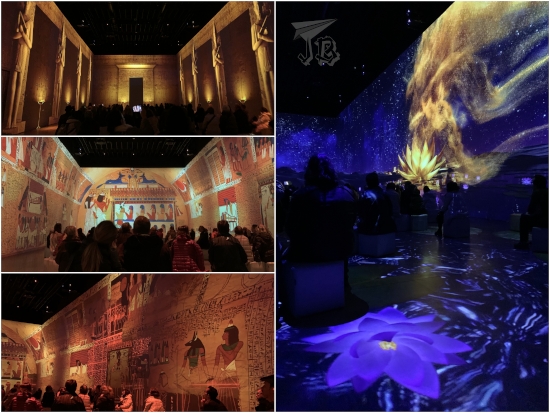
Afterwards, you go into a huge ward with a projection on all four walls plus the floor, which is very spectacular but does not tell you much about the real history of either Tutankhamun or the tomb, it was just a cool video of flashy images with a narration in first person, showing the interior of the tomb, yes, but mostly vaguely-related imaginary, including some of the Egyptian gods. What it did have, and that was neat, was an original newsreel about the opening of the tomb, including Howard’s voice.

Collage of a 3D projection. Left, from top to bottom, views of Tutankhamun's grave: the outer area, in sandstone with sculptures, and two views of the inner painting an decoration, showing figures and hyeroglyphs. On the right, a projection of lotus flowers blooming and turning into gold, representing the soul of the pharaoh.

A large ward with a projection of a starry sky on the walls. At the front, a view of Tutankhamun's mortuary mask, eyes glowing.

A projection of Tutankhamun's mortuary mask, eyes glowing. Around it, golden writing symbols, maybe hyeroglyphs.

The following area had an augmented reality game, which I won (didn’t get anything though), a photo booth that I skipped and some “I bet you didn’t know” facts – about one third of them were common knowledge, and another third was information from previous panels though.

Finally, there was a room with virtual reality glasses and headphones, but my headphones wouldn’t work – I later realised they were not plugged into anything. This represented – I think – the trip to the Egyptian underworld, as I “started” at Tutankhamun’s tomb, then there were volcanoes, and I ended up in front of Anubis, who weighed a heart against a plume – the Judgement of the Dead.

The VR experience there was the last spot in the exhibition – because I skipped the photo booth – before one went into the shop. In the end, I was there for about an hour and a half, but it almost took me two hours to arrive and an hour and half to come back.

Though I don’t regret the mental break, I have decided that immersive experiences are not for me.