
I wanted to do a full day in Madrid this weekend, but ticketing did not align, thus I had to organise two half days. So on Saturday morning I set off for an 11:00 visit to Frontón Beti-Jai. A frontón is the court where games of Basque pelota (pelota vasca) are played. The term refers to a number of sports that use a small hard ball which is hit by the players so it bounces off the vertical walls of the court. Depending on the specific variety, the ball can be hit with the hand, a racket, a bat or a type of basket, and it can bounce on one or two walls of the frontón as long as they are at right angles with each other. Basque pelota is mainly played in Spain and France, and it is also popular in some Latin America countries. Though it was originally included in the 1900 Olympics, it has only been played as an exhibition sport and never in competition.
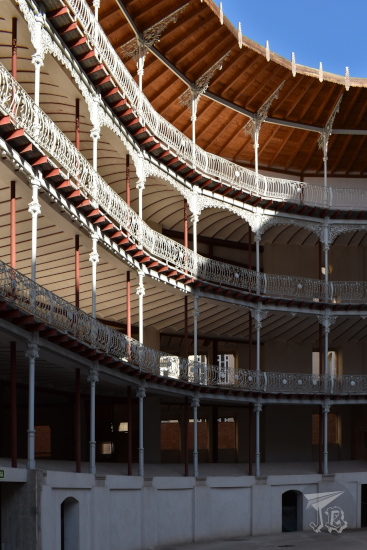
In the 19th century, Basque pelota was a popular and lucrative business in Spain, especially in Madrid. In 1891, businessman José Arana commissioned architect Joaquín Rucoba to build a frontón in Madrid, “similar to but better than” the one in San Sebastián, the original Beti-Jai. The capital’s Beti-Jai (“always party” in Basque) was placed in the district of Chamberí, witch construction starting in 1893. The architect designed a white-and-grey outer façade in an eclectic style with Neoclassical reminiscences in order to blend with the mansions in the area at the time, and a red-brick Neomudéjar secondary or side façade. The inner wall that stands behind the main entrance is also Neomudéjar. The playing court is plain concrete, and he whole area is shaped as a half-ellipse. There were long-lost stands on the ground, and three upper stories supported and adorned by cast iron balconies and columns, with a wooden roof on top. The decoration on the balconies is different for each floor.
The frontón opened in 1894 and it hosted games until 1919 – it is said that the crackdown on the betting systems and loan sharks caused Basque pelota to slowly fade out of fashion. Throughout the period and afterwards, it also had some alternative – and creative – uses, among them aeronautical experiments by renown engineer Leonardo Torres Quevedo, car workshop (a few times in different years), motorbike shop, political hotspot, even industrial bakery. The stands were eventually walled off – which protected the ironwork. Though both in the late 1970s and the early 1990s the building was “declared” as protected, the structure was eventually left to rot. The building was bought and restored by the Madrid Town Hall between 2010 and 2019, finally attaining protected status in 2011. It is the largest and oldest frontón standing.

I like cast iron architecture a lot, which is why I signed up for this Pasea Madrid guided visit. We did not get a nice and knowledgeable guide this time, so I mentally checked out. She was not just nervous, she read the whole visit out of a phone, gave some wrong or plain false information, and relied on people “knowing things” and “having visited places”. I wandered around taking pictures and approaching the group periodically trying to fish out any interesting bit of information, until the guide grew tired and kicked us out when most people decided to just stand in the sun, even if there was some time left. People who had been listening to her had barely any time for photographs.
After the frontón, I had a reservation for lunch a restaurant part of a franchise specialising in croquettes, is called Solo de Croquetas Zurbano – a pun between “only croquettes” and “croquettes’ solo”; Zurbano is just the street. It has been a bit of a buzz lately so I was really curious about it. The place was organised in three floors – a bar on the ground floor, a loft-like seating on the first floor and a bigger restaurant-like area in the basement.
Though the Internet said the restaurant opened at 13:00, I was offered a reservation at 12:45, which I took because I did not want to be wandering around in the cold for too long. I was not extremely surprised though when I popped by at the reservation time and it was indeed crossed. I ended up wandering for a while before 13:00 came up and I could sit down. I decided to try a basic “croquette tasting”, which includes six savoury croquettes two sweet ones, and a drink. There are three lists to choose from, and I took the B-set:
- Rulo de cabra con pimiento caramelizado, goat cheese roller with caramelised red pepper – happy to report the pepper was barely distinguishable, just added some colour to the filling. Very cheesy, cheese is always good.
- Boletus con trufa, boletus with truffle. Lots of mushroom, little truffle, but okay. I’m not that much of a truffle fan anyway.
- Provolone con tomate seco y orégano, provolone cheese with dry tomato and oregano. There is never such a thing as too much cheese.
- Cachopo; a cachopo is a typical dish from the North of Spain that consists on two beef steaks with a filling between them, and everything breaded, which I ate once in Astorga. This one was weird.
- Cecina con puerro y queso gorgonzola, beef jerky with celery and gorgonzola cheese. Probably my favourite out of the savoury ones.
- Sobrasada de Mallorca con queso Mahón, sobrassada (cured pork sausage filling) with Mahon cheese. All right.
- Croqueta de Oreo con chocolate blanco, Oreo and white chocolate. Rather good, which is surprising considering I don’t even like Oreos…
- Croqueta de Cheesecake con frambuesa , Cheesecake and raspberry. Surprising, to say the least.

All in all it was good. The croquettes were decently sized and had distinctive flavours. The set felt a bit scarce though. Not that I went hungry, but I could have done with another couple of croquettes. I think it is what they are counting on – the tasting is okay, price-wise, considering the novelty (18.50 €), but if you want anything else, the meal will get very expensive very fast. I guess it is noteworthy that all croquettes are gluten-free, and the tasting has a lactose-free set and a vegan set.
I left the restaurant and walked towards the train station. On the way, I was distracted by the small Christmas market, more precisely by the a gorgeous 1900 merry-go-round that had been installed among other attractions. I had a bit of a walk around to check out the stands and then I went to wait for the train – which was, predictably, delayed.

 JBinnacle – A Travel Logbook