5th July 2025: Cheese, archaeology, pancakes (Madrid, Spain)

I am not completely sure how the conversation came up. My sibling said something about cheese tastings. I mentioned something about knowing about a shop in Madrid which organised them. Next thing I knew, I had been tasked with planning an escapade to try. However, closing on dates is not something my family is fast at doing, so by the time my sibling confirmed, the June date we wanted was sold out and I had to book for July.

The final date was Saturday the 5th of July at 13:00. The evening before, there was an explosion and fire in a factory in an area alongside both the speedway and the railway lines, and that forced me to reevaluate transportation – the warehouse worked with lithium batteries, which burn for a very long time. In the end, I decided to try for an early train, with a plan B to drive to a station halfway and meet my sibling there. While you could see the smoke from the wagon, there was no weird smell or anything and the train ran smoothly for once. Maybe we were five minutes late to Madrid? Funny, when I was warned at the station that there were delays. I had planned an extra activity in case we were early.

There was also Pride to take into account, as it was the main Parade, and that causes a cascade of station closures, including Recoletos, the station we had to go to. That would only be an issue to consider when we had to go back though, since they started at 18:00. We could always get the underground and find our way to Atocha.

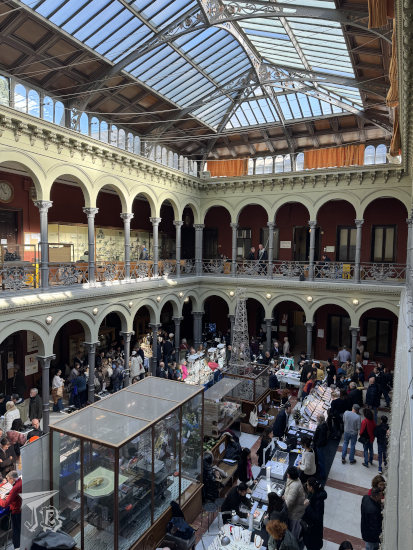
We started off at the Museum of the National Library Museo de la Biblioteca Nacional. I had seen the museum already, but I had read that there was a temporal exhibit. However, we were unable to find it – it’s been apparently “temporarily closed”. It worked to pass the time out of the heat though. We were done at 12:30 – a bit too early to directly go to the store, but too late to try to see anything else. We decided to walk towards the shop, and we missed it at first, but we soon backtracked and walked into… a literal fridge.

Formaje (an old-fashioned Spanish word for cheese) is a specialised / delicatessen cheese shop. Created in 2020, it aims to “create community around artisan cheese”. They work with farmers, craftspeople, and traditional cheesemakers to distribute environmentally-conscious cheeses from producers who respect the natural processes, the landscape and of course the product. The store is designed to be a warehouse too, so it is… cold. Good thing I was carrying a jacket.

Formaje Castelló: Shop. A cheese shop full of pieces and whole cheeses

We waited in the shop, trying not to obstruct the customers, and gawked at all the types of cheese in display, all of which could be bought, and tasted beforehand! We saw some regulars who had their thermal bags ready for their shopping and debated getting a cheese subscription, and people wandering in out of curiosity. Around 12:55 a lady came to check us in. I was the closest to her, so I was able to take a picture of the whole set up and find a seat closest to the speaker. I have way too many attention issues not to want to be close to someone who is going to do some explaining I care about.

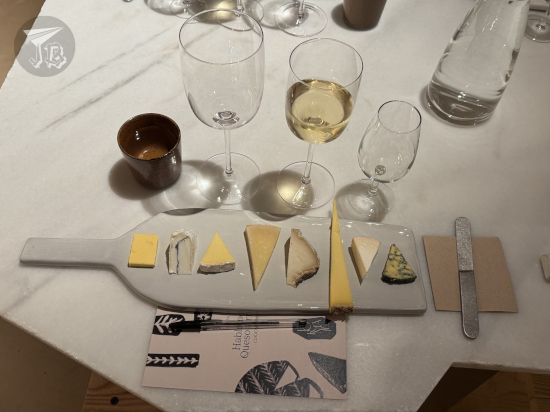
The tasting Cata de Quesos Edición Primavera involved fresh sourdough bread, butter, seven types of cheese, sweet quince paste, red and white wine, and “ice cider”. I am not a fan of alcohol in general, but the ice cider was magnificent. I am not going to gush about how all the cheeses were delicious. Assume I loved them.

Formaje Castelló: Cheese tasting. Long table and a tray full of sourdough bread

To begin with, there was real butter from the farm Airas Moniz in Chantada (Lugo, Spain). Made from the raw milk of Jersey cows grass-fed in the north of Spain, it was fresh, yellow, creamy and salted, and the bread was delicious. The first cheese was Olavidia (from Jaén, Spain), made from goat milk. It had a small layer of smoked wood halfway through. Even if I don’t care much about “the proper order you should eat things in”, I discovered that goat-milk cheese is supposed to be a “soft-tasting” cheese, I have always found it pretty strong. The cheeses were organised from softer to stronger, which apparently is how you should consume them.

The second cheese was a Camembert (protected designation of origin, AOP from its French acronym) from the region of Normandie, France; it was creamy, made from raw cow milk, with a slight moulded rind (with Penicillium camemberti) which protects the inner creaminess.

Then came a Manchego (protected designation of origin, DOP from the Spanish acronym), made with raw sheep milk. It originated in a farm called Finca Valdivieso (Alcázar de San Juan, Ciudad Real). In my opinion this one was the weakest cheese, as I am a fan of older Manchego and this was less than a year old, though still nice.

Number four was a cheese I had not heard about before, Tronchón (from cheesemaker Los Corrales, Almedíjar, Castellón). Tronchón is generally made from raw sheep milk, though sometimes it might be made with goat milk or a mix of both. The one we tried was made from goat milk. The rind is dark and unappealing on sight, but it was nice enough. Despite my ignorance, this cheese is old enough that it was mentioned in Cervantes’ Don Quijote.

Another discovery was the German Blossom Hornkäse. Hornkäse comes from the Bavarian region of Allgäu. The cows that provide the milk are fed with local grass and they don’t have their horns cut (Did you know that a cow’s horns are connected to her throat and they are part of the digestion process?). The cheese is made in wood recipients using only wooden tools. This version comes with a crust of dry flowers which makes it… just amazing.

Sierra Sur was… the icky one. It smelled like literal stable – and not a clean one. It is made with raw goat milk and you have to fight yourself a little bit to take a bite of the rind. It is a seasonal cheese, which I wouldn’t be able to say whether it has gone bad… It did look like it had gone bad… But it was nice enough, if you could ignore the smell. Not something I would buy on my own though.

The last cheese, Savel, came from Chantada – like the butter at the beginning. It is made from raw cow milk, from Jersey cows, injected with Penicillium roqueforti. This was extremely strong, but really good, especially with the bread, and the ice cider called Bizi-Goxo. Though this one brand comes from the north of Spain and is made from Errezile apples, ice cider originally comes from Canada. To produce this particular spirit, the apple is kept through the winter on straw mats, and it does not rot. The resulting drink is stronger and sweeter than a regular cider.

Formaje Castelló: Cheese tasting. Seven small pieces of cheese perfectly aligned on a tray

We spent some time chatting with the lady who had given the explanations, then went on our way. We walked to the archaeological museum Museo Arqueológico Nacional, where they were running two temporal exhibitions. One was a personal-turned-public collection of Egyptian Artifacts called El Egipto de Eduard Toda. Un viaje al coleccionismo del siglo XIX (Eduard Toda’s Egypt: A trip to collecting in the 19th century). Eduard Toda i Güell (1855 – 1941) was the Spanish Vice-Consul in Egypt for a couple of years, during which he amassed a rather impressive collection of artefacts, which he eventually donated to public institutions. The bulk of what he owned is now held in the archaeological museum as part of both the permanent collection and the archives. He had antiques, carbon copies of reliefs, photographies and a hefty number of fakes – apparently, knowing they were so.

Treasures from an Egyptian tomb

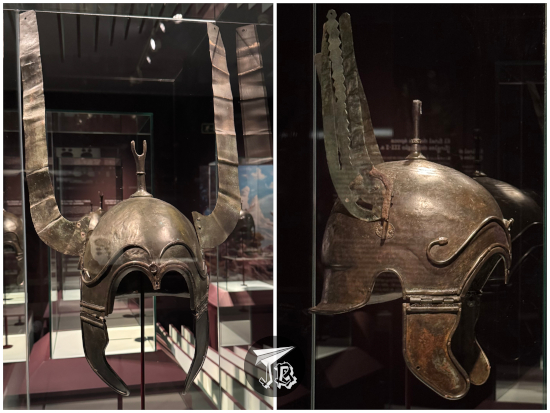
The second temporal exhibition we wanted to see was Alas para la guerra. Aratis y la Celtiberia: Wings for war, Aratis (a town, now an archaeological site) and Celtiberia. This one focuses on the Celtiberian culture and how it warred, using soldier helmets as a storyline. These particular helmets have a convoluted history – it turns out that between the early 1980s and 2013, someone used metal detectors to find artefacts from the ancient town and sell them out. This “gang” found and illegally auctioned up to 6,000 artefacts, including twenty helmets which had been forged between the 5th and 2nd century BCE. The archaeological site of Aratis, now called Aranda del Moncayo, would have been probably the most important Celtiberian site after Numancia if these guys had not systematically destroyed it.

The Aratis helmets are the most complete items of their kind that have ever been found. They were not really used for war, but were part of funerary treasures. Truth be told, Germany sounded the alert at some point around 2008 about the legality of the auctions, but the Spanish government did not stop them. Seven of the helmets were returned to Spain in 2018 thanks to the European buyers who learnt that they had been illegally exported, and 11 more have been located. The seven helmets are deposited now in the Museum of Saragossa, but that one is currently closed due to construction work (scattering some of its collections to be shown elsewhere), so they have been lent to the Archaeological Museum.

Celtiberian helmets with decorations on the sides

The exhibition also holds other weapons, parts of armours, and Celtiberian artefacts such as coins and brooches. I had seen some of the messed up spears in the museum in Tiermes, which makes sense, considering it also held Celtiberian items.

Afterwards, I finally (finally!) managed to find the reproduction of the Altamira Caves Neocueva de Altamira open! It just had not worked any other time I had been in the museum for the last ten years, and I had seen it once when I was really young, and something similar in the museum on site a lifetime ago. It was smaller than the one I remember from both times… And it makes me sad that I will never be able to see the real thing, because there’s a waiting list you can’t even get into any more, and only 50 people per year see the actual cave…

Reproduction of the Altamira Cave, with bisons, horses and bulls painted on the ceiling.

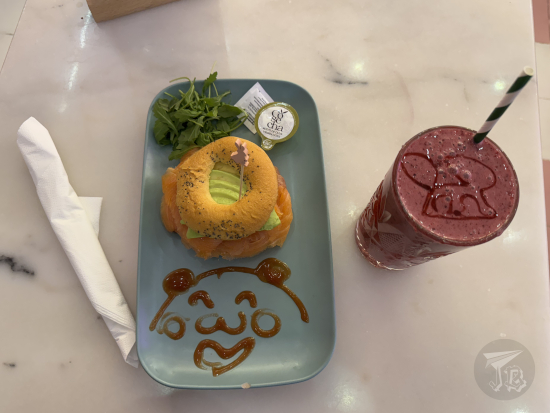
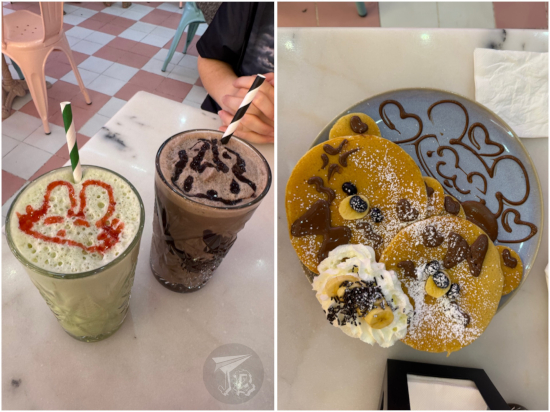
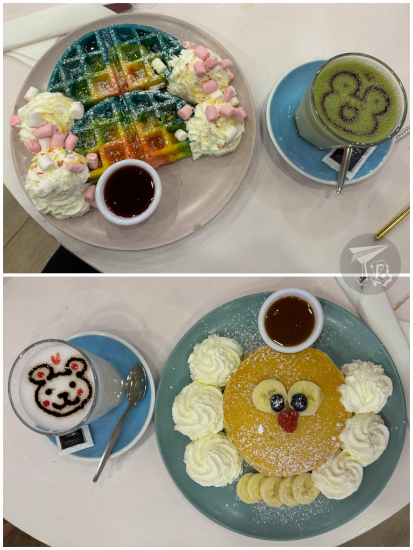
My sibling was not ready to go home just yet, so I thought they might like a stop at Kawaii Café before we turned in. We could take the underground and in under a change and 30 minutes – since I had been there just a couple of days before, I remembered the underground station. I was not sure whether there would be a queue to enter or not, but we were lucky. We alighted at Tirso de Molina and went into the café without problem – it was half empty at the time, around 16:30. They really wanted to order something cute – which is not hard. In the end, they chose teddy-bear-shaped pancakes with chocolate spread Ositos rellenos de Nutella, with chocolate syrup, whipped cream and banana slices. This time I went for a matcha frappé.

Two drinks with cute rabbits drawn on top, and pancakes decorated to look like teddy bears

Afterwards, we walked down to Atocha Station down one of the shopping streets. We made a few stops, and reached the station just before the Pride Parade blocked the streets. There, we settled to wait for a train. On the way back, the factory that had had the accident was still smoking, but the dark cloud seemed weaker. However, I never thought I would have to consider “lithium explosion” in my adventure planning, to be honest…

2nd July 2025: Sabina’s Hello & Goodbye (Madrid, Spain)

Lots of things came together on the 2nd of July. First of all, due to weird work schedules that I had no control over, I had a day off in the middle of the week. Second, I had a doctor appointment in the morning – lucky how I could fit it there. Third, Jurassic World: Rebirth, the new film in the Jurassic Park franchise came out. Finally, back in January, I had bought tickets to watch a concert in the goodbye tour by the singer who composed the soundtrack of my teenage-angst years.

So it was just a stroke a luck that work just happened to give me the day off because of unrelated reasons. It would have been luckier to have the following day off too but what can one do? Actually, I propose an unpaid leave called “I had a concert yesterday and it’s not that I’m tired or sore or anything, but I don’t want to go back to reality just yet, I deserve to bask in post concert ‘the world is okay’ bliss.” Think about it, it’s a great idea.

Since I had the doctor’s appointment, I could not plan a whole day out. Once I was done there, I changed clothes and then drove off to the train. Of course, there were delays, what else is new? Halfway, one of the doors got stuck open and we could not start until that got closed manually. But instead of blocking it, they allowed it to keep opening at subsequent stations – so it got stuck again and again.

I reached Atocha just in time to change trains and get to Sol using the same system without a wait, so in a few minutes later I was out in the heat. The original idea had been a light lunch at Yatai Market, but the air conditioning in Kawaii Café was stronger. I had been to another of their shops before, and the food was all right, so I thought why not? I ordered a strawberry frappé and a “sleepyhead bunny” Conejito Dormilón – a Red Velvet crêpe filled with strawberry compote and decorated with cheese cream and blueberries, along with a vanilla-jello bunny mascot. Adorable and delicious. Quite pink, too, due to all the strawberry…

A collage of pink café and a meal - a strawberry frappe with a cute koala face drawn on it. and a crepe which looks like a bedding with a sleeping rabbit on top

When I finished, I headed towards the nearby Yelmo Cines Ideal to watch Jurassic World: Rebirth, a monster movie with a homage to the Jurassic Park book. I guess the film is better if Scarlett Johansson is your type. The film retcons the whole “Jurassic World” premise: now the dinosaurs are dying (and nobody cares about them any more!) and only surviving on an island near the Equator. It turns out that they somehow hold the key to cure heart disease. And then the palaeontologist says that they need to collect samples from the three biggest dinosaurs: Patagotitan (okay, it’s famous now), Mosasaur and Quetzalcoatlus, both of which have already been featured in previous films and are not dinosaurs. Then there are mutated freaks and a Tyrannosaurus with the head of a xenomorph and some extra arms, because the dinosaurs can’t survive, but the “mutated experiments gone wrong” are alive and well? The best from the film was a scene taken from the book, with a Tyrannosaurus and a raft. Unfortunately, this new Tyrannosaurus was not Rexy. Furthermore, the special effects are… not good. Too much bad CGI makes the creatures less believable than those in the 90s instalments, which is… a huge faux pas.

I am glad I saw it on opening day, though – I was able to avoid most spoilers and went in with an open mind. It was not a good film but I didn’t hate it. I will just probably ignore it exists (until the next film comes out, we all know that). Points for the pro-planet message, but it falls a bit flat when you know that Michael Crichton, the original author, was pretty much anti-science…

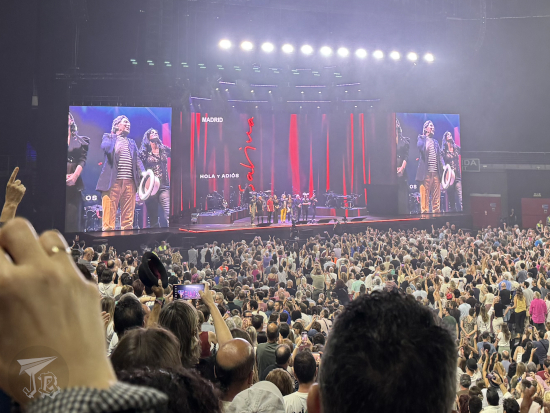
The film was around 133 minutes long, but oh god, the previews were long. Thus, I left the cinema around 19:30. I had to take the underground, and I knew that some stops would be closed due to Pride. However, last year I had learnt that you’re still allowed to transfer even if you cannot enter or exit the station. I used that knowledge to get myself to Movistar Arena Madrid for Joaquín Sabina’s final tour Hola y Adiós (Hello and Goodbye). I am happy I bought the tickets when I first saw them, because most concerts have sold out, and I got quite a good seat considering the event and the venue.

Joaquín Sabina is a Spanish singer and songwriter born in 1949 in Jaén, in the south of Spain. When he finished his studies, his father offered him a present, and he asked for a guitar. Due to his leftist ideas he had to exile himself in London for a few years during Franco’s dictatorship. When he came back, he lived a life of debauchery, mostly in Madrid, and he probably was not the best role model. But between 1994 and 2000, when I was an angtsy teen, his music was important to me, though I eventually moved away from it. When I heard he was retiring (again) early in the year, I thought I wanted to see him at least once, despite the fact I have not consistently listened to his music much in a couple of decades – there are a few hits in my car playlist. And then there is ¿Quién me ha robado el mes de abril?, Who stole the month of April from me?, which hit me very hard during Covid lockdown and I’ve skipped since then, but never had the heart to delete from the playlists.

Security let me in with my tiny water bottle, thankfully, and I found my seat about 45 minutes before the show was due to start, and 15 minutes after doors – it was weird, I had expected a larger crowd, and I had been a bit stressed leaving the cinema 20 minutes later than what I had calculated. I was on the side stalls, on a ninety-nine-euro spot. There is a whole etiquette about concerts with seats, and while I am quite happy to stand up when it is appropriate, and in this case, I decided I would stand up when people in front of me stood up. Pretty easy.

Sabina Hola y Adiós Madrid: empty stage

Setlist:
 Un último vals (One last waltz; recording and MV)
  1. Yo me bajo en Atocha (I’ll alight in Atocha)
  2. Lágrimas de mármol (Marble tears)
  3. Lo niego todo (I deny everything)
  4. Mentiras piadosas (White lies)
  5. Ahora que… (Now that…)
  6. Calle Melancolía (Melancholy Street)
  7. 19 días y 500 noches (19 days and 500 nights)
  8. ¿Quién me ha robado el mes de abril? (Who stole the month of April from me?)
  9. Más de cien mentiras (Over a hundred lies; band intros)
  10. Camas vacías (Empty Beds; vocals: Mara Barros)
  11. Pacto entre caballeros (Pact amongst gentlemen; vocals: Jaime Asúa)
  12. Donde habita el olvido (Where oblivion dwells)
  13. Peces de ciudad (City fish)
  14. Una canción para la Magdalena (A song for Magdalene)
  15. Por el bulevar de los sueños rotos (Through the Broken Dreams Boulevard)
  16. Y sin embargo te quiero (And yet I love you; folk copla song; vocals: Mara Barros) + Y sin embargo (And yet)
  17. Noches de boda (Wedding nights) + Y nos dieron las diez (And the clock struck ten on us)
 Encore:
  18. La canción más hermosa del mundo (The most beautiful song in the world; vocals: Antonio García de Diego)
  19. Tan joven y tan viejo (So young and so old)
  20. Contigo (With you)
  21. Princesa (Princess)
 La canción de los buenos borrachos (The good drunkards’ song; recording)

Well, what can I say? Sabina has got old since I was a teenager. His voice has cracked – after all, he is a smoker – and he has swollen up. But his concert made me feel 30 years younger, and I enjoyed it immensely. I’ll freely admit that I bought the ticket back in January purely out of FOMO. However, I am happy I did. I did not get any of my personal favourites, and I am okay with that. Most of what he sang was part of those times.

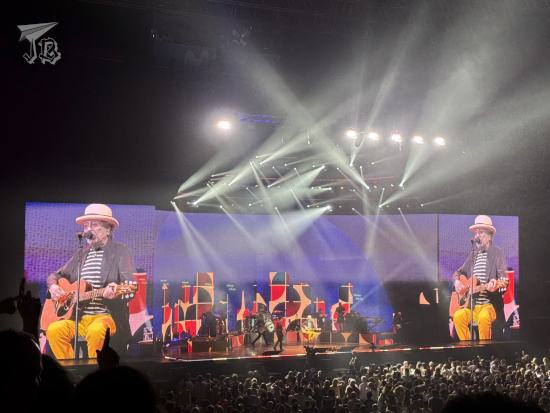
Sabina Hola y Adiós Madrid: musican ensemble

The concert started with Yo me bajo en Atocha (I’ll alight in Atocha), a description and homage to the city of Madrid, which the singer holds particularly dear – despite the fact that he has a bad record with concerts in the city – he once had a panic attack and another time he literally fell of the stage and ended up in hospital. He started sobbing right at the end of the song. Figures.

The venue, of course, cheered and applauded, and stood up to bounce to Lágrimas de mármol (Marble tears), which has too dark lyrics for how… perky the music is, but I guess the message of “survivor, yes, damn it” is what matters. It was during Calle Melancolía (Melancholy Street) when the old guard took over, so Sabina turned the microphone towards the attendees, which did not only sing chorus but brought down the dome with their voices. He was visibly moved.

Good thing that next came 19 días y 500 noches (19 days and 500 nights) a getting-over-a-break-up song during which people can yell, and broke the spell. That made me strong enough for ¿Quién me ha robado el mes de abril? (Who stole the month of April from me?), the first time I’ve actually listened to the song since 2020 – “who stole the month of April from me? I kept it in the drawer where I keep my heart” did not sound so threatening surrounded by hundreds of other people.

Sabina Hola y Adiós Madrid: playing guitar

During Más de cien mentiras (Over a hundred lies), which is a list of all the good things in life and “over a hundred lies that are worth it”, we got the band introductions. Sabina sang himself, and played the guitar for some songs – he stayed sitting down on a tall stool. Safer for him. Antonio García de Diego played guitar, bass, and harmonica; Jaime Asúa Abasolo and Borja Montenegro also played guitar; Josemi Sagaste played sax and non-drums percussions; Pedro Barceló played drums; Laura Gómez Palma played the bass; and Mara Barros did the choruses and had some solo vocals.

Sabina retired to rest for two songs, alleging that it had always been a dream of his to have a song of his sung by a beautiful woman – Camas vacías (Empty Beds), performed by Mara Barros – and by an actual “rocker man” – Pacto entre caballeros (Pact amongst gentlemen) with Jaime Asúa on vocals. Soon after Sabina’s return came a song which holds one of the song lines that has impacted me the most in my whole life: Noches de boda (Wedding nights) hopes that “the end of the world finds you dancing”. I really hope it does.

I guess part of the fun of a concert is that you feel special. Of course that the singer has a speech for every city, and holds each one close to their hearts, or are the best or whatever. But this one did hit differently. I guess my inner child enjoyed it immensely, and even if neither of the songs of the encore did much for me in terms of nostalgia, I was incredibly grateful and happy that I had been able to attend. If it is the last tour indeed, I will have said my hello and goodbye, even if it has been 30 years after the time Joaquín Sabina’s was the only music that played in my room.

Sabina Hola y Adiós Madrid: waving goodbye to the public

Also, another extremely convenient thing: though I went by train, I had a ride home, as my parents were in town and driving back around the same time. Which was great, considering that a storm was brewing, and that there were many underground and train stations still closed due to Pride…

18 & 19th November 2024: Apocalyptica Played Metallica in Madrid (Spain), so there I went

Planning for this short getaway started on the 23rd of February, when I bought my ticket for the Apocalyptica Plays Metallica Vol. 2 Tour 2024 stop in La Riviera in Madrid (50.50 €). Almost immediately, I headed off to Apocalyptica’s website to buy the VIP Tour 2024 Upgrade (58,90 €). The upgrade consisted on early access, photograph / meet & greet / autograph session (the important part), VIP lanyard, fabric patch, pin and tote bag. Honestly, all that for barely 100 € was a sweet deal. Back in Antwerp for Starset, someone I was queueing with complained that VIP tickets were too expensive for “a broke uni student”, but for me, meeting with the artist, albeit briefly is usually worth it – early entry is a plus, too, because for some concerts I either find a barrier spot or I just have to go to the back. The bundle was dispatched on the 9th of June (according to the email. Do Finnish post offices open on Sunday?) and it arrived on the 18th.

I originally booked a cheap hotel about half an hour’s walk from the venue. Later, I decided that I preferred the more expensive one less than 10 minutes away, so I changed my booking a week before the concert. I did not book there originally because it required prepayment, and my card was playing up..

On Friday the 4th of November I received an email with instructions for the Meet & Greet, which was to start at 18:30, and I should be there at 18:15. All right, I could do that. It was only a matter of waiting.

On Monday, 17th of November, I took a morning train to head out to Madrid with some leeway for time because I needed to do some small item shopping. I had to dodge some guys trying to get people to sign up for an NGO, but at 11:40 I made it to my first stop of the day – the light museum Museo de la Luz. I had been putting this visit off to go with someone who had expressed interest. However, I also waited for another exhibit and I missed my chance as it turned out to be only temporal. Thus, I decided to head to the Light Museum on my own – it was also one of the few exhibitions open on a Monday morning.

The Light Museum is a modest exhibition with interactive artworks that are mainly made out of lamps, lasers and lights. When you come in, you are given covers for your shoes and a key for a locker – all for free. Then you wait until an attendant takes you in and shows you how to interact with the first artwork “The birdcage” (La Pajarera), a box made out of light and metal that you make change colours with the movement of your arms. Once you know how to “play” with the art, you are left on your own to wander for an hour. At first I thought it would be tight, but the place was small – a bit too small for the price, I thought. I was there for around 40 minutes in total.

There were few people and I was able to check out most of the artwork uninterrupted. The next exhibit is made out of a number of old music festival lights – those that gave a lot of heat from the 90s, which are supposed to be a reference to climate change. Then there is a giant kaleidoscope you can walk in – this one became my favourite. Other rooms or works include a wall of lights that follow you as you move or dance, something with lasers (that I think was broken), some light illusions, a room full of hanging lights, a cube of mirrors and light… At the end there is a wall reading “light museum” in differently coloured lights. When I left, the lady at reception gave me a badge for booking with the official website.

Light Museum Madrid

Light Museum Madrid

I walked out and headed towards the restaurant where I wanted to cheat the system. I crossed the square Puerta del Sol, where they were setting up the Christmas tree – it was about 45% Christmas. On my way, I walked by the underground stop Metro Banco de España which has a tiny door for Little Mouse Pérez – Ratoncito Pérez, the Spanish equivalent to the tooth fairy. I never remember to check it out when I am around, but I made the connection this time.

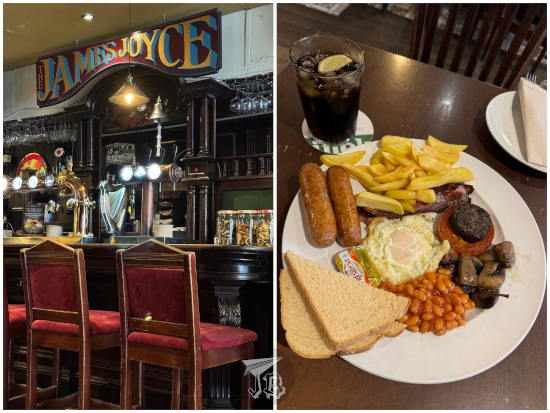
I finally made it to the James Joyce Pub – which is technically a sports bar. I was not there for the TVs though. I had a while back found the place looking up places which served English breakfasts in Madrid. The James Joyce prides itself in being an Irish pub and offers Irish All-Day Breakfast (12.00 €) – two pork sausages, two rashers of bacon, baked beans, fried egg, sautéed mushrooms, grilled tomato, blood pudding, chips, two half-toasts and butter. No, I would not survive that for breakfast, so I ordered it for lunch (and dinner), thus tricking the system indeed. Unfortunately, it was really good and authentic, so now I’ve got to come back for the sausages and the shepherd’s pie, so at least twice.

James Joyce Irish breakfast

After lunch, I headed out towards the park known as Madrid Río. The park runs along the banks of the river Manzanares. It covers 121 hectares, and it was designed after to cover the space emptied when the belt road M-30 was rebuilt as an underground tunnel. The original project was created by a team of architectural studios and landscapers, with strong ecological consideration – aiming to help the area recover from the degradation and pollution caused by years of road traffic. The project was carried out between 2006 and 2012. In 2015, a second project was carried out to “renaturalise” the river, opening the dams to allow the water to flow freely, which in turn caused the recovery of many plant and animal species (to the detriment of… the local rowing team).

There are also bridges that connect both banks of the river. One of them is the one I crossed – just because I could. It is the pedestrian bridge Puente Monumental de Arganzuela, designed by Dominique Perrault. It is a bridge in two parts – one crosses the river, the other overlooks the park and connects to the urban area, and a total length of 278 metres. It is a tube made out of steel and wood that I’ve been wanting to check out for a while.

Arganzuela bridge

Another important bridge is the completely different Puente de Toledo, a baroque bridge built by Pedro de Ribera. It was erected in granite between 1717 and 1732 as the previous ones had been taken down by torrential floods. This one was made to stay, with nine solid arches opened to allow for the river floods. It was… ready for Christmas.

Madrid Río and bridges

It was weirdly warm for a November afternoon, so when I went to my hotel I opened the window while I had a shower. Around 17:00 I headed out to the venue, where there was a small group of people waiting already. La Riviera is a 1,500 people venue, with really good acoustics – and very dedicated staff. The place was originally a cinema, which was turned into a disco, and then into a music venue and nightclub. It is the same place I saw Epica and Apocalyptica in 2023, and I was surprised how many people came for the M&G considering that last year we were… six. We were around 30 this time around.

At first we were chatting in front of the main door, but soon a queue started forming. A little later, the nice security guy (who last year told me “I looked the part of an Apocalyptica fan”) took us to a secondary door, and the queue was properly organised. Surprisingly, bags were not checked – while last year they even took markers from people.

Apocalyptica is a Finnish symphonic metal band. It was formed in 1993 as a tribute to Metallica with a classical touch – playing with cellos. Their debut album Apocalyptica plays Metallica by Four Cellos was released in 1993. They slowly moved from covering other bands in a neoclassical style to their very own repertoire. Today, the members are Eicca Toppinen, Paavo Lötjönen and Perttu Kivilaakso, three classically-trained musicians with a deep love for metal. In 2024, they have gone full circle with the album and tour Apocalyptica Plays Metallica Vol. 2, performing with drummer Mikko Kaakkuriniemi.

Apocalyptica Tour 24/25

We were ushered into a queue for signatures, and afterwards we would go at the end of the line to wait for photographs. I had brought a print-out of the picture from the previous year, and I told them that whenever they came to Madrid, I would come see them. I got a smile for that. It was an awesome photograph, after all. After everyone had their stuff signed we had the photographs. I asked for “a big metal hug” and got trolled instead. Fun times though!

After the photograph, I found a spot at the barrier. Last time I got on the right, this time I went left. Just a little. I did not want to go dead centre in case anyone decided to moshpit, but I might next time as there was no issue – everyone was too entranced for anything like that, I’d say.

The opening act was the Finnish band Arctis, a baby band who has just debuted with their first CD. They were pretty fun, maybe… a bit… too happy bouncy for metal? I’ve read their act described as metal-pop. It might be. I liked them okay, and they were nice.

Setlist:
 1. I’ll Give You Hell
 2. Remedy
 3. Tell Me Why
 4. WWM
 5. Bimbo (Lambretta Cover)
 6. Fire
 7. Frozen Swan
 8. When The Lights Go Out
 9. Theater of Tragedy

Arctis at La Riviera 2024

Arctis at La Riviera 2024

Apocalyptica came on stage at 21:00 sharp, and the live was glorious. All the songs were Metallica covers, from the new album, the first one, or the remastered version of Plays Metallica released in 2016. Despite that, one would not even have to be a Metallica fan to enjoy the concert, because the three men that compose Apocalyptica have an amazing magnetism. Perttu reminds me of the Duracell Bunny, he just did not stop for a second throughout the whole concert, which lasted a good two hours. Paavo seemed to be in his own little world, as he usually does. Eicca is the one doing most of the talking, and he is hilarious when he delivers his puns with a total deadpan voice and face.

Setlist:
 1. Ride the Lightning
 2. Enter Sandman
 3. Creeping Death
 4. For Whom the Bell Tolls
 5. Battery
 6. The Call of Ktulu
 7. St. Anger
 8. The Four Horsemen
 9. Blackened
 10. Master of Puppets
 11. Nothing Else Matters
 12. Seek & Destroy
 13. One

The audience was mostly moved by Nothing Else Matters, I’d say, judging by how they chorused it. Perttu was all in for that. Personally, I found Seek & Destroy and One, particularly, to be extremely powerful. Also, knowing that they dug up the original bass track from deceased Metallica member Cliff Burton for The Call of Ktulu was half-amazing and half-chilling. All in all, it was a fantastic concert, no matter how one looked at it.

Apocalyptica La Riviera 2024

Eicca Toppinen . Apocalyptica La Riviera 2024

Paavo Lötjönen. Apocalyptica La Riviera 2024

Perttu Kivilaakso. Apocalyptica La Riviera 2024

Apocalyptica La Riviera 2024

Afterwards, Arctis was hanging out by the merch. I got their CD, they signed it, we took a photo. It was fun!

I left the venue and I brought an ice-cream and a sports drink for “dinner” of sorts, because I was thirsty. I had both in the hotel room before my shower – the second of the day – and collapsing onto the king-sized bed. I had to wait for the phone to finish charging before I slept though, so I watched a movie before I zonked out.

I woke up on Tuesday, 18th of November and drank my coffee before I set out. It was freezing out there, with frost on the grass, in spite of the warm afternoon the day before. On my way, I found the ancient walls of the city, remains from the old Moorish fortress alcázar, which stand to the side of the Royal Palace and the Almudena cathedral. I walked towards the centre of Madrid – The Sol Christmas tree was about 60% ready – to meet up with my relative for breakfast at a new place called Kawaii Cafe. Inspired by the Japanese kawaii [可愛い]. Kawaii means pretty, childlike, cute, and the Kawaii Cafe has taken the idea to heart, maybe not not in a complete accurate manner though. Everything is pink, full of fluffy and glitter. The food is not only tasty, also pretty. However, the wait staff is dressed as “maids” [マイド], which I tend to associate more to the… hm… more risqué side of hospitality. When food is brought out, you are offered to chant a spell for it to be even tastier.

I found the place existed by chance, and I was instantly smitten by the rainbow waffles, because they were adorable, and very, very rainbow-like. Thus, I ordered them, along a matcha latte. My relative tried the pancakes with a cocoa. She was ecstatic at the quirkiness of the place.

Kawaii Cafe Madrid order

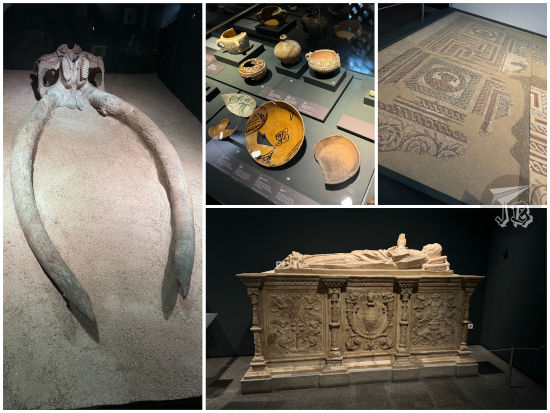
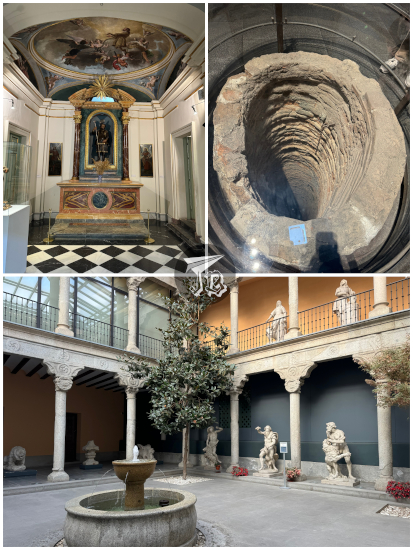
We stayed for well over an hour, and then headed out to one of the local museums Museo de San Isidro – Museum of Saint Isidore the Labourer. Isidore is the patron saint of Madrid. He is credited with several miracles – multiplying wheat and food, having his oxen plough on their own, and rescuing a child from a well making the waters inside rise. According to tradition, the museum is housed where he used to work, and legend has it that the old well is the one he pulled the child from.

Today the museum hosts some palaeontological and archaeological exhibits, from a mastodon and ancient rhinos to Medieval artefacts, running through the Roman occupation and the Muslim period. The place is a complement to the Museo de Historia de Madrid, or maybe its competition, though I think both belong to the same institution – and both are free. As the building is a historical place, it offers the chance to enjoy its small but beautiful Renaissance courtyard, with sculptures of mythological heroes, and of course St. Isidore and his wife. There is also a tiny Baroque chapel.

San Isidro Museum

San Isidro Museum: chapel, well, and courtyard

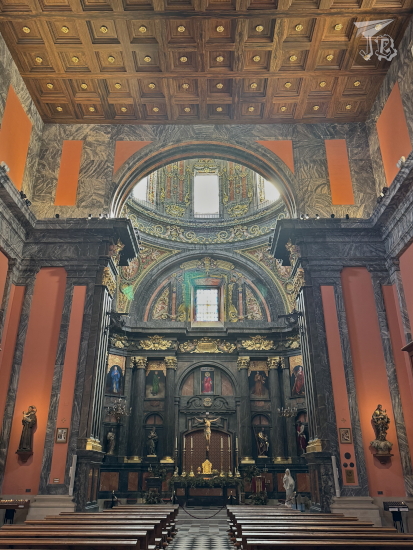
Right next to the museum stands the Baroque church of Saint Andrew the Apostle Iglesia de San Andrés Apóstol , which was getting ready for Christmas. The church is one of the oldest in town, though it was rebuilt after its destruction during the Civil War, and it has been recently restored. It hosts a number of religious sculptures and a painted vault above the altar.

Saint Andrew church Madrid

We took the underground at the station Tirso de Molina, which can still be accessed through the historical entrance hall, which is similar to the one that was closed off in Pacífico. It was beautiful, though of course busier than the museum one. Over the entrance to the platform there is a tile mosaic with the old shield of Madrid, dating back from the original station. It was installed in 1921, and it is the oldest artistic item in the underground network.

Access Hall at undeground station Tirso de Molina

From there we commuted to Nuevos Ministerios, where they had just kick-started the Christmas market. It seemed to be the “brands” market, with Lego, Disney, and so on. There was also a food truck by a famous chef selling basically chicken sandwiches at outrageous prices. I had been vaguely curious but not going to break the bank for a chicken sandwich, especially after such a breakfast!

I took a train from there back home, with no incidents whatsoever (because by now I’m desensitised to trains being late…)