
It might very well be that Madrid’s Expominerales is my favourite drop-in convention – free, easy-to-reach, and full of (literal) shiny stuff, most of which I can’t afford anyway, but I can gape at. For the 2026 edition, I informed my parents I was coming, and they decided to tag along. Ideas for the day included Expominerales and a Japanese wood-prints exhibition. One of my parents decided to add lunch to the mix, and we had a complete plan drawn up. From my previous trainless Expogema experience, I knew that the right time to leave the ETSIME is noon, so we planned to be there around 10:30, since that put us on the most convenient train.
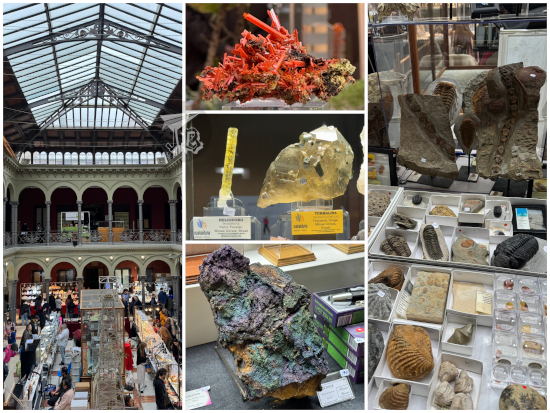
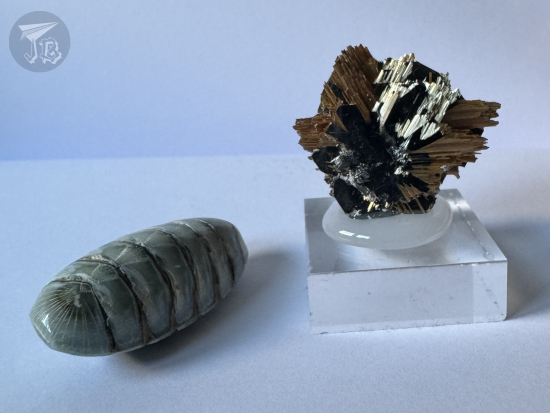
Expominerales is held once a year, usually on the second weekend of March, in the Mining and Engineering School Escuela Técnica Superior de Ingenieros de Minas y Energía (ETSIME). The main event is a literal rock fair – vendors from all over the world (but mostly Madrid) head there to sell their items at the cloister of the university: minerals, fossils, gems, meteorites, or items related to geology, such as magnifying glasses. Sometimes there are conferences or extra activities, and it is always a great moment to visit the little mining and mineral museum Museo Histórico-Minero Don Felipe de Borbón y Grecia. I’ve come to recognise a few of the vendors by now, there is a lady who always has very random shiny things, one who sets a large stand of marine fossils, and a seller who will talk your ear off just because you say hi. One I did not know had brought some rutile (titanium dioxide, TiO2) from Brazil. This mineral is a titanium ore and it is used as a bright white pigment, and also as an ingredient of sun lotion, as it absorbs UV light. I however was just taken by how pretty it looked – and got myself a piece.
Something else I got is a “fossilised” chiton – I’m not completely sure whether it is an actual fossil and not just a cleaned out shell, it’s very light. Chitons are marine molluscs belonging to the class Polyplacophora. There are around 900 extant and 400 fossil species, all native to salt water, usually intertidal and sub-tidal areas. Chitons have one articulated dorsal shell with eight valves, usually composed of aragonite. Early Polyplacophora appeared in the Late Cambrian or Early Ordovician (around 487 million years ago), maybe stemming from a mutated limpet. Their current form evolved during the Paleozoic, having changed little since the Mesozoic (252 – 66 million years ago). Most are herbivorous grazers, scraping algae from the rocks they live on. They can glue themselves to surfaces, or roll into a protective ball if needed.
Of course, we all know that what I really wanted was a huge megalodon teeth that cost as much as I make in three months, but that I did not fall for it. After an hour or so, we headed out towards the underground towards the Real Academia de Bellas Artes de San Fernando, one of the most important cultural institutions in Spain – the Royal Academy of Fine Arts.
The Academia was founded by Felipe V in 1752, right in the middle of the Absolutist period. It was conceived as a “trustee of knowledge and transmitter of the artistic tastes”, to mirror the Paris Academy for the Arts. It became a vehicle to promote Neoclassicism, the “correct” ways to create art (instead of Baroque, which had fallen out of grace), the teaching of the artistic protections and the research on the distant past – including Roman history, such as Pompeii, as at that time Naples was part of the kingdom of Spain. Today, it aims to “promote artistic creativity alongside the study, spreading and protection of cultural heritage, especially painting, sculpting, architecture, music” and whatever is meant by “the new imaging arts”. To be honest, I am not too sure what they do nowadays besides organising exhibits, concerts and conferences. It was running the exhibition “Beauties of the floating world – Bijin-ga in the golden age of ukiyo-e” Bellezas del Mundo Flotante. Bijin-ga en la edad de oro del ukiyo-e.
While the Museum of Zaragoza (Saragossa) is closed down, a lot of its collections are travelling or on loan. One of the strengths of that museum is its Asian Arts collections, part of which is the personal property known as Colección Pasamar Onila (formerly Colección Víctor Pasamar Gracia).
The collection comprises almost 300 pieces of Japanese woodblock printing [木版画, mokuhanga], specialised in the bijin-ga [美人画] topic within the ukiyo-e [浮世絵] genre. Ukiyo-e – images of the floating world – flourished between the 17th and 19th centuries. They were produced en masse, stamping rice paper with successive ink-coated wood blocks that created the final picture. The images represented landscapes, travel scenes, mythology, the passing of the seasons, and famous people – including kabuki actors, sumo wrestlers, members of the nobility, and courtesans. The term bijin-ga [美人画], literally means “images of beautiful people”, mainly beautiful women (美 is a gender-charged kanji, kind of more similar to pretty).
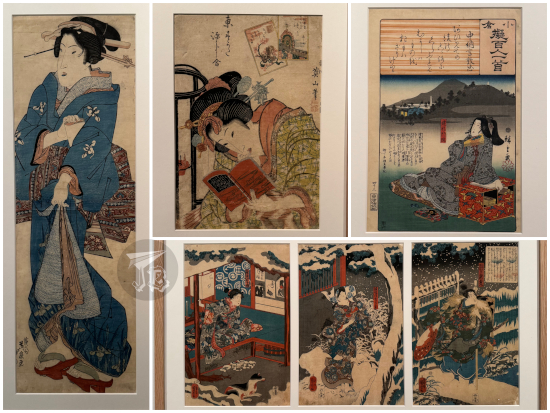
The exhibition organised by the Academia hosts 77 prints that span the whole history of ukiyo-e. Most of them depict beautiful women with different focuses – noblewomen, courtesans, ladies at home, and snippets from the Tale of Genji (one of the classical works in Japanese literature). One of the important details about the collection is that a lot of the prints were originally published by female artists, making it unique in Europe.
My favourite piece of the exhibition was a print from 1823 (Edo Period) by Kikugawa Eizan [菊川英山筆] Momiji no ga [紅葉賀] (“Atumn leaves”, one of the chapters in the Tale of Genji) from the series Azuma sugata Genji awase [東姿源氏合] Eastern Figures Matched with the Tale of Genji, which just shows a woman reading the book looking absolutely absorbed in the story. However, a lot of the prints were extremely impressive, especially considering how rare it is to see so many together, spanning all the ukiyo-e golden age. It does make me wonder the need to announce that the exhibition “contains explicit images” as there are… a whole two erotica wood-prints.
The exhibition is located next to the Goya collection Gabinete Francisco de Goya. Francisco de Goya was one Spain’s most important painters, and he also did several collections of prints in aquatint and etching. The plates that he originally engraved are preserved in the Academia. Unfortunately, these happened in his era of being disappointed by any and everything, so they are gory at best, disgusting at worst – they show humanity at its lowest, to the point that the witchcrafts motifs might be the less disturbing ones.
Afterwards, we crossed over towards Galerías Canalejas, which now features a not-so-small art gallery selling contemporary art. There were no prices, but nothing I would feel drawn to… except some… doughnut-like art with people presented as ants… which was weird, but colourful. Hey, it was cold and rainy, so it was just a pastime out of the winter weather.
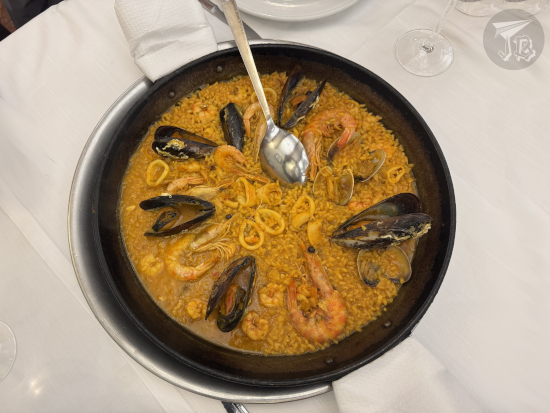
We headed to La Casa Gallega for lunch. This is a place that my parent likes, which is always tricky due to family dynamics. In the end, I got away with a dish I wanted, empanada gallega (tuna pie). We also ordered some smoked cod carpaccio carpaccio de bacalao ahumado and one of the Spanish rices they prepare paella marinera, with seafood (prawns, mussels, squid and clams). It was really good, and I enjoyed it much better than the steakhouse we tried in January.
Finally, we headed back towards the railway system and headed home. Or nap on the train while digesting the rice.

