It was a crisp morning in Vienna when we got up. We went down for breakfast and it was not particularly well stocked. The coffee was… weak, so I decided to mix a cappuccino and a black coffee to get me the energy I needed for the day. I tried some local cake, but I did not enjoy it, so I decided to stick to bread and croissants. Thankfully, I did run into the lady from the day before, and her husband, during breakfast, and told her about our plans – that way at least someone in the group would know not to wait for us and we would not delay anyone. Apparently, we were not the only ones who had made their own plans either, as the excursion had been marketed as “optional” and yet it seemed to be “a given”. Even better, we came across the driver from the day before (despite him saying he had nothing to do with the trip), and we could tell him that we were not coming, either. As we stepped out, it was freezing – literally below zero – but sunny during the whole day.
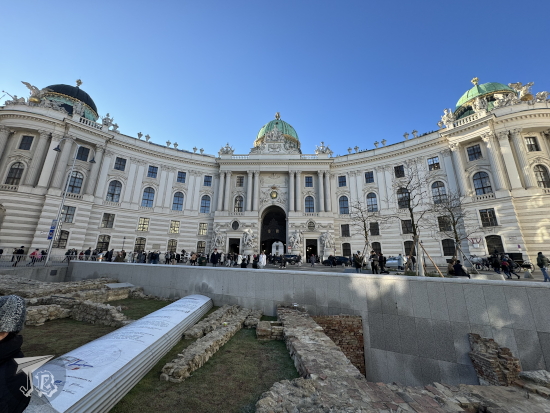
We took the underground at Zieglergasse and headed towards the city centre. I asked my parent to use their phone for GPS and maps in order to keep my battery for as long as I could so I could be taking pictures throughout the day, so they would be guiding. Our first stop was the Hofburg – the former imperial palace – and the Sisi Museum. Empress Elisabeth of Austria (1837 – 1898) was the wife of Emperor Franz Josef I of Austria. She married the Emperor when she was just 16 years old, and was stifled by court life. She spent most of her time travelling and avoiding royal duties. Her perceived eccentricity – today we would call it depression – and assassination in 1898 helped create an image of a romantic heroine in the media that has reached today, especially through actor Romy Shenider’s portrayal in the 1950s.
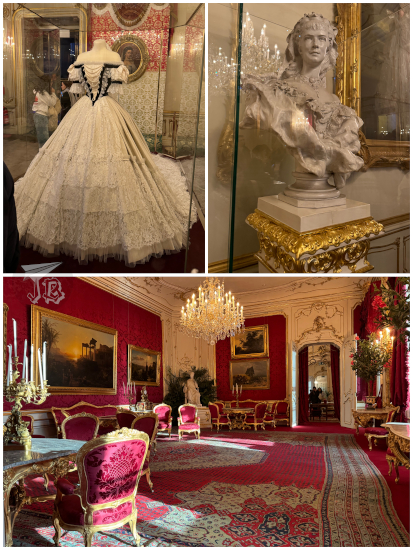
The museum tells about her life by showing objects, portraits and reproductions of her clothes. Then, you step into the former imperial apartments, which have been refurbished with furniture from the 19th century to make them look real. The audioguide was… corny to say the least, and I kind of skipped most of it because I got bored.
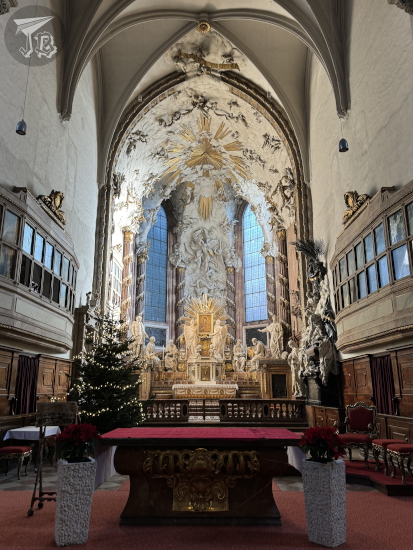
I proposed the church of Saint Michael first, and then the National Library. However, my parent had been intrigued by the church that stood at the exit of the underground. Thus, we headed there. The Wiener Minoritenkirche, Friars Minor Conventual Church, is officially the Italian National Church of Mary of the Snows Italienische Nationalkirche Maria Schnee. The church was erected between 1276 and 1350, and it was one of the first gothic churches in Vienna, following a French pattern. There were many subsequent reforms, including rebuilding the bell tower and the spire again and again – today the bell tower is flat and the spire is gone. The interior altar is Neogothic, by Ferdinand Hohenberg. Since it was still around Christmas time there were Nativities and Christmas trees.

Afterwards, we headed towards St. Michael’s Church Pfarre St. Michael. It started as a late Romanesque or early Gothic building, maybe in 1221. The following two centuries saw Gothic annexes added. The crypt was built in the 16th century. The organ was built in 1714. The Rococo high altar was sculpted by Karl Georg Merville, and it represents the Fall of the Angels after the War in Heaven, when Lucifer was banished; underneath, there is a Byzantine Virgin Mary from the Cretan school. The outer façade was rebuilt in a classicist style in 1791. Construction officially finished in 1792. The crypt is accessible in a guided tour, but considering it has about 4,000 bodies, some of them mummified and on display, I think I’m happy we did not take it.
I proposed going to the Library again, because it was cold and there would be toilets there. My parent took over guiding with their phone, and my sibling and I got distracted as we passed by the Stallburg, where we caught a glimpse of the Lipizzan horses chilling out.
Instead of reaching the Library, my parent decided that we wanted to see the Augustinian church Augustinerkirche, a mix of 14th century Gothic and 18th century Neogothic. The original church was engulfed by the Hofburg as it expanded, and in 1634 it became the official imperial church. May Habsburg weddings were officiated there, and a chapel to the side, called the Herzgruft (Heart Crypt), contains the hearts of the members of the dynasty, from Ferdinand IV in 1654 to Archduke Franz Karl in 1878.

I did not get to go to the Library, but we walked past the Hotel Astoria, which opened in 1912. it was built in the a late Art nouveau style known as fin de siècle (end-of-century). At the time it opened, the hotel was the latest, with electricity, bathrooms and all!
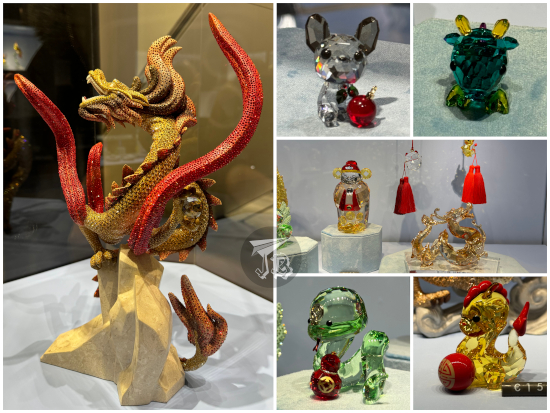
We reached the pedestrian / shopping street Kärntner Straße, the neuralgic centre for Vienna shopping. There we… met the card-not-working lady and her husband again, in what would become a funny number of encounters. We also saw the Swarovski shop. We entered it because we thought it would be warm – and hey, it had a toilet, which was handy, considering we had left the hotel over four hours before. Swarovski is an Austrian glass producer, known for its crystal glass, used in jewellery, decoration, watches, accessories. The company was founded in the late 19th century with the idea of “making a diamond for everyone”. Since then, it has produced thousands of items – from Christmas decorations to sculptures to collectible tiny figurines to whole dresses for the Vienna Opera. The place was halfway between a shop and a museum – and we might have spent a bit more than we had planned there, especially considering we were not planning to spend anything.
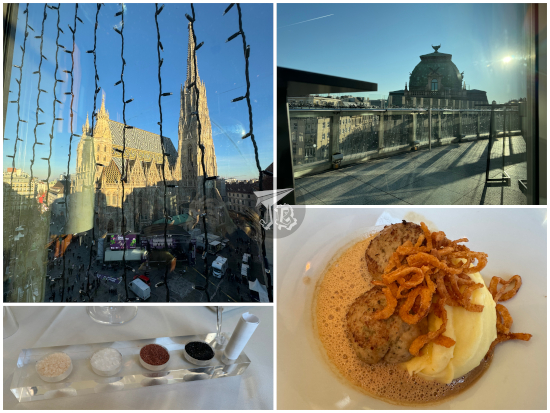
We reached DO & CO Restaurant Stephansplatz, located on the top floor of the post modernist structure Haas House, constructed in 1990. Most of the building is a hotel now. The restaurant has a fun view of the cathedral Domkirche St. Stephan. My parent and I discovered the restaurant because the opening scene of Austrian TV series Kommissar Rex, which ran between 1994 and 2004. It follows the story of German Shepherd Rex, a police dog which is “transferred” to the homicide department after his original handler dies… at the DO & CO terrace. It is such a naïve series, I just love it. Think The A-Team ingenuity with an adorable GSD saving the day every time and stealing sausage rolls as a self-reward. In a later series, Rex would move to Italy, and there is currently a Canadian reboot too…
There were no doggies in DO & CO, but both service and food were superb. They had butter and bread, and small receptacles with different types of salt, and a note on how they should be used. For lunch, I ordered kalbsbutterschnitzel – delicious minced veal butter patties with cream, accompanied with mashed potatoes, fried onion rings and a small leaf salad. For dessert, I had an ice latte that I should not have had, but I saw it pass by and I was smitten. We snuck a number of pictures from the restaurant, too.
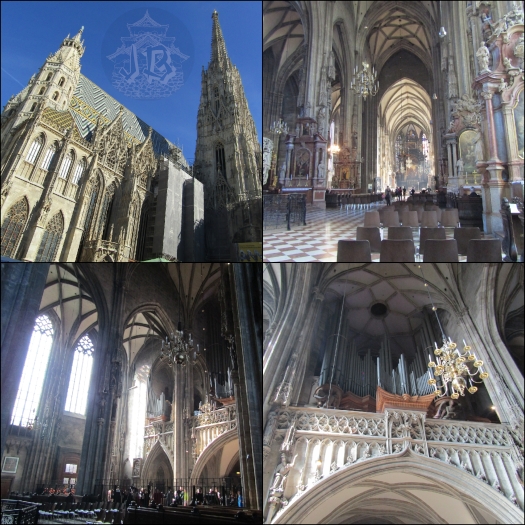
After lunch, we went into St Stephan’s cathedral Domkirche St. Stephan. The building is a mixture of Romanesque and Gothic, and it was initiated around 1137 and completed 1578, and as many as four construction stages can be seen – the first Romanesque towers, the later Romanesque church, the Gothic Choir, and the outer, newest additions. The roof is tiled with as many as 230,000 pieces, one side shows the mosaic of a double-headed eagle, and the other the coat of arms of the city and the country. The bell tower has twelve bells, and the interior hosts as many as 18 altars (plus the ones in chapels). The cathedral was built in limestone, so it looks darker than other churches its size (107 metres long, 70 metres wide and 137 metres high).
The high altar was built in marble by Tobias Pock in the 1640s in the Baroque style. It depicts the stoning of Saint Stephen, church patron and the first Christian martyr. He was stoned to death by the Israelites after a rather inflammatory speech in front of the Sanhedrin, defending Christ’s teaching versus the traditional Jewish ones. According to the Bible, this would have happened a couple of years after Jesus’ death, and before the Roman persecution.

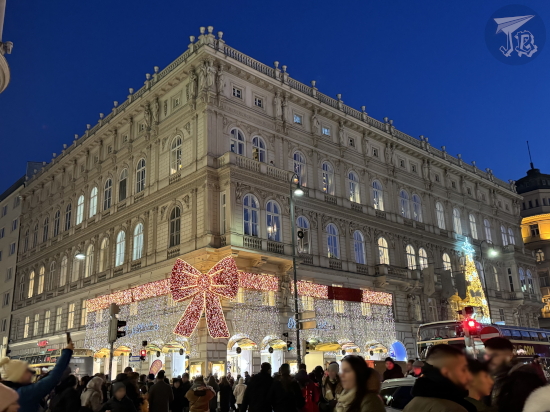
My parents were tired and they decided to head off towards the hotel, while my sibling and myself stayed behind. We wandered around Stephansplatz, Rotenturmstraße, and Kärntner Straße, checking out the Christmas lights and decoration until we reached the Popp & Kretschmer fashion store. They are a luxury women’s clothes firm, which draw tourist crowds during Christmastime to see their huge bow decoration, which makes the whole building look like a present. They call it the Vienna Bow.
We also looked at the Vienna State Opera Wiener Staatsoper, which was prepared to celebrate the new year, with a neon display saying (in English) “Hello 2025”. It was stupidly cold though, so we might have stayed in an underpass for a few minutes longer than necessary.
Afterwards, we headed towards the Sacher Hotel. The five-star hotel was founded in 1876 by the son of a famous confectioner. When the founder died, his wife, Anna Sacher, became manager. She turned the hotel into one of the most refined in the world, catering exclusively to the aristocracy. This management lead the hotel to bankruptcy, and she had to sell the business to new owners, who restored it to its former glory. The hotel serves “the original Sacher-torte”, a chocolate cake coated with dark chocolate icing, and a thin layer of apricot jam in the middle, served with unsweetened whipped cream. It was reportedly invented by the father of the founder, and the recipe is kept a secret. There are other versions of Sacher-torte, but the hotel is the only one with legal standing to call theirs original.
We had a 17:30 reservation at Café Sacher, in the hotel. Sacher Hotel actually has two cafés. The more modern one faces Kärntner Straße and is called Café Bel Étage. It had a long queue – Christmas is peak season in Vienna, as we were quickly learning – but I had been informed that reservations accessed through a particular door. However, that was not where our reservation was – I swear, I did not see the different name anywhere. The historic Café Sacher had an even longer line, and no special door. I dared ask the doorman at the hotel how to get there, and he gave me a huge grin and said “skip the line, go through the exit”. Boy, that was… awkward. Very, very awkward. I though the people just outside would lynch us!
Staff came to check on us, and since our reservation at the Café Sacher was valid – I made the reservation in July, literally as soon as the spots open – we were shown into one of the small salons. The café has a perfect offer – Sacher Sweet Treat: a perfect slice of original Sacher-torte with whipped cream, a non-alcoholic hot beverage and a bottle of Römerquelle mineral water for 22.5 € (31.5 € with a glass of the in-house champagne, Original Sacher Cuvée). I ordered mine with sencha senpai, Japanese green tea. I enjoyed the cake more than I had thought I would, and the tea was great. The staff was incredibly nice, too. They must have been used to silly tourists.

We left the Café Sacher and headed towards the Spanish Riding School Spanische Hofreitschule. For my sibling, this was a core-memory event, so they insisted we got really, really good seats for the Gala Performance Galavorführung at 19:00, on the parterreloge – the box at ground level. The Gala performance is the longest exhibition the Riding School has, and it lasts 90 minutes, with a break. The horses were gorgeous, and the riders looked very cold, but everything felt strangely… cold. I think I liked the exhibit in Jerez Riding School better.
The Spanish Riding School, considered the oldest horsemanship school in the world, was established during the Habsburg Monarchy in 1565. It is dedicated to the breed and training of Lipizzan horses. Lipizzaners are a breed of riding horses developed during the Habsburg empire. It derives from Arab, Bavarian, Spanish and Neapolitan breeds. They were selectively bred so most of them are grey with white coats – albeit there is always a bay stallion in the Spanish Riding School. The breed itself might be traced to eight stallions in the late 1700s, and it was developed in Slovenia. The horses are considered so precious that they were evacuated during WWI, and “rescued” by the US army during WWII. “Lipizzan horse breeding traditions” has been considered Unesco Intangible Cultural Heritage since 2022.
Once bred, foaled and fledged, the Lippizaners are trained. This is done at the Spanish Riding school. The traditional horse training methods used by the school can be traced back to Ancient Greece, and like many other things, they re-flourished during the Renaissance period in the 16th century. The goal of Classical training was to prepare horses for warfare as part of the calvary. Horses train for six year after they turn four.
In Vienna, the Lippizaners are housed at the Stallburg, which is technically part of the Hofburg Palace. It is a Renaissance building from around 1560, originally conceived as a residence but that was later converted into the Imperial Stables. The Winter Arena was built in 1735, and has remained unchanged since then – including the chandeliers. The arena is presided by a painted portrait of Emperor Charles VI.
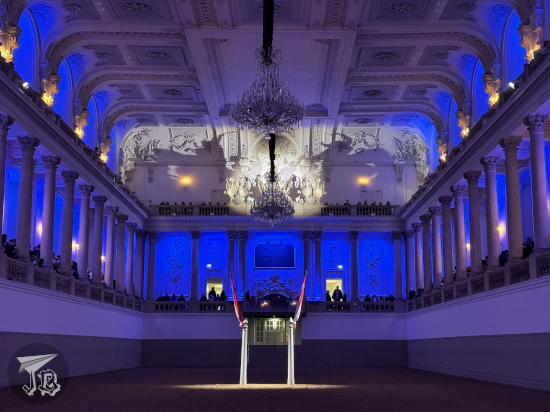
There was something weird in the atmosphere that made it not feel all that… fun. Before every performance, a lady walked to the centre of the arena to introduce the exercises movements in German and English. The performance was pretty though. I tried to sneak a picture or two, but I was unsuccessful – and a bit worried they would kick me out if the venue. There were a total of six different numbers, and the show, including the introductions, was organised as follows:
1. Alle Gänge und Touren der Hohen Schule – “All Steps and Movements of the High School”: four riders and stallions in individual choreographers, including the one dark stallion in the stable, with classical movements.
2. Am Langen Zügel “Schools on the Ground: On the Long Rein” – the riders guide the horse from the ground, they are not on top of the horse, with movements such as piaffe and pirouette.
3. Pas de Deux “Step by Two” – two riders-horses pairs work in tandem, mirroring each other.
4. Arbeit an der Hand und Schule über der Erde “Working Hand and Airs Above the Ground” – with three main movements: levade, capriole and courbette. Four horses work with their riders on the ground, and two of them with the riders on the saddle, but without stirrups. When horses perform well, they get a sugar treat from the rider.
5. Am Zügel “Schools on the Ground: Curb Reins” – only one horse and his rider, who only holds two out the four reins in their left hand, and they hold the riding crop upright in their right hand, a commemoration of the military heritage of the horse riding tradition.
6. Schulquadrille “School Quadrille” (or Das Ballett der weißen Hengste “Ballet of the Eight White Stallions”) – eight horse-rider pairs have to coordinate with each other for a choreography, ending in the Radetzky-Marsch.
When the exhibition came to an end, we tried to go to the toilets. You had to scan your tickets and pay 50 cents. Really. Two hundred quid for the tickets and they charged fifty cents for the toilets, which were filthy on top? A total rip-off.
I got my sibling to the hotel, and then I left again to meet up with my friend D****e and her father Fr***, who were also in Vienna for a few days. They were even staying in a hotel close to ours, so it seemed that we had planned it in advance. We spent a couple of hours in a small eatery – Gschamster Diener – where they introduced me to kaiserschmarrn, fluffy shredded pancakes with raisins, powdered sugar and cinnamon.
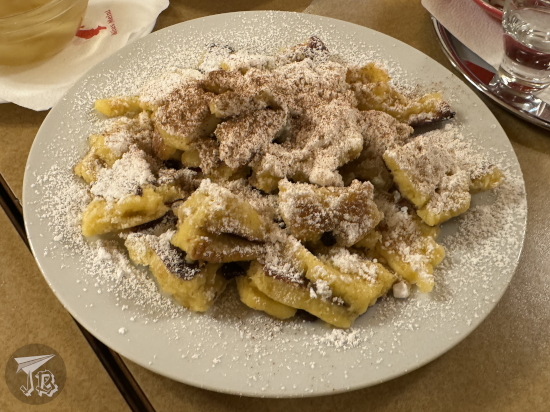
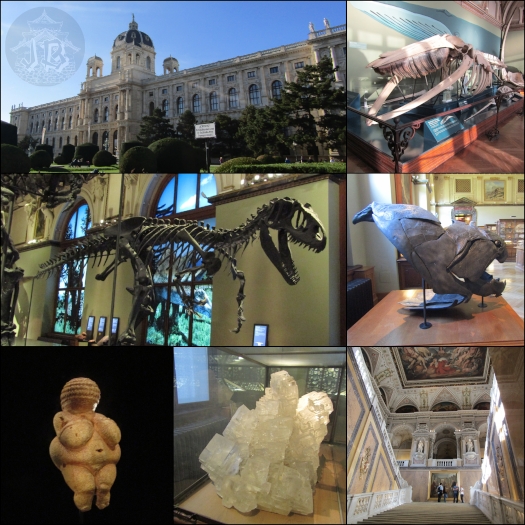
I eventually had to go back to the hotel and my room. There, I spent an hour trying to find a place to book lunch for the following day. After deciding not to plan anything on the 31st, my parents had a change of mind and suddenly I found myself tasked with planning and finding a place for lunch. Most restaurants were either closed or booked off. I was not a happy camper, but in the end I managed to find something… somewhat decent. My sibling suggested the Natural History Museum, the Butterfly House and the Library before lunch. I was absolutely sure that was impossible to cram three things in the morning. We would not even do the entire Natural History Museum, but at least we would be somewhere warm. I resigned myself not to see the Library, had a shower and went to bed.









 JBinnacle – A Travel Logbook