6th April 2025: Birds of Prey experience with Emociones Al Vuelo (Aranzueque, Spain)

The 2025 Medieval fair in Tendilla had fewer animals than usual, as the farm was not there on Sunday. However, there was a stand by a birds-of-prey rescue. I was sad I had missed the demonstration on Saturday till I got talking to the lady there. It turned out the rescue had visits. And activities. And activities you could book and pay for. This is important because animal interactions tend to favour kids, which is good for environmental education and all, but makes me jealous…

Emociones Al Vuelo is an education centre and birds-of-prey rescue / charity established in the small village of Aranzueque. It was set up in 2016 to fill a gap and take care of birds which could not be recovered nor released into nature due different circumstances – for example, a kestrel born in the wild, but taken as a chick to be sold in the black market. Or what’s even more shocking to me, hybrids! There are weirdos out there JurassicWorld’ing birds of prey (Your scientists were so preoccupied with whether or not they could, they didn’t stop to think if they should. Creepy). These animals often bounce from home to home as hunters acquire and then get rid of them, until the rescue intercedes. The rescue also takes care of animals that used to belong to negligent owners, with broken limbs, or out of breeders’ hands.

The organisation seems to be doing a good job. The birds looked relaxed and were allowed to… basically ignore their “jobs” until they were properly bribed with food, and if they did not want to “work”, they were properly excused. All the birds are tagged and have their names – all of them kind of nerdy: Star Wars, Game of Thrones… They seem to be quite comfortable with the handlers and with the strangers most of the time.

There are three ticket tiers: “basic”, “fly an eagle” and “emotion pass”, which allows you to hold – or be a perch for – five of the tamest birds, and fly the eagles on top of that. I decided that since the tickets were to support the rescue, I would make the sacrifice and get the highest tier… And we all know I’m lying, I totally got the highest tier because I was dying to play with the residents.

Birds of prey, sometimes called “raptors”, are a group of bird species who actively hunt and eat other vertebrates. These strict carnivores are fast flyers, have acute vision, and sharp talons and beaks to help them hunt. Some of them are also scavengers or piscivores. In general they’re characterised as active predators. Though the term “bird of prey” is not really “scientific”, it is very visual and easy to understand. They range from the smallest pygmy falcon, with a wingspan of around 40 cm to the largest Andean condor, whose wingspan can reach 3.3 m. In general, male and female of the same species are different in colours, and at the very least in size, with females usually bigger and stronger, even if usually raptors are lighter than their feathers make them look – on top of feathers having next to no weight, birds have hollow bones to help them fly. Fun fact: nocturnal raptors tend to have dark eyes, diurnal ones light-coloured eyes, and those which are active during dawn and dusk have reddish or golden eyes.

Birds of prey have been used for hunting – falconry – for over 4,000 years, with the earliest references coming from Mesopotamia and Mongolia. Writings from the 7th century CE describe it as widespread in Asia, but as it seems that nothing ever existed before the Europeans found out about it, one has to wait until Frederick II, Holy Roman Emperor (1194 – 1250) wrote his treatise On the Art of Hunting with Birds for it to become commonplace. During the Middle Ages, falconry became a symbol of power and status, especially for recreational hunting, until the raptors were substituted by firearms. Falconry became popular again in the 20th century, and in 2010, it was added to the UNESCO List of Intangible Cultural Heritage of Humanity.

While the birds in Emociones Al Vuelo are somewhat trained to at least tolerate human presence, what the rescue does cannot be considered falconry. The birds fly from protective glove to protective glove in search of treats, but they are not really trained for tricks. One of the things that we visitors were told is that the birds “fly off” the gloves, not made to take off, as you see in films.

I arrived in Aranzueque around 9:35 for the 10:00 show, with gates at 9:45. It was a crispy morning, but it had been raining all March, and finally there was sun and a decent forecast. I was wearing layer upon layer anyway, and was happy to shed them off as the day warmed up. To be honest, when I booked the place, I did ask if there would be a rescheduling should the weather be miserable, but aside from some mud on my boots, I had nothing to worry about.

Once gates opened, visitors parked inside – people from the rescue have maximising parking space down to an art – and checked in. I had paid when I booked, and I received a lanyard pass and a paper bracelet.

The base activity lasts about three hours. The guests sit on benches arranged in a circle under a tree – I found a spot and made sure my back was to the sun for pictures. There was a brief introduction of very logical rules for the animals’ wellbeing. The activity – I feel reluctant to call it a show – brought out 14 birds of nine species and I got to interact with five different species, and a total of six – seven animals.

The first bird to come out was Sansa, the (Western) barn owl (Tyto alba). Barn owls are mostly nocturnal birds, white to reflect the moonlight, and with brown specks on their back for camouflage on the ground. They are not the biggest raptors, though they can reach a wingspan of almost one metre. They’re mostly recognisable because they have a heart-shape face, and black eyes. At first, Sansa did not seem to want to make friends, and she flew high up the tree, but after some bribing she agreed to come say hi. She was the first bird we interacted with, she flew from glove to glove to snack.

Sansa, the (Western) barn owl

Sansa, the (Western) barn owl

The second raptor was a tiny one – a little owl (Athene noctua) called Xena. In Ancient Greece, little owls were considered the companions to Athena, Goddess of War and Wisdom. They’re small birds with yellow eyes and brown-and-white plumage which mimics the bark of trees. Xena was happy to be walked around and set on shoulders and heads for her interaction turns. She did not approve much of my glasses for some reason.

Xena the little owl

Afterwards, Nymeria was brought out. Nymeria is a rescue hybrid, born from combining a lanner falcon (Falco biarmicus) and a peregrine falcon (Falco peregrinus). She has never really flown and it was hard for the rescue to take care of her, since she had several congenital and behavioural issues when she was taken in. She’s still getting used to seeing people, but she is apparently getting better.
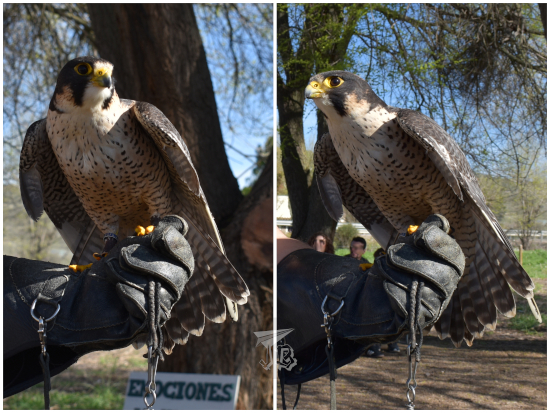
Nymeria the raptor hybrid

Another rescue was Ripley, a common kestrel (Falco tinnunculus). Kestrels can reach a wingspan of 80 cm, and though males and females look different, they tend to be chestnut brown with darker spots on the back, and lighter spots on the underside. They also have a black or darker mark around the cheek (malar stripe). Though they are not considered endangered, their nesting areas are protected in places like Plasencia. Ripley was chicknapped and ended up in a legal limbo – when she was found, she could not be kept, could not be released, until she found her home in the rescue. She was very happy to flop from glove to glove and snack on the fresh meat she was given as an incentive.
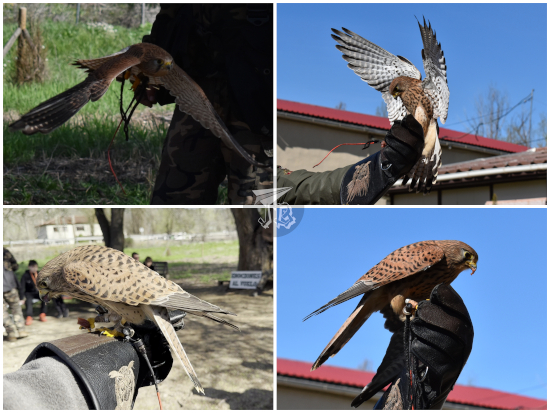
Ripley the common kestrel

The Eurasian eagle-owl (Bubo bubo) is a bird of prey that has always fascinated me, since I was really small and I heard that a) there was one in our attic and b) they could hunt and eat little children. Somehow, looking back, I doubt either of those statements were true. And despite it all, I was literally never allowed in that attic for the nine years we lived in the house… Eurasian eagle-owls are amongst the largest owls, with almost two metres of wingspan. They are easily recognised by their orange eyes and their facial feathers pointing upwards looking like “ears” or “eyebrows”. They always look like they disapprove of you. They camouflage really well against tree bark, being different shades of brown in spotted patches. The rescue has two of them – Dracarys, the male I got to hold, and Storm, a less tame female.

Dracarys the Eurasian eagle-owl

We then met Vader the common raven (Corvus corax). Ravens are not birds of prey, but are closely associated to them. In nature, when an animal dies, ravens are among the first scavengers to arrive. Their black-blue iridescent plumage is easily spotted by flying raptors, who come join the feast. Don’t get fooled, ravens are bigger than they look – they might reach a wingspan of 150 cm – but most importantly they’re smart – they analyse, problem solve, imitate, recognise individuals, and hold grudges. Vader has mastered the opening of lids in order to access snacks…
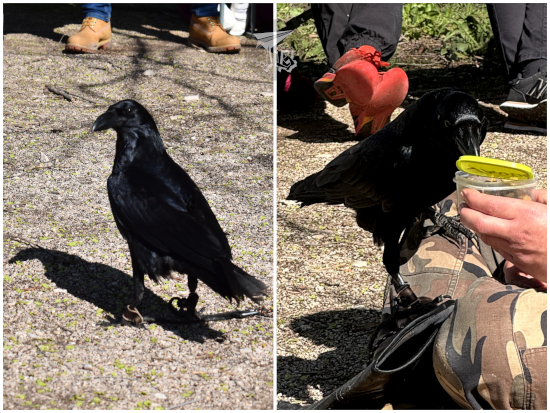
Emociones Al Vuelo Raven

Next came the oldie-but-goldie Blue, a female Eurasian goshawk (Astur gentilis), who was taken in from a breeder after 12 years of laying eggs for them. Goshawks are medium-large raptors (up to 130 cm) with a distinctive striped pattern across the underside, and a greyish back. They have piercing reddish eyes and one hell of an attitude. They are extremely territorial, and usually live in breeding pairs, though females are known for being able to kill the male if he does not bring food to the courtship.
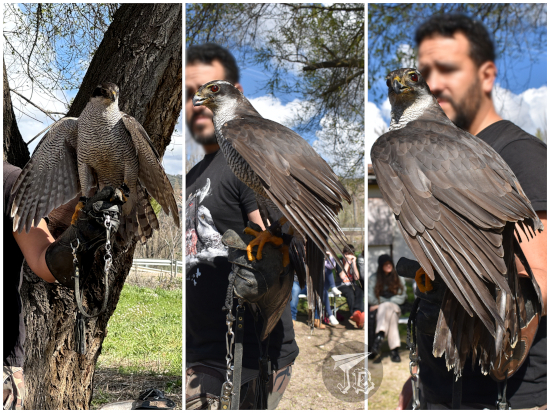
Blue the female Eurasian goshawk

Later came Valyria the Red-tailed hawk (Buteo jamaicensis). She seemed that she would be happier chomping on fingers than perching on gloves. Red-tailed hawks are endemic to North America, and they are diurnal hunters of up to 141 cm wingspan, with females being much larger than males. They do not fly around for prey, but hunt from a perch, and their brown and dark plumage helps them camouflage against the bark of trees, their tail is predictably reddish when seen in flight.

Valyria the Red-tailed hawk (Buteo jamaicensis)

The final species we got to see was the Harris’s hawk (Parabuteo unicinctus), which I’d also seen in the Medieval fair in Alcalá de Henares. They can reach 120 cm of wingspan and are also quite intelligent. They originate from the woodlands and semi-deserts in the Americas, thus they tend to be brown and black, with a little spotted white. They live and hunt in stable groups with a dominant female and her mate. They have developed pack-hunting strategies, with half of the group scouting and half of the group doing the killing. They currently are the most popular raptor in Western falconry, often used to control smaller birds’ population. They are apparently easy to train and they are quite social. There were three of these animals we got to interact with – Tyrion, Winter and Arya.

We could go out to the “flying field” and “play” with them. Tyrion did not seem to want to play a lot, and had to be benched. He actually did only two or three flights – the first one was towards me, and I got to hold him for a while longer since he did not want to fly away. Something that surprised me was how light all of the birds were – I had been worried I would be unable to hold them, but as I mentioned before, feathers and hollow bones make them absolutely… unheavy.

We had a few flights, which yielded to cool pictures, and then some “games” which involve trying to get the hawk to fly between two rows of people, or underneath someone else’s legs. There were some more explanations about behaviour in the wild and the dynamics of the birds and their human caretakers. We actually got to hear a lot about how the different birds interact with each other and their humans throughout the three hours the activity lasted.
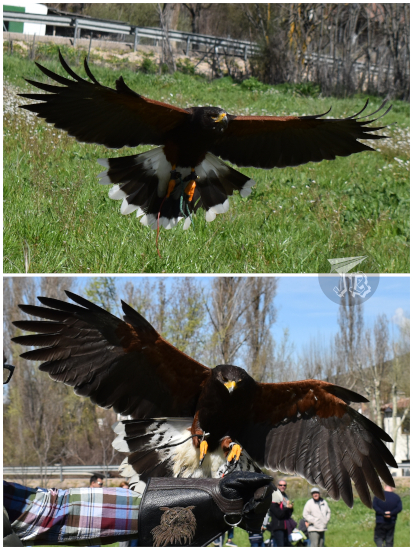
Harris's Hawks mid-flight, wings open

Harris's Hawks coming to the falconry glove

At the end, everyone – even those who had not got the interaction pass – could take a picture with one of the Harris’s hawks. I ended up signing up to another activity – a wildlife photography course – but that one was eventually cancelled due to lack of sign-ups. I drove back home, happy the weather had been almost perfect, and hoping I had not get sunburnt. I also managed to make it through the day without cracking a Jurassic Park joke, but obviously not a whole post – so I shall just remind you here that birds are direct descendants from dinosaurs… Or why do you think they chose “Blue” along all the Game of Thrones references?
23rd February 2025: The Annual Medieval Fair (Tendilla, Spain)

For the last few years, the Medieval fair Feria de Mercaderíass de San Matías in Tendilla has started on the 25th (2022), 24th (2023) and the 23rd (2024) of February. So it makes perfect sense that my mind placed 2025’s edition start on the… 14th, right? Since the fair celebrates St. Matthew, and the onomastic is the 13th, I unilaterally decided that the fair must be that weekend. Obviously, I was wrong, and the fair was held from the 21st to the 23rd. Due to the date mishap, I had a visit booked on the 22nd, and I amended my plans to head to the fair on Sunday the 23rd instead of on Saturday as I usually do – that way I could see the Palace, the Botarga Parade and the Fair on the same weekend.

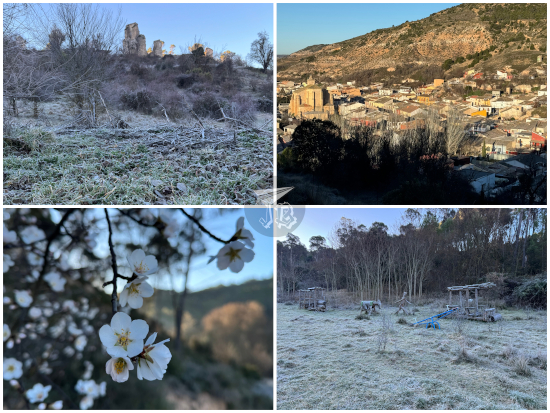
It was a good thing that I decided to go to the Parade instead of trying to make it to the fair on Saturday, because apparently they were blocking cars from entering the village, but not letting them park anywhere close-by which… is a problem. To avoid a similar issue on Sunday, I drove to Tendilla before the fair even opened, so I was there around 8:40. I used the time to climb up the frozen nearby hills to see if there were nice views from above. I also headed into the pine forest, which was covered by a thin layer of frost everywhere. It was pretty.

Tendilla: Landscapes before the fair started

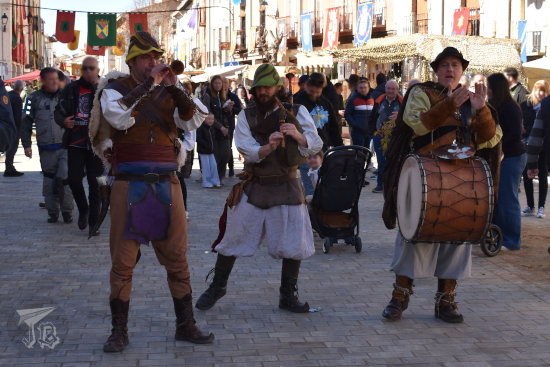
There was a parade scheduled to take place at 11:00, which did not happen until around 13:00 – there was just a trio of musicians going up and down the main street. In the mean time, I wandered up the fair, and stayed around the ox paddock hearing things like “such noble eyes the animal has” from the mouths of city-dwellers. The poor oxen seemed pretty much used to to be stared at, so they just munched on hay with an air of resignation. There were two of them separated from the herd, which would later be yoked to a traditional cart. Looking back, I’m slightly surprised that I did not get any allergy symptom from their straw.

Three musicians in Medieval Clothes

Oxen in the Medieval Fair

I also found the newly-inaugurated statue to honour the fair – a tiny farmer with two donkeys standing atop a column which… was a bit underwhelming, to be honest.

La borriquilla - the little donkey

Around noon, a queue started forming for migas. In the mornings during the fair, some of the villagers prepare this typical dish from the area for all passers-by (queuers-by?) to enjoy. The traditional migas are made from fried breadcrumbs, paprika and meat from pig slaughtering. However, Tendilla is famous for its torreznos (processed pork lard snacks), so these communal migas are served with the local dry treats, and accompanied with a glass of wine to be washed down. I had never queued for them, but some family members saw me when they were almost at the front of the line and I was snuck forward in exchange for some photos. I also got to talk to one of the stand owners, and I discovered about a place called Emociones al Vuelo, a bird-of-prey rescue and training centre which organises activities. I may or may not have decided to pay them a visit.

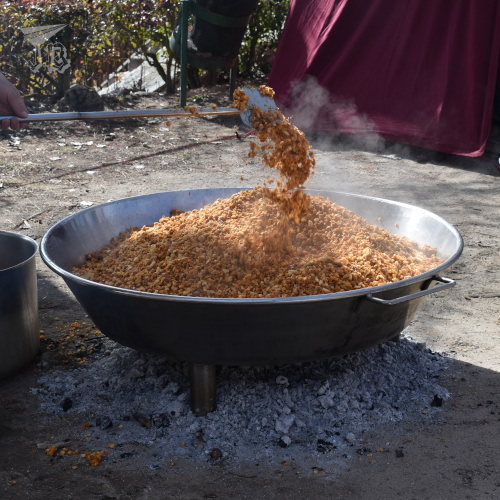
Communal migas being prepared

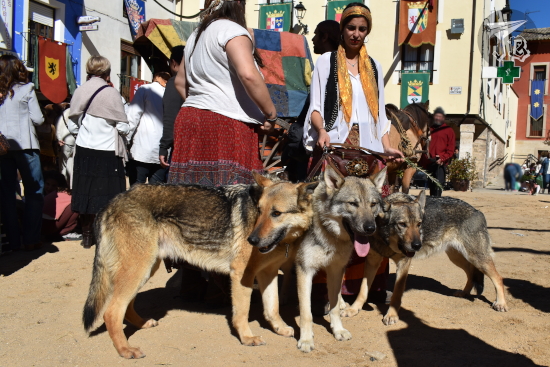
We snacked, and then moved around the village. I was in the middle of Main Street Calle Mayor when the parade came through. The troupe had changed this year, and it was not Christian knights and moors, but gypsies and magicians. They brought horses and “wolfdogs” – not actual wolfdogs but wolf-looking domestic dogs. Enough to fool a lot of people. There was supposed to be a tournament, but apparently the gypsies were not up to it. There was no tournament, and after an hour of waiting, the troupe went back to the Main Square Plaza Mayor, did a couple of horse tricks, and started cutting ham to share with the onlookers. It was a bit disappointing, but I least I got to pet the dogs.

Troupe of horse riders dressed as Medieval gypsies

Dogs from the gypsy troupe

I headed to my relatives’ place and we prepared lunch, though I had some leftover migas that had been saved for me from the previous day, and a fried egg on top. Much better than the communal ones, for real.

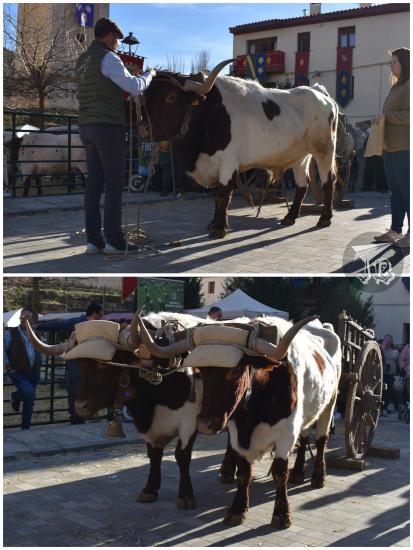
The last activities for the day were related to the long-suffering oxen. First, two of them were yoked to a traditional hay cart and children were given rides through the fair. The two oxen were led to the cart and then tied to the structure. Something that I had never known was that part of this tie went around their horns and forehead, so the owners placed a small pillow on the animals’ foreheads for them to pull more comfortably. However, to do the tie the knots as strong as it was necessary for them to be, he had to use his foot as leverage on the ox’s head… Once the animals were yoked, the cart started moving. One small child who had apparently been asking about the ride all day long was the first to be helped on the cart – even though some others tried to cut the line! At first, they went up and down the village, but apparently some idiot spooked the poor animals and the owners decided to just move around the main square afterwards.

Oxen being yoked

After six or seven rides, the oxen were untied and let into the paddock. A lorry was brought and the owners created a mini stampede for all the oxen to go into the vehicle. That was wickedly cool.

That was the last activity, so I decided to say goodbye to my relatives soon and drive back through the sunset. Most of the stalls were already closing anyway and there was no way I was going to stay for dinner – because that would mean I’d have to actually eat more that day, which was not the plan.

On the way back I drove into a very weird traffic jam. It did not happen around the bottleneck, but much much earlier, and the bottleneck was clear. I’ve never understood traffic jams anyway…

So all in all, I had a very complete weekend, combining Madrid, Guadalajara and Tendilla, I had relatively good weather, and got to check out most of what I wanted. The only downside? Having to go to my day job on Monday without having caught any rest!

13th October 2024: Mercado Cervantino de Alcalá de Henares (Spain)

Alcalá de Henares was the birthplace of writer Miguel de Cervantes, author of Don Quixote, one if not the most important novel in the Spanish speaking world – often considered the first modern novel in Western literature. Thus, a lot of the town activities are presented in relation to Cervantes, one way or another.

Renaissance Fairs are getting popular in the centre of Spain, and Alcalá has dubbed its own “Cervantine Market” Mercado Cervantino as part of a week-long celebration of Cervantes’ christening Semana Cervantina. I missed most of it since I was in Türkiye, but on the last day I was able to drop for a couple of hours with my sibling.

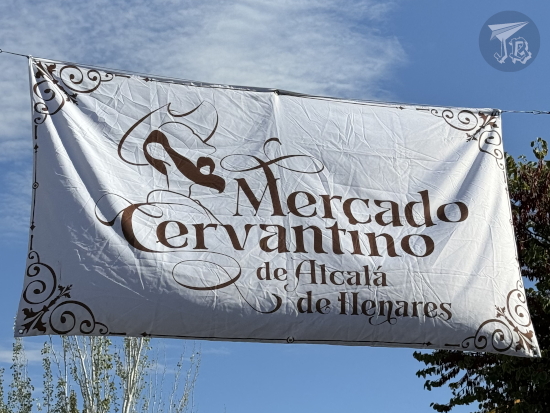
Mercado Cervantino

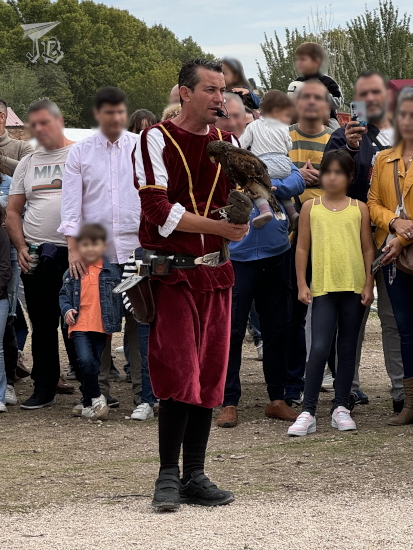
We reached the market around 11:30, too late to hear the cannons. It being a Sunday, everything was packed. We got to see Don Quixote and his sidekick Sancho, a horde of orcs, and a falconry exhibition by Francisco Miranda and his Harris’ hawk.

Don Quixote

An orc

Falconer

Harry's eagle mid-flight

Afterwards, I talked my sibling into dropping by the nearby Archaeology and Palaeontology museum Museo Arqueológico y Paleontológico de la Comunidad de Madrid, MARPA. The exhibition Cazadores de DragonesDragon Hunters – is still on, and I was not going to waste the chance to see the Concavenator (Concavenator corcovatus). I realised they had brought some extra merch for the exhibition, and I decided to drop by in the near future.

Concavenator Skull

We went off for a late lunch afterwards, and later I just drove off.

24th February 2024: Feria de las Mercaderías de San Matías 2024 (Tendilla, Spain)

Going to the Medieval Fair in Tendilla around the festivities of Saint Matthew’s Feria de las Mercaderías de San Matías seems to have become a tradition. Though they close off the village to traffic, I know the area well enough to know where to ditch the car so I can get in and out easily. Since last year, I’ve been driving in early on Saturday, before the scheduled events start so I can help out with the shopping for the day – there’s the tradition of cooking breadcrumbs, migas at my relatives’, and it’s a big meal, so we usually need to get some last-minute stuff.

The weather forecast was miserable – and there was the risk of a huge storm like the previous day, so this year there were fewer stands and visitors. That, in turn, meant I ran into many more acquaintances than usual, as it was harder to blend in…

After getting everything ready, we left the house around 11:30 to walk around the already-set stands and look at the communal migas. There was not much of interest on display. We walked into the women’s association ladies, giving out confectionery items, and we tried those. A bit after noon, the opening parade set off, with musicians, dancers and giant puppets.

Opening parade

Then we found a place at the edge of Main Square Plaza de la Constitución, to watch the equestrian show by the group Caballeros del Alarde, called Privilegio de Juan II de Castilla. It was very similar to the one they did in 2023 – they make sure that the square is covered in sand and prepare two U-shaped courses and they do different activities on the horses, trying to emulate a joust. At the end, they brought out a small hawk – which they called “fat” – so it got used to people. During the show there was a few minutes’ worth of hail, nothing serious. It was chilly all through the day, though.

Stuntment doing horseriding exercises

Afterwards, we went home to make lunch and we happily ate our migas – breadcrumbs seasoned with paprika and fried with garlic and minced chorizo, with a sunny-side-up fried egg on top. Some people like eating them with grapes or orange bits, but I just like them “plain”, so I ate the fruit later.

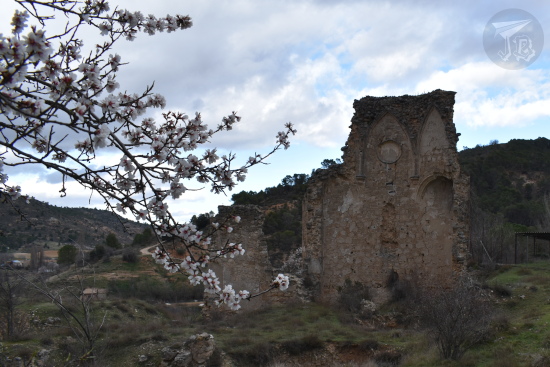
Once fed, family needed to entertain some guests and I made myself scarce. I headed out on my own, and I went to see the animals at the exhibit at Plaza de Vicente Mariño. It was still early and bright, so I decided to climb up to the ruined monastery Monasterio de Santa Ana. As spring was nearly upon the village, the almond trees were in bloom despite the cold, and it was really pretty.

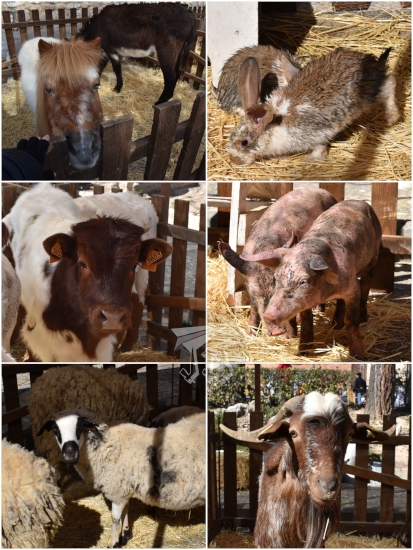
Animals at the farm exhibit - A rabbit, a horse, an ox, a goat, two geese, a pig and a herd of sheep

Saint Anne's Monastery with flowers in the foreground

I went back home and we decided to show up to the “guided visit” that the town hall organised. Right now, this is the only way to see the recreation of a traditional house that has been built in the ethnography museum Museo etnográfico. It made me feel old, because there were a lot of things that I was used to seeing – and using – when I was a kid. However, the guide was… not too good. She even said things like “oh, I’m not rural, I wouldn’t know what that is” about some items.

Afterwards, we tried to find a good spot to watch the parade-show by the cultural group Asociación Gentes de Guadalajara, which started after dusk. They played the funeral parade for the Count of Tendilla Cortejo fúnebre con el catafalco de D. Íñigo López de Mendoza, I Conde de Tendilla. Born in the Mendoza family, one of the most powerful clans during the Castilian Middle Ages, he was a politician and warrior. The Count participated in the power struggle before Isabel I was proclaimed Queen of Castile. He died in 1479, and was originally buried in the monastery Monasterio de Santa Ana. Later, his tomb was relocated to Guadalajara, and eventually destroyed during the Civil War. The whole thing was very solemn, and we ended up catching the parade at three or four points. We even could catch part of it from the balcony at home as they turned to “bury” the Count in the church.

Burial of the Count of Tendilla

We went back to the square Plaza de la Constitución to watch the last show of the day – by now dark night. It was supposed to involve the Knights Templar arriving, and then dancers and jugglers, but apparently the Templars got lost. A lady danced with fire, and there was a scuffle with fire swords, but no knights. That was a bit of a bummer.

Jesters at the Medieval fair

Afterwards, I went to find my car and drive back before all the Sunday drivers finished having their dinner and left. I hoped that would mean fewer idiots on the road. Unfortunately though, I still could not avoid the stereotypical idiot using full-beam headlights behind me. It seems there is always one of those when I drive at night.

21st September 2023: Puy du Fou España (Toledo, Spain)

Puy du Fou is a project which started in France in 1977, when Philippe de Villiers decided to create a show in the ruins of a Renaissance castle in Les Epesses, a village about an hour away from Nantes. Initially, the show, named Cinéscénie was not too successful, but it increased in popularity as spectacular elements with horse riding and sword fighting acrobatics were added. A theme park was built around the show in 1989, and the venture went on to become one of the most popular parks in France, after Disneyland and Parc Astérix. Between 2019 and 2021, the French project was exported to Spain and turned into Puy du Fou España, located in the central city of Toledo, one of Spain’s most historical towns. Toledo is close enough to Madrid that the park can be visited on a day trip from there, and the land around it were probably on the cheap side.

Regardless of the logistics, Puy du Fou España markets itself as a historical theme park. It does not have rides, and instead, it focuses on shows, restaurants and shops. There is a day-ticket and a night-show ticket and we combined both on the same day. We reached the parking lot about twenty or thirty minutes after the park opened and had to walk for about ten minutes until we reached the entrance. We had booked a “fast pass” called Pase Emoción, which guaranteed access to all the shows at specific times, and the walk-throughs without having to queue. We had also reserved lunch, though by the time we bought tickets, the lunch-show was already sold out – we knew we risked this, but the weather had been unpredictable, and we did not want to be caught in a bad storm so we waited until the previous week to decide. While we did have some drizzle during our visit, it mostly found us indoors, so aside from the hassle of putting the camera out and having to pull it out again (and again, and again), it was not a real problem.

Summary of bookings (times three; four tickets per person):

  • Experience 1 day: Park + Night show: Parque + El Sueño de Toledo Ubicación Plata – Entrada 1 día Adulto, 68.00 € (non-weekend, non-high-season price) separated into:
    • Park ticket: Parque 1 día Adulto, 27.20 €.
    • Night show: Espectáculo Nocturno “El Sueño de Toledo” (best seating available), 40.80 €.
  • Fast pass: Pase Emoción, 20.00 €.
  • Lunch: Menú Hospedería de Santiago – Adulto (first course, second course, dessert and drink, saving a couple of bucks from the on-site price): 22.05 €. We decided to book lunch because we thought it would be harder to find a spot, and that for dinner we could grab a sandwich or something. In the end, we had a snack and a drink in the evening, which came up to around 11 € / person, bringing the total spent in the park to 121.05 € (no souvenirs, no extras).

We visited the park on a September Thursday, so we were not expecting many people. The first surprise was the number of buses in the parking lot – yes, there were quite a few people, though not “crowds” as no doubt they have during summer season. We were directed to the private-car parking lot, on the other side of the area and closer to the entrance, but we were “late” enough so that eight double-lines of cars had already been filled. We walked the kinda-long road to the park and picked up our fast passes, which were already prepared on a lanyard, and we were given times for four shows, along with the two others to do “whenever”, which turned out to be walk-throughs.

Thus, according to the bookings and the pass, we had the following schedule and in theory no queues:

  • 12:45, show: A pluma y espada.
  • 14:00, lunch at Hospedería de Santiago.
  • 15:45, show:El Último Cantar.
  • 16:30, show: Cetrería de Reyes.
  • 17:30, show: El misterio de Sorbaces.

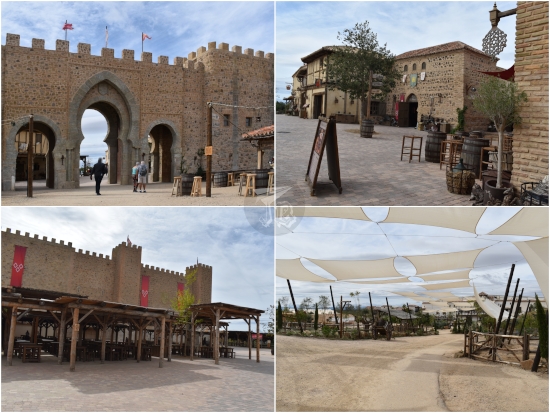
Puy du Fou España Historical Village Puebla Real

The park is organised to look like a Medieval village – castle included – with both Christian and Moor flavours (using the word “Moor” to refer to the different Muslim groups that populated Al-Andalus in the Middle Ages). the different shows are scattered throughout the park and there are small clusters of shops, restaurants or activities. The distances are long and though there is some protection, it would not protect from rain nor sun / heat. There were “watering points” but no fountains at them? I think that’s where people selling water bottles stand in summer. I probably should have done more research on the whole thing, but I was just tagging along someone who really was curious about it and I was happy to let them take over the organisation. Instead of wandering around a little, they decided to go inside the theatre that hosted the first show almost at the time doors opened to let people without the fast pass in. Thus, we waited for about half an hour until the show started.

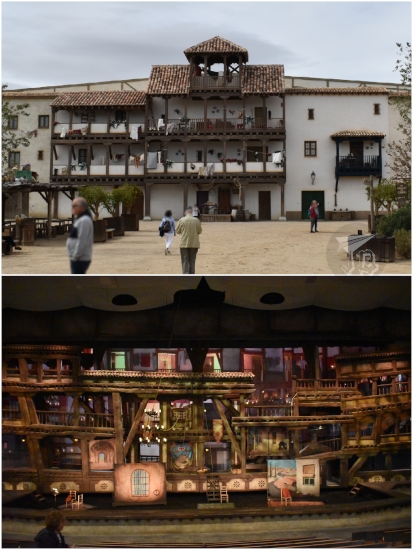
A pluma y espada, “With quill and sword” is an adaptation of one of the French shows, about Musketeers. That makes more sense than the Spanish version – which follows 16th-century playwright Lope de Vega as he tries to foil a conspiracy to kill the king. The stage changes from an open theatre to a prison, to a ship, to the roofs of Toledo as scenes follow one another. After the happy ending, there is a pretty ballet / flamenco dance on the water, along horse riding, which was really cool.

Theatre exterior and stage

We went out and our designated guide got lost, getting us into the complete opposite direction from where he wanted to go. We finally turned around and found our way, though it started raining. We decided to try our luck in the restaurant to see if we could grab lunch early, and we were lucky enough to do so. Actually, we had to be in the restaurant 10 minutes before the reservation, but we had to queue because a bunch of groups before us had issues ordering and understanding how the restaurant worked – never mind that it was easy: flat rate with a choice each from three first courses, three second courses, three desserts, and one drink. Finally, we reached the front of the line and found our table, got our lunch, and sat down.

The food was okay, though value-for-money was a little on the low side (captive audience and all. Though you can take your own food into the park, it might just not a good idea to carry a heavy backpack considering distance and queueing). I had a goat-cheese salad with honey-mustard sauce, a vegetable parmentier – which had pepper instead of the announced mushrooms and upset my stomach for a while – and rice pudding.

In general, the park feels too big, probably with the idea of filling it up as the park generates revenue (though I’m sure that when it’s crowded during summer season it does not feel as empty). My impression that I had was that as long as you were lucky and everything ran smoothly, it would be okay, but anything going wrong could ruin your experience. Just a couple of weeks earlier, the park had to be evacuated due to torrential rains, and people complained about being denied refunds. We would have a little inconvenience later.

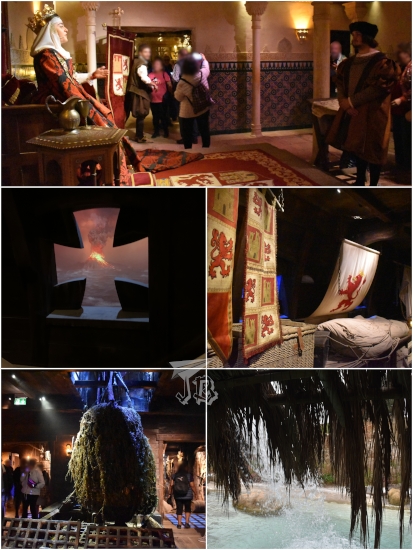
After lunch it had almost cleared, and we headed off to Allende la Mar Océana, “Beyond the Ocean Seas”, which is a walk-through. You “enter” a medieval palace to see Queen Isabel I of Castile (Isabella the Catholic) meeting with Christopher Columbus, as the latter convinces her to fund his expedition to the Indies. Then you get to see different stages of Columbus’ trip with a fictionalised voice diary, with the most important stages: setting sail, navigating near Tenerife, where one of the volcanos had erupted, losing hope in the Sargassum Seas, and finally reaching America – complete with Amerigo Vespucci crying “land ahoy” and walking out to a paradise beach with white sand and palm trees. Some of the areas have live actors interpreting scenes. Not too impressive, and too many people decided to get in the way of my pictures, However, the queen smiled at me.

Puy du Fou España Allende La Mar Océana

We had time to check out the other walk-through De tal palo…. The Spanish expression de tal palo, tal astilla means “like parent like child” or “the apple does not fall far from the tree”, literally “from this stick, that splinter”. The idea is to stop to listen to different generations of the same family which have partaken in key episodes in the history of Spain: the resistance in Numancia against the Romans, Medieval clashes between Christians and Moors, and so on. It was probably the weakest show, but truth be told my companions were not really in the mood for it, and we ended up seeing only two complete tales, and two halves. The rain stopped around this time, too.

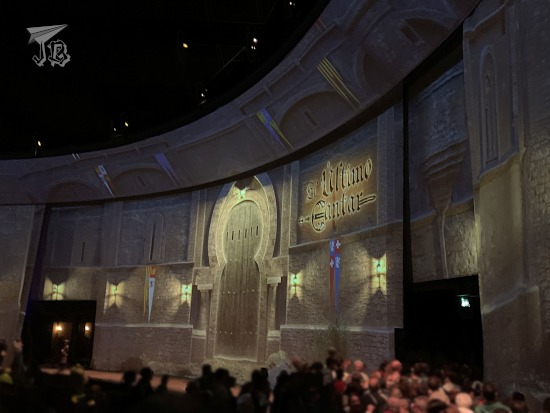
Afterwards, we backtracked to El Último Cantar “The last Song” or “The last Romance” which tells an extremely sanitised story of one of the warlords of Medieval Spain. Rodrigo Díaz de Vivar, El Cid, was a 10th-century mercenary whose life was later composed into a book-long romance. He’s sort of the classical hero of Spain, with an extremely idealised view – imagine, this is the first compulsory book to read in school when you’re around 10. The show was even more romanticised. It was held inside, in a circular stage, and the stands turned to face the different scenes. It had work with horses, and even sort of a just. The problem was that this show finished past 16:15, and we had to be at the exact opposite side of the park before 16:30 (16:25, as they closed the doors). My companions told me to make a run for it, because they knew it was the show I’d be more keen on. I literally ran halfway through the park and made it just before doors closed – the person managing entrance was extremely rude, too.

Puy du Fou España El último cantar stage

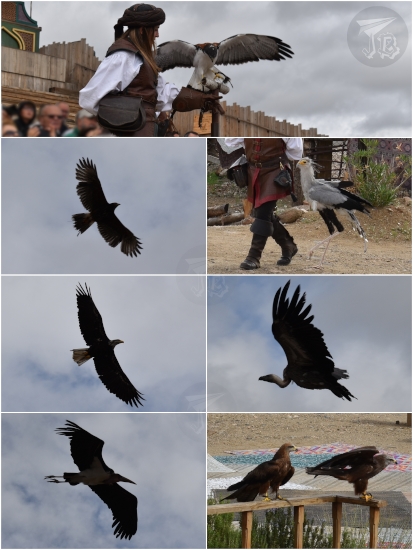
This show was Cetrería de Reyes, “Kings’ falconry”. I did not follow the plot much, to be honest, I was focused on the birds. It is supposed to be an encounter between a Muslim king and a Christian knight during the Middle ages, and they decide to… measure each other up by showing off their birds of prey. There are barn owls, sparrowhawks, caracaras, falcons, eagles and griffin vultures trained to attack on command, fly to specific places, and “hunt” mid-air. More exotic species include a secretary bird (Sagittarius serpentarius) and a marabou stork (Leptoptilos crumenifer) which were cool just for being there. At the end of the show, they let out a lot of the flying birds that flock all over the show. It was really cool.

Puy du Fou España falcorny show

I got to see the whole show since I sprinted. The other two people were lead in later, as most of the fast pass holders did not make it. They were admitted in small groups around one third into the show. It felt like really bad organisation, to sell something that is almost impossible for most of the pass holders. Furthermore, at the end, we were ushered out through different gates, and could not meet up amidst the crowd. We reunited at the final show.

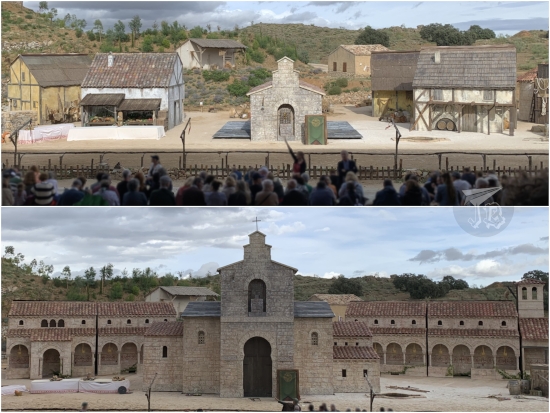
El misterio de Sorbaces, “Mystery in Sorbaces”, tells a fictionalised tale of how the king Recaredo I, the first Visigothic King in Hispania who converted into Roman Christianity in 587. His brother marries a Roman girl in a Christian ceremony, and the festivities include a lot of horse riding acrobatics. Then the goths come to destroy the village, but they are stopped by the “miracle” of a chalice turning a pond into fire. Recaredo converts and the whole stage is turned into a monastery. Besides the horse riding, the background moving and changing, and the fire special effects are the more impressive thing of this show.

Puy du Fou España El Misterio de Sorbaces initial and final stages

We just hung around the park a bit longer for a while after that. The shops were pretty expensive, and though the eagle plushies were adorable, they cost too much money. So were the handwritten scrolls, even though they were fantastic. We grabbed supper in one of the fast food restaurants – a toast and a drink, a bit on the unremarkable side. Finally, we set off towards the outdoor theatre for the night show El Sueño de Toledo, “Toledo Dream”. It was getting cold so people were waiting in the corridors of the theatre, then the staff kicked us out to line, and they created a bit of chaos – despite assigned seating. They wanted guests to be there with an hour’s time, and in the end we had to wait around 50 minutes until the show started, in front of a backdrop of the city of Toledo. We had paid extra for “silver” tickets, and I was very surprised how they were spaces that I found much better, but were not considered “silver”.

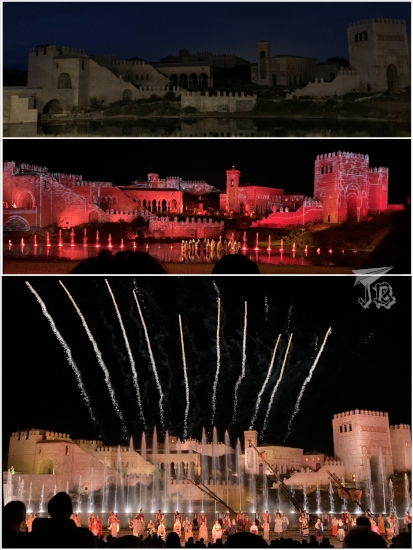
As the sun sets, the story starts with an old water bearer coming in – he represents the memory of Toledo as a metaphor of the history of Spain. He comes and talks to a young lady at the gate of the walled town, and together they reminisce about the key episodes of Spanish and Toledo’s history. The first stage is the Moors leaving town to battle the Christians in Al-Andalus (though Toledo probably existed before as a Roman encampment, it was the Umayyad civilisation who made it great). The Christians attack the town and conquer it, then lose it again. When they once more enter the town, one of the churches has kept a candle burning in front of a walled-off crucifix (famous Toledo legend). The show is presented with lots of light, acrobatics, horse riding, and dancing, even on the shallow water that forms the stage. The sultan’s glass palace comes out of the water, and the cathedral is created with water spurts and light effects.

Time passes. The Catholic monarchs receive Columbus back from America and his ship also emerges from the water. The revolt of the Comuneros comes and goes. Toledo loses its importance and becomes a town of farmers. Then the Napoleonic armies ride in on white horses – the men walk into war and are killed, and the women take over from them. Peace comes, prosperity: the 20th century, the train, the Roaring Twenties – and then the Civil War in the 1930s. The singing girl cries out that her brothers killed each other in battle. In a final dance of hope and healing women dressed with the traditional attire of the different autonomous communities come and dance with her (a bit… dismissive… considering recent events and tensions). Then instead of ending in a happy note, everything goes downhill as the water bearer claims that he is a dream and he’s fading away and the children won’t hear of him and the stories he has to tell, as the whole cast comes to wave goodbye – and it’s about 200 of them, not counting horses, sheep, goats, oxen…

Puy du Fou España night show El Sueño de Toledo

When it was over, we walked back to the parking lot and drove off. It was a bit chaotic and we ended up going in the opposite direction we wanted to – because there was nowhere to turn around until we reached the motorway. We drove to the hotel and crashed in the rooms. If we had been just one floor or two higher, I would have had awesome views of Toledo, but most of it was hidden behind trees.

All in all, the experience was okay – for one time. The price was steep, not even counting petrol and accommodation. I have read online that people go back four or five times, I don’t get the need to do so, even if I know that we missed most of the street shows. We were pretty lucky with the weather, because the park is not prepared for either heat nor heavy rain – and Castille is known for its scorching summers and its temperamental thunderstorms.

The next morning, we had breakfast – hotel was good, but the breakfast there was quite expensive, so I had brought some canned coffee and pastries. We drove back without much traffic, making this a 24-hour-ish adventure. Maybe it would have been cool to try the spa at the hotel, but driving back later would have meant running into the heavy traffic around Madrid at the start of the weekend, and we preferred not to do so.

25th February 2023: Feria de las Mercaderías de San Matías 2023 (Tendilla, Spain)

In 2022, some relatives who spend the weekends there talked me into visiting the Medieval fair in TendillaFeria de las Mercaderías de San Matías. It recovers the tradition of the cattle fair around St. Matthew’s day, and today it is one of the yearly highlights of the village. The historical roots of the municipality as an important villa in Medieval times can be traced to the Second Count of Tendilla, Don Íñigo López de Mendoza (1442 – 1515). He accompanied the Catholic Monarchs in their conquest of Andalusia and was later named “governor” (of sorts) of Granada once it was won for the Kingdom of Castile.

I once more arranged to attend the fair in 2023, and I drove off early in order to secure a decent parking spot as the core of the village gets closed off to traffic. Tendilla is laid out along a former main road, which used to work as a separating axis. Today, traffic has been diverted and circumvents the whole village, and the axis has been renamed as two streets: Calle del General Muñoz y Muñoz from the beginning of the village to the town hall square, Plaza de la Constitución, and Calle del Alférez Agudo to the end of the village and the “former fair square”, today the square Plaza de Vicente Mariño. Along this axis, rows of stands on both sides of the street, selling crafts, trinkets, traditional products and foods, and so on. Tendilla is known for its torreznos, processed pork lard snacks, so there are many of them on offer.

The typical food at the fair is migas, a dish made out of toasted breadcrumbs and several toppings. Traditionally, migas were made from stale bread by semi-nomadic shepherds back when it was common to move livestocks from one area of Spain to the other according to the season (transhumance). The town hall organises a collective cook-out of a simplified version for the attendants, just the fried breadcrumbs with paprika and garlic, topped with the famous torreznos. Though there are endless variations of the dish, the local tradition calls for breadcrumbs, paprika, garlic, and minced pork, topped with a fried egg, and sometimes some fruit.

We were going to prepare our own complete version of the migas, so the first goal was securing some minced chorizo, called picadillo from the butcher’s. We also bought some torreznos for later. Then, we started wandering the village – literally up and down from one square to the other – to see the stands and catch all the events. Although it was rather cold, it was sunny and not windy, quite pleasant once you were wearing enough layers – I had actually brought some extra ones that I did not end up needing.

At 11:00 the “farm” opened at Plaza de Vicente Mariño – this is the closest activity related to the origin of the fair, a cattle trade event. There were horses, ponies, donkeys, cows, goats, sheep, piglets, and fowls… I might have remembered a little too late that hay causes an allergic reaction these days. Across the street from the farm stood a huge BBQ grill and some watering holes – I guess that to place the roasting pork just in front of the living piglets is part of the village’s twisted sense of humour. Desensitising kids, or what? One of the funniest things around this area is hearing people squealing at the animals, especially at the piglets – there are a lot of “urban people” in the fairs wanting to “experience country life”, who have never really seen a farm animal in their life and are thoroughly impressed – and end up saying hilarious things.

Farm animals - pony, rabbits, white-and-brown cow, small piglets, sheep, a cheeky goat

At 11:10, we caught the Opening Parade took place, described as musicians, jugglers and knights walking along the streets. It featured a dancer, a small group of musicians, and the members of the horse riding school Caballeros del Alarde.

Collage showing a female dancer followed by three Medieval musicians; two horse riders, one in full armour and the other one dressed as a nobleman from the Middle ages.

After the parade ended at Plaza de Vicente Mariño, we went to check on the communal migas, and say hi to the guys preparing them. They had prepared a bonfire and a huge pot to toast the breadcrumbs, and fought off the cold with beer and wine.

A huge pot with orange breadcrumbs being cooked

There was a second parade at 12:10, this time the official inauguration one. Aside from the musicians, dancers and horse riders, walkers included the authorities, ladies in Medieval clothing, and giants. They walked from the town hall square Plaza de la Constitución to the migas cook-out. With this, the festival officially kicked off.

Parade. Three musicians playing Medieval instruments. Three giant puppet-like giant costumes; men and women dressed as Medieval nobles. A moorish-like kight on a white horse.

I followed the horse riders Caballeros del Alarde back to Plaza de la Constitución where they started practising for their later show. They are part of a horse riding school which carries out several activities, Medieval riding is one of them, along with horse training, archery, and shows in Medieval fairs and markets. For this event in particular, there were six riders – five men and one woman – with two bay and two white horses. One of the bay horses was not in the mood to cooperate though, and got easily spooked.

The show happened from 13:30 to 14:30. It was an exhibition of Medieval horse-riding – while horses galloped through, different different tests carried out – spearing a bale of hay, hitting a metal shield, catching a metal loop with the sword, then cutting off a carrot… There was also a bit of a staged scuffle, swashbuckler-style. The emcee made it sound like the whole show was an exhibit to train for an upcoming jousting contest (in the evening) and the riders would later compete for a pouch full of gold maravedis – Medieval Spanish coins. The show itself was pretty fun and impressive to be honest – the riders had to control the horse in a crowded and small area, full of bystanders and noise, and do the activities with a very high level of success.

Shots from the horse riding exhibit - one of the riders galloping, another spearing the bale of hay, two riders sword-fighting; The female rider, wearing bright blue, with a long spear.

After the horse show, we went home to prepare the traditional version of migas – we fried some minced chorizo, garlic and paprika, then worked the bread on the stove. Finally, we fried the eggs (sunny side up) and the food was ready! Not that we stayed down for long, soon after finishing our late lunch we went out again to find a good spot to watch the jousting at Plaza de la Constitución.

Preparing the migas - frying mincedmeat, then the garlic, then the paprika. Breadcrumbs just poured, still white, then cooked and looking bright orange. Finally, a dish with a sunny-side-up egg on top of the migas.

We walked around the square and realised that there was not really a good spot though because the square was too small and set in a way that anything the riders did, their right hand would be towards the inner area of the square. So whatever they did, the view would be obstructed by flags and décor. And the best viewpoint was actually taken by the sound equipment – which ended up malfunctioning anyway…

Before the tournament started, a sword was brought in as a present to the village. Because the sound was so horrible, I did not completely get the significance of it – it was supposed to have been donated by Queen Isabel of Castile to the village. The program said that there was going to be a forged sword at some point, so I thought it was that one.

A woman parading a Medieval sword, and a group of horsement behind her

This time there were only five riders, apparently one of them had been hurt at a previous exhibition and was not ready for the whole competition. The show itself was all right though – the emcee presented the best rider as a bit (or a lot) of a cheater, and he hyped a lot of “girl power” vibe around the female rider. The riders competed on tests in pairs, again spearing, loop catching and carrot-cutting. The “cheater” won in the end and the maravedis were distributed among attending children, as apparently the coins were not legal Medieval currency but plain old chocolate. They tried to do an archery exhibition too, but the square was too small.

Scenes from the jousting, showing horses and riders as they take the different tests with swords, spears and the to-be-cut carrot.

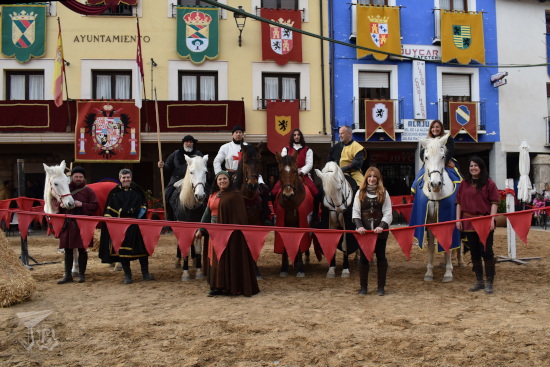
There were much fewer people for this exhibition since it was later in the evening (17:00) and because the evil-looking storm cloud just above our heads. Thus, this time, when the riders offered if someone wanted to take a picture on one of the horses, I got myself up a white Pure Spanish Breed warhorse, which was really cool. Then, the group asked if someone would take a picture of them, and I offered to do so.

All the horse-riding school performers, in character, both on horses and on foot, pose for the picture. They are all dressed in Medieval clothes and smiling.

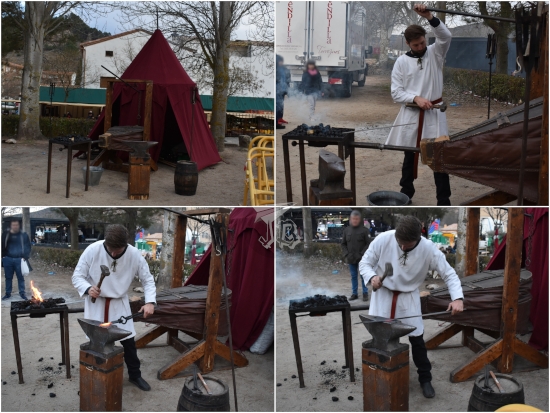
We went to see the campsite afterwards, with different things that could have existed in Medieval times. One of the most interesting things was the forge, with the blacksmith at the ready. I hung out around the smithy for a while and as night fell, the sword started to take shape. I realised later that this was the sword that was going to be forged for the village, and not the one I had seen before the jousting.

A blacksmith hammering down metal to forge a sword and a guard.

I don’t know whatever happened to it, because I eventually moved away to find the final parade, in which a group of villagers dressed up as Moors from Granada, either friends or foes of the Count. The parade was lit with torches, and ended at main square Plaza de la Constitución again. There were also jugglers, fire-dancers, and some more swashbuckling. They also made a queimada, a distilled spirit with “magical powers” flavoured with herbs, cinnamon, sugar, herbs and coffee beans. A spell is usually requires an extra spell as it is prepared. While I would have wanted to try it, I did not dare do so before driving…

Collage of the final parade. A group of people wearing flashy red and gold clothes carrying torches. A woman dancing with fire torches in her hands. A man and a woman fighting with swords on fire. Two men dressed in Medieval attire on war horses.

A bit after 21:00, after roughly 12 hours of “fairing”, I got back on the car to drive home with a basketful of food and good memories to drive home before the temperature went below zero again. Only when I was home I realised I had not even taken my scarf off, and that it still had straw on it from the farm – which quite probably did not help with the allergies.

2nd January 2023: Lies or oblivion? {Egypt, Winter 2022-2023}

I was awake at 6:40 to be ready for a half-day trip. However, the phone call that the tour guide had promised the day before never came. I was distressed because this gave way to two options. Either the tour guide had lied to me, or someone had forgotten that I existed. Neither was a happy thought. I tried to cheer myself up with a cup of Espresso from the room complimentary bar, and around 8:30 I went to have a quick breakfast. I was not hungry and to be honest quite upset. I had insisted five times about this beforehand.

A bit after 9:00 I tried to call the ground agency, Galaxia Tours, and I texted them through the website. But around 9:20 I said screw it. The hotel had a mini travel agency – I had noticed this because we had made an attempt to go see the light and sound show at Giza on the 30th, which the tour guide had walked around. Instead of telling us “you won’t have the time” he had deflected every question we asked about it.

Had I had more time to organise things, I would have hired the mini-agency to take me back to the Egyptian Museum, the Museum of Egyptian Civilisation, or even the Valley of the Whales. However, since the tour guide had mislead me, I was out of time. Then again, the hotel was not in actual Cairo, but in Giza [الجيزة], and a nominal 20 minutes away from the Giza Plateau and thus the pyramids, so I hired a tour over there. And, believe it or not, I ended up… on a “camel” – actually a dromedary – for a few hours.

I had been resisting doing a dromedary ride of any kind out of concern for animal welfare, especially after seeing how they were treated at the Petra site in Jordan. However, this time it looked like it was the best option to spend my three hours around the pyramids, introducing Moses the dromedary (Camelus dromedarius).

Moses the dromedary kneels looking at the camera over his shoulder. He exudes personality

I checked out at the hotel, left my luggage at reception, and was driven towards the The Pyramids of Giza Archaeological Site [مجمع أهرامات الجيزة]. My driver was a bit creepy, so I tried to keep it light. We arrived at a backstreet next to the Great Sphinx [أبو الهول] entrance, from where I had a great view. This entrance was a bit different from the one we had used on the 31st next to the tourist bus parking lot. Most people using this entrance were Egyptians, and they were thoroughly patted down. Upon entry though, the view was astonishing – the Sphinx, and Pyramid of Khafre standing right behind it, the Pyramid of Khufu [هرم خفرع], the Pyramid of Menkaure, with the Pyramids of the Queens peeking to the side.

A front view of the sphinx, with three pyramids behind it. The pyramids decrease in size from right to left

Riding the dromedary was easier than I thought. The trickiest part was managing his kneeling down and standing back up – I did get a cramp on the very first standing up – but it was mostly a matter of leaning forward and backwards. Through this new walk around the Giza Plateau I got to see the modern cemetery on the left, then we moved onto the archaeological site itself. From this side, I saw the path that joins the Great Sphinx with the Funerary Temple of Khafre and the Pyramid of Khafre. I also got to see the Tomb of Queen Khentkawes I [مقبرة الملکه خنتکاوس] and the Central Field of Mastabas and rock-cut tombs. It was weird, having such a vantage point of view! I got used to the rocking very quickly, so I got a few good pictures.

Two views of the archaeological area of Giza, with pyramids in the background and low, excavated tombs in the foreground.

My guide – and Moses – took me to a a different Panoramic Point of the Pyramids, the picture perfect one, a few metres south of where we had been the previous day – this spot is not reachable from the bus, but I honestly cannot calculate if I would have had the time to get there and back the previous time – it’s hard to estimate distances in the desert, and the pyramids are too big to gauge good references.

A general view of the area of Giza. All the big three pyramids and the small six are visible.

We rode around the Pyramid of Menkaure, and actually passed between two of the Pyramids of the Queens.

A collage showing the approach to the Pyramid of Menkaure. The smaller pyramids of the Queens are in the foreground, and the camera seems to go through them until it focuses on the bigger pyramid.

Then we moved on towards the Pyramid of Khafre. Coming closer was really cool, as I could see the granite blocks that would have made the pyramid smooth back in the day, along with the rest of some columns. Also, two sides of the pyramid are actually somewhat sunk in the ground, with a vertical wall of rock-cut tombs. I know I was paying for it, but being able to walk around the pyramid felt special, and allowed me to feel awed at the size and technology again, considering these were built about 4500 years ago.

The pyramid of Khafre. The top is still smooth as granite blocks have not fallen. At its foot, you can see the granite blocks that have fallen, some aligned next to the pyramid so you can guess how it would be smoothed. Another picture shows the moat like structure around the pyramid - it is the back-wall of some tombs

The Pyramid of Khufu stood to the left, and we continued our ride towards the Central Field of Mastabas and rock-cut tombs and the Tomb of Queen Khentkawes I.

A view of the Great Pyramid from behind.

A number of basement-like structures excavated in the desert. They are the tombs of the nobles and the pyramid builders.

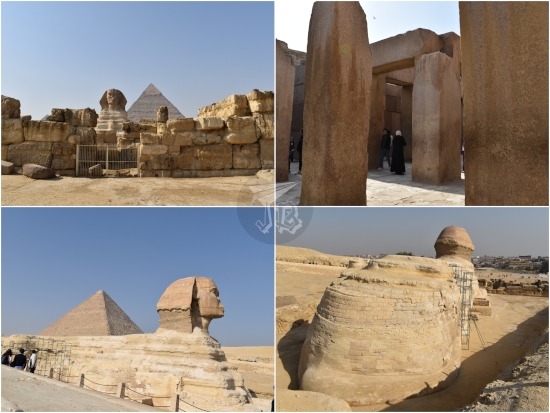
I dismounted again and walked into the Valley Temple of Khafre [معبد الوادي لخفرع]. This time, not running and with fewer people, I got to see the megalithic structures for real. I also could go to see the rump area of the Great Sphinx of Giza.

Collage showing the sphinx with the pyramid of Khafre behind it; the megalithic temple through which you access it; then a lateral view of the sphinx and a view from the rump.

Afterwards, there was an “essence shop” experience, but as I told the lady I would not be buying anything, she dispatched me really fast. My driver got only creepier in the way back, so I tipped him and ran off to the reception of the hotel, where I sat down to wonder whether someone would pick me up from the hotel, or they would forget me like they had for the dray trip. Fortunately, I spotted some people I had seen during the New Year’s Eve party, and it turns out that they had the same pick up. That was good, because handling the transfer for Cairo Airport – and the airport itself – would have been more stress than I was willing to deal with. I actually think I was forgotten indeed, but this family was not – I did approach the representative they pointed out, and made him aware of my existence. Firmly.

At 14:05, we were off on the mini bus towards the airport, and it took a bit over an hour. Meanwhile, they gave me a questionnaire to fill in – I tried not to get personal, nor attack anyone, but I was very sincere about the things that had gone wrong. Being forgotten is not a nice feeling.

We reached the airport past 15:00. There were two security controls for luggage, and one pat down. In the second control, the guards got money to let a group go before me, and the guard actually gestured that money would make things go faster. However, waiting had an interesting consequence… I met the people who went on the day trip, to Saqqara again, and they entered other pyramids there. So there had been another day trip – and again, lied to, or forgotten about?

But I had had my own fun, so I did not let that rile me up. I checked in, dropped my luggage, got my exit visa and settled down to wait – I was now just destined to have to listen to We wish you a Merry Christmas on loop for as long as it took to board. I got myself a cheese sandwich for lunch – this was past 16:00 by now, I was a bit hungry after only a fast breakfast. Cairo Airport is anything but traveller-friendly. Half the shops were closed, but without signs, so they just yelled at you if you walked in. There are no sitting areas next to the gates, just the shops, and I did not want to sit on another floor and rely on their English to know when boarding was ready, so I just walked up and down “a few” times. I was lucky enough to be next to the gate when boarding started – with yet another X-ray control, getting separated by sex, and being frisked. And yet, you have to take off your shoes, but you are allowed water bottles on the plane… Weird.

We finally took off around 19:30 for very uneventful five-hour flight. We got dinner on the way, which was unexpectedly nice, and I had a window seat, extra water, and got to see Cairo goodbye.

An aereal view of a city at night. The streets are lit, and light pollution diffuminates in the background. There is a black line in the middle, north to south - the Nile.

Overall balance: things were left unseen, and maybe one day I’d go back to see the rest of the Valley of the Kings, the Valley of the Queens, and the new Grand Egyptian Museum. Possibly the Valley of the Whales. But I don’t really feel I must come back any time soon. It was the adventure of a lifetime, and I am very grateful I got to live it. I do admit, however, that I dropped by my travel agent’s to make it known that someone had either forgotten me, or lied to me, and that I was not happy – similarly to what I had done with the questionnaire. I don’t know if I’ll ever get a reply, but I have to say the experience has left me not feeling up to trusting anyone with my travelling for a little while. Though I had to admit, my first solo experience with a group was all right… nice people all around, so I’ve been lucky in that department.

26th February 2022: A Medieval Fair in Tendilla (Spain)

Tendilla is a tiny village in the area of Guadalajara, Spain. It was declared a town – by Medieval standards at least in 1394. About a century later, the County of Tendilla was founded. By that time, the local cattle fair, around the festivity of St. Matthew, was considered one of the best in the Kingdom of Castile, with the Catholic Monarchs bestowing their blessings on the town. Among the most interesting areas are the long covered arcades, and the unfinished church dating back from the 16th century, Iglesia de la Asunción.

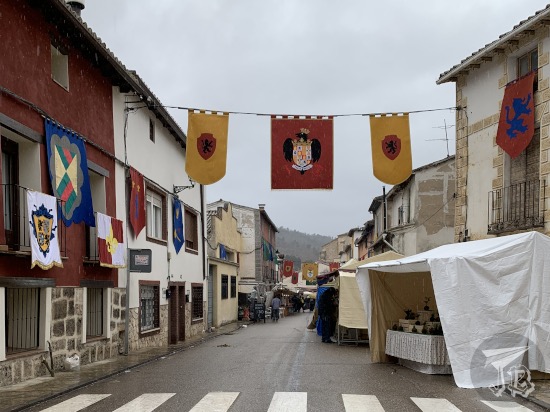
The cattle fair was rekindled in the 1990s, and today it is called Feria de Mercaderías de San Matías. The closest weekend to the 24th of February, St. Matthew’s day, a Medieval market is laid along Main Street, with edibles, trinkets and artisan items. The village becomes decorated with flags, pennons showing off real and assumed heraldry items.

This year, I decided to get there as some family members were going to be in the house they own in the village. I arrived at around 10 am, and by that time most the village was already full. I got deviated, but it was not hard to find a parking spot. Unfortunately the weather had not decided to accompany and it was rainy and freezing all day.

The fair stalls had begun to open, but first we made a run for the local grocery stores to grab some ingredients for lunch. The typical thing to eat in this time are migas, which are basically fried breadcrumbs with paprika, pork, garlic and a fried egg on top. We also bought sweets and confectioneries, just because we could.

At noon, we walked along Main Street Calle Mayor. The stalls were already open, and even in the bad weather there were quite a few people. Some were even in costume, dressed in Medieval outfits, as dames, knights or noblemen.

A wide street. There are flags hanging above and from the balconies, and shopping stands on the right. the sky is dark and heavy, as in all the pictures taken

A wide street. There are flags hanging above, and shopping stands on the both sides, selling hand-made jewellry and trinkets.

A Romanesque church with a bell tower. The church is unfinished.

Main square. It has a pole in the middle, and colourful ribbons run from it to the buildings around the square. The floor has been covered in sand, and the houses are decorated with flags. Lots of people walk around.

To the end of the village, a small “farm” had been installed – oxen, horses, cows, goats, donkies, sheep, rabbits, piglets… Due to the ‘health situation’ which for once was not Covid but avian flu, there were no ducks or hens or any kind of bird. You could hold the bunnies, but I really really wanted to hug the huge draft horses.

Farm animals: a donkey, two piglets, cows, rabbits, a sheep trying to eat the camera, a working horse.

Farm animals: goats trying to escape the pen, oxen ignoring the camera, a black-and-white cow wanting pets, and a working horse looking tired.

Someone had not really thought positioning carefully though, and right in front of the farm – and the piglets – stood the food stalls, especially a roaster, whose cooked pork was… suspiciously similar to the piglets in the farm *coughs*.

On the other side of the farm, the locals had started preparing the communal migas – every visitor is entitled to a plate of them, but it was way too cold to queue. Instead of being topped with an egg, though, they are sprinkled with torreznos, pork lard fried and preserved.

A huge barbecue with pork roasting and sausages. The barbeque itself is round, and it's big enough to fit at least a dozen ribcages, ten pork legs, and twenty or thirty sausages.

A person using a shovel to stir a huge pot of breadcrumbs being cooked, and a close up of the severd plate: orange-looking breadcrumbs with dried fried pork lard on top.

On our way back we ran into the horse parade and show, which was held in front of the town hall. The riders of El Duque Espectáulos, dressed in Medieval and Templar costumes, trotted and galloped along the music.

A group of medieval-looking horse riders making their way through the crowds

An older man making a golden horse trot and gallop on command, the horse is photographed mid-hop

Riders in medieval clothing galloping on the Main square

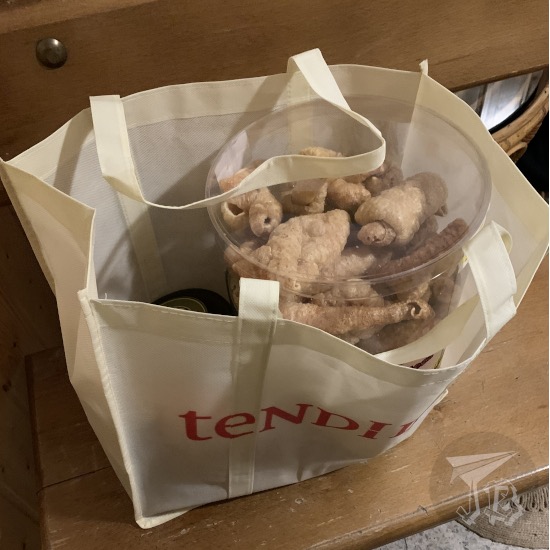
We stopped to buy some torreznos to take home, and we got given the tourist treat – a cloth bag with a huge box of fried pork skin. It is tastier than it sounds, honest!

A tote bag reading Tendi (the rest of the writing is obscured), with a box of torreznos inside

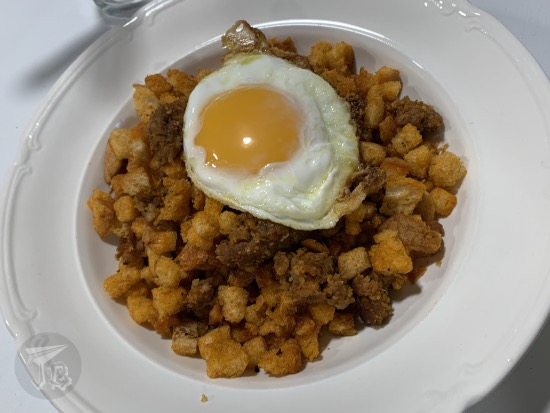
We had lunch at home, and not to show off, but I do think our breadcrumbs looked much better. We made them ourselves, with chorizo meat and eggs sunny side up! They looked so much better than the communal ones, right?!

A plate of migas. The breadcrumbs look golden, and there are pieces of pancetta and chorizo mixed with the bread. On top, there is a fried egg, sunny-side up

Finally, after lunch, we took another stroll, but the weather was miserable, raining and cold – which was so mean because the following day when I had to work it was nice and sunny, and there was a bird of prey exhibit.

Romanesque and Baroque buildings, deserted in the rain. One of them is a tiny hermit church, the other a column, and the third a palace that has seen better times

But all in all I spent a nice time with family and got to pat horses and goats. I guess there are much worse ways to spend a Saturday.

Walked distance: 6.20 km (9866 steps)