A while back I visited the printing museum Imprenta municipal in Madrid. I’ve since learnt that they have book-binding workshops, and I would very much like to attend one. So would at least one of my parents, and I was asked to sign them up online for one on the 22nd of January, a day when I was supposed to be at work. My project got delayed, so I ended up workshop-less and a bit envious. Just a bit. There’ll be other chances.
On the 21st, I received a notification that I could pick up some paperwork in town, so we arranged we would have lunch together after I had my documentation and they were done. We would all be taking the train, and I was a bit uneasy. I’ve complained about the railway system before, but just a few days before there had been a horrible train accident that killed over 40 people, and a slightly less horrific one that killed one person.
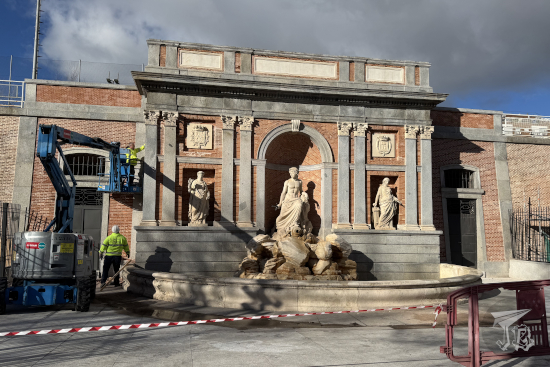
Though it did feel a bit uncomfortable when the train shook within the rails, we reached Madrid just a few minutes late, and I hopped off. It was extremely cold, not only because it was January, Spain had been hit with a string of storms just one after the other. After getting my documents, I realised I was rather close to the fountain I had missed when I was in the Bravo Murillo area exploring after Expogema, Fuente del Río Lozoya, which honours the river Lozoya, the source of the city’s drinking water. It was my third time trying to find the fountain and… it was getting cleaned, and thus empty and fenced off. I felt it was hilarious.
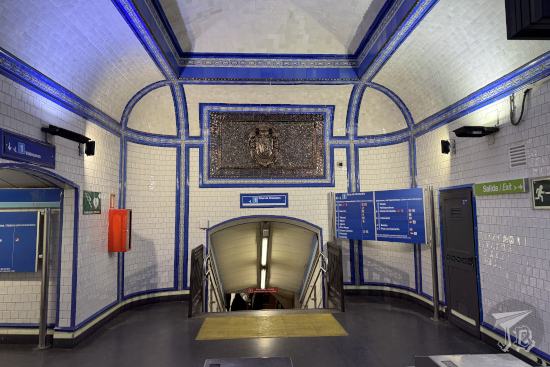
I headed towards the underground and headed towards Tirso de Molina station. The station opened in 1921, and one of the halls retains the original tiling and decoration, the historical hall – Vestíbulo Histórico de Tirso de Molina, which is considered part of the underground museum network Museos de Metro de Madrid. The station has a bit of a black urban legend / history. It is located underneath the square Plaza de Tirso de Molina, which honours a Spanish friar, dramatist and poet. The square named after him used to be home to his own convent, a building that was expropriated and demolished during the Ecclesiastical confiscations in the 19th century. Apparently, there was a small graveyard associated to the convent, and human remains were found (and quietly reburied behind the walls) during the construction of the station. Creepy.
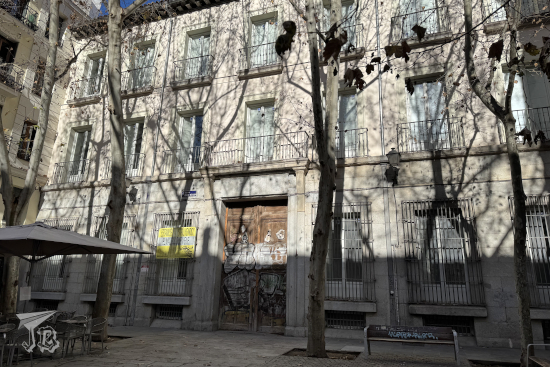
Quite close stands the manor known as Palacio de la Duquesa de Sueca, an Age of Enlightenment building which was for a while featured in one of the most successful fictions on Spanish TV – El Ministerio del Tiempo (The Ministry of Time). It has been abandoned forever, it seems, and nobody quite knows what to do with it, so it is slowly wasting away.
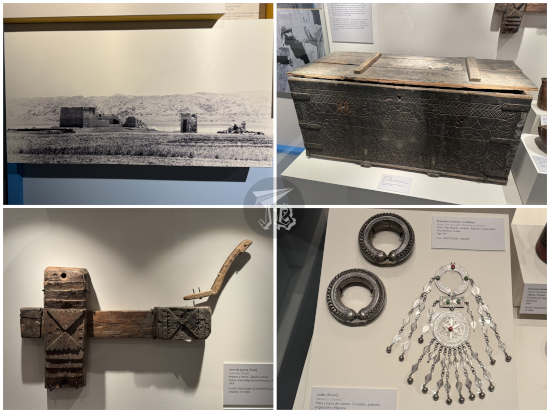
I walked to the small metropolitan museum Museo de San Isidro, which was running a special exhibition about the Temple of Debod and the town it used to stand on, fittingly called Debod. 1954-1964. Debod is the only free-standing Nubian temple outside Egypt. The building was dismantled during the International campaign to Save the Monuments of Nubia between 1960 and 1980, as the rising waters from the Nile, turning into Lake Nasser, swallowed them.
The exhibition did not only focus on the temple Templo de Debod, but put a lot of emphasis on the town of Debod itself, whose people were forcibly relocated to Kom Ombo. The region of Nubia stood between today’s Egypt and Sudan. It was home to the Kerma culture from around 2500 BCE until the area was conquered and incorporated to the New Kingdom of Egypt around 1500 BCE. Kerma culture is regarded as one of the earliest civilisations of Ancient Africa. A lot of knowledge about the region, including culture and customs, was lost with the move. It was a bit heart-wrenching, surprisingly even more than hearing about it in Egypt itself. The exhibit comprised a lot photographs and videos that showed the people who left, and you could see the desperation in their eyes.
A good part of the items shown were photographs of how the temple stood and how it was documented before getting dismantled in order to rebuild it – which in the end, they did wrong, as one of the entrance pillions was placed backwards. The building was originally erected in the 2nd century BCE, dedicated to the God Amun, creator and King of the Gods. He would later be merged with Ra, hence the Amun-Ra denomination for the Sun God. The small structure would be later expanded by Kings and Roman Emperors. It reached the Nile through a processional walkway that ended at a quay.
The temple was gifted to Spain in 1970, dismantled in 2,300 pieces. The whole thing was reconstructed as well as it could be, filling up the gaps with newer material in a process called anastylosis, and experts say it’s not even a good one. Today, the Templo de Debod stands in a park in the middle of Madrid, and can be accessed at weekends. Unfortunately, the sandstone is getting weathered, which threatens the integrity of the whole structuture. What is surprising is the contrast between all the photographs in the exhibition, and the complaint that there was not enough good documentation to re-erect the building.
After the exhibition, I walked around the museum once, then went out in the cold again. At least it was sunny, and after noon, so not that bad. During a conversation about Madrid must-dos, someone had mentioned two churches I did not know, which happened to be rather close. The first one I found was the Cathedral Church of the Armed Forces Iglesia Catedral de las Fuerzas Armadas (also known as Church of the Sacrament Iglesia del Sacramento). Though Spain is technically a non-religious country, this has not always been so. For a long time it was an officially Catholic country, and there is a strong catholic tradition amongst the armed forces. As a matter of fact, there is even a Military Archbishopric of Spain (Arzobispado Castrense de España), with seat in this cathedral. I am not sure how one can be an soldier and a priest, much less a bishop / colonel, but I am not an expert.
The cathedral is a Baroque building designed by Juan Gómez de Mora, with a Neoclassical altarpiece and many frescoes. It was built between 1671 and 1744 to be the church of a convent that has since disappeared. The main façade was built by Pedro de Ribera towards the end of the construction period. Today it belongs to the Ministry of Defence – I did not know state agencies could own churches in Spain.
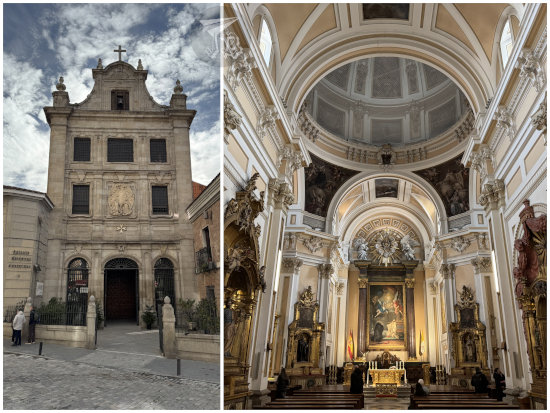
Nearby stands another important church, the Pontifical Basilica of Saint Michael Basílica Pontificia de San Miguel, another Baroque structure – actually it is considered one of the most important buildings in the Spanish Baroque. It is attributed to Italian architect Giacomo Bonavia and dates from the 1730s. Unfortunately, it closed at 13:15 and it was 13:13, so I could not come in.
In front of the church there is a sculpture called The Reader El Lector, a bronze statue by Félix Hernando García. The statue was recently moved there as part of the urban sculpture program, since a library was installed there in 2011. It is apparently a homage to Carlos Cambronero y Martínez, apparently one of the first “Madrid Historians”.
I headed back towards where I had to meet with my parents, and though I was early, so were they. Their workshop, which was scheduled to finish at 14:00, wrapped up at 13:20, so in the end I had to head there in a bit of a hurry. Once I picked them up, we walked to “a random restaurant” in theory. In practice, one of them had a very specific place in mind – Museo del Jamón. Self-described as a “family chain of restaurant”, the idea of a ham-focused restaurant was born in 1978. Since then, they have opened seven different eateries specialising in ham and other pork products, alongside several typical tapas.
The Spanish word for ham is jamón. It is obtained from the hind leg of a Black Iberian pig, usually. The ideal ham-producing swine lives range-free in oak groves (the dehesa) so it can feed on acorns, as they lead to the best meat, apparently. After the animal is slaughtered, the hind legs are salted and left to dry, in a curing process that may take up to 48 months. How much acorn the pig consumes as part of its diet, and whether or not this is supplemented, determines the quality of the final product, with the best hams being “100% acorn fed” – jamón 100% ibérico de bellota, marked with a black label.
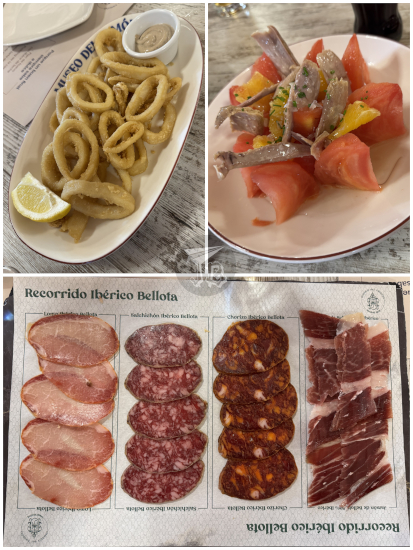
Of course, many other products might be obtained from a pig – the most important sausages are lomo, chorizo and salchichón. Lomo refers to the tenderloin, the piece of meat underneath the ribs and along the spine, cured for about four months after being marinated in spices – normally oregano, garlic and paprika. Chorizo is a sausage made from pork meat and fat with added garlic, and can be either cured or fresh (the former is eaten as is, the latter is usually cooked). The meat is seasoned with smoked paprika (pimentón), which determines how spicy it becomes, and gives it a bright red colour. The best chorizo comes in natural casings, usually the intestines of the pig, and the curing process can take several months. Salchichón is similar to cured chorizo but there are more spices added – salt, pepper (often black grains), oregano, nutmeg, and garlic – and curing can last for three months. If the animal was an acorn-fed black Iberian pig, the monicker ibérico de bellota is added to the name.
We shared a salad (Ensalada de tomate y ventresca de atún), with tomato, tuna and orange – because my parents are unable to be in a restaurant without ordering a salad. We also ordered some battered squid Calamares a la andaluza, and a dish called “Recorrido Ibérico Bellota” – with bits of the different pork cuts: jamón de Bellota 50% Ibérico, chorizo Ibérico de Bellota, salchichón Ibérico de Bellota and lomo Ibérico de Bellota. Despite Madrid being dead in the centre of Spain, battered squid is an extremely typical dish, especially in sandwich form.
I had been extremely lucky that the rainy weather had given a reprieve and I could carry my paperwork around safely, but it was windy and not that nice. Thus, after lunch we headed back towards the train, and we were rather lucky with the connections, so we were home rather early. During the train ride, I learnt hat someone from the binding workshop had decided to leave in a huff because it was “too basic”. I could have totally taken that spot!

