9th October 2022: Atémpora, Sigüenza (Spain)

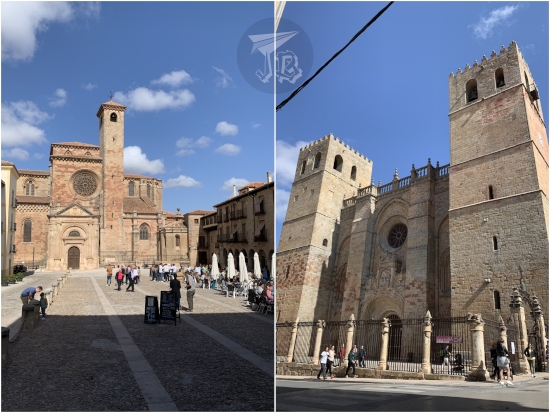
Sigüenza a Medieval town in the centre of Spain that is currently trying to gain the status of Unesco World Heritage Site. It has a castle, a protected historical centre, and in the heart of it stands the cathedral Catedral de Santa María La Mayor de Sigüenza . The cathedral dates back to 1124, when the original Romanesque building was was erected. The construction finished in 1326 , with remodelling and decoration elapsed several centuries, with different add-ons, until it was “declared” finished after the Spanish Civil War, with later works being just conservation.

Cathedral in Siguenza, a late-Romanesque / early-Gothic building, in a reddish colour. Left: side view, showing the bell tower. Right: façade, with two side towers.

In summer and autumn 2022, there is an exhibition in the cathedral – Atémpora. Sigüenza entre el Poder y la Gloria, which translated to something akin to “Timeless. Sigüenza between Power and Glory”. It displays some of the treasures of the cathedral and the museum, along with a few archaeological devices. We had seen most of the religious artefacts in a previous visit, but the historical chronicle was rather interesting.

The first block, around the cloister, deals with Celtiberian (the Arevaci tribe) and Roman weapons and everyday life. The second block deals with the Goth conquer and the newfound Christianity.

Upper Left: entrance to Atempora, flanked by two angels. Upper right: Celtiberian Daggers. Bottom left: oil lamp looking like a bird. Bottom left: clay bowl.

Interwoven with the exhibition are the treasures of the cathedral, including two collection of Flemish tapestries, one focused on Athena, the other on the story of Romulus and Remus. Another highlight is an Annunciation painting by Domḗnikos Theotokópoulos “El Greco” a Greek artist of the Spanish Renaissance (since he moved to Toledo in his prime). Of course, the cloister is fantastic. There is a tiny gothic altarpiece in one of the chapels that is delicious. The problem? As always, Baroque trends building choirs in the middle of the naves, blocking the view, and overdecorated altarpieces. The wooden ceilings are extremely beautiful where they have been preserved.

Upper left: tapestry collection, hanging from walls. Bottom right: Annunciation by El Greco. Bottom left: decorated wooden ceiling. Bottom right: Cloister of the cathedral.

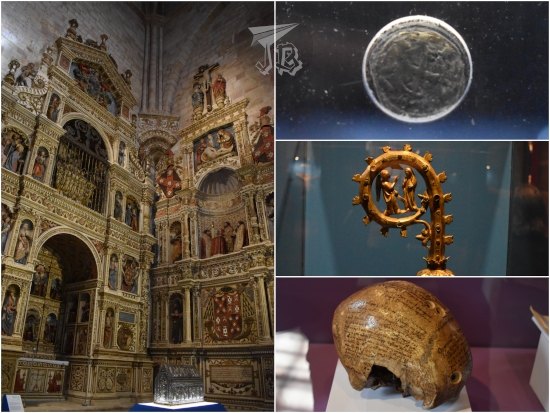
The three final blocks present different Christian symbols and pieces of art from the Middle Ages onwards, and interestingly enough, a watermill from the old salt marshes. The exhibit makes a particular emphasis on Wilgefortis, a Catholic folk saint which is supposed to be buried in the cathedral, with the silver arch where her body lies brought from the altar. Other pieces include coins, sceptres, and even a few elements from the times when there was a Medieval university in town – one of them being a human skull with “anatomy notes” on it. There are also late Medieval sculptures, most importantly crucified Christ representations and Virgins with the Child, though probably the nicest one is the one which is permanently at the entrance of the cathedral. Next to it, a mill from the nearby salt mines (Salinas de Imón) has been brought – I really want to visit those at some point too, so great reminder.

Altar of St. Wilgefortis on the left. On the right, a coin, a scepter and half of a skull with writings on it.

Top left: Romanesque virging with child. Bottom left: watermill. Right: Crucified Christ with four nails on his hands and feet.

The most important monument, or area, in the Sigüenza cathedral is the chapel called Capilla del Doncel. It holds the tombs of Martín Vázquez de Arce and his parents. The de Arce men participated in the war against Granada Muslims during the 15th century, where the son was killed in an ambush, as the Muslims created a flash flood from the watering system they had to control the waters of River Genil. Though he was already 25 years old, too old to be called a doncel, teenage boy, the name has stuck for centuries. The parents’ tombs are traditional burials, however, the Doncel’s grave is an arcosolium, with the decorative sculpture showing the young man awake and reading a book, rather than lying in death as it is the typical representation.

Chapel of"El Doncel", showing the traditional burials in the foreground, and the Doncel's tomb in the background.

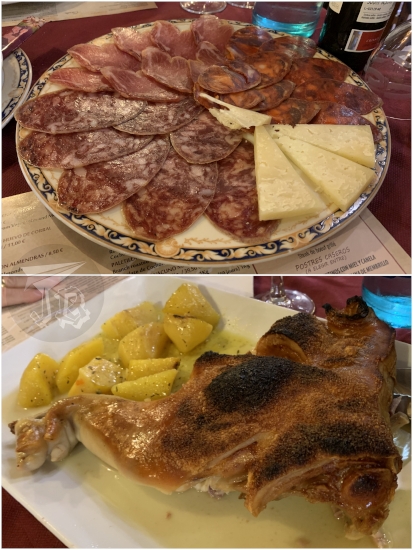
We went to have lunch after the visit, we went to have lunch at La Taberna Seguntina, where we shared some typical cheese, sausage, and roasted pork before we went home.

Typical Siguenza Dishes. Top: sausages and cheese. Bottom: roasted pork leg with potatoes.

25th September 2022: Ruta de las Caras (Buendía, Spain)

As I had a visitor, I proposed a hiking route I had heard about as a silly adventure. The area around the reservoir Pantano de Buendía is home to an… interesting hiking route.

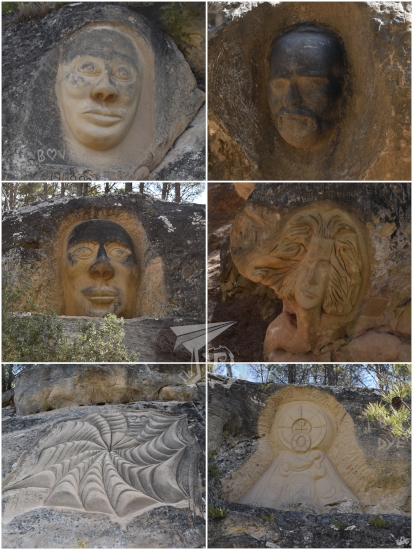
In the early 1990s, a couple of friends called Eulogio Reguillo and Jorge Juan Maldonado, a builder and a pottery maker, got the idea to create a sculpture on the rock. That, which in other circumstances could have be just been considered “defiling nature” became a Land art project – the two “artists” have carved gigantic faces into the sandstone, and the route has become a tourist spot – the Route of the Faces or Ruta de las Caras.

The route has been on my radar for a while (but I’d been feeling lazy about the drive) and I thought it would be a fun bizarre thing we could do together. It did not disappoint. You can do the complete route from the nearby village of Buendía, which is around 9 km, or drive up to the beginning of the route at the edge of the reservoir and hike around 2 km. We decided to do this, as the complete route did not offer much else to do / see.

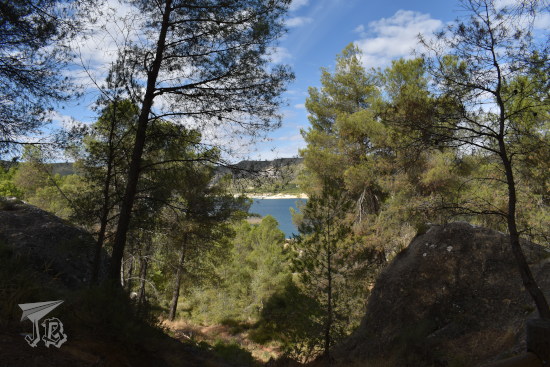
The route features a lot of official and unofficial sculptures, along with graffiti on the rocks. It is circular and runs through a pine forest which makes it suitable for both warm and cold weather – as long as the roads to get to the village are not frozen. Though temperature had plopped down compared to the previous day, it was still mostly over 20 ºC, so nice enough to be out in a sweatshirt.

Pine trees with a bit of water in the background - the reservoir

The rock carvings vary in size, style and elaboration. There are some religious motives, such a couple of Christian Virgin Marys, and some figures from Indian (Hindu and Buddhist) inspiration, but the ideas are so all over the place that they probably just let the artists do whatever they felt like. While the first carvings date from the 1990s, the route is still being carved, and we missed one of the faces as it is in a “new” area which is still not signalled. Some of the sculptures we did see include:

  • Moneda de Vida – The Coin of Life
  • Cruz Templaria – Templar Cross
  • Krishna (Hindu deity)
  • Maitreya (future Buddha in Buddhist eschatology)
  • Arjuna (a character in one of the Hindu epics)
  • Espiral del brujo – The Male Witch’s Spiral
  • Chemary (short for the name “José María”, Joseph Mary)
  • Sin nombre – Unnamed (and unfinished)
  • La monja – The nun
  • Chamán – Shamman
  • Beethoven (the composer, yes)
  • Duende de la grieta – Goblin in the Crack
  • Dama del pantano – Lady of the Reservoir
  • Virgen de la flor de Lis – Virgin of the Fleur-de-lis
  • Virgen de las caras – Virgin of the Faces

Different faces and shapes carved in sandstone

Different faces and shapes carved in sandstone

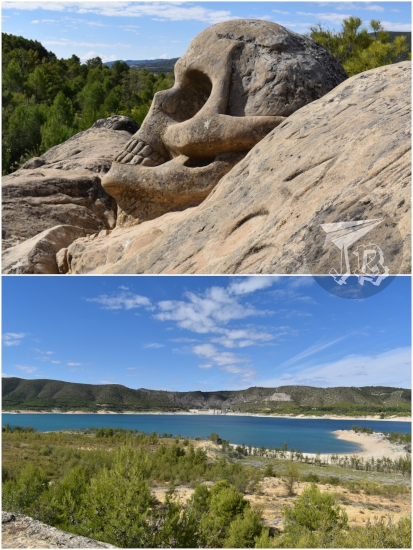
Our favourite was the skull overlooking the reservoir, called De muerte – Deadly – which one could actually climb – noooot absolutely sure it was “legal”, but the rules only said “do not carve or alter the rocks” and the sculptures are coated in a protective liquid. And after all, this started as a random art-vandalism thing.

Large skull carving (top) + the look from the viewpoint - the reservoir is pretty depleted, there is a lot of sand, but also some green trees (bottom)

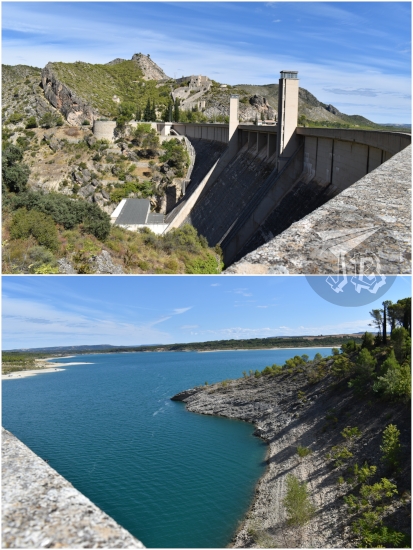
On the way back we stopped at the dam that closes off the Reservoir Presa del Pantano de Buendía, where we played with the echo.

Massive concrete dam, and the water behind it, a rich azure. The water looks cool.

Then, we moved on and once again stopped at the dam in the Entrepeñas reservoir Presa del Pantano de Entrepeñas – and I got the exit wrong again afterwards, exactly like the previous time. We saw a flock of vultures, and as they were circling in search for prey, they were a ‘kettle’.

The silhouette of two vultures circling

To end the day with befor my friend was off to the airport, we headed back and stopped to have lunch at a tiny Mexican place in the shopping centre on our way. And there I discovered that yes, there is such a thing as too much cheese on nachos. In the end, we walked around 4.11 km (6464 steps), so I think we were allowed to deal with the junk-y food.

Nachos + tacos. Everything looks a bit greasy.

24th September 2022: Manzanares el Real & Alcalá de Henares (Spain)

My friend, whom I had not seen since January 2020 as the pandemic kept us apart, dropped by for a visit as she was in the area. Since the weather forecasting had not been promising, I had not booked anything, but given her a bunch of options to do. She was particularly taken by the castle in Manzanares El Real, a town in the Madrid area, so we drove there.

The palace-castle Castillo Nuevo de Manzanares El Real was built in the late 15th century as a replacement of the previous one by the House of Mendoza. The noble family was given control over the area the previous century, and after a hundred years living in the older castle, the new one was commissioned to Juan Guas, who designed the building in a on a Romanesque-Mudejar style. It was built in granite stone, with Isabelline Gothic decoration, mixing defensive / military, palatial and religious architecture. It was inhabited for about a century before it was abandoned. The castle was declared a Cultural Monument in 1931, and it has undergone several restorations. In 1961, it was used as shooting location for Charlton Heston and Sophia Loren’s “El Cid” film.

Considered one of the best-preserved castles in the Madrid area, the building it has four towers, six floors, and a central patio. It holds a collection of tapestries, and most of it can be walked. Unfortunately, the towers cannot be climbed, but you can walk around the walls, both in the terraced gallery and outside. It was a bit overpriced, but well-worth the visit.

Collage showing the castle. It is reddish with hard corners and rounded towers. The decoration is white and ornate.

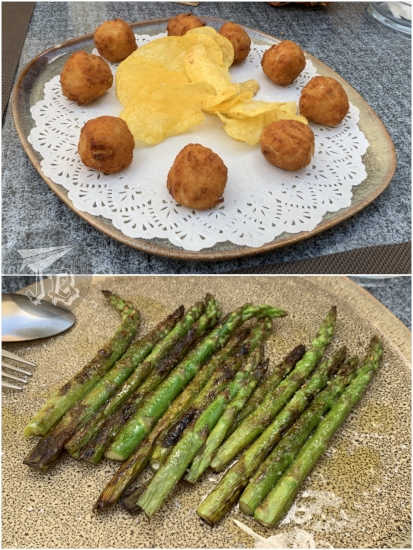
We made a pause for lunch and tried the best wild asparagus (Asparagus acutifolius) that I have had in ages – just grilled with salt and lemon. We had some croquettes too.

Plate of perfectly-round croquettes and some crisps in the middle + plate of roasted green wild asparagus

As we had walked into the village for lunch, we only had to walk a little further to find the ruins of the original castle Castillo Viejo de Manzanares el Real. At the moment, only the foundations can be seen, though it is similar to the new one. The archaeological excavation started in the year 2022, but nothing much is known of it, except this one was an actual military fortress that predates the new castle. From there, the views of the new castle and the local church make a nice skyline of sorts.

Foundations of the old castle. Not much is seen, there is a sign reading "Old Castle Archaeological Excavation"

View of Manzanares el Real, showing modern roofs, the church tower, and the castle in the furthest background

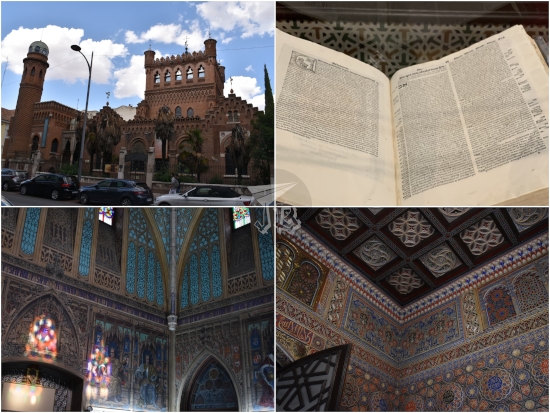
It was still early in the afternoon, so I suggested stopping by Alcalá de Henares. I wanted to make a stop at a shop to check for something, but after a quick visit to the shopping centre, we moved on to what is, in my opinion, one of the most interesting buildings in town – the small palace house Palacete Laredo. Built in the Neo-Mudejar style, it is a bizarre combination of mosaics, moorish-like decorations, and vibrantly-coloured windows that somehow work, somehow. Though only about half of the building can be visited, I just find it bizarrely alluring. My friend loved it. Furthermore, the building has a few Complutensian Polyglot Bibles in display – the first polyglot edition of the Christian Holy book, published in the 16th century under the patronage of the Cardinal Cisneros, a key figure in local history.

Palacete Laredo: exterior and interior decorations + close up of the open bible, in Latin and Hebrew

We continued on, and walked round the city. We saw two back-to-back weddings at the cathedral Santa e Insigne Catedral-Magistral de los Santos Justo y Pastor – that meant we could not snoop into the cathedral, but we did see one of the brides arrive in a Rolls Royce.

Finally, we dropped by the archaeological museum Museo Arqueológico Regional, which has opened a very interesting new palaeontology ward – holding reproductions and real fossils of animals that used to live in the Madrid area, with a few coming from the palaeontological site of Cerro de los Batallones – most interestingly a Tetralophodon longirostris and a Machairodus aphanistus sabretooth cat.

Skeletons and skulls: mastodon, giant prehistoric giraffe that looks similar to a humongous goat, and sabretooth cat

We did a little more shopping afterwards, and eventually we drove off into the sunset… and the traffic. We ended up walking for 12.47 km (19078 steps), and driving for a good three hours, though M40 was so busy it actually felt like much much longer.

13th August 2022: Smoothness in Chaos {England, August 2022}

As rail strikes rolled out both in London and the rest of England, I was thankful I had found out in advance. The hotel internet was patchy and I would have had trouble booking a coach ticket for the airport. I decided not to try and cram more than I had already on my plate for the day, and stick to my booked tickets and original timing.

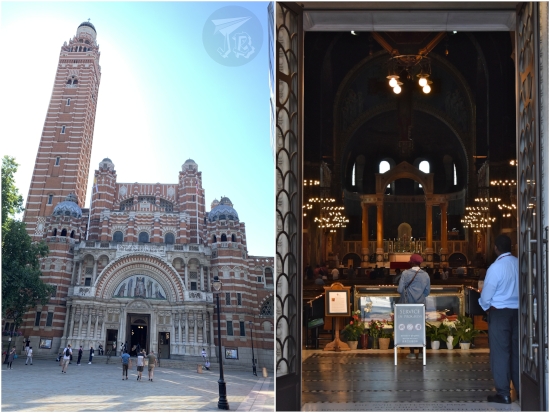
I took an underground line to Victoria railway station, from which I went to find out where my airport coach would leave from. After that, I walked from Victoria coach station towards Westminster, stopping at Westminster Cathedral, a rather out-of-place Neo-Byzantine building, which serves as the Catholic cathedral. Designed by John Francis Bentley, it was completed in 1903. It was closed for service, unfortunately.

Westminster Cathedral, a Chrsistian neo-byzantine building: a view of the exterior, in white and red brick, and the open doors showing the inner altar from afar

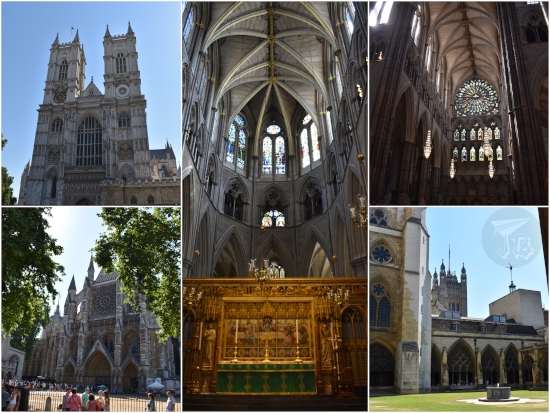
Due to the strikes and potential issues, Westminster Abbey had rearranged its opening hours, and waived all the “entry times”. So basically it was a bit on the chaotic side, though I arrived for my own timeslot, as I had calculated that would be all right for the tour I had signed up for. The abbey is officially called Collegiate Church of Saint Peter at Westminster. It was a originally a Benedictine abbey, and William the Conqueror, in 1066 made it the “official coronation ceremony” place, and many Royal Weddings have occurred there. It is built in the Gothic style, with Neo-Gothic towers. Furthermore, most British monarchs were buried there, along with a number of personalities that were either earthed there, or had memorials erected – Darwin, Newton, Hawkins, Shakespeare… The Abbey features a 19th-century wooden choir in the middle, and an outer cloister in early Gothic style. It was bustling with people fighting the audio guide and extremely hot though. However, this completed my tour of the Unesco World Heritage Site of “The Palace of Westminster, Westminster Abbey and St Margaret’s Church”

Westminster Abby, a Gothic Protestant Cathedral. Collage showing the towers and main entrance, the inner Norman altar in golden wood, the ceiling in the nave, and the cloister

Before the train strikes and the chaos in English airports, I had booked a 12:15 “Westminster Abbey hidden highlights” tour as my last activity in London before taking the Stansted Express to the airport. The change of plans meant I had to take the 14:00 h coach instead of the 15:00 h train to be at the airport by 16:00, to make sure that I would have plenty of time to go through security. That meant that I unfortunately had to cut the tour short. Event then, I got to see St Margaret’s Church, the old Medieval sacristy, the inner chambers of Samaria and Jerusalem, and got close to coronation chair. Not bad at all, even if I unfortunately had to miss the library to walk back to the station.

A collage showing an archaeological excavation (very professional holes on the ground, some showing a hint of brick foundations); the Coronation Chair and the hanging flag over it; ornate wooden ceilings; and a mythological-themed tapestry hanging from a wall

I have to say that the return was exhausting. Even with one hour difference, I got on the coach for the airport at 14:00 and did not land until 22:00. However, flying out of Stansted always has a good thing – goodbye sushi!

Tray of sushi and sashimi

All in all, this non-weekend weekend was an amazing mental break! Even if the last day did not work as originally organised, I had a heads up in order to prepare my contingency plans. I got to see something that I always wanted to see – and even if Stonehenge was smaller than I thought, it was not disappointing. Also, I checked that entering the UK after Brexit is pretty much the same as before, so I can organise more escapades in the future, because I still need to go to Jurassic Coast…

Walking distance: 11.27 km / 16672 km

12th August 2022: Stones, the reason for the trip. Lots of Stones {England, August 2022}
I was convinced I’d sleep like the dead and set a couple of alarms. Unfortunately, laundry and house service got going at 6:30, and woke me up. At least, the room had a kettle and some instant coffee which, along with one of the sandwiches I had procured the previous day, got me going. I made sure that the camera was charged, put everything I needed into the backpack and strolled off. My hotel was close to Earl’s Court, and I was walking to South Kensington to check out sandwich and coffee shop. And – to my eternal surprise – to queue for a museum! I don’t think I’ve ever seen so many people waiting for a museum to open in my life.

I’m referring to the Natural History Museum, one of my favourite ones. This time, it was a must, so I booked free entry with the special exhibition – “Dippy is Back”. Dippy is the diplodocus cast replica that used to stand in the middle of the museum, the Hintze Hall (where now the whale skeleton hangs). Dippy was the first of its kind to go on display in the world. The original skeleton was discovered in 1898 by railroad workers in an area called Sheep Creek, in Wyoming, USA. At the time, Andrew Carnegie had made a fortune in the American steel industry, and become one of the most important philanthropists in the US and the British Empire. He paid for casts of the bones to be made (some sources also say that he bought the actual skeleton, some that he had sponsored the dig) and sent to museums in Europe and South American. For the first time the public got to see a whole dinosaur skeleton, which was actually named Diplodocus carnegii after Carnegie. Dippy was gifted to the National History Museum in 1905, and was exhibited there until it went “on tour” around the United Kingdom in 2017.

Here is a little trip down memory lane: back in the mid-nineties I was a teenager in London with my English class. We had free time and they wanted to go to Harrods, so… instead I got myself into the Tube to go to the Natural History Museum just to see this dinosaur (I also ditched the group in the British Museum, but that’s another tale). The point was that I was around 14 or 15, bouncing through London by myself, on my way to see this very cool dinosaur! And I did not have to listen to people being rowdy, nor try to keep the peace in group – I was alone (scared out of my skin, true), but I was free by myself. And for me, that was very important, even if I would not come to realise that until recently.

The fossilised skeleton of a diplodocus, seen from the front. Lots of people are trying to take pictures with it

I saw Dippy again in 2011 when I went to London, but I was surprised when he was not there in 2018, shipped around the country in a travelling exhibition. For some reason, knowing that it was there made me really, really want to see it again. Since the pandemic, you need to reserve at ticket at the Natural History Museum, even if it’s free, so I booked mine for 10:00, to be there first thing as they opened – thus the queuing-before-opening.

Originally a gallery of the British Museum, the Natural History Museum was first designed by civil engineer Captain Francis Fowke, and then it was revised by Alfred Waterhouse, who redesigned the façades in a Romanesque-like style, with architectural terracotta tiles to withstand the British weather. These tiles have flora and fauna decoration and reliefs. The building was finished in 1880, and all the material had been moved by 1883. In the 20th century, the museum rebranded itself as a separate entity from the British Museum, and in recent years different areas and expansions have been opened.

Anyhow. The gates opened a little before 10:00 (If I lived in London I would totally be a member and stroll the museum before opening hours), and the queue started moving. There were lines for ticket holders and non-ticket holders, but my ticket was not even checked. Thus, I just moved towards the area where Dippy was and spent a while there. I felt a little emotional, thinking that, in a way, I owe that dinosaur one.

After seeing Dippy, I wandered around the dinosaur gallery for some time, then I went to buy a sandwich and have a coffee and a painkiller, because I had a long day ahead of me and my head was buzzing a little – I needed to get that under control beforehand. At 11:40 I took a coach with a company called Anderson Tours for an organised day trip: Stonehenge Special Access – Evening. Even though I am not too keen on guided tours, I will admit that they can be handy at some particular circumstances. They will never become my preferred choice of travel, in this case, choosing a tour was the best option.

Regarding Stonehenge, if you want to get up close and personal with the stones, you need a VIP ticket, which means you have to be there before they open to the general public, or after they close, and for that you need transportation – either a taxi, or renting a car, and a hotel as close as possible. The Stonehenge VIP ticket is around £50, and I booked my tour for £135, a full-day tour, including coach, Stonehenge at sunset, and two other destinations, with pick up and drop-off near my London hotel. In the end, that was cheaper than a taxi or a rental plus a hotel near the site (I did a lot of maths before deciding to book this). Anderson Tours offers different combinations of “Stonehenge and…”, with places like Bath or Bristol. However, those are easily reachable by train, and I can explore them on my own. Nevertheless, there was a particular trip that interested me – it went along two or three spots that are a bit off the beaten track, and related to the theme – a Neolithic tomb and another stone circle. This particular tour happens only on certain specific Fridays, thus why my “weekend” away was not such a weekend, as I had to make sure I was in London on the 12th.

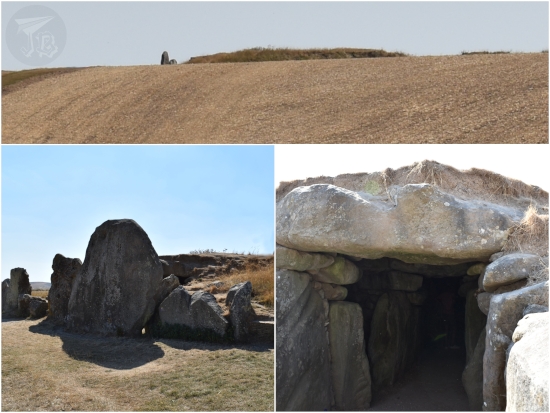
The first stop of the day was West Kennet Long Barrow. A long barrow is an elongated prehistoric (3800 – 3500 BCE) stone monument that has been linked to the worship of the dead and the ancestors. Sometimes, human remains have been found in them. If one imagines what Great Britain was at that time, the south-east area would be the one with less tree coverage, and therefore the best option for primitive people who had started to settle and use agriculture. The counties of Gloucestershire, Wiltshire, Somerset and Dorset have a lot of chalk-rich soil (the Salisbury Plain), which makes it difficult for tress to root and grow. Thus, it would have been easy for the primitive humans to settle and build their villages and monuments. Today, the whole area is known as Stonehenge and Avebury World Heritage Site, listed by Unesco in 1986, and it includes over 700 prehistoric monuments from the Neolithic and Bronze Age.

Collage: elongated mound of dirt on top. On the borrom, the gate. On the left the protective slabs, standing upright, and on the right, the entrance. It is a construction of vertical walls made from grey slabs and another slab on top. The interior is dark.

West Kennet Long Barrow is situated in the middle of a farm. There is a tiny parking lot to the side of the road, and a fifteen-minute walk to the barrow itself. It is one of the largest built in Britain, and around 50 sets of remains have been identified, along with pottery, beads and other personal items. Around 2000 BCE, it was closed down and barricaded, then discovered in the 19th century and scientifically excavated and restored in 1956. It is private property under the care of British Heritage. Apparently, all these sites have become a point of pilgrimage for neo-pagans, and on this day, there was a bunch of them chanting inside the barrow…

On the opposite side of the road from the barrow stands Silbury Hill, a mound or artificial mountain. It stands 30 metres high, with 160 metres in diameter wide, and it is estimated that half a million tonnes of material (mostly local chalk) were used to build it throughout several generations of humans. It cannot be climbed, due to a collapse a while back, that would have been neat!

View of a small hill and dry grass.

After that, we headed off to the village of Avebury, which hosts the largest Neolithic stone circle, with smaller circles inside. It originally had over 100 stones, and it might have built between 2850 and 2200 BCE. Today there is a village in the area, with a few shops and museums in the centre, and a lot of sheep grazing the area. Around three quarters of the circle is still standing, along the henge (long ditch that used to be built with the stones in Neolithic circles).

We had two and a half hours in Avebury – a bit too much, I would say – to explore the Avebury Stone Circle and Henge and its sheep. The guide told us about ley lines and trees that were supposed to have inspired Tolkien’s Ents from “The Lord of the Rings”, and I needed to ask about the geology of the stones – here I learnt that they are made out of sarsen, like the Stonehenge ones. Sarsen refers to silicified sandstone blocks, common in the area, and it has been proven that the ones used in the megaliths come from Marlborough Downs, some 25 km away (35 km from Stonehenge). Once we were dismissed for our “free time”, I walked along the three fourths of stone circle remaining.

A collage showing different megaliths from the Avebury stone circle. Small pillars mark the spots where the stones have been lost. There are some sheep grazing on dry grass.

There are other places to visit in town, such as a Medieval manor with a dovecote. The stables of the manor are the site of the archaeological museum is hosted, and here I made a mistake. I should have got in, but I wanted to visit the church, and by the time I was done, the museum was closing down. Live and learn. There is also a tiny chapel, and a lot of souvenir and “crystal” shops.

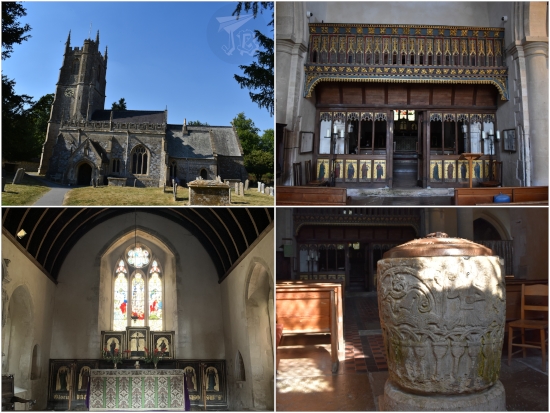
The Church of Saint James dates back to the 1000s, though later centuries saw the addition of many items, such as the aisles and the 15th-century wooden roof. The nave and the chancel are separated by a one-of-a-kind wooden rood / screen with an original 13th century base. There are Saxon windows and a Norman font. It is a fantastic little church.

Gothic church, from the outside. The inside shows a wooden Normand altar, the standard altar, and a carved stone baptismal font

Finally, the time came. At 17:30 we met up on the way to the coach, and then we started off towards the highlight of the day – Stonehenge. Stonehenge was erected between 3000 and 2000 BCE – the primitive human somehow got the sarsen stones into Salisbury plain and planted them so they stood in a circle. They measure up to four metres long, and some of them are arranged in the shape of trilithons – two large vertical stones (posts) support a third one (lintel) which is set horizontally on top of them, with carved studs so the structure fits like a snap. There is a tear-shaped monolith standing a few metres away called “Heel stone”, which marks the entrance.

Some of them are indeed collapsed now and some are covered in lichen – there is a special type of lichen that only grows in three places in the world, and that is one of them. For thousand of years, these stones have remained standing, and the first historical study of them dates from 1666, carried out by an English antiquary, natural philosopher and writer John Aubrey, and has been restored a several times, especially during the 20th century, when they were roped off and a fee charged for entry.

Currently, the stone circle belongs to the Queen of England, and according to the British Ancient Monuments Bill, it cannot be touched or altered in any way that is not to preserve its current status. In 2020, a core taken from the stones during the 1958 restoration was returned. This allowed researchers to analyse the composition and prove that the megaliths are indeed sarsen from the Malborough area.

The rules when you are allowed into the stone are “simple”: do not touch the stones, do not step on the stones, do not hug the stones, do not lick the stones, do not get naked among the stones. Judging by the tone in the guide’s voice, all that has happened before. Apparently, there are a lot of ley-line believers, neopagans and neodruids wanting to “connect” with the earth energy there (there is even a “yoga at sunset group”). In a kind of compromise, they allow you to take off your shoes and socks – which I did not do.

According to archaeologists, Stonehenge was designed in alignment the Winter Solstice sunset. The site was probably a celebration of the end of the worst of the winter before days started getting longer again. Other theories propose that it was originally a burial site that became a place to worship the ancestors.

The great thing about the after-hours tour is that you get to see the sunset around the site. Our timing was 18:45 – 19:45. The guide was nice too, and gave us “permission” to wander around and did not expect to listen to him all the time – don’t tell me twice. I explored and wandered to my heart’s content. We stayed there for about an hour, and it was really cool. I mean, not magical or “I feel the magic of the earth” or anything, but the circle is a fantastic piece of engineering, especially considering it was built five thousand years ago, before writing was even invented. Sometimes, humans are neat.

Stonehenge collage. Two shots of the megaliths standing on dry grass, from the outside; the sun shines between the darkened stones. One shot from the inside of the circle, showing the megaliths circling inwards.

It was over sooner than I would have liked, but about an hour later we were back on the bus after hitting the souvenir shop – where I got a guidebook – and we arrived in London around 22:00. When I got off the bus I just walked to the hotel, had my sandwich. Good thing I had left the window open, too, as it made the temperature slightly more tolerable – I own up though, I slept with the fan on, but… like a rock. Or a stone.

Walking distance: 11.96 km / 18742 steps
Coach distance: 317 km

11th August 2022: 21 hours straight of ups and downs in London {England, August 2022}

The first thing I had to do was waking up for a 6:30 flight – though considering I did not sleep very much that night due to the heat, I’m not sure if that it counts as waking up. The previous day, the airline had sent warning emails about arriving at the airport early – three hours before the flight would have meant being there at 3:30, so… not really. I arrived at the airport around 5:10, and I was at the gate by… 5:20, I’m not even kidding. While I normally do not queue to enter planes – the advantages of backpacks, I just kick them under the seat – I had been assigned seat 1A, which meant I had to put my luggage into the overhead compartment. I had decided to take a small backpack too, because I would be carrying it around for a while, and it would get searched in a couple of places.

Surprisingly, despite Brexit, the Ryanair strikes, airport chaos, and the fact that apparently the automatic passport reader cannot cope with my new look, I made it into the United Kingdom first and straight to London without a glitch. Not only that, I managed to get my Oyster recharged without any problems, and as soon as I had bought some food, I was on my way to the first stop of the day: Crystal Palace Park, for which I got to ride the shiny new underground line, the Elizabeth Line, then the Overground. Even though there are another couple of landmarks (that might warrant a visit when / if the restoration project finally goes through), what interested me in Crystal Palace was a collection of Victorian sculptures – the Crystal Palace Dinosaurs.

Though Ancient Greek already knew about fossils before the current era, it was in the 19th century when it hatched as a “science”, according to some spurred by Darwin’s “On the Origin of Species”. Fossil hunters ran amok, excavating and spoiling the North American badlands. In England itself, Mary Anning kept discovering cool things. There was a sort of a “Dinosaur fever” – the Victorians became fascinated with all things prehistoric. In 1852, a number of extinct animal reconstructions were commissioned to be erected in the gardens of the Crystal Palace, after the World Exhibition. Using the knowledge available at the time, Benjamin Waterhouse Hawkings, a natural history illustrator and sculptor, who did his best according to scientific knowledge at the time.

Not all the animals represented are real dinosaurs, but the nickname stuck. From today’s standards, most of the reproductions are extremely inaccurate, with some exceptions, such as the ichthyosaur (discovered by Mary Anning around 1811), and the plesiosaur (of which Mary Anning also found a skeleton in 1823, and then another in 1830 – I love that woman). Today, the park is organised in several “islands” where you can see the sculptures, though the water was a bit down due to the heatwaves:

  • Amphibians and therapsids: Dicynodon and Labyrinthodon
  • Marine reptiles: Ichthyosaur, Mosasaurus, Plesiosaur and Teleosaurus
  • Dinosaurs and pterosaurs: Hylaeosaurus, Iguanodon, Megalosaurus and Pterosaur
  • Mammals: Palaeotherium, Anoplotherium, Megaloceros and Megatherium

I have been aware of these sculptures for a long time – since I was a child and started liking dinosaurs. However, only recently did I find out that they really existed, and where they were. I arrived at Crystal Palace station a little after ten (making whole travel from the airport about two hours). I walked by a small farm with typical fauna such as… an alpaca, then I ate my sandwich overseeing the first island.

A collage showing differet statues of prehistoric creatures. Some try to be dinosaurs, and they look almost comically wrong, like giant iguanas or chameleons. There is one plesiosaurus looking rather acurate - it has a long neck and flipers. Finally, some mammals: a deer with huge antlers and a tiny horse-looking creature

I walked around for about an hour and then I set on my way back. Though I had planned to have a relaxed day at first, I had to adjust due to cancellations and train strikes. It was around that time that I calculated that I could actually cram my original Thursday and Saturday plans onto Thursday, plus the alternative plans I had made if I tweaked the time a little. So I back-rode for another hour towards the city.

Near Tower Hill stands the Sky Garden, on the 35th floor of the 20 Fenchurch Street building, designed by Rafael Viñoly. Sky Garden is considered the highest garden in London, and a fantastic viewpoint of the city. I almost accidentally came across the option to book a free access ticket for this – while I had not wanted to pay for any morning / early afternoon activities in case my plane was delayed, I figured out that I could book this for free, especially as they go stupidly fast! I made my 12:30 timeslot with a few minutes to spare, but I was let in after a queue, ID check, X rays and metal detection.

The Sky Garden features two terraces full of plants (landscaped by Gillespies), a couple of restaurants and bars, and an “open” gallery which has glass above your head so the feeling of opening dissipates – the glass is stained and scratched. It was one of the “must-do’s” in London I had never visited before, so I thought it would be a good opportunity. Fortunately, they have relaxed the rules on no bottles because of the unusual high temperatures.

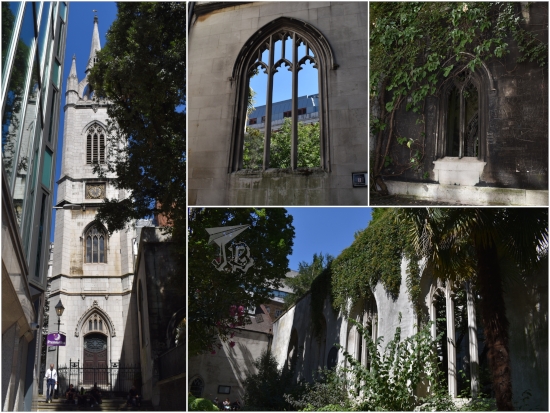
After wandering around for a bit, I continued onto Saint Dunstan in the East Church Garden, the ruins of an old Wren church destroyed by The Great Fire of London and destroyed again during the Blitz (World War II bombings). Dating back to the 1100s, it was opened as a public park in 1970. Aside from being a very cute building park I wanted to see for a while, a music video by the band VAMPS was filmed there.

Ruins of a gothic church turned garden, with hanging ivy and bushes overgrowing the walls and windows

As it was lunchtime, the park was bustling with people, so I just had to move on rather quickly, and went back to the underground to get to the area of Westminster. I had originally booked tickets for Saturday (back in May) but then they were cancelled due to “repair work” going on that day (I do wonder if it was a security measure related to the strikes though).

But of course, first I feasted my eyes on the very new Elizabeth Tower clock tower aka Big Ben – though Big Ben is one of the bells in the tower, but nobody really cares about that any more.

Elizabeth Tower, shining gold with the restoration. It almost looks fake. The clock marks Quarter to two.

The Palace of Westminster or Houses of Parliament is the centre of the United Kingdom’s turbulent political life. The current palace was built after the previous one was destroyed by a fire in 1834. The new palace was erected in the Neo-Gothic style, and it was mostly finished by 1860, although it did open to be used in 1835. There was a competition regarding the design, which was won by sir Charles Barry. The Palace of Westminster holds the two chambers where the British government meets – the House of Lords and the House of Commons – alongside the Norman Porch, St. Stephen’s chapel, and the different corridors where the MPs vote or discuss state matters. I’ll forever be amused that “for security reasons, photography is not permitted in these chambers with dozens of cameras for TV broadcasting and Internet streaming”, but alas. The woodwork on the Norman Porch ceiling is fantastic, and some of the decoration choices, such as Churchill’s sculpture are… interesting. It is noteworthy that it is part of the Unesco Heritage Site “Palace of Westminster, Westminster Abbey and St Margaret’s Church”.

Collage: a view of the houses of parliament (London), with the Elizabeth Tower on the left. Two shots of the Norman Hall, a huge ward with an intrincate design of wooden ceiling. A gothic corridor with a wooden door and some coloured glass panels

Afterwards, I just found my way to the hotel – though I had to wander a little to find the nearby supermarket, bugger those never-ending attached-house neighbourhoods, rested for a little and then went to the station to go to the theatre – I wanted some extra time to check out where my airport coach would leave, so I gave myself 45 minutes for a 22-minute trip. It turns out there was train trouble and I was barely on time, taking an alternative route instead of the direct one.

When I realised my flight timing would give a free evening in London, I booked tickets for the Apollo Victoria Theatre to watch the “Wicked”. This musical tells the story of “The Wonderful Wizard of Oz” from the point of view of the witches, and somehow gives the “Wicked Witch from the West”, Elphaba, an amazing personality and backstory that resonates a lot with me. For the same price as the ticket I was eyeing back in the day, I found a VIP upgrade just one seat over, so I was entitled to a drink and “snacks”, an early entry, along with access to the “Ambassador Lounge”, a tiny reception hall with access to a private restroom.

“Wicked” was great. The actress who plays the main character, Elphaba (Lucie Jones) came out a little yelly though in her solos. The duets with the other female singer (Glinda, Helen Woolf) were fantastic, and the male love interest’s (Fiyero, Ryan Reid) song was absolutely great, even though he is a character I have never cared for.

Apollo Victoria Theatre: the inner theatre, showing a dragon and a closed curtain showing a map of Oz. The outer theatre: there is a sign reading Apollo Victoria Wicked, and everything is lit green. The VIP lounge, with a glass of soda, and some chairs. The cast at the end of the show, taking their goodbye bows.

By the time I was out, the trains were running again, and one-to-three-minute delay on a line that runs every five minutes or so, and I was at the hotel by 23:00, absolutely beat. The room was extremely hot, because London is absolutely not ready for heat, so I had a snack in front of the fan, took a shower and then got some sleep – 21 hours on the go were over. Funnily enough, by the time I went to bed, I had that wobbly-world jet-lag feeling I have after my first day in Japan. It must have been the barely sleeping the night before. I fell asleep very fast.

Walking distance: 30.52 km / 46192 steps

11th – 13th August 2022: Non-weekend weekend in England 11th – 13th August 2022: Non-weekend weekend in England {England, August 2022}

When, back in May, I decided to book this trip, I was surely not anticipating the chaos in the European airports this year, nor for sure the England transport strikes. I did not foresee that the Palace of Westminster would suddenly cancel my visit, nor that it would be through my Westminster Abbey reservation that I would be informed of trains cancellations. I did not know that I would have to buy a last-minute bus ticket and miss half of a tour… Lots of things went almost wrong, but in the end, most everything worked out.

25th July 2022: Half a day {Salamanca, July 2022}

Mondays are always tricky because a lot of things close then. We reprised our latte/croissant and visited the Tourist information office that claimed that everything was open – which… was incorrect. My companion wanted to see Iglesia de San Marcos, a Romanesque church which has an interesting circular shape, probably built in the 11th century (that we had found in the book we got from the cathedral).

A Romanesque church. It has a round nave and a short bell tower with two bells.

We saw the local market Mercado Central de Salamanca, designed by the same architect as the Casa Lis. As this is a public building, it was in working order – though funnily enough, all the fishmongers were closed – no fish in Salamanca on Mondays! The building is modernist, with iron structures and colourful windows.

A Modernist building with colourful glass windows

To finish off the morning we went to visit the palace Palacio de la Salina, also a public building so also open. The architect in the project was Rodrigo Gil de Hontañón (who also designed the University building in Alcalá de Henares). It was built in 1538, mainly in Plateresque style, with some Italian elements.

The patio of a Plateresque palace, in gold tones with a lot of decoration on the stonework

Right across the park from the palace there is a lonely Renaissance tower Torre del Clavero. It was a 15th-century defence tower, with a square base that turns octagonal in height.

A

We walked around for a while longer, had lunch, and our train back left around 3:30. It was a rather uneventful trip full of gothic, modernism and iron, which I really enjoyed. I keep trying to get to like guided visits, and I have somehow got fond of climbing up towers.

Walking distance: 11737 steps / 7.31 km

24th July 2022: Up, up and down {Salamanca, July 2022}

After a latte and the best croissant I’ve had in a long time, we went over to see the gothic palace Casa de las Conchas, which was built between 1493 and 1517. The façade is decorated with sandstone-carved shells (concha, in Spanish). The exterior sports ironwork-protected windows, and the interior a patio with artistic arches.

The gothic palace called House of Shells. There are hundreds of them carved on the façade. The inner patio is carved in golden stone, with very thin columns and lots of decoration

It was still early for our visit to Palacio de Monterrey, a 16th-century Renaissance palace inspired in the Italian style of the time, combined with Plateresque decoration, which was heavily imitated later on in the 19th century. The building currently belongs to the House of Alba, probably the most prominent Spanish noble family. The House opened the palace to the public, and the inner area cannot be photograph – it was weird anyway, with some antiques and art pieces, but all of it was… prepared and staged, though the carpets were rolled out of the way. In this case the only option to sneak out a picture was from the tower, as a member of the staff followed us all the time.

Monterrey palace, built in golden-like masonery. The roofs and towers are decorated, and there is a row of windows alongside the upper floor.

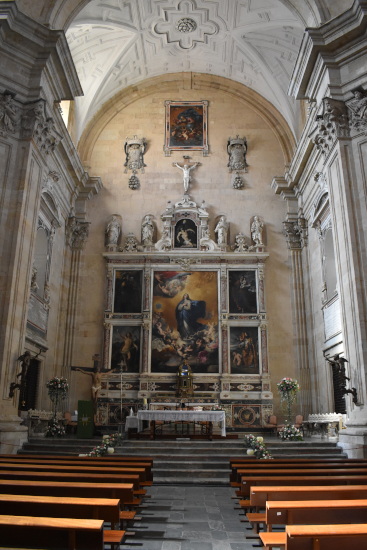
Next, just in front the palace, we visited the 17th-century church Iglesia de la Purísima, in Italian Baroque style. Its altarpiece is considered to have one of the best images of the Virgin Mary in her Immaculate Conception advocacy.

A Catholic altar showing the Inmaculate conception in the centre, she is dressed in blue, and standing in front of golden clouds, with angels around her. The back of the altar is built in white stone, and ornate.

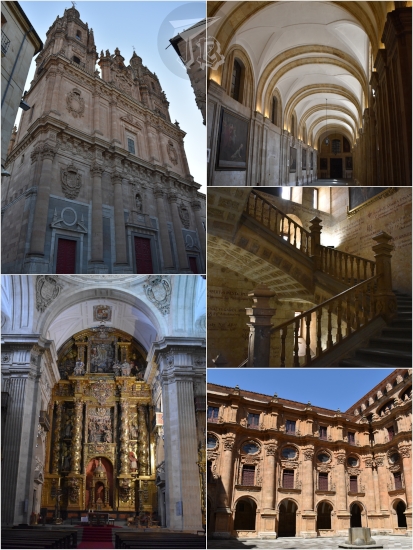
Our next spot was the second university of Salamanca, the see of the Universidad Pontificia de Salamanca, a building called La Clerecía. As the original university went secular, the Jesuits built a clerical university. The building, built in Baroque style between the 17th and 18th centuries is composed of a church, a cloister, a patio and a magnificent staircase, forming the complex (read: guided tour) called Vita Ignatii.

Collage: On the left, a very baroque church from the outside, also showing the gold inner altar. On the right, some shots of the upper and lower cloister, the patio is ornate and reddish, the staircase is made completely out of stone.

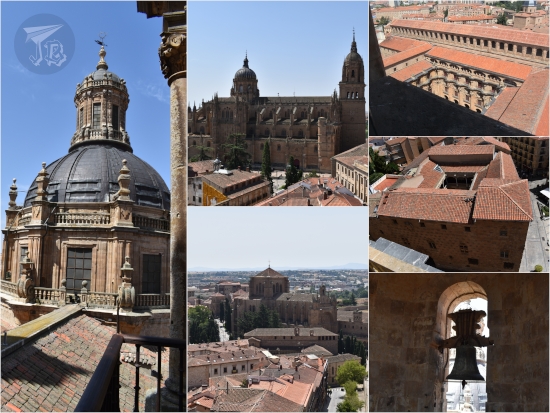
Then there are two towers that give out really awesome views of the town, named Scala Coeli, the stairs to the Sky.

Views of Salamanca from the above: the dome of the church from the outside, the cathedral, the House of Shells, and the bells.

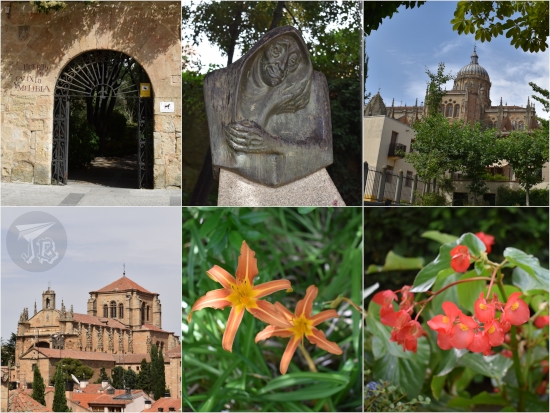
It was rather hot, so we had some unremarkable lunch and went to the hotel to wait out the blunt of it. It did not really work, and we eventually tried our luck with some more sightseeing. The first stop was the garden known as Huerto de Calixto y Melibea, based on a literature work Tragicomedia de Calisto y Melibea or La Celestina. It is considered the first Renaissance writing in Spanish, and it echoes with Romeo (Calisto or Calixto) and Juliet (Melibea), with an extra character, the old matchmaker Celestina, who is a horrible person trying to break the lovers up to marry Melibea to someone else. Though the writing does not have a firm setting, some say that it is probably Salamanca, where the author attended university. It was nicely shaded and had nice views.

Gate to the gardens, a bust of Celestina (the fictional character), from the cathedral, and some flowers: star-shaped and orange, bell-shaped and red.

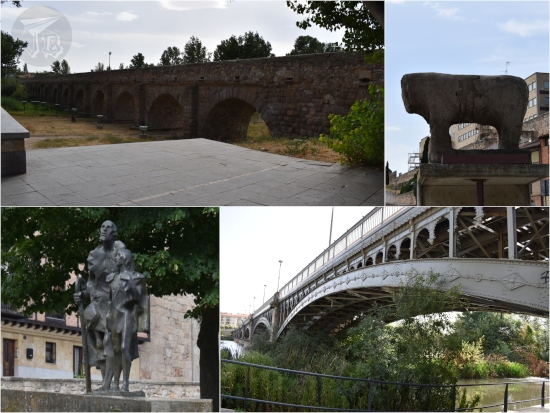
Then, we wandered off to see the bridges over the river Río Tormes again: both Puente de Enrique Estevan and Puente Romano. Next to the Roman bridge there is a statue of a verraco (ancient Celtic sculpture) Verraco del Puente Romano, which is supposed to have been there since the 16th century. A bit to the side, there is yet another literary monument, which represents the book El Lazarillo de Tormes, Lazarillo being the word for “guide dog (for the blind)” in Spanish (such an eye-seeing dog). Also written in the 16th century, it is considered another of the peak writings in Spanish, telling the story of a young lad who learns to survive by gathering street-smarts and shedding off any morals he ever had, finally settling in Salamanca with his unfaithful wife: Monumento al Lazarillo de Tormes.

Collage. The historical bridges in Salamanca: the Roman one, made from stone with wide archs, and the iron-architecture one, in greyish-green. Sculptures: Lazarillo with his master, and a prehistoric bull or pig, with a flat head

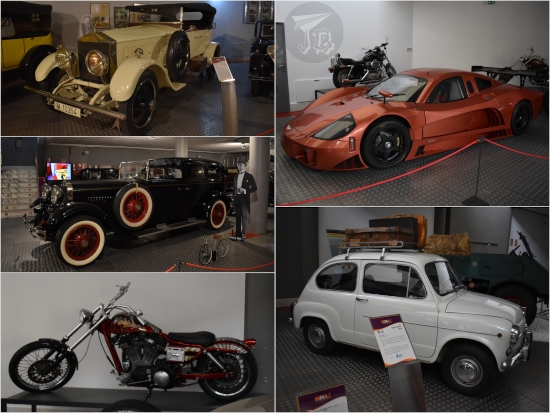
Then we found a very air-conditioned and interesting place – the automobile museum Museo de la Historia de la Automoción (which reminded me a little of the Megaweb Toyota City Showcase and History Garage in Tokyo). It has a lot of classic cars, and some historical pieces such as vehicles that belonged to dictator Francisco Franco or the writer Camilo José Cela (and air-con).

A collage of some cars: A Rolls-Royce, a Ferrari, a Wolkswagen 600; and a Harley-Davidso

I had then booked myself an evening visit around sunset time, to go up the towers of the cathedral, an experience called Ieronimus, with the hope to see some cool sunset and night views. It makes sense, right? Wrong. I should have realised when it turned out to be a guided visit that most of it would be inside, listening to the guy fanboy his own city – then he started speaking about the Lisbon earthquake and its effects in Salamanca and gave out wrong information. I stopped listening to him at that point. There was a light/music show in the cathedral, and I did get some neat pictures, but honestly? The choir concert in the old cathedral would have been a much better choice, had we known about it.

Views of Salamanca at night, with the gothic architecture highlighted by the illumination. The city looks Romantic and mysterious.

Walking distance: 13017 steps / 8.00 km

23rd July 2022: Plateresque Salamanca {Salamanca, July 2022}

Officially in western Spain, Salamanca stands next to the Tormes river and sports a Unesco World Heritage title for its old town. I was five or six the first time I was there, so it’s not like I remembered anything from it, except memorising excerpts from the book El Estudiante de Salamanca (José de Espronceda), my favourite Spanish Romantic poet.

Salamanca is known due to its university, which is considered one of the best in the teaching of Spanish as a second language, the oldest Spanish university and one of the oldest in Europe, founded in 1218. There are actually two universities, but we shall get to that later.

There is a period in Spanish history referred to as the Gold Century, Siglo de Oro (Not an actual century, the given dates are between 1492 – the year when the Catholic monarchs finished conquering the country, Europeans realised America existed, and the first book on Spanish grammar was published – and 1659 – when the Pyrenees treaty was signed after the war with France). It was throughout this period when Salamanca thrived, especially late-time Gothic styles and early Renaissance ones. Then of course Baroque later on, but you know my stance on Baroque by now I guess… The mixture of late-gothic and Renaissance gave way to a unique style, Plateresque – with a strong Gothic base and a blend of Mudéjar, Flamboyant Gothic, Lombard and Tuscan Renaissance elements and decorations. Plateresque is characterised by heavy decorations sculpted onto the main architecture, especially in the typical fusion of doors and altarpieces. The motifs are plants, animals, shields and medallions… All and all, an impressive style considering we are talking about carving stuff on stone – in the case of Salamanca, a lot of it is sandstone, which gives the old city a golden tone.

We had to take a couple of trains, but and made it to Salamanca around 10:30, and were in the city centre a few minutes later. After dropping the luggage at the hotel – I had been requested the hotel to be near the cathedral and I found one which was literally across the street from one of the flanks. Then again, here’s the thing – Salamanca has not one but two cathedrals: the Old Cathedral Catedral Vieja de Santa María and the New Cathedral Catedral Nueva de la Asunción de la Virgen. Apparently, instead of building over the old one, they decided to keep both, making the historical complex unique in the country.

The New Cathedral was built mainly in Gothic style with later Baroque add-ons, with an ornate Plateresque façade. It was commissioned by king Ferdinand V of Castile, and built between the 16th and 18th century, in the Gothic style, even though this was at time when Gothic was already in decline. However, the town authorities wanted it to “match” the old Romanesque cathedral. A cupola and a choir were added in the Baroque period, and the façades were decorated in the Plateresque way (in a 20th-century restoration, someone thought it would be funny to add an astronaut to the decoration, causing some hoaxes to pop up afterwards). The most important architect who worked in the new cathedral was José de Churriguera, one of the leading Baroque architects / sculptors / urbanists.

A very ornate Gothic cathedral. The entrance has so many carvings that it actually looks organic, if not for the fact that it is made out of golden / reddish stone

The New Cathedral connects to the old Cathedral, which is late Romanesque / early Gothic in style (I know, it’s confusing. Historically, the old cathedral is between Romanesque and Gothic, and the new one between Gothic and Renaissance – and this is the reason why the Gothic makes the two cathedral “match”). It was built between the 12th and 14th centuries. The most impressive thing in the Old Cathedral is the altarpiece, in which the highest-quality paintings were made by the Italian Dello Delli. On the way out, I let myself be tempted by a paper guidebook of the city – which was helpful because we had to remake all of our plans a couple of times.

Interior of a Romanesque church - the nave has very high and severe-seeming columns

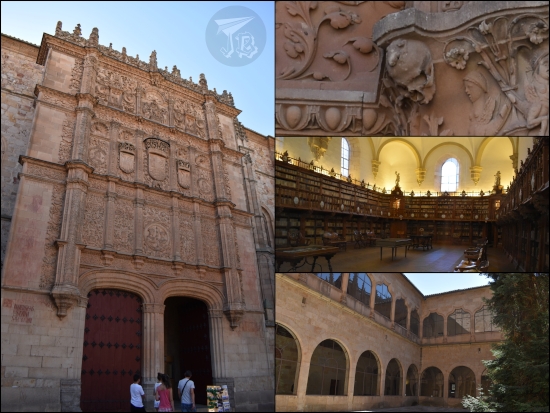
Afterwards, we headed off to the main university building Universidad de Salamanca, the first university building. The university was founded by King Alfonso XI in 1218, which makes it the oldest university in the whole Spanish-speaking world. The most important building today is the Escuelas Mayores, the upper school, built between 1411 and 1533. The façade, which looks towards the newly-discovered New World is sculpted in the Plateresque style, with a ton of decoration – and the most famous motif is the frog that stands on top of a skull. The university was built around a cloister for the students of old, and it has the most amazing library I have seen in a long while – selfishly (I’m joking of course) closed to the public. There is also a chapel and the classroom where the Spanish academic Fray Luis de León, who was famously jailed for four years, and picked up his lectures with “as we were saying yesterday”. The cloister has two floors since the 19th century, and in the centre there is a small giant sequoia (which I thought was a simple fir). There are chapels, and halls, and areas where university holds events.

Very ornate entrance to a building. there are two doors (four or five times as tall as a person) and the decoration, all carved in stone, is on top. Three floors of decoration, with columns and shields. A close-up shows a frog on top of a skull.

The problem with Salamanca is that the entries and exits of the building make you have to backtrack a lot (and the horrible street lights), but I love Gothic so I did not mind wandering around anyway. After the Escuelas Mayores, we went to another university building the lesser school or Escuelas Menores. Today, there is a cloister which dates from 1428 with a Baroque upper veranda. In one of the side halls there is a fresco panting that used to be in the library and that was moved over in 1950. The fresco represents a night sky was used in teaching.

Gothic patio and a suck picture of a fresco painting, showing stars and the representation of constellations

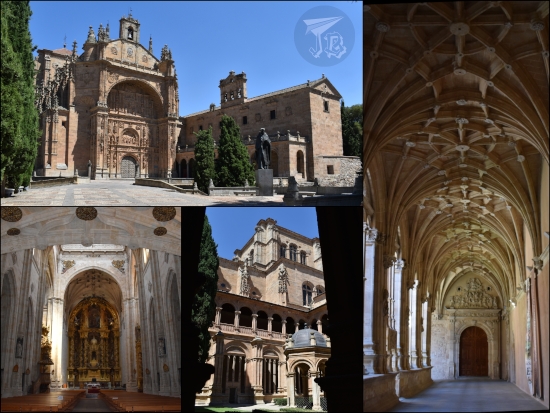
We had lunch, then we went to the Dominican monastery Convento de San Esteban and its church. The current monastery dates from 1524-1610, and it was built over the previous one. The façade of the church is considered the best example of Plateresque, and José de Churriguera also worked in the main altarpiece. The monastic building has a portico with Italian loggias, typical of the Renaissance. The cloister is mainly Renaissance with Gothic features, and a small temple in the middle. The ambulatory in the cloister has beautiful Gothic columns and nerves on the ceiling.

A convent, built in ornate gotic style. The covered corridor around the cloister shows pointed arches and rich decorations

Right in front of the monastery stands the Dominican convent Convento de las Dueñas. The building is Baroque, and before being a convent it used to be a palace – which has caused the convent to have some eclectic elements of architecture, such as the Mudéjar arch mosaic or doors. The inner cloister is Plateresque and full of roses and flowers.

A Baroque building. The inner patio is decorated with plants and Moorish-seeming blinded arches

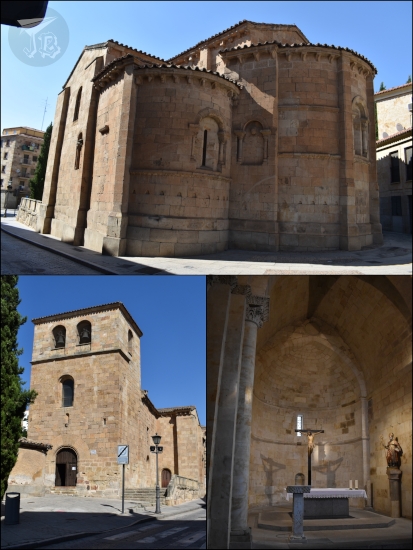
Next, we found the tiny Romanesque church Iglesia de Santo Tomás Cantuariense, where I happily sicced the oh-so-bored guide onto my companion.

Small Romanesque church in reddish-gold stone. It has a tiny bell tower.

After a stop for a cold drink we went to the Art Nouveau and Art Déco Museum Museo de Art Nouveau y Art Déco Casa Lis, which is one of those places that takes itself very seriously and does not allow photographs. I got scolded for having my camera to my side even closed – but I have to admit that I did sneak up a few things with the phone, mostly because I wanted a record of the central hall with the glass ceiling, and the green windows from the inside, more than the decorative details, though some of them were pretty nice. The Lis house was built by Andalusian architect Joaquín de Vargas towards the end of the 19th century for the first owner, Miguel de Lis.

A Modernist building with brightly-coloured glass in the ceiling and walls.

We headed to the main square Plaza Mayor for dinner, and then to see the pretty lights. On the way we found the other university Universidad Pontificia and the palace Casa de las Conchas, which we would visit the following day.

The main square was another of the city landmarks first designed by Alberto Churriguera, and later one of his nephews – it seems that the Churriguera family claimed dibs on doing stuff in Salamanca. The square is fantastic by day but when night fell and the lights were turned on, it was unbelievable. We had some local sausages and cheese for dinner at one of the street tables in the square.

A plate of sausages and cheese, and two views of the Main Square in Salamanca, one in daylight, one at night, and lit up. The square buildings have a lot of windows and arches on the ground floor

Afterwards, I wandered alone for a while, to revisit some of the sights at night, and a couple of new ones.

Salamanca at night. The cathedral is lit and the ornamets almost shine. The Modernist house is lit in green and blue lights.

I headed off to the riverside of Río Tormes, which as any river has bridges. The first one I found is the Puente de Enrique Estevan, commissioned in 1891 in order for the town to be ready for the new cars. It has six iron arches and at night it is lit in bluish light. A few minutes downstream stands the older stone bridge Puente Romano, which according to the legend was built by Hercules – it dates back to the first century, but it has been heavily rebuilt and reconstructed through the years, especially after it was damaged by a flood in the 17th century.

A collage showing an iron bridge, and a stone bridge, both lit in the dark

Finally, around midnight, I went back to the hotel for a shower and sleep.

Walking distance: 17269 steps / 10.76 km

10th July 2022: Reservoirs (Buendía & Entrepeñas, Spain)

I tried going for a hike because I was feeling cooped up, and tried to make the most out of the draught Spain is going through. The centre of Spain is sprinkled with large reservoirs, a lot of them built during Franco’s dictatorship as part of the efforts to get the country to recover from the war. The reservoir Embalse de Buendía is fed by the river Guadiela and it was finished in the year 1958. Before that, there used to be a bathing complex used by the royals, along with a village there. I have wanted to get there for a while, but it is tricky because the trail is reported to be in bad condition. So I decided to walk down the trail Camino de La Isabela to gauge whether my small city car would make it. Thus, think about this as a recognisance mission.

I parked the car at the beginning of the trail around 8:10 in the morning and started walking. I saw a small lizard which had shed off its tail, and some footprints – birds, canid, and I’m pretty sure a deer.

Close-up of a brown lizard which is growing its tail back.

Collage of animal footprints: paws, tallons and hooves

The temperature was nice at that time and I walked for about an hour until I got to the shore of the reservoir, then another 20 minutes or so until I got to see the derelict settlement. The water was still too high so I decided not to walk there.

A view of the reservoir. The sun is shining and there are some green / yellow plants ashore.

The reservoir. On one of the inlets you can guess the ruins, along with some columns that peek over the water.

I just hung out at the shore and found a bunch of dragonflies (I think Trithemis annulata, violet-marked darter (female and male), from a helpful comment on social media). Then I started walking back, because the temperature was rising fast.

A yellow and a red dragonfly.

I made it back to the car around 11:00 and drove off towards a second reservoir in the area, Embalse de Entrepeñas. I have driven by more than a few times, and I would always be drawn to a little side road that seemed to overlook the reservoir. It is actually the beginning of a hiking trail, but it was already too hot to keep going. Instead, I peered around the actual dam and hydroelectric station.

A white-grey dam closes the reservoir. There are trees in the foregrond and the water looks almost turquoise.

The electricity power-plant that is fed by the water behind the dam. There are a lot of wires coming out at different heights.

It was too hot to do anything, the beginning of the heat wave, so I just drove off and made a stop to see some friends on the way. I’ll keep an eye on the water level of the reservoir Embalse de Buendía in case I can come back to the area, now that I’ve figured out how far I can reach with the car.

Walking distance: 16846 steps / 11.76 km

27th June 2022: One unexpected Aquarium visit. Zaragoza (Spain)

Because life is strange sometimes, I found myself travelling to Zaragoza in a super-slow train that took three and a half hours (while the high-speed train takes around one hour). It was somewhat of an emergency so we had to leave on Sunday in the late afternoon, and came back on Monday. We booked a hotel next to the station, one that had been built for the Expo 2008, and it goes without saying that the hotel had indeed seen better times.

My company was not required on Monday morning, so I walked towards the area that had been the Expo’08. I crossed river Ebro using the bridge Puente del Tercer Milenio, the longest concrete bow-string bridge in the world, designed by architect Juan José Arenas de Pablo.

Several views of Zaragoza's Millenium Bridge. It is white, arched in form, and the middle is held by a zigzag of wiring.

The north wind was blowing and it was a bit uncomfortable. Furthermore, the area where the Expo used to be was creepy. A lot of it was abandoned and / or fenced off, and even if they had tried to make it a park it just looked derelict and forsaken.

A collage of the parks, buildings and decorations from the former Expo 98. Everything looks derelict, with dry weeds growing where there used to be fountains. Interestingly, no windows are broken.

I looked over at the river Río Ebro. To both sides there were bridges – Pasarela del Voluntariado to the downstream to the left, and Pabellón Puente upstream to the right.

A panoramic from the river bank. There is a bird flying, the sky is blue and there are several clouds

Then I went to the river aquarium Acuario de Zaragoza, which prides itself in being the largest freshwater aquarium in Europe.

The aquarium is divided in five areas or rivers, organised surrounding a central freshwater tank called “World River”, where there are no sharks, but there are several arapaima (Arapaima gigas), one of the largest freshwater species of fish, up to 2 metres long.

Huge Amazonian fish swimming about.

The first river is the Nile (Egypt). It included (obviously) a bunch of fish, a couple of Nile crocodiles (Crocodylus niloticus), a Nile monitor lizard (Varanus niloticus, which had somehow by the way figured out that it lived in an enclosure with a sliding door and… was trying to get it open), a couple of lungfish, perches…

Collage: a Nile monitor lizard, Nile crocodiles chilling, and colourful fish.

The second river is the Mekong (China), which is known for its giant fish – as a matter of fact, the largest freshwater fish ever was recently found there. There are also an insane amount of catfish – in the river, the aquarium has them under control. The most interesting thing about the Mekong is the freshwater rays.

Collage: Big orange-and-red fish, and a freshwater ray, which is black with white spots. It looks a bit like a pan.

The third river is the Amazon (Brazil), which is the largest river ever, so there are three separate areas – the blackwater-flooded forest or Igapó, the forest itself, and the mangrove. The displays included Knysna turaco (Tauraco corythaix), which is the “only true red and green bird”, green iguana (Iguana iguana), catfish, red-bellied piranha (Pygocentrus nattereri), electric eels (Electrophorus electricus), anaconda (Eunectes notaeus).

Collage: black and white fish with whiskers, a green and blue bird silendly judging the photographer, brightly-coloured fish and something that looks like a rock but it's actually a weird turtle.

Then there is the Darling-Murray river (Australia), which must be saltier than I had expected, because apparently clownfish (Amphiprion ocellaris) and anemone (Entacmaea quadricolor) packs, and seahorses, along Pearl arowanas (Scleropages jardinii), tree frogs (Litoria caerulea), and the supercute (I think it was a) nobbi dragon (Diporiphora nobbi)…

Collage: A lizard, quite unamused; a clown fish hiding behind an anemone

Finally, there’s the Ebro river, the local one. There are the endemic barbs (“barbo de Graells” Luciobarbus graellsii), the local otter (Lutra lutra) and sturgeons (Acipenser sp.).

Collage: a turtle, an edible fish, and a blurry otter that would not stay still for a picture

Throughout the whole run there are hundreds of turtles – the aquarium runs a turtle rescue scheme in order to get abandoned pet turtles out from the rivers, mostly the pond slider (Trachemys scripta).

I saw some of the old Expo’08 mascot, and some people diving in the central tank – I don’t think I’d go into a tank with the arapaima, even if they were swimming near when I was feeding the manatee in Faunia. There were also some animals that had been rescued from illegal trade and donated to the aquarium.

After the aquarium, there was only coming back in yet another train that took over three hours. It was the weirdest trip I have ever taken…

31st May 2022: Anaga {Tenerife, birthday 2022}

I got up on the early side as I had booked breakfast at 8:00. I was surprisingly not hungry, even if I had not finished dinner the previous evening. My plane was a little before 17:00 and I had to return the car at 13:30 (I must have messed up the time, because I was convinced I had chosen 14:30). however, there was still one spot in the island I wanted to check out – the Nature Reserve Parque Rural de Anaga, in the north of the island and about half an hour’s drive away from the airport. This is a mountain area covered in primitive subtropical moist broadleaf forests, called laurisilva canaria. The mountain range is the oldest part of the island of Tenerife.

During the Tertiary Period, the whole Mediterranean area was covered in forests which had wide, dark leaves. They disappeared with the glacial era that started with the Quaternary. The forest has not changed nor evolved with time, so it has remained as it was 40 million years ago. It was preserved in several humid areas due to the wind patterns while the continents dried out and deserts opened. Sometimes, these forests are called laurel forests, as laurel (Laurus novocanariensis) is one of the typical plants. There are other trees as tils (Ocotea foetens), bushes, vines, ferns and mosses.

I drove around two hours to get from the Parador to Anaga, and was lucky to snatch one of the last parking spots. I asked at the visitor’s centre about a route that was not too long and I was recommended a two-hour one, called Bosque de los Enigmas, the Enigma Forest.

The beginning of it was really cool. The tils and the laurels twisted almost magically and I was alone on the path. I saw some birds, though capturing them on camera was hard, possibly a grey wagtail (Motacilla cinerea) and a female blackbird (Turdus merula; which is not really black). Aside from being a nature reserve, Anaga is also a bird protection area.

A path into the primitive forest. The trees curve over and around the trail, and everything is dark

A shot up a tree, the trunk is covered in moss

An old waterway or river bed turned into a path. There are walls of dirt to the side, and the roots of the trees are showing

Collage: a grey fluffy bird looking at the camera, and a black one with its back turned, completely ignoring it.

At some point, unfortunately, I lost the trail. I reached the viewpoint Mirador de Zapata going in the wrong direction. Though the weather was very appropriate for an evergreen subtropical forest, this meant that I could either backtrack, or go along the road for a while. I decided on the side of the road as that way I knew how long I would take to reach the parking lot.

A view of the tree tops from above. In the backgrond, partially obscured by the thick fog, there is a village, and the sea is beyond it.

I eventually reached the beginning of the trail again and I had not been run over a car, which was a plus, and before leaving I could look over a second viewpoint Mirador de la Cruz del Carmen, which offers a peek onto the whole massif.

Traces of water runoff paths, which have eroded the soil and torn some trees down

A view of the tree tops from above. In the backgrond, partially obscured by the thick fog, there is a village, and volcanic mountains beyond it.

After this, I drove back to the airport to turn back the car and have some lunch. I had hoped that the smaller airport would be less strict than one of the big hubs, but it turned out they were even more vigilant. So off with the shoes again. We took off at the brink of time, landed at the expected hour… and on the way back home got caught in an hour-long double traffic jam. Ho boy!

All in all, nothing really went according to plan, even if the plans were just a draft. But all in all I had a good time and got to spend some time with myself, which I desperately needed. So yay luckiest unlucky trip ever!

30th May 2022: The Slopes of Mount Teide {Tenerife, birthday 2022}

Due to the amount of near-misses, I had started thinking about this as the luckiest unlucky trip in a long time. Unfortunately, this was the day the luck ran out. As I woke up and turned on the phone I received the notification that the cable-car to go up Mount Teide was closed due to bad weather, which was a bit of a blow. I mean, I was in the middle of the natural park, without anything to do within a couple of hours by car as the hiking trails are closed on Monday mornings as it is then when the mouflon population is controlled – using rifles. I did not want to end up shot.

If you consider that the island Tenerife is one big volcano, Mount Teide is the most famous eruptive fissure. Considering it an independent item, it is a stratovolcano. The cone stands around 7500 metres from the sea floor, with an emerged 3715 m above sea level. Its base is located on a previous crater called Las Cañadas. Mount Teide last erupted in 1909, so it is still considered an active volcano, and it hosts a bunch of towns on its slopes, that might get obliterated in an eruption. Aside from being a National Park, the area is a Unesco World Heritage Site.

Historically, an eruption was reported by Christopher Columbus in 1492. Most recent eruptions happened in 2805, 1798 and 1909. Looking back, Mount Teide formed around 160,000 years ago, after the collapse of Las Cañadas. The last summit eruption happened in the 9th century, which caused the black lava blocks that seem to run down the slopes.

The whole point of my being there was going up the mountain, so I resolved to try and do that. I knew there was little chance I could make it to the top even with the access permission, but I would try. I decided to gamble the track Sendero de Montaña Blanca, which is the most typical one. For this, I had a good breakfast and started walking around 9:45 am. The track runs 8 km and starts at an altitude from 2348 m. If you have the permission, you can access the track Sendero de Telesforo Bravo that peaks the volcano at 3718 metres.

A stone and tile marker, with a map of the trail.

The first part of the morning, I spent on Montaña Blanca. I hiked around 3 km upwards in an hour or so. A park ranger told me that the bad weather was actually strong winds and to be careful. I’d never hiked with wind, so I decided that I would not do anything stupid. As I walked, I went by the accretion balls affectionately called “Teide Eggs” Huevos del Teide.

Collage: The Montaña Blanca trail. The landscape is desertic, reddish and brown, and there is barely any vegetation. When turning back, the sea peeks in the distance, and when looking up there are black rocks from an eruption.

Eventually, I reached the actual foot of Mount Teide, and this is when things got hard – and spectacular. The slope became much steeper and the wind made it hard to move forward. I walked between the two dark petrified lava flows, and could see Montaña Blanca and the Atlantic Ocean beneath.

View from the slope of Teide. Montaña Blanca is underneath, in red-gold. To the sides, the black and dark grey rocks trailing the old lava flows

I reached Refugio de Altavista at 3260 m around 14:00. At this point I was two kilometres away from the next station and 650 m away from the crater. Unfortunately, the elevation was still around 500 m. At this point the wind was very strong and shortly after the refuge I saw an area of the slope I knew I could climb up… but I knew I wouldn’t climb down with such strong wind, not safely. So I realised I had to turn back, even if that meant I wouldn’t see the peak, much less reach it. However, it was the sane thing to do.

Standing in the middle of the two solidified coladas - looking down there are black and grey rocks, and the sea in the horizon. Looking up, only more rocks.

It took me two and a half hours to hike down, and I made it back at the Parador around 17:30. I had a shower and I felt tired, though not as sore as I imagined. For dinner, I tried some local speciality “wrinkled potatoes” papas arrugadas, which are boiled in saltwater, and they are so high-class that can be eaten without being peeled. They come with some dips, a bit too spicy for my taste, but they were delicious.

Small voiled potatoes and three small bowls of sauces. The potatoes are unpeeled and they look wrinkled.

I was a bit bummed that I did not manage to reach the crater, but I think I did a good job, almost 1000 metres up and down. I guess it just meant I had to go back at some point…

29th May 2022: La Orotava, Icod de los Vinos & Parque Nacional del Teide {Tenerife, birthday 2022}

I got up rather early in the morning (especially considering that the Canary Islands are an hour behind my usual time zone) and I was surprised at how many people there were already on the streets of Santa Cruz de Tenerife before 8:30 on a Sunday morning. I drove out of the town and headed north-west, where I came across my first stop – a viewpoint of Mount Teide called Mirador de Humboldt honouring the German explorer from the late 18th century (though I kept thinking that there was a missing penguin opportunity there). The viewpoint overlooks the ocean and Mount Teide, which Humboldt climbed in 1799.

Mount Teide, a volcano, looms in the background. The top is bare and barren, but the slopes look green and fertile, with plantations and some villages. In the foreground, there is a bronze sculpture of Alexander Humbolt, sitting on the low wall of the lookout, and looking to the side.

I continued driving towards La Orotava, the municipality which Mount Teide actually belongs to. After parking the car, I walked towards the historical centre and ended up at the square Plaza de la Constitución, which stands next to the church Iglesia de San Agustín. Mount Teide loomed over the streets, ready to celebrate Pentecost Sunday. And guess what? The main church is called… Parroquia Matriz de Nuestra Señora de la Concepción. The initial hermit church was built in the 15th century, and it was completely rebuilt in the Baroque style throughout the 18th century, though the interior was remade in the 19th century and there was yet another renovation in the 20th century. It is considered the most important building of the Canarian Baroque.

A collage of La Orotava. The buildings are built with white plaster and black volcanic rock. Mount Teide peeks from the background.

The most representative construction in La Orotava is the “house of balconies” Casa de los Balcones. The house was built in the 17th century. The façade shows a front-long balcony on the third floor, and five smaller balconies on the second, all of them made from dark teak wood. The interior holds a museum, but I decided to give that a miss because I reached there at the same time as a very disorganised group of forty or fifty people who were going in at the time.

A colonial house. It is built in white brink. It has three floors. On the ground, there are brown windows. On the first floor, five balconies, with decorated ironwork. On the second floor, a long balcony or gallery in dark wood.

Instead, I went back to the car and drove towards Icod de los Vinos. There, my first stop was the butterfly house Mariposario del Drago, since the ethnographical museum Museo del Guanche is closed.

A collage showing colourful butterflies - red, orange, blue, black, black and white. One of them is chilling on the shell of a turtle, and another one is caught mid-flight. Most are on flowers and plants.

The butterfly house stands next to a botanical park Parque del Drago built around the symbol of the town – and maybe the whole island – the Drago Milenario. This is the largest and oldest specimen of Canary Islands dragon tree or drago (Dracaena draco). Folklore says that it is a thousand years old, hence the name “the thousand-year-old dragon tree”, though in reality, it is probably around 600 years.

The dragon-blood tree. It has a knotted grey trunk and bony branches. Around it there are bright-green palm and laurel trees

The park, built around the drago, holds local species trying to reproduce the local biotopes with height, there is also a small volcanic cave. It was here where where I managed to catch my first glance at the local fauna – two of the endemic lizards (though not as big as the one I had seen in the museum): lagarto tizón (Gallotia galloti) or tizon lizard, a blue-spotted male and a brown-striped female.

Two lizards. One camouflages on the grey and brown ground. The other on has a brown tail, but the body is black and bright blue

Then I went back to the car to climb up a crazy slope until I reached the visitors’ centre of the lava tube Cueva del viento. A lava tube is a “cave” formed the flowing lava of a volcano. As the outer part solidifies, the inner core continues flowing until it empties the tube. The guided visit is the only way you can enter the tube, so I had reserved that a few weeks earlier.

The visit started with a small introduction in the visitor’s centre, with a lot of “gotcha” questions on the guide’s part. I tried really, really hard not to be a smartarse, but I did sit down on the floor at a point because I did not feel like standing around for twenty minutes. The important information we received was that there were two types of lava that had formed the island of Tenerife: pahoehoe and block lava.

Then we took the centre’s vehicles to the outer area of the cave, where we could see the solidified lava, now turned into stone. Pahoehoe lava is basaltic, it flows slowly, and it is the responsible for creating the tubes. As it flows and solidifies, it creates undulations and wrinkles. On top of it, only small trees and bushes can grow.

Old Pahoehoe lava trails. The rock looks wrinkled or similar to pillows.

Block lava is more acidic, with a higher silica contents, it flows less and creates “blocks” as it solidifies. Pines can be found growing on top.

Pines around an old colada, which seems rocky and broken.

The cave itself was very cool. Unfortunately, there were a couple of families with kids and grandparents, all trying to be braver than the next – and thus acted loud and boisterous. More interesting information – mummified guanche aboriginals had been found in the cave, along with remains of a giant rat and lizard that were the ones reproduced in the Museo de Ciencia y Antropología de Tenerife. It is one of the biggest lava tubes in the world, with up to three levels and maybe 18 km of tunnels, though only a short walk can be had.

Inside the lava tube. It looks alien, like the rock is going to start dripping any second

Back in the parking lot, I had a snack and headed off towards the Parador de las Cañadas del Teide, where I had booked my next couple of nights. On the way, I went through several amazing volcanic landscapes that I could not photograph as I was driving. However, I did stop at several lookouts throughout the Parque Nacional del Teide.

Mirador de Samara.

Pines growing up on the dusty remains of a lava flow. In the background, there are three mountains - three craters of the same volcano

Mirador de las Narices del Teide, which shows the collapse on the mountain during the last known eruption.

A view of the black collapse of lava from the last eruption. Everything is barren, brown and grey, except for a black spillage coming down ominously. The sky is blue in the background, which makes the whole thing look even more bizarre.

Mirador Zapato de la Reina.

The top of Teide. This is the point where vegetation has become scarce, with low bushes, that creep up the slope. The summit looks naked.

Finally, I arrived in the area of Las Cañadas del Teide or Las Siete Cañadas where the Parador de las Cañadas del Teide stands. I was lucky that the season was good to see the flowering bugloss Echium wildpretii (tajinaste in Spanish), an endemic flora species mostly found on the Teide slopes. After checking in I wandered around the different tracks and paths – Cañada Blanca, Roques de García and Mirador de la Ruleta, which show the different stages of various volcanic eruptions.

Mount Teide rises in the background. It looks wrinkled due to the different eruptions. At its foot, a low building, looking completely out of place. In the foreground, small bushes in grey and green.

Collage: Different rocks and structures created by lava and erosion, the rocks are reddish or grey, and they have weird shapes. The tajinaste is a tall bush, with tiny red flowers, it stands about 1m above the rest of the plants.

I turned in early, and I had booked my dinner in the Parador both nights I’d be sleeping there, so that was an easy one. The staff made it a little awkward though, even if I was not the only solo traveller around. After dinner, I tried to get some pictures of the night sky, but I was unsuccessful.

28th May 2022: San Cristóbal de la Laguna, Bajamar & Santa Cruz de Tenerife {Tenerife, birthday 2022}

I had a four-day weekend that happened to overlap with my birthday, so I decided to get myself a present and I booked the four days out – I wanted to visit the Spanish island of Tenerife. I seemed to have a streak of luck finding a decent flight, a couple of good hotels and a free permission to visit the peak of Mount Teide, a non-extinct volcano that happens to be the highest peak in Spain. I also decided to rent a car for the first time so I could travel around the island and do different activities in different places.

The plane left on time at 8:15 on Saturday – and I have to say that I love my IKEA travel bag, because it has a huge capacity but the perfect size to place under the seat, therefore I do not need to queue up for boarding to make sure I can stow the carry on. We taxied at the correct time, but when we got to the runway, we stopped. It turned out that one of the sensors was giving a warning of a 400 ºC temperature on one of the wheels. It turned out to be a false alarm, but we ended up with an hour-long delay that ended up cascading.

I reached the airport and got my rental – Volkswagen Polo I had to learn how to reverse. Once I was done with that, it was surprisingly easy to get by. I drove off to San Cristobal de la Laguna and went off to visit the historic quarter, which is a Unesco World Heritage site as an example of colonial architecture – Centro Histórico de San Cristobal de la Laguna. Most of the buildings date back to the 15th century, and the design was then copied in different colonial cities in South America. The houses are painted in different colours and most of them sport amazing woodwork in their doors or balconies.

It gave me a pretty distinct “Disneyland” feeling as the pedestrian streets are plagued with cafés, brand shops and bars. It was packed with tourists like myself flocking in guided tours from the tourist office, which seemed to only open to gather groups in order to hold those tours. As the week before my trip had been work-crazy, I had not been able to plan in detail, so my plan was to hit the tourist office, gather information and move on. This did not work out, and on top of that, the cathedral Catedral de Nuestra Señora de los Remedios was already closing down when I arrived – due to the delay. Other interesting but closed buildings included the church Iglesia Matriz de la Concepción, and several palaces including Casa de los Capitanes and the reconstructed Palacio de Salazar.

Typical buildings from Canary Islands. They are colonial in style, with big doors and windows. The façades are painted with different colours.

Typical buildings from Canary Islands. They are colonial in style, with big doors and windows. The façades are painted with different colours. The streets are wide and full of people.

I’m not going to say that I was disappointed, but I was really not digging the atmosphere, so I decided to move on. Instead of following the initial rough plan, I decided to head off to the tiny village of Bajamar to see the “sea pools”. Built in the petrified lava coast, the Piscinas de Bajamar are swimming pools fed by ocean water that keep swimmers safe from the rocks and the waves. I was lucky enough to find a very good and easy parking spot.

I wandered around the promenade Paseo Marítimo de Bajamar, saw the pools, the beach, and the mini lighthouse Faro de Bajamar.

Waves coming into the volcanic beach, which does not have sand but big black blocks of rock.

I moved onto Santa Cruz de Tenerife afterwards, ditched the car and checked into the hotel, then went off to explore. I walked by the market complex La Recova, also called Mercado de Nuestra Señora de África.

A bright orange building. It has a low, wide wall, and in the centre a clock tower

The tower of the church Iglesia Matriz de la Concepción (yes, again, but another one). The church has been repeatedly rebuilt and renamed between the 15th and 18th centuries. The current building is Canarian Baroque / Tuscan style.

A church with a bell tower. The building is white clay with black rock; this style is typical in the area

My first real destination was Plaza de España where the defensive castle Castillo de San Cristóbal used to stand. Now there is a fountain / pond and you can see the foundations of the castle.

Collage. The former site of the castle, now converted into a fountain or lake. On the other side, the castle foundations, and a cannon.

Next, I found another important square, Plaza de la Candelaria, but it was unfortunately under construction.

A grey building with construction work being done on it

So I moved on to the science and anthropology museum Museo de Ciencia y Antropología de Tenerife. It was rather underwhelming at first, as most of the “exhibit” were photographs. Eventually I reached the “good” stuff, with reconstructions of ancient and extinct animals such as the Tenerife giant rat (Canariomys bravoi) and the Goliath Giant (Gallotia goliath) lizard – we’ll come back to those eventually. There were butterfly collections, reproductions of marine animals, rocks and meteorites. In the archaeology ward there were mummies – that was a little unnerving to be honest, I thought we had learnt a little more respect about the ancient cultures.

Before the Europeans arrived in the Canary Islands in the 15th century, there was a previous civilization in Tenerife, called the guanche. The guanche settled in the island around the 6th century. While it is not clear where they came from it is thought that they came from the north of Africa, as their language was similar to those in the Berber language group. They lived off the cattle and the land, and their economy was clearly based on the goat, which they used for everything – food (meat and dairy), clothing, bone tools, and mummification material.

Collage of the museum: a prehistoric carved rock; preserved giant rat and lizard; models of fish; a meteorite; rests of mummies (a foot and an arm)

After the museum, I walked along the harbour and saw the modern concert hall Auditorio de Tenerife, designed by the famous architect Santiago Calatrava, whose style is easily recognised – even though in recent years he has drawn criticism for going way beyond budget and his building having problems due to “over innovation”.

The auditorium. It looks like the sail of a yacht, all white.

A few steps further stands the tiny fortress Castillo de San Juan Bautista, built between 1641 and 1643, and rebuilt the following century. I would have loved to see the botanical garden, but it closed early – as most things seemed to do.

Small castle surrounded by a moat that fills up in high tide.

I took a small detour to see the former arsenal Casa de la Pólvora, built in masonry in the 18th century. Eventually, I went to the supermarket to buy some dinner and snacks for the upcoming adventures, and called it a day after 14 hours on the go.

Armourine building. It looks like a treasure chest, built in grey rock

13th – 15th May 2022: Paris (France) & Saint Seiya Symphonic Adventure

This has been a weird ride in more ways than one. Back when we did not know what kind of hell was breaking loose in Wuhan, I went to Paris for a couple of concerts with the idea of coming back in a few week’s time. Instead of that, Covid turned the world upside down. Four postponements later, and a stupid amount of money I am not even going to calculate, I finally set off to Paris, France, once more, to watch the Saint Seiya Symphonic Adventure. The concert that was supposed to happen on the 18th of April, 2020 finally took place on the 14th of May, 2022, and the promoter handled the postponements pretty badly, which led to a lot of people returning their tickets at some point.

Ticket. Frand Rex 75002 Paris, Overlook Events Presente: Saint Seiya Symphonic Adventure. Les Chevaliers du Zodiaque. Samedi 30 Octobre 2021, 19:30 h. Orchestre Chevaliers Dor. Eur 240,00. Accès VIP. The rest of the information is blurred.

Corny and problematic as it may be, Saint Seiya [聖闘士星矢] was my favourite anime as a child – it was exciting and my parents heavily disapproved of it, the perfect mixture for a pre-teen finding their place in the world. In December 2019, I do not even remember how, I came across the information about the event, described as a fully-immersive live-to-picture symphonic concert with the music from pop-culture […] synchronized to cutting edge video screen, lighting and special sound effects. Similarly to the recent Final Fantasy Remake concert, the idea is an orchestra concert with the original singers for some of the musical pieces, along with projections of the original cartoon. Overlook announced an afternoon and an evening concerts. However, by the time I found out that the event had been planned, tickets had been on sale for a while. I managed to get a fairly decent ticket for the afternoon concert, but and a very bad one for the evening concert as part of Christmas sales (which meant I got both tickets for the price of the normal “good” afternoon ticket). At the time, I was ecstatic, as you may guess, though a tiny bit bummed I had not learnt about the whole thing in time to get some VIP tickets.

Enter Covid-19. One postponement led to another, and then another. At some point in late summer 2021 I entered the ticket page for something, and I could not believe my eyes – someone had returned one of the second-tier VIP tickets, and… I got that one. I seriously could not believe it. One of twelve (with the name of one of twelve characters of the show), it came with goodies, access to the rehearsal, and the autograph session after the show. So I now had a good ticket and a fantastic ticket!

Then the event got postponed again, barely three weeks before. I was… miffed. Eventually though, the promoter got in touch with me and I was assigned a character, I bought plane tickets (again), booked a hotel (again – in this case I booked two, one at the airport and one near the theatre), and… held my breath.

When the Japanese singers arrived in Paris, I realised that it was finally happening. And thus, I booked my airport parking ticket and… held my breath again. Iberia’s check in gave me trouble, but I eventually managed to get my boarding pass (I could check in on the webpage, but only get my boarding pass from the app), and fill in the passenger form to get into France.

The plane left late on Friday evening, and it was a long weekend in Madrid, so I left with time – a lot of time. I learnt two things: one, my planning skills are awesome, and two, my car has run out of air-con gas, as I got caught in a bad traffic jam, and yet somehow I arrived within five minutes of my expected entrance time. The flight to Paris was stupidly uneventful and I was surprised at how nicely the security personnel actually behaved.

Upon arriving in Charles de Gaulle I walked out of the plane into the bus and then to the terminal. There was no kind of health check whatsoever, so I could just walk up to my hotel, which was strangely bustling for it being near midnight.

14th May 2022: Paris & Grand Rex

The organisers had sent me an email that I had to be at the Grand Rex theatre at 10 a.m. in order to pick up my goodie bag. It turned out that the email was wrong, and I was not to be there till 11 a.m. The Grand Rex is an art decó building which, like a bunch of things I saw, was under renovation.

Outside the Grand Rex. It is only a huge scaffolding as the façade is being renovated.

Throughout all the waiting for the different sessions I took a few strolls around the area of Grand Boulevards after dropping off my luggage at the hotel. I ambled round and saw two smallish triumph arcs – Porte Saint-Denis and Porte Saint-Martin.

Two monumental gates in the middle of crossroads. The traffic is horrible.

Also around the area are Mairie du 10e arrondissement, a Renaissance Revival public building, Église Saint-Laurent (Church of Saint Lawrence), a gothic chapel which was also under reconstruction, Église Saint-Vincent-de-Paul (Saint-Vincent de Paul Catholic Church). A bit further away stands Gare de l’Est, one of the six large stations in Paris.

Some buildings, including a gothic church, a neoclassical one, and a 19th century train station.

At 11:00, I finally got into the Grand Rex to watch the rehearsal, which lasted about an hour. I had been lucky to find a staff member who spoke English as I was apparently the only non-French-speaker in the VIP group, and he told me that the artists would come to say hello after the rehearsal. He added that as everything would be French and Japanese I’d be lost. I replied that I had better Japanese than French anyway. After the rehearsal we got to wave hello to the two Japanese special guests – popster NoB (Nobuo Yamada) and soprano Kazuko Ishikawa.

The staff member was very proud to point out the “Spanish person who had come from Spain” to the Japanese staff. Nob said “gracias” to which I replied in Japanese – the standard “we are looking forward to the act today”, which I guess threw everybody off a little, and got me an also standard “nihongo joozu” (you are good at Japanese” that the Japanese tell you when you’ve thrown the curveball of talking to them in their language. At this point, I became noticed.

I left the theatre for a while and came back for the first concert, which started late. The venue was rather empty, and during the break a bunch of people tried to parachute into better seats. I saw some other VIPs who had gotten a complimentary seat. As the lights went out the only thing that went through my head was “I can’t believe this is finally happening” again and again and again.

The inside of Grand Rex. The stage is a great arch with the words Saint Seiya Symphonic Adventure projected on a screen

But it was happening. The recital was divided in two acts – the first one aligned with the first arc of the anime, and the second with arcs two and three, what is call the “classical anime” as the final act was not animated up until a couple of decades later.

ACT 1
Opening
Pegasus Fantasy
The Galaxian Wars
Hyoga and Crystal Saint
Silver and Gold Saints
Zodiac Temples Part I
Ikki’s Wrath
Zodiac Temples Part II
Victory of the Heroes
Eien Blue

ACT 2
Saint Sinwa ~Soldier Dream
The Seven God Warriors
The Fury of Asgard
The Odin Sapphires
Yume Tabibito
Poseidon’s Lair

ENCORE: Pegasus Fantasy

Bluntly put, I loved it, but mostly because of nostalgia. The first one was better than the second, but there were issues with the sound, and the microphones, and at times the orchestra complete swallowed the vocals. The conductor was hilariously into it, bouncing in his platform. The harp was fantastic, and the soprano spectacular. NoB, the pop singer… is showing his age, but did a decent job of getting the audience hyped-up.

The orchestra on the stage. Images from the anime are projected on the screen.

Another of the guests was the voice actor who played the main character in the original French anime version, and boy did he bring down the walls. People absolutely loved him. To be honest, I was rather surprised at the audience’s attitude towards the whole thing, with clapping and yelling and – among everything – parachuting to better seats. I wonder whether this last thing is usual or just due to the stalls being rather empty (after all there was “free seating” in the first-floor paradise).

I went to the hotel between the first and second concert to retrieve my things and get some rest, but eventually I got back to the theatre. There were more people this time around, and my seat was undoubtedly better. It was there when I got “adopted” by the high-class VIPs, who had been very amused at my having been “lost” and then surprised at the fact that yes, I could speak some Japanese. Thanks to them I found my way to the signing session and got my programme signed by both NoB and Kazuko Kawashima. I did trip over my Japanese there, but I should have known I don’t do well trying to learn new words just before post-concert signing sessions.

Merchandise included in the VIP ticket: mug, t-shirt, posters and booklet, all with images from the Saint Seiya anime

A close up of the booklet - showing the signatures of the singer and the soprano, and the VIP badge.

15th May 2022: Angels, Unicorns and Organ Music

I checked in early in the morning and I fought the Paris Metro system to a) find an entrance where I could buy tickets and b) make the machine work so I could buy those tickets. My first destination was the largest cemetery in Paris – Cimetière du Père-Lachaise. This early 19th century cemetery holds the remains of personalities such as Oscar Wilde, whose grave is protected by a glass wall as it became a fad to put lipstick on and kiss it, which was damaging it; the grave looks like a Babylonian bull or angel. Another grave I wanted to visit was that for Jean-François Champollion – the man who discovered the Rosetta stone, whose tomb looks like an obelisk. And after some wrong turns I also found Frédéric Chopin (minus his preserved heart, which was taken to Poland); this tomb features Euterpe, the muse of music, crying over a broken lyre.

Graves at Père-Lachaise: a flying Babylonian angel (Wilde), an obelisk (Champollion), a muse weeping on her lyre (Chopin).

The cemetery was not as well laid-out as I had hoped so after a while wandering around I decided to move on. On Friday I had read that the museum of Medieval History and the old Therms of Paris had been reopened after a long closure. Thus, I decided to skip looking for more “celebrity graves” and headed towards central Paris. The Musée de Cluny – Musée national du Moyen Âge is built in a 1485 “town house” (more like a palace though, usually called a château) that was erected right on the the old Roman Baths that date the city of Paris back into the Roman period. Today it has been refurbished and holds artefacts and artworks from the Upper and Lower Middle Ages that have been brought from over different churches, including Notre Dame and the Sainte-Chapelle.

The most important piece in the museum is a collection of six tapestries, called “The Lady and the Unicorn”, dated from the late 15th / early 16th century. Five of them represent the sentences, and the sixth is a mystery (theories include “love” and “free will” – I’m a fan of the latter). They all feature the same medieval dame in a red background, accompanied by a golden lion and a white unicorn, and they are marvellous.

Collage: The foundations of the manor; an ornate church entryway, carved on the stone; a Virgin Mary statue; the tapestry of the lady petting the unicorn, with plants and a red background

A piece of art in its own right is the chapel of the town house. It was built around the same time of the house in the Flamboyant Gothic style. It contrast with the stark outside of the house, with its sever walls.

The ceiling of the chapel, which looks like a star fractal, and a view of the whole manor

I still had some time, so I decided to head over to the church Église de la Madeleine, a catholic church that looks like a classical temple (believe it or not to hail the Napoleonic army). It is built in the Neoclassical style, and it is enormous. However, it was also being renovated, so the outside was covered in hideous publicity panels.

Church of La Madeleine, it looks like a Greek temple, all columns with a triangular front, and the inside, showing Mary surrounded by the saints and the angels.

Finally, I went back to the hotel to pick up my things and walked back to the station – I did not want to carry my luggage around because I worried it would damage the posters I had got at the concert. I actually arrived and left from different airports, so I had to head to Orly this time. However, RER B joins both airports, so the closest station for arrival, Châtelet–Les Halles, was also the closest to leave. Upon coming out on Saturday I had caught eye of a small gothic church, and as I walked past this time I noticed that there was an open door and people went in and out. It was the church of St. Eustache, Église Saint-Eustache. The structure is Flamboyant Gothic, and the decorations are Renaissance and classical. It has one of the largest organs in France, and I was lucky enough that it was being played when I was there. It felt pretty magical, to be honest.

Top: A gothic church from the outside, with lots of windows. Bottom: the same church inside - high columns look like a forest, and the light filters through all the windows outsde, like water from a fall.

Afterwards, I hopped onto the train and headed for the airport. I got there earlier than expected, too, as I had planned according to some traffic restrictions that did not happen in the end. I debated some food, but everything was so expensive! The return flight was plagued with turbulence, and I got home exhausted and with a migraine, but it was well worth it! Also, travelling through Covid-19 was… weird. While I kept my facemask on most of the time, including the plane rides, the concerts, and whenever I was inside, most people would not – even the still-compulsory places. I was also happy to skip the “health checks” because I swear, the way I was feeling after landing, I don’t know if I had been running a temperature, and that would have been… awkward.

A view of Paris from the plane, also showing the wing

13th March 2022: The outskirts of Madrid (Spain)

I’m usually rather enthusiastic when I visit new places, but if there is a place that I’ve found kind of over-hyped, that has been the park Parque del Capricho, in Madrid. “Capricho”, which means whim or folly – in its architectural meaning of an often extravagant picturesque building erected to suit a fanciful taste, or building erected for decoration, typical of the French and English decorative gardens from the 18th century. The park is located in Madrid, and the only romantic garden that remains in Madrid. It was promoted by the 12th Duchess of Osuna between 1787 and 1839, and became a recreational area for the nobility of the time. Some of the most important gardeners and landscapers of the time worked on its design. It was declared Historical Garden in 1934 and restored in 1999.

So it is a garden, with some plants, some flowers, and a bunch of weird-looking decorative items, that takes itself a bit too seriously. It won’t accept pets and you can’t bring any food inside (it has some cage-looking “lockers” were you can leave your stuff). There is a strict capacity control which does nothing for it not to feel ridiculously crowded on a regular nice-weather Sunday. Maybe it improves in spring / summer, and with fewer people, but I had some stuff to do in the area and that is why I made time to visit today.

It had been raining all week, so I had mostly scrapped my plans. It was a great sunny day though so in the end I decided to get there. Parking the car was ridiculously easy – though the parking spot was maxed out, I found a very easy one in the avenue next to the park – good, it was close as I would not put my sandwich in the crappy-looking lockers and preferred taking it back to the car. Then I walked in, and explored for a couple of hours – and don’t tell anyone, but I ate a piece of candy, just to be rebellious (≧▽≦) (and to make sure I did not sugar crash without any food around, but that does not really make for a good story).

While I of course did not expect everything to be blooming and colourful and green… I hoped that it would have at least maintained through winter. No such luck. A bunch of areas were fenced off, the footpaths were swamped with puddles, and the water in the ponds was not as clean as it should have been. Exploring the 14 hectares took me about an hour and a half, considering that I did go into all the little paths, but all the buildings were closed and / or under constructions. There is a Civil War bunker in the park too, but that is only open through pre-booked guided visit and I did not know I was going to do this 30 minutes before I jumped on the car. The few flowers that had already bloomed included the garden pansies (Viola × wittrockiana, which are after all winter flowers), and the yellow and white daffodils (narcissus, maybe the subspecies jonquil Narcissus jonquilla). There were a couple of black swans (Cygnus atratus) at the main pond, and mallards (Anas platyrhynchos) on every second water body, including fountains.

Pond in the park. There are some flowers and buildings around it, and a black swan sunbathing.

Collage of different park decoration: a bush labyrinth, a fountain, and some decoration reminding of Greek temples.

Afterwards, I took a small detour to see if any of the Japanese cherry trees in the park opposite the street Parque Juan Carlos I had started blossoming. The answer was not at all. But the point was heading to the restored castle Castillo de la Alameda. The castle dates back to the 15th century, though there are older remains underneath, and it is thought that its presence is the one that got all the aristocrats to flock to the area, as it switched from defensive castle to palace.

The remains of the castle feature an irregular moat with lobe-like structures in the corners, and the restored keep, which stands up to the first floor, though it must have been much higher. An interesting characteristic of the castle is that it was built using a kind of mortar made from flint. I have to say it was a nice surprise, free to visit.

A clover-shaped castle ruins, all white. There is not much of the castle left, but the moat is almost intact, though empty

To the side of the castle there is a casemate – a fortified machine gun emplacement from the Spanish Civil War, called Nido de Ametralladoras (Machine gun nest), a semi buried cement block for snipers of sorts to defend the position.

Concrete block that was used as a machine-gun base

Then I moved onto Mejorada del Campo a little town near Madrid that only has one tourist attraction – a… handmade cathedral. Of sorts – Catedral de Justo Gallego .

Justo Gallego was born in 1925. Deeply Catholic, he became a young monk-in-training but had to leave the monastery when he contracted tuberculosis. He made a vow to erect a cathedral to the Virgin Mary in her “Lady of the Pillar” avocation, and he sort of did. Throughout the next 60 years he worked on building the cathedral, using recycled material, and on his own. His work came to fame when a soft-drink company made him the star of an advertising campaign, which made him and his work famous.

The cathedral has 12 towers, a crypt, two cloisters, a baptistery, and the main nave is 20×50 metres, with a 35 metres high dome. Most of it was done by hand, using discarded items such as tubes and bicycle wheels. It is garish and childish in its decoration, but I found it to have some strange allure. The cathedral has drawn the attention of international artists and institutions, and apparently Gallego built it without any blueprints or knowledge of construction. Upon his death, an architectural studio started working on “legalising” the cathedral (from an urbanistic point of view; it is not an official Christian building) and is it is now under management from an NGO. It was just a bizarre thing to see, but interesting since I was in the area (sort of. Construction made the route stupidly long), glad I’ve visited it at least once. I did catch a European white stork (Ciconia ciconia ciconia) coming home to one of the towers.

Cathedral made out of recycled items: pipes, plastic bottles, irons... there is a dome and a nave, in bizarre colours.

A stork approaches one of the towers of the cathedral

I drove off afterwards, and I have to say the weather that day was amazing – just in-between two piss-poor ones, so yay spring escapade.

Walking distance: 11.18 km (16916 steps)