29th May 2022: La Orotava, Icod de los Vinos & Parque Nacional del Teide {Tenerife, birthday 2022}

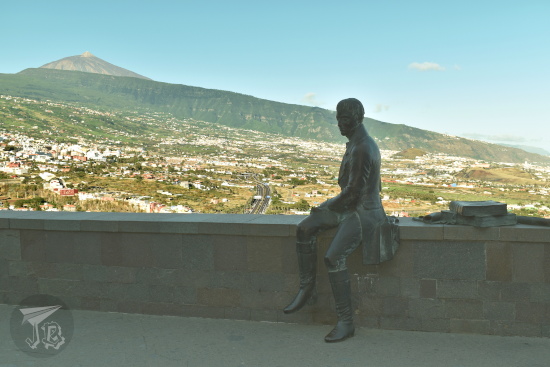
I got up rather early in the morning (especially considering that the Canary Islands are an hour behind my usual time zone) and I was surprised at how many people there were already on the streets of Santa Cruz de Tenerife before 8:30 on a Sunday morning. I drove out of the town and headed north-west, where I came across my first stop – a viewpoint of Mount Teide called Mirador de Humboldt honouring the German explorer from the late 18th century (though I kept thinking that there was a missing penguin opportunity there). The viewpoint overlooks the ocean and Mount Teide, which Humboldt climbed in 1799.

Mount Teide, a volcano, looms in the background. The top is bare and barren, but the slopes look green and fertile, with plantations and some villages. In the foreground, there is a bronze sculpture of Alexander Humbolt, sitting on the low wall of the lookout, and looking to the side.

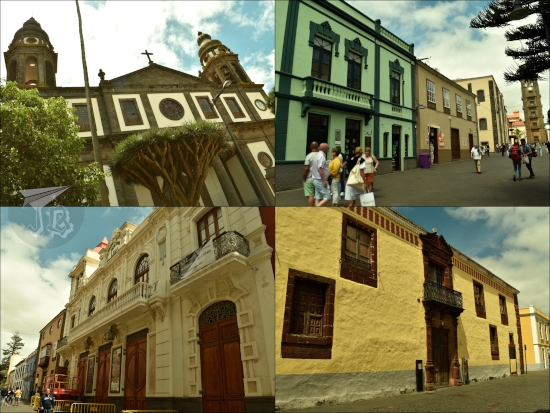
I continued driving towards La Orotava, the municipality which Mount Teide actually belongs to. After parking the car, I walked towards the historical centre and ended up at the square Plaza de la Constitución, which stands next to the church Iglesia de San Agustín. Mount Teide loomed over the streets, ready to celebrate Pentecost Sunday. And guess what? The main church is called… Parroquia Matriz de Nuestra Señora de la Concepción. The initial hermit church was built in the 15th century, and it was completely rebuilt in the Baroque style throughout the 18th century, though the interior was remade in the 19th century and there was yet another renovation in the 20th century. It is considered the most important building of the Canarian Baroque.

A collage of La Orotava. The buildings are built with white plaster and black volcanic rock. Mount Teide peeks from the background.

The most representative construction in La Orotava is the “house of balconies” Casa de los Balcones. The house was built in the 17th century. The façade shows a front-long balcony on the third floor, and five smaller balconies on the second, all of them made from dark teak wood. The interior holds a museum, but I decided to give that a miss because I reached there at the same time as a very disorganised group of forty or fifty people who were going in at the time.

A colonial house. It is built in white brink. It has three floors. On the ground, there are brown windows. On the first floor, five balconies, with decorated ironwork. On the second floor, a long balcony or gallery in dark wood.

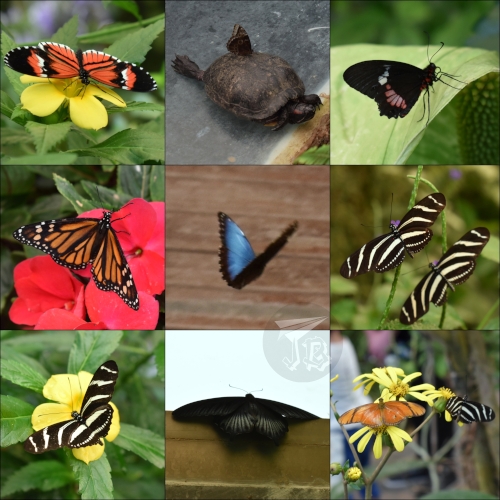
Instead, I went back to the car and drove towards Icod de los Vinos. There, my first stop was the butterfly house Mariposario del Drago, since the ethnographical museum Museo del Guanche is closed.

A collage showing colourful butterflies - red, orange, blue, black, black and white. One of them is chilling on the shell of a turtle, and another one is caught mid-flight. Most are on flowers and plants.

The butterfly house stands next to a botanical park Parque del Drago built around the symbol of the town – and maybe the whole island – the Drago Milenario. This is the largest and oldest specimen of Canary Islands dragon tree or drago (Dracaena draco). Folklore says that it is a thousand years old, hence the name “the thousand-year-old dragon tree”, though in reality, it is probably around 600 years.

The dragon-blood tree. It has a knotted grey trunk and bony branches. Around it there are bright-green palm and laurel trees

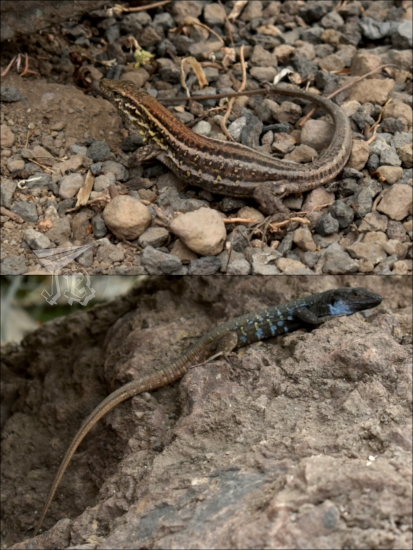
The park, built around the drago, holds local species trying to reproduce the local biotopes with height, there is also a small volcanic cave. It was here where where I managed to catch my first glance at the local fauna – two of the endemic lizards (though not as big as the one I had seen in the museum): lagarto tizón (Gallotia galloti) or tizon lizard, a blue-spotted male and a brown-striped female.

Two lizards. One camouflages on the grey and brown ground. The other on has a brown tail, but the body is black and bright blue

Then I went back to the car to climb up a crazy slope until I reached the visitors’ centre of the lava tube Cueva del viento. A lava tube is a “cave” formed the flowing lava of a volcano. As the outer part solidifies, the inner core continues flowing until it empties the tube. The guided visit is the only way you can enter the tube, so I had reserved that a few weeks earlier.

The visit started with a small introduction in the visitor’s centre, with a lot of “gotcha” questions on the guide’s part. I tried really, really hard not to be a smartarse, but I did sit down on the floor at a point because I did not feel like standing around for twenty minutes. The important information we received was that there were two types of lava that had formed the island of Tenerife: pahoehoe and block lava.

Then we took the centre’s vehicles to the outer area of the cave, where we could see the solidified lava, now turned into stone. Pahoehoe lava is basaltic, it flows slowly, and it is the responsible for creating the tubes. As it flows and solidifies, it creates undulations and wrinkles. On top of it, only small trees and bushes can grow.

Old Pahoehoe lava trails. The rock looks wrinkled or similar to pillows.

Block lava is more acidic, with a higher silica contents, it flows less and creates “blocks” as it solidifies. Pines can be found growing on top.

Pines around an old colada, which seems rocky and broken.

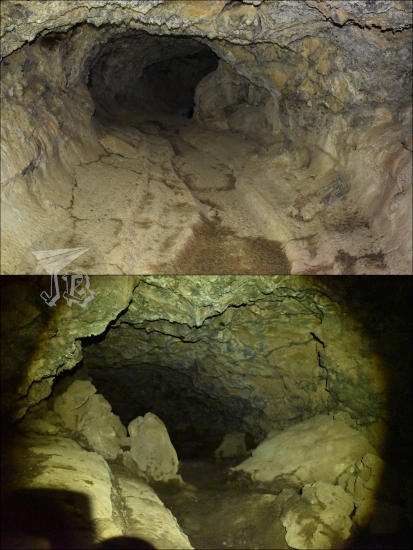
The cave itself was very cool. Unfortunately, there were a couple of families with kids and grandparents, all trying to be braver than the next – and thus acted loud and boisterous. More interesting information – mummified guanche aboriginals had been found in the cave, along with remains of a giant rat and lizard that were the ones reproduced in the Museo de Ciencia y Antropología de Tenerife. It is one of the biggest lava tubes in the world, with up to three levels and maybe 18 km of tunnels, though only a short walk can be had.

Inside the lava tube. It looks alien, like the rock is going to start dripping any second

Back in the parking lot, I had a snack and headed off towards the Parador de las Cañadas del Teide, where I had booked my next couple of nights. On the way, I went through several amazing volcanic landscapes that I could not photograph as I was driving. However, I did stop at several lookouts throughout the Parque Nacional del Teide.

Mirador de Samara.

Pines growing up on the dusty remains of a lava flow. In the background, there are three mountains - three craters of the same volcano

Mirador de las Narices del Teide, which shows the collapse on the mountain during the last known eruption.

A view of the black collapse of lava from the last eruption. Everything is barren, brown and grey, except for a black spillage coming down ominously. The sky is blue in the background, which makes the whole thing look even more bizarre.

Mirador Zapato de la Reina.

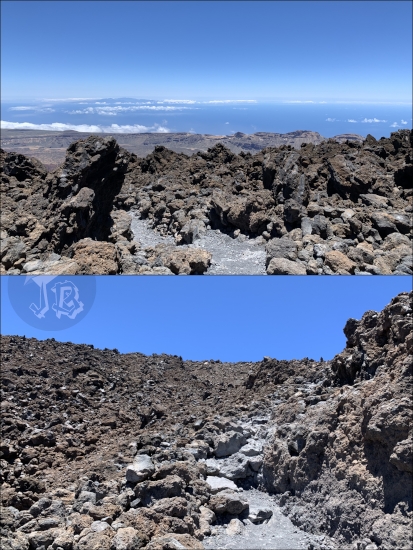
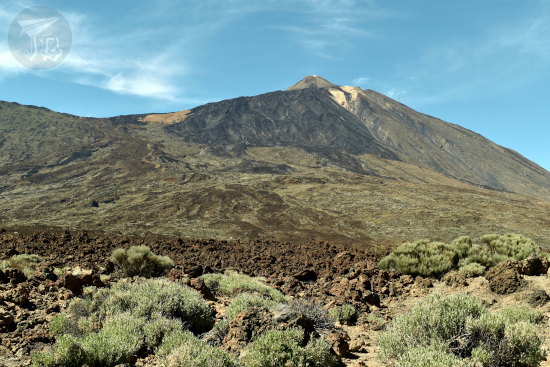
The top of Teide. This is the point where vegetation has become scarce, with low bushes, that creep up the slope. The summit looks naked.

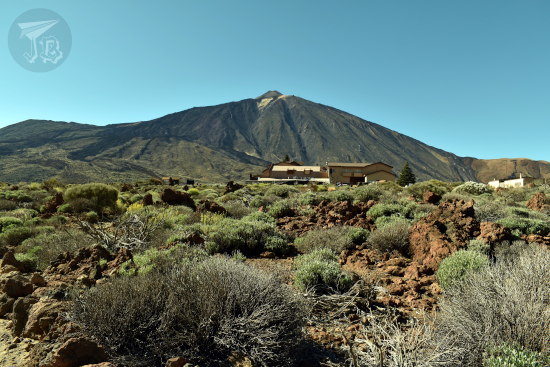
Finally, I arrived in the area of Las Cañadas del Teide or Las Siete Cañadas where the Parador de las Cañadas del Teide stands. I was lucky that the season was good to see the flowering bugloss Echium wildpretii (tajinaste in Spanish), an endemic flora species mostly found on the Teide slopes. After checking in I wandered around the different tracks and paths – Cañada Blanca, Roques de García and Mirador de la Ruleta, which show the different stages of various volcanic eruptions.

Mount Teide rises in the background. It looks wrinkled due to the different eruptions. At its foot, a low building, looking completely out of place. In the foreground, small bushes in grey and green.

Collage: Different rocks and structures created by lava and erosion, the rocks are reddish or grey, and they have weird shapes. The tajinaste is a tall bush, with tiny red flowers, it stands about 1m above the rest of the plants.

I turned in early, and I had booked my dinner in the Parador both nights I’d be sleeping there, so that was an easy one. The staff made it a little awkward though, even if I was not the only solo traveller around. After dinner, I tried to get some pictures of the night sky, but I was unsuccessful.

28th May 2022: San Cristóbal de la Laguna, Bajamar & Santa Cruz de Tenerife {Tenerife, birthday 2022}

I had a four-day weekend that happened to overlap with my birthday, so I decided to get myself a present and I booked the four days out – I wanted to visit the Spanish island of Tenerife. I seemed to have a streak of luck finding a decent flight, a couple of good hotels and a free permission to visit the peak of Mount Teide, a non-extinct volcano that happens to be the highest peak in Spain. I also decided to rent a car for the first time so I could travel around the island and do different activities in different places.

The plane left on time at 8:15 on Saturday – and I have to say that I love my IKEA travel bag, because it has a huge capacity but the perfect size to place under the seat, therefore I do not need to queue up for boarding to make sure I can stow the carry on. We taxied at the correct time, but when we got to the runway, we stopped. It turned out that one of the sensors was giving a warning of a 400 ºC temperature on one of the wheels. It turned out to be a false alarm, but we ended up with an hour-long delay that ended up cascading.

I reached the airport and got my rental – Volkswagen Polo I had to learn how to reverse. Once I was done with that, it was surprisingly easy to get by. I drove off to San Cristobal de la Laguna and went off to visit the historic quarter, which is a Unesco World Heritage site as an example of colonial architecture – Centro Histórico de San Cristobal de la Laguna. Most of the buildings date back to the 15th century, and the design was then copied in different colonial cities in South America. The houses are painted in different colours and most of them sport amazing woodwork in their doors or balconies.

It gave me a pretty distinct “Disneyland” feeling as the pedestrian streets are plagued with cafés, brand shops and bars. It was packed with tourists like myself flocking in guided tours from the tourist office, which seemed to only open to gather groups in order to hold those tours. As the week before my trip had been work-crazy, I had not been able to plan in detail, so my plan was to hit the tourist office, gather information and move on. This did not work out, and on top of that, the cathedral Catedral de Nuestra Señora de los Remedios was already closing down when I arrived – due to the delay. Other interesting but closed buildings included the church Iglesia Matriz de la Concepción, and several palaces including Casa de los Capitanes and the reconstructed Palacio de Salazar.

Typical buildings from Canary Islands. They are colonial in style, with big doors and windows. The façades are painted with different colours.

Typical buildings from Canary Islands. They are colonial in style, with big doors and windows. The façades are painted with different colours. The streets are wide and full of people.

I’m not going to say that I was disappointed, but I was really not digging the atmosphere, so I decided to move on. Instead of following the initial rough plan, I decided to head off to the tiny village of Bajamar to see the “sea pools”. Built in the petrified lava coast, the Piscinas de Bajamar are swimming pools fed by ocean water that keep swimmers safe from the rocks and the waves. I was lucky enough to find a very good and easy parking spot.

I wandered around the promenade Paseo Marítimo de Bajamar, saw the pools, the beach, and the mini lighthouse Faro de Bajamar.

Waves coming into the volcanic beach, which does not have sand but big black blocks of rock.

I moved onto Santa Cruz de Tenerife afterwards, ditched the car and checked into the hotel, then went off to explore. I walked by the market complex La Recova, also called Mercado de Nuestra Señora de África.

A bright orange building. It has a low, wide wall, and in the centre a clock tower

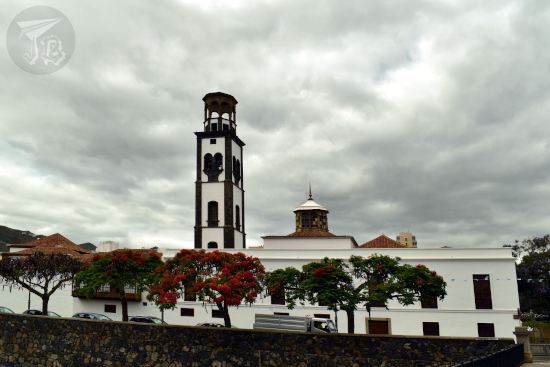
The tower of the church Iglesia Matriz de la Concepción (yes, again, but another one). The church has been repeatedly rebuilt and renamed between the 15th and 18th centuries. The current building is Canarian Baroque / Tuscan style.

A church with a bell tower. The building is white clay with black rock; this style is typical in the area

My first real destination was Plaza de España where the defensive castle Castillo de San Cristóbal used to stand. Now there is a fountain / pond and you can see the foundations of the castle.

Collage. The former site of the castle, now converted into a fountain or lake. On the other side, the castle foundations, and a cannon.

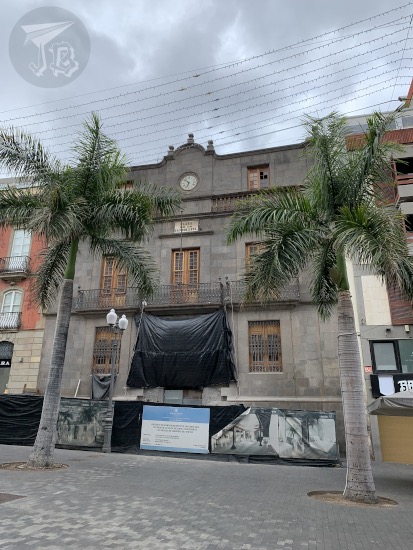
Next, I found another important square, Plaza de la Candelaria, but it was unfortunately under construction.

A grey building with construction work being done on it

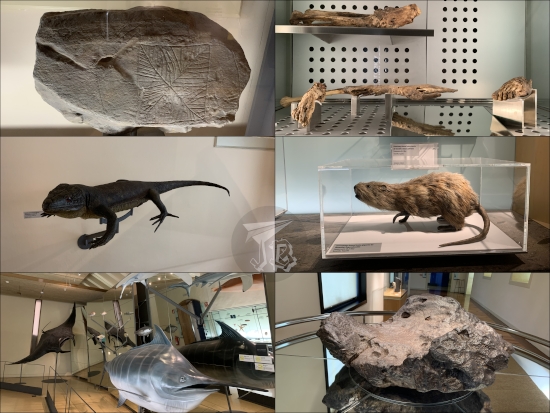
So I moved on to the science and anthropology museum Museo de Ciencia y Antropología de Tenerife. It was rather underwhelming at first, as most of the “exhibit” were photographs. Eventually I reached the “good” stuff, with reconstructions of ancient and extinct animals such as the Tenerife giant rat (Canariomys bravoi) and the Goliath Giant (Gallotia goliath) lizard – we’ll come back to those eventually. There were butterfly collections, reproductions of marine animals, rocks and meteorites. In the archaeology ward there were mummies – that was a little unnerving to be honest, I thought we had learnt a little more respect about the ancient cultures.

Before the Europeans arrived in the Canary Islands in the 15th century, there was a previous civilization in Tenerife, called the guanche. The guanche settled in the island around the 6th century. While it is not clear where they came from it is thought that they came from the north of Africa, as their language was similar to those in the Berber language group. They lived off the cattle and the land, and their economy was clearly based on the goat, which they used for everything – food (meat and dairy), clothing, bone tools, and mummification material.

Collage of the museum: a prehistoric carved rock; preserved giant rat and lizard; models of fish; a meteorite; rests of mummies (a foot and an arm)

After the museum, I walked along the harbour and saw the modern concert hall Auditorio de Tenerife, designed by the famous architect Santiago Calatrava, whose style is easily recognised – even though in recent years he has drawn criticism for going way beyond budget and his building having problems due to “over innovation”.

The auditorium. It looks like the sail of a yacht, all white.

A few steps further stands the tiny fortress Castillo de San Juan Bautista, built between 1641 and 1643, and rebuilt the following century. I would have loved to see the botanical garden, but it closed early – as most things seemed to do.

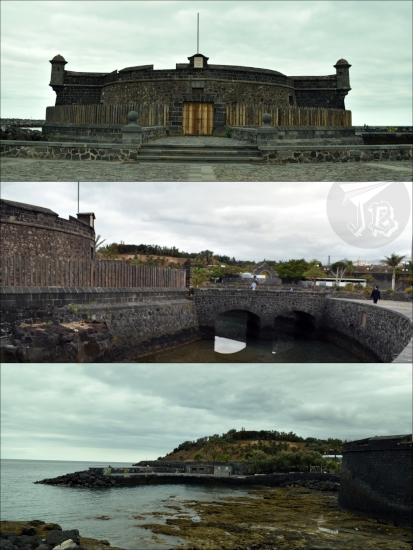
Small castle surrounded by a moat that fills up in high tide.

I took a small detour to see the former arsenal Casa de la Pólvora, built in masonry in the 18th century. Eventually, I went to the supermarket to buy some dinner and snacks for the upcoming adventures, and called it a day after 14 hours on the go.

Armourine building. It looks like a treasure chest, built in grey rock

13th March 2022: The outskirts of Madrid (Spain)

I’m usually rather enthusiastic when I visit new places, but if there is a place that I’ve found kind of over-hyped, that has been the park Parque del Capricho, in Madrid. “Capricho”, which means whim or folly – in its architectural meaning of an often extravagant picturesque building erected to suit a fanciful taste, or building erected for decoration, typical of the French and English decorative gardens from the 18th century. The park is located in Madrid, and the only romantic garden that remains in Madrid. It was promoted by the 12th Duchess of Osuna between 1787 and 1839, and became a recreational area for the nobility of the time. Some of the most important gardeners and landscapers of the time worked on its design. It was declared Historical Garden in 1934 and restored in 1999.

So it is a garden, with some plants, some flowers, and a bunch of weird-looking decorative items, that takes itself a bit too seriously. It won’t accept pets and you can’t bring any food inside (it has some cage-looking “lockers” were you can leave your stuff). There is a strict capacity control which does nothing for it not to feel ridiculously crowded on a regular nice-weather Sunday. Maybe it improves in spring / summer, and with fewer people, but I had some stuff to do in the area and that is why I made time to visit today.

It had been raining all week, so I had mostly scrapped my plans. It was a great sunny day though so in the end I decided to get there. Parking the car was ridiculously easy – though the parking spot was maxed out, I found a very easy one in the avenue next to the park – good, it was close as I would not put my sandwich in the crappy-looking lockers and preferred taking it back to the car. Then I walked in, and explored for a couple of hours – and don’t tell anyone, but I ate a piece of candy, just to be rebellious (≧▽≦) (and to make sure I did not sugar crash without any food around, but that does not really make for a good story).

While I of course did not expect everything to be blooming and colourful and green… I hoped that it would have at least maintained through winter. No such luck. A bunch of areas were fenced off, the footpaths were swamped with puddles, and the water in the ponds was not as clean as it should have been. Exploring the 14 hectares took me about an hour and a half, considering that I did go into all the little paths, but all the buildings were closed and / or under constructions. There is a Civil War bunker in the park too, but that is only open through pre-booked guided visit and I did not know I was going to do this 30 minutes before I jumped on the car. The few flowers that had already bloomed included the garden pansies (Viola × wittrockiana, which are after all winter flowers), and the yellow and white daffodils (narcissus, maybe the subspecies jonquil Narcissus jonquilla). There were a couple of black swans (Cygnus atratus) at the main pond, and mallards (Anas platyrhynchos) on every second water body, including fountains.

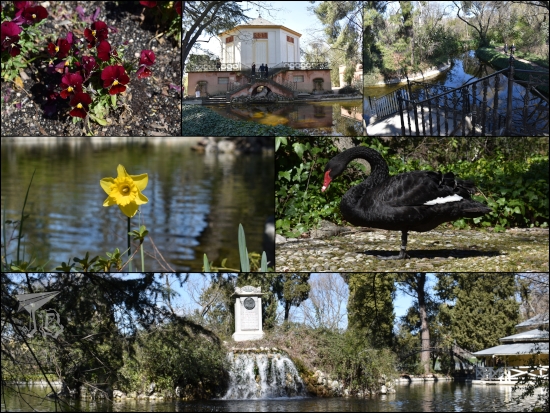
Pond in the park. There are some flowers and buildings around it, and a black swan sunbathing.

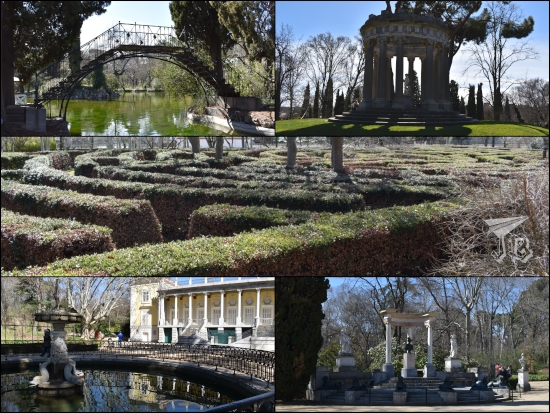
Collage of different park decoration: a bush labyrinth, a fountain, and some decoration reminding of Greek temples.

Afterwards, I took a small detour to see if any of the Japanese cherry trees in the park opposite the street Parque Juan Carlos I had started blossoming. The answer was not at all. But the point was heading to the restored castle Castillo de la Alameda. The castle dates back to the 15th century, though there are older remains underneath, and it is thought that its presence is the one that got all the aristocrats to flock to the area, as it switched from defensive castle to palace.

The remains of the castle feature an irregular moat with lobe-like structures in the corners, and the restored keep, which stands up to the first floor, though it must have been much higher. An interesting characteristic of the castle is that it was built using a kind of mortar made from flint. I have to say it was a nice surprise, free to visit.

A clover-shaped castle ruins, all white. There is not much of the castle left, but the moat is almost intact, though empty

To the side of the castle there is a casemate – a fortified machine gun emplacement from the Spanish Civil War, called Nido de Ametralladoras (Machine gun nest), a semi buried cement block for snipers of sorts to defend the position.

Concrete block that was used as a machine-gun base

Then I moved onto Mejorada del Campo a little town near Madrid that only has one tourist attraction – a… handmade cathedral. Of sorts – Catedral de Justo Gallego .

Justo Gallego was born in 1925. Deeply Catholic, he became a young monk-in-training but had to leave the monastery when he contracted tuberculosis. He made a vow to erect a cathedral to the Virgin Mary in her “Lady of the Pillar” avocation, and he sort of did. Throughout the next 60 years he worked on building the cathedral, using recycled material, and on his own. His work came to fame when a soft-drink company made him the star of an advertising campaign, which made him and his work famous.

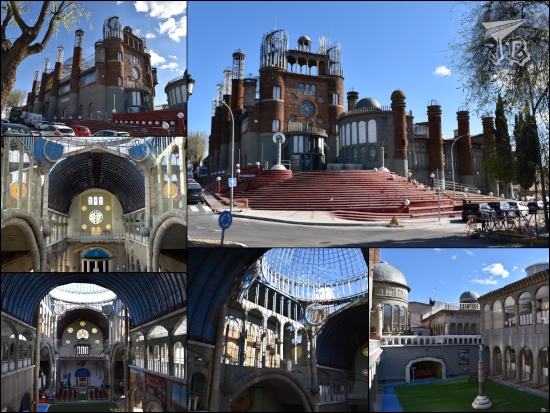
The cathedral has 12 towers, a crypt, two cloisters, a baptistery, and the main nave is 20×50 metres, with a 35 metres high dome. Most of it was done by hand, using discarded items such as tubes and bicycle wheels. It is garish and childish in its decoration, but I found it to have some strange allure. The cathedral has drawn the attention of international artists and institutions, and apparently Gallego built it without any blueprints or knowledge of construction. Upon his death, an architectural studio started working on “legalising” the cathedral (from an urbanistic point of view; it is not an official Christian building) and is it is now under management from an NGO. It was just a bizarre thing to see, but interesting since I was in the area (sort of. Construction made the route stupidly long), glad I’ve visited it at least once. I did catch a European white stork (Ciconia ciconia ciconia) coming home to one of the towers.

Cathedral made out of recycled items: pipes, plastic bottles, irons... there is a dome and a nave, in bizarre colours.

A stork approaches one of the towers of the cathedral

I drove off afterwards, and I have to say the weather that day was amazing – just in-between two piss-poor ones, so yay spring escapade.

Walking distance: 11.18 km (16916 steps)

26th February 2022: A Medieval Fair in Tendilla (Spain)

Tendilla is a tiny village in the area of Guadalajara, Spain. It was declared a town – by Medieval standards at least in 1394. About a century later, the County of Tendilla was founded. By that time, the local cattle fair, around the festivity of St. Matthew, was considered one of the best in the Kingdom of Castile, with the Catholic Monarchs bestowing their blessings on the town. Among the most interesting areas are the long covered arcades, and the unfinished church dating back from the 16th century, Iglesia de la Asunción.

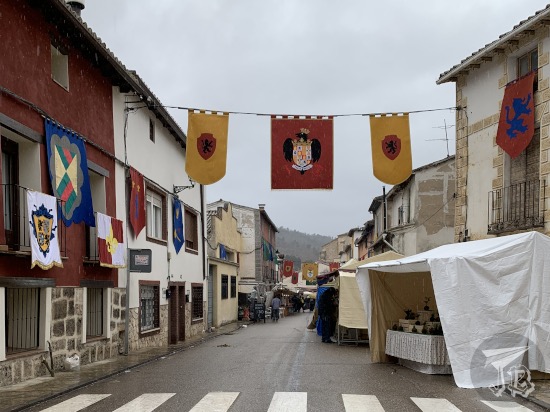
The cattle fair was rekindled in the 1990s, and today it is called Feria de Mercaderías de San Matías. The closest weekend to the 24th of February, St. Matthew’s day, a Medieval market is laid along Main Street, with edibles, trinkets and artisan items. The village becomes decorated with flags, pennons showing off real and assumed heraldry items.

This year, I decided to get there as some family members were going to be in the house they own in the village. I arrived at around 10 am, and by that time most the village was already full. I got deviated, but it was not hard to find a parking spot. Unfortunately the weather had not decided to accompany and it was rainy and freezing all day.

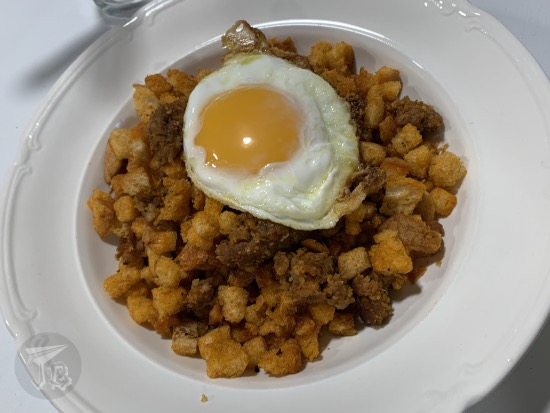
The fair stalls had begun to open, but first we made a run for the local grocery stores to grab some ingredients for lunch. The typical thing to eat in this time are migas, which are basically fried breadcrumbs with paprika, pork, garlic and a fried egg on top. We also bought sweets and confectioneries, just because we could.

At noon, we walked along Main Street Calle Mayor. The stalls were already open, and even in the bad weather there were quite a few people. Some were even in costume, dressed in Medieval outfits, as dames, knights or noblemen.

A wide street. There are flags hanging above and from the balconies, and shopping stands on the right. the sky is dark and heavy, as in all the pictures taken

A wide street. There are flags hanging above, and shopping stands on the both sides, selling hand-made jewellry and trinkets.

A Romanesque church with a bell tower. The church is unfinished.

Main square. It has a pole in the middle, and colourful ribbons run from it to the buildings around the square. The floor has been covered in sand, and the houses are decorated with flags. Lots of people walk around.

To the end of the village, a small “farm” had been installed – oxen, horses, cows, goats, donkies, sheep, rabbits, piglets… Due to the ‘health situation’ which for once was not Covid but avian flu, there were no ducks or hens or any kind of bird. You could hold the bunnies, but I really really wanted to hug the huge draft horses.

Farm animals: a donkey, two piglets, cows, rabbits, a sheep trying to eat the camera, a working horse.

Farm animals: goats trying to escape the pen, oxen ignoring the camera, a black-and-white cow wanting pets, and a working horse looking tired.

Someone had not really thought positioning carefully though, and right in front of the farm – and the piglets – stood the food stalls, especially a roaster, whose cooked pork was… suspiciously similar to the piglets in the farm *coughs*.

On the other side of the farm, the locals had started preparing the communal migas – every visitor is entitled to a plate of them, but it was way too cold to queue. Instead of being topped with an egg, though, they are sprinkled with torreznos, pork lard fried and preserved.

A huge barbecue with pork roasting and sausages. The barbeque itself is round, and it's big enough to fit at least a dozen ribcages, ten pork legs, and twenty or thirty sausages.

A person using a shovel to stir a huge pot of breadcrumbs being cooked, and a close up of the severd plate: orange-looking breadcrumbs with dried fried pork lard on top.

On our way back we ran into the horse parade and show, which was held in front of the town hall. The riders of El Duque Espectáulos, dressed in Medieval and Templar costumes, trotted and galloped along the music.

A group of medieval-looking horse riders making their way through the crowds

An older man making a golden horse trot and gallop on command, the horse is photographed mid-hop

Riders in medieval clothing galloping on the Main square

We stopped to buy some torreznos to take home, and we got given the tourist treat – a cloth bag with a huge box of fried pork skin. It is tastier than it sounds, honest!

A tote bag reading Tendi (the rest of the writing is obscured), with a box of torreznos inside

We had lunch at home, and not to show off, but I do think our breadcrumbs looked much better. We made them ourselves, with chorizo meat and eggs sunny side up! They looked so much better than the communal ones, right?!

A plate of migas. The breadcrumbs look golden, and there are pieces of pancetta and chorizo mixed with the bread. On top, there is a fried egg, sunny-side up

Finally, after lunch, we took another stroll, but the weather was miserable, raining and cold – which was so mean because the following day when I had to work it was nice and sunny, and there was a bird of prey exhibit.

Romanesque and Baroque buildings, deserted in the rain. One of them is a tiny hermit church, the other a column, and the third a palace that has seen better times

But all in all I spent a nice time with family and got to pat horses and goats. I guess there are much worse ways to spend a Saturday.

Walked distance: 6.20 km (9866 steps)

18th – 20th February 2022: Extremadura, the not-at-all-wild west of Spain

With everything that keeps going on in the world, my little travel gig seems insignificant. Here it is, anyway, for the sake of completion.

18th February 2022: Jam and Ham

After a crazy crazy period, and within a just-slightly-less-crazy period, we made space for a mini escapade – just under 48 hours, but it was an interesting mental reset. We took the car and drove off to Cáceres after I finished work in the afternoon. The trip should have taken a little over 3 hours and 15 minutes, but we spent about 70 minutes caught in several traffic jams – or just a very long jam with different instalments.

Sunset from the road. The orange light zigzags through the grey and blue clouds

Cáceres is located in the autonomous community of Extremadura, which is famous because of its particular grassland with dwarf trees called a dehesa. The typical animal farmed in the area is the native Black Iberian pig – a traditional breed of the domestic pig (Sus scrofa domesticus). Through breeding with wild boars and millennia of adaptation, the Iberian pig has grown accustomed to eating oak acorns, and thus it has become a key part of the ecosystem. Furthermore, the breed has great tendency to accumulate intra-muscular fat. This means that its meat is delicious, especially as sausage. The most famous treat is the “Black label” (Etiqueta Negra or Dehesa de Extremadura) ham: a pig raised in the dehesa, fed acorns and natural grass, and whose meat has been cured for at least 20 months.

The area of Cáceres is also known for its sheep-milk cheese, Torta del Casar. It is a strong-flavoured creamy cheese that comes from controlled sheep, also raised in the dehesa. The cheese is especially curded with rennet made from cardoon (Cynara cardunculus). Another typical food from the area is the local paprika Pimentón de la Vera, which is made from smoked local red peppers. All three – ham, cheese and paprika – hold European Protected Designation of Origin certificates.

Of course, not everything is food in Cáceres. After we checked into our hotel near the historical centre, we headed off to the Main Square Plaza Mayor de Cáceres, which features the town hall, the former wall gate called Arco de la Estrella (Star Arch), and one of the watch towers Torre de Bujaco.

The medieval square of Caceres by night. It looks like a castle, with arches, battlements. The sky is completely black.

We found a place inside to grab a bite, and we tried the sausages for dinner before turning in – acorn-fed pork ham, loin, chorizo, morcón (similar to chorizo), salchichón, and patatera (pork mixed with potato and paprika in sausage form).
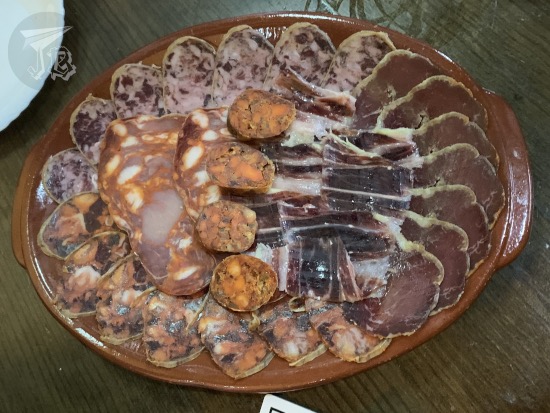
A plate of sausage slices and ham

Walked distance: 1.79 km (2838 steps)

19th February 2022: The Old Town of Cáceres

The Old or Walled Town of Cáceres, Ciudad Vieja de Cáceres was declared a Unesco World Heritage Site in 1986, and it is easy to see why. It is a small knot of streets between the ancient city walls and the gorge where cars can barely drive, sprinkled with Medieval and Renaissance palaces and manors. After finding an open café, we had breakfast, then headed off to explore that. Since it was a bit before 9 am, most everything was closed – but it was also empty, which was good. We crossed the Arco de la Estrella next to the Torre de Bujaco and walked into the walled area.

The medieval square of Caceres by daylight. It looks like a castle, with arches, battlements, and irregular bricks making up the walls.

We walked past the co-cathedral – to which we would come back later and several palaces, and we ended up at a two-level square called Plaza de San Jorge (St. George Square), towered over by the peculiar-looking church Iglesia de San Francisco Javier – note the white-painted towers.
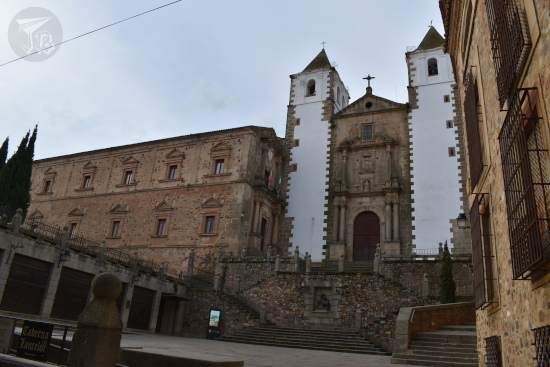
A church with two twin bell towers, both in white. Between them, the body of the church, in grey rock. In order to access it, you have to climb a staircase, which has a small sculpture of St George attacking the dragon

There was a small palace to the left, and while the building was closed off, the gardens Jardines de Doña Cristina de Ulloa were open, albeit as it was early February, still in winter mode but for some berries and roses.

Wintery garden with bare tree. There are also evergreen bushes and trees, stairs, and benches.

We wandered around for a while, the headed off to a visit we had booked in advance – the manor / palace of the Lower Golfines Palacio de los Golfines de Abajo, which has nothing to do with their position in the social scale, but literally the position within the city hill – in the lower part. The family is known to have owned the palace from the time of the Catholic Monarchs, in the 15th century, till the death of the last descendant in 2012. This woman willed all the heirloom to a foundation that today manages the palace. The foundation got the palace renovated and brought some of the furniture from other properties belonging to the family – among them a glass lamp way too big for the room it was set in, and a sofa which was identical to the one that used to be in my great-aunt’s living room… The lower floor holds the recreated rooms – with more or less success and taste – and a smaller area decorated with Medieval paintings which were discovered by accident. The upper floor holds a small ethnography museum and some documents from the family’s library. Unfortunately, the foundation takes itself a little too seriously and won’t allow you to roam freely in the palace or take pictures, except for the inner Castilian patio.
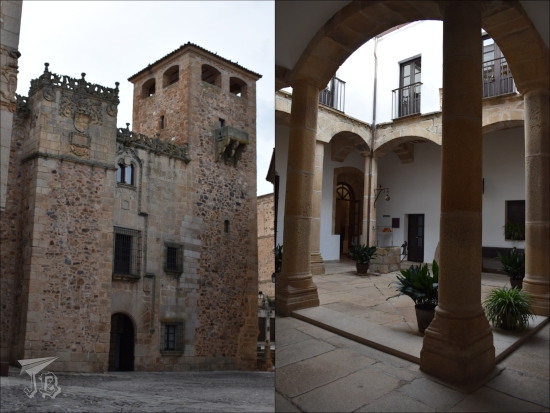
Gothic palace, with an ornate roof and a small cloister or patio.

After the palace, we walked a whole minute and a half for the co-cathedral Santa Iglesia Concatedral de Santa María. It is the oldest church in town, built around the 15th century, in a Romanesque-going-Gothic style. Outside the church, at the base of the tower, there is a sculpture of Saint Peter of Alcántara. Inside, the altarpiece was carved between 1547 and 1551, in unpainted pine and cedar. The tower can be climbed, and I decided that I wanted to do that, despite not being what I usually do. It was empty enough that I felt comfortable doing so, and I was treated to some nice views.

Collage: a gothic church with a bell tower; the inside showing a bare-wood altarpiece; the sea of columns from above, and a view from the belltower, showing another church and the roofs of some low houses.

By the time we went out, the city had already been taken over by walking tours and guided visits. There were so many companies that the guides put stickers on their tourists so they could herd them round. We backtracked to the Baroque church with the white towers Iglesia de San Francisco Javier (also known as Iglesia de la Preciosa Sangre), where there is no worship today. Instead, there is a huge collection of nativities (hundreds of them, literally). In order to visit the nativities you have to go up a perilous metal staircase. Once on the second floor – after having survived the peril – I decided to continue on the relatively safer stone staircase to one of the towers – only one, I did not climb up both of them. The lower floor holds two last nativities, a classical one and a hilarious set up made out of Playmobil, a German company that makes plastic figure toys.

Collage: The interior of a church with a baroque golden altarpiece, and a collection of Nativities.

We moved onto the following manor, to the side of the square, Casa Palacio Becerra, which shows some antique elements, and the house structure.
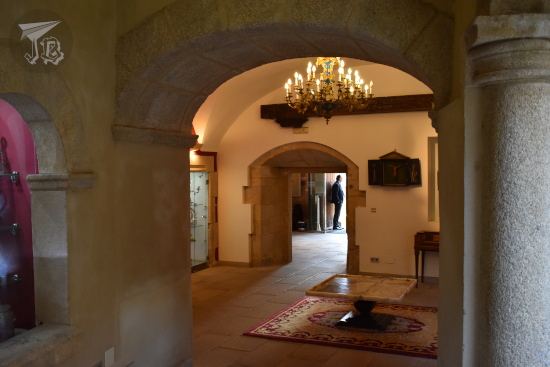
Inside a Renaissance palace, with a low arch, a glass lamp and a red carpet that try to look eclectic and end up looking bizarre

Later, we walked to Stork Square Plaza de las Cigüeñas. European white storks (Ciconia ciconia ciconia) are typical birds in Extremadura, and one wonders how they have not decided to make food out of them. In the tower stands one of the few towers that has kept its merlons, as the Catholic Monarchs were very into tearing tower tops down when they conquered a site. The adjacent manor, Casa de las Cigüeñas, hosts the military museum Museo de Armas Aula Militar.
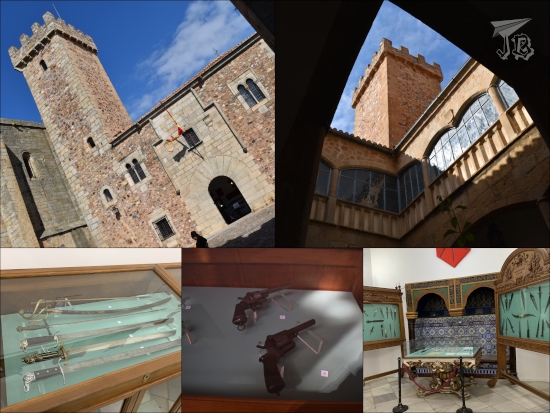
A building with a tower. The inside is a museum, and there are some swords, firearms and Moorish decoration

At the end of the square, in yet another palace – two of them, actually – lies the Museo de Cáceres, the local museum. The part in the Casa de Las Veletasis a regular archaeological museum, with the kind of things you would expect – prehistoric, Roman and Celtic remains, more modern artefacts. The other area, Casa de Los Caballos, hosts the modern art gallery.
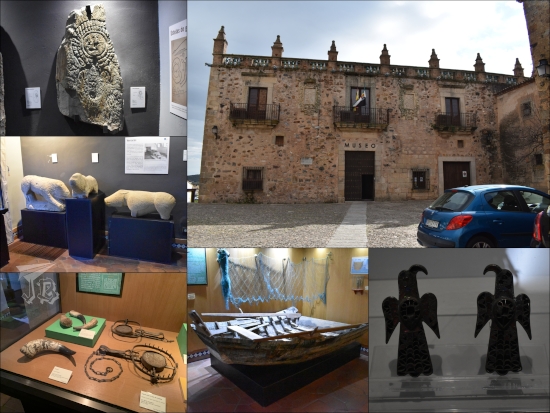
Gothic building turned into a museum. The pieces shown are funerary stelae, prehistoric animal representations - bulls or pigs - and jewells, a boat, and Roman emblems

However, the palace was erected on top of the local Arab cistern or aljibe. It is the best preserved in Spain and it has been gathering the rainfall water since the 10th century. Pretty impressive piece of engineering if you ask me.

The aljibe: a moorish basement filled with water. The columns sustain horseshoe shaped arches

Afterwards we still had some time to kill until it was time for lunch, so we wandered around the area of the Jewish quarters or Judería, under the watchful gaze of the local Cerberus.
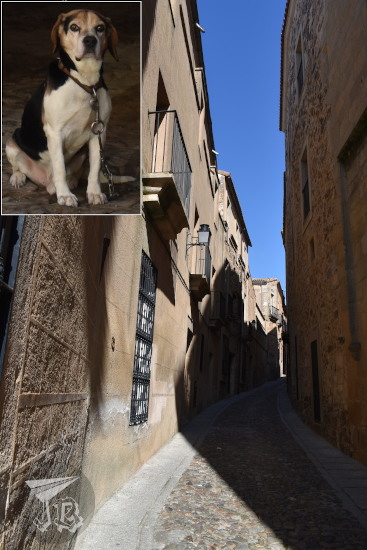
Narrow streets, and a guarding dog looking suspicious

We had lunch in the local Parador de Cáceres, so I of course got my stamp. As a started we ordered the famous local cheese Torta del Casar cheese.
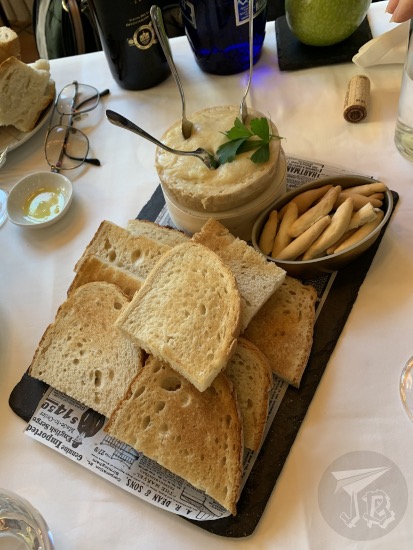
A tray with bread slices and breadsticks, and a cream cheese with spoons to be spread on the bread

In the afternoon we had a look at another church Iglesia de Santiago de los Caballeros. The church of St. James of the Knights was built in the 14th century over an older temple dating back from the 12th century. The altarpiece was carved and coloured by one of the most important sculptors of the Spanish Mannerism, Alonso Berruguete (1490 – 1561). This time I did not climb the tower – which had been happily colonised by a couple of storks.

Gothic church with a golden altarpiece. A stork snoozes on one of the towers.

After a little while, after sunset, I decided to skid around and have a walk through the old city at night. The artificial light made it look eery and romantic in the most… historical sense of the word. I came across some cats begging for food from a bunch of schoolgirls, and one of them very indignant because the girls would not beg it to take the food!
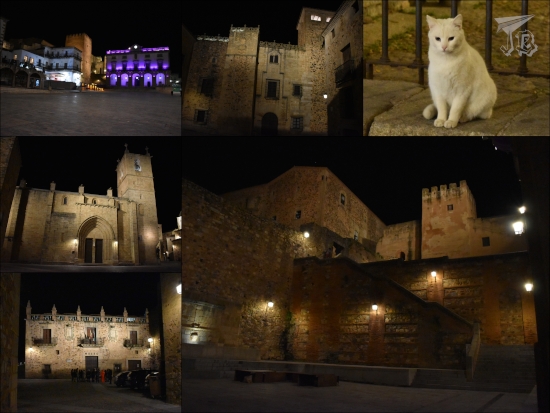
Different buildings of Cáceres at night. The are lit wit strategic lamps to give a mysterious feeling. There is also a white fluffy cat sitting and expecting food

Walked distance: 9.04 km (14766 steps)

20th February 2022: Trujillo & Oropesa (Toledo)

On this day I managed two more Paradores stamps. Trujillo is a town a meagre 30 minutes away from Cáceres. It also has a traditional / Medieval city centre, set around the main Square Plaza Mayor de Trujillo. It was the birthplace of one of the so-called conquerors during the colonisation of South America, Francisco Pizarro, whose equestrian statue, Estatua ecuestre de Francisco Pizarro (by American sculptor Charles Cary Rumsey). Other highlights in main square include the corner balcony in the “Conquest Manor” Palacio de la Conquista.
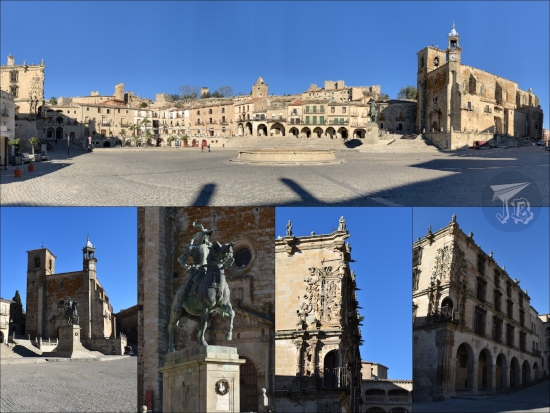
The large Reinassance square of Trujillo with decorated palaces and a sculpture of Hernan Cortez on his horse

One of the most interesting churches in the area is Iglesia de Santa María la Mayor. Its tower dates back from the 13th century, but was almost completely rebuilt in the 16th century. Inside the richly painted altarpiece was erected around 1490. Apparently, my newly-discovered activity of climbing towers yielded to a new adventure, as for a few minutes I ended up locked down in the bell tower – I guess I’m a Disney Princess now (≧▽≦).
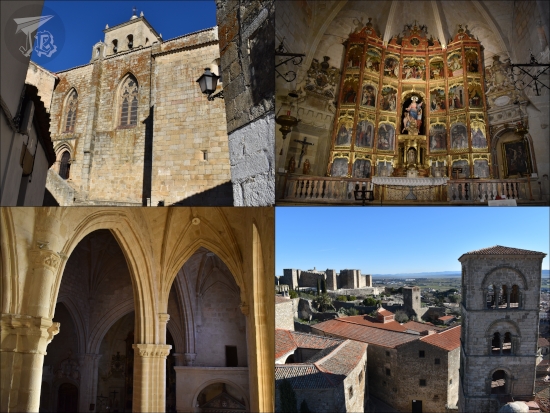
Gothic church with gothic golden altarpiece.

I got an hour and a little to wander round the town, so I climbed up to see the Muslim fortress Alcazaba de Trujillo (also called castle). Built between the 9th and the 12th century, it is a huge building with a defensive wall, an aljibe or cistern, several towers and a Christian chapel.
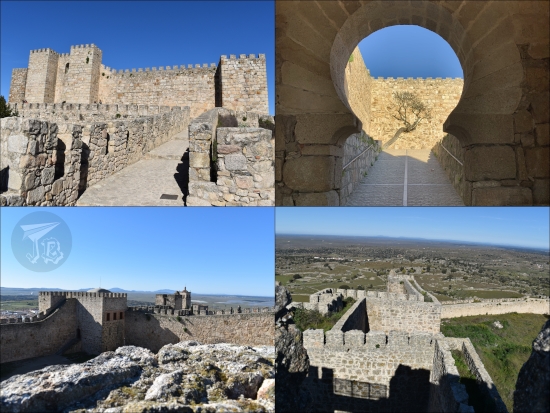
Moorish castle, from the outside and the inside. The walls and the battlements are amazingly well-preserved. It seems that the castle is built around the natural rocks defending the area

Then I hurried towards the other edge of the city to get my Parador de Trujillo stamp (only cheating slightly. I was there, after all). On my way I happened upon the Torre del Alfiler, with a family of storks happily clattering away the late morning.

Storks on top of a bell tower

I backtracked to the Plaza Mayor and I had twenty minutes before our rendezvous time, so I decked into the church Iglesia de San Martín. Its origins date from the 14th century, but it was not finished till the 16th century – which makes it so that the thick Romanesque walls are mixed with Gothic and Renaissance elements. No tower this time, but the second floor holds a religious museum.

Romanesque turning Gothic church. The inside is plastered in white and the celing above the altar and the nave retains the original decorated stone ceilings

After getting a general idea of the Medieval town of Trujillo, but it being a “working Sunday”, we moved on rather quickly, and drove off until we made it for lunch in Oropesa (Toledo) which also holds a Parador – Parador Museo de Oropesa, the first monumental Parador opened in 1930. That makes three stamps in two days, I’m almost impressed with myself!
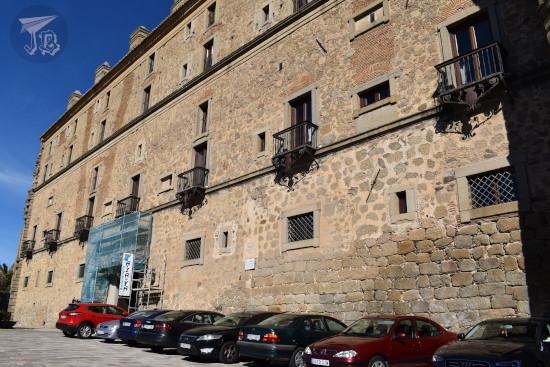
Plain building with ornate balconies, and cars parked on a row in front of it.

The Parador is adjoined to the castle Castillo de Oropesa, which was unfortunately closed, but I shall put in on my list of “to re-explore”. It was built by the Arabs during the 12th – 13th century, probably on a former Roman fortress. Today, the Old Castle is joined to the New Palace and both belong to Paradores.

Classical Romanesque castle with towers and turrets. It looks heavily restored.

After that, we drove back home, and as we got a couple of wrong turns, we ended up avoiding the traffic jam we had found on our way to Extremadura, which was convenient!

Walked distance: 5.57 km (8836 steps)

1st January 2022: Barranco de la Hoz & some towns around (Spain)

I found myself socially free on the first so I decided to kick off the year by improvising a hike – and when I arrived at the parking lot I realised I was crazy person #3 to have the same plan. To be honest I kind of went along the flow for half of the day trip, with just a faint idea of what to do.

My first stop was an area in the natural park Parque Natural del Alto Tajo. One of the tributaries, the River Gallo, has eroded a deep valley in the sandstone and calcareous rockbed – Barranco de la Hoz, which translates to something akin to “Gorge Ravine” (though technically it could also be “Sickle Ravine”). The gorge is located in the north of the province of Guadalajara. Two hundred million years ago (Early Triassic period), the area was covered by the same sea that gave way to all the fossils that can be found in Albarracín and reached the muddy areas where dinosaurs left their footprints in Enciso.

When the sea level receded, it left behind different layers of rock, that have been painstakingly excavated by the river Río Gallo for the last two million years or so (Quaternary period). There are conglomerates at the very base of the gorge, and red sandstone, calcite and dolomite in the upper parts. The vertical wall is around 115 metres high. At the base there is also a small hermit church. According to the legend, during the Middle Ages, the Virgin Mary appeared to one of the shepherds in the area – that is the reason why the area is also called Barranco de la Virgen de la Hoz. Next to the sanctuary there is a restaurant / hotel, and a parking lot. Along the river bank there are several tables for picnics and so.

Being the insomniac I am, waking up after the New Year celebration was not excessively hard. As mentioned though, as I was not sure I would be free until the previous evening, I just went along the flow of the day. I drove off and reached the gorge at around 11:00. The the car measured a temperature of -1 ºC. I was wearing five layers anyway so I was all right. Just before reaching the parking area, I had to yield to a sounder of wild boars.

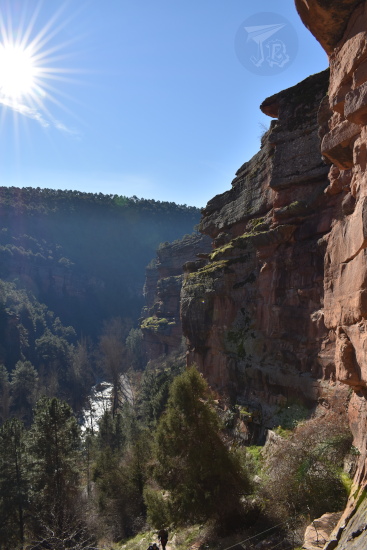
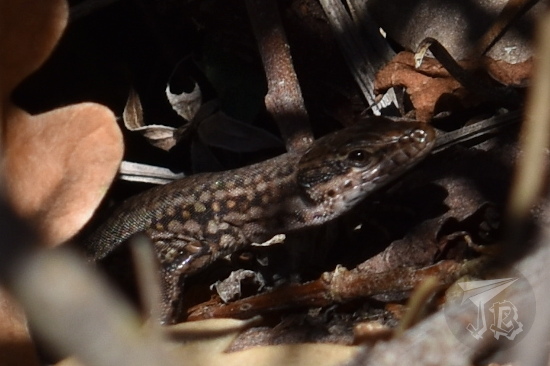
The sanctuary is the starting point of a path of around 400 steps carved and sculpted onto the vertical wall, ascending over 110 metres. The climb was not as hard as I expected, especially as the sun shone on the steps. I reached the mid-viewpoint in less than 15 minutes and sprawled on the stone ground for a little to bask in the sun. As I continued upwards, I encountered a small lizard doing the same sun-basking routine – Iberian wall lizard Podarcis hispanicus (maybe?). I finally reached the top of the gorge and I was the first on the upper viewpoint area for a while. Throughout the hike up, the strata can be clearly seen, along with fossilised ripples, fracture lines and the hints of some folds. The steps and viewpoints are protected by markers and verandas (helpful at points).

Halfway up a reddish sandstone wall. The picture faces the rising sun, and at the bottom of the ravine is the river, with the evergreen trees around.

Close up of a lizard hidden amonng leaves

Although you are technically supposed to stay on the trail, I honestly wanted to explore the upper edge of the gorge, so I went towards the rocky cliffs to the east. I came across marks caused by of boars, and European wildcat (Felis silvestris) paw prints, I also saw some birds of prey (very maybe a golden eagle, Aquila chrysaetos) , but not the right time to see much fauna – probably because around noon people started arriving with dogs. Also, it was stupidly warm for a first of January… Good thing I was using the good-old technique of having a lot of layers and shedding / putting them on as I felt warmer or colder.
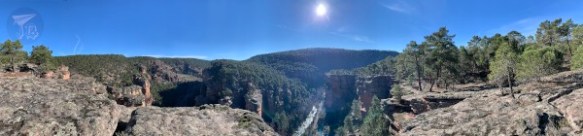
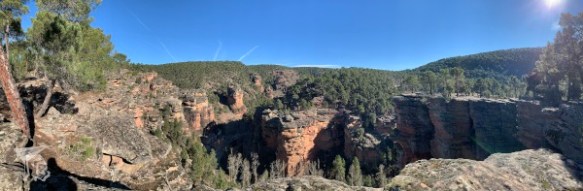
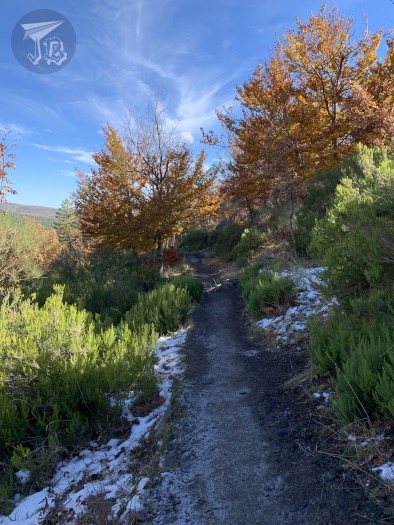
A panoramic view of a rabine, with the river at the bottom.

A panoramic view of the top of a ravine, with the cut-off walls dropping from sight

A view of the vertical sandstone walls that create the ravine

A flying bird of prey and some animal tracks: a paw print and removed ground from a boar digging for acorns.

After an hour or so, I made my way downwards and I visited the church now that it was empty and walked into the area where the legend says the Virgin appared.

A hermit church built against / into the vertical wall of the ravine

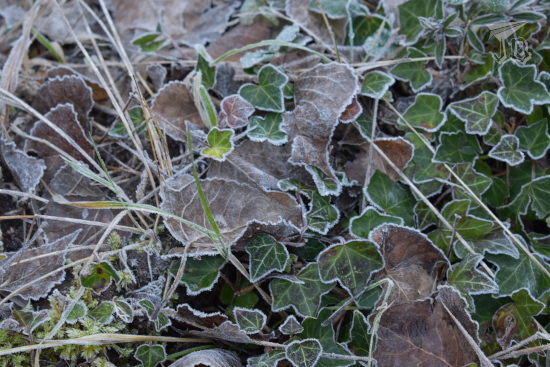
Then I walked around the river bed for a while. The river bank was covered in frosted leaves, and the water was quite cold. I layered up again…

The wall of the ravine from the riverbank

Ivy and fallen leaves on the ground. The rims are white with frost and ice

At around 13:15 I decided to head over to Molina de Aragón. It was New Year’s Day, so I did not expect anything to be open, so I just wanted to wander round for a while. Though the town is considered one of the coldest places in the area, when I parked it was warm. I found the castle Castillo de Molina and wandered around for a bit. The castle has three distinctive parts – the walled fortress, the lone watchtower Torre de Aragón, and the back area, which was cordoned off, but not walled, Prao de los Judíos. The first Arab castle or alcázar was built the 10th century, over an older Celtiberian hill fort. In the 12th century, it was conquered by the Christians and rebuilt in the Romanesque style. Out of the eight towers that the castle had, four of them have survived, along the ruins of two more.

A rectangular castle with quite a few towers and battlements on top. Around half of it is reconstructed, the rest is in ruins

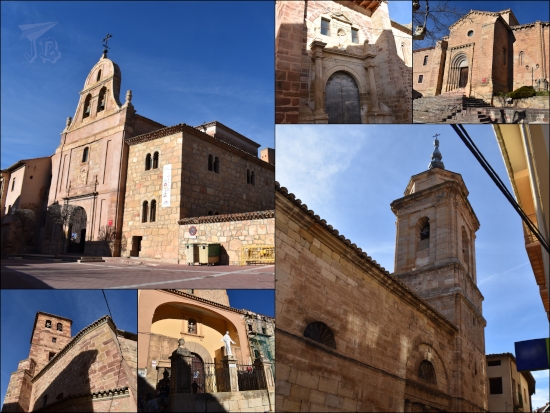
Afterwards, I took a stroll down the town. There are many churches dating to the Medieval times, most of them Romanesque style, some already showing hints of Gothic: Parroquia de San Felipe, Iglesia de Santa Clara, Iglesia de San Pedro, Iglesia de San Martín, Iglesia de Santa María la Mayor de San Gil. There were also some mansions and palaces.

Buildings in Molina. They all look reddish due to the characteristic rocks used to build them

I tried to locate a bridge I had seen trying to find a parking spot, and it only took a couple of wrong turns to do so. The bridge is Puente Viejo, the old Romanesque bridge, built in the reddish calcites that are characteristic of the area. From there I also peeked onto Monasterio de San Francisco, originally from the 13th Century, though the current building dates from the 18th century.

A reddish stone bridge over the river. It has three arches, but today only the left arch is over the river, the other two are over grass.

A church with an angel on top of the belltower

It was already late afternoon, and I had a couple of options. In the end I decided to head back in order not to drive through the sunset – at this time of the year, the sun’s glare would hit me square in the eyes in the highway. However, on my way towards the gorge, I had driven through a tiny village, Rillo de Gallo, where, for some reason, there is a Modernist-style house, called, more or less formally, El Capricho Rillano (The Folly in Rillo), as a lot of Modernist buildings have the “whim” name in them. It was apparently erected by a builder who apparently liked the aesthetics, without an architect being involved. It was… interesting, though the village was tiny and it was difficult to get into it and find a place to leave the car without blocking a street.

Bizarre modernist house. The construction looks wavy, with snakes and twisted columns. The balcony is held out by gigantic hands.

That was the whole day in the end, I drove back home, and did not have much trouble with sunset. As a whole, I drove around 300 km, and walked just a little over 10 km. And it was way warmer than expected for a first of January! Here’s to hoping that it was a promising start to 2022…

14th December 2021: Navilandia (Guadalajara, Spain)

Back when I visited Torrejón de Ardoz in November, they were already preparing their Christmas display, which is famous in the area. In a smart way to curve attendance though, this year the town hall decided to charge non-locals to enter. Towns around quickly noted this and decided to organise their own magnificent displays, and in the case of Guadalajara, give a hand to the people who live off the carnivals and fairs, as most regional summer festivals have been cancelled for the last two years. They called it Navilandia (Christmasland), the biggest “Christmas Theme Park” in the region.

The “theme park” is divided in several areas. The first one is the palace Palacio del Infantado, its gardens and the adjacent square. The Palace features the same Christmas tree as last year, and the gardens have been decorated with lights, Disney characters, a Zeus sculpture, music and… dinosaurs. I have no idea what dinosaurs have got to do with Christmas, but you won’t hear me complaining about dinosaurs. They are called the magical gardens Jardines Mágicos del Infantado. There is also a small flea market.

A gothic façade with a Christmas Tree made out of green and gold lights in front, along with some more decorations: Felices Fiestas, another tree, a reindeer made out of light

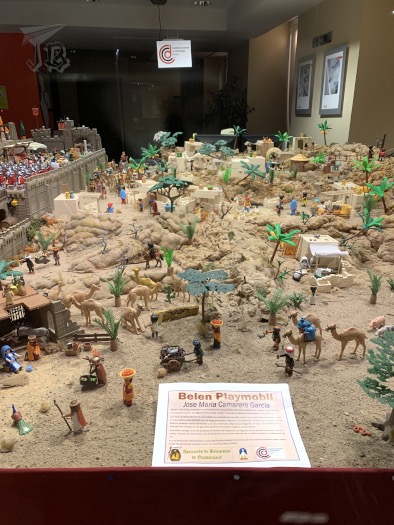
As I walked up Main Street I saw the traditional Playmobil Nativity they always set in one of the shops. However… I’ve never been able to spot the actual Nativity scene here. It is rather cool, though.

A Nativity made out of Playobil figurines, the stable is on the left and a bunch of toys are coming towards it through the desert. There a lots of dromedaries.

The second “Christmas hotspot” is the town hall square Plaza Mayor had a tasteful light decoration, a childish representation of the Three Wise Men, and a very beautiful – and lit up – carousel. I really wanted to ride it, but there were too many toddlers. It would have looked… weird. I need to find out when it closes so I sneak in after the kiddies have gone home (≧▽≦).

A caroussel with bright lights on in a square. Hanging above the square there are lots of lights and stars in gold colours. There are also four Christmas trees

Third spot was half-closed but that is okay. The square Plaza de Santo Domingo hosts another flea market, that was not open – they are setting three rotating markets there, basically one each weekend, and we were between them. There was a big walk-in Christmas tree and the “monumental Nativity” there.

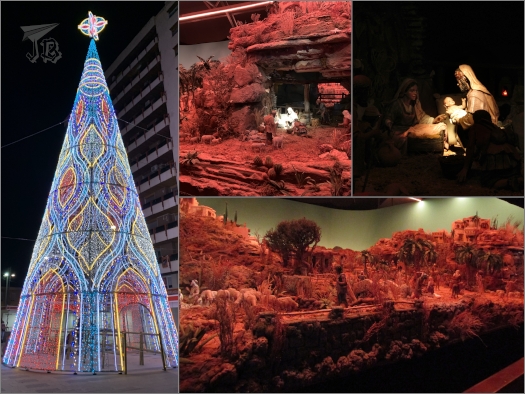
Collage: A Christmas tree made out of eye-shaped lights in blue, purple, red and yellow. A picture of the classical nativity with realistic figures. The Holy Family is illuminated in white - Joseph is placing the Child on a crib that Mary is holding.

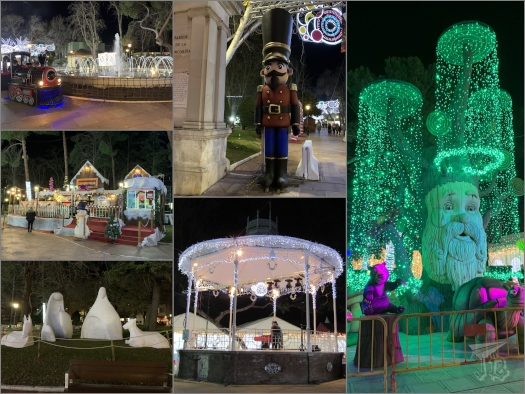
The final area extends along the parks Parque de la Concordia and Parque de las Adoratrices. The entrance is flanked by two nutcrackers; it hosts a talking tree, lights, food trucks, yet another flea market, and rides that again… are only Christmassy by name. There is another Nativity, this time an “abstract one”, a cute train and a “Polar Express” ride, some lights and… a “talking tree”, which broke into telling some tales out all of a sudden. Then, there was a bunch of rides, but they looked like your average travelling carnival rides, and I was not going to go onto any of those, so I made my way back. Also, I was strong and did not buy any cotton candy nor similar treats, though I was tempted to get some roasted chestnuts.

Bizarre Christmas decorations and motifs in the park: A giant nutcracker / soldier, an abstract nativity, some gingerbread-house-shaped shops, a Polar Express mini train, and a... something that looks like a tree with a face on the trunk and leaves made from green lights.

It was weird because for the second time in a couple of months I’ve been asked if I’m an actual photographer. True, this time it was a drunk guy who then proceeded to yell fascist slogans. I decided it was the right time to call it an evening and go home for the day…

11th & 12th December 2021: Final Fantasy Remake Orchestra World Tour, Barcelona (Spain)

11th December 2021: El Triángulo Friki

When the tickets for the FINAL FANTASY VII REMAKE Orchestra World Tour first came out, 2020 promised to be an amazing year. True, we all know how that turned out, but the point was that I did not have enough fun funds at that moment. So I just looked at the Barcelona dates, sighed, and never bought tickets because I decided that it was a low-priority event for me. Then, what happened happened and the tour was pushed forward to 2021. By chance, back in summer this year, I saw that it would take place on a Saturday, the 11th of December 2021. My sibling overheard me mulling whether I wanted to try to go or not this time over, since I had not done much on the nerdsphere for a while, and the low priotity was conflagrating with higher priortity and the still lacking fun budget. They didn’t know about this, though, and they proposed we went together. I thought it was a good opportunity for a weekend out, so I did some checking. We found some tickets that had been turned back, in an amazing place, actually – row #5 on the stalls. We booked a hotel and trains, and just went on with our lives.

The train left around 8:00 and arrived in Barcelona short from 11:00 – both of us had been in town before and were looking for an “alternative” plan. I had been checking out different options, and by pure chance, on Thursday, I found out that there is an area in Barcelona called Triángulo Friki, something akin to “the nerd triangle”. It is an area near Arc de Triomph that holds a bunch stores which specialise in comics, manga, figures, merchandising and so on. I thought it could be a fun thing to see, as Japanese stuff a hobby I share to some extent with my sibling.

We took the commuter train to the area (commuter train tickets are complementary with long-distance ones, which helps, as the Barcelona public transport is very expensive) and wandered around a bunch of shops, under the agreement not to spend too much money nor to buy anything that did not fit in our backpacks. We… failed the mission successfully. On the sixth or so shop I got myself a Christmas present that sure as hell did not fit in the backpack.

A collage showing the entrance to a bunch of comic and gaming stores. Most of them have a window showing Funko pops

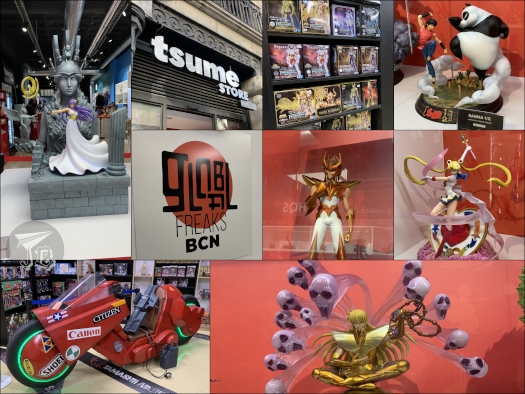
One of the shops we visited was Tsume Store, in association with Global Freaks. Tsume is a business that 3D-prints statuettes from anime designs, and Global Freaks is a merchandise shop. They have a partnership and Tsume is selling some of its statuettes through Global Freaks – we saw one of them, priced at 1400€. Most of the figures were just for show. On the other hand, Global Freaks had several things we bought (remember the “mission failed successfully” comment? We spent way too much money on stuff that did not fit in the backpacks). Furthermore, they had a reproduction of a motorbike from Akira (アキラ), a famous manga / anime – a cyberpunk action story whose main character, Shōtarō Kaneda, rides it through Neo-Tokyo.

Tsume / Global freaks store in Barcelona. There are different pictures of resine statues of different sizes (and prices), and a reproduction of an anime motorbike.

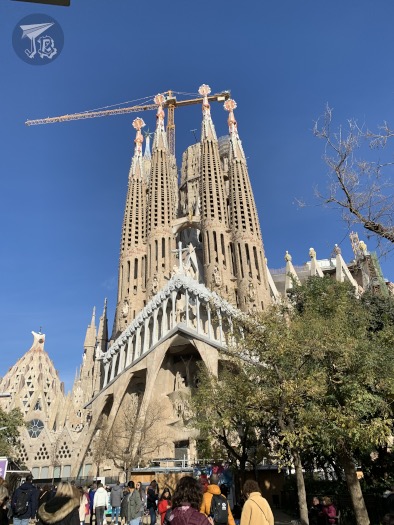
We walked towards the area where the basilica designed by Gaudí, and consecrated to the Holy Family, Basílica de la Sagrada Família, which had been decorated with a new twelve-point 7.5-metre 5.5-tonne star. As there was a Christmas market around the basilica, I thought that the start was just for Christmas, but it turns out that it is there for good.

A modernist cathedral. It looks a bit like it's melting. It has four towers, plus one with a star, and a triangular façade

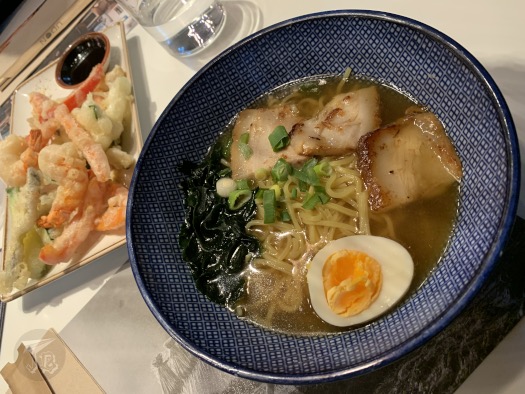
We took an underground train to the area where the venue was, and we were there around half an hour before hotel was open to check ins so we decided to have lunch first in the adjoining shopping centre. We ended up at an Udon, a wannabe fancy noodle bar chain. This was our first time getting our Covid passport checked as it’s not necessary where we’re from. The whole process was fast – open the PDF, zoom in, get it read with a device, and a green light with our names on it lit up (eventually I just screenshot the zoomed-in QR). I still felt a little uncomfortable due to the amount of people in the restaurant, so we ate as quick as possible before heading off to the hotel.

A bowl of ramen and a peek of a tempura plate in the background

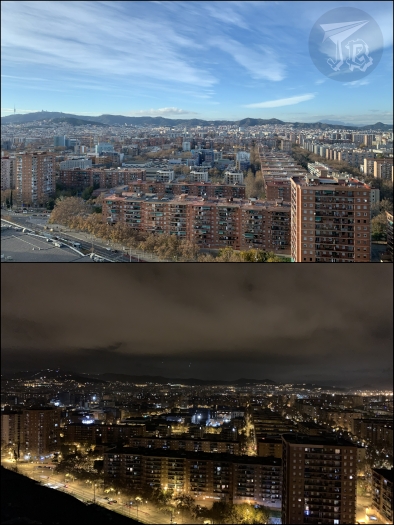
It was the worst check-in experience ever. First of all, I think it’s stupid to demand a payment deposit on an already-paid booking. Second, they tried to charge me for the room again, we were given one card key for two people which didn’t even work, and we were “upgraded” to a room with a city view (16 € more expensive than our booking), but that only had amenities for one guest. We needed to get off the lift to request another card in order to get to the 21st floor, and we finally got two working cards. Oh, and the hotel was hosting a bunch of teams for some kind of handball championship who thought masks were for lesser beings and got away with it, despite the super-strict Covid-policy the hotel claimed to have, and with the obvious blessings of the clerks, despite other guests’ complaints.

Two views of Barcelona from above, one with daylight, the other one at night. The buildings are apartment blocks, rather regular, and you can guess the long streets that separate the different areas

We stayed in the room, just chatting and taking in the astonishing views (nah, I’m not being sarcastic (≧▽≦).) The FINAL FANTASY VII REMAKE Orchestra World Tour concert was to start at 20:00, but doors were at 18:30. It took place in the convention centre CCIB – Centre de Convencions Internacional de Barcelona, which… actually turned up to be the auditorium of the local Natural Science Museum. That was confusing for a minute.

We were quite literally across the square so we just had to go down. It took just a few minutes to enter, and then we went into the goods queue, because my sibling absolutely needed a chokobo plush. We were in line for about half an hour, as we debated how expensive everything was! They decided that I needed a chokobo too, so I’m the proud owner of a Chokobo Black Mage now.

An adorable chokobo plush with a mage cape sitting on the leaflets we got from the concert.

After we had all our goods, we headed off to our seats – which had been occupied by two different people who had bought row five on the dress floor – but had tried the main floor stands, never mind that a lady told you which door you had to use when you went in, in order to avoid these “mistakes” . I decided that I did not care about causing a scene, so I just grabbed an usher and had her clear our seats. The guy on mine took my flyer too, but I found some more when the concert was over. I’m amused though that someone would buy a ticket on the first floor and then happily stroll down to the fifth row on the stalls – more than double the price.

Let me start by saying that I’m not a video-game player, that’s why this event was originally a low-priority one. When my wrist problems started, I was recommended not to play them any more. But I love video-game graphs and Final Fantasy VII designs more than any. I mean, I own the Advent Children DVD just because it’s pretty. I have to admit though that the concert blew my mind. The stage was full with a complete orchestra indeed, and a choir – the Ensemble Symphony Orchestra & Chorus. At the back of stage there was a screen that projected scenes from the game, both animations and gameplay. In the little emcees by conductor – and producer – Arnie Roth we also got messages from composers and producers from Japan. Furthermore, the composer Hamauzu Masashi was in attendance. We did not get Yosh Morita, from The Prophets, as it was originally announced, but singer Ricardo Afonso did a very decent job out of the power ballad Hollow.

Empty stage with chairs for the orchestra. There is a screen in the background reading Final Fantasy VII Remake Orchestra World Tour in front of a futuristic cityscape

    Part 1

  1. Prelude – Reunion –
  2. Opening medley
  3. Mako Reactor 1
  4. Flowers Blooming in the Church
  5. The Turks’ Theme
  6. Tight rope
  7. Stand up
  8. Words left unheard
  9. Tifa’s Theme – Seventh Heaven –
  10. Those who fight – Battle Medley –

    Part 2

  11. Anxious Heart
  12. Hurry!
  13. Jessie’s Theme
  14. Shinra’s Theme
  15. The Arsenal
  16. Those chosen by the Planet – Fate’s Calling –
  17. Arbiters of Fate – Singularity –
  18. Hollow
  19. Final Fantasy VII Main Theme

    Encore

  20. Aerith’s Theme
  21. One Winged Angel

I loved the Those who fight – Battle Medley –, and I’d say that one of the highlights was the song Hurry Up. Apparently, during a specific part of the game you have to put the rather-uptight main character in a dress and teach him to dance in a night club. I also really liked the choir interventions. The concert ended on a hype – for a second I thought it would end in the slow song, but no, we got the fantastic theme for the bad guy Sephiroth, One-winged angel.

The stage again, this time it is full with the orchestra and the director. The screen shows the main character of the game, Cloud, with blond spiky hair and a ridiculously big sword, holding a bright ball in his hand.

The concert lasted for two hours and a half, including the intermission – in which I got to see (and hug!) friends. After the ending, we tried to go and grab some sushi at the shopping centre, but they were already closing down – so in the end we just got a salad and some chips at McDonald’s and took it to the hotel – then we showered, rearranged luggage and purchases, and went to bed.

12th December 2021: Walk by the ocean

Our original plan after breakfast was to take a walk by the beach, then check out and ride the underground, but we realised that we had a train station about 20 minutes away, and we could get a detour by the seaside and make it a bit longer – and if we took the train, we had a free ride.

When we checked out we got the same person who had checked us in. They still had to charge us for the tourist tax, and I had that ready in cash. They insisted that they had to deduct that from the deposit and give us the change, they could not give us a fifty-buck note. They had to give us the change. With lots of coins. They did not even check the room for damage, so what was even the point of the deposit?

We left the hotel, and walked towards the station. We spent a little time at the beach Platja del Fòrum and the mouth of the river Río Besòs before we reached the station – lots of people walking their dogs, and lots of happy dogs playing on the beach and with the waves. In the background, the former thermal station with three chimneys looming over the sand – Central Tèrmica de Sant Adrià de Besòs. Had we had more time, we would have taken the time to try and get to it, but due to external reasons we had tickets for the noon train and it was already 10:45 – and I am paranoid about schedules.

A sandy beach with a factory building in the background, it has three chimneys made of brick. The waves are coming in gently.

We took the commuter train, then the long distance train. When we arrived, before going home, we made a short stop to have some make-up sushi for the one we could not get the previous night. And some side Chinese dumplings.

Sushi and bao plate

Walking distance Saturday: 9.05 km
Walking distance Sunday: 5.54 km

30th November 2021: Naturaleza Encendida – Explorium. Royal Botanical Garden in Madrid (Spain)

After being in semi-lock down last year, my sibling, who loves Christmas lights, asked me to accompany them to the Real Jardín Botánico, the botanical garden in Madrid. The Botanical garden was founded in 1755, adjacent to the planned museum of Natural Science, which would later become the art gallery Prado Museum. Today, it is a research centre. The garden is divided into four terraces, a main building (Edificio Villanueva), and a back terrace, and it serves as museum of live plants of sorts.

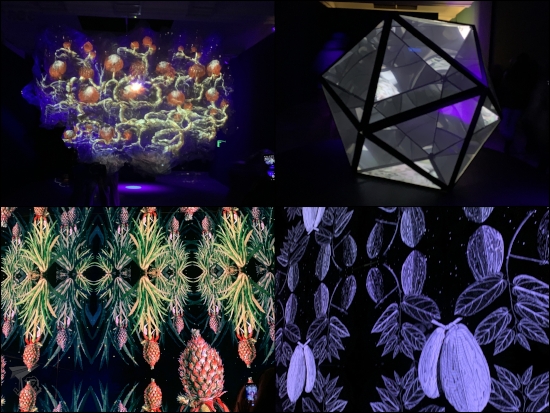
For the last few years (at least three that I’m aware), the botanical garden has spiced up its winter downtime with light shows and displays. This year, the display is called “Lit Nature: Explorium”: Naturaleza Encendida: Explorium by the company Let’s go. The topic is ocean explorers and exploration, spread throughout the three main terraces and an extra exhibit in the building.

In order to have flexibility, I got us Premium tickets in case we needed to cancel last minute, which had the extra advantage that spared us from any queues, as we had full-access between 18:00 and 19:00. We also got to see the extra exhibit without paying extra. I drove up to a mid-way train station that allowed me better schedule flexibility – and my sibling lives close-by so it gave us the option to have dinner afterwards. I took the first train and we met at the botanical garden station at 17:30. We wandered around for a little while we waited until twilight faded, and we got in, avoiding all the lines – I did a bit of astronomy maths when planning this, regarding latest sunset and shortest twilight.

The exhibit is organised so you are free to wander around each terrace, but you can only cross from the lower to the upper terraces upwards, you cannot backtrack, in order to control capacity and people in each area. It only felt a bit crowded at a couple of points, mostly around the checkpoints, as it was very difficult to hear the staff.

The whole display has thousands of little blue LEDs to get you on the ‘ocean’ scenery. The first terrace sets the mood – there are Christmas-tree looking build-ups and different types of colour-changing sculptures: turtles, pufferfish, and sea horses. The second focuses on laser and smoke, and reflection displays, and some serious-looking grouper. On the third, where the building stands, there is a little pond from where a few gigantic tentacles rise, and jellyfish hanging from the trees. The exhibit in the building itself is similar to the projections done by Team Lab.

Collage. A garden lit up at night, with different shapes: pufferfish, seahorses, a turtle... The trees and bushes are decorated with thousands of tiny blue leds

Collage. Light flashes in a dark garden, along with a colour gouper fish

Collage. Huge tentacles coming out of a pond, illuminated in red and blue; and blue jellyfish lamps hanging from trees

Collage. Light effects repeating the same patterns: a pineapple, a thisle, a khaki

We wandered around for a couple of hours, and believe me or not… the lights went out at some point! This was like climbing up (rope-way-ing up, to be honest) aaall the way up to see Nagasaki’s lights from Inasayama and getting caught in the clouds, but fortunately shorter (≧▽≦).

We left the botanical garden and took a train back. There were a few places to grab a bite around the station, so we ended up at a cosy Italian place and shared some stuff – too much to then grab some dessert though. When we left it was so cold that my car gave me the first heart attack of the winter by bleeping and showing me an orange alarm in the dashboard that means “the roads might be frosty” but scares me to death whenever I see it for the first time in the winter season. I drove off home, had a shower, went straight into work at 23:00 because how was I going to manage a free Tuesday evening without consequences?

Final waking distance: 8.50 km (though I really think that the wristband confuses my stress-driving with activity.

12th November 2021: Beech Unplugged – Hayedo de la Tejera Negra (Spain)

One of the Unesco World Heritage Sites is “Ancient and Primeval Beech Forests of the Carpathians and Other Regions of Europe”. The “other regions of Europe” actually makes the site expand into 94 forests in 18 European countries – three of these forest are in Spain. A primeval forest, in layman’s terms “old-growth forest” is one that has been allowed to thrive without significant alteration from humans. Most of Europe’s temperate forests have been altered by human activities, so the protected areas are patched throughout the continent.

One of the protected areas is the beech forest Hayedo de la Tejera Negra. The European beech (Fagus sylvatica) is a deciduous tree from the same family as oaks. The trees usually measure up to around 30 m, tend to have a slim trunk and grow branches high on the tree. The leaves are simple, though they are toothed, the shape is soft. They change colour in autumn from green to gold and tend not to be shed but stay in the tree unless the weather brings them down. They grow in humid areas, but they require a well-drained soil. Forests tend to be thick and dark, with few other species as the beech canopy takes up all the light.

The forest is located in the centre of Spain, and it is part of the natural park Parque Natural de la Sierra Norte de Guadalajara, some 30 km away from the Aljibe Waterfalls. Beech forests tend to grow in colder climates, so this one is a relict forest from times when Spain was cooler and wetter (maybe what is called the Little Ice Age between 1300 and 1850). The fact that it remains is due to a very precise location – low valleys with a lot of shades and shadow where fog and mist are common and it rains rather often. Furthermore, the calcite-rich area makes the soil ideal for beeches. The reality of it being a Primeval forest is thrown has doubts cast as the forest was actually cut down twice – 1860 and 1960.

The beech forest technically belongs to Cantalojas, in the north of the province of Guadalajara, Spain. There is an inner parking lot that has to be reserved in advance for just under 5€ (access between 10:00 and 13:00), and a free-access parking lot at the edge of it. In order to get there, the first step is to arrive in Cantalojas. There, a bumpy rail gets to the beginning of the park, where the checkpoint stands, you can either leave your car here and walk the longer trail (Senda del Robledal), or if you have an inner parking reservation, you will get waved through the longer driving path, 8 km long. Once in the parking lot, you may walk the inner trail.

After my first try to visit the park was fouled by the driving path being closed on weekdays and the parking lot full, and my second by the bad weather, I was finally on my way on Friday the 12th of November – took long enough! The roughly 100 km took a bit more than expected due to a good part of the road having a lower speed-limit than normal, as it is considered a “dangerous mountain road”. There is also loose cattle around the roads, and I came across a few cows having a field day. In the end, I drove for an hour and forty-five minutes, and started walking around 11:30. I took the shorter, inner trail, called Senda de Carretas, which is around 6 km long. Depending on which resource you look at, between two and three hours are expected to hike it.

The trail starts in the lower valley, between the creek Río Lillas and the lower pine forest, whose trees won’t lose their leaves anyway. Thus, even if the weather is turning cold this area is still very green. The name of the trail translates into “Trail of Carts” as it was used in the past to transport coal that was produced in the beech forest. As the trail turns to the left, it starts ascending, leaving behind the valley and the pines. First, there is an area of low bushes and trees, where pieces of calcite rock are abundant, then it delves first into the oak forest, which has already turned brown.

A sign reading Senda de Carretas. Behind it, a small valley. A creek runs at the bottom, and the sides are covered in pines and other evergreen trees.

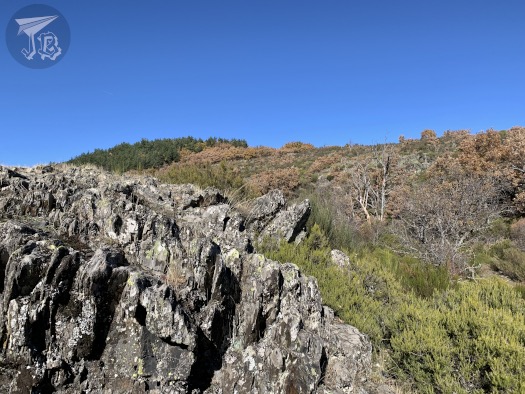
A rock formation, with vertical cracks, and bushes in the background

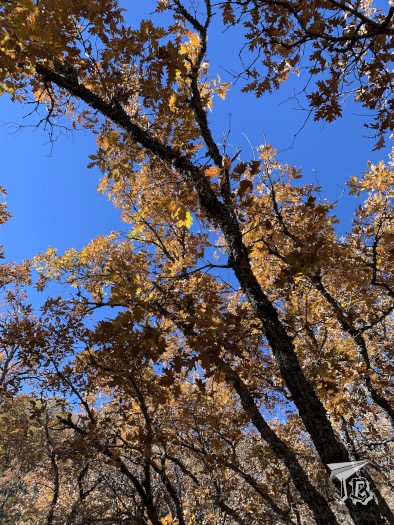
Beech trees, looking brown / orange / golden in the autumn weather.

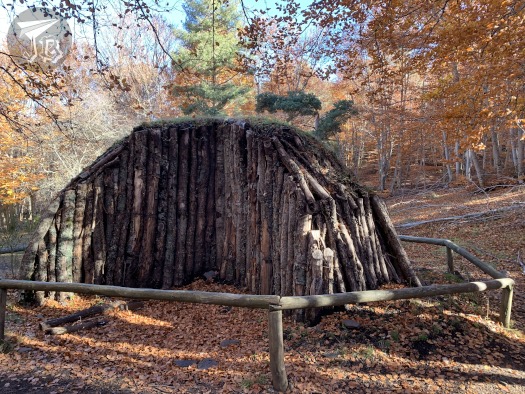
There were way more people than I had been expecting for a weekday – a lot of them were hiking in groups and unfortunately loud, which made catching a glimpse of any animal impossible. The forest was beautiful though. Around one-third in I came across the sculpture that recreates the old coal-ovens, La Carbonera.

A hut made out of thin trunks. The autumn leaves have accumulted against

I continued hiking up, and after a pretty wooden bridge, the steep slope started. This was a bit harder than I had anticipated, and made the mistake of taking a break in-between, so I lost my pace. At the end of the slope I found the open prairie Pradera de la Mata Redonda, which looks down on the valley and up onto the multi-coloured mountain.

The valley from above. There are no trees, but a high plane with bushes and scattered grey rocks covered in lynchen

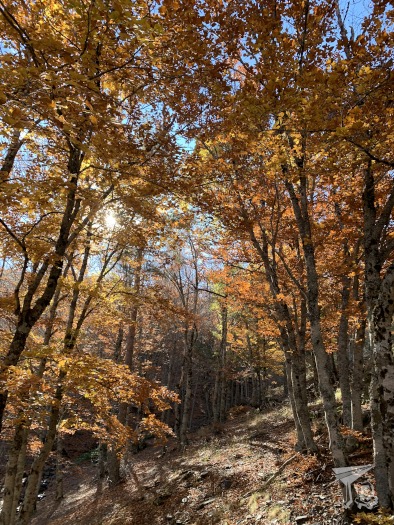
After a short look-around, I continued on the hiking path. Here I could actually see something unexpected… snow! Do you remember that my second attempt had been thwarted by the weather? Well, there were the remainders of so… This was in my opinion the most beautiful part of the forest, as the descend starts. The beech forest was completely golden at this point, and the ground was also covered on leaves. This is the part that gives the forest its fame, and it is well-deserved, at least in autumn.

Grey path into the forest. On the sides there are brown / gold trees, green bushes, and even a bit of snow.

A whole forest of beeches in gold, brown and golden colours; the ground is covered in leaves.

When I reached a fork on the road, I continued for a little on the Senda del Robledal (Oak forest trail), then took the path down towards the parking lot. The forest opened up and I eventually got to the parking lot, where I got on the car and drove away at around 14:45. I took a little over three hours in total and walked 7.46 km.

A whole forest of beeches in gold, brown and golden colours; the ground is covered in leaves

On my way back I drove past more cows chilling out – the complete drive was a bit under 200 km. And I did not have signal for the whole day, which was a nice change for a while.

A black cow chilling at the side of the road - they actually have the right of way in this area

6th November 2021: Torrejón de Ardoz & Guadalajara (Spain)

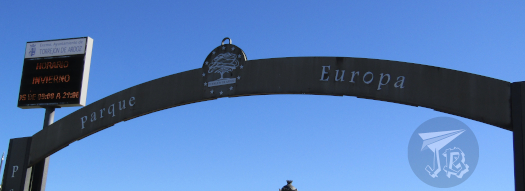
No matter how much some people demonise it, one true thing is that a great chunk of the Spanish general income is dependent on tourism. That’s why when the 2008 recession hit the country, many areas or municipalities tried to fabricate tourist attractions where there used to be none. Torrejón de Ardoz is one of these places – despite shouldering a huge debt, it gambled a couple of tourist lure. One is a huge winter lights (Christmas) display, which runs from November through January. The other is a huge park in a former slum, called Parque Europa, Europe Park.
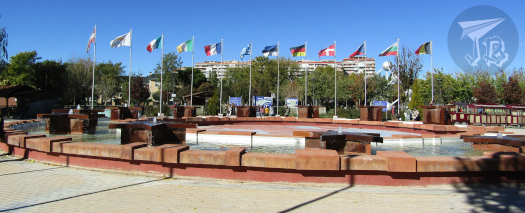
Parque Europa was described as “Pharaonic” upon its inauguration in 2010. It covers a whooping 23 hectares of trees, bushes, ponds, rides for kids and replicas of different European monuments and landmarks, both real and art depictions. I can’t be sure if in the end the park managed to break a profit, but the reviews online do sound like it did.

In winter, the park opens at 9.00 am, and I thought that if I managed to get there relatively early in the morning, I might find a free parking spot around the area. Online reviews do talk about limited parking space aimed to fill the pay-per-car parking lot close to the entrances, so I thought I’d try to leave the park in the streets of the industrial complex nearby. After a couple of Sat-Nav mishaps – human-caused aka I forgot the adapter for it to work in the car (≧▽≦) – I was on my way and I reached the neighbourhood a bit before 10.00 am. As I was driving towards my intended parking spot I caught a glimpse of the Eiffel Tower, so when I turned and found a random parking spot, I decided to just ditch the car. There were many double-parked cars ahead so I thought the rest of the street would be packed. At that time in the morning, I could have just parked in front of one of the access gates without problems, apparently. So I had to walk two whole extra minutes!! In the end though, that parking spot was even closer than the ones I planned to look for – so it was all good.
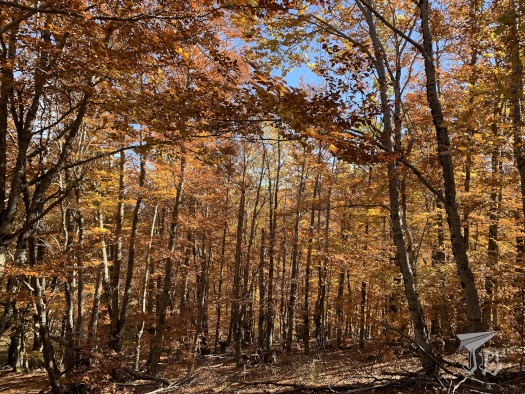
I wanted something to do in the morning outside the house so I did not have a plan per se (to be honest, I had long made the afternoon plans and I wanted something to do in the morning to make the most out of the disposable contacts). However, as the fountains were turned on at noon, I wanted to leave them for last. Fortunately, most of them are in the same area of the park – which is shaped like a ham of sorts. At that time most of the children rides were closed, and I was mostly alone except for people jogging or walking their dogs, and it was rather chilly. But I wanted to see the replicas, so that was all right.

These are the monument replicas that are hosted in the park, in the order I saw them, turning clockwise from the entrance I used:

  • Puerta de Alcalá (Gate to Alcalá), Madrid, Spain. Neoclassical gate to the former walls in Madrid. Today it is considered World Heritage as part of the “Paisaje de la Luz”.
  • Torre de Belém (Belém Tower), Lisbon, Portugal. Officially named Torre de São Vicente (Tower of Saint Vincent), a 16th-century port fortification for Portuguese explorers, with high symbolism and ceremony.
  • Tower Bridge, London, United Kingdom. Crossing the River Thames, it is one of the most iconic London landmarks.
  • Kinderdijkse molens, the Windmills of Kinderdijk, Netherlands. The original windmills were designed as part of water drainage to drain the excess water in the Alblasserwaard polder.
  • Brandenburger Tor (Brandenburg Gate), Berlin, Germany. It is one of the most characteristic landmarks in the country, a monument built in the place of a former wall gate in the 18th century.
  • Den lille Havfrue (The Little Mermaid), Copenhagen, Denmark. This small sculpture is displayed on a rock in the a promenade in Copenhagen, and depicts the mermaid in Hans Christian Andersen’s tale becoming human.
  • La tour Eiffel (The Eiffel Tower), Paris, France, built for the entrance to the 1889 World’s fair and one of the most visited monuments of the world.
  • Michelangelo’s David, Florence, Italy. One of the masterpieces of the Renaissance sculpture, standing 5.17 m of white marble. This replica I didn’t get to see because it had been either stolen or taken away for restoration.
  • Fontana di Trevi (Trevi Fountain), Rome, Italy. Dating back from 1762, the fountain is a “more dramatic” version of a previous one at the end of one of the Roman aqueducts. The fountain was turned on at noon and it had just a little water.
  • Manneken Pis (“Little Pissing Man”), Brussels, Belgium. It is a bronze fountain sculpture depicting a naked little boy peeing into the basin, dating back from the 17th century.
  • Atomium, Brussels, Belgium. This stainless steel building was constructed for the 1958 Brussels World’s Fair, and renovated between 2004 – 2006. It stands 102 metres high and some of the spheres are open to the public and hosts exhibitions.

There are also “adaptations” or monuments that you can “sort of” identify but have been more freely reproduced.

  • Greek Theatre, based on the Athens one, with the Winged Victory of Samothrace watching over in a bit of an artistic license move I guess, considering it was a ship figurehead. The actual one is in the Louvre Museum in Paris. The theatre is built into the slope of the central pond of the park so visitors can see the light and sound show in said pond when they are held.
  • Plaza de España (Square of Spain). The centre of the square is the famous “Puerta del Sol” in Madrid and the older Post office. Its back represents the Main Square of the city. Other houses represent different regional buildings throughout Spain that I was unable to recognise.
  • Viking Ship fountain. There is not much I can say about this. It was one of the fountains, and this one was turned before any of the others.

Inspired by paintings, there are two other monuments.

  • The Three Graces. While the park’s webpage claims that the sculpture is a copy of the one that Antonio Canova created, it looks like it was sculptured using Ruben’s painting as inspiration. This one was the first monument I saw.
  • Van Gogh’s bridge”, a wooden bridge inspired by Vincent van Gogh’s painting “The Langlois Bridge at Arles”. I missed it at first so I had to backtrack and I did not find a good angle to see it from the side.

An original piece is the fountain called Plaza de Europa, Europe Square, a circular square with stars forming little fountains. This was one of the fountains I had to wait till noon to see and to be honest, I was… underwhelmed, expecting way more by the pictures on the website. I’m not sure if it was just “winter fountain” or whether the sprouts were set on low because it was a bit windy.

What was interestingly impressive was the original piece of the Berliner Mauer, the Berlin Wall. During the Cold War, after WWII, Berlin was partitioned into West Germany and East Germany with the erection of the wall in 1961 (in what was called the Berlin Crisis of 1961). It was all built within the eastern border as it was the USSR who decided to put it up. The Wall separated the city halves for decades, there were even deaths as people from the east tried to defect to the west. The wall officially but metaphorically fell in November 1989 as the political powers who had driven its building agonised. The piece that stands in Parque Europa originally stood in Postdamer Platz and was ceded to Torrejón by the city of Berlin and it stands behind the Brandenburg Gate.

There are many other areas and activities for kids. A number of them were already opening up by the time I left, others seemed to be on hold due to pandemic concerns. The park has different things to draw attention too, such a giant bird cage (mostly full of parakeets), three life-sized elephants made out of bush, gardens, or an artificial waterfall – which did not get turned on. I saw a lot of birds too – magpies, swans, mallards and some very territorial Egyptian geese (I think that they were Egyptian geese. I’m absolutely sure they were territorial).

I left Torrejón at around 12:30, I think. I took care of some errands on the way, had lunch, and then I headed off to the second part of my self-imposed day off. A late-Halloween activity that ran throughout the month of November: Arquitectura y escultura funeraria in Guadalajara: a walking tour with a focus on the funerary architecture and sculpture in town. Well, at least with a stop at those places that are directly controlled by the town hall, missing those that are not. Yes, I voluntarily signed up for a guided visit! Unfortunately, information on Guadalajara is rather difficult to find, so I thought there might be interesting knowledge to be gathered (Narrator’s voice: there wasn’t).

The tour started at the local cemetery Cementerio Municipal Virgen De La Antigua, where we saw several tombs and pantheons dating from the 19th century and the early 20th century. These included:

  • Panteón de la Tropa, the “Troop mausoleum”, a communal grave for soldiers who died in the African campaigns, where supposedly some of the Civil Wars victims were buried. It actually is not the place, but legends are legends, I guess.
  • Panteón de los Marqueses de Villamejor – a neoclassical mausoleum where a noble family was interred.
  • Monumento funerario de la Familia Cuesta Sanz, a creepy obelisk-looking tomb.
  • Some smaller mausoleums (or big graves) Panteón de María Luisa García Gamboa, Panteón de la Familia Chavarri, Panteón de Josefa Corrido de Gaona, and Panteón de la familia de Ripollés Calvo. All these are stone tombs with a rounded roof that drains off rainwater.
  • Panteón de los Condes de Romanones, the place of eternal rest of another noble family, whose head was the son of the previous one.
  • Kittens

We then walked off towards the chapel Capilla de Luis de Lucena. Luis de Lucena was a doctor and a priest who was born in the 15th century. He died in Rome as he worked as a doctor for the Pope, but he expected to be buried in this chapel, adjacent to a now-disappeared church. The outer area is built in brick, and the inner ceilings have several frescoes, even if they are rather deteriorated as the town had no money to take care of the art during the 90s and the early 2000s. The chapel was never used as a burial place, and now it is a tiny museum that keeps rests of other disappeared churches in town, especially the funerary sculptures.

The final spot was the crypt of the church of St. Francis – Cripta de la Iglesia de San Francisco, built in dark marble and similar to the one in El Escorial. This is where the Mendoza duchy family members were buried, but the area was ransacked by the French during the Napoleonic wars and the remains were taken to Pastrana afterwards, so the crypt is currently empty. Which is good considering the way some of the tombs are shattered…

This concluded the tour so I was free to go. I saved up the entry fee on the chapel and the crypt as the tour was free. Most of the tour was just crawling from one point to the other and there was not that much new information to be learnt. Maybe there is jut not enough information to be found…

Driven distance: around 83 km.
Walking distance: 13.14 km

22nd & 23rd October 2021: Zaragoza Getaway (Spain)

We had a silly day-and-a-half and it turned out that for some reason a commuting train to Madrid took about as long as a high-speed train to Zaragoza, a town in the area of Aragón that we scratched off our summer route because there are lots of curves in the Pyrenees and time was limited.

22nd October 2021: Churches, Museums and a Palace

The train to Zaragoza arrives at the Delicias station, which is a bit away from the centre of the town, so we took a taxi to the hotel. This was around 9 am so we were of course not expecting any room, what with check-in being 2 pm – we just wanted to drop off the overnight bag. Not being able to give us a room seemed to upset the receptionist quite worried, and he promised to call as soon as a room was available. Honestly, I just set my phone to flight mode because we were starting to visit monuments right away, as the hotel was just by the most important square in town Plaza del Pilar.

Zaragoza is home to one of the most important Christian icons in Spain, the Virgin Mary of the Pillar, Virgen del Pilar. The image is hosted in Catedral-Basílica de Nuestra Señora del Pilar. The bulk of the current cathedral-basilica was built between 1681 and 1686 in the Baroque style, but was later modified quite a few times and it was finalised in 1872. Interesting items in the church include, aside from the virgin image, some frescoes painted by Goya, the main altarpiece, and two bombs that fell within the church during the Spanish Civil War (1936-1939). Zaragoza is very anti pictures inside so I had to sneak them in. Sorry, not sorry.

A collage showing the Baroque Basilica, including unexploded bombs, and two of the altars

Virgin of the Pillar, wearing a mantle

After a small detour to say good morning to the river, Río Ebro, and the Puente de Piedra (stone river), the second building we visited was the Old Market Exchange building – Lonja de Zaragoza. This was the first Renaissance building erected in Zaragoza, dedicated to commerce, with an amazing Gothic-imitation ceiling. Today it is used for exhibits, such as paintings or sculptures.

Coming out, we almost walked into one of the fountains in the square, Monumento a Francisco de Goya, featuring the artist – a brilliant Spanish painter from the Romantic times. He was as brilliant as bad-tempered though. Behind the fountain stands the cathedral, for which we had tickets for 11 am, and it was still early for that.

Thus, we started the route of the Caesaraugusta Museums. Zaragoza was founded in Roman times under this name (where an Iberian dwelling used to be) and in the latest decades, this Roman past has started being dug up. We first visit the museum focused on the original forum, Museo del Foro de Caesaraugusta where we could see the foundations of the old city and walk into the sewers (yeah, it’s cooler than it sounds). The Roman ruins date back from emperors Augustus and his successor Tiberius’ reigns.

After that it was almost time for our reservation to visit the Catedral del Salvador also known as La Seo de Zaragoza, the other cathedral of the town, literally at the end of the same square as the other one. The cathedral mixes several architectonic styles: Romanesque, Gothic and Mudéjar, these last tow being among my favourite styles, so a total win – Renaissance and Baroque elements were added, including the towers. The cathedral has a tapestry museum with a lot of works, not exactly “pretty” but rather impressive.

Following the cathedral we walked towards the rest of the Roman museums, but we made a small detour to look at the Mudéjar tower of the church of Mary Magdalene, Iglesia de Santa Magdalena.

Then we reached the museum of the Bathhouse, which was open but closed – let me explain. They run an “Audiovisual” and close the museum door for as long as it runs. It runs every half hour so finding the thing open seems to be hard. Thus, we moved onto the next archaeological site, related to the old Roman Theatre Museo del Teatro de Caesaraugusta. The theatre was apparently discovered by accident in the early 1970s, and it is apparently one of the biggest Roman theatres in Spain.

We tried our luck with the Bathhouse Museum again Museo de las Termas Públicas de Caesaraugusta. Unfortunately, just like before, we walked up to it while the audiovisual was running, and the concierge made a very studious effort not to see us – so we just peered over the glass roof to see what is left of the main bath.

More impressive was the river port museum Museo del Puerto Fluvial de Caesaraugusta, which keeps the foundations and some of the clay amphorae that were used for import / export.

And believe it or not, we did all that before lunch!! Therefore, we decided it was the right time for a break. We headed back to the hotel to see if we could wash our hands (and take off our facemasks for a while). To our surprise, the hotel had given us an upgrade to a junior suite, so we had a sitting room, a full bathroom and a bedroom – and a balcony that went all along the three. When I opened the window I could hear people playing the piano on the street, as there was some kind of festival going round. Believe it or not… I got to listen to Queen’s Bohemian Rhapsody and Rufus Wainwright’s Hallelujah.

We had lunch outside in a place that my companion enjoyed called La Lobera de Martín – not a cheap place, honestly! However, we splurged a little. We shared a smoked fish salad and I had a side of fresh Foie. As a main, ordered steak tartare, which to my surprise, was prepared for me next to the table! For dessert I tried the home-made berry yoghurt. I have to admit that I was totally planning on having a tiny dinner (or completely skip it!) at that time.

After lunch we walked along one of the main arteries of the town, Paseo de la Independencia, to find the Basílica Menor Parroquia de Santa Engracia, to at least see the outside, since we could not fit visiting the interior and the crypt with our tight schedule. One of the most interesting things about this church is how its façade is built like an altarpiece.

Next to the church stands the neo-Mudéjar post office, built in typical bricks from the area – Oficina de Correos de Zaragoza.

And finally, we looked at the current Science Museum, Museo de Ciencias Naturales, the former Medicine University. Why? Because that’s where my parents met *cue romantic music*!

We did not go in though, because we needed a break and had booked a ticket for 5pm somewhere else, so we decided to raise our feet a little for a while in the hotel room – the sitting area was nice though unfortunately there was no more sun on the balcony, else I would have totally impersonated a lizard there (I did scare a pigeon away though, even if the startle was mutual). Our next target was the Medieval palace called Palacio de la Aljafería – a fortress that combines Islamic architecture and ulterior Christian elements. The Moorish palace was built around 1065 – 1081, and it holds a magnificent garden called the Golden Hall with a portico made out of interlocking mixtilinear arches (I totally looked the word up, and will forget it promptly). The palace was taken over by the Christians 1118 and became a palace for the monarchs of Aragón. It was not modified until the 14th century, and in the 15th Century the Catholic Monarchs extended it further into the Mudéjar Palace. Today it is the meeting site for the local government. I adored it, to be honest, I loved the Golden Hall most of all, but the original ceilings in the Christian palace were also really cool.

We walked back towards the Plaza del Pilar (probably through some streets we probably shouldn’t have, hindsight is 20/20 they say), and we reached the church of St. Paul Iglesia Parroquial de San Pablo. The restored interior leaves a bit to be desired, but the exterior, built between the 13th and 14th centuries in the Mudéjar style – it has an octagonal tower in dark tones, with the upper roof added in the 17th century with richly decorated with tiles and windows. It is worth mentioning here that several Mudéjar buildings in Zaragoza, along with others of singular architecture, are declared Unesco World Heritage Site.

Between the church and the square we walked by the central marketplace Mercado Central de Zaragoza in the late 19th and early 20th century, in a combination of stone and iron-and-glass architecture.

Close to it we could see some of the ruins of the original Roman walls Antiguas Murallas de Romanas de Zaragoza, which are actually sprinkled all through the town and mixed with the Medieval ones at points. There, a lady was happily chatting on the phone while her child climbed the walls – so in case it is not evident, here’s a social clue: if there is any kind of barrier / signage around something, it should not be climbed on.

To finish off the day we visited the Museum dedicated to Goya Museo Goya. Goya, whose complete name was Francisco José de Goya y Lucientes (1746 – 1828) was a painter and printmaker from the Romantic age. He is probably one of the most important artists in Spanish history. He was a royal portraitist, fresco decorator, and also painted and printed many critical and fantasy works. To be honest, the museum was a bit underwhelming – with few of the minor works, and one of the least impressive major works, the Christ portrait. There was however a whole room full of prints.

After one more visit to the square, where I managed my only complete picture of the whole (night-lit) Basílica del Pilar from that angle, we just headed to the hotel. There was a sandwich shop at the entrance, so we took one each and had a late light dinner as we watched Night at the Museum in the hotel bathrobes – because it was cozier than turning up the heating. I did not sleep too well as the fire alarm was right on top of the bed and it kept flashing – at one point I thought that an electric storm had hit, but it was just the alarm…

23rd October 2021: Papercraft and walks

The next morning we had breakfast and headed off to the origami museum and workshop EMOZ: Escuela Museo Origami Zaragoza, located in the “Stories Museum” Centro de Historias. I remembered the exhibition from a few years back in Museo Cerralbo in Madrid, with an actual-size hippo, so I have to admit this time I was a little… underwhelmed, probably because the temporary exhibit ended up being “abstract” paper folding…

However, in the very same building there was a very fun exhibition about the evolution of household appliances throughout the 20th century. That was cute!

As we got ready to draw a close to our day-and-a-half getaway we went to say goodbye to the river Río Ebro. We walked by the modern Puente de Zaragoza bridge, and crossed over the Puente de Piedra, the traditional stone river of the town. The current one dates back (although reconstructed) from 1440, but there are records that a previous Roman one stood in its place and was destroyed in the 9th Century. Between the two bridges a flock of cormorant seemed to be sunbathing.

From Puente de Piedra I took my last picture of the Basílica del Pilar before we had a nice milkshake, then headed back to the station to take our train back. By the way – I find it ridiculous that the stations have blocked 60% of the seats while they’re filling up the platforms and the trains as normal…

Total walked distance: 8.69 km

15th October 2021: Torija & Brihuega (Spain)

The castle of Torija is another of those things I’ve regularly driven by and thought ‘I have to visit one day’. Even though I had been warned that it might be disappointing as it had nothing inside but some touristic promo. Boy, was I in for a ride.

I arrived in Torija at around 10:30 in the morning and upon entrance I saw the demand that a reservation had to be made using a QR – the thing was free but it did not allow for 10:00 or 10:30 reservations – you had to pick it up for 11:00.

The castle Castillo de Torija was built in the 14th century, during a time of strife among all the factions and kingdoms of Spain. Later, in the 19th century, it was taken over by the French during the so-called Peninsular War against Napoleon’s troops, after basically the king Ferdinand VII gave Napoleon Spain wrapped in a bow. Napoleon made the king abdicate and installed his brother on the Spanish throne. There was a popular uprising in 1808 to fight off “the French”, who did not like this new attitude. During the war, the castle was occupied and then blown up. The current reconstruction dates back from 1962.

So there I was. The castle was empty – literally – but nobody was allowed before the reservation time because of ‘capacity rules’. So everybody in the castle was in the hall – yours truly, two other tourists, and four employees. All in the hall. Rules are rules again, but in the times of Covid, it feels utterly stupid to do this to ‘control capacity’ – since the rest of the castle was empty.

There was nothing really worthwhile to see in the castle – none of the interiors were even interesting and some of them were almost embarrassingly bad. Just a few pictures and models and mentions of the famous regional honey. I had been warned that it was going to be ‘disappointing’ but this was utterly ridiculous.

Thus, I continued off on my drive and I reached the village of Brihuega, which aside the lavender fields has a number of historical buildings and curiosities and was declared historical site in 1973. I had left the visit to this village for Friday because there were online tickets for the castle on sale, and therefore I had gathered that it was visitable that day. Right? Wrong, but that comes later.

After being unable to find the spot I wanted my Sat-Nav to take me due to blocked streets, I dropped the car at a public parking lot at the edge of the village, then I walked towards the medieval core of the city. The first item I came across was one of the gates to the medieval wall Puerta de la Cadena.

I strolled towards the centre but after a block or so I saw an archway that drew my attention. Upon turning towards it I found myself in front of the church of Saint Philip, Iglesia de San Felipe, which I had seen in my previous flash-trip. The church dates back from the 13th century, and it is a ‘transition’ church from the Romanesque to the Gothic building styles.

I backtracked towards the main street and reached the main square where the tourist information office stands. Here I learnt that there was going to be a popular festival the following day and that explained why some of the streets were blocked. After a quick stop at the tourist information office, where I got a map and a pamphlet, then I check about the process I had read for visiting the Arab caves – Cuevas Árabes. What the Internet told me was that I had to go to the butcher’s and ask the owner to let me in.

It was true – it turns out that the caves are private property and only he has decided to open up his. The Cuevas Árabes are a number of tunnels excavated into the rocky bed in the 10th and 11th centuries. They run around 8 km underneath the village, but only around 700 metres can be visited. The temperature is constant throughout the year at around 12ºC, so it is thought that they were used for food storage, and several sites say for wine. There are a number of large earthenware jars that are indeed used by winegrowers, but Arabs historical Arabs wouldn’t be drinking wine? I’d put my money on oil, but I really don’t have information to make more than a guess.

The butcher asked me what I wanted, I answered that I wanted to visit the caves. Then he proceeded to ask if I wouldn’t be scared – I paid (2.50€) and I went in after reassuring the guy I would be okay and he explained that I would also find some Visigoth archways, older than the Arab caves themselves and probably a starting point for them. The caves were the highlight of the day, really cool and mystifying, although I kept half-expeciting the owner to jump at me and try to scare me.

After the caves I headed out to the castle area, for which I had to cross another of the wall gates Arco de la Guía.

I found myself in a small square with the castle Castillo de la Peña Bermeja to my left. The castle is mixed with the graveyard in a very strange organisation. Unfortunately, it was closed (despite the fact that the website was selling tickets for the day – so glad I did not want to pay almost double in advance!). The castle is of Arab origin, built between the first and third centuries, and it gathers its name from the reddish colour of the mountain it stands on (Peña Bermeja means Vermillion Crag).

I also got to visit the inside of the church of Saint Mary, Iglesia de Santa María de la Peña by pure chance. The church was built during the 13th century, and it hosts the image of the patron virgin of the village.

Then I walked back towards the car, passing by the corridor they were building for the running of the bulls, I saw some more buildings, such as the convent of Saint Joseph, and the traditional fountains. Then I deviated towards the medieval walls Murallas de Brihuega, which was the last spot for my three-day on-and-off adventure.

Driving distance: Around 68 km (without counting the Sat-Nav merry-go-round)
Walking distance: 7.33 km

14th October 2021: Roman city of Complutum (Alcalá de Henares, Spain)

Around this time in 2020 I took a small tour around Alcalá de Henares. However, the Roman ruins were not near the town centre, and we exchanged walking there for a walking tour the university and the archaeological museum. This time I exclusively drove to the ruins (or tried to, somehow my phone and my GPS have different layouts, so ended up parking 15 minutes away when I should have parked… right by it).

Complutum was founded as a Roman town in the first century BCE, when the locals moved in looking for fertile lands for crops and cattle. The area, near the Roman road and at the bank of the river, was great – and who cared about the original Iberian settlers anyway? The city grew and a newer town started being built in the first century CE. Soon, the town became a religious (dedicated to the goddess Diana and the water nymphs), economic and strategic hub, so that several Roman roads (viae Romanae) started and died there. The town’s influence expanded for kilometres until the 8th century, when the Islamic population took over the city and the population re-settled to what is now the centre of Alcalá.

The city was eventually lost as the town developed around and over it, but part of it was excavated in the 19th century. The modern excavation was organised in the 1970s trying to salvage as much as could be from the urban developments. Most of the mosaics from the archaeological museum are from this time, apparently.

In the 1980s, the city of Alcalá decided to protect and excavate the town and as of now there are two areas that can be visited. However, they are separated and you have to walk or drive from one to the other.

I first visited a building called Casa de Hippolytus, Hippolytus’ House, which was a school dormitory for boys. The building hosts a thermal area, a bathroom, and a garden.

The key part of the house is the “fish mosaic”, commissioned by the rich family who sponsored the school (Anios) to the merchant Hippolytus, who signed the mosaic. The mosaic. is thought to have been a teaching tool as it depicts with a lot of detail a number of aquatic species from the Mediterranean Sea (in contrast with the people in the boat) – there is a dolphin, a sea urchin, a lobster, a cuttlefish, a moray eel, a sea bream…

I walked to the other site afterwards, Foro y Regio II, and it’s divided in several parts – it has a residential neighbourhood, some public buildings (therms, curia, basilica…), and the oracle building, along with remains of the sewers and water supplies.

The most important building, called ‘the house of griffin’ due to to the decoration, was unfortunately closed. But you can be sure that the place is kept safe by the kitty queen on call and her dutiful apprentice.

Driving distance: around 64 km
Walking distance: 6.79 km

13th October 2021: Poblado de Villaflores (Spain)

Poblado de Villaflores (Settlement of Villaflores) is a long-abandoned farm settlement was erected between 1886 and 1887. In 1882, María Diega Desmaissières y Sevillano, countess of Vega del Pozo and duchess of Sevillano (among other titles) came to own the land where the village now stands. She was known for her philanthropy and ordering several buildings be built. The settlement was one of these – the duchess commissioned architect Ricardo Velázquez Bosco to design a ‘rural colony’. The buildings were erected in limestone masonry and exposed brick, and the most important items in the settlement were the main hamlet, a dovecote, four several-family houses and a hermit church. There is confusing information on whether it has been declared an “interesting” or talks of the the declaration were finally archived.

I have driven by the settlement several times, but at one point I made up my mind to visit, even if the area has been in decline for years – as a matter of fact, a clock tower that used to be part of the hamlet collapsed in 2016, and the first alarms had been rung as early as 1980. Since then, most of the buildings have had the entrances either boarded up or walled, and the collapsed areas seem to unstable to come in explore. I wish I had decided to visit earlier, when real urbex was doable, but oh well.

The actual entrance to the area – which is paved – has been fenced off since at least 2011, despite the different announcements about recovering and restoring the settlement. However, next to the settlement there is an official cattle way (Cañada real ), used to guide the herds from winter to summer pastures (the practice of transhumance). This was a common practice in the Middle Ages, but it died away with time, and today most of them have been turned into hiking trails. The key thing is that as they cross roads, there are big clearings where you can park, and that is the way to go in this particular case. The area is named Cañada Real de las Matas (Área Recreativa Francisco Rodríguez).

At the edge of the holm oak (Quercus rotundifolia) forest, Chaparral de Villaflores someone installed a children recreational area and some tables and benches, maybe mid-1990s, and called it a park Parque del Sotillo. While the tables are still in use – judging by the rubbish around it – the swings and other elements have been plundered.

As I approached the hamlet, antigua casa de labranza, I saw the chicken wire fences but most of them were actually open and torn down, so I guess I just decided to wing it. The hamlet was open but I decided not to enter it, just in case I broke an ankle or something. This is the building that lost the clock tower, and the only one whose property is private – it belongs to a real estate company which at some point planned to develop the area, but backed out for some reason.

I went on to the church, which used to be consecrated to Saint Didacus of Alcalá – antigua ermita de San Diego de Alcalá.

I deviated towards the mill, then backtracked to the houses, crossing the actual road that is blocked. It is weird, seeing roundabouts in such a dilapidated place (≧▽≦). As I was exploring the houses, I heard shots and saw ducks try to fly away, so the cars I had come across, which I expected to belong to people looking for mushrooms ended up belonging to hunters.

That made me a bit apprehensive, but I was finally close to the most attention-grabbing building of the whole settlement – the dovecote, called La Tabalta in Spanish. It has two floors and it could home ten thousand doves – which were kept for recreative hunting in the 1880s.

I did not try to enter the winery because it was too dilapidated, nor the more modern barn, but this was a fun little visit that thankfully did not end up with me getting shot! I might try to visit this again in winter when there is less vegetation. Though since it is in the middle of nowhere the wind will be freezing…

Walking distance: 4.48 km

8th October 2021: Tamajón & Cogolludo (Spain)

When I went to the waterfalls of the Aljibe I drove past a little village I had never heard of before – Tamajón, and a side sign reading “Pequeña Ciudad Encantada de Tamajón”. The term “Cuidad Encantada”, meaning Enchanted or Magic City, is used in Spanish to refer to karst formations. Karst is the name of a particular topography, created by the dissolution and chemical weathering of soluble rocks, chiefly but not just limestone.

The particular Spanish karst landscapes were formed by precipitation of salts – calcium carbonate – in the quiet waters of the Tethys Ocean during the Mesozoic Era (251-66 million years ago). Plate tectonics made central Spanish arise during the Cretaceous (the later subdivision of the Mesozoic, 140-66 million years ago) emerge, and the calcium carbonate became exposed to the elements, which started the erosion process. The most famous karst landscape in Spain is the Ciudad Encantada near Cuenca, which I guess spread the name.

Tamajón has a short hiking route around its karst formation, and while it is true that they are on the relatively smaller size, there are different shapes. I started my hiking route at the Ermita de la Virgen de los Enebrales, hermitage church dedicated to the Virgin of the Juniper Forest – the current building was reformed in the Renaissance style, thought the actual dates are shaky.

I started on the hiking route from the hermitage, along the road, and there were no markings there, so I kind of winged it for a while. After I took the first turn and started going up the rocks, I found the painting marking the routes – I had a handmade map because someone had shared it online, so I just went along it, and when I finished I redid about a fourth of it to take a detour to the other side of the road. There are cracks, arches, caves, cavities and capricious forms. I spent about an hour and a half walking around almost completely alone, which was awesome.

On my way back I stopped by the Church of the Assumption Iglesia de la Asunción, also a Romanesque – Renaissance mixture. The porch is typical of Romanesque churches in the Camino de Santiago (St. James’ Way), to shelter pilgrims.

As it was still early and I was relatively close, instead of driving home I headed off to another village called Cogolludo. I parked the car at the edge of the village and walked towards the main square, where there is a famous Renaissance palace Palacio de los Duques de Medinaceli. It is considered the first Renaissance Palace built in Spain, and it is reported to have been finished in 1492. The palace was designed by Lorenzo Vázquez de Segovia, with exquisite decoration, and the blaring lack of towers, which were very popular at the time. If I’m ever in the area again I might want to try to see the interior, which is only open in the guided visits.

The Palace stands in the main square Plaza Mayor which has a typical Castilian arcade with stone columns (unfortunately workers, sun and cars made it hard to take a good picture of it).

Cogolludo has two churches, Iglesia de Santa María de los Remedios (Our Lady of Remedies) and Iglesia de San Pedro (Saint Peter), both dating from the 16th century, but both completely closed down.

Finally, there are also the ruins of the Medieval Castle Castillo de Cogolludo, but there was not much incentive to climb up. All in all, it was a short but interesting morning – though I glad I teamed the two visits up, going to Cogolludo on its own would have not felt productive.

Driven distance: around 115 km
Walking distance: 7.27 km

8th September 2021: Impromptu Madrid Run! (Spain)

This was oh my god so unplanned that I kept improvising throughout the whole day! It all started because a Spanish publisher decided to translate a non-fiction book I’ve loved for ages – Tokyo Vice by Jake Adelstein. The publisher flew the author in for interviews, and I guess I was disappointed that no signing event was organised. I asked the author once and the publisher another time, then shrugged it off when I got no answer. There were some interviews scheduled for him, and a book fair coming up. I guessed it was just not meant to be, but I did feel disappointed.

And then, on the 7th, Mr Adelstein shot me a message that he would sign my book if I could go to Madrid and meet him at one of his breaks. As you can imagine I just… said yes (I could not meet him that very same evening because of travel times, but I could make it on the 8th. And there I went).

It was the first time taking the train since the whole pandemic thing (hell, I had not even been on a train since Paris 2020), and a weekday so I chose the times carefully to hopefully get close to as few people as possible – it worked, as both rides nobody sat next to me.

I arrived in Madrid and transferred easily, then got out at a new station in the area of Gran Vía. The Tokyo Vice book came out that day, so I wanted to go to a big book store that would hopefully have it already. My first stop, FNAC, failed miserably, so I went to La Casa del Libro, where they told me I would find the book in a completely different section where I actually did. But at least I had it in my hands, even if I had apparently not used my credit card for so long, I got the right PIN for the wrong card (≧▽≦).

After I had the book in Spanish – I’ve owned a first edition copy in English since 2010 – I had thought that I should get a small detail for the author as he was making time for me. As he had to continue on his travelling, I decided to do something small and “consumable”, so I came up with buying some typical Madrid candy – violet sweets from La Violeta. I’d never been inside the shop, but it’s an adorable little place dating back to 1915.

It was still early for my appointment at 14:00, so I decided to head towards a square that hosts an Egyptian temple of all things. On the way I made a stop at a Starbucks for a Vanilla Frappucino, I figured out that the amount of calories would get me going and I would not have to eat until I was back – looking back it was a weird thing, but it made sense in my head at the time. I strolled around the park next to the palace Palacio Real.

The way to the temple was completely blocked off due to construction, so I decided to backtrack. I walked up the great avenue in the middle of the city Gran Vía. As I walked around, minding my business and listening to music, I kept remembering a comic by Sarah Sanders, in which she makes fun of how people won’t leave you alone when you’re wearing headphones and, well, minding your own business.

I reached the square with the fountain to the goddess Cybele Fuente de la Cibeles and the related Palace Palacio de Comunicaciones (by Antonio Palacios). The fountain dates back to the 18th century, when king Carlos III revamped a lot of Madrid trying to make it more beautiful and similar to other European capitals.

Carlos III is also responsible for the design of the modern version of one of the former wall gates, called the gate to Alcalá, the nearby town, Puerta de Alcalá. This area was declared Unesco World Heritage Site in summer 2021 as Paisaje de la Luz, so Madrid was in a celebratory mood.

I headed into the park Parque del Retiro, which is also included in the Heritage declaration. The park was initially built in the first half of the 17th century, as part of the royal recreational areas. Carlos III opened it up as public park a hundred years later. Aside from the obvious green areas, the park features fountains, palaces and sculptures. I walked past some of them. First I came across the fountain “of the turtles” Fuente de los Galápagos.

There is also a large pond, aptly called the big pond Estanque Grande del Retiro populated by carps, to whose side stands the monument to Alfonso XII – Monumento a Alfonso XII.

Nearby the pond stands the fountain called the artichoke fountain, Fuente de la alcachofa.

I walked to the fountain that depicts the fall of Lucifer from Heaven, Fuente del Ángel Caído. The fountain itself was built in order to exhibit the sculpture by Ricardo Bellve, who originally created it in plaster. The figure would then be cast in iron for the World Exhibit of 1878 in Paris, and eventually placed in the Retiro.

I strolled back towards one of my favourite points in the park, but that’s because I like iron-and-glass architecture – a little building called Palacio de Cristal, which has a small pond around.

Finally I headed over the little café where I had arranged to meet with Mr Adelstein. He arrived shortly after. He signed my book, but truth be told, I had also brought my first-edition copy, which happens to be full of post-its from the first time I read it. He was happy to sign that one too, and to my eternal mortification… he went over all the notes. I almost died right then and there. We chatted for a little, I gave him the violet candy and he had some umeboshi sweets for me too. I babbled that I was very happy that he had made some time for me, and he told me “but you were so polite on twitter and the publisher said no signatures!” and I kind of died again.

In the end, our meeting was only 15 minutes, but I have not felt so happy in a very long time – that he specifically took time felt amazing. We took pictures and even had a safe mask-hug. Afterwards I headed towards the nearest train station so I could be on my way before the afternoon rush came through, so that was it for the day.

Walking distance: 12.39 km

22nd August 2021: Romanesque Soria {Spain, summer 2021}

We just spent the morning in Soria, in the region of Castilla y León, before we got on our way back in the early afternoon, but I have to say that the good morning sunset was spectacular.

As again we had a breakfast slot at 8:00, we were out to see stuff at around 9:00. The Parador de Soria is located on the top of the Castle Park Parque del Castillo, we just had to go down. First we came across some of the ruins and the buildings that had populated the area in Medieval times.

As we continued our trek downwards we ended up at the church of Our Lady of the Thorn Iglesia de Nuestra Señora del Espino, which was closed as it was still early on a Sunday morning.

In the tiny garden in front of the church there is a dead tree that has been preserved by pouring fibreglass and other synthetic materials on it – the dry elm tree, Olmo Seco. In 1912, the Spanish poet Antonio Machado wrote a poem – to an old elm tree, struck by lightning and half-rotten, which has sprouted a few green leaves after April rain and May sun… Well, this is the tree, preserved for all to see, with the poem in a small sign (and another in Braille) right next to it.

After staying there for a few minutes, we went on our trek downwards and we reached another church, the church of St. John San Juan de la Rabanera. It is known that the church had already been built in 1270. In the Renaissance and Baroque periods it was heavily remodelled, but restorations during the 20th century recovered most of the Romanesque purity. The main portal, although Romanesque too, used to be part of another church. The apse keeps all the Romanesque decoration – unfortunately, it was closed too.

We kept strolling around the town centre and came across a bunch of palaces – some of them have been repurposed into public-service buildigns such as the local government, revenue and taxes services, town’s archive, a high school… others were for sale or rent.

In front of the high school we found the sculpture to the poet I mentioned before, Escultura a Antonio Machado.

Not far from there we found the church of Saint Dominic Iglesia de Santo Domingo. Like the church of St. John, it is a reformed Romanesque temple. The most important and impressive part of the church is the main façade, in golden stone with amazing carvings (considered by some the best Romanesque façade in the country), and a rose window.

We decided to try to find the co-cathedral of St Peter Concatedral de San Pedro. Dating back from the 12th century, on the outside, it just looks like yet another Romanesque church, but that changes when you enter. When it is illuminated, the church seems to glow.

Furthermore, you can access the cloister of the former collegiate, which was also built in the 12th century as part of a now-disappeared monastery.

We walked back to the centre of the town. We left the main square Plaza Mayor de Soria, which I accessed through a tiny archway delimited by coloured windows, named Arco del Cuerno.

We ended up at main park Alameda de Cervantes.

However, we were more interested in seeing the archaeological museum Museo Numantino, which was open by then – it holds a few ancient straight-Tusked elephant (Elephas antiquus), Pehistoric art, and most of the artefacts that have been found in Numantia, both Roman and Celtiberian, including Roman statues, Celtiberian weapons and drinking jars and the most famous relic of all: a tiny horse-shaped fibula (brooch) that has been adopted as the symbol of Soria.

Finally, on our way out, we stopped at the ruins of the monastery of Saint John of the Douro, commonly just referred to as “archway” and not monastery Arcos de San Juan de Duero, a very cool cloister with different arc styles – a typical Romanesque one from the 13th century, and a second one that might have had Arab influence.

And with this, we drove back home for around 170 km after walking for 6.57 km. Fingers crossed for the next adventure working out!

21st August 2021: Fossil tracks and Roman ruins {Spain, summer 2021}

Enciso is a couple of hours away from Sos del Rey Católico, but to be honest it is barely even on the map. It is a tiny little village in the area of La Rioja that I had not even heard of a year ago. But at some point during this year I became aware of it – and its palaeontological importance as it is the reference point for a dozen or so sites where ichnites have been found. Ichnites or fossil tracks are marks left by dinosaurs and other prehistoric animals on the mud that eventually become fossilised. In this little village in the middle of nowhere there are around 1,400 dinosaur foot tracks. When we were in Albarracín, we saw a bunch of fossils from the time Spain was submerged under the ocean. During the Mesozoic, the area of La Rioja, and the neighbouring Soria (Castilla y León), were somewhat swampy, which lead to a lot of mud. When dinosaurs and other animals moved through the mud, they left trails that sometimes became fossilised.

Our first stop in the village was the palaeontological museum Centro Paleontológico de Enciso . This one we could have skipped – it has next to no original pieces, and it basically just has a few infographics and reproductions of different types of dinosaur legs, but we had to start somewhere.

We visited two fossil track sites. The first one was a long strip of rock called Yacimiento de Valdecevillo . In this site, there are tracks of theropods (carnivores with three fingers, usually bipeds that left clawy marks), ornithopods (herbivores with three fingers, also bipeds, that left somewhat more rounded tracks), and sauropods (four-legged dinosaurs with less-defined fingers). Some of the tracks are very easy to identify (especially the ones fenced off), others are chalked on, and sometimes they even cross each other.

Next to the rock formation, a few reproductions have been built, in order to illustrate what dinosaurs roamed the area. A family of iguanodon has been clearly identified. The sauropod looks like a generic brachiosaurus, but it could have been a turiasaurus, even. I have to say though that the carnivore theropod needs a bit of an update – but it looked adorably like those that they drew when I was a kid back in the 80s. Oh, and we also saw a real-life present-day minisaurus (aka lizard, maaaaaaaybe Spanish psammodromus Psammodromus hispanicus).

It was too hot to walk around the trail, so we hopped onto the car and drove off to the other site, Yacimiento de la Virgen del Campo.
In this formation you can “feel” the mud – the rock has ripples (water marks), and here is even a small mud collapse from an earthquake. Here we saw foot tracks again, marks of skin, and even tail trails left by ancient crocodiles. In this site there are indications of a carnivore attacking a herbivore, represented by 1:1 sculptures (maybe a ceratosaurus and an iguanodon).

Around 13:00 we got back on the car and drove off to the town of Garray for lunch and a rest near the river…s. Río Tera, a smaller current, joins one of the most important rivers in Spain, Río Duero (Douro River) under the unnamed stone bridge.

We managed to have lunch in one of the few restaurants in town, in front of the municipal fountain and the church of Saint John the Baptist Iglesia San Juan Bautista. After lunch we stayed at the river bank for a while before we moved towards our next stop.

The archaeological site of Numantia Yacimiento arqueológico de Numancia holds the remains of a Roman town, built upon an earlier Celtiberian settlement. The Celtiberian town was the centre of a number of hostilities against the Romans in the second century BCE – the Numantine War, the third of the Celtiberian Wars broke out in 143 BCE. After a decade, the Romans sent one of the heroes of the Third Punic war to suffocate the rebellion. The general cut down all the trees in the area and built a barrier around the settlement, in what has been called the Siege of Numantia, in 133 BCE. The town was completely cut off the rest of the world and after eight months of siege, the inhabitants set the town on fire. Most of them committed suicide in order to avoid being taken as slaves.

After the Roman conquerors levelled the ruins, a new town emerged, and a Roman settlement existed in the area between the first and fourth centuries CE. The last remains date back from the sixth century before the town vanished from existence and memory until it was located in the late 19th century.

Today, the site holds remains and patterns for several houses, and it has a reconstructed Roman house, an Iberian house and two pieces of the wall. The most visual building is a Roman house of the later period which still keeps a couple of columns. Unfortunately, this was 16:30 and the guided visit was long and full of useless and dull information – guess who got a sunburnt, even under an umbrella?

When we were done with Numantia, we decided to skip the complementary exhibition in Garray and drove off towards Soria, where we would be staying the night.

The Parador de Soria, our hotel, is the first modern Parador I’ve stayed in, though it stands on the mountain where the castle used to be, and the views were astonishing (I also almost forgot my stamp!!). We had dinner in the parador, which included some freshly-fried torreznos de Soria. Torreznos are a pork-based snack especially typical in the area. The pork belly is marinated with salt and paprika, cured or smoked, and finally fried – delicious but for sure a “sometimes food”. After dinner, we went to our rooms to compare the day-view with the night-view and admire the moon.

Total driven distance: 196 km. Total walking distance: 6.57 km.