9th March 2025: Expominerales 2025, the other half of the weekend’s plans (Madrid, Spain)

Since I had to be in Madrid to watch the fantastic concert by the Wiener Sängerknaben, the plan had been to attend the yearly Expominerales mineral fair in the Mine and Energy Engineering School Escuela Técnica Superior de Ingenieros de Minas y Energía (ETSIME) that same day. However, the fair closes on Saturdays between 14:00 and 16:00 for a lunch break, so since the weather was so horrid, I decided not to wait. On Sunday, the weather forecast was slightly less miserable, and in the end I was lucky with only some gentle rain as I walked between the train station and the Engineering School, nothing like the sleet deluge the previous day.

Expominerales fills the ETSIME with stalls selling minerals, fossils and crystals offered by reputable sellers. Here I’ve seen the biggest megalodon teeth in my life, held a plesiosaur vertebra – which I regret not buying when I had the chance – and discovered that moldavite exists – and which I regret not buying when I had the chance… do you spot a pattern here? I did not break it anyway, because in the end I cannot afford most of what is sold, and I already own most of what I can…

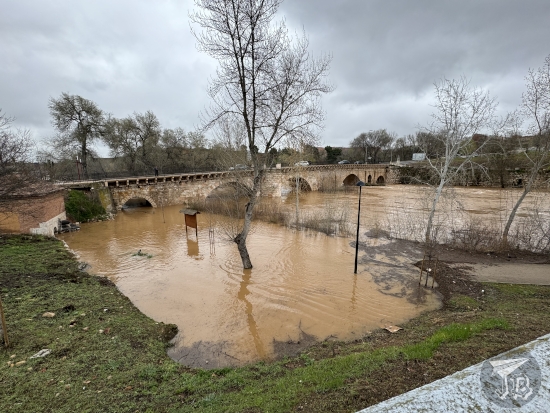
Overlook of ETSIME during Expominerales

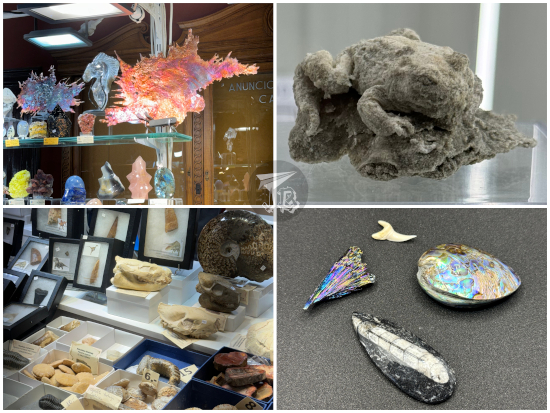
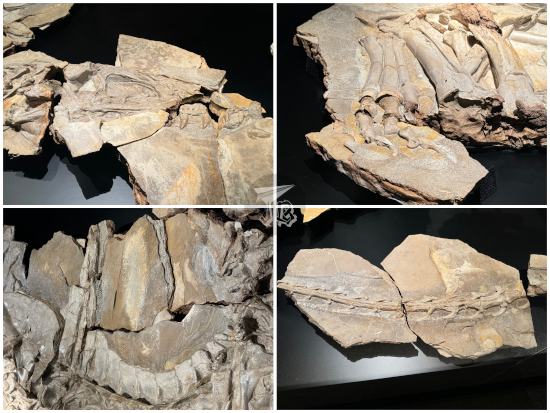
I arrived at the School shortly after the exhibit opened around 10:00, and the area was still pretty empty. There were fewer stands than the previous years I’ve been there, and the moldavite stand was not there. Actually, there were very few meteorite-related stands this time around. I did see amazing modern-times frog fossils from Owens Lake. Owens Lake is called Patsiata in the Mono Native American language. In 1913, the lake dried out when the water from the Owens River was redirected and with years it has become a deadly salt flat, a source of alkali sand storms with a side of carcinogen materials. One of the minerals found in Owens Lake is trona, a crystal formed by the precipitation of sodium carbonate, making it a type of evaporite. In 2023, an atmospheric river caused floods in California, filling the lake up for the first time in over a century. The floods damaged infrastructure and created a surge of floodwater to the lake, which eroded surfaces and dragged a lot of small hibernating animals towards the lake, where they were killed instantly. Their soft tissues were quickly replaced by trona salt before the bodies even decomposed, creating a perfect cast of the poor critters. There were two on display at Expominerales and they were creepy!

Something else that caught my eye (and was actually within my doable price range) was a polished abalone shell. The Korean abalone (Haliotis discus) has been used for centuries in the art of najeonchilgi [나전칠기], which refers to decorating items with mother of pearl. The abalone can be polished in full, creating a whole iridescent body of nacre. These mollusks used to be collected by haenyeo [해녀], traditional female divers from the Jeju province, but most of them are farmed for food today. A small polished abalone came home with me.

Items from Expominerales

The School opens its classic museum during the exhibit, and I always enjoy visiting it. However, after wandering around for a bit (and spending some money), I moved onto what basically is the next building over to the ETSIME, the Spanish Mining and Geology Institute IGME – Instituto Geológico y Minero de España, which hosts the Geomineral Museum Museo Geominero. The original design of the building was conceived by Francisco Javier de Luque, and work started in 1921. Though a congress was held there in 1925, construction went on until 1941. The building has not been extensively restored, but it presents deviations from the original plans, and even from subsequent ones.

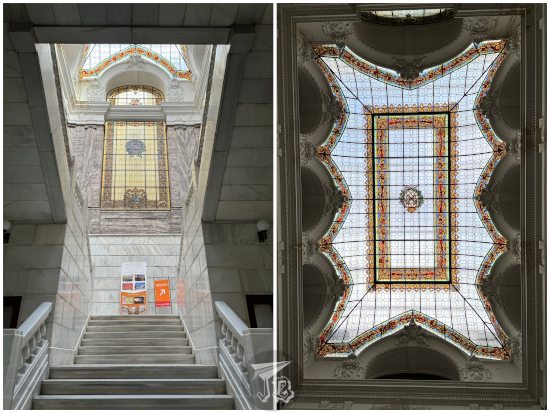
The museum is hosted in the former hall, and to get there, first you have to go through a very bored security guard – who first asked if I was sure I wanted to be there. Once inside the building, one goes up the main staircase towards the gallery underneath a glass-and-iron skylight with the logo of the Mining Institute. It was designed by Luque himself and created by the Madrid workshop La Veneciana, a glassware shop dating from 1876 and which, under a different name, still exists today.

Entrance staircase to the Geomineralogical museum

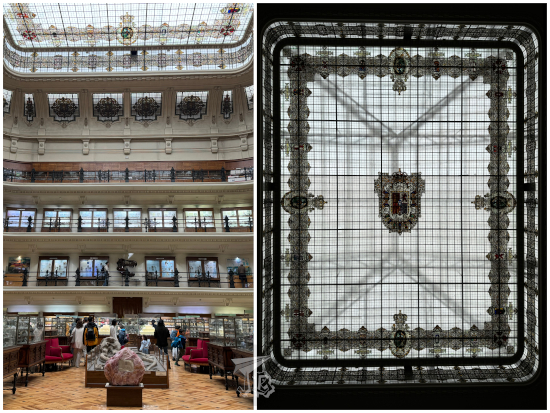
The museum is an open area, located underneath another incredible skylight. The displays are hosted in wooden cabinets in the main floor. The upper balconies can be accessed through spiral staircases and are protected by metalwork railings. One of the details I absolutely adore are the glassworks displaying geological sample cores of different surveys. I’ve never seen the library, but I was once part of a group which was allowed to play with some of the “lesser value” items they have as part of a training session, and that was super fun. The museum is probably one of my favourite spots in town.

The Geomineralogical Museum

From the architecture point of view, I like the building and the skylights. However, there are way more things to love in the museum, such as the wooden cabinets, full with samples of minerals, fossils and meteorites. The museum’s collection are divided into “Mineralogy and Petrology”, “Flora and Invertebrate fossils from Spain”, “Vertebrate fossils from Spain”, “Foreign fossils”, “Systematic invertebrate palaeontology”, “Micro-palaeontology”, “Fossil resin”, “Fossil tracks”, “Stromatolites”, and the “special exhibits”. One of these is a complete cavern bear (Ursus spelaeus), another one is an Ibex (Capra ibex). The last two have honour spots, with their own display.

When you come into the museum, one of the first things that you see, in front of the door, up on the first-floor balcony, is the cast of the most complete Tyrannosaurus rex skull ever found – Stan. Specimen BHI 3033, Stan, was found in 1987 and excavated in 1992, in South Dakota’s Hell Creek Formation. Stan lived around 65 million years ago, in the Cretaceous period. We know he fought for his life more than once – his ribs were broken and healed, two vertebrae were fused together, and he suffered a bite to his snout. Stan remains one of the most complete skeletons ever found, and probably the most-often cast. The skeleton made mainstream news when it was auctioned at Christie’s in New York due to money disputes among partners of the original owner-firm, Black Hills Institute. An anonymous buyer paid $31.8 million for it in October 2020. In 2022 it was disclosed that the Department of Culture and Tourism of Abu Dhabi had bought Stan for their projected new Natural History Museum.

On the ground floor there is a mastodon fossil Anancus arvernensis found in the 1990s. These animals related to modern elephants lived throughout the Miocene and went extinct in the Early Pliocene (two million years ago). The could have been around the size of a modern African bush elephants, but their tusks were mostly straight. They would have lived in steppe with dry and warm climate, but close to water. The fossilised bones were recovered are dated around 3.2 million years ago, and were dug from the Las Higueruelas site between 1948 and 1991.

Exhibits at the Museo Geominero

After I wandered the museum for a while, I left towards my train which was delayed… 43 minutes. Fortunately, so were the ones that had to pass before, so I ended catching one in the right direction after only a twenty-minute wait. And then I got junk food, because some days have to end in junk food…

8th March 2025: Wiener Sängerknaben Spain Tour, half of a weekend’s plan (Madrid, Spain)

Where should I get to see the Vienna Boy’s choir Wiener Sängerknaben? Vienna? Of course not! Madrid, of course. We did try to see them in their home town, but it did not work out, because they sang before we arrived, and while we were on our way to the airport on the day we left. However, chance wanted that their Schubert Choir Schubertchor would be touring Spain in March, and Madrid would be their first stop. We got good tickets by a hair’s breadth, because my parents do not believe in booking in advance – nor in me booking for everyone – but we got them, literally last row of stalls.

Nobody knows exactly when the historical Wiener Sängerknaben was established, but there are records of boys singing at the Imperial Chapel back in 1296, even before the chapel was in Vienna. The Boys Choir just performed for the Court until 1918, when the Austria-Hungary Empire collapsed. In 1924, the institution was re-established as a private non-profit. It remained boys-only until 2004, when the Girls Choir Wiener Chormädchen was founded.

The boys attend their own campus from primary to senior high school. There are 100 choristers divided in four choirs (Bruckner, Haydn, Mozart and Schubert), each of which tours for around 10 weeks per school year. They perform High Mass in the chapel of the Imperial Palace every Sunday as part of an ensemble called Hofmusikkapelle (Court Music Orchestra), formed by the boys and members of the choir and orchestra of the Vienna State Opera (Wiener Staatsope).

As part of those ten-week tours, it was announced that in 2025 the Schubert Choir would tour South Korea, Spain, Switzerland and Italy. In Spain, they were to perform four special concerts in Madrid, Seville, Alicante and Valencia. The Madrid show took place at 11:00 in the national auditorium Auditorio Nacional de Música. The auditorium was designed by architect José María García de Paredes and it opened in 1988. The largest music hall can host over 2400 spectators.

Auditorio Nacional, inside and out

The Schubertchor has 22 members from all over the world – though most are Austrian, others come from China, Croatia, the Czech Republic, England, Germany, Hungary, Japan, South Korea and Ukraine. The boys’ names are not released, but they were touring with Peruvian conductor Andy Icochea Icochea, who had previously worked in the Wiener Sängerknaben between 2005 and 2011. Icochea seems to have specialised in training young choristers, and has had a long career with different choirs and orchestras, even with a music charity. He has collaborated with other directors such as Riccardo Muti, who conducted the 2024 Silvesterkontzert / 2025 New Year’s concert in Vienna.

The day of the concert started raining buckets, but we had decided to try public transport instead of driving to the area where the Auditorio Nacional de Música stands. Afterwards, we wanted to have lunch and head to Expominerales, which was held that same weekend. We arrived with plenty of time, and we had to find a café to pass the time until doors opened. Once that happened, it was a bit of a chaos of umbrellas and everybody trying to push in at the same time. If you think young people get excited before a concert, they’ve got nothing on senior citizens.

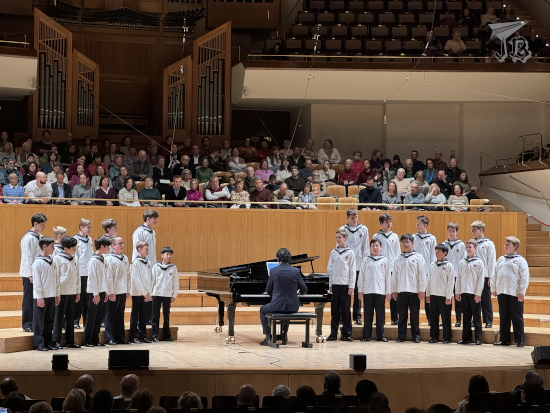
At 11:00 sharp, even before the hall had completely filled up – doors had opened kind of late in my opinion, less than half hour in advance – the children and the director came out. People were still being admitted during for the first couple of songs, and the auditorium staff were harassing patrons about where they had placed their jackets, or whether they were in their correct seats, well into the show. It was weird, and a bit disrespectful, those details should have been sorted beforehand. However, the concert itself were amazing. Most of it was sung a capella, and only a piano was used for accompanying the choristers in several songs, played by Icochea himself.

Vienna Boys' Choir Madrid

Setlist:
  First part:
    1. Kaiser-Walzer, Op. 437 (Emperor Waltz), composed by Johan Strauß II, with lyrics by Victor Gombocz and arranged by Gerald Wirth.
    2. Der Wassermann (The Water Genie), composed by Robert Schumann, with lyrics by Justinus Kerner.
    3. Hebe deine Augen auf zu den Bergen (Lift thine eyes), trio from Elias, Op. 70 (The Prophet Elijah), composed by Felix Mendelssohn from the lyrics of Psalm 121:1-4.
    4. Die Meere, Op. 20 No. 3 (The Seas), composed by Johannes Brahms
    5. Psalm 23, D.706, composed by Franz Schubert with Germany lyrics by Moses Mendelssohn.
    6a. Nun stehen die Rosen in Blüte (Now the roses have bloomed) from Der Jungbrunnen, Op. 44 (The Fountain of Youth) composed by Johannes Brahms with lyrics by Paul Heyse.
    6b. Die Berge sind spitz (The mountains are pointed) from Der Jungbrunnen, Op. 44 (The Fountain of Youth) composed by Johannes Brahms with lyrics by Paul Heyse.
    6c. Am Wildbach die Weiden (The willows beside the stream) from Der Jungbrunnen, Op. 44 (The Fountain of Youth) composed by Johannes Brahms with lyrics by Paul Heyse.
    6d. Und gehst du über den Kirchhof (And if you walk across the churchyard) from Der Jungbrunnen, Op. 44 (The Fountain of Youth) composed by Johannes Brahms with lyrics by Paul Heyse.
    7. Inclina Domine aurem tuam ad me, Op. 118 (Incline your ear, Lord, to me), Josef Gabriel Rheinberger (Psalm 86).
    8. Erlkonig (The Elven King) composed by Franz Schubert, with lyrics by Johann Wolfgang von Goethe, arranged by Oliver Gies.
    9. Sängerslust, Polka française, Op. 328 (Singer’s Joy, French Polka), composed by Johann Strauß II with lyrics by Joseph Weil.
    10. Wiener Blut, Walzer Op. 354 (Viennese Spirit), composed by Johann Strauß II, arranged by Helmuth Froschauer.
  Second part:
    11. 아리랑 [Arirang] (impossible to translate, but it might have meant “My beloved one” in Ancient Korean), arranged by Gerald Wirth, a traditional Korean love song from the Kyonggi Do province, with over 60 variations.
    12. Vreneli abem Guggisberg (Vreneli from Guggisberg), Swiss folk song arranged by Gerald Wirth.
    13. Müsle gang ga schlofa (Go to sleep, little mouse). Cradle song from Vorarlberg, Austria with lyrics by Walter Weinzierl, arranged by Gerald Wirth.
    14. Unz Wättr isch winti (Until the weather is windy), written by Luis Stefan Stecher like an Italian folk song, with music by by Ernst Thoma.
    15. O more duboko (Oh, deep sea), Croatian folk song, arranged by Gerald Wirth.
    16. La Paloma (The Dove), Spanish habanera by Sebastián Yradier, arranged by Gerald Wirth.
    17. Chim Chim Cher-ee from Mary Poppins (1964 film), by Richard M. Sherman and Robert B. Sherman, arranged by Christi Cary Miller.
    18. What Was I Made For? from Barbie (2023 film), by Billie Eilish O’Connell and Finneas O’Connell, arranged by Jennifer Lucy Cook.
    19. Under the Sea from The Little Mermaid (1989 film), by Alan Menken and Howard Ashman, arranged by Kirby Shaw.
    20. For ever, Polka schnell, Op. 193 (Forever, Fast Polka) by Josef Strauß, arranged by Gerald Wirth with English lyrics by Tina Breckwoldt.
    21. An der schönen blauen Donau, Op. 314 (The Blue Danube), composed by Johann Strauß II, with lyrics by Franz von Gernerth (1821-1900) and arranged Gerald Wirth.
  Encore
    22. Radetzky-Marsch, Op. 228 (Radetzky March), by Johann Strauß I, arranged by Gerald Wirth.
    23. Un Elefante Se Balanceaba (An elephant swung), Spanish children counting song, probably arranged by Icochea.

Charming does not even come close to describing the show. I’d never understood the concept of “angelic voices” until now, and I found it really unfair that you can’t actually find out the names of the boys. I don’t know whether it is to protect their privacy as they are minors, but it would have been great to at least know the names of the soloists, because the powerful voices from those little bodies was amazing.

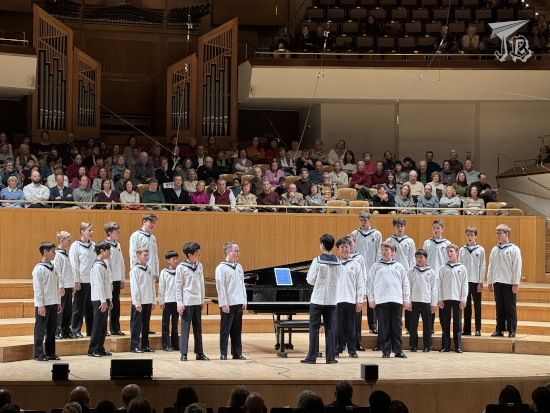
The children were organised by tone of voice, which was similar to size, with the highest voices (smallest boys) on the front left and the lowest voices (biggest kids) on the back right. They sang most of their numbers towards the stalls, but for one song they turned to the people behind them, to both sides of the organ. Highlights included any time a child sang a solo – particularly the first one during the Emperor Waltz, as people were still coming in. During another song, Icochea left the stage for another boy to direct.

Vienna Boys' Choir Madrid

The oldest boy was in charge of having the audience clap during the Radetzky March, just like in the New Year’s Concert – and he looked right at that age when teens are all knees and elbows and awkwardness, but he seemed to be extremely proud of himself (well deserved!).

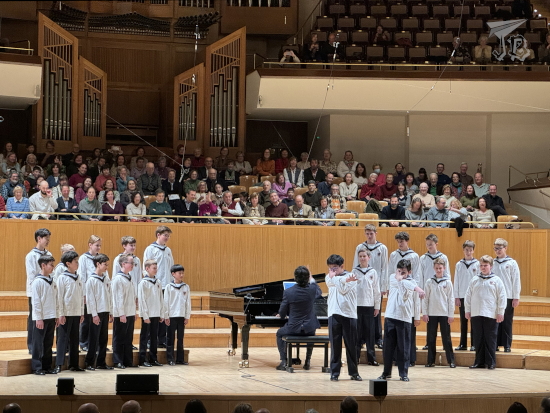
The last song of the encore was a total surprise. Before it started, the director invited us to “sing along if we were familiar with it”. This unexpected performance was a Spanish counting song, Un Elefante Se Balanceaba (An elephant swung), which goes “one elephant swung on a spiderweb – as it saw it did not fall down, it went to call another elephant. Two elephants swung on a spiderweb – as they saw they did not fall down, they went to call another elephant. Three elephants…” you get the idea – not precisely a philosophical song, but way less traumatic than say Hush little baby. One of the boys walked to the front and made a sort of trunk with one of his arms as he “swung” to the music. One by one, the others joined him until the proverbial spiderweb snapped and down to the floor all the children went. It was absolutely hilarious, and adorable.

Vienna Boys' Choir Madrid

Vienna Boys' Choir Madrid singing the elephant song

It was still raining heavily when we left the auditorium. It was 13:15, so no real time to get to Expominerales before it closed between 14:00 and 16:00. Had the weather been nicer (decent, at the very least), I would have found something else to do before it re-opened. But it was still raining cats and dogs – and maybe some ice – so we just decided to call it a (half) day.

6th December 2024: Knowing people gets you places – Church of the Virgin Mary, Guadalajara (Spain)

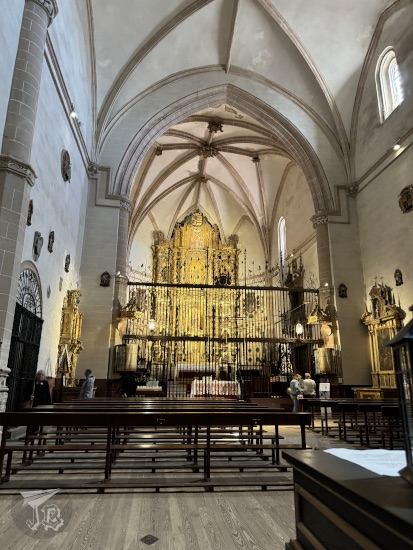
Knowing people who know people is cool. It opens doors, too. I was in Guadalajara for personal reasons and an acquaintance of an acquaintance offered to show us around the co-cathedral of the Virgin Mary Santa María de la Fuente la Mayor. The church, built in the 14th century in the Mudejar style, shares rank with the co-cathedral of Sigüenza. The whole structure is made or covered in brick, with some traces of coloured ceramic tiles around the horseshoe arch entrance.

Santa María Guadalajara

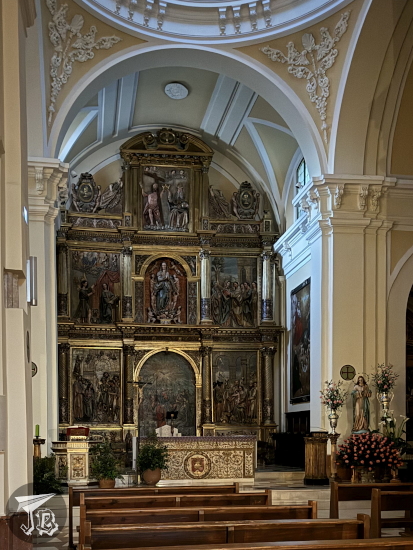
The interior is covered in plaster, hiding away the original stonework. Golden decoration was added afterwards. The main altarpiece was built by Francisco Mir in the late Renaissance style, with scenes of the life of the Virgin Mary. It was designed in 1622 and decorated in more gold.

Altarpiece at Santa María in Guadalajara

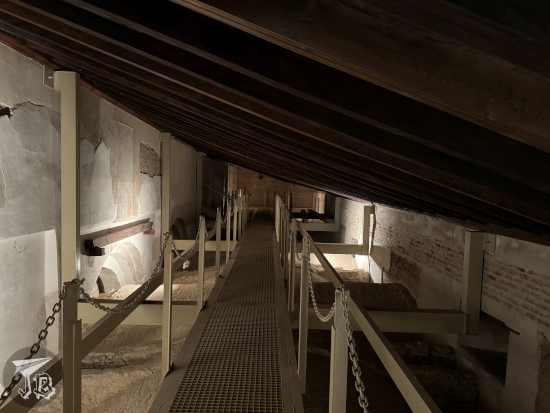
The church has a Mudejar artesonado or Spanish ceiling (a ceiling structure halfway between support and decoration, made out of wood, usually decorated). The artesonado was covered up during the Baroque renovations of the church and recently restored. Furthermore, if you know people, they show it to you. Up the high choir we went, and past a narrow staircase, through a small walkway that has been built for the few privileged visitors who are admitted (a bunch of people apparently tried to emulate us but were declined). We “floated” above the ceiling and underneath the wood for a while, and it was really interesting. Though of course the wood has been restored, most it is the original one. You can also see the Baroque vaults from above, along the original brick ceilings and walls, hidden away in the nave.

Spanish celiling at Santa María in Guadalajara

Spanish celiling at Santa María in Guadalajara

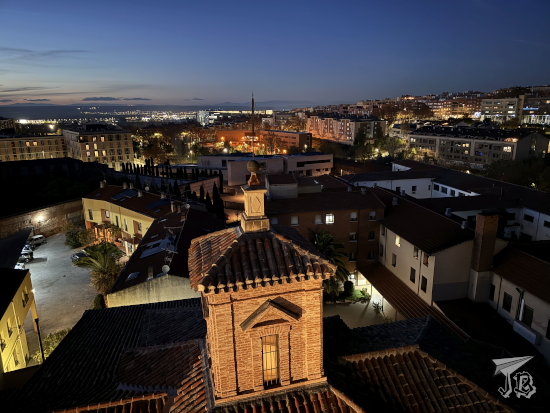
We were invited to climb the bell tower, too. The structure has also been restored, following the original brickwork. The tower is narrower at the top than at the bottom, and the ascending path has vaulted ceilings in brick. On top, there are eight bells. One of them dates from the 18th century, two of them from the 19th century and the rest are newer. There was also a view of the city, but Guadalajara does not really have dramatic backdrops, I fear…

Bell at Santa María Guadalajara

Guadalajara skyline of sorts

It was not a big trip or anything, but apparently you have to know someone to get there. Thus, I guess it is worthy of its own mention, right?

26th November 2024: Another Concavenator visit (Alcalá de Henares, Spain)

I had to run some errands in Alcalá de Henares in the afternoon, so I decided I would get there in the morning, and walk to the Archaeology and Palaeontology museum Museo Arqueológico y Paleontológico de la Comunidad de Madrid, MARPA. The exhibition “Dragon HuntersCazadores de Dragones was still running and since it was a random weekday morning, I thought it would be empty.

I was right, it was deserted enough that the security guard looked at me weirdly. Yes, I’ve been there before. Twice. I hope to be back at least once more before the exhibit closes in January 2025. The security guard should not be remembering me, I did nothing weird. Taking a few hundred photographs of a fossil is completely normal.

Why am I so obsessed about the Concavenator? Well, one does not always have such a unique fossil so handy, and for free. Furthermore, the usual home of the Concavenator does not allow pictures. And lastly, I’m a nerd. The species Concavenator corcovatus was described in 2010 by Francisco Ortega, Fernando Escaso, and José Luis Sanz from a single skeleton found at Las Hoyas site in 2003. The specimen was officially catalogued as MCCM-LH 6666. The animal was a medium-sized carcharodontosaurid. Carcharodontosauria, which included the likes of Giganotosaurus, Mapusaurus or Carcharodontosaurus, were a group of large theropods from the Cretaceous period. The skeleton was almost complete, with the tail and neck contorted in rigor mortis. The fossil shows two things that make it special – a hump or sail created by the spines of the back vertebrae, and the fact that some pigments were found on the fossil. Not unique but rare enough findings include impressions of skin and scales, and smaller bones in the belly area, rests of undigested dinner. On the arm bones there are insertions for ligaments similar to those that modern birds have at the insertion of feathers.

Concavenator corcovatus

The Concavenator lived around 125 million years ago, in an area of wetlands. Its teeth, general shape (it walked on its two hindlegs and had small-ish arms), along with the remains of animals that it had eaten, tell us it was a carnivore, and its placement in the carcharodontosaurid family, that it was a predator. However, no large predator is known for rejecting a good scavenging feed. The spikes or hump on its back, above the hips, can be clearly seen on the fossil, but nobody has any idea of what it was for – speculations have been made for communication means, fat deposits and thermoregulation. When alive, the animal would have been around 5 metres long, two metres tall, and 450 kilograms heavy.

Concavenator corcovatus details

All that to end up being dug up and named… Pepito, which is the diminutive of the diminutive of the Spanish version of Joseph. The equivalent of Joseph would be José, nicknamed Pepe, and changing the last “e” into “ito” – the suffix for small – would yield to something like Joey. So this magnificent predator was either named after a mini-mini-Joseph, or a small meat sandwich, which is also referred to as a pepito. Seriously, what happened to the illustrious tradition of Boaty McBoatface? This would have been a glorious Toothy McToothface (“Spanishised” as Dientito Caradientez or something).

Anyway, after the visit I dropped by the museum shop to buy myself some Concavenator-related merchandise. When was there the first time, I bought the exhibition catalogue, but since then they had received some silly cute items – I bought a pin, a badge, and a magnet, just because I could. Maybe as the exhibit draws closer to the end there will be discounts on other things…

I left the museum and decided that since it was way past 14:00, I should grab a bite to eat. As I had parked my car next to a shopping centre, I headed there with the idea of some Asian food. However, there is a burger joint that usually has a long queue and that some friends had told me was really good – as good as fast food can be, I guess. It is called TGB – The Good Burger. It is supposed to serve “NYC style gourmet hamburgers”. The place was empty, so I decided to give it a try.

I ordered a “Cheese Lovers” burger, which consisted of a beef patty, American cheese, goat cheese, Gorgonzola, sautéed onions, arugula and honey mustard sauce. It was… very cheesy. It was nice, but nothing I feel I must try again, especially when there are cheaper options in the shopping centre. And sushi. But at least, I satisfied my curiosity before I went off towards all my dull, grown-up errands which I shall not bore you with…

The Cheese Lovers burger

22nd November 2024: “Wicked” (film) on opening day (Madrid, Spain)

There was a time when you could mute words on social media to avoid spoilers. Since the algorithms have taken over and you can’t curate what you see any more, I decided that the best way to avoid Wicked spoilers was trying to see it as early as possible, preferably on opening day. Ideally, on the first screening on opening day, an English version.

For a change, “ideally” worked. At least, I found a screening at 15:45 on the day the film came out. It was a cinema with Spanish subtitles but I can live with that. I have seen the musical twice in the Apollo Victoria Theatre in London and I’ve loved it both times. Not only I’m a firm believer in the message of Defying Gravity, I also give regular thought to Dancing Through Life. Sometimes I also listen to No One Mourns the Wicked and get all philosophical…

Anyway, I headed off to Madrid with next-to-no information and no expectations, hoping to enjoy the film. I had been slightly surprised that so many tickets were already booked when I bought my own, but I gave it no more than a couple of seconds’ worth of attention, I just thought I was running late since I made the decision the previous weekend before heading out to see Ha·Ya·To . Since the film was rather early in the afternoon, I had to get to Madrid with time for a bite. One of my options was Yatai Market but in the end I decided to grab brunch at Toby’s Brunch Club, where they run an all-day brunch (here I went, cheating the system again, just like I did at the James Joyce – twice in one week, too). I tried to book online but the system only took reservations for two or more. Since the Internet said that it was usually quite busy, just thought I still had Yatai as a backup plan…

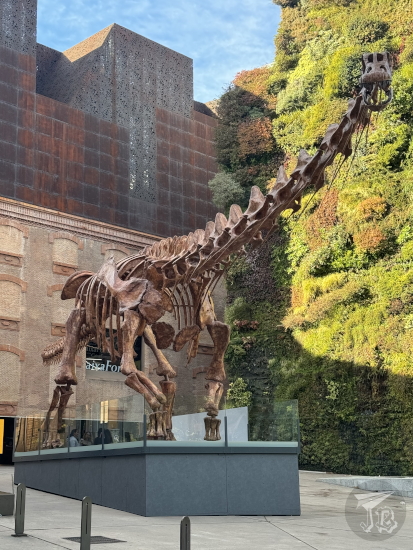
I arrived at Atocha Station and walked towards the brunch place. As I did, I had to walk past Caixa Forum, which is still running the exhibit on Patagonian dinosaurs, and the Patagotitan smiled at me. I, of course, smiled back.

Patagotitan mayorum

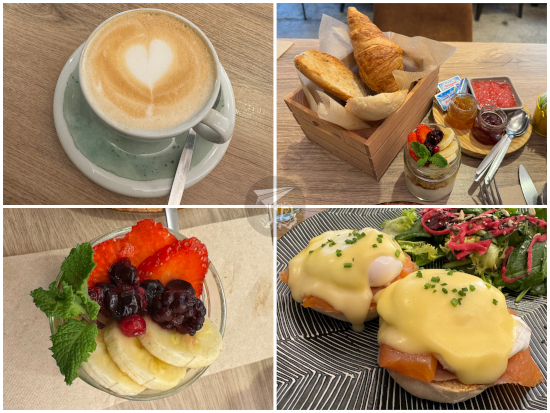
The very-busy brunch place was empty – weekday “crowds” I guess. I was the only customer there for the duration. Usually, not being able to book for myself on my own discourages me from a place, but I’ve been wanting a “typical” brunch for a while now. The brunch consisted of a cold drink, coffee or tea and two courses (22€). For my cold drink, I ordered orange juice, and for the hot one a coffee latte. The first course was a basket of breads with butter, jams and tomato paste, and a yoghurt with fresh fruit. As my second course, I ordered eggs Benedict with smoked salmon. Because I really wanted eggs Benedict and I can’t cook them to save my life. Everything was delicious, especially the yoghurt. The eggs were perfect. I think this would kill me before noon though, so glad I used it as lunch.

Toby's breakfast club brunch

After my brunch / lunch I still had some time so I dropped by the art gallery Museo del Prado. I used my museum card Tarjeta de Museos Estatales and the lady at the ticket booth told me she had never seen a card like that before. She took it to the back shop, and when she came back, it turned out that the card had stuck to another card, which explained why she was confused. I finally managed to get in, and spent about an hour there. There was a small exhibit called El Taller de Rubens (Rubens’ workshop) which analysed the master’s works and that of his apprentices which was very interesting.

Afterwards, I walked towards Yelmo Cines Ideal (passing by and waving at the Patagotitan again) to watch Wicked. When I got there, the cinema was still closed, but as soon as I turned away to snoop into a shop across the street, the doors opened. I found my seat and I found myself seated between two groups of high school and university students, who were complaining that their life was very hard, and that they had barely had the time to eat lunch before getting to the cinema. And a few of them were threatening to cry. And they were telling each other not to sing along. I had not realised there was such a big following of Wicked from the younger crowd…

After a few minutes of hearing them babble excitedly, I realised that all of them had listened to the songs on the Internet, or something, but they had never had the chance to seen the musical themselves – it’s debuting in Spain in autumn 2025. It made me realise how lucky I am to be able to jump onto a red-eye flight at a random weekend and go to London, and be there for the 14:30 performance at the Apollo Victoria Theatre.

Wicked film poster

In general, I enjoyed the film. More than I believed I would, because I went with zero expectations and I had managed to avoid any kind of spoiler and previous knowledge, except that Jeff Goldblum was the Wizard. The main cast includes Cynthia Erivo as Elphaba, Ariana Grande as Glinda, Jonathan Bailey as Fiyero, Michelle Yeoh as Madame Morrible, Marissa Bode as Nessa (kudos for an actual disabled actor playing a disabled character!), Ethan Slater as Boq, Jeff Goldblum as The Wonderful Wizard of Oz; and Peter Dinklage as Dr. Dillamond (voice).

I do not believe what I am going to say – but I thought Goldblum was the weakest character. I mean, he keeps playing himself, and Jeff Goldblum is not the Wizard (I had the same feeling when I watched Jurassic World: Dominion; he played himself, not Ian Malcolm). On the contrary, Michelle Yeoh was fantastic, her sole presence in a take stole the whole screen. I enjoyed seeing the animal characters a lot, as it is the bit of the musical that always feels a bit off. The logistics of landscaping Oz was a bit awkward at points, but I guess that’s theatrics and not… geography.

I found the music decent. As for me the most important thing was for the story to be faithful to the musical – which is more up my alley than the novel – I was rather satisfied. The best song, in my opinion was What is this feeling?, the camerawork was stunning. It was also great to see the cameo of the actors who portrayed Glinda and Elphaba on Broadway for the first time, Kristin Chenoweth and Idina Menzel – known worldwide today for Frozen’s anthem Let it go. The library scene and choreography for Dancing through life was also impressive.

What I saw of the subtitles was not a good sign though, because the message of No One Mourns the Wicked loses most of its meaning if you translate it as “she’s finally dead”. However, I am rather good at ignoring subtitles anyway. I am not sold on Glinda being all pink either. Too many Legally Blonde vibes there, I prefer ice-blue.

The film ended at the end of the first act of the musical, with the “main event” of sorts – Defying Gravity. Very showy, okay music-wise. It was more visually impacting than musically, and my mind was dubbing it with Kristin Chenoweth’s version anyway. At this point, half the theatre was sobbing, which I found slightly amusing.

All in all, I enjoyed the day and the film. I am looking forward to the second part, and having affordable Wicked merchandise I don’t have to save for special occasions. After leaving the cinema, I walked back, and since it was cold, I got there in record time – and then I had to wait 40 minutes for the train because of course I did.

17th November 2024: Ha·Ya·To Drum Masters in Guadalajara (Spain)

A while back, I read on Keita Kanazashi’s Instagram that Ha·Ya·To Project was going to come back to Spain for a small tour with their show Ha·Ya·To: Drum Masters. The most convenient place for me to see them was Teatro Buero Vallejo in Guadalajara. I got tickets as soon as I realised they were out, and still I did not beat the local crowd who buy tickets for any and everything.

Ha·Ya·To Drum Masters promo

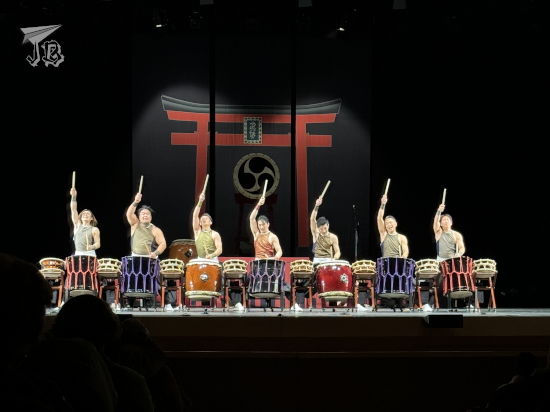
Ha·Ya·To: Drum Masters is a Japanese percussion show wadaiko [和太鼓]. While Ha·Ya·To is officially formed by the three Kanazashi brothers, Keita Kanazashi, Ryota Kanazashi, and Yuta Kanazashi, for Drum Masters they are joined by Koji Hada, Takayuki Hashiguchi, Makoto Sekine and Shunichiro Kamiya, along with special guest stars Chieko Kojima (first female wadaiko master) and Masato Shibata (Japanese guitar shamisen world champion).

The show depicts the seasons of the year. It starts in Spring, with flowering cherry blossoms and a slow build up that yields to a super-energetic Summer, full of bouncing and strong beats. Then there comes the break and afterwards there is Autumn, where Chieko Kojima really shines, though the rhythm is a bit lower and more melancholic. Finally, energy picks up again for Winter – because it’s cold and one needs to warm up.

Ha·Ya·To Drum Masters

Ha·Ya·To Drum Masters

Ha·Ya·To Drum Masters

Ha·Ya·To Drum Masters

The show was absolutely fantastic. Afterwards, there was a “collective M&G” with pictures with the musicians. I did not get any autographs, though Ms Kojima did notice that I was carrying the DVD I bought in 2018. That lead to her, Keita and myself talking a little. I also had a photograph with Keita from an event in 2019. Their manager is very strict, and once she decides picture time is over, she really ushers them away. I did manage to sneak a selfie with Makoto Sekine after the rest of the group had left though.

Ha·Ya·To Project

I love taiko. It really energises me, and it was a great way to spend the evening. I could’ve combined it with something else, but I had plans for the next couple of days. I was off to see Apocalyptica the following day.

16th October 2024: San Francisco Ballet’s Swan Lake at Teatro Real (Madrid, Spain)

While heavy metal and hard rock concerts are my form of meditation, there is something magical about ballet in general and Swan Lake in particular. Also, in my defence, I’ve loved Swan Lake since before I first saw Yoshiki play part of it on piano. Swan Lake is a three-act ballet written by Pyotr Ilyich Tchaikovsky in 1876. The story is widely known – Evil sorcerer Von Rothbart curses princess Odette to live as a swan during the day and only return to her human self at night. Nearby, prince Siegfried is trying to avoid all his obligations, and goes hunting. The two meet and fall in love, and Siegfried invites Odette to a ball where he will propose and both will live happily ever after since obviously love is stronger than black magic. Except, at the ball Von Rothbart shows up with another lady, Odile, the black swan, who seduces Siegfried, and he proposes to her, thinking she is Odette. Drama ensues. Siegfried realises that he has the wrong girl, and runs to the lake where he first met Odette.

Now, depending on the version, after Siegfried and Rothbart fight, the ending can go several ways, and I’ve seen a few. There is a standard happy ending – true love conquers all, Von Rothbart is defeated, and Siegfried and Odette get their happily ever after. In another version, Odette commits suicide as Siegfried’s mistake has made the curse unbreakable. Another option is that she dies of heartbreak. Her death yields to a very epic ending image of Siegfried lifting Odette’s body into the air, and Von Rothbart is defeated by Siegfried’s grief and true love. Finally, there is the option of both Odette and Siegfried dying, and the power of their loving sacrifice defeats Von Rothbart. Note how the evil sorcerer “loses” every time. However, in the original script – which I’ve actually never seen on stage – both Siegfried and Odette drown in the lake and Von Rothbart sort of wins. I’ve always found that interesting. 

Anyway, I really enjoy watching Swan Lake and trying to anticipate which ending the choreographer has chosen. I have to admit that I’m personally partial to the ending where Odette dies of heartbreak, because while I love the ballet – and the black swan – Siegfried is an idiot and with this ending he gets to live with the knowledge that he proposed to the wrong girl.

Back in March I read that the San Francisco Ballet was taking their version of Swan Lake to Madrid. I asked my parents if they wanted to tag along and since I had not received an answer by August, I checked for tickets. Whilst Teatro Real tends to be a bit on the expensive side, it is rather easy to find an unoccupied single seat in a good location just searching a bit. I could not really afford floor seats but there was a very nice single seat on the first row of the third floor that I soon got my clutches on.

I had planned to take the train to Madrid to be there around 16:00. I wanted to go see an exhibition in the manor Palacio de Longoria, since that is the only way to enter it and last time I could not climb any of the stairs to get a good look at the skylight. Unfortunately, there were issues with the previous train, which got stuck in Atocha. My own train could not enter the station, and we were just a few metres away. It is illegal to walk on the tracks, so the train driver, of course, would not open the doors. We were stopped there for over an hour. I was sitting in the first carriage, and some people lost their nerves – they started banging on the driver’s door, and one of them even grabbed the emergency hammer and tried to break the glass on the doors. Thus, I decided to just get off the train when we finally reached Atocha and walk towards the theatre.

Swan Lake promo

I had arranged to meet with a friend for a quick coffee around 18:00 near the theatre. There is a Starbucks within the same building, and it is easy to find a sitting space. At 19:15, we said goodbyes and I entered the theatre Teatro Real and found my seat. What I was not able to find was a brochure.

San Francisco Ballet artists:
  Orchestra director: Martin West
  Odette / Odile: Wona Park
  Prince Siegfried: Wei Wang
  Von Rothbart: Jakub Groot
  Choreography: Helgi Tomasson
  Artistic Director: Tamara Rojo

The show was fantastic. Wei Wang as Siegfried had a lot of weight in the first act – sometimes a lot of his work is given to another character. In this ballet, the ballerina dances two different roles, which sometimes feel like three – First-act Odette, who is nice and falling in love with Siegfried, Odile in the second act, the Black Swan seductress, and the Last-act Odette, who is dying… Wona Park did a fantastic job with her body language in order to show both Odette and Odile.

The corps de ballet was so numerous that I actually don’t think I’ve ever seen so many swans on stage. The set-up was beautiful and the coordination was incredible. At some point there were 32 swan-dancers there. It was fantastic, and I enjoyed every second of it. The ballet lasted 2 hours 40 minutes with a twenty-five minute intermission.

During the break, I went off to find a brochure – not because I did not know the plot, but because I wanted the names of the artists. I thought that one day I needed to try the intermission dinner at Teatro Real, but since they have the “to share” dishes, I don’t think they’ll take bookings for one.

Main dancers accepting the ovation

Swan dancers accepting the ovation

Dancers accepting the ovation and musical director accepting the ovation

The show was over before 22:00, and the waters had calmed down on the train front. They were still running late, but there were no aggressively frustrated passengers on the platform nor the train. I made it home just before midnight.

13th October 2024: Mercado Cervantino de Alcalá de Henares (Spain)

Alcalá de Henares was the birthplace of writer Miguel de Cervantes, author of Don Quixote, one if not the most important novel in the Spanish speaking world – often considered the first modern novel in Western literature. Thus, a lot of the town activities are presented in relation to Cervantes, one way or another.

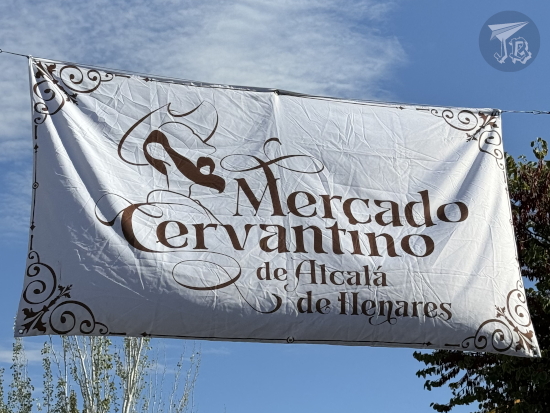
Renaissance Fairs are getting popular in the centre of Spain, and Alcalá has dubbed its own “Cervantine Market” Mercado Cervantino as part of a week-long celebration of Cervantes’ christening Semana Cervantina. I missed most of it since I was in Türkiye, but on the last day I was able to drop for a couple of hours with my sibling.

Mercado Cervantino

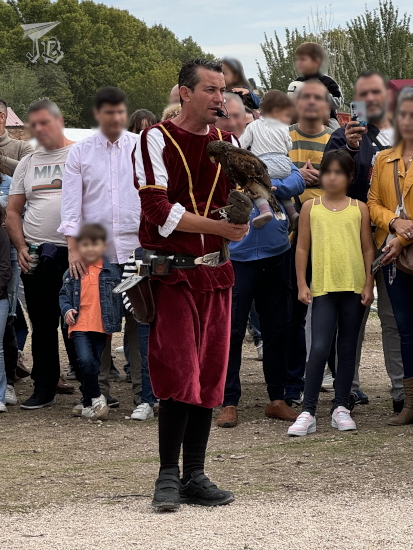
We reached the market around 11:30, too late to hear the cannons. It being a Sunday, everything was packed. We got to see Don Quixote and his sidekick Sancho, a horde of orcs, and a falconry exhibition by Francisco Miranda and his Harris’ hawk.

Don Quixote

An orc

Falconer

Harry's eagle mid-flight

Afterwards, I talked my sibling into dropping by the nearby Archaeology and Palaeontology museum Museo Arqueológico y Paleontológico de la Comunidad de Madrid, MARPA. The exhibition Cazadores de DragonesDragon Hunters – is still on, and I was not going to waste the chance to see the Concavenator (Concavenator corcovatus). I realised they had brought some extra merch for the exhibition, and I decided to drop by in the near future.

Concavenator Skull

We went off for a late lunch afterwards, and later I just drove off.

8th September 2024: Dinosaur FOMO (Guadalajara, Spain)

Whenever I’m reasonably close to dinosaur stuff, I have to check it out, I just can’t help myself. About a year ago, I attended DinoExpo XXL in Guadalajara, which turned out to be rather disappointing. Apparently, the town hosts dinosaur exhibits in time with the yearly festivals – they must be profitable. I read about Dinosaurs Tour (or Jurassic Expo, according to the banners), and I thought I would skip it, but in the end… in the end I just had to go and see it, because the Fear of Missing Out was strong. Maybe this time over it would be cool…

The exhibit was small, and while some of the models were correctly covered with feathers, a few were mislabelled to conform to the popular imaginary (way more of a cash cow than anything scientific). The usual suspects were Tyrannosaurus Rex, brachiosaurus, pachycephalosaurus, iguanodon, parasaurolophus… For some reason, there was a stegosaurus half climbing a tree, and a few Jurassic Park inspired reproductions: questionably-represented dilophosaurus and too-big velociraptors. Something new was a sarcosuchus, a giant crocodile ancestor. Oh, and something I was completely unable to identify… like a diplodocus with a beak and spikes… Maybe it tried to be a homage to Littlefoot?

Dinosaur Tour Guadalajara

The lights made everything look weird, too, because there was a lot of colourful – pink, blue, green – lighting which made it for a very disco-like atmosphere. It was not a big or good exhibit – not even the toddlers were extremely impressed, but as I said: Fear Of Missing Out gets the best out of me when it’s about dinosaurs. Next time though, I’ll try to get over the FOMO, because I think they’ll just bring a wall lizard and call it a Velociraptor.

27th August 2024: Arganzuela Greenhouse, British Cemetery and a ‘palaeontological site’, Madrid (Spain)

I have been feeling dizzy on and off these last few months, so I’m avoiding long drives – that has left me dependent on public transport, which is not too reliable. Thus, instead of all the hikes I wanted to take, I’ve been doing day trips to Madrid.

My first stop was in the district of Arganzuela. Although I’ve been to Matadero a few times before, I had never wandered to the side, where a boring-looking metal roof peeked over some trees. I recently discovered that I should have ventured beyond the brick walls that close the Matadero area. This building is called Arganzuela Crystal Palace Palacio de Cristal de la Arganzuela, and is an example of the wrought iron functional architecture of the early 20th century.

Invernadero de Arganzuela - structure

The building was designed by Luis Bellido y González and erected between 1908 and 1928 as a vegetable warehouse. In 1992, the building was remodelled – the wrought iron structure was consolidated and the original fibre cement panels were substituted by glass ones. The warehouse, 7,100 square metres, was divided into different sections, each one transformed into a different greenhouse: two for tropical plants, one for subtropical species, and the last one for desert plats and cacti. The centre has four long fountains with tiny sprouts and waterfalls. I expected a few plants to be in second bloom, but apparently that does not work for tropical or desert species?

Invernadero de Arganzuela - inside

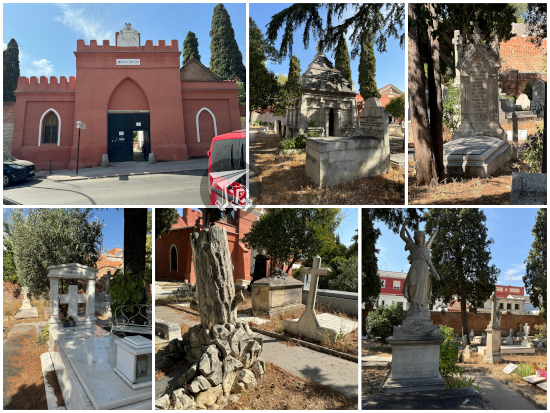
I then hopped onto the underground towards the district of Carabanchel, where I could visit an unusual place – the British Cemetery Cementerio Británico de Madrid. Around 1854, the British government bought the terrain with the intention to turn it into a cemetery, since during that time Catholic cemeteries did not accept interments from other denominations.

The burial ground hosts about 600 graves and about 1,000 tombs, most of them British citizens – but there are also Americans, Germans, Swiss and French, even some Spanish. Though it is now closed to new burials, in the 20th century it was open to non-Christians. Inscriptions on the markers are in Latin, English, French, German, Hebrew, Cyrillic and Spanish. Some of the people buried here include part of the Georgian royal family, historian Alice Bache Gould y Quincy, members of the fashion family Loewe, photographer Charles Clifford… There is also a memorial to the American soldiers who died in a plane accident. There is only one pantheon, belonging to the Bauer family – owners of an important commercial emporium in the 19th century.

British Cemetery Madrid

I have to say that the charm of a Victorian cemetery fades more than a little in the middle of the Spanish plateau’s scorching summer. Though there are several artistic markers – ever-present angels, a couple of tree trunks, and a very gothic grave – most of them are simple headstones with a cross or just a name. One of the graves asked a good question: If good things lasted forever, would we appreciate how precious they are? All in all, it was a quaint little cemetery that felt slightly out of place in the middle of Madrid.

Afterwards, I went back into the underground. The cemetery is a couple of stops away from Carpetana. On the connection, I got checked for a ticket, sort of – they were controlling that passengers had a valid ticket, and just as the train was arriving they waved me through, maybe not complaining about it and just looking for the card made me trustworthy or something? (For the record, I did have a ticket). Anyway, I reached my destination in about 10 minutes or so. When they were working on the Carpetana underground station, they found a few fossilised bones and jaws, and they have turned it into another of the spots of Museos de Metro de Madrid – palaeontological site Yacimiento Paleontológico de Carpetana. I saw reproductions a few mammal jaws and took a picture. Good thing I was close, this would not have warranted a trip from further away.

Reproduction of the prehistorical habitat of Carpetana

I had a reservation for late lunch, but I decided to cancel it. I wanted to check a shop for something I needed, and that would take me in the complete opposite direction from the restaurant. Instead, after the shop, I grabbed a Matcha Frappuchino and headed back to the train station to return home.

Starbucks Matcha Frapuccino with a lot of whipped cream

8th August 2024: The Museums in Moncloa (Madrid, Spain)

It’s quite hot out there, but I decided to hit a couple of museums in Madrid. A few months back, I got a card for the national museums, thinking I was getting a better deal than I did. Though it is true that you can get enter (most of) the national museums for free, you have to ID yourself, so you still have to queue, which is what I was expecting to avoid. However, it has at least pushed me to try and see a couple of museums I would not really visit (or even be aware of!) otherwise.

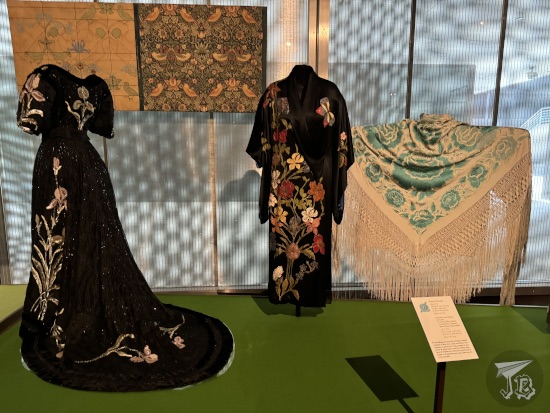
There are two museums in the district of Moncloa-Aravaca, an area I’m not usually around. One, I was curious about. The other is one I would not have even considered without the card: the Costume or Fashion Museum and Ethnographic Heritage Research Centre Museo del traje. Centro de Investigación del Patrimonio Etnológico (CIPE). It is a collection of pieces of clothing, textiles and accessories from the 17th century onwards, and I’m sure it is amazing if you know anything about fashion… which I don’t. The museum is organised chronologically, with a few pieces from the Middle Ages, then fabrics, costumes and complements since they became a thing.

There is also a collection of traditional outfits from different regions throughout Spain. The visit finishes with some of the big names in fashion, including Coco Chanel, Balenciaga, or Christian Dior. There was also an area for visually-impaired visitors, which allowed them to touch mannequins and fabrics from different style periods in history.

Costume and Fashion Museum Madrid

They were running a temporary exhibition called Vistiendo un jardín (Wearing a garden). It deals with the nature and flowers in fabric and costumes from the Baroque period onwards. They were in the middle of a guided visit so there was a big group, and I could only have a quick walk.

Wearing a garden Temporary exhibition

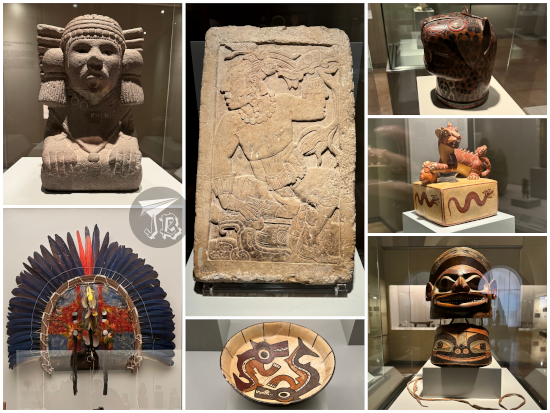
I walked over to the museum of the Americas Museo de América. The institution exhibits archaeological and ethnographical artefacts from the Americas, alongside art from the Palaeolithic period to the present, with a strong presence of Colonial art.

The origin of the collection was the Royal Cabinet of Natural history that Charles III had established in 1771. The collection increased with objects brought from discovery expeditions and Spanish colonies in America, especially those unearthed during archaeological excavations. In 1815, the science artefacts from the cabinet were integrated into what became the National Museum of Natural Sciences, and in 1868 the antiquities, ethnography, and art were transferred to the Museum of Archaeology. In 1941, the American artefacts were transferred to the newly formed museum. A more recent source has been that of donation and legacies.

Nowadays, the collection comprises around 25,000 artefacts and about 2,500 of them are exhibited – though the most important ones are copies due to “conservation issues”. The archaeological artefacts include Mayan, Inca, Aztec, Nazca, Amazonian, and even from North American native cultures who lived in what we now call the Great Plains or Alaska. The Colonial art pieces mostly include religious art and what is called pintura de castas, which tries to represent the appearance and daily life of the peoples of mixed race, descendants of European, African and Indigenous inhabitants of the colonies. There is also a ward dedicated to modern art and social criticism against colonisation. I found the organisation of the museum a bit strange, by theme areas instead of time-and-place.

Artefacts from the Museum of the Americas

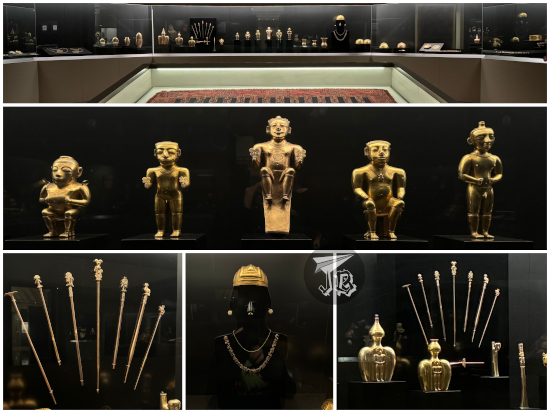
Arguably, the most important group of pieces that the museum exhibits is the so-called Tesoro de los Quimbayas (Quimbaya Treasure). The Quimbayas were a small indigenous group from precolonial America, who lived south of what is now Medellín, Colombia. They were known for their works in gold and an alloy of copper and gold called tumbaga. The treasure comprises 122 pieces, which represent about one fifth of the original findings. It is believed that the belonged to two sets of grave goods, and dates from the 5th or 6th centuries CE. The treasure was dug up during the Colombian gold fever, when archaeological items were sold for their weight in gold. The artefacts include figures, crowns, jewellery (nose- and ear-ornament, necklace beads, pins, pendants), containers, ceremonial vessels and poporos (used to keep coca leaves for religious ceremonies), and musical items such as bells.

Quimbaya treasure

I actually had been thinking about staying in Madrid and do something else, like the observatory known as Faro de Moncloa, which is literally next to the Museum of the Americas. Or a nice themed restaurant or something. But it was ridiculously hot and I just did not feel like it. It was early for lunch too, but by the time I got anywhere cool, it would be right in the middle of the rush. So I just went back into the transport system. Of course, the train was delayed. I need to stop planning around the official train schedules, especially around food times…

27th July 2024: Staying inside in Madrid’s heat (Spain)

I was so excited when I found tickets for the historical hall at Pacífico station that I did not stop to think I had booked for late July, at 16:00, in Madrid. The heat wave was an extra, but even without it, the Spanish central plateau is not precisely known for its mild summers. However, the hall only opens once a month, and not every month, and I had never been able to find a ticket on a weekend I could go, so honestly – when I saw these tickets, I did not think about the weather, just… that I could come.

The day came, and Madrid had a heat alert. It was around 37 ºC, and I thought I would stay inside, and just head out for the visit. Unfortunately, since trains are being horrible, I needed to take one with at least an hour’s berth to make sure I reached the underground station Estación de Pacífico. When I arrived, I looked around to finally realise that the hall was at the actual platform, warded off by a very modern nondescript door. I had brought a book to pass the time, because I knew I would either have a lot of time, or I would be stressed because the train was late. I found a bench and settled down to wait somewhere I could keep an eye on the door. Visitors are not directly admitted into the hall, but they are cleared at ticket control on the other side of the platform, then go back all the way to the entrance. In our case, we waited for a bit, and the guide decided to head through the platform right as a train arrived, so everything was full. Spanish logic.

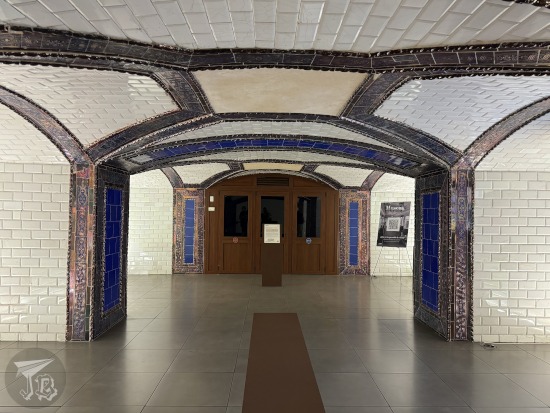
The former hall Vestíbulo de Pacífico is part of the network of Underground museums Museos de Metro de Madrid. Until it was walled off in 1966, it was the entrance to the station Estación de Pacífico, built in 1923 when the underground Line 1 was extended towards the south-west. The passengers climbed down a now-disappeared staircase and crossed the hall, which still had natural light. On the other side, there was some sort of metallic bridge with another set of stairs to access the platforms.

The station used to be part of a huge complex owned by Metro, which also comprised offices, control rooms, and the warehouse that housed the engines that created energy for the trains to run on. At the time, it was an unpopulated area, so land was cheaper. Today, most everything has been replaced by apartment buildings and only the station and the nearby Nave de Motores remain.

The whole complex was designed by architect Antonio Palacios, and the hall was built in white tiles with blue decoration – a homage to the Pacific Ocean, which gives the station its name. The hall is tiny by today’s standards, barely 119 square metres. It has three vaults that used to have skylights for the sun to light up the hall – now those are closed off as the street above them is busy. The station was renovated in the 60s so it could accommodate the longer trains, new accesses were built, and the hall closed down. That renovation was the same that made the station Estación de Chamberí close, and apparently another hall that has been uncovered in Ventas.

The hall was bricked away for almost half a century, until restoration work started in 2007. It took ten years, as budget was low and the process was labour intense – 60% of the hall had to be rebuilt. However, the final product is really good, you can see the newer tiles if you look for them, but the whole thing feels extremely well preserved. Even the staircase, which was built to access the hall after the iron bridge was destroyed, feels time-appropriate. A replica of the original doors was put up.

Pacífico Booking Hall

And right when I have seen all the five Underground museums that require appointment… I find out there is a passport of them – Pasaporte de Pasaporte de los Museos de Metro. Just my luck! Then again, maybe Metro will take these articles as proof of visit and backstamp me for them?

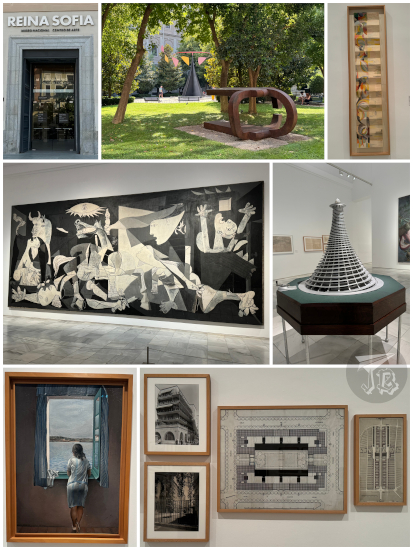
The visit took about one hour, then I rode the underground back towards Atocha, and bypassed it to the next station. I had decided to try my luck with the queue at modern art museum Museo Nacional Centro de Arte Reina Sofía, part of the national network of museums covered by my card. To be honest, I do not enjoy modern art that much, so I have been putting off this one visit. However, the museum holds a piece by Pablo Picasso that has become quite socially loaded – Picasso’s Guernica, which I have always thought I ought to see at least once.

Pablo Picasso (1881 – 1973) is considered one of the most important artists of the 20th century. He was co-inventor of collage, co-founder of Cubism, and inventor of the assemblage (basically, collage in 3D). He painted, sculpted, and made prints, ceramics and theatre sets. I have never connected much, if at all, with the kind of art he was making. I do not really understand the limits he broke, nor whatever he wanted to express. That is why I wanted to see this artwork in particular – to try to understand.

Arguably Picasso’s most famous painting is Guernica (1937). During the Spanish Civil War, German planes bombed the Basque town of Guernica, in the north of Spain, to aid the Nationalist army. The town was destroyed, and up to 300 people lost their lives – the raid opened the northern front for Franco to reach Bilbao. British reporter George Steer wrote a scoop on the event after he witnessed the destruction, and his reports made waves internationally. Picasso, who lived in France at the time, had been commissioned a piece of artwork for the Paris World’s Fair by the Republicans (at the time the rightful government of Spain). Upon reading the news, he scrapped his original idea and painted the Guernica instead.

The painting is one of the most important artworks that the museum has. It is a huge piece, in black and white, showing the carnage. As most men were out in the battleground, the majority of victims were women and children – along with a dead soldier, a horse and a bull, most of the figures in the pairing represent women and horror. I honestly find the description of the painting more chilly that the artwork itself.

One kind of feels that the museum itself as built as a huge sarcophagus for the Guernica, and other pieces are there just to fill up the space. A sculpture by Eduardo Chillida is exhibited in the gardens. There is also a space about architecture, with blueprints and photographs, including artwork by Le Corbusier. Other artists whose work is shown include Salvador Dalí, Joan Miró, Alexander Calder… Actually, I enjoyed the museum more than I thought, as I expected only abstract art that I would not understand. I enjoyed the blueprints and photographs of buildings, and the actual building too.

Exhibits at Museum Reina Sofía

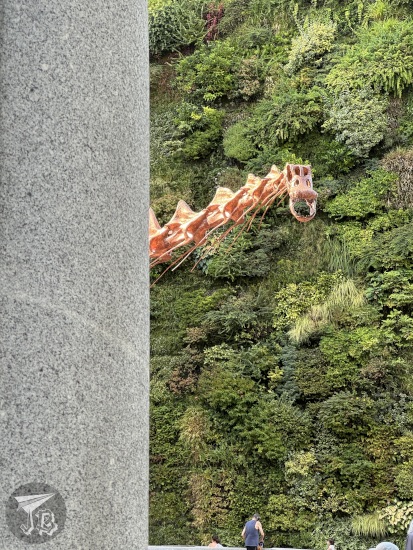
I then headed up Paseo del Prado to find one of the local cultural centres. I was ridiculously amused when I reached the corner where CaixaForum stands. I was on my phone, and when I looked up, I saw the Patagotitan “looking” at me. It gave me a laugh.

Patagotiatan at Caixaforum

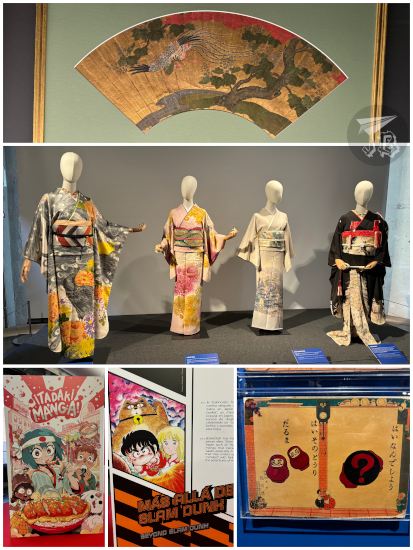
The cultural centre Serrería Belga is running a Japan-themed exhibit, divided in parts:

  • Kinpaku. Naturaleza, poder e imaginación en el arte japonés (Kinpaku: Nature, power and imagination in Japanese art): Kinpaku [金箔] refers to gold leaf artwork, often used in decoration in classical Japanese culture. A private collector has lent their items to exhibit – windscreens and fans, all painted in gold, so they can be enjoyed by everyone.
  • Kimono, identidad cambiante: un siglo a pie de calle (Kimono, changing identities: a century on the streets): Kimono [着物] is the traditional Japanese clothing – one that unlike many others is still common wear. There were twenty of these, including accessories.
  • Expokon: A series of panels discussing different hits in sports manga and derivatives.
  • Japan International Manga Award: Panels drawn by the Spanish artists who have won the awards in different years.
  • Kamishibai: Kamishibai [紙芝居] is (was) a form of Japanese street theatre using a small paper theatre with pictures to tell the stories. There were several sets of stories, some classical, some more modern.
  • Manga Kids Academy: A few panels showing Japanese school life through manga and anime.
  • Itadakimanga!: A series of panels showing different foods popular in manga and anime.
  • Gêmu: cultura visual y videojuego japonés (Gēmu: visual culture and Japanese video games): Some items regarding video games, and even a few arcade machines for playing.

Japanese exhibits at Serrería Belga

The exhibits were part of Madrid’s summer cultural program, which has named Japan “Guest Country”. They were a few cute little exhibits, and they were free too, so a good way to complete half a day trip. I headed back to the station afterwards, to wait for whichever train came, and I was lucky enough that one was there in a couple of minutes – I even found a good seat on my way back.

And I have finally seen the hall at Pacífico, which has been a goal since April 2023. Now I just have to figure out a way to obtain the passport and have it stamped…

6th July 2024: O fortuna! (Madrid, Spain)

A couple of days before going to London to see Kamijo, I found out that a local music non-profit was staging Carmina Burana by Carl Orff in Madrid. Buying tickets (for that, and the upcoming opera Madama Butterfly) broke havoc with my credit cards, but everything was eventually fixed – I think. It had me stressed at the beginning of that trip, but it seems to be finally fixed. Again. I did have to miss Swan Lake in London because the credit cards would not go through.

Anyway, I had my ticket and though I would have loved to spend the day out, I was too ridiculously tired to take a whole day of sightseeing. Furthermore, the place I wanted to have lunch out was not taking reservations since they broadcast sports, and there was some big match or another. Yes, I want to go somewhere that defines itself as a sports bar, but that’s a story for another day (like the time I thought I could go to a sports bar during the Olympics because “Oh, well, there’s nothing sporty going on, right?”).

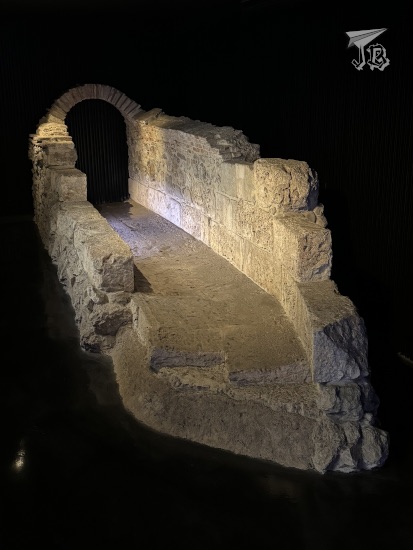
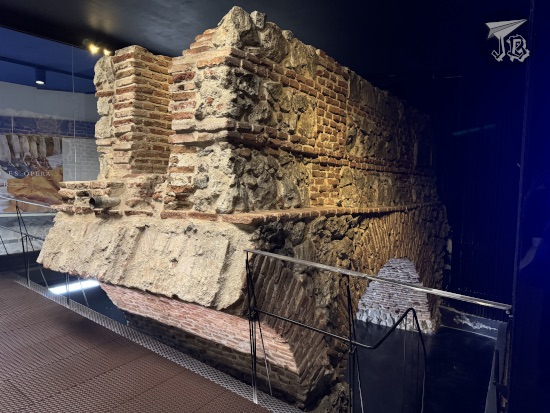
I thus decided to head off with a small pre-show plan, which turned out to be a great idea. When I alighted from the train station, the streets were clear for the Pride parade – I do not think I have ever seen the area surrounding Estación de Atocha so empty. I walked towards the theatre Teatro Real, but my first stop was the underground station of Opera, home to one of the Underground museums Museos de Metro de Madrid. Unlike the others, this is only tangentially related to the underground system itself – it is an archaeological museum, hosting an ancient fountain, part of an aqueduct, and the remains of a sewer.

King Felipe II made Madrid the capital of Spain in 1561, and aside of some brief periods of strife, it remains so to the present day. That has implied a lot of changes through history – among them, the destruction of the city walls, and the construction of an aqueduct to provide the city with water. When the court moved there, the villa of Madrid was little more than a village whose population skyrocketed in a couple of years. The new city needed services as it grew.

One of these was the fountain called Caños del Peral (literally something like “Peartree faucets”). The fountain was 34 metres long and it channelled water from the stream that ran down what is now Arenal Street. It was built in local limestone, had six faucets, and it probably was the largest fountain in the area where it was built in the late 1500s – the outskirts. Ironically, today it is quite close to the centre of the city, even the middle of Spain, the so-called “Zero Kilometre” in the square Puerta del Sol.

Fountain Caños del Peral

The fountain was destroyed during the reign of José I (Joseph Bonaparte, Napoleon’s brother, who was installed as king of Spain between 1808 and 1813). Caños del Peral, along with the buildings around the square, were demolished and used to fill the gorge that until then had separated Madrid in two. And in that filled gorge it was discovered in the early 2000s during works to refurbish the underground station of Ópera. Further works uncovered the sewer from the same period, a structure that channelled black waters away from the drinking streams for sanitation.

Sewer at el Arenal

The aqueduct Viaje de Amaniel was built around 1615 century to bring clean water to the Royal Palace, and with time it also supplied other properties. The infrastructure was heavily remodelled in the 18th century, after the Royal Palace was rebuilt into its current form after the fire that destroyed the original alcázar.

Section: Viaje de Amaniel

As I was coming out from the little museum and the underground system, I noticed a display reading that the underground / train station that I needed after the show was closed “until end of service”. Which was good to know beforehand, since I had time to replan my route – the trains were a mess in the evening due to Pride, and a few stations being closed off for crowd control. I grabbed a snack at the local Starbucks and headed into the theatre.

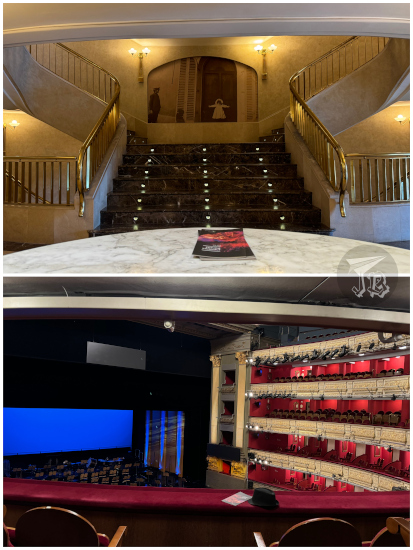
The Royal Opera of Madrid Teatro Real opened in 1850. It was originally designed by José Manuel González-Valcárcel, though it has been widely renovated, with the latest iteration dating from 1997. It is considered the most important venue for performing and musical arts in Spain – despite having been closed for decades at a time. Curiously, the theatre has the shape of a coffin – at first, I really thought that was my imagination, but apparently it is not only real but intentional.

Teatro Real: stairs and interior

I had found really good tickets, first floor next to the Royal Booth – for the same price, I would later get a fifth / sixth floor ticket for Madama Butterfly. The repertory had been put together by Fundación Excelentia, a non-profit foundation dedicated to promote and divulge lyrical heritage and musical values.

Carmina Burana Promo

Programme:
  First part:
  1. Beethoven: Egmont. Overture: Sostenuto, ma non troppo – Allegro
  2. Beethoven: Symphony No. 8 in F major, Op. 93
  Second Part:
  3. Carl Orff: Carmina Burana

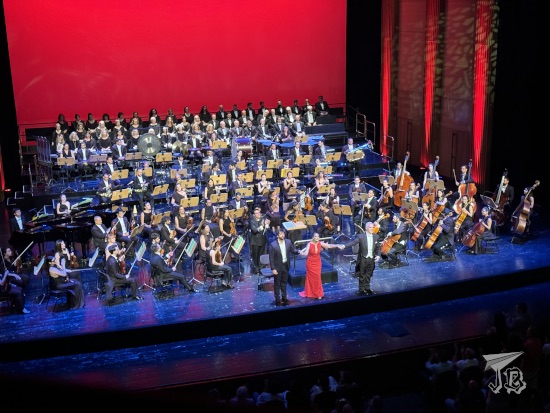
The show was conducted by Juan Pablo Valencia and interpreted by the orchestra Orquesta Clásica Santa Cecilia, the choir Sociedad Coral Excelentia de Madrid, soprano Rocío Martínez, baritone Manuel Mas and countertenor David Miranda.

Ludwig van Beethoven (1770? – 1827) is considered one of the most important figures in Western music. Born in Germany, his works bridged the classical and romantic periods in classical music. His works are amongst the most performed in the world, even though he began losing his hearing halfway through his career. He composed Egmont around 1810 for a full symphonic orchestra, and Symphony No. 8 in F major, Op. 93 in 1812. The Symphony has four movements: Allegro vivace e con brio (F major), Allegretto scherzando (B flat major), Tempo di menuetto (F major), and Allegro vivace (F major). I am not the biggest Beethoven fan, to be honest, but it was good. The conductor had a great time.

My main reason to be there was the second part of the show: Carmina Burana (Officially Carmina Burana: Cantiones profanae cantoribus et choris cantandae comitantibus instrumentis atque imaginibus magicis which translates from Latin as “Songs of Beuern: Secular songs for singers and choruses to be sung together with instruments and magical images”, quite a mouthful). German author Carl Orff (1895 – 1982) composed the cantata between 1935 and 1936. Most of the lyrics are in Latin, though there is a bit of old German and even old French. The cantata has 25 movements based on 24 Medieval poems, with the first and last movements being the same: O fortuna, which happens to be one of my favourite choir pieces ever. There is one instrumental-only piece, and all the others have vocals – for choir, soprano, baritone and countertenor.

The twenty-five movements are organised in sections, which are officially five, but divided as:

  • Fortuna Imperatrix Mundi (Fortune, empress of the world): 1. O fortuna (Oh, fortune), as I mentioned, I love this choir; 2. Fortune plango vulnera (Regret for the wounds of fortune).
  • I. Primo vere (In spring): 3. Veris leta facies (The joyous face of Spring); 4. Omnia Sol temperat (All the things are warmed by the sun); 5. Ecce gratum (Behold the welcome)
  • Uf dem anger (In the meadow): 6. Tanz (Dance), the only instrumental movement in the cantata; 7. Floret silva nobilis (The noble woods bloom); 8. Chramer, gip die varwe mir (Monger, give me a coloured paint); 9a Reie (Round dance); 9b Swaz hie gat umbe (Those who dance around); 9c Chume, chum, geselle min (Come my dear companion); 9d: Swaz hie gat umbe reprise; 10. Were diu werlt alle min (If the whole world were mine)
  • II. In taberna (In the tavern): 11. Estuans interius (Seething internally); 12. Olim lacus colueram (I once swam in lakes) – this is the piece the countertenor sang, and I am not completely sure the guy was drunk, or playing drunk. 13. Ego sum abbas (I am the abbot); 14. In taberna quando sumus (When we are in the tavern)
  • III. Cour d’amour: 15. Amor volat undique (Love flies everywhere) I have to admit that I did not love the soprano, who sang for the first time at this piece – she sang well, but too low, it was difficult to hear her at times; 16. Dies, nox et omnia (Day, night and everything); 17. Stetit puella (There stood a girl); 18. Circa mea pectora (Inside my chest). 19. Si puer cum puellula (If a boy with a girl). 20. Veni, veni, venias (Come, come, please come) – these are the same lyrics that Final Fantasy VII’s theme for Sephiroth, One-Winged Angel has, and looking at the translation, now I understand why it was never intended to be the psychotic mass-murderer theme… 21. In trutina (On the scales); 22. Tempus est iocundum (Time to jest); 23. Dulcissime (Sweetest lad)
  • Blanziflor et Helena (Blancheflour and Helen); this refers to the romance story of Blancheflour and to Helen of Troy. 24. Ave formosissima (Hail to the loveliest)
  • Fortuna Imperatrix Mundi: 25. O fortuna (Oh, fortune)

All in all, it was a great experience, and I had a privileged seat. I really enjoyed the show, as it was expected from something at the Teatro Real. The gentleman next to me slept through the first part and hummed along the second, which was weird. The soprano’s voice was too faint and she tended to sing towards the other side of the theatre, making it hard to hear her, but the baritone was good. The choir was fantastic, and the percussion musicians had a perfectly choreographed exchange of positions to play all the small parts which was really amusing to watch. Especially one who hugged the gong to quiet down the reverberations.

Artists after the Carmina Burana Show

When I came out the theatre, I headed off towards the underground system and reached the train station, which took over 20 minutes – normally, I would have just walked to Sol and take the first train there to connect faster, and stay within the same system. As Sol was closed, this was not an option. When I arrived at Atocha, the platform was almost overflowing as the trains were running with long delays. I think I took a train that should have passed through around 22:30… at 23:00. I was not sure everyone would fit in the train, to be honest. Good thing that they announced a second one for a few minutes later. I made it home past midnight, took a shower and crashed because it was hot – Spain in July. What else is new?

31st May 2024: Santa María de Huerta & Medinaceli (Spain)

For the last few years, I’ve tried to do (or visit) something cool on my birthday, especially when it fell on a long weekend. In 2024 I could not plan anything big despite the long weekend,. Instead, I broke it off into a small outing with my sibling and a little road trip. There are a couple of places not too far away that I wanted to see, but the roads are not so great. One of my parents is keen on driving anyway, so they were happy to oblige, and I could get away with not driving the curves myself.

Our first stop was the Cistercian monastery Monasterio de Santa María de Huerta. The Order of Cistercians are a Catholic religious order. A group of Benedictine monks founded the new order in 1098, as they wanted to strictly adhere to Rule of St. Benedict, and felt that the other had “relaxed” too much. Cistercian monks are credited with creating very “pure” churches as they believed that ornamentation was superfluous and distracting from prayer.

The monastery is located in the village of Santa María de Huerta, which actually grew around its walls at the side of Jalón River. The building dates back from 1162, though the order had been in Spain for two decades at the time. Most of the building was erected halfway between Romanesque and Gothic styles, with some add-ons from more recent times, mostly the Herrerian cloister and a Baroque altarpiece – which distorts a little the idea of the “pure Cistercian lines” and no extra decoration. But then again, I am not a fan of Baroque decoration.

Entry is from the side of the church to the Gothic cloister Claustro de los Caballeros, around which all the dependences can be accessed. The first one is the church, the first area to be built. There are still some of the original paintings, and a baroque organ. The monks’ refectory is the most important room, built from 1215. It has large pointed-arched windows which allow light to come in, and it is communicated with the kitchen. There is a second refectory, more Romanesque, for the lay brothers who took religious vows but were not actual monks. The last cloister, in the Herrerian style, is severe and impressive. As we were leaving, there was a black out, not sure what that could have meant…

Santa María de Huerta Monastery

We went back to the car and we drove towards the town of Medinaceli, which has a couple of monuments I wanted to see. Reputed for dating back to Roman times, it has a free-standing arch Arco Romano de Medinaceli, the only one in Spain with three arches. It is a triumphal arch built in reddish sandstone during the first century, at an altitude of 1200 m, where it rains, snows, and so. It feels like a miracle that a small structure (around 13 metres long, eight metres high and two metres wide) has withstood two thousand years.

Medinaceli: Roman triumphal arch

We saw the collegiate church Colegiata de Santa María de la Asunción, built in a late Gothic style. Artistically, the most important item is the iron grating in front of the altar. Religiously, there is a figure of Christ, which is called Cristo de Medinaceli, a wooden sculpture from the 16th century (though the most famous sculpture with that name is in Madrid). It was a little underwhelming, and most of the sculptures were not pretty.

Medinaceli: Collegiate Church

Afterwards we visited the main square of the village Plaza Mayor de Medinaceli. To one side stands a 16th-century building called La Alhóndiga, current town hall and former prison, with rounded arches on the ground floor and a balcony all along the façade on the first floor.

16th Century commercial building turned into town hall

To another side, the palace of the former dukes Palacio de los Duques de Medinaceli, which was saved from the ruin turning it into a semi-private art gallery. Inside, the most important part is the Roman mosaic. The palace was built around 1430, and today only the Renaissance yard stays undisturbed. I am not a big fan of modern art, so I just can say that some of it was colourful and pretty. The entry ticket included entrance to a rural-house-turned-erotic-art-exhibition which… was weird. The whole house was painted pink, and the works were neither interesting and nor felt artistic at all. So 10 bucks to in the end see a Roman mosaic was a bit steep.

Medinaceli Duchate Palace

We decided not to stay in town for lunch, but – almost in a bit of a joke – we drove off to have lunch at what is probably the most iconic roadside restaurant in the centre of Spain – Área 103, a brasserie that is over 125 years old. It includes a small hermit-church built for truckers, Capilla de los Conductores.

Drivers' chapel, Area 103

It might have not been a glamorous birthday, but hey, along with the escapade on Tuesday, I guess I spent it doing what I like – discovering new things.

7th May 2024: “Dragon Hunters” in Alcalá de Henares (Spain)

The Archaeology and Palaeontology museum in Alcalá de Henares is running a temporary exhibition on the history of digging dinosaur bones, called “Dragon Hunters”. I was drawn to it because well… dinosaurs. Driving in the city centre is a nightmare, so I left the car in an easy-to-park area a bit away, and walked downtown.

I had been trying to see the cathedral of the Magistral Cathedral of Saint Justus and Saint Pastor Santa e Insigne Catedral-Magistral de los Santos Justo y Pastor, but it was always either locked, booked for events, or “closed to visitors”. This time around, I was able to finally see it – and it was honestly a bit underwhelming. Though I generally enjoy Gothic buildings, I guess I was so hyped after trying so many times, that reality did not live up to expectations. Furthermore, I dislike when places do not advertise that part of the visit is closed / unavailable, so I guess I’m still pretty out of luck with this one cathedral. I missed the chance to climb up the tower and see the views of the town due to construction, but oh well.

Legend has it that catholic Saints Justus and Pastor were martyrized in the year 304, near the Roman city of Complutum. In the year 414, a chapel was built to keep their remains in the place where the martyrdom happened. The current building was erected by architects Antón Egas and Enrique Egas in late Gothic and Renaissance styles around 1446. The tower, by Rodrigo Gil de Hontañón and Rodrigo Argüello, is Herrerian. The interior has three naves with pointed arches, and to one side stands the cloister, with access to the museum, and – when it is open – the tower. It was a bit of a bummer not to even be able to step into the open part of the cloister. Underneath the altar there is a crypt with a gold-and-silver urn with the remains of the Saints, and the stone where they were killed.

Afterwards, I continued on towards my real destination, the local Archaeology and Palaeontology museum Museo Arqueológico y Paleontológico de la Comunidad de Madrid, MARPA. They are currently running the exhibition Cazadores de Dragones (Dragon Hunters). The exhibit summarises the historical hits of palaeontology, starting with prehistoric and classical references and theories about them, such as a the phoenix having been inspired by Protoceratops skeletons, or the bones of giants being actually dinosaur fossils. This area has a few replicas and small statuettes – running from the originally-made ones to the newest reconstructions.

Exhibit entrance, protoceratops, corridor

The exhibit name-drops a few of the big figures in dinosaur-digging history such as William Buckland, the man who described Megalosaurus as an antediluvian creature; Gideon Mantell, who tried to reconstruct an Iguanodon from a tooth (now in the Natural History Museum in London); Georges Cuvier, who proposed the idea of extinction, and named animals such as Megatherium, Pterodactyl or Mosasaurus; and Richard Owen, who “invented” the word “dinosaur”, meaning “terrible lizard” – though today we know that a lot of dinosaurs had more in common with birds than with reptiles, down to protofeathers and even feathers.

Archaeopteryx, titanosaur

The following section follows the “Bone Wars” – Charles Marsh and Edward Cope were two palaeontologists who raced through the Morrison Formation (Montana, USA) to discover up to 30 species of dinosaurs – they were not always honest in their competition, and it did not help that Cope messed up a reconstruction of an Elasmosaurus, placing the skull at the end of the tail. The Morrison formation was (is) in the middle of nowhere, and digging during the 19th century had its risks. This concept ties with the idea of “the adventurer” à la Indiana Jones, mentioning Roy Chapman Andrews and Barnum Brown, the man who excavated the first Tyrannosaurus. And then you turn a corner and are greeted by a replica of a T-Rex. Of course, I stayed a while here – trying to take pictures without the security guard in them.

Tyrannosaurus rex replica

After World War II, palaeontology hits moved from the USA to Mongolia and the Gobi desert, with new species being discovered every so often. Later, in the last years of the 20th century, the idea of “the avian dinosaur” arrived, and there is a replica of a Deinonychus, with screens showing recreations of the creature looking “like a lizard” and looking “like a bird”, feathered and all.

Titanosaur, therizinosaurus, eggs, deinonychus

Finally, there are the local dinosaurs: a tail and part of a foot from Qunkasaura pintiquiniestra, a nest from the Poyos Site (Guadalajara), and the star of the show – the original fossil holotype of Concavenator (Concavenator corcovatus), a theropod found in Cuenca. The fun part? The museum which holds the holotype, Museo de Paleontología de Castilla-La Mancha, bans pictures – so I took my sweet time with this. There is also a life-size reproduction, with colours tuned down to more realistic than the originally proposed blue and red.

Concavenator fossil and reproduction

Afterwards, I wandered around MARPA, mostly to go to the palaeontology room, as I have explored the museum extensively before. The palaeontology ward is relatively new, and it has quite a few nice reproductions and… even if I have explored that one too. I also dropped by the shop to get the exhibition book. Finally, I went back to run through the Dinosaur exhibit again, just because I could, before I headed home. I had thought I’d look for a nice restaurant for lunch, but nothing drew my attention.

20th March 2024: Mundo Pixar (Madrid, Spain)

Due to some kind of weird… extended family thing, we ended up with some vouchers for Pixar World Spain Mundo Pixar, happening in IFEMA in Madrid. It would have been a pity to waste all of the tickets, so there we went, on a Wednesday morning, to at least redeem a couple of them. This immersive exhibit comprises several rooms with life-sized scenarios and characters based on Pixar films.

Mundo Pixar Madrid - outside

Pixar is an American animation studio which started off as part of the Lucasfilm computer division back in 1979. For over a decade, the group collaborated with graphic design and CGIas a third-party, until it was properly founded as an independent company in 1986. Pixar collaborated with Disney creating computer animations, and kept developing the technology, until it was finally able to pitch its first feature film to Disney – Toy Story, which was also the first-ever completely computer-animated film. Released for the 1995 Christmas season, it was a world-wide hit. Pixar became part of Disney in 2006.

The studio’s films have received 23 Academy Awards, eleven times for Best Animated Feature (a category added in 2001). One of the characteristics of Pixar films is their layering – though they are marketed as children’s entertainment, they tend to have a deeper, more adult-oriented subtext that… kids don’t even grasp. Something weird is that despite its successes, Pixar always seems on the brink of bankruptcy…

We had tickets for 11:00, and thought we had plenty of time until we got caught in a huge traffic jam due to a fair in another part of IFEMA. We had over 45 minutes of leeway, and ended up taking half an hour just to be able to get into the parking lot from the roundabout 650 metres away. That was wild.

We finally got into the queue around 10:50, and it took a while to get in. Mundo Pixar is organised in a U-shaped circuit, so that you can get round to the shop before or after seeing the exhibit. For a weekday, it was packed – not only by families, a bunch of random friend groups and tourists, too. Interesting.

We accessed through a tunnel to the first space, which is a bit of a self-promotion video mixed with the rules of the game – mostly, the one that people seemed unable to follow: do not touch. The immersive experience takes you to recreated scenarios from several films by the studio, to the slightest detail. The rooms are supposed to have different smells, but we only perceived a few. And of course, people kept touching.

Rooms 1 & 2: Up. This films tells the story of an old widower who goes on a last “adventure” to Paradise Falls, where his late wife would have loved to live. To do this he… floats his house away with thousands of balloons. He meets kid Russel and dog Dug. The rooms include a view of the whole house, and one of the interior. The living room is a perfect reconstruction of the one in the film, down to the pictures and the armchairs where Ellie and Carl sit, and the device Carl builds to steer the house while it flies.

Room 3: Monsters Inc.. This is a take on a widespread childhood obsession, the monster in the closet. In another dimension, energy is powered by the screams of frightened children from our world – thus, monsters sneak into kids’ rooms using magic doors to their wardrobes. Sully and Mike are the top-scary team until they run into a toddler who turns their lives upside down. The room has different bits from the film, including the scream factory doors and the two main characters waving awkwardly, recreating a scene where Mike and Sully are made to pose for a picture – I kinda expected them to move.

Pixar World Spain: Entrance, Up, Monster Inc.

Room 4: Toy Story. A bunch of toys which / who become sentient when they are not being played with get a new companion, who does not know he’s actually a toy. Enter a house-move, a bully neighbour, and a nasty dog. Chaos (and a trio of sequels) ensues. The fun part of this room is that it’s built so you see the room from one of the toys’ perspective, everything is high up, and the toys themselves are scaled.

Room 5: Elemental. This is a coming-of-age romantic comedy which focuses on overcoming differences. You walk into a train car with the two characters – a water element and a fire element, awkwardly sitting next to each other.

Room 6: Inside Out. In this coming-of-age comedy-drama, every person (and cat) has five basic feelings: Joy, Sadness, Anger, Disgust and Fear. They control a person’s life using a big console, and they collect “core memories” to help with their job. A young girl’s Joy and Sadness must learn to work together to overcome moving to another city. The room shows a perfect life-size reproduction of Sadness and Joy at the console and all the core memories.

Room 7: Ratatouille. This films follows the adventures and misadventures of the rat Remy, struggling to become a chef – to do this he hides in the hat of a young man and “guides” his cooking. The title is a pun between the word rat and a French recipe. The room is a huge kitchen, and you see Remy cooking inside a huge chef hat.

Pixar World Spain: Toy Story, Elemental, Inside Out, Ratatouille

Room 8 & 9: Coco. Set around Mexico’s Day of the Dead (Día de los Muertos), this film sees a young boy, Miguel, explore his family roots and his love of music. The first room shows Miguel and his grandmother, and the second area holds skeleton Héctor, a dead musician who accompanies Miguel in his adventures.

Room 10: Luca. This film tells the story of two sea-monster children (Luca and Alberto) and a human child (Giulia), and deals with friendship and acceptance in the Italian Riviera in 1959. The room hosts the size-appropriate children, with Giulia – and her cat – getting the most prominent set.

Room 11: Cars. The film is set in a world populated only by anthropomorphic vehicles. Arrogant young racing car Lightning McQueen learns about humility, sportsmanship and friendship. There was a nice staff member taking pictures of visitors in this room, with the film’s main character.

Pixar World Spain: Coco, Luca and Cars

Room 12: Finding Nemo. Nemo is a little clownfish, the only survivor from a barracuda attack in which his overprotective father, Marlin, lost his wife and all their other fertilised eggs. When Nemo gets “fished”, Marlin embarks on a crazy journey to find him, meeting amnesic surgeon fish Dory, wannabe-vegetarian shark Bruce, and surfer turtle Crush. To be honest, finding Nemo in this room was easy. He was in the middle of it, surrounded by marine mist, with jellyfish and the rest of the characters on a screen behind him. I was severely disappointed there was no Bruce whatsoever in the room.

This was the last room; afterwards there was the shop, and a small photocall with a giant Luxo (a yellow bouncing ball with a blue band and a red star), back at the beginning. I am not sure this area actually counted as a room, because we were told there were thirteen rooms? No clue.

Pixar World Spain: Finding Nemo, photocall, Pixar ball

Fortunately, when we left, the traffic jam had dissipated. Unfortunately, I had to go work in the evening, which did not feel great. I obviously enjoyed the rooms dedicated of films I had watched (and liked) more than the others – I personally find the first ten minutes of Up heart-wrenching, but Finding Nemo was my favourite (both as a film and a room). I still uphold my protests about shark discrimination though!

23rd February 2024: Zorita de Los Canes & Recópolis (Spain)

Zorita de los Canes is a hamlet at the bank of River Tagus, in the middle of nowhere in the Spanish Central Plateau. It was founded as an Almoravid dynasty fortress (alcazaba), however the stones that erected the castle are much, much older. The fortress was built around the 12th – 13th centuries, and although ruined, it used to be visitable – not at the moment though. The stones to build the castle were quarried from an even older settlement, which today is known as the archaeological site of Recópolis.

During the Middle Ages, Zorita was extremely disputed. After the Moors built the alcazaba, the town was taken over by the Christians, then recovered by the Almoravid dynasty, until it was conquered by Christian king Alfonso VII. The village was entrusted to the Order of Calatrava, the first military order to be founded in the Kingdom of Castile, who were to defend it against the Almohad Caliphate.

I’d been wanting to go to Recópolis for a while, and I found out that the archaeological sites in the area are free until the end of the year, so I thought it would make a nice mini-trip. I booked the ticket a few days in advance as it seemed that the weather would be cold but dry, albeit windy. I thought it could be a good chance before fuel prices go up again.

I had an early lunch and drove off with the idea to get to the archaeological site around quarter to three, as I was booked for three o’clock and the ticket said to arrive ten minutes in advance. The drive was a bit faster than I thought, but the Sat-Nav sent me on a completely different route than Google had, which made me a bit insecure about timings. That’s why, even if I saw a couple of villages that looked interesting, I decided not to stop and explore them, I could do it on my way back. Suddenly, the ruined castle came into view. I pulled over in a safe place to admire it and checked the time – I was good. Thus, I drove into Zorita de Los Canes and stopped at a small parking lot at the entrance of the village. I parked next to the river Tagus Río Tajo, which gave me a couple of nice views.

Castle in Zorita de los Canes, atop a hill

Part of the Medieval wall still stands, and access to hamlet’s core is done through an ancient gate, which I was happy to cross on foot. There was a small church, and at the summit of the peak stands the derelict castle Castillo de Zorita de los Canes. I decided not to climb as I knew it was closed, and after a few minutes, I got back into the car and drove off.

River Tagus and Castle in Zorita de los Canes

All in all, I was in town for about a quarter of an hour, and did not drive for longer than three or four minutes before I parked at the entrance of the archaeological site Parque Arqueológico de Recópolis. The interpretation centre was empty and locked, and I was the only car in the parking lot. The time was around 14:30 at that point and I decided to wander around for a bit, as there was what looked like a hiking trail amongst the fields. I found a nice lookout of the castle, but not the ruins themselves.

Zorita de los Canes from far away

The discovery of Recópolis is credited to Juan Catalina García López in 1893. Juan Cabré Aguiló started the excavation in 1945, and found a “little treasure” (tesorillo) of coins from looting (one of them fake). Of Visigoth origin, it predates the Moorish town by a few centuries. It was erected around the year 578 by king Leovigildo in honour of his son Recaredo, who would go on to become the first of the Christian kings of Spain.

The city followed the byzantine pattern. There were two perpendicular streets, one of which lead to the palatial area, with shops to the side. Recópolis became important enough to mint its own coins, but the crisis of the Visigoth state lead to it conquest by the Moors in the 8th century. The city was slowly abandoned and became a quarry for the nearby settlement of Zorita. Later, in the 11th century, Christian settlers built a church and a small village, which had been abandoned by the 15th century.

The whole archaeological area spreads 30 hectares, out of which eight have been excavated. The interpretation centre has a few replicas of artefacts that have been found – due to security concerns, no originals are kept on site. To be honest, I was not surprised – I could have walked into the site and left without anyone stopping or even seeing me. When I arrived, it was me and the vultures, and I had a bit of a flashback to that time at the cave Cueva de los Casares, and even fantasised a little about being alone to explore the site. The guide arrived on time and opened the centre, and I was still the only one there, which was weird – I know for a fact that there were a bunch of reservations for 15:00, but only I showed up. Maybe the others became discouraged because of the weather?

The nice tour guide suggested waiting for a few minutes to give time for others to arrive, and offered me the VR experience. I accepted, of course – I’m not going to turn down such a thing. It was really fun, because you could pick up objects as the local goddess and a little child showed you around a reconstruction of the town, the palace and a glass workshop.

Afterwards, we headed off towards the ruins – nobody else had shown up. The guide offered to let me stay after the tour to take all my pictures so I decided to just listen to him as he explained and pointed to some very interesting details – a bit giddy inside. Would I really be alone eventually? He showed me the church, the palace and the grain silos in the ground, where grain was stored. He also took me to the palace and pointed out the main streets, and taught me how to differentiate the Moorish construction (criss-crossed materials) from the original Visigoth one (parallel architectural stones).

We also chatted a little and I mentioned I hoped it did not rain – he said that it had been threatening rain all week, but it would be all right. I eyed the black cloud approaching and hoped he was right.

Spoiler alert: he was not.

After finishing the guided visit, I was left alone indeed. I went around the main area of the archaeological site, and when I was in the church, the storm broke out. I had an umbrella, but I still got drenched. Interestingly though, even if it was raining and windy, it was suddenly not as cold as before. However, I had to give up eventually, since taking pictures was too difficult. As I decided to return to the visitor centre, the cloud finally moved through, and rain slowed down. I was heading down the hill towards the visitors’ centre when it finally cleared completely. I stopped, wondering whether to leave or come back, and when I looked up I saw a rainbow, sprouting right out of the castle. There were even vultures flying against the retreating cloud. It was really cool.

Rainbow hitting the castle, and a vulture flying

I felt motivated again, so I went back to the ruins of the city to take a few more pictures – after all, it was really cool to be all alone in the archaeological site. I wandered among the houses where it was allowed, and went to the edge of the site to take it all in, then I walked back. As I was in the middle of the street, a griffon vulture circled me a couple of times, maybe wondering if I was food – I think staying where I was taking pictures did not help? It eventually left, and I headed back to the centre, where I arrived just in time to watch the little video documentary about the Visigoth town.

Ruins of Recópolis

Recopolis ruins

Griffon vulture mid-flight

I left afterwards, and I got caught in the storm again – thus I did not stop in any village on the way. The first half of the drive was miserable in the rain, but then it cleared out, and the rest of it was all right. Fortunately, I did not run into too many other cars either. I got home around sunset and went to bed early since I had to wake up early the following day.

Nevertheless, now I’ve got a VIP (VOP? Very only person?) experience, alone in an archaeological site, which is added value to the whole thing and I loved every second of it, even with the rain.

17th February 2024: Hita, Medieval villa (Spain)

Today, Hita is barely more than a hamlet at the foot of a hill, lost in the middle of the Spanish central plateau, in the Guadalajara region. Its origins date back to pre-Roman times, and the settlement was first recorded in Roman roadmaps. The area later became part of the Caliphate until 1085, when it was conquered by king Alfonso VI and the town was incorporated to the Crown of Castile. The town flourished in the Middle Ages. In the 14th century, a then-famous poet, known as Juan Ruiz, the Archpriest of Hita (Arcipreste de Hita), wrote one of the most important literary works in Spanish-speaking history, the Libro del Buen Amor (Book of Good Love), a bit of a parody of the local society of the times in poem form.

Also in the 14th century, the lord Íñigo López de Mendoza took over the region. He rebuilt the castle from the ruined Moorish alcazaba and erected a wall around the settlement. However, the village eventually lost its importance, inhabitants, and vineyards, as the feudal system evolved. It was mostly destroyed during the Civil War in the 20th century. In 1961, historian Manuel Criado de Val wrote a play based on the Book of Good Love and it was played in the town square. People liked the idea, which eventually grew into the town’s Medieval Theatre Festival. It revitalised the village a little, and the first summer of June, the town fills up with plays, a marketplace, tournaments and jousts, and people dressing in period clothing. Today, Hita has fewer than 300 inhabitants, and it’s trying to build a reputation as a picturesque day trip “Medieval villa” – it has even built a visitors’ parking lot.

We arrived around 11:00, and left the car at the entrance of the village, in said parking lot. By 11:20 we had walked by all the whole historical centre – which, given how the town is promoted as a Medieval marvel, was a little underwhelming. We parked in front of the area named stockade or palisade, Palenque, where the medieval tournaments are carried out. Its construction is fairly recent, so it does not hold any historical importance outside the festival.

Stockade in Hita.

Next to the Palenque stands one of the remaining sections of the medieval walls Muralla Medieval that still remain around the village. There is also the sculpture of a semi-mythical figure – Álvar Fañez de Minaya. Minaya was Rodrigo Díaz de Vivar, El Cid’s, right-hand man. El Cid’s deeds are known from the Spanish epic poem Cantar de Mío Cid, which presents him as someone akin a Round Table knight. Though he probably did exist – along with his lieutenant – he was probably more of a mercenary and a warlord than the legendary hero.

Sculpture of Minaya in front of the medieval wall

The access to the historical centre is done through the stone gate Puerta de Santa María, the only one of the wall entrances that has survived – although it has been heavily restored. It was originally an arch, in civilian gothic; today the upper part is completely reconstructed, with two turrets. In front of the gate stands the pillory Picota, which signals that in medieval times there was a justice department.

St. Mary's gate into the town of Hita.

The village is small, and mostly uphill. There is a main square, some ruins, and a church. Since the church was closed and we could not snoop around, we decided to visit the local museum and sign up for the guided visit that was offered, as they would open the visitable monuments up.

The museum, Casa Museo del Arcipreste, multitasks as archaeological display, ethnographic museum, festival promotion, and recreation of the Archpriest’s writing chamber, with some facsimiles of the pages. There are masks from the festivals, and the town’s botargas.

Hita - local museum

When the guided visit started, we first overlooked the landscape. We got a commentary of the location of the village and its historical importance, and the kind of soil and crops that used to and still are grown in the area. I had chosen the weekend because the weather was going to be nice, and it was – especially no wind, which would have made things awkward.

We then visited the ruins of Saint Peter’s church Ruinas de la Iglesia de San Pedro. Originally a Romanesque temple turned mudéjar, it was blown up during the Civil War. Today, only the altar stands, and it is used as stage for cultural acts. As a memento of its original mission, the town has kept the tombstone of the last governor of the castle before it was destroyed, still on the ground.

Hita - Ruins of St Peter's church

We moved onto the church Iglesia de San Juan Bautista. The building was erected in the mudéjar style throughout the 14th and 15th century. The tower is herrerian, erected in the 16th century. Inside, the most remarkable detail are the wooden ceilings, also dating from the 16th century. The floor is sprinkled with gravestones that used to be in the other church. There are two baptism fountains, and a small statue of the Virgin Mary with the Child, carved halfway between Romanesque and Gothic styles. Then she was embellished with baroque jewellery.

Hita - Church of St John the Baptist

Thankfully, we only looked at the ruins of the castle,and did not climb up to it – today, only a wall and the base of a tower stand, high up the hill that in the Medieval Age controlled the whole plain.

Ruins of the castle in Hita

Instead, we were invited to peer into a bodego, a traditional cave-house. The one we saw was restored, but it felt pretty authentic. There was a bedroom, a kitchen, and the end of the dwelling was more cave-like, working as stable and barn. The smell was damp, and it was good that they’ve put electric lights on it, because the tiny windows would have made it a little claustrophobic.

Cave house in Hita

We then descended towards the main square Plaza Mayor, which was the old marketplace and even older synagogue. A hollow on the wall has been used to recreate a cell where the Archpriest was imprisoned. Opposite the wall, there are popular architecture houses, with typical porticos.

Main square in Hita

The Archpriest's cell

To end the visit, we looked at the gate Puerta de Santa María, and then were invited to see a traditional wine cellar excavated into the medieval wall. Though wine production was abandoned long ago, the cellar Bodega de Doña Bellida still exists with its traditional structure and huge clay vessels. It was excavated into the mountain, just like the bodego.

Wine cellar and jars

There was not much more to see in the village, so we just headed off afterwards. I was a bit underwhelmed about the whole thing, I am not going to lie.

3rd February 2024: The Botarga Parade (Guadalajara, Spain)

There is no reason to doubt the folk / pre-Christian origins of Carnival (Shrovetide). Scholars trace it back to Greek Anthesteria to honour Dyonisius and the Roman Saturnalia – Romans liked adapting everything from everyone after all, especially if a party could be had. It might even be related to Imbolc, an ancient Irish festival celebrated halfway between Winter Solstice and Spring Equinox (similar to how Hallowe’en is the night between Autumn Equinox and Winter Solstice). In the European Middle Ages, it was around this time when people consumed all the meat they had from the winter slaughter before it went bad – and then they would have no “good” food for a while. This eventually led to the idea of fasting during Lent, when the Christian church decided to hijack the celebrations.

A lot of what we consider “Carnival” today can be traced back to Medieval Italy – it started the masquerade balls, dressing up, and the carnal parades. The most important event was the Carnival of Venice. From there, it spread into Europe and with the Spanish and Portuguese empires to the Caribbean and Latin America.

Going back to its origins, it seems clear that the celebrations were rooted in nature, especially the coming of spring. Just as Hallowe’en marks the beginning of winter, it is around Imbolc (Christians call it Candlemas, and celebrate it on the 2nd of February) that you start really noticing that the days have grown longer. They are about an hour longer than on the Winter Solstice – at Stonehenge, one of the most natural / mystical points in the world, sunset on the 2nd of February 2024 was at 16:59, while on the Winter Solstice it was 16:02. Like Hallowe’en brings out spirits and monsters, Inbolc starts conjuring spring and nature-related folklore “creatures”.

Looking at Europe, there seem to be a lot of analogous characters in Carnival traditions. The German characters Hooriger Bär (hairy bear) and Strohbär (straw bear) wear a… camouflage / leaves suit covering all its body which looks eerily similar to the English Whittlesea, the Polish niedźwiedź zapustny, the Italian Hermit (tree-man), or even the Slovenian Korant. When one looks at the Korant, it can be seen the “leaves” are actually fur (sheepskin to be precise), which would make it in turn similar to the Hungarian busós, horned and more animal-like. All these appear to represent a connection to nature, only enhanced by the German Hopfennarr, which looks like one would draw a spirit of spring. It would be easy to reach the conclusion that all these characters are indeed related to the advent of spring – both for plants and animals.

As Italy (and especially Venice) made carnival a thing in Medieval Europe, they “exported” the concept of costumes “done right” and “proper” masks. This influenced older characters, giving them a more similar look to the archetypes in the Commedia dell’arte, with colourful clothes and expressive masks. These are more generic, masked, characters as those found in Venice, though in this city every character has its own name and story.

Some of these characters – both newer masked and older nature-linked characters – seem to have their representatives in the current Spanish Carnival folklore. They seem to have been especially important in the centre of the country, more dependent on agriculture and nature cycles than those areas close to the sea. They were popular in the past, and switched from the pagan festival to the Christian one. They were stifled during Franco’s Dictatorship (with the ban on Carnival), and have been recently re-popularised by folklore enthusiasts – some of them have been “rescheduled” to more touristic times than around Carnival. It is considered that the origin of these characters lies in fertility rituals and symbols – such as the orange – and dances from pre-Roman Spain, with some authors daring to call them Neolithic.

I attended the parade Tradicional Desfile de Botargas in Guadalajara which gathered these characters from the town and several other villages in the province. The main and more general name of the characters in this area is botarga. However, there are different characters according to what they look like: botargas, vaquillones, diablos, mascaritas, chocolateros, danzantes, and mascarones. These characters and their recovered traditions were declared Intangible Cultural Asset in 2022. The parade was a big day when most of the characters in the region came together. The parade used to take place on a Thursday before, and it was changed to the Saturday before Carnival so more people could enjoy it.

The term botarga derives from the Italian bottarga, which refers to colourful clothes related to Medieval performances and the Commedia dell’arte (aside from fish roe). The original clothes seem to have taken their name from the 16th-century actor Stefanello Bottarga, who used to wear wide pants, and play one of the archetypical characters, the vecchi (old geezers or masters). Under the name “botarga”, the province has recovered (or reinvented) a few traditions, and up to 36 single characters and groups walked the parade in Guadalajara.

The proper botarga is a usually single character, who wears a mask and garish clothes in bright colours. The masks can be made of many materials, some of them even esparto. The botarga usually carries some kind of staff, and it chases the onlookers, and sometimes pokes them for luck or fertility. Vaquillas (heiferettes) and vaquillones (literally, big male heiferettes) are characters which cover their faces with sackcloth or a similar material; they carry horns, and often cowbells; they represent cattle and are sometimes accompanied by “shepherds” (with staffs – there is a pattern there). The danzantes are dancers, and Diablos means Devils, pretty self-explanatory – some of the latter also wear horns, and a few are covered in black soot, and enjoy “marking” the onlookers with black smudges. Mascaritas and Mascarones both derive from the word mask, and could be translated as “small masks” and “big masks”; the mascaritas are the most common character, usually women in traditional clothes covering their faces with plain white masks.. Finally, the chocolateros or chocolatiers offer the treat (which they… carry in a chamberpot) to whomever they meet – and if they are declined, they use it to “attack” their victim.

There is actually a project called The Botarga Route, with a calendar so one can see each botarga in the original village. Most come out between New Year’s Day and the end of February, but some have been “moved” to the main day of the summer festivals. The great thing about the parade I attended in Guadalajara was that it concentrated a lot of the region’s botargas and further characters, and one “guest” from another region – it was the Desfile de Botargas, Vaquillones, Diablos, Mascaritas, Chocolateros, Danzantes y Mascarones de la Provincia de Guadalajara.

Characters posing in front of Espacio TYCE Guadalajara

The host botarga, Botarga from Guadalajara (Botarga de Guadalajara) is a team of four. They chase teens and and lightly hit them when they catch them. They play a traditional Carnival game similar to bobbing-for-apples, alhiguí. A dry fig is hung from a sort-of fishing pole, and onlookers can try and catch the fruit – the trick is that one has to use their mouth, not their hands hands. Meanwhile the botargas sing “tothefig, tothefig, not with the hands, yes with the mouth” (alhiguí, alhiguí, con las manos, no, con la boca, sí). Originally, there was only one character that came out on the 17th of January and played alhiguí with the children around the church of Santiago – El Manda (the Order-giver). Later, two more were added – Los Mandaneros (the Order-receivers), and since the custom was recovered in 1998, a new character, Botarguilla (Little Botarga) carries the basket with the figs.

First, all the characters met at Espacio TYCE, then they marched down to the Main Square in front of the town hall Plaza Mayor for the Carnival opening speech, and back.

The host botarga opened the parade. Music was provided by three teams of musicians: Grupo Dulzaineros from Guadalajara, Dulzaineros Pico del Lobo (their main instrument being the dulzaina, an instrument similar to an oboe) and Gaiteros from Villaflores (pipers). Although the parade did not take long to devolve into a lot of chaotic fun, it was organised in three bodies – single botargas, couple botargas, and teams. The signs reading “individual”, “couples” and “teams” were carried by characters wearing full-body costumes that made them look like walking grass-made men. Since I know the town a little, could I watched the parade from three spots, short-cutting from the TYCE area to the square Plaza de Bejanque , and then to Main Street Calle Mayor. Then I walked along towards Plaza Mayor Main Square, where the botargas one by one, or group by group, came on stage as the character was explained.

Botargas de Guadalajara

Aside from the music, there was a very distinctive sound – a lot of the botargas carry cowbells on their belts. The local botargas that participated in the parade are (in alphabetical order of the village they come from, and how they were called onto the stage):

  • Botarga de Alarilla: Botarga from Alarilla. It comes out on the 1st of January to greet the new year and send the evil spirits away. When it is not scaring little kids or getting frisky with the single ladies, it gives out little satchels of nuts.
  • Botarga de Aleas: Botarga from Aleas. The character used to come out on the 3rd of January, now it comes out on the 15th of August, for the village’s festival. The botarga and a number of dancers go around asking for money and food – especially sweets and wine.
  • Botargas y Mascaritas de Almiruete: Botargas and Little Masks from Almiruete. They come out on Shrove Saturday. The botargas throw straw and the mascaritas confetti. There are three other characters – the bear, its trainer, and the heiferette.
  • Botarga de Cabanillas del Campo: Botarga from Cabanillas del Campo. The two characters come out on the 3rd of February, sounding bells and cowbells to bother people and summon spring.
  • Chocolateros de Cogolludo: Chocolatiers from Cogolludo. They come out on Ash Wednesday to tempt people to break the religious fast. They carry a chamberpot with creamy chocolate, and sponge cakes dipped in it. If they don’t manage to tempt the onlookers, they smear the chocolate on their faces.
  • Botarga de Fuencemillán: Botarga from Fuencemillán. On the closest Saturday to the 25th of January, it dances in front of the image of Saint Peter, and chases people to get rid of the bad spirits.
  • Vaquillas de Grajanejos: Vaquillas from Grajanejos. They look more like shepherds and farmers than actual cattle.
  • Botarga de Hita: Botarga from Hita. Though today the two characters come out during the town’s Medieval festival in July, they are clearly Carnival characters. They represent the struggles of personified Carnival and Lent – though they dress so similarly, I could not tell who’s who.
  • Botarga de Humanes: Botarga from Humanes. It comes out on the 1st of January and knocks on doors to wish a happy new year. It wears a colourful costume with 31 tinker bells and seven bells. It blocks entry to the church unless it is given a coin.
  • Diablo y Vaquillas de Luzaga: Devil and Heiferettes from Luzaga. Nowadays, they come out on Shrove Saturday. The heiferettes wear red capes, a mask of sackcloths, a hat, and carry bull horns. They toll the cowbells and chase the onlookers. The devil throws straw to symbolise riches and fertility.
  • Diablos y Mascaritas de Luzón: Devils and Little Masks from Luzón. The devils carry horns on their heads and cowbells on their waists. They paint their body black and use a piece of potato to feign huge teeth. They “attack” onlookers with a mixture of ash and oil. They are accompanied by the Little Masks, who are safe from their actions, wearing the typical clothing of the area and white face coverings. They come out on Shrove Saturday.
  • Botarga de Majaelrayo: Botarga from Majaelrayo. This is one of the characters that comes out “off season”, on the first weekend of September, though the original festival was the third Sunday of January. It is one of the few (if not the only) unmasked ones, and it leads traditional dancing on Sunday.
  • Botarga de Casados de Málaga del Fresno: Botarga of Married Couples from Málaga del Fresno. The original botarga came out on the first of January. It stopped for a while and when the tradition was picked up, the festival moved to the 24th of January, and two more masked characters, the mojigangas were added. The botarga carries a staff and a bag of candy and chases people who go and come out from mass.
  • Botarga de Mazuecos: Botarga from Mazuecos. On the 23rd of January, they chase the young and hit them with their poles.
  • Vaquillas de Membrillera: Heiferettes from Membrillera. They wear two tunics in different colours, a collar of bells, and horns on their waists. They come out on Shrove Saturday to chase the youth.
  • Botarga de Mohernando: Botarga from Mohernando. This duo of botarga and buffoon come out on the closest Sunday to the 20th of January. Though they participate on the religious activities in a serious fashion, they chase kids and teens, and play pranks.
  • Botarga de Montarrón: Botarga from Montarrón. It comes out around the 20th of January, and panhandles through the village for food and drink that is later consumed by the inhabitants. It is one of the few botargas to attend mass, leaving its bells and mask outside.
  • Botarga de Muduex: Botarga from Muduex. This botarga has just been recovered, so it is writing its own tradition. It will come out on the local festival in July.
  • Botarga de Peñalver: Botarga from Peñalver. It chases young men and if it caches them, it will ask them a question, and only let them go if it likes the answer. It comes out the first Sunday after the 3rd of February.
  • Botarga de Puebla de Beleña: Botarga from Puebla de Beleña. This horned character takes part in the religious ceremonies to honour Saint Blaise (3rd of January) and chases people to hit them with its staff. He also knocks on doors and makes its cowbells toll to call people to mass.
  • Botarga de Razbona: Botarga from Razbona. Considered a symbol of prosperity and fertility, it comes out on the closest Saturday to the 25th of January. It picks up donations for charity and cultural acts. It used to attack people who did not cooperate with ash, now it gives out candy for those who donate. However, as it is regarded as a pagan character, it won’t step into the church.
  • Botarga de Retiendas: Botarga from Retiendas. It comes out on the closest Sunday to Candlemas. It dances and chases people to the beat of a drum, and takes part in the religious ceremonies.
  • Vaquilla de Riba de Saelices: Heiferette from Riba de Saelices. It comes out on Carnival Saturday (though originally it was Shrove Tuesday), charging people and getting mock-stabbed in return.
  • Vaquilla de Ribarredonda: Heiferette from Ribarredonda. The heiferette comes out on Shrove Sunday, tolling its cowbells. In the village, shepherds who cover their faces with sackcloth masks keep it in check with their staffs – the person playing the heiferette wears a helmet for protection.
  • Botarga de Casados de Robledillo de Mohernando: Botarga of Married Couples from Robledillo de Mohernando. It comes out on the 1st of January and enters the houses to wish a happy new year and wake people up with tolls and chimes from the bells it carries.
  • Botarga Infantil de Robledillo de Mohernando: Child Botarga from Robledillo de Mohernando. The only child group in the area, they come out on the closest Sunday to the 24th of January. There is a child botarga, musicians and basket-carriers. They don’t wear masks and they perform traditional dances.
  • Vaquillones de Robledillo de Mohernando: Big-Male-Usherettes from Robledillo de Mohernando. Completely clad in sackcloths and carrying horns and cowbells, they charge the onlookers on Shrove Saturday.
  • Botarga de Romanones: Botarga from Romanones. They come out on the last Saturday before Carnival (which was technically the day of the parade so… not sure when). The Little Masks throw confetti or flour at the ladies. They are accompanied by a shepherd and a bull – the bull is “fought and killed” a few times, as it can come back to life with a sip of “magic wine”.
  • Botarga de Salmerón: Botarga from Salmerón. A group of Little Masks comes out on Shrove Saturday. They throw confetti as a fertility charm. A botarga, Tío Alhiguí (Uncle Tothefig) comes with them to play the game with children.
  • Botarga de Taracena: Botarga from Taracena. It comes out on the 23rd of January. Alongside musicians, it walks through the town streets, chasing people towards the church.
  • Botarga de Tórtola de Henares: Botarga from Tórtola de Henares. It comes out in the morning of Christmas Eve, knocking on doors for food. It also comes out on the 6th of January and, along the Little Masks, during Carnival.
  • Botarga y Danzantes del Santo Niño de Valdenuño Fernández: Botarga and Danzantes of the Holy Child from Valdenuño Fernández. They come out the first Sunday after the 6th of January. There are records that a child got lost in 1721 everyone in the village looked for him. The botarga and the dancers recreate this event, and dance in exchange of oranges. One of the dances, the paloteo, involves the group of eight dancers clashing batons with each other.
  • Botarga de Valdesaz: Botargas from Valdesaz. This group chases each other and onlookers on Shrove Saturday.
  • Vaquillones de Villares de Jadraque: Big-Male-Usherettes from Villares de Jadraque. They come out on Shrove Saturday, wearing orange capes, horns and a hat, chasing anyone they come across.
  • Botarga de Villaseca de Uceda: Botarga from Villaseca de Uceda. Recovered in 2023, this botarga comes out the first Saturday after the Epiphany. Its design is modern, and it has mane-looking hair.
  • Botarga de Yélamos de Abajo: Botarga from Yélamos de Abajo. It is the only botarga that comes out during Holy Week (Easter) – but it actually looks a bit like a devil. On Spy Wednesday, villagers light a bonfire in front of the church, and summon the botarga with rattles. The botarga uses the bonfire to light its broom, and dances until the broom goes out. On Holy Thursday the botarga is summoned again, and asks for money. The money-giver says a prayer, the botarga kneels and a coin is inserted in the money-box hidden in the botarga’s hump. On Black Saturday, a dummy botarga is burnt in the bonfire.

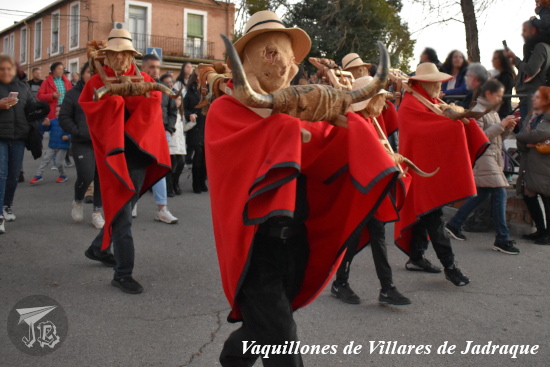
Botargas from different villages

Vaquillones de Villares de Jadraque

Furthermore, the four botargas from Guadalajara walked (and ran) after the kids and teenagers at the head of the parade. The Mascarones (Big Masks) from Guadalajara – a cultural association which has worked really hard on the recovery of the botargas – were clad in colourful rags – a lot of them were accompanied by their kids and toddlers in marching suits, with the children handing out candy to both enthusiastic and terrified onlooking kids. The botarga from Muduex, just recovered, received a lot of attention. The kids who were part of the parade often went to give child onlookers candy.

Every year there is a “guest botarga” in the parade. In 2024, the guests are the Hamarrachos de Navalacruz, a group of very druidic-like characters, preceded by their very own flagpole. Navalacruz is a village in the Ávila region, and they have a whole party of creatures – three types: the ones covered in oak leaves, the ones covered in a hay sack, and the ones covered in fur. They seem to represent ancient winter spirits (big Hogfather vibes).

Hamarrachos de Navalcruz Characters

Funnily enough, I was “attacked” three times – twice by the Devils from Luzón Diablos de Luzón. They paint their bodies black and carry cowbells on their belts, horns on their heads and big teeth made from potatoes – they painted my forehead and jawline black in two different occasions. Another time, one of the Vaquillones from Robledillo de Mohernando Vaquillones de Robledillo de Mohernando mock-charged at me. I startled and he was mortified. But it was all good. Oh, and at some other point one of the Mascaritas dumped a handful of confetti on me – I had found a great spot to take pictures: right in front of a potted plant on main street. I was not in the way, since they had to ditch the plant, but I could take pictures of the characters up front.
Botargaas Parade, different characters

Once the parade made it to Main Square, they were called by groups onto the stage. The child botarga did a little dance to show off their skills. The most impressive moment on that stage came with the exhibition of the Dancers of the Holy Child Danzantes del Santo Niño de Valdenuño Fernández. They carry batons that they use when they dance, slamming them against the batons that others carry in a very impressive display of coordination.

Botargas on the stage

Danzantes del Santo Niño clashing batons

The speech of the major had nothing of interest, just the usual political stuff. Mementos were handed to the recovered botarga, and the guests, and then came the Proclamation to open up the Carnival period. The speaker was someone I’ve never heard of – Pepe Sanz, president of a local Vespa and Lambretta motorbikes club. I think.

Unfortunately, as I had been following the parade, I had a horrible spot in Main Square, I could not see the stage at all – but I could use my phone above my head for pictures and videos, while the people in front of me blocked the barriers and played with their phones. I can’t even. After all the speeches, welcoming the Carnival and so on, all the botargas and characters headed back to where came from. I did not stay for the backtracking, because it was cold and it was time to get back home.

24th January 2024: Williams & Zimmer by the Hollywood Symphony Orchestra (Guadalajara, Spain)

I had a good day planned, but it turns out that life sometimes does not go as one wants, so in the end the fun part of it was reduced to attending a concert in the theatre Auditorio Buero Vallejo in Guadalajara. The Hollywood Symphony Orchestra was touring Spain with a repertoire of film soundtracks by Hans Zimmer and John Williams.

Williams And Zimmer promo

The Hollywood Symphony Orchestra (HSO), from Los Angeles, comprises some musicians who record original soundtracks for films. Originally just a recording orchestra with works dating back to 1953, from 2006 they hold concerts and radio broadcasts. Today it is dedicated to perform “live to picture” concerts, playing live music in synch with the original material from the film. I think it would be really cool to watch a whole film with them playing the score!

However, this is not what they brought this time. It was more “snippets” of films with a remix of the main themes. The “Best Cinema Music” La mejor música de cine comprised several pieces by probably two of the most famous composers ever.
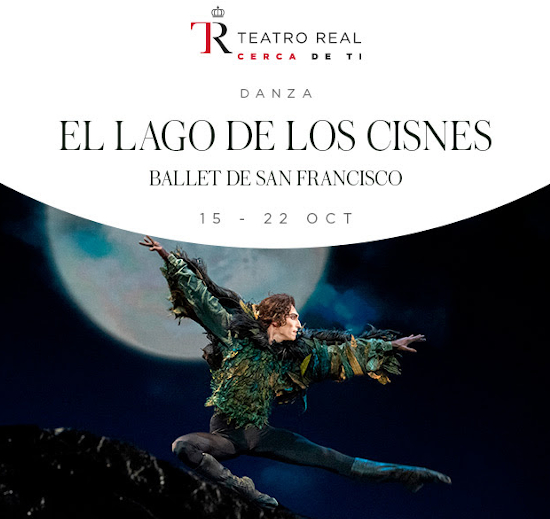
John Williams was born in 1932 and is still considered “an active composer and conductor”. Since his career started in 1954, he has been nominated for an Oscar 54 times, and he won five times – Fiddler on the Roof, Jaws, Star Wars, E.T. the Extra-Terrestrial and Schindler’s List. Hans Zimmer, a German film score composer and music producer, has been “only” nominated twelve times, with two wins – one for The Lion King and another for Dune. But he is more than 30 years younger than Williams, so I guess there is still time. Both of them have written film music I enjoy a lot (along with Howard Shore and Jerry Goldsmith), so I really wanted to go. I was even ready to brave the awful Guadalajara crowds and head to the theatre there.
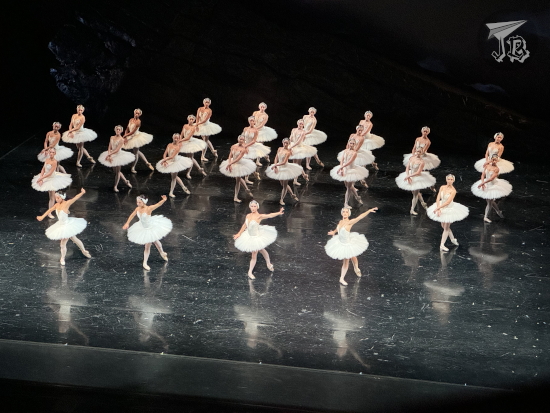
The whole concert lasted about two hours, in two parts with one interlude, and two pieces of encore – a total of 15 songs. The director was not introduced, but he looked nothing like the main director that the HSO webpage introduces. As set up, the orchestra was on stage and behind them, a screen showed scenes from the films whose soundtracks they were playing. They were not too well planned, though, because most of them had to run a time and a half before the music piece ended. I like this set up though, because it gives me something visual to look at while the music plays. For me, it is perfect – it is the same thing they’ve done before at the Final Fantasy live concerts.
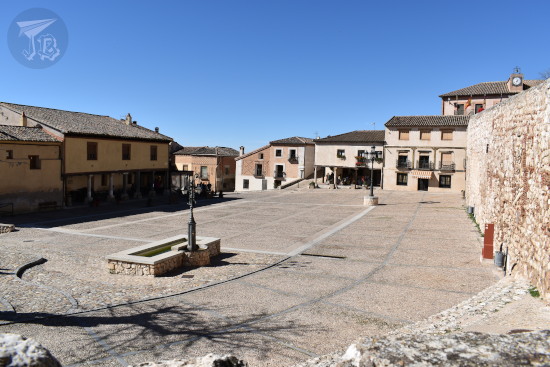
Setlist:

Part 1
  1. Main Title from Star Wars (Williams, 1977)
  2. The Lion King soundtrack medley (Zimmer, 1994)
  3. Superman Main Title Theme (Williams, 1978)
  4. Schindler’s List Theme (Williams, 1993)
  5. Pearl Harbor Suite (Zimmer, 2001)
  6. Now We Are Free, Gladiator main theme (Zimmer, 2000)
  7. The Raiders March, Main theme of the Indiana Jones films (Williams, 1982)
Part 2
  8. E.T. the Extra-terrestrial main theme (Williams, 1982)
  9. Main Theme from Jurassic Park (Williams, 1993)
  10. Molossus, Batman Begins main theme (Zimmer, 2005)
  11. Hymn to the Fallen, Saving Private Ryan main theme (Williams, 1998)
  12. Harry Potter Main Theme (Williams, 2001)
  13. He’s a Pirate, Pirates of the Caribbean main theme (Zimmer, 2003)
Encore
  14. Imperial March from Star Wars: Episode V – The Empire Strikes Back (Williams, 1980)
  15. The Raiders March, Main theme of the Indiana Jones films (Williams, 1982).

Hollywood Symphony Orchestra standing in front of an Indiana Jones photogram

All in all, the day did not pan out as I had planned it, but it did have a bit of an epic ending, and I was glad that I managed to squeeze the outing. I did miss hearing the theme of Jaws, but I got Jurassic Park, Pirates of the Caribbean and Indiana Jones. I have to admit that The Lion King was way intense (hello, inner child!). And I did not like the Gladiator film, but the rendition was epic. Most of it was. Except for E.T., which felt a bit too long, I thoroughly enjoyed the performance. A great way to end a not-so-good day.

Hollywood Symphony Orchestra in front of a Star Wars poster

Edit in January 2025. It seems this was not the Hollywood Symphony Orchestra at all, but a group of musicians impersonating them. During the 24/25 tour, the performance so bad that there were complaints and musicians got sacked and quit left and right. This rendition was good, to be honest, but I feel ripped off. Isn’t this fraud, technically? The reports of what happened in 2025 are surreal, with the ensemble impersonating two different orchestras for different repertories. Note to self: never trust promotor NK Prodarte.