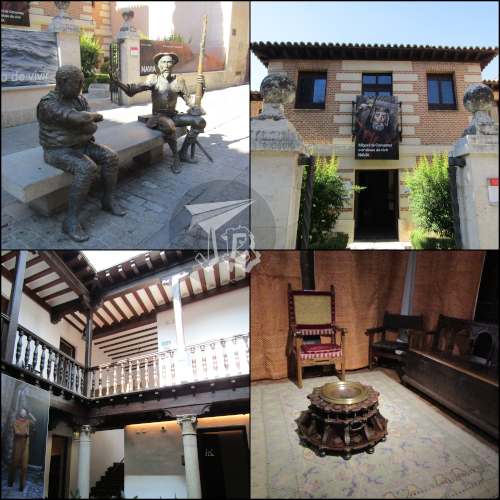
15th October 2021: Torija & Brihuega (Spain)

The castle of Torija is another of those things I’ve regularly driven by and thought ‘I have to visit one day’. Even though I had been warned that it might be disappointing as it had nothing inside but some touristic promo. Boy, was I in for a ride.

I arrived in Torija at around 10:30 in the morning and upon entrance I saw the demand that a reservation had to be made using a QR – the thing was free but it did not allow for 10:00 or 10:30 reservations – you had to pick it up for 11:00.

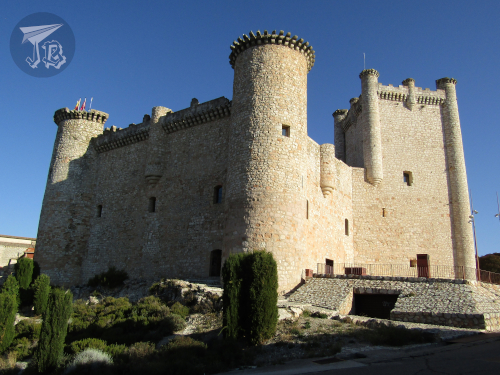
The castle Castillo de Torija was built in the 14th century, during a time of strife among all the factions and kingdoms of Spain. Later, in the 19th century, it was taken over by the French during the so-called Peninsular War against Napoleon’s troops, after basically the king Ferdinand VII gave Napoleon Spain wrapped in a bow. Napoleon made the king abdicate and installed his brother on the Spanish throne. There was a popular uprising in 1808 to fight off “the French”, who did not like this new attitude. During the war, the castle was occupied and then blown up. The current reconstruction dates back from 1962.

So there I was. The castle was empty – literally – but nobody was allowed before the reservation time because of ‘capacity rules’. So everybody in the castle was in the hall – yours truly, two other tourists, and four employees. All in the hall. Rules are rules again, but in the times of Covid, it feels utterly stupid to do this to ‘control capacity’ – since the rest of the castle was empty.

There was nothing really worthwhile to see in the castle – none of the interiors were even interesting and some of them were almost embarrassingly bad. Just a few pictures and models and mentions of the famous regional honey. I had been warned that it was going to be ‘disappointing’ but this was utterly ridiculous.

Thus, I continued off on my drive and I reached the village of Brihuega, which aside the lavender fields has a number of historical buildings and curiosities and was declared historical site in 1973. I had left the visit to this village for Friday because there were online tickets for the castle on sale, and therefore I had gathered that it was visitable that day. Right? Wrong, but that comes later.

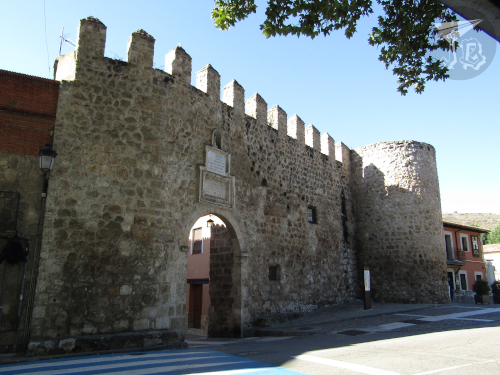
After being unable to find the spot I wanted my Sat-Nav to take me due to blocked streets, I dropped the car at a public parking lot at the edge of the village, then I walked towards the medieval core of the city. The first item I came across was one of the gates to the medieval wall Puerta de la Cadena.

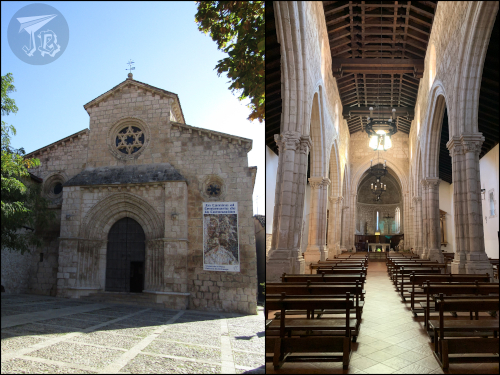
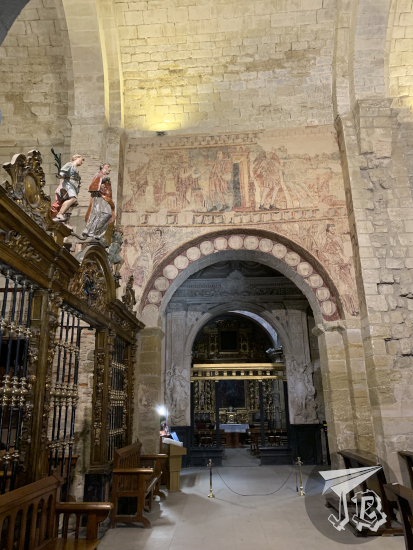
I strolled towards the centre but after a block or so I saw an archway that drew my attention. Upon turning towards it I found myself in front of the church of Saint Philip, Iglesia de San Felipe, which I had seen in my previous flash-trip. The church dates back from the 13th century, and it is a ‘transition’ church from the Romanesque to the Gothic building styles.

I backtracked towards the main street and reached the main square where the tourist information office stands. Here I learnt that there was going to be a popular festival the following day and that explained why some of the streets were blocked. After a quick stop at the tourist information office, where I got a map and a pamphlet, then I check about the process I had read for visiting the Arab caves – Cuevas Árabes. What the Internet told me was that I had to go to the butcher’s and ask the owner to let me in.

It was true – it turns out that the caves are private property and only he has decided to open up his. The Cuevas Árabes are a number of tunnels excavated into the rocky bed in the 10th and 11th centuries. They run around 8 km underneath the village, but only around 700 metres can be visited. The temperature is constant throughout the year at around 12ºC, so it is thought that they were used for food storage, and several sites say for wine. There are a number of large earthenware jars that are indeed used by winegrowers, but Arabs historical Arabs wouldn’t be drinking wine? I’d put my money on oil, but I really don’t have information to make more than a guess.

The butcher asked me what I wanted, I answered that I wanted to visit the caves. Then he proceeded to ask if I wouldn’t be scared – I paid (2.50€) and I went in after reassuring the guy I would be okay and he explained that I would also find some Visigoth archways, older than the Arab caves themselves and probably a starting point for them. The caves were the highlight of the day, really cool and mystifying, although I kept half-expeciting the owner to jump at me and try to scare me.

After the caves I headed out to the castle area, for which I had to cross another of the wall gates Arco de la Guía.

I found myself in a small square with the castle Castillo de la Peña Bermeja to my left. The castle is mixed with the graveyard in a very strange organisation. Unfortunately, it was closed (despite the fact that the website was selling tickets for the day – so glad I did not want to pay almost double in advance!). The castle is of Arab origin, built between the first and third centuries, and it gathers its name from the reddish colour of the mountain it stands on (Peña Bermeja means Vermillion Crag).

I also got to visit the inside of the church of Saint Mary, Iglesia de Santa María de la Peña by pure chance. The church was built during the 13th century, and it hosts the image of the patron virgin of the village.

Then I walked back towards the car, passing by the corridor they were building for the running of the bulls, I saw some more buildings, such as the convent of Saint Joseph, and the traditional fountains. Then I deviated towards the medieval walls Murallas de Brihuega, which was the last spot for my three-day on-and-off adventure.

Driving distance: Around 68 km (without counting the Sat-Nav merry-go-round)
Walking distance: 7.33 km

14th October 2021: Roman city of Complutum (Alcalá de Henares, Spain)

Around this time in 2020 I took a small tour around Alcalá de Henares. However, the Roman ruins were not near the town centre, and we exchanged walking there for a walking tour the university and the archaeological museum. This time I exclusively drove to the ruins (or tried to, somehow my phone and my GPS have different layouts, so ended up parking 15 minutes away when I should have parked… right by it).

Complutum was founded as a Roman town in the first century BCE, when the locals moved in looking for fertile lands for crops and cattle. The area, near the Roman road and at the bank of the river, was great – and who cared about the original Iberian settlers anyway? The city grew and a newer town started being built in the first century CE. Soon, the town became a religious (dedicated to the goddess Diana and the water nymphs), economic and strategic hub, so that several Roman roads (viae Romanae) started and died there. The town’s influence expanded for kilometres until the 8th century, when the Islamic population took over the city and the population re-settled to what is now the centre of Alcalá.

The city was eventually lost as the town developed around and over it, but part of it was excavated in the 19th century. The modern excavation was organised in the 1970s trying to salvage as much as could be from the urban developments. Most of the mosaics from the archaeological museum are from this time, apparently.

In the 1980s, the city of Alcalá decided to protect and excavate the town and as of now there are two areas that can be visited. However, they are separated and you have to walk or drive from one to the other.

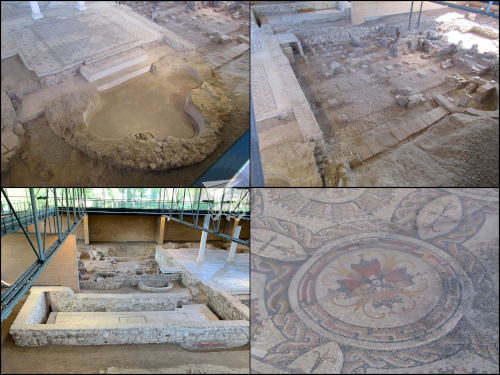
I first visited a building called Casa de Hippolytus, Hippolytus’ House, which was a school dormitory for boys. The building hosts a thermal area, a bathroom, and a garden.

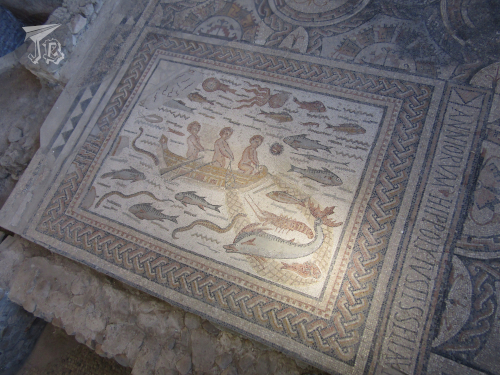
The key part of the house is the “fish mosaic”, commissioned by the rich family who sponsored the school (Anios) to the merchant Hippolytus, who signed the mosaic. The mosaic. is thought to have been a teaching tool as it depicts with a lot of detail a number of aquatic species from the Mediterranean Sea (in contrast with the people in the boat) – there is a dolphin, a sea urchin, a lobster, a cuttlefish, a moray eel, a sea bream…

I walked to the other site afterwards, Foro y Regio II, and it’s divided in several parts – it has a residential neighbourhood, some public buildings (therms, curia, basilica…), and the oracle building, along with remains of the sewers and water supplies.

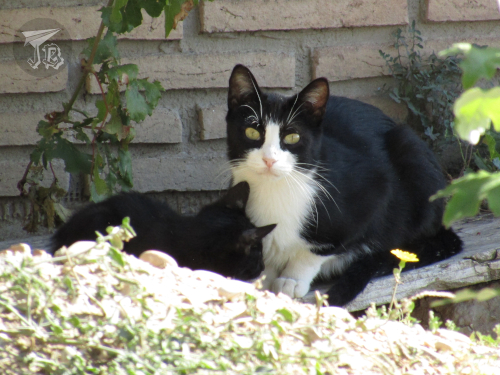
The most important building, called ‘the house of griffin’ due to to the decoration, was unfortunately closed. But you can be sure that the place is kept safe by the kitty queen on call and her dutiful apprentice.

Driving distance: around 64 km
Walking distance: 6.79 km
13th October 2021: Poblado de Villaflores (Spain)

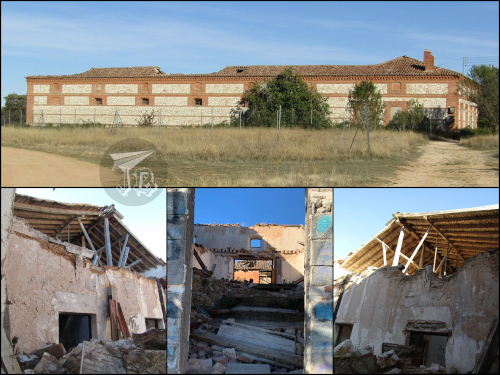
Poblado de Villaflores (Settlement of Villaflores) is a long-abandoned farm settlement was erected between 1886 and 1887. In 1882, María Diega Desmaissières y Sevillano, countess of Vega del Pozo and duchess of Sevillano (among other titles) came to own the land where the village now stands. She was known for her philanthropy and ordering several buildings be built. The settlement was one of these – the duchess commissioned architect Ricardo Velázquez Bosco to design a ‘rural colony’. The buildings were erected in limestone masonry and exposed brick, and the most important items in the settlement were the main hamlet, a dovecote, four several-family houses and a hermit church. There is confusing information on whether it has been declared an “interesting” or talks of the the declaration were finally archived.

I have driven by the settlement several times, but at one point I made up my mind to visit, even if the area has been in decline for years – as a matter of fact, a clock tower that used to be part of the hamlet collapsed in 2016, and the first alarms had been rung as early as 1980. Since then, most of the buildings have had the entrances either boarded up or walled, and the collapsed areas seem to unstable to come in explore. I wish I had decided to visit earlier, when real urbex was doable, but oh well.

The actual entrance to the area – which is paved – has been fenced off since at least 2011, despite the different announcements about recovering and restoring the settlement. However, next to the settlement there is an official cattle way (Cañada real ), used to guide the herds from winter to summer pastures (the practice of transhumance). This was a common practice in the Middle Ages, but it died away with time, and today most of them have been turned into hiking trails. The key thing is that as they cross roads, there are big clearings where you can park, and that is the way to go in this particular case. The area is named Cañada Real de las Matas (Área Recreativa Francisco Rodríguez).

At the edge of the holm oak (Quercus rotundifolia) forest, Chaparral de Villaflores someone installed a children recreational area and some tables and benches, maybe mid-1990s, and called it a park Parque del Sotillo. While the tables are still in use – judging by the rubbish around it – the swings and other elements have been plundered.

As I approached the hamlet, antigua casa de labranza, I saw the chicken wire fences but most of them were actually open and torn down, so I guess I just decided to wing it. The hamlet was open but I decided not to enter it, just in case I broke an ankle or something. This is the building that lost the clock tower, and the only one whose property is private – it belongs to a real estate company which at some point planned to develop the area, but backed out for some reason.

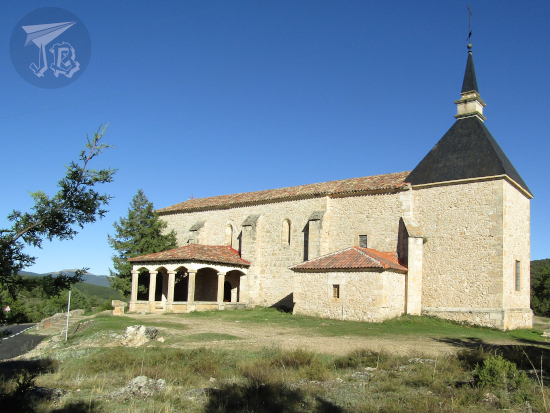
I went on to the church, which used to be consecrated to Saint Didacus of Alcalá – antigua ermita de San Diego de Alcalá.

I deviated towards the mill, then backtracked to the houses, crossing the actual road that is blocked. It is weird, seeing roundabouts in such a dilapidated place (≧▽≦). As I was exploring the houses, I heard shots and saw ducks try to fly away, so the cars I had come across, which I expected to belong to people looking for mushrooms ended up belonging to hunters.

That made me a bit apprehensive, but I was finally close to the most attention-grabbing building of the whole settlement – the dovecote, called La Tabalta in Spanish. It has two floors and it could home ten thousand doves – which were kept for recreative hunting in the 1880s.

I did not try to enter the winery because it was too dilapidated, nor the more modern barn, but this was a fun little visit that thankfully did not end up with me getting shot! I might try to visit this again in winter when there is less vegetation. Though since it is in the middle of nowhere the wind will be freezing…

Walking distance: 4.48 km

8th October 2021: Tamajón & Cogolludo (Spain)

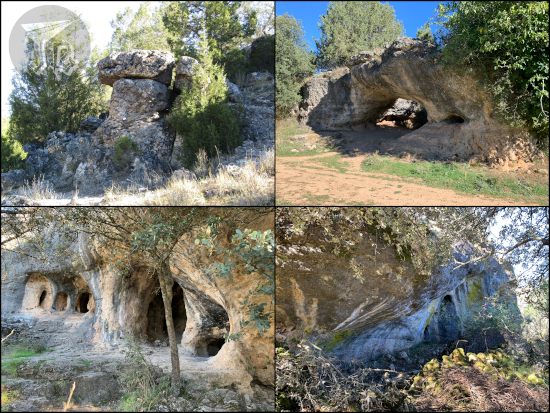
When I went to the waterfalls of the Aljibe I drove past a little village I had never heard of before – Tamajón, and a side sign reading “Pequeña Ciudad Encantada de Tamajón”. The term “Cuidad Encantada”, meaning Enchanted or Magic City, is used in Spanish to refer to karst formations. Karst is the name of a particular topography, created by the dissolution and chemical weathering of soluble rocks, chiefly but not just limestone.

The particular Spanish karst landscapes were formed by precipitation of salts – calcium carbonate – in the quiet waters of the Tethys Ocean during the Mesozoic Era (251-66 million years ago). Plate tectonics made central Spanish arise during the Cretaceous (the later subdivision of the Mesozoic, 140-66 million years ago) emerge, and the calcium carbonate became exposed to the elements, which started the erosion process. The most famous karst landscape in Spain is the Ciudad Encantada near Cuenca, which I guess spread the name.

Tamajón has a short hiking route around its karst formation, and while it is true that they are on the relatively smaller size, there are different shapes. I started my hiking route at the Ermita de la Virgen de los Enebrales, hermitage church dedicated to the Virgin of the Juniper Forest – the current building was reformed in the Renaissance style, thought the actual dates are shaky.

I started on the hiking route from the hermitage, along the road, and there were no markings there, so I kind of winged it for a while. After I took the first turn and started going up the rocks, I found the painting marking the routes – I had a handmade map because someone had shared it online, so I just went along it, and when I finished I redid about a fourth of it to take a detour to the other side of the road. There are cracks, arches, caves, cavities and capricious forms. I spent about an hour and a half walking around almost completely alone, which was awesome.

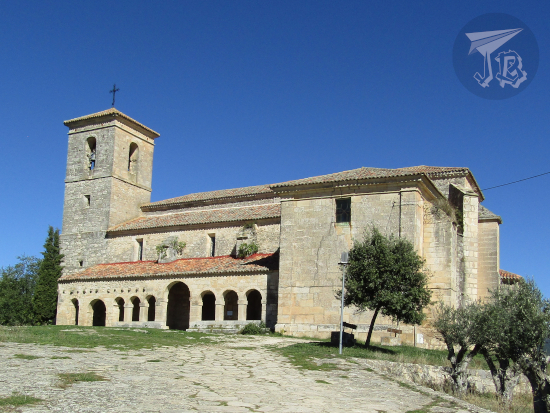
On my way back I stopped by the Church of the Assumption Iglesia de la Asunción, also a Romanesque – Renaissance mixture. The porch is typical of Romanesque churches in the Camino de Santiago (St. James’ Way), to shelter pilgrims.

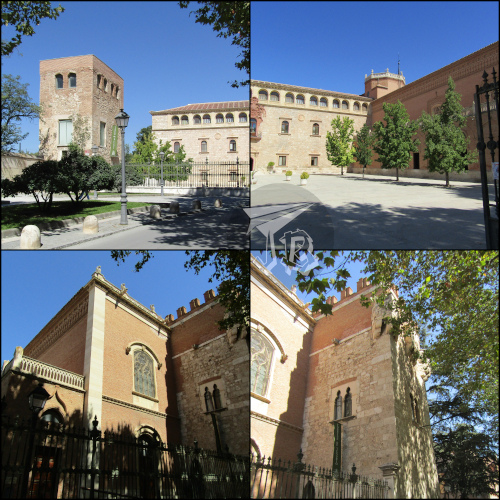
As it was still early and I was relatively close, instead of driving home I headed off to another village called Cogolludo. I parked the car at the edge of the village and walked towards the main square, where there is a famous Renaissance palace Palacio de los Duques de Medinaceli. It is considered the first Renaissance Palace built in Spain, and it is reported to have been finished in 1492. The palace was designed by Lorenzo Vázquez de Segovia, with exquisite decoration, and the blaring lack of towers, which were very popular at the time. If I’m ever in the area again I might want to try to see the interior, which is only open in the guided visits.

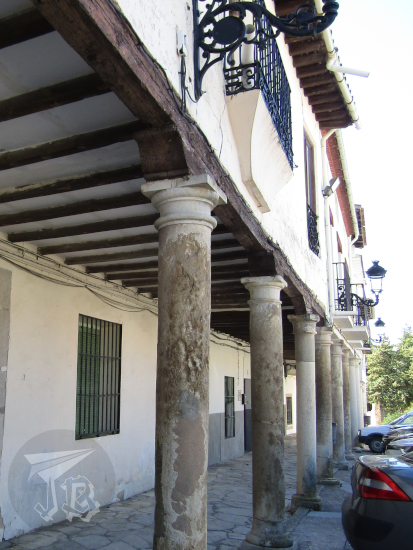
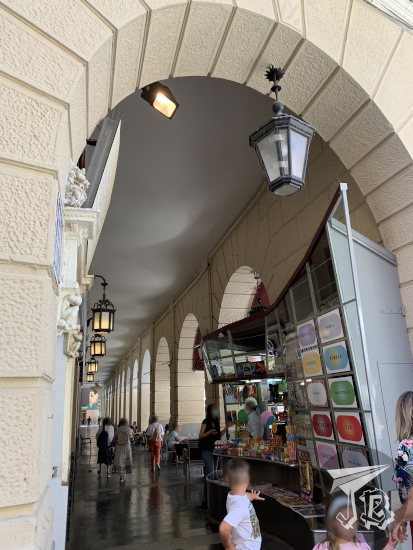
The Palace stands in the main square Plaza Mayor which has a typical Castilian arcade with stone columns (unfortunately workers, sun and cars made it hard to take a good picture of it).

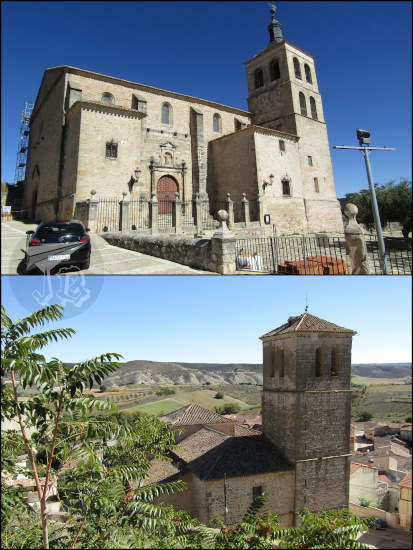
Cogolludo has two churches, Iglesia de Santa María de los Remedios (Our Lady of Remedies) and Iglesia de San Pedro (Saint Peter), both dating from the 16th century, but both completely closed down.

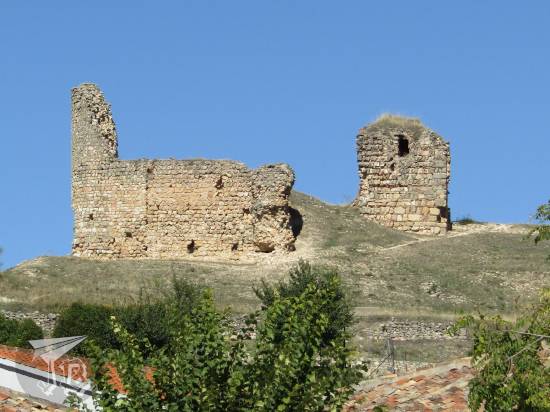
Finally, there are also the ruins of the Medieval Castle Castillo de Cogolludo, but there was not much incentive to climb up. All in all, it was a short but interesting morning – though I glad I teamed the two visits up, going to Cogolludo on its own would have not felt productive.

Driven distance: around 115 km
Walking distance: 7.27 km

8th September 2021: Impromptu Madrid Run! (Spain)

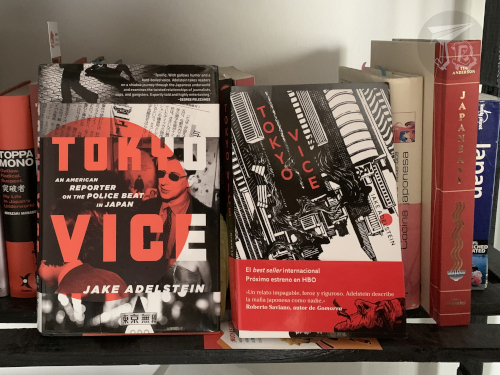
This was oh my god so unplanned that I kept improvising throughout the whole day! It all started because a Spanish publisher decided to translate a non-fiction book I’ve loved for ages – Tokyo Vice by Jake Adelstein. The publisher flew the author in for interviews, and I guess I was disappointed that no signing event was organised. I asked the author once and the publisher another time, then shrugged it off when I got no answer. There were some interviews scheduled for him, and a book fair coming up. I guessed it was just not meant to be, but I did feel disappointed.

And then, on the 7th, Mr Adelstein shot me a message that he would sign my book if I could go to Madrid and meet him at one of his breaks. As you can imagine I just… said yes (I could not meet him that very same evening because of travel times, but I could make it on the 8th. And there I went).

It was the first time taking the train since the whole pandemic thing (hell, I had not even been on a train since Paris 2020), and a weekday so I chose the times carefully to hopefully get close to as few people as possible – it worked, as both rides nobody sat next to me.

I arrived in Madrid and transferred easily, then got out at a new station in the area of Gran Vía. The Tokyo Vice book came out that day, so I wanted to go to a big book store that would hopefully have it already. My first stop, FNAC, failed miserably, so I went to La Casa del Libro, where they told me I would find the book in a completely different section where I actually did. But at least I had it in my hands, even if I had apparently not used my credit card for so long, I got the right PIN for the wrong card (≧▽≦).

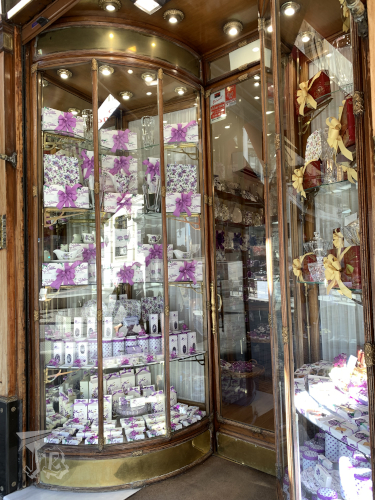
After I had the book in Spanish – I’ve owned a first edition copy in English since 2010 – I had thought that I should get a small detail for the author as he was making time for me. As he had to continue on his travelling, I decided to do something small and “consumable”, so I came up with buying some typical Madrid candy – violet sweets from La Violeta. I’d never been inside the shop, but it’s an adorable little place dating back to 1915.

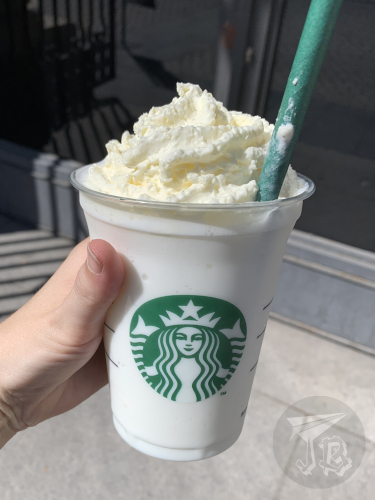
It was still early for my appointment at 14:00, so I decided to head towards a square that hosts an Egyptian temple of all things. On the way I made a stop at a Starbucks for a Vanilla Frappucino, I figured out that the amount of calories would get me going and I would not have to eat until I was back – looking back it was a weird thing, but it made sense in my head at the time. I strolled around the park next to the palace Palacio Real.

The way to the temple was completely blocked off due to construction, so I decided to backtrack. I walked up the great avenue in the middle of the city Gran Vía. As I walked around, minding my business and listening to music, I kept remembering a comic by Sarah Sanders, in which she makes fun of how people won’t leave you alone when you’re wearing headphones and, well, minding your own business.

I reached the square with the fountain to the goddess Cybele Fuente de la Cibeles and the related Palace Palacio de Comunicaciones (by Antonio Palacios). The fountain dates back to the 18th century, when king Carlos III revamped a lot of Madrid trying to make it more beautiful and similar to other European capitals.

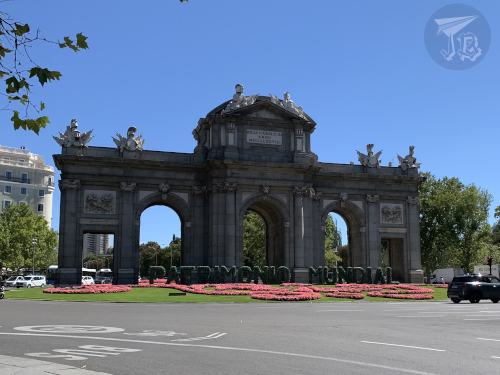
Carlos III is also responsible for the design of the modern version of one of the former wall gates, called the gate to Alcalá, the nearby town, Puerta de Alcalá. This area was declared Unesco World Heritage Site in summer 2021 as Paisaje de la Luz, so Madrid was in a celebratory mood.

I headed into the park Parque del Retiro, which is also included in the Heritage declaration. The park was initially built in the first half of the 17th century, as part of the royal recreational areas. Carlos III opened it up as public park a hundred years later. Aside from the obvious green areas, the park features fountains, palaces and sculptures. I walked past some of them. First I came across the fountain “of the turtles” Fuente de los Galápagos.

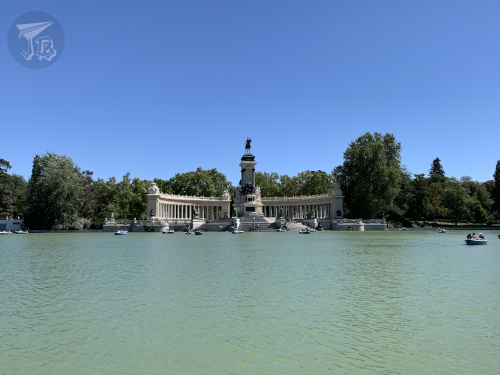
There is also a large pond, aptly called the big pond Estanque Grande del Retiro populated by carps, to whose side stands the monument to Alfonso XII – Monumento a Alfonso XII.

Nearby the pond stands the fountain called the artichoke fountain, Fuente de la alcachofa.

I walked to the fountain that depicts the fall of Lucifer from Heaven, Fuente del Ángel Caído. The fountain itself was built in order to exhibit the sculpture by Ricardo Bellve, who originally created it in plaster. The figure would then be cast in iron for the World Exhibit of 1878 in Paris, and eventually placed in the Retiro.

I strolled back towards one of my favourite points in the park, but that’s because I like iron-and-glass architecture – a little building called Palacio de Cristal, which has a small pond around.

Finally I headed over the little café where I had arranged to meet with Mr Adelstein. He arrived shortly after. He signed my book, but truth be told, I had also brought my first-edition copy, which happens to be full of post-its from the first time I read it. He was happy to sign that one too, and to my eternal mortification… he went over all the notes. I almost died right then and there. We chatted for a little, I gave him the violet candy and he had some umeboshi sweets for me too. I babbled that I was very happy that he had made some time for me, and he told me “but you were so polite on twitter and the publisher said no signatures!” and I kind of died again.

In the end, our meeting was only 15 minutes, but I have not felt so happy in a very long time – that he specifically took time felt amazing. We took pictures and even had a safe mask-hug. Afterwards I headed towards the nearest train station so I could be on my way before the afternoon rush came through, so that was it for the day.

Walking distance: 12.39 km
22nd August 2021: Romanesque Soria {Spain, summer 2021}

We just spent the morning in Soria, in the region of Castilla y León, before we got on our way back in the early afternoon, but I have to say that the good morning sunset was spectacular.

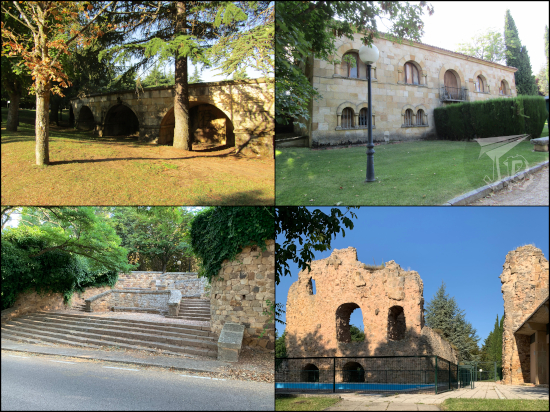
As again we had a breakfast slot at 8:00, we were out to see stuff at around 9:00. The Parador de Soria is located on the top of the Castle Park Parque del Castillo, we just had to go down. First we came across some of the ruins and the buildings that had populated the area in Medieval times.

As we continued our trek downwards we ended up at the church of Our Lady of the Thorn Iglesia de Nuestra Señora del Espino, which was closed as it was still early on a Sunday morning.

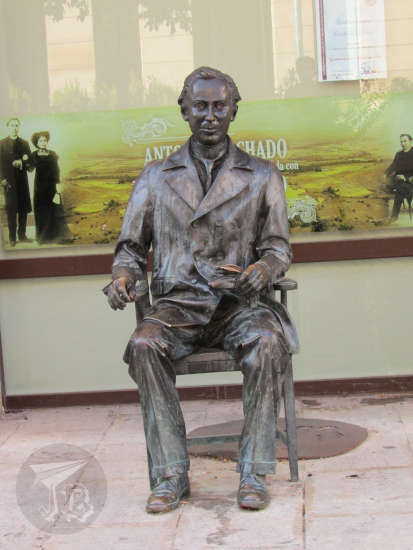
In the tiny garden in front of the church there is a dead tree that has been preserved by pouring fibreglass and other synthetic materials on it – the dry elm tree, Olmo Seco. In 1912, the Spanish poet Antonio Machado wrote a poem – to an old elm tree, struck by lightning and half-rotten, which has sprouted a few green leaves after April rain and May sun… Well, this is the tree, preserved for all to see, with the poem in a small sign (and another in Braille) right next to it.

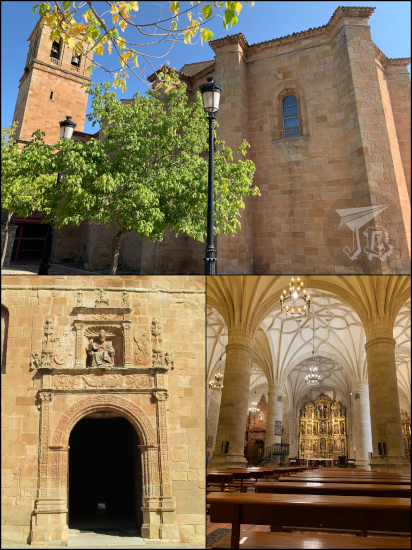
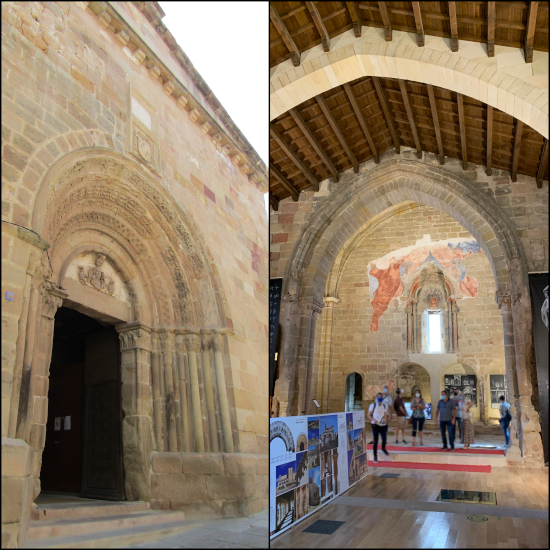
After staying there for a few minutes, we went on our trek downwards and we reached another church, the church of St. John San Juan de la Rabanera. It is known that the church had already been built in 1270. In the Renaissance and Baroque periods it was heavily remodelled, but restorations during the 20th century recovered most of the Romanesque purity. The main portal, although Romanesque too, used to be part of another church. The apse keeps all the Romanesque decoration – unfortunately, it was closed too.

We kept strolling around the town centre and came across a bunch of palaces – some of them have been repurposed into public-service buildigns such as the local government, revenue and taxes services, town’s archive, a high school… others were for sale or rent.

In front of the high school we found the sculpture to the poet I mentioned before, Escultura a Antonio Machado.

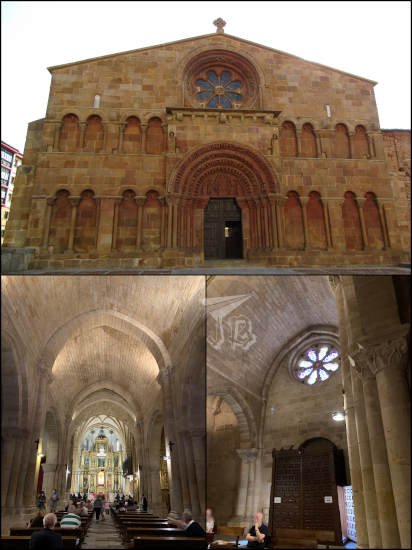
Not far from there we found the church of Saint Dominic Iglesia de Santo Domingo. Like the church of St. John, it is a reformed Romanesque temple. The most important and impressive part of the church is the main façade, in golden stone with amazing carvings (considered by some the best Romanesque façade in the country), and a rose window.

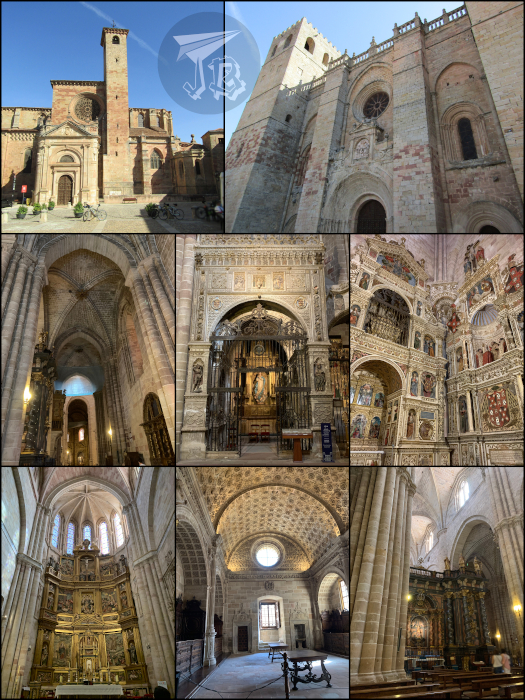
We decided to try to find the co-cathedral of St Peter Concatedral de San Pedro. Dating back from the 12th century, on the outside, it just looks like yet another Romanesque church, but that changes when you enter. When it is illuminated, the church seems to glow.

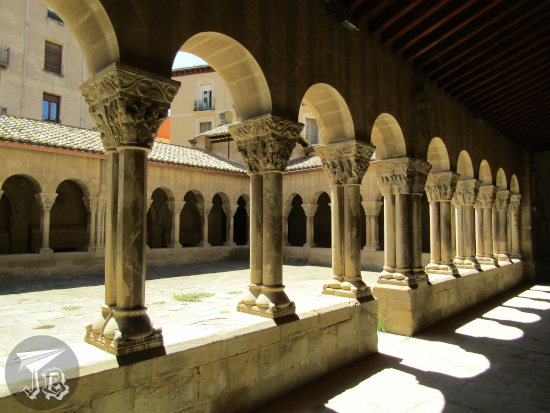
Furthermore, you can access the cloister of the former collegiate, which was also built in the 12th century as part of a now-disappeared monastery.

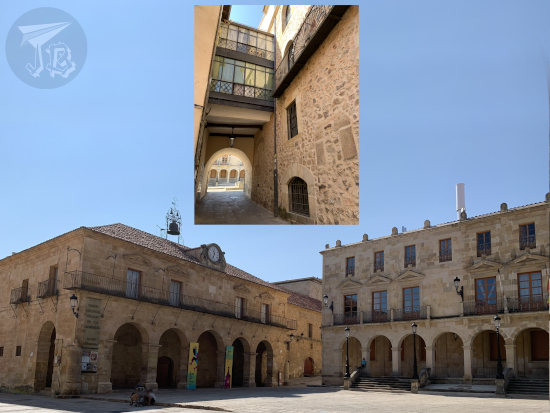
We walked back to the centre of the town. We left the main square Plaza Mayor de Soria, which I accessed through a tiny archway delimited by coloured windows, named Arco del Cuerno.

We ended up at main park Alameda de Cervantes.

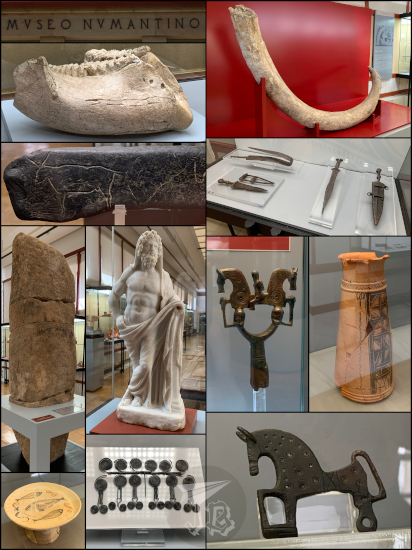
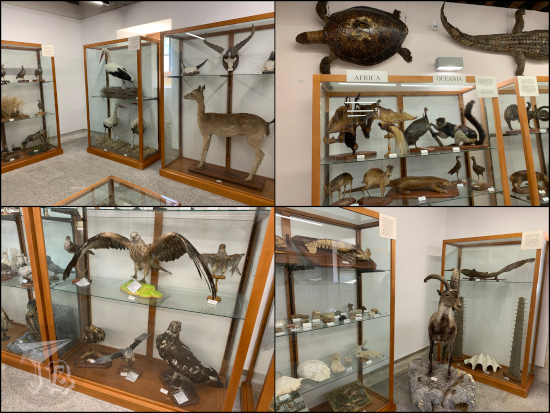
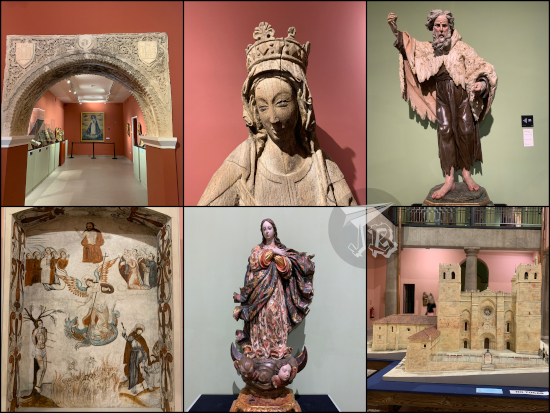
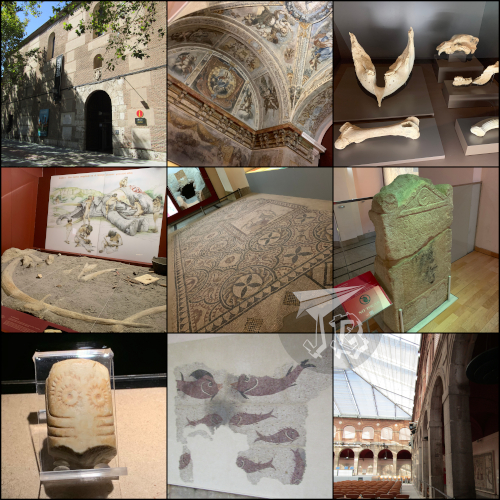
However, we were more interested in seeing the archaeological museum Museo Numantino, which was open by then – it holds a few ancient straight-Tusked elephant (Elephas antiquus), Pehistoric art, and most of the artefacts that have been found in Numantia, both Roman and Celtiberian, including Roman statues, Celtiberian weapons and drinking jars and the most famous relic of all: a tiny horse-shaped fibula (brooch) that has been adopted as the symbol of Soria.

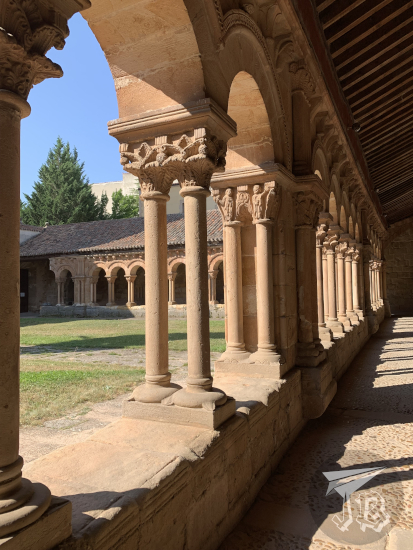
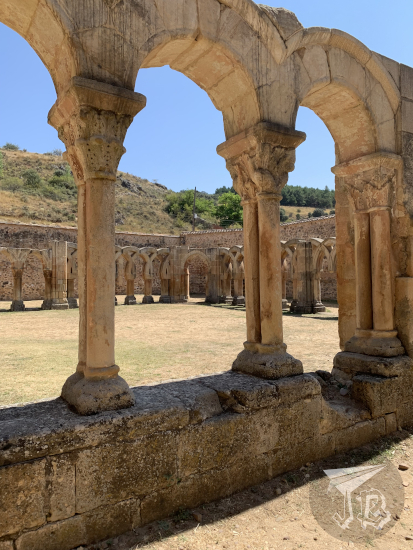
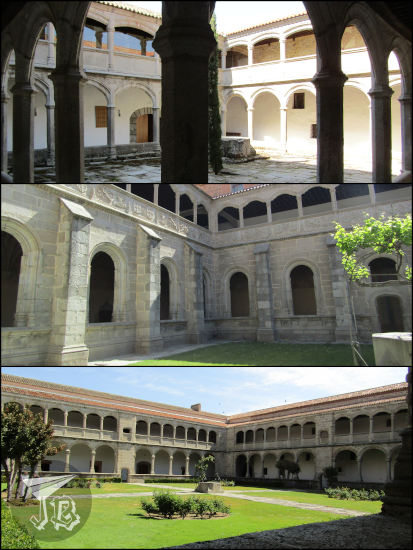
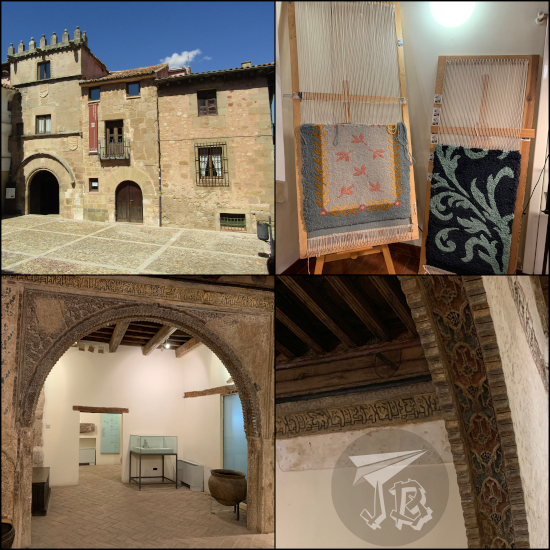
Finally, on our way out, we stopped at the ruins of the monastery of Saint John of the Douro, commonly just referred to as “archway” and not monastery Arcos de San Juan de Duero, a very cool cloister with different arc styles – a typical Romanesque one from the 13th century, and a second one that might have had Arab influence.

And with this, we drove back home for around 170 km after walking for 6.57 km. Fingers crossed for the next adventure working out!

21st August 2021: Fossil tracks and Roman ruins {Spain, summer 2021}

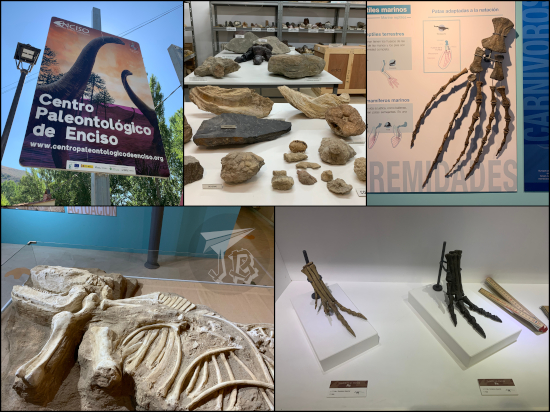
Enciso is a couple of hours away from Sos del Rey Católico, but to be honest it is barely even on the map. It is a tiny little village in the area of La Rioja that I had not even heard of a year ago. But at some point during this year I became aware of it – and its palaeontological importance as it is the reference point for a dozen or so sites where ichnites have been found. Ichnites or fossil tracks are marks left by dinosaurs and other prehistoric animals on the mud that eventually become fossilised. In this little village in the middle of nowhere there are around 1,400 dinosaur foot tracks. When we were in Albarracín, we saw a bunch of fossils from the time Spain was submerged under the ocean. During the Mesozoic, the area of La Rioja, and the neighbouring Soria (Castilla y León), were somewhat swampy, which lead to a lot of mud. When dinosaurs and other animals moved through the mud, they left trails that sometimes became fossilised.

Our first stop in the village was the palaeontological museum Centro Paleontológico de Enciso . This one we could have skipped – it has next to no original pieces, and it basically just has a few infographics and reproductions of different types of dinosaur legs, but we had to start somewhere.

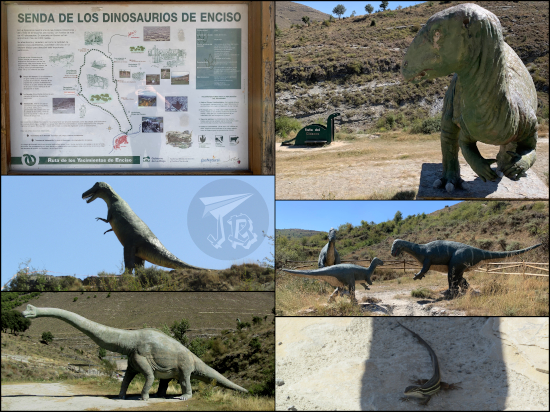
We visited two fossil track sites. The first one was a long strip of rock called Yacimiento de Valdecevillo . In this site, there are tracks of theropods (carnivores with three fingers, usually bipeds that left clawy marks), ornithopods (herbivores with three fingers, also bipeds, that left somewhat more rounded tracks), and sauropods (four-legged dinosaurs with less-defined fingers). Some of the tracks are very easy to identify (especially the ones fenced off), others are chalked on, and sometimes they even cross each other.

Next to the rock formation, a few reproductions have been built, in order to illustrate what dinosaurs roamed the area. A family of iguanodon has been clearly identified. The sauropod looks like a generic brachiosaurus, but it could have been a turiasaurus, even. I have to say though that the carnivore theropod needs a bit of an update – but it looked adorably like those that they drew when I was a kid back in the 80s. Oh, and we also saw a real-life present-day minisaurus (aka lizard, maaaaaaaybe Spanish psammodromus Psammodromus hispanicus).

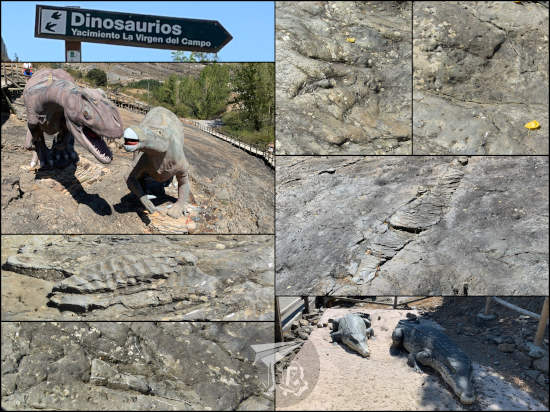
It was too hot to walk around the trail, so we hopped onto the car and drove off to the other site, Yacimiento de la Virgen del Campo.
In this formation you can “feel” the mud – the rock has ripples (water marks), and here is even a small mud collapse from an earthquake. Here we saw foot tracks again, marks of skin, and even tail trails left by ancient crocodiles. In this site there are indications of a carnivore attacking a herbivore, represented by 1:1 sculptures (maybe a ceratosaurus and an iguanodon).

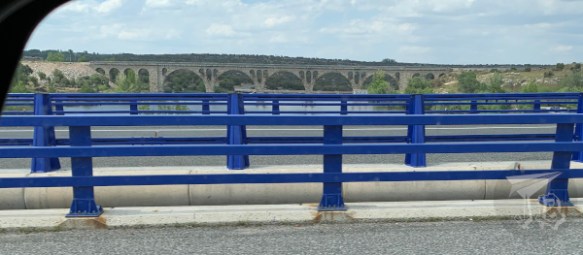
Around 13:00 we got back on the car and drove off to the town of Garray for lunch and a rest near the river…s. Río Tera, a smaller current, joins one of the most important rivers in Spain, Río Duero (Douro River) under the unnamed stone bridge.

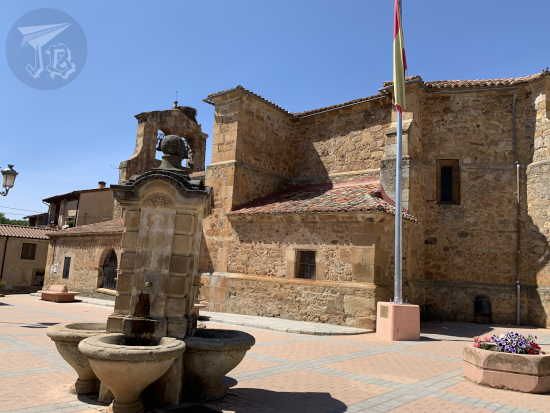
We managed to have lunch in one of the few restaurants in town, in front of the municipal fountain and the church of Saint John the Baptist Iglesia San Juan Bautista. After lunch we stayed at the river bank for a while before we moved towards our next stop.

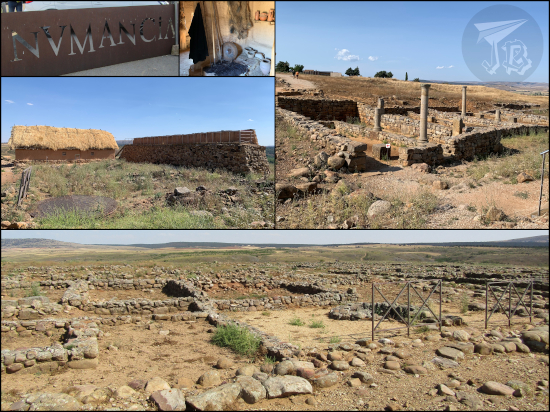
The archaeological site of Numantia Yacimiento arqueológico de Numancia holds the remains of a Roman town, built upon an earlier Celtiberian settlement. The Celtiberian town was the centre of a number of hostilities against the Romans in the second century BCE – the Numantine War, the third of the Celtiberian Wars broke out in 143 BCE. After a decade, the Romans sent one of the heroes of the Third Punic war to suffocate the rebellion. The general cut down all the trees in the area and built a barrier around the settlement, in what has been called the Siege of Numantia, in 133 BCE. The town was completely cut off the rest of the world and after eight months of siege, the inhabitants set the town on fire. Most of them committed suicide in order to avoid being taken as slaves.

After the Roman conquerors levelled the ruins, a new town emerged, and a Roman settlement existed in the area between the first and fourth centuries CE. The last remains date back from the sixth century before the town vanished from existence and memory until it was located in the late 19th century.

Today, the site holds remains and patterns for several houses, and it has a reconstructed Roman house, an Iberian house and two pieces of the wall. The most visual building is a Roman house of the later period which still keeps a couple of columns. Unfortunately, this was 16:30 and the guided visit was long and full of useless and dull information – guess who got a sunburnt, even under an umbrella?

When we were done with Numantia, we decided to skip the complementary exhibition in Garray and drove off towards Soria, where we would be staying the night.

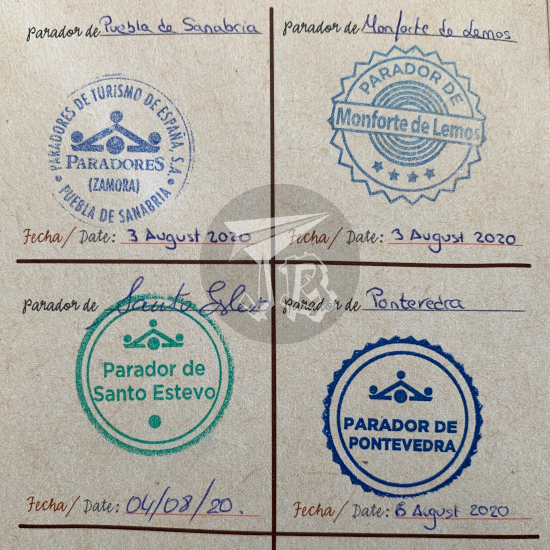
The Parador de Soria, our hotel, is the first modern Parador I’ve stayed in, though it stands on the mountain where the castle used to be, and the views were astonishing (I also almost forgot my stamp!!). We had dinner in the parador, which included some freshly-fried torreznos de Soria. Torreznos are a pork-based snack especially typical in the area. The pork belly is marinated with salt and paprika, cured or smoked, and finally fried – delicious but for sure a “sometimes food”. After dinner, we went to our rooms to compare the day-view with the night-view and admire the moon.

Total driven distance: 196 km. Total walking distance: 6.57 km.

20th August 2021: A Monastery and a Castle… again {Spain, summer 2021}

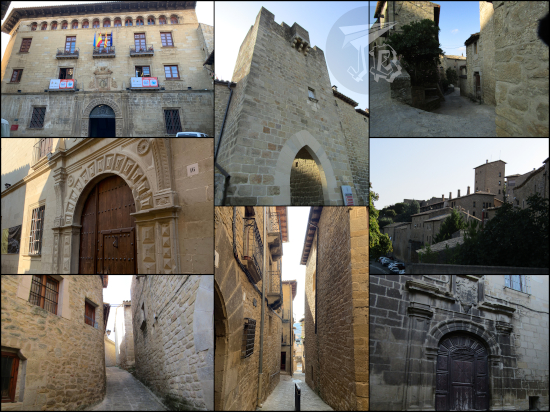
Sos del Rey Católico, formerly just Sos, is a small town still in the province of Zaragoza in Aragón. Its historical centre is so historical that it has been around since the 1400s. In 1452, the infante Fernando, who would go on to become the Catholic King, was born there. Back in the Middle Ages, the Kingdoms of Aragón and Castille became intertwined when Queen Isabel I of Castille and Fernando II of Aragón got married, earning the moniker of Catholic Monarchs due to their relentless fight against the Muslim Caliphates that had conquered the country long before. The trick of their marriage was that both of them remained the king / queen of their own kingdom in a very delicate equilibrium that sometimes was referred to as tanto monta.

A walk through the town yields to viewing a lot of Medieval buildings and palaces – too many to keep tack of. The wall is still standing in several places, built around the natural rock in order to make the most of the natural defences. There are a number of palaces that have been repurposed with new functions – the town hall, a school, and so on, and you can see them all in a short stroll, which we of course took. We left the hotel at around 9 in the morning because our breakfast turn was from 8:00 to 8:30 and there was not much else to do anyway.

The second reason why Sos del Rey Católico became known was the filming of an absurd Spanish comedy back in 1985. Thus, the village erected a sculpture to the director, Luis García Berlanga, Estatua a Berlanga.

The sculpture lies at the feet of the church of Saint Stephen Parroquia de San Esteban, which we could not enter, unfortunately, due to a scheduling conflict. The church has a Romanesque-style entrance carved in the 12th century, but protected from the elements by an outer portico from the 16th century. The church has an interesting shape, which tunnels and stairs, owning to the actual relief of the area.

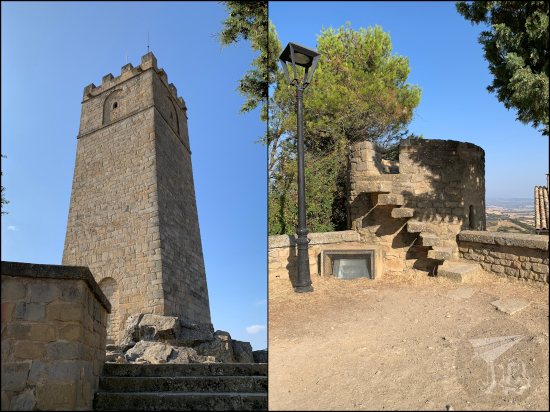
Beyond the church stands the remains of the castle Castillo de Sos del Rey Católico, out of which the keep and a little turret still stand, albeit heavily restored. The old town was a frontier fortified area between the kingdoms of Navarra and Aragón, and it was a strategic point in Medieval times. This is why Fernando II’s mother fled there when the war started and why Fernando was born there.

The short climb yields to being able to survey the surroundings.

The whole “Fernando the Catholic King” was born here reaches its peak in the old palace called Palacio de Sada, where the King was born. Today they have turned it into an “interpretation museum” and holds some panels, an audiovisual, and reproductions of both the Catholic Monarch’s Last Will and Testament. The highlight of the palace is the Romanesque chapel and former Church of Saint Martin, Iglesia de San Martín de Tours, which still shows the painting and polychrome on the altar walls.

Shortly after 11 we went back to the car to drive to the other side of the Aragón – Navarra border, both the old kingdoms and the current areas. We had a booking for the monastery of Leyre Monasterio de Leyre at 12:30 and considering how much our Sat-Nav was trolling us we wanted to give ourself an hour of leeway. The device behaved itself and we arrived there at the right time.

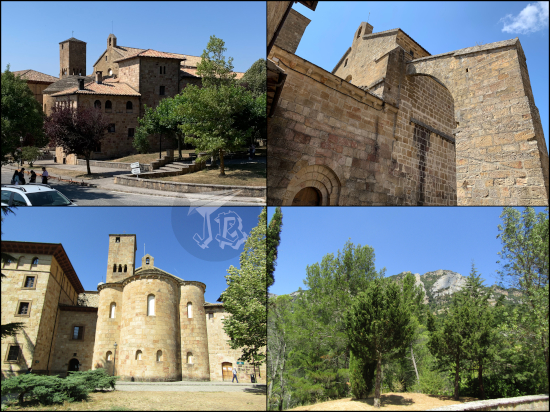
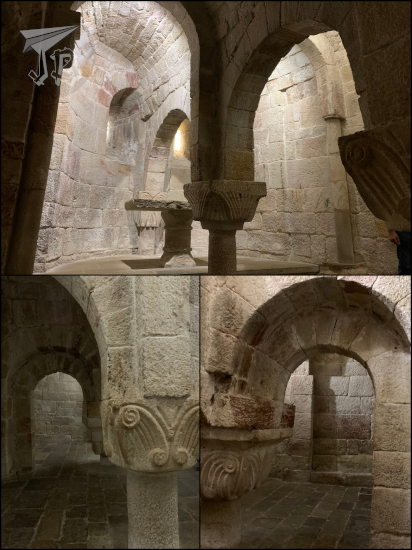
Leyre is a still-active Benedictine monastery has been rebuilt and renovated, but at its core stands the church of Leyre. Standing in the middle of the mountains, it used to be a fortified monastery.

The church is based on an early Romanesque “crypt” whose goal was to flatten the terrain in order for the church to be built above it. It is an amazing engineering work, and not at all usual.

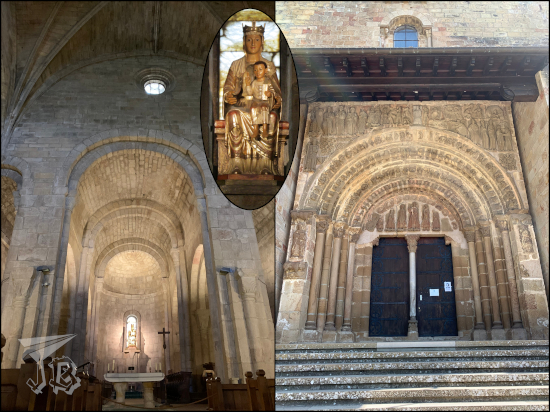
The original Romanesque church was consecrated in 1057, and it is one of the most impressive and highest Romanesque buildings I’ve ever seen. The main nave is also Romanesque, but the dome is already Gothic. There is a beautiful sculpture of the Virgin of Leyre. The entrance of the church is magnificent, carved in the 12th century with dozens of carving in stone.

We were lucky enough to have timed the visit with the monks’ Sext prayer, in Latin and Spanish, and mostly sung in the Gregorian style. Ah, and this was also a burial point for the Monarchs, but this time of Navarra… then again, eventually the Kingdoms of Navarra and Aragón became one so…

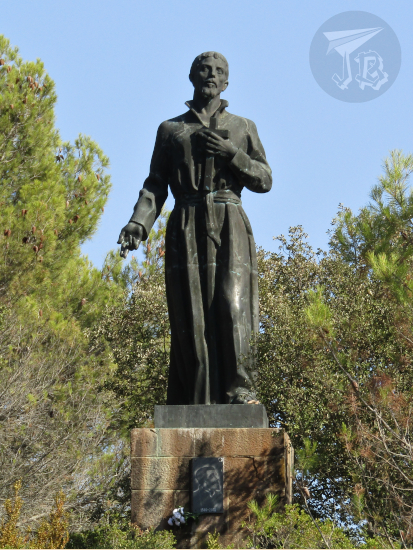
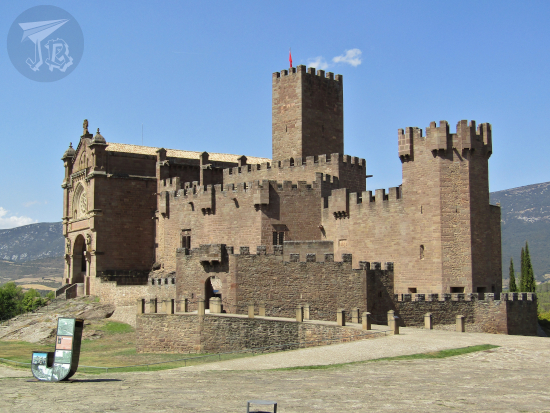
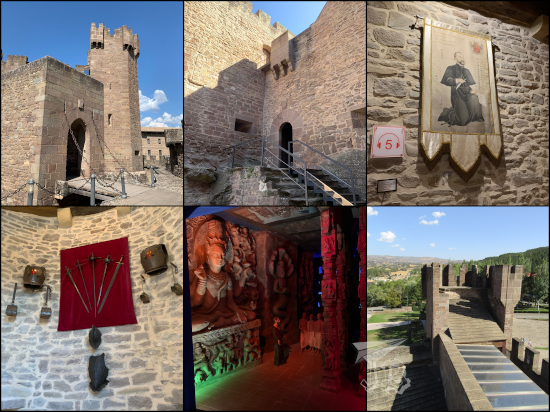
After Leyre, we got onto the car again and crossed over to the other side of the highway to the Castle of Xavier Castillo de Javier. We had lunch around the castle before we even approached the building, under Saint Francis Xavier’s glance.

The castle was the birthplace and childhood home of this Catholic saint (born 1506), famous for trying to spread Christianity in India, South-East Asia and Japan. He was a co-founder of the Jesuit order, which owns the castle now. The building has been turned into a museum about the saint.

The origins of the castle date from the 10th century, though most of its current appearance can be traced to the 11th and 13th century. Later the towers were destroyed, and in the 19th century they were re-erected, and the adjacent basilica was built. There is also a reconstructed little church were the saint was christened.

The inside of the castle holds some items from Francis Xavier’s times – real or not – some Japanese paintings and scrolls, trinkets that were brought from Asia during the preaching missions, and a bunch of dioramas. You can climb up to the keep and look at the surrounding area. Unfortunately, the guide was horrid and he just regurgitated facts that were dubious or plain wrong – for example, he claimed that a diorama that looks like a Hindu temple represented the Emperor of Japan.

One of the most interesting artefacts in the castle is a late-Gothic oak carving of Christ on the cross, which sports a faint smile. The piece is located in a tiny chapel decorated with dancing skeletons referring to the Latin expression “Carpe Diem” (seize the day).

After the castle we drove over the “border” back to Sos del Rey Católico, and after a shower and a drink, I decided to explore de historical building of our hotel, Parador de Sos del Rey Católico, and the gardens.

Driven distance: 56 km. Walking distance: 6.17 km.

19th August 2021: A Monastery and a Castle {Spain, summer 2021}

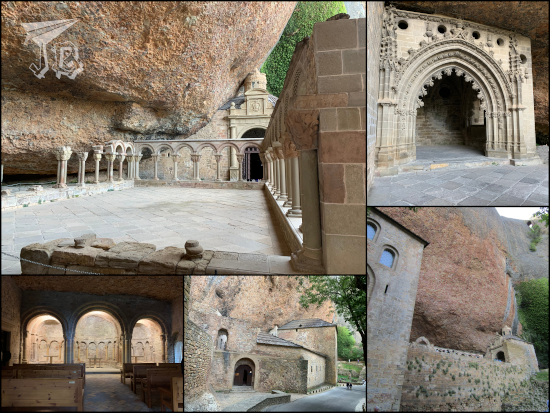
We packed up and in the morning, we continued out trip, heading generally westward towards our next destination, which was about an hour and twenty minutes away. Unfortunately, we got on a slight disagreement with the Sat-Nav again – it sent us through the secondary road and in the end we took two hours going through the curves. Thus, around 10 am we managed to get our tickets to the “royal” monastery Real Monasterio de San Juan de la Peña – which is in the middle of nowhere but technically belongs to Jaca.

The monastery is actually two (or three, depending on how you look at it). The old monastery, Monasterio Viejo de San Juan de la Peña was built in the Romanesque style, and dates back from the tenth century. Its origins, however, seem to be more obscure, related to Iberian and pagan rituals. It is excavated into / built onto the vertical wall of a natural cove occurring in a bare-rock hill or crag in the middle of the forest. It held a convent, a church, and a cloister on the first floor. From the time it was built till the time it was confiscated by the government in the 19th century, it became one of the burial points for the monarchs of the old Kingdom of Aragón and Navarra, thus the “royal” eponym.

One of the many legends regarding the monastery is that it was home to the Holy Grail between the 11th and the 14th century. Later, in the 17th century, there was a fire, and it was decided to build a new monastery. Here is what is weird – there is a building there now, the so-called new monastery Monasterio Nuevo de San Juan de la Peña. Some of the buildings have survived, but most of it is an archaeological museum / excavation of what was there, again until the liberal confiscation.

Issues: You can only visit the old monastery after buying your tickets at the new monastery. And to get from one monastery to the other, you need to take the shuttle, again, awesome during Covid times. Furthermore, there was no control of the number of people there, which resulted in an overcrowding that would have been uncomfortable in normal times, much more during the pandemic. While the bus makes sense due to the fact that there is literally no way to park around the old monastery, some crowd managing would have been necessary.

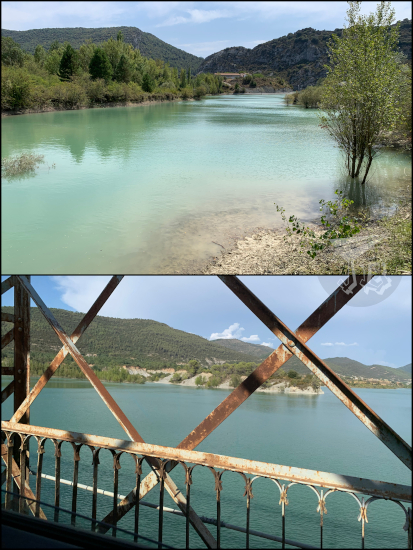
After visiting both monasteries, we went back to the awful road. I don’t know if it was the curves, the heat, that I had overdone it the day before, or all of the above but I was not feeling well. Thankfully after some food and a stop at the water reservoir Embalse de la Peña, I felt better.

We continued our way and made a stop to look at an interesting geological feature called Mallos de Riglos, which are several almost-detached vertical walls of conglomerate rock left behind by erosive processes that dragged away what used to be around them. They stand up to 275 metres high over the river Río Gállego.

This was a short stop from a viewpoint, but we soon drove on towards the next destination – after one of the most important buildings in religious Romanesque architecture, we were going to see a civil counterpart, the (self-reportedly) best-preserved Romanesque castle in the world: Castillo de Loarre. The truth is that, from afar it looks awesomely cool, though once you are inside, it loses a bit of its appeal as there is no perspective. Besides, it was too hot to hike down the hill for good views.

The keep is built on a rocky hill, and the surrounding buildings are connected to it by a number of doors and haphazard stairs and arcs. Both the main towers and the fortified wall were erected around 1287, in a strategic point between the Muslim and the Christian kingdoms battling over the place. As the Christians expanded their influence, the Muslim tribes retreated towards the Mediterranean, leaving the castle “jobless” in a way, and the castle decayed until it was restored (twice) in the 20th century.

After the castle, we went back to the car, and from there I fought the Sat-Nav (I was not the driver). When I saw that it wanted to send us through another god-forsaken secondary road full of curves for over a hundred kilometres, I advocated for 123 km of main roads and highways. I won (^◇^)y, and around half past seven we arrived in our next destination Sos del Rey Católico, where we would be staying at the Parador for two nights (of course, I got my stamp there). A great improvement from the hotel in Torla-Ordesa, and a welcome one, with awesome sunset views to go with it.
Total driven distance: 272 km. Maybe around five hours and a bit? Some of the roads felt eternal.
Total walked distance: 5.23 km.

17th August 2021: Towards the Pyrenees, via the cathedrals {Spain, summer 2021}

The total driven distance today was around 450 km, but we did that in three legs with with two visits in-between.

The first stop was Huesca, in the province of the same name, in Aragón. After ditching the car (and having our first Sat-nav disagreement for the trip), we walked towards the city centre. The first thing we peered into was a little grocer’s shop Ultramarinos La Confianza, which dates back to 1871 and is reported to be the longest-running grocer’s in Spain. Unfortunately, due to Covid restrictions there was a queue outside and we could only see it from the outside.

We proceeded to the cathedral of the Lord’s Transfiguration Catedral de la Transfiguración del Señor, a Gothic-style building that stands in the centre of the town, just in front of the council hall. The cathedral has only one tower which used to be crowned by a spire, but that was lost during the civil war. The main gate is decorated with carvings of the Apostles.

However, we did not enter through the main gate, but the lateral one which gave us access to the religious museum of the cathedral Museo Diocesano de Huesca. The museum has several art pieces from different periods, and gives access to the Gothic cloister of the cathedral, and to older structures, among them, a peek into the original Romanesque cloister.

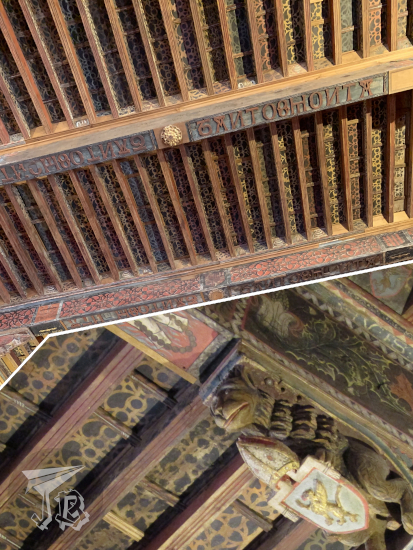
Adjacent to the cathedral stands the Bishop’s palace, also part of the museum. The most impressive part is the hall called Salón del Tanto Monta , which sports a Mudejar wooden ceiling carved and polychrome in 1478, restored twice since then. The wording “Tanto Monta” refer to the Catholic King Fernando, indicating that he had as much importance in his wife’s kingdom as she did – I’ll get into that history titbit another day though.

We finally walked into the cathedral itself, which is presided by the high altar made from alabaster and sculpted in the 16th century by Damián Forment, the most important sculptor at the time.

Again due to Covid, we could not visit the council hall and see the painting that illustrates a rather sordid legend – the king Ramiro II called upon some treacherous noblemen under the excuse to show them “the greatest bell in the kingdom” and beheaded all of them. Some of the legends add that he used one of the severed heads as a clapper. The town hall hosts a painting by José Casado del Alisal depicting this side of the legend, even though it has been long debunked. What was open was the little church in the convent Monasterio de Nuestra Señora de la Asunción, though the most interesting part of the monastery is the building itself, in a very characteristic style using bricks that reminds of the Mudejar style.

The next stop was another monastery San Pedro el Viejo, one of the oldest Romanesque buildings in Spain. The church was used as Royal Pantheon and some of the old Monarchs of the former Kingdom of Aragón are buried there. Though it has been completed and renovated in different styles, the cloister dates back to 1140 – albeit some of the capitals have been “cloned” in restoration.

The inside of the church has been populated by Baroque chapels (urgh). However, some of the original polychromy can still be seen.

These are the main sights for the town of Huesca, so we decided to go on. We tried to find a place to have lunch, but most places were closed as the local festival had just finished. Searching, we ended up passing by and underneath the Porches de Galicia, a covered street considered a historical landmark, but there is no actual information on it that I could find.

On our way out, we walked past the fountain Fuente de las Musas, representing the Greek Muses.

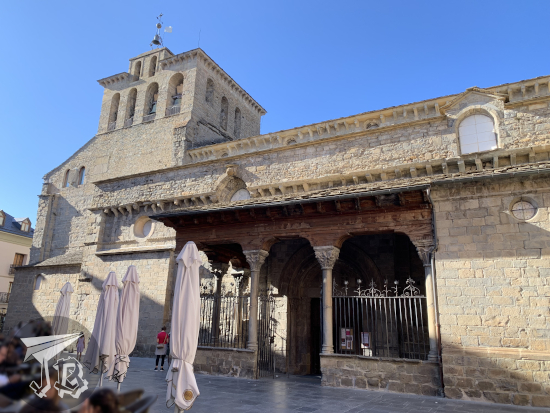
The second leg of the journey took us to Jaca, where we visited the cathedral and the Diocesan museum. The cathedral of St. Peter Catedral de San Pedro Apóstol, a predominantly Romanesque building (with, of course, Baroque decoration), although the wooden ceilings have been replaced. The building itself was completed around the year 1130. The altar holds the organ and is richly decorated with frescoes.

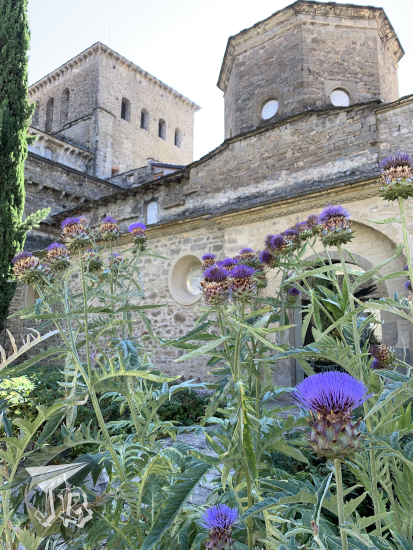
The adjacent museum Museo Diocesano de Huesca, also called the Romanesque Museum, which contains a large number of Romanesque paintings that have been collected from the different churches around the area, and sculptures from the period. It also yields entrance to the cloister, which has a small garden populated with roses, bright purple thistles, and tiny shy lizards that ran away as I peered in.

It was a little too late to enter and walk around the old fortress Ciudadela de Jaca, the military museum, so I just walked around it. Unfortunately, the star shape is not appreciated from the ground, so take my word for it – it is star-shaped. Due to droughts, however, the moat is devoid of water, and it has been turned into a… deer park.

So after this we drove off to the final destination of the day, the small village of Torla-Ordesa, which is the entryway to the Pyrenees area on the Huesca province, particularly the nearby national park Parque Nacional de Ordesa y Monte Perdido.

We had a bit of an organisation issue here. Because the park is a National one, there is zero reliable information from the administration itself – it turns out that to reach the park you need to take the bus from the visitor’s centre in Torla-Ordesa, you cannot get there on your own (lovely for Covid times, don’t you think?). Furthermore, the park has top capacity which is measured by the buses that depart from the centre – around 30 buses, which is usually reached around 10 am in summer. This made us change all our plans. So we set the alarm for 6:30 am to get an early start, and went to bed.

As mentioned before, driven distance was around 450 km. Total walking distance: 7.5 km.

8th – 12th July 2021: Beach weekend (El Campello & Elche, Spain)

The sea is far, far away and due to a number of situations coming together, we rented an apartment near the ocean for a couple of days. Our usual summer destination was not a good option this year due to – as everything that is going less than great these days – to Covid, so we gave a try to the town of El Campello. The town likes boasting itself as a beach paradise-resort, while it’s barely a standard Mediterranean village eaten which boomed along other, bigger resorts such as Benidorm. The apartment was not anything marvellous, but it was extremely close to the ocean – just beyond the waterfront promenade, Paseo Marítimo.

8th July 2021: The arrival

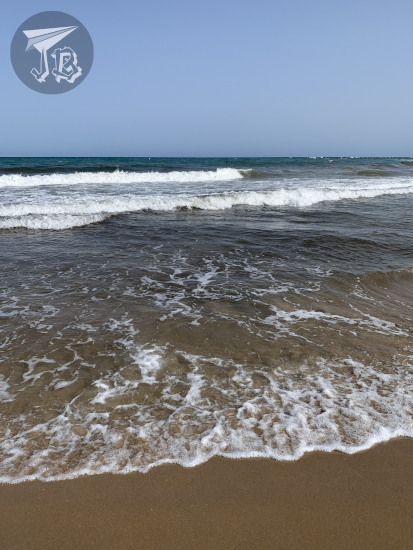
We arrived in El Campello at around 4pm, did a fast sweep of the apartment in order to feel safer Covid-wise and I decided to go for a walk at the beach, jeans and all. There were surprisingly fewer people than expected, and not as hot as I thought it would be – all in all we were pretty lucky, weather-wise.

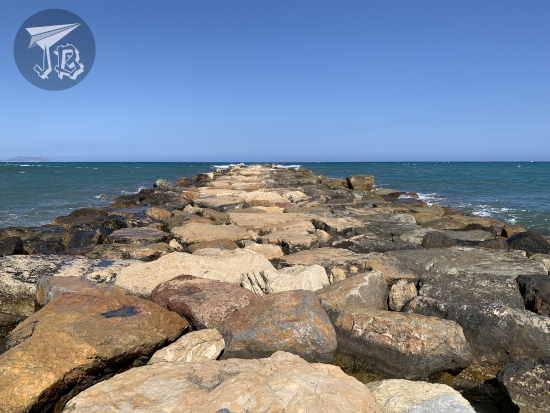
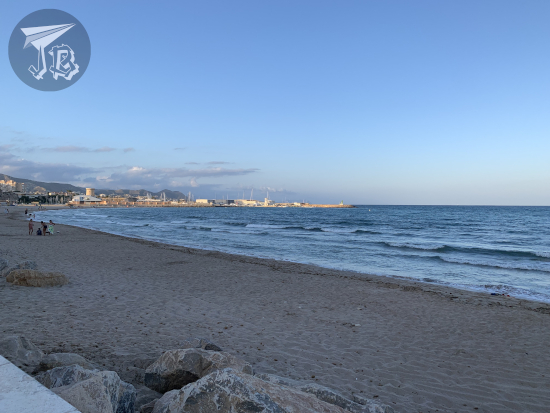
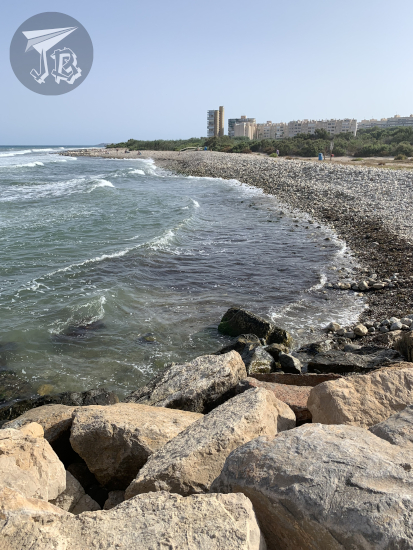
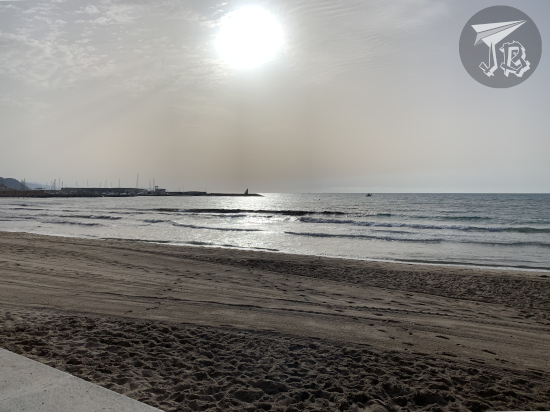
El Campello is built parallel to the coastline. The more traditional area has a small marina Puerto de El Campello to the north, and then a sand beach that extends towards the south divided into Platja de la Illeta and Platja del Carrer de la Mar. Though the beach has a couple of breakwaters, they are for protecting the beach against erosion and not to separate the different areas – the east of Spain has a reputation for building quite close to the beaches. Over the years, that caused the winds and waves to shift and the once amazing and long beaches started being washed away – now all those groins are necessary to keep the sand in place, and are liberally built along the Mediterranean coast.

I climbed on one, of course, more than once – and more than one too (≧▽≦).

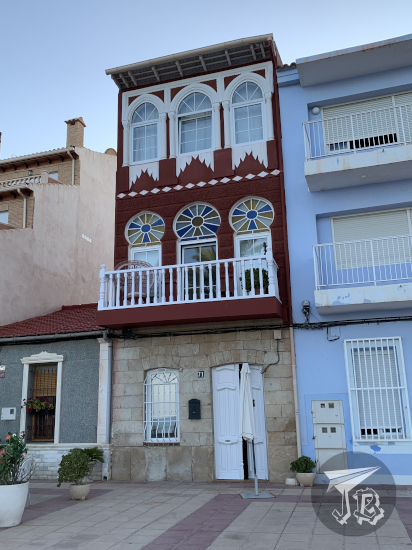
In the evening we walked along the waterfront promenade. While most of it is fronted by restaurants and souvenir shops, I did see this cute little house.

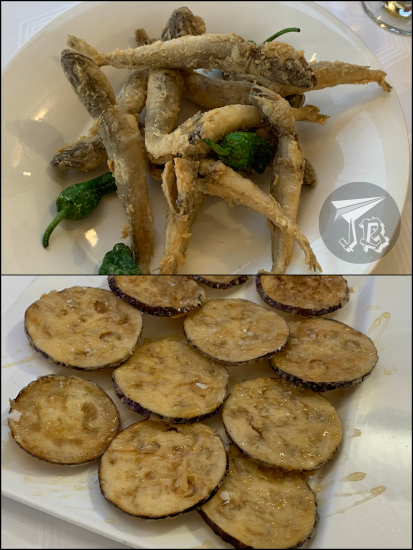
Eventually, we chose a place to have dinner – some fish and the area speciality: honey-soaked aubergine (berenjenas con miel), which is not actually made with honey, but a type of molasses – which actually makes this a vegan dish, as bees are not involved in making the “honey”, what do you know? The first time I tried this I was not too convinced, but if prepared well, this dish is absolutely delicious.

9th July 2021: The lady’s town

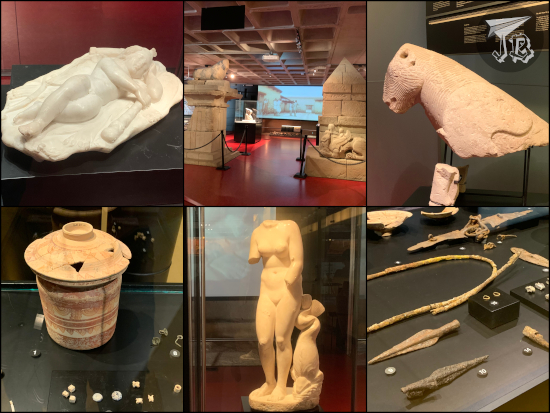
Elche is a nearby town a bit inland, and the third most populated in the area. It is famous due to the Iberian sculpture bust found nearby and because of its palm grove. The history of the town can be traced back to the current archaeological site Yacimiento Arqueológico de La Alcudia, whose stratigraphic sequence dates to the Bronze Age. There are ruins and artefacts, mostly from the Iberian and Roman ages, though there are findings until the Islamic era.

In 1897, a young farmer found the bust named La Dama de Elche, the Lady of Elche, which can be seen in Madrid’s archaeological museum Museo Arqueológico Nacional – it is the limestone bust of an Iberian woman, probably with funerary purposes, what was carved around the fourth century BCE. Since that time, a great deal of work has been carried out in the area of La Alcudia, and today is a full-fledged archaeological site with a Roman wall, several Iberian and Roman houses, a Roman temple and an Iberian one, a basilica, and hundreds of sculptorical and clay artefacts.

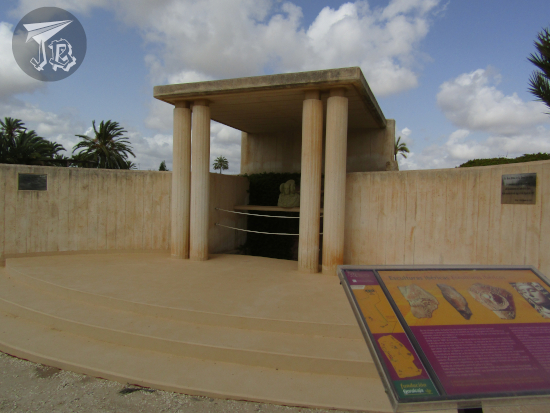
We visited the site in the morning, hoping to finish the stroll before it became too hot. There are still works carried out in the site, but you can visit and walk around the area – as long as you don’t step on the red ground. There are two museums on site, aside from the outer ruins. In one of them there is a reproduction of the lady, which yields to easier pictures than the glass protection in the National museum. There are also interpretations and reconstructions about what the Lady may have looked like when she had her colours. Unfortunately, reaching the site is hard, and probably not worth the detour unless you’re an expert in archaeology, but it turned out interesting to see.

… Except for the “commemorative site” of where they found the Lady. That was hideous.

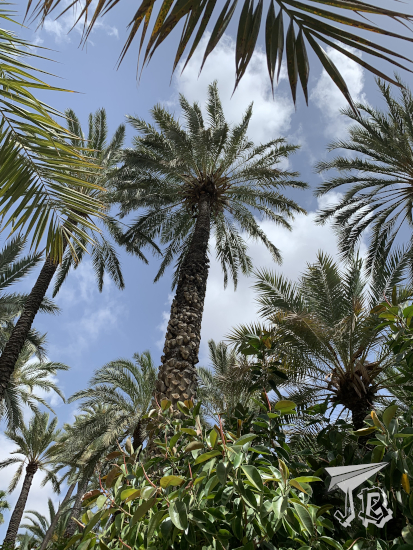
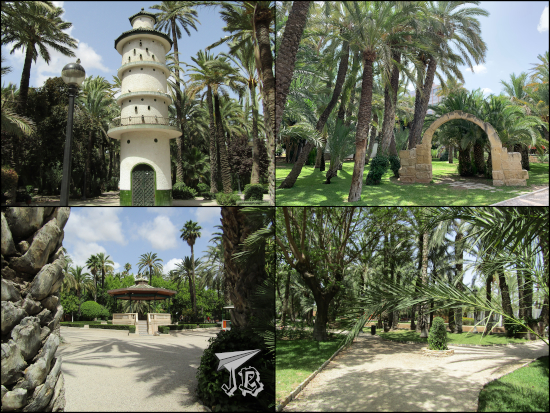
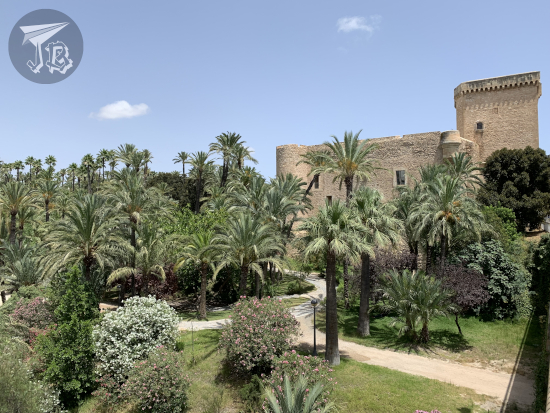
After La Alcudia, we drove off to the town centre to walk around Palmeral de Elche, the biggest palm grove in Europe, with around 200,000 – 300,000 trees, most of the date palm species, Phoenix dactylifera. The palm tree grove originates in the 10th century CE (planted by the Caliphate of Cordoba conquerors), and it has been a Unesco World Heritage Site since the year 2000. The most important palm grove is in the centre of the town (and we missed the dragon that stands on one of the trees 。゚(゚´Д`゚)゚。).

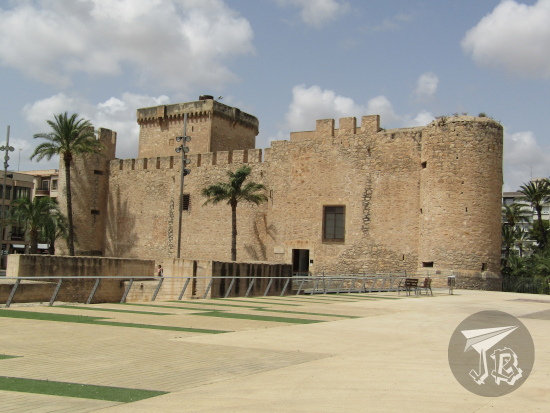
Close to the grove stands the local archaeological museum, Museo Arqueológico y de Historia de Elche, divided between the new building and the old Moorish castle or alcázar, Palacio de Altamira, which drinks from La Alcudia and other findings from the area.

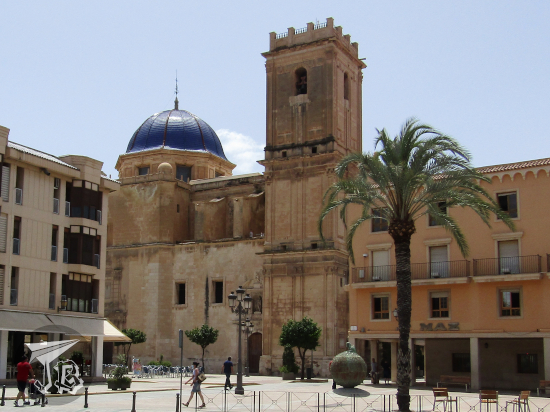
After the museum, we headed off to see the main church Basílica de Santa María, but we had just missed opening times. It stands on the place of the original mosque, and the current building – the third church that has been built – is Baroque. The bold blue dome is typical of the area, found all over the region on towers and churches.

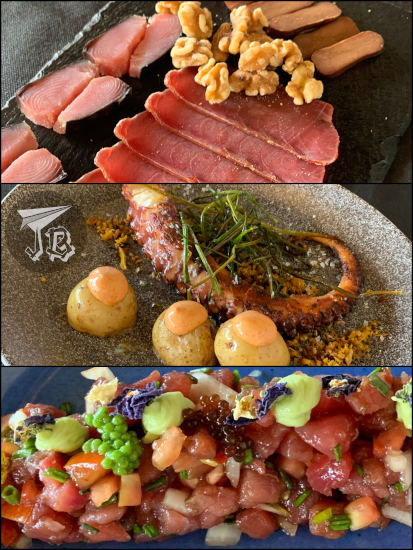
As we could not see the basilica, we just had lunch! After a bit of a banter with an over-friendly waiter we had some fish-based lunch to share – salt-preserved fish bits, grilled octopus and tuna tataki.

On the way back we got to see a different view from the palm grove and the castle and the palm grove – maybe it looked like this in the old Arab times?

It was too hot to stick around and wait for the museums and church to open up again, so we drove back and after a while I headed back to the beach. This time I reached the end of the sand beach and got to the boulder one at the end of the waterfront promenade.

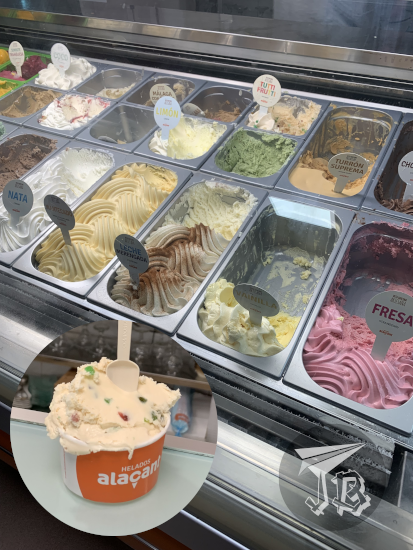
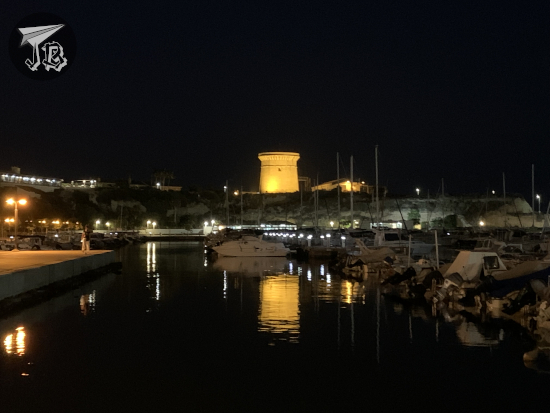
We had a quiet dinner at the apartment, then went out for ice-cream. We ended up walking to the marina, Port d’El Campello and caught sight of the Torre Vigía De La Illeta in the background.

10th July 2021: Not much to report

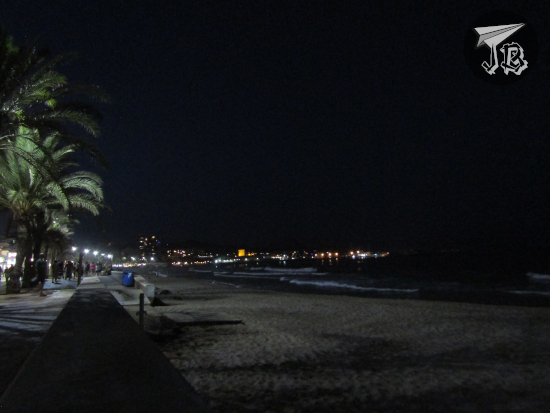
Just some pizza and a night-time walk along the waterfront promenade yielding tries to take artistic pictures without much success.

11th July 2021: The Tower

I woke up with a lovely reaction to the sun – not a sunburn, more like an allergy flare-up (here’s the plausible explanation for that), so we went out rather early for a walk, to then shield from the sun.

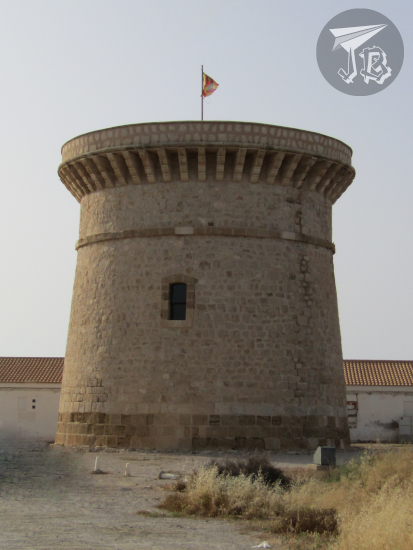
From the Roman times, a number of watchtowers were build along the Mediterranean coast to be on the lookout for pirates. The tower in El Campello, Torre Vigía de la Illeta was built between 1554 and 1557 (and restored in the 1990s), was part of a watch system commissioned by the Viceroy of Valencia at the time. The tower was manned by two infantry and two mounted soldiers – in case a pirate ship was spotted, the former would make smoke signals and the latter would ride to raise alarm in town.

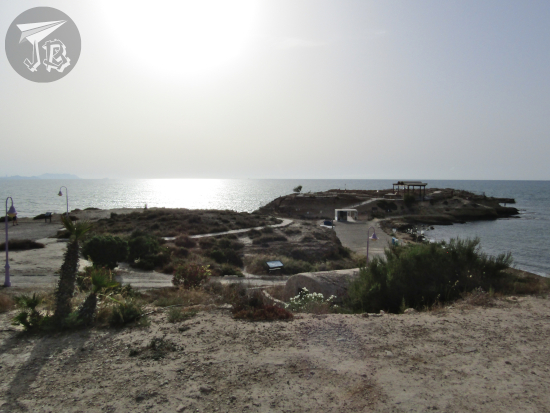
The tower overlooks the marina, the town, and the archaeological site Yacimiento Arqueológico La Illeta dels Banyets, with ruins and artefacts dating from the Iberian and Roman times, but we did not walk to them as it was early in the morning and it was not even open.

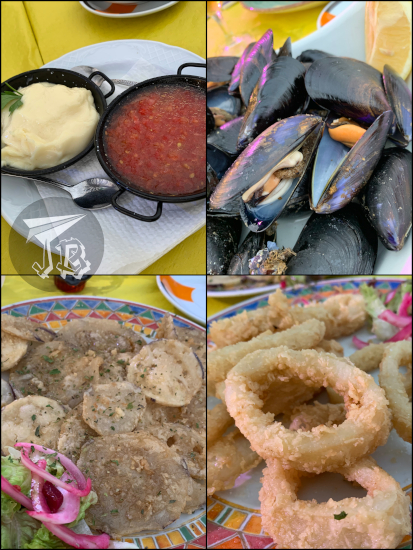
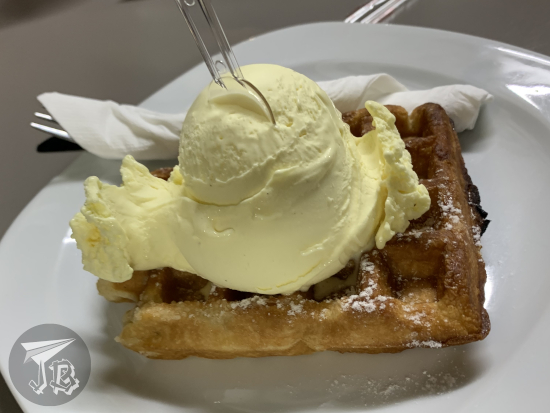
It was hot, so most of the day was spent under the air-con, to later have dinner out – some mussels, more aubergine with honey (not so good this time), and squid rings. But the highlight of the night was the final ice-cream waffle, which is a great, great idea.

And that was it, as we left early in the morning the following day, as soon as we could check out, as the trip is – as mentioned – long.

29th & 30th May 2021: The Walls (and churches) of Ávila (Spain)

There was a little-talked about consequence of the Industrial Revolution in Spain. While it is widely known that it drew a large number of people to the cities and towns, few stop to think of the subsequent steps that had to be adopted. More people in town required housing, and thus a number of projects denominated ensanches or “widenings” were projected and carried out. Even though such a thing makes sense, here lies the problem – in order to enlarge the urban area, many Spanish cities and towns tore down their Roman and Medieval walls, leaving either bare traces or nothing at all.

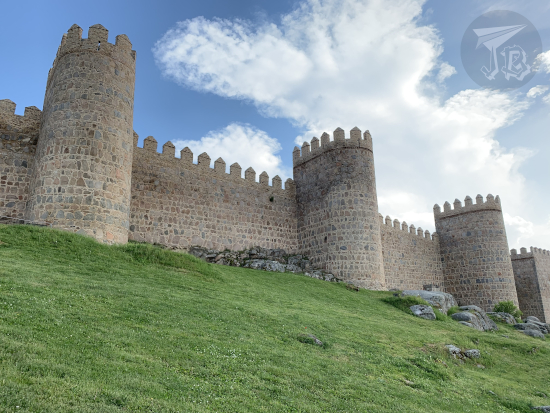
Legend has it that the town of Ávila lacked the money to demolish the wall. In retrospect, that was a good thing, because today, the walls that surround Ávila, Murallas de Ávila are among the most impressive Europe, some say that even better preserved than Carcassonne (France).

Ávila is a couple of hours away by car, so we drove off on Saturday morning at around 8 am and were there just before 10 am. We entered the city through one of the city wall gates, Puerta del Carmen.

Approach to the walls

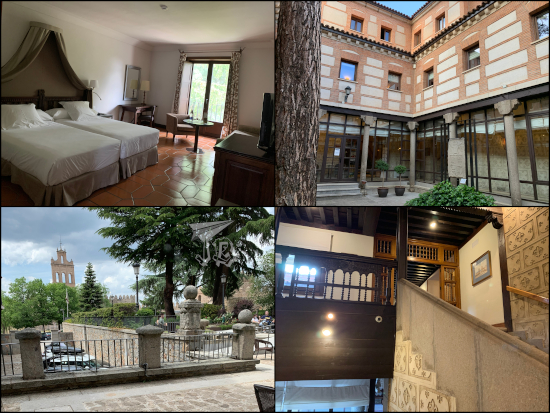
We parked (100% ditched the car) at the hotel and checked in – even if it was quite early, they told us that one of the rooms was already prepared and gave us the keys. Unfortunately, it was not, and since the blunder was a Covid-protcol blunder, they upgraded us as an apology. The hotel, Parador de Ávila, belongs to the Spanish network of Paradores, and it is located in a 16th century palace, Palacio de Piedras Albas. We booked late-check-out for the following day, which can be done “for free” booking lunch in the restaurant (which is obviously not free).

Parador

Our first stop was the tourist office, but not the one that is clearly signalled in the middle of the town – the one that is located outside the wall and you have to turn around and around to find. But we needed it to buy the 48-hour pass to the monuments. Then we stuck around to wait for the nearby church to open, which gave way to observing the wall for the first time.

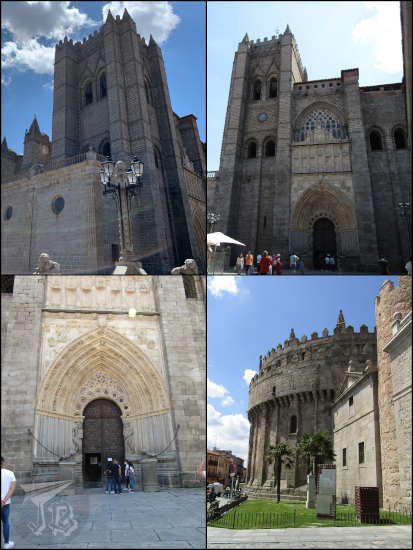
The Muralla de Ávila has been a Unesco World Heritage site since 1985. The structure is clearly defensive and it was built towards the end of the 11th century, quite probably as extension or reinforcement of a previous one, either Roman or Arab – though the Roman theory is the most credible as some pieces used in the original wall seem to come from a now-lost Roman cemetery, and there are documents about a Roman camp with similar shape. The wall has been restored in several occasions, and after surviving the ensanche risk, it was declared national monument and cleared of attached houses. Today most of the wall belongs to the Spanish government, and it is managed by the town hall, though there are some private parts, such as the ones that are part of the cathedral. The walls close off all the historical centre. They have a perimeter of 2,515 metres, with around 2,500 merlons, almost 90 turrets, and nine gates. Our second gate was Puerta de San Vicente.

Puerta de San Vicente

The first monument we stopped by, as soon as it opened since we were already there, was the basilica church Basílica de San Vicente (officially Basílica de los Santos Hermanos Mártires, Vicente, Sabina y Cristeta, three Christian siblings who were martyred nearby). It is one of the most important Romanesque buildings in the whole country, built between the 12th and the 14th century. It is protected as part of the World Heritage Site declaration. One of its characteristics is the golden rock in which it is built – sandstone-looking granite.

Iglesia de San Vicente

The inside of the basilica is, in the typical way, a mix of more modern styles. The grave of the martyr siblings is Pre-gothic, and the large altarpiece is Baroque. In the crypt there are proto-Christian pieces and a Romanesque Virgin which we did not get to see and which is the patron of the town.

Iglesia de San Vicente

Afterwards we headed off to the cathedral Catedral de Cristo Salvador, which is considered the first gothic cathedral in Spain (something that other people say about Cuenca), with clear French influences. It was designed as a fortress church as its abse dubs as one of the turrets of the city wall.

Catedral de Cristo Salvador

In later years, a choir was added, along with a Baroque altarpiece. The walls are also sandstone-looking granite, but some elements inside are limestone and wood.

Catedral de Cristo Salvador

To the side of the cathedral stands the cloister, which holds the grave to the first modern president of Spain, Adolfo Suárez, and the entrance to the cathedral’s museum. It yields to views of the tower and… the storks that squat there.

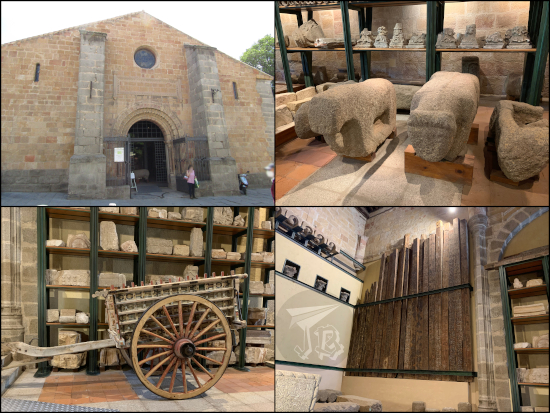
We headed off towards the Museum of Ávila. First we stopped at the former church Iglesia de Santo Tomé, which today is a warehouse for the museum, but can be visited anyway. When I was young, I studied the statues / sculptures called verracos, built around the 5th century BCE by the Vettones, a Celtic pre-Roman civilisation that faded upon the arrival of the Romans. The verracos are crude statues that represent four-legged animals – bulls, boars or pigs. At the time, I had only heard about a number of them, and was somehow under the impression that there were two or three around. I was quite wrong, apparently they pop up from the snow like daisies or something. In the church-turned-warehouse there were like twenty, one outside, there was one at the hotel garden… so no, apparently they are quite common. Other artefacts in the building include some carriages, Roman sculptures and mosaic, Muslim funerary artefacts and roof boards…

Iglesia de Santo Tomé

Then we moved onto the museum itself, Museo de Ávila, with a beautiful patio and a number of archaeological and ethnological items which represent the history and folklore of the town.

Museo de Ávila

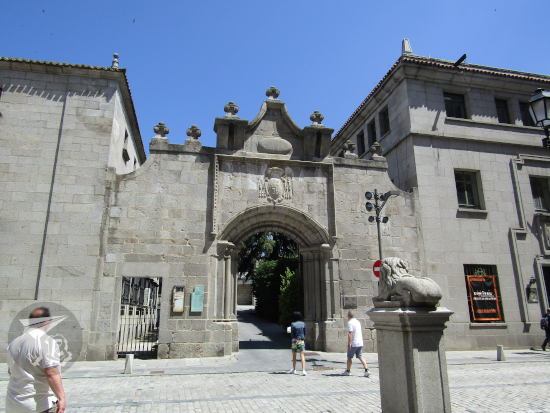
It was almost time for lunch, so we headed off towards the restaurant where we had booked. Before, we made a small stop at an old palace Palacio del Rey Niño, built in the 12th century, today turned into the Post office and the public library, with a patio closed off by the Walls themselves.

Palacio del Rey Niño

Then we walked by the modern marketplace.

mercado

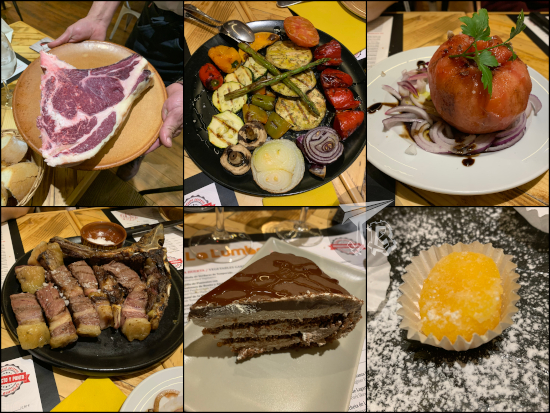
Which happened to be right in front of the restaurant, named La Lumbre. Aside from its walls, Ávila is famous for its cattle, a particular breed called Raza Avileña – Negra Ibérica, and of course the meat the animals produce, especially the matured and grilled meat from older oxen. After the animal has been sacrificed, the meat is matured in a traditional process called “dry maturation” for six weeks before it is grilled. We ordered the rib steak, chuletón to share, along with some grilled vegetables, a “tomato salad” that was a… one-tomato with dressing. And then there were desserts, aside from chocolate cake, we ordered yemas de Ávila – a typical confectionery made with egg yolks, lemon juice, cinnamon, and caster sugar. Lots of typical stuff, as you can see!

lunch

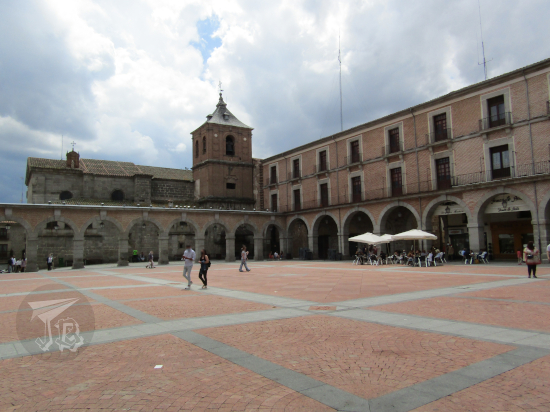
Our next stop was the main square, called “little market square”, Plaza del Mercado Chico, along with the town hall or Ayuntamiento. The square was rebuilt in the 19th century and is flanked by arcades. The town hall was built in 1862.

Plaza del Mercado Chico

Plaza del Mercado Chico: Ayuntamiento

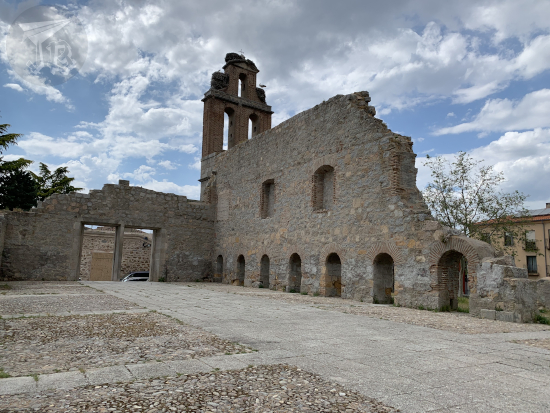
After a brief stop at the Parador for some rest, we headed off to find a convent / monastery on the other side of town. On the way we came across some ruins that I assume are the church Iglesia de San Jerónimo, as they sit in the square of the same name.

Ruinas de San Jerónimo

We reached the convent Convento de San José, a reconstruction of a previous monastery and church, the first founded by Santa Teresa de Jesús (Saint Teresa of Ávila), a Christian “doctor of the church” and mystic Carmelite nun, known for her ‘raptures’, her reforms, and her literature work. More on her later though. The convent and church were a little… underwhelming, even if is a World Heritage building.

Contento de San José

Then we walked back towards the historical centre, and walked past the church Iglesia de San Pedro, a 13th-century building with a great rose window, but which was closed (reforms).

Iglesia de San Pedro

On the other side of the square, Plaza del Mercado Grande (Big Market Square) stands another of the wall gates, Puerta del Alcázar, and a monument to Saint Teresa Monumento a Santa Teresa: La Palomilla.

Puerta del Alcázar

Next we separated and I went off to climb the walls Murallas de Ávila. Well, to walk on the parapet. Due to Covid, there is only one access, next to the Cathedral and its gate Puerta de la Catedral. The walkable area is around 1.4 km, including walking over some of the gates and up and down more than a few turrets. It allows for some amazing views of the town and its outskirts…

Views from the walls

… but also of the wall itself, both the original walls and the add-ons from later eras (and a magpie).

When I reached the end of the walk, I went down and crossed the bridge gate Puerta del Puente, named that way because it overlooks the bridge over the Adaja river. I could not take a picture of it because the traffic police was checking cars at the roundabout in front of the gate. Thus, I headed off to the pedestrian bridge to cross over towards the tiny hermit popularly known as “the four posts”, Los Cuatro Postes, which yield to an impressive view of the town and its walls.

Cuatro Postes

Views on the wall

Avila and View

I walked back to see the walls from the base. Then I crossed the gate we had driven through in the morning, Puerta del Carmen, and I headed back to the hotel for a drink.

At the feet of the walls

Puerta del Carmen

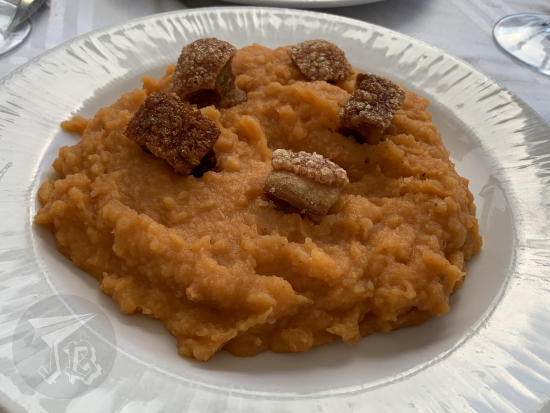
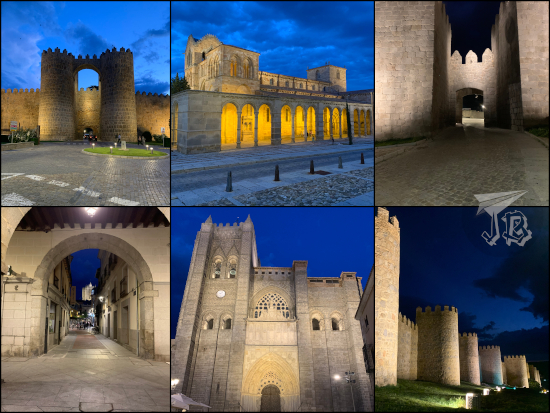
After a while we headed off for dinner and tried another of the typical dishes in Ávila, patatas revolconas – mashed potatoes with paprika and pork rashers, and waited for the sun to go down so the city lit up.

Patatas revolconas

A walk around the town yielded to views of the Iglesia de San Vicente and Puerta de San Vicente, some of the inner streets leading to the town hall Ayuntamiento, the longer area of the Muralla and the Puerta del Carmen.

Night view

And then I had a very, very long shower and went to bed.

In the morning, breakfast was had – not a fan of the “we can’t have a buffet so we prepared this and this is what you get” plate, but whatever. I mentioned Santa Teresa before, let’s get into that a bit further. She was a 16th-century nun born near Ávila, canonized in the 17th century, and elevated to doctor of the church in the 20th century. She is conisdered one of the great mystics and religious women in the Roman Catholic church, author of a number of spiritual classics, and the reformer of the Carmelite nun order into the Discalced Carmelites. She founded convents all over Spain and was known for her mystics raptures which may have been messages from God or epileptic attacks. She is one of Ávila’s most important historical figures and wherever you go there are traces of her. In the place where her house stood now there is a convent, a church, a reliquary room and an interpretation museum, with really strange hours on Sundays. We could see the convent / church Convento de Santa Teresa de Jesús / Iglesia de la Santa and the reliquary room where no pictures were allowed Sala de Reliquias between services.

Iglesia de la Santa

On the way, however, I found some interesting ruins – the gate to the former hospital Hospital de Santa Escolástica, and we walked past a bunch of palaces.

Portada de Santa Eulalia

Then we moved onto a long walk to the 16th- century Gothic monastery Real Monasterio de Santo Tomás, which we could see due to lucky timing as there was a First Holy Communion Mass happening and the local little old ladies were not to keen on cultural visits of the church.

The monastery has a church, three cloisters and two adjacent museums. The church has an impressive Gothic altarpiece (by Pedro Berrugete, one of the key painters riding the wave between Gothic and Renaissance arts), and hosts the grave to the Catholic Monarch’s only male son.

Santo Tomás

The three cloisters: Claustro del Noviciado, Claustro del Silencio, and Claustro de los Reyes Católicos (Novitiate, Silence and Catholic Monarchs).

Santo Tomás Cloisters

The Museum of Natural Sciences Museo de Ciencias Naturales, an occupational therapy project could… be better, and sets the expectation bar rather low for the next one.

Museo de Ciencias Naturales

However, the Museum of Eastern Arts Museo de Arte Oriental is pretty impressive. It contains pieces and artefacts that the Dominican missioners brought from China, Japan, Vietnam and the Philippines.

Museo de Arte Oriental

And in the end, that was it for the weekend. We walked back, decided to give the museum of Saint Teresa a miss, had a drink, had lunch and went back on our merry way – with a a view of the train tracks over the dam of the reservoir Embalse de Fuentes Claras.

Train tracks over Embalse de Fuentes Claras

Walked distance (Saturday): around 12.5 km
Walked distance (Sunday): around 6 km
Total distance driven (both days): around 340 km

23rd & 24th April 2021: Mental Reset Half-weekend: Cuenca (Spain)

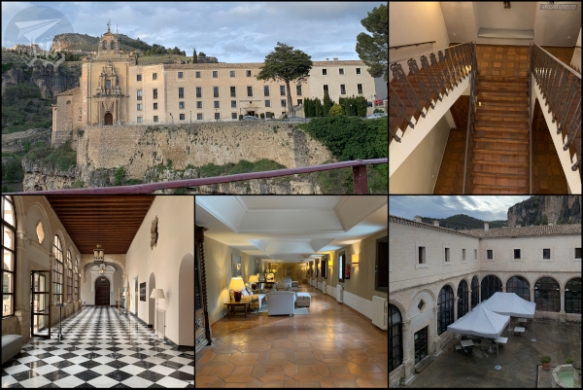
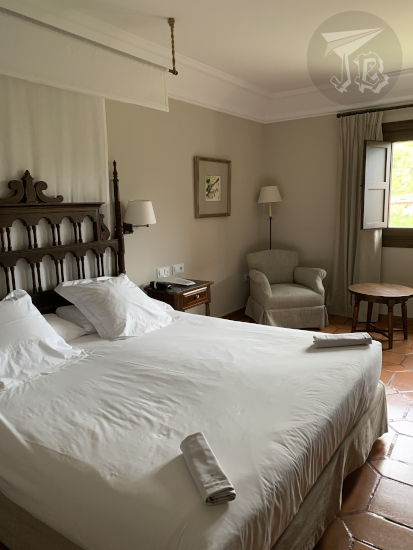
With everything going on, travelling is almost impossible, but the stars aligned for a tiinny bit longer than day trip – from Friday to early Sunday morning, with every precaution possible, of course. We ran away to Cuenca for a day and a fifth. As days are becoming a bit longer, when we arrived there were still a couple of hours of light left. We checked in and dropped off the car at the Parador de Cuenca. The Parador hotel chain might be more expensive than standard accommodation, but truth be told, it is upholding the strictest hygiene protocols, even though their hand disinfectants give me allergies. Truth be told, it was spectacular.

The Parador stands in a repurposed monastery, the old convent of Saint Paul, just at the edge of the historical centre of Cuenca. The hotel has a covered cloister and a newer building, and the adjoint church has been turned into an art centre.

Parador

Room

Gorge

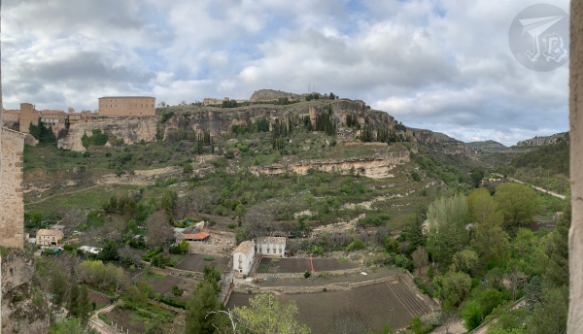
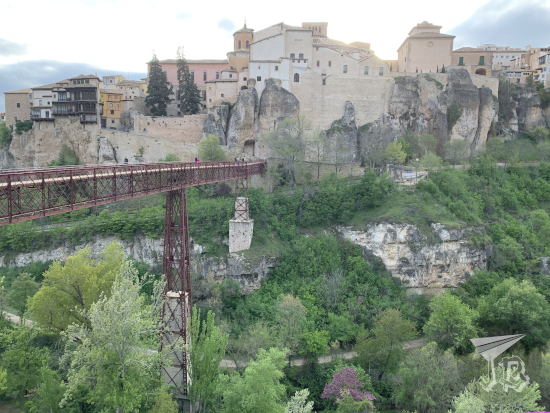
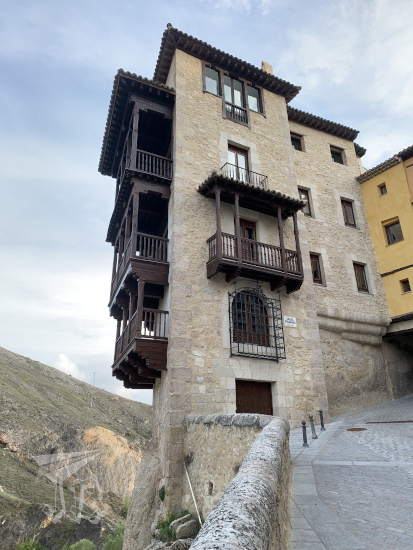
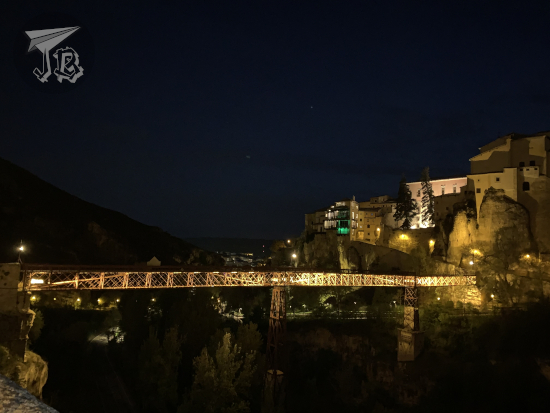
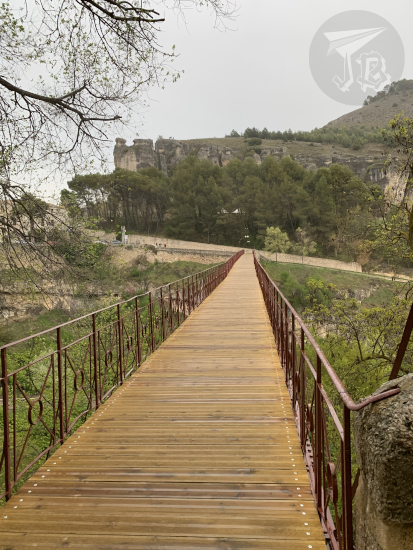
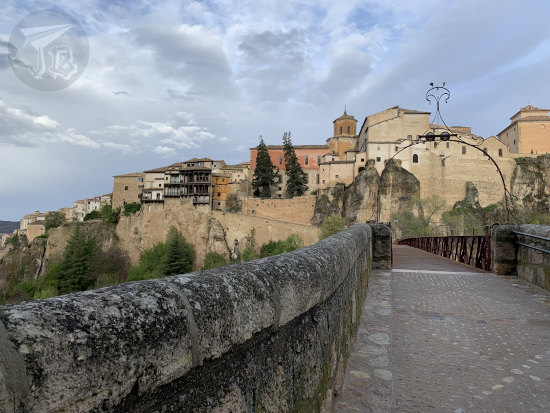
The core of the town stands between two rivers, River Júcar and River Huécar. As the area is rich in karst – calcite rocks, which dissolve in water – the rivers have dug parallel gorges around the historical dwellings. The walled city has been declared a Unesco World Heritage Site and one of the keymost point is the hanging houses, Casas Colgadas (now home to the Museum of Abstract Art). While the houses are now rather unique, they used to be the norm in the 15th century. In order to cross the Huécar gorge Hoz del Huécar, there is a(n also) hanging bridge. The bridge of Saint Paul, Puente de San Pablo, was built at the beginning of the 20th century in the typical cast-iron architecture of the time.

Puente de San Pablo

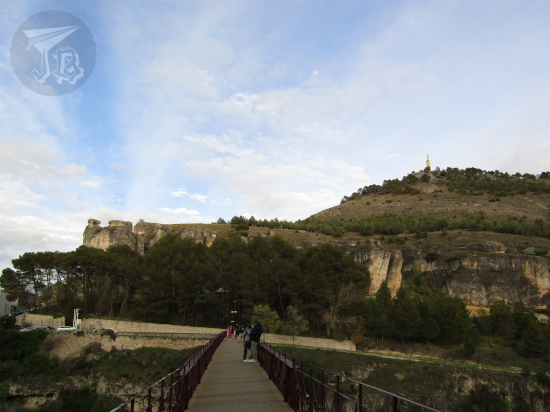
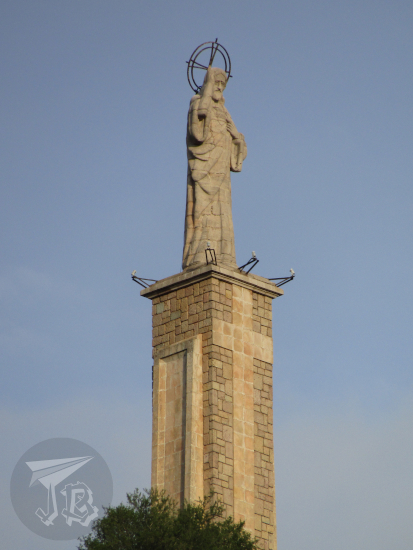
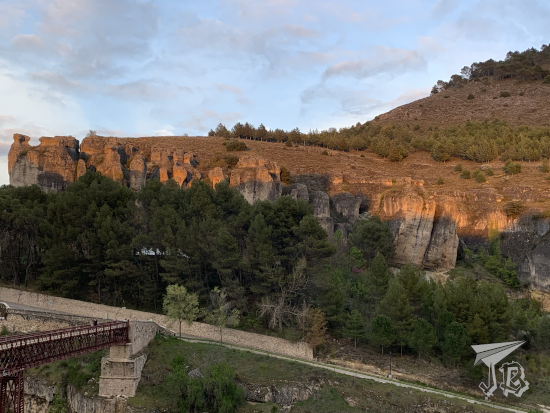
Looking back to the other side of the bridge, you see deceivingly high hill, Cerro del Socorro, carved out of karst. I say deceiving because when you actually look at it, you’re half-way up, and you can look down to the bottom of the gorge. At the top of the hill stands a religious pillar to the Catholic Sacred Heart, Monumento al Sagrado Corazón.

Cerro del Socorro

Monumento al Sagrado Corazón

Casas Colgadas

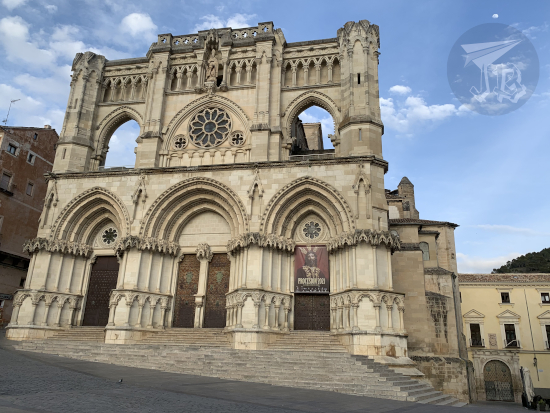
We went on walking towards Main Square and the Cathedral of Our Lady of Grace and Saint Julian – Catedral de Santa María y San Julián de Cuenca. The cathedral is one of the earliest Gothic buildings in Spain (although the main façade has been rebuilt in style). However, it is not the typical Spanish Gothic style, but it is more similar to the Norman buildings in the north of Europe. It was unfortunately not open for visiting though (it’s the third time I’ve been to Cuenca and I’ve never been able to walk in (≧▽≦) ).

Catedral de Cuenca

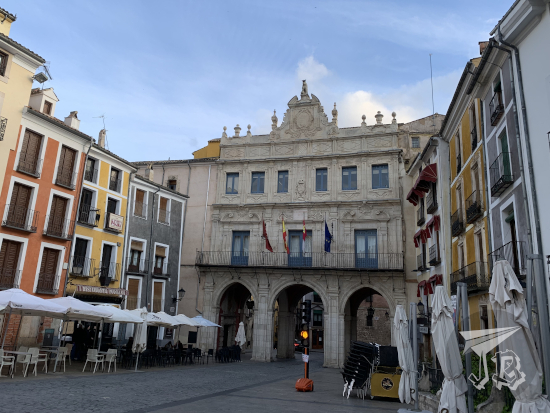
There also stands the Ayuntamiento de Cuenca or town hall, a three-arched Baroque building erected around 1760 after the designs of the architect Jaime Bort. The building closes off the square and is the gateway to a maze of chaotic traffic of one-way streets and directing traffic lights.

Ayuntamiento de Cuenca

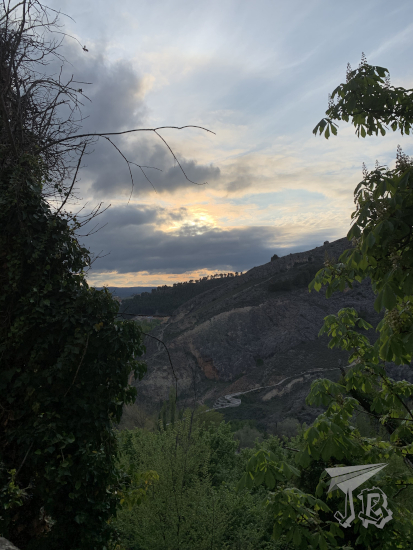
We turned towards the gorge, Hoz del Júcar on the other side of the town for a view of the sunset, but the clouds seemed to be hiding it.

Hoz del Jucar

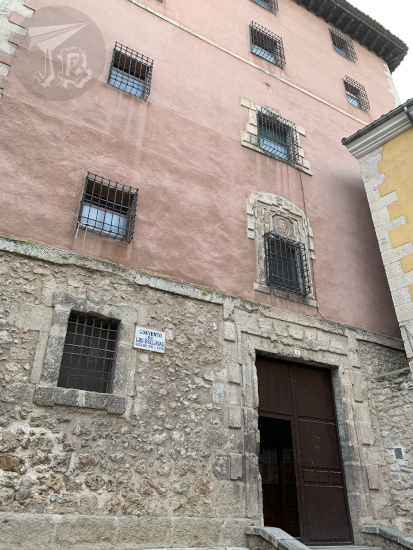
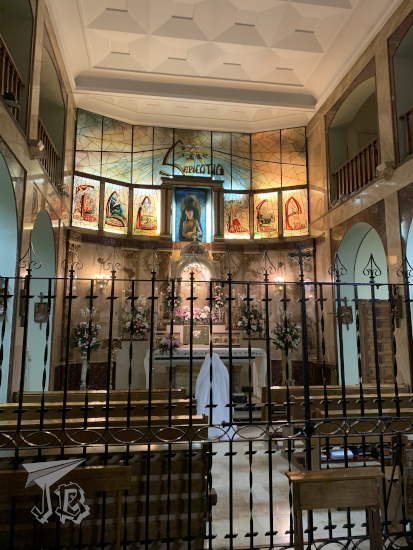
As we continued on, we stopped by a nun convent Convento de las Esclavas. This Catholic nun congregation leads a contemplative life and they are perpetually praying to the Eucharist – at least some of them, as apparently they bake and sell confectionery to sustain themselves. You can see a nun praying in the church, and to be honest for a second I did not realise she was there, it felt like there was a ghost all of a sudden. The building was erected between the 15th and 16th centuries.

Convento de las Esclavas

Convento de las Esclavas

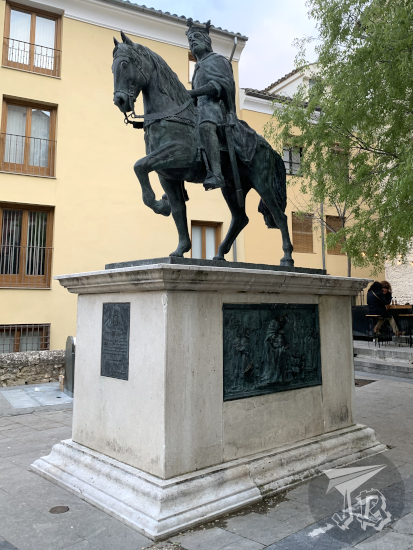
We found the monument to a medieval king Monumento a Alfonso VIII. During the Christian and Muslim wars, the king was the one to conquer Cuenca for the Christians, and assimilated it into the Castilla crown.

Monumento a Alfonso VIII

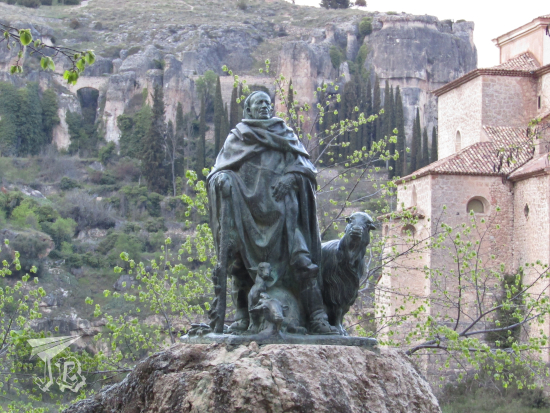
Another sculpture we found was, conversely, erected to honour the traditional shepherd from one of the old streets in town, a bronze statue named Monumento al pastor de las Huesas del Vasallo and located next to the bridge.

Monumento al Pastor

We also got treated to some nice views as the sun came out the second we turned out backs on it.

Sunset

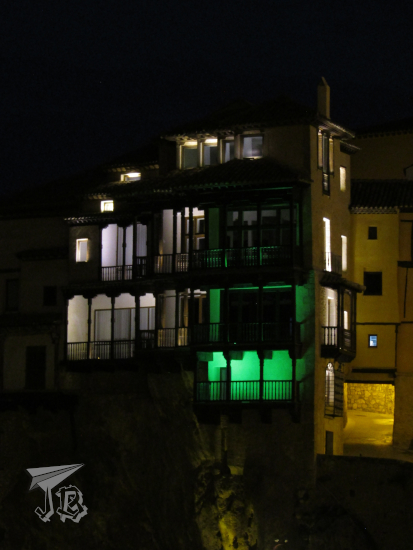
After dinner – a really good club sandwich in my case, I walked out to take some pictures of the bridge and the hanging houses after dark, expecting them to be lit up… Which they were. I mean, I was really not expecting the green colours.

Night

Casas Colgadas

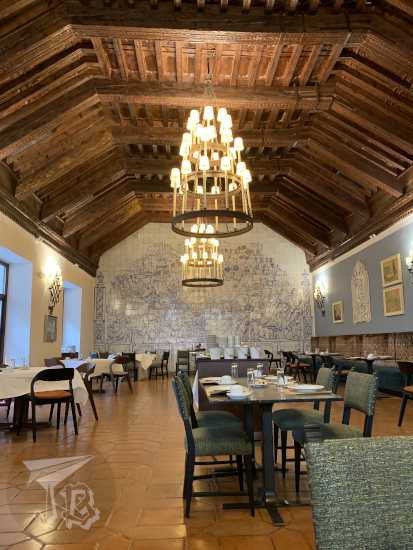
In the morning we had breakfast at the old dining room of the convent, the refrectorium, which still keeps its old allure.

Refrectorium

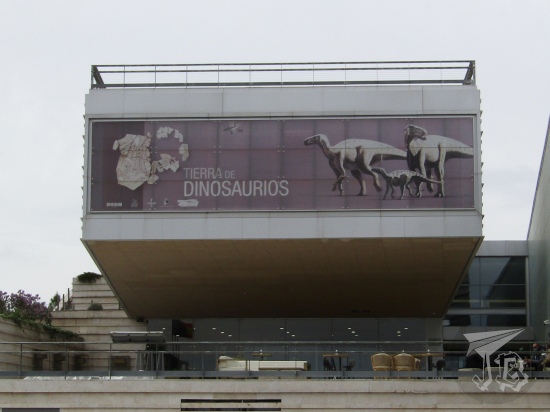
Later, we headed out to the local palaeontological museum Museo de Paleontología de Castilla-La Mancha. The museum was inaugurated in 2005, recycling, so to speak, a previous building that overlooks the city of Cuenca. The museum has an inner area with some reproductions and pieces from the different palaeontological sites around the area, and several models of the animals, organised in eras.

MUPA

MUPA

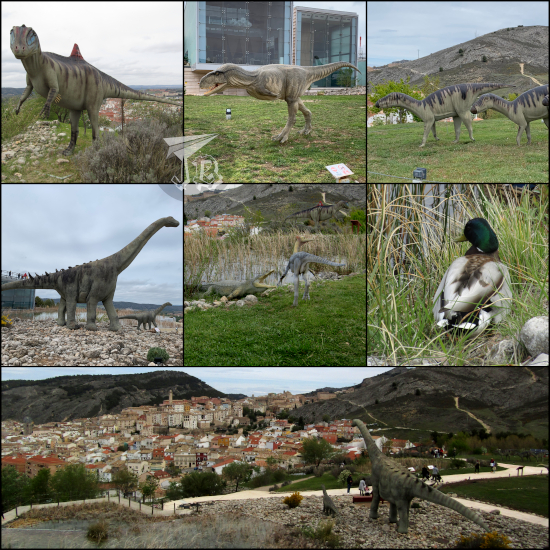
The outer part also holds replicas, and it gives a very Jurassic World feeling for a second, when you take the view with the dinosaurs. We had booked first thing in the morning, so we were leaving when the kid-crowd started to arrive, in order to see both the extinct and the extant dinosaurs (a.m., we found a mallard minding his own business at one of the ponds).

MUPA

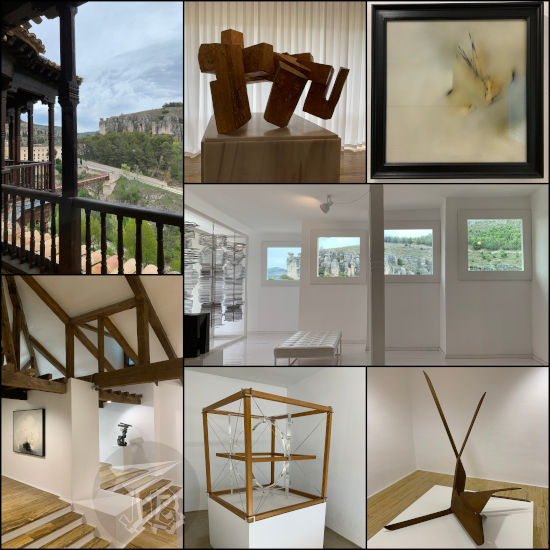
We drove back, and unfortunately the Sat-Nav got us lost. However, we dropped the car safely off a the hotel and decided to take the plunge and walk into the museum of Spanish abstract art Museo de arte abstracto Español, home to a number of… works… by Spanish artists from the 1950s and 60s in the Hanging Houses / Casas Colgadas. I… have to admit I am not the biggest fan of abstract art, so I was not terribly impressed – I mean I had been there before and it had not imprinted on me, like at all (≧▽≦).

Museo arte abstracto

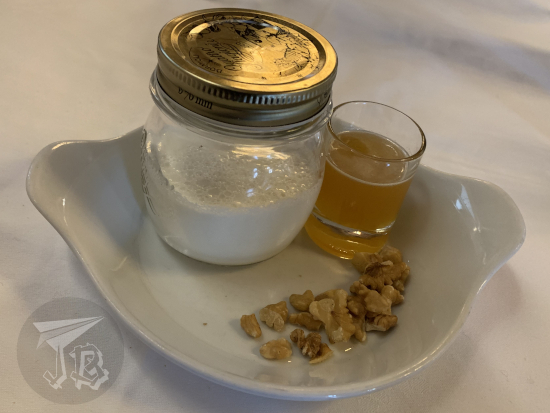
After the museum we headed back to the Parador for lunch and some rest – and I have to say that the curd I had tried the last time was nowhere to be found any more. Sad.

cuajada

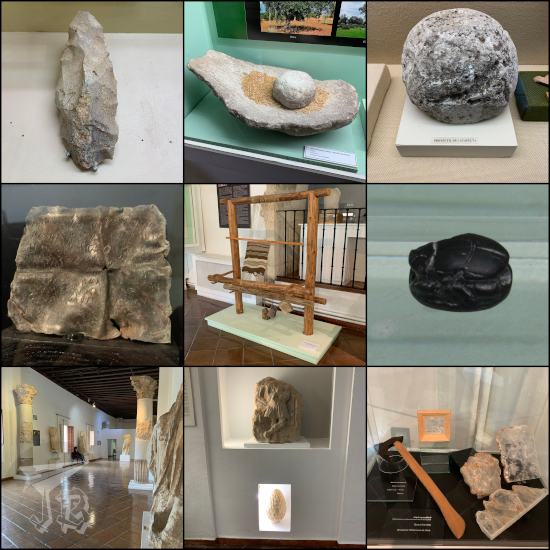
But not to be deterred, we soon moved to the city museum Museo de Cuenca, which highlights the Roman origins of the city. There are displays from Prehistory to the Middle Ages, but there is either a surprising lack of Muslim artefacts, or they were in the closed-off rooms.

Museo de Cuenca

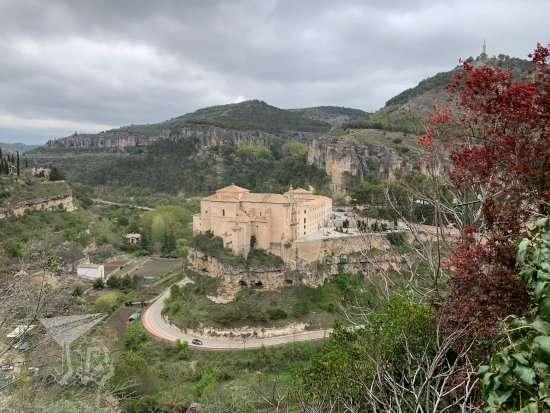
After this, we wanted to check out one of the churches, and on the way we passed by a viewpoint towards the gorge Hoz del Huécar.

Hoz del Huécar

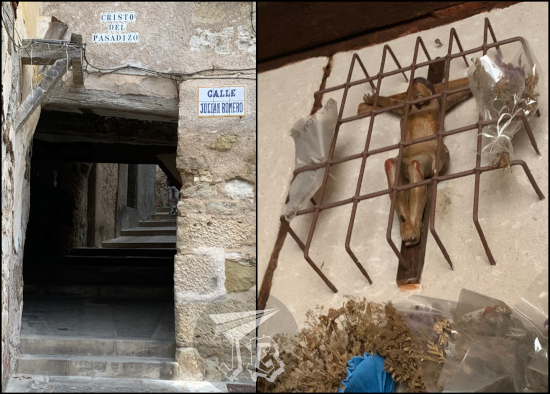
We also came across the “Christ in the Alleyway” or Cristo del Pasadizo, which is related to the legend of two lovers – he went to war, she stayed behind and moved on, and then everything ended in tears because how dare a woman in Christian Middle-Ages Spain try to be happy. Anyway, here’s the alleyway and the Christ figure.

Cristo del Pasadizo

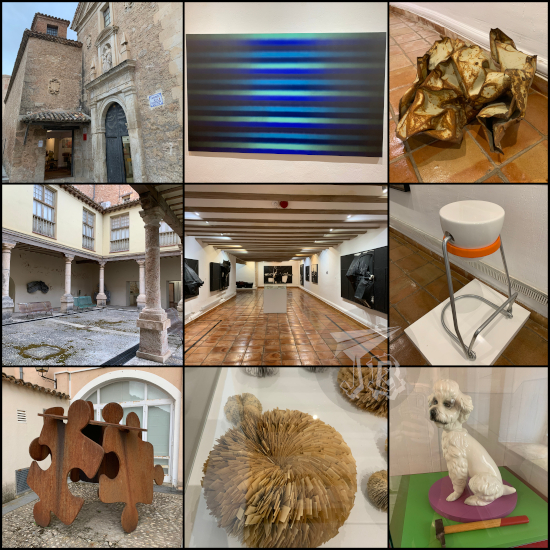
After that we ended up at another museum of contemporary art, Fundación Antonio Pérez, located in another former convent built in the 17th century. Honestly? It was slightly interesting but mostly claustrophobic. The majority of rooms do not have windows whatsoever and the fact that there is a one-way itinerary due to Covid, and how dry the air was, made it stressing to an almost ridiculous level.

Arte contemporáneo

It was early evening when we came out, and the second we put a foot outside it started pouring, so we headed back – it also made for a few spectacular pictures.

Rain

Rain

Some cool ones were also taken on Sunday morning just before we drove off early because there was stuff to be done throughout the day.

Casas Colgadas + Puente de San Pablo

8th & 9th January 2021: Guadalajara & Filomena (Spain)

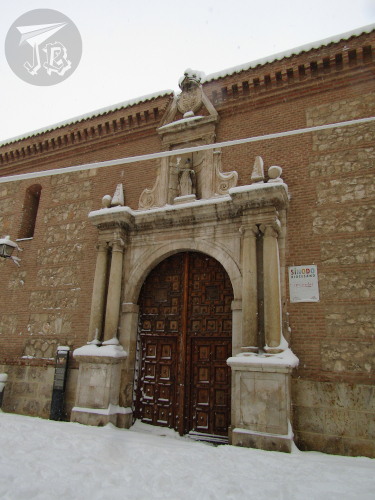
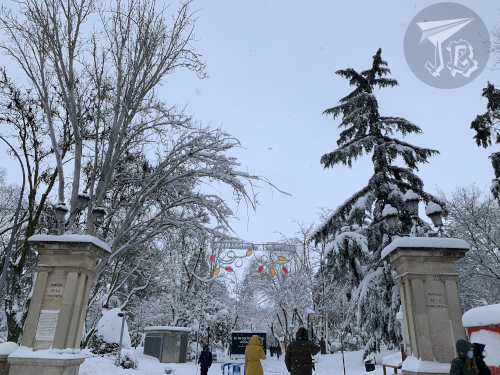
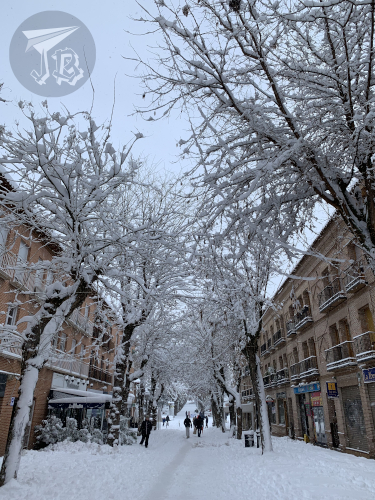
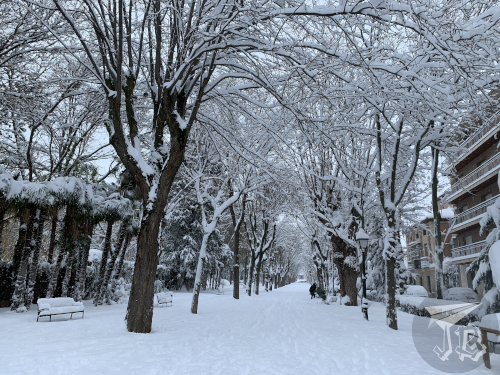
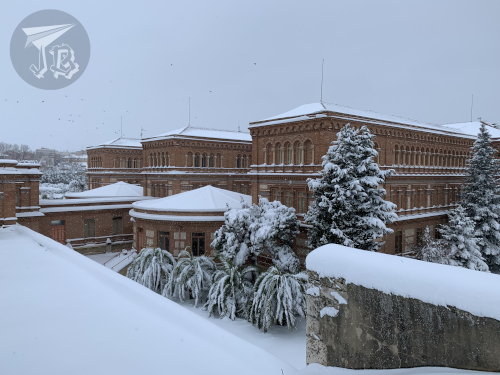
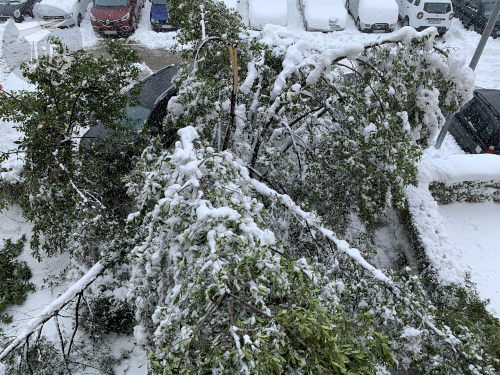
Since 2017, Spain (alongside Portugal and France) has taken up the custom of naming bad storms, and this season we are up to ‘F’, the 6th bad storm. In this case, the storm, named Filomena, entered Spain from the south west and collided with a polar air mass that happened to be coming from the north. The result – snow. Lot’s of it, with low temperatures and snow-heights not seen in a very long time. Some call it “the snowfall of a lifetime”.

As Covid-19 has made travelling impossible – or at least pretty unsafe / irresponsible (choose your pick), plans have been pushed back again, and plain cancelled. While truth be told I still hold tickets for the Saint Seiya event in Paris in late May, I have no hope I will be able to attend. Even if the Covid crisis fades away, there’s the extra issue of the economic blow 2020 caused.

Anyway, back to Filomena – it brought something that is rarely seen in these parts. Snow. Lots of it. So before everything went to hell, I just decided to ignore the stay at home recommendation and took a couple of walks around Guadalajara for a rare sight – the monuments covered with snow. Furthermore, as the snow is expected to freeze into ice plates, I had to go out when the snow was still fresh.

I took two different walks. On the eight of January, Friday, as soon as I got out of wok I put on my snow boots (perks from the time living in Scotland) and winter coat, then threw my raincoat over it – it was a tricky movement, but I managed not to dislocate my shoulder doing so. By this time there was a coverage of a few centimetres, and I decided to head out to the outer area of town where I could sneakily take my mask off if my glasses fogged too much, which I had to do when I crossed the road, because there’s no actual crossing.

There was a surprising amount of people around! Fortunately I was able to keep my distance, especially at the times when I tried to breathe – even if I went out with the smaller glasses, at points I had to take them and the mask off to be able to breathe and see anything.

I walked up to the Toro de Osborne a winery-billboard-turned-item-of-cultural-and-visual-interest which as you can see is shaped as a bull – representing the species used in bred for bullfighting, because the Osborne winery is located in an area also famous for the livestock. It is made of metal and measures around 14 metres high, one of the 91 that remain around Spain. It stands in an area that was supposed to become urbanised but never did, so it has several unfinished alleys and corners. There has been a statue there since 1975, called El Abrazo, (The Hug), which has always reminded me of a decomposing DNA strand. It was erected by Francisco Sobrino, the most famous sculptor from the town.

I went back right before sundown, and the roads were already difficult. It continued snowing throughout the night, and when I woke up on Saturday morning, no cars could run, there were no buses, trains had been stopped and some trees had collapsed under the weight of the strongest snowfall in decades. But… temptation won. I only wanted to peek around the corner a little, but then I decided that as there was a good chance I would run into people, I could not cheat on mask policy – so I put my contacts on. That warranted for a longer walk as those are disposable, and… not cheap (≧▽≦).

First I walked down the Avenida del Ejército, one of the main arteries in town, which had already been somewhat cleaned of snow, which was good, because… well, there was a bit more of a cover than the day before

I reached the park built after the ancient Arab structure, Parque de la Huerta de San Antonio. To the left stands one of the towers of the old walls, Torreón de Alvar Fáñez.

I saw the snowed Palacio del Infantado. This palace was built in the late Renaissance style, designed by Juan Guas and commissioned by the Marquis of Santillana. Although the main construction happened between 1480 and 1497 but has been reformed in several occasions, even recently as it was turned from public library into monument and museum. Infantado is a name related to the concepts of infante or infanta, which are the Spanish terms that designate the children of monarchs who are not the direct heirs (so no the crown prince or princess). The most important feature is the main façade built with sand-coloured rocks and diamond protuberances as decoration. It was suspected to have suffered from aluminosis concrete a couple of years back, but after a small political struggle, it the palace was deemed healthy again. Magic, I guess.

Up the central street of the old town, I took a small detour to check the Iglesia de Santiago Apóstol to the left. The church, built in bricks, used to belong to a now-gone convent.

In front of the church stands the convent-turned-palace-turned-high-school Convento de la Piedad / Palacio de Antonio de Mendoza. The convent-palace represents the start of the Renaissance influence in Spain, especially the former grand entrance.

At the end of the street stands the main square and Ayuntamiento, the town hall, and main square, where the street turns into the main street, Calle Mayor. The town hall, built at the beginning of the 20th century, sports an interesting bell tower in iron.

The square Plaza del Jardinillo (square of the little garden) where the Baroque church Iglesia de San Nicolás el Real stands. You can’t really recognise him under all the snow, but there is a Neptune standing in the middle of the fountain in the square.

Main Street continues until the square Plaza de Santo Domingo. The square is half park-like, half built, and one of the trees that died in the park area was carved into a book-stash sculpture.

On the other side of the road stands another church, Iglesia de San Ginés, built in the 17th century with two towers and a Romanesque-looking entrance.

The police tape around the main town park, Parque de la Concordia, had been partially taken down and I interpreted (wrongly) by the sheer number of people inside that it was allowed to walk in. Only when I reached the other side I realised that the park was considered unsafe, and of course I did not risk any other trespassing. The park dates to mid-19th century, and hosts a gazebo-like structure built in brick and iron by Francisco Checa in 1915.

I went on to the Paseo de San Roque, only on the street area, as the more park-like one was taped off. This is one of the most diverse parks in town, and some say that it could / should have been considered a botanical garden.

I walked alongside, peeked into the park Parque de las Adoratrices, but it was packed, so I continued on. Although this park is rather recent, opened in 2009, the walls and fences were built a century earlier. The town festival used to be celebrated here, but it was moved away to the outskirts as the town grew.

At the end of the street stands the chapel Ermita de San Roque , which originally was outside the town when it was built in the 17th century, in the typical brick of the area.

I walked around the walled area of the Colegio de las Adoratrices, with some really cool views of the pantheon that stands there, Panteón de la Duquesa de Sevillano, the school building and the church Iglesia de Santa María Micaela. This whole area used to belong to the Duchess, who commissioned the architectural complex in the 19th century. The pantheon is a particular example of the eclectic architecture, with a purple dome. The church is a mixture of different styles, out of which maybe neo-Gothic would be the most prominent one.

The street I wanted to go along next was a) taped off and b) waaaay too steep for a safe climb-up, so I decided to turn towards another of the important squares in town, Plaza de Bejanque. You can guess the old fortress Fuerte de San Francisco behind it, but it was also full of people, so I walked fast.

One of the features of the square is the old gate from the walls, Puerta de Bejanque, one of the access gates through the 14th century wall. This used to be part of a house that was built around it, and it was unearthed, so to speak, in the 90s.

I went down towards the co-cathedral Concatedral de Santa María. Originally built in the 13th century, this catholic church has been redesigned and rebuilt in several styles. It is best characterised by the horse-shoe arches in the main façade.

And sneaked up towards the chapel Capilla de Luis de Lucena, a small and compact chapel built like a tiny fortress that used to be an oratory part of a larger church.

I walked past the old palatial house Palacio de la Cotilla, a palatial house from the 15th century.

The convent Convento de las Carmelitas de San José. This convent, where cloistered nuns still live (tradition says that couples that are going to marry should bring them eggs for sun on the day of the wedding) was built in 1625, and the inside is decorated in the Baroque style.

And finally reached the lookout over the park built within the old torrent, Parque del Barranco del Alamín.

I finally saw the former church Iglesia de los Remedios. Today it is used as the grand hall for the nearby university, but it was originally a Renaissance temple, with three characteristic arches guarding the entrance.

And turned back towards the Palacio del Infantado from the square Plaza de España.

It had started snowing more heavily by then and my legs were getting tired. The sloshy snow on the roads had become frozen so it was slippery, and when I was walking on the actual snow, it was up to my mid-shins, so I was feeling the strain in my legs and my back. Thus, I decided to go back home and not to return in the afternoon again because the trees had lost more and more branches under the weight of the snow. The temperature going down also meant that the snow was going to freeze and it would be more slippery as it became ice…

I mean, this is the tree that used to stand in front of my balcony… So better safe than sorry. But all in all, the snowfall of a lifetime in these latitudes!

12th September 2020: Sigüenza (Spain)

We took a drive to Sigüenza, in Spain. This medieval town? big village? had a big relevance through the Middle Ages, and the historical centre reflects that. The most prominent point is the castle on top of a hill. The Castillo de los Obispos is a fortress that can be traced to Roman times. However, the actual castle was a Moorish alcazaba. After the Christians took it over in the 12th century, it was remodelled and enlarged. Due to its vantage point, the castle was a key element in different wars and strife, including the Napoleonic invasion and the Civil War, thus resulting pretty damaged. In the late 20th century it was decided to restore it turn it into a Parador with around 50 rooms.

During our planning stage we called and tried to book a restaurant for lunch, and we were told they were not taking them, we had to call on the same day. Of course, when we got there, it was impossible to book – there was a course and the celebration of a communion (seriously, people, learn to say no so others can get organised). Unfortunately, you could not see the interior or even the yard if you had no reservations, so I can only share a picture from the parking lot, where we left the car.

We walked down the main street Calle Mayor, a clobbered slope that ends (well, technically begins) at the town’s main square.

Main Square or Plaza Mayor is home to the Town Hall or Ayuntamiento de Sigüenza, an old palace with a typical Castillian inner yard or patio.

Opposite the town hall stands the cathedral Catedral de Santa María La Mayor de Sigüenza. The Gothic building was built upon a previous Romanesque one and it had some Neoclassical and Baroque additions. Thus, the façade sports Romanesque doors and rose window, and the main body is Gothic. The altar and the choir are awfully Baroque too, and some of the chapels sport Cisneros, Plateresque and Renaissance decorations. All in all, an interesting pout-pourri of architectural and decoration styles.

The most important piece of art of the cathedral, however, is a funerary piece to the right of the altar. It is the sepulchre of Martín Vázquez de Arce “El Doncel” (“The Young Man”). The chapel holds him, his parents and grandparents, but the sculpture on his sepulchre is the most impressive one. The Vázquez de Arce family were vassals of the Mendoza family, the most important family in the area during the Middle Ages. During the war to conquer Al-Andalus, the Vázquez de Arce males followed the Mendoza to the war in Granada, where Martín died in a trap set by the Arabs, which consisted on damming the River Genil to a creek, and then releasing the dam so the water took over the enemies crossing (which… kinda sounds like something out of the Lord of the Rings, doesn’t it? At least, it makes me think of Arwen and Treebeard). The sepulchre, commissioned by Martín’s brother, presents him taking a break during training and reading a book. He even has pupils, so if you could climb up, you’d see what he’s reading!

The cloister is also Gothic, as the previous Romanesque one was torn down. It holds a central garden and a number of side rooms where there is a collection of mythology-themed tapestries. In one of the chapels, there is also a painting by El Greco, a Greek painter rooted in Spain who was one of the key artists during the Spanish Renaissance.

The cathedral ticket also allows a visit to the Diocesan Museum Museo Diocesano, which holds many pieces of religious art, along with a few models of the cathedral in its different construction stages. These days I’m trying to learn some hagiography, which means how to identify religious figures by how they’re presented. Getting there, three out of ten times or so, because half the time they cheat.

After the cathedral we climbed up towards the castle, and we stopped at the former church Iglesia de Santiago, now transformed into a mini-introduction centre for all the “hidden” or “unknown” Romanesque in the area. The church itself had some beautiful paintings, but it was destroyed during the Civil War.

Continuing our way up, we turned a little to see the house where the Vázquez de Arce family used to live, now turned in a museum, Museo Casa del Doncel. There is a little paintings exhibition and a guitar museum, along with some ancient artefacts such as vases or looms. The most interesting part are the Moorish “Mozárabe” decoration. Here is a bit of historic trolling: when the Christian “conquerors” hired Arab craftsmen to do decoration, one of the things the Arabs did was decorate using Quran verses.

Then we saw the outside of the church Iglesia de San Vicente Mártir, Romanesque to boot.

Afterwards, we ended up at the square Plazuela de la Cárcel, where the old gaol jail stood.

Finally, we headed over to the restaurant where we had booked a lunch table, a traditional grill called La Taberna Seguntina where I chose to have a “summer menu” with salmorejo (a thick soup or purée made with tomato, oil, and bread and sprinkled with boiled egg and cured ham) and roasted cochinillo (suckling pig, roasted whole) with potatoes and herbs. For dessert I had a pudding!

And that was it, really – Medieval Sigüenza has nothing else to see. As the façade of the castle was being restored, we did not even take pictures of it as we drove away.

4th September 2020: Alcalá de Henares (Spain)

After looking for a place to park the car for 12 minutes, I left the car and I went off on foot towards the centre with a relative who is living in Alcalá de Henares. The town centre has been a Unesco World Heritage Site since 1998.

Our first stop, at 10:30 almost sharp was the Palacete Laredo, a small palace built in the Neo-Mudéjar style, a type of Moorish Revival architecture. It was designed and built between 1880 and 1884 by the Spanish artist Manuel José de Laredo y Ordoño. After a century in private hands, it passed to the town hall, which allows the university to use it as a museum, showing a collection of ancient documents.

The palace is built in brick, it has two floors and a minaret-like tower. The inside is decorated with coloured-glass window, tiles and paintings. The visible ceilings on the first floor are wooden artesonado (decorative beams joined together). There is also a garden, but it was closed.

Afterwards, we headed off towards the centre. We walked by the church Parroquia de Santa María la Mayor and is inhabitant the stork on photo duty.

We had tickets to see the Corral de Comedias, a theatre built in the site of an ancient “theatrical courtyard”. These were open-air theatres that were common during the late middle ages and exploded in popularity in the 16th century. The Corral in Alcalá de Henares was built in 1601 by Francisco Sánchez, member of the Carpenters Guild. It suffered several changes – the ceiling was built in the 18th century, then it became a cinema, and eventually was “lost” in the 1970s. In the 1980s, it was rediscovered, restored, and finally opened as working theatre in 2003.

Alas, we were too late for the 12:00 visit to the university, so we wandered around the town’s main square Plaza de Cervantes – Alcalá de Henares was Cervantes’ birthplace. Miguel de Cervantes was a 16th century Spanish writer, most renown for his novel “The Ingenious Gentleman Don Quixote of La Mancha”, which many authors consider “the first modern novel” and “the best literary work ever written” (though… I disagree). The square features a bandstand, the statue of Cervantes, and is surrounded by several buildings of importance – the ruins of the church Iglesia de Santa María, the Town Hall and the Círculo de Contribuyentes, former casino, and the Corral de Comedias.

Then we walked down Main Street Calle Mayor, until we got down to the Obispado de Alcalá de Henares, the bishopric, with two towers from the former wall at their sides. That reminds me – we did not visit the cathedral or any religious buildings because they were all closed to tourism.

At 13:00 we took the guided visit to one of the university buildings, the Colegio Mayor de San Ildefonso. The university was established in 1499 by Cardinal Cisneros, an influential Spanish religious and statesman in the time of the Catholic Monarchs. A colegio mayor is basically a dignified “classic” dormitory. The façade was built between 1537 and 1559 in the Plateresque style, an architectural style that developed in Spain between the late Gothic and the early Renaissance. The architect was Rodrigo Gil de Hontañón.

Inside, we saw the cloisters and yards, the gate of honour (from where the successful students left the university), the classroom where the students defended their final thesis, and the chapel, with the tomb of the founding Cardinal (but not his body, which is in the cathedral).

We had a reservation to have lunch at the Parador de Alcalá de Henares, which is a rather modern building and not a historical one, but a stamp was needed (≧▽≦). Lunch was a looong affair because our waiter might not have been the… most efficient. We tried the combos with a little bit of everything to share (entrées and desserts), and some bull tail. Oh and coffee. Yay coffee. (Also, kudos to me for cutting that nut in half.)

After lunch, we walked down the Calle Mayor again and we made a stop at what is supposed to be the house where Cervantes was born, or at least a reconstruction, with a bunch of ancient objects thrown in – the Museo Casa Natal de Cervantes. There was also a photography exhibition. To be honest, it had a great quality-price relation. It was free, and the quality was… lacking. Or maybe I’m old and I have seen most of the stuff they showed in action, and used a few.

We continued on to the regional archaeological museum Museo Arqueológico Regional, located in the old Archiepiscopal palace. That was unexpectedly good, with the fossil record and the old Roman mosaics.

Pending for a future visit to Alcalá de Henares: Roman and Medieval areas, and the religious buildings, as the day finished up doing some necessary and work-related shopping before I drove back home.

Driven distance: Around an hour? I dumped the car as soon as I could and we walked the hell out of the town (≧▽≦)
Walked distance: 14.61 km

9th August 2020: The Cross-Roads {Spain, summer 2020}

When driving around Madrid, a great cross can be seen from several kilometres on the road. It belongs to the monument to the fallen during the Spanish Civil War, the so-called Valle de los Caídos (later, in 2022, the name would be officially changed to Valle de Cuelgamuros). It was built during the dictatorship times, and the regime forced political prisoners to do so.

During the last couple of decades, the site has been the centre of a lot of polemics, and in 2019 Franco, buried there, was exhumed and taken somewhere else. There is no doubt that it is a symbol of… something. Of course it is. More and more voices, however, claim it should be torn down and in case they ever succeeded I thought that I should, at least, have visited it once. It is after all a piece of history.

And it was literally a ten-minute detour away on our way back. After we left Astorga, there was nothing else on the route plan, so it was a good stop for a quick visit. The monument stands in San Lorenzo del Escorial, in the valley of Cuelgamuros and it is comprised of a basilica, a monastery, and a 150-metre-high monumental cross

The valley is mainly accessible by road. You drive into the valley through a barrier-gate where you buy your tickets (at the moment, only through credit card), then you go up some curves and you can turn left for the monastery and right for the abbey. There used to be restaurants and cafés but at the moment only the toilets are in working order. The monastery has a hostel but I’m not sure whether that works.

As of 2020 the access to the cross, both on foot and by cableway are closed. The basilica, built into the rock, is where the main core is. Entering the basilica there is X-ray security and there are no pictures allowed. We visited between masses so there were lots of people.

The project in itself is… megalithic. I was asked if it was what I had imagined and I said no. The basilica is bare and huge and after walking through a damp-feeling tunnel with some chapels to the sides, you go up some stairs and reach the pews and altar, with two chapels to the sides.

The outside esplanade is made of white granite, and it was scorching hot, but at least I can bring you some pictures of it, along with the cross.

After that, we just took the car and drove back home.

Driving distance: 405 km
Walking distance: 4.37 km

All in all… no, this was not the greatest trip ever, but we were lucky to be able to take it. Of course, there was the stress about the virus. We tried to be careful, overused hand sanitizer (my poor nails), never let go of face masks except when strictly eating, and there were extra stress factors involved that made it hard to enjoy. But although I would very much have preferred taking my trip to Greece, I am grateful that we were able to at least take a bit of a breather this summer. And got myself some stamps.

8th August 2020: Astorga {Spain, summer 2020}

We left Pontevedra in the morning and we drove off towards Astorga, in León. It should have been an all-motorway trip, except half the motorway was under construction so it took us a while longer than we thought to arrive.

The hotel was… shabby – and I’ve been in “bad” hotels before, but I’d never before been to one where there was food from the previous (?) guests in the mini-fridge, nor one with such… untrained staff.

After checking in, we went to see the cathedral Catedral de Santa María de Astorga and its religious artefacts museum, including some neat codices.

Then we had lunch – and did not die out of trying the local cachopo (huge stuffed and breaded fillet that we shared (≧▽≦).)

After lunch, we went to visit the palace that a bishop had commissioned Gaudí with, the Episcopal Palace of Astorga, or Palacio Episcopal de Astorga, also called Palacio de Gaudí, built within between 1889 and 1913, and obviously Modernist. I’d been wanting to visit this for a while now, so finally!

Later, we went out to buy “souvenirs” – namely local beef jerky cecina and chocolate! Although the chocolate museum was briefly on the plan, we forsook it because it was not significantly different from the one in Villajoyosa. and in the end the final product is what is important (≧▽≦).

Driving distance: 301 km
Walking distance: 5.89 km

7th August 2020: Seafood {Spain, summer 2020}

We headed out for a guided visit around Pontevedra (personally, not a fan, but the downsides of travelling in a group…). These are some of the monuments / places we visited:

Alameda de Pontevedra and Monumento a los Héroes de Puente Sampayo.

Casa Consistorial (Town Hall) and Fiel Constraste sculpture by Ramón Conde.

Casa de Campás (palace house where a local pirate used to live).

Theatre and Liceo.

Plaza del Hospital (square).

Monument to the Parrot Loro Ravachol

Santuario de la Virgen Peregrina, church and fountain.

Plaza de la Herrería (Blacksmiths’ square), along with the convent Convento San Francisco and Wall Gate; Jardines de Casto San Pedro (gardens), with another fountain, and the other squares around: Ourense, Estrella, Casto San Pedro.

Casa de las Caras (House of the Faces).

Plaza de la Leña (Firewood Square), a cruceiro (stone cross) and García Flórez Building.

Iglesia San Bartolomé (St. Bartholomew’s church).

Plaza Verduras (Greengrocers’ Square).

Statue to Valle Inclán, who was an important Spanish writer born in 1866.

Plaza de Teucro (Teucro Square) along with the powerful family shields (Montenegro Family) on the buildings.

Casa Valle Inclán, where the writer used to live, and cruceiro.

Basílica de Santa María la Mayor (basilica).

Ruinas del Monasterio de Santo Domingo (ruined monastery).

After the visit, we headed off to a restaurant called Casa Román for some seafood, which is typical of the area. We had Goose barnacles (Pollicipes pollicipes), which are supposed to be an amazing delicacy of the area – I had never tried them before, not the real thing. Then we ordered velvet crab (Necora puber) and a fried lobster (Homarus gammarus) on a potato bed.

Can you say food coma? Yeah. Me too, because we did nothing else that day except going out for a salad dinner, that turned out to be this:

To be honest we did some walking around beforehand, and came across a couple of bridges over the river Lerez: the modern Puente de las Corrientes and the Medieval Puente del Burgo.

Then we went back to the Ruins of the convent Ruinas de Santo Domingo to see them at night.

Walking distance: 7.20 km

6th August 2020: Monforte → Ourense → Pontevedra {Spain, summer 2020}

We left behind Monforte de Lemos and drove off to Ourense, one of Spain’s thermal cities. Unfortunately most of the thermal water stuff is closed due to Covid and it was 40ºC anyway (≧▽≦). Upon arriving we left the car, and walked to the cathedral Catedral de San Martín de Ourense, an amazing piece of Romanesque / Gothic art with an amazing 13th-century chromatic Portico of Paradise [Pórtico del Paraíso] and a horrible Baroque Chapel of Christ [Capilla del Santo Cristo].

Ourense: Romanesque portico with wooden figures painted in bright colours (by JBinnacle)

We walked past Plaza Mayor or main square.

And we reached the area called As Burgas, where the old Roman baths and fountains of thermal water stand.

Then we took a stroll upwards and found an interesting church – the Iglesia de Santa Eufemia, very, very Baroque and climbed about five hundred stairs.

After arriving at the cloister of Francis, Claustro de San Francisco, we took a walk around and then went back to the car to drive off to Pontevedra.

On our way out we could spot the Roman bridge, Ponte Romana, but could not take any nice pictures due to the railing of the actual bridge we were on.

It did not take long to Pontevedra, where we had lunch, rested for a while, and then took a stroll around the town centre. Oh, and I got stamp number four as we stayed at the Parador de Pontevedra, which is an old city palace. Pontevedra is the town of a thousand squares, or so it feels. The truth is that the following morning we had booked a guided visit, so just a few highlights here.

Santuario de la Virgen Peregrina, a shell-shaped church in the centre of the town:

Plaza de la Herrería (and a few others surrounding it), with a friendly mask-concerned dinosaur (don’t judge, their hands might not be too good for the knot-tying).

We had dinner a splendid dinner: scallops (both zamburiñas and vieiras, or king scallops (Pecten maximus), empanada(pie) and lacón (pork. Not quite ham, but yummy anyway).

Driving distance: 168 km
Walking distance: 6.28 km