I was offered a half-day trip with lunch for my birthday, and that is how we ended up in Molina de Aragón. Today, it is a historical village with around 3,000 inhabitants, considered part of the Natural Reserve Parque Natural del Alto Tajo. In the Middle Ages, however, the area became important after being seized by the Christians. The kings and nobles pushed for peasants to move in so they would keep the previous Berber population from retaking it. The region became an independent estate Señorío de Molina around 1139 under the rule of Manrique de Lara. The estate renounced the Castilian monarchs and joined Aragón for a few years – hence the name – until it was given back to Castile. The town became an axis of wool trade and a customs point, along with a strategic battleground until the 19th century.
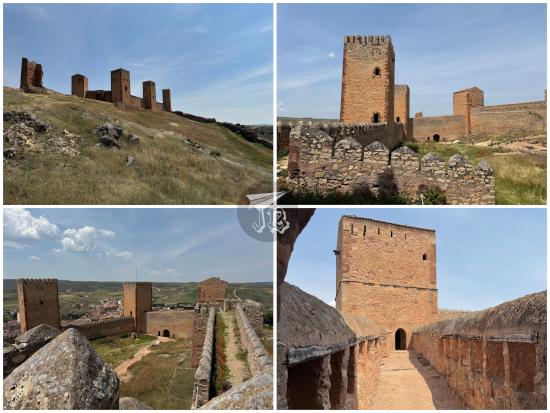
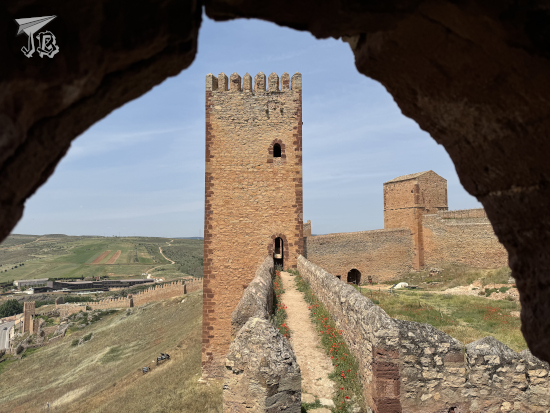
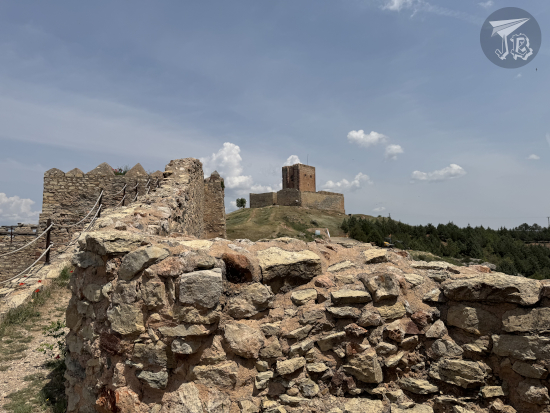
The castle Castillo de Molina de Aragón was originally an Arab fortress, and it was already mentioned in the Spanish Romance poem El Cantar de Mío Cid. The current structure dates from an order by Alfonso I of Aragón in 1129 after the conquest of the area. The castle is the largest stronghold in the province, with four complete towers and the ruins of two more, out of the eight that were originally erected. There are two walls, the inner and outer one, with five gates. The structure was built mostly in bricks and red limestone ashlars. The colour helped camouflage the castle and its defences amongst the hills and erosive landscape. The ruins were declared Important Cultural Asset (BIC in its current denomination) in 1931, and have been protected ever since.
I had seen the castle from outside the first time I visited Molina de Aragón (but that was unplanned, since I was around and the weather was nice). This time around, it was open. Unfortunately, my parent drove right past the parking lot that has been “prepared” (cleared out of brambles, and not too well at that), so we ended up following some signs reading “castle” that lead us to one of the outer watchtowers, known as Torre de Aragón. It would have originally been joined to the main castle, but today it’s just a lonely tower, surrounded by its own walls. It was locked, though it can be visited in theory.
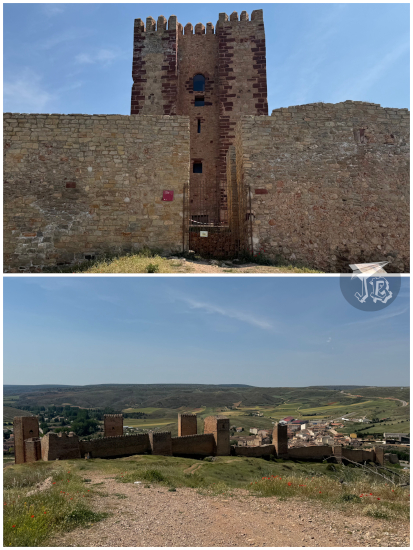
We backtracked to the parking lot, and climbed – almost literally – to the gate of the castle Castillo de Molina de Aragón, named Torre y Puerta del Reloj (Clock tower and gate). After you enter the walled area, there is a ticket booth, next to the remains of the church. Once you purchase tickets, you can commence your ascent towards the actual keep.
Considering how little the castle is being taken care of, most of it is in excellent condition. You can walk all around the perimeter on the walls and climb a lot of the towers, which is really cool. I should have worn my hiking boots though. At some point we saw a kettle of vultures flying around but they did not seem interested in anyone in the castle – even if a little girl decided it would be hilarious to throw down stuff from the top of one the towers as I was walking underneath. That could have killed me for sure.
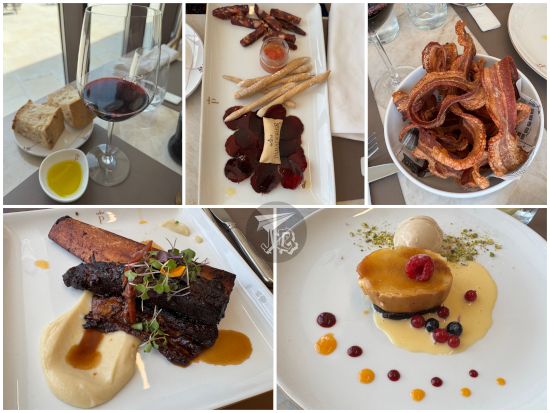
After the castle, we went to the Parador Parador de Molina de Aragón to have lunch – well, I had to get a stamp too. The hotel / restaurant opened last year, and just as it got inaugurated, it had to be closed down as it flooded in a torrential rain episode. The restaurant had nice views of the castle and the food was good, but a bit on the expensive side. My family decided that they wanted to share some cheeses (Selección de quesos de la región con crema de membrillo y cañas de pan feo) and cured meats (Cecina de ciervo y chorizo de caza con tomate y pan de azafrán and Torreznillos crujientes en adobo de pimentón de la Vera), and for my main I chose a fancy beef rib (Costilla de vaca glaseada al vino de Mondéjar, cebolla encurtida y crema de apionabo) – basically the only thing that did not have coriander in it. Since it was my birthday, I decided on a dessert, a sponge cake with ice cream called “cow leg” (“Pata de vaca” con crema y helado de vainilla).
My family was not up for more, so we drove back home, which was a bit of a bummer. There are cool things to do in Molina de Aragón that I haven’t seen yet – maybe as I drive through it in the future I can stop and have a snoop.

