10th December 2025: Oxford, trains and back to London {United Kingdom, December 2025}

I got up, used the kettle in the room to prepare a quick coffee… and one look at the radiator told me how it worked. I must have been much more tired than I realised the night before… I left my luggage at reception and went back to the streets of Oxford. I basically retraced my route from the previous evening in daylight.

I started off at the Claredon Building, the Bodleian Library and the Bridge of Sighs. Beyond that, I got back to the Radcliffe Camera, University Church of St Mary the Virgin, and the Old Bank Hotel. Down High Street, I walked by All Souls College, the Examination Schools, the Queen’s College, all the way down to Magdalen College.

Up the street again, I reached the Covered Market and turned at Carfax Tower, to St Aldates Church and Christ Church College. Though visiting it was my goal for the morning, I still had some time before the College opened. Thus, I decided to go to Costa Coffee for a proper breakfast, where I had a vanilla latte and a blueberry muffin.

I then headed back to Christ Church College. As it is the largest and most important structure – and also the one that holds the cathedral – it was the college I thought I needed to visit. The visitors’ centre is located in Christ Church Meadow, a floodable grassland open to the public during the day.

I purchased a self-guided visit ticket and went on to explore. Christ Church College (officially The Dean and Chapter of the Cathedral Church of Christ in Oxford of the Foundation of King Henry the Eighth) was founded in 1531 by King Henry VIII, as expected by the name. It was later refounded in 1532, and again in 1546. The second refoundation had a lot to do with the reorganisation of the Church of England, and since then it has been the home of Oxford’s cathedral. Christ Church is a huge complex, mostly in a stunning Gothic and Neo Gothic styles (with some Baroque and Neoclassical add-ons), and the audio guide kept insisting that one should not peer through the windows. Though I think it would have been doable to take the tour the previous day, the cathedral had been closed, and I wanted to see that.

I don’t really think I was ready for how grandiose – I can’t find any other word for it – the whole compound was. The Great Hall caught me by absolute surprise. The staircase which accesses it is magnificent, and the hall is just fascinating. There are fireplaces, pictures of Deans and Professors, long wooden tables and lead windows with different motifs, the most important one being the Alice in Wonderland Window.

The visit begins at Meadow Quad, a 19th-century Gothic Revival building, designed by TN Deane. The particular style is known as Venetian Gothic. During the Victorian period there were several efforts to redefine the significance of Classical ruins and medieval structures, along with a scorn of Baroque. In a typical with-me-or-against-me fashion, two thought currents emerged. On the one hand, Frenchman Eugène Viollet-Le-Duc, who wanted to be more Gothic than the Medievals themselves. His idea was to perfect Gothic buildings using more modern materials and techniques, often making up structures and even whole buildings. Amongst his notable efforts are the restoration of Notre Dame in Paris and the city of Carcassonne (and by his followers, the Olite castle).

On the other hand, Englishman John Ruskin claimed that construction had a life cycle and should be born (be built), then live (be used) and die (collapse). Being a Romantic in the artistic sense of the word, he also idealised Gothic, and his theories inspired more than one Gothic Revival attempt, but he considered them plagiarism and “faux”. Ruskin studied in Oxford, and some of the Neo Gothic buildings there tried to recreate his idealised visions of Gothic – Meadow Quad is one of them (the museum of natural history is another). While Ruskin originally (and vehemently) opposed restoration, to the point that at some point he wrote that it “shattered his soul”, by the end of his life he acknowledged that maybe it was not such a bad idea. Though this is of course a very summarised version of both theories, if I have to take a stand, I’m on Viollet-Le-Duc’s side.
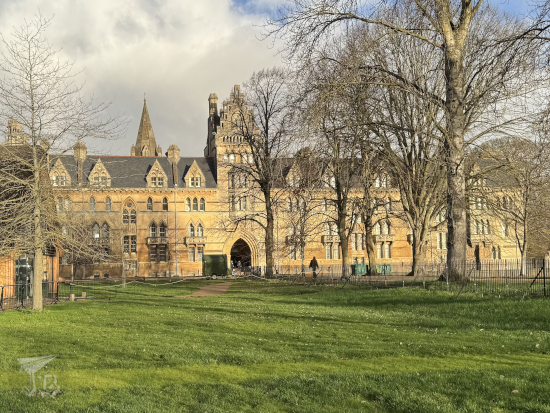
Outer façade of Christ Church College, Oxford, towards the end of the meadow.

The first visit inside the college is Bodley Tower, which features a the monumental Hall Staircase, with an incredibly vaulted ceiling of Medieval design but carved in 17th century. It leads to the Great Hall, the Renaissance mesh room where students and teachers share their meals on long wooden tables (I’ve also learnt that during summer holidays Christ Church turns the students’ rooms into a B&B and you can have breakfast there. Yes, I’m having thoughts). Features of the room include the two chimneys, painted portraits, and stained glass windows.

There is a particularly famous window, called Alice’s window, which honours a former student of the college, one Charles Dodgson, who is more famous than you think. Dodgson’s pen name was Lewis Carroll, and Alice is the one who went to Wonderland and Through the Looking Glass. Carrol was born in 1832, and throughout his life he became a writer, photographer and mathematician. He was tall but scrawny, deaf in one ear, had weak lungs and suffered from a stammer. In 1851, he enrolled to study in Oxford’s Christ Church, where he would go on to work for the rest of his life. It is said, especially in this college, that the main character from Alice’s Adventures in Wonderland (1865) and its sequel Through the Looking-Glass (1871) was based on the Dean’s daughter, Alice Liddell. Another apocryphal story is that the Dodo that appears in the fist book is based on himself – apparently his stammer made it difficult for him to pronounce his own surname, Dodgson, so he referred to himself as a Dodo. It’s difficult to know if this was true…
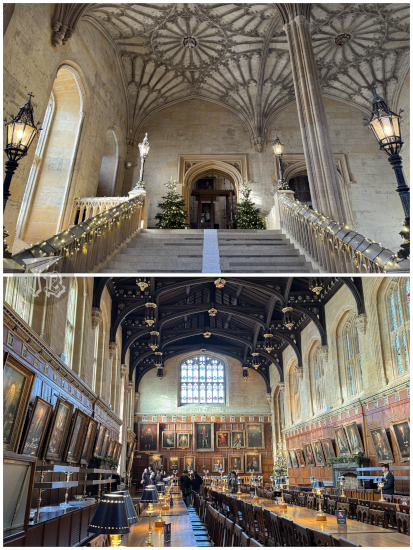
Main Staircase and Main Hall, where food is served.

Leaving behind the tower, I ventured onto the main yard of the college, Tom Quad (officially the Great Quadrangle), home of the resident pet ducks Tom and Peck. It was originally designed to be a cloister, but the arcade was never finished. In the middle of the quad stood a firefighting water reservoir, now substituted by a decorative fountain with a flying Mercury in bronze. The street and the college are connected by a gate on top of which stands the bell tower known as Tom Tower, whose bell is known as Great Tom. Tom Tower was designed by Christopher Wren around 1680, and Great Tom rang for the first time in 1684. Today, it rings 101 times at 21:00 Oxford time, which is 21:05 GMT, signalling the original curfew time.

The other two quadrants open to visitors are Peck Quad and Canterbury Quad. The former is overlooked by the New Library built in the 18th century in the Renaissance style. The latter gives way to the Picture Gallery. Possibly though, the most impressive element in the complex is Christ Church Cathedral or Cathedral Church of Christ. The building was erected towards the end of the 12th century, but the interior was redesigned, in the Neo Gothic style by Sir George Gilbert Scott.
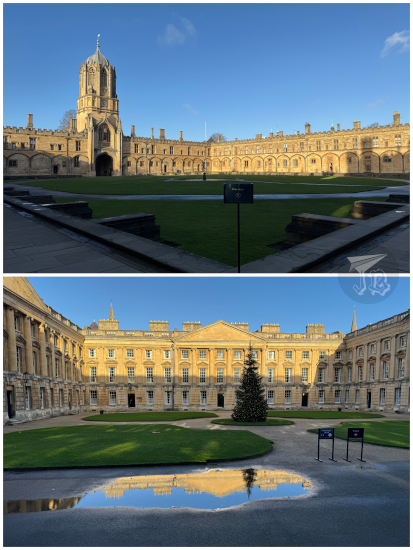
Quadrants at Christ Church College, Oxford. One is Gothic, the other is Baroque.

The cathedral was re-signified within the context of Henry VIII’s Reformation, which was sparked when the king wanted to have his first (out of six of them) marriage annulled. The original wife, Catherine of Aragon (Catalina de Aragón, daughter of Spain’s Catholic Monarchs) had already married Henry’s older brother, Arthur, who died soon after. Seven years later, she was wedded to Henry VIII, soon after his ascent to the throne, and although she become pregnant six times, only one child, future Queen Mary I, survived past infancy. In order to marry his brother’s widow, Henry needed a special dispensation from the Pope.

However, he was unhappy that Catherine had only reared one daughter, so by the time she was too old to have more children, he sought a personal favour from the Pope – the annulment of the marriage. He claimed to have realised that according to the Bible, said marriage was wrong and the lack of sons was a divine sign. It did not help that by this time, he had fallen in love (or in lust) with Anne Boleyn. The Pope rejected the request, which eventually yielded to Henry VIII’s breaking out with the Catholic Church and creating the Church of England. Henry banished Catherine, and married Anne Boleyn, who later ended up beheaded, accused of “treason” (read: infidelity), while Henry married again – four times.

Christ Church Cathedral was originally Catholic, built in the Norman (Romanesque) style during the 11th and 12th centuries. After its conversion to the Anglican rite, the interior of the church was redesigned. It has large stained glass windows and an amazing Neo Gothic ceiling. During the audio guide explanation there was a salute from the Dean, Sarah Foot, welcomed visitors “of any faith, or none” into the cathedral. As the building had originally been designed as an Augustinian monastery during the Catholic period, it features a cloister and a chapter house, the last visitable elements in Christ Church. I turned back in the multimedia guide, bought a trinket at the gift shop, and left the premises.
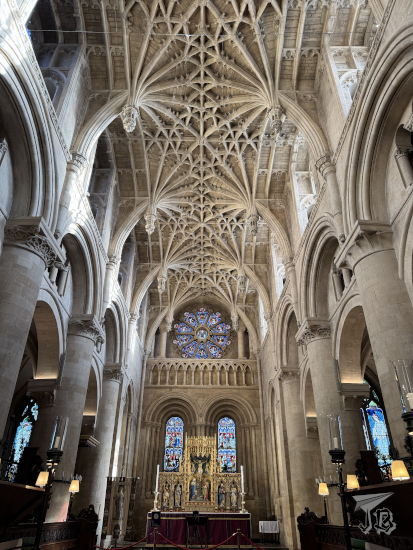
Interior of the very gothic Christ Church cathedral.

Afterwards, I returned to the hotel to pick up my luggage and head to the station taking a small detour to see the outside of Oxford Castle and Prison and the Castle Mound. There’s no free exploring the castle, you must book a guided tour, so I had decided against it, heading back towards London instead. I wanted to leave on the 12:34 train, which gave me enough time to drop the luggage in my London room, and head out again. Unfortunately, the train was delayed by a “disruptive passenger” and reached Oxford 20 minutes late. I had a booking for the London Museum of Natural History, but I could get another one to guarantee entry if there was a queue, half an hour after the original.

I did not see everything that you can see in Oxford. However, I’ve learnt that day trips are cheaper, because a single and a return ticket have the same price. I did not get to see anything related to JRR Tolkien, nor the Headington Shark, so I might have to eventually come back. I do not regret my planning though, because I had priorities. Off to London I rode, munching on salt-and-vinegar crisps.

I reached Paddington, then changed to the underground to reach Victoria Station. I hate Victoria. I hate it almost as much as I hate Shinjuku Station. It’s bustling and chaotic and I never get my exit right. It was particularly crowded as they had a Christmas installation – a huge plastic “Christmas bauble” which people could enter to have their picture taken. I finally got my bearings and reached the hotel, a few minutes away. Though it was called the Grapevine Hotel, check-in was next door, in the Sheriff Hotel. I had booked a single en-suite with private toilet, and when I got to my second-floor room I found the faucet, the shower, the bed, and a note reading “the toilet is on the first floor”. As in… a whole floor down there was a toilet with a sign reading “Room 15 toilet”. It was incredible surreal, and I had a good laugh about it!

I headed back to Victoria Station (have I mentioned I really hate Victoria?), hopped onto the Tube, and reached South Kensington. It was not too crowded and I could take the tunnel towards London’s Natural History Museum. They have recently reopened their garden, after revamping the area and adding a bunch of details and attractions. Renamed Evolution Garden, its main feature – due to sheer size alone – is Fern the Diplodocus (Diplodocus carnegii). The life-sized specimen is made in bronze and based on Dippy, the Carnegy cast. Before Dippy went on tour in 2021 (again), each bone was scanned so further copies could be made. The museum wanted a new specimen in a lifelike pose and no external support, that would be placed outside, no less. That was why it was decided to build the new display in bronze. However, the resulting skeleton would be too heavy, so they needed to hollow the bones out and keep the skeleton up using internal wiring. The result is a 25-metre long, self-supporting giant that gently sways with wind and withstands both heat and rain.

It almost dwarfs the smaller Hypsilophodon, first discovered in the Isle of Wight – a typical “English dinosaur”. The species lived in the Early Cretaceous, and it was first discovered in 1849, and for a couple of decades it was thought to be a young Iguanodon, until Thomas Henry Huxely proved otherwise. The new species was officially named Hypsilophodon foxii in 1869. It was bipedal, had a beak and teeth, and it is thought to have been a natural runner. It measured up to 2 metres in length, weighed around 20 kilograms.
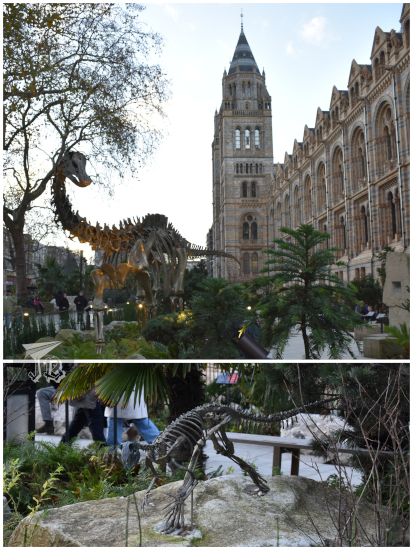
Outside garden if the Natural Science Museum London showing the diplodocus and Hypsilophodon fossil replicas.

The Garden of Evolution has vegetation in order of appearance – from ferns to other early plants to flowering plants and grasses as one walks through the garden and “advances” in time. There are more small sculptures and art pieces, rocks and ponds, all of them dedicated to recreate evolution and at the same time provide a little nature to the heart of London.

I walked into the building, and my bag was flagged for inspection… ish. It’s just big enough to hold my camera and my wallet, and when the security guard saw that it flopped – the camera was already around my neck – he waved me through. My first stop was the gift shop – there were two things I wanted so I got that out of the way. I was aiming for two Christmas ornaments, but I got a Fern commemorative coin too.

I headed to the dinosaur area. One museum’s traditions is dressing their T. Rex animatronic in a humongous Christmas jumper every year – this year it featured ammonite, theropod prints, stars and a T. Rex skull. It was hilarious. I almost bought myself the human-design version after seeing it.
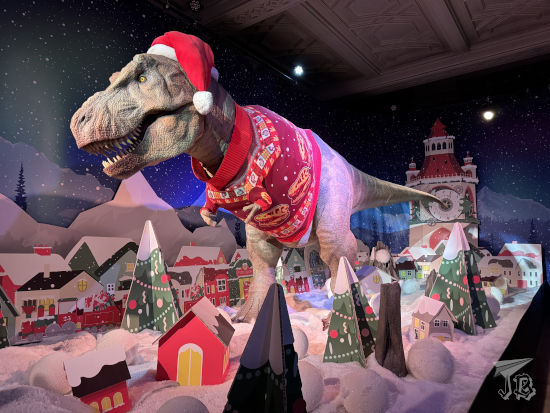
T Rex animatronic dressed in an ugly Christmas sweater with T Rex skulls.

I then went to the birds area to find the museum’s dodo, because after Oxford, everything dodo had to be checked out, of course. Later, I found my way to Sophie, the most complete stegosaurus skeleton. Afterwards, I made my way up because in June, the Museum unveiled a new species, a small herbivore named Enigmacursor mollyborthwickae from the Morrison Formation in the US. It is considered the holotype for the species (the only specimen known, even). Enigmacursor means “mysterious runner” and mollyborthwickae references Molly Lowell Borthwick – she and her husband donated a small fortune so the museum could acquire the unique skeleton, filed NHMUK PV R 39000. It was named in 2025 by Professors Susannah Maidment and Paul Barrett, and put on display. I was very excited to see it for the first time.
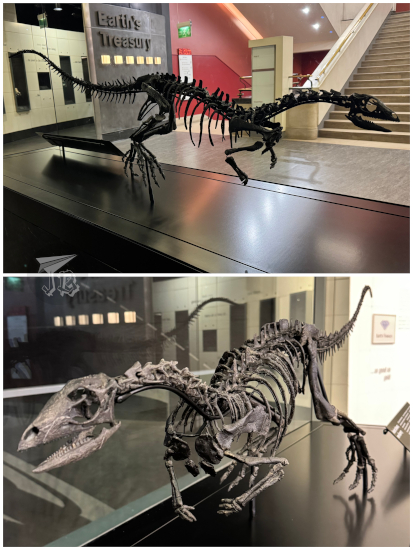
Enigmacursor mollyborthwickae, the one and only skeleton of this small theropod dinosaur.

I wandered through other spaces of the museum, including seeing the Treasures in the Cadogan gallery, where the Archaeopteryx is kept, the mineral gallery and The Vault, with all the gems and precious minerals. I also popped into the newly-renovated Hall of Mammals. I left the museum a bit before closing and was a tad disappointed that I could not cross the gardens, as they had closed an hour before the museum itself. I had a couple of hours before the musical, which did not feel like much to go to the centre and snoop around something “Christmassy”. So I headed back towards Victoria, and stayed a little at the bauble decoration, which now had a few ballet dancers inside – characterised as the Nutcracker, but to the music of Swan Lake.
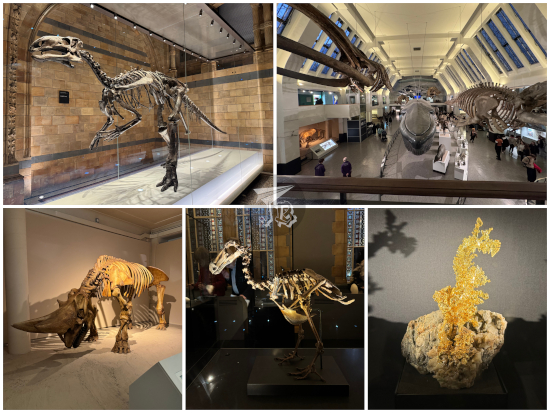
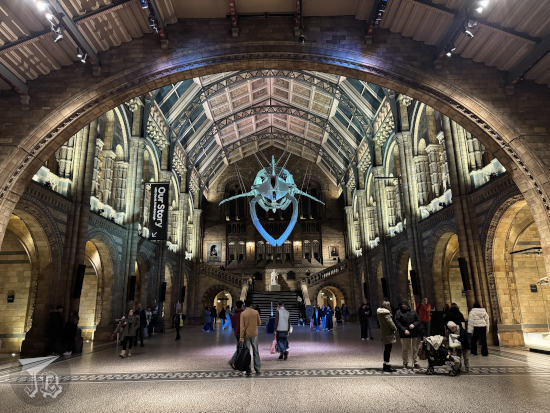
Natural History Museum London exhibits: Maiasaurus skeleton, mammal hall, rhino skeleton, dodo skeleton, gold ore in the shape of a dragon.

Hintze Hall and Hope the blue whale of the Natural History Museum London from the entrance.

At 18:30 I strolled to Apollo Victoria Theatre. After watching the Spanish version and the first film, it felt right to go back to watch the original Wicked musical once more.

The theatre was displaying a couple of dresses and a sculpture of Chistery the flying monkey. I checked out the upper bar for a change, but everything was packed, so as soon as the sitting area opened, I went to find my seat. Since I was amongst the first people inside, I could take a few decent pictures of the stage. The theatre was rather empty in comparison to what I was expecting, but then I realised that it was the middle of the week, and I had only been to the Apollo Victoria at weekends before. I had booked a seat next to the aisle on row S, and honestly it was a perfect view – the person in front of me was also short, which was fantastic.
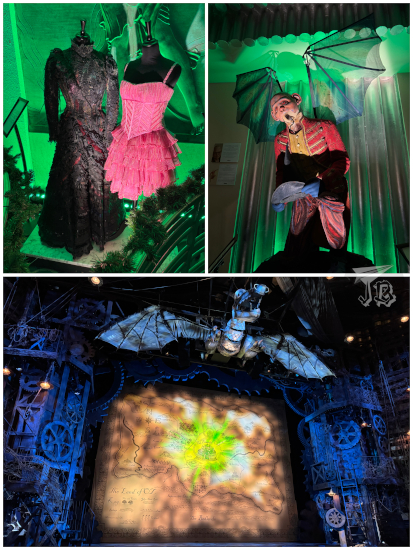
Dresses, figures and stage from Wicked in London.

The three main characters were played by Emma Kingston as Elphaba, Zizi Strallen as Glinda and Carl Man as Fiyero. I think Kingston has become my favourite Elphaba to date. Points to Man for keeping the British Ts during his solos, too. However, he did not feel as powerful a character as 2022’s Ryan Reid. I saw a few of Jeff Goldblum’s mannerism on the Wizard (Michael Matus), which… honestly do not work if you’re not Goldblum. Though the cast claims that they have not been influenced by the film, there are times that it just… slips in. Not in a bad way, but… it’s there. I really enjoyed it though, much more than any of the other versions. It feels natural – and not as long as the film(s).
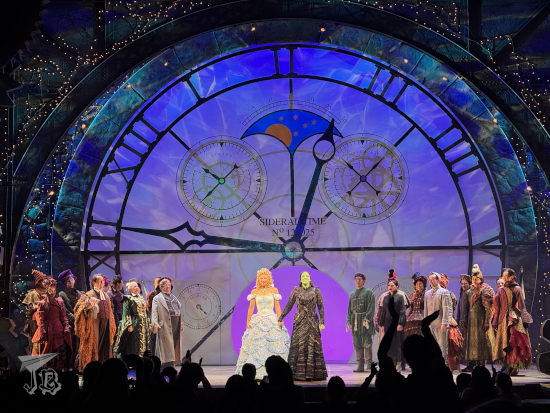
The Cast of London's Wicked after the show.

After the play was over, I stopped by the station so I could buy some dinner (and cut some walking in the cold), and I guess I was hungry because I had all but skipped lunch. Once back at the hotel, I checked in for my flight, and also received an email stating that there was a bit of a chaos at London Stansted airport due to operational issues. That made me decide to head to the airport a couple of hours before I would usually do the following afternoon. It meant sacrificing one of the stops, but it would have sucked to get stuck there due to a long security line. And it’s London. It’s not like I’m not planning to go back already.

The truth is that the hotel had been cheap, and it ended up being quite uncomfortable. On top of the toilet issue, there were no blinds on the window, and it was humid. At least, heating worked, I guess. I did not sleep much, but that gave me time to try and plan my following morning.

3rd & 4th October 2025: Wicked Madrid (Spain)

I am not a big fan of musicals – not because of the genre, but because in general the stories don’t seem to appeal to me. However, I like Wicked. Just before the first instalment of the movie duology was released, it was announced that the musical was getting a Spanish version. I was on the fence as to whether buy tickets or not, because I have often come across horrible translations into Spanish. After a lot of pondering, I decided to get an opening-day ticket, which I purchased in late November 2024. If in the end I backed up from attending, I could always give it to someone else, as it was sure to be a full house. Thus, I got a spot for Wicked: El Musical in Nuevo Teatro Alcalá in Madrid. However, once the film was released and I got to read the subtitles – I’m a visual person, I can’t ignore subtitles no matter how much I try – I became a bit more apprehensive.

In March 2025, I received an email advertising the option to get a VIP upgrade, Experiencia Premium Wicked, which included early entry, the booklet, a guided tour of the theatre, and what was de-facto dinner in the VIP lounge (which had its own private toilets). It was convenient, so I purchased it. Since I had originally bought the ticket on presale, some kind of discount was applied to it. I can’t be sure how much due to the anything-but-transparent Spanish ticket pricing. The nice seat on row 13 had a face value of 84.90 €, there was a fee of 6.79 € and a discount of 17.98 €, yielding to a final price of 74.71 € for the seat. The Premium upgrade was 29.90 €, value for money for the convenience only. Thus in total, I paid 104.61 €, without even being sure I was going to attend – I think my nibling was praying I would back out in the end and gave them the tickets…

I was not completely sure what to do with myself that day. I got a hotel because the 21:00 session would wrap up late, especially on opening day. The theatre Nuevo Teatro Alcalá was not in a convenient point to drive to. Trains would not be running any more when I reached any station, but the underground would. The only affordable but private room I found was 20 minutes away on said underground, but a big city would still have reasonably-full trains around midnight on a Friday in what is climatologically late-summer. The hotel was relatively close to the largest cemetery in Madrid, Cementerio de La Almudena, which reportedly holds some masterpieces of funerary architecture. I thought that it being October, it might be an appropriate visit, following a cultural itinerary provided.

On the day of, I set towards Madrid so I could reach the hotel a bit around check-in time, at 15:00. I dropped my luggage and set off towards the graveyard. Cementerio de La Almudena is the largest cemetery in Western Europe. It opened in 1884, though it was officially inaugurated in 1925. There were several architects involved in the design, but the current appearance is due to Francisco García Nava, who substituted previous styles with different Modernisme trends. Looking from above, the cemetery is designed as an adorned Greek cross, a design that eventually yielded to the creation of a secondary civil cemetery across the street.

I had wanted to visit for a while, but once there, I found Cementerio de La Almudena oppressive. Though there are green areas, it had nothing on the nature feeling northern Europe cemeteries give off. The niche walls felt overcrowded and cold, and the paved paths seemed designed just for vehicles and not people. I mean, the cemetery is big enough that it has its own bus stops inside, but there was something off about it. It was not a Victorian Garden, I guess. Since I was not enjoying myself, I decided to cut the visit short. I left after an hour, and headed towards the Central District.

La Almudena graveyard, with some neobyzantine decoration and traditional cross-decorated graves

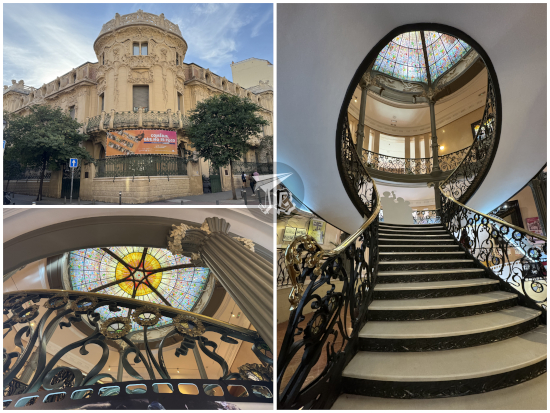
When I reached my underground stop, I saw there was a matcha bar nearby, but upon reaching it, there was long a queue outside – it turns out that it belongs to a TikTok influencer – and I decided to just go to Starbucks instead. I had a vanilla drink sitting at a park, then headed out to one of the few buildings representative of Modernisme in Madrid, the manor Palacio de Longoria. It was running an exhibition on the history of Spanish comedy cinema. I am not a fan, but exhibitions are the only way to visit the manor. The building was designed by José Grases Riera and built in 1902. It features a central staircase with a colourful skylight which is always cordoned off, but it is incredibly beautiful.

Longoria Palace, a Modernisme building with a stunning skylight with a red stair in a sun and a blue stela. It is over a staircase with an intrincate railing.

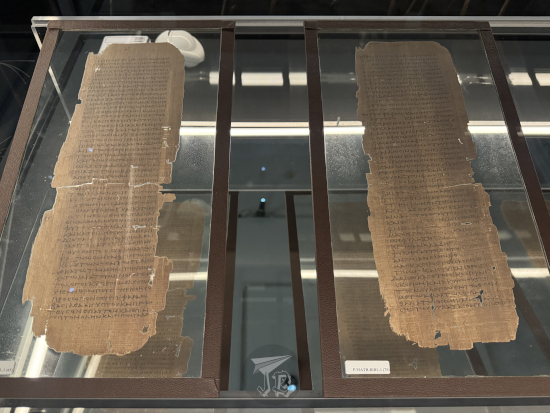
My next stop was the national library Biblioteca Nacional de España for an exhibition I wanted to see in July, but it was not running. It turns out that the temperature control in the room had broken down, and the exhibits were removed for safety. The exhibition El papiro de Ezequiel. La historia del códice P967 (The Ezekiel Papyrus. History of Codex 967) displays part of the oldest surviving document preserved in the National Library of Spain, and discusses its history. The document is a Greek translation of some of the books of the Bible, copied on papyrus probably in the 3rd century CE. It was discovered in the necropolis of Meir (Egypt), probably in the 19th century, and sold by the page to different institutions and collectors around the world between 1930 and 1950. Its excellent conservation is probably due to it being sealed in a vase until it was dug up.

The Spanish National Library is depositary of several sheets, which were originally bought by private collector Pénélope Photiadès. Upone her death, her collection of around 350 papyri, now called Papyri Matritensis, was bequeathed to the cultural organisation Fundación Pastor de Estudios Clásicos. As for the rest of the original codex, 200 out of 236 pages are accounted for in different places around the world. The pages in deposit in Madrid contain the oldest version of Ezekiel’s prophecies

The Book of Ezequiel is part of the Hebrew Bible [Tanakh, תַּנַ״ךְ] and the Christian Old Testament. Ezequiel was an Israelite priest, considered one of the 46 prophets to Israel, who lived around the 600 BCE. His prophecies or visions revolve about the fall of Jerusalem and its eventual restoration. In-between, there are prophecies against other nations or rulers who had wronged the Israelites.

Regardless of the importance of their contents for the Abrahamic religions, it was really cool to see something that old. Especially considering that all those centuries ago, someone thought the writing was important enough to have it preserved and protected for the future. The exhibition is held in a round room, with photographies of all the known pages and their location. At the moment, there are five collections – Cologne, Princeton, Dublin, Madrid and Barcelona.

The exhibition displayed five sheets mounted over mirrors so both sides could be seen. Alongside, there are other translations of the Bible, and a small display on how to write on papyrus. The whole collection was displayed in a circular room, so it felt really immersive. It was really cool.

Ezequiel papyrus - two pieces of papyrus with ancient writing on it

The weather was nice and I still had time, so I headed out to the park Parque del Retiro. This large park in the centre of Madrid originates in a Royal possession in the 15th century, and it opened to the public in 1767 under the reign of Charles III (Carlos III). Today there are several buildings remaining, alongside the royal gardens, now the large green area. There are ponds, fountains, sculptures and extremely old trees – which end up being a potential hazard when it’s too hot, too cold or too windy. This yields to quite the controversy when the park closes during summer due to the risk of collapsing branches. Parque del Retiro is considered a historical garden and part of the Unesco Heritage Site Paseo del Prado and Buen Retiro, a landscape of Arts and Sciences.

I finally headed off towards the nearby theatre Nuevo Teatro Alcalá. I ended up joining a loose group of people waiting for the theatre to open, and I got shoved away by a group coming out from a taxi. Later, one of the ladies would claim that she was there before anyone else – everyone who had seen them pushing me knew she was lying, but obviously her group needed to go in first. Ironically, though they made it to the hall first, I ended up reaching the theatre and the VIP lounge way before them. The irony.

Teatro Nuevo Alcalá with the promo of Wicked for the musical.

Upon entrance to the hall, I received my VIP lanyard and booklet. I am not well-versed in Spanish musical theatre actors, but I’m told the cast is really popular. First, we were shown inside the hall, where we had an introduction to the building and the play. Wicked is the musical adaptation of the eponymous book by Gregory Maguire (1995). The novel is in turn based on the world created by L. Frank Baum, The Wonderful Wizard of Oz (1900). While the original book is aimed to children – I read somewhere that it was conceived as the first “US-based fairytale”, later adaptations would take a turn towards more mature audiences.

In The Wonderful Wizard of Oz, a normal child from Kansas, Dorothy (with her little dog too), ends up in the magical world of Oz after being flown away by a tornado. There she partners up with a Cowardly Lion, a Tin Woodman and a Brainless Scarecrow. Together they travel to meet the eponymous Wizard, who promises to help them if they kill the Wicked Witch of the West.

The book has been both praised and reviled throughout its history. While the original story gives no room to think that the Wicked Witch is anything but gratuitously evil, the very way the protagonist party is just sent to kill her may sound… strange. It did to me when I was young and read the story for the first time. Other versions just have the Wizard tell the party to bring him the Witch’s broom.

It might have also been like that for Maguire, whose novel focuses on the evil witch, whom he names Elphaba. In the novel, Elphaba is ostracised and radicalises as she grows up, which leads to her fall into evil. In the musical, she is not really evil, but the circumstances around her life and powerful people’s manipulations make her a scapegoat. She chooses her own path rather than either give in or become a victim.

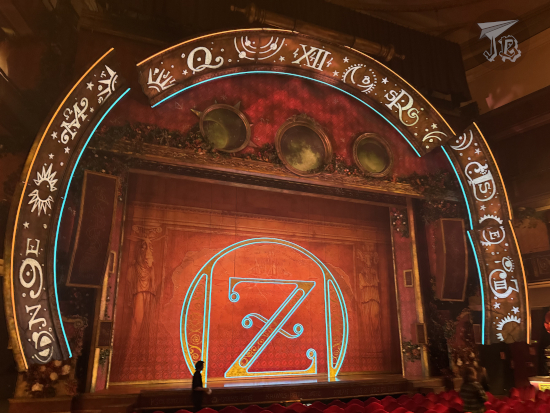
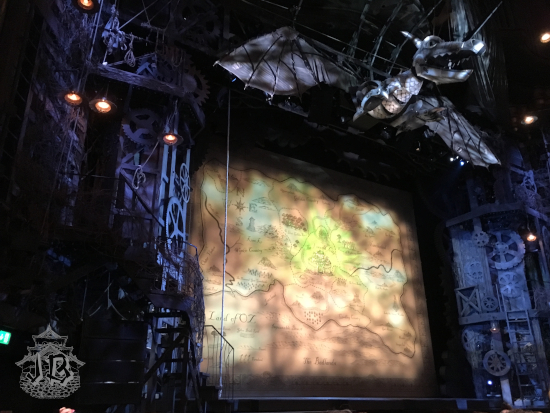
The original musical features music and lyrics by Stephen Schwartz and book by Winnie Holzman. It first opened on Broadway (after a San Francisco try-out) in 2003 – and it has run since then, except during the Covid pandemics. In 2005, it went on tour in the US, staying on different cities for literally hundreds of performances. The London production opened in the Apollo Victoria Theatre in 2006 – I have seen that one twice, in 2018 and 2022. There have been two German productions (2007 – 2011 and 2021 – 2022). There have also been runs in Australia, New Zealand, Japan, South Korea and Brazil. Between 2013 and 2015, the first Spanish adaptation was staged in Mexico City, though I cannot be sure the translation is the same as the Mexican one. The Spain version is considered a “non-replica production” as the setting is different. For starters, there is no dragon hanging above the stage and no map of Oz on the curtain.

Wicked stage, surrounded by a circle of runes and a stylised Z in the middle

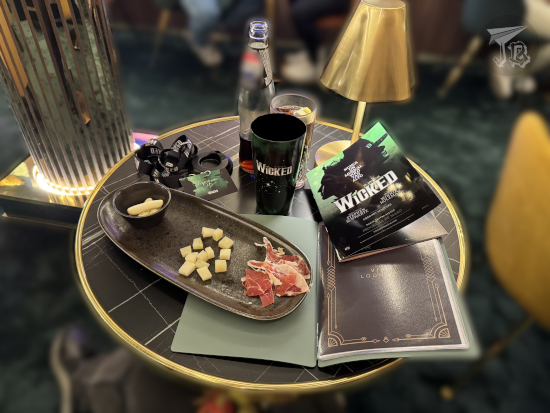
We did not hear any of this at the small explanation, but we learnt that they have 140 pairs of shoes. Then, we could go up the stage to get our picture taken with the giant Z on the curtain. I was amongst the first to get up there, so I also was lead to the VIP room quite early – remember the lady from before? I beat her every time, I did not even try, but it amused the hell out of me to realise it. To be honest, I had chosen the VIP experience not only because I’m a snob, but because it included what could be counted as dinner – cheese, ham and breadsticks with a drink before the play. And also the private bathroom, which was great. Ten minutes before curtain the waiters started telling us, along with taking orders for the drink during the break.

VIP package at Teatro Nuevo Alcalá - cheese, ham, breadsticks, soda, a commemorative grass, the program, and the menu.

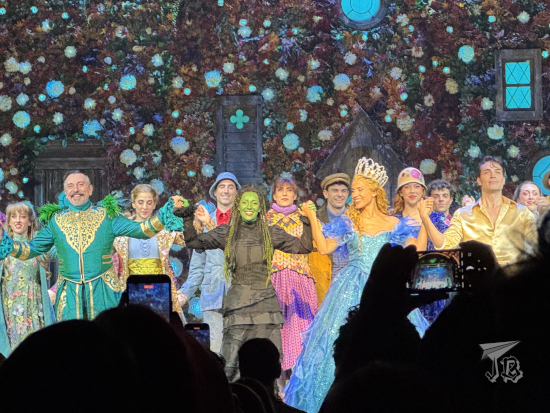
I was at my seat at 20:55, and the theatre was not full yet. The play started a little late, and I was a bit apprehensive, to be honest, because as mentioned before Spain has a less than stellar record with translations, but adaptors David Serrano and Alejandro Serrano have done a general good job. Main singers included Cristina Picos as Elphaba; Cristina Llorente as Glinda (that must have been confusing during rehearsals); Guadalupe Lancho as Madame Morrible, Javier Ibarz as the Wizard and Xabier Nogales as Fiyero. The latter was, in my totally-non-expert opinion, the weakest performance. When trying to sing with both the witches, his voice was barely audible, and he just did not have the… charm nor the presence. There is more to Fiyero’s character than choosing a cute actor, I think. There is one line that defines Fiyero in Dancing through life, which hints that there is more to him than the deeply shallow character he plays. After babbling about being brainless and shallow, when the “Ozdust ballroom” is mentioned, he sings that in the end “dust is what we come to”.

The play was well carried by the main characters, despite a couple of wardrobe malfunctions with Glinda’s dress and Chistery’s wings. The translations of the songs and the jokes were mostly on point. An exception was “magic wands, are they pointless?” – that one either completely flew over the translators’ heads, or they tried to localise it – and failed. The lyrics were well-chosen, carrying as much parallel in form and meaning as the originals. Unfortunately, the song that suffered the most was Defying Gravity, which just… can’t be easily done. It was decent though. In general, I’d give the effort an 80%.

The main cast of the Spanish Wicked musical greeting after opening day

During the break, I returned to the VIP lounge to skip the bathroom lines, and have a snack (popcorn) and my second drink. I have to say that the VIP experience is much more value for money than the London one, even if it catered to way more people – maybe because it was opening day. After the event was over, I made it to the nearby underground station and… the trains were crowded. I’ve seen fewer people on the platforms on a random weekend morning. Maybe in the future, I can drive closer to Madrid and park somewhere with an underground station so I won’t need to book a hotel.

However, staying over had a few advantages. When I woke up in the morning, I headed towards a cosy café (as cosy as a franchise can be), Santa Gloria, to order a “glorious latte with vanilla” whipped cream and cinnamon, and a salmon-on-avocado toast, which was delicious. Afterwards, I took the underground to meet up with some family members (amongst them my very-disappointed nibling). Their house is actually quite near the Museo del Aire y del Espacio, Museum of Aeronautics and Astronautics and we headed there to spend the morning.

The Museum of Aeronautics and Astronautics is a space where the Spanish Air Force preserves historical aircraft. It is located in the neighbourhood of Cuatro Vientos (Four Winds), close to the military air base. Since it was established in 1975, the site has expanded its collection to 200 aircraft. There are seven hangars full of stuff and almost 70,000 square metres of exhibition. Along with all the actual preserved items, there are reproductions of important planes in history, models, engines, uniforms… I know next to nothing about the history of aeronautics, but it was really cool to see all the machinery and even go inside a couple of planes. There were even a few items from space exploration.

We were there from around 11:00 until closing time, 14:00, and it was barely enough to have a quick look at everything. There are guides who show you around, and it might be interesting to take a visit with one of them in the future.

Several aircraft at the Cuatro Vientos - helicopters and military planes, along with a historical biplane.

I had seen there was a big shopping centre nearby, but we got lost and then caught in a traffic jam, so we ended up having a very late lunch before everyone headed home for the day. Oh, but the mall had a Lego store where I could get stamps on my passport. When the salesperson asked me how many I wanted, he was somewhat surprised that I said I wanted all of them…

9th & 10th June 2018: Wicked London (England, Great Britain)

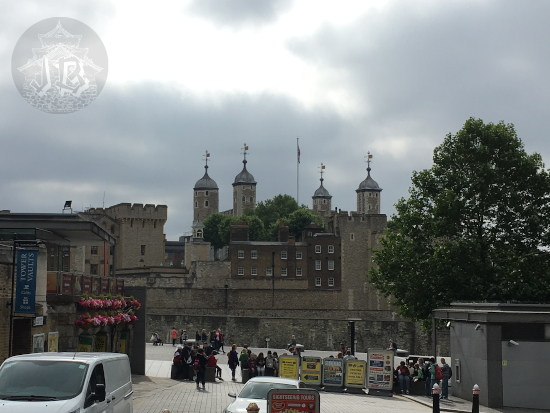
This will be the last work-trip, at least for a while. I might change my mind later, but for now I’m done with them (although there’s an upcoming family trip rather soon…). Again, we flew in early Saturday morning, and we went to walk around the Tower of London and the Tower Bridge.

Then we went to the British Museum. I left them for a couple of hours there and I went to visit some of the lesser-seen galleries.

We had booked tickets for the musical “Wicked” in the Apollo Victoria Theatre at 14:30, so we headed over there. Wicked is a parallel story to “The Wizard of Oz”, focusing on the story of the Wicked Witch of the West, who becomes a social outcast due to her tendency to speak her mind and the strength of her magic. I had really wanted to watch this for a long time, so I used this chance and convinced the group to get there. I absolutely loved it ♥.

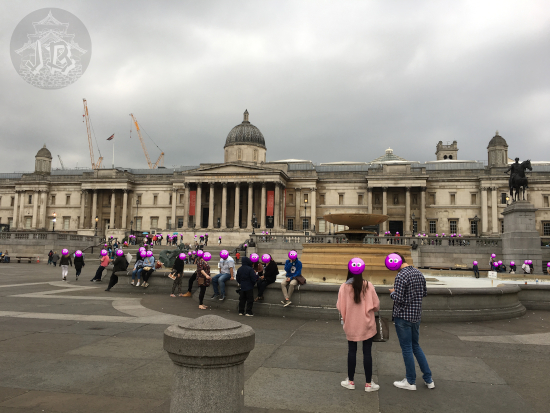
After the show, we dropped our things at the hotel. The group wanted to get some rest, so we stayed there for a while, then got out again. We took the underground towards London central and we were in Trafalgar Square for a while.

Then, we went to Chinatown for dinner.

Later, we walked around Piccadilly Circus, checking out some shops and so. We even stopped for cake.

On Sunday morning we went to Saint James’s Park, where we got to meet the local fauna, especially a very adventurous squirrel.

Then we dropped by Buckingham Palace. Although we did not watch the Guard Change, we did see one of the relief marches.

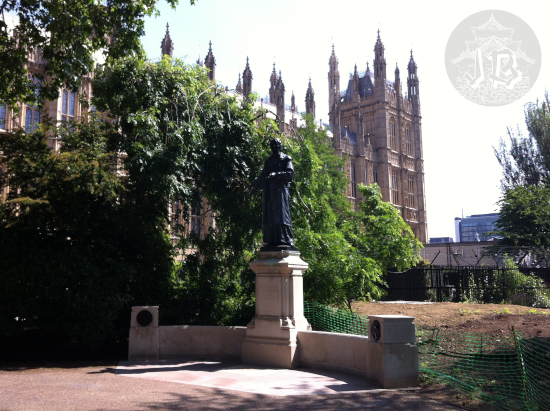
We walked from there to Westminster, saw the Houses of Parliament and the Big Ben, along the outside of Westminster Abby.

We visited the Monument to Emmeline Pankhurst and stayed for a while in the Victoria Tower Gardens.

As a final visit, we went to the Natural History Museum.

Finally, we headed off to the airport, and the icing of the cake was that we got caught in a controllers’ strike, so we had like a three-hour delay on our flight and it took forever to get home (;¬_¬). All in all, this was a very… strange trip, and without a doubt the highlight was going to see Wicked, which is something I had wanted to do for a long time, and gave me a couple of hours of enjoyment to myself.