11th December 2024: CBA, hotpot and lights (Madrid, Spain)

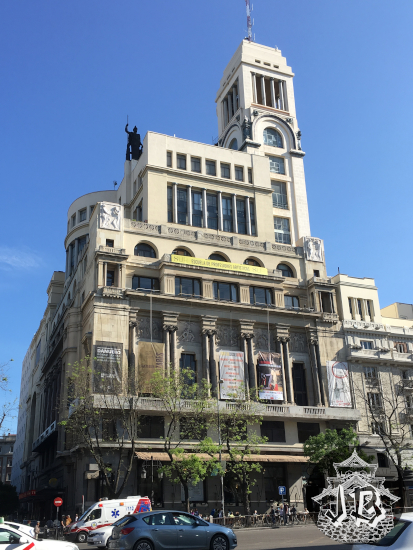
Since I was meeting my sibling for the yearly event of Naturaleza Encendida in Madrid in the evening, I decided get there early and make the most out of the day. As I arrived, I headed to the Círculo de Bellas Artes (literally “Fine Arts Circle”). The CBA is a sort of NGO dedicated to culture and the arts. Its headquarters host many activities such as exhibitions, theatre plays, concerts, lectures… The building was designed by Antonio Palacios, one of my favourite architects. It has seven floors, some of them used for events, others for offices. There is even a small theatre.

The CBA was running an exhibition called “Messenger Species” Especies Mensajeras, by artist Álvaro Soler-Arpa. It is a collection of pieces created from animal bones and items found in dumps. Born in Gerona in 1974, Soler-Arpa is a multifaceted artist who does publicity illustration and creates distressing sculptures using animal bones as its medium to make the viewer to think about waste and pollution. This exhibition of modern art is described as “ecological art for reflection”. I thought that it could be either really good or a holier-than-thou approach, but my curiosity was piqued.

The exhibit collects selected pieces from four series of sculptures: “Toxic Evolution” (Evolución tóxica), “Devastated Nature” (Naturaleza devastada), “Design-methastasis” (Diseño-metástasis) and “Sculptures from the End of the World” (Esculturas del fin del mundo). It was… disturbing, but in a good way. It did not feel preachy. The idea is that nature is affected by the consumerism in current society, but not dying – adapting to it. The imagined futuristic animals are a warning sent through time – nature is resilient and it will survive. Us humans? Maybe not if we do not get any better.

Álvaro Soler-Arpa's Especies Mensajeras

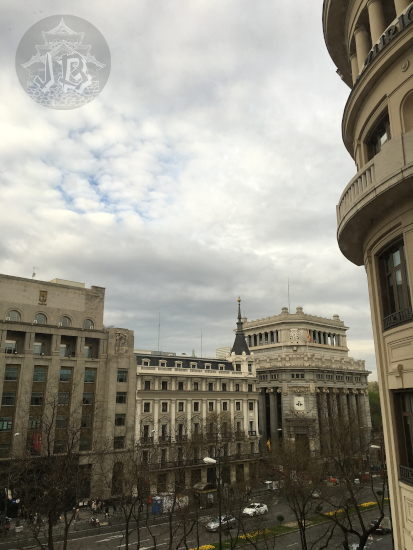
There was another exhibition in the building about the consequences of war, but I decided I could not stomach that one. However, I had the access ticket, so I could take the glass lift to the famous terrace of the building – the one that kicked off a trend of opening terraces in Madrid to watch the skyline while having a drink. It was too cold and too closed to have anything, but I did get a nice view, especially of the Palacio de Telecomunicaciones and the Spanish language Institute Instituto Cervantes, both designed by Antonio Palacios too. The terrace is mostly flat, with a bar and an impressive sculpture of Minerva made in bronze by Juan Luis Vassallo. Minerva – Roman goddess of wisdom and art – is the symbol of the CBA. There is also a smaller and higher structure that looks like it could hold an even better view, but that was closed off.

Skyline from Azotea Círculo Bellas Artes

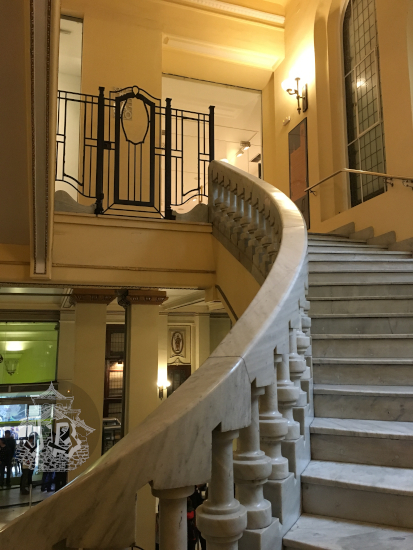
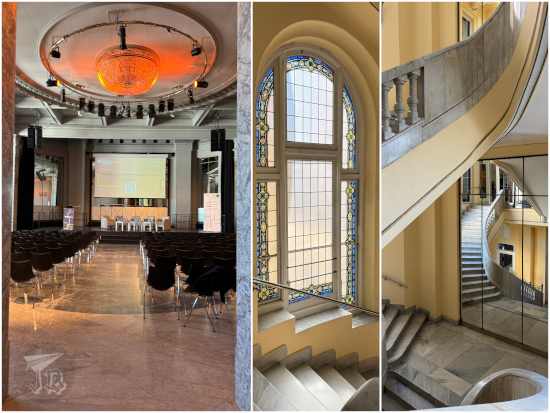
The CBA building has many cool spaces, such as the ball room (Salón de Baile) or the colonnade room (Sala de Columnas). However, my favourite part of the building are.. the stairs. They are designed as a double staircase with mirrors at the landings, and coloured windows alongside the steps. One of the sides is less bright now, because a building was erected and blocks the sun. I still find the staircase superb, so I hung around there for a while until the security guard gave me a weird look.
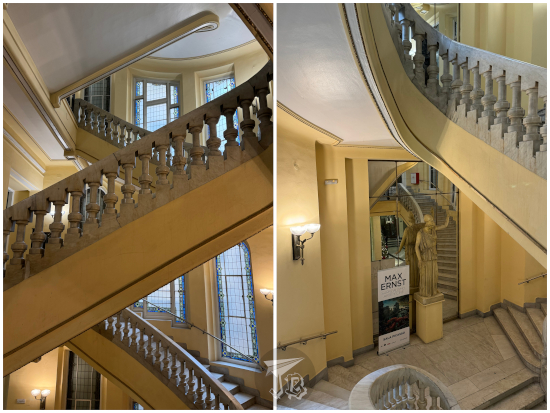
Stairs Círculo Bellas Artes

I left the CBA and walked down the street Calle Alcalá and stopped at Galerías Canalejas just to see what kind of decorations they had. It turned out to nutcrackers and elves inside and a huge Christmas tree outside. I still cannot afford anything they sell there.
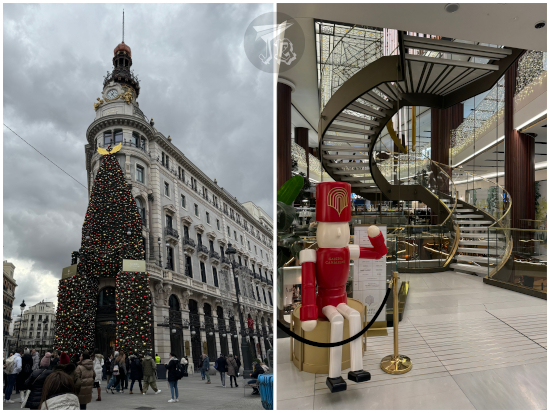
Chrismas at Galerías Canalejas

I continued down towards the square Plaza de Oriente, where there was a classic merry-go-round – empty and ready to be ridden. Thus, since I have no shame, I went on it. The salesperson was incredibly kind, since I was the only rider – and an adult at that – and yet they directed me to a horse which moved up and down and showed me how to climb on it.

Then, I backtracked to the shop Turrones Casa 1880 in the street Calle Arenal, which hosts a small Museo del Turrón. Turrón is a typical Spanish confectionery eaten mostly at Christmas. It is mainly made out of processed almonds, and 1880 is probably the most famous brand – and it prides itself on the most expensive one. I am not a fan of turrón, to be honest, but it was almost Christmas, and if I was ever going to do it, that was the right time frame. The museum is mostly an audiovisual in a decorated cellar, with a photo-op, but the staff was really nice.

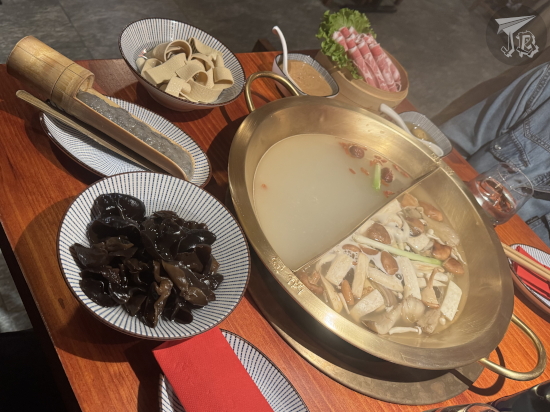
At 14:30 sharp, I met up with my sibling for a restaurant that I’ve been wanting to try for a while 壹锅火锅 Hotpot de Sichuan. Hotpot [火锅, huǒguō] is a Chinese type of stew based on a stock or soup that is kept simmering in the table itself, and you just grab the raw ingredients and dip them in the broth to cook them – imagine a fondue with broth instead of cheese. We ordered a menu for two, a pot with two broths, one mushroom-based and one meat-based. The dips were spring onion, coriander (which was not used, because I hid it), shrimp mince, thin beef slices, tofu stripes, Chinese black mushrooms, cabbage, and rice noodles, along with two sauces – one slightly spicy, and my beloved sesame and peanut sauce. The food was great, but at 15:40, the waiters popped up to tell us that they wanted to close the restaurant, and then stood up next to us until we finished and left. It was more than a bit awkward, so we hurried up to do so. While the food was great, the situation spoilt our experience a little, I think. We were still eating, not slouching around. I am not sure I would want to go back…
Afterwards, my sibling had to do some shopping, so we spent a while going up and down some shops and a department store, before we headed out to Naturaleza Encendida in the park Parque Enrique Tierno Galván. This is a yearly light show organised in Madrid parks – it used to take place in the Botanical Gardens, before it was moved to a larger area. The 2024 edition is titled Naturaleza Encendida: Life.

Naturaleza Encendida Life

To be fair, I was a little bit disappointed, as “Life” turned out to have mostly figures reused from the last few events. Though the organisers tried to build a narrative of water, land and air topics, the novelty had worn off. It was not bad, but the show keeps getting more and more expensive every year, with fewer and fewer perks for the VIP tiers. Furthermore, the new larger location does not imply more light sculptures – they’re just spread farther apart so they can fit more people without it feeling crowded, so it simply takes longer to walk it through. This has its advantages and disadvantages – it was good last year when we had to go on a weekend but this time around it just felt… colder. They also tried to give the whole thing an ecologist spin, and this time it did come out preachy… I mean, it is a show of lights, which technically could count as light pollution, without any actual… purpose… but charging you to watch pretty lights.
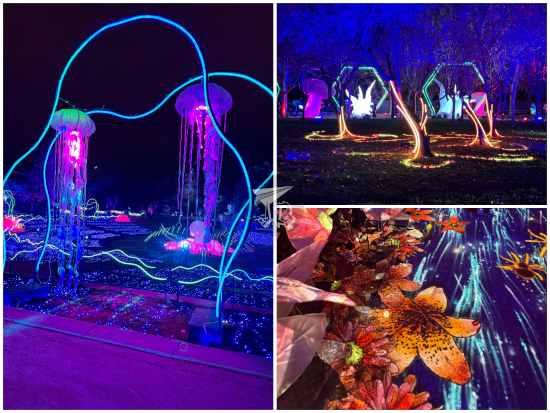
Naturaleza Encendida Life

Naturaleza Encendida Life

That was the end of the day, and we just headed home afterwards, but aside having to wait for the train for over half an hour, nothing to report on that end.
12th March 2024: A free afternoon – the bullring & Pompeii Exhibition (Madrid, Spain)

Due to life being weird sometimes, I was summoned to a work-related event in Madrid on the morning of the 12th. The event took place in one of the buildings erected by Antonio Palacios, the cultural centre Círculo de Bellas Artes (CBA). The centre hires out its facilities for conventions, gatherings and theatre plays. In our case, we were there for the presentation of a new product in the Column Hall Sala de Columnas on the fourth floor.

Interior of the Círculo de Bellas Artes

After all the necessary chatting, networking, and a disappointing (and rather questionable) choice of canapés, the event was over at 14:30. I ditched my companion then and headed out to Plaza de Toros de Las Ventas, the local bullring. I am not a bullfighting fan – my personal view is that it is not an art, nor a “fair fight” as it is presented, and I hope we humans evolve to phase it out. And while I would not attend an event, I was curious to get to know the building and its architecture.

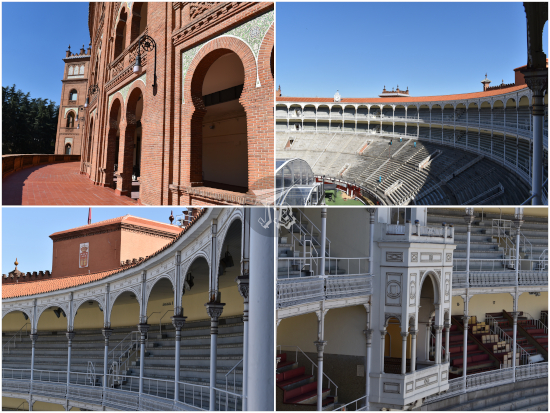
Las Ventas bullring, outside

The ring is the largest of its kind in Spain. It was designed by José Espelius in the neo-mudéjar style and erected between 1919 and 1931. The central ring is just over 60 m in diameter, with a metallic structure holding the stands around it, and a façade of reddish brick and porcelain tiles. Aside from bullfighting, it is also used for concerts and other events.

I took a self-guided tour with an audio-guide Las Ventas Tour Experience, because I actually know nothing about bullfighting – I learnt that it actually has “rules”, I thought it was just taunting and hurting the bull. The passes have names, and there is a whole colour code of handkerchiefs – I had no idea. The tour takes you past the “Great Gate” through which bullfighters come out through when they are deemed to have done a great job. Then you climb up to the first floor balconies, and you can even go up to the highest point to have a panoramic view. You see the outside of the Royal Box, the gate through which the dead bull is brought out through, and then you walk down to the ring itself. There you can stand in the areas where the bullfighters and their helpers wait, and peer towards the stables, the closed door to the infirmity and finally the chapel. There are two VR experiences too that I did not care for, so instead of the expected 75 minutes, I took a bit less than an hour to do the whole tour.

Inside the bullring of LasVentas

Afterwards, I was curious to check out an immersive exhibition regarding Pompeii called “the last days of Pompeii” Los Últimos Días de Pompeya in the cultural hub Matadero Madrid. It was designed by Madrid Artes Digitales, the same company which organised the Tutankhamun one. At first I was not overly interested in it, but when I went to Recópolis the guide mentioned an actual VR tour, and I became curious (read: it was totally FOMO in the end).

The exhibit has a couple of replicas of archaeological artefacts, but it’s mostly a digital display. The first time I went to the Madrid Artes Digitales building I thought they had rented the place, but now I saw that they might actually own the warehouse and design the exhibits into it. There is a huge room where they project a sort-of film on the walls, a small circuit that you walk doing different activities, and a sitting VR ward, where you get to see a fictional world in 3D.

Of course, there were replicas of the Pompeii casts, and a copy of the novel The Last Days of Pompeii, written by Edward Bulwer-Lytton, which has inspired the exhibit. The novel, in turn, was sparkled by the painting The Last Day of Pompeii. The projection recreated a few passages from the book, then Mount Vesuvius erupted and you were taken “into” the crater, seeing lava bubbling and lightning bolts. Then one was back in the city as the pyroclastic cloud rolled into the city, along with volcanic bombs falling into buildings.

Last Days of Pompeii exhibition

The circuit was a VR walk-through that took you though a house, both in ruins and reconstructed, as a woman led you through it. Walking with the VR glasses was a new experience, I have to admit, but going through doors was strange. Unfortunately, my set had a finger print in one of the lenses which spoiled the view a little. In the final ward, there was a representation of a circus fight with gladiators and tigers that turned into a naumachia (ship games in the amphitheatre) while Mount Vesuvius erupted in the background. All in all, it was a bit weird, and maybe… a tad on the morbid side, if you ask me.

Afterwards I just headed off, and I was lucky to make it into the train, it was so full! The car emptied out enough to sit down after a few stops, but just wow.

3rd November 2018: Samurai Spirit in Madrid (Spain)

I booked tickets to see the show Kamui x Mika Kobayashi: Utakatana Sekai – Samurai Spirit in Madrid. In a last-minute change, my parents decided to tag along, so we just drove there in time for the show. It took place in the theatre Teatro Fernando de Rojas, one of the halls in the Círculo de Bellas Artes building.

Publicity poster with the show's date

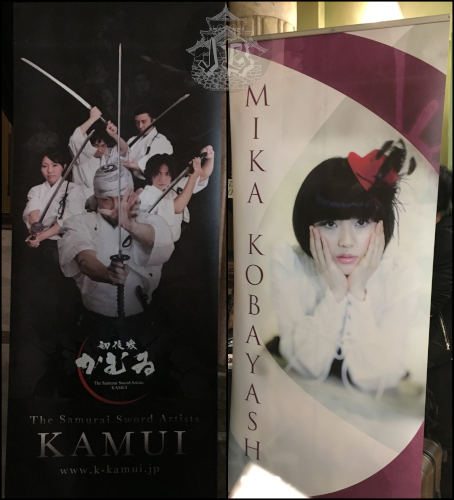
Samurai Artist Kamui [剱伎衆かむゐ, Kengishuu Kamui] is a “samurai sword artist troupe” . They perform stories through “samurai communication” using music, sound and light to work on the atmosphere, along with of course, Japanese sword – katana – performances. The founder and leader of the troupe is Tetsuro Shimaguchi [島口哲朗], who played a part in Quentin Tarantino’s Kill Bill vol.1, a film for which he also served as choreographer for the swordfighting.

Mika Kobayashi [小林未郁] is a singer, pianist, and songwriter from Hiroshima. She is known for her vocals on anime, such as Attack on Titan or Gundam UC, and video games like Final Fantasy XI. She established her own style and record label in 2016 and has been doing her own thing since then.

The collaboration Kamui x Mika Kobayashi: Utakatana Sekai – Samurai Spirit seems to be designed for touring overseas as there is no trace of that name in Japanese. Utakatana Sekai would roughly translate as “the world of singing swords”. It features Kobayashi as singer and pianist providing the background voice for the show.

Through artistic sword-fighting and music, the performance conveys a story about the old samurai ways giving way to a new world. Short self-contained scenes tell the story of a samurai warrior who gives way to the new generation – played by a lady. A bit subversive from the Japanese traditional way, I guess.

The show has three parts. The first act comprises fights and individual actors showing off their individual skills. Younger or less experienced fighters, who get “swordsman #4” roles end up being killed two or three times. I liked a short story about a blind samurai better than the romantic ones. Unfortunately, I was a bit to the side – I only bought the tickets with a week or so when I found out – and my angle was awkward at times. I could see the gaps between the swords when they did not clash for real.

During the interlude / break, they brought two volunteers from the public to learn some moves and get the mood lightened up. This showed off Shimaguchi’s language and teaching skills, along with a flair for the dramatic, and it was really funny.

Different scenes from the show

The last part was more spectacular, full of stunts and coordinated exhibition acts. That was the part I enjoyed the most. All in all, the whole ninety-minute show was very fun. Mika Kobayashi’s melodic voice and piano tunes fit really well with the whole theme, and everybody seemed to have fun, and at the same time take their jobs very seriously. However, I’d need a better seat next time, in order to keep the suspension of disbelief and not see all the stunts as… stunts.

Artists’ publicity banner

Afterwards, many artists came out to take pictures with the audience. We got to take pictures with Mika Kobayashi too, and I bought a signed CD of hers.

Mika Kobayashi's signed CD

22nd May 2016: Kabuki at the CBA (Madrid, Spain)

I made a short escapade to the theatre Teatro Fernando de Rojas in the Círculo de Bellas Artes, in Madrid. It was my first time watching kabuki [歌舞伎], a type of Japanese theatre. The play was called Tsumoru koi yuki no seki no to [積戀雪関扉], something akin to “The Snowbound Barrier” and translated into Spanish as “En los límites de Osaka, bajo la nieve del amor” (In the Outskirts of Osaka, under the love snow). It is a dance-drama kabuki written in the 9th century, and deals with the spirit of a black cherry tree turning into a courtesan to extract revenge. Before the play, there was a small conference to explain some details about kabuki and that was really interesting.

Afterwards I just had to run for the trains so… no much time to hang around.

2nd April 2016: Círculo de Bellas Artes & Tsugaru-shamisen music (Madrid, Spain)

Círculo de Bellas Artes (CBA) is a Spanish cultural and artistic association founded in 1880, and they had partnered with The Japan Foundation to hold a concert by Kenichi Yoshida [吉田 健一], a famous Tsugaru-shamisen [津軽三味線] player / artist.

I got to Madrid in the late afternoon, with enough time to get to one of the most hidden Starbucks in the city, which was rather crowded as it was Saturday. Fortunately I found myself a table to spend the extra time (public transport transport paranoia, maybe. But it’s not paranoia if they’re really after you and you have been stuck in Spain commuter trains for hours already). And well, a Starbucks a year and all that… And I mean, I was planning to skip dinner so a Vanilla Frappuccino would keep me going.

The concert was to be held at the Círculo de Bellas Artes building, located in downright in the middle of Madrid. It was designed by the Spanish architect Antonio Palacios and erected in the early 1920s. From the outside, I had always thought it looked pretty weird.

Inside, however, it was a different feeling. I had never imagined the inside of the building was going to be this neat! The CBA Headquarters has a neat staircase, an impressive ballroom, and a reportedly-cool observatory at the top. Unfortunately, getting to the observatory required lining and I was not willing to do so either before or after the concert. However, I did get some views from the second-floor windows!

The concert was in the inner theatre Teatro Fernando de Rojas, a fully-functioning theatre on that second floor, with about 400 chairs, and I had got a fairly good seat so I was happy and could sneak up a couple of pictures.

The concert in itself was amazing. Kenichi Yoshida, the younger brother in the Yoshida Brothers band, comes regularly to Spain to teach shamisen – a classical Japanese string instrument – in Barcelona. Oftentimes he makes the most out of his time and organises recitals and other activities. The concert was a mixture of old and new melodies, played along some drumming. The concert lasted for about an hour, and it felt very short. As Yoshida is a frequent visitor, he can speak a tiny bit of Spanish, too, and he tried that. It was a lovely touch.

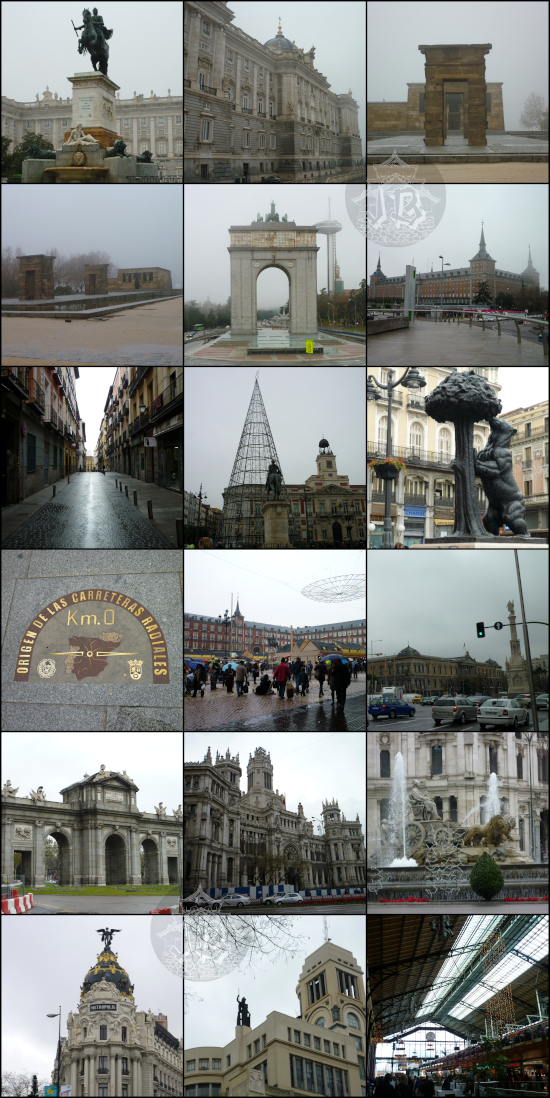
Flashback to 26th December 2009: Winterday in Madrid (Spain)

  • Palacio Real de Madrid (Royal Palace)
  • Templo de Debod (Egyptian Temple to Debod)
  • Arco de la Victoria (Victory Arc)
  • Palacio de la Moncloa (Palace of La Moncloa)
  • Puerta del Sol (Square Puerta del Sol)
  • Plaza Mayor de Madrid (Main Square)
  • Plaza de Colón (Columbus Square),
  • Puerta de Alcalá (Puerta de Alcalá Arc)
  • Edificio de Correos (Postal Building)
  • Fuente de la Cibeles (Cibeles Fountain)
  • Edificio Metrópolis (Metropolis Building)
  • Gran Vía de Madrid (Gran Vía Avenue)
  • Círculo de Bellas Artes (Fine Arts Club)
  • Estación de Príncipe Pío (Príncipe Pío Station)

Note: This is a flashback post, which means it is just a collage regarding a trip I took before I started the blog in 2012. Tags may be incomplete or slightly off.