31st January 2026: Mistakes were made around the Tercios (Madrid, Spain)

A local cultural association organised a day trip to Madrid on the 31st of January to witness the historical re-enactment Día de Los Tercios (Tercios Day). Tercios (thirds) were the Spanish Empire’s infantry force, usually considered to be the origin of modern European armies. They were formed by volunteers-turned-professional soldiers, the elite of the Spanish military.

Despite their 1534 establishment as an actual unit, the strategies and structure of the Tercios can be traced to the 1480s, when the Christians were trying to conquer Grenada from the Arabs. They were known for effectively mixing bladed weapons, usually pikes, and firearms (primitive rifles known as arquebuses). They had a very characteristic hierarchy system in which old soldiers trained newcomers. They had rankings amongst themselves, medical staff, chaplains, even their own justice system. Their most recognisable symbol was the Cross of Burgundy on different backgrounds.

Tercios battled all across Europe with the expansion of the Habsburg house. They fought in Italy, and most famously in the Belgian region of Flanders – there are several monuments in Antwerp hailing the locals who opposed them. Velázquez painted the most famous work of art around the Tercios, La Rendición de Breda – the “Surrender of Breda”, an Italian city conquered in 1625. As world and war changed, their battlefield tactics became obsolete in the 18th century, and they eventually dissolved away, transformed into regiments, as the figure of the pikeman was dropped.

The name Tercios survives in naming the Spanish Navy and Legion units. The historical recreation association 31 Enero Tercios appeared (as far as I have been able to find) around 2020, formed by history professional and amateurs who wanted to remember the Tercios units, organising re-enactments and activities all around the country. Their website is a bit chaotic, and might be slightly problematic with its language at points, but most people just seem to enjoy dressing up, playing with fake weapons, and going home to their phones after they wrap up.

One of the goals of the association is to establish the 31st of January as Tercios Day Día de los Tercios, organising activities and re-enactments throughout the country. It sounded interesting enough so we thought we would sign up the aforementioned day trip… only for it to be cancelled a couple of days later due to general lack of participation. Since there was no forecast of rain or snow, but sun for a change, we thought we could drop by on our own.

There were two main stages for the activities in Madrid: one was Plaza de la Villa (site of the historical town hall), the other Main Square Plaza Mayor. We walked through the latter on our way to the former, and there was absolutely no indication of anything going on. When we arrived at the Plaza de la Villa, they were still setting up camp (literally), so we went to have breakfast somewhere in order to be out of the cold. We had decided to join the “theatre visit” at 11:00, which was difficult as inscriptions were chaotic.

I’m not a guided-visit person, but this was… bad. My parent, who actually likes them, concurs. The “theatre” part came from three people tagging along in period dresses and a two-minute “assassination” in the end, after walking through a number of alleyways and stopping in the most awkward and windy points to see… unrelated buildings. I was completely unable to follow the theoretical plot line of the visit and how it… was any kind of plot, really. I’m still even unclear on who or why was assassinated and their relation to the Tercios.
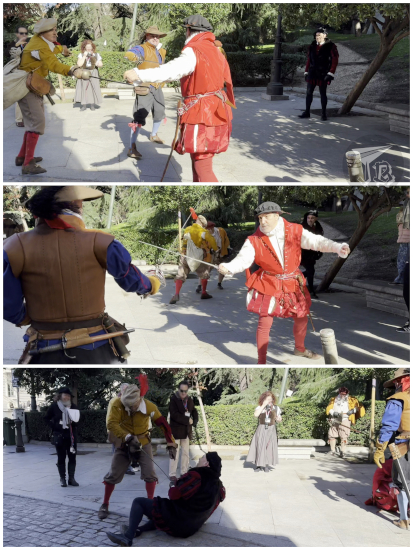
Sequence of a "theatre play" showing the assassination of some Medieval character, complete with swordplay

The visit ended near the Army cathedral Iglesia Catedral de las Fuerzas Armadas, so I asked my parents if they minded stopping by St Michael’s church Iglesia de San Miguel, which had been closed the previous time I had been around. We were able to snoop inside, but just a little, as they were holding mass.
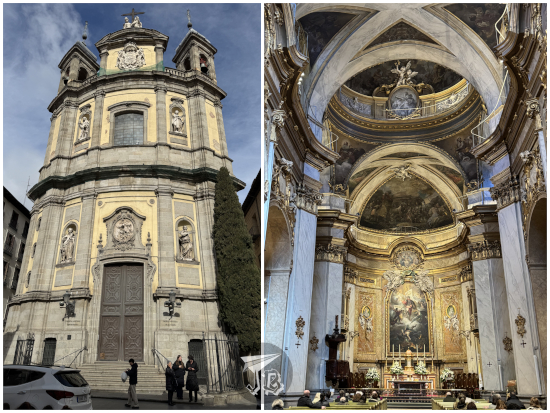
Neoclassical church

We then headed back towards the Plaza de la Villa, where there was a demonstration of how the pikers would train. This is the kind of thing I like to watch, but my parents don’t, especially in the cold. After a few minutes, they wanted to move on. By the time we reached the Plaza Mayor, the event there had finished and I only managed to get a photo of the ensemble.
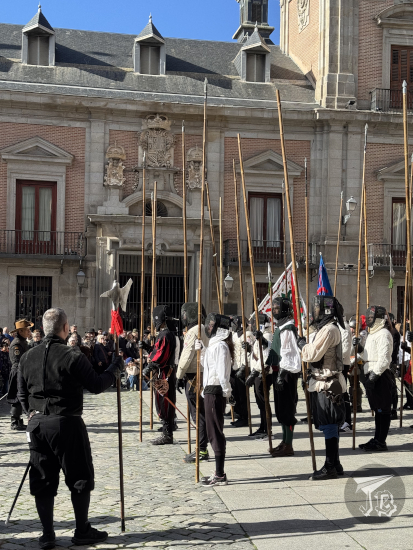
Re-enactment of pikers formed at attention

We then headed off to a high-end traditional grill Asador de Aranda that my parent wanted to try. I can’t say I’d recommend the place, as they broke my heart. First, the menu promised baked potatoes and the waiter brought microwaved ones. As we were sitting near the actual wood oven, I had really hoped for oven-baked potatoes. The meat was all right, maybe a bit overcooked, and finally the advertised “five-star pudding” was not-at-all stellar. In general, it felt overhyped and overpriced.

After lunch, I debated whether to stay in Madrid or head back with my parents, but the next event on the Día de los Tercios schedule was a parade at 20:00… too long to wait in the cold. Hence, I decided to just make a note in my calendar for 2027, and quietly slip out to see all the re-enactments on my own. Knowing in advance that this event exists, I can keep an eye on it and plan for down time between the different activities.
21st & 22nd July 2018: Swan Lake in Madrid (Spain)

21st July: The housefront

This Saturday/Sunday getaway was a birthday present, and I have to admit that I was super excited about it – the main part of the present was a hotel night in Madrid and tickets to watch the (British) Royal Ballet in the Spanish Royal theatre, the Teatro Real. And I mean stall tickets, I was over the moon.

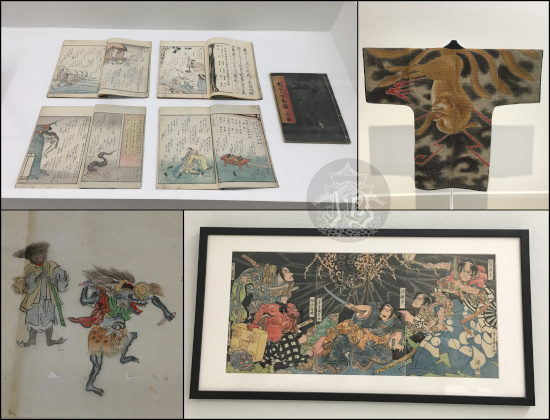
The day started at the Museo de la Real Academia de Bellas Artes de San Fernando, where there was an exhibition about yokai, the Yumoto Koichi Collection (Miyoshi, Hiroshima). It was called Yokai: Iconografía de lo Fantástico (Iconography of the fantastical), and it was rather interesting. It holds a collection of different items related to mythological creatures of Japan, yokai [妖怪] – there are scrolls, woodprints, games, pottery, even clothes and accessories. This was an interesting exhibition, and having seen it would later save me a trip to Miyoshi, allowing me to discover Takehara instead.

Rolls of paper, kimojo jacket and blookwood painting, showing different scenes and beings from Japanese mythology

After the exhibition, we went to the Green Tea Sushi Bar & Cocktail Room, which turned out to have the most overpriced mediocre sushi ever. The place was ridiculously expensive but fortunately we had booked with a special 50% discount, which made it bearable. However, fair is fair, and the tataki was delicious, and the chocolate coulant turned out to be amazing.

Lunch. Sushi boat, sald, tuna tataki, edamame, and an ice cream scoop

The hotel was in the right smack of Madrid, a short walk away from the “royal theatre” Teatro Real and we had tickets for 17:00 – to watch Swan Lake performed by British The Royal Ballet. Before sitting down we took a small exploration walk through the different rooms, including the ball room. I really loved the whole building and in particular the blue room and the ball room.

Royal theatre snippets - the main hall, the stage, the stands. Most curtains are a rich burgundy colour.

Swan Lake happens to be my favourite ballet – I love Tchaikovsky in general, though the stars have always aligned against me watching Sleeping Beauty. In Swan Lake, the evil sorcerer Rothbart turns maidens into a swan during the day, and they turn back to women at night as long as they are near the enchanted lake. The ballet officially opens with Prince Siegfried celebrating his birthday. He receives a crossbow as present, and he is later told by his mother that he needs to choose a bride the next night. As he becomes upset his friend suggest going hunting. In the forest, Siegfried becomes separated from the group and meets Odette, one of the swans. She explains of her predicament, and they eventually fall in love, and Siegfried invites her to the ball in which he needs to choose his bride. The next night, however, Rothbart sends Odette’s magical doppelgänger, to whom Siegfried swears love. Witnessing this in swan-form breaks Odette’s heart. As he realises his mistake, Siegfried makes it back to the lake.

The ending of the ballet changes. Sometimes it is a happy one when the spell is broken. The original ending has both Siegfried and Odette dying together to break the spell. Another alternative is that only Odette dies, but Siegfried manages to kill Rothbart and break the spell – this was the one that the Royal ballet played, and it managed to make me a puddle of happy goo. As Siegfried raises Odette’s inert body over his head, I shuddered all over. It was magnificent.

Snapshot of the credits, Showing Akane Takada as Odette and Odile, William Bracewell as Prince Siegfried, and Thomas Whitehead as Rothbart

The cast after the play taking their bows.

After the performance was over, we had dinner in the Plaza Mayor and then walked towards Puerta del Sol, then back went to the hotel to catch some sleep.

Square Plaza del Sol lit by night

22nd July: The backhouse

On Sunday we went back to the Teatro Real because we had booked one of the visits they offer, the technical one. During this visit you walk through the inner areas of the theatre, and even more interestingly, the upper area.

We saw the main hall, and afterwards we went first onto the backstage, then the backstage, and finally onto the stage where the Swan Lake props still stood, so that was really cool. The visit finished climbing up to the upper area of the theatre to see the views and the theatrical rigging system.

Empty royal theatre, showing the stalls from the stage, the backstage, and the view of the cathedral and the royal palace from the upper windows.

Finally, we had a bite to eat and we headed home for the weekend, and I have to say, I was happy as a skunk.

Flashback to 26th December 2009: Winterday in Madrid (Spain)

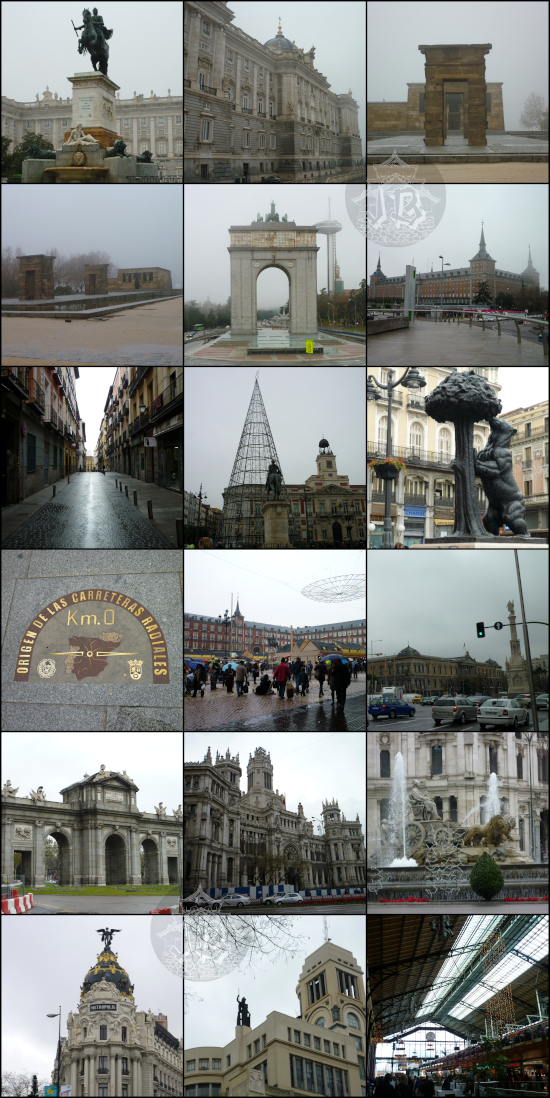
  • Palacio Real de Madrid (Royal Palace)
  • Templo de Debod (Egyptian Temple to Debod)
  • Arco de la Victoria (Victory Arc)
  • Palacio de la Moncloa (Palace of La Moncloa)
  • Puerta del Sol (Square Puerta del Sol)
  • Plaza Mayor de Madrid (Main Square)
  • Plaza de Colón (Columbus Square),
  • Puerta de Alcalá (Puerta de Alcalá Arc)
  • Edificio de Correos (Postal Building)
  • Fuente de la Cibeles (Cibeles Fountain)
  • Edificio Metrópolis (Metropolis Building)
  • Gran Vía de Madrid (Gran Vía Avenue)
  • Círculo de Bellas Artes (Fine Arts Club)
  • Estación de Príncipe Pío (Príncipe Pío Station)

Note: This is a flashback post, which means it is just a collage regarding a trip I took before I started the blog in 2012. Tags may be incomplete or slightly off.