
While we were on the train to have Father’s Day brunch, I was asked what my plans for Easter break were – either a couple of day trips or meet my sibling. I explained about the gypsum mines in the Cuenca area, and one of my parents was immediately interested, to the point that they ended up hijacking the whole thing. They, however, drove, so I am not going to complain, just be low-key amused at how it all went down.
Gypsum (Calcium sulfate dihydrate, CaSO4·2H2O) is a very common mineral, a type of evaporite that forms when solvents precipitate as water evaporates from from seas, lakes or hot springs. It can be a white powder (actually very small crystals), rocky white veins, or selenite crystals. Selenite is a transparent crystallised variety of gypsum, and it can be tinted with the presence of impurities. In Roman times, a variety of selenite, referred to lapis specularis (stone mirror) was used to create windows throughout the Empire.
A lot of that lapis specularis was mined in Spain, and distributed from the Ancient Roman settlement of Segóbriga (which I wanted to visit on my way back from Almadén, but they were on weather alert and I decided to skip it in the end). The mines extended up to 100,000 steps (150 km) around the city, and a couple of vistable ones were about an hour’s drive away. My curiosity was piked. When I was a kid, in Tendilla, I used to dig up a lot of small gypsum crystal, and I guess I wanted to see if there was much difference between what I had and what Cuenca offered. I have to own up that Cuenca’s crystals are larger (by far) and more transparent.
The two mines I wanted to explore are located in the village of Huete (technically, in Saceda del Río, but it is the Huete Tourist Office that exploits them since Saceda is barely a neighbourhood). They can only be accessed by car and my plan was to get there, see the mines and then drive back stopping at several archaeological sites. My parent took over planning and was able to get a visit for 11:00 on Good Friday, which is a holiday in most (if not all) of Spain, therefore traffic would be limited. We actually did not meet many cars until we reached the meeting point by the road, around 10:30. I hiked up the hill to see what was ahead, and there was a parking spot right at entrance of the mines, so we drove up there. The guide was late, but someone from the Tourist Office came to collect the money (5 € per person) and “open up” the mines, which are locked away using grilled bars. Not sure whether to protect them or to be able to charge entry (probably… both).
When the guide finally arrived, we were shown (rushed) in. The visit to both mines / caves was only about 30 minutes, and we could barely snoop around, just at the entrance of both.
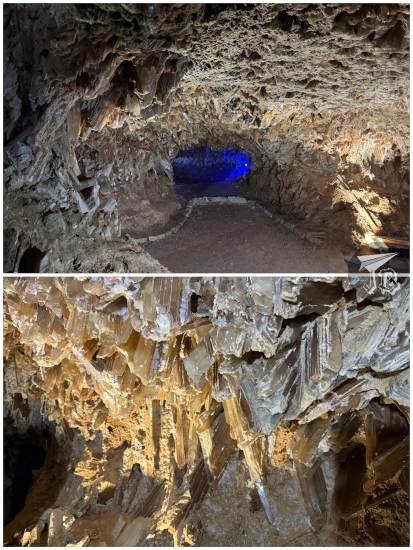
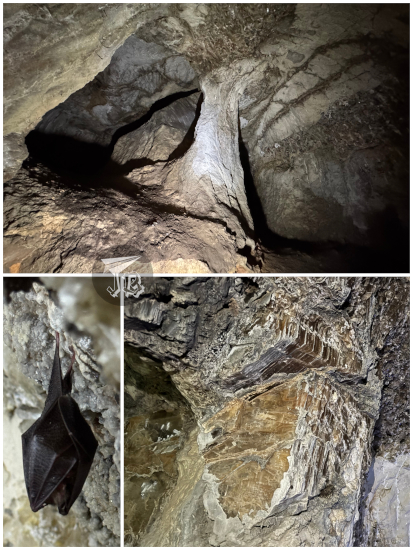
The first mine is called Cave of Knives, Cueva de los Cuchillos. This is due to the way the lapis specularis crystallises, in small(ish) crystals that protrude outwards from the ceiling. The second is Cueva del Sanabrio. Apparently, the sanabrio was a monster made up by adults to prevent kids from entering the mines and getting lost. Not that we had any chance to do so, considering how little we were allowed to explore. The crystals in this cave were larger, and could have been mined off in one sizeable slab. I did not pick any minerals inside, but there were a few easy to grab in the parking lot so I hauled a couple of tiny samples.
The guide “invited” us to go to the nearby village of Huete for the guided visit at 12:30. My parent loves guided visits, so they decided that we should drop by. When we got to the tourist office in town, we learnt that the village has four museum (2 € entry for each), and that the guided visit was 7 €. We paid for the visit but adding up the museums and the mines, the whole thing would have been 20 € per person – daylight robbery, I thought. The visit started at 12:50 as the guide still had to come from the mines with a second batch of visitors.
We used the idle time to book a spot for lunch at the local grill, which happened to be near the old town walls. There is not much left of the fortification except one of the gates Puerta de Almazán and the clock tower Torre del Reloj. The meeting point for the visit was the Tourist Office, located in the monastery Monasterio de Santa María de la Merced, which now belongs to the town hall and has been used as museum and local offices.
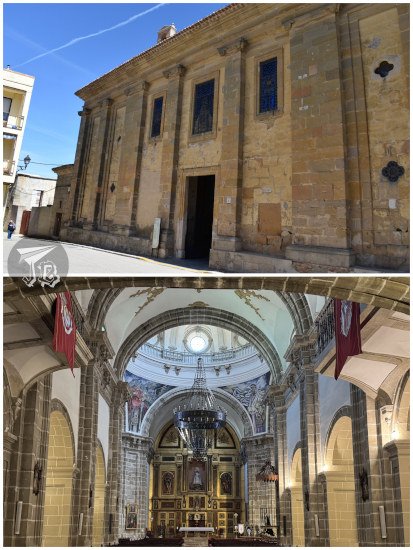
It’s not a secret that I’m not a fan of guided visits, but this was probably the worst one I’ve attended in a while, not even considering the tardiness. Besides the guide’s high tone of voice, the bad sound amplifier, and the reverberation in the church… the whole thing was bad. Really bad. Our first visit was indeed the church, where the guide spent 30 minutes telling us about how Huete was great, its history, and the lives of kings and saints vaguely if at all related to the village. What she did not say? For example, the name of the church. I later learnt that it was the Baroque temple Iglesia San Esteban Protomartir, designed by José de Arroy. When the guide was about to let us leave the church, a religious procession came back from parading the streets, so we waited for them to pass out of respect.
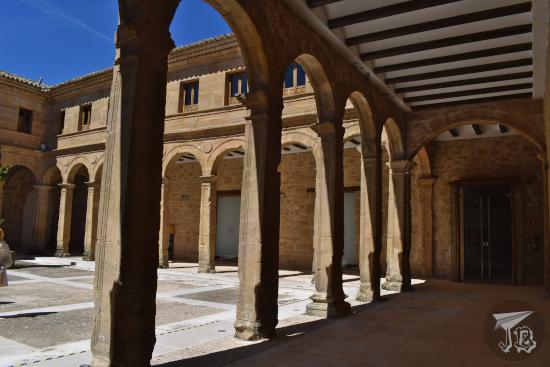
After that, we trotted towards the former convent Antiguo Convento de Jesús y María de Huete, where the photography museum Fundación Antonio Pérez. The foundation of the convent happened in the mid 16th century, but the building has been renovated again and again. Here, we saw the Renaissance façade, and the Baroque cloister.
We then were ushered towards the city wall, the gate Puerta de Almazán and the clock tower Torre del Reloj, where we learnt that the only function of the latter was telling the time – hence… the clock? (what she meant is that it was not a defensive tower). Afterwards, we went walked past the “royal barn” Pósito Real and reached the second gate of the Medieval walls, Puerta de la Medina. At this point, my parents and I gave up and left for lunch, sunk cost be damned.
Lunch was… forgettable and slow. At least we were next to the air-con and that was set on heat, so I was warm and content. After eating, we took a small detour on the next street and saw the outside of the church Iglesia de Santo Domingo and the rural hotel Palacio de los Condes de Garcinarro.
We got back to the car and headed back. We missed a Roman mausoleum which is marked on the Sat-Nav, but there was no way to park so it must not have been that important. What we did find was the so-called “Prehistoric Valley” Valle Prehistórico de Altomira. The only thing we saw at first were a bunch of caves, but apparently they are home of scattered Palaeolithic, Neolithic and Chalcolithic remains, mainly pottery and stone tools.
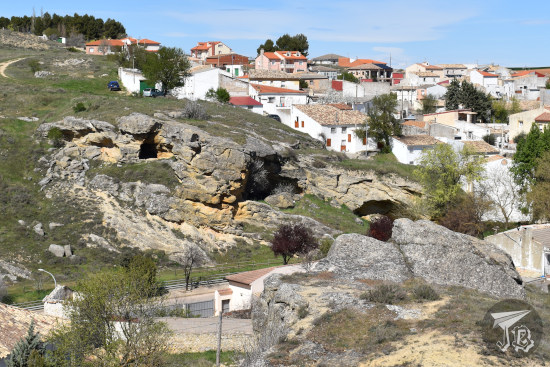
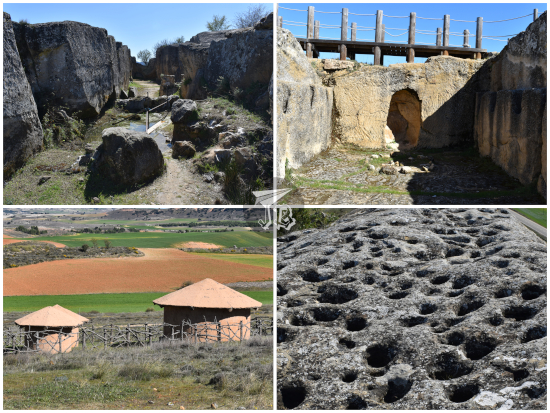
We drove a bit further (closer?) and stopped at the archaeological site Yacimiento Arqueológico de la Cava, in Garcinarro. The area was first occupied around 4,000 years ago in the Bronze Age, strategically situated on top of a mountain. The problem, of course, is that you have to actually climb the mountain to get to the site. A wall lizard thought we were crazy to be out and about at that time in the afternoon.
The oldest structure is a horizontal layer of rock with small circular petroglyphs, called cazoletas (cups) – there are around 8,000 of them, and nobody currently knows their function. From the Celtiberian period in the Iron Age, there is a three-room building. It faces south (probably for warmth), and it was carved out of rock, and protected by a sort of moat. Facing north there are newer remains from the Bronze Age, where a bunch of artefacts have been recovered. These are kept in the museum, but we did not get there. The settlement was eventually abandoned – probably destroyed by an earthquake.
All in all… I don’t know. The caves were cool, the Huete visit was really bad, and the archaeological site was okay – and free. The prehistoric valley needs more research and exploration though, but it was not something I could do with my parents. Some other day when I’m in the vicinity, because I still need to get to Segóbriga…

