3rd April 2026: Roman mines & archaeology, or how my road trip got hijacked (Spain)

While we were on the train to have Father’s Day brunch, I was asked what my plans for Easter break were – either a couple of day trips or meet my sibling. I explained about the gypsum mines in the Cuenca area, and one of my parents was immediately interested, to the point that they ended up hijacking the whole thing. They, however, drove, so I am not going to complain, just be low-key amused at how it all went down.

Gypsum (Calcium sulfate dihydrate, CaSO4·2H2O) is a very common mineral, a type of evaporite that forms when solvents precipitate as water evaporates from from seas, lakes or hot springs. It can be a white powder (actually very small crystals), rocky white veins, or selenite crystals. Selenite is a transparent crystallised variety of gypsum, and it can be tinted with the presence of impurities. In Roman times, a variety of selenite, referred to lapis specularis (stone mirror) was used to create windows throughout the Empire.

A lot of that lapis specularis was mined in Spain, and distributed from the Ancient Roman settlement of Segóbriga (which I wanted to visit on my way back from Almadén, but they were on weather alert and I decided to skip it in the end). The mines extended up to 100,000 steps (150 km) around the city, and a couple of vistable ones were about an hour’s drive away. My curiosity was piked. When I was a kid, in Tendilla, I used to dig up a lot of small gypsum crystal, and I guess I wanted to see if there was much difference between what I had and what Cuenca offered. I have to own up that Cuenca’s crystals are larger (by far) and more transparent.

The two mines I wanted to explore are located in the village of Huete (technically, in Saceda del Río, but it is the Huete Tourist Office that exploits them since Saceda is barely a neighbourhood). They can only be accessed by car and my plan was to get there, see the mines and then drive back stopping at several archaeological sites. My parent took over planning and was able to get a visit for 11:00 on Good Friday, which is a holiday in most (if not all) of Spain, therefore traffic would be limited. We actually did not meet many cars until we reached the meeting point by the road, around 10:30. I hiked up the hill to see what was ahead, and there was a parking spot right at entrance of the mines, so we drove up there. The guide was late, but someone from the Tourist Office came to collect the money (5 € per person) and “open up” the mines, which are locked away using grilled bars. Not sure whether to protect them or to be able to charge entry (probably… both).

When the guide finally arrived, we were shown (rushed) in. The visit to both mines / caves was only about 30 minutes, and we could barely snoop around, just at the entrance of both.

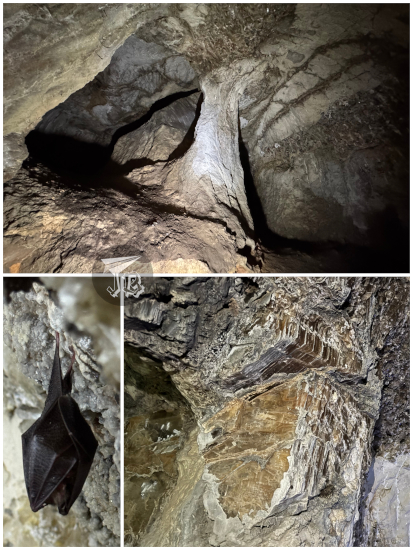
The first mine is called Cave of Knives, Cueva de los Cuchillos. This is due to the way the lapis specularis crystallises, in small(ish) crystals that protrude outwards from the ceiling. The second is Cueva del Sanabrio. Apparently, the sanabrio was a monster made up by adults to prevent kids from entering the mines and getting lost. Not that we had any chance to do so, considering how little we were allowed to explore. The crystals in this cave were larger, and could have been mined off in one sizeable slab. I did not pick any minerals inside, but there were a few easy to grab in the parking lot so I hauled a couple of tiny samples.
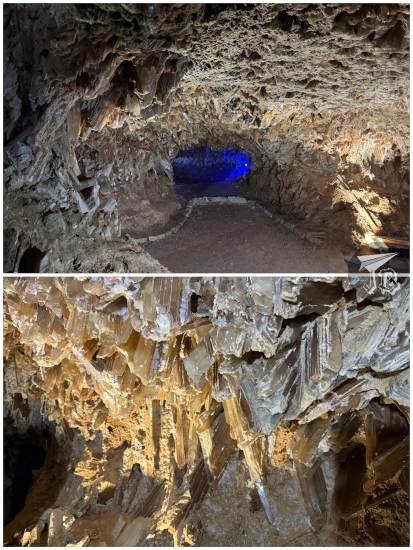
Gypsun crystal mine


Gypsun crystal mine (and a sleeping little bat)

The guide “invited” us to go to the nearby village of Huete for the guided visit at 12:30. My parent loves guided visits, so they decided that we should drop by. When we got to the tourist office in town, we learnt that the village has four museum (2 € entry for each), and that the guided visit was 7 €. We paid for the visit but adding up the museums and the mines, the whole thing would have been 20 € per person – daylight robbery, I thought. The visit started at 12:50 as the guide still had to come from the mines with a second batch of visitors.

We used the idle time to book a spot for lunch at the local grill, which happened to be near the old town walls. There is not much left of the fortification except one of the gates Puerta de Almazán and the clock tower Torre del Reloj. The meeting point for the visit was the Tourist Office, located in the monastery Monasterio de Santa María de la Merced, which now belongs to the town hall and has been used as museum and local offices.

It’s not a secret that I’m not a fan of guided visits, but this was probably the worst one I’ve attended in a while, not even considering the tardiness. Besides the guide’s high tone of voice, the bad sound amplifier, and the reverberation in the church… the whole thing was bad. Really bad. Our first visit was indeed the church, where the guide spent 30 minutes telling us about how Huete was great, its history, and the lives of kings and saints vaguely if at all related to the village. What she did not say? For example, the name of the church. I later learnt that it was the Baroque temple Iglesia San Esteban Protomartir, designed by José de Arroy. When the guide was about to let us leave the church, a religious procession came back from parading the streets, so we waited for them to pass out of respect.
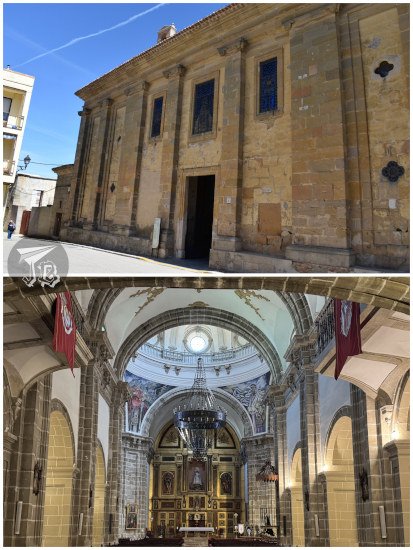
Neoclassical church with a golden altar

After that, we trotted towards the former convent Antiguo Convento de Jesús y María de Huete, where the photography museum Fundación Antonio Pérez. The foundation of the convent happened in the mid 16th century, but the building has been renovated again and again. Here, we saw the Renaissance façade, and the Baroque cloister.
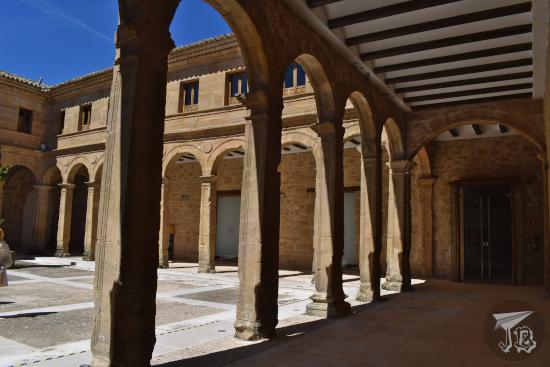
Neoclassical cloister

We then were ushered towards the city wall, the gate Puerta de Almazán and the clock tower Torre del Reloj, where we learnt that the only function of the latter was telling the time – hence… the clock? (what she meant is that it was not a defensive tower). Afterwards, we went walked past the “royal barn” Pósito Real and reached the second gate of the Medieval walls, Puerta de la Medina. At this point, my parents and I gave up and left for lunch, sunk cost be damned.

Lunch was… forgettable and slow. At least we were next to the air-con and that was set on heat, so I was warm and content. After eating, we took a small detour on the next street and saw the outside of the church Iglesia de Santo Domingo and the rural hotel Palacio de los Condes de Garcinarro.

We got back to the car and headed back. We missed a Roman mausoleum which is marked on the Sat-Nav, but there was no way to park so it must not have been that important. What we did find was the so-called “Prehistoric Valley” Valle Prehistórico de Altomira. The only thing we saw at first were a bunch of caves, but apparently they are home of scattered Palaeolithic, Neolithic and Chalcolithic remains, mainly pottery and stone tools.
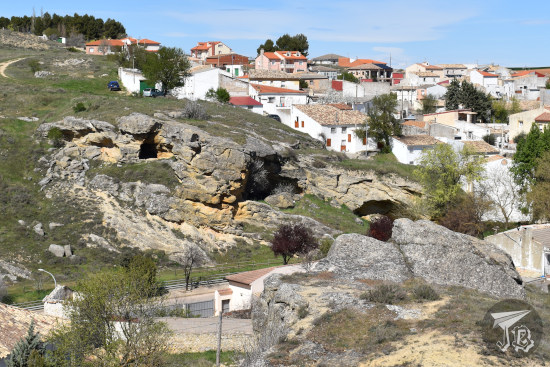
Prehistoric caves and a village in the background

We drove a bit further (closer?) and stopped at the archaeological site Yacimiento Arqueológico de la Cava, in Garcinarro. The area was first occupied around 4,000 years ago in the Bronze Age, strategically situated on top of a mountain. The problem, of course, is that you have to actually climb the mountain to get to the site. A wall lizard thought we were crazy to be out and about at that time in the afternoon.

The oldest structure is a horizontal layer of rock with small circular petroglyphs, called cazoletas (cups) – there are around 8,000 of them, and nobody currently knows their function. From the Celtiberian period in the Iron Age, there is a three-room building. It faces south (probably for warmth), and it was carved out of rock, and protected by a sort of moat. Facing north there are newer remains from the Bronze Age, where a bunch of artefacts have been recovered. These are kept in the museum, but we did not get there. The settlement was eventually abandoned – probably destroyed by an earthquake.
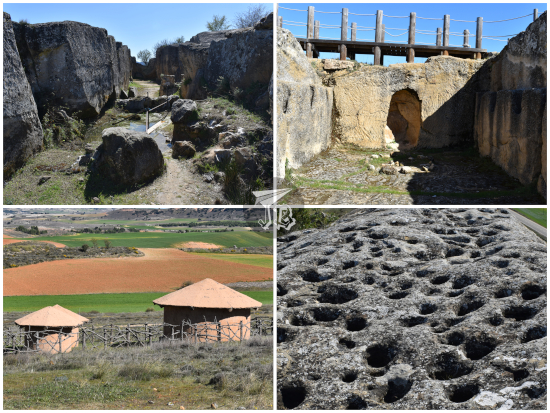
Pre-roman archaeological ruins, including round holes dug up on the ground rock

All in all… I don’t know. The caves were cool, the Huete visit was really bad, and the archaeological site was okay – and free. The prehistoric valley needs more research and exploration though, but it was not something I could do with my parents. Some other day when I’m in the vicinity, because I still need to get to Segóbriga…
20th September 2025: The Mercury Mine in Almadén {Road Trip & Almadén, September 2025}

My lodging in Almadén included breakfast, so I had a coffee and a toast – better than dinner the previous night, but this time there was the hotel lady working the bar. Afterwards, I just grabbed my things and redid half of my tour from the previous night, and re-visit all the spots inscribed as World Heritage Heritage of Mercury. Almadén and Idrija.

The former mining school, the first one created in Spain, Antigua Escuela de Ingeniería de Minas was still closed – it is not open to visitors due to its poor conservation state. It is a Baroque building erected in the 1780s, with a sober façade and wooden interior with basements and semi-basements to deal with the steep street outside, the whole building designed around a master staircase.

I climbed up towards the castle Castillo de Retamar. Historically, the Romans were the first to intensively exploit the mines, as they used cinnabar for pigments. Later, the Moors started distilling mercury, which they used for decoration. There are testimonies of fountains of mercury running in Al-Andalus – let’s face it, quicksilver is a fascinating thing. As the Moors wanted to protect their dominion over the mine – and the whole territory, including the water sources – they erected the castle in the 12th century. The building was later reinforced by the Order of Calatrava, but today there are only a few remains: the brick foundations of what could have been the keep, topped with a 14th-century bell tower.

I finally headed out towards the mining complex Parque Minero de Almadén. When the mine closed down in 2003, it had been the largest producer of mercury in the world throughout the current era – it is calculated that one third of the mercury used in the world comes from Almadén. The catch? Several of them, actually. First of all, mercury is toxic. Second, the exploitation of the mine was less than stellar – at a point in history, digging in the mine was a punishment for capital crimes, considered worse than being sent to row in the navy, with workers being little more than slaves. Third, the mine is surrounded by underground water reservoirs that percolated slowly into the tunnels, which reach 700 metres deep, threatening to inundate them. If breaking down rock was hard, so was carrying the mineral, along with bags of never-ending water, up and out. Since the mines closed, the water has flooded most of the 19 under-levels of the mine, rising up until the third one.

With the mine closed, life in Almadén dwindled down. The area opened to visitors in 2008. When the Unesco Heritage Declaration came in 2012, it breathed a bit of a new air into the town, turning it into a tourist destination, but lack of management makes it, in the end, barely worth a day’s visit. Visits to the mine are only guaranteed at the weekends, when the museum located in the university is closed down. Reservation of activities is confusing, and unless you’re a whole group there is no way to book a complete visit. I had booked the guided visit to the mine at 10:30 in the morning and a visit to the museums in the afternoon. I was not sure that I could do both before Spanish lunch time, but figured out I would be able to talk my way into the museums early if both things could be combined in one go. It was actually the cashier’s idea to have me do so, even better. One of the museums was closed and there was no warning about it anywhere but Google Maps, which feels a bit like cheating.

The main entrance to the mining complex Parque Minero de Almadén is locked down. There is a side building with an open door and a sign reading “we don’t have any information about tourist visits”, which leads to the Visitors’ Centre. That was confusing. As I came in, there was a large group who had not booked in advance because they were afraid they’d feel claustrophobic, and now they had no tickets. The cashier managed to fit them into the afternoon visit. I talked to him about my bookings and he told me to go to the museums after my mine visit, and to wander around while the rest of the group came together.

The lift that reaches inside the mine (modern lift in old encasing)

Of course, there was a family with young children absolutely in the wrong mind frame to get into a poorly-lit underground tunnel for a couple of hours. Fortunately, there were two groups organised and I made sure to insert myself into the child-free one. I didn’t want a repeat of the Cueva del Viento, where a bunch of information was lost due to kids being kids. And I understand that kids are kids but… for me it’s hard enough to focus on the information from a guide without the added distractions.

The visit into the mine only goes down to the first floor and an upper sub-gallery, after which you ride out in the “mining train”. Before starting, you need to get your helmet, and some lanterns are dealt out to each group to improve visibility in the tunnels. The rules are simple: distribute the lanterns throughout the group, keep light pointed at the floor. Apparently, those pointers are too hard to follow – my group had three lights together in the middle of the group, pointed upwards all the time. Good thing phones have torches now.

The descent to the mine is done through a modern-times lift installed in a former shaft Pozo de San Teodoro, down 50 metres to the gallery. It did not feel claustrophobic to me, and surprisingly, I was more impressed about knowing about the water creeping up than the rock above my head. The visit took about two hours and a half. Along the walk we saw areas that were worked on from the 17th to the 19th centuries, along some of the machinery that came into play in the 20th.

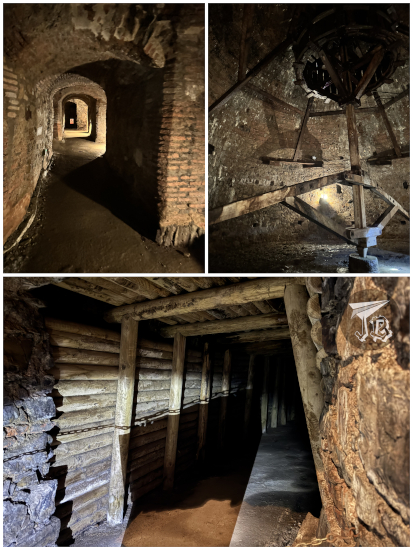
Inside the Almadén mine - corridors and mining galleries and a well to extract the water.

Inside the Almadén mine - corridors sustained by brick. In one of the pictures there is a bat flying but you can't see it.

Don’t get me wrong, back in the day mining those tunnels must have been beyond horrible. It is impossible to describe the history of mine without considering the harsh conditions the workers had to endure, especially the prisoners that were all but enslaved there for decades. The most intense exploitation of the mine happened during the age of the Spanish Empire and its expansion to America. Mercury became a key ingredient in the production of gold and silver in the New World.

Inside the Almadén mine - corridors sustained either by brick (newer) or wood (older).

Inside the Almadén mine - corridors and an image of the Virgin Mary.

Throughout the works in the mine, various exploitation strategies were used, digging both horizontally and in angles. We saw different methods and tools, from plain old pickaxes to modern hydraulic hammers, and the room where the mules would work to help extract the cinnabar. We were shown corridors held up by wooden beams – which were discontinued after in the mid 1750s there was a fire that lasted two years – and later brick ones. We saw shafts that had water at the bottom, and in the end we rode a little mining train to come up to street level. The visit ended with a brief lookout and explanation of the furnaces used to purify the mercury.

A piece of cinnabar embedded in the rock within the Almadén mine.

The mining train that used to transport cinnabar and now transports tourists out of the mine.

Rusted distilling equipement, metres high, where mercury was produced from cinnabar when the mine was in operation.

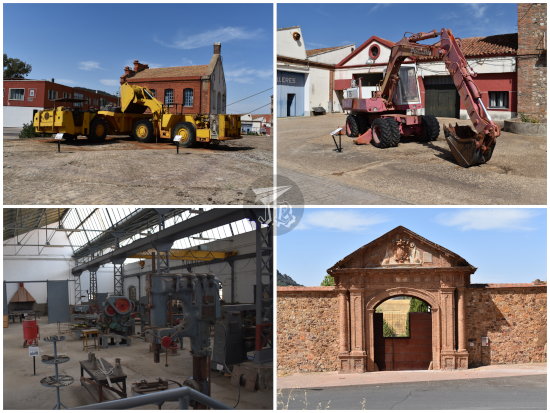
Afterwards, I had my visit to the museums. One of them has an explanation of the mining procedures, the same thing we had heard within the mine itself. The second held the former workshops, which displayed machinery to keep up with the maintenance of all the apparatuses used within the mine. I was the only person who had booked those tickets, so it was a quiet visit. I was also allowed to amble around the outer part of the mining park, seeing all the heavy-duty machines.

I left the mining park and tried to find the historical gates. The entrance to the mines has always been walled off – historically to protect the valuable resources it held. I could see the restored Puerta de Carlos IV. This gate would have taken me to the Mercury Museum, currently closed. There was another gate, but the overgrown vegetation made it impossible to do more than glimpse it.

Mining equipment and buildings on the outer part of the mine in Almadén, including an excavator, the mechanical shop and the classic door, in red brick.

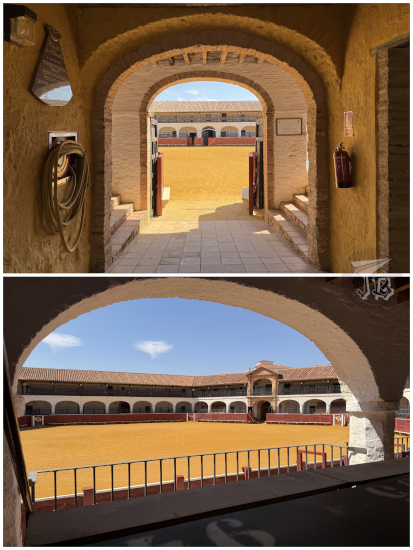
My next step was heading back downtown until I reached the bullfighting ring Plaza de Toros de Almadén. During thirty-month fire of the mine, which started in 1755, the miners had to work on anything, anywhere, to raise some money. One of their ways to get income was converting the communal garden into a bullfighting ring – at least that is one theory. Today, it is considered the second-oldest ring in the world, with the characteristic that the coso (the actual bullring) is not a circle but a hexagon. It is an important national monument and part of the Heritage Site.

Bullfighting ring in Almadén. The sand pit is hexagonal, which is its main characteristic.

In front of the entrance to the bullring stands the Monument to the Miner Monumento al Minero, which takes a new meaning after having visited the mine itself and heard about all the hardships and dangers within its galleries.

And then came the hard job to find a place to grab a bite. I wanted to try a typical dish from a restaurant with a typical name, but they had run out… For real. At least they let me have lunch at the bar… It made me decide to buy something from the local supermarket to have dinner later on. After lunch, I went back to the hotel to wait for 17:00, when the last monument would open.

This was the former hospital Real Hospital de Mineros de San Rafael. It was built between 1755 and 1775 – started during the fire – in order to treat miners who became ill or had an accident in the mine. The most common malady was hydrargyria – mercury poisoning – though of course there were physical accidents, especially loss of fingers after dynamite was introduced.

The visit has three parts of sorts. On the right there is a bit on the history of mining medicine and mercury poisoning. On the left, a very humble display of what is called “the archive” – documentation related to the mine and mining operations. Upstairs, a ward with some archaeological items and an exhibition about how the layman lived outside the mine, with a chilling panel explaining that the work in the mine was considered so dangerous that children would not be allowed to play when there was a relative in the galleries.

Mining hospital - a baroque building with some exhibits inside, amongst them cinnabar, mercury (sealed away) and a wagon

Afterwards, I moved towards the current university, which has been built around and over the former prison Real Cárcel de Forzados, but there was nothing to see from the outside, and the campus was closed as it was a weekend. However, I was on a small hill, so I decided to continue upwards and see if I could get a general view of the mining park. I ended up at a small forest-park, but did not get a great view.

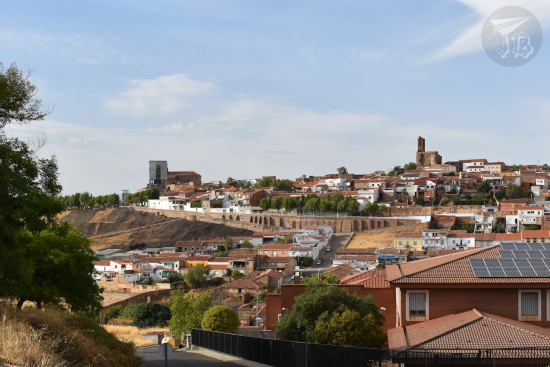
A general view of the town of Almadén. It shows that it is located on a hilltop. The main structures seen are the mining complex on the left (a grey mass on top of a black gorge) and the castle at the very top.

I headed downtown again and I headed towards a tobacco shop I had seen in a small side street. They had souvenirs in the window, so I hoped that they would sell some mercury. Technically, you cannot buy mercury in Europe – both the Mining Park and the Hospital staff had told me so – but this little shop had a little for sale. So yay me, now I officially own some Almadén mercury.

I found the side entrance to the church Iglesia de Santa María de la Estrella, but no other shops open – I wanted to buy some local cheese. Not even the supermarket had anything that I would not find in my local one. I did buy some dinner and snacks though, and a thermally insulated bag because mine is old and is not working that well any more. It helped keep dinner fresh until I reached the hotel and could use the small fridge there. Pity about the cheese though.

Baroque church in Almadén, showing the exterior in and the main altar.

I turned in afterwards to decide what I would do on my way back, and study the routes.

19th September 2025: A knot of roads {Road Trip & Almadén, September 2025}

I woke up early – way before the alarm clock went off, so I decided to hit the road. I first topped up the fuel tank at the cheap petrol station near my place. Afterwards, I drove off to the motorway and the morning rush hour. As I was caught in the traffic jam, there was a pretty rainbow in front of me – no pictures, though, for obvious reasons. Traffic dwindled a lot when I left the A2 behind and merged onto M50. From there, I took a couple of hours to reach my first stop, the village of Consuegra. On the mountaintop of the so-called Cerro Calderico, in the outskirts of this ten-thousand inhabitant, stand some the best examples of restored traditional windmills.

During the Middle Ages, the area in central Spain known as La Mancha proved a challenging place for watermills, the dominant technology at the time. The rain regimes cause irregular river flow, with a lot of the currents drying up in summer. As demand for flour grew, windmills were built near but outside towns, on high ground. They provided clean flour, cheap enough to be affordable, without being subjected to draught or flood seasons changing. The windmills lived its golden age from the second half of the 16th century until almost the 20th. Towards the end of the 1800s, most of the cereal crops were exchanged for vines in order to supply wine to France, leading to the decay and progressive abandonment of wind-milling. The Industrial Revolution and the appearance of fossil fuels and electricity finished off whatever little remained in the early 20th century.

However, besides their practical function, there was something else about the La Mancha windmills. They had gone viral centuries before the Internet was a thing. In the year 1605, Miguel de Cervantes – considered the greatest writer in the Spanish language – wrote his masterpiece El Ingenioso Hidalgo Don Quijote de la Mancha, worldwide known as “Don Quixote”. The novel is amongst the most translated literary works in the world, and tells the tragic story of a minor nobleman, the title character, who goes crazy from reading too many chivalric romances. He decides to leave his home and become an errant knight, having great adventures in his mind, which are more misadventures in real life. He is accompanied by a farmer-turned-squire, Sancho Panza.

During one of his delusions, Don Quixote fights giants with long arms – which the reader knows, from Sancho’s warnings, that are in reality windmills. Of course, the madman is “defeated” by the blades, which shatter his spear on impact. It is one of the most famous passages of the book, even if it is barely a page or two in the eighth chapter. Throughout the novel, which starts “in a village of La Mancha, the name of which I have no desire to call to mind”, several locations are explicitly mentioned, others are implied, and some have completely imaginary names. Experts have placed this fictional encounter with windmills either in Consuegra or Campo de Criptana – which was not on my route.

Thirteen windmills were built in the 19th century on the Cerro Calderico, and twelve have been restored and turned into tourist attractions – one even works. They stand in a row alongside the ridge and next to the local castle Castillo de la Muela (or Castillo de Consuegra). After all, both castles and windmills need the higher ground to be effective, in a way. The castle already existed in the 13th century, with roots in a 10th century previous fortress.

I parked at the foot of the hill and walked up to see the castle and the windmills. The castle was closed as it was a local holiday, and the fortress is managed by the town hall. I stayed around for an hour or so, walking from one end of the hill to the other. I had a snack as I snooped around, then I moved on.

Consuegra - a line of windmills with a castle in the background

My next stop was the National Park Parque Nacional de las Tablas de Daimiel, a weird place. I call it weird because despite its status as a protected area, it has been on the brink of collapse for the last century or so. The wetlands have been drying out for decades.

The area is the literal last of its kind in Spain, a kind of wetland generated when rivers break their banks in their middle course on flat terrain. In the middle of the de facto Spanish Inner Plateau desert, it is formed by the rivers Guadiana (fresh water) and its tributary, the Cigüela (brackish water), and fed by a number of underwater aquifers. These have been exploited for farming, which seems to be the cause for the dessication. So out of what it should be, there is only one medium-sized pond, Laguna de Navaseca (usually referred to the “permanent pond” Laguna Permanente), where a number of birds, fish and amphibians live either seasonally or all year round. The area was designated a national park in 1973. Later, it received other protections, especially regarding the bird population.

I parked in the allocated space and had a sandwich before I went in. The visitors’ centre was manned by a very disgruntled employee who explained the dessication to me as if I were personally responsible for it. I really felt like apologising. The truth is that the first place I visited was the pier, which has not seen water for at least a decade. I could do two of the three walking routes, but in the end I only did one and a half, as the second I tried was way hot and dry and I gave it up three-quarters in, as there was no water any more.

In the end, I stayed around the main pond Laguna de Navaseca, where wooden walkways have been built. I felt horribly guilty whenever the wood cracked under my feet and I scared the ducks away, but the local guides could be heard from across the whole pond. On the banks, there are bushes of common reed (Phragmites) and rushes (Juncus). The only tree in the area is the tamarix (Tamarix gallica), small and brime-resistant.

In the pond – and flying over it – I found a flock of greater flamingoes (Phoenicopterus roseus) – which are for some reason not listed anywhere that explains the park. I also saw herons, ducks, geese and I swear ibises – the latter are not mentioned either, but my bird identification book suggest a glossy ibis (Plegadis falcinellus). I was hoping that autumn had modulated the temperatures a bit, but it was extremely hot. It was also… stupidly dry for wetlands… That is why I gave up on the second route halfway.

Doñana National Park - view of the main pond, surrounded by low bushes

Doñana National Park - view of the main pond with flying flamingoes

An ibis waddling for food

A flock of flamingoes flying

I went back to the car and drove to a small parking lot at the entrance of the park which allows you to see the watermill. It was closed, and again dry, but it was an interesting structure.

I continued on the road towards the archaeological site Yacimiento Visitable de Calatrava la Vieja in Carrión de Calatrava, which has a very nice and shaded parking area, where I had my second sandwich as I was there 30 minutes before schedule – read: they had not opened yet.

The archaeological site is considered one of the most important of Moorish origin in Spain – a city and a castle from that period, erected on older remains, probably Iberian. Back during the Arab vs Christian wars in Spain, the fortress was right in the middle on the way between Toledo and Córdoba, along with other important commercial routes, so it became a key defence point. It is known that the castle already existed before the 8th century, on the Guadiana riverbank. When it fell to the Christians around 1150, it became the first line of defence, and it was entrusted first to the Knights Templar and then to the Cistercians. It became the birthplace of the first Spanish military order, the Order of Calatrava Órden de Calatrava.

Calatrava castle from the outside - a ruined fortress with a roundish shape, built in clay-coloured rock, with no vegetation whatsoever around it

The castle was built on a plateau, defended by the river itself and the walling structure, which included at least 44 flanking towers. There were four fortified corridors (corachas) that protected access to the water. The entrances to the inner fortress had several turns to make them easier to protect. Between the inner core and the walls stood the medina, the Islamic city, and the alcázar rose as a sort of triangular keep, accessed through a triumphal arch. The inner castle itself is the best-preserved area, having even rebuilt furnaces to make clay. During the Templar times, part of the alcázar was repurposed into a budding church which was never finished. On one of the inside walls there are carved drawings of vessels.

Calatrava castle, collage: The inside of a room with a Templar cape as sole decoration, the inside of a pottery oven, a view of the mdina arched entrance and two inner archways.

As I climbed the walls, clouds had started gathering and the wind had picked up. I decided to get going, trying to outdrive the storm. At first I thought I had been lucky, but about 20 minutes away from Almadén, the skies opened and there was a torrential downpour. I was lucky enough to find a parking spot where I hoped, down the corner from the hotel, and I have an umbrella in the car. A few minutes after parking, the storm stopped though, albeit the rain did nothing to cool down the evening. I checked in, and the hotel lady gave me a map with all the spots that have been inscribed as World Heritage Heritage of Mercury. Almadén and Idrija.

Mercury (chemical symbol Hg) is a native metallic element, the only one which is liquid under normal temperature and pressure conditions. In nature, it is usually found as cinnabar (mercury sulphide, HgS), a bright scarlet mineral. Its formation is linked to volcanic activity and alkaline hot springs (the area of Ciudad Real comprises the extinct volcanic field called Campo de Calatrava, which I drove through, but found no way to stop anywhere to explore). Liquid mercury, also called quicksilver, is extracted from cinnabar by heating it, as sulphur evaporates with heat.

Mercury is toxic to the nervous system, dissolves gold and silver, and has long been associated with “mystical” powers and sites – the first emperor of China was buried in a tomb with rivers of mercury, there is mercury under one of the Teotihuacan pyramids in Mexico, and in the end it carries the name of the Roman God of Messengers and Travellers. It has fascinated humans throughout history.

The name of the five-thousand-inhabitant town, Almadén, comes from the Arabic Al-maʻdin [المعدن], which means “The Mine”. The site was already exploited in times of the Romans – the extracted bright-red cinnabar was used to create vermilion paint for the walls of Pompeii and Complutum. When I was a child, my history book had some information on Almadén, and the accompanying photograph showed someone who had thrown a cannonball into a mercury pool, but the cannonball was floating on it. I have wanted to see the mine since then, even knowing that there was no way I would ever see that one pool any more, due to the legislations that have deemed mercury as “too toxic for anything”.

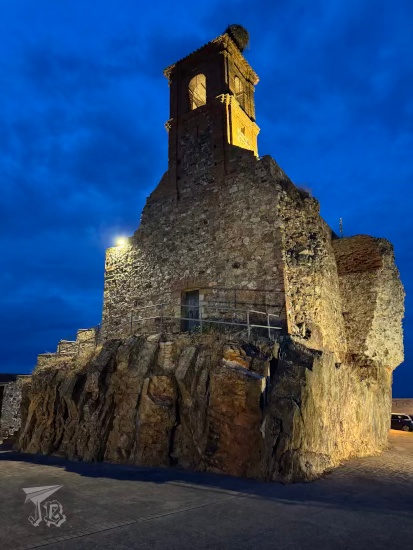
I went to have a look around town. It was dusk and everything was closed – not that many things would open the next day anyway. I did a small circular walking tour which included the main church Iglesia de Santa María de la Estrella, and down the main street the central square with the town hall Ayuntamiento de Almadén and the church Iglesia de San Juan. I continued on and found the the old mining school Antigua Escuela de Ingeniería de Minas. To the side of the street stands the former castle point Castillo de Retamar, where only a turret remains. Up a little, I reached the third church, Iglesia de San Sebastian and the ruins of the manor house Casa de la Superintendencia.

Almadén Castle - a derelict tower in brick, with a stork nest on top

I undid my path and headed to the other side of town. In a secondary square there is a monument to miners Monumento al Minero, and across the street the bullfighting ring Plaza de Toros de Almadén. My final stop was the former hospital Real Hospital de Mineros de San Rafael. I had dinner at the hotel restaurant, which honestly was a little disappointing.

Almadén: monument to the miner at night; a huge sculpture in metal that represents miners. Two of them have picks and are breaking a rock, two others are pushing a wagon. The miners have helmets with actual lights.

I headed back to the room to have a shower and some rest, and get ready for the following day – and try to digest dinner.