
The city of Prague [Praha] has a rich history, and some of it is dark. Nevertheless, it cannot be ignored just because it is uncomfortable.
The day did not start well. After breakfast, I checked the plane tickets for the following afternoon’s return, and ran into the same issue as before – a message saying “you must check your bags”. Seriously, it felt like extortion, but I decided to let it go and pay up. That put us behind schedule – my mistake, I misunderstood the time we wanted to be out. On our way, a guy helped us out with directions, and offered money exchange. He was standing at the door of a legit shop. I did not trust him, but a second later my parent was talking to him! Remember my parent’s obsession with the bad exchange rate they claimed they had received from the bank? In the end, they got scammed out of a couple hundred bucks, as the guy gave him Russian roubles instead of Czech crowns. That was not a nice experience, and the day was still going to get a bit more difficult.
Since my parent just pocketed the money, we did not realise it was not valid until they tried to use it to pay for our first spot of the day in Josefov, the Old Jewish Quarter. Today the quarter is luxurious and mostly full of 20th century buildings, after it was almost completely demolished at the end of the 19th century. However, it may have started with the arrival of the first Jews in the 10th century, and reached its peak in the late 1500s. Before the reconstruction, it was composed of narrow streets and brick houses.
Amongst the few remaining historical buildings and structures there are a number of synagogues, the old town hall and the cemetery. Our first stop was Pinkas Synagogue Pinkasova synagoga. Built in the gothic style, it was completed in 1533, and during World War II, it became a repository of religious paraphernalia after the Nazis banned Jewish services. Today, it serves as a memorial to around 80,000 victims of the Holocaust. Their names are written on the walls, and there is a collection of drawings by children from between 1942 and 1944 – most of the children ended up murdered in Auschwitz. I had understood that the synagogue was working as a social centre, so I assumed the drawings were by local contemporary kids. When I realised what they were, it broke me inside. The wave of feelings – and tears – makes the whole experience a bit of a blur.
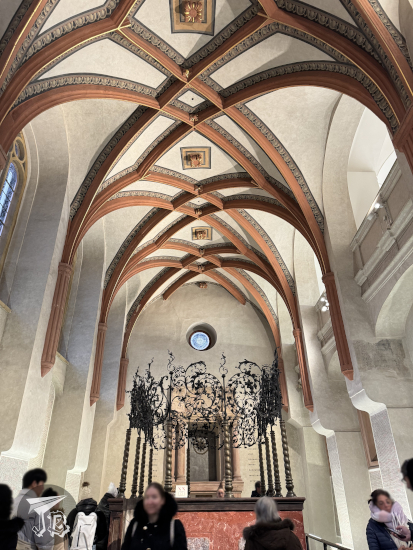
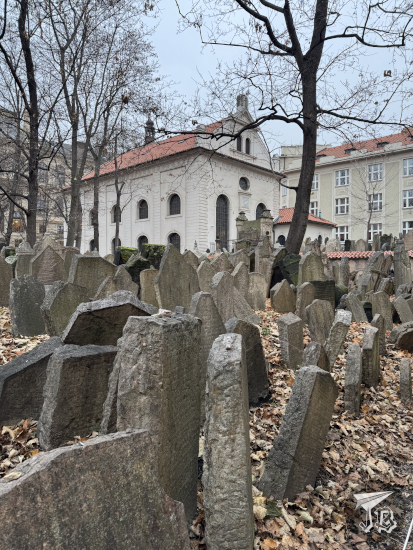
All the synagogues in the area are managed by the institution Jewish Museum in Prague Židovské muzeum v Praze, so there is one combined ticket for all of them. There was a small security check at each entryway, but the security guards were all extremely nice and kind. The Pinkas Synagogue was in the same controlled area as the Old Jewish Cemetery Starý židovský hřbitov.
The cemetery is one of the largest of its kind in Europe, and it was used between the 15th and 18th centuries. Since space was scarce, there are layers upon layers of burials, and the headstones often refer to someone who is buried in the lower levels. This scheme has allowed for older graves to remain through time, as the layers were added on top of the existing ones. Despite my general liking of old cemeteries, I found the place oppressive – probably because of the recent shock to my system.
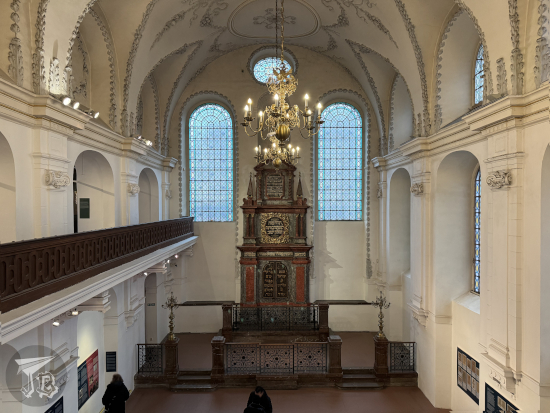
We then walked a couple of minutes to Klausen Synagogue Klausová synagoga. It is the second synagogue built in the same place, erected in 1884 in the Baroque style. It was the only one in that style spared by the urban renewal in the early 20th century. It struck me then that, even if I was aware of architectural styles in churches, I had never thought that synagogues in Europe would go through the same architectural trends. Then again, up until today, I don’t reckon I’d ever been into a synagogue that could still be used as such.
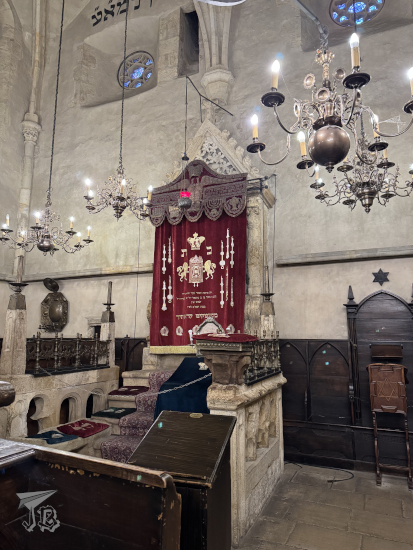
I later learnt that there is no actual “right” way to build a synagogue, and that any group of believers can erect one. This is usually done in the architectural style of the time and place. Synagogues have a raised platform or pulpit, the bimah [בּימה], from where the Torah is read. The Torah [תורה] comprises the first five books of the Hebrew Bible [Tanakh, תַּנַ״ךְ], and, usually in scroll form, is read daily. When not in use, the Torah is kept in a chest or cabinet called the Ark [Aron Kodesh, ארון קודש], which dictates how the whole building is erected, as attendees are supposed to face Jerusalem for prayers. Many synagogues have an eternal light or flame, always lit somewhere in front of the Torah Ark.
Next, we visited the Old New Synagogue Staronová synagoga, the oldest active synagogue in the Czech Republic [Česká Republika], and one of the earliest examples of Gothic in the city of Prague [Praha]. It was originally the New Synagogue to an Old Synagogue, but when the latter was demolished, and even newer ones were built, hence the confusing name. It felt a bit closed off and claustrophobic, as it was accessed by a long corridor and packed with three tourist groups.
We got a bit lost on our way out, so I was able to catch a glimpse of a bit of an oddity – the Prague Metronome Pražský metronom, a giant instrument that… swings. It holds no other function than moving along with time, it does not even click like a normal metronome would. It’s officially named the Time Machine and it was erected by artist Vratislav Novák. I saw it on the other side of the Vltava River, across the Czech Bridge Čechův most.
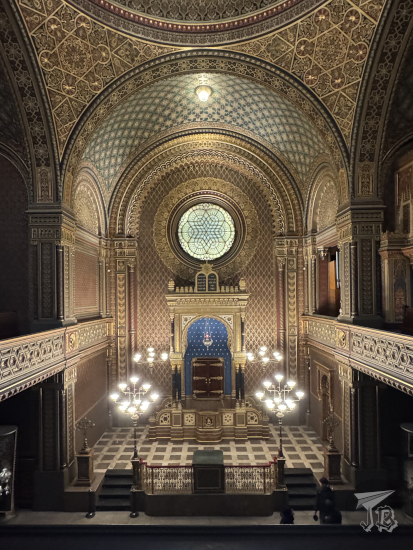
We finally reached the Spanish Synagogue Španělská synagoga. Built in the 19th century, it replaced the Old Synagogue, and its side, which used to be a hospital, is now the Museum. It was erected in a Moorish revival style, with two stories, several balconies and a lot of gold and golden. It hosts an exhibit about the history of Jews in the Czech Republic, but there is no tangible relation to Spain, the name seems to be a reference to the art style of Al-Andalus.
And for some reason (aside from him being Jewish, of course), there is a Statue of Franz Kafka Socha Franze Kafky standing next to the Spanish Synangogue. It is a bronze sculpture of the writer riding a hollow suit, based on the short story Description of a Struggle [Beschreibung eines Kampfes].
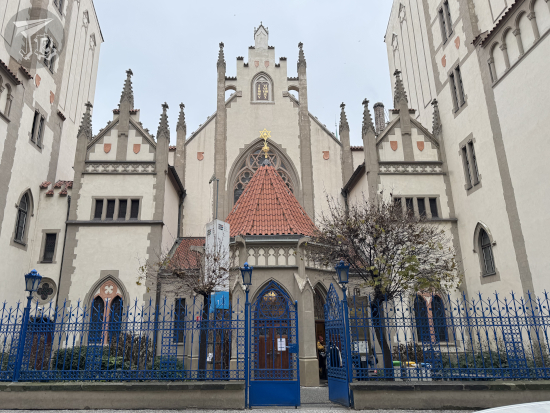
The last synagogue we visited was Maisel Synagogue Maiselova synagoga, currently a museum. It is Neo Gothic, after a previous building was destroyed. It has been restored recently, and hosts a very impressive display of menorah [מְנוֹרָה], a candelabrum with seven branches, symbol of Judaism since ancient times.
We set off then to try and find the nearby underground station, near the Jan Palach square and park Park u náměstí Jana Palacha. There are several buildings and views from the square. We did not stop for long there, and hopped onto the underground to get to Wenceslas Square Václavské nám. We had a bit of time before our lunch reservation, so we decided that the two-story souvenir shop at the corner was a perfect place to spend 20 minutes because it had heating. Afterwards, we walked down the square and crossed the Art Nouveau palace-turned-shopping-hub Lucerna Palace Pasáž Lucerna. Looking back, it could have been a cool place to explore with the idle time we had, but the pedestrian passage was not heated…
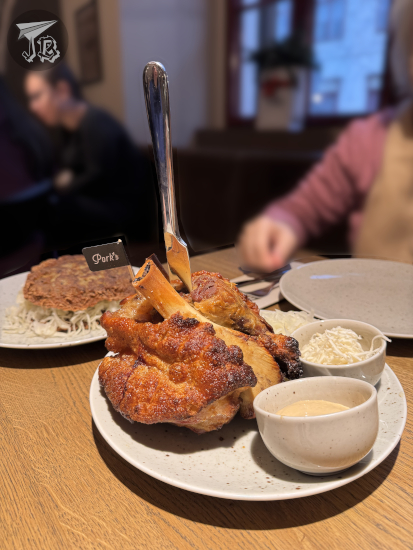
We finally got to the restaurant that my parent had wanted to try from the moment Prague [Praha] had been decided upon – Pork’s. As the name conveys, their menu is basically comprised of pork dishes, and reportedly they serve the best pork knuckle in town. The original restaurant, Pork’s Mostecká, is in Malá Strana, close to the Charles Bridge, and it was the one my parent had their heart set on… Unfortunately, it books out a month in advance. We had been able to find a spot in its sister restaurant Pork’s Vodičkova.
The place was full and bustling, but we had our table ready for us. We ordered two signatory dishes – pork knuckle with mustard, horseradish, crispy sauerkraut Vepřové koleno, hořčice, křen, křupavé zelí, a salad (Lettuce salad with grilled goat cheese, beetroot and marinated pear Listový salát s grilovaným kozím sýrem, řepou a marinovanou hruškou) and a weird potato thing I had seen and was extremely curious about – Potato pancake with sour cabbage, fried in pork fat from our knuckles (Bramborák s kysaným zelím smažený na výpeku z našich kolen), which turned out to be a sort of waffle sandwich (I loved it, because I’m weird like that). The knuckle was all right but I had to peel off some of the fat because it made the dish too heavy on the stomach. For dessert, we shared some apricot dumplings – Homemade fruit dumplings with cottage cheese, sugar and warm butter, Domácí ovocné knedlíky z tvarohového těsta, tvarohem a cukrem sypané, máslem přelité.
We left the restaurant around 15:00 and my parents, who were still a bit on the upset side, decided to go to the hotel, claiming they wanted a break before the light show at 19:30. Since my sibling was up to anything, I decided to head out to the main building of the National Museum Historická budova Národního muzea. We would not have time to do the whole thing, but at least we could wander for a couple of hours and snoop around.
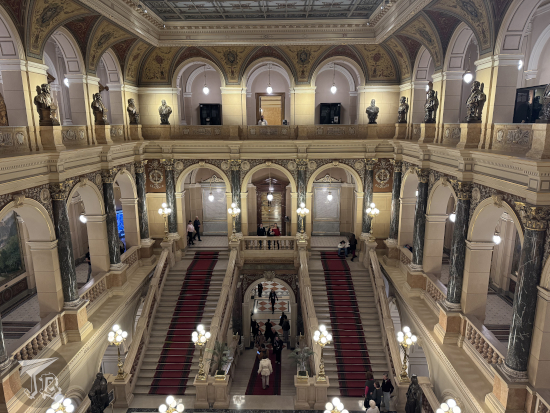
The main or historical building was designed by architect Josef Schulz and erected between 1885 and 1891, when it was inaugurated. It is a magnificent structure in the Neo Renaissance style, grandiose and decorated with gold and frescoes. It feels like a palace, and honestly, it does not look like a museum at all. The building was damaged during the succeeding conflicts in the 20th century, so it ended up closing between 2011 and 2018 for extensive renovations. At the moment, it hosts four permanent exhibitions: the Hall of Minerals, Miracles of Evolution, Windows into Prehistory, and (Czech) History, though the latter seems to only cover from the Middle Ages to the first half of the 20th century. Thus, I guess that it doubles as natural history and archaeology museum.
We started at the Hall of Minerals, which is a traditional collection of minerals in vintage cases. The meteorite collection is pretty good, especially the moldavites. Moldavite vltavín is a mineral derived from a meteorite impact (a tektite), around 15 million years ago. It is a green gemstone, local to the area of Bohemia. It is not uncommon, but not widely available in the world (and unfortunately none was for sale in the gift shop).
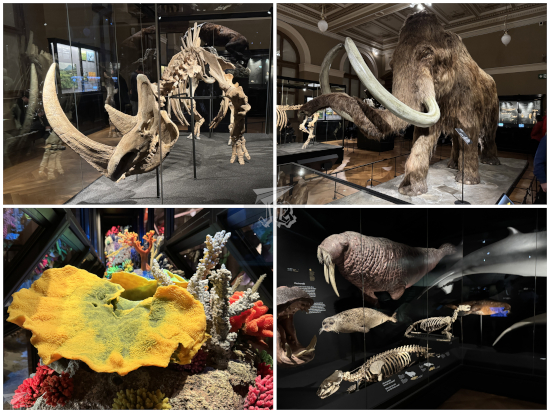
We got to the prehistory ward, and it was really fun. As far as huge diversity goes, the exhibit was not impressive, but what they lack in actual stuff, they make up for with models. We entered through the Paleocene room with a mammoth (technically there is a baby mammoth too but that had been moved to another exhibition) and the skeleton of a woolly rhinoceros, almost complete. The latter is either haunted and has tried to escape, or someone seriously mismeasured its case, because the horn had cracked the glass at some point. Some other models included a sabretooth cat and a scene of steppe wolves hunting.
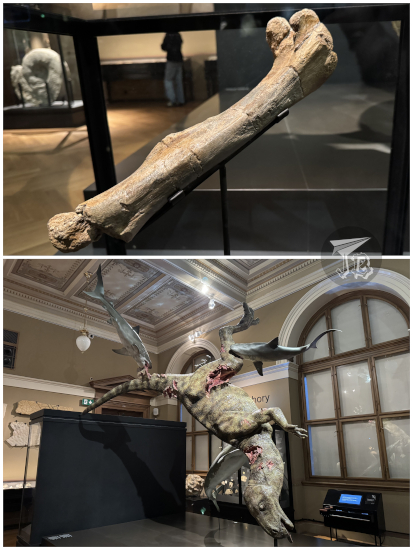
We went back in time towards older epochs. There was a mosasaur hunting an ammonite, along with a number of fossils from both invertebrates and vertebrates. We reached the Age of Dinosaurs. They have literally one bone, a femur, of an ornithopod dinosaur, similar to an iguanodon. From that, they managed to describe a whole species, Burianosaurus augustai (2017), similar to an Iguanodon. Upon studying the specimen, scientists also discovered that there were shark teeth marks on the bone, so someone recreated a whole scene of the poor beast dying and being torn apart by sharks. I’m not even kidding.
Further back in time, and deeper into the museum, we reached the wall of national fossils – trilobites. There were cases about the primitive oceans, with dioramas and replicas. From there, we entered the world of evolution and biodiversity, which again had great models but humble actual exhibits.
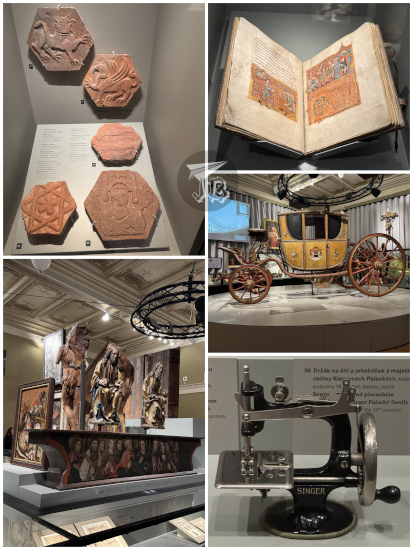
The History Exhibit starts in the 8th century and lasts until World War I. It held a lot of interesting artefacts that reflected how life was at the beginning of the 20th century, including some fascinating objects such as toys. The Prehistory area was a bit more strange, with lots of human remains in reproductions of burials (I really hope they were reproductions and nobody had relocated a whole necropolis…).
We left the museum to head back towards the hotel. There was a small Christmas Market at the end of Wenceslas Square Václavské nám, and we passed by yet another one: the regular market Havelské tržiště had been turned into a festive checkpoint, but most of the stalls had the same stuff at the same prices. It was still packed though. We made a stop at the Choco-Story shop to see if they had started selling the Christmas-tree sweets we had seen made the day before, but no such luck.
We went back the hotel to regroup and find out what time they were picking us up the following day. Later in the evening, we left once more to find Broadway Theatre so we could watch the WOW Show Black Light Theatre Prague. Notice the English name, it was clearly aimed at tourists, but the only one my parents found advertised at the hotel. Doors opened at 19:30, but placement was free, so we wanted to be there around 19:15. As we checked in, we were given some glow sticks. I don’t think my family had ever held glow sticks in their life…
We had to go down a couple of floors worth of stairs to get to the actual theatre and when we got to the stalls, we ended up getting pretty horrible seats for some reason or another. Soon the venue began to fill up. There was a huge group of young tourists who had obviously been raised in a barn. They yelled and burped and, when lights went off, they decided to start throwing the glow sticks. One got me in the back of the head, and damn, those things hurt.
Prague’s black light theatre (černé divadlo) works with black backgrounds, UV lights and fluorescent elements to create visual illusions. Basically, you only see brightly coloured bits, either props, face paint, or clothing. It was… weird. Not what I was expecting at all. The idea was that a guy came back from work, watched some TV, then went to sleep, and we got to see all his dreams, in dance version. At some point, the actors bounced some big balls at the audience for us to play with, and the rude macro-group decided to play dodge-ball with them. Some dancers also played spiders which had to move over the audience. All in all, it was an interesting experience, a bit ruined by the company, but I did not like it much. A bit too surreal for me.
Dinner was again at the shopping centre – not much choice, at the only open sandwich place. One of these days, my family will realise that buying snacks in advance is a good idea. That day was not today.

