15th April 2025: Kinetic art and Egyptian replicas (Guadalajara, Spain)

Rain and school holidays having thwarted my hiking plans yet again, I decided to make the most of half a non rainy morning when I was going to be around Guadalajara to check out a free exhibition and the museum of a local artist.

Francisco Sobrino (1932 – 2014) was a conceptual artist whose sculpture can be framed into the kinetic art and constructivism styles. The museum Museo Francisco Sobrino hosts some of his smaller works, mostly in colourful vinyls and experiments with materials, textures and light. Pretty colours and shapes, but I guess you need more knowledge of art than I have to appreciate the works and see… something different from pretty colours and shapes. But the museum is free and it is hosted in a historical building, the former slaughterhouse, built in traditional brick and stone. Though I’ve been around a few times, I’d never visited it before…

Francisco Sobrino Museum Guadalajara

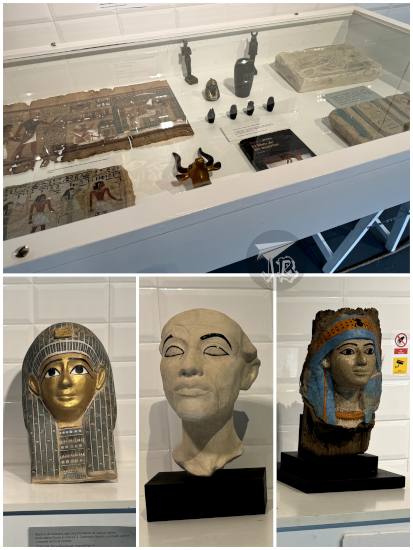
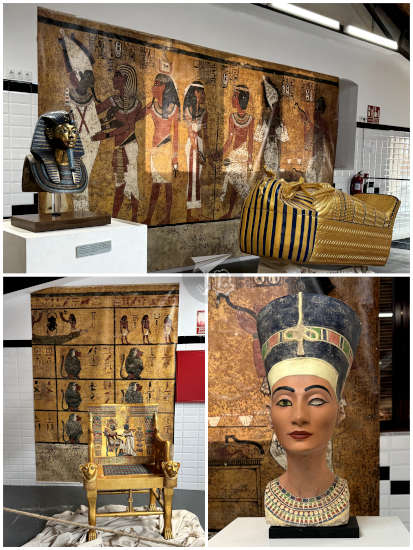
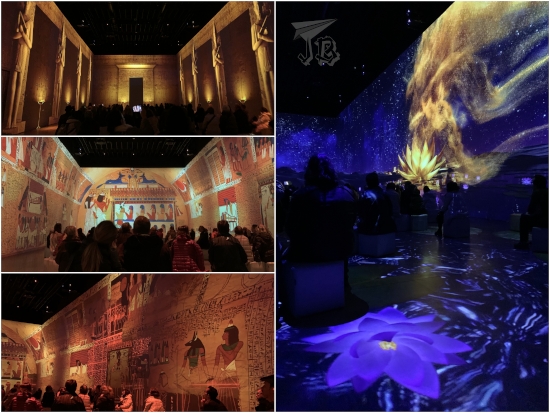
The exhibition on Ancient Egypt and King Tutankhamen’s tomb Tutankamón Secretos Revelados: La Exposición (Tutankhamen Secrets Revealed: The Exhibition) was endearing but lacking. It was located in another historical building, the traditional market Mercado de Abastos. It used to be a very successful local market, but the vendors lost most their clientele when it was closed for a few years to turn the place into a culture and bar hub. It was not successful at all, and now it’s a sad-looking place. The top floor hosted the exhibition, with a few posters with information and pictures, one of them being a very buff Anubis from the video-game franchise Assassin’s Creed. There were a few display cases with reproductions of Egyptian antiquated from private collections and books on Egypt. The largest part of the exhibition was a reproduction of several items found in Tutankhamen’s tomb: the wall paintings, a golden chair and the gold-plated sarcophagus. There were also a reproduction of the funerary mask, a brass tray and anything golden the curators seemed to have at hand, including a scarf. And the bust of Nefertiti for some reason.

Tutankhamun Exhibit Guadalajara

Tutankhamun Exhibit Guadalajara

I’m not going to say I was disappointed or that I expected more, it was a cute little exhibition that tried to do its best. Unfortunately, some of the information was inaccurate or outdated – they were showing a video from the 1980s, and archaeology has evolved a little since then.

However, I am still cackling at the low-resolution buff Anubis…

11th April 2025: Extant, extinct and extrastormy (Madrid, Spain)

Since March was extremely rainy, I hoped that April would not be so. No such luck. However, there was a dinosaur exhibit in Madrid that I was keen on seeing, and I wanted to do it before Easter, because it would be packed during the holidays and I could not get there in May due to personal stuff. And since getting to the Casa de Campo area takes so long by train, I looked at combining it with something else around (it’s a four-hour roundtrip from where I am). What other thing was close? Somewhere else I never go because it’s far away by public transport and a nightmare to park around – the local zoo Zoo Aquarium de Madrid. There was after all only a 10% chance of rain…

Spoiler alert: while I was getting drenched (I’m being dramatic, of course. I had an umbrella) in the zoo, and later in the exhibit, the weather app said “partly cloudy” and there was no mention of storms nor rain. But the skies opened. Ask the peafowl…

I took the train and changed to the underground until I got to the Casa de Campo stop. There were not many people around since it was a weekday. There’s a bus that takes you to the zoo, but I found it more efficient to walk, since there is a pedestrian way alongside the road. I reached the zoo a bit after it opened at 11:00, and just as my ticket was getting scanned the first few raindrops fell. At first, it seemed like a small drizzle, but soon it started to rain in earnest. By that time, I had managed to get to the pandas, about 40 metres into the zoo.

I’d been to the Zoo Aquarium de Madrid twice in my life before. The first one I was very small. I have no memory of it, but there is a home video of three-year-old me chasing a peacock and a voice warning “come back, it’s going to bite you!”. The second time I was in third grade, and had my first camera. I remember that I was devastated because the pandas were very far away and I could only take a picture of a distant, tiny, black-and-white blur. That was decades ago, and I had never been back, though I had a recurring dream for years that involved one of the pools there.

The zoo opened in 1972 as an alternative to the “Beast House” or Casa de Fieras that used to be hosted in the Retiro Park, a few sad and crammed-looking cages that must have been horrible for the animals. As every animal park, Zoo Aquarium de Madrid is not free of controversy, especially related to the ethics of keeping great apes and cetaceans in captivity. They used to have dolphins, but those were surrendered and sent away earlier in 2025. Conversely, the zoo participates in over 60 conservation and breeding programs for endangered animals – they have breeding couples of owls, whose chicks are routinely released into the wild, and have succeeded in breeding pandas (they claim to be the most successful institution at breeding panda outside China) and white rhinos. They have non-breeding animals as ambassadors, such as a family of Iberian lynx.

The zoo is vaguely organised per continent – Europe, Australia, Asia, Africa and the Americas, and the home of actual wild animals such as storks and rabbits.

As I went into the zoo, the first thing I spotted was a small lake with flamingoes, pelicans and (squatting) storks. The storks are free to come and go, but they like to be in the zoo because they get free food, I guess. My idea had been to walk a spiral and try to see everything, but I got distracted by “Panda Land”, signalled by a big red gate – after all, they are the main attraction. I thought the pandas might be visible, and they were – much closer than I remembered indeed. I did get to see both the male and the female, who live apart within the same installation. I had time to take a few pictures before it started to rain in earnest. And no, they were not distant, tiny black-and-white blobs this time, and not only because I had borrowed a really good lens for the day. I had to put the camera away when the rain became too heavy.

Zoo Madrid - stork, flamingoes, panda

It rained for a couple of hours, and that impacted me a little. I ended up sharing shelter with a band of peafowl, and had to go from covered exhibit to covered exhibit at first. I found the orang-utan territory very sad, and I did not catch a glimpse of any gorilla. In the aquarium, I got stuck with all the school visits, but there were quite a few sharks and big fish in the ocean tank.

Zoo Madrid: peacocks and peahens sheltering from the rain

Zoo Madrid: Sea lion, small blue jellyfish, sharks

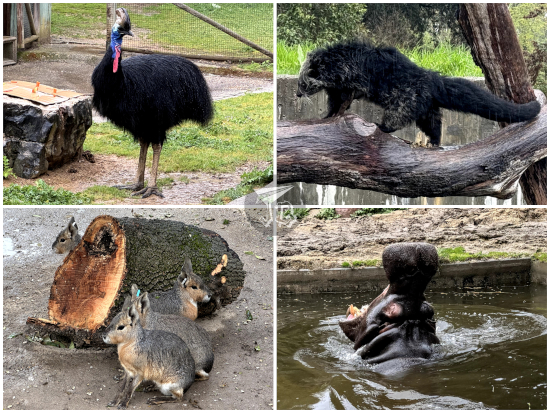
I ambled around the Australian area, where most of the animals were unfazed – especially the cassowary, which by the way is apparently the most dangerous bird in existence, even if I’m way more crept out (and fascinated) by emus. I did not see the koalas, and I walked past a tree which seemed fenced off just because. As rain cleared out, some of the animals started playing around, such as the binturong (Arctictis binturong), a distant relative of civets. At around 13:20, I had reached Africa, and I was in front of the hippos when it stopped raining. Awesome!

Zoo Madrid: Cassowari, binturong, Patagonian mara, and hippo yawning

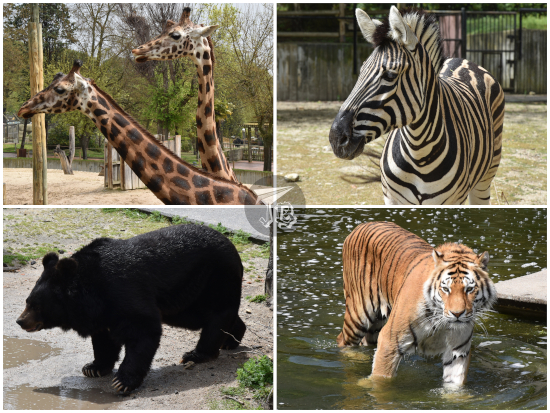
Since I had borrowed a camera lens which is better – but heavier – than mine, I really wanted to try it out. Carrying it around without being able to use the camera due to the rain, at all, would have been a bummer. After the rain stopped, I was able to take quite a few good pictures though. Those included the Siberian tiger (Panthera tigris tigris), and its relative the domestic cat (Felis catus), whom I’m not sure is a resident or a squatter in the “farm” section of the zoo alongside the sheep, goats, and a very large pig.

Zoo Madrid: Jiraffes, zebra, black bear and Siberian tiger

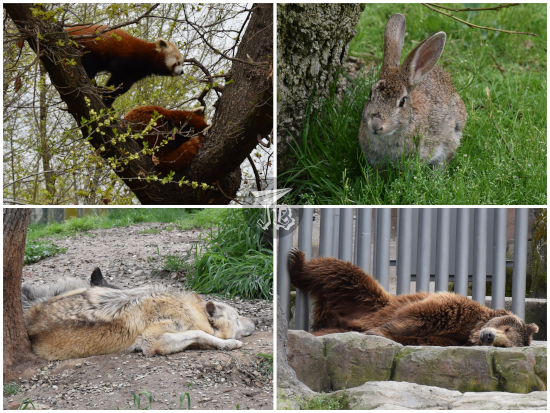
Since I’d been to Emociones al Vuelo a few days earlier, I did not mind the lack of Raptor Flight exhibit due to rain. I did miss the Exotic Birds one, but I caught the Sea Lion exercise (hello, swimming pool from years of recurring dreams). Around 14:30, it had stopped raining, the animals had eaten, and I caught many of them. Unfortunately, most – especially the carnivores – were napping. I did however saw a very active red panda (Ailurus fulgens) around the tree that I previously thought was fenced off for no reason.

Zoo Madrid: Red panda, common rabbit, grey wolves, brown bear

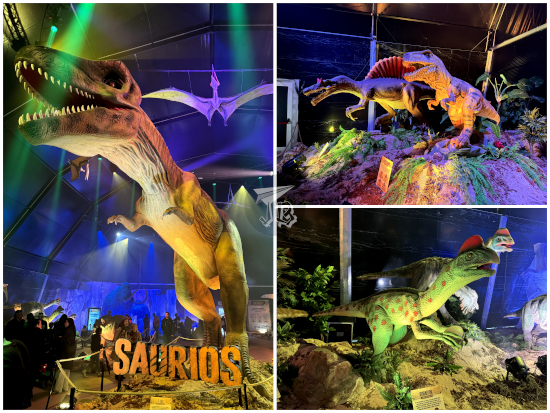
By the time I left, the workers had also dropped off a few Easter Eggs throughout the zoo as the holidays were about to start. At 17:00 I had to be at Escenario Puerta de Ángel to see Saurios, a dinosaur exhibit, which turned out to be a bit of a disappointment. Most of the animatronics I had already seen as “Dino Expo XXL” – I recognised it because of the broken neck on one of the brachiosaurus. The exhibit had a first part with a few skeleton replicas – the coolest thing, as I had never managed to see a complete cast of a Spinosaurus before. Then there was an open area with some life-sized replicas and photo-ops, but it was completely made for kids. There were actors and activities for them, which I guess were extremely fun if you’re younger than five. Yet another “dinosaurs are for kids” activity.
Saurios Madrid - skeleton replicas

Saurios Madrid - models

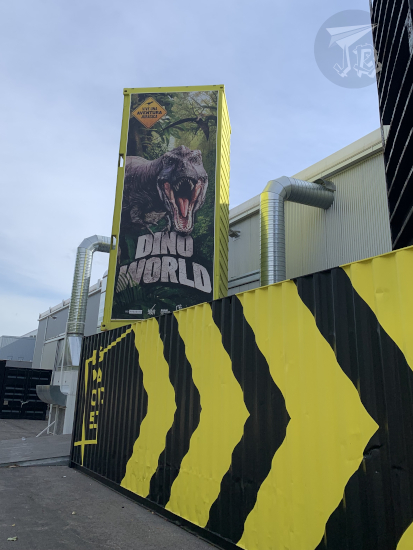
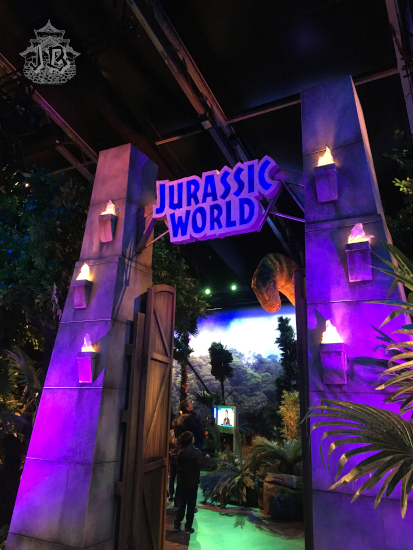
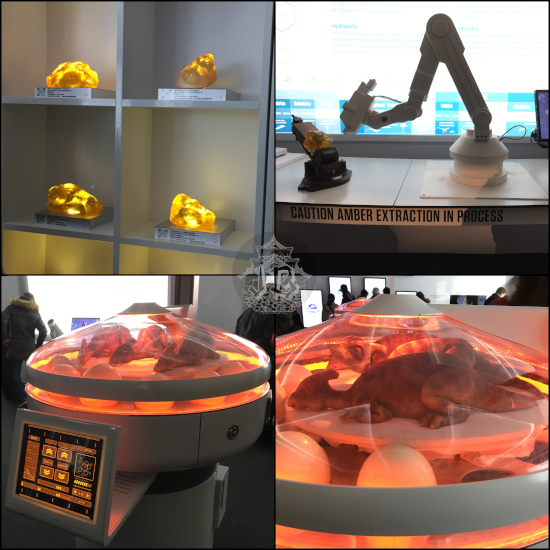
And then it started storming again. A black cloud, a clap of thunder, and the skies opened. Thus, we all had to hurry to the last section, which was most of what I’d seen in “Dino Expo XXL”. I was really not impressed by the whole thing – remember folks, “for all the family” means “designed for kids”. I guess I would be more gracious had the weather been nice, but… having seen most of the exhibit before for half the price, I was not impressed. Fortunately or unfortunately, there is a Jurassic World Exhibition coming up soon…

Saurios Madrid - models

28th November 2024: Parallel Universes (Madrid, Spain)

Whenever a Marvel film comes out, my parent always comments on how they used to read the comics when they were young – probably they belonged to the first generation of comic readers in this country (and I have to confess over the years I salvaged quite a few “relics” from the attic at the old house). Thus, when the exhibition Marvel: Universe of Superheroes opened, I thought I would bring them along. I booked us tickets on the 28th of November at 10:00 for the event, which was happening in the convention centre IFEMA in Madrid.

By pure chance, my parents received an invitation to Feriarte, a collectionism fair – that is what we thought at that moment. They were not particularly into it, so I asked if I could have the invitation. When I checked it out, I realised that we could visit Feriarte on the same day as Marvel: Universe of Superheroes, since the dates overlapped, and it was also at IFEMA, just a couple of pavilions down. My parent agreed after some coaxing. Finally, I offered to take them to a “fun place” for lunch, and we had a plan.

Marvel has traditionally been one of the most important comic publishing houses in the US. Its key writer / creator was Stan Lee, who came up with some of the most iconic characters in the medium – Spiderman, Thor, Iron Man… It is true that the first superheroes to succeed on the big screen belonged to Marvel’s competition, DC – Christopher Reeve’s Superman in the 1970s and Michael Keaton’s Batman the following decade. However, Marvel kicked off a golden age of cinema superheroes. While DC festered in the darkest, more depressed Batman, Marvel released Iron Man, which took superhero films in a new direction – they turned from fun-for-fans to funny-for-all (of course, purists would never be satisfied, but what are you going to do?). Robert Downing Jr. had a lot to do with this boom, dominating the scene whether the film carried the name of his character – Iron Man – or not. For about a decade, Marvel dominated the blockbuster season, with explosions, one-liners and good-triumphs-over-evil plots. Eventually the bubble burst, as they always do, and things went downhill. However, companies are still willing to milk out any cash cow, and as long as Marvel makes money, it will be producing stuff.

Less known than the film boom is the fact that with the launching of Marvel Studios, the parent company also became a transmedia master. The idea of transmedia is not new, and refers to tying stories in different publishing methods (Hasbro was doing this with GI Joe back in the 80s already). However, Marvel has it down to an art. Samuel L. Jackson was cast as Nick Fury because a comic artist based the revamped character on him, so now Nick Fury statuettes look like Samuel L. Jackson. Since Disney acquired Marvel Studios, the so-called MCU (Marvel Cinematic Universe) is so interwoven with the Disney+ shows that neither can be followed on its own. Funnily enough, this has not washed over to the comics that much, save for the special Alligator Loki that I kept looking for in London earlier in 2024.

Well, one of the many facets of Marvel’s outreach octopus is organising exhibitions. I suspect that they are all the same under different names though. The one which took place in the IFEMA convention centre in Madrid was Marvel: Universe of Superheroes. The exhibition runs through the history of Marvel from its beginning, hailing the works of Stan Lee and running through the influence of the Comics Code Authority (CCA), which censored the content of the media – and made the evolution of American and European comics diverge forever. The pages from that time are mostly lost, so elements like the first issue of a Marvel comic ever, or original Spiderman and Fantastic Four dating back from the 60s are kind of amazing – and belong to private collectors who have lent (or rented out, one guesses) them to the organisers. Most of the exhibition, however, focuses on the MCU, with quite a few costumes and items from the films and Disney+ series. There were life-sized statues, too – or at least to scale for characters like The Thing or Hulk. There was an interactive game where an on-screen you would wear Iron Man’s suit and practice-shoot with it.

We hilariously ran into a preschool day trip, with the teacher completely made things up as she went and kept trying to keep a bunch of rowdy kids in line – without much success.

The first area ran through the history of American comics and Marvel itself, purely as a comic publisher. Then, it moved into the film area, starting with Black Panther, revindicating his status as the first black superhero. Then there was a room on Spiderman, one of the most beloved characters, even if he was almost not made because editors thought a spider-related superhero would not sell. This was probably the last room focusing heavily on comics. Hulk got a small room to share with She-Hulk. Afterwards, the MCU took over, with film memorabilia of Iron Man, Thor and Captain America. The following area was a bit of a mix, with Wandavision, X-Men, Daredevil, Luke Cage, Moon Knight, Ghost Rider… which ended in a very psychedelic room for Doctor Strange. The final room was “Marvel in Space”, with The Marvels (Captain Marvel, Monica Rambeau and Ms. Marvel) and Guardians of the Galaxy. Considering the huge hit that Agatha All Along was, I was surprised not to find any references to it, but then I realised that the exhibition predates the series.

Marvel Universe of Superheroes

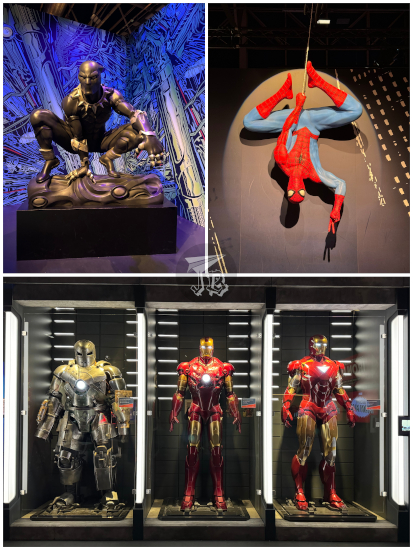
Marvel Universe of Superheroes: Black Panther, Spiderman, Iron Man

Marvel Universe of Superheroes: Doctor Strange, Mighty Thor, Groot

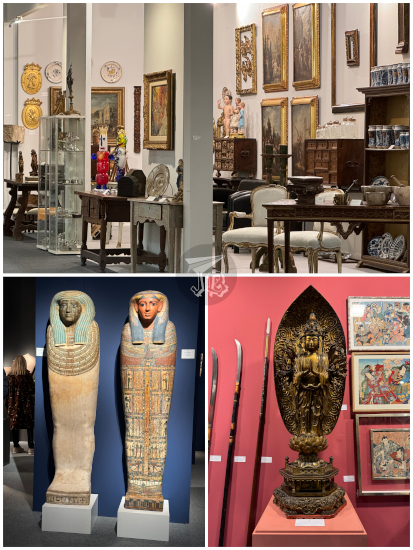
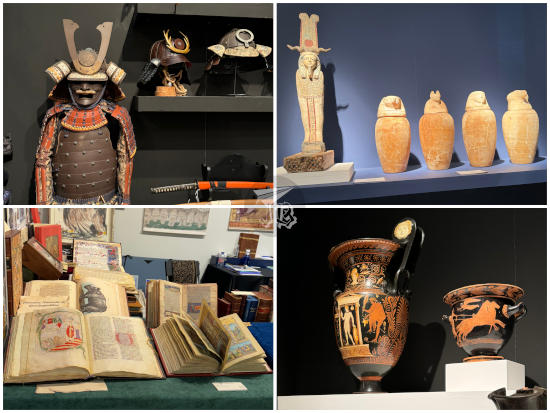
I would have wanted a memento, but none of the items in the shop appealed to me. Besides, everything was too expensive, I thought. I had no idea. We left the exhibit and marched into the inner pavilion where Feriarte took place. Feriarte is way more than the collectionism event I had originally thought – it is an antiques and art fair, with items that range from archaeological artefacts to the most modern pieces. Our minds were blown. There were 64 art galleries and archaeology specialists from all over the world carrying prehistoric items, Egyptian mortuary artefacts (including a whole sarcophagus), Grecian sculptures and vases, Japanese samurai armours and weapons, paintings, contemporary art (Miró, Dalí, Chillida, Sorolla…), furniture, jewellery and watches, reproductions of Medieval manuscripts… And I thought that the Marvel shop was expensive! I could have afforded… a tiny Egyptian scarab smaller than the nail on my little finger. I was shocked when I saw the first three paintings by Miró (a surrealist painter from the beginning of the 20th century), but it turns out they sell like doughnuts among the collectors…

There was a “collectionism for beginners” area, with tips to “start collecting with pieces under 5,000 €”. When thinking about private collections, I’ve often gone with Indiana Jones’ line “it belongs in a museum”, but lately, with the attacks on art by climate activists, and the fact that most of Marvel’s memorabilia was recovered from private collectors… I’m not so sure. I might have started changing my mind. Then again, not really, because when the original fossil of Tyrannosaurus rex Stan was auctioned and I was sad it would end up in private hands and I would never seen it – good news, it was sold to a museum, though I’m not sure I’ll ever make it to the soon-to-open Natural History Museum Abu Dhabi. Needless to say, we left Feriarte empty-handed, and very amused that you go through security and X-ray when you go out, not when you go in. A couple of days after, I read that an organised gang had stolen jewels and watches worth 390,000 €…

Feriarte 2024

Feriarte 2024

We retrieved the car, and got lost trying to get to the shopping centre La Vaguada to have lunch at Runni In Market, the first of the Running Sushi franchise I visited (and got lost trying to get there too, so… maybe it’s just difficult). My parent loved the concept. However, I was peeved that the table before us kept getting all the lychee and mochi when the time came for dessert. Mean!

Runni Sushi In Market

We left afterwards to head home, having caught a glimpse of the secret life of superheroes and what kind of décor rich people have in their houses. Parallel universes indeed…

8th September 2024: Dinosaur FOMO (Guadalajara, Spain)

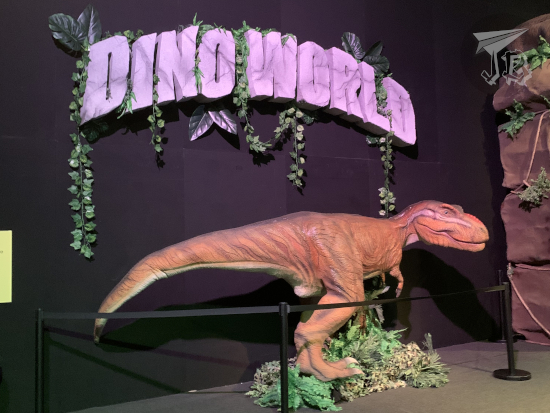
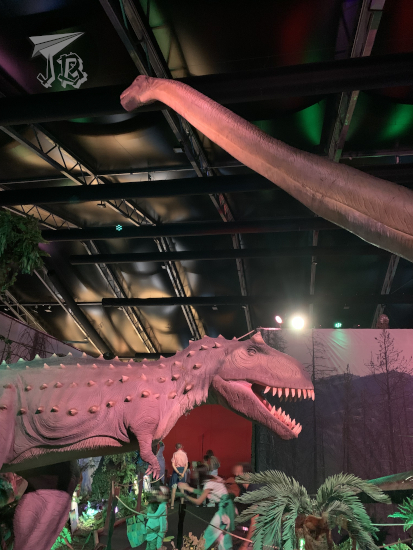
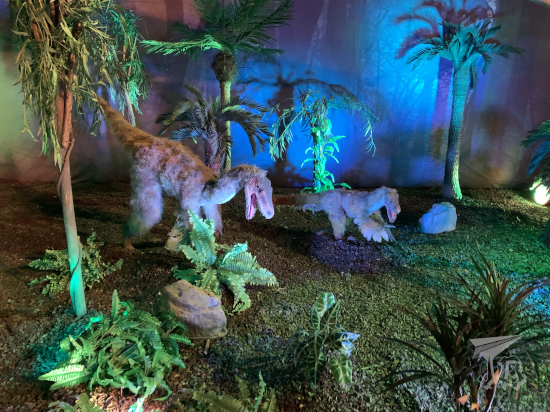
Whenever I’m reasonably close to dinosaur stuff, I have to check it out, I just can’t help myself. About a year ago, I attended DinoExpo XXL in Guadalajara, which turned out to be rather disappointing. Apparently, the town hosts dinosaur exhibits in time with the yearly festivals – they must be profitable. I read about Dinosaurs Tour (or Jurassic Expo, according to the banners), and I thought I would skip it, but in the end… in the end I just had to go and see it, because the Fear of Missing Out was strong. Maybe this time over it would be cool…

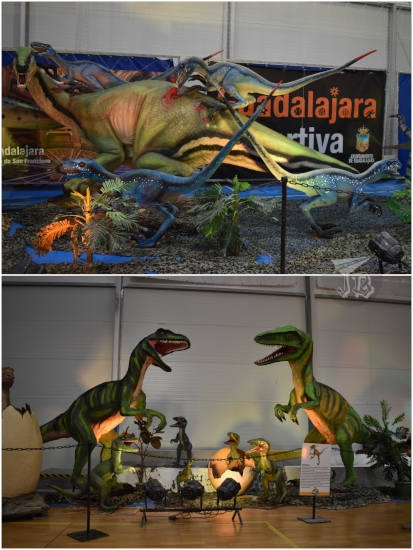
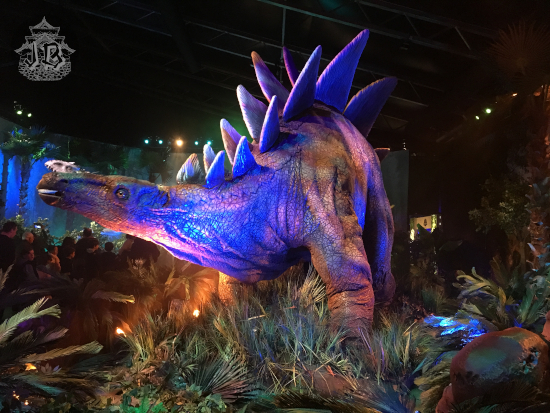
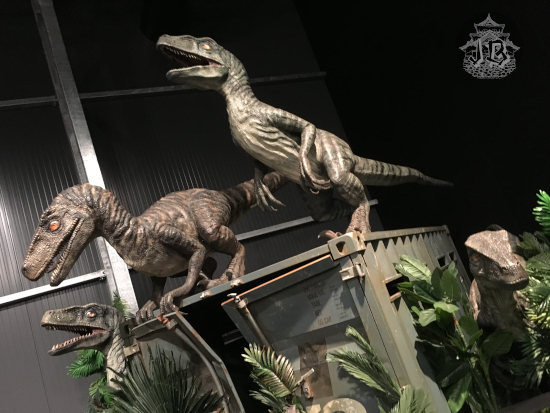
The exhibit was small, and while some of the models were correctly covered with feathers, a few were mislabelled to conform to the popular imaginary (way more of a cash cow than anything scientific). The usual suspects were Tyrannosaurus Rex, brachiosaurus, pachycephalosaurus, iguanodon, parasaurolophus… For some reason, there was a stegosaurus half climbing a tree, and a few Jurassic Park inspired reproductions: questionably-represented dilophosaurus and too-big velociraptors. Something new was a sarcosuchus, a giant crocodile ancestor. Oh, and something I was completely unable to identify… like a diplodocus with a beak and spikes… Maybe it tried to be a homage to Littlefoot?

Dinosaur Tour Guadalajara

The lights made everything look weird, too, because there was a lot of colourful – pink, blue, green – lighting which made it for a very disco-like atmosphere. It was not a big or good exhibit – not even the toddlers were extremely impressed, but as I said: Fear Of Missing Out gets the best out of me when it’s about dinosaurs. Next time though, I’ll try to get over the FOMO, because I think they’ll just bring a wall lizard and call it a Velociraptor.

28th May 2024: Architecture and a niche restaurant (Madrid, Spain)

I was talking to an acquaintance whose child likes superheroes – so does the acquaintance, actually – about Comic Planet. After exchanging experiences, they mentioned that their spouse also enjoyed another thematic restaurant, and I decided that it could be a fun thing to do – and since they don’t take reservations for one, I roped my sibling into tagging along. And of course, since we were braving the horribly-working trains, I felt we should fill the day out. We could not leave early in the morning as I would have liked because I had this stupid bureaucracy appointment I had to get out of the way first.

We arrived in Madrid around 12:30, and our first stop was the Casa de Correos, an iconic building in the middle of the square Puerta del Sol. I did not even know you could just visit that building, nor that they ran exhibitions. It was a cool opportunity to check it out. Furthermore, the exhibition was actually something that I was quite keen on – the architect Antonio Palacios, commemorating the 150th anniversary of his birth. The exhibition, called “the Metro architect” Antonio Palacios, el arquitecto de Metro, is part of the network of museums managed by the underground company Metro. It consists mostly of photographs, a few of them by photographer Luis Lladó, an original model of Palacio’s project to renovate Puerta del Sol, and a modern model of a now-lost station, including lifts. It was a bit underwhelming, but still worth it – and free, so it was good either way.

Exhibition Antonio Palacios El Arquitecto de Metro

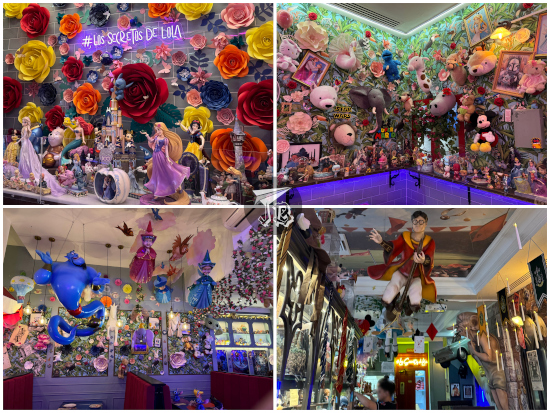
Afterwards, we headed out to the restaurant for our 13:30 reservation. The place is called Los Secretos de Lola (Lola’s Secrets ). It used to be just another bistro-grill in a street full of them, but some time after the pandemic, it reinvented itself. The restaurant has slowly turned into a Mecca of childhood mementos – Disney princesses, teddy bears, Harry Potter, Funko Pops… and crazy fun references like a Möet&Chandon spray to clean the tables. A lot of the food comes in a special piece of dishware – most of it Disney, but I can’t tell whether it’s actually licenced or a bunch of knock-offs. It was hilarious anyway. Though I am not much of a Disney person (my sibling is), my favourite film of theirs would be Mulan, and I just about lost it laughing when I checked the menu beforehand – I saw that they served gyoza in a Mushu-like dish, and decided we needed to order that. I was open to negotiation about anything else, really, but not the gyoza. The pasta in the Lady and the Tramp dish was also hysterical, but I could do without.

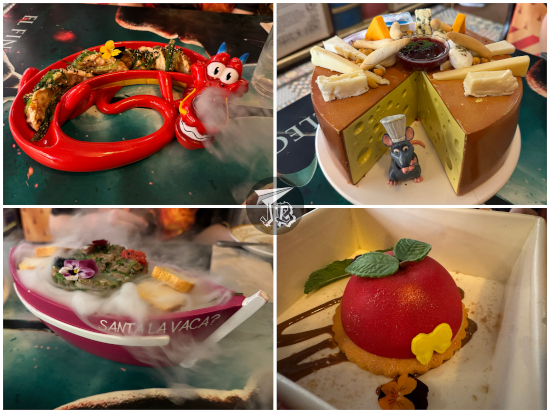
We reached the restaurant on point, and the owner directed us inside. We got a really cute Stitch table, but my sibling was not comfortable on high chairs, so we were accommodated at a Harry Potter one. We shared the non-negotiable teriyaki prawn-and-vegetable gyoza with wakame and bean sprouts, served on a Mushu-plate: Gyozas de gambas y vegetables al teriyaki, a plate of cheese Tabla de quesos variados (Blue cheese, Havarti, Mimolette, Emmental, Basilio, butter and breadsticks, on a Ratatouille’s Remy plate, which I had also found adorable) and a bluefin tuna tartar Tartar De Atún Rojo (on a little boat – I asked for no mango, and it was honoured; this was probably the weakest dish though). Finally, I tricked my sibling into a dessert called “Snowhite magic apple” Manzana Encantada Blanca Nieves: red chocolate capsule with white Kinder and a heart of caramel sauce, which came in an adorable “present box”.

Decoration: Los Secretos de Lola

Food Los Secretos de Lola

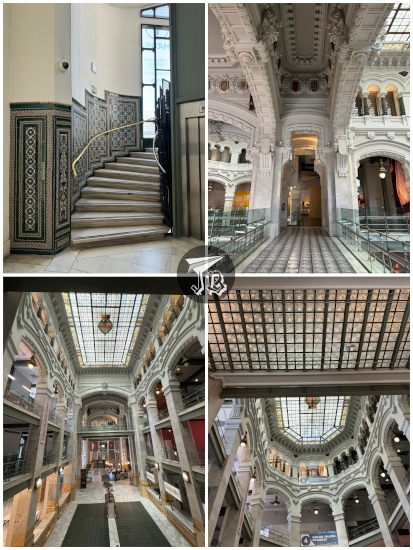
The food was good, and I really like themed restaurants, I guess, even if they are not “my” theme. We did not stay for the two hours, I think we were on our way after an hour and a half – and when we asked for the check, it came in a Frozen music box. Then, we left towards Palacio de Cibeles, the old “communication palace” of Madrid, designed by Antonio Palacios and Joaquín Otamendi, and erected between 1907 and 1919. It is considered one of the first and most important Modernist buildings in Spain, constructed in biocalcarenite, with three stained-glass skylights, catwalks on the third floor, and a magnificent lookout on the rooftop. Part of the building is being used by the town hall, the other by the public entity CentroCentro, which runs cultural activities in the open spaces – mostly conferences and exhibitions.

Palacio de Cibeles

We arrived a bit before 16:00. Since we had a ticket for one of the exhibitions at 17:30, we checked whether we could find a ticket for the rooftop. We found available slots at 16:30, which was great. Before the viewpoint access, we had time to wander around. Most of the free exhibitions were of modern art, and not that interesting, and I was more focused on the building itself. There is one dedicated to the World Heritage site Paisaje de la Luz, explaining why the area deserves its UNESCO place.

We found the staircase to one of the towers and we used it to move it through the different floors. It is a spiral staircase around the lift, with Palacios’ typical green tiles similar to the ones he used at Maudes hospital and Chamberí station. The catwalks were paved with glass tiles, and it was quite impressive above all. I loved the building, but after all, Palacios is one of my favourite architects, so it was to be expected.

Inside Palacio de Cibeles

Then, we went up to the rooftop, where we could have a view of all of Madrid around us, most interestingly one of the main arteries of the city – Gran Vía. The weather was great, maybe a bit too bright. The turns were 30 minutes, but we were done in about half the time, after taking two walks around the middle tower.

Lookout on the rooftop of Palacio Cibeles

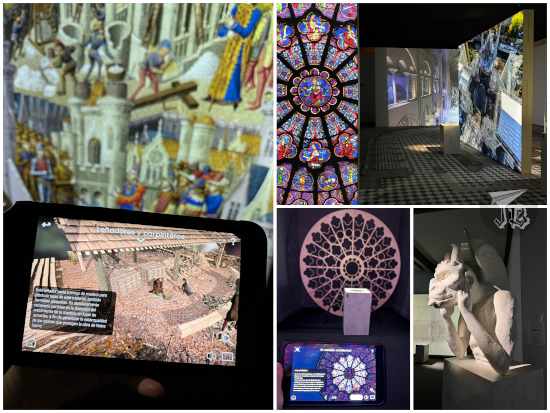
We went down and sat for a little before we headed down to the basement to see “Notre-Dame of Paris: The Augmented Exhibition” Notre-Dame de Paris: l’Exposition Augmentée. It was only 3€, so I was not expecting much, but it actually blew my mind.

The experience was created by the company Histovery, which specialises in “virtual exhibitions” through an interactive tablet called “HistoPad”. The Public Entity in Charge of the Conservation and Restoration of Notre-Dame de Paris cooperates with the event, and the beauty company l’Oreal is a sponsor. The exhibition (which is simultaneously running in several parts of the world) follows the history of the Parisian cathedral Notre-Dame de Paris – it starts with the 2019 fire, which is a bit heart-wrenching, and then it covers a few key moments in the history of the cathedral, using a mixture of written information, videographs and a “treasure hunt” where you have to find pieces of a puzzle hidden within the virtual information. This is done using the tablet to scan 21 “time portals” that take you to a particular point in history.

Around 1160. The Dream of a Builder. At that time, Bishop Maurice de Sully came up with the idea to build a new, better, cathedral in Paris. The previous one was a smaller, Romanesque building, but the goal was a larger, architecturally impressive building. In this room (the second, actually, but the first chronologically), you find out about the “treasure hunt” – you need to find a number of hidden “light spots” to build a “stained glass window”.

Around 1180. The Gothic choir. This makes a small overview of the kinds of workers that helped in the construction, the kinds of stones, building materials – quarries, forests. I was extremely disappointed at this point when I came across a dog in the virtual quarry, but the program did not let you pet it.

1241. The Holy Relics: Louis IX, the future Saint Louis, bought the Crown of Thrones in Jerusalem and brought it to Paris. There was a great procession into Notre-Dame, where the relics were to be kept. Here there’s a spectacular recreation of the gates with the original polychrome sculptures and decoration.

1645. The Royal Promise: Widowed Queen of France explained to her son, future Louis XIV, that he was to renovate the choir of the cathedral and build a new altar, dedicated to the virgin Mary. This was the original splendour of Notre-Dame, before the French revolution broke out – the church was one of the targets of the revolutionaries, and a lot of the art was damaged and / or destroyed.

1804. The Imperial Coronation. After the French Revolution, Napoleon crowned himself “Emperor”, but a very “equal and revolutionary” Emperor. He held a ceremony for himself in Notre-Dame, with the presence of the Pope and everyone who was anyone in the totally equal new society.

1857. The Spire. Enter Viollet-Le-Duc, a major architect and restorer in France’s 19th century, whose theories influenced countless others. He revalorised gothic style in the country, managing to turn it into a “national style”. The man had the goal to restore and create buildings in “the gothic style that would have been if the Medieval workers had had the technology he had access to”. Historians have not been kind to him, accusing him of “inventing” stuff instead of “restoring” but kudos to him, he managed to make a lot of buildings survive to our time. In Notre-Dame, he is responsible for putting back a lot of the sculptures that were destroyed during the French Revolution. He also built the spire that famously collapsed in the 2019 fire.

2019-2021 (first and last rooms). A description of the restoration works that have been happening in and outside the cathedral since the fire, with special attention to the Paris firefighters who worked the incident. There is a very interesting part about safely removing debris and the original scaffolding, and the fact that there was a lot of lead in the cathedral that the workers had to be safe around. They also homage the “vertical workers” who had to remove collapsed pieces from the ground… hanging from ropes.

Notre-Dame the Augmented Exhibition

We completed the stained-glass window and signed up to get a diploma. The fun part is that most of the exhibition was not really… even physical. There were a few posters, a reproduction of one of the chimaeras, some small models… Nevertheless, it was extremely interesting – possibly the best “virtual exhibition” I’ve seen to date. The length of the experience is said to be 60-90 minutes… we stayed from 17:30 to 19:45, much longer than I had anticipated! Thus, we had to forfeit the last plan of the day to go back to the train system – which of course was experimenting delays. It took forever to get home. Because what else is new?

Time-traveller diploma after completing the treasure hunt in Notre-Dame the Augmented Exhibition

20th March 2024: Mundo Pixar (Madrid, Spain)

Due to some kind of weird… extended family thing, we ended up with some vouchers for Pixar World Spain Mundo Pixar, happening in IFEMA in Madrid. It would have been a pity to waste all of the tickets, so there we went, on a Wednesday morning, to at least redeem a couple of them. This immersive exhibit comprises several rooms with life-sized scenarios and characters based on Pixar films.

Mundo Pixar Madrid - outside

Pixar is an American animation studio which started off as part of the Lucasfilm computer division back in 1979. For over a decade, the group collaborated with graphic design and CGIas a third-party, until it was properly founded as an independent company in 1986. Pixar collaborated with Disney creating computer animations, and kept developing the technology, until it was finally able to pitch its first feature film to Disney – Toy Story, which was also the first-ever completely computer-animated film. Released for the 1995 Christmas season, it was a world-wide hit. Pixar became part of Disney in 2006.

The studio’s films have received 23 Academy Awards, eleven times for Best Animated Feature (a category added in 2001). One of the characteristics of Pixar films is their layering – though they are marketed as children’s entertainment, they tend to have a deeper, more adult-oriented subtext that… kids don’t even grasp. Something weird is that despite its successes, Pixar always seems on the brink of bankruptcy…

We had tickets for 11:00, and thought we had plenty of time until we got caught in a huge traffic jam due to a fair in another part of IFEMA. We had over 45 minutes of leeway, and ended up taking half an hour just to be able to get into the parking lot from the roundabout 650 metres away. That was wild.

We finally got into the queue around 10:50, and it took a while to get in. Mundo Pixar is organised in a U-shaped circuit, so that you can get round to the shop before or after seeing the exhibit. For a weekday, it was packed – not only by families, a bunch of random friend groups and tourists, too. Interesting.

We accessed through a tunnel to the first space, which is a bit of a self-promotion video mixed with the rules of the game – mostly, the one that people seemed unable to follow: do not touch. The immersive experience takes you to recreated scenarios from several films by the studio, to the slightest detail. The rooms are supposed to have different smells, but we only perceived a few. And of course, people kept touching.

Rooms 1 & 2: Up. This films tells the story of an old widower who goes on a last “adventure” to Paradise Falls, where his late wife would have loved to live. To do this he… floats his house away with thousands of balloons. He meets kid Russel and dog Dug. The rooms include a view of the whole house, and one of the interior. The living room is a perfect reconstruction of the one in the film, down to the pictures and the armchairs where Ellie and Carl sit, and the device Carl builds to steer the house while it flies.

Room 3: Monsters Inc.. This is a take on a widespread childhood obsession, the monster in the closet. In another dimension, energy is powered by the screams of frightened children from our world – thus, monsters sneak into kids’ rooms using magic doors to their wardrobes. Sully and Mike are the top-scary team until they run into a toddler who turns their lives upside down. The room has different bits from the film, including the scream factory doors and the two main characters waving awkwardly, recreating a scene where Mike and Sully are made to pose for a picture – I kinda expected them to move.

Pixar World Spain: Entrance, Up, Monster Inc.

Room 4: Toy Story. A bunch of toys which / who become sentient when they are not being played with get a new companion, who does not know he’s actually a toy. Enter a house-move, a bully neighbour, and a nasty dog. Chaos (and a trio of sequels) ensues. The fun part of this room is that it’s built so you see the room from one of the toys’ perspective, everything is high up, and the toys themselves are scaled.

Room 5: Elemental. This is a coming-of-age romantic comedy which focuses on overcoming differences. You walk into a train car with the two characters – a water element and a fire element, awkwardly sitting next to each other.

Room 6: Inside Out. In this coming-of-age comedy-drama, every person (and cat) has five basic feelings: Joy, Sadness, Anger, Disgust and Fear. They control a person’s life using a big console, and they collect “core memories” to help with their job. A young girl’s Joy and Sadness must learn to work together to overcome moving to another city. The room shows a perfect life-size reproduction of Sadness and Joy at the console and all the core memories.

Room 7: Ratatouille. This films follows the adventures and misadventures of the rat Remy, struggling to become a chef – to do this he hides in the hat of a young man and “guides” his cooking. The title is a pun between the word rat and a French recipe. The room is a huge kitchen, and you see Remy cooking inside a huge chef hat.

Pixar World Spain: Toy Story, Elemental, Inside Out, Ratatouille

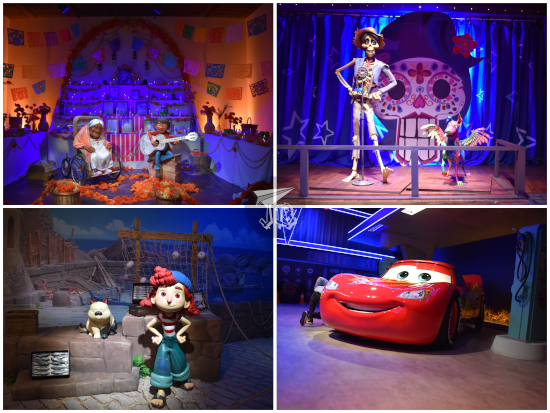
Room 8 & 9: Coco. Set around Mexico’s Day of the Dead (Día de los Muertos), this film sees a young boy, Miguel, explore his family roots and his love of music. The first room shows Miguel and his grandmother, and the second area holds skeleton Héctor, a dead musician who accompanies Miguel in his adventures.

Room 10: Luca. This film tells the story of two sea-monster children (Luca and Alberto) and a human child (Giulia), and deals with friendship and acceptance in the Italian Riviera in 1959. The room hosts the size-appropriate children, with Giulia – and her cat – getting the most prominent set.

Room 11: Cars. The film is set in a world populated only by anthropomorphic vehicles. Arrogant young racing car Lightning McQueen learns about humility, sportsmanship and friendship. There was a nice staff member taking pictures of visitors in this room, with the film’s main character.

Pixar World Spain: Coco, Luca and Cars

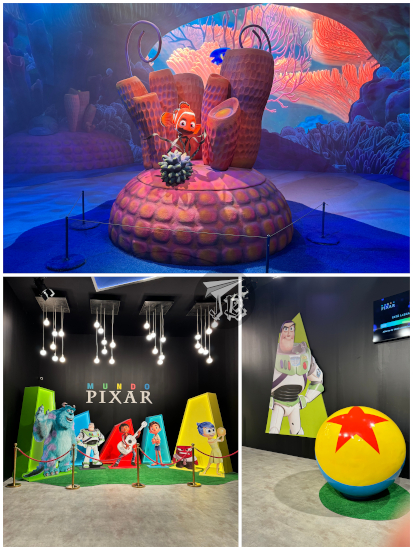
Room 12: Finding Nemo. Nemo is a little clownfish, the only survivor from a barracuda attack in which his overprotective father, Marlin, lost his wife and all their other fertilised eggs. When Nemo gets “fished”, Marlin embarks on a crazy journey to find him, meeting amnesic surgeon fish Dory, wannabe-vegetarian shark Bruce, and surfer turtle Crush. To be honest, finding Nemo in this room was easy. He was in the middle of it, surrounded by marine mist, with jellyfish and the rest of the characters on a screen behind him. I was severely disappointed there was no Bruce whatsoever in the room.

This was the last room; afterwards there was the shop, and a small photocall with a giant Luxo (a yellow bouncing ball with a blue band and a red star), back at the beginning. I am not sure this area actually counted as a room, because we were told there were thirteen rooms? No clue.

Pixar World Spain: Finding Nemo, photocall, Pixar ball

Fortunately, when we left, the traffic jam had dissipated. Unfortunately, I had to go work in the evening, which did not feel great. I obviously enjoyed the rooms dedicated of films I had watched (and liked) more than the others – I personally find the first ten minutes of Up heart-wrenching, but Finding Nemo was my favourite (both as a film and a room). I still uphold my protests about shark discrimination though!

9th September 2023: DinoExpo XXL (Guadalajara, Spain)

When I heard that this was going to happen nearby, in Guadalajara, I was mildly excited. I mean, I did not expect a Jurassic World Exhibition level event, more similar to Dino World Expo. Not even.

In any case, I decided to attend DinoExpo XXL to have a look. There, I had the pleasure to see a bunch of dinosaur models cramped in an obviously-too-small area, a few fake skeletons and bones, and some “Ice Age” representation. Some of the dinosaurs swayed their tails and necks, and there were roaring sounds. It is obvious that someone agreed to place the exhibit there without thinking it through. The models were extremely close to each other, to the point that a lot of their tails were basically in another one’s snout.

The kids were thrilled though, except the ones who wanted to actually ride the available dinosaurs and their parents told them that it was too expensive – on top of the ticket – for a photo-op. A bigger area would have been more enjoyable, but the way it was crammed in the auxiliary tent took of a lot of its lustre. Not sure about the legality of the Jurassic Park logo either… The models were a bit on the old side – some of them a bit damaged, and others inaccurate, such as a Spinosaur with the old tail, and Nanotyrannus has been deemed a juvenile T-rex for a while now.

Two dinosaurs on jeeps that remind of Jurassic park

DinoExpo XXL general view

A hunt scene and a family scene - with dinosaurs

A model of smallish T-rex and a fossil cast.

I stayed for about forty minutes, then left when the area started crowding up. I really did not feel like doing anything else, so I just drove home.

5th August 2023: Prints, Sharks, Mice and Neon (Madrid, Spain)

I won’t say that the Southern Italy trip was a bad one, but due to the planning blunder, the heatwave and the general not-so-relaxing atmosphere, I kind of needed a low-stakes day out. And what can be lower-stakes than a silly giant shark film? I got myself a ticket to watch Meg 2: The Trench at noon – I’ve found out that my non-dubbed cinema has started doing matinée shows at a reduced price – and planned my day in Madrid around that.

I took the train and arrived in Madrid on time for my ideal connection. Unfortunately the local public transport is chaotic this summer, with both the train system and the underground going through construction, outages and closed stations. As fortunately the city was between heat waves, I decided to walk for 20 minutes instead of waiting for 17 for a train that might or might not come to take me to where I wanted to go.

My first stop was Imprenta Municipal – Artes del Libro, a local free museum dedicated to the history of book printing and binding. The exhibition is hosted in a dedicated building with two levels. The ground floor focuses on the invention and development of the print, both for text and images, and the art of binding and decorating books. There are printing “machines” from the 16th century on, for copying books and texts, and the whole thing gives off a retro feeling – a video actually shows how the machines work even today.

Collage Imprenta Municipal Artes del Libro

The second floor held an exhibition about “Asian Writings” Trazos de Oriente: imágenes, objetos y caligrafías de Asia. It hosts Arabic documents, Mongolian drawings, Chinese writing instruments and Myanma and Hindu praying books, along with items like ex libris and schoolbooks. All very cool.

Exhibition about writing in Asia

I had a little bit of time before the film, so I got a snack, then headed to the nearby Yelmo Cines Ideal to watch my film. Something I’ve learnt is that matinées attract a weird crowd – when I went to watch Jurassic World: Fallen Kingdom, I sat next to someone who narrated the whole film, and this time there was a lady who would tut whenever any of the sharks was on screen. I read the Meg: a novel of deep terror by Steve Alten a lifetime ago, and I enjoyed its albeit-very-liberal adaptation to film, especially because it did have a self-parody tone. It was fun because it was implausible, and it knew it was so. The second and current film, Meg 2: The Trench, has tried to become more of an action-like blockbuster and it takes itself way too seriously in my opinion. But there are three giant prehistoric sharks on screen at times, and I’m simple in that regard. Bigger and more teeth, I’m all for that.

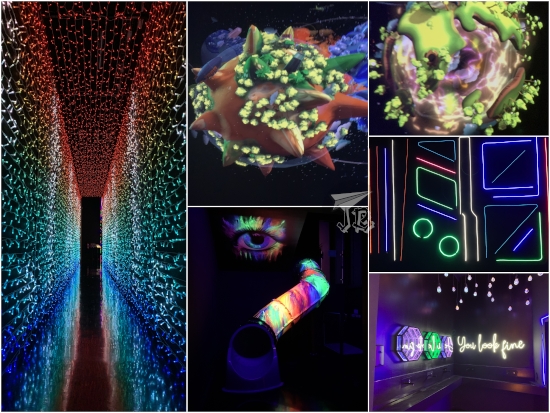
The film finished around 14:00. I was not hungry, so I just grabbed myself a drink at Starbucks. I had a ticket at 15:00 at the Nomad Museo Inmersivo (and it was bad timing I guess, because just a couple of days later they opened a new exhibit). When I first read about it, the idea reminded me of Mori TeamLab Museum, since the art is all digital. The museum is staged in two floors. The lower one hosts the immersive projection ward and the shop. The upper one hosts the entrance and the “activities”. I thought that I’d ask if I could come in early, and they had absolutely no problem with that, so I entered around 14:35.

As you climb down the stairs, you have a very cool corridor with mirrors and lights that lead to the projection area. I had a ticket with entrance and “iris picture”, so an employee took me to get that one (I guess because the photographer was about to go on a break). We had to try a couple of times as it was hard to force my eyelid open under the bright light of the flash. The photographer was very patient with me and we were done in a few minutes.

Interactive Museum Nomad access corridor

I found my way back to the beginning – the museum is surprisingly small. The immersive projection is shown on the four walls and the floor. The projection I watched was called Utopia 1.0, where millions of digital blocks work as a tridimensional Lego set that sort of “build” a surreal world with dragons, deer, sculptures, whales, high rises, dinosaurs… The whole thing takes around 20 minutes and you can watch sprawled on the floor, or sitting up on a pouf – I chose this last option as it allowed me to turn around.

Interative Museum Nomad: Utopia projection

Following the projection, I went upstairs to do the activities. There’s a virtual reality experience where you get to travel the cosmos and see a lot of “space cetaceans”. I wonder why digital artists are so keen on whales… Another of the activities consists on “painting” planets with a giant brush as they float on a wall, and when you colour them all, you get to see penguins on a rocket or something… I did not catch it well because a bunch of kids burst in and took over. On another wall, there is a bunch of neons that you can play with using an app that you download on your phone, and blast music so they pulsate with that. Finally, the nice attendant is at the ready to take your picture at some stairs photo call (I think it is the glorified emergency exit), and you can go back down using a spiral slide.

There is finally a last corridor with lights and you end up at the shop, where you can start all over again, as there is no limit about how long you can stay in the museum. I really liked the first corridor, so I went back there for a while. Then I walked into the projection area again just in time to watch the dinosaurs roam once more. A fun detail is that even the toilets are “in character” with neon and messages.

Interactive Museum Nomad exhibits

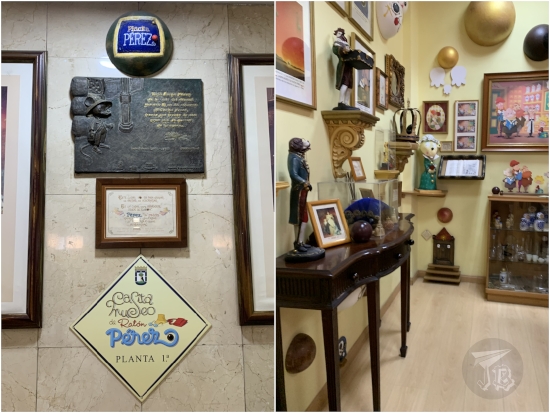
On my way out, I bought myself a shark glass at the shop. There was also a very fun pufferfish cocktail glass, but I thought it would be awful to clean after use – not that the shark one is going to be much easier though… I left and headed off to a place I’ve always tangentially felt curious about, even if I’m not really the target public for it – it’s called Casita-Museo del Ratón Pérez.

Ratón Pérez or Mouse Pérez (also called Ratoncito Pérez, Little Mouse Pérez) is the equivalent of the Tooth Fairy in Spanish-speaking tradition. In 1894, writer Luis Coloma was commissioned with writing a tale for the future King Alfonso XIII, who had lost his first tooth. This tale penned the folklore mouse into print. According to the story, Mouse Pérez lived in central Madrid, in a biscuit box in the patisserie Prast, situated in number 8 of Madrid’s Calle Arenal. The town hall installed a plaque to commemorate the place and when the shopping centre in that building became almost empty, someone came up with the idea of building a “museum-house” dedicated to the mouse.

Museum-House of Mouse Pérez

The kids had a blast for sure, the visit is a forty-minute activity 100% dedicated to them . The guide has them running round looking for stuff and going into small doors. I snooped around and found it an interesting business model – though it falters when you pay a bit of attention to detail: books like 1984 or anatomy guides may very well be interesting, but a bit out of place in a children’s museum. At the end of the visit, the guided asked me what I was doing there and I told him I… wanted to see what the fuss was about, what kind of things they did in such “alternative” museums. We chatted away for a bit before I left.

To end the day, I did some shopping and I headed back home – the trains were delayed, but I eventually made it home and had a pizza dinner, because I suck at staying fed on day trips. Truth be told, I wanted to step by a famous bar to eat a calamari sandwich, but it… was complicated, with lots of signage on where to stand and wait to be seated, but there was nobody around, so in the end I decided I did not care enough for the calamari. Some other day – I’ve been saying that for months now though…

11th July 2023: Museum of Dreamers in Madrid (Spain)

After I had so much fun in the Balloon Museum, I decided that I also wanted to see the Museum of Dreamers, which is something similar. Furthermore, it Madrid exhibit will close down at the end of July, too.

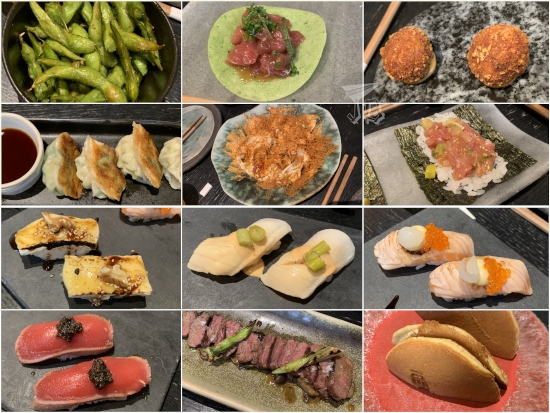
After I finished French school in Madrid, I headed headed off to the Japanese fusion restaurant Nomo Braganza, part of the Nomo Group. Nomo was established in 2007 under the culinary direction of Japanese chef Naoyuki Haginoya. I have to say that I don’t really trust the Spanish-Japanese fusion too much, but in this case, it really panned out. I met my sibling for a late lunch, because I was curious about the chef’s menu, what in Japanese would be called omakase [お任せ], which means leaving the choice of food to the chef. The menu was was a whooping 12 small-sized courses for 50€ – drinks not included, and considering it was 39 ºC outside, we ended up ordering a few rounds of water.

The menu, which changes periodically, comprised in July 2023:

  • Age Edamame Truffle – fermented edamame beans fried with white truffle scent. I personally prefer my edamame boiled, but the truffle scent was a nice touch.
  • Sukiyaki Croquette – oxtail croquette breaded with panko breadcrumbs. This was surprisingly good – and the actual flavour was strong.
  • Maguro Taco – mini taco of tuna tartar with wasabi and shiso (the “taco” was weirdly… not taco-shaped, more like cracker-shaped). The tuna was really good, albeit the base was a bit strange.
  • Gyu Niku Gyoza – aged beef dumplings with caramelised onion and yuzu, two of them per person. It was all right.
  • Ebi Chili – spicy king prawns and fried egg on kataifi noodles, mixed at the table. When we are talking spicy, it means… really spicy. The prawn bits were sizeable, but this was really something I would not miss should it disappear from the menu.
  • Toro Tartar No Temaki – tuna tartar prepared at the table: raw tuna belly mixed with Japanese onion, turnip, egg yolk, chilli pepper and wasabi on a bed of nori and rice so you can roll it yourself (spoiler: you really can’t). This was probably one of my favourite items – but I guess that after all I am a raw tuna fan.
  • Brie Nigiri – flamed Brie cheese nigiri with honey and walnuts. This was probably the weakest sushi bite, but it was still good.
  • Butter Fish Nigiri – butterfish nigiri with kimchi and chilli peppers. Butterfish is only good raw anyway.
  • Aburi Salmon Nigiri – flamed Norwegian salmon nigiri, with Japanese mayonnaise, salmon roe and onion. I still prefer raw salmon, but the flame was light so it was barely perceptible.
  • Maguro Tataki No Nigiri Trufa Nose – tuna tataki nigiri with soy and black truffle sauce. This was also really good.
  • Gyu Niku No Tataki – aged beef tataki with caramelised mushrooms and miso sauce. The combination of meat and the mushroom was strange, but when taken separately it was all good.
  • Caramel dorayaki – two halves of a dorayaki filled with salty caramel paste. Unexpected, because the menu listed something else, but it is not as if it was bad at all!

Chef's choice menu at Nomo Madrid

My sibling ordered some green tea out of the menu, and in the end, the drinks did not add as much to the price as I expected. Also, I have to give a shout-out to the pickled ginger we got. Really good.

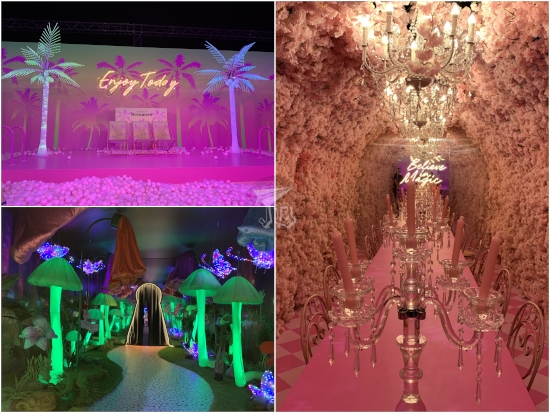
After having lunch, we took a train towards the Museum of Dreamers, which is stands in Espacio Ibercaja Delicias, a place that seems to always look somewhat abandoned, even when it is stupidly hot and sunny. The exhibit was designed by sisters Elena and Giulia Sella, founders of Postology, an agency specialised in “phygigal” experiences. This concept merges the words “physical” and “digital”, allowing for a number of immersive and surreal experiences. The Museum of Dreamers is one of those things that you have to see with an open mind to have some fun. It comprises sixteen interactive installations which are basically photo-ops – after all, the word instagrammable has been officially accepted on dictionaries. I guess it is a new niche that can be exploited, and to be honest, I can get behind that, because some of these activities are hilarious.

Entry is timed, but they do not hold a very strict waiting policy – at least not on a Tuesday at 17:00 and 39 ºC. There were no timed exhibits or performances either. The first installation is a dark room with a starry sky of sorts, designed maybe to isolate the rest of the exhibition from the outside, maybe as a metaphor (100 Dreamers). Then you get to a semi open space that opens to the smaller installations that allow for fun pictures. All through the space there are motivational sentences and “rules” for safety in the different installation.

There is some kind of cosmic tube with mirror that was dizzying to walk into (Free your power), a tunnel made of hearts with an encouraging message at the end (Do what you love), an upside down room (Change perspective), an downside down bedroom with a giant plush and fun bed covers (Never stop dreaming), one full of disco lamps (Sparkle more), and a neon staircase flanked by colourful palm trees (Step by Step).

Museum of Dreamers exhibits

Afterwards, there is a ball pit – you know, it’s not like I had ever stepped into one before Friday, and now that’s twice in one week – with a “relaxing island” in the middle (Enjoy Today). In front of that, a tunnel made of fake pink flowers with a long table, set for a tea party (Believe in Magic). That managed to make you think of Alice in Wonderland imprint on your brain. Thus, you are in the right mindset for the following room, full of giant mushrooms and flowers that open up at will – theirs, for sure, not the visitors – whole giant butterflies hang around with their wings made out of lights (Wonder).

Museum of Dreamers exhibits

The final part of the exhibit consists on a second row of booths – a colour wheel, a door that opens to a fantasy scenery, a VR experience (Choose your Way), a stage (The stage is yours), some pink telephones (Your Dreams are Calling you), bright lights commanding you to DREAM (Be Bright)… There were two more rooms, one with a sky background and swings (Sky is not the limit), and the other with punching bags reading FEAR, STRESS, ANXIETY and so on (Never Give Up). I can’t punch, but I can strangle, so I choked the hell out of these last two.

Museum of Dreamers exhibits

That was the end of the escapade. It was a fun half-day out.

7th July 2023: Balloon Museum “Pop Air” in Madrid (Spain)

Part of this summer’s plans involved a three-week French course-and-stay in Montpellier, but I ended up changing my mind – too many hidden costs on top of the already-steep price, and a generalised bad feeling that I could not really define. I decided to take a course in Madrid and use up the evenings to do some exploring in town.

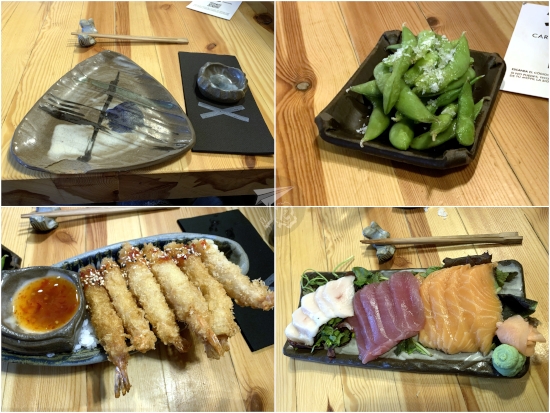
After class, I booked a table at the Chueca shop of the Japanese restaurant chain Sibuya Sushi Bar, which claims to offer a new concept of sushi. Most of what they offer felt pretty normal to me, except some random baos and the desserts. I browsed the website before booking, so when I arrived I had a pretty good idea of what I wanted. Somehow, the waiter did not expect that and was thrown off track. I ordered some ebi furai and a sashimi mix – I have to admit that the size of the sashimi portion did surprise me a little, as I did not expect such a generous serving. Luckily, I had hold on ordering dessert, because the two dishes were more than enough.

Lunch at Sibuya Madrid

There were two temporary exhibits I wanted to check out, and I chose the one that closed down earlier. I checked as I had lunch, and there were tickets available online. I decided to take the underground and buy the tickets in person instead of stressing about making it on time for a particular timeslot. I reached the Balloon Museum on time for the 15:45 entry. The exhibition Pop Air runs from March to July 2023 in the Escenario Puerta del Ángel in Madrid’s Casa de Campo.

Still considered a noon slot, the exhibition was not too crowded at the time I entered, I even had a couple of rooms for myself before I reached a point in which you had to be admitted because the performance was timed. The Ballon Museum‘s Pop Air exhibit is a collection of art pieces that use air and light as their main vehicle.

Artworks:

  • The Goof by Filthy Luker (2021). They are a bunch of “friendly monsters” that observer the world feeding off surprise and happiness. They look… just adorable, as if they were made of giant inflated latex gloves in different colours with huge eyes.
  • Aria, The Breath Immersive Experience by Pepper’s Ghost (2022). A room full of mirrors and digitally-created colourful spheres that spreads to infinite and beyond.
  • Airship Orchestra by Eness (2020). More adorable creatures made out of air, some resembling Japanese peaches, other bunnies, or cacti.
  • Ballon Museum exhibits. The Goof, Aria, Airship orchestra

  • Hypercosmo by Hyperstudio (2021), which is basically a huge ball pit with a show of music and lights.
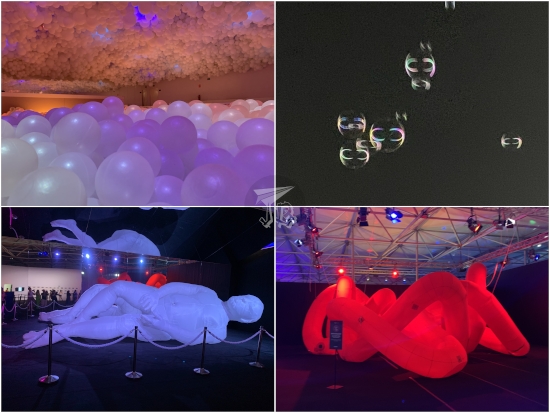
  • A Quiet Storm by Quiet Ensemble (2022). A dark room where cannons shoot bubbles.
  • Silenus by Max Streicher (2002). A giant, breathing… person… sleeping. It’s a bit creepy, to be honest.
  • Knot by Cyril Lancelin (2017). It is an inflatable… knot, literally a 3D knot made out of a tube.
  • Balloon Museum exhibits: Hypercosmo, A quiet storm, Silenis, Knot

  • Polyheadra by Karina Smigla-Bobinski (2022). It is a room full of balloons with small magnets which you can stick to the wall and the ceiling, and even to each other.
  • Never Ending Story by Motorefisico (2021). Music: Gentle Music by Plume (Netlabel). A lot of decorative balls in a small room full of mirrors and light.
  • Tholos by Plastique Fantastique (2022). A giant black ball surrounded by a plastic structure that imitates the archaeological tholos tombs.
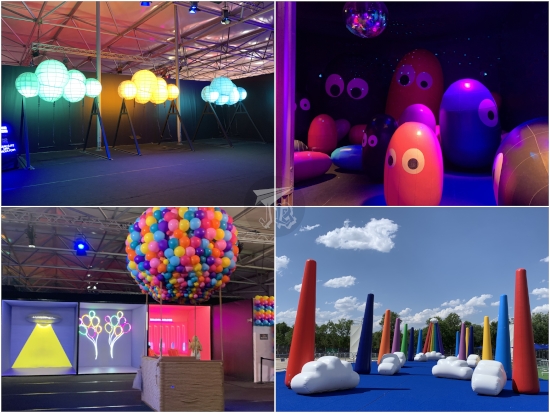
  • Canopy by Pneuhaus & Bike Powered Events (2019). Four palm-tree-like structures that open up and glow if you bike them into life.
  • Balloon Museum Exhibits. Polyheadra, Never ending story, Tholos, Canopy

  • Cloud Swing by Lindsay Glatz with Curious Form (2019). Cute swings held by colourful “clouds” of light.
  • The GINJOS by Rub Kandy (2022). They’re blobs of air with eyes. When I saw them my first impression was “they’re squishy and unstable. I have found my people”. I also found the song hilarious, especially the reference that “GINJOS are not Barbapapa”.
  • Into the Rainbow by Ultravioletto. A VR experience out of which one cannot really take pictures. A white sphere travels through the colours of the rainbow and its symbols – orange candy, yellow rubber duckies, green trees, blue whales, purple… cows(?) and amethyst crystals
  • A number of cute photo booths for picture opportunities, without credit to any particular artist.
  • Parcobaleno by Stefano Rossetti (2020), is a large “inflatable park” for “all the family” (i.e. for kids), which was empty as it was way too hot for any playing.

Ballon Museum exhibits. The swings, the Ginjos, Parcobaleno

All in all, it was a really silly but fun experience. I headed back home afterwards, because even if exploring Casa de Campo is on my list, it was way too hot and I did not have any cold drinks on me. I made an amazing underground-train connection though, which was great because the Casa de Campo stop is pretty far away by public transport – and rather horrible to drive to.

27th May 2023: Mammoths and Knights in Madrid (Spain)

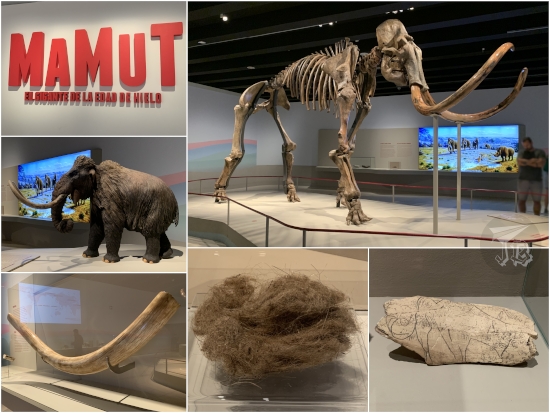
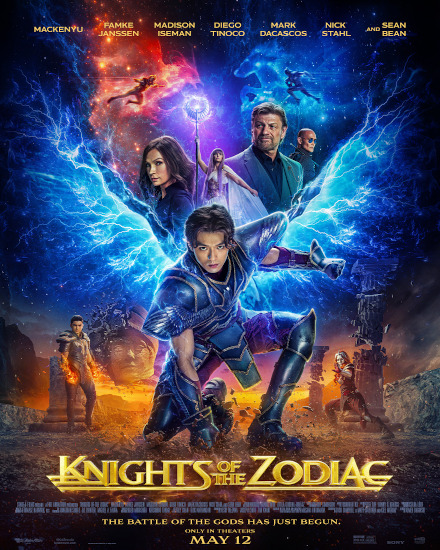
I headed off to Madrid to watch the Knights of the Zodiac film, the Hollywood remake of the 80s anime Saint Seiya – I’m not making any excuses (I mean, I still went to the Symphonic Adventure after it got cancelled trice), I just wanted to see it, even if I did not have much faith in it. I wanted to combine it with another activity, and I thought I lucked out when I found that Caixa Forum Madrid was running an exhibition on mammoths – Mamut, el Gigante de la Edad del Hielo (Mammoth, the Ice-Age Giant). I allocated about an hour and a half for the exhibition, which hosted an almost-complete fossilised skeleton and a hyperrealist sculpture “among other pieces”. Truth be told, there was not much else to see.

The exhibit has some molars from different species, some fur, a tusk and a few pieces of prehistoric art. There was also an evolutionary timeline and little models comparing the sizes of different mammoth species to the average human size. The pièce de résistance is indeed the complete mammoth skeleton that was the literal centre of the exhibit – hugely-tusked specimen of wholly mammoth (Mammuthus primigenius). It was a truly magnificent piece, but I was a little disappointed by how few pieces were actually on display. It’s not like there is not any material around – there used to be a Mammoth Museum in Barcelona that had actual tusks for sale. I had also seen another one in Muséum des sciences naturelles de Belgique in Belgium a couple of months back, which diminished the awe factor a little.

Mammoth - The Ice Age Giant exhibit featuring the giant skeleton with huge curved tusks, the smaller sculpture, a lone tusk, some hair and a piece of Paleolithic art engraved on the ivory of a tusk.

I was done in a bit over 30 minutes, so I had time to walk to the cinema – there was another exhibition in the same floor, but I had already seen it in Barcelona, and the Museum shop did not have anything interesting. I had planned to walk to the cinema, as public transit was only slightly shorter. The weather was not so nice, and there was a small storm. I did duck into a couple of shops but to be honest I ended up at the cinema 40 minutes before the session started while it poured outside. I found myself a seat to wait – I had got my ticket online the day the release was announced. This was my first time in a cinema since Jurassic World: Fallen Kingdom in 2018, and it was a weird feeling, being so close to strangers again. It was also extremely cold, and the previews were felt eternal.

The reason I sometimes choose Yelmo Cines Ideal is that some of their films are shown in their original language, and I tend to enjoy subs more than the dubbed versions. The Knights of the Zodiac film was… a choice, I guess. It is based on the newest remake – which I have not seen because I’m not a streaming-service person – and it changed a lot of the lore. Except for the main character (Seiya in the original material), all the names had been changed, but I noticed that the subs stuck to the original ones.

Knights of The Zodiac movie poster

It was not a bad film, all things considered. Entertaining, wannabe Marvel-like, tapping a little into mixing the cosmic magic and newer technology that was unimaginable in the 80s when the manga was made. It lacked on the music department though – considering how powerful the anime music is, that was disappointing, though here and there there are a few chords of the original song Pegasus Fantasy. That was cool.

But then again, I was half-expecting a disaster, so anything was an improvement, and the film made itself watchable. Sean Bean’s character died, but considering that in the original material his character is already dead at the end, I guess it could be considered some kind of record…

22nd and 23rd April 2023: A date with a dinosaur (London, England, Great Britain)

Since I cannot keep my mouth shut, I offered to organise a trip to London with some people from work. Despite prices skyrocketing everywhere and my ridiculously hectic schedule, I managed to secure a weekend when flying would not be stupidly expensive, and an activity I would really be looking forward to – the Natural History Museum was running couple of things I was very interested in. One was an exhibition on a gigantic dinosaur: Titanosaur: Life as the biggest dinosaur. Well, twist my arm – NHM is much closer than the actual Titanosaur home in Argentina. Furthermore, there was a collaboration with Jurassic Park (‘an adventure 63,000,030 years in the making’ is the motto), and coming back to the museum would give me the chance to purchase the rock I wanted the last time I was over and did not get because I was heading out to Stonehenge on the same day.

In the end, only one person took up the offer, and I figured out that well, London is pretty much always a good idea for a weekend – so I figured I’d arrange myself a date with a dinosaur. Unfortunately, it turned that London Marathon was held that weekend. Hotel prices were bloated for the night and we ended up at Earl’s Court because I wanted to stay close to South Kensington and the other person wanted the cheapest place possible. We left on a red-eye flight to London Stansted which took a long time to land – we spent about an hour circling the airport, and eventually the head cabin attendant said that there was bad visibility at the airport, and that the pilot required all electronic devices to be turned off so he could use the autolanding system. I did not like that one bit – after I visited Santiago de Compostela in 2022, I felt that I had got over the bad-visitiblity near-miss when I was a teen. Apparently not, the feeling of uneasiness is still there. We landed over an hour late, but we were on our way on the first Stansted Express a few minutes after getting on it. After reaching Liverpool Street Station at around 9:30, I asked my companion to take us to Guildhall as part of the incentive of the trip was introducing them to international travel. It was not a good idea. Their phone trolled us and tried to take us to Guildhall… in Stratford upon Avon. The Costa at the station was closed, but at least I had got myself a sandwich and a latte before we started walking.

After backtracking, we were in known territory around 10:15. As it turns out, my companion was only interested in “walking the city” and shot down any activities I had proposed – thus, some things I just imposed in order not to feel that I had wasted the whole day away. By 11:00, I had confirmed that our travelling styles were not compatible. After some time at the docks next to the Tower of London, I wanted to enter the Anglican church All Hallows by the Tower. All Hallows is the oldest church in the City of London – founded in 675 CE, it predates the nearby Tower of London. The parish used to take care of a lot of the prisoners executed there. The building withstood the Great Fire of London (1666), but it was severely damaged through The Blitz – the German WWII bombing campaign against the UK throughout 1940 and 1941. The church was rebuilt and reconsecrated in 1975. Its windows are decorated with symbols from the different London guilds and some families.

Collage of a church. The outer building is brick and it has a tower crowned with a greenish metal spire. The inside has huge windows decorated with guild symbols. The small crypt inside is covered in white stone.

Underneath, there are a few chapels and a small Crypt. Most of the crypt is a museum which chiefly holds artefacts from the Roman period – including remains of an old road. There are other historical items from the Saxon and Medieval times, and the 20th century Crow’s Nest of the vessel Quest, in which Sir Ernest Shackleton sailed for Antarctica for the third time, and where he died.

When we were done, we went to Saint Dunstan in the East Church Garden. I was hoping to use this as a relaxing point for a few minutes, but there was work being done on the parterres. We continued towards the River Thames for some views of Tower Bridge, the museum HMS Belfast and The Shard skyscraper.

We walked by the Monument to the Fire of London on our way to the Sky Garden. The Great Fire burnt inside the Roman city wall for four days after breaking out a bakery after midnight on the 2nd of September, 1666. Though the number of victims is (theoretically) small, the fire destroyed over 13,000 houses (15% of the city’s housing), almost a hundred parish churches, governmental buildings, St Paul’s cathedral, and even some of the city gates.

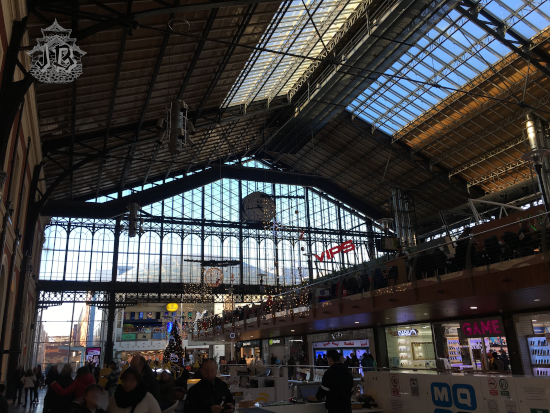
Afterwards, we walked over to Leadenhall Market, a covered shopping street which can be traced back to a 1321 food market, and marks the centre of Roman Londinium (ruins from the Forum and Basilica are buried underneath). It was given to the city in the 15th century, and in the 19th century, the City Architect Sir Horace Jones designed an iron-and-glass arcade. Today, it holds restaurants, wine bars, varied shops and even beauty parlours.

A covered shopping gallery or street, in dark red and beige tones.

Around the market stands a mixture of modern buildings and traditional buildings, mostly small churches. Among the former:

  • The Lloyd’s Building (25 Gresham Street), sometimes called the “Inside-Out building”. It was finished in 1986 and it is consider a great example of Bowellism – an architectural style that maximises inside space by building ducts, lifts, and other structural necessities on the outside. It was designed by Richard Rogers & Partners, and it still maintains the original entrance of the building that stood in its place in 1928 – the East India House.
  • The Leadenhall Building (122 Leadenhall Street), designed by the Rogers Stirk Harbour + Partners. It opened in 2014.
  • The Willis Towers Watson (WTW), designed by Norman Foster, it was finished in 2008.
  • The Scalpel (52-54 Lime Street), which yields to cool reflections along with the WTW, and has a strange sculpture at the entrance – it made me think of several ship wheels fused together. The building was designed by Kohn Pedersen Fox and only completed in 2018.
  • And of course The Gherkin (30 St Mary Axe). It was designed by Foster + Partners and it is the first ecological building ever built in London. It opened in 2004.

The historical buildings we encountered (having survived both the Great Fire of London and the Blitz) include:

  • Saint Andrew Undershaft Church. It dates back from 1147, although it has been rebuilt several times. The current building was erected in 1532.
  • Saint Helen’s Bishopsgate Church, where Shakespeare himself used to worship in the 1590s. The building can be traced back to the mid 12th century, and it was restored during the Victorian period and later during the 20th century.
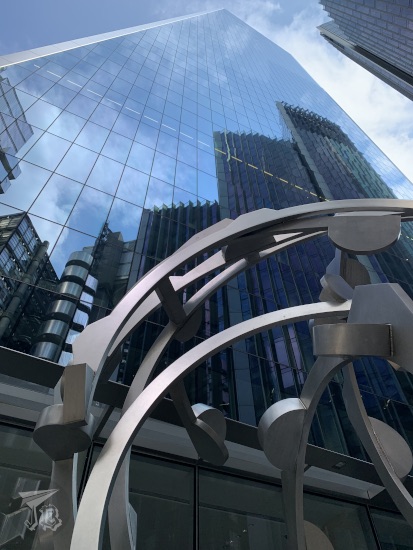
Skyscrapers reflected on the glass that covers yet another huge skyscraper

A small church built in Stone in the background with a huge modern high-rise building behind it

Afterwards, we headed towards Embankment on the Tube. There, I was happy to find a Costa Coffee and get my vanilla latte fix. In the area, we saw the Victoria Embankment Gardens and I wanted to visit Cleopatra’s Needle – half of a pair of obelisks (the other one is in New York), originally made and carved in Heliopolis, what is Cairo today. It has inscriptions from the 18th and 19th Egyptian dynasties (around 1450 BCE). It was presented to the United Kingdom by Sultan Muhammad Ali in 1819, and later transported to London in 1877. Two sphinxes and other decorations were added when the Needle was erected, and the plinth under one of the sphinxes was damaged during London Bombings – it was never restored as a tribute to memory.
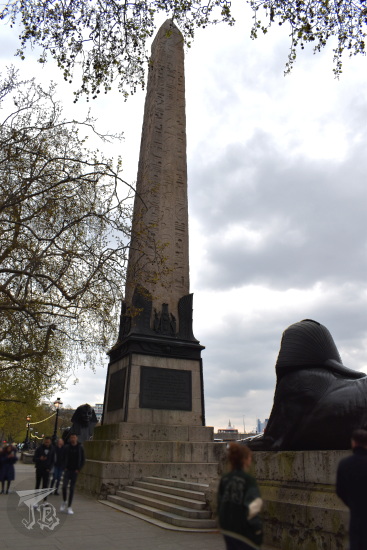
An Egyptian obelisk standing against a cloudy background

We walked over to the Westminster area to see the Palace of Westminster and Elizabeth Tower. There was an environmental protest there, which made it packed, but at the same time diverted traffic, allowing for new views from the middle of the street. On the way, I encountered an adorable pit bull mix I got permission to pet – coffee and dog pets made everything better.

A view of the palace of Westminster, with the Elizabeth tower on the left

We continued off to Saint James’s Park, home to squirrels, geese, swans, pigeons, mallard ducks, robins… all of them extremely used to people and tourists, and rather unconcerned by dogs being walked. We ditched the marathon fencing and reached Buckingham Palace, but by then my companion was beat. Thus, we had to go to the hotel so they could get some rest. The hotel was better than expected for a London 2*. It was nice and warm, although the bathroom was tiny – it was difficult to stand inside and close the door.

Buckingham Palace and some of the animals at Saint James' parks

A couple of hours later, we were off into the evening to see Piccadilly Circus, the entrance to Chinatown, and Leicester Square. Companion was beaten, so they were not sure they would be up for anything the following day – we arranged to touch base at 9:00 for them to evaluate. Once in my room, I had a shower and booked a free time slot for the British Museum the following day, just to avoid the queues. I thought, even if we did not make it, at least we had assured entry if we did, and I could always cancel and release the ticket.
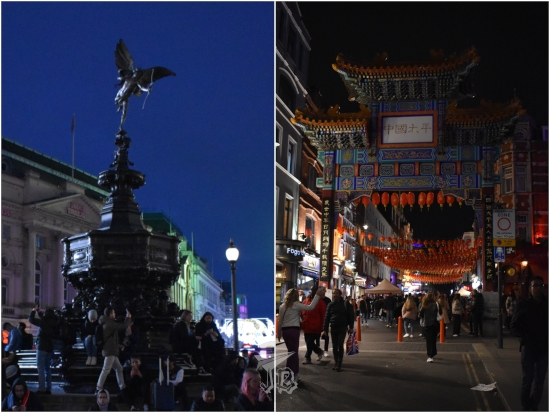
Central London at night - Picadilly Circus' Eros and entrance to Chinatown

The next morning, I left on my own around 8:00 to look for a nearby Costa Coffee for a large vanilla latte breakfast, and I came across Brompton Cemetery. This had not been on my radar, but since I had time, I decided to explore it a little. Brompton Cemetery, formerly West of London and Westminster Cemetery, opened in 1840, and it has belonged to the British Crown since 1852. It is on of the oldest garden cemeteries in Britain and comprises around 35,000 monuments. I wandered for about half an hour before I had to head back.

Brompton cemetery, a 19th century graveyard and garden

We managed to get to to the Natural History Museum on time for my date with a dinosaur just after opening. I had my Titanosaur ticket at 10:15, and left off my companion to wander on their own after agreeing to check with each other around noon. The exhibition Titanosaur: Life as the Biggest Dinosaur brings a cast of Patagotitan mayorum to Europe for the first time, along with a few real fossil bones, of a front leg, some teeth, and an egg.

Patagotitan mayorum is one of the largest known animals to have ever lived. It was a sauropod dinosaur – a tetrapod with extremely long neck and tail. It lived in forest regions during the Late Cretaceous (102 to 95 million years ago) grazing on ferns and tree leaves. The species was discovered in Argentina in 2010, and it’s calculated that it could have been up to 31 metres long and weigh over 50 tonnes. It is widely considered the most complete of the South American dinosaurs. The cast that the Natural History museum brought is considered the holotype, and it was reconstructed from the partial skeletons of six specimens.

Titanosaur skeleton. People walking around don't even reach its knees.

The best thing about the exhibit was being able to actually touch the cast, so I kinda hugged my date, I guess. As far as I know, there are only three casts of titanosaur – the one in Argentina (Museo Paleontológico Egidio Feruglio in Trelew), one in the US (Field Museum, Chicago), named Máximo, and this one.

After I had pranced around the exhibition to my heart’s content, and as it filled up with kids, I moved on to reason number two of this visit having to happen asap in 2023. To celebrate 30 (thirty!) years of the 1993 release of Jurassic Park, the Natural History Museum was running a limited-time-only collaboration pop-up shop – the Jurassic Park 30th Anniversary #NHMxJURASSIC store in which I did not even spend that much! I bought a replica badge and a commemorative coin, both limited, numbered editions. The shop had both Jurassic Park and Jurassic World merchandise, especially toys and T-shirts, and a few props, including a life-size sculpture of Blue the velociraptor.

Jurassic Park pop-up shop, with Blue the velociraptor just hanging out

I then headed to the official museum shop to get myself the rock I had wanted – a piece of aura silicon carbide, a shiny mostly-artificial mineral. I also bought a souvenir guide, just because. They did not have anything from the Titanosaur exhibit there, so I backtracked to the exhibition shop to buy a pin.

Whenever I got to the Natural History Museum, I end up in the dinosaur gallery (well, there was that one time I walked through the whole thing throughout a winter day). This time, however, I decided to wander the upper area of the historical building. I was drawn to the Treasures in the Cadogan gallery. I had not been there since it opened in 2013, and my mind was blown. The collection includes a first edition of Darwin’s On the Origin of Species, and some of the pigeon specimens that he used to develop the theory of evolution. I also got to see the first-ever-found iguanodon teeth (not the replicas), the first fossil ever found of the Archaeopteryx (the link between dinosaurs and birds), and a skeleton and egg of the great auk, the first confirmed victim of anthropogenic extinction (due to human activity). I was very impressed, these were all treasures indeed – no overselling.

Treasures at the Natural History Museum - ancient bird fossil, extinct penguin-like bird, a book, dinosaur teeth. Whale skeleton.

After wandering the second floor for a bit, I ran into my companion and at noon we left towards the British Museum, where I had booked entry for 12:40. I left them to their own devices again and headed off to the Japanese galleries, which had been closed the last couple of times I was in the museum. I was… a bit on the disappointed side, I remembered them being way more impressive from my early 2000s visits.

Japanese Galleries at the British Museum: Samurai Armour, lion dogs pair, articulated metal animals, a standing Buddha.

I visited the Moai, the Elgin Marbles, the Babylonian bulls and the Rosetta Stone, and I headed off to the shop to get myself a treat – retail therapy is a thing. Eventually, we left the museum and managed to get to Liverpool Street to take the Stansted Express to the airport. Security was smooth, not as crammed as other times, and then, as tradition calls, I got myself some sushi at Itsu.

When we boarded the plane, I had been assigned an emergency exit seat. In order to sit there, you need to be able to take responsibility about opening the exit if something happens. I flagged a flight attendant to inform them that I would be physically unable to do so. I had a new seat in 4.5 seconds, and it turned out to be a window seat. We took off a few minutes late, and landed with a delay of almost a quarter of an hour. Nevertheless, after passport control and all, I managed to reached the parking lot payment machines with a few seconds to spare the overstaying fee – all good!

Balance – The marathon barely interfered with the weekend. I had a date with a dinosaur and hugged them. That was awesome. I got limited edition Jurassic Park and Jurassic World merchandise. I found some Kettle Sea Salt and Balsamic Vinegar of Modena crisps at one of the supermarkets. I got two new books, commemorative coins and a shiny rock. I also discovered new places to explore in the future, and had Costa – twice. Unfortunately, we ran out of time for extra visits on Sunday – so I could not fit in either the HMS Belfast or the Jack the Ripper Museum. Furthermore, the Grant Museum of Zoology is closed for renovation, and the Petrie Museum of Egyptian Archaeology does not open on Sundays, so in the end I was not really able to scratch much off my list. Whoops!
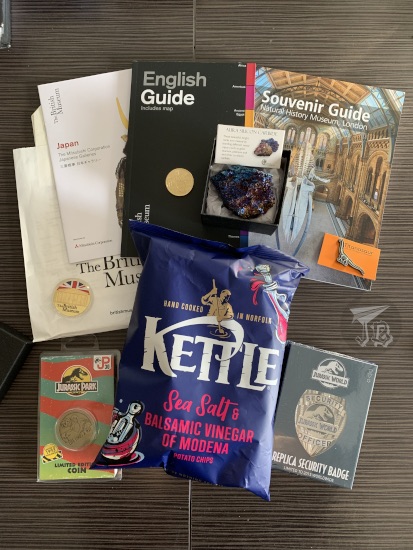
Souvenirs from London: books, crisps, commemorative coins and Jurassic Park merch

24th March 2023: Brussels {Belgium, March 2023}

I woke up stupidly early to catch a short red-eye flight that was in the end delayed by the French air controller’s strike. Crossing security at the airport was a bit of an issue – I got stuck behind a class of teens going somewhere, and kudos to the teacher for not losing it when about 50% of the kids were sent back because they had not taken out their tablets / liquids / bottles of water and so on. Once inside, I had to head towards the Schengen area transit lounges, which were considerably fuller than beyond passport control in the early morning.

I landed in Brussels [Bruxelles (French) | Brussel (Dutch)], Belgium [Belgique | België] around 9:00. At the airport arrival lounge, I was welcomed by a rocket taken out from The Adventures of Tintin, and some fake flowering trees. I found the station – I had booked all my tickets online beforehand – and after a short train ride I reached the centre of Brussels. From the train I caught a glimpse of the famous atom-like building, the Atomium. I found my way to the hotel throughout a chaos of construction, and dropped off my luggage. Then, I set off to explore the city, which is called the comic capital of Europe: up to 50 comic character murals are painted on walls around the city, to the point that there is even a route dedicated to seeing them all – the Brussels’ Comic Book Route. I had not walked 200 m from the hotel when I saw my first mural, Le Scorpion.

I headed towards the Cathedral of St. Michael and St. Gudula Cathédrale des Saints Michel et Gudule | Kathedraal van Sint-Michiel en Sint-Goedele. The current building was erected in the 13th century in Brabantine Gothic, which is a deviation from the French Gothic style that developed in the Low Countries (Belgium, the Netherlands, and Luxembourg). It features the use of sandstone or limestone in light colours (unfortunately, these materials are very susceptible to erosion), pointed arches, round columns with decorated “cabbage” capitals, and a very clear cruciform floor plan on churches. Unlike the Spanish cathedrals, there is no choir built in-between, so the perspective of the churches built in this style is fantastic.

The cathedral has two symmetrical front towers with tolling bells. It is accessed from the monumental staircase (built in the 18th century) on the western façade, by one of the gates under the bell towers. It does not feature a round or wheel window, but an ogival one. The nave is wide and lit from all the colourful side windows representing biblical scenes. The pulpit on the side is Baroque, carved in dark wood by the sculptor Hendrik Frans Verbrugge. A lot of the sculptures inside the cathedral are also Baroque, as the originals were destroyed by iconoclast movements (Beeldenstorm) in 1566 – this is a feature along most of the monuments I visited. Along with the Chapel Church and Our Lady of the Sablon, the cathedral is considered one of the three traditionally listed gothic churches in the city of Brussels. The organist was rehearsing, along with a cellist and a female singer, which was cool to hear as I explored. Underneath the cathedral, the archaeological site can be accessed to explore the Romanesque origins of the chapel of St. Michael.

The cathedral of Brussels

After the cathedral, my path took me through the park Parc de Bruxelles | Warandepark, featuring a pretty kiosk in metalwork and a bunch of trees striving to blossom. Along one of the axes of the park, 22 sculptures have been erected for a temporary exhibition “Le Chat déambule” Expo (9th March – 30th June 2023). They feature Le Chat, an anthropomorphic obese cat from a comic strip created by Belgian artist Philippe Geluck. Le Chat ran from 1983 to 2013, comically tackling everyday situations or presenting absurd conclusions.

An obese, anthropomorfic cat on a tutu raising a leg while a mouse uses a jack to keep the cat's leg up.

I continued walking for a bit of a long walk that led me past the Royal Palace of Brussels Palais royal de Bruxelles | Koninklijk Paleis van Brussel and the Monument to Leopold II. I went on until I reached something I felt that I could not have missed – the Museum of Natural Sciences of Belgium Muséum des sciences naturelles de Belgique | Museum voor Natuurwetenschappen van België, part of the Royal Belgian Institute of Natural Sciences. This was on my to-visit map long before this little trip came into plan. The museum’s Dinosaur Gallery is the largest room dedicated to dinosaurs in Europe. It holds a replica of Stan the T-rex (the original one was auctioned a while back and bought into private hands for 32 million USD), a piece of the Mont-Dieu meteorite, similar to the one which might have caused the extinction of dinosaurs, along with a bit of the boundary K-T (Cretaceous-Tertiary) or K-Pg (Cretaceous-Palaeogene) – this is a sedimentary layer of black rock with a lot of iridium that separates the “age of reptiles” and the “age of mammals” in the fossil registry.

There is also a room completely dedicated to mosasaur findings, and a lone Allosaurus fossil called Arkhane, which is considered the only discovered specimen of its species. Allosaurus was a Jurassic carnivore and this skeleton, clocking at almost 9 metres long, comes from Wyoming (US) and is 70% complete. However, this was tucked away in a completely different area of the museum. I also saw a Dunkleosteus head. This one was behind glass and I did not find the information to read if it was a cast, so maybe I found an original one?

Fossils at the Belgian Museum of Natural History: dinosaurs, mosasaurs, the Allosaurus Arkhane, and a massive fish head

The most important feature of the Dinosaur Gallery though is the collection of iguanodon fossils – the Bernissart iguanodons. Iguanodon (meaning “iguana tooth”) was the second dinosaur to receive a name. This herbivore lived from the late Jurassic to the early Cretaceous, and it is thought to have been able to on either two or four legs. In 1878, as many as 38 iguanodon fossils were found in the Bernissart coal mine. Nine are displayed in “wrong” standing positions – what was believed at the time to be correct, called the “kangaroo standing” – and nineteen can be seen partly covered in plaster just as they were found in the mine. The standing skeletons are too fragile to be dismantled now – though early palaeopathologists did the best they could, the skeletons contain a lot of pyrite, which disintegrates in contact with air, so they are extremely brittle. Thus, they are exhibited in a protective chamber as historical testimony. These fossils were the most abundant and complete ever found of the species. They unseated the previous English hegemony on iguanodon knowledge at the time, and one of them became the Iguanodon bernissartensis holotype. Today, one of the skeletons stands outside the case, posed in the modern interpretation of how iguanodon would have moved.

Collage: The iguanodons. The upper picture shows a modern interpretation of the iguanodon on four legs standing in front of the older "kangroo posed" reconstructions. On the bottom, the iguanodons as they were found in the mine.

Other exhibits in the museum include a gallery of evolution (which I saw backwards as it was full of high school kids), a mineral collection, a gallery on humans and human evolution, and a biodiversity collection. They have the preserved body of the last captive Tasmanian tiger that lived, and a small ward about the history of the museum and urban flora and fauna.

Collage. The centre is the mascot of the museum. Around it, a tasmanian tiger, a mammoth skeleton, some rocks and taxidermed animals.

I had lunch halfway through the museum visit, and then set off to the centre of the town, undoing my previous way. By now I had got a hold of the construction detours, and I reached the city centre more easily. I walked past Mont des Arts | Kunstberg next to Central Station, with a very fun clock, and eventually reached the central square Grand-Place | Grote Markt. This central square, declared Unesco Heritage site in 1998, is surrounded by monumental buildings dating from the 15th to the 19th century, forming a particularly recognisable unit: the Town Hall Hôtel de Ville | Stadhuis, a Brabantine gothic building with a spire or tower; the Maison du Roi | Broodhuis in Neogothic style; and the so-called guildhalls and private houses, traditionally built buildings, either crammed together and cutely thin, or almost palatial – including the house where Victor Hugo, the writer, used to live in the city.

Grand Place. The buildings are light coloured or grey with a lot of gold decoration

I went down one of the side streets, debating a typical Belgian waffle, but I was not brave enough to try and eat one on my own. I saw the Adventures of Tintin mural (by Belgian cartoonist Hergé) painted on a wall (art by Oreopoulos and Vandegeerde). About five minutes away from the square, one of the corners hosts the fountain known as Manneken Pis, which depicts a naked little boy urinating into the basin. The current fountain features a replica of the boy, the original (sculpted by Jérôme Duquesnoy the Elder) is in the Brussels City Museum. The one on the fountain is often dressed up, and this time round, it was characterised as a construction worker – I can understand why. One of the many legends about the design tells of a young boy who put out an explosive charge fuse by peeing on it.

Collage. Tintin and Captain Haddock climb down some stairs. Manekken Pis fountain boy dressed in yellow reflective clothing.

I walked on to find another comic mural I was extremely interested in – actually two, but the Astérix mural (by Goscinny and Uderzo) was covered by construction. After a quarter of an hour I found the Lucky Luke mural (by Belgian cartoonist Morris, painted by Oreopoulos and Vandegeerde). When I was a child, I absolutely loved the Lucky Luke animated series, and especially his white horse Jolly Jumper and dog Rantanplan, so this was a bit of a tribute visit, rather than tackling the whole comic route.

Lucky Luke mural. The Daltons have robbed a bank and Luke prepares to arrest them (again)

On my way back towards the city centre, I stopped by a number of points of interest – the Baroque church and convent Église Notre Dame aux Riches-Claires; a mural by artist Mr.Doodle called Mr. Doodle Artwork; the late 19th century market Halles Saint-Géry; the 12th century church Église Saint-Nicolas; a “parody” of the Manneken Pis depicting a dog doing the same Zinneke Pis; and the Brussels Stock Exchange Bourse de Bruxelles (under renovation).

Collage showing different buildings in Brussels, and a bronze medium-sized dog peeing on a bollard

As I was making my way back towards the Grand-Place, the weather, which had been behaving most of the day – there had been some rain while I was inside the museum – took a turn for the worse, and there was a bit of a shower. The problem was not the rain itself, but the wind that made it come sideways. I had packed my umbrella, though it was not too helpful. When rain subsided down, I continued walking, and I got to see a rainbow over the Grand-Place. Great timing!

Rainbow peering through buildings at the end of the street in Brussels

It was only round 18:00 but I decided to go back to the hotel, check in, and get some food and rest. En route, I crossed through the classy shopping gallery Galeries Royales Saint Hubert. At first I had considered grabbing a bite here, but prices made me decide on a supermarket dinner, which was all right. I ate a sandwich and lots of berries.

After checking in, and warning the hotel staff that my companion would arrive late during the night, I got some rest, warmed the room, and when it was dark, I went out to see the illumination on the cathedral Cathédrale des Saints Michel et Gudule | Kathedraal van Sint-Michiel en Sint-Goedele, the square Grand-Place | Grote Markt, the fountain Manneken Pis and the shopping centre Galeries Royales Saint Hubert.

Cathedral and Grand Place at night, illuminated in warm light

I finally returned to the hotel and fumbled a bit with the shower until I found the nice massage mode.

3rd & 4th February 2023: Final Fantasy Distant Worlds 35th Anniversary – Coral – in Barcelona (Spain)

3rd February 2023: Mummies, fish, and music

Though I would not have minded to become a gamer back in the day, my joint issues discouraged this. Thus, my relation with the Final Fantasy saga is tangential. However, my sibling is a big fan of one of the instalments, and last year I accompanied them to Final Fantasy VII Remake Orchestra World Tour in Barcelona in 2021. Having had more time to prepare for this one, we got VIP tickets, and I planned a two-day outing.

Our arrival in Barcelona happened right on schedule, and we walked from the station to Caixa Forum Barcelona to see the exhibit Momias de Egipto. Redescubriendo seis vidasEgyptian mummies; Rediscovering six lives, in collaboration with the British Museum. I am not sure whether the items are part of the actual collection over there or are in the archives, because I don’t really remember seeing any of the mummies. The Barcelona exhibits focus around six mummies and how they lives could have been before their deaths. Aside from the actual mummies and their sarcophagi or coffins, there are objects that they may have used in life, and images of what the bodies look like inside the wrappings.

It was at the very same time interesting and creepy, everything we can get to know through technology about these poor souls who passed away millennia ago. There was information about their age, illnesses, and objects they had been buried with – god statuettes, jewellery, funerary miniatures… One of the mummies in display was that of a small child with his face painted on the wrapping, that was more than a bit creepy, to be honest.

A collage showing a a mummy and a turquoise wrapping; a sarcophagus; four canope jars; three statuettes: Horus, an ibis, Thoth; close-up of a sarcophagus, with bright colours; a mummy and a plain wooden casket.

We took the underground towards the waterfront to visit L’Aquàrium de Barcelona, located in the harbour. With more than 11,000 animals and 450 species, it is the largest aquarium dedicated to the Mediterranean Sea. It was inaugurated in 1995 and it holds 35 aquariums, including an oceanarium with capacity for almost four million litres of water (36 metres diameter, five metres high) with two tunnels at the bottom. Species-wise, the aquarium does not have anything out of the ordinary, but the size of the tiger sand sharks is impressive. There are a few sharks, some tropical fish, axolotls, frogs… and a very fun sperm-whale room to keep the jellyfish in darkness.

A collage of the aquarium. Seahorse; swimming sharks; anaemone; baby dogfish shark; tiny crustacean similar to a prawn; sand tiger shark; octopus trying to eat the viewers; penguin showing off; fabulous tiny jellyfish

We grabbed an expensive-but-convenient bite to eat at the aquarium itself during some of the feeding events to make sure the cafeteria was empty. AFter we had finished viewing all the exhibits, we went on towards the hotel, which was well-placed between the auditorium and the shopping centre. Since check in had been so bad when we went to the previous Final Fantasy concert, this time we had booked different accommodation, and it was a total 180 – everyone in the hotel was super friendly, and we had zero issues. We procured some sandwiches for dinner, then got ready for the concert.

The Final Fantasy Distant Worlds 35th Anniversary – Coral – directed by Arnie Roth is a compilation of the background pieces from all the Final Fantasy games, from the first (1987) to the latest to date not counting the remakes (Final Fantasy XV, 2016). The concert was held at the CCIB – Centre de Convencions Internacional de Barcelona. We had no idea what time doors would open, but I calculated that an hour should be good for queuing for merch and then get to our seats.

By the time we got to the queue, the concert booklet had already been sold out. When we reached the front, my favourite plush toys were also gone. I decided to get the previous year’s CD in order to get it signed later at the meet & greet event that was included in the ticket we had bought. Looking back, maybe I should have asked for the autographs on the tote bag we got for the spending.

The concert had two halves and an encore, and was… strangely not very coral, for something called so. The choir was placed over to one side, and only did three or four songs – they actually did not show up for the whole first half. The set list was accompanied by projected images on the screen and it was super-impessive to see the first 8-bit games at first compared to what the technology of the latest Advent Children (movie from Final Fantasy VII) managed to create.

    First half

  1. Final Fantasy I~III: Medley 2002
  2. Final Fantasy III: Eternal Wind
  3. Final Fantasy IV: The Red Wings ~ Kingdom of Baron
  4. Final Fantasy IV: Main Theme of Final Fantasy IV
  5. Final Fantasy V: Home, Sweet Home ~ Music Box
  6. Final Fantasy V: A New World
  7. Final Fantasy VI: Phantom Forest ~ Phantom Train ~ The Veldt
  8. Final Fantasy VI: Kids Run Through the City
  9. Final Fantasy I~VI: Battle Medley 2022

    Second half

  10. Final Fantasy VIII: Liberi Fatali
  11. Final Fantasy XI: Ragnarok
  12. Final Fantasy XII: Flash of Steel
  13. Final Fantasy VII: Aerith’s Theme
  14. Final Fantasy XIV: Torn from the Heavens
  15. Final Fantasy XV: Apocalypsis Noctis
  16. Final Fantasy IX: Not Alone
  17. Final Fantasy X: 素敵だね [Suteki da ne] (Isn’t it wonderful?)
  18. Final Fantasy Main Theme with Choir ~ The Definitive Orchestral Arrangement ~

    Encore

  19. Final Fantasy X: Zanarkand
  20. Final Fantasy VII: One-Winged Angel

The concert was all right. I did not feel the general chill I had through the previous one. I really liked Liberi Fatali and One-Winged Angel, but I guess I don’t have enough of an emotional connection with most of the games. Aside from the conductor Arnie Roth, we had composer Yoko Shimomura present, and vocalist RIKKI, who is the original singer of 素敵だね in Japanese, and did the live version.

Collage. Three pictures show a classical orchestra with different things projected on the screen behind them - the logo of Distant worlds, several 8-bit screenshots of games, a very realistic depiction of a blond man with a very unrealistic sword. The last picture shows singer RIKKI, composer Yoko Shimomura and conductor Arnie Roth

The M&G was fun, and I got to tell Roth that when I grow up I want to have as much fun as he does at work. They signed autographs and took pictures with people – it was much less stiff than the usual, too. We headed off afterwards for a sandwich, a shower and a good night’s sleep. In general though, not much value for money considering how much more expensive the VIP tickets were, even though the seats were good. Also, the fact that most merchandising sold out showed poor planning.

Collage. The ticket reading the name of the concert, the autographs of the three main artists, and a plush of a Final Fantasy imaginary being, it looks like a white teddy bear with a huge pink nose, a red ball on top of it and cute wings

4th February 2023: Ramen with Friends

We had bed and breakfast at the hotel, and the latter was fantastic. The buffet had both a juice bar and a milk bar – both of which I sampled, of course. I overdid it with the fried egg, I fear, but they were just cooked and it looked just too appetizing not to fall for one. After breakfast, we packed up, vacated the room, and asked the hotel to keep our bags for a couple of hours. We went to the science museum Museu de Ciències Naturals NAT, where we spent a couple of hours. This is the only place where they refused to speak Spanish to us.

The museum is divided in several areas. The first one is “history of the Earth”, where you can see a few interactive exhibits, fossils and reproductions. The second one is the collection of living animals, most of the stuffed, some of them just skeletons. There was another one about fungi – with the edible ones exhibited in tins. Then there was one on plants, and finally rocks and minerals. Not a bad place to spend a couple of hours, but it is just one of those places that takes itself much more seriously than it should, to the point that it felt pretentious. Some items were exhibited over and over again, as if they just wanted to use up the room – I counted at least eight elbaite specimens in different locations, and there were a bunch of reproductions taking up important spaces, you would believe they were originals if not paying lots of attention to the writing, and the blue light made for horrid photographs.

Collage. Four pictures show prehistoric animals in blue light, stuffed animals, a tin of mushrooms along real specimens, a red algae and some shiny rocks.

We transited to Sants train station to drop off my sibling’s bag at the cloakroom there and went on to meet my Barcelona friends E**** and P***o who had offered to take us to eat really-real Japanese ramen. Since I had a feeling that the restaurant would be on the small-ish side, and my sibling’s luggage was a bit oversized since they had cosplayed for the concert, I decided on the Sants detour for convenience.

The restaurant is called KOBUTA ramen i més (Kobuta Ramen and More) and I was amused when all of us made the same choice – tonkotsu miso ramen with an extra of half an egg, and water; then we shared some gyoza (dumplings) and karaage (fried chicken). The restaurant is not cheap, but the food makes up for that, it is very authentic Japanese food.

Collage. A dish of breaded fried chicken, some dumplings, and a bowl of ramen, with the ingredients floating - algae, half an egg, noodles, pork meat and spring onion

Though P***o had to leave early, the rest of us headed off towards the bullfighting-ring-turned shopping centre Arenas de Barcelona. There, we climbed up the terrace for views, then sat down for drinks and a long chat. We also popped into the local comic store, since it was convenient, and eventually we headed off to the station.

Collage. Shopping centre las Arenas, a round building that used to be a bullfighting ring, there are two pictures, one by daylight and another one at night, lit up. There's a picture of the views- two clock towers leading to a palace; finally three glasses together showing brightly coloured drinks - yellow, orange and dark pink

The train ride home was surreal. People playing music on their phones, yelling, talking loudly and making the footrests squeak – apparently there had been some kind of sporting event for kids and a lot of families were coming back home. All in all, not a bad couple of days, lots of laughs, I got to see dear friends and eat nice food, and listen to cool music – in the CCIB, not on the train.

6th December 2022: Tim Burton’s Labyrinth (Madrid, Spain)

Despite having decided that immersive exhibits were not for me and the fact that I’m not a Tim Burton fan, here I found myself in Madrid to see this one: Tim Burton’s Labyrinth El Laberinto de Tim Burton. Truth be told, I was only there because my sibling asked me to accompany them. I did not find premium tickets for any of the dates either of us was available, but the 6th of December is a national holiday in Spain, and I calculated that if we were there at opening times it might not be too busy, and we would not come across too many kids.

Tim Burton is an American film-maker born in 1958. His first “hit” may have been Stalk of the Celery Monster, which he wrote, directed and animated when he was a student in the California Institute of Arts, in 1979. It presumably earned him a good grade, but more importantly, an animator’s apprenticeship at Disney Animation Studios. With time, he developed a shrill eerie style, with lots of colours and creepy designs that have increased as years have passed, sometimes defined as “gothic fantasy” – I would refer to it as strident and macabre at times, to be honest. His greatest or most famous works include Beetlejuice, Charlie and the Chocolate Factory, Edward Scissorhands, The Nightmare before Christmas, and the first two Batman films.

The exhibition is hosted in a weird place in Madrid, Espacio Ibercaja Delicias, which might look less… abandoned… when it hasn’t been raining for days, I guess. The space consists on a big tent – where we were not going, it might be designed for circuses or so, some kind of bar / cafeteria, and the monster-like building that hosts the exhibit. It is called a labyrinth because out of the thirty-ish wards, you have to go around choosing doors to see different rooms of the exhibit, insomuch that you would need four rounds to see the complete thing. In the end, you choose 15 rooms to see, out of which some are common, and you reach them from whichever previous place you were in. Others are “less common” and you can reach them through several doors, but not all. You enter the labyrinth through a toothy monster’s mouth, then there’s a big button that “decides” on the first room for you.

Collage: exterior of the Labyrinth, which looks like a one-eyed tentacle monster, and the inner entrance monster whose mouth is the curtain you have to cross to enter the different rooms.

In the rooms there are sculptures that represent the characters, some of them with the original clothes that were designed for them (if the film is a live-action), the plain clothes, and on the walls sketches and animations, some original, some “inspired”, and some made specifically for the exhibit. Some rooms are small and rather empty, others are decorated like the movie sets. There are tricks with lights, and some mirrors, but nothing “immersive” about it, and way too many people around considering the size of some rooms.

The idea of a labyrinth is interesting, but I don’t think the price warrants just seeing half of the exhibit, especially considering the big “misses” of not seeing all the The Nightmare before Christmas. We took about 40 – 45 minutes to go through the 15 rooms.

What I am aware we saw included:

  • Beetlejuice
  • Edward Scissorhands
  • Batman and Batman returns
  • Mars attacks!
  • Charlie and the Chocolate Factory
  • Alice in Wonderland or Alice Through the Looking Glass
  • Corpse Bride
  • Frankenweenie
  • Jack from The Nightmare before Christmas

Collage of Tim Burton's characters: Batman's Pengun, Edward Scissorhands, Emily from Corpse Bride

Collage of Tim Burton's characters: Alien from Mars Attack; the clothing from the Chocolatier (I think) in Charlie and the Chocolate factory, surrounded by twirling candy canes; Beetlejuice

Collage of Tim Burton's characters: Jack from The Nightmare before Christmas; The Mad Hatter from Alice in Wonderland, with some giant mushrooms behind; the boy and the dog of Frankenweenie

I think this is an exhibit for die-hard fans that are willing to pay for the premium ticket and see the whole thing twice. What it’s not, and that’s for sure, is for kids.

On both ways, we had some train trouble – delays and technical problems, but nothing too dramatic, and I was home before sunset – but after buying a stack of Christmas candy canes! And my sibling enjoyed, which was the goal anyway.

2nd December 2022: “Tutankhamun Immersive Exhibition” in Madrid (Spain)

In 1922, an archaeologist named Howard Carter discovered the tomb of Pharaoh Tutankhamun in the Valley of the Kings, Egypt. Tutankhamun belonged to the Eighteenth Dynasty. He reigned over Egypt around 1330 BCE, and restored the Ancient Egyptian religion. When he died, he was buried in a smaller-than-expected tomb, probably because his death was sudden and unexpected – for a while, it was hypothesised that he had been murdered, but it seems that he died from a combination of an infection and several previous pathologies (nothing to do with the fact that his parents were brother and sister, I’m sure).

The tomb was robbed and restored twice within a few years of Tutankhamun’s death, but it was eventually buried by alluvium brought by flash floods, and the debris from other tombs being built nearby. Thus, when Carter found it in 1922, it was mostly untouched and unspoilt. The death of Carter’s sponsor George Helbert, five months after visiting the tomb, sparked the rumour about a Curse of the Pharaohs, which has inspired countless works of fiction.

In 2022, Spain is living through a fad of “immersive exhibitions”, heavily based on technology, virtual reality and computer games. I was curious about what it would be about, exactly, so I decided to celebrate the end of work season by hitting the exhibit. I was early as the day before there had been a bit of public transport trouble and you usually have more chances of getting in if you’re early rather than late. Thus, I reached Centro Cultural Matadero in Madrid about half an hour earlier than my ticket read, and I was let in without any issue.

The “immersive exhibit” Tutankamón: La Exposición Inmersiva was devised by MAD, Madrid Artes Digitales, which specialises in digital creation and immersive experiences such a this. The exhibit has been designed in cooperation with the History Channel.

The first bit was a number of panels, explaining the “Egyptmania” that swept the world after the discovery of the mummy, the process of mummification, or life in ancient Egypt. The second held a replica of the inner and outer sarcophagus, along with the mummy, then replicas a few artefacts that had been found in the tomb, including the famous golden mask the pharaoh was buried with.

Three part collage: The upper picture shows the mummy of Tutankhamun suspended from the floor, imitating an open sarcophagus with the lid open on top of that. Bottom left: reproduction of the mortuary mask, in gold and blue, it has the typical Egyptian hair and beard. Lower right: reproductions of small objects found in the grave: estelae and human-like small sculptures.

Afterwards, you go into a huge ward with a projection on all four walls plus the floor, which is very spectacular but does not tell you much about the real history of either Tutankhamun or the tomb, it was just a cool video of flashy images with a narration in first person, showing the interior of the tomb, yes, but mostly vaguely-related imaginary, including some of the Egyptian gods. What it did have, and that was neat, was an original newsreel about the opening of the tomb, including Howard’s voice.

Collage of a 3D projection. Left, from top to bottom, views of Tutankhamun's grave: the outer area, in sandstone with sculptures, and two views of the inner painting an decoration, showing figures and hyeroglyphs. On the right, a projection of lotus flowers blooming and turning into gold, representing the soul of the pharaoh.

A large ward with a projection of a starry sky on the walls. At the front, a view of Tutankhamun's mortuary mask, eyes glowing.

A projection of Tutankhamun's mortuary mask, eyes glowing. Around it, golden writing symbols, maybe hyeroglyphs.

The following area had an augmented reality game, which I won (didn’t get anything though), a photo booth that I skipped and some “I bet you didn’t know” facts – about one third of them were common knowledge, and another third was information from previous panels though.

Finally, there was a room with virtual reality glasses and headphones, but my headphones wouldn’t work – I later realised they were not plugged into anything. This represented – I think – the trip to the Egyptian underworld, as I “started” at Tutankhamun’s tomb, then there were volcanoes, and I ended up in front of Anubis, who weighed a heart against a plume – the Judgement of the Dead.

The VR experience there was the last spot in the exhibition – because I skipped the photo booth – before one went into the shop. In the end, I was there for about an hour and a half, but it almost took me two hours to arrive and an hour and half to come back.

Though I don’t regret the mental break, I have decided that immersive experiences are not for me.

9th October 2022: Atémpora, Sigüenza (Spain)

Sigüenza a Medieval town in the centre of Spain that is currently trying to gain the status of Unesco World Heritage Site. It has a castle, a protected historical centre, and in the heart of it stands the cathedral Catedral de Santa María La Mayor de Sigüenza . The cathedral dates back to 1124, when the original Romanesque building was was erected. The construction finished in 1326 , with remodelling and decoration elapsed several centuries, with different add-ons, until it was “declared” finished after the Spanish Civil War, with later works being just conservation.

Cathedral in Siguenza, a late-Romanesque / early-Gothic building, in a reddish colour. Left: side view, showing the bell tower. Right: façade, with two side towers.

In summer and autumn 2022, there is an exhibition in the cathedral – Atémpora. Sigüenza entre el Poder y la Gloria, which translated to something akin to “Timeless. Sigüenza between Power and Glory”. It displays some of the treasures of the cathedral and the museum, along with a few archaeological devices. We had seen most of the religious artefacts in a previous visit, but the historical chronicle was rather interesting.

The first block, around the cloister, deals with Celtiberian (the Arevaci tribe) and Roman weapons and everyday life. The second block deals with the Goth conquer and the newfound Christianity.

Upper Left: entrance to Atempora, flanked by two angels. Upper right: Celtiberian Daggers. Bottom left: oil lamp looking like a bird. Bottom left: clay bowl.

Interwoven with the exhibition are the treasures of the cathedral, including two collection of Flemish tapestries, one focused on Athena, the other on the story of Romulus and Remus. Another highlight is an Annunciation painting by Domḗnikos Theotokópoulos “El Greco” a Greek artist of the Spanish Renaissance (since he moved to Toledo in his prime). Of course, the cloister is fantastic. There is a tiny gothic altarpiece in one of the chapels that is delicious. The problem? As always, Baroque trends building choirs in the middle of the naves, blocking the view, and overdecorated altarpieces. The wooden ceilings are extremely beautiful where they have been preserved.

Upper left: tapestry collection, hanging from walls. Bottom right: Annunciation by El Greco. Bottom left: decorated wooden ceiling. Bottom right: Cloister of the cathedral.

The three final blocks present different Christian symbols and pieces of art from the Middle Ages onwards, and interestingly enough, a watermill from the old salt marshes. The exhibit makes a particular emphasis on Wilgefortis, a Catholic folk saint which is supposed to be buried in the cathedral, with the silver arch where her body lies brought from the altar. Other pieces include coins, sceptres, and even a few elements from the times when there was a Medieval university in town – one of them being a human skull with “anatomy notes” on it. There are also late Medieval sculptures, most importantly crucified Christ representations and Virgins with the Child, though probably the nicest one is the one which is permanently at the entrance of the cathedral. Next to it, a mill from the nearby salt mines (Salinas de Imón) has been brought – I really want to visit those at some point too, so great reminder.

Altar of St. Wilgefortis on the left. On the right, a coin, a scepter and half of a skull with writings on it.

Top left: Romanesque virging with child. Bottom left: watermill. Right: Crucified Christ with four nails on his hands and feet.

The most important monument, or area, in the Sigüenza cathedral is the chapel called Capilla del Doncel. It holds the tombs of Martín Vázquez de Arce and his parents. The de Arce men participated in the war against Granada Muslims during the 15th century, where the son was killed in an ambush, as the Muslims created a flash flood from the watering system they had to control the waters of River Genil. Though he was already 25 years old, too old to be called a doncel, teenage boy, the name has stuck for centuries. The parents’ tombs are traditional burials, however, the Doncel’s grave is an arcosolium, with the decorative sculpture showing the young man awake and reading a book, rather than lying in death as it is the typical representation.

Chapel of"El Doncel", showing the traditional burials in the foreground, and the Doncel's tomb in the background.

We went to have lunch after the visit, we went to have lunch at La Taberna Seguntina, where we shared some typical cheese, sausage, and roasted pork before we went home.

Typical Siguenza Dishes. Top: sausages and cheese. Bottom: roasted pork leg with potatoes.

19th June 2021: Dino World Expo in Madrid (Spain)

Upon finding that the exhibit Dino World Expo was opening in Madrid on the 18th, I decided to book myself a ticket for the first pass on Saturday morning, 10 AM. I guessed that it would not be too full since it was the first weekend, early, and before school was out for the summer and all the reviews popped up so everyone found about it and brought their kids.

The exhibit was held in Madrid’s fair grounds, IFEMA Espacio 5.1, a short drive away, and aside a small mishap with setting the Sat-Nav. When I arrived, about 15 minutes later there were about ten families with little kids. I walked around for a little and came back when the doors opened. There were several types of tickets, the basic one was 13.50€. The exhibit included an extra “Virtual Reality experience for 3€” (it was 4€ if you bought it during the exhibit itself), so I decided to get the “premium entry ticket” which for 23.50€ included entry, a printed picture (10€ otherwise), the VR experience, a lanyard and a poster – both of which have been distributed around kids who might have want them.

When my ticket was scanned, the system roared and I was given my “VIP lanyard”, and told that I just had to show it around. Then again, let me tell you that I almost called this post “normalise people doing stuff alone” but that would go into the ranting territory and I did not want to do that – it is enough to say that from the beginning to the end of this exhibit, every staff member gaped at me for being in a dinosaur exhibition alone / without kids.

Upon entrance I got my picture taken, then had to wait a little with a couple of families before me until the first room cleared. We got an explanation about the audio-guide app and the exhibit rules. The exhibition itself was composed mostly of animatronics that moved and roared – when they had remembered to turn them on, some of them were still asleep. Aside from the life-sized animatronics, there was a CGI film and at the end of it, the VR experience which… was okay I guess. I learnt that I am not a VR person, as I got more than a bit queasy from the “flying” with the pterodactyl, swimming with a few anachronic species, and then following the T-Rex hunting.

From the shop I got my picture and the promised poster, although I had to show my ticket, not only the pass, in order to do so. All in all it was a cute little experience, but not really worth a detour if you are not in the area – one day I’ll learn that “for all the family” means “kid-oriented”, but that day was not today. On the way back the Sat-Nav got me confused and I took the wrong exit (“stay left on exit 9A” is not the same as “take exit 9A and then 9B to the left” in my books), but I was home by noon, and of course I took a lot of pictures.

Approach

Entrance

dinosaur animatronics: diplodocus

dinosaur animatronics: carnotasaurus and brontosaurus

dinosaur animatronics: pteranodoon

dinosaur animatronics: iguanodoon and Eustreptospondylus

dinosaur animatronics: feathered dinos

dinosaur animatronics: T-rex and triceratops

30th July 2020: Vampires in Madrid (Spain)

The world is pretty much topsy-turvy these days, isn’t it? I’ve been literally staring at the computer screen for about an hour, wondering how to start, how to explain. I’ve erased the opening paragraph about four times too (≧▽≦). Thus, I will just spare you the introduction, explanations, justifications, and so. It took me a while to decide in favour of my little trip to Madrid.

Vampires, the Evolution of the Myth, or Vampiros, la Evolución del Mito (#VampirosCaixaForum) was scheduled before the whole COVID-19 debacle. Once things started opening up in Spain, the exhibition was rescheduled to run in Madrid for a couple of months through summer. And for a while I pondered whether it was… I’m not sure how to put it… worth the risk? For months we had been told to avoid public transport, which is my main mean of moving around, so in the end I decided what the fuck, if I was doing this, I was going to drive into the centre of Madrid – for the very first time in my life. For the record I don’t particularly enjoy driving, I much prefer being driven, and my sense of directions when driving is… not the best, so I borrowed a GPS, picked up my sister, and drove off.

After only getting the wrong exit once, we left the car in an underground parking lot and walked ten short minutes and we were in front of the Caixa Forum Madrid. Caixa Forum is a cultural space owned by a savings bank in search of tax deductions that organises shows and exhibitions. We had a compound ticket for 12:00, which included both exhibitions in the building, and a theme lunch. And so we went.

Vampiros: La Evolución del Mito, “Vampires, the Evolution of the Myth” is an exhibition originally organised by La Cinémathèque française, which is a French French non-profit film organisation that holds one of the collection of cinema-related objects and documents in the world. As they are specialised in films, the vampire exhibition focuses on the figure of the preternatural being throughout cinema.

The first room is focused on the book Dracula, and the Romantic interpretation of the myth – Romantic as the literary period, not the lovey-dovey stuff. Highlights include a facsimile of the first scene of the manuscript of Bram Stoker’s version of Dracula for theatre, aside from early editions of the novel and other vampire books such as John William Polidori’s The Vampyre and Joseph Sheridan Le Fanu’s Carmilla. There were also some surprising items – some of Francisco de Goya’s wood-prints. Goya was one of the most influential painters in Spain, also grounded in the Romantic movement. Good stuff.

The second room was dedicated to Nosferatu, one of the key films in the vampire genre, with some promotional material and film props – this was the ward with best and most important number of items.

The following room was dedicated to the romantic, erotic and sexual vampires. It had two main focuses – one was the Dracula portrayed by Bela Lugosi as the epitome of the elegant, seductive vampire, first in Broadway, then in the 1931 film by Universal Studios. The centrepiece of the room featured two pieces of the wardrobe in Coppola’s Bram Stoker’s Dracula worn by Gary Oldman and Winona Ryder, along with several designs for the wardrobe (which could not be photographed, but you can peek at in some of the pics). Finally, we got to see the suit worn Tom Cruise as Lestat and Kirsten Dunst as Claudia in the 1994 film Interview with the Vampire. I missed some more Christopher Lee, as there were barely some photographies of his performance in Dracula (1958) and its sequels.

On one side there was a small area dedicated to the vampire as a political metaphor. The final area was dedicated to the pop vampire, including magazines, comics and graphic novels, some Japanese manga, and so on – even Count Dracula from Sesame Street! Then again, he was on a screen. I would have killed to see the real puppet.
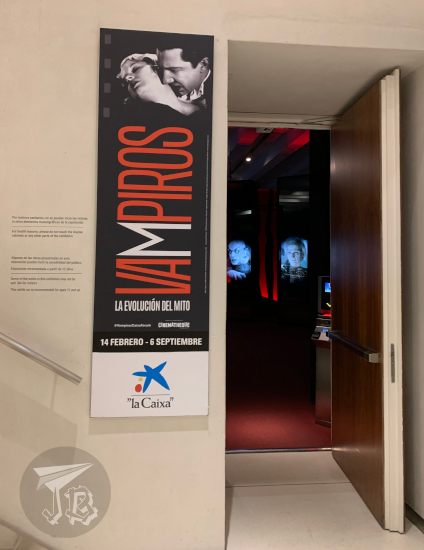
All in all I got the impression that the exhibit lacked ‘the real thing’ and abused the film montages. I was expecting a few more props and less bits of films which… after all I’ve seen most (≧▽≦). The truth is that the myth of the vampire starts much earlier than the “Medieval” vampire featured in the Romantic fantasies, and can be traced to early succubi or the Lamia myths in Ancient Greece if you think about Western Culture alone. The Romantic and Victorian writers just made the myth cool as it was once more popular due to a sort of “vampire hysteria” that crossed the Balkans the previous century – that’s probably the main reason why Bram Stoker chose the figure of a Transylvanian warlord to create his character. But in the end it was a good way to break the activity fast.

Then we moved on to the next exhibition, Cámara y ciudad. La vida urbana en la fotografía y el cine, “Camera and the city: urban life in photography and the cinema” which… was okay, I guess. I guess I’m not a photography / video kind of person (≧▽≦).

After perusing the shop for a while, we moved to the cafeteria, where a “theme menu” had been designed. Let me detail that for you:

  • El frenesí vampírico / Vampire frenzy: virgin – I think – Bloody Mary
  • Estacas de la muerte / Death stakes: aubergine tempura with sweet and sour sauce
  • Reencarnación / Reincarnation: Goat cheese, sweet beet and raspberries salad
  • Inmortalidad / Immortality: Macerated sea bass with lime, orange, coriander, salt and pepper, with a side of mango and tortilla chips
  • Embalsamamiento / Embalmment: Duck magret with a red wine sauce and mushrooms
  • Drácula / Dracula: Crème anglaise, jelly and raspberry mousse.

Let me tell you, this was amazing – and fortunately the portions were small so the final amount was more than adequate.

It was a little later than 15:15 when we left the CaixaForum centre and headed off the Museo Nacional Thyssen-Bornemisza, the Thyssen-Bornemisza National Museum, a museum built from a noble family’s art collection which also hosts temporary exhibitions. The permanent exhibition is chronologically organised, and here are some of the pieces by famous artists: Rubens, Rembrandt, Van Gogh, Degas, El Greco, Tiziano… and hm… many very modern painters I… can’t understand.

Finally we decided to call it a day before people started coming out of work and leaving town so that we did not get into a traffic jam, and I am very proud of myself for taking the drive – which was my wee white whale for a while. I’ll see myself out now (≧▽≦)

Distance: Approx. 120 km driving; 6.08 km walking

Also, as an afterthought, I ordered the Vampire exhibition book online. I did not at first because I did not feel like carrying it around as it is thick. But they home-delivered and I actually saved 2.5 bucks?

PS: New logo! What do you think?

2nd January 2019: Jurassic and 19th Century Madrid (Spain)

I was in the middle of winter holidays and a couple of family members asked me if I had plans – I said I was getting tickets for a dinosaur exhibit in Madrid, and they jumped in. We made arrangements to head over there on the 2nd of January and spend the day in Madrid. I don’t think they really realised what it meant to be around me and the “terrible lizards” (≧▽≦). But off we went.

General entry ticket for 2nd January 2019

The Jurassic World: Exhibition was held in Madrid. The whole thing is organised in-verse, as if you actually visited the island.

Jurassic World the Exhibition logo and title

After you walk in, there is first a small introduction on the “boat” as you travel towards Isla Nublar. There you are given the instructions (mainly, keep your hands to yourself), the boat makes dock and you are let into the Park. Keeping in touch with the spirit of the films (not the book though *giggles*) there’s a Brachiosaurus there to greet you, just like the first animal you see in Isla Nublar (and later the last).

Pretencious gate with two columns on the side, reading Jurassic World. A brontosaurus head peers down at you

You also catch a glimpse of a Parasaurolophus.

The head of an herbivore dinosaur (parasaurolophus) peering through the bushes

Then you get to the “stables” where you get to see a Triceratops mama with her baby.

Mom and baby Triceratops behind a fence that reads Gentle giants petting zoo

Afterwards, there is a small room that represents the laboratory where the dinosaurs are made – I could have made it out with a critter but there were only baby Iguanodon.

Fake amber pieces and DNA extactor along with an incubator with eggs and baby dinosaurs

Next, you walk into a tiny museum with some fossil reproductions and actual scientific information…

Reproduction of carnivore dinosaurs skull and bones, along with the drawing of a huge T-rex fooot print drawn on the ground to compare it to a human one

… right before everything goes to hell and back when you’re shown a hologram of Owen Grady talking to his velociraptor Blue and you get a… guy in a velociraptor costume prancing around (≧▽≦).

Person disguised as a verlociraptor

The next room shows the Tyrannosaurus rex cage (by the way #TeamTRex here, in case you did not know) behind her cage, menacing and staring.

T-rex animatronic, showing the huge head behind a fence

The final room is another garden in which you get to see a Stegosaurus being stalked by the made-up Indominus rex.

Stegosaurus

Head of the Indominus rex, looking like it's stalking prey

And at the end of the exhibition, after the shop even, you find the velociraptors, which have apparently escaped and are ready to attack!

Jurassic world velociraptors on a wrecked crate

All in all, being the dinosaur geek I am, I had a blast. I’m not sure that my poor family members that had wanted to tag along with me knew what they were bargaining for (≧▽≦).

However, they were still willing to put up with my for a little longer, and together we drove off to the centre of Madrid, and somehow ended up at the Museo Cerralbo. They asked if there was something I wanted to see, and the Cerralbo Museum was running a couple of Japan-related specials I was curious about. The museum stands in the Palace of the same name, and it holds the collection of the late Marquis Cerralbo.

The museum is… crammed and chaotic, but interesting in its own way. It holds thousands of pieces, from worthless-looking mementos to priceless paintings by masters such as El Greco. Art experts say that the Cerralbo collection was the most valuable of its time.

Collage of cerralbo museum. A room with two samurai armous. A centrepiece made with swords. A long table, set, with chairs along and an ellaborate lamp hanging from the ceiling. The hall of the museum, with a staircase with an ellaborate balaustrade and a glass lamp hanging from the ceiling.

The museum was holding a designated route focused on the Japanese pieces it has, including samurai armours.

Collage of Asian and Japanese pieces of the museum: hars, a samurai armour, and an hexagonal carey box

Furthermore, there was an origami exhibition on the lower floor.

Origami pieces: a phoenix, a snake, an orca, corals, and a life-sized hippo

After the museum we sat down for lunch at a fusion Asian-Japanese restaurant, because the family members “wanted to try” – although they were rather scared of the food. Eventually they managed to enjoy it too, and even have seconds – however I needed to make a run to get my tablet serviced.

Lunch. Sushi, chicken skewers, rice dish and noodles dish

Once it was up and running, and family had come to find me, we walked towards the shopping centre in Principe Pío for dessert – yoghurt ice cream with berries and smarties. A great way to end the day!

An old station from iron architecture epoch repurposed into shopping centre

Frozen yoghurt with berries sauce and smarties