
It was ridiculously early in the day, but D****e and I were ready to go. Our first self-appointed destination in Vienna that morning was the historical Café Sacher for breakfast. The café is located within the no-less-historical Hotel Sacher. The hotel’s origins can be traced back to an actual confectioner, hence the eventual rise to fame of the Sacher-torte – a chocolate cake with a thin layer of apricot jam in the middle and coated in dark chocolate icing, served with a side of unsweetened whipped cream.
The Hotel Sacher was founded in 1876, and under the management of Anna Sacher, it became the most exclusive hotel in the world. Originally, it catered exclusively to the aristocracy. In the 1930s, it changed hands and was completely renovated, but then WWII hit. It would not be until the late 1980s that the hotel recovered its status as a luxury destination. Between 2005 and 2012, the hotel was refurbished and modernised, with only 10 weeks of downtime throughout the period. Since then, smaller works have been carried out, and the brand has expanded to other cities in Austria. Currently, the Vienna establishment currently has 152 rooms and suites, with the lowest category I found being a “junior suite”, and prices that range from 500 to 10,000 € a night.
Throughout its history, the hotel has battled other confectionery creators to hold the rights to its original Sacher-torte. It is offered in the hotel cafés, shops, and can even be ordered online. It is given out as complimentary little cubes (Sacher Würfel) with some of the other dishes, too.
Though the Café Sacher queues can be insane, there was none at 7:55 when we walked in for breakfast. We had a packed day ahead of us, including a crossing a border, hence the early start!
I required coffee, of course, and I had been torn between two specialities. In the end, I chose the Einspänner (Double espresso topped with whipped cream, served in a served in a tall glass with a handle), because it had more coffee in it. I wanted something substantial and savoury, and though I considered the eggs, something else caught my eye – Sourdough bread with whipped butter and chives (Sauerteigbrot, Aufgeschlagene Butter und Schnittlauch). I also ordered the Sacher-torte. After a while, our waiter came to check on us and I… had finished my Einspänner… so I ordered myself a Sacher Melange too (Single espresso with steamed milk and whipped cream). Caffeine was not loading…
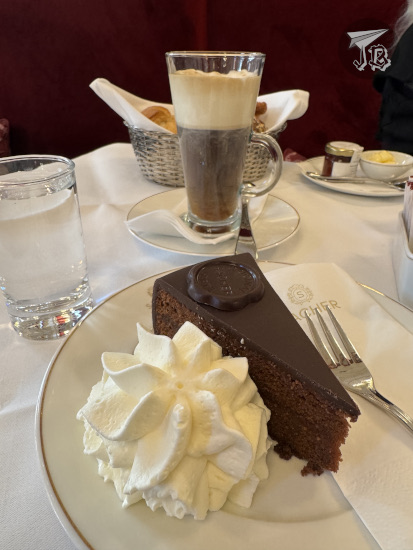
Breakfast was amazing and customer service exquisite. D****e had been there the day before and they remembered her! The maître gifted us a Sacher pen each, and I was ecstatic – laugh, but somehow I ended up with a… minishrine of Sacher mementos from this trip… It’s almost embarrassing.
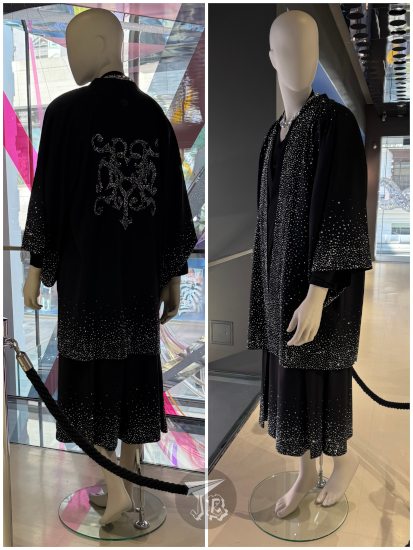
We still had some time before our train, so instead of heading directly to the station, we popped into the Swarovski flagship shop for a bit. Aside from the toilets, there was a connection with Hyde, too. He had his hat for the [Inside] tour made by them, along with the microphone stand he was going to use on the Konzerthaus concert. Furthermore, he had “designed” a piece of clothing to wear for some promotional activities that featured some 2,000 crystals. It was, to commemorate the event, exhibited in the shop. There were also necklaces described as part of the collaborations, priced at around 600 €. And, unrelated, they also had little boxes full of crystals of hundreds of colours. I decided to get one of those – don’t judge me, I could afford them (I think they were rainbow coloured because Pride was coming?).
We walked towards Vienna Central Station Wien Hauptbahnhof to board a train to Bratislava, the capital of the neighbouring country of Slovakia [Slovenská republika]. Slovakia and the Czech Republic used to be one country before the Velvet Divorce (1992), one of the few bloodless disintegrations of the old Europe towards the end of the 20th century. When the two countries split up, Bratislava took over as capital of Slovakia, while Prague, the capital of the dissolving unit, remained as such for the Czech Republic. Hence, Bratislava gives off a bit of a “new” vibe, despite having existed for over a thousand years. The train ride from Vienna barely takes an hour (50 km distance), and you really don’t get to see / feel / realise when you cross the border between countries, which feels weirdly amazing and sad at the same time. The only notice you get is that you must bring printed tickets if you buy them on the internet, digital ones are not accepted – but there is no gate control to access the trains at Vienna Central. You have to love the presumption of honesty there.
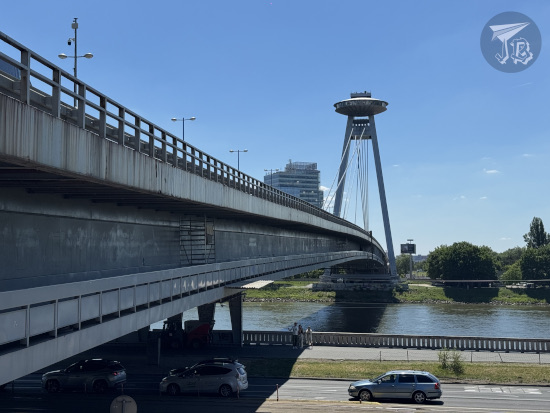
We reached Bratislava Petržalka (the central station, though it is on the outskirts of town). If Prague was scarred by WWII, it seems that Bratislava was most damaged by its time as part of the Eastern Bloc, when the Communist Party reached power in 1948. During the years of Communism, a great deal of the historical centre, including the Jewish quarter, was demolished in order to modernise the city – and actually to build one bridge, which we crossed on our walk from the station to the downtown area. This is the Most Slovenského národného povstania (Bridge of the Slovak National Uprising), most commonly known as the UFO bridge, because of the flying-saucer-shaped restaurant and observation deck it features. Over 400 metres long, it was quite a walk in order to cross over the Danube.
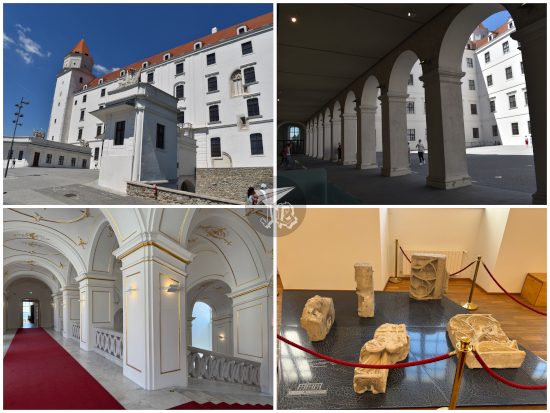
Once on the correct bank of the river, we undertook the climb to the Castle Bratislavský hrad, which we could visit for half price because they were celebrating Museum Day. The castle may have been built around 4,500 years ago, but the oldest remaining areas date back from the 9th century. Most of what can be seen today is Baroque, erected in the 18th century under the reign of Maria Theresa (Holy Roman Empress between 1745 and 1765 and Queen of Bohemia between 1740 and 1780, except for 1742 and 1743), and restored in the 20th century. Today, the castle is the site of the SNM Museum of History Historické múzeum.
We visited the palace, which gave us access to the courtyard, the building itself – wide staircases decorated with golden stucco – the treasury, and several historical exhibitions, including the religious art that used to be found in the Medieval chapel. We climbed up to the Queen’s Tower – a bit of a mistake on my part, the stairs down made me dizzy and queasy – and the Romanesque foundations, including a deep well. On our way out we stopped by the Baroque Garden.
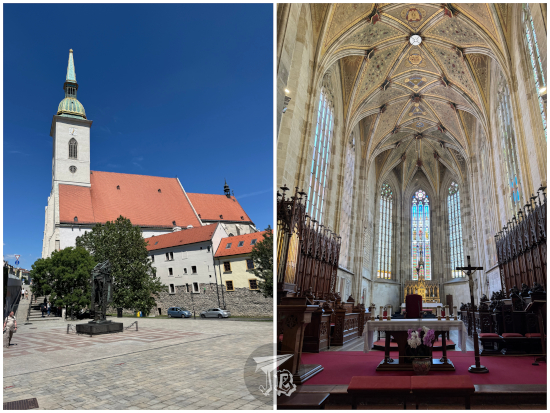
As we headed towards the city centre, we stopped by St Martin’s Cathedral Katedrála svätého Martina. The interior and the exterior clashed in my mind. The outer area was white with a terracota-coloured tiled roof, and a metallic spire atop the tower. The interior is lined with gothic arches built in stone, dating from 1311. The ceiling is decorated with golden details, and the windows behind the altar let beautiful light in. When we left the cathedral, through a different entrance, I saw that the other side of the church features stonework indeed. So it seems that the angle matters a lot!
A few minutes later we were in Ventúrska, the main street of the historical centre, to have lunch. We ended up getting an outside table at a small place called Loclub Food & Drink. We shared a bruschetta with avocado (two pieces of bread, tomatoes, olive oil, red onion, garlic, basil pesto, avocado) and Bryndzové pirohy, sheep cheese pierogi (potato dumplings with cheese, sour cream, and fried bacon). I did not feel like food, but I think I was less light-headed after it, and my stomach had settled.
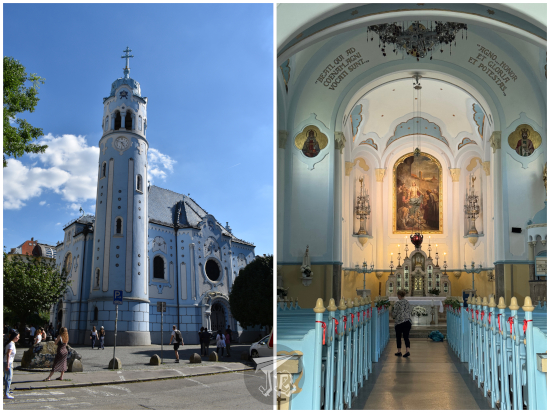
We continued on the street and we got to Michalská brána (Michael’s Gate), which during Medieval times was one of the city gates. The building that stands today is a Baroque reconstruction. We did not go in, but turned at the corner and undid a bit of our way until we got to Main Square Hlavné námestie, which holds palaces, the town hall, statues, a fountain and lots of overheated tourists searching for a drink or an ice cream. We were on our search for Farský kostol sv. Alžbety, Church of Saint Elizabeth, better known as the Blue Church. Its main feature is… being baby blue. It’s built in a style I had never heard about, Hungarian Secession, designed by Edmin Lechner in the early 20th century. It was indeed… very blue. It reminded me of kids’ toys.
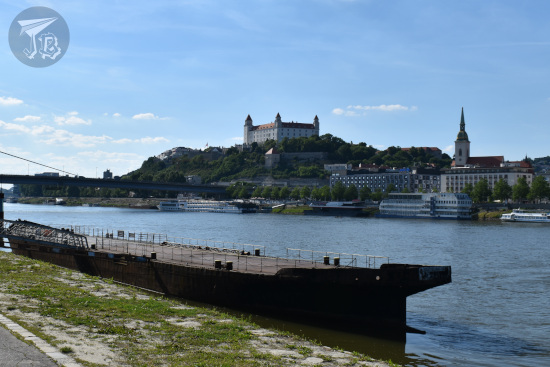
We slowly made our way back towards the station, through the iron bridge Starý most and the park Sad Janka Král’a along the Danube, which led to some amazing views of the Castle Bratislavský hrad.
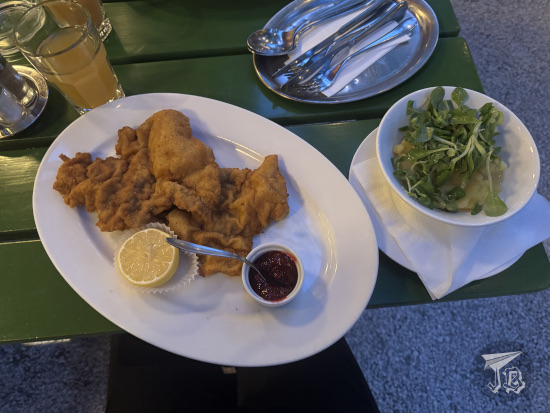
We took the train back to Austria and left Slovakia behind. That evening we had a reservation for dinner at the beer garden Glacis Beisl in Vienna. The place was packed and loud, but the food was good. The one upside of the heatwave is that dining outside felt really nice. I decided to treat myself to my own Schnitzel – Original Wiener Schnitzel from Austrian milk-fed veal with potato and coleslaw salad and cranberries (Original Wiener Schnitzel vom österreichischen Milchkalb mit Erdäpfel-Vogerl-Salat und Preiselbeeren) and an apple juice drink, which came in a pint glass – awesome.
You’d think we would be turning in afterwards, right? Wrong. D****e had also arranged to meet another friend for a drink afterwards, so we headed out towards Selleny’s Bar, adjacent to the Hilton. I had a very lemony (and overpriced) lemonade there. Finally, we headed back to the hotel for a shower and bed, but once more I did not sleep much.

