
Spain celebrates father’s day on the 19th of March (Saint Joseph’s Day), but my parents were scheduled to be out of town. As a family, we’ve recently decided to try and repurpose Christmas presents into trips and smaller celebrations into experiences. My sibling had a look at different options and after weeding them out, we presented our father with a couple of ideas. When he decided to “leave it to us”, I suggested a closed-menu brunch with a singer, which felt different enough from the one we had done for my sibling’s birthday.
Thus, we booked a table at Gran Hotel Inglés (Grand English Hotel) for their Show brunch at 13:30, an hour after it had started. Not the time I would have chosen for a “brunch”, but I can’t get my family off the Spanish timetables. We took a train to Madrid and arrived with an hour’s time. It was early, but it gave us some wiggle space in case there were railway delays. I had proposed just showing up at the hotel, but the family did not agree, so we started wandering around. We ended up at the nougat artisan Casa Mira, a patisserie established in 1842, distinguished with the honour of being a “royal supplier”, meaning the Royal Palace used to buy from them. We ended up heading towards Gran Hotel Inglés around 13:10.
Established in 1886, Gran Hotel Inglés is considered the oldest hotel in Madrid. Other historical “firsts” include being the first hotel with its own restaurant, and one of the first buildings to use electric lights in the city. It was opened by businessman Agustín Ibarra, who by then already owned a famous café. His vision was offering high-class hospitality and lodging at European levels – a hotel with a restaurant might something normal today, but in the 19th century, Spain was considered an “exotic and slightly dangerous” country to travel to – meaning “uncivilised” in the Grand Tour mentality. Part of the marketing included every room having both cold and hot running water, phone and heating. Latest technology and comfort at the time!
The hotel became popular amongst intellectuals, both Spanish and international, from Valle-Inclán to Virgina Woolf. However, as many things did, its popularity faded away during the 20th century, what with the two World Wars and the Spanish Civil War and subsequent dictatorship making luxury… well, unaffordable. The hotel reopened in 2018 as a five-star member of the Hidden Hotel brand, a high-end hotel cartel that specialises in luxurious hotels in heritage buildings.
The café / restaurant area in the hotel is called LobbyTo, a pun between the word lobby and a reference to lobo, Spanish for wolf, because the street it stands on used to be called that. Even if we were a bit early, the table was ready for us. The “show” had already started – a lone male singer with a boom box of sorts, singing classics in a sultry voice, from Disney to Oasis. He managed okay in Spanish, but his English was lacking. He did have the voice to sing almost non-stop for three hours though.
The first impression I got when I walked into the area was a definite “whoops”. The table next to us had a small dog with them – my family is not too keen on pet the pet-friendly fad. I did my best to block view of the animal – fortunately, although spoilt as hell (at one point it ended on its master’s lap, cuddled in a napkin), it remained quiet and did not bother us. For a second, I thought that we would turn around and leave. Fortunately, my father did not notice, and we manoeuvred so he was sitting the farthest away from the critter.
The menu was pretty much closed, with just a couple of choices to make. It started with a juice – since I had studied the menu in advance, I knew I wanted the Antioxidante drink, made with lots of things ending in “berry”. Not that much of a strong flavour, but nice nonetheless.
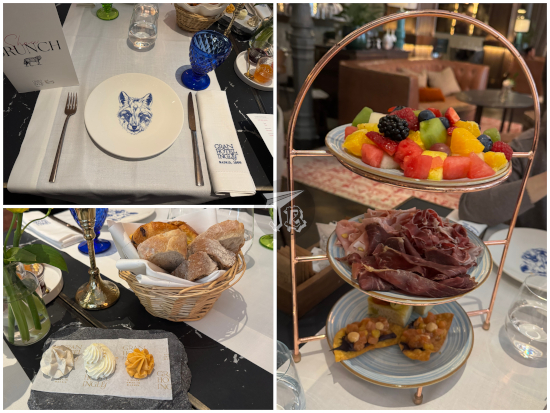
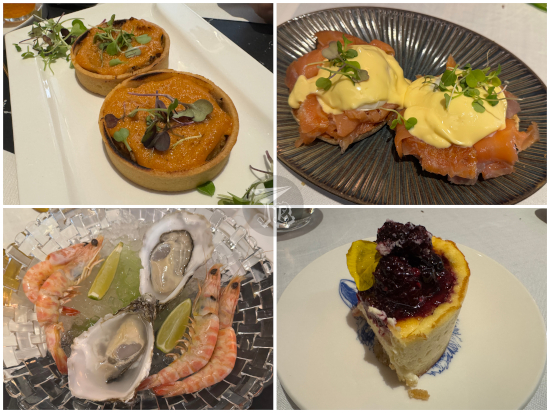
The first dish was already waiting for us at the table when we arrived – Assortment of bread & pastries accompanied with grated tomato, homemade jams and butters (Surtido de pan & bollería, acompañado con tomate rallado, mermeladas y mantequillas caseras). There was actual bread, pastries, a croissant or two, way too little tomato, bitter orange marmalade, strawberry jam and three types of butter with slightly different colours and textures. Then came the tray tower – two towers for four people with the first set of appetisers. The lowest plate contained the seafood snacks: Salmon and Mango Tartar Taco (Taco de tartar de salmón y mango) and Tomato focaccia with homemade pesto and smoked sardine (Focaccia de tomate con pesto casero y sardina ahumada). Before we had even had the time to start on that, an independent plate with the warm Spider crab Tartlet with king prawn velouté (Tartaleta de txangurro y velouté de carabineros) was brought.
Back to the trays, the middle was a Selection of national cured meats and cheeses: Iberian ham, Italian mortadella and a Spanish smoked cured beef named cecina (Selection of national cured meats and cheeses), which unfortunately lacked any cheese. The upper serving was a Seasonal fruit bowl (Bowl de fruta de temporada), which included grapes, strawberries, blueberries, blackberries, and chunks of watermelon, pineapple, orange and kiwi.
But, this was not the end! Next came another plate of seafood, with a Gillardeau Oyster No. 5 (Ostra Gillardeau Nº 5) and two striped prawns (Langostinos tigre). Gillardeau oysters are supposed to be amongst the best in the world. They are farmed by the Gillardeau family under the commercial name of Maison Gillardeau in Ireland, Normandy (France), and Portugal. The company was founded in 1898 and it has cultivated Pacific oysters (Crassostrea gigas) since then, with an extremely curated process that involves moving the oysters through different farming areas in different stages of their lives in order to improve meatiness and flavour. Number 5 identifies a small oyster (the smallest commercial size), between 30 and 45 grammes. It honestly did not feel small… I just wish I had hidden away a shell to see if it had really been engraved with a laser G, which is something the company claims to do to avoid counterfeiting. I might have accidentally stolen the menu though, I thought it was going to be a disposable one…
All this was the set part. There was still a main to choose, and dessert. For my main, I had ordered Eggs Benedict on English muffin with smoked salmon (Huevos Benedictinos sobre English muffin con salmón ahumado), because it is not brunch if you don’t have Eggs Benedict, or at least some kind of poached egg. There was a lot of salmon on them! So much fish made it a little tricky to let the muffin soak on the egg yolk, but they were really nice, I’m not going to complain!
Finally, we could go to the dessert display carrito de postres, a side stand full of confectioneries, to choose a sweet treat. I went with cheese cake, and a decaf latte on the side, to wash it down.
All in all, it was a good experience. I do think the wait staff was not as ready as they should be – a bit on the clumsy side. The entertainer was not top-notch either. He did not do badly though, and held his ground for three hours. He was far away enough so we could have a conversation along his singing, but he did not really add to the atmosphere much, except for him dedicating Happy Birthday to someone in another table.
It did draw my attention how pet-friendly the lobby was, with as many as four or five dogs inside at the same time. I might have to come back for afternoon tea at some point, as Gran Hotel Inglés has been in my radar for a while – however, the machine translation of the website had put me off…
After we had settled the bill, we had a nice walk towards the station to take the train back.

