28th May 2024: Architecture and a niche restaurant (Madrid, Spain)

I was talking to an acquaintance whose child likes superheroes – so does the acquaintance, actually – about Comic Planet. After exchanging experiences, they mentioned that their spouse also enjoyed another thematic restaurant, and I decided that it could be a fun thing to do – and since they don’t take reservations for one, I roped my sibling into tagging along. And of course, since we were braving the horribly-working trains, I felt we should fill the day out. We could not leave early in the morning as I would have liked because I had this stupid bureaucracy appointment I had to get out of the way first.

We arrived in Madrid around 12:30, and our first stop was the Casa de Correos, an iconic building in the middle of the square Puerta del Sol. I did not even know you could just visit that building, nor that they ran exhibitions. It was a cool opportunity to check it out. Furthermore, the exhibition was actually something that I was quite keen on – the architect Antonio Palacios, commemorating the 150th anniversary of his birth. The exhibition, called “the Metro architect” Antonio Palacios, el arquitecto de Metro, is part of the network of museums managed by the underground company Metro. It consists mostly of photographs, a few of them by photographer Luis Lladó, an original model of Palacio’s project to renovate Puerta del Sol, and a modern model of a now-lost station, including lifts. It was a bit underwhelming, but still worth it – and free, so it was good either way.

Exhibition Antonio Palacios El Arquitecto de Metro

Afterwards, we headed out to the restaurant for our 13:30 reservation. The place is called Los Secretos de Lola (Lola’s Secrets ). It used to be just another bistro-grill in a street full of them, but some time after the pandemic, it reinvented itself. The restaurant has slowly turned into a Mecca of childhood mementos – Disney princesses, teddy bears, Harry Potter, Funko Pops… and crazy fun references like a Möet&Chandon spray to clean the tables. A lot of the food comes in a special piece of dishware – most of it Disney, but I can’t tell whether it’s actually licenced or a bunch of knock-offs. It was hilarious anyway. Though I am not much of a Disney person (my sibling is), my favourite film of theirs would be Mulan, and I just about lost it laughing when I checked the menu beforehand – I saw that they served gyoza in a Mushu-like dish, and decided we needed to order that. I was open to negotiation about anything else, really, but not the gyoza. The pasta in the Lady and the Tramp dish was also hysterical, but I could do without.

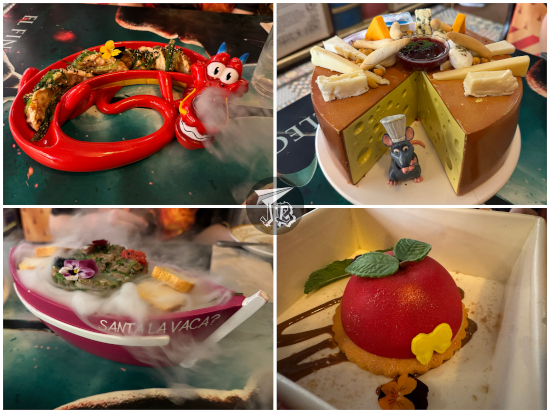
We reached the restaurant on point, and the owner directed us inside. We got a really cute Stitch table, but my sibling was not comfortable on high chairs, so we were accommodated at a Harry Potter one. We shared the non-negotiable teriyaki prawn-and-vegetable gyoza with wakame and bean sprouts, served on a Mushu-plate: Gyozas de gambas y vegetables al teriyaki, a plate of cheese Tabla de quesos variados (Blue cheese, Havarti, Mimolette, Emmental, Basilio, butter and breadsticks, on a Ratatouille’s Remy plate, which I had also found adorable) and a bluefin tuna tartar Tartar De Atún Rojo (on a little boat – I asked for no mango, and it was honoured; this was probably the weakest dish though). Finally, I tricked my sibling into a dessert called “Snowhite magic apple” Manzana Encantada Blanca Nieves: red chocolate capsule with white Kinder and a heart of caramel sauce, which came in an adorable “present box”.
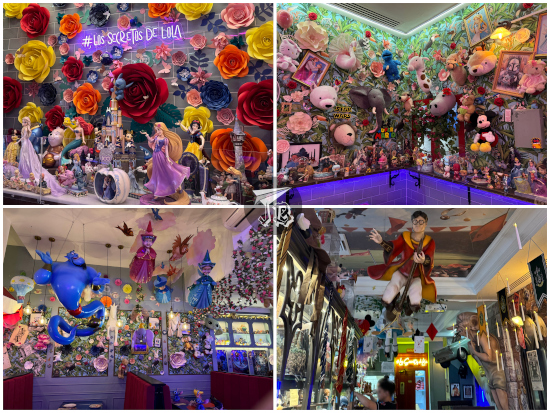
Decoration: Los Secretos de Lola

Food Los Secretos de Lola

The food was good, and I really like themed restaurants, I guess, even if they are not “my” theme. We did not stay for the two hours, I think we were on our way after an hour and a half – and when we asked for the check, it came in a Frozen music box. Then, we left towards Palacio de Cibeles, the old “communication palace” of Madrid, designed by Antonio Palacios and Joaquín Otamendi, and erected between 1907 and 1919. It is considered one of the first and most important Modernist buildings in Spain, constructed in biocalcarenite, with three stained-glass skylights, catwalks on the third floor, and a magnificent lookout on the rooftop. Part of the building is being used by the town hall, the other by the public entity CentroCentro, which runs cultural activities in the open spaces – mostly conferences and exhibitions.

Palacio de Cibeles

We arrived a bit before 16:00. Since we had a ticket for one of the exhibitions at 17:30, we checked whether we could find a ticket for the rooftop. We found available slots at 16:30, which was great. Before the viewpoint access, we had time to wander around. Most of the free exhibitions were of modern art, and not that interesting, and I was more focused on the building itself. There is one dedicated to the World Heritage site Paisaje de la Luz, explaining why the area deserves its UNESCO place.

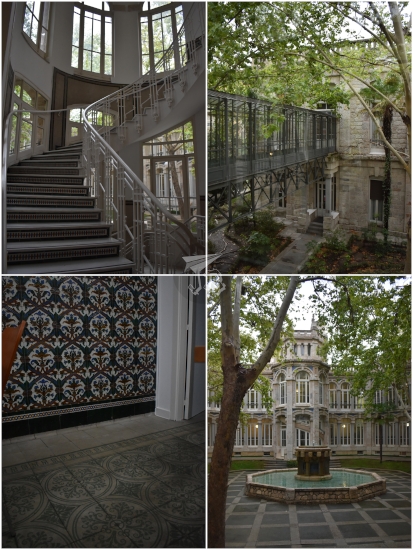
We found the staircase to one of the towers and we used it to move it through the different floors. It is a spiral staircase around the lift, with Palacios’ typical green tiles similar to the ones he used at Maudes hospital and Chamberí station. The catwalks were paved with glass tiles, and it was quite impressive above all. I loved the building, but after all, Palacios is one of my favourite architects, so it was to be expected.
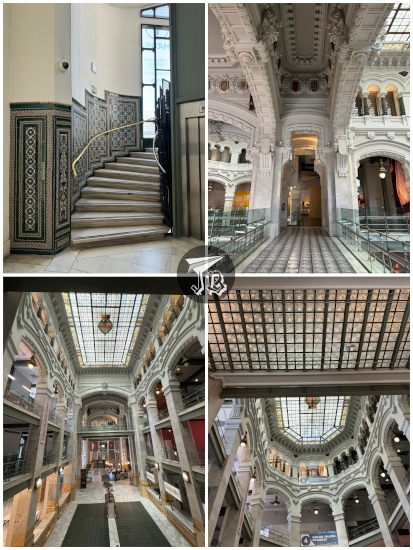
Inside Palacio de Cibeles

Then, we went up to the rooftop, where we could have a view of all of Madrid around us, most interestingly one of the main arteries of the city – Gran Vía. The weather was great, maybe a bit too bright. The turns were 30 minutes, but we were done in about half the time, after taking two walks around the middle tower.

Lookout on the rooftop of Palacio Cibeles

We went down and sat for a little before we headed down to the basement to see “Notre-Dame of Paris: The Augmented Exhibition” Notre-Dame de Paris: l’Exposition Augmentée. It was only 3€, so I was not expecting much, but it actually blew my mind.

The experience was created by the company Histovery, which specialises in “virtual exhibitions” through an interactive tablet called “HistoPad”. The Public Entity in Charge of the Conservation and Restoration of Notre-Dame de Paris cooperates with the event, and the beauty company l’Oreal is a sponsor. The exhibition (which is simultaneously running in several parts of the world) follows the history of the Parisian cathedral Notre-Dame de Paris – it starts with the 2019 fire, which is a bit heart-wrenching, and then it covers a few key moments in the history of the cathedral, using a mixture of written information, videographs and a “treasure hunt” where you have to find pieces of a puzzle hidden within the virtual information. This is done using the tablet to scan 21 “time portals” that take you to a particular point in history.

Around 1160. The Dream of a Builder. At that time, Bishop Maurice de Sully came up with the idea to build a new, better, cathedral in Paris. The previous one was a smaller, Romanesque building, but the goal was a larger, architecturally impressive building. In this room (the second, actually, but the first chronologically), you find out about the “treasure hunt” – you need to find a number of hidden “light spots” to build a “stained glass window”.

Around 1180. The Gothic choir. This makes a small overview of the kinds of workers that helped in the construction, the kinds of stones, building materials – quarries, forests. I was extremely disappointed at this point when I came across a dog in the virtual quarry, but the program did not let you pet it.

1241. The Holy Relics: Louis IX, the future Saint Louis, bought the Crown of Thrones in Jerusalem and brought it to Paris. There was a great procession into Notre-Dame, where the relics were to be kept. Here there’s a spectacular recreation of the gates with the original polychrome sculptures and decoration.

1645. The Royal Promise: Widowed Queen of France explained to her son, future Louis XIV, that he was to renovate the choir of the cathedral and build a new altar, dedicated to the virgin Mary. This was the original splendour of Notre-Dame, before the French revolution broke out – the church was one of the targets of the revolutionaries, and a lot of the art was damaged and / or destroyed.

1804. The Imperial Coronation. After the French Revolution, Napoleon crowned himself “Emperor”, but a very “equal and revolutionary” Emperor. He held a ceremony for himself in Notre-Dame, with the presence of the Pope and everyone who was anyone in the totally equal new society.

1857. The Spire. Enter Viollet-Le-Duc, a major architect and restorer in France’s 19th century, whose theories influenced countless others. He revalorised gothic style in the country, managing to turn it into a “national style”. The man had the goal to restore and create buildings in “the gothic style that would have been if the Medieval workers had had the technology he had access to”. Historians have not been kind to him, accusing him of “inventing” stuff instead of “restoring” but kudos to him, he managed to make a lot of buildings survive to our time. In Notre-Dame, he is responsible for putting back a lot of the sculptures that were destroyed during the French Revolution. He also built the spire that famously collapsed in the 2019 fire.

2019-2021 (first and last rooms). A description of the restoration works that have been happening in and outside the cathedral since the fire, with special attention to the Paris firefighters who worked the incident. There is a very interesting part about safely removing debris and the original scaffolding, and the fact that there was a lot of lead in the cathedral that the workers had to be safe around. They also homage the “vertical workers” who had to remove collapsed pieces from the ground… hanging from ropes.
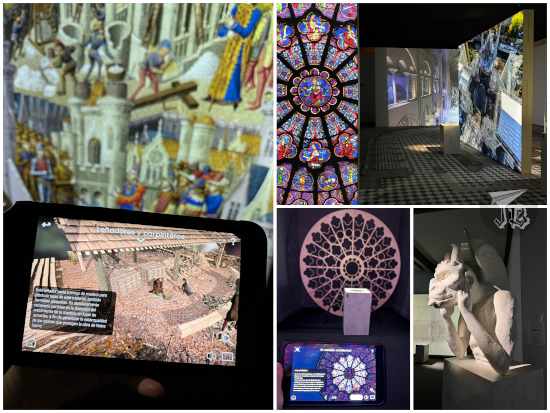
Notre-Dame the Augmented Exhibition

We completed the stained-glass window and signed up to get a diploma. The fun part is that most of the exhibition was not really… even physical. There were a few posters, a reproduction of one of the chimaeras, some small models… Nevertheless, it was extremely interesting – possibly the best “virtual exhibition” I’ve seen to date. The length of the experience is said to be 60-90 minutes… we stayed from 17:30 to 19:45, much longer than I had anticipated! Thus, we had to forfeit the last plan of the day to go back to the train system – which of course was experimenting delays. It took forever to get home. Because what else is new?

Time-traveller diploma after completing the treasure hunt in Notre-Dame the Augmented Exhibition

23rd October 2023: Happiness Museum and a former hospital, Madrid (Spain)

At the beginning of the year, I found out about an old hospital building turned office building that looked pretty interesting to visit in Madrid had opened up. It is a governmental office, so the visits are guided and supervised. Unfortunately, I was working an afternoon shift and they only run the visits on Mondays at 16:00. I signed up for the waiting list hoping for a summer visit, but they don’t run them in July and August. The September and early October visits did not work out either because I was in London. I finally managed a spot for the visit on the 16th of October, which was rescheduled for the 23rd. It’s not hardcore work season yet, so I was easy to rearrange meetings to have the day off.

Of course, it was a Monday, and Mondays are not Madrid’s best day, especially when the weather is not nice – most things are closed, and even though there are many neat parks, they usually close in the event of storms or winds. However, I almost accidentally discovered something potentially-fun and open, and I made plans with my sibling and nibling, who had a free morning.

I took a train with an hour’s berth of time, but then, because what else is new, there were train issues, and we were all delayed. I was stuck on my line for almost 40 minutes, and decided to walk instead of taking the connection, and they were waiting at their station for almost 30. If you are wondering why I keep taking the train, it is because during 2023 I can get a four-month unlimited pass for 10€, which beats any other transportation mode.

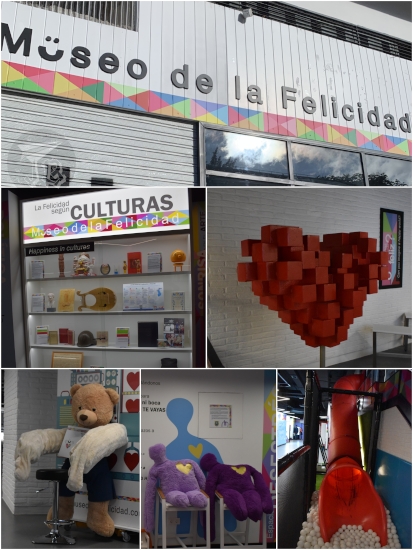
In the end, we luckily made it on time to a new photo-op place, which calls itself the Museum of Happiness Museo de la Felicidad MüF, with a little happy face on the u. It is a two-storey… silly-fun kind of place. Out of all the “instagrammable” places I’ve visited, I think this has been the weakest, as there were actually few things to actually do (too many touchscreens), and it kind of looked a bit… plain. Probably because it was Monday morning and there was no animation. I mean, it was fun, don’t get me wrong.

The first thing you see when you come in are two individual trampolines and a slide that ends in a ball pit. As I can’t jump, I skipped the trampoline. There is a small exhibition on lucky symbols, and another on things that make people happy. There is a small soundproof capsule where you are coached on how to laugh – weird – and a “team good people” that you can stand behind for a picture (the message being “kindness brings happiness”). As I was taking a photograph of my nibling, someone – who had just seen me show my ticket – decided I was the official museum photographer. I turned her down as nicely as I could. It was a day with a lot of comments about my camera.

The MüF has some screens and a VR experience, a “magic” trick on a screen, a big heart made of blocks and a hugging machine – apparently made to comfort autistic kids who benefit from deep pressure, but can’t deal with actual people hugging them. To go down from the second floor back to the first one, you can use the slide into the ball pit or the plain old stairs. That slide is steeper than it looks…

The basement has a few more things that you can touch, a ward with headphones and uppy songs, and the abrazadores (huggers), big plushies that are apparently designed to simulate hugs and grow people’s confidence. They were fuzzy and warm, but I am not sure how they can improve your mental health… There are a few confidence boosters, and a “five-senses happiness booth” where you get to eat chocolate, which is always good. In the end there were lots of silly giggling, because in the end that is why you go to places like that. There is also a “closet of truth” which you should not spoil for other people and helps you discover who is the most important person in your life.

Happiness Museum Madrid

After the museum we headed off for an early lunch. Despite being 300 km from the nearest port in the Mediterranean Sea, one of Madrid’s most famous meals is the calamari sandwich – bocadillo de calamares. A lot has been speculated about how this came to happen, though no one is really sure how the sandwich made its way into the local gastronomy throughout the 20th century. The squid is cut in rings, battered, and served within a small loaf of rustic bread similar to a baguette (pan de barra), an interesting combination at the very least.

The most famous joint to eat a calamari sandwich is Bar El Brillante. It might not be the best, and it quite surely is not the friendliest, but it is the iconic place for it, which actually makes it a tourist spot. The bar was established in the 1950s and it is a family company, the current owner being the third generation. They do not care much about customer loyalty as their business is based on the “novelty” and the “being a must do in Madrid” since the 90s – or maybe they’re just nice to regulars? I for one I’m open to try thebocadillo de calamares again, but not the place. The staff was unhelpful and took forever to clear the tables, which led to a lot of… hm… “birdwatching” as pigeons and sparrows helped themselves to leftovers.

Calamari Sandwich at El Brillante

We separated after lunch and ice-cream, and I continued alone towards the Chamberí district, which at the beginning of the 20th century was the outskirts of Madrid. There, philanthropist Dolores Romero Arano commissioned architect Antonio Palacios to build a hospital for labourers: Hospital de Jornaleros, known today as Hospital de Maudes. During that time, it was typical that a hospital had a “target patient”. In this case, it was male workers from the newly industrialised city who were not infectious or incurable – sort of a trauma unit, early-20th-century style. They took in labourers that could be cured, nursed them back to health, and released in “perfect working conditions”. Considering, of course, that the hospital opened in 1916.

For the building, Antonio Palacios chose a cross layout with a hall on one side and a church on the opposite one and two smaller buildings to complete the symmetry. He used Francisco Zuloaga’s ceramics for decoration until money ran out, and aimed for lots of light and open spaces. There are two types of decorative ceramics on the outside: water drops which imitate waves, and broken tile mosaics (Trencadís, a technique favoured by Antoni Gaudí). Palacios even built lifts of sorts to take patients to the roofs of the wards. The hospital worked for its intended purpose until the Civil War broke out and it became a military one. It was eventually abandoned and derelict during the following years until it was bought and restored by the local government in the late 20th century.

All this was explained to us during a 45 minute talk for an hour-and-a-half visit, as we stood in the hallway – which is actually in the basement floor. I arrived about 15:50 for the 16:00 visit, gave my name and ID and sat to wait. We had to go through metal detector and X-ray before the visit started – there is a volunteer guide from a retiree association and an actual worker to chaperone (governmental workers do not work afternoons in summer, which explained then why there had not been visits during that period as I had hoped for). Once the “introduction” was over, we finally got to see what I wanted to see – the building itself. Unfortunately, as the guide prattled on and on inside, it had started raining, so we could not go out to the patio, nor barely see the outside. That was disappointing – I mean, I’m all in for introductions and historical contexts but this is my problem with guided visits, it is just too much talking and too little visiting.

As we walked into the inside of the building, we were pointed out to the ceramics on the walls. Then, the tunnel that connected the hospital with the morgue – which was one of the outer minor buildings. We went up using one of the decorative stairs and we finally arrived at the ground floor of the crossing point of the wards. The centre of the structure is the octagonal patio with the fountain in the middle. As people saw me taking photographs with the camera – I had asked for permission beforehand – they decided I was either a journalist or the official photographer. It got annoying at the fourth or fifth time I was asked or someone made a comment / joke about me photographing them. Which I was very careful not to, even if they keep walking into my field of view.

Maudes Laborers Hospital exterior

The main material of the building is white limestone, which both contributes to the building’s luminosity and it’s common in Palacio’s design. His likings are also shown in the green colour of the interior tiles, which are very similar to the ones in the ghost station of Chamberí. The tiles all along the corridors are decorated and some of them feature heraldic symbols. We got to snoop around the cafeteria, one of the few areas that still features the original floor, since most of the flooring was too damaged to be restored.

The central area surrounding the patio is also octagonal, full of ground-to-ceiling windows. From one side of the corridor to the other and through the patio you can even seethe main staircase that we used to access the second floor behind the windows. Once on the second floor, we crossed the metal bridge that separates the main building from one of the accessory constructions, where the external consultation rooms used to be. Finally, we went downstairs again, walked around the patio and crossed over to the former operating theatres (the above-ground area of the morgue), which are now being transformed into an exhibition room.

Maudes Laborers Hospital interior

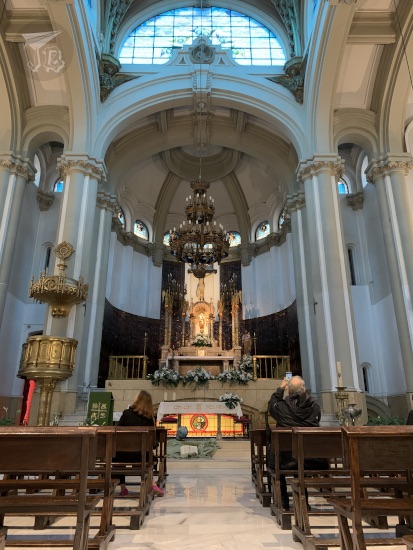
By the time the visit was over, it was raining heavily, but I still had the time to visit the in-hospital church Santa María del Silencio, Our Lady of Silence, which is the parish of the Madrid deaf and hard-of-hearing community. Lots of the architecture details are Modernist in style, including the iron fence and coloured glass ceiling.

Altarpiece in Our Lady of Silence

It was still raining cats and dogs when I left, so I forsook the idea of walking around the building to take pictures of the main hospital entrance, I just crossed the street to head to the train station. After aquaplaning on the square to get in, I had to wait about 50 minutes for a train, as the morning breakdown was still causing delays. And of course, when the train came it had already stopped raining.

Maudes Laborers Hospital and Our Lady of Silence from the outside

It was a nice day out, with great company and lots of laughs. Food was okay, the hospital building was amazing, the guide not so much. And the weather… very… autumn-ly.

5th April 2023: The ghost station of Chamberí (Madrid, Spain)

Perusing the web for something – I can’t even remember what – I came across one of those things that I had discovered a long time ago, then forgotten because life is hectic and so (read: Covid happened). In Madrid, there an underground ghost station, one that has not changed since the 1960s. Well, sort of – it was closed, then restored, and finally turned into a museum. Anyway, somehow accidentally, I ended up securing a free ticket to visit it during Easter break, so there I went. I decided to round up the trip with a fancy lunch in a place I also wanted to visit.

The Madrid underground system Metro de Madrid was the third underground line to open in Europe, after Moscow and London. It ran a little short of 3.5 km, with eight stations, when King Alfonso XIII inaugurated it in October 1919. Subsequent ampliations and renovations of the line were carried out until it reached its current 24 km and 33 stations (plus twelve more lines). The city expanded, its population increased, and underground trains grew with both, going from four to six carriages in the 1960s. The stations were renovated to fit the new, longer trains. Most of them. The ampliations of the stations of Bilbao and Iglesia made it inefficient to do the same with the stop that lay in-between – Chamberí. Thus, this station was locked down – and bricked off – in 1966.

The city forgot about the station’s existence for decades, until in the early 2000s, it was turned into part of the Underground’s museum network Museos de Metro de Madrid or Andén 0. Today, Estación de Chamberí can be visited for free, but only under reservation. Pre-pandemic, I looked into it a few times, and never found a spot, then the whole thing slipped my mind, until I relearnt about it, and lucked out.

I took the train to Madrid and walked from Recoletos to the square where the station was built Plaza de Chamberí. The original entrance has long disappeared, so the underground area is accessed through an ugly metal kiosk and a spiral staircase. However, the original station looks completely different. It was designed by Antonio Palacios (1878 – 1945), a Spanish urbanist and architect with a very recognisable style, whose most important works still stand in Madrid (such as the Círculo de Bellas Artes and Palacio de Comunicaciones). My entry slot was 11:30, and I arrived with plenty of time – trains have been unreliable lately so I gave myself a wide margin. When most of the group had arrived, we went down the modern stairs that yields to the old hall. Characteristic white tiles are laid along the access tunnel that leads to the original ticketing stands and the exit control. The station used to have a skylight, now closed off. The original stairs and maps still stand, along the Metro logo – though everything has been adapted for wheelchair-users.

Ghost Station of Chamberí. Entrance corridor and old ticketing booths

The group comprised 25 people, with a surprising amount of non-Spanish speakers – at least seven, who of course did not care about the guide’s explanation, which was little more than the Wikipedia page (so I guess anyone can take the visit. Print out the wiki and read along). There were families with kids who tried to yell over anything the guide said. Furthermore, underground trains still run through the station, which make for cool pictures, but their six-minute frequency drowns all the given explanations. It was hard to actually get into the “ghost station” mood.

Estación de Chamberí does look really cool though. Unfortunately, glass panels separate the platform from the tracks – they are dirty and get in the way of pictures of the other side of the platform. However, it was interesting to see the old advertisement mosaics – they used to be painted on tiles, and built into the walls themselves, and surrounded by very cool darker slabs with metallic tint. The visit takes about 40 minutes, and on the way out, you get to go through the old ticket gates, which have a very ingenious way of opening – you step on the little platform in front of them, which triggers a latch, and you can push the gate open. Really fun.

Ghost Station of Chamberí. Collage showing details - the name of the station on the old logo, tiles, the platform, and a train coming through

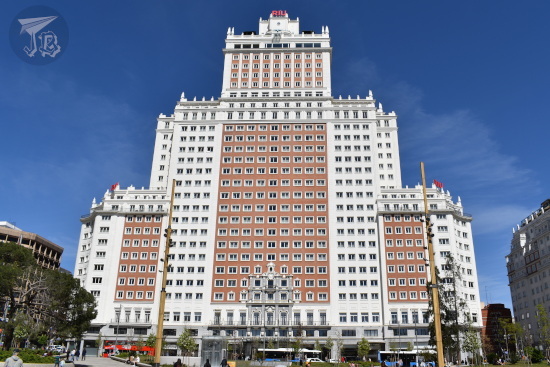
Truth be told, I had booked another free visit before lunch, but I realised I had messed up the location. I cancelled that one before entering the ghost station so the ticket would be available for someone else to use. And thus, I had a bit of time before my lunch reservation at 14:00. Since the weather was nice, I decided to walk to my next spot, and I spent the extra time – and some not-extra money – in one of the big bookshops in the centre of Madrid. At 13:50, I arrived at the back entrance of the hotel Hotel Riu Plaza España. This hotel opened in 2019 in a mid-20th century skyscraper (Edificio España) designed and engineered by brothers Julián and Jose María Otamendi. It is a 26-floor tower which was the highest building in the city at the time of its construction. Situated in the square called Plaza de España, it is close to the Royal Palace and Main Square.

Edificio España - tower like building in reddish and white brick, spanning 26 floors. It is the Riu hotel now.

The hotel has a large terrace on what would be the 27th floor, a rooftop bar and a restaurant or “gastro bar”, whatever the current buzz word means. Entry to the terrace is 10 € (5 € on a weekday), and food is not on the cheap side (everything around that area is stupidly expensive), but I found a deal at their Edén Gastro Bar: one-course lunch + drink + entry to the rooftop terrace for 30€ which allowed me to skip the queue.

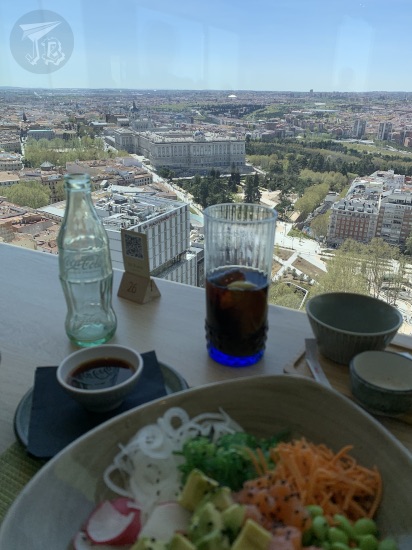
I did skip the “ticket-buying” line, but there is only one lift to go to the rooftop, so that queue I had to wait. I ended up reaching the restaurant around 14:10 or 14:15, and snagged a counter-with-a-view seat. I ordered a salmon poké and a drink, and got a few complimentary snacks and breadsticks to complete the meal.

Rooftop picture showing Madrid's Plaza de España and Royal Palace. Blurred in the foreground, lunch

Afterwards, I climbed the stairs to the terrace, officially called 360º Rooftop Bar, on the 27th floor. Music was blaring and there were tons of people drinking overpriced cocktails. The views were cool, sort of a once-in-a-lifetime thing that I don’t think I’d need again. The terrace has a small all-glass balcony that I did not wait the queue for, and a glass platform that would probably impress a bit more if the glass under your feet were clean(er). The terrace was completed by a tacky bull sculpture with metallic-gold testicles.

Madrid rooftop view - low houses with red brick roofs, and in the very background a few highrises

I walked around a couple of times, and then I headed back to the train station after calling it a day. I killed time reading one of the books I had just got, and time flew on the train. It was a nice little outing, but I did mess up with one of the locations, so it could have been more efficient. I guess not every little trip can work flawlessly…