27th August 2024: Arganzuela Greenhouse, British Cemetery and a ‘palaeontological site’, Madrid (Spain)

I have been feeling dizzy on and off these last few months, so I’m avoiding long drives – that has left me dependent on public transport, which is not too reliable. Thus, instead of all the hikes I wanted to take, I’ve been doing day trips to Madrid.

My first stop was in the district of Arganzuela. Although I’ve been to Matadero a few times before, I had never wandered to the side, where a boring-looking metal roof peeked over some trees. I recently discovered that I should have ventured beyond the brick walls that close the Matadero area. This building is called Arganzuela Crystal Palace Palacio de Cristal de la Arganzuela, and is an example of the wrought iron functional architecture of the early 20th century.

Invernadero de Arganzuela - structure

The building was designed by Luis Bellido y González and erected between 1908 and 1928 as a vegetable warehouse. In 1992, the building was remodelled – the wrought iron structure was consolidated and the original fibre cement panels were substituted by glass ones. The warehouse, 7,100 square metres, was divided into different sections, each one transformed into a different greenhouse: two for tropical plants, one for subtropical species, and the last one for desert plats and cacti. The centre has four long fountains with tiny sprouts and waterfalls. I expected a few plants to be in second bloom, but apparently that does not work for tropical or desert species?

Invernadero de Arganzuela - inside

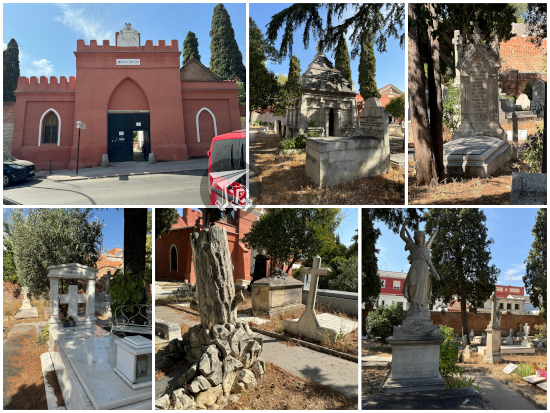
I then hopped onto the underground towards the district of Carabanchel, where I could visit an unusual place – the British Cemetery Cementerio Británico de Madrid. Around 1854, the British government bought the terrain with the intention to turn it into a cemetery, since during that time Catholic cemeteries did not accept interments from other denominations.

The burial ground hosts about 600 graves and about 1,000 tombs, most of them British citizens – but there are also Americans, Germans, Swiss and French, even some Spanish. Though it is now closed to new burials, in the 20th century it was open to non-Christians. Inscriptions on the markers are in Latin, English, French, German, Hebrew, Cyrillic and Spanish. Some of the people buried here include part of the Georgian royal family, historian Alice Bache Gould y Quincy, members of the fashion family Loewe, photographer Charles Clifford… There is also a memorial to the American soldiers who died in a plane accident. There is only one pantheon, belonging to the Bauer family – owners of an important commercial emporium in the 19th century.

British Cemetery Madrid

I have to say that the charm of a Victorian cemetery fades more than a little in the middle of the Spanish plateau’s scorching summer. Though there are several artistic markers – ever-present angels, a couple of tree trunks, and a very gothic grave – most of them are simple headstones with a cross or just a name. One of the graves asked a good question: If good things lasted forever, would we appreciate how precious they are? All in all, it was a quaint little cemetery that felt slightly out of place in the middle of Madrid.

Afterwards, I went back into the underground. The cemetery is a couple of stops away from Carpetana. On the connection, I got checked for a ticket, sort of – they were controlling that passengers had a valid ticket, and just as the train was arriving they waved me through, maybe not complaining about it and just looking for the card made me trustworthy or something? (For the record, I did have a ticket). Anyway, I reached my destination in about 10 minutes or so. When they were working on the Carpetana underground station, they found a few fossilised bones and jaws, and they have turned it into another of the spots of Museos de Metro de Madrid – palaeontological site Yacimiento Paleontológico de Carpetana. I saw reproductions a few mammal jaws and took a picture. Good thing I was close, this would not have warranted a trip from further away.

Reproduction of the prehistorical habitat of Carpetana

I had a reservation for late lunch, but I decided to cancel it. I wanted to check a shop for something I needed, and that would take me in the complete opposite direction from the restaurant. Instead, after the shop, I grabbed a Matcha Frappuchino and headed back to the train station to return home.

Starbucks Matcha Frapuccino with a lot of whipped cream

27th July 2024: Staying inside in Madrid’s heat (Spain)

I was so excited when I found tickets for the historical hall at Pacífico station that I did not stop to think I had booked for late July, at 16:00, in Madrid. The heat wave was an extra, but even without it, the Spanish central plateau is not precisely known for its mild summers. However, the hall only opens once a month, and not every month, and I had never been able to find a ticket on a weekend I could go, so honestly – when I saw these tickets, I did not think about the weather, just… that I could come.

The day came, and Madrid had a heat alert. It was around 37 ºC, and I thought I would stay inside, and just head out for the visit. Unfortunately, since trains are being horrible, I needed to take one with at least an hour’s berth to make sure I reached the underground station Estación de Pacífico. When I arrived, I looked around to finally realise that the hall was at the actual platform, warded off by a very modern nondescript door. I had brought a book to pass the time, because I knew I would either have a lot of time, or I would be stressed because the train was late. I found a bench and settled down to wait somewhere I could keep an eye on the door. Visitors are not directly admitted into the hall, but they are cleared at ticket control on the other side of the platform, then go back all the way to the entrance. In our case, we waited for a bit, and the guide decided to head through the platform right as a train arrived, so everything was full. Spanish logic.

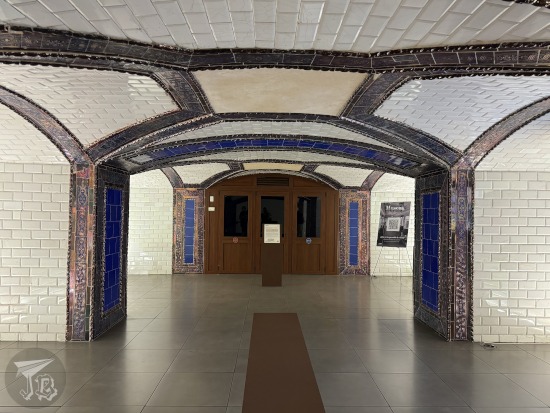
The former hall Vestíbulo de Pacífico is part of the network of Underground museums Museos de Metro de Madrid. Until it was walled off in 1966, it was the entrance to the station Estación de Pacífico, built in 1923 when the underground Line 1 was extended towards the south-west. The passengers climbed down a now-disappeared staircase and crossed the hall, which still had natural light. On the other side, there was some sort of metallic bridge with another set of stairs to access the platforms.

The station used to be part of a huge complex owned by Metro, which also comprised offices, control rooms, and the warehouse that housed the engines that created energy for the trains to run on. At the time, it was an unpopulated area, so land was cheaper. Today, most everything has been replaced by apartment buildings and only the station and the nearby Nave de Motores remain.

The whole complex was designed by architect Antonio Palacios, and the hall was built in white tiles with blue decoration – a homage to the Pacific Ocean, which gives the station its name. The hall is tiny by today’s standards, barely 119 square metres. It has three vaults that used to have skylights for the sun to light up the hall – now those are closed off as the street above them is busy. The station was renovated in the 60s so it could accommodate the longer trains, new accesses were built, and the hall closed down. That renovation was the same that made the station Estación de Chamberí close, and apparently another hall that has been uncovered in Ventas.

The hall was bricked away for almost half a century, until restoration work started in 2007. It took ten years, as budget was low and the process was labour intense – 60% of the hall had to be rebuilt. However, the final product is really good, you can see the newer tiles if you look for them, but the whole thing feels extremely well preserved. Even the staircase, which was built to access the hall after the iron bridge was destroyed, feels time-appropriate. A replica of the original doors was put up.

Pacífico Booking Hall

And right when I have seen all the five Underground museums that require appointment… I find out there is a passport of them – Pasaporte de Pasaporte de los Museos de Metro. Just my luck! Then again, maybe Metro will take these articles as proof of visit and backstamp me for them?

The visit took about one hour, then I rode the underground back towards Atocha, and bypassed it to the next station. I had decided to try my luck with the queue at modern art museum Museo Nacional Centro de Arte Reina Sofía, part of the national network of museums covered by my card. To be honest, I do not enjoy modern art that much, so I have been putting off this one visit. However, the museum holds a piece by Pablo Picasso that has become quite socially loaded – Picasso’s Guernica, which I have always thought I ought to see at least once.

Pablo Picasso (1881 – 1973) is considered one of the most important artists of the 20th century. He was co-inventor of collage, co-founder of Cubism, and inventor of the assemblage (basically, collage in 3D). He painted, sculpted, and made prints, ceramics and theatre sets. I have never connected much, if at all, with the kind of art he was making. I do not really understand the limits he broke, nor whatever he wanted to express. That is why I wanted to see this artwork in particular – to try to understand.

Arguably Picasso’s most famous painting is Guernica (1937). During the Spanish Civil War, German planes bombed the Basque town of Guernica, in the north of Spain, to aid the Nationalist army. The town was destroyed, and up to 300 people lost their lives – the raid opened the northern front for Franco to reach Bilbao. British reporter George Steer wrote a scoop on the event after he witnessed the destruction, and his reports made waves internationally. Picasso, who lived in France at the time, had been commissioned a piece of artwork for the Paris World’s Fair by the Republicans (at the time the rightful government of Spain). Upon reading the news, he scrapped his original idea and painted the Guernica instead.

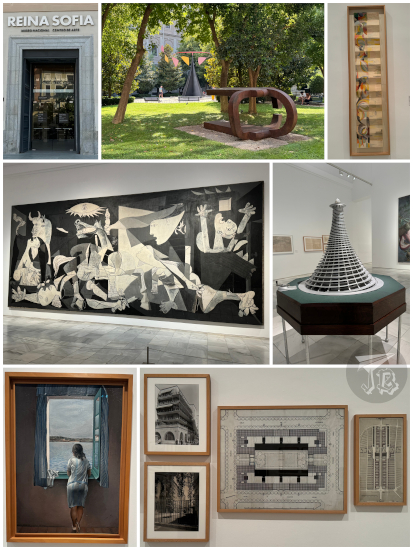
The painting is one of the most important artworks that the museum has. It is a huge piece, in black and white, showing the carnage. As most men were out in the battleground, the majority of victims were women and children – along with a dead soldier, a horse and a bull, most of the figures in the pairing represent women and horror. I honestly find the description of the painting more chilly that the artwork itself.

One kind of feels that the museum itself as built as a huge sarcophagus for the Guernica, and other pieces are there just to fill up the space. A sculpture by Eduardo Chillida is exhibited in the gardens. There is also a space about architecture, with blueprints and photographs, including artwork by Le Corbusier. Other artists whose work is shown include Salvador Dalí, Joan Miró, Alexander Calder… Actually, I enjoyed the museum more than I thought, as I expected only abstract art that I would not understand. I enjoyed the blueprints and photographs of buildings, and the actual building too.

Exhibits at Museum Reina Sofía

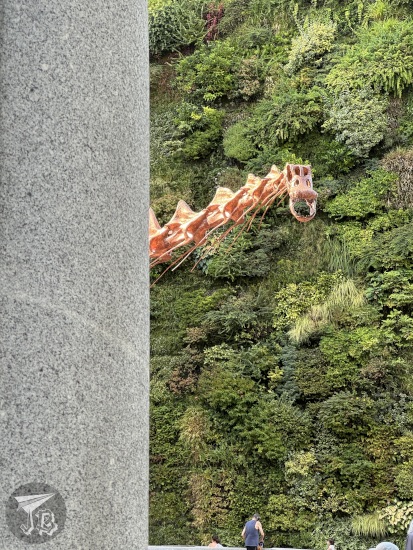
I then headed up Paseo del Prado to find one of the local cultural centres. I was ridiculously amused when I reached the corner where CaixaForum stands. I was on my phone, and when I looked up, I saw the Patagotitan “looking” at me. It gave me a laugh.

Patagotiatan at Caixaforum

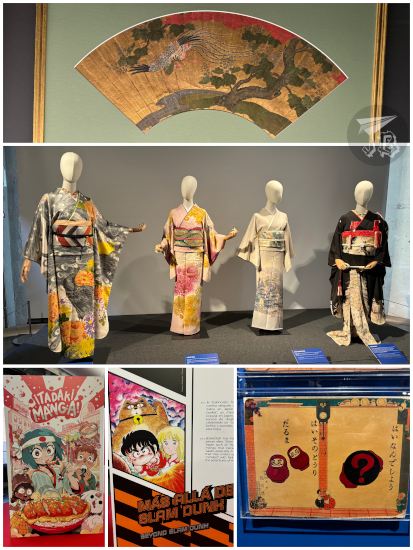
The cultural centre Serrería Belga is running a Japan-themed exhibit, divided in parts:

  • Kinpaku. Naturaleza, poder e imaginación en el arte japonés (Kinpaku: Nature, power and imagination in Japanese art): Kinpaku [金箔] refers to gold leaf artwork, often used in decoration in classical Japanese culture. A private collector has lent their items to exhibit – windscreens and fans, all painted in gold, so they can be enjoyed by everyone.
  • Kimono, identidad cambiante: un siglo a pie de calle (Kimono, changing identities: a century on the streets): Kimono [着物] is the traditional Japanese clothing – one that unlike many others is still common wear. There were twenty of these, including accessories.
  • Expokon: A series of panels discussing different hits in sports manga and derivatives.
  • Japan International Manga Award: Panels drawn by the Spanish artists who have won the awards in different years.
  • Kamishibai: Kamishibai [紙芝居] is (was) a form of Japanese street theatre using a small paper theatre with pictures to tell the stories. There were several sets of stories, some classical, some more modern.
  • Manga Kids Academy: A few panels showing Japanese school life through manga and anime.
  • Itadakimanga!: A series of panels showing different foods popular in manga and anime.
  • Gêmu: cultura visual y videojuego japonés (Gēmu: visual culture and Japanese video games): Some items regarding video games, and even a few arcade machines for playing.

Japanese exhibits at Serrería Belga

The exhibits were part of Madrid’s summer cultural program, which has named Japan “Guest Country”. They were a few cute little exhibits, and they were free too, so a good way to complete half a day trip. I headed back to the station afterwards, to wait for whichever train came, and I was lucky enough that one was there in a couple of minutes – I even found a good seat on my way back.

And I have finally seen the hall at Pacífico, which has been a goal since April 2023. Now I just have to figure out a way to obtain the passport and have it stamped…

6th July 2024: O fortuna! (Madrid, Spain)

A couple of days before going to London to see Kamijo, I found out that a local music non-profit was staging Carmina Burana by Carl Orff in Madrid. Buying tickets (for that, and the upcoming opera Madama Butterfly) broke havoc with my credit cards, but everything was eventually fixed – I think. It had me stressed at the beginning of that trip, but it seems to be finally fixed. Again. I did have to miss Swan Lake in London because the credit cards would not go through.

Anyway, I had my ticket and though I would have loved to spend the day out, I was too ridiculously tired to take a whole day of sightseeing. Furthermore, the place I wanted to have lunch out was not taking reservations since they broadcast sports, and there was some big match or another. Yes, I want to go somewhere that defines itself as a sports bar, but that’s a story for another day (like the time I thought I could go to a sports bar during the Olympics because “Oh, well, there’s nothing sporty going on, right?”).

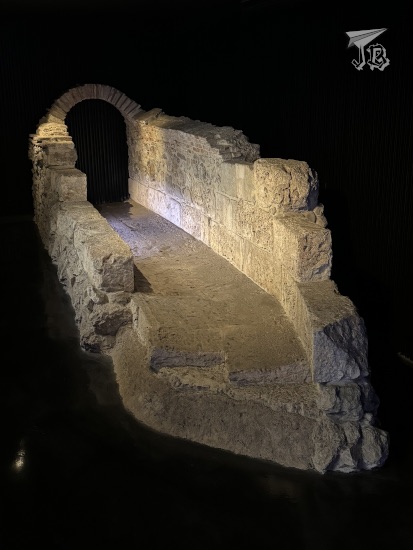
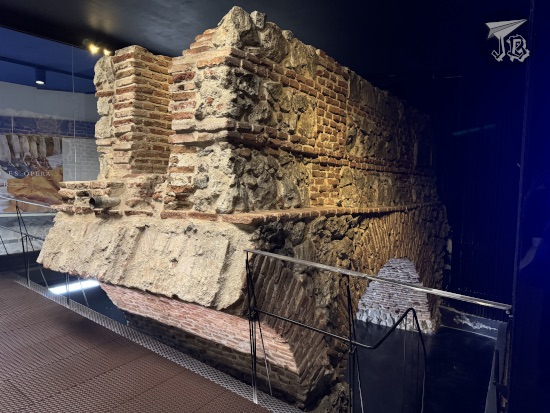
I thus decided to head off with a small pre-show plan, which turned out to be a great idea. When I alighted from the train station, the streets were clear for the Pride parade – I do not think I have ever seen the area surrounding Estación de Atocha so empty. I walked towards the theatre Teatro Real, but my first stop was the underground station of Opera, home to one of the Underground museums Museos de Metro de Madrid. Unlike the others, this is only tangentially related to the underground system itself – it is an archaeological museum, hosting an ancient fountain, part of an aqueduct, and the remains of a sewer.

King Felipe II made Madrid the capital of Spain in 1561, and aside of some brief periods of strife, it remains so to the present day. That has implied a lot of changes through history – among them, the destruction of the city walls, and the construction of an aqueduct to provide the city with water. When the court moved there, the villa of Madrid was little more than a village whose population skyrocketed in a couple of years. The new city needed services as it grew.

One of these was the fountain called Caños del Peral (literally something like “Peartree faucets”). The fountain was 34 metres long and it channelled water from the stream that ran down what is now Arenal Street. It was built in local limestone, had six faucets, and it probably was the largest fountain in the area where it was built in the late 1500s – the outskirts. Ironically, today it is quite close to the centre of the city, even the middle of Spain, the so-called “Zero Kilometre” in the square Puerta del Sol.

Fountain Caños del Peral

The fountain was destroyed during the reign of José I (Joseph Bonaparte, Napoleon’s brother, who was installed as king of Spain between 1808 and 1813). Caños del Peral, along with the buildings around the square, were demolished and used to fill the gorge that until then had separated Madrid in two. And in that filled gorge it was discovered in the early 2000s during works to refurbish the underground station of Ópera. Further works uncovered the sewer from the same period, a structure that channelled black waters away from the drinking streams for sanitation.

Sewer at el Arenal

The aqueduct Viaje de Amaniel was built around 1615 century to bring clean water to the Royal Palace, and with time it also supplied other properties. The infrastructure was heavily remodelled in the 18th century, after the Royal Palace was rebuilt into its current form after the fire that destroyed the original alcázar.

Section: Viaje de Amaniel

As I was coming out from the little museum and the underground system, I noticed a display reading that the underground / train station that I needed after the show was closed “until end of service”. Which was good to know beforehand, since I had time to replan my route – the trains were a mess in the evening due to Pride, and a few stations being closed off for crowd control. I grabbed a snack at the local Starbucks and headed into the theatre.

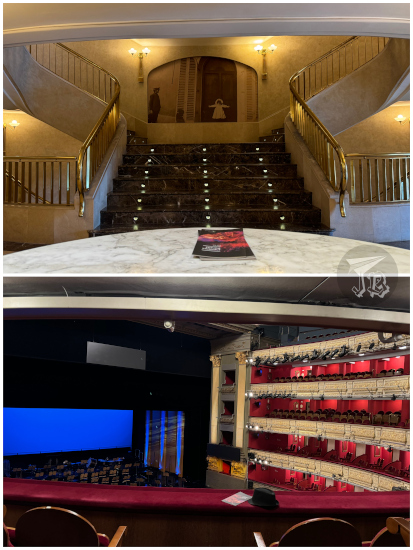
The Royal Opera of Madrid Teatro Real opened in 1850. It was originally designed by José Manuel González-Valcárcel, though it has been widely renovated, with the latest iteration dating from 1997. It is considered the most important venue for performing and musical arts in Spain – despite having been closed for decades at a time. Curiously, the theatre has the shape of a coffin – at first, I really thought that was my imagination, but apparently it is not only real but intentional.

Teatro Real: stairs and interior

I had found really good tickets, first floor next to the Royal Booth – for the same price, I would later get a fifth / sixth floor ticket for Madama Butterfly. The repertory had been put together by Fundación Excelentia, a non-profit foundation dedicated to promote and divulge lyrical heritage and musical values.

Carmina Burana Promo

Programme:
  First part:
  1. Beethoven: Egmont. Overture: Sostenuto, ma non troppo – Allegro
  2. Beethoven: Symphony No. 8 in F major, Op. 93
  Second Part:
  3. Carl Orff: Carmina Burana

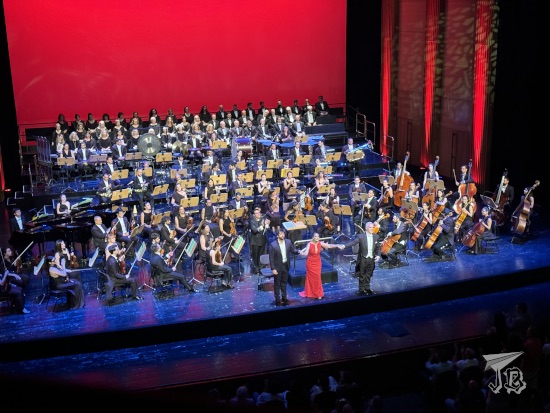
The show was conducted by Juan Pablo Valencia and interpreted by the orchestra Orquesta Clásica Santa Cecilia, the choir Sociedad Coral Excelentia de Madrid, soprano Rocío Martínez, baritone Manuel Mas and countertenor David Miranda.

Ludwig van Beethoven (1770? – 1827) is considered one of the most important figures in Western music. Born in Germany, his works bridged the classical and romantic periods in classical music. His works are amongst the most performed in the world, even though he began losing his hearing halfway through his career. He composed Egmont around 1810 for a full symphonic orchestra, and Symphony No. 8 in F major, Op. 93 in 1812. The Symphony has four movements: Allegro vivace e con brio (F major), Allegretto scherzando (B flat major), Tempo di menuetto (F major), and Allegro vivace (F major). I am not the biggest Beethoven fan, to be honest, but it was good. The conductor had a great time.

My main reason to be there was the second part of the show: Carmina Burana (Officially Carmina Burana: Cantiones profanae cantoribus et choris cantandae comitantibus instrumentis atque imaginibus magicis which translates from Latin as “Songs of Beuern: Secular songs for singers and choruses to be sung together with instruments and magical images”, quite a mouthful). German author Carl Orff (1895 – 1982) composed the cantata between 1935 and 1936. Most of the lyrics are in Latin, though there is a bit of old German and even old French. The cantata has 25 movements based on 24 Medieval poems, with the first and last movements being the same: O fortuna, which happens to be one of my favourite choir pieces ever. There is one instrumental-only piece, and all the others have vocals – for choir, soprano, baritone and countertenor.

The twenty-five movements are organised in sections, which are officially five, but divided as:

  • Fortuna Imperatrix Mundi (Fortune, empress of the world): 1. O fortuna (Oh, fortune), as I mentioned, I love this choir; 2. Fortune plango vulnera (Regret for the wounds of fortune).
  • I. Primo vere (In spring): 3. Veris leta facies (The joyous face of Spring); 4. Omnia Sol temperat (All the things are warmed by the sun); 5. Ecce gratum (Behold the welcome)
  • Uf dem anger (In the meadow): 6. Tanz (Dance), the only instrumental movement in the cantata; 7. Floret silva nobilis (The noble woods bloom); 8. Chramer, gip die varwe mir (Monger, give me a coloured paint); 9a Reie (Round dance); 9b Swaz hie gat umbe (Those who dance around); 9c Chume, chum, geselle min (Come my dear companion); 9d: Swaz hie gat umbe reprise; 10. Were diu werlt alle min (If the whole world were mine)
  • II. In taberna (In the tavern): 11. Estuans interius (Seething internally); 12. Olim lacus colueram (I once swam in lakes) – this is the piece the countertenor sang, and I am not completely sure the guy was drunk, or playing drunk. 13. Ego sum abbas (I am the abbot); 14. In taberna quando sumus (When we are in the tavern)
  • III. Cour d’amour: 15. Amor volat undique (Love flies everywhere) I have to admit that I did not love the soprano, who sang for the first time at this piece – she sang well, but too low, it was difficult to hear her at times; 16. Dies, nox et omnia (Day, night and everything); 17. Stetit puella (There stood a girl); 18. Circa mea pectora (Inside my chest). 19. Si puer cum puellula (If a boy with a girl). 20. Veni, veni, venias (Come, come, please come) – these are the same lyrics that Final Fantasy VII’s theme for Sephiroth, One-Winged Angel has, and looking at the translation, now I understand why it was never intended to be the psychotic mass-murderer theme… 21. In trutina (On the scales); 22. Tempus est iocundum (Time to jest); 23. Dulcissime (Sweetest lad)
  • Blanziflor et Helena (Blancheflour and Helen); this refers to the romance story of Blancheflour and to Helen of Troy. 24. Ave formosissima (Hail to the loveliest)
  • Fortuna Imperatrix Mundi: 25. O fortuna (Oh, fortune)

All in all, it was a great experience, and I had a privileged seat. I really enjoyed the show, as it was expected from something at the Teatro Real. The gentleman next to me slept through the first part and hummed along the second, which was weird. The soprano’s voice was too faint and she tended to sing towards the other side of the theatre, making it hard to hear her, but the baritone was good. The choir was fantastic, and the percussion musicians had a perfectly choreographed exchange of positions to play all the small parts which was really amusing to watch. Especially one who hugged the gong to quiet down the reverberations.

Artists after the Carmina Burana Show

When I came out the theatre, I headed off towards the underground system and reached the train station, which took over 20 minutes – normally, I would have just walked to Sol and take the first train there to connect faster, and stay within the same system. As Sol was closed, this was not an option. When I arrived at Atocha, the platform was almost overflowing as the trains were running with long delays. I think I took a train that should have passed through around 22:30… at 23:00. I was not sure everyone would fit in the train, to be honest. Good thing that they announced a second one for a few minutes later. I made it home past midnight, took a shower and crashed because it was hot – Spain in July. What else is new?

30th June 2024: Engines, illusions, history and tea (Madrid, Spain)

Since finding about my tea time outings, my sibling had been wanting to tag along to one. I was asked to organise something for the weekend that involved either Chinese hotpot or afternoon tea in Madrid. The hotpot place was booked out both days, but I found an afternoon tea opening on Sunday the 30th. I am too lazy to move out just for tea, so I organised a bit of a day out.

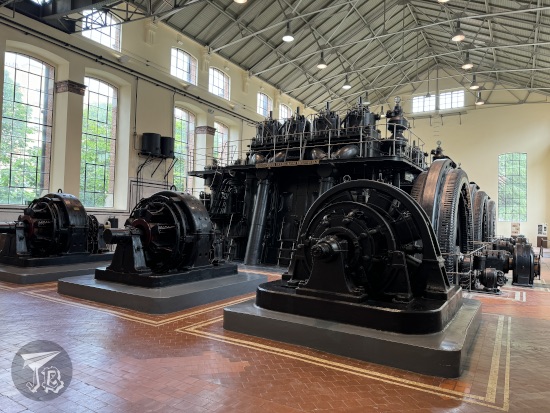
After an uneventful train ride, our first stop was at noon: Nave de Motores de Pacífico, the former energy centre that fed electricity to the original underground lines. Today, it is not in use and it has become part of the network of museums Museos Metro de Madrid. The warehouse was built by Antonio Palacios between 1922 and 1923 to home the diesel engines, transformers and fuel that single-handedly powered the underground system before the Spanish Civil War. The system was actually in place until 1972.

Warehouse containing the old underground engines

The building was erected in red brick, with white tiles inside, decorated with Palacio’s typical metallic green. The floors are ceramic tiles, and the engines are three monstrous vessel-powering pieces of engineering. These diesel engines created electricity, which then entered the transformers, and was sent to the power lines to feed the trains. At night, the excess was sold to the local street-light network.

Since we were going for afternoon tea to El Jardín de Orfila, where I have been before, I knew lunch was out of the question. However, we needed a snack. I planned that at Yatai Market, an… Asian food court of sorts. A number of stands come together to offer different cuisines and snacks, even full-sized meals. We tried a Chinese bao each and a couple of dim sums. I ordered a hoisin duck bao which was extremely yummy. I will definitely come back to try other stuff.

HotBao Yatai Market Cortezo

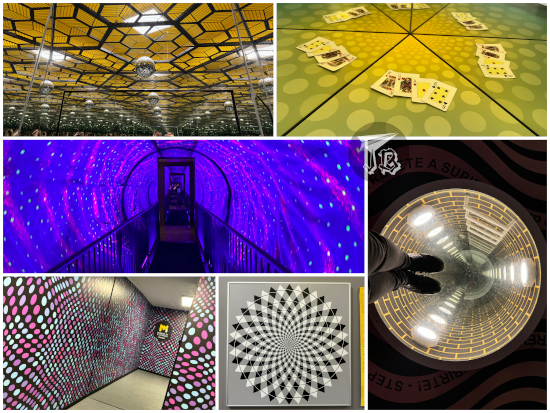
Afterwards, we headed off to the so-called Museum of Illusions. This museum is a compendium of optical illusion and installations designed to fool the brain into believing things that are either wrong or just not there: a distorted room so you look big in one corner but small in the other (Ames room), a vortex where you seem unable to walk straight, a rotated room, a room full of mirrors – there were a lot of illusions with mirrors actually – stereograms with hidden images, turntables, holograms…

We had a reservation for 14:00, and I was surprised at how chaotic entry was. I mean, they’ve been running the thing for a while now, someone should have figured out how to do crowd management, but no. Then, there were kids running and screeching all around, but it calmed down after a while. I had really hoped that the museum would be calm and half-empty at lunch time, but it was not so, not by a long shot. It was interesting though, and pretty fun.

Museum of Illusions Madrid

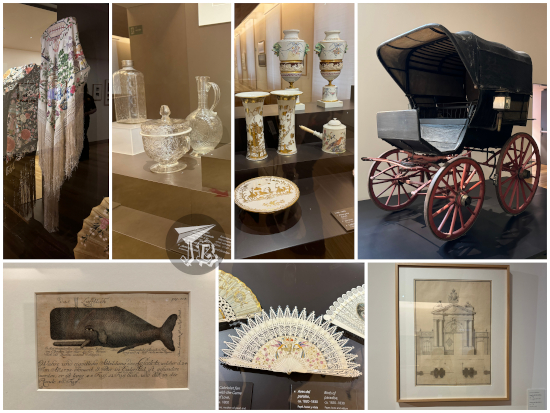
However, the experience was shorter than I had calculated, so I had to improvise an extra stop. Thus, we entered the local history museum Museo de Historia de Madrid, which tells the city’s history since Madrid became the capital of Spain. There are paintings, models, typical costumes, plans, maps, and Playmobil sets depicting of the uprising against the French in 1808. The museum is hosted in a former palace-like building which was actually built as a hospice. To the side stands the original Baroque chapel. It also has a lovely garden with a monumental fountain, which was relocated from its original place for conservation.

Museo de Madrid exhibits

Museo de Madrid - chapel and fountain

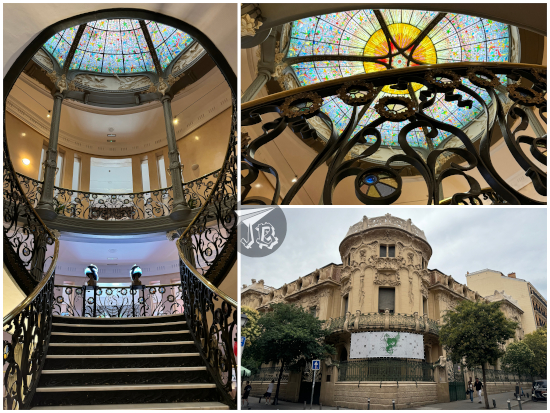
We spent some time there and then headed off to the building that now holds the office of the Copyright Owners’ association, a manor known as Palacio de Longoria. It was designed by José Grases Riera and built between 1902 and 1904. It is one of the few actual Art Nouveau buildings in Madrid, possibly the most important one. The façades were made in artificial stone, with sculptures and shapes resembling vegetation. I’ve wanted to visit it for a long time, but it is only open when there is an exhibition, and the stars had never aligned – until this time. There was an exhibition about urban music, and I was not going to let go of the chance to see the monumental staircase and the skylight.

Longoria Palace

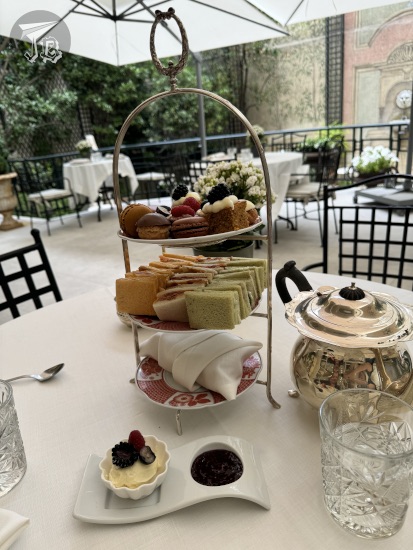
We finally set off for afternoon tea at El Jardín de Orfila. Out of the several places I’ve tried afternoon tea in Madrid, this has been my favourite to date. The outside garden is lovely, but mostly, their scones are the best around.

We ordered green tea, and the snacks were finger sandwiches – smoked salmon and cheese cream, classic cucumber and cheese, pastrami – pastries – carrot cake, macarons, lemon curd – and the scones. This time round, I decided to eat the scones after the sandwiches in order not to be full when it was their time. The afternoon was pleasant, but we shared the terrace with another table, and later a loud lady who wanted a smoke. That broke the magic a little, but the tea was fantastic and the scones were great.

El Jardínde Orfila: tea serving for two

Afterwards, we just headed for the train station to get back to our places. Of course we missed the correct one since they run whenever they like. What else is new? But the fun part was being able to pull a fun day out from my sleeve, and it was not stupidly expensive either, so good fun, all in all!

28th May 2024: Architecture and a niche restaurant (Madrid, Spain)

I was talking to an acquaintance whose child likes superheroes – so does the acquaintance, actually – about Comic Planet. After exchanging experiences, they mentioned that their spouse also enjoyed another thematic restaurant, and I decided that it could be a fun thing to do – and since they don’t take reservations for one, I roped my sibling into tagging along. And of course, since we were braving the horribly-working trains, I felt we should fill the day out. We could not leave early in the morning as I would have liked because I had this stupid bureaucracy appointment I had to get out of the way first.

We arrived in Madrid around 12:30, and our first stop was the Casa de Correos, an iconic building in the middle of the square Puerta del Sol. I did not even know you could just visit that building, nor that they ran exhibitions. It was a cool opportunity to check it out. Furthermore, the exhibition was actually something that I was quite keen on – the architect Antonio Palacios, commemorating the 150th anniversary of his birth. The exhibition, called “the Metro architect” Antonio Palacios, el arquitecto de Metro, is part of the network of museums managed by the underground company Metro. It consists mostly of photographs, a few of them by photographer Luis Lladó, an original model of Palacio’s project to renovate Puerta del Sol, and a modern model of a now-lost station, including lifts. It was a bit underwhelming, but still worth it – and free, so it was good either way.

Exhibition Antonio Palacios El Arquitecto de Metro

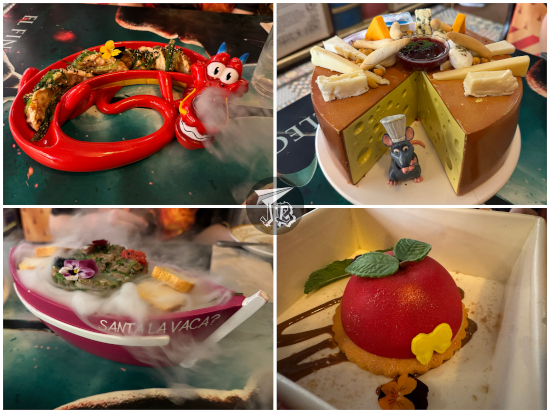
Afterwards, we headed out to the restaurant for our 13:30 reservation. The place is called Los Secretos de Lola (Lola’s Secrets ). It used to be just another bistro-grill in a street full of them, but some time after the pandemic, it reinvented itself. The restaurant has slowly turned into a Mecca of childhood mementos – Disney princesses, teddy bears, Harry Potter, Funko Pops… and crazy fun references like a Möet&Chandon spray to clean the tables. A lot of the food comes in a special piece of dishware – most of it Disney, but I can’t tell whether it’s actually licenced or a bunch of knock-offs. It was hilarious anyway. Though I am not much of a Disney person (my sibling is), my favourite film of theirs would be Mulan, and I just about lost it laughing when I checked the menu beforehand – I saw that they served gyoza in a Mushu-like dish, and decided we needed to order that. I was open to negotiation about anything else, really, but not the gyoza. The pasta in the Lady and the Tramp dish was also hysterical, but I could do without.

We reached the restaurant on point, and the owner directed us inside. We got a really cute Stitch table, but my sibling was not comfortable on high chairs, so we were accommodated at a Harry Potter one. We shared the non-negotiable teriyaki prawn-and-vegetable gyoza with wakame and bean sprouts, served on a Mushu-plate: Gyozas de gambas y vegetables al teriyaki, a plate of cheese Tabla de quesos variados (Blue cheese, Havarti, Mimolette, Emmental, Basilio, butter and breadsticks, on a Ratatouille’s Remy plate, which I had also found adorable) and a bluefin tuna tartar Tartar De Atún Rojo (on a little boat – I asked for no mango, and it was honoured; this was probably the weakest dish though). Finally, I tricked my sibling into a dessert called “Snowhite magic apple” Manzana Encantada Blanca Nieves: red chocolate capsule with white Kinder and a heart of caramel sauce, which came in an adorable “present box”.
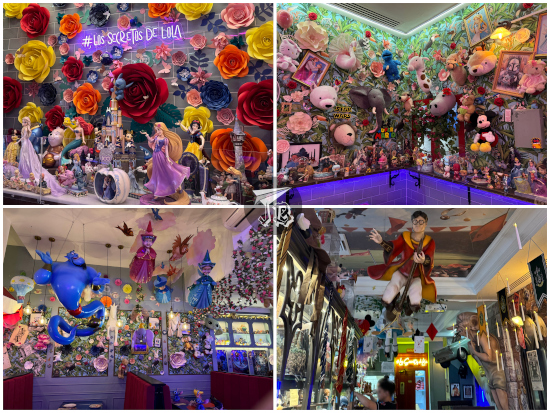
Decoration: Los Secretos de Lola

Food Los Secretos de Lola

The food was good, and I really like themed restaurants, I guess, even if they are not “my” theme. We did not stay for the two hours, I think we were on our way after an hour and a half – and when we asked for the check, it came in a Frozen music box. Then, we left towards Palacio de Cibeles, the old “communication palace” of Madrid, designed by Antonio Palacios and Joaquín Otamendi, and erected between 1907 and 1919. It is considered one of the first and most important Modernist buildings in Spain, constructed in biocalcarenite, with three stained-glass skylights, catwalks on the third floor, and a magnificent lookout on the rooftop. Part of the building is being used by the town hall, the other by the public entity CentroCentro, which runs cultural activities in the open spaces – mostly conferences and exhibitions.

Palacio de Cibeles

We arrived a bit before 16:00. Since we had a ticket for one of the exhibitions at 17:30, we checked whether we could find a ticket for the rooftop. We found available slots at 16:30, which was great. Before the viewpoint access, we had time to wander around. Most of the free exhibitions were of modern art, and not that interesting, and I was more focused on the building itself. There is one dedicated to the World Heritage site Paisaje de la Luz, explaining why the area deserves its UNESCO place.

We found the staircase to one of the towers and we used it to move it through the different floors. It is a spiral staircase around the lift, with Palacios’ typical green tiles similar to the ones he used at Maudes hospital and Chamberí station. The catwalks were paved with glass tiles, and it was quite impressive above all. I loved the building, but after all, Palacios is one of my favourite architects, so it was to be expected.
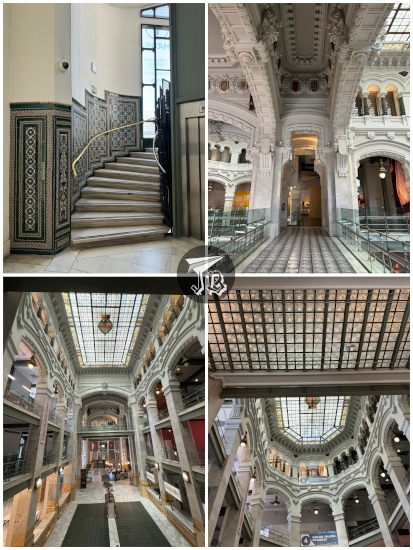
Inside Palacio de Cibeles

Then, we went up to the rooftop, where we could have a view of all of Madrid around us, most interestingly one of the main arteries of the city – Gran Vía. The weather was great, maybe a bit too bright. The turns were 30 minutes, but we were done in about half the time, after taking two walks around the middle tower.

Lookout on the rooftop of Palacio Cibeles

We went down and sat for a little before we headed down to the basement to see “Notre-Dame of Paris: The Augmented Exhibition” Notre-Dame de Paris: l’Exposition Augmentée. It was only 3€, so I was not expecting much, but it actually blew my mind.

The experience was created by the company Histovery, which specialises in “virtual exhibitions” through an interactive tablet called “HistoPad”. The Public Entity in Charge of the Conservation and Restoration of Notre-Dame de Paris cooperates with the event, and the beauty company l’Oreal is a sponsor. The exhibition (which is simultaneously running in several parts of the world) follows the history of the Parisian cathedral Notre-Dame de Paris – it starts with the 2019 fire, which is a bit heart-wrenching, and then it covers a few key moments in the history of the cathedral, using a mixture of written information, videographs and a “treasure hunt” where you have to find pieces of a puzzle hidden within the virtual information. This is done using the tablet to scan 21 “time portals” that take you to a particular point in history.

Around 1160. The Dream of a Builder. At that time, Bishop Maurice de Sully came up with the idea to build a new, better, cathedral in Paris. The previous one was a smaller, Romanesque building, but the goal was a larger, architecturally impressive building. In this room (the second, actually, but the first chronologically), you find out about the “treasure hunt” – you need to find a number of hidden “light spots” to build a “stained glass window”.

Around 1180. The Gothic choir. This makes a small overview of the kinds of workers that helped in the construction, the kinds of stones, building materials – quarries, forests. I was extremely disappointed at this point when I came across a dog in the virtual quarry, but the program did not let you pet it.

1241. The Holy Relics: Louis IX, the future Saint Louis, bought the Crown of Thrones in Jerusalem and brought it to Paris. There was a great procession into Notre-Dame, where the relics were to be kept. Here there’s a spectacular recreation of the gates with the original polychrome sculptures and decoration.

1645. The Royal Promise: Widowed Queen of France explained to her son, future Louis XIV, that he was to renovate the choir of the cathedral and build a new altar, dedicated to the virgin Mary. This was the original splendour of Notre-Dame, before the French revolution broke out – the church was one of the targets of the revolutionaries, and a lot of the art was damaged and / or destroyed.

1804. The Imperial Coronation. After the French Revolution, Napoleon crowned himself “Emperor”, but a very “equal and revolutionary” Emperor. He held a ceremony for himself in Notre-Dame, with the presence of the Pope and everyone who was anyone in the totally equal new society.

1857. The Spire. Enter Viollet-Le-Duc, a major architect and restorer in France’s 19th century, whose theories influenced countless others. He revalorised gothic style in the country, managing to turn it into a “national style”. The man had the goal to restore and create buildings in “the gothic style that would have been if the Medieval workers had had the technology he had access to”. Historians have not been kind to him, accusing him of “inventing” stuff instead of “restoring” but kudos to him, he managed to make a lot of buildings survive to our time. In Notre-Dame, he is responsible for putting back a lot of the sculptures that were destroyed during the French Revolution. He also built the spire that famously collapsed in the 2019 fire.

2019-2021 (first and last rooms). A description of the restoration works that have been happening in and outside the cathedral since the fire, with special attention to the Paris firefighters who worked the incident. There is a very interesting part about safely removing debris and the original scaffolding, and the fact that there was a lot of lead in the cathedral that the workers had to be safe around. They also homage the “vertical workers” who had to remove collapsed pieces from the ground… hanging from ropes.
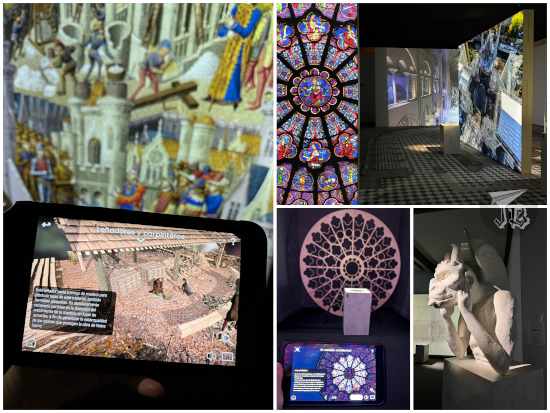
Notre-Dame the Augmented Exhibition

We completed the stained-glass window and signed up to get a diploma. The fun part is that most of the exhibition was not really… even physical. There were a few posters, a reproduction of one of the chimaeras, some small models… Nevertheless, it was extremely interesting – possibly the best “virtual exhibition” I’ve seen to date. The length of the experience is said to be 60-90 minutes… we stayed from 17:30 to 19:45, much longer than I had anticipated! Thus, we had to forfeit the last plan of the day to go back to the train system – which of course was experimenting delays. It took forever to get home. Because what else is new?


Time-traveller diploma after completing the treasure hunt in Notre-Dame the Augmented Exhibition

9th March 2024: Minerals, fossils & trains (Madrid, Spain)

I might not be the most people-person ever, but if there is something that makes conventions extra fun, it is seeing attendees unapologetically geek out about what they love – in the case of Expominerales, that would be… rocks. Of course, this is an over-simplification. Expominerales is held yearly in the mine and energy engineering school Escuela Técnica Superior de Ingenieros de Minas y Energía (ETSIME) in Madrid. The year 2024 marks the 43rd edition of the event, which is considered one of the most important fairs in Spain in the topic of Earth Sciences – minerals, fossils, gems, and meteorites are widely available to the public. Aside from the small historical museum Museo Histórico-Minero Don Felipe de Borbón y Grecia, there were dozens of exhibitors with all kinds of items for sale, ranging from a few euro to several thousands. These year there were a few lectures, too, and coincidentally, the two of them I was most interested in happened on Saturday, one after the other.

I arrived at the ETSIME around 11:00, and I walked around the stands a couple of times. I have to say that I wanted everything, but I set a budget and I was able to stay around it, after shopping and lunch. At noon, I settled to listen to the lectures – one about the rehabilitation of an ancient gypsum mine in a hamlet called Hornillos de Cerrato, in the area of León. The other one versed about the uses of an already-rehabilitated one in the south of Spain, home to a huge geode. Both of them were pretty interesting, though the conference room was freezing. Someone had forgotten to turn on the heater there, it seemed…

Expominerales 2024 at ETSIME

After the two conferences, I had a last round to buy a last thing, so in the end I bought an iron-meteorite pendant, a fossilised shark tooth pendant, a plesiosaur tooth, and a soil sample of the K–T boundary. A plesiosaur was a marine reptile with flippers, a short tail and a long neck. The K–T boundary (now named the Cretaceous–Palaeogene (K–Pg) boundary) is the theoretical layer of iridium-rich black sand that was formed by the meteorite that caused the extinction of non-avian dinosaurs – and basically most life at the time, in one of the great world-wide extinctions in the history of Earth.

Shopping from Expominerales

At 14:30, I had a reservation for lunch at a Japanese franchise called Ramen Shifu. While I had originally been looking forward to trying the ramen (and I got my hopes pumped up when I read that they were Hakata ramen style), the noodles were rather disappointing. Fortunately, the okonomiyaki – Japanese pizza of sorts, made with a base of cabbage and topped with sauce and bonito flakes, was all right. On top of everything, paying was stupidly difficult because they did not have change.

Shifu Ramen ponzano - okonomiyaki and ramen

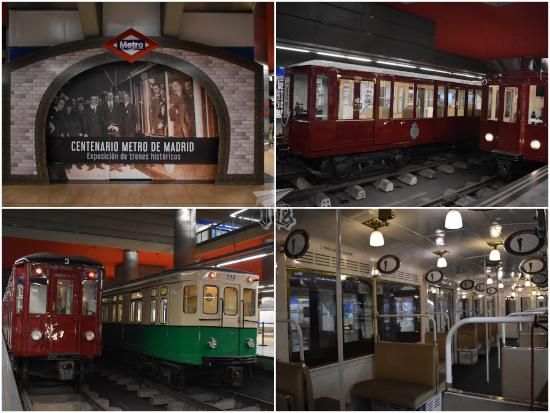
When I came out of the restaurant though, it was raining like crazy. I pulled out my umbrella and hopped towards the closest underground station, as my next destination was inside the metro system – one of the Underground’s museum network Museos de Metro de Madrid the collection of classic trains Estación de Chamartín: Exposición trenes históricos, inside the Chamartín stop. The exhibition displays four historical trains, restored from among the first ones that ran under the city, and some memorabilia. It was a bit underwhelming – more like false advertisement. I hoped I would be able to snoop inside the trains, since that was the photograph that opened the webpage, but unfortunately they were cordoned off. There was however a map with the works by Antonio Palacios in Madrid, which will become handy eventually.

Classical Train Exhibition Madrid

Afterwards, I just headed off towards the train station and got back home.

5th April 2023: The ghost station of Chamberí (Madrid, Spain)

Perusing the web for something – I can’t even remember what – I came across one of those things that I had discovered a long time ago, then forgotten because life is hectic and so (read: Covid happened). In Madrid, there an underground ghost station, one that has not changed since the 1960s. Well, sort of – it was closed, then restored, and finally turned into a museum. Anyway, somehow accidentally, I ended up securing a free ticket to visit it during Easter break, so there I went. I decided to round up the trip with a fancy lunch in a place I also wanted to visit.

The Madrid underground system Metro de Madrid was the third underground line to open in Europe, after Moscow and London. It ran a little short of 3.5 km, with eight stations, when King Alfonso XIII inaugurated it in October 1919. Subsequent ampliations and renovations of the line were carried out until it reached its current 24 km and 33 stations (plus twelve more lines). The city expanded, its population increased, and underground trains grew with both, going from four to six carriages in the 1960s. The stations were renovated to fit the new, longer trains. Most of them. The ampliations of the stations of Bilbao and Iglesia made it inefficient to do the same with the stop that lay in-between – Chamberí. Thus, this station was locked down – and bricked off – in 1966.

The city forgot about the station’s existence for decades, until in the early 2000s, it was turned into part of the Underground’s museum network Museos de Metro de Madrid or Andén 0. Today, Estación de Chamberí can be visited for free, but only under reservation. Pre-pandemic, I looked into it a few times, and never found a spot, then the whole thing slipped my mind, until I relearnt about it, and lucked out.

I took the train to Madrid and walked from Recoletos to the square where the station was built Plaza de Chamberí. The original entrance has long disappeared, so the underground area is accessed through an ugly metal kiosk and a spiral staircase. However, the original station looks completely different. It was designed by Antonio Palacios (1878 – 1945), a Spanish urbanist and architect with a very recognisable style, whose most important works still stand in Madrid (such as the Círculo de Bellas Artes and Palacio de Comunicaciones). My entry slot was 11:30, and I arrived with plenty of time – trains have been unreliable lately so I gave myself a wide margin. When most of the group had arrived, we went down the modern stairs that yields to the old hall. Characteristic white tiles are laid along the access tunnel that leads to the original ticketing stands and the exit control. The station used to have a skylight, now closed off. The original stairs and maps still stand, along the Metro logo – though everything has been adapted for wheelchair-users.

Ghost Station of Chamberí. Entrance corridor and old ticketing booths

The group comprised 25 people, with a surprising amount of non-Spanish speakers – at least seven, who of course did not care about the guide’s explanation, which was little more than the Wikipedia page (so I guess anyone can take the visit. Print out the wiki and read along). There were families with kids who tried to yell over anything the guide said. Furthermore, underground trains still run through the station, which make for cool pictures, but their six-minute frequency drowns all the given explanations. It was hard to actually get into the “ghost station” mood.

Estación de Chamberí does look really cool though. Unfortunately, glass panels separate the platform from the tracks – they are dirty and get in the way of pictures of the other side of the platform. However, it was interesting to see the old advertisement mosaics – they used to be painted on tiles, and built into the walls themselves, and surrounded by very cool darker slabs with metallic tint. The visit takes about 40 minutes, and on the way out, you get to go through the old ticket gates, which have a very ingenious way of opening – you step on the little platform in front of them, which triggers a latch, and you can push the gate open. Really fun.

Ghost Station of Chamberí. Collage showing details - the name of the station on the old logo, tiles, the platform, and a train coming through

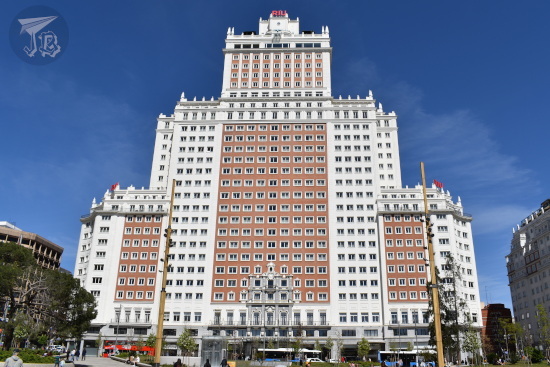
Truth be told, I had booked another free visit before lunch, but I realised I had messed up the location. I cancelled that one before entering the ghost station so the ticket would be available for someone else to use. And thus, I had a bit of time before my lunch reservation at 14:00. Since the weather was nice, I decided to walk to my next spot, and I spent the extra time – and some not-extra money – in one of the big bookshops in the centre of Madrid. At 13:50, I arrived at the back entrance of the hotel Hotel Riu Plaza España. This hotel opened in 2019 in a mid-20th century skyscraper (Edificio España) designed and engineered by brothers Julián and Jose María Otamendi. It is a 26-floor tower which was the highest building in the city at the time of its construction. Situated in the square called Plaza de España, it is close to the Royal Palace and Main Square.

Edificio España - tower like building in reddish and white brick, spanning 26 floors. It is the Riu hotel now.

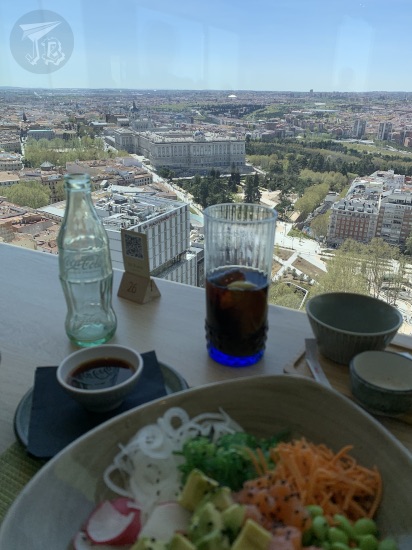
The hotel has a large terrace on what would be the 27th floor, a rooftop bar and a restaurant or “gastro bar”, whatever the current buzz word means. Entry to the terrace is 10 € (5 € on a weekday), and food is not on the cheap side (everything around that area is stupidly expensive), but I found a deal at their Edén Gastro Bar: one-course lunch + drink + entry to the rooftop terrace for 30€ which allowed me to skip the queue.

I did skip the “ticket-buying” line, but there is only one lift to go to the rooftop, so that queue I had to wait. I ended up reaching the restaurant around 14:10 or 14:15, and snagged a counter-with-a-view seat. I ordered a salmon poké and a drink, and got a few complimentary snacks and breadsticks to complete the meal.

Rooftop picture showing Madrid's Plaza de España and Royal Palace. Blurred in the foreground, lunch

Afterwards, I climbed the stairs to the terrace, officially called 360º Rooftop Bar, on the 27th floor. Music was blaring and there were tons of people drinking overpriced cocktails. The views were cool, sort of a once-in-a-lifetime thing that I don’t think I’d need again. The terrace has a small all-glass balcony that I did not wait the queue for, and a glass platform that would probably impress a bit more if the glass under your feet were clean(er). The terrace was completed by a tacky bull sculpture with metallic-gold testicles.

Madrid rooftop view - low houses with red brick roofs, and in the very background a few highrises

I walked around a couple of times, and then I headed back to the train station after calling it a day. I killed time reading one of the books I had just got, and time flew on the train. It was a nice little outing, but I did mess up with one of the locations, so it could have been more efficient. I guess not every little trip can work flawlessly…