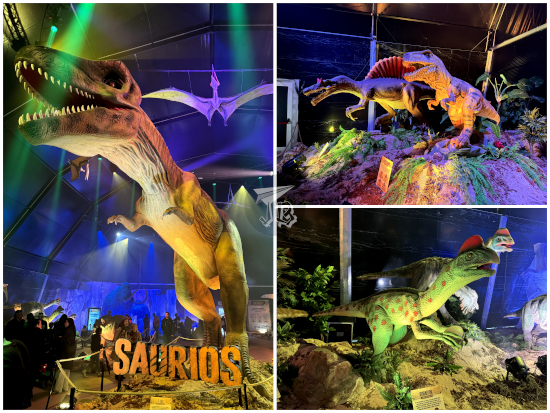
29th July 2025: Birds with great PR (Madrid, Spain)

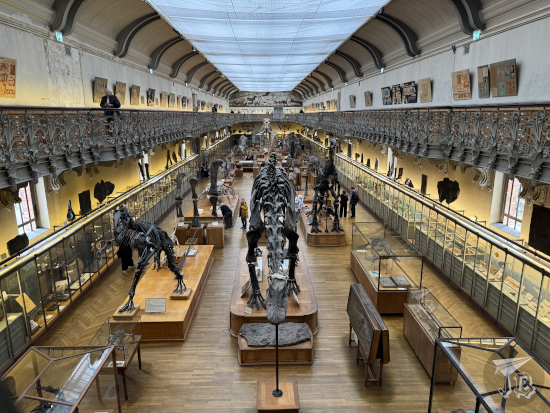
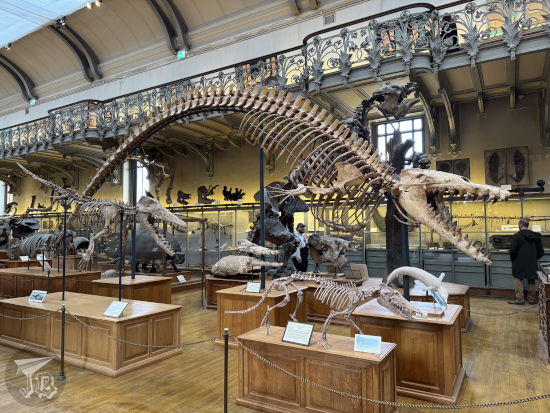
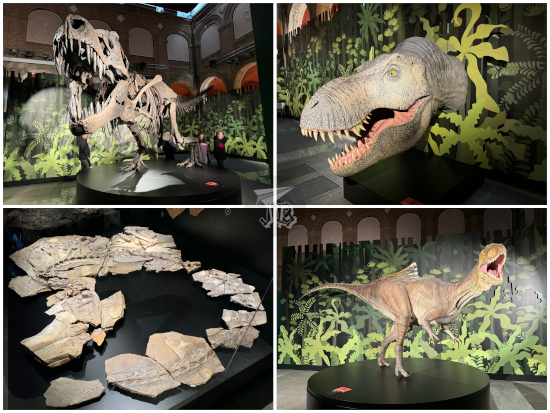
The National Museum of Natural Science Museo Nacional de Ciencias Naturales in Madrid announced that they were having an exhibit called Dinosaurios entre Nosotros / Dinosaurs among us, a collaboration with the American Museum of Natural History (though the original exhibition was apparently called Dinosaurs among us: The ancestry of birds, which feels slightly more accurate).

When I was young, it was believed that dinosaurs came from birds. With the new definition of what a dinosaur is, it turns out that birds are dinosaurs. The key features used to define a dinosaur is that the animal belongs to the clade (natural group) archosauria, and it has hind limbs which are erect underneath the body – as opposed to growing sideways and bent. Currently, two groups of archosauria exist: crocodilians (with bent legs) and birds (with straight legs). I think if you ever look into an emu or a cassowary’s eyes, you’ll understand what a deinonychus’ (the real species of the Jurassic Park velociraptor) prey might have seen.

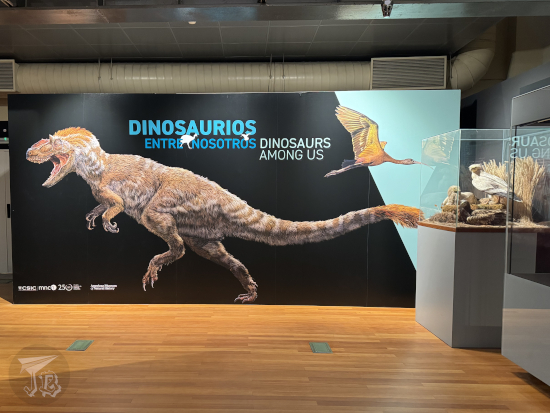
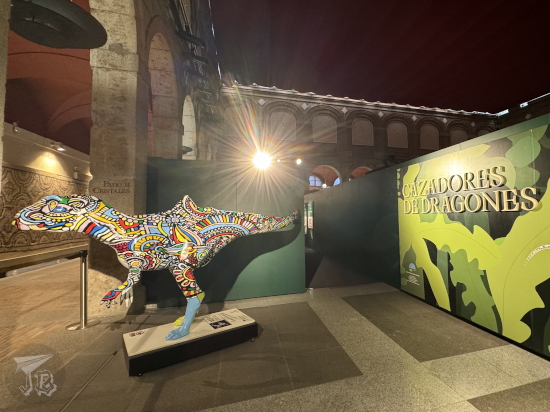
Dinosaurs among us sign, showing a feathered T-rex

The characteristic that originally defined archosauria was the hinge-like ankle structure. As time went on, protofeathers developed and some animals adopted a straight-legged stance, which is the start of the real dinosaurs – first the ornithischians (triceratops), then the sauropods (patagotitan or diplodocus), and the theropods (tyrannosaurus), the first with a wish bone. Then the forelimb became wing-like (deinonychus), yielding to the Avialae clade, which developed flapping flight. Some scientists declare that all Avialae are already birds. Others claim that birds are the subgroup Aves.

I took the train to Madrid and walked to the museum Museo Nacional de Ciencias Naturales. It took a second to be admitted because their computer system was down, but I was carrying cash, so I could was able to purchase my ticket (I had not bought it in advance because entry is timed, and I did not trust public transport delays). It was around 10:30, still early enough so that the museum was not crowded even during the school holidays. I headed directly to the exhibition, which, mostly through panels, taxidermy, and mounted birds, summarised how dinosaurs behaved similarly to today’s birds – laying eggs, brooding those eggs, protecting the nests… The biology and anatomy of birds and dinosaurs, especially theropods, are very similar.

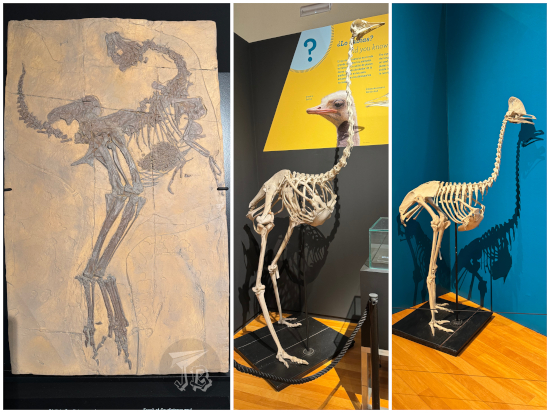
Fossil of Caudipteryx zoui (replica) and skeletons of a cassowary and an ostrich. They all share uncanny similarities, except the fossil is about one metre long and the current birds are larger

There was a very special exhibit – and no, it was not the Tyrannosaurus rex skull they’ve got. It was the original (and only) fossil of Iberomesornis romerali, a holotype from the MUPA, which you cannot photograph at its home, but you can here (just like my photography spree with the Concavenator at MARPA). Iberomesornis was the sparrow of the Early Cretaceous. There was a reconstruction of how it would look in real life (though I’ve read some texts that say it’s an outdated view?).

Iberomesornis romerali fossil and recreation. It was a crossing between a sparrow and a crocodile.

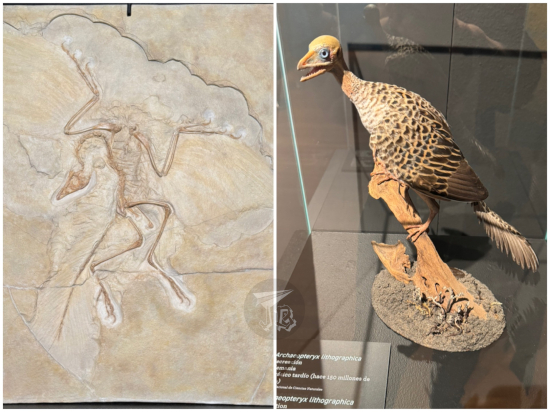
Similarly, there was a model of Archaeopteryx, the first ever-discovered feathered bird-like dinosaur. With only 13 specimens ever found, it was key in palaeontological studies before more avialans were discovered. This one was a replica, I’ve only seen one real slab ever in the London Museum of Natural History (I hope I can see the Berlin one at some point). The model was so ugly, the poor thing, but somewhat endearing.

Archaeopteryx fossil (replica) and life-sized recreation. It looks like a bald nightmare with a beak and teeth.

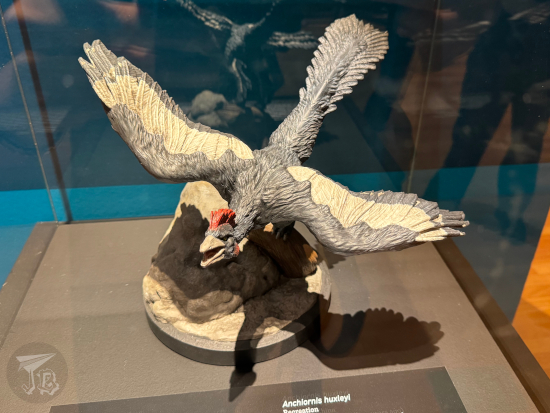
There was also a model of Anchiornis Huxleyi, discovered in China and named after Thomas Henry Huxley, the biologist who in 1869 suggested that maybe birds were related to dinosaurs. He did this comparing the hip of a Megalosaurus and an ostrich (for a while, dinosaurs were classified using “bird hip” and “reptile hip” criteria) amongst other similarities, and of course he used Archaeopteryx as evidence. Unfortunately, the poor guy is more often remembered for being a Darwin fanboy – he was even nicknamed “Darwin’s bulldog”. Palaeontologist Xu Xing described the species in 2009, and chose to call it “Huxley’s almost bird”. It has allowed to rebuild almost completely the colours of dinosaur feathers.

Anchiornis Huxleyi, proof that dinosaurs evolved into birds. Something between a rooster and a lizard

The rest of the exhibition was most… modern birds, sprinkled with children’s disappointed “Where are the dinosaurs?” wonderings. Truth be told, at the end of the exhibit there was a life-sized reconstruction of Velociraptor mongoliensis, the “real” one, not the presented in Jurassic Park, along with the explanation that Michael Crichton found the name cooler than Deinonychus, which is the animal he described in his book.

Taxidermy bird collection

Reconstruction of a Velociraptor mongoliensis, with a crocodilian face, long arms with proto-feathers and powerful claws.

So in the end, the exhibit was a lot of information about birds, hyped up with the buzzword “dinosaur”. Interesting enough but… not really what it was pumped to be. That’s what good PR does, I guess. And erasing half of the exhibition’s original title…

Back to Darwin though, the museum has a bit on him in its gallery of biodiversity – which is just a way to… continue exhibiting the old taxidermy specimens that they already had, some of them… made with more success than others – while some of the works they’ve got are extremely realistic, some others are… horror shows – such as the famous giant panda that the Zoo Aquarium first hosted.

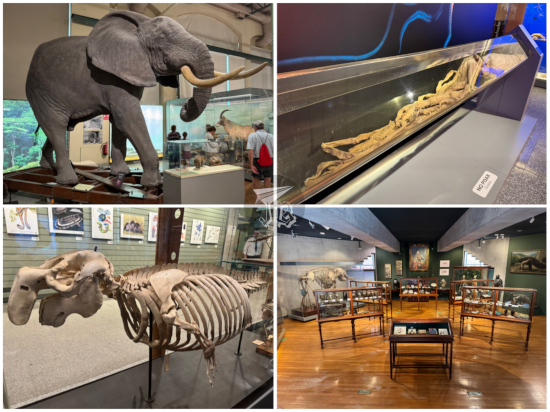
One of the most interesting parts of this museum is the science cabinet Gabinete Científico, which recreates Carlos III’s scientific collection. It shows a glimpse of how science was understood at the time (though the human skeletons it used to host have been quietly removed).

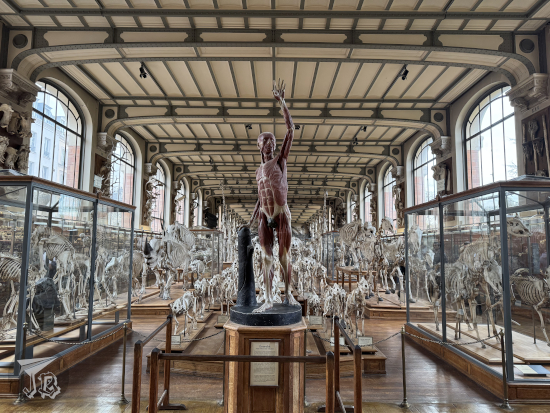
Natural Science Museum Madrid - Diversity collection: elephant, giant squid, manatee skeleton, 19th century cabinet

Recently, the museum became the custodian of Santiago Ramón y Cajal’s legacy, including his Nobel Prize certificate and medals. Ramón y Cajal was a Spanish doctor considered the father of modern neuroscience. In 1888, he discovered how nervous cells work, even before they were called neurons, and that they were separate entities that created the nerves and the brain, explaining how impulses are transmitted through the nervous system. He described characteristics that could only be observed in real life almost a century after he wrote abut them. In 1906, amongst many other awards, he received the Medicine Nobel Prize alongside Camillo Golgi, who designed the methodology to colour cells, a process that allowed many of Ramón y Cajal’s discoveries. The museum exhibits microscopes, drawings, and his original office and library. For some reason, next to the ocean display and the giant squid.

Santiago Ramón y Cajal legacy: reconstruction of his office and Nobel Prize

This was all in the first ward of the museum. The second one is on the other side of the building that it shares with the Industrial Engineering School. To get there, you have to follow the dinosaur footprints, but I took a couple of detours. First, I got a bit distracted trying to figure out the “Mediterranean Forest” garden, but honestly it was too hot to stay there for long. Maybe some other time with better weather.

My other stop was at the Engineering School, Escuela Técnica Superior de Ingenieros Industriales (UPM). I had recently discovered that its main hall hosts an 1832 steam engine, built by the company David Napier & Son Limited. The machine was designed to power coin minting, and it was one of the first machines to arrive in Spain, purchased by the Royal Mint. It is not clear in the description if it was designed by James Watt, or just similar to his models, but it seemed a piece of history worth seeing – and the janitor was distracted while I snooped around. The engine was donated to the Engineering School in 1914, when the Mint replaced it.

Watts Machine

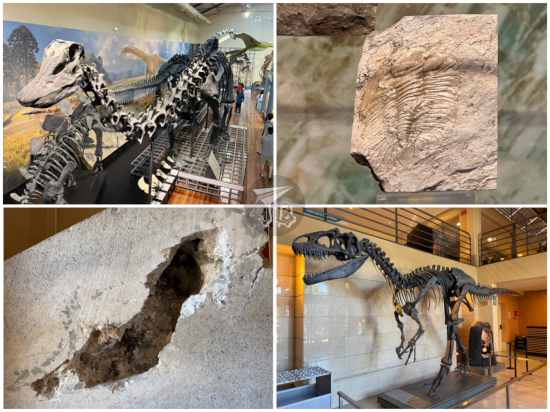
I reached the second building of the science museum Museo Nacional de Ciencias Naturales, which is the palaeontology, geology and anthropology ward. Nothing had changed there that much since my last visit. Here’s a funny story though – they have a replica of a Diplodocus carnegii, of Dippy, exactly the same one that the London Museum of Natural history has – albeit on tour. Why am I so obsessed with the London one, having another replica so close? I think it’s because the “care” the NHM gave it, while in Spain it has just been set against a wall, mixed with all the other dinosaurs from whichever age. It actually took me a while to realise they were the same cast…

The original Dippy fossil was unearthed in 1898, and soon Andrew Carnegie bought it for his new museum in Pittsburgh, hence the name of the species. In 1902, King Edward VII convinced Carnegie to donate the original cast to the NHM while the skeleton was still unmounted (there was no museum to house it yet). In later year, Carnegie would donate a few more casts to other museums in the world, including Madrid, Paris and Vienna.

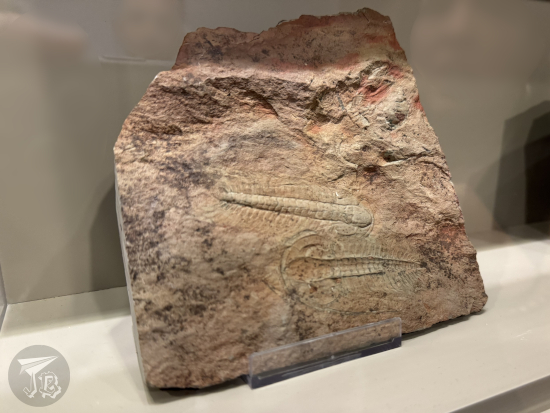
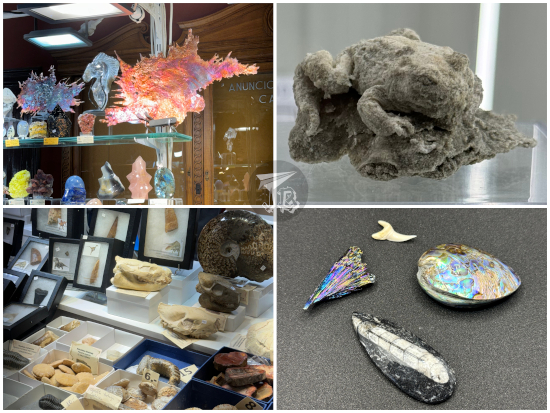
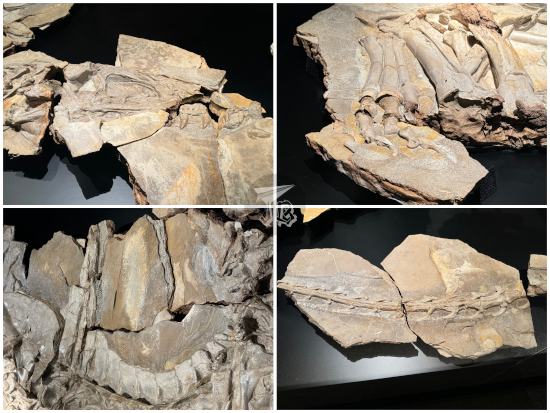
This time around (call it selective perception, or plain looking out for them) I spotted the trilobites from the Murero palaeontological site, one of whose characteristics are how deformed they are, due to the earth’s internal forces and movement. The museum has a large mineral collection too, but I think it lacks something. Maybe it’s me mentally comparing to other natural history museums in Europe, or even other incredible museums in Madrid itself, such as the Geomineralogical museum nearby. It is missing… loving, in a way. I think the Natural History Museum is a bit of an ugly duckling in the cultural system, because even if it’s considered a “national museum”, it is not part of the national network, so there is something weird going on there.

Natural Science museum Madrid - diplodocus, deformed trilobite from Murero, allosaurus, geode

As I left the museum, it was incredibly hot. It was early for Spanish lunch, but some places had already started opening. I had been looking at an “Asian Market” called Oiko, but then I read that you have to order through a machine (okay) and input your phone number so they call you on WhatsApp when your order is ready, and I get too many spam calls already. I was not planning on giving out my phone number to anyone who does not need it. Even if they had taiyaki desserts.

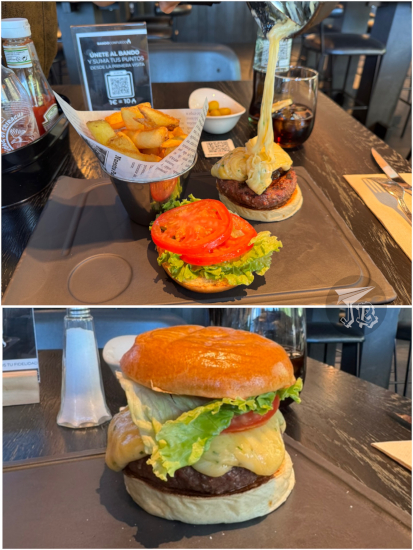
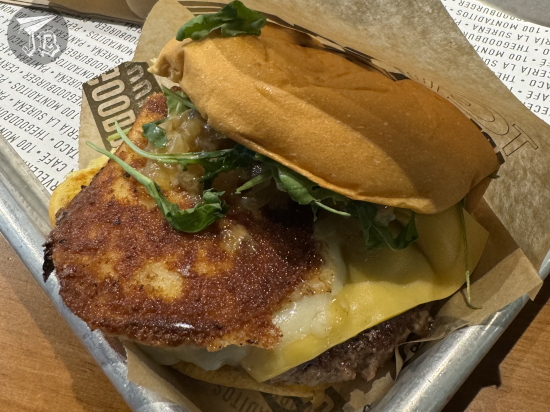
Instead, I found a burger joint called Steakburger, which self-describes as a gourmet burger restaurant, trying to become a franchise. I later realised that they are not 100% upfront with their prices, as the online menu lists one price, but the details shows another – and the desserts don’t even come with prices. It might also be a coding issue, since once you’ve checked the details, the correct price shows everywhere. Also, the machine translation is awful. Anyway, I had seen that they carried a burger with matured Angus and a topping of raclette – red cheddar, Gouda and mozzarella which were poured onto the burger, alongside Batavia lettuce and tomato, La melting cheese madurada. Honestly? It was good but not worth the price. The desserts looked decadent, but the burger was enough for me.

Hamburger being bathed over with melted cheese.

Afterwards, I just headed off to the station to take a train back, and for once I was there when a train was about to arrive. It was just too hot to look for something else to do, and during August a lot of things close at 15:00.

19th July 2025: Highway → Murero → Highway → Home {Dinosaur Eggs Loarre & Zaragoza, July 2025}

While Zaragoza (Saragossa) is not a super-busy city, the noise from the large avenue the hotel was in woke me up early enough to be amongst the first customers at Pannitelli Original Bakery. I had a toast, orange juice, and a coffee, then set off to the not-so-easy task of retrieving my car, driving back to the hotel, getting my deposit returned, and going on my merry way. It took a while, but once that was taken care of I could drive off. Getting out of Zaragoza was easier than getting in had been, and there were few cars on the road. One of them was the traffic police, so every driver seemed on their best behaviour…

Once in the speedway, the first stop of the day was a petrol station, as there was no way I made it home with one quarter of a tank. Unfortunately, there were no low-cost fuelling points on my way, so I had to use a big-name one. Thirty euro don’t take you as far with branded fuel…

To be fair, I could have driven home the previous day, but I thought that after such a week, an extra night of sleep could only be beneficial. Staying also allowed me to see the Asian treasure exhibits in the Lonja and make a stop on the way. My first idea had been going downtown to see the Natural History Museum, but it closes at the weekend. That was why I asked about the visit during the course, and it turned out it was doable. Thus, in the end, I decided to make a stop in a small palaeontological site that I would not travel to otherwise. Furthermore, the site popped up during the course twice – the signage had been handled by Paleoymas and the Natural Science Museum had quite a few specimens from there.

View of a valley with a sign that reads 'Plaeontological site' in Spanish

The Yacimiento Paleontológico de Murero palaeontological site holds remains from the Cambrian Period, extremely important because there are around eight million years’ worth of fossils (511 to 503 million years ago) preserved in the strata. Palaeontologists have found about eighty species of trilobites, along with echinoderms which had not yet developed five-way symmetry, brachiopods, worms… It is mainly composed of shales which allow for soft-bodied organisms to be fossilised along the hard bits like shells or exoskeletons. The site is famous because it allowed researchers to identify sexual dimorphism in trilobites – they were able to describe two distinct types of animals within a same species, which are interpreted as male and female. What they don’t know is which animal is which sex.

I left Zaragoza using the A23, then turned to a national, smaller road (N234) that crossed over to the A2. The site and the municipality it technically belongs to, Murero, lie halfway through this road. As mentioned before, not somewhere I would purposely travel to, but since I was literally in the area, it was a convenient stop. The regional road was all right, but the local one was narrow and the curves were very sharp and steep. I was thankful that all of the cars I saw passed while I was hiking or taking photos of the site, and none while I was driving. I decided to only stop at the area which had a small parking lot so it was safe for me and any potential driver.

To be honest, I expected to see more in the palaeontological site. The signage has either weathered out or been vandalised and nothing is readable. It is a short walk up and down a hill where you can’t really see anything except for a box at the top where people leave what they find, but there was not a chance to see anything in situ. I guess the palaeontologists and the amateurs have taken out everything that is worth anything already – or left it well buried so it can’t be pillaged. I wouldn’t even consider it a nice hike because broken pieces of slates made the path extremely slippery (I forgot my hiking boots in the car…).

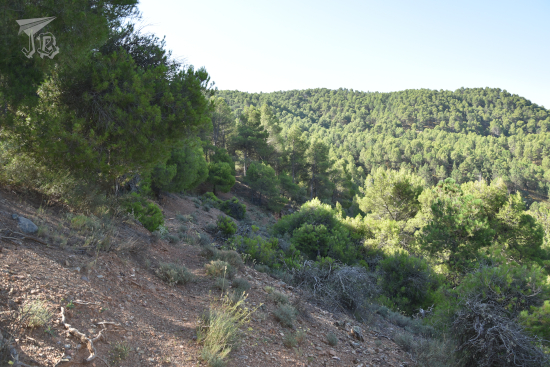
Walking upward to the site, among the pines. On the lft there is a rock with the number 6 painted on it with yellow paint.

Side of the mountain with pine trees

And oh, the temptation to steal a trilobite from the display box was strong! I resisted it though, and headed back to the car after an hour or so. I undid the path towards the N234 road and continued onto the A2. I made a stop in-between for some caffeine and a snack, but I was home for Spanish lunchtime. I have to admit I had pondered stopping somewhere along the way, maybe Daroca, Belchite or Calatayud, but considering that I still had to drive back, I decided to leave it for another time.

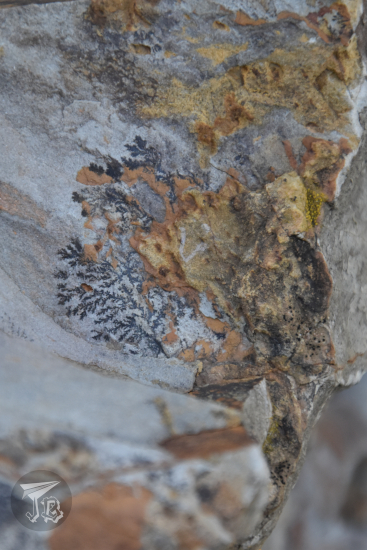
Cool crystal dendrite, which is not a fossil but still neat

Fossil equinoderms on a stone

Fossil trilobite, deformed by pressure and the pass of time

On my first solo road trip, I was surprised by the sheer amount of people who like driving at the same speed all the time. A bunch of drivers in the regional road, with limits of 90 kph, did 70 kph even when they drove through 50 kph towns. The same happened in the speedway – some people drove at 110 kph, both at the 120 kph or the 100 kph stretches. There were also those who liked aligning their cars with the markings that separate the lanes, effectively occupying both. The lorries were more manageable on the way back than towards Loarre, as it was a Saturday morning, and because the speedway feels more “downwards”.

Once home, it hit me how tired I was, so I guess it was a good thing that I had not made another stop. Checking Murero out was a good idea as it broke the trip in half and was a small hike that helped me keep alert, but more would have been overdoing it.

As a recap of my experience with the course Técnicas de restauración en paleontología a través de la preparación de los huevos de dinosaurio de Loarre: Palaeontological Restoration Techniques through the preparation of Loarre dinosaur eggs, I can say that all in all, it was amazing. The professors were extremely knowledgeable, they made learning effortless and entertaining, and the group was fun and easy-going. The course was way more hands-on than I had expected, literally covering everything from geological analysis to the fate of a dug-up piece, either in display or in storage within the museum, including working with the fossils themselves. It was not cheap, mostly due accommodation choices, but booking in advance probably made it better – and honestly, decent hotels were a must. As Loarre is a small village, food options were limited. Though there was a bakery / shop, we were out doing stuff while it was open. However, I made do with crisps or nuts for dinner, as I had a good breakfast. Probably lunch in Ayerbe was the weakest, and most awkward since it involved getting to know each other (and ten bucks for a frozen pizza was daytime robbery).

The whole trip involved driving around almost 700 km. It did show me that I (and my coffee-maker of a car) can manage the long drives better than I had expected, even during a “peak” time such as a holiday-period opening date. I am more comfortable on the road than in towns, though, even when caught in a jam. Was it the smartest idea to head to Loarre directly after work? Probably not, but if I had to do it all over again, I probably would – it was the only actually available option. And knowing that not all the course openings were filled, I would not have stressed as much over the University’s lack of efficient sign-up.

The only downside I can find is the lack of mental reset – I was constantly learning new facts, and I did not get much me-time. It was extremely fun, but not really a holiday where I could plan and do stuff at my own pace. Would I do it again? Well, the University of Teruel runs a similar summer course using Dinópolis resources, and sign ups open in February…

Stay tuned.

18th July 2025: In the University of Saragossa {Dinosaur Eggs Loarre & Zaragoza, July 2025}

I woke up and for the first time in days I put on “person clothes” (for the city) instead of “scarecrow clothes” (for hiking & working in the field). Before setting off on the trip, I went to the sales to buy some jeans that would work for sitting on rock or walking through thistles and dry grass, and while they are not particularly nice, they are comfortable and resistant. Saragossa / Zaragoza was still waking up as I headed for breakfast to a bakery close to the hotel, Pannitelli Original Bakery, which I had chosen for two reasons. One, they opened at 7:30, which gave me plenty of time to walk to the university afterwards and two, they had waffles, I had seen them online. I wanted waffles, and a big coffee. I had both (and some orange juice, just because I could).

It turned out that not driving to the university Universidad de Zaragoza had been a great idea. Though it had been my first thought (dump the car there, then walk to my accommodation), I was lucky that in the end I was able to reserve my parking spot with the hotel. It happens that access to campus is restricted to working staff. Students can drive into the parking lot ten times in the school year. And on top of that, there was a farmers’ market for some reason.

Having 20 minutes to walk, I was the first one there, and I sat down in the rock garden of the Earth Sciences building to wait for everyone else for the last day of the course Técnicas de restauración en paleontología a través de la preparación de los huevos de dinosaurio de Loarre: Palaeontological Restoration Techniques through the preparation of Loarre dinosaur eggs. By 9:00, when class was to start, I was the only one besides the teachers who had managed to arrive. Everyone else had either got lost, left Loarre late, or was taking forever trying to park. So yay me being lucky for once (and for the 20 € which the hotel parking cost for the whole stay).

The first chunk of the morning was a tour through the Rock and Hard Material Preparations, 3D Printing and Scanning Service (Servicio de preparación de rocas y materiales duros, impresión y escaneado en 3D) in the university. They have two main lines of work. One is to make thin translucent sections out of specimens so they can be studied under the microscope, and the other is digitalising and making 3D models and copies of items so they can be lent or studied through a computer. The inner works of the department were explained by Raquel Moya Costa, who not only described in detail all her complex machinery, she also gave each of us a 3D printed T-Rex charm from the Dino Run Game!

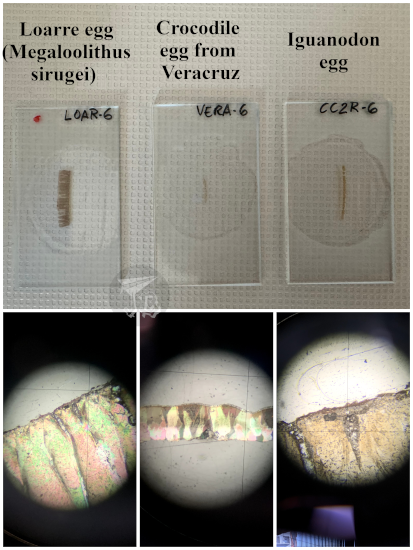
We then moved onto the Petrology lab to look at thin sections on the transmitted-light microscopes – preparations of a sauropod eggshell, a crocodilian eggshell and an iguanodon eggshell. There were other preparations we could snoop around if we promised not to take pictures and publish them. We also got to play with the 3D copy of one of the first eggs recovered from Loarre. Much less heavy than the real thing, for sure.

Microscope used in geological studies

Microscope preparations and how they look under the microscope. There are three egg specimens: one from Loarre (sauropod), a crocodile and an iguanodon, The crocodile is the thinnest, and the sauropod is the brightest and more complex

Then a bit of chaos ensued as we got distracted by the shiny exhibits of the Palaeontology department, and a couple of post-docs offered to show us their lab and what they were working on. Having finished all the activities of the course, the coordinators had organised an extra visit to the Natural Science Museum Museo de Ciencias Naturales de la Universidad de Zaragoza (which might have actually been my fault as I asked how come that would not happen, considering that most of the region’s fossils are officially deposited there). A few people left first, but some of us got delayed looking at the lab specimens, and then we had to hurry to the museum…

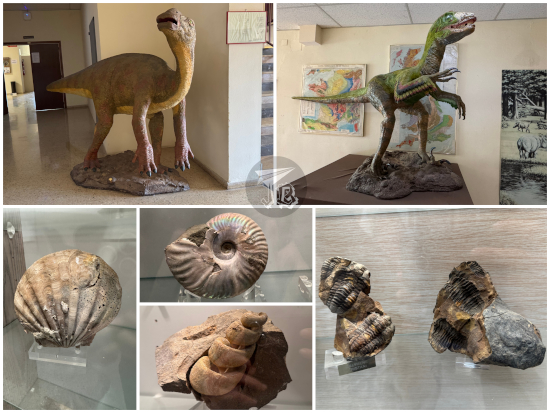
Zaragoza Natural Science Museum: Exhibits in the Geological science building. Replicas of dinosaurs and invertebrate fossils

Once we were at the site of the Museo de Ciencias Naturales, we were taken on an express visit of the palaeontology ward by Ester Díaz Berenguer, curator of the collections. The museum is located in one of the historical buildings of the Zaragoza campus. Designed by Ricardo Magdalena in 1886, it was erected with academicist criteria, in brick, with large windows and striking symmetry. It opened in 1893, and during the 20th century, it served as Faculty of Medicine. When the university moved to the newer campus, the building was refurbished as cultural spot and seat of the government body. The basement was turned into the exhibition site of the Science Museum, which has three main areas – palaeontology, natural science, and mineralogy.

The palaeontology ward of the museum comprises nine rooms. The first one is an introduction to the science and the concept of fossilisation, and the following ones run through the Earth’s history, from the Precambrian to the Quaternary. The Precambrian is the earliest “calculated” period in geological time, and spanned from 4567 to 539 million years ago (give or take). Though we cannot pinpoint when life actually originated, it was already there when this “supereon” gave way to the Cambrian. During the Ediacara Period, at the end of the last Eon of the Precambrian, the Proterozoic, the earliest complex multicellular organisms that we know about thrived in a state that has been called “The Garden of Ediacara”. The word “garden” tries to evoke the idea of the “Garden of Eden” as there was no active predation and life just… existed.

The next rooms focus on the “Cambrian Explosion”, a term used to refer to the point in geological time when living things took over the planet. At first, this brand-new life was comprised of ocean-dwelling invertebrates. In the room there are impressive trilobites from the Murero Palaeontological Site, which I had actually planned to drive through on my way back. But not only animals appeared, so did plants – organisms which produced a new toxic gas that would change the planet forever: oxygen. To the side of this area there is a curtained room, the “aquarium”.

Zaragoza Natural Science Museum: Two trilobites from the same species showing slightly different shapes, thought to be a male and a female

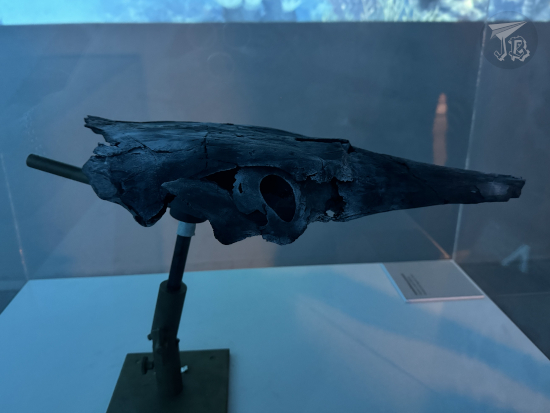
Here you can see the cranium of Carolowilhelmina geognostica, a fish which lived around 392 million years ago, during the Devonian period. It was a placoderm, a group whose main characteristics were being covered in armoured plates, and having developed an actual jaw and true teeth. The specimen is not just the holotype, it is the only known fossil of the animal. The cranium alone measures almost 45 cm, and by its shape, palaeontologist speculate that the animal was probably a predator of invertebrates. A first fragment of the fossil was found in Southern Aragón in 1971 by palaeontologist Peter Carls. Carls kept returning to the site to search for the rest of it every summer, until in 1986 he unearthed the rest of the skull, which was finally extracted in 1993.

Zaragoza Natural Science Museum: skull of an ancient armoured fish

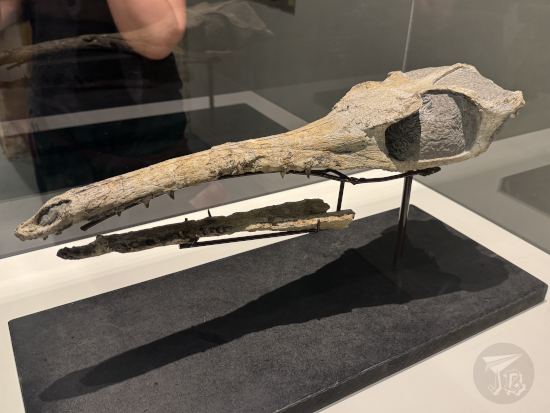
The following room is devoted to the Mesozoic, and it hosts another of the museum treasures, the skull of the holotype and only specimen of Maledictosuchus riclaensis, the “Cursed Crocodile from Ricla”. This crocodilian lived in saltwater around 163 million years ago, during the Middle Jurassic. It had flippers instead of legs, and probably ate fish. The fossil was found during the construction of the high-speed railway between Madrid and Barcelona in 1994. It earned the name of “cursed crocodile” because despite the fact that it was the oldest crocodilian found in Spain, exceptionally preserved on top of that, it took 20 years until someone could tackle its study and description. The “curse-breaking” researcher was Jara Parrilla Bel, one of the post-docs who shown us her lab work at the university.

Zaragoza Natural Science Museum: Skull of an ancient crocodile

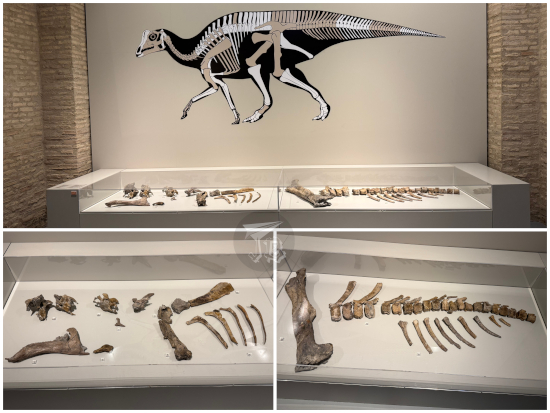
Of course, the “stars” of any palaeontological exhibit are dinosaurs. The museum hosts several iconic pieces, amongst them replica of the feet of the first dinosaur ever described by researchers belonging to the local university Universidad de Zaragoza, Tastavinsaurus sanzi (a titanosaur), a whole specimen of the Mongolian Psittacosaurus (a small ceratopsian), and a good part of an Arenysaurus ardevoli, a hadrosaur which lived in the Pyrenees area around 66 million years ago, during the early Maastrichtian; the rest of the specimen is located in Arén, where it was located, and which is one of the museum’s satellite centres, just like Loarre’s museum-lab. In the same room there were trunks of fossilised wood that could be touched, and a skull of the extinct crocodile Allodaposuchus subjuniperus.

Zaragoza Natural Science Museum: Skeleton of a small Mongolian dinosaur

Zaragoza Natural Science Museum: some bones from a hadrosaur, including the tale, hind hip and some ribs

After a small room with an audiovisual representing the impact of the meteorite and the K-Pg mass extinction (which we skipped due to time constraints), there was an exhibit of the spread of mammals. The specimen of honour in this exhibit is the ancient sirenian Sobrarbesiren cardieli (holotype, and the topic of our guide’s thesis). This species lived during the Eocene, around 45 million years ago. Sirenians (manatees and dugongs) are a type of marine mammals whose closest relatives are elephants – and not other ocean-dwelling mammals. After life spread through land, a number of mammals went back to water, and it looks like this species is a snapshot on the readaptation process: it was already completely aquatic, but it still had four functional limbs. Its hind legs had started reducing and its tail was getting flat. It was a strict herbivore, eating sea grass, but less efficiently than current sirenians.

Zaragoza Natural Science Museum: Skull of an ancient sirenian.

There was also an impressive aquatic turtle of the genus Chelonia, several remains of Gomphotherium angustidens, an elephantimorph, and smaller pieces including crabs, sea urchins, gastropods and even insects. Several of these specimens are holotypes, too.

The final area was almost contemporary considering when we had started. It hosted remains of cave bears (Ursus spelaeus, 40,000 years ago), the skull of an aurochs (Bos primigenius, a species that actually lived until the 1600s), evidence ancient hyena nests, micro-invertebrate bones, mammoth defences… These animals coexisted with human beings, whose skulls comprise the ending room before moving onto the “nature collections” which we did not visit because a) the course had after all to do with palaeontology and b) it was closing time – quite literally, museum security was turning off lights behind us since the museum shut down at 14:00.

Zaragoza Natural Science Museum: Skull of an ancient bull, curved mammoth defence, a pile of bones from a hyena nest and several human-ancestor skulls

We had a mini closure “ceremony” in the hall of the building – coordinators Miguel Moreno Azanza and Lope Ezquerro Ruiz thanked us for attending, we clapped and thanked them back. Then we all went off to have a drink, a snack and a chat. A bit after 16:00, when most students had already left and the professors had been joined by university staff, I took my leave.

Palaeontological Restoration Techniques through the preparation of Loarre dinosaur eggs

Hopping from shadow to shadow to avoid the sun and the heat as much as I could, I headed downtown. On my way I made an exception regarding the walking in the shade when I found the only remaining gate of the original Medieval Wall, today called Puerta del Carmen. Calling it “original” is a bit of a stretch though. While it is in the same place as the first gate, it actually dates from the early 1790s, and it follows Neoclassical patterns.

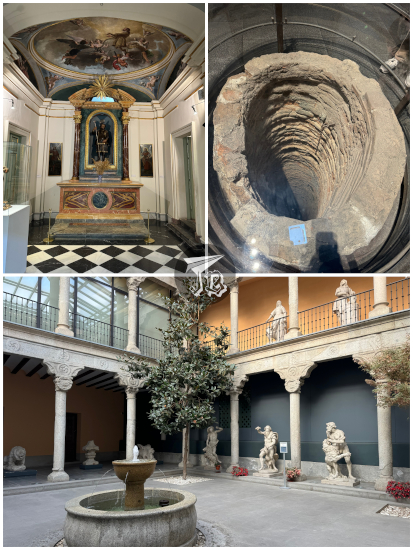
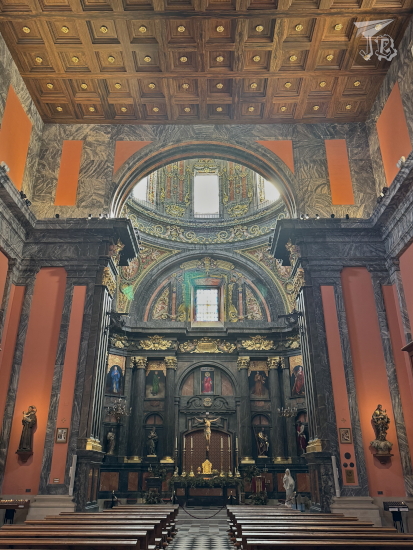
I also stopped at Starbucks for a Vanilla Frappuccino – I’m on a bit of a matcha remorse trip due to the alleged shortage, so I’ve reverted to my old drink of choice. With a temperature of around 38 ºC, I reached the most important square in town, Plaza de Nuestra Señora del Pilar, where the namesake basilica is. I kid you not, what was running through my head was “I’ve got a 0.5 zoom on my phone now, I’ll be able to take a nice picture of the whole building with its towers…”. Only to find said towers covered in scaffolding. I was able to take the picture, but it could have been nicer. I entered the Cathedral-Basilica of Our Lady of the Pillar Catedral-Basílica de Nuestra Señora del Pilar, a Baroque / Neomudejar catholic temple which is considered the first-ever church dedicated to the Virgin Mary. I sat at the chapel for a little bit, but when I was ready to have a walk around the church, there was a call for mass, so I did not do it out of respect.

Chapel of Our Lady of the Pillar, a baroque chapel for the workshop of a small figurine of the Virgin Mary carrying a child and standing on a pillar

Instead, I strolled to the former exchange building Lonja de Zaragoza, which has been turned into a free exhibition centre. The building is Renaissance with a touch of Neomudejar, and it is considered the most important civil architecture construction erected in the whole area of Aragón during the 16th century.

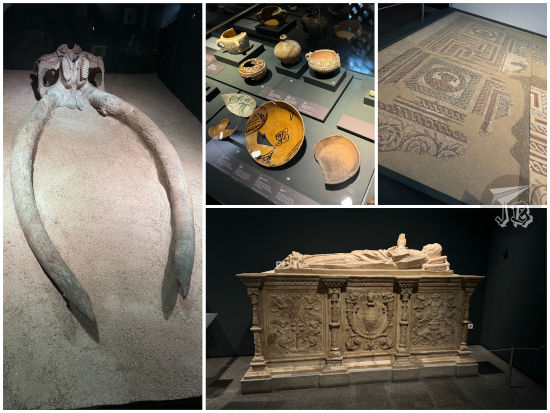
I had read that there was an exhibition on Asian culture called Tesoros. Colecciones de arte asiático del Museo de Zaragoza – Treasures: Asian art collections from the Zaragoza Museum. At the moment, the Zaragoza Museum is closed and has loaned a few of its artifacts to be displayed elsewhere. This one exhibition displays items that were originally part of personal collections and were donated to the museum. The Colección Federico Torralba, comprises religious items and art pieces from China and items from Japan. The Colección Víctor Pasamar Gracia and Colección Miguel Ángel Gutierrez Pascual have woodblock prints – landscapes, noh [能], kabuki [歌舞伎], even modern ones. The. Finally, the Colección Kotoge displays lacquered tea bowls (chawan [茶碗]). There are also modern calligraphies, paintings, and the compulsory samurai armour. The regional government has undertaken buying artefacts to engross the Asian collections. Though they looked a bit out of place in the historical building, the items were fantastic – and you could even make your very own “woodblock print” at the end.

Zaragoza exchange ceiling, decorated with architectural flower-like patterns

Though the exhibition was the reason I had wanted to go downtown, after I left the (nicely air-conditioned) Lonja, I still had some time to do stuff. I wandered back into the cathedral for a bit – between the 17:00 mass and the 18:00 mass, and left before the second one started.

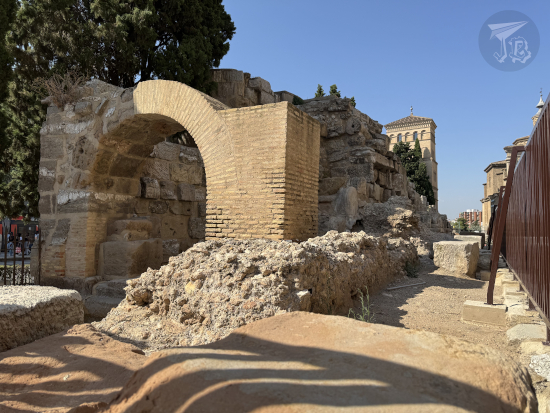
I continued towards the Roman Walls Murallas Romanas de Zaragoza, which sadly have had to be fenced off because people have no respect (I vividly remember a mum letting her toddlers to climb all over them one time I visited). At the end of that square stands the marketplace Mercado Central de Zaragoza, a wrought iron architecture building designed in 1895 by Félix Navarro Pérez. Being a Friday evening, in the middle of summer, many of the stands were closed, so it was not crowded.

Zaragoza Roman ruins

Iron and glass architecture market

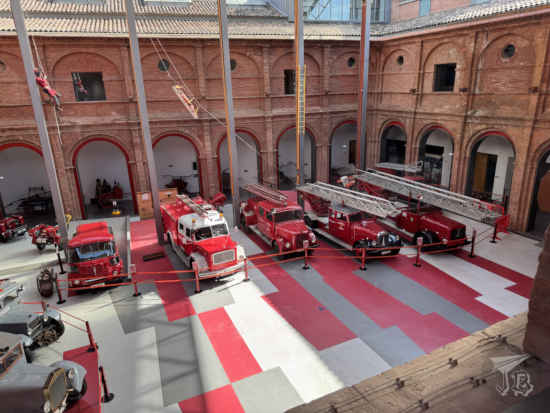
I continued towards the Fire and Fireforce Museum Museo del Fuego y de los Bomberos, where a nice gentleman wanted to give me a guided visit which I declined. Honestly, I just wanted to look at the old fire trucks (and actually, support any initiative by firefighters if it helps fund firefighting). It is a little quaint museum located in part of a former convent, the other half is an actual fire station. The exhibition covers documentation of historical Zaragoza fires, firefighting equipment, a collection of helmets, miniatures, and quite an impressive collection of vehicles used to fight fire. There were two immersive rooms, one which showed damage to a house and another about forest fires. I really enjoyed it, though I only had a quick visit – they closed in an hour, and I was the only guest along a family.

Firefighting museum: collection of vintage vehicles in a brick cloister

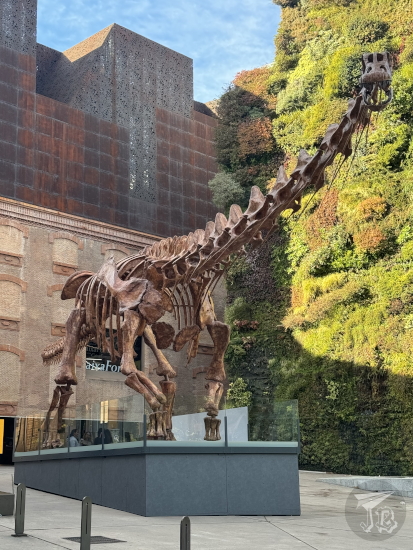
On my way back towards the hotel I walked by CaixaForum Zaragoza, where they were running the Patagonian dinosaurs Dinosaurios de la Patagonia. Seeing the Patagotitan on the balcony made me want to go in, but I had already seen it, and I knew I was just on a palaeontology high.

Patagotitan installation on a balcony

I headed back to the hotel – crossing a couple of quite unsavoury neighbourhoods – and bought some fast food dinner again. It was stupidly early, but after eating I could have a shower and relax on the bed while I studied the route for the following day. Furthermore, it was so hot I really needed that shower, and I knew I would not be going anywhere after taking it. Thus, I showered and plopped down to watch the Natural Science Museum’s YouTube Channel after I had learnt how to get out of the city.

17th July 2025: Hands on in the lab! {Dinosaur Eggs Loarre & Zaragoza, July 2025}

I got up around 7:30 and got dressed. I finished packing and before breakfast I took my luggage to the car, as I was leaving Loarre in the evening and I had to clear the room. Since I was outside, and the sky was clear, I went to explore the village a little more. There were some fountains and older farmhouses – one of them had been transformed into the rural hotel which never replied to my query. Some buildings had decorated their windows with cute homemade mascots.

Old Loarre Townhall, turned hotel (this is where I stayed)

Walk around Loarre: rhino mural, fountain, old house, wash house

At 8:30 I went back to the Hospedería de Loarre for breakfast. Since there was nobody at reception, I asked the lady at the restaurant what to do with the key when I left the room. I had my coffee(s) and toast, grabbed what I needed for the day, dropped off the key, and headed to the museum-lab for the third day of the course Técnicas de restauración en paleontología a través de la preparación de los huevos de dinosaurio de Loarre: Palaeontological Restoration Techniques through the preparation of Loarre dinosaur eggs. Today was the day when we would work hard at the laboratory.

The Restoration Lab in Loarre

Once again we got divided in three groups. One group opened a cast jacket using a radial saw – no way I was going to try and operate heavy machinery. Opening the jacket is the first step to study what it has been protecting, now that it is safe in the lab. The cast is removed in layers, and the rock is processed so the matrix (everything which is not actual fossil) is removed from around the eggs. Afterwards, there are two jobs. One is going through the discarded matrix / sediment for any and every interesting thing that can be found. The second is cleaning up the fossilised egg or eggs from any extra sediment to reveal their actual shape and colour.

I started with the cleaning crew (again). Under Ester Díaz Berenguer’s guidance, we worked on chemically removing sediment from a fossilised egg using alcohol diluted in water and brushes. It was a slow but very Zen work – wax-on-wax-off kind of thing. The others in my group sounded a bit frustrated with the task, but I guess it’s because they were younger people and more impatient? I know that I did not finish cleaning one shell fragment after an hour, but I was just… aware that fossil prep was a slow process?

Chemical clean up of fossil egg using a brush

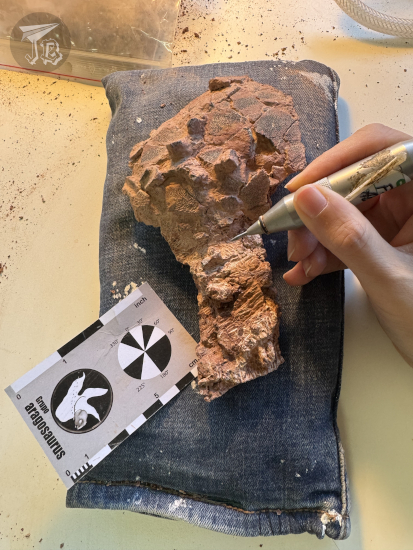
My second activity was also cleaning, but this time mechanically, using an air pen to remove as much of the remaining matrix as possible without damaging the general structure. This step would actually happen before chemical clean-up. The air pencil is a pneumatic tool so you really don’t have to press against the rock, to see the sediment peel away. It’s even more Zen than the chemical clean up – unless you’re working on a fragile bit. The important thing is to always clean away from the shells. I worked on that for another hour or so, and I even got to use some gluing materials to make sure a crack did not cause a problem – that was the bit that was more stressful, worrying I might damage the fossil.

Mechanical cleaning of fossils using an air pen

We had a short break which I used to go to the car to organise the car boot – I had thrown all my things there, but a classmate had asked me to drive him to Saragossa, and I had to adjust for his luggage to fit too. Then my group moved onto studying the removed matrix from a jacket, under the direction of Manuel Pérez Pueyo. This consists on checking bags upon bags of broken rock bits to find anything that could be an eggshell. Though the main find of the Santa Marina site are the sauropod eggs, there are eggs belonging to other species – crocodilians and theropods. You weigh some sediment, spread it on a tray and move it around until you’ve taken out anything that can be useful to science. You have a microscope handy in case you need it. I am proud to report that during my three rounds, I did not miss anything key (before you discard your sediments, you call an expert to recheck). I did not find anything out of the ordinary, but I pulled out a couple dozen egg shell fragments.

Sediment being checked for loose egg shells

At the end of the morning, I snooped around what they were doing on the opened cast jacket, and someone was using the air pen on it, trying to locate the eggs. The jackets are opened upside down, so there’s a bit of detective work to find the fossils again. In order to protect the eggs, the casts are made big enough to protect them from any saw, so casts may be huge (and of course heavy). Thus, a lot of cleaning work is required at the lab, which translates in an insane amount of time. The palaeontologists must find an equilibrium amongst protection, weight, and lab-work when deciding on the size of the cast.

Upside down cast jacket that has just been opened. The job is cleaning out all the sediment around the eggs.

For lunch, all of us went to Casa Lobarre, the village restaurant, I think a concession from the town hall, as it is in the same building. The inside is decorated with reproductions of Romanesque frescoes and painted to look like a castle, as it was used as the set in a film some time ago (Kingdom of Heaven, 2005 I think. Don’t quote me on it). They offered a set menu with the choice of a (hearty) starter, a main course, and a dessert, drinks included. It was a big lunch! I ordered stuffed courgette and assorted grilled meats. The food was quite all right, especially for the price, and the desserts were handmade.

Afterwards, we had two lectures. One was given by Manuel Pérez Pueyo, who explained to us the hard science data of the Garum facies, which could be the key to understanding the last dinosaurs surviving in Europe. He also talked about the K-Pg limit and dinosaur extinction. He also made a comparison between the little Santa Marina site with the American Hell Creek formation – as the presentation said… size matters. That’s why there have been so many dinosaurs found there, compared to the more humble sites in Spain.

The final lecturer was José Ignacio Canudo Sanagustín, the director of the University of Saragossa’s Natural Science Museum Museo de Ciencias Naturales de la Universidad de Zaragoza. He explained how a museum works (I was reminded me of the visit to the inner works of the geomineralogical museum in Madrid), and the museum-lab status. The Saragossa Museum, as an institution, is the custodian of the Loarre fossilised eggs, even if they stay in the Laboratorio Paleontológico de Loarre. This is not unique to this village, as there are several similar schemes in place all throughout Aragón, known as “satellite sites” or “remote halls”.

Canudo also talked about counterfeit fossils – a reason why I only buy my fossils during Expominerales or Expogema, I don’t trust random vendors. Then, he moved onto the topic of the Museum itself – how it works, what kind of items they hold, how they came into the museum, and a little pride-flex, that they are home to a whooping 319 holotypes (the specimen that is used to describe a species), mostly from the Aragón region. The museum only exhibits a tiny proportion of the treasures that are deposited there for their protection and research.

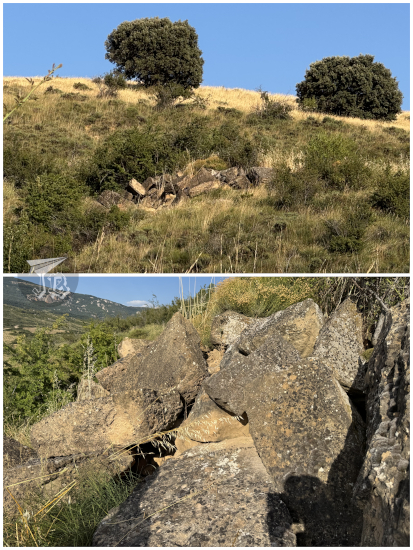
Towards the end of the evening, we hopped onto the vans yet again to head to the middle of nowhere for some amazing views of the castle. No, really. We were headed to another “palaeontological site”. It turns out that a few years ago, a farmer was ploughing his land and found a few slabs of rock which he discarded to the side. These slabs held footprints from hornless rhinoceros from maybe 15 – 10 million years ago. The slabs are haphazardly stacked with the footsteps on the underside, which is great for conservation. Also, the way is so unkempt that nobody would get there to damage them for kicks and giggles, which is good too. We had to waddle through thistles and dry plants about hip-height to get there, then climb up the rocks so all of us could get a look. Afterwards, we found a shaded spot to talk – and the professors brought cold drinks (and chocolate) again for the hike. They were crazy prepared.

Loarre castle

Here’s the thing with the rhino footsteps – scientifically, they’re out of place, so they have lost a good part of their intrinsic / purely scientific value. But legally, they must be protected and conserved. So, what to do with them? It would be expensive to move them, and once they were transported, where would they end up? Neither the lab nor the museum were willing to take them on… Each of the coordinators told us about pros and cons of different actions. In the end, what we were brought to realise was the big discrepancy between what must be done (considering the law), what should be done (considering the science) and what can be done (considering the money). The museum-lab has an idea or two about what to do with them, and I wish they succeed. I really hope the rhino footsteps become well-known some day. That way I can boast I knew them before they became famous…

Slabs of rock in the middle of a hill.

Ancient rhinoceros footsteps

Technically, the day was over then, but the coordinators asked for our help with some stuff – getting the jacket we had extracted from Santa Marina into the lab, and moving one of the display cases to change the exhibit inside. We happily complied with both, being the first to see the new display in the museum. Are we special or what?

New exhibit in Loarre, which has exchanged a jacket for two prepared eggs

Afterwards, my classmate and I set off towards Saragossa Zaragoza. We arranged that I would drive him to my hotel and he would get a taxi from there. The drive from Loarre to outer Zaragoza takes about an hour, but once you get into the city itself, all bets are off. Furthermore, Google Maps had given me some strange instructions to enter Saragossa, but fortunately, traffic was light, as I had predicted / hoped. The hardest part getting to the hotel parking lot – I had to go to the hotel first (and find a parking spot for that) to check in, and get the key to the parking lot, then drive there. Of course, the only place I could drop off the car near the hotel was a one-way street in the opposite direction from what I needed, with no convenient turns allowed. In the end, it took 20 minutes to be able to leave the car, but it was really the most convenient option. Zaragoza is really not made for visitors to park in the streets, even if the hotel was far from the centre. It was the closest to the university as I had been able to find so the next day was nice and easy.

It was insanely hot, sticky hot, and I needed some dinner. I found a nearby fast food place and headed back to the hotel room with take-out. I finally had a long shower – this was a bit of a theme during this trip, wasn’t it? The room was small and a bit claustrophobic (honestly, it reminded me a little of a prison cell), and the air-conditioning machine was right above the bed, so it was a bit tricky to find the correct temperature / fan combination. I was tired, but stupidly alert, so it took a while to fall asleep.

Palaeontological Restoration Techniques through the preparation of Loarre dinosaur eggs

16th July 2025: Santa Marina Palaeontological Site {Dinosaur Eggs Loarre & Zaragoza, July 2025}

In our second morning in the Loarre course Técnicas de restauración en paleontología a través de la preparación de los huevos de dinosaurio de Loarre: Palaeontological Restoration Techniques through the preparation of Loarre dinosaur eggs, we met at 9:00 in the museum-lab Laboratorio Paleontológico de Loarre. The first thing we did was pick up our PPE – glasses, earplugs, facemask and work gloves. For the day we would be cared for by Miguel Moreno Azanza, Lope Ezquerro Ruiz, Ester Díaz Berenguer, Manuel Pérez Pueyo and Laura De Jorge i Aranda.

Miguel Moreno Azanza and Lope Ezquerro Ruiz are the course coordinators. The former is holds a PhD in Geology and is a Postdoctoral fellow in the Saragossa university Universidad de Zaragoza. He is the egg expert and the leader of the works in Loarre. Ezquerro Ruiz is now a Lecturer at another University, Universidad Complutense (Madrid), but he has not lost contact with the dino-egg world. He is the expert sedimentologist, described as an “all-terrain geologist”. Ester Díaz Berenguer did her doctorate about ancient manatees, once dug a sauropod skeleton all by herself, and is the Natural History collection curator in the Natural Science Museum of the University in Saragossa. Manuel Pérez Pueyo holds a postdoctoral position in the university Universidad del País Vasco and is currently away in Romania, studying the same kinds of sediments the Loarre eggs are found in – he is the K-Pg Limit expert. And finally, Laura De Jorge i Aranda is the de facto boss – she is the main restorer and conservation expert in the lab, so what she says, goes. If she ever stays still for long enough to finish saying it, because she must be related to the Duracell bunny…

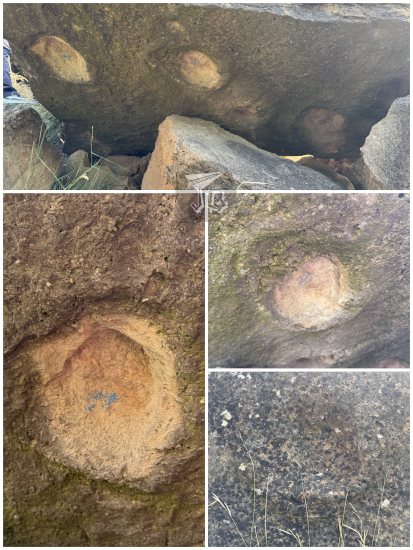
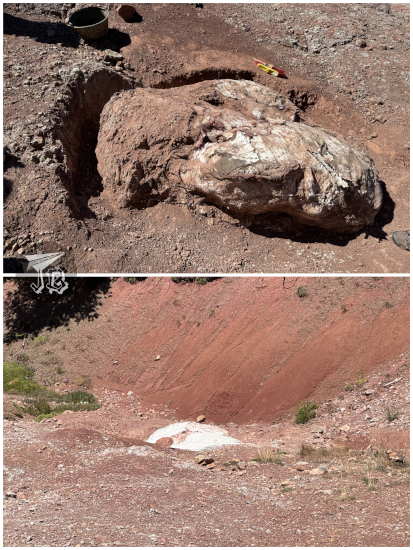
We hopped onto the vans, and drove / bounced off towards the actual palaeontological site: Yacimiento de Santa Marina, the outcrop where the eggs were first found. Around 6 km away from the village, the area of the site is around 500 square metres, and eggs could be found from the surface (originally, those have been excavated now) to almost 2 m deep. It is mainly comprised of red clays hardened into actual rock, whose age is disputed between around 70 and 66 million years ago. Fragments of egg shells can be found on the surface, easy to tell apart. While the clays are mainly reddish, the egg shells are dark grey / blue, three millimetres wide, clearly rounded and with clearly-visible pores on the outer surface. And no, finding one of the dozens of them that we saw never got old. They have found six or seven groups of eggs there, so the upcoming steps are extracting them and working out if the groups are actual nests or just casual accumulations due to transport or other causes.
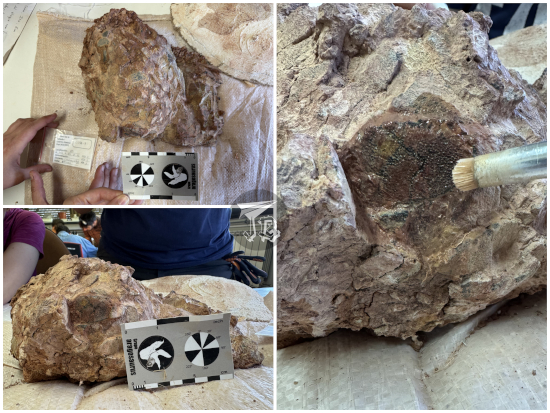
Yacimiento de Santa Marina - red hard unforgiving rock full of dinosaur eggs if you dig hard enough

There were three jobs to do around the site – cleaning up an area where eggs had already been found to check for more, repairing a cast jacket which had been damaged, and extracting a cast jacket which was ready to be transported to the laboratory. I started with the clean-up team. There, we used the “small” equipment (cleaning brushes, paintbrushes, and screwdrivers) to remove sediment and small rocks trying to see if there were more eggs around or underneath the one that had been removed. It was a definite maybe.

A spot in the ground where an egg was found. It has to be cleaned (swept) to check if there are more eggs or eggshells

The professors had brought Coke, Aquarius and pastries for breakfast at the mountain hut next to the hermit church Ermita de Santa Marina, which lends its name to the site, and thus we had a break around noon – the museum-lab team had brought us snacks and drinks. Afterwards, my group moved onto recasting a jacket which protects what could be a whole nest inside. The whole thing is massive and thus heavy, so difficult to move. While the logistics for that are being taken care of, the cast jacket protects the fossils inside, and the whole thing is kept buried to prevent weathering.

In Spanish, the cast jackets are called momias, mummies, as they are wrapped in gauze or similar before. Unfortunately, that degrades with time and weather. In order to protect the fossils, three of us applied a layer of cellulose (read: wet toilet paper) first, while the other two made burlap stripes that would go between the cellulose and the plaster. Later, another group would make and apply the new cast, and the following day the professors came back the next day to rebury it for extra protection.

Giant cast protecting fossil eggs before and after getting some TLC and new plaster

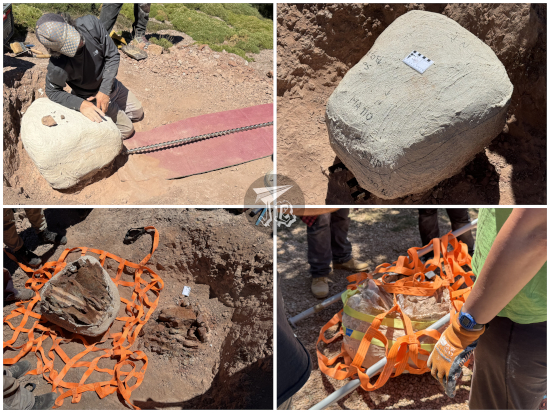
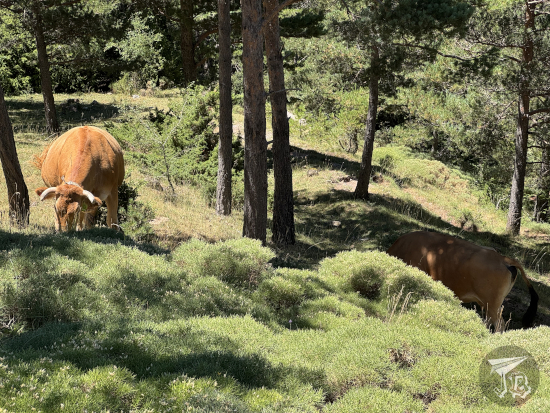
My group’s final job was breaking a plaster cast off the ground. As we worked on the other two spots, the other groups had taken a hydraulic hammer and a giant drill to the rock surrounding the cast to get it ready for extraction.. I got to work on the drill – while one of my peers pushed the tool into the rock, I was in charge of keeping the drill bit steady. Afterwards, I could hammer one of the stone-splitting wedges into the holes we had drilled, and a group-mate hammered in the other two. The cast was labelled and extra information was written on it: level, north, which side was up. After that, the whole thing was torn off the stand (by sheer blunt force, aka someone pushing it) and rolled onto a net that had to be hauled up the outcrop and then into the van, all that under the incredulous look of a herd of free-range cows which grazed nearby.

Jacket cast of a fossil being broken off the ground with a giant drill, and then transported using a net.

Two cows grazing

The strongest people around loaded the cast and carried it out, then put it in the van. They needed someone to take pictures of the process and I volunteered for that. By then, it was way past 14:30, which meant we were too late to have lunch in Loarre, where apparently it is only served between 14:00 and 15:00. Calls were (sort of desperately) made to find somewhere which would feed our large group lunch. We ended up in the restaurant at the campsite Camping de Loarre, which happily let us have some food there. They offered stuff to share, but we preferred to have individual plates. I think we all wanted something we really… wanted, so we just chose from the main dish options.

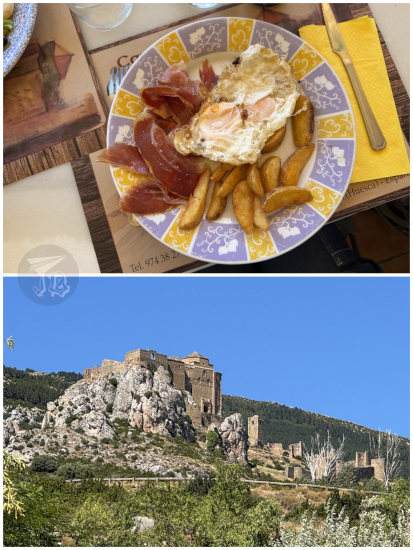
I ordered fried eggs with ham and chips. While I prefer my eggs runny, they were adequate. Since I had drunk a Coke for breakfast, I had an isotonic drink instead, and some of the communal water. As I was finishing, I overheard that they had ice cream inside… watermelon ice cream. It was exactly what I needed for dessert. While I was paying, the waiter asked something about whom to charge for the water, so I took care of that. It was still cheaper than buying all the soda and snacks the professors ended up providing.

Camping de Loarre: eggs with ham and a view of the castle

After lunch, we headed back towards the village, where we had a lecture by Laura De Jorge i Aranda on the theory of fossil restoration, conservation and preservation. One of the most important things she mentioned was documentation – as we had seen with the cast we had broken off. Once in the laboratory, the plaster is opened, the sediment classified for later study, the eggs cleaned mechanically and chemically, and any crack sealed with special glue. Every step of the way is documented. Finally, the fossils have to be packed for transport or preservation, and the sediment must be combed for anything of interest it might be hosting, such as loose egg shells (from either titanosaurs, crocodilians or theropods).

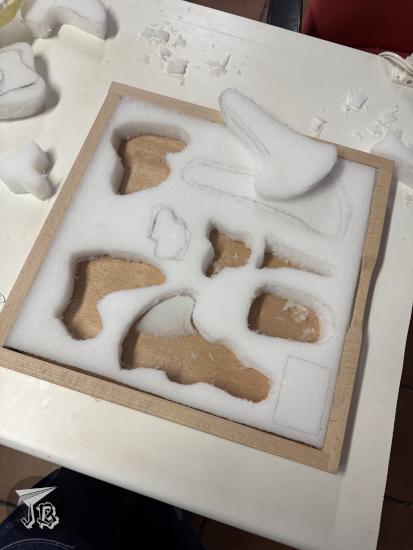
We moved then to the museum-lab to apply what we had just learnt in our first hands-on visit to the restoration laboratory. We were provided with a bunch of fossils (newly-discovered spinosaurid bones, so new that they are unpublished and thus cannot be shown) and Ester Díaz Berenguer guided us to make fossil beds with polyethylene covered with tissue. These were to go into fireproof drawers for conservation in the Natural Science Museum in Saragossa. The fossils are laid out on the polyethylene, traced, and the bed is carved for them with scalpels and cutters – remembering to also carve spaces for fingertips, so picking up the item is easier in the future.

A tray with cuts to fit the different fossil bones that we cannot show for scientific reasons, so it just looks like we cut a bunch of holes with weird shapes

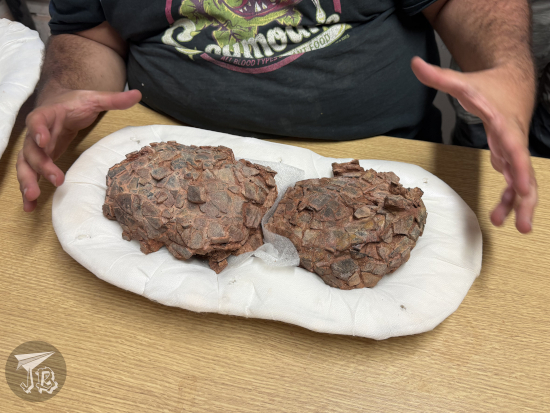
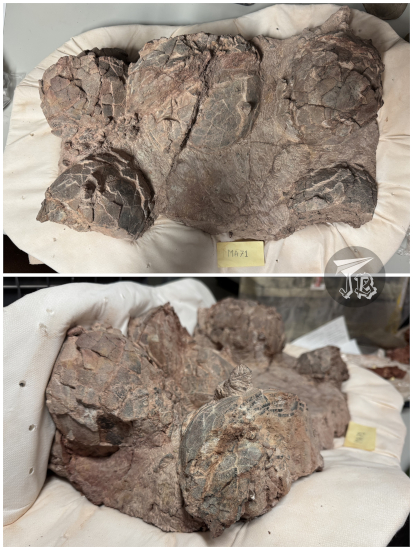
After that, Miguel Moreno Azanza showed us some of the prepared eggs. One of the specimens was a couple of eggs stored together (one of them might have a baby inside!). These were found in another site, Collado de la Tallada, which apparently is “easier to dig in”, but we were playing level pro in Santa Marina. Another was a group of five eggs together, which could have been a nest. They are criss-crossed by mini-faults. We were able to snoop around other eggs, as the professors chuckled something like “Don’t worry, you’ll work on them tomorrow”.

Two titanosaur sauropod eggs in a case. They look about as big as the palaeontologist's hands each. They are deformed and broken but have a vague egg shape.

When I signed up for the course, I expected that the “practice” would be standing there while an expert did something. Maybe we would all get one egg shell to touch and share amongst us. That would have been really cool already. But by now I had dug, protected, drilled, pushed, and held fossils. I was ecstatic. The course had blown up my mind already, and there were still two and a half days left.

A titanosaur sauropod egg nest with five or six eggs, deformed and cracked by the passing of time.

I went back to the hotel Hospedería de Loarre to shower, have a snack, and pack all my things as I had to clear the room the following morning. I also studied off the route to get to Saragossa in the evening after the course. During the planning stage, I had considered whether I wanted to go to Saragossa on Friday morning before the lessons or Thursday evening after them, and in the end I decided to drive on Thursday.

On the one hand, it meant driving after the whole day of class, probably tired, and around dusk. On the other hand, it allowed me to do the drive without a time limit constraint, park directly at the hotel, and it might mean less traffic. Furthermore, sunset was at 21:00, and it should be bright enough for a bit still after class. In the end, I decided in the end that it would be less stressful. Thus, Wednesday was my last night in Loarre.

Palaeontological Restoration Techniques through the preparation of Loarre dinosaur eggs

15th July 2025: The Egg Museum & the Mallos {Dinosaur Eggs Loarre & Zaragoza, July 2025}

I woke up around 7:30. After I had stressed out so much about reaching there, I almost could not believe I was really in Loarre, at the feet of the Pyrenees mountain range. I lounged around until breakfast started at 8:30. I went down and the choice was limited but adequate – fresh bread (still warm, the bakery was literally under my window, and it had been making me hungry for an hour), tomato spread, Spanish omelette, cheese, sausages, pastries, coffee, milk, and an assortment of jams and butter. The coffee was weak, so I had a couple of cups, but the orange juice was freshly squeezed and awesome. I made myself toast with cheese and omelette, loaded up on the caffeine and went on my way. At 8:58 I was at the museum-lab Laboratorio Paleontológico de Loarre (Oodinolab). And there was my name, on the attendance sheet for the course Técnicas de restauración en paleontología a través de la preparación de los huevos de dinosaurio de Loarre: Palaeontological Restoration Techniques through the preparation of Loarre dinosaur eggs. Everything was going to be all right. I have to admit I was 100% ready to show all my emails and confirmation should any problem have arisen… but it was all right (which… I should have known due to the email received previously… but I am an overthinker by nature).

After signing attendance and checking details for the certificate, we received a tote bag with postcards, notebooks and pens. The course started with a welcome and introduction by Miguel Moreno Azanza, who is the Universidad de Zaragoza researcher in charge of the lab. The most important goal of the course, he transmitted, was empowering us with knowledge about every step involved in fossil-handling: from digging to commercial exploitation, including geology, conservation, restoration, study and museumification.

The course kicked off with the guided visit of the museum-lab that is usually done for kids and families, including pulling out crates for our backpacks. Thus we learnt about the story of the discovery of the eggs – a fellow researcher of Moreno Azanza’s, José Manuel Gasca, a geologist, runs mountain trail. In 2019, he was training with a few colleagues when during a break he looked at the ground and saw what it looked like a fossilised dinosaur egg. And that is how one of the largest egg-dinosaur sites in Europe was discovered.

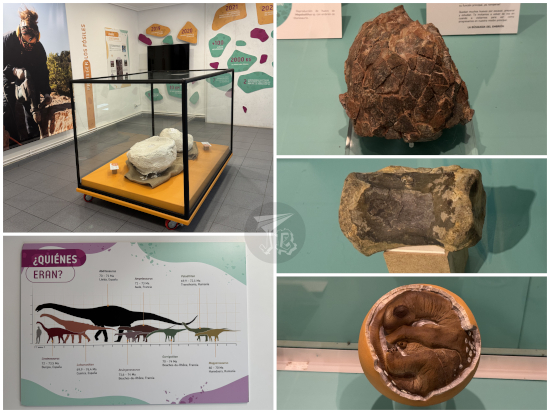
From the science standpoint, we also heard about how hardshell eggs played a key part in the evolution of animals coming out of the sea, as they allowed reproduction on land, without having to return to water. There were (are) different strategies to take care of eggs, and spherical eggs mean that they were (are) buried. From fossil tracks, we know that the dinosaur females that laid their eggs in the area buried them for protection using their back legs. We saw two cast jackets too, ready for research, on display.

Collage showing several exhibits of the museum: two cast jackets (with fossils inside), the first sauropod egg excavated (of course, in broken pieces of shell pressed together), a dinosaur vertebra and a reproduction of a sauropod embryo in an egg.

Fossil eggs are categorised as oospecies, unless or until it can be proven which animal laid them. The Loarre dinosaur eggs are tentatively classified as Megaloolithus siruguei (sometimes spelt Megaloolithus sirugei), laid by a species of titanosaurian sauropod – some candidates are Garrigatitan, Ampelosaurus and Lohuecotitan. Sauropods were plant-eating dinosaurs that moved on four straight legs, and had long necks and tails, such as Dippy, the Diplodocus (and other copies, such as the one in Madrid or Paris). During the Cretaceous period, the dominant group of sauropods were the Titanosaurs, the last surviving long-necked dinosaurs until the extinction of dinosaurs – in South America there was Patagotitan; another example is Qunkasaura pintiquiniestra, which I saw in MUPA and MARPA exhibits.

The first dinosaur eggs ever registered were found in the Pyrenees – on the French side though – by Pierre Philippe Émile Matheron in 1846, and described in 1859 by Jean-Jacques Pouech. In 1967, Pierre Souquet documented dinosaur eggshells around the reservoir La Peña, some ten-ish kilometres from Loarre (had I known in 2021…). These were the same oospecies as the ones in Loarre – since the fossil layer is the same, it makes sense.

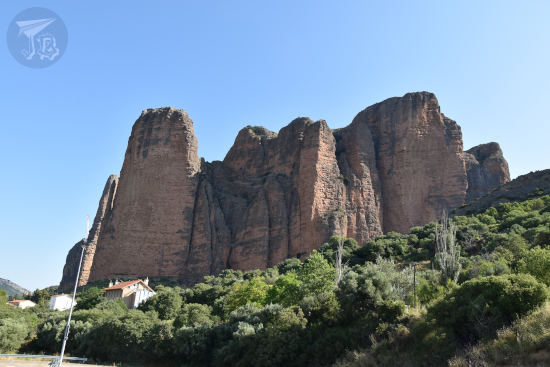
We were supposed to have a video-conference inauguration with someone from the university, but she decided to come in person, and that was moved to 19:00. So instead we hopped onto the vans that the organisation had provided and drove towards the geological formation called Mallos de Riglos, in the village of Riglos (hence the obvious name). The Mallos are a number of vertical domes conformed by reddish conglomerates. I had actually seen these geological structures before, from the other side of the River Río Gállego – not up close. The wording of the email “a slight ascent” had not made me suspect at first we were going to climb all the way up in the heat. Looking back, it was not that bad but a) I was not mentally prepared for it, and b) I have a new backpack, and it’s comfortable but… differently-shaped, so my centre of gravity was all off. There, Lope Ezquerro Ruiz (honourable mention to Manuel Pérez Pueyo, who cracked jokes and held the whiteboard) gave us a few good pointers on geology which made me wonder where he was when I was first studying geology at university.

Looking up at the Mallos de Riglos, vertical structures made from reddis conglomerates

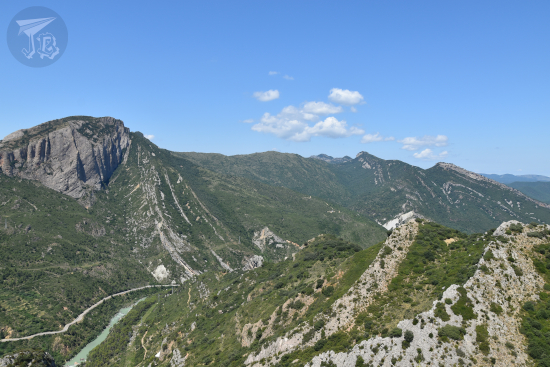
Simply put, if one assumes that the natural laws have not changed with time (Uniformitarianism), then three things happen that define geology: strata deposits are horizontal, deeper strata are always older, and if they are not, it is because something new has eroded or deformed them. Of course, the Pyrenees mountain range is anything but flat.

Pyrenees geological structures on the side of the mountain, from the mountain opposite the river - erosive walls, faults and folds

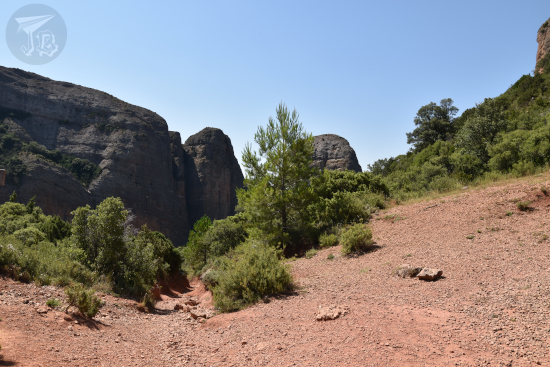
On site, we learnt about the Garum facies, the result of the sedimentation of fluvial and marshy red clays. The layer started forming during the Maastrichtian (the latest age of the Upper Cretaceous, 72.2 to 66 million years ago. Both the Maastrichtian and the Cretaceous ended with a literal bang – the Cretaceous–Palaeogene extinction event, when non-avian dinosaurs went extinct, marked by the K-Pg boundary (formerly K-T boundary), a layer of sediment rich in iridium which probably came from a meteorite impact. The deposit of Garum facies continued through the first age of the Paleocene, the Danian. This means that the K-Pg boundary is somewhere inside the layer, which is pretty cool. And even cooler? There are dinosaur eggs there, obviously from before the mass extinction.

We learnt about this literally standing on the Garum itself. We talked about the time when the a lot of the Iberian Peninsula was a shallow sea with scattered islands, and then sat to try and “see” the processes of folding, faulting and erosion that created the Pyrenees mountain range as the African tectonic plate pushed against the Eurasian plate.

Reddish rock on the ground, called the garum facies

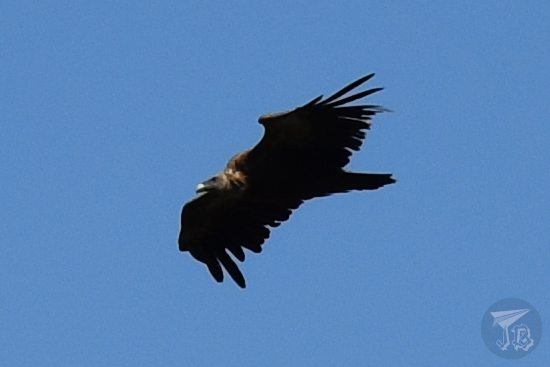
Every now and then, a vulture flew above us, in wide circles. We were apparently not appetising, because it flew away every time. Once we tackled the descent, we headed towards Ayerbe, where we split up for lunch. At 16:00 we met up again so professor Lope Ezquerro Ruiz could demonstrate how strata bend and break using a model and sand. Afterwards, we drove back to Loarre.

Griffon Vulture mid-flight

Walking down the Mallos de Riglos, with two vertical walls at the sides and a river-valley in the background

Simulation of how folding ocurs in rocks using sand

In the modern town hall, we had the first lecture of the afternoon, by José Luis Barco, Manager of the business Paleoymas, a company specialised in protection, development, management and use of cultural and environmental assets, with a strong emphasis on palaeontology and geology. One of their work lines is monetising projects related to palaeontology, as opposed to the “research-focused” stereotype. Between a palaeontological discovery and its communication or exploitation for the general public, there is a gap that can last over a decade.

Paleoymas is responsible for the project Paleolocal, which created the museum-lab in town, with the idea of studying the fossil eggs almost in situ, which would develop a touristic resource and help the village profit from it. The museum-lab is technically part of the Natural Science Museum Museo de Ciencias Naturales de Zaragoza, which has custody of the fossils according to the regional law. However, keeping the eggs in Loarre is a way to involve the community into protecting the palaeontological site, as well as to create a tourist flow to the village itself. See: yours truly, who spent 240 € in lodging there.

The second lecture was given by Miguel Moreno Azanza, who talked about the Theory of Excavating a Palaeontological Site, as one of the activities in the course was working on the field. The summary could be: “forget Alan Grant with a paintbrush, think hydraulic hammer”, but the important lesson is “do not dig up anything you cannot take with you, and register any and everything you see / do / touch”. Also, regarding egg shells, it’s important to write down whether you find them concave up or concave down. This can help decipher whether the egg has rolled or not (for example, if several eggs are found together, were they in a nest, or where they moved there somehow? Did a baby dinosaur break the eggshell?).

Around 19:30, we had the official inauguration of the course, with a representative from the university, Begoña Pérez, and the mayor of Loarre, Roberto Orós, who was nice enough to buy us all a drink afterwards. Not one to turn down a free Coke, I tagged along for a while, and when people started taking their leaves, I returned to my room. I had some crisps in lieu of dinner, took a long (and I mean long) shower, scribbled down some notes and lay down till it was time to sleep.

Palaeontological Restoration Techniques through the preparation of Loarre dinosaur eggs

14th June 2025: The road to Loarre {Dinosaur Eggs Loarre & Zaragoza, July 2025}

The closer the day came, the more nervous I got. First, there was the drive. It would be a long drive on my own, during the pre-holiday rush, and I had to go around Zaragoza (Saragossa), which has a notorious knot of connections. I had studied the route up and down with both Google Maps and my Sat-Nav. However, I could not control traffic nor other drivers. And secondly, that weekend there had been torrential rain alerts in the area. The last thing I needed was a flash flood.

I pumped fuel before I went to work in the morning as I had a cheap petrol station on the way. When I finished at 15:00, wrapped up, said my goodbyes, and headed off. I had a swing of water and set on the road, with the goal of taking a break in an hour or so. I had over 360 km to drive through, most on the A2 speedway, then a national road, and a final local road. The first 20 km or so were the worst, with lots of traffic and lorries because I was right in the middle of a logistics hubs. For the next 100 km or so, as I went north, I had the pleasure of getting caught in a few “lorry overtaking lorry” instances (sometimes even “lorry overtaking lorry overtaking lorry” ones, when there were three lanes), with the slowest lorry going at 110 kph and the overtaking one at 111 kph on a 120 kph speed limit.

I was surprisingly not tired, but I forced myself to make a stop around 17:30 to have a caffeinated drink and one of the sandwiches I had prepared, then continued on. I found some construction work which created a traffic jam that got us to a near stop for about 20 minutes around 18:00, maybe. I managed the Zaragoza exchange and drove successfully onto the following speedway (A-23) – from there, it was about another hour. When I reached Huesca, the exchange was easier, just a turn left into the national network (A-132). The last 34 km were on the local road (A-1206 – the lower the number, the “better” the road is), and took a bit longer than expected due to getting stuck behind a tractor and a harvester for the last stint. I finally reached Loarre around 19:20. I found a convenient (and legal) parking spot in one of the outer streets, and walked to my accommodation.

The hotel Hospedería de Loarre is located right in the Main Square of the village, roughly a three-minute walk away from the street where I had parked, and four minutes from the main road. When I checked in, the worker made some conversation and asked me why I was in town. Upon explaining that I had come for the course Técnicas de restauración en paleontología a través de la preparación de los huevos de dinosaurio de Loarre: Palaeontological Restoration Techniques through the preparation of Loarre dinosaur eggs, I was told that I was “the one from close-by”. Considering that I had driven for over 360 km, that shocked me. The worker explained that the previous people who had checked in before me, who were also there for the course, came from Chile and Mexico! I was the one from close-by indeed, and one of the three people from the course staying at the Hospedería. The network Red de Hospederías de Aragón comprises a group of hotels in historical buildings within areas with high tourism potential. The Loarre one is located in a palatial house, the former town hall, which was rehabilitated recently.

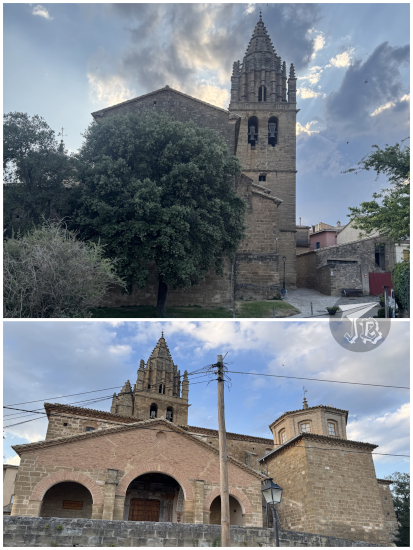
After check-in, I went for a walk for an hour or so. I saw the church Iglesia de San Esteban and the cross that marks the end of the village Cruz de Término. I also found the laboratory or “museum-lab”, Laboratorio Paleontológico de Loarre, which is a tiny building painted in bright colours and silhouettes of sauropods (though it shall soon move to a bigger one).

Romanesque church

Building with dinosaurs painted on it, the museum-lab in Loarre

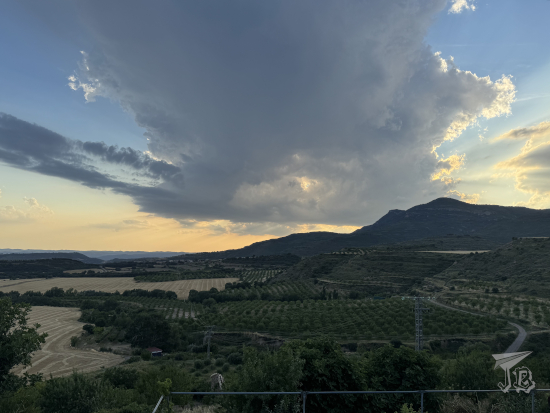
The castle Castillo de Loarre was not too far away (walking route was about an hour). I had visited it before, so I did not need to see it again, but I would have liked a picture of the walls that I was unable to get due to a lack of perspective. Unfortunately, as I considered the hike, a storm cloud rolled by. There was ominous thunder, and a few raindrops fell. If I continued on my walk, I was sure I would get drenched. If I decided to go back, the second I got out of the shower and into the pyjamas, it would stop raining. The area had been on alert due to rain and flash floods all weekend too…

Loarre castle from the valley

A huge thunderclap helped me decide to head back.

Storm rolling in over the cultivated fields near Loarre

When I pulled up my toiletries, the sun lotion had not been well-closed, so I had to wash all the stuff. At least my chapstick wouldn’t get sunburnt? Then, I headed into the shower, and when I came out, it had indeed stopped raining. However, the cloud was still there, and I did not trust it… Oh, well. There would be other chances, I thought.

Palaeontological Restoration Techniques through the preparation of Loarre dinosaur eggs

14th – 19th July 2025: Loarre & Zaragoza Summer University (Spain) {Dinosaur Eggs Loarre & Zaragoza, July 2025}

Sometimes I get weird ideas stuck in my head. I usually let common sense override them, but this time the temptation was too great, so I allowed myself to do something slightly insane. I don’t regret it one bit.

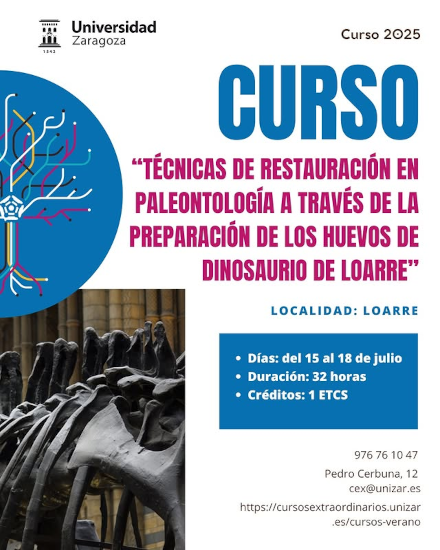
Until a few years ago, my work projects rarely extended past June. Lately however, I’ve had to work well into July, which means I have not been able to sign up for any summer university course. Especially, one summer university course from the university of Saragossa Universidad de Zaragoza called Técnicas de restauración en paleontología a través de la preparación de los huevos de dinosaurio de Loarre: Palaeontological Restoration Techniques through the preparation of Loarre dinosaur eggs. Until now, I had been working through both editions of the course – usually until the very same day the four-day course finished. However, this year my last day of work was the day before the course started.

I started mulling… what if? What if I signed up? What if I directly drove from work to the site of the course? What if I did something crazy and went to Loarre? It would mean driving for a about four hours through the late afternoon / early evening of the 14th of July, the day before lots of holiday periods kicked off… right after a whole work session. It was not the best of ideas. It was not the most reasonable thing to do. What if I did it anyway?

I made up my mind – I would do it, sanity be damned. My family also offered to subsidise part of the course and accommodation as my birthday present, too (thanks!). I found out all the information and decided to try for the course on the 27th of April. Now, I just had to wait for admission to open, sign up, be accepted, and pay. It seemed to be a simple process, like any other course I’ve taken before.

Palaeontological Restoration Techniques through the preparation of Loarre dinosaur eggs

Except, it was anything but simple.

Sign-up for the Saragossa Summer University, Cursos de Verano UNIZAR usually opens the first Monday of May. That did not happen this year – because 2025 is special? Once I located the correct website, I checked every day – like keeping tabs on concert-ticket information – until a tiny banner reading “sing-ups will open on the 12th May” appeared. Since enrolment did not open a midnight, I deduced that slots would open at 9:00, so I was ready at the computer at that time. The online forms opened indeed around 9:20, but there were only five courses listed on the website, and none of them was mine. The rest opened gradually, but only as numbers… I kept refreshing the webpage until I finally saw my course just after 9:40. I filled in the information, and the webpage said that I would receive an email with confirmation and further instructions.

That email never arrived.

I gave the university a couple of hours, then phoned them up around 13:00. I was told there was a problem with the system and to call the following day if the email had not arrived. Thus, I called around 9:15 on the 13th of May, when I was informed that they had forgotten to activate sending the confirmation emails but not to worry.

On the 15th of May there was a webpage update, saying that the email that had never arrived held confirmation and paying instructions, so I rang the University again. They told me that they would send the information “manually” and “later”. Maybe. The conversation was not really reassuring in tone. I explained that I needed to book accommodation, and they checked again – I was number seven in the list, which meant I was in. They also informed me that there was a partner accommodation on the website – not really, there was a coding error and it did not display. I told the lady so, and she said she would update the webpage. I asked again if she was sure my enrolment had gone through, she insisted that I was in, and the email would come later. Definitely maybe.

I went on Google Maps to check for accommodation in town. Loarre is a 350-inhabitant village famous for its castle and since 2019, its palaeontological sites, where around a hundred sauropod eggs have been found. These eggs were the star of the course Técnicas de restauración en paleontología a través de la preparación de los huevos de dinosaurio de Loarre: Palaeontological Restoration Techniques through the preparation of Loarre dinosaur eggs, from the 15th to the 19th of July 2025. If everything worked in the end…

The accommodation recommended by the University was the campsite, but that was a bit out – it meant driving to the village every day, or a 35-minute walk each way. And that would be nice in the morning, but not after the whole day out. I sent an email to a nice rural cottage which never replied. Then I realised that the course actually was held in Loarre only for three of the four days, the last one would be in Zaragoza (Saragossa) itself. I tried to book at the recommended accommodation, but when they had not confirmed within 48 hours, I just went on a third-party site. I booked a place to stay in the heart of Loarre and a hotel near the university in Saragossa. Of course, a few hours later, the recommended accommodation replied, so I had to cancel. I still reserved everything with full cancellation, just in case. Can you tell I had little confidence in the whole process?

Of course, in between, work tried to change my schedule (already chaotic), because someone needed one of my days in exchange for the 15th of July, which I had to regretfully decline. I hope they don’t hold that against me, but after all the planning and the stress, I did not want to give up the chance to take this course to do someone a favour. On the 13th of June (Friday), the sign-up email arrived, with a payment deadline on the 23rd (Monday) – the course fee was 190 € (160 € discounted). I transferred the money right away, since the following day there would be a bank outage. I also sent proof of payment and a copy of the documentation that entitled me to the discounted price. A few minutes later, someone wrote to me to ask for the discount paperwork. I sent it again.

On Friday the 20th of June, I got a phone call from a long number at work. I rang back. It turned out to be an admin from the summer university asking me if I was still interested because I had not paid yet! I said I had transferred the money, sent the receipt, and the documentation. The person on the other side of the line was surprised for a second, then updated bank data or something, and it turned out that my payment had indeed gone through. Magic! Guess who emailed the University again to have confirmation on writing… It should not be so difficult to… enrol in a course from an establishment that has been offering them for literally almost a century.

To be honest, I was not 100% confident I was really enrolled until I saw my name in the roster the morning of the first day. But it was. Actually, that is a bit dramatic, as on the 7th of July 2025 I received an email from one of the course coordinators, Lope Ezquerro Ruiz with some information. In that email, he explained that some people had contacted them to try and organise transportation, so they were offering to drive people from Saragossa or Huesca on the first day, and back to Saragossa for the last session.

The truth is that public transport to Loarre was a nightmare. That is why I had decided to drive, even if I don’t like it that much, especially in the middle of the holiday rush. Had I known transport from and to Saragossa was a possibility beforehand, I would have planned accordingly. I might have considered taking a railway round trip to Saragossa instead of driving, but by then it was too late to rearrange and change the whole accommodation planning. Furthermore, it allowed me to pack for all kinds of eventualities (yay boot space). In the end, it was way more convenient to have the car, so I don’t regret it.

As the day approached, the weather predictions were al over the place. I decided to pack a bag for Loarre, and a different one for Zaragoza (Saragossa) that I would swap, I also prepared an isothermal bag with frozen water bottles, drinks and snacks – of course, the ice would eventually melt, but I had to leave the car outside while I was at work (and when I came back at 15:00, the the temperature it marked was usually 43 ºC), and I wanted to make sure no fizzy drink exploded. I finally readied an extra bag for “maybes” – extreme cold, extreme heat, rain, extra headwear…

Both the village of Loarre and the city of Zaragoza are located in the area of Aragón, a region of Spain which has gained a lot of traction in the palaeontological world due to the impact of Dinópolis and their exploitation of anything that can be even vaguely related to dinosaurs.

One of the things that surprised me, however, was how Loarre wants to attract tourists but does not seem to be willing to carter to them. I packed snacks for dinner because I was not sure I’d find a place to eat or a shop, and I was right. On Wednesday, we were too late for lunch and had to find alternative plans, and the Hospedería decided that they would not offer food in the evening because the cook had hurt her foot.


If you are interested in the “hard science” of what I learnt and will summarise here, I recommend these sources (in Spanish) by part of the course professors:

  • Moreno-Azanza, Miguel; Ezquerro, Lope; Pérez-Pueyo, Manuel & Gasca, José. (2021). Huevos de dinosaurio en las Sierras Exteriores de Huesca. You can read it here.
  • Díaz Berenguer, Ester & Canudo, José. (2024) El Museo de Ciencias Naturales de la Universidad de Zaragoza. Revista PH. 10.33349/2024.113.5663. Available here.
  • Pérez-Pueyo, Manuel; de Jorge, Laura; Ezquerro, Lope; Laita, Elisa; Moreno-Azanza, Miguel; Díaz Berenguer, Ester; Núñez-Lahuerta, Carmen; Barco, José; Cuenca-Bescós, Gloria & Canudo, José. (2023). Paleontología de proximidad: cómo fijar el patrimonio en el medio rural. Found here.
  • The museum-lab Laboratorio Paleontológico de Loarre website.
  • The company that manages the private side, Paleoymas website.
  • The Saragossa University Natural Science Museum Youtube channel.

30th May 2025: Retiro Park, Alice’s sushi & Jurassic World (Madrid, Spain)

I had been on the waiting list to buy tickets for Jurassic World: The Exhibition in Madrid since it accepted sign-ups, so I was able to be amongst the first to buy tickets – albeit a few days later than originally scheduled due to the blackout. Thus, I got tickets for the first session on opening day, at 17:00 on the 30th of May. Exciting! And – almost as important – it guaranteed a spoiler-free experience…

I decided to fill the morning beforehand, and I arranged to meet some relatives at Retiro Park Parque del Retiro north-east corner. There stands one of the Romantic constructions of the park – the artificial mountain known as Montaña de los Gatos. It is a space that can be used as an exhibition venue erected during the 19th century, when follies where all the rage. A folly is a decorative building placed in a garden, usually extravagant or out of context, without a real use save from looking cute for the owner’s amusement.

The artificial mountain is literally a hollow mound covered in flowers, with a waterfall that was turned off, a sad-looking pond with a duck family, and a glass ceiling to illuminate the inside. It was closed so I could not snoop the “archaeological remains” that were found during the recent restoration.

Montaña de Los Gatos in Retiro Park, artificial mound covered in flower

Next to the mountain there is another folly, La Casita del Pescador (Fisherman’s little house). Besides that stand the remains of an old church Ruinas de San Pelayo y San Isidoro. This tiny hermit church was originally erected in Ávila during the mid 1200s. Built in the Romanesque style, it was first dedicated to Pelagius of Córdoba, and then this was changed to Isidore of Seville. During the Spanish confiscation of the Catholic church properties, it was dismantled and eventually rebuilt in Madrid as Romantic decoration in a project directed by Ricardo Velázquez Bosco. It looks weirdly out of place, but rather pretty.

Ruins of the Romanesque church Ruinas de San Pelayo y San Isidoro, in brick

The yearly book fair Feria del Libro de Madrid had started, but as my relatives were late, we could only have a quick walk before we headed off to Wonderland – The Kaiten Lab – , a running sushi restaurant with hot-dish orders on the side, with decoration inspired by Alice in Wonderland, with a twist. According to the restaurant “you step into Alice’s mind, though Alice was a psychiatric patient”. I am not sure how I feel about the mental hospital thing – I think they were just trying to cash on the entrance that was already there when they bought the venue. However, I can state that it’s a pretty mediocre sushi restaurant. With a menu price about 10 € over a Runni sushi, I was expecting something at least as good, not worse. It sells the decoration, and that is the only thing that makes it special.

Wonderland – The Kaiten Lab –. A funky restaurant themed around Alcie in Wonderland which serves sushi

We went somewhere else for dessert, and I had a smoothie. Afterwards we said goodbye and I headed off towards Espacio Ibercaja Delicias for the opening session of Jurassic World: The Exhibition, which was full of parents with children and a bunch of actual fans, some of them being parents too. I was actually the first in line to enter, but they pulled me to the side to wait for a card called “credit photopass”, which was a free perk from having been on the list. Unfortunately, the fact that they did not have that ready put a bunch of families with kids in front of me. I got my photo taken against a green screen and they added digital dinosaurs later.

As we were waiting, the whole “dinosaurs are for kids” thing popped up again. I knew things were not going to be as awesome as expected when one of the “park guides” said that her favourite dinosaur was Mosasaur. Despite what Jurassic World: Rebirth claims, Mosasaurs are not dinosaurs, but marine reptiles, which lived in the Cretaceous period (94 – 66 million years ago).

Like the previous show, the experience starts on the ferry to the island, which then opens to the main gates with a Brachiosaurus peering from overhead. The whole exhibition runs on the story that you’re a VIP visitor to the Jurassic World complex, getting a special tour. A couple of guys and myself stayed a bit behind to take pictures without kids and families, and the “ranger” scolded us because “we were going to miss the explanations” in front of a pachycephalosaurus. At that point I felt that they were herding us like cattle…

The second room is the laboratory, with Mr DNA included. There are reproductions of eggs, amber, and baby parasaurolophus, one of them a puppet brought out for kids to take pictures with. The staff did not seem to keen on catering to anyone older than eight, again…

The following two rooms were the Jurassic World movie velociraptors (Deinonychus, in real fossils): Charlie, Delta and Echo were in their confinements and there was a bit of a “training show” with Blue and Owen Grady.

Then there was a bit of a “reprieve” room with fossil replicas and a make-believe excavation, where they brought out a puppet of Bumpy, the baby ankylosaur from Camp Cretaceous. Afterwards came the hybrid Indominus rex jungle, which had a hilarious moment when a kiddo shouted “Hello Indominus, I love you” while the thing was supposedly mangling its food. This was probably the best-made animatronic, it looked a lot like the beast they invented for the movie.

The next room held the Gyrospheres from the Jurassic World film, and a baby velociraptor puppet. This one I could take a picture with after all the kids had had their turn.

Jurassic World The Exhibition. Gate with a Brachiosaurus peering above: Collage showing the velociraptors, a carnivorous dinosaurs skull, the Indominus rex and a Gyrosphere

Jurassic World The Exhibition Baby Bumpy the ankylosaurus

Finally, the last room was Rexy the Tyrannosaur – scars from the first movie and all. In universe, she almost broke containment and almost escaped. There were noises and sparks and roaring, honouring the exhibition’s motto: the closest you’ll ever be to real dinosaurs.

Jurassic World The Exhibition Rexy the T-rex. We know she's the one from the first movie because she has scars down her cheek and neck.

All in all, the dinosaur animatronics were amazing, but the staff had instructions to get everyone in-and-out in one hour, so it felt rushed and, as I said before, herded. And honestly, I am not going to listen to “park rangers” who don’t know their dinosaurs from their reptiles… Which would later be one of my beefs with the upcoming Jurassic World: Rebirth movie anyway…

However, there were dinosaurs, and they felt pretty real, especially the Indominus and Rexy. I missed the mosasaur, though (even if there was a super-cute plush toy in the souvenir shop). All in all, the exhibition was really fun. The animatronics were very lifelike and Bumpy looked exactly like she does in the animation. All in all, it was a good day with ruins, sushi, dinosaurs and geeking out. There’s not much more anyone can ask for…

11th April 2025: Extant, extinct and extrastormy (Madrid, Spain)

Since March was extremely rainy, I hoped that April would not be so. No such luck. However, there was a dinosaur exhibit in Madrid that I was keen on seeing, and I wanted to do it before Easter, because it would be packed during the holidays and I could not get there in May due to personal stuff. And since getting to the Casa de Campo area takes so long by train, I looked at combining it with something else around (it’s a four-hour roundtrip from where I am). What other thing was close? Somewhere else I never go because it’s far away by public transport and a nightmare to park around – the local zoo Zoo Aquarium de Madrid. There was after all only a 10% chance of rain…

Spoiler alert: while I was getting drenched (I’m being dramatic, of course. I had an umbrella) in the zoo, and later in the exhibit, the weather app said “partly cloudy” and there was no mention of storms nor rain. But the skies opened. Ask the peafowl…

I took the train and changed to the underground until I got to the Casa de Campo stop. There were not many people around since it was a weekday. There’s a bus that takes you to the zoo, but I found it more efficient to walk, since there is a pedestrian way alongside the road. I reached the zoo a bit after it opened at 11:00, and just as my ticket was getting scanned the first few raindrops fell. At first, it seemed like a small drizzle, but soon it started to rain in earnest. By that time, I had managed to get to the pandas, about 40 metres into the zoo.

I’d been to the Zoo Aquarium de Madrid twice in my life before. The first one I was very small. I have no memory of it, but there is a home video of three-year-old me chasing a peacock and a voice warning “come back, it’s going to bite you!”. The second time I was in third grade, and had my first camera. I remember that I was devastated because the pandas were very far away and I could only take a picture of a distant, tiny, black-and-white blur. That was decades ago, and I had never been back, though I had a recurring dream for years that involved one of the pools there.

The zoo opened in 1972 as an alternative to the “Beast House” or Casa de Fieras that used to be hosted in the Retiro Park, a few sad and crammed-looking cages that must have been horrible for the animals. As every animal park, Zoo Aquarium de Madrid is not free of controversy, especially related to the ethics of keeping great apes and cetaceans in captivity. They used to have dolphins, but those were surrendered and sent away earlier in 2025. Conversely, the zoo participates in over 60 conservation and breeding programs for endangered animals – they have breeding couples of owls, whose chicks are routinely released into the wild, and have succeeded in breeding pandas (they claim to be the most successful institution at breeding panda outside China) and white rhinos. They have non-breeding animals as ambassadors, such as a family of Iberian lynx.

The zoo is vaguely organised per continent – Europe, Australia, Asia, Africa and the Americas, and the home of actual wild animals such as storks and rabbits.

As I went into the zoo, the first thing I spotted was a small lake with flamingoes, pelicans and (squatting) storks. The storks are free to come and go, but they like to be in the zoo because they get free food, I guess. My idea had been to walk a spiral and try to see everything, but I got distracted by “Panda Land”, signalled by a big red gate – after all, they are the main attraction. I thought the pandas might be visible, and they were – much closer than I remembered indeed. I did get to see both the male and the female, who live apart within the same installation. I had time to take a few pictures before it started to rain in earnest. And no, they were not distant, tiny black-and-white blobs this time, and not only because I had borrowed a really good lens for the day. I had to put the camera away when the rain became too heavy.

Zoo Madrid - stork, flamingoes, panda

It rained for a couple of hours, and that impacted me a little. I ended up sharing shelter with a band of peafowl, and had to go from covered exhibit to covered exhibit at first. I found the orang-utan territory very sad, and I did not catch a glimpse of any gorilla. In the aquarium, I got stuck with all the school visits, but there were quite a few sharks and big fish in the ocean tank.

Zoo Madrid: peacocks and peahens sheltering from the rain

Zoo Madrid: Sea lion, small blue jellyfish, sharks

I ambled around the Australian area, where most of the animals were unfazed – especially the cassowary, which by the way is apparently the most dangerous bird in existence, even if I’m way more crept out (and fascinated) by emus. I did not see the koalas, and I walked past a tree which seemed fenced off just because. As rain cleared out, some of the animals started playing around, such as the binturong (Arctictis binturong), a distant relative of civets. At around 13:20, I had reached Africa, and I was in front of the hippos when it stopped raining. Awesome!

Zoo Madrid: Cassowari, binturong, Patagonian mara, and hippo yawning

Since I had borrowed a camera lens which is better – but heavier – than mine, I really wanted to try it out. Carrying it around without being able to use the camera due to the rain, at all, would have been a bummer. After the rain stopped, I was able to take quite a few good pictures though. Those included the Siberian tiger (Panthera tigris tigris), and its relative the domestic cat (Felis catus), whom I’m not sure is a resident or a squatter in the “farm” section of the zoo alongside the sheep, goats, and a very large pig.

Zoo Madrid: Jiraffes, zebra, black bear and Siberian tiger

Since I’d been to Emociones al Vuelo a few days earlier, I did not mind the lack of Raptor Flight exhibit due to rain. I did miss the Exotic Birds one, but I caught the Sea Lion exercise (hello, swimming pool from years of recurring dreams). Around 14:30, it had stopped raining, the animals had eaten, and I caught many of them. Unfortunately, most – especially the carnivores – were napping. I did however saw a very active red panda (Ailurus fulgens) around the tree that I previously thought was fenced off for no reason.

Zoo Madrid: Red panda, common rabbit, grey wolves, brown bear

By the time I left, the workers had also dropped off a few Easter Eggs throughout the zoo as the holidays were about to start. At 17:00 I had to be at Escenario Puerta de Ángel to see Saurios, a dinosaur exhibit, which turned out to be a bit of a disappointment. Most of the animatronics I had already seen as “Dino Expo XXL” – I recognised it because of the broken neck on one of the brachiosaurus. The exhibit had a first part with a few skeleton replicas – the coolest thing, as I had never managed to see a complete cast of a Spinosaurus before. Then there was an open area with some life-sized replicas and photo-ops, but it was completely made for kids. There were actors and activities for them, which I guess were extremely fun if you’re younger than five. Yet another “dinosaurs are for kids” activity.
Saurios Madrid - skeleton replicas

Saurios Madrid - models

And then it started storming again. A black cloud, a clap of thunder, and the skies opened. Thus, we all had to hurry to the last section, which was most of what I’d seen in “Dino Expo XXL”. I was really not impressed by the whole thing – remember folks, “for all the family” means “designed for kids”. I guess I would be more gracious had the weather been nice, but… having seen most of the exhibit before for half the price, I was not impressed. Fortunately or unfortunately, there is a Jurassic World Exhibition coming up soon…

Saurios Madrid - models

9th March 2025: Expominerales 2025, the other half of the weekend’s plans (Madrid, Spain)

Since I had to be in Madrid to watch the fantastic concert by the Wiener Sängerknaben, the plan had been to attend the yearly Expominerales mineral fair in the Mine and Energy Engineering School Escuela Técnica Superior de Ingenieros de Minas y Energía (ETSIME) that same day. However, the fair closes on Saturdays between 14:00 and 16:00 for a lunch break, so since the weather was so horrid, I decided not to wait. On Sunday, the weather forecast was slightly less miserable, and in the end I was lucky with only some gentle rain as I walked between the train station and the Engineering School, nothing like the sleet deluge the previous day.

Expominerales fills the ETSIME with stalls selling minerals, fossils and crystals offered by reputable sellers. Here I’ve seen the biggest megalodon teeth in my life, held a plesiosaur vertebra – which I regret not buying when I had the chance – and discovered that moldavite exists – and which I regret not buying when I had the chance… do you spot a pattern here? I did not break it anyway, because in the end I cannot afford most of what is sold, and I already own most of what I can…

Overlook of ETSIME during Expominerales

I arrived at the School shortly after the exhibit opened around 10:00, and the area was still pretty empty. There were fewer stands than the previous years I’ve been there, and the moldavite stand was not there. Actually, there were very few meteorite-related stands this time around. I did see amazing modern-times frog fossils from Owens Lake. Owens Lake is called Patsiata in the Mono Native American language. In 1913, the lake dried out when the water from the Owens River was redirected and with years it has become a deadly salt flat, a source of alkali sand storms with a side of carcinogen materials. One of the minerals found in Owens Lake is trona, a crystal formed by the precipitation of sodium carbonate, making it a type of evaporite. In 2023, an atmospheric river caused floods in California, filling the lake up for the first time in over a century. The floods damaged infrastructure and created a surge of floodwater to the lake, which eroded surfaces and dragged a lot of small hibernating animals towards the lake, where they were killed instantly. Their soft tissues were quickly replaced by trona salt before the bodies even decomposed, creating a perfect cast of the poor critters. There were two on display at Expominerales and they were creepy!

Something else that caught my eye (and was actually within my doable price range) was a polished abalone shell. The Korean abalone (Haliotis discus) has been used for centuries in the art of najeonchilgi [나전칠기], which refers to decorating items with mother of pearl. The abalone can be polished in full, creating a whole iridescent body of nacre. These mollusks used to be collected by haenyeo [해녀], traditional female divers from the Jeju province, but most of them are farmed for food today. A small polished abalone came home with me.

Items from Expominerales

The School opens its classic museum during the exhibit, and I always enjoy visiting it. However, after wandering around for a bit (and spending some money), I moved onto what basically is the next building over to the ETSIME, the Spanish Mining and Geology Institute IGME – Instituto Geológico y Minero de España, which hosts the Geomineral Museum Museo Geominero. The original design of the building was conceived by Francisco Javier de Luque, and work started in 1921. Though a congress was held there in 1925, construction went on until 1941. The building has not been extensively restored, but it presents deviations from the original plans, and even from subsequent ones.

The museum is hosted in the former hall, and to get there, first you have to go through a very bored security guard – who first asked if I was sure I wanted to be there. Once inside the building, one goes up the main staircase towards the gallery underneath a glass-and-iron skylight with the logo of the Mining Institute. It was designed by Luque himself and created by the Madrid workshop La Veneciana, a glassware shop dating from 1876 and which, under a different name, still exists today.

Entrance staircase to the Geomineralogical museum

The museum is an open area, located underneath another incredible skylight. The displays are hosted in wooden cabinets in the main floor. The upper balconies can be accessed through spiral staircases and are protected by metalwork railings. One of the details I absolutely adore are the glassworks displaying geological sample cores of different surveys. I’ve never seen the library, but I was once part of a group which was allowed to play with some of the “lesser value” items they have as part of a training session, and that was super fun. The museum is probably one of my favourite spots in town.

The Geomineralogical Museum

From the architecture point of view, I like the building and the skylights. However, there are way more things to love in the museum, such as the wooden cabinets, full with samples of minerals, fossils and meteorites. The museum’s collection are divided into “Mineralogy and Petrology”, “Flora and Invertebrate fossils from Spain”, “Vertebrate fossils from Spain”, “Foreign fossils”, “Systematic invertebrate palaeontology”, “Micro-palaeontology”, “Fossil resin”, “Fossil tracks”, “Stromatolites”, and the “special exhibits”. One of these is a complete cavern bear (Ursus spelaeus), another one is an Ibex (Capra ibex). The last two have honour spots, with their own display.

When you come into the museum, one of the first things that you see, in front of the door, up on the first-floor balcony, is the cast of the most complete Tyrannosaurus rex skull ever found – Stan. Specimen BHI 3033, Stan, was found in 1987 and excavated in 1992, in South Dakota’s Hell Creek Formation. Stan lived around 65 million years ago, in the Cretaceous period. We know he fought for his life more than once – his ribs were broken and healed, two vertebrae were fused together, and he suffered a bite to his snout. Stan remains one of the most complete skeletons ever found, and probably the most-often cast. The skeleton made mainstream news when it was auctioned at Christie’s in New York due to money disputes among partners of the original owner-firm, Black Hills Institute. An anonymous buyer paid $31.8 million for it in October 2020. In 2022 it was disclosed that the Department of Culture and Tourism of Abu Dhabi had bought Stan for their projected new Natural History Museum.

On the ground floor there is a mastodon fossil Anancus arvernensis found in the 1990s. These animals related to modern elephants lived throughout the Miocene and went extinct in the Early Pliocene (two million years ago). The could have been around the size of a modern African bush elephants, but their tusks were mostly straight. They would have lived in steppe with dry and warm climate, but close to water. The fossilised bones were recovered are dated around 3.2 million years ago, and were dug from the Las Higueruelas site between 1948 and 1991.

Exhibits at the Museo Geominero

After I wandered the museum for a while, I left towards my train which was delayed… 43 minutes. Fortunately, so were the ones that had to pass before, so I ended catching one in the right direction after only a twenty-minute wait. And then I got junk food, because some days have to end in junk food…

22nd February 2025: Architecture in Madrid, and folklore in Guadalajara (Spain)

By now, reaching Madrid by train without anything remarkable to comment on is actually remarkable all by itself – there were actually no problems for once. I had booked a spot for a visit at noon, but since I don’t trust the rail service, I hopped on a train to be at Atocha Station around 10:00, and for once I was there right on time, maybe even a minute early!

As I walked up the street Paseo del Prado, I passed by the exhibition centre CaixaForum, where the Patagotitan still stands. Since it was still winter, the trees on both sides had little to no leaves, and I could see it from the opposite side. I of course said hi.

Patagotitan skeleton

My first stop was the church Iglesia de San Jerónimo el Real, dedicated to St. Jerome, a late Gothic – early Renaissance building erected between 1502 and 1505. It belonged to a monkhood whose original monastery stood near the river. The stagnant waters caused illnesses among the brethren, who asked the Catholic Monarchs for a new location. The church for the new community was created from brick and masonry, and towers were added in the 17th century. The interior is decorated with two gothic altars to the sides, but no main altarpiece, as the original one has been lost to time. Instead, there is a painting by Rafael Tegeo La última comunión de San Jerónimo – Saint Jerome’s last communion – created in 1829.

Monastery Monasterio de Jerónimos

Afterwards, I headed towards the National Museum of Anthropology Museo Nacional de Antropología, a small museum dedicated to the diversity of cultures in the world, particularly the Americas, Philippines, Africa and the “Far East”, focusing on traditions, culture and religion. It is covered by my national museum card.

At the moment, the museum is running a temporal exhibit on art based on myths, legends, and sacred texts from India, Caminos místicos. Tradiciones vivas del arte de la India – Mystic Paths. Living Traditions of art from India. I was curious about it, but not expecting how much I liked it in the end. The pieces of the exhibit were mostly based on Hinduism (Sanātana Dharma, सनातन धर्म), the oldest religion in the world. According to Hindu tradition, the Supreme Being Brahma exists as themself, but also as the manifestation of the deities Brahma the Creator, Vishnu the Sustainer and Shiva the Destroyer, all of who at the same time have different avatars (avatāra, अवतार) or incarnations. One of the core principles of Hinduism is the concept of cosmic cause-and-effect justice, karma [कर्म]. Another is reincarnation (saṃsāra, संसार), an eternal cycle of life and death until the individual is liberated from it through self realisation or illumination. The religion is based on values like righteousness, truth, love, peace, and ethical conduct, and it is quite open to other beliefs and ethics.

Religious Indian Art pieces

The Museum of Anthropology’s permanent exhibition has a lot of items from the Philippines on the ground floor, probably due to how long(1565–1898) the islands were a Spanish colony. There are clothes, tobacco items, ritual objects, and a small sample of how the local culture was throughout the 1800s. To the back, there is a room dedicated to the religions of Asia and the Middle East – Hinduism, Buddhism and Islam. The first floor is dedicated to Africa, combining a number of traditional exhibits with modern photographs of the traditional people’s way of life – baskets, pottery, leather and wooden objects, ritual masks… The second floor holds items from the Americas, especially from South America. Some of them include a Mexican Día de los Muertos (Day of the Dead) altar, Andean Carnival masks, Sioux-Lakota clothes, Inuit coats…

Religious icons and traditional masks

I remember visiting the museum when I was a child, and then feeling disappointed in it when I returned as an adult. This time around, I found the permanent and temporal exhibitions quite interesting, so it’s a good thing I headed there. It also helped make time until noon, when my next visit was due, to the only Ministry that can be visited – albeit not freely, by appointment and paying a fee – as it is a historical building.

The current Agriculture Ministry is housed in the historical building known as Palacio de Fomento – Palace of Development. Its plans were originally drawn by architect Mariano  Belmás y Estrada, aiming for an Arts and Craftwork School. Later, Eduardo Saavedra y Moragas took over to turn the design into a university. Finally, the project ended in the hands of architect Ricardo Velázquez Bosco, who erected the building between 1893 and 1897 to house the then Ministry of Development.

The Palace is an impressive construction. The original design had three floors, which have now been turned into five. From the outside, the building looks white and orange-brown, but a more focused look reveals decorative tiles by Daniel Zuloaga, who also collaborated with Velázquez Bosco in the ETSIME. The entrance is flanked by two caryatids and roof above there is a sculpture group – Glory and Pegasi La Gloria y los Pegasos, a bronze copy of an original marble by Agustín Querol.

Palacio de Fomento, outside

Once you enter, you find yourself in a huge majestic hall, where we had to check in, since the building is a working Ministry. The email said to be there at 11:45 to go through security. I got there at 11:40 and went in at 11:44. They took my name (they did not care about the ticket) and they put my stuff in the X-ray machine. I had to go through the metal detector and when I asked whether I had to remove my belt, I was just told to put my hand over the buckle… So much for security, I thought, because I did not beep. Then I realised that I must look quite non-threatening as quite a few people were thoroughly searched as they set off the machine.

Beyond the hall where we were checked in, there is an imperial staircase in marble, and a vaulted frescoed ceiling. From there, we visited some offices and meeting rooms, and the portrait gallery – from which the ministers who held office during the Franco dictatorship had been removed. Finally, we visited one of the side inner courtyards, covered in a skylight with some ironwork.

Palacio de Fomento, inside

After the visit was over, the security guards saw us out and locked the doors. I walked around the building, because I had honestly never realised it was square. As the place was next to the Retiro Park, I had been considering looking for some archaeological spot they had opened. However, there were more ideas – Guadalajara was having the Botarga parade, and it was the fair weekend in Tendilla, though, a phone call informed me that traffic was horrid and that it was not a good idea to head there so late in the afternoon.

Eventually, I decided on the Parade. I bought some sandwiches and headed for the train. Though I got rained upon, it cleared up, and at 18:00 I was in Guadalajara to have a look at the traditional Parade of Carnival characters Desfile de Botargas – “creatures” from the whole area which meet up in the capital the Saturday before carnival, despite each character having its own schedule wherever it is rooted. The parade was a bit late, so I could talk the local botarga group – El Manda (the Order-giver), Los Mandaneros (the Order-receivers), and the Botarguilla (Little Botarga) – into posing for me. I watched and took pictures from two spots, but the parade moved really fast because they only had thirty minutes to do the route – last year they took well over an hour for that. I decided I did not want to run for it that much… I have to remember to find myself a vantage point next year, instead of trying to get the beginning of the parade…

Guadalajara Botargas

Heifferette from Riba de Saelices

Botarga Parade 2025

I got “attacked” a few times, and ended up with soot all over my face, but at least I avoided the guy painting people with mustard… The botargas seemed to zoom in on children and cameras, and so did the devils Diablos (from Luzón) and the heiferettes Vaquillas and Vaquillones (Villares de Jadraque, Robledillo de Mohernando, Luzaga, Riba de Saelices). It was fun. One of these days I might have to try to follow the botargas in their own villages…

4th January 2025: Bye Bye, Murderbird. MARPA, Alcalá de Henares (Spain)

While it was great to have the Concavenator fossil (a.k.a. Murderbird in my headspace) in the Dragon Hunters exhibit in Alcalá de Henares close enough to visit at will, the time had come to see it move on. Just in case there was any information I was missing, I decided to book a guided visit to the exhibit. As it was scheduled for 12:00, I decided to look for something to do beforehand, and I found guided visits to the monastery Monasterio de San Bernardo at 10:00. I had seen the building before, as it stands next to the MARPA, I just had never given it much of a thought.

The monastery was established under the patronage of Cardinal Bernardo Sandoval y Rojas around 1620. He bought land cheap because it was near the Moorish quarter. The church was erected in brick with decoration in stone on the outside. The inside has an elliptical dome, and it was heavily damaged in a fire during the Civil War, so it had to be restored – the work on it was a Rehabilitation prize in 2019. Most of the decoration of the church was lost and today walls and roof are just white and gold. The building is attributed to architect Juan Gómez de Mora.

There is a free-standing ciborium in gold, with a number of sculptures of Saints instead of an altarpiece. Behind the altar and ciborium, there are a number of paintings – they were created by Italian artist Angelo Nardi. Nardi was born in the late 16th century, and studied in Venice before moving to Madrid, where he became a Court Painter. His style evolved from late-Renaissance (mannerism) to Baroque, and he is known for his expressive faces. He was friends with Velázquez, and famous for being quite kind, though his style eventually fell out of grace. He painted most of the pictures in the church, although some of them are now out of order as they were moved during the Civil War.

The visit was interesting albeit a little underwhelming. It felt a bit weird to be the only visitor and having the whole thing explained to me – that has only happened once before, in Recópolis. However, that was epic, because I ended up getting the whole archaeological place for myself. The monastery was more of a serious experience – and it did not rain on me. But still it felt… colder. And like being in an exam, the guide kept asking me questions about history, architecture and hagiography.

Monastery of San Bernardo in Alcalá de Henares

I had a bit of time before my following visit, so I decided to run to the Sala Museográfica de la BRIPAC, a tiny museum about the history of the Army’s Parachuting Brigade. The Brigade was created in 1953, and the parachuters participated in combat for the first time in 1957. In its origin, it was established in Alcalá, so there is a historical connection there. The hall hosts uniforms, flags, medals, and reports about the peace missions in the 1990s. I am not much of a fan of Armed Forces museums, but today the BRIPAC is considered a peace corps. The museum opened in February 2023, on the 70th anniversary of the foundation.

BRIPAC exhibit

I still had a bit of time, so I dropped by Plaza Cervantes, which was full with Christmas lights and shoppers at the small market. There were food stalls, a small bookshop, some rock shops… Nothing really caught my eye though.

Plaza de Cervantes Christmas

I finally headed back towards the Archaeology and Palaeontology museum MARPA Museo Arqueológico y Paleontológico de la Comunidad de Madrid. It was one of the last chances to see the exhibition on the history of palaeontology “Dragon Hunters” Cazadores de Dragones with a guided visit, and I figured out that maybe I could learn anything new – despite the fact that I’ve been there a few times and bought the book. We had a nice fun guide who relied a lot on asking questions to her audience. Apparently I was the only one with… some knowledge of… anything she asked – what’s with guides in Alcalá de Henares trying to have you do their job? I felt a bit sorry for her so I answered her questions – with a higher success rate than the ones from the Monastery, to be honest. She did not impress me with the depth of her knowledge, to be honest. She actually looked at me a bit panicky when I asked her t confirm that the T-Rex replica was a cast of the famous Stan.

Cazadores de Dragones entry in the cloister of the MARPA

I stayed back for a bit longer after the visit ended. I’ve ranted on and on about the Concavenator before, both the fossil slab and the actual-size reconstruction. I just loved having both so at hand. When I was young, the scientific community came to the conclusion that “birds descend from dinosaurs” but today it is actually believed that birds are actual dinosaurs. And since the poor beast has such a ridiculous name, I’ve just been calling it “Murderbird” or “Murderchicken”, for kicks and giggles.

There were these two little kids who kept grilling their dad about the skeletons, and the poor man was a bit overwhelmed. I decided to give him a hand with the questions and explained a little. I thought that was it, but the smallest child pointed at the Concavenator and blurted out “can you tell us more things about that one??” He was so eager that I just took the family to see it and told them a few things further. The family was on their merry way in five minutes – four-year-olds only have so much attention span. The kids were happy, the parents were relieved and I got to geek out about dinosaurs with appreciative public. I think the interaction was an all-around win.

Murderbirds: T-rex and Concavenator

At first I had thought that I would be staying in Alcalá for an exotic lunch, but I was not really feeling up to it. With great sadness, I said goodbye to the Concavenator and moved on to drive home.

26th November 2024: Another Concavenator visit (Alcalá de Henares, Spain)

I had to run some errands in Alcalá de Henares in the afternoon, so I decided I would get there in the morning, and walk to the Archaeology and Palaeontology museum Museo Arqueológico y Paleontológico de la Comunidad de Madrid, MARPA. The exhibition “Dragon HuntersCazadores de Dragones was still running and since it was a random weekday morning, I thought it would be empty.

I was right, it was deserted enough that the security guard looked at me weirdly. Yes, I’ve been there before. Twice. I hope to be back at least once more before the exhibit closes in January 2025. The security guard should not be remembering me, I did nothing weird. Taking a few hundred photographs of a fossil is completely normal.

Why am I so obsessed about the Concavenator? Well, one does not always have such a unique fossil so handy, and for free. Furthermore, the usual home of the Concavenator does not allow pictures. And lastly, I’m a nerd. The species Concavenator corcovatus was described in 2010 by Francisco Ortega, Fernando Escaso, and José Luis Sanz from a single skeleton found at Las Hoyas site in 2003. The specimen was officially catalogued as MCCM-LH 6666. The animal was a medium-sized carcharodontosaurid. Carcharodontosauria, which included the likes of Giganotosaurus, Mapusaurus or Carcharodontosaurus, were a group of large theropods from the Cretaceous period. The skeleton was almost complete, with the tail and neck contorted in rigor mortis. The fossil shows two things that make it special – a hump or sail created by the spines of the back vertebrae, and the fact that some pigments were found on the fossil. Not unique but rare enough findings include impressions of skin and scales, and smaller bones in the belly area, rests of undigested dinner. On the arm bones there are insertions for ligaments similar to those that modern birds have at the insertion of feathers.

Concavenator corcovatus

The Concavenator lived around 125 million years ago, in an area of wetlands. Its teeth, general shape (it walked on its two hindlegs and had small-ish arms), along with the remains of animals that it had eaten, tell us it was a carnivore, and its placement in the carcharodontosaurid family, that it was a predator. However, no large predator is known for rejecting a good scavenging feed. The spikes or hump on its back, above the hips, can be clearly seen on the fossil, but nobody has any idea of what it was for – speculations have been made for communication means, fat deposits and thermoregulation. When alive, the animal would have been around 5 metres long, two metres tall, and 450 kilograms heavy.

Concavenator corcovatus details

All that to end up being dug up and named… Pepito, which is the diminutive of the diminutive of the Spanish version of Joseph. The equivalent of Joseph would be José, nicknamed Pepe, and changing the last “e” into “ito” – the suffix for small – would yield to something like Joey. So this magnificent predator was either named after a mini-mini-Joseph, or a small meat sandwich, which is also referred to as a pepito. Seriously, what happened to the illustrious tradition of Boaty McBoatface? This would have been a glorious Toothy McToothface (“Spanishised” as Dientito Caradientez or something).

Anyway, after the visit I dropped by the museum shop to buy myself some Concavenator-related merchandise. When was there the first time, I bought the exhibition catalogue, but since then they had received some silly cute items – I bought a pin, a badge, and a magnet, just because I could. Maybe as the exhibit draws closer to the end there will be discounts on other things…

I left the museum and decided that since it was way past 14:00, I should grab a bite to eat. As I had parked my car next to a shopping centre, I headed there with the idea of some Asian food. However, there is a burger joint that usually has a long queue and that some friends had told me was really good – as good as fast food can be, I guess. It is called TGB – The Good Burger. It is supposed to serve “NYC style gourmet hamburgers”. The place was empty, so I decided to give it a try.

I ordered a “Cheese Lovers” burger, which consisted of a beef patty, American cheese, goat cheese, Gorgonzola, sautéed onions, arugula and honey mustard sauce. It was… very cheesy. It was nice, but nothing I feel I must try again, especially when there are cheaper options in the shopping centre. And sushi. But at least, I satisfied my curiosity before I went off towards all my dull, grown-up errands which I shall not bore you with…

The Cheese Lovers burger

22nd November 2024: “Wicked” (film) on opening day (Madrid, Spain)

There was a time when you could mute words on social media to avoid spoilers. Since the algorithms have taken over and you can’t curate what you see any more, I decided that the best way to avoid Wicked spoilers was trying to see it as early as possible, preferably on opening day. Ideally, on the first screening on opening day, an English version.

For a change, “ideally” worked. At least, I found a screening at 15:45 on the day the film came out. It was a cinema with Spanish subtitles but I can live with that. I have seen the musical twice in the Apollo Victoria Theatre in London and I’ve loved it both times. Not only I’m a firm believer in the message of Defying Gravity, I also give regular thought to Dancing Through Life. Sometimes I also listen to No One Mourns the Wicked and get all philosophical…

Anyway, I headed off to Madrid with next-to-no information and no expectations, hoping to enjoy the film. I had been slightly surprised that so many tickets were already booked when I bought my own, but I gave it no more than a couple of seconds’ worth of attention, I just thought I was running late since I made the decision the previous weekend before heading out to see Ha·Ya·To . Since the film was rather early in the afternoon, I had to get to Madrid with time for a bite. One of my options was Yatai Market but in the end I decided to grab brunch at Toby’s Brunch Club, where they run an all-day brunch (here I went, cheating the system again, just like I did at the James Joyce – twice in one week, too). I tried to book online but the system only took reservations for two or more. Since the Internet said that it was usually quite busy, just thought I still had Yatai as a backup plan…

I arrived at Atocha Station and walked towards the brunch place. As I did, I had to walk past Caixa Forum, which is still running the exhibit on Patagonian dinosaurs, and the Patagotitan smiled at me. I, of course, smiled back.

Patagotitan mayorum

The very-busy brunch place was empty – weekday “crowds” I guess. I was the only customer there for the duration. Usually, not being able to book for myself on my own discourages me from a place, but I’ve been wanting a “typical” brunch for a while now. The brunch consisted of a cold drink, coffee or tea and two courses (22€). For my cold drink, I ordered orange juice, and for the hot one a coffee latte. The first course was a basket of breads with butter, jams and tomato paste, and a yoghurt with fresh fruit. As my second course, I ordered eggs Benedict with smoked salmon. Because I really wanted eggs Benedict and I can’t cook them to save my life. Everything was delicious, especially the yoghurt. The eggs were perfect. I think this would kill me before noon though, so glad I used it as lunch.

Toby's breakfast club brunch

After my brunch / lunch I still had some time so I dropped by the art gallery Museo del Prado. I used my museum card Tarjeta de Museos Estatales and the lady at the ticket booth told me she had never seen a card like that before. She took it to the back shop, and when she came back, it turned out that the card had stuck to another card, which explained why she was confused. I finally managed to get in, and spent about an hour there. There was a small exhibit called El Taller de Rubens (Rubens’ workshop) which analysed the master’s works and that of his apprentices which was very interesting.

Afterwards, I walked towards Yelmo Cines Ideal (passing by and waving at the Patagotitan again) to watch Wicked. When I got there, the cinema was still closed, but as soon as I turned away to snoop into a shop across the street, the doors opened. I found my seat and I found myself seated between two groups of high school and university students, who were complaining that their life was very hard, and that they had barely had the time to eat lunch before getting to the cinema. And a few of them were threatening to cry. And they were telling each other not to sing along. I had not realised there was such a big following of Wicked from the younger crowd…

After a few minutes of hearing them babble excitedly, I realised that all of them had listened to the songs on the Internet, or something, but they had never had the chance to seen the musical themselves – it’s debuting in Spain in autumn 2025. It made me realise how lucky I am to be able to jump onto a red-eye flight at a random weekend and go to London, and be there for the 14:30 performance at the Apollo Victoria Theatre.

Wicked film poster

In general, I enjoyed the film. More than I believed I would, because I went with zero expectations and I had managed to avoid any kind of spoiler and previous knowledge, except that Jeff Goldblum was the Wizard. The main cast includes Cynthia Erivo as Elphaba, Ariana Grande as Glinda, Jonathan Bailey as Fiyero, Michelle Yeoh as Madame Morrible, Marissa Bode as Nessa (kudos for an actual disabled actor playing a disabled character!), Ethan Slater as Boq, Jeff Goldblum as The Wonderful Wizard of Oz; and Peter Dinklage as Dr. Dillamond (voice).

I do not believe what I am going to say – but I thought Goldblum was the weakest character. I mean, he keeps playing himself, and Jeff Goldblum is not the Wizard (I had the same feeling when I watched Jurassic World: Dominion; he played himself, not Ian Malcolm). On the contrary, Michelle Yeoh was fantastic, her sole presence in a take stole the whole screen. I enjoyed seeing the animal characters a lot, as it is the bit of the musical that always feels a bit off. The logistics of landscaping Oz was a bit awkward at points, but I guess that’s theatrics and not… geography.

I found the music decent. As for me the most important thing was for the story to be faithful to the musical – which is more up my alley than the novel – I was rather satisfied. The best song, in my opinion was What is this feeling?, the camerawork was stunning. It was also great to see the cameo of the actors who portrayed Glinda and Elphaba on Broadway for the first time, Kristin Chenoweth and Idina Menzel – known worldwide today for Frozen’s anthem Let it go. The library scene and choreography for Dancing through life was also impressive.

What I saw of the subtitles was not a good sign though, because the message of No One Mourns the Wicked loses most of its meaning if you translate it as “she’s finally dead”. However, I am rather good at ignoring subtitles anyway. I am not sold on Glinda being all pink either. Too many Legally Blonde vibes there, I prefer ice-blue.

The film ended at the end of the first act of the musical, with the “main event” of sorts – Defying Gravity. Very showy, okay music-wise. It was more visually impacting than musically, and my mind was dubbing it with Kristin Chenoweth’s version anyway. At this point, half the theatre was sobbing, which I found slightly amusing.

All in all, I enjoyed the day and the film. I am looking forward to the second part, and having affordable Wicked merchandise I don’t have to save for special occasions. After leaving the cinema, I walked back, and since it was cold, I got there in record time – and then I had to wait 40 minutes for the train because of course I did.

18 & 19th November 2024: Apocalyptica Played Metallica in Madrid (Spain), so there I went

Planning for this short getaway started on the 23rd of February, when I bought my ticket for the Apocalyptica Plays Metallica Vol. 2 Tour 2024 stop in La Riviera in Madrid (50.50 €). Almost immediately, I headed off to Apocalyptica’s website to buy the VIP Tour 2024 Upgrade (58,90 €). The upgrade consisted on early access, photograph / meet & greet / autograph session (the important part), VIP lanyard, fabric patch, pin and tote bag. Honestly, all that for barely 100 € was a sweet deal. Back in Antwerp for Starset, someone I was queueing with complained that VIP tickets were too expensive for “a broke uni student”, but for me, meeting with the artist, albeit briefly is usually worth it – early entry is a plus, too, because for some concerts I either find a barrier spot or I just have to go to the back. The bundle was dispatched on the 9th of June (according to the email. Do Finnish post offices open on Sunday?) and it arrived on the 18th.

I originally booked a cheap hotel about half an hour’s walk from the venue. Later, I decided that I preferred the more expensive one less than 10 minutes away, so I changed my booking a week before the concert. I did not book there originally because it required prepayment, and my card was playing up..

On Friday the 4th of November I received an email with instructions for the Meet & Greet, which was to start at 18:30, and I should be there at 18:15. All right, I could do that. It was only a matter of waiting.

On Monday, 17th of November, I took a morning train to head out to Madrid with some leeway for time because I needed to do some small item shopping. I had to dodge some guys trying to get people to sign up for an NGO, but at 11:40 I made it to my first stop of the day – the light museum Museo de la Luz. I had been putting this visit off to go with someone who had expressed interest. However, I also waited for another exhibit and I missed my chance as it turned out to be only temporal. Thus, I decided to head to the Light Museum on my own – it was also one of the few exhibitions open on a Monday morning.

The Light Museum is a modest exhibition with interactive artworks that are mainly made out of lamps, lasers and lights. When you come in, you are given covers for your shoes and a key for a locker – all for free. Then you wait until an attendant takes you in and shows you how to interact with the first artwork “The birdcage” (La Pajarera), a box made out of light and metal that you make change colours with the movement of your arms. Once you know how to “play” with the art, you are left on your own to wander for an hour. At first I thought it would be tight, but the place was small – a bit too small for the price, I thought. I was there for around 40 minutes in total.

There were few people and I was able to check out most of the artwork uninterrupted. The next exhibit is made out of a number of old music festival lights – those that gave a lot of heat from the 90s, which are supposed to be a reference to climate change. Then there is a giant kaleidoscope you can walk in – this one became my favourite. Other rooms or works include a wall of lights that follow you as you move or dance, something with lasers (that I think was broken), some light illusions, a room full of hanging lights, a cube of mirrors and light… At the end there is a wall reading “light museum” in differently coloured lights. When I left, the lady at reception gave me a badge for booking with the official website.

Light Museum Madrid

Light Museum Madrid

I walked out and headed towards the restaurant where I wanted to cheat the system. I crossed the square Puerta del Sol, where they were setting up the Christmas tree – it was about 45% Christmas. On my way, I walked by the underground stop Metro Banco de España which has a tiny door for Little Mouse Pérez – Ratoncito Pérez, the Spanish equivalent to the tooth fairy. I never remember to check it out when I am around, but I made the connection this time.

I finally made it to the James Joyce Pub – which is technically a sports bar. I was not there for the TVs though. I had a while back found the place looking up places which served English breakfasts in Madrid. The James Joyce prides itself in being an Irish pub and offers Irish All-Day Breakfast (12.00 €) – two pork sausages, two rashers of bacon, baked beans, fried egg, sautéed mushrooms, grilled tomato, blood pudding, chips, two half-toasts and butter. No, I would not survive that for breakfast, so I ordered it for lunch (and dinner), thus tricking the system indeed. Unfortunately, it was really good and authentic, so now I’ve got to come back for the sausages and the shepherd’s pie, so at least twice.

James Joyce Irish breakfast

After lunch, I headed out towards the park known as Madrid Río. The park runs along the banks of the river Manzanares. It covers 121 hectares, and it was designed after to cover the space emptied when the belt road M-30 was rebuilt as an underground tunnel. The original project was created by a team of architectural studios and landscapers, with strong ecological consideration – aiming to help the area recover from the degradation and pollution caused by years of road traffic. The project was carried out between 2006 and 2012. In 2015, a second project was carried out to “renaturalise” the river, opening the dams to allow the water to flow freely, which in turn caused the recovery of many plant and animal species (to the detriment of… the local rowing team).

There are also bridges that connect both banks of the river. One of them is the one I crossed – just because I could. It is the pedestrian bridge Puente Monumental de Arganzuela, designed by Dominique Perrault. It is a bridge in two parts – one crosses the river, the other overlooks the park and connects to the urban area, and a total length of 278 metres. It is a tube made out of steel and wood that I’ve been wanting to check out for a while.

Arganzuela bridge

Another important bridge is the completely different Puente de Toledo, a baroque bridge built by Pedro de Ribera. It was erected in granite between 1717 and 1732 as the previous ones had been taken down by torrential floods. This one was made to stay, with nine solid arches opened to allow for the river floods. It was… ready for Christmas.

Madrid Río and bridges

It was weirdly warm for a November afternoon, so when I went to my hotel I opened the window while I had a shower. Around 17:00 I headed out to the venue, where there was a small group of people waiting already. La Riviera is a 1,500 people venue, with really good acoustics – and very dedicated staff. The place was originally a cinema, which was turned into a disco, and then into a music venue and nightclub. It is the same place I saw Epica and Apocalyptica in 2023, and I was surprised how many people came for the M&G considering that last year we were… six. We were around 30 this time around.

At first we were chatting in front of the main door, but soon a queue started forming. A little later, the nice security guy (who last year told me “I looked the part of an Apocalyptica fan”) took us to a secondary door, and the queue was properly organised. Surprisingly, bags were not checked – while last year they even took markers from people.

Apocalyptica is a Finnish symphonic metal band. It was formed in 1993 as a tribute to Metallica with a classical touch – playing with cellos. Their debut album Apocalyptica plays Metallica by Four Cellos was released in 1993. They slowly moved from covering other bands in a neoclassical style to their very own repertoire. Today, the members are Eicca Toppinen, Paavo Lötjönen and Perttu Kivilaakso, three classically-trained musicians with a deep love for metal. In 2024, they have gone full circle with the album and tour Apocalyptica Plays Metallica Vol. 2, performing with drummer Mikko Kaakkuriniemi.

Apocalyptica Tour 24/25

We were ushered into a queue for signatures, and afterwards we would go at the end of the line to wait for photographs. I had brought a print-out of the picture from the previous year, and I told them that whenever they came to Madrid, I would come see them. I got a smile for that. It was an awesome photograph, after all. After everyone had their stuff signed we had the photographs. I asked for “a big metal hug” and got trolled instead. Fun times though!

After the photograph, I found a spot at the barrier. Last time I got on the right, this time I went left. Just a little. I did not want to go dead centre in case anyone decided to moshpit, but I might next time as there was no issue – everyone was too entranced for anything like that, I’d say.

The opening act was the Finnish band Arctis, a baby band who has just debuted with their first CD. They were pretty fun, maybe… a bit… too happy bouncy for metal? I’ve read their act described as metal-pop. It might be. I liked them okay, and they were nice.

Setlist:
 1. I’ll Give You Hell
 2. Remedy
 3. Tell Me Why
 4. WWM
 5. Bimbo (Lambretta Cover)
 6. Fire
 7. Frozen Swan
 8. When The Lights Go Out
 9. Theater of Tragedy

Arctis at La Riviera 2024

Arctis at La Riviera 2024

Apocalyptica came on stage at 21:00 sharp, and the live was glorious. All the songs were Metallica covers, from the new album, the first one, or the remastered version of Plays Metallica released in 2016. Despite that, one would not even have to be a Metallica fan to enjoy the concert, because the three men that compose Apocalyptica have an amazing magnetism. Perttu reminds me of the Duracell Bunny, he just did not stop for a second throughout the whole concert, which lasted a good two hours. Paavo seemed to be in his own little world, as he usually does. Eicca is the one doing most of the talking, and he is hilarious when he delivers his puns with a total deadpan voice and face.

Setlist:
 1. Ride the Lightning
 2. Enter Sandman
 3. Creeping Death
 4. For Whom the Bell Tolls
 5. Battery
 6. The Call of Ktulu
 7. St. Anger
 8. The Four Horsemen
 9. Blackened
 10. Master of Puppets
 11. Nothing Else Matters
 12. Seek & Destroy
 13. One

The audience was mostly moved by Nothing Else Matters, I’d say, judging by how they chorused it. Perttu was all in for that. Personally, I found Seek & Destroy and One, particularly, to be extremely powerful. Also, knowing that they dug up the original bass track from deceased Metallica member Cliff Burton for The Call of Ktulu was half-amazing and half-chilling. All in all, it was a fantastic concert, no matter how one looked at it.

Apocalyptica La Riviera 2024

Eicca Toppinen . Apocalyptica La Riviera 2024

Paavo Lötjönen. Apocalyptica La Riviera 2024

Perttu Kivilaakso. Apocalyptica La Riviera 2024

Apocalyptica La Riviera 2024

Afterwards, Arctis was hanging out by the merch. I got their CD, they signed it, we took a photo. It was fun!

I left the venue and I brought an ice-cream and a sports drink for “dinner” of sorts, because I was thirsty. I had both in the hotel room before my shower – the second of the day – and collapsing onto the king-sized bed. I had to wait for the phone to finish charging before I slept though, so I watched a movie before I zonked out.

I woke up on Tuesday, 18th of November and drank my coffee before I set out. It was freezing out there, with frost on the grass, in spite of the warm afternoon the day before. On my way, I found the ancient walls of the city, remains from the old Moorish fortress alcázar, which stand to the side of the Royal Palace and the Almudena cathedral. I walked towards the centre of Madrid – The Sol Christmas tree was about 60% ready – to meet up with my relative for breakfast at a new place called Kawaii Cafe. Inspired by the Japanese kawaii [可愛い]. Kawaii means pretty, childlike, cute, and the Kawaii Cafe has taken the idea to heart, maybe not not in a complete accurate manner though. Everything is pink, full of fluffy and glitter. The food is not only tasty, also pretty. However, the wait staff is dressed as “maids” [マイド], which I tend to associate more to the… hm… more risqué side of hospitality. When food is brought out, you are offered to chant a spell for it to be even tastier.

I found the place existed by chance, and I was instantly smitten by the rainbow waffles, because they were adorable, and very, very rainbow-like. Thus, I ordered them, along a matcha latte. My relative tried the pancakes with a cocoa. She was ecstatic at the quirkiness of the place.

Kawaii Cafe Madrid order

We stayed for well over an hour, and then headed out to one of the local museums Museo de San Isidro – Museum of Saint Isidore the Labourer. Isidore is the patron saint of Madrid. He is credited with several miracles – multiplying wheat and food, having his oxen plough on their own, and rescuing a child from a well making the waters inside rise. According to tradition, the museum is housed where he used to work, and legend has it that the old well is the one he pulled the child from.

Today the museum hosts some palaeontological and archaeological exhibits, from a mastodon and ancient rhinos to Medieval artefacts, running through the Roman occupation and the Muslim period. The place is a complement to the Museo de Historia de Madrid, or maybe its competition, though I think both belong to the same institution – and both are free. As the building is a historical place, it offers the chance to enjoy its small but beautiful Renaissance courtyard, with sculptures of mythological heroes, and of course St. Isidore and his wife. There is also a tiny Baroque chapel.

San Isidro Museum

San Isidro Museum: chapel, well, and courtyard

Right next to the museum stands the Baroque church of Saint Andrew the Apostle Iglesia de San Andrés Apóstol , which was getting ready for Christmas. The church is one of the oldest in town, though it was rebuilt after its destruction during the Civil War, and it has been recently restored. It hosts a number of religious sculptures and a painted vault above the altar.

Saint Andrew church Madrid

We took the underground at the station Tirso de Molina, which can still be accessed through the historical entrance hall, which is similar to the one that was closed off in Pacífico. It was beautiful, though of course busier than the museum one. Over the entrance to the platform there is a tile mosaic with the old shield of Madrid, dating back from the original station. It was installed in 1921, and it is the oldest artistic item in the underground network.

Access Hall at undeground station Tirso de Molina

From there we commuted to Nuevos Ministerios, where they had just kick-started the Christmas market. It seemed to be the “brands” market, with Lego, Disney, and so on. There was also a food truck by a famous chef selling basically chicken sandwiches at outrageous prices. I had been vaguely curious but not going to break the bank for a chicken sandwich, especially after such a breakfast!

I took a train from there back home, with no incidents whatsoever (because by now I’m desensitised to trains being late…)

13th October 2024: Mercado Cervantino de Alcalá de Henares (Spain)

Alcalá de Henares was the birthplace of writer Miguel de Cervantes, author of Don Quixote, one if not the most important novel in the Spanish speaking world – often considered the first modern novel in Western literature. Thus, a lot of the town activities are presented in relation to Cervantes, one way or another.

Renaissance Fairs are getting popular in the centre of Spain, and Alcalá has dubbed its own “Cervantine Market” Mercado Cervantino as part of a week-long celebration of Cervantes’ christening Semana Cervantina. I missed most of it since I was in Türkiye, but on the last day I was able to drop for a couple of hours with my sibling.

Mercado Cervantino

We reached the market around 11:30, too late to hear the cannons. It being a Sunday, everything was packed. We got to see Don Quixote and his sidekick Sancho, a horde of orcs, and a falconry exhibition by Francisco Miranda and his Harris’ hawk.

Don Quixote

An orc

Falconer

Harry's eagle mid-flight

Afterwards, I talked my sibling into dropping by the nearby Archaeology and Palaeontology museum Museo Arqueológico y Paleontológico de la Comunidad de Madrid, MARPA. The exhibition Cazadores de DragonesDragon Hunters – is still on, and I was not going to waste the chance to see the Concavenator (Concavenator corcovatus). I realised they had brought some extra merch for the exhibition, and I decided to drop by in the near future.

Concavenator Skull

We went off for a late lunch afterwards, and later I just drove off.

8th September 2024: Dinosaur FOMO (Guadalajara, Spain)

Whenever I’m reasonably close to dinosaur stuff, I have to check it out, I just can’t help myself. About a year ago, I attended DinoExpo XXL in Guadalajara, which turned out to be rather disappointing. Apparently, the town hosts dinosaur exhibits in time with the yearly festivals – they must be profitable. I read about Dinosaurs Tour (or Jurassic Expo, according to the banners), and I thought I would skip it, but in the end… in the end I just had to go and see it, because the Fear of Missing Out was strong. Maybe this time over it would be cool…

The exhibit was small, and while some of the models were correctly covered with feathers, a few were mislabelled to conform to the popular imaginary (way more of a cash cow than anything scientific). The usual suspects were Tyrannosaurus Rex, brachiosaurus, pachycephalosaurus, iguanodon, parasaurolophus… For some reason, there was a stegosaurus half climbing a tree, and a few Jurassic Park inspired reproductions: questionably-represented dilophosaurus and too-big velociraptors. Something new was a sarcosuchus, a giant crocodile ancestor. Oh, and something I was completely unable to identify… like a diplodocus with a beak and spikes… Maybe it tried to be a homage to Littlefoot?

Dinosaur Tour Guadalajara

The lights made everything look weird, too, because there was a lot of colourful – pink, blue, green – lighting which made it for a very disco-like atmosphere. It was not a big or good exhibit – not even the toddlers were extremely impressed, but as I said: Fear Of Missing Out gets the best out of me when it’s about dinosaurs. Next time though, I’ll try to get over the FOMO, because I think they’ll just bring a wall lizard and call it a Velociraptor.

27th August 2024: Arganzuela Greenhouse, British Cemetery and a ‘palaeontological site’, Madrid (Spain)

I have been feeling dizzy on and off these last few months, so I’m avoiding long drives – that has left me dependent on public transport, which is not too reliable. Thus, instead of all the hikes I wanted to take, I’ve been doing day trips to Madrid.

My first stop was in the district of Arganzuela. Although I’ve been to Matadero a few times before, I had never wandered to the side, where a boring-looking metal roof peeked over some trees. I recently discovered that I should have ventured beyond the brick walls that close the Matadero area. This building is called Arganzuela Crystal Palace Palacio de Cristal de la Arganzuela, and is an example of the wrought iron functional architecture of the early 20th century.

Invernadero de Arganzuela - structure

The building was designed by Luis Bellido y González and erected between 1908 and 1928 as a vegetable warehouse. In 1992, the building was remodelled – the wrought iron structure was consolidated and the original fibre cement panels were substituted by glass ones. The warehouse, 7,100 square metres, was divided into different sections, each one transformed into a different greenhouse: two for tropical plants, one for subtropical species, and the last one for desert plats and cacti. The centre has four long fountains with tiny sprouts and waterfalls. I expected a few plants to be in second bloom, but apparently that does not work for tropical or desert species?

Invernadero de Arganzuela - inside

I then hopped onto the underground towards the district of Carabanchel, where I could visit an unusual place – the British Cemetery Cementerio Británico de Madrid. Around 1854, the British government bought the terrain with the intention to turn it into a cemetery, since during that time Catholic cemeteries did not accept interments from other denominations.

The burial ground hosts about 600 graves and about 1,000 tombs, most of them British citizens – but there are also Americans, Germans, Swiss and French, even some Spanish. Though it is now closed to new burials, in the 20th century it was open to non-Christians. Inscriptions on the markers are in Latin, English, French, German, Hebrew, Cyrillic and Spanish. Some of the people buried here include part of the Georgian royal family, historian Alice Bache Gould y Quincy, members of the fashion family Loewe, photographer Charles Clifford… There is also a memorial to the American soldiers who died in a plane accident. There is only one pantheon, belonging to the Bauer family – owners of an important commercial emporium in the 19th century.

British Cemetery Madrid

I have to say that the charm of a Victorian cemetery fades more than a little in the middle of the Spanish plateau’s scorching summer. Though there are several artistic markers – ever-present angels, a couple of tree trunks, and a very gothic grave – most of them are simple headstones with a cross or just a name. One of the graves asked a good question: If good things lasted forever, would we appreciate how precious they are? All in all, it was a quaint little cemetery that felt slightly out of place in the middle of Madrid.

Afterwards, I went back into the underground. The cemetery is a couple of stops away from Carpetana. On the connection, I got checked for a ticket, sort of – they were controlling that passengers had a valid ticket, and just as the train was arriving they waved me through, maybe not complaining about it and just looking for the card made me trustworthy or something? (For the record, I did have a ticket). Anyway, I reached my destination in about 10 minutes or so. When they were working on the Carpetana underground station, they found a few fossilised bones and jaws, and they have turned it into another of the spots of Museos de Metro de Madrid – palaeontological site Yacimiento Paleontológico de Carpetana. I saw reproductions a few mammal jaws and took a picture. Good thing I was close, this would not have warranted a trip from further away.

Reproduction of the prehistorical habitat of Carpetana

I had a reservation for late lunch, but I decided to cancel it. I wanted to check a shop for something I needed, and that would take me in the complete opposite direction from the restaurant. Instead, after the shop, I grabbed a Matcha Frappuchino and headed back to the train station to return home.

Starbucks Matcha Frapuccino with a lot of whipped cream

27th July 2024: Staying inside in Madrid’s heat (Spain)

I was so excited when I found tickets for the historical hall at Pacífico station that I did not stop to think I had booked for late July, at 16:00, in Madrid. The heat wave was an extra, but even without it, the Spanish central plateau is not precisely known for its mild summers. However, the hall only opens once a month, and not every month, and I had never been able to find a ticket on a weekend I could go, so honestly – when I saw these tickets, I did not think about the weather, just… that I could come.

The day came, and Madrid had a heat alert. It was around 37 ºC, and I thought I would stay inside, and just head out for the visit. Unfortunately, since trains are being horrible, I needed to take one with at least an hour’s berth to make sure I reached the underground station Estación de Pacífico. When I arrived, I looked around to finally realise that the hall was at the actual platform, warded off by a very modern nondescript door. I had brought a book to pass the time, because I knew I would either have a lot of time, or I would be stressed because the train was late. I found a bench and settled down to wait somewhere I could keep an eye on the door. Visitors are not directly admitted into the hall, but they are cleared at ticket control on the other side of the platform, then go back all the way to the entrance. In our case, we waited for a bit, and the guide decided to head through the platform right as a train arrived, so everything was full. Spanish logic.

The former hall Vestíbulo de Pacífico is part of the network of Underground museums Museos de Metro de Madrid. Until it was walled off in 1966, it was the entrance to the station Estación de Pacífico, built in 1923 when the underground Line 1 was extended towards the south-west. The passengers climbed down a now-disappeared staircase and crossed the hall, which still had natural light. On the other side, there was some sort of metallic bridge with another set of stairs to access the platforms.

The station used to be part of a huge complex owned by Metro, which also comprised offices, control rooms, and the warehouse that housed the engines that created energy for the trains to run on. At the time, it was an unpopulated area, so land was cheaper. Today, most everything has been replaced by apartment buildings and only the station and the nearby Nave de Motores remain.

The whole complex was designed by architect Antonio Palacios, and the hall was built in white tiles with blue decoration – a homage to the Pacific Ocean, which gives the station its name. The hall is tiny by today’s standards, barely 119 square metres. It has three vaults that used to have skylights for the sun to light up the hall – now those are closed off as the street above them is busy. The station was renovated in the 60s so it could accommodate the longer trains, new accesses were built, and the hall closed down. That renovation was the same that made the station Estación de Chamberí close, and apparently another hall that has been uncovered in Ventas.

The hall was bricked away for almost half a century, until restoration work started in 2007. It took ten years, as budget was low and the process was labour intense – 60% of the hall had to be rebuilt. However, the final product is really good, you can see the newer tiles if you look for them, but the whole thing feels extremely well preserved. Even the staircase, which was built to access the hall after the iron bridge was destroyed, feels time-appropriate. A replica of the original doors was put up.

Pacífico Booking Hall

And right when I have seen all the five Underground museums that require appointment… I find out there is a passport of them – Pasaporte de Pasaporte de los Museos de Metro. Just my luck! Then again, maybe Metro will take these articles as proof of visit and backstamp me for them?

The visit took about one hour, then I rode the underground back towards Atocha, and bypassed it to the next station. I had decided to try my luck with the queue at modern art museum Museo Nacional Centro de Arte Reina Sofía, part of the national network of museums covered by my card. To be honest, I do not enjoy modern art that much, so I have been putting off this one visit. However, the museum holds a piece by Pablo Picasso that has become quite socially loaded – Picasso’s Guernica, which I have always thought I ought to see at least once.

Pablo Picasso (1881 – 1973) is considered one of the most important artists of the 20th century. He was co-inventor of collage, co-founder of Cubism, and inventor of the assemblage (basically, collage in 3D). He painted, sculpted, and made prints, ceramics and theatre sets. I have never connected much, if at all, with the kind of art he was making. I do not really understand the limits he broke, nor whatever he wanted to express. That is why I wanted to see this artwork in particular – to try to understand.

Arguably Picasso’s most famous painting is Guernica (1937). During the Spanish Civil War, German planes bombed the Basque town of Guernica, in the north of Spain, to aid the Nationalist army. The town was destroyed, and up to 300 people lost their lives – the raid opened the northern front for Franco to reach Bilbao. British reporter George Steer wrote a scoop on the event after he witnessed the destruction, and his reports made waves internationally. Picasso, who lived in France at the time, had been commissioned a piece of artwork for the Paris World’s Fair by the Republicans (at the time the rightful government of Spain). Upon reading the news, he scrapped his original idea and painted the Guernica instead.

The painting is one of the most important artworks that the museum has. It is a huge piece, in black and white, showing the carnage. As most men were out in the battleground, the majority of victims were women and children – along with a dead soldier, a horse and a bull, most of the figures in the pairing represent women and horror. I honestly find the description of the painting more chilly that the artwork itself.

One kind of feels that the museum itself as built as a huge sarcophagus for the Guernica, and other pieces are there just to fill up the space. A sculpture by Eduardo Chillida is exhibited in the gardens. There is also a space about architecture, with blueprints and photographs, including artwork by Le Corbusier. Other artists whose work is shown include Salvador Dalí, Joan Miró, Alexander Calder… Actually, I enjoyed the museum more than I thought, as I expected only abstract art that I would not understand. I enjoyed the blueprints and photographs of buildings, and the actual building too.

Exhibits at Museum Reina Sofía

I then headed up Paseo del Prado to find one of the local cultural centres. I was ridiculously amused when I reached the corner where CaixaForum stands. I was on my phone, and when I looked up, I saw the Patagotitan “looking” at me. It gave me a laugh.

Patagotiatan at Caixaforum

The cultural centre Serrería Belga is running a Japan-themed exhibit, divided in parts:

  • Kinpaku. Naturaleza, poder e imaginación en el arte japonés (Kinpaku: Nature, power and imagination in Japanese art): Kinpaku [金箔] refers to gold leaf artwork, often used in decoration in classical Japanese culture. A private collector has lent their items to exhibit – windscreens and fans, all painted in gold, so they can be enjoyed by everyone.
  • Kimono, identidad cambiante: un siglo a pie de calle (Kimono, changing identities: a century on the streets): Kimono [着物] is the traditional Japanese clothing – one that unlike many others is still common wear. There were twenty of these, including accessories.
  • Expokon: A series of panels discussing different hits in sports manga and derivatives.
  • Japan International Manga Award: Panels drawn by the Spanish artists who have won the awards in different years.
  • Kamishibai: Kamishibai [紙芝居] is (was) a form of Japanese street theatre using a small paper theatre with pictures to tell the stories. There were several sets of stories, some classical, some more modern.
  • Manga Kids Academy: A few panels showing Japanese school life through manga and anime.
  • Itadakimanga!: A series of panels showing different foods popular in manga and anime.
  • Gêmu: cultura visual y videojuego japonés (Gēmu: visual culture and Japanese video games): Some items regarding video games, and even a few arcade machines for playing.

Japanese exhibits at Serrería Belga

The exhibits were part of Madrid’s summer cultural program, which has named Japan “Guest Country”. They were a few cute little exhibits, and they were free too, so a good way to complete half a day trip. I headed back to the station afterwards, to wait for whichever train came, and I was lucky enough that one was there in a couple of minutes – I even found a good seat on my way back.

And I have finally seen the hall at Pacífico, which has been a goal since April 2023. Now I just have to figure out a way to obtain the passport and have it stamped…