13th – 15th May 2022: Paris (France) & Saint Seiya Symphonic Adventure

This has been a weird ride in more ways than one. Back when we did not know what kind of hell was breaking loose in Wuhan, I went to Paris for a couple of concerts with the idea of coming back in a few week’s time. Instead of that, Covid turned the world upside down. Four postponements later, and a stupid amount of money I am not even going to calculate, I finally set off to Paris, France, once more, to watch the Saint Seiya Symphonic Adventure. The concert that was supposed to happen on the 18th of April, 2020 finally took place on the 14th of May, 2022, and the promoter handled the postponements pretty badly, which led to a lot of people returning their tickets at some point.

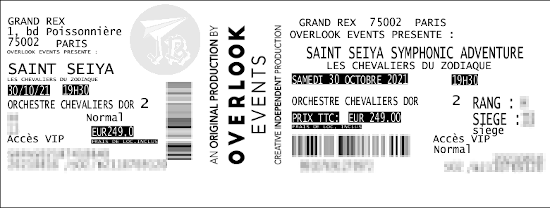
Ticket. Frand Rex 75002 Paris, Overlook Events Presente: Saint Seiya Symphonic Adventure. Les Chevaliers du Zodiaque. Samedi 30 Octobre 2021, 19:30 h. Orchestre Chevaliers Dor. Eur 240,00. Accès VIP. The rest of the information is blurred.

Corny and problematic as it may be, Saint Seiya [聖闘士星矢] was my favourite anime as a child – it was exciting and my parents heavily disapproved of it, the perfect mixture for a pre-teen finding their place in the world. In December 2019, I do not even remember how, I came across the information about the event, described as a fully-immersive live-to-picture symphonic concert with the music from pop-culture […] synchronized to cutting edge video screen, lighting and special sound effects. Similarly to the recent Final Fantasy Remake concert, the idea is an orchestra concert with the original singers for some of the musical pieces, along with projections of the original cartoon. Overlook announced an afternoon and an evening concerts. However, by the time I found out that the event had been planned, tickets had been on sale for a while. I managed to get a fairly decent ticket for the afternoon concert, but and a very bad one for the evening concert as part of Christmas sales (which meant I got both tickets for the price of the normal “good” afternoon ticket). At the time, I was ecstatic, as you may guess, though a tiny bit bummed I had not learnt about the whole thing in time to get some VIP tickets.

Enter Covid-19. One postponement led to another, and then another. At some point in late summer 2021 I entered the ticket page for something, and I could not believe my eyes – someone had returned one of the second-tier VIP tickets, and… I got that one. I seriously could not believe it. One of twelve (with the name of one of twelve characters of the show), it came with goodies, access to the rehearsal, and the autograph session after the show. So I now had a good ticket and a fantastic ticket!

Then the event got postponed again, barely three weeks before. I was… miffed. Eventually though, the promoter got in touch with me and I was assigned a character, I bought plane tickets (again), booked a hotel (again – in this case I booked two, one at the airport and one near the theatre), and… held my breath.

When the Japanese singers arrived in Paris, I realised that it was finally happening. And thus, I booked my airport parking ticket and… held my breath again. Iberia’s check in gave me trouble, but I eventually managed to get my boarding pass (I could check in on the webpage, but only get my boarding pass from the app), and fill in the passenger form to get into France.

The plane left late on Friday evening, and it was a long weekend in Madrid, so I left with time – a lot of time. I learnt two things: one, my planning skills are awesome, and two, my car has run out of air-con gas, as I got caught in a bad traffic jam, and yet somehow I arrived within five minutes of my expected entrance time. The flight to Paris was stupidly uneventful and I was surprised at how nicely the security personnel actually behaved.

Upon arriving in Charles de Gaulle I walked out of the plane into the bus and then to the terminal. There was no kind of health check whatsoever, so I could just walk up to my hotel, which was strangely bustling for it being near midnight.

14th May 2022: Paris & Grand Rex

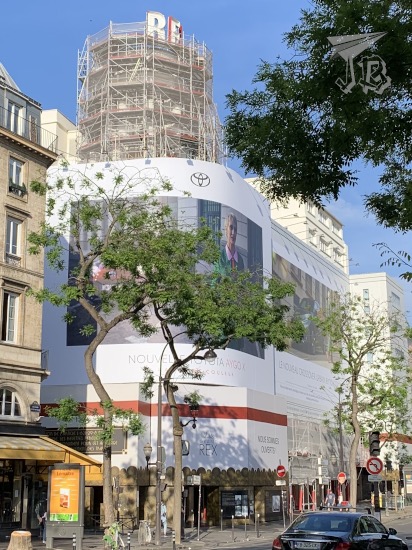
The organisers had sent me an email that I had to be at the Grand Rex theatre at 10 a.m. in order to pick up my goodie bag. It turned out that the email was wrong, and I was not to be there till 11 a.m. The Grand Rex is an art decó building which, like a bunch of things I saw, was under renovation.

Outside the Grand Rex. It is only a huge scaffolding as the façade is being renovated.

Throughout all the waiting for the different sessions I took a few strolls around the area of Grand Boulevards after dropping off my luggage at the hotel. I ambled round and saw two smallish triumph arcs – Porte Saint-Denis and Porte Saint-Martin.

Two monumental gates in the middle of crossroads. The traffic is horrible.

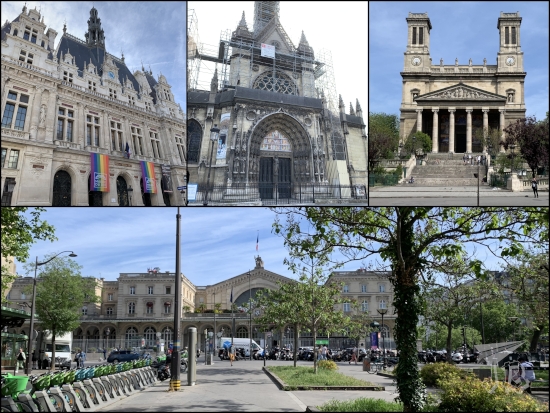
Also around the area are Mairie du 10e arrondissement, a Renaissance Revival public building, Église Saint-Laurent (Church of Saint Lawrence), a gothic chapel which was also under reconstruction, Église Saint-Vincent-de-Paul (Saint-Vincent de Paul Catholic Church). A bit further away stands Gare de l’Est, one of the six large stations in Paris.

Some buildings, including a gothic church, a neoclassical one, and a 19th century train station.

At 11:00, I finally got into the Grand Rex to watch the rehearsal, which lasted about an hour. I had been lucky to find a staff member who spoke English as I was apparently the only non-French-speaker in the VIP group, and he told me that the artists would come to say hello after the rehearsal. He added that as everything would be French and Japanese I’d be lost. I replied that I had better Japanese than French anyway. After the rehearsal we got to wave hello to the two Japanese special guests – popster NoB (Nobuo Yamada) and soprano Kazuko Ishikawa.

The staff member was very proud to point out the “Spanish person who had come from Spain” to the Japanese staff. Nob said “gracias” to which I replied in Japanese – the standard “we are looking forward to the act today”, which I guess threw everybody off a little, and got me an also standard “nihongo joozu” (you are good at Japanese” that the Japanese tell you when you’ve thrown the curveball of talking to them in their language. At this point, I became noticed.

I left the theatre for a while and came back for the first concert, which started late. The venue was rather empty, and during the break a bunch of people tried to parachute into better seats. I saw some other VIPs who had gotten a complimentary seat. As the lights went out the only thing that went through my head was “I can’t believe this is finally happening” again and again and again.

The inside of Grand Rex. The stage is a great arch with the words Saint Seiya Symphonic Adventure projected on a screen

But it was happening. The recital was divided in two acts – the first one aligned with the first arc of the anime, and the second with arcs two and three, what is call the “classical anime” as the final act was not animated up until a couple of decades later.

ACT 1
Opening
Pegasus Fantasy
The Galaxian Wars
Hyoga and Crystal Saint
Silver and Gold Saints
Zodiac Temples Part I
Ikki’s Wrath
Zodiac Temples Part II
Victory of the Heroes
Eien Blue

ACT 2
Saint Sinwa ~Soldier Dream
The Seven God Warriors
The Fury of Asgard
The Odin Sapphires
Yume Tabibito
Poseidon’s Lair

ENCORE: Pegasus Fantasy

Bluntly put, I loved it, but mostly because of nostalgia. The first one was better than the second, but there were issues with the sound, and the microphones, and at times the orchestra complete swallowed the vocals. The conductor was hilariously into it, bouncing in his platform. The harp was fantastic, and the soprano spectacular. NoB, the pop singer… is showing his age, but did a decent job of getting the audience hyped-up.

The orchestra on the stage. Images from the anime are projected on the screen.

Another of the guests was the voice actor who played the main character in the original French anime version, and boy did he bring down the walls. People absolutely loved him. To be honest, I was rather surprised at the audience’s attitude towards the whole thing, with clapping and yelling and – among everything – parachuting to better seats. I wonder whether this last thing is usual or just due to the stalls being rather empty (after all there was “free seating” in the first-floor paradise).

I went to the hotel between the first and second concert to retrieve my things and get some rest, but eventually I got back to the theatre. There were more people this time around, and my seat was undoubtedly better. It was there when I got “adopted” by the high-class VIPs, who had been very amused at my having been “lost” and then surprised at the fact that yes, I could speak some Japanese. Thanks to them I found my way to the signing session and got my programme signed by both NoB and Kazuko Kawashima. I did trip over my Japanese there, but I should have known I don’t do well trying to learn new words just before post-concert signing sessions.

Merchandise included in the VIP ticket: mug, t-shirt, posters and booklet, all with images from the Saint Seiya anime

A close up of the booklet - showing the signatures of the singer and the soprano, and the VIP badge.

15th May 2022: Angels, Unicorns and Organ Music

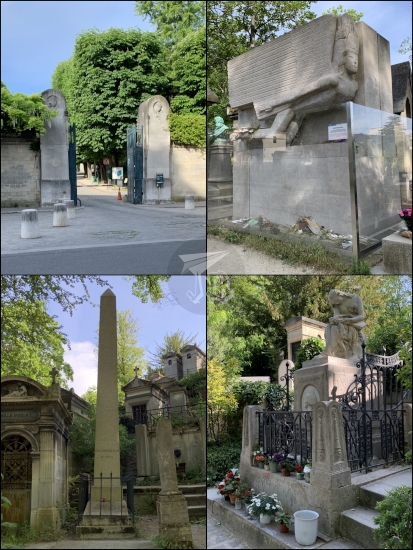
I checked in early in the morning and I fought the Paris Metro system to a) find an entrance where I could buy tickets and b) make the machine work so I could buy those tickets. My first destination was the largest cemetery in Paris – Cimetière du Père-Lachaise. This early 19th century cemetery holds the remains of personalities such as Oscar Wilde, whose grave is protected by a glass wall as it became a fad to put lipstick on and kiss it, which was damaging it; the grave looks like a Babylonian bull or angel. Another grave I wanted to visit was that for Jean-François Champollion – the man who discovered the Rosetta stone, whose tomb looks like an obelisk. And after some wrong turns I also found Frédéric Chopin (minus his preserved heart, which was taken to Poland); this tomb features Euterpe, the muse of music, crying over a broken lyre.

Graves at Père-Lachaise: a flying Babylonian angel (Wilde), an obelisk (Champollion), a muse weeping on her lyre (Chopin).

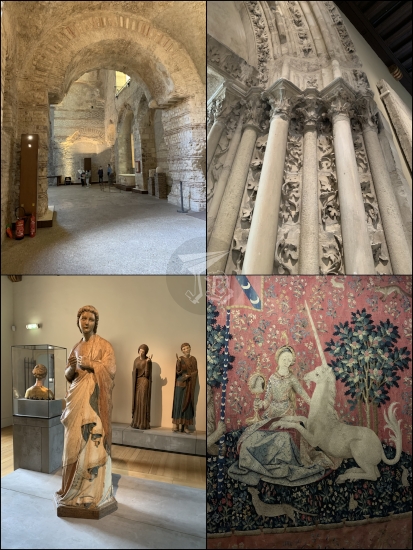
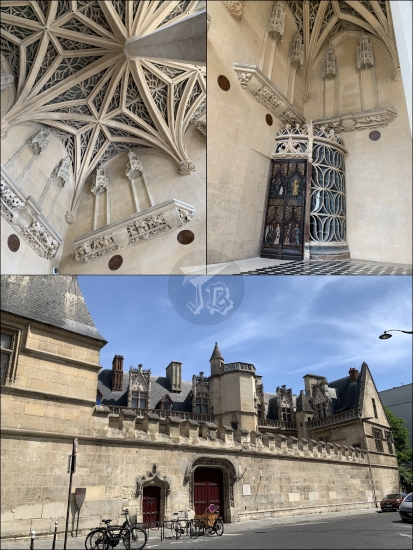
The cemetery was not as well laid-out as I had hoped so after a while wandering around I decided to move on. On Friday I had read that the museum of Medieval History and the old Therms of Paris had been reopened after a long closure. Thus, I decided to skip looking for more “celebrity graves” and headed towards central Paris. The Musée de Cluny – Musée national du Moyen Âge is built in a 1485 “town house” (more like a palace though, usually called a château) that was erected right on the the old Roman Baths that date the city of Paris back into the Roman period. Today it has been refurbished and holds artefacts and artworks from the Upper and Lower Middle Ages that have been brought from over different churches, including Notre Dame and the Sainte-Chapelle.

The most important piece in the museum is a collection of six tapestries, called “The Lady and the Unicorn”, dated from the late 15th / early 16th century. Five of them represent the sentences, and the sixth is a mystery (theories include “love” and “free will” – I’m a fan of the latter). They all feature the same medieval dame in a red background, accompanied by a golden lion and a white unicorn, and they are marvellous.

Collage: The foundations of the manor; an ornate church entryway, carved on the stone; a Virgin Mary statue; the tapestry of the lady petting the unicorn, with plants and a red background

A piece of art in its own right is the chapel of the town house. It was built around the same time of the house in the Flamboyant Gothic style. It contrast with the stark outside of the house, with its sever walls.

The ceiling of the chapel, which looks like a star fractal, and a view of the whole manor

I still had some time, so I decided to head over to the church Église de la Madeleine, a catholic church that looks like a classical temple (believe it or not to hail the Napoleonic army). It is built in the Neoclassical style, and it is enormous. However, it was also being renovated, so the outside was covered in hideous publicity panels.

Church of La Madeleine, it looks like a Greek temple, all columns with a triangular front, and the inside, showing Mary surrounded by the saints and the angels.

Finally, I went back to the hotel to pick up my things and walked back to the station – I did not want to carry my luggage around because I worried it would damage the posters I had got at the concert. I actually arrived and left from different airports, so I had to head to Orly this time. However, RER B joins both airports, so the closest station for arrival, Châtelet–Les Halles, was also the closest to leave. Upon coming out on Saturday I had caught eye of a small gothic church, and as I walked past this time I noticed that there was an open door and people went in and out. It was the church of St. Eustache, Église Saint-Eustache. The structure is Flamboyant Gothic, and the decorations are Renaissance and classical. It has one of the largest organs in France, and I was lucky enough that it was being played when I was there. It felt pretty magical, to be honest.

Top: A gothic church from the outside, with lots of windows. Bottom: the same church inside - high columns look like a forest, and the light filters through all the windows outsde, like water from a fall.

Afterwards, I hopped onto the train and headed for the airport. I got there earlier than expected, too, as I had planned according to some traffic restrictions that did not happen in the end. I debated some food, but everything was so expensive! The return flight was plagued with turbulence, and I got home exhausted and with a migraine, but it was well worth it! Also, travelling through Covid-19 was… weird. While I kept my facemask on most of the time, including the plane rides, the concerts, and whenever I was inside, most people would not – even the still-compulsory places. I was also happy to skip the “health checks” because I swear, the way I was feeling after landing, I don’t know if I had been running a temperature, and that would have been… awkward.

A view of Paris from the plane, also showing the wing

18th – 20th February 2022: Extremadura, the not-at-all-wild west of Spain

With everything that keeps going on in the world, my little travel gig seems insignificant. Here it is, anyway, for the sake of completion.

18th February 2022: Jam and Ham

After a crazy crazy period, and within a just-slightly-less-crazy period, we made space for a mini escapade – just under 48 hours, but it was an interesting mental reset. We took the car and drove off to Cáceres after I finished work in the afternoon. The trip should have taken a little over 3 hours and 15 minutes, but we spent about 70 minutes caught in several traffic jams – or just a very long jam with different instalments.

Sunset from the road. The orange light zigzags through the grey and blue clouds

Cáceres is located in the autonomous community of Extremadura, which is famous because of its particular grassland with dwarf trees called a dehesa. The typical animal farmed in the area is the native Black Iberian pig – a traditional breed of the domestic pig (Sus scrofa domesticus). Through breeding with wild boars and millennia of adaptation, the Iberian pig has grown accustomed to eating oak acorns, and thus it has become a key part of the ecosystem. Furthermore, the breed has great tendency to accumulate intra-muscular fat. This means that its meat is delicious, especially as sausage. The most famous treat is the “Black label” (Etiqueta Negra or Dehesa de Extremadura) ham: a pig raised in the dehesa, fed acorns and natural grass, and whose meat has been cured for at least 20 months.

The area of Cáceres is also known for its sheep-milk cheese, Torta del Casar. It is a strong-flavoured creamy cheese that comes from controlled sheep, also raised in the dehesa. The cheese is especially curded with rennet made from cardoon (Cynara cardunculus). Another typical food from the area is the local paprika Pimentón de la Vera, which is made from smoked local red peppers. All three – ham, cheese and paprika – hold European Protected Designation of Origin certificates.

Of course, not everything is food in Cáceres. After we checked into our hotel near the historical centre, we headed off to the Main Square Plaza Mayor de Cáceres, which features the town hall, the former wall gate called Arco de la Estrella (Star Arch), and one of the watch towers Torre de Bujaco.

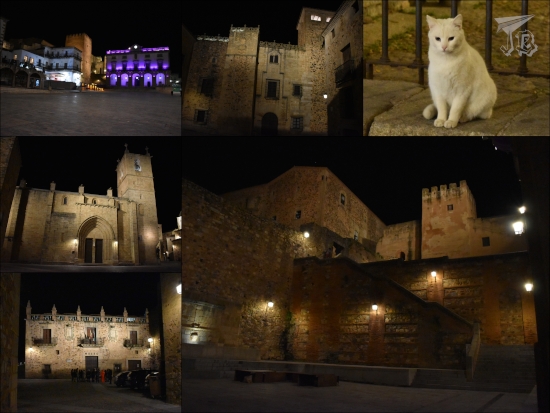
The medieval square of Caceres by night. It looks like a castle, with arches, battlements. The sky is completely black.

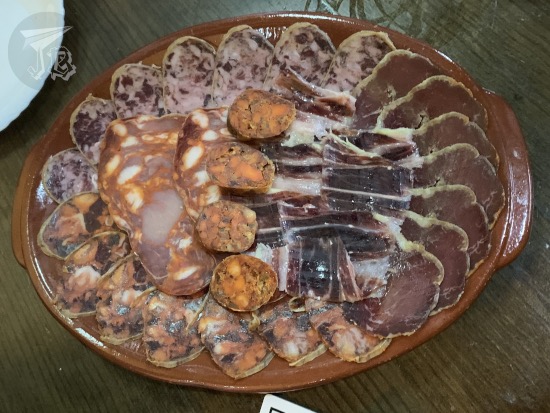
We found a place inside to grab a bite, and we tried the sausages for dinner before turning in – acorn-fed pork ham, loin, chorizo, morcón (similar to chorizo), salchichón, and patatera (pork mixed with potato and paprika in sausage form).

A plate of sausage slices and ham

Walked distance: 1.79 km (2838 steps)

19th February 2022: The Old Town of Cáceres

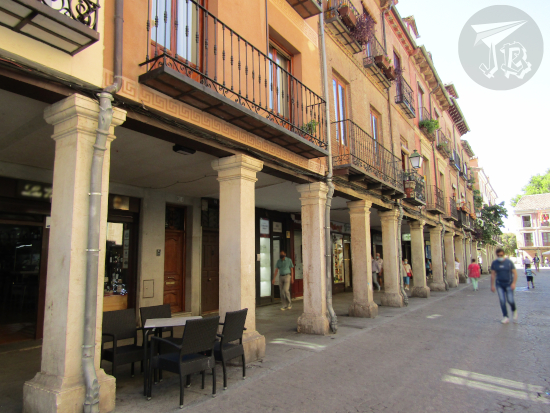
The Old or Walled Town of Cáceres, Ciudad Vieja de Cáceres was declared a Unesco World Heritage Site in 1986, and it is easy to see why. It is a small knot of streets between the ancient city walls and the gorge where cars can barely drive, sprinkled with Medieval and Renaissance palaces and manors. After finding an open café, we had breakfast, then headed off to explore that. Since it was a bit before 9 am, most everything was closed – but it was also empty, which was good. We crossed the Arco de la Estrella next to the Torre de Bujaco and walked into the walled area.

The medieval square of Caceres by daylight. It looks like a castle, with arches, battlements, and irregular bricks making up the walls.

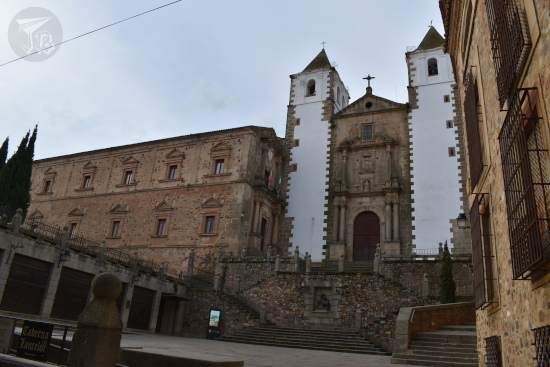
We walked past the co-cathedral – to which we would come back later and several palaces, and we ended up at a two-level square called Plaza de San Jorge (St. George Square), towered over by the peculiar-looking church Iglesia de San Francisco Javier – note the white-painted towers.

A church with two twin bell towers, both in white. Between them, the body of the church, in grey rock. In order to access it, you have to climb a staircase, which has a small sculpture of St George attacking the dragon

There was a small palace to the left, and while the building was closed off, the gardens Jardines de Doña Cristina de Ulloa were open, albeit as it was early February, still in winter mode but for some berries and roses.

Wintery garden with bare tree. There are also evergreen bushes and trees, stairs, and benches.

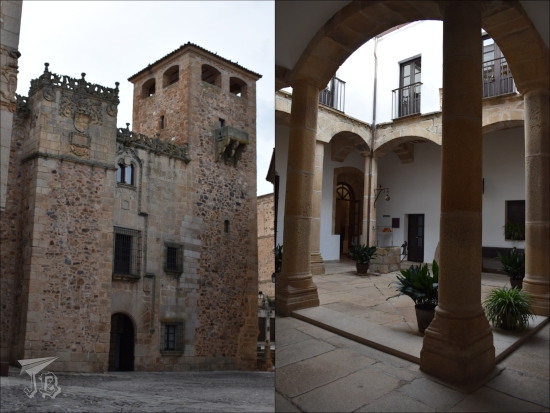
We wandered around for a while, the headed off to a visit we had booked in advance – the manor / palace of the Lower Golfines Palacio de los Golfines de Abajo, which has nothing to do with their position in the social scale, but literally the position within the city hill – in the lower part. The family is known to have owned the palace from the time of the Catholic Monarchs, in the 15th century, till the death of the last descendant in 2012. This woman willed all the heirloom to a foundation that today manages the palace. The foundation got the palace renovated and brought some of the furniture from other properties belonging to the family – among them a glass lamp way too big for the room it was set in, and a sofa which was identical to the one that used to be in my great-aunt’s living room… The lower floor holds the recreated rooms – with more or less success and taste – and a smaller area decorated with Medieval paintings which were discovered by accident. The upper floor holds a small ethnography museum and some documents from the family’s library. Unfortunately, the foundation takes itself a little too seriously and won’t allow you to roam freely in the palace or take pictures, except for the inner Castilian patio.

Gothic palace, with an ornate roof and a small cloister or patio.

After the palace, we walked a whole minute and a half for the co-cathedral Santa Iglesia Concatedral de Santa María. It is the oldest church in town, built around the 15th century, in a Romanesque-going-Gothic style. Outside the church, at the base of the tower, there is a sculpture of Saint Peter of Alcántara. Inside, the altarpiece was carved between 1547 and 1551, in unpainted pine and cedar. The tower can be climbed, and I decided that I wanted to do that, despite not being what I usually do. It was empty enough that I felt comfortable doing so, and I was treated to some nice views.

Collage: a gothic church with a bell tower; the inside showing a bare-wood altarpiece; the sea of columns from above, and a view from the belltower, showing another church and the roofs of some low houses.

By the time we went out, the city had already been taken over by walking tours and guided visits. There were so many companies that the guides put stickers on their tourists so they could herd them round. We backtracked to the Baroque church with the white towers Iglesia de San Francisco Javier (also known as Iglesia de la Preciosa Sangre), where there is no worship today. Instead, there is a huge collection of nativities (hundreds of them, literally). In order to visit the nativities you have to go up a perilous metal staircase. Once on the second floor – after having survived the peril – I decided to continue on the relatively safer stone staircase to one of the towers – only one, I did not climb up both of them. The lower floor holds two last nativities, a classical one and a hilarious set up made out of Playmobil, a German company that makes plastic figure toys.

Collage: The interior of a church with a baroque golden altarpiece, and a collection of Nativities.

We moved onto the following manor, to the side of the square, Casa Palacio Becerra, which shows some antique elements, and the house structure.

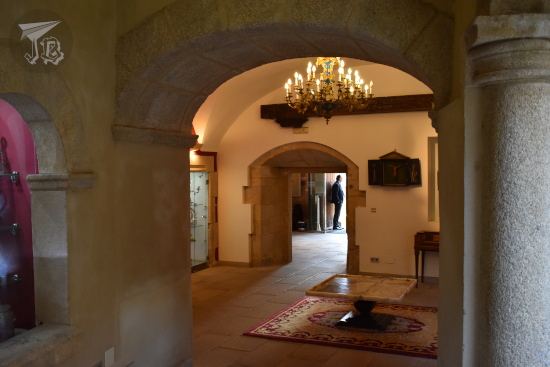
Inside a Renaissance palace, with a low arch, a glass lamp and a red carpet that try to look eclectic and end up looking bizarre

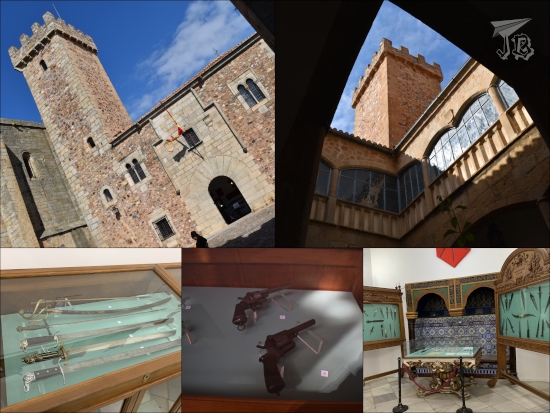
Later, we walked to Stork Square Plaza de las Cigüeñas. European white storks (Ciconia ciconia ciconia) are typical birds in Extremadura, and one wonders how they have not decided to make food out of them. In the tower stands one of the few towers that has kept its merlons, as the Catholic Monarchs were very into tearing tower tops down when they conquered a site. The adjacent manor, Casa de las Cigüeñas, hosts the military museum Museo de Armas Aula Militar.

A building with a tower. The inside is a museum, and there are some swords, firearms and Moorish decoration

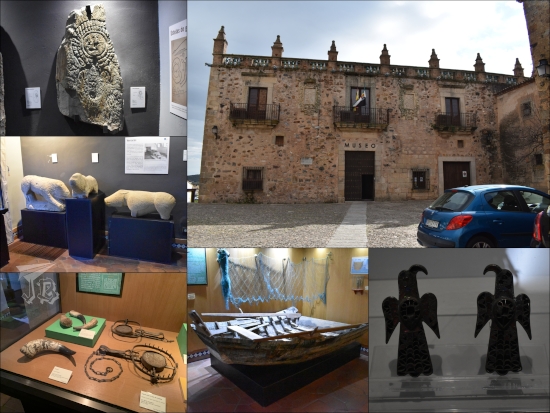
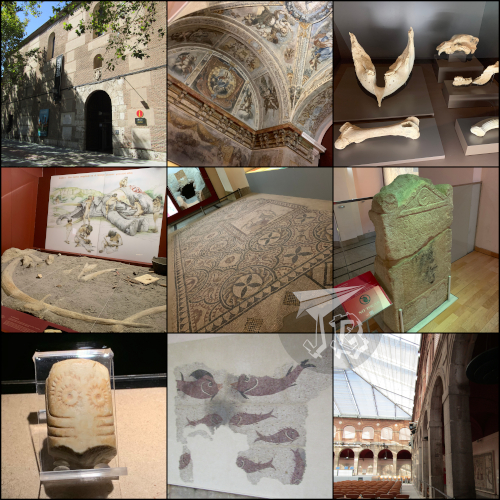
At the end of the square, in yet another palace – two of them, actually – lies the Museo de Cáceres, the local museum. The part in the Casa de Las Veletasis a regular archaeological museum, with the kind of things you would expect – prehistoric, Roman and Celtic remains, more modern artefacts. The other area, Casa de Los Caballos, hosts the modern art gallery.

Gothic building turned into a museum. The pieces shown are funerary stelae, prehistoric animal representations - bulls or pigs - and jewells, a boat, and Roman emblems

However, the palace was erected on top of the local Arab cistern or aljibe. It is the best preserved in Spain and it has been gathering the rainfall water since the 10th century. Pretty impressive piece of engineering if you ask me.

The aljibe: a moorish basement filled with water. The columns sustain horseshoe shaped arches

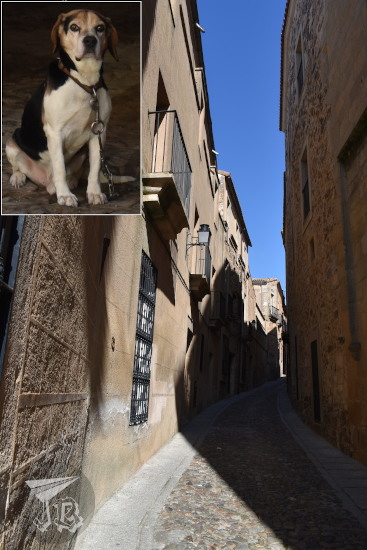
Afterwards we still had some time to kill until it was time for lunch, so we wandered around the area of the Jewish quarters or Judería, under the watchful gaze of the local Cerberus.

Narrow streets, and a guarding dog looking suspicious

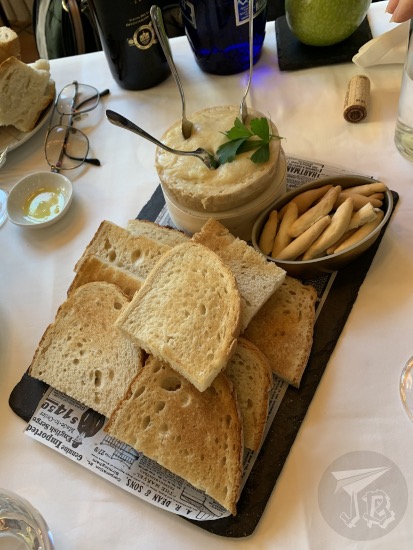
We had lunch in the local Parador de Cáceres, so I of course got my stamp. As a started we ordered the famous local cheese Torta del Casar cheese.

A tray with bread slices and breadsticks, and a cream cheese with spoons to be spread on the bread

In the afternoon we had a look at another church Iglesia de Santiago de los Caballeros. The church of St. James of the Knights was built in the 14th century over an older temple dating back from the 12th century. The altarpiece was carved and coloured by one of the most important sculptors of the Spanish Mannerism, Alonso Berruguete (1490 – 1561). This time I did not climb the tower – which had been happily colonised by a couple of storks.

Gothic church with a golden altarpiece. A stork snoozes on one of the towers.

After a little while, after sunset, I decided to skid around and have a walk through the old city at night. The artificial light made it look eery and romantic in the most… historical sense of the word. I came across some cats begging for food from a bunch of schoolgirls, and one of them very indignant because the girls would not beg it to take the food!

Different buildings of Cáceres at night. The are lit wit strategic lamps to give a mysterious feeling. There is also a white fluffy cat sitting and expecting food

Walked distance: 9.04 km (14766 steps)

20th February 2022: Trujillo & Oropesa (Toledo)

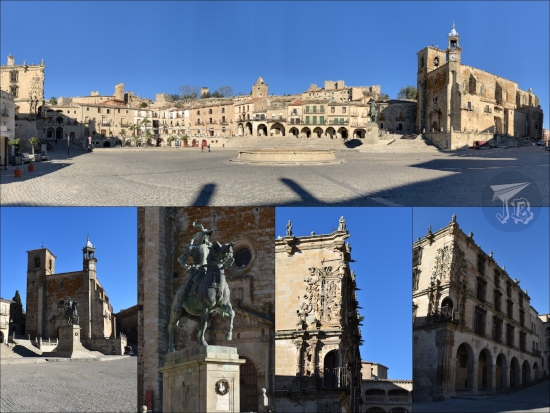
On this day I managed two more Paradores stamps. Trujillo is a town a meagre 30 minutes away from Cáceres. It also has a traditional / Medieval city centre, set around the main Square Plaza Mayor de Trujillo. It was the birthplace of one of the so-called conquerors during the colonisation of South America, Francisco Pizarro, whose equestrian statue, Estatua ecuestre de Francisco Pizarro (by American sculptor Charles Cary Rumsey). Other highlights in main square include the corner balcony in the “Conquest Manor” Palacio de la Conquista.

The large Reinassance square of Trujillo with decorated palaces and a sculpture of Hernan Cortez on his horse

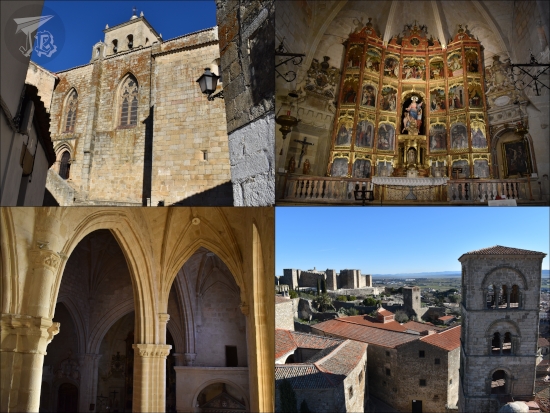
One of the most interesting churches in the area is Iglesia de Santa María la Mayor. Its tower dates back from the 13th century, but was almost completely rebuilt in the 16th century. Inside the richly painted altarpiece was erected around 1490. Apparently, my newly-discovered activity of climbing towers yielded to a new adventure, as for a few minutes I ended up locked down in the bell tower – I guess I’m a Disney Princess now (≧▽≦).

Gothic church with gothic golden altarpiece.

I got an hour and a little to wander round the town, so I climbed up to see the Muslim fortress Alcazaba de Trujillo (also called castle). Built between the 9th and the 12th century, it is a huge building with a defensive wall, an aljibe or cistern, several towers and a Christian chapel.

Moorish castle, from the outside and the inside. The walls and the battlements are amazingly well-preserved. It seems that the castle is built around the natural rocks defending the area

Then I hurried towards the other edge of the city to get my Parador de Trujillo stamp (only cheating slightly. I was there, after all). On my way I happened upon the Torre del Alfiler, with a family of storks happily clattering away the late morning.

Storks on top of a bell tower

I backtracked to the Plaza Mayor and I had twenty minutes before our rendezvous time, so I decked into the church Iglesia de San Martín. Its origins date from the 14th century, but it was not finished till the 16th century – which makes it so that the thick Romanesque walls are mixed with Gothic and Renaissance elements. No tower this time, but the second floor holds a religious museum.

Romanesque turning Gothic church. The inside is plastered in white and the celing above the altar and the nave retains the original decorated stone ceilings

After getting a general idea of the Medieval town of Trujillo, but it being a “working Sunday”, we moved on rather quickly, and drove off until we made it for lunch in Oropesa (Toledo) which also holds a Parador – Parador Museo de Oropesa, the first monumental Parador opened in 1930. That makes three stamps in two days, I’m almost impressed with myself!

Plain building with ornate balconies, and cars parked on a row in front of it.

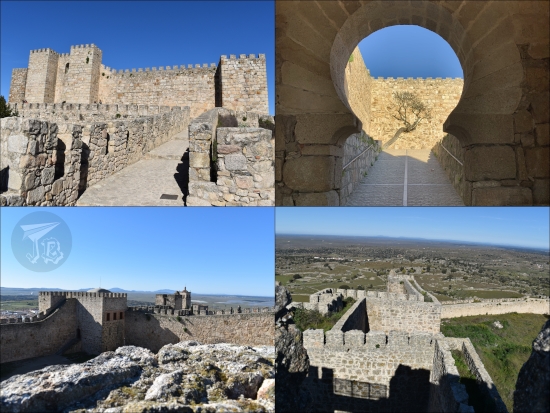
The Parador is adjoined to the castle Castillo de Oropesa, which was unfortunately closed, but I shall put in on my list of “to re-explore”. It was built by the Arabs during the 12th – 13th century, probably on a former Roman fortress. Today, the Old Castle is joined to the New Palace and both belong to Paradores.

Classical Romanesque castle with towers and turrets. It looks heavily restored.

After that, we drove back home, and as we got a couple of wrong turns, we ended up avoiding the traffic jam we had found on our way to Extremadura, which was convenient!

Walked distance: 5.57 km (8836 steps)

6th November 2021: Torrejón de Ardoz & Guadalajara (Spain)

No matter how much some people demonise it, one true thing is that a great chunk of the Spanish general income is dependent on tourism. That’s why when the 2008 recession hit the country, many areas or municipalities tried to fabricate tourist attractions where there used to be none. Torrejón de Ardoz is one of these places – despite shouldering a huge debt, it gambled a couple of tourist lure. One is a huge winter lights (Christmas) display, which runs from November through January. The other is a huge park in a former slum, called Parque Europa, Europe Park.

Parque Europa was described as “Pharaonic” upon its inauguration in 2010. It covers a whooping 23 hectares of trees, bushes, ponds, rides for kids and replicas of different European monuments and landmarks, both real and art depictions. I can’t be sure if in the end the park managed to break a profit, but the reviews online do sound like it did.

In winter, the park opens at 9.00 am, and I thought that if I managed to get there relatively early in the morning, I might find a free parking spot around the area. Online reviews do talk about limited parking space aimed to fill the pay-per-car parking lot close to the entrances, so I thought I’d try to leave the park in the streets of the industrial complex nearby. After a couple of Sat-Nav mishaps – human-caused aka I forgot the adapter for it to work in the car (≧▽≦) – I was on my way and I reached the neighbourhood a bit before 10.00 am. As I was driving towards my intended parking spot I caught a glimpse of the Eiffel Tower, so when I turned and found a random parking spot, I decided to just ditch the car. There were many double-parked cars ahead so I thought the rest of the street would be packed. At that time in the morning, I could have just parked in front of one of the access gates without problems, apparently. So I had to walk two whole extra minutes!! In the end though, that parking spot was even closer than the ones I planned to look for – so it was all good.

I wanted something to do in the morning outside the house so I did not have a plan per se (to be honest, I had long made the afternoon plans and I wanted something to do in the morning to make the most out of the disposable contacts). However, as the fountains were turned on at noon, I wanted to leave them for last. Fortunately, most of them are in the same area of the park – which is shaped like a ham of sorts. At that time most of the children rides were closed, and I was mostly alone except for people jogging or walking their dogs, and it was rather chilly. But I wanted to see the replicas, so that was all right.

These are the monument replicas that are hosted in the park, in the order I saw them, turning clockwise from the entrance I used:

  • Puerta de Alcalá (Gate to Alcalá), Madrid, Spain. Neoclassical gate to the former walls in Madrid. Today it is considered World Heritage as part of the “Paisaje de la Luz”.
  • Torre de Belém (Belém Tower), Lisbon, Portugal. Officially named Torre de São Vicente (Tower of Saint Vincent), a 16th-century port fortification for Portuguese explorers, with high symbolism and ceremony.
  • Tower Bridge, London, United Kingdom. Crossing the River Thames, it is one of the most iconic London landmarks.
  • Kinderdijkse molens, the Windmills of Kinderdijk, Netherlands. The original windmills were designed as part of water drainage to drain the excess water in the Alblasserwaard polder.
  • Brandenburger Tor (Brandenburg Gate), Berlin, Germany. It is one of the most characteristic landmarks in the country, a monument built in the place of a former wall gate in the 18th century.
  • Den lille Havfrue (The Little Mermaid), Copenhagen, Denmark. This small sculpture is displayed on a rock in the a promenade in Copenhagen, and depicts the mermaid in Hans Christian Andersen’s tale becoming human.
  • La tour Eiffel (The Eiffel Tower), Paris, France, built for the entrance to the 1889 World’s fair and one of the most visited monuments of the world.
  • Michelangelo’s David, Florence, Italy. One of the masterpieces of the Renaissance sculpture, standing 5.17 m of white marble. This replica I didn’t get to see because it had been either stolen or taken away for restoration.
  • Fontana di Trevi (Trevi Fountain), Rome, Italy. Dating back from 1762, the fountain is a “more dramatic” version of a previous one at the end of one of the Roman aqueducts. The fountain was turned on at noon and it had just a little water.
  • Manneken Pis (“Little Pissing Man”), Brussels, Belgium. It is a bronze fountain sculpture depicting a naked little boy peeing into the basin, dating back from the 17th century.
  • Atomium, Brussels, Belgium. This stainless steel building was constructed for the 1958 Brussels World’s Fair, and renovated between 2004 – 2006. It stands 102 metres high and some of the spheres are open to the public and hosts exhibitions.

There are also “adaptations” or monuments that you can “sort of” identify but have been more freely reproduced.

  • Greek Theatre, based on the Athens one, with the Winged Victory of Samothrace watching over in a bit of an artistic license move I guess, considering it was a ship figurehead. The actual one is in the Louvre Museum in Paris. The theatre is built into the slope of the central pond of the park so visitors can see the light and sound show in said pond when they are held.
  • Plaza de España (Square of Spain). The centre of the square is the famous “Puerta del Sol” in Madrid and the older Post office. Its back represents the Main Square of the city. Other houses represent different regional buildings throughout Spain that I was unable to recognise.
  • Viking Ship fountain. There is not much I can say about this. It was one of the fountains, and this one was turned before any of the others.

Inspired by paintings, there are two other monuments.

  • The Three Graces. While the park’s webpage claims that the sculpture is a copy of the one that Antonio Canova created, it looks like it was sculptured using Ruben’s painting as inspiration. This one was the first monument I saw.
  • Van Gogh’s bridge”, a wooden bridge inspired by Vincent van Gogh’s painting “The Langlois Bridge at Arles”. I missed it at first so I had to backtrack and I did not find a good angle to see it from the side.

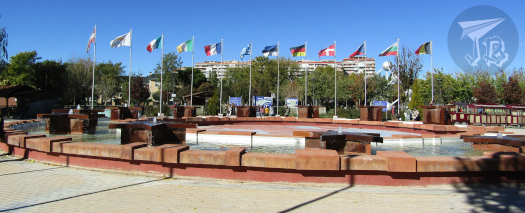
An original piece is the fountain called Plaza de Europa, Europe Square, a circular square with stars forming little fountains. This was one of the fountains I had to wait till noon to see and to be honest, I was… underwhelmed, expecting way more by the pictures on the website. I’m not sure if it was just “winter fountain” or whether the sprouts were set on low because it was a bit windy.

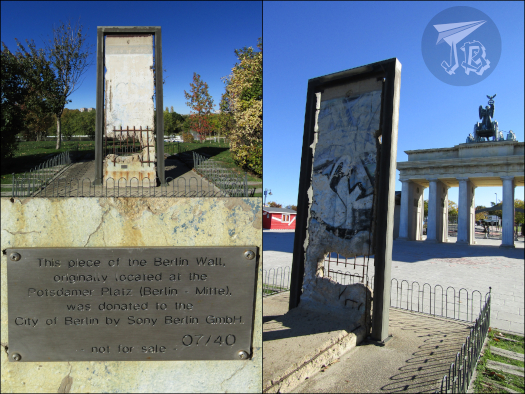
What was interestingly impressive was the original piece of the Berliner Mauer, the Berlin Wall. During the Cold War, after WWII, Berlin was partitioned into West Germany and East Germany with the erection of the wall in 1961 (in what was called the Berlin Crisis of 1961). It was all built within the eastern border as it was the USSR who decided to put it up. The Wall separated the city halves for decades, there were even deaths as people from the east tried to defect to the west. The wall officially but metaphorically fell in November 1989 as the political powers who had driven its building agonised. The piece that stands in Parque Europa originally stood in Postdamer Platz and was ceded to Torrejón by the city of Berlin and it stands behind the Brandenburg Gate.

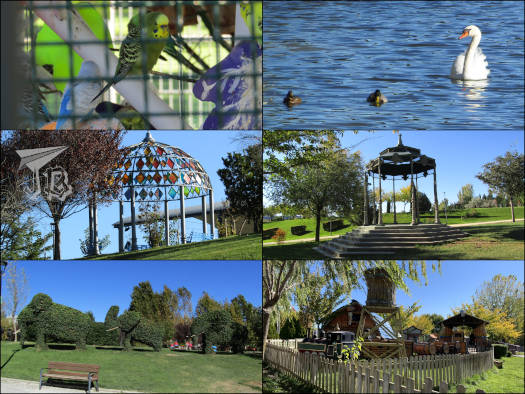
There are many other areas and activities for kids. A number of them were already opening up by the time I left, others seemed to be on hold due to pandemic concerns. The park has different things to draw attention too, such a giant bird cage (mostly full of parakeets), three life-sized elephants made out of bush, gardens, or an artificial waterfall – which did not get turned on. I saw a lot of birds too – magpies, swans, mallards and some very territorial Egyptian geese (I think that they were Egyptian geese. I’m absolutely sure they were territorial).

I left Torrejón at around 12:30, I think. I took care of some errands on the way, had lunch, and then I headed off to the second part of my self-imposed day off. A late-Halloween activity that ran throughout the month of November: Arquitectura y escultura funeraria in Guadalajara: a walking tour with a focus on the funerary architecture and sculpture in town. Well, at least with a stop at those places that are directly controlled by the town hall, missing those that are not. Yes, I voluntarily signed up for a guided visit! Unfortunately, information on Guadalajara is rather difficult to find, so I thought there might be interesting knowledge to be gathered (Narrator’s voice: there wasn’t).

The tour started at the local cemetery Cementerio Municipal Virgen De La Antigua, where we saw several tombs and pantheons dating from the 19th century and the early 20th century. These included:

  • Panteón de la Tropa, the “Troop mausoleum”, a communal grave for soldiers who died in the African campaigns, where supposedly some of the Civil Wars victims were buried. It actually is not the place, but legends are legends, I guess.
  • Panteón de los Marqueses de Villamejor – a neoclassical mausoleum where a noble family was interred.
  • Monumento funerario de la Familia Cuesta Sanz, a creepy obelisk-looking tomb.
  • Some smaller mausoleums (or big graves) Panteón de María Luisa García Gamboa, Panteón de la Familia Chavarri, Panteón de Josefa Corrido de Gaona, and Panteón de la familia de Ripollés Calvo. All these are stone tombs with a rounded roof that drains off rainwater.
  • Panteón de los Condes de Romanones, the place of eternal rest of another noble family, whose head was the son of the previous one.
  • Kittens

We then walked off towards the chapel Capilla de Luis de Lucena. Luis de Lucena was a doctor and a priest who was born in the 15th century. He died in Rome as he worked as a doctor for the Pope, but he expected to be buried in this chapel, adjacent to a now-disappeared church. The outer area is built in brick, and the inner ceilings have several frescoes, even if they are rather deteriorated as the town had no money to take care of the art during the 90s and the early 2000s. The chapel was never used as a burial place, and now it is a tiny museum that keeps rests of other disappeared churches in town, especially the funerary sculptures.

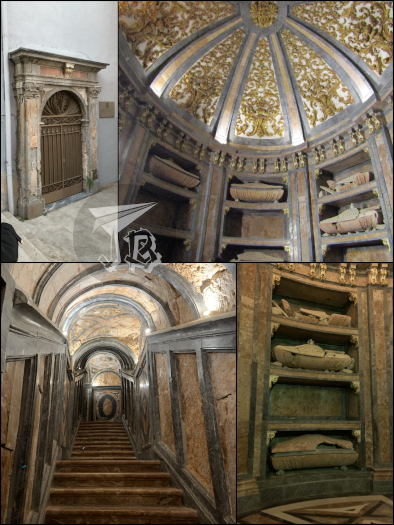
The final spot was the crypt of the church of St. Francis – Cripta de la Iglesia de San Francisco, built in dark marble and similar to the one in El Escorial. This is where the Mendoza duchy family members were buried, but the area was ransacked by the French during the Napoleonic wars and the remains were taken to Pastrana afterwards, so the crypt is currently empty. Which is good considering the way some of the tombs are shattered…

This concluded the tour so I was free to go. I saved up the entry fee on the chapel and the crypt as the tour was free. Most of the tour was just crawling from one point to the other and there was not that much new information to be learnt. Maybe there is jut not enough information to be found…

Driven distance: around 83 km.
Walking distance: 13.14 km

22nd & 23rd October 2021: Zaragoza Getaway (Spain)

We had a silly day-and-a-half and it turned out that for some reason a commuting train to Madrid took about as long as a high-speed train to Zaragoza, a town in the area of Aragón that we scratched off our summer route because there are lots of curves in the Pyrenees and time was limited.

22nd October 2021: Churches, Museums and a Palace

The train to Zaragoza arrives at the Delicias station, which is a bit away from the centre of the town, so we took a taxi to the hotel. This was around 9 am so we were of course not expecting any room, what with check-in being 2 pm – we just wanted to drop off the overnight bag. Not being able to give us a room seemed to upset the receptionist quite worried, and he promised to call as soon as a room was available. Honestly, I just set my phone to flight mode because we were starting to visit monuments right away, as the hotel was just by the most important square in town Plaza del Pilar.

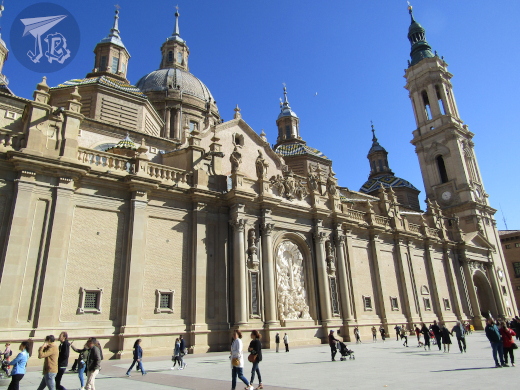
Zaragoza is home to one of the most important Christian icons in Spain, the Virgin Mary of the Pillar, Virgen del Pilar. The image is hosted in Catedral-Basílica de Nuestra Señora del Pilar. The bulk of the current cathedral-basilica was built between 1681 and 1686 in the Baroque style, but was later modified quite a few times and it was finalised in 1872. Interesting items in the church include, aside from the virgin image, some frescoes painted by Goya, the main altarpiece, and two bombs that fell within the church during the Spanish Civil War (1936-1939). Zaragoza is very anti pictures inside so I had to sneak them in. Sorry, not sorry.

A collage showing the Baroque Basilica, including unexploded bombs, and two of the altars

Virgin of the Pillar, wearing a mantle

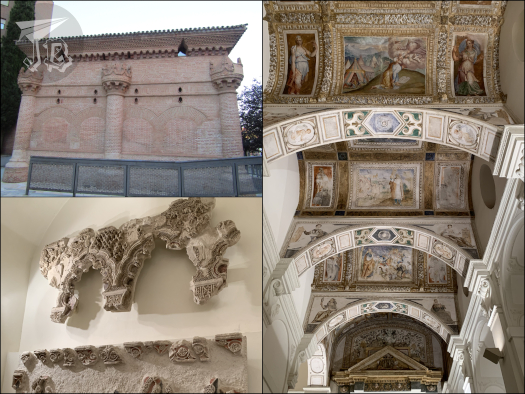
After a small detour to say good morning to the river, Río Ebro, and the Puente de Piedra (stone river), the second building we visited was the Old Market Exchange building – Lonja de Zaragoza. This was the first Renaissance building erected in Zaragoza, dedicated to commerce, with an amazing Gothic-imitation ceiling. Today it is used for exhibits, such as paintings or sculptures.

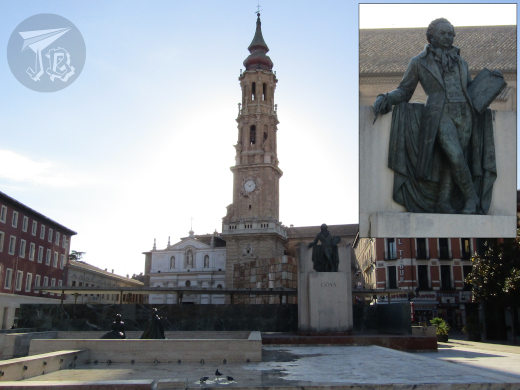
Coming out, we almost walked into one of the fountains in the square, Monumento a Francisco de Goya, featuring the artist – a brilliant Spanish painter from the Romantic times. He was as brilliant as bad-tempered though. Behind the fountain stands the cathedral, for which we had tickets for 11 am, and it was still early for that.

Thus, we started the route of the Caesaraugusta Museums. Zaragoza was founded in Roman times under this name (where an Iberian dwelling used to be) and in the latest decades, this Roman past has started being dug up. We first visit the museum focused on the original forum, Museo del Foro de Caesaraugusta where we could see the foundations of the old city and walk into the sewers (yeah, it’s cooler than it sounds). The Roman ruins date back from emperors Augustus and his successor Tiberius’ reigns.

After that it was almost time for our reservation to visit the Catedral del Salvador also known as La Seo de Zaragoza, the other cathedral of the town, literally at the end of the same square as the other one. The cathedral mixes several architectonic styles: Romanesque, Gothic and Mudéjar, these last tow being among my favourite styles, so a total win – Renaissance and Baroque elements were added, including the towers. The cathedral has a tapestry museum with a lot of works, not exactly “pretty” but rather impressive.

Following the cathedral we walked towards the rest of the Roman museums, but we made a small detour to look at the Mudéjar tower of the church of Mary Magdalene, Iglesia de Santa Magdalena.

Then we reached the museum of the Bathhouse, which was open but closed – let me explain. They run an “Audiovisual” and close the museum door for as long as it runs. It runs every half hour so finding the thing open seems to be hard. Thus, we moved onto the next archaeological site, related to the old Roman Theatre Museo del Teatro de Caesaraugusta. The theatre was apparently discovered by accident in the early 1970s, and it is apparently one of the biggest Roman theatres in Spain.

We tried our luck with the Bathhouse Museum again Museo de las Termas Públicas de Caesaraugusta. Unfortunately, just like before, we walked up to it while the audiovisual was running, and the concierge made a very studious effort not to see us – so we just peered over the glass roof to see what is left of the main bath.

More impressive was the river port museum Museo del Puerto Fluvial de Caesaraugusta, which keeps the foundations and some of the clay amphorae that were used for import / export.

And believe it or not, we did all that before lunch!! Therefore, we decided it was the right time for a break. We headed back to the hotel to see if we could wash our hands (and take off our facemasks for a while). To our surprise, the hotel had given us an upgrade to a junior suite, so we had a sitting room, a full bathroom and a bedroom – and a balcony that went all along the three. When I opened the window I could hear people playing the piano on the street, as there was some kind of festival going round. Believe it or not… I got to listen to Queen’s Bohemian Rhapsody and Rufus Wainwright’s Hallelujah.

We had lunch outside in a place that my companion enjoyed called La Lobera de Martín – not a cheap place, honestly! However, we splurged a little. We shared a smoked fish salad and I had a side of fresh Foie. As a main, ordered steak tartare, which to my surprise, was prepared for me next to the table! For dessert I tried the home-made berry yoghurt. I have to admit that I was totally planning on having a tiny dinner (or completely skip it!) at that time.

After lunch we walked along one of the main arteries of the town, Paseo de la Independencia, to find the Basílica Menor Parroquia de Santa Engracia, to at least see the outside, since we could not fit visiting the interior and the crypt with our tight schedule. One of the most interesting things about this church is how its façade is built like an altarpiece.

Next to the church stands the neo-Mudéjar post office, built in typical bricks from the area – Oficina de Correos de Zaragoza.

And finally, we looked at the current Science Museum, Museo de Ciencias Naturales, the former Medicine University. Why? Because that’s where my parents met *cue romantic music*!

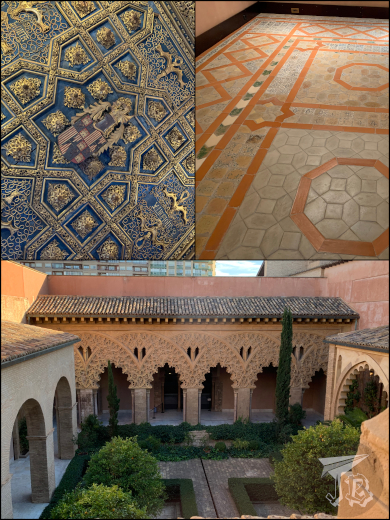
We did not go in though, because we needed a break and had booked a ticket for 5pm somewhere else, so we decided to raise our feet a little for a while in the hotel room – the sitting area was nice though unfortunately there was no more sun on the balcony, else I would have totally impersonated a lizard there (I did scare a pigeon away though, even if the startle was mutual). Our next target was the Medieval palace called Palacio de la Aljafería – a fortress that combines Islamic architecture and ulterior Christian elements. The Moorish palace was built around 1065 – 1081, and it holds a magnificent garden called the Golden Hall with a portico made out of interlocking mixtilinear arches (I totally looked the word up, and will forget it promptly). The palace was taken over by the Christians 1118 and became a palace for the monarchs of Aragón. It was not modified until the 14th century, and in the 15th Century the Catholic Monarchs extended it further into the Mudéjar Palace. Today it is the meeting site for the local government. I adored it, to be honest, I loved the Golden Hall most of all, but the original ceilings in the Christian palace were also really cool.

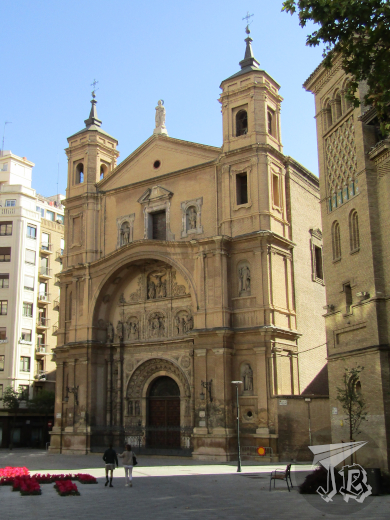
We walked back towards the Plaza del Pilar (probably through some streets we probably shouldn’t have, hindsight is 20/20 they say), and we reached the church of St. Paul Iglesia Parroquial de San Pablo. The restored interior leaves a bit to be desired, but the exterior, built between the 13th and 14th centuries in the Mudéjar style – it has an octagonal tower in dark tones, with the upper roof added in the 17th century with richly decorated with tiles and windows. It is worth mentioning here that several Mudéjar buildings in Zaragoza, along with others of singular architecture, are declared Unesco World Heritage Site.

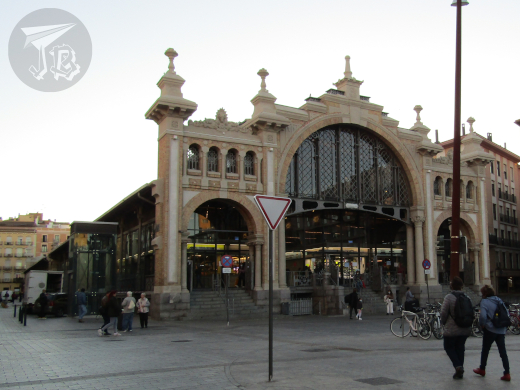
Between the church and the square we walked by the central marketplace Mercado Central de Zaragoza in the late 19th and early 20th century, in a combination of stone and iron-and-glass architecture.

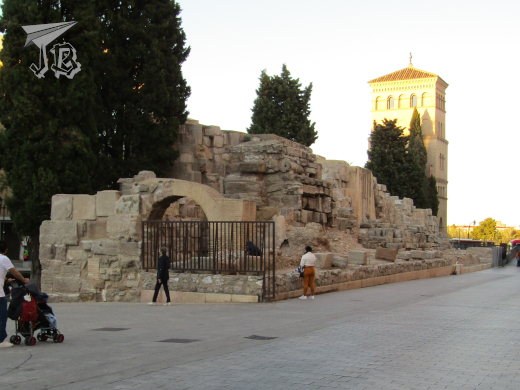
Close to it we could see some of the ruins of the original Roman walls Antiguas Murallas de Romanas de Zaragoza, which are actually sprinkled all through the town and mixed with the Medieval ones at points. There, a lady was happily chatting on the phone while her child climbed the walls – so in case it is not evident, here’s a social clue: if there is any kind of barrier / signage around something, it should not be climbed on.

To finish off the day we visited the Museum dedicated to Goya Museo Goya. Goya, whose complete name was Francisco José de Goya y Lucientes (1746 – 1828) was a painter and printmaker from the Romantic age. He is probably one of the most important artists in Spanish history. He was a royal portraitist, fresco decorator, and also painted and printed many critical and fantasy works. To be honest, the museum was a bit underwhelming – with few of the minor works, and one of the least impressive major works, the Christ portrait. There was however a whole room full of prints.

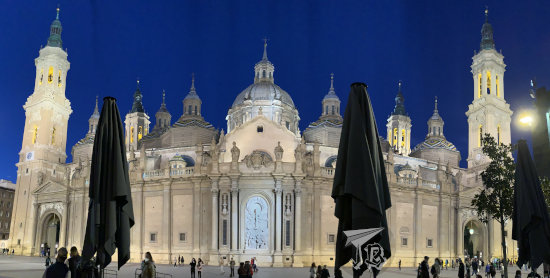
After one more visit to the square, where I managed my only complete picture of the whole (night-lit) Basílica del Pilar from that angle, we just headed to the hotel. There was a sandwich shop at the entrance, so we took one each and had a late light dinner as we watched Night at the Museum in the hotel bathrobes – because it was cozier than turning up the heating. I did not sleep too well as the fire alarm was right on top of the bed and it kept flashing – at one point I thought that an electric storm had hit, but it was just the alarm…

23rd October 2021: Papercraft and walks

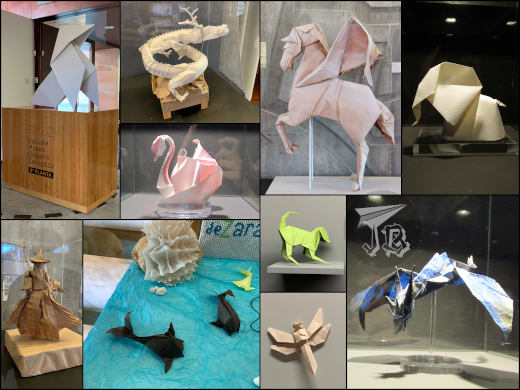
The next morning we had breakfast and headed off to the origami museum and workshop EMOZ: Escuela Museo Origami Zaragoza, located in the “Stories Museum” Centro de Historias. I remembered the exhibition from a few years back in Museo Cerralbo in Madrid, with an actual-size hippo, so I have to admit this time I was a little… underwhelmed, probably because the temporary exhibit ended up being “abstract” paper folding…

However, in the very same building there was a very fun exhibition about the evolution of household appliances throughout the 20th century. That was cute!

As we got ready to draw a close to our day-and-a-half getaway we went to say goodbye to the river Río Ebro. We walked by the modern Puente de Zaragoza bridge, and crossed over the Puente de Piedra, the traditional stone river of the town. The current one dates back (although reconstructed) from 1440, but there are records that a previous Roman one stood in its place and was destroyed in the 9th Century. Between the two bridges a flock of cormorant seemed to be sunbathing.

From Puente de Piedra I took my last picture of the Basílica del Pilar before we had a nice milkshake, then headed back to the station to take our train back. By the way – I find it ridiculous that the stations have blocked 60% of the seats while they’re filling up the platforms and the trains as normal…

Total walked distance: 8.69 km

8th October 2021: Tamajón & Cogolludo (Spain)

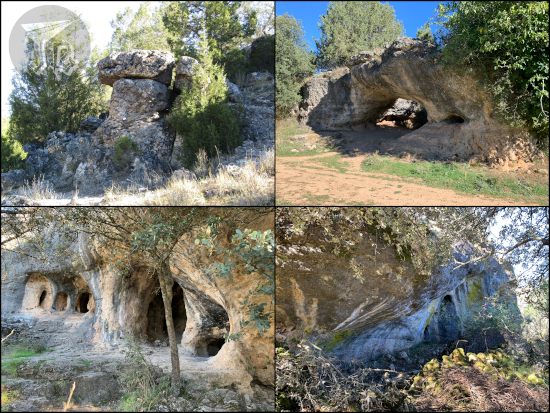
When I went to the waterfalls of the Aljibe I drove past a little village I had never heard of before – Tamajón, and a side sign reading “Pequeña Ciudad Encantada de Tamajón”. The term “Cuidad Encantada”, meaning Enchanted or Magic City, is used in Spanish to refer to karst formations. Karst is the name of a particular topography, created by the dissolution and chemical weathering of soluble rocks, chiefly but not just limestone.

The particular Spanish karst landscapes were formed by precipitation of salts – calcium carbonate – in the quiet waters of the Tethys Ocean during the Mesozoic Era (251-66 million years ago). Plate tectonics made central Spanish arise during the Cretaceous (the later subdivision of the Mesozoic, 140-66 million years ago) emerge, and the calcium carbonate became exposed to the elements, which started the erosion process. The most famous karst landscape in Spain is the Ciudad Encantada near Cuenca, which I guess spread the name.

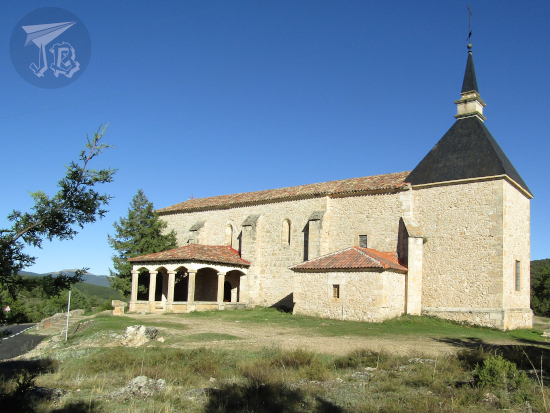
Tamajón has a short hiking route around its karst formation, and while it is true that they are on the relatively smaller size, there are different shapes. I started my hiking route at the Ermita de la Virgen de los Enebrales, hermitage church dedicated to the Virgin of the Juniper Forest – the current building was reformed in the Renaissance style, thought the actual dates are shaky.

I started on the hiking route from the hermitage, along the road, and there were no markings there, so I kind of winged it for a while. After I took the first turn and started going up the rocks, I found the painting marking the routes – I had a handmade map because someone had shared it online, so I just went along it, and when I finished I redid about a fourth of it to take a detour to the other side of the road. There are cracks, arches, caves, cavities and capricious forms. I spent about an hour and a half walking around almost completely alone, which was awesome.

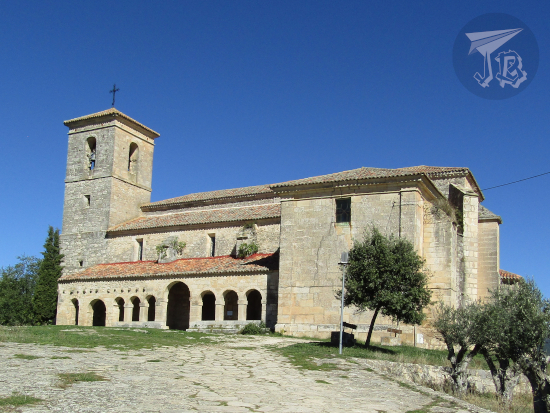
On my way back I stopped by the Church of the Assumption Iglesia de la Asunción, also a Romanesque – Renaissance mixture. The porch is typical of Romanesque churches in the Camino de Santiago (St. James’ Way), to shelter pilgrims.

As it was still early and I was relatively close, instead of driving home I headed off to another village called Cogolludo. I parked the car at the edge of the village and walked towards the main square, where there is a famous Renaissance palace Palacio de los Duques de Medinaceli. It is considered the first Renaissance Palace built in Spain, and it is reported to have been finished in 1492. The palace was designed by Lorenzo Vázquez de Segovia, with exquisite decoration, and the blaring lack of towers, which were very popular at the time. If I’m ever in the area again I might want to try to see the interior, which is only open in the guided visits.

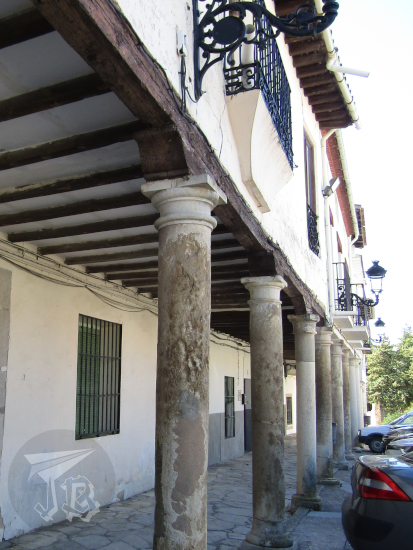
The Palace stands in the main square Plaza Mayor which has a typical Castilian arcade with stone columns (unfortunately workers, sun and cars made it hard to take a good picture of it).

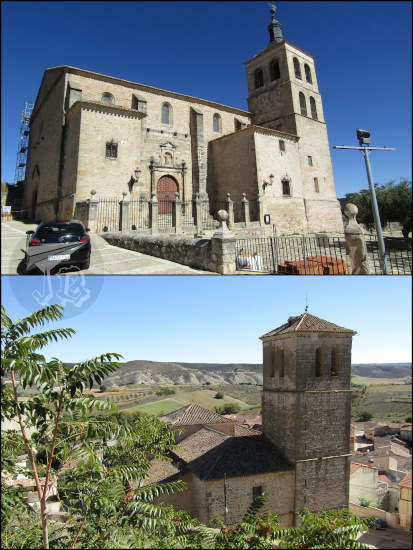
Cogolludo has two churches, Iglesia de Santa María de los Remedios (Our Lady of Remedies) and Iglesia de San Pedro (Saint Peter), both dating from the 16th century, but both completely closed down.

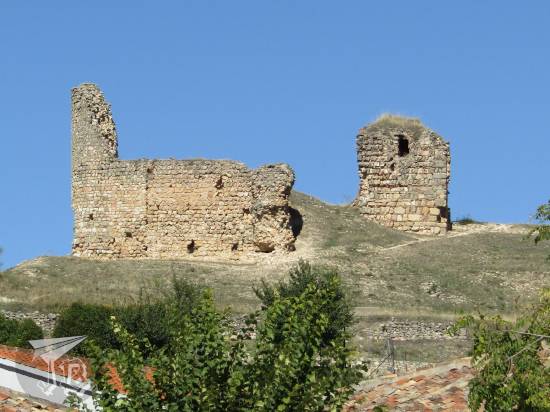
Finally, there are also the ruins of the Medieval Castle Castillo de Cogolludo, but there was not much incentive to climb up. All in all, it was a short but interesting morning – though I glad I teamed the two visits up, going to Cogolludo on its own would have not felt productive.

Driven distance: around 115 km
Walking distance: 7.27 km

22nd August 2021: Romanesque Soria {Spain, summer 2021}

We just spent the morning in Soria, in the region of Castilla y León, before we got on our way back in the early afternoon, but I have to say that the good morning sunset was spectacular.

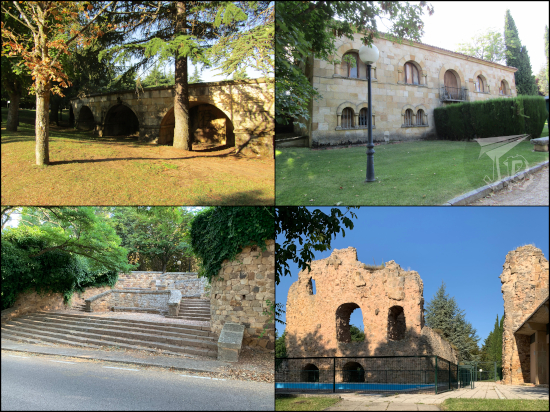
As again we had a breakfast slot at 8:00, we were out to see stuff at around 9:00. The Parador de Soria is located on the top of the Castle Park Parque del Castillo, we just had to go down. First we came across some of the ruins and the buildings that had populated the area in Medieval times.

As we continued our trek downwards we ended up at the church of Our Lady of the Thorn Iglesia de Nuestra Señora del Espino, which was closed as it was still early on a Sunday morning.

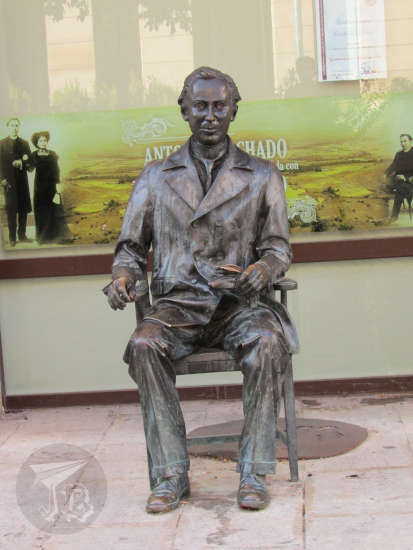
In the tiny garden in front of the church there is a dead tree that has been preserved by pouring fibreglass and other synthetic materials on it – the dry elm tree, Olmo Seco. In 1912, the Spanish poet Antonio Machado wrote a poem – to an old elm tree, struck by lightning and half-rotten, which has sprouted a few green leaves after April rain and May sun… Well, this is the tree, preserved for all to see, with the poem in a small sign (and another in Braille) right next to it.

After staying there for a few minutes, we went on our trek downwards and we reached another church, the church of St. John San Juan de la Rabanera. It is known that the church had already been built in 1270. In the Renaissance and Baroque periods it was heavily remodelled, but restorations during the 20th century recovered most of the Romanesque purity. The main portal, although Romanesque too, used to be part of another church. The apse keeps all the Romanesque decoration – unfortunately, it was closed too.

We kept strolling around the town centre and came across a bunch of palaces – some of them have been repurposed into public-service buildigns such as the local government, revenue and taxes services, town’s archive, a high school… others were for sale or rent.

In front of the high school we found the sculpture to the poet I mentioned before, Escultura a Antonio Machado.

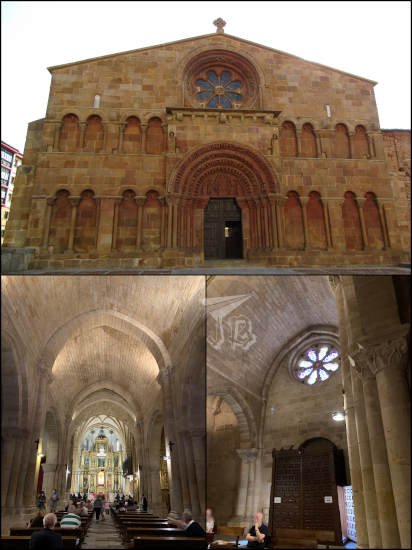
Not far from there we found the church of Saint Dominic Iglesia de Santo Domingo. Like the church of St. John, it is a reformed Romanesque temple. The most important and impressive part of the church is the main façade, in golden stone with amazing carvings (considered by some the best Romanesque façade in the country), and a rose window.

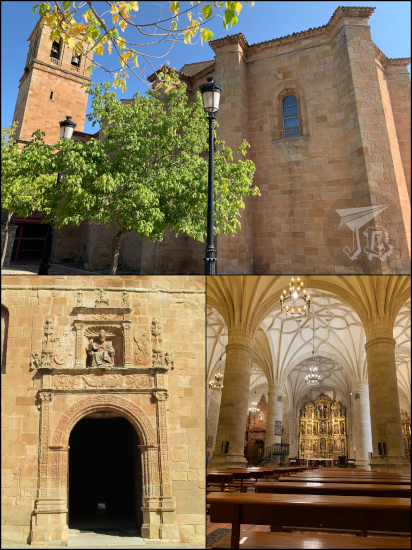
We decided to try to find the co-cathedral of St Peter Concatedral de San Pedro. Dating back from the 12th century, on the outside, it just looks like yet another Romanesque church, but that changes when you enter. When it is illuminated, the church seems to glow.

Furthermore, you can access the cloister of the former collegiate, which was also built in the 12th century as part of a now-disappeared monastery.

We walked back to the centre of the town. We left the main square Plaza Mayor de Soria, which I accessed through a tiny archway delimited by coloured windows, named Arco del Cuerno.

We ended up at main park Alameda de Cervantes.

However, we were more interested in seeing the archaeological museum Museo Numantino, which was open by then – it holds a few ancient straight-Tusked elephant (Elephas antiquus), Pehistoric art, and most of the artefacts that have been found in Numantia, both Roman and Celtiberian, including Roman statues, Celtiberian weapons and drinking jars and the most famous relic of all: a tiny horse-shaped fibula (brooch) that has been adopted as the symbol of Soria.

Finally, on our way out, we stopped at the ruins of the monastery of Saint John of the Douro, commonly just referred to as “archway” and not monastery Arcos de San Juan de Duero, a very cool cloister with different arc styles – a typical Romanesque one from the 13th century, and a second one that might have had Arab influence.

And with this, we drove back home for around 170 km after walking for 6.57 km. Fingers crossed for the next adventure working out!

29th & 30th May 2021: The Walls (and churches) of Ávila (Spain)

There was a little-talked about consequence of the Industrial Revolution in Spain. While it is widely known that it drew a large number of people to the cities and towns, few stop to think of the subsequent steps that had to be adopted. More people in town required housing, and thus a number of projects denominated ensanches or “widenings” were projected and carried out. Even though such a thing makes sense, here lies the problem – in order to enlarge the urban area, many Spanish cities and towns tore down their Roman and Medieval walls, leaving either bare traces or nothing at all.

Legend has it that the town of Ávila lacked the money to demolish the wall. In retrospect, that was a good thing, because today, the walls that surround Ávila, Murallas de Ávila are among the most impressive Europe, some say that even better preserved than Carcassonne (France).

Ávila is a couple of hours away by car, so we drove off on Saturday morning at around 8 am and were there just before 10 am. We entered the city through one of the city wall gates, Puerta del Carmen.

Approach to the walls

We parked (100% ditched the car) at the hotel and checked in – even if it was quite early, they told us that one of the rooms was already prepared and gave us the keys. Unfortunately, it was not, and since the blunder was a Covid-protcol blunder, they upgraded us as an apology. The hotel, Parador de Ávila, belongs to the Spanish network of Paradores, and it is located in a 16th century palace, Palacio de Piedras Albas. We booked late-check-out for the following day, which can be done “for free” booking lunch in the restaurant (which is obviously not free).

Parador

Our first stop was the tourist office, but not the one that is clearly signalled in the middle of the town – the one that is located outside the wall and you have to turn around and around to find. But we needed it to buy the 48-hour pass to the monuments. Then we stuck around to wait for the nearby church to open, which gave way to observing the wall for the first time.

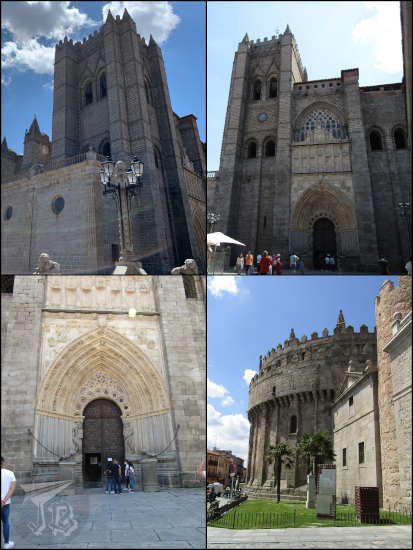
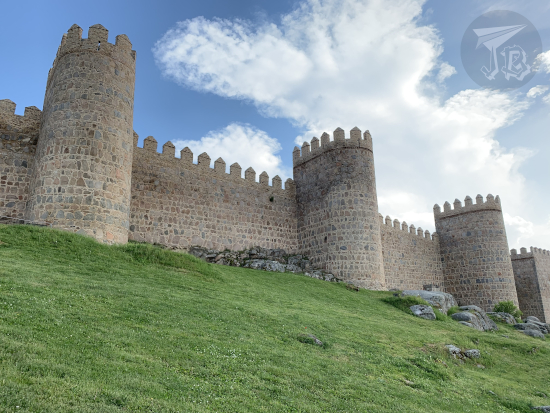
The Muralla de Ávila has been a Unesco World Heritage site since 1985. The structure is clearly defensive and it was built towards the end of the 11th century, quite probably as extension or reinforcement of a previous one, either Roman or Arab – though the Roman theory is the most credible as some pieces used in the original wall seem to come from a now-lost Roman cemetery, and there are documents about a Roman camp with similar shape. The wall has been restored in several occasions, and after surviving the ensanche risk, it was declared national monument and cleared of attached houses. Today most of the wall belongs to the Spanish government, and it is managed by the town hall, though there are some private parts, such as the ones that are part of the cathedral. The walls close off all the historical centre. They have a perimeter of 2,515 metres, with around 2,500 merlons, almost 90 turrets, and nine gates. Our second gate was Puerta de San Vicente.

Puerta de San Vicente

The first monument we stopped by, as soon as it opened since we were already there, was the basilica church Basílica de San Vicente (officially Basílica de los Santos Hermanos Mártires, Vicente, Sabina y Cristeta, three Christian siblings who were martyred nearby). It is one of the most important Romanesque buildings in the whole country, built between the 12th and the 14th century. It is protected as part of the World Heritage Site declaration. One of its characteristics is the golden rock in which it is built – sandstone-looking granite.

Iglesia de San Vicente

The inside of the basilica is, in the typical way, a mix of more modern styles. The grave of the martyr siblings is Pre-gothic, and the large altarpiece is Baroque. In the crypt there are proto-Christian pieces and a Romanesque Virgin which we did not get to see and which is the patron of the town.

Iglesia de San Vicente

Afterwards we headed off to the cathedral Catedral de Cristo Salvador, which is considered the first gothic cathedral in Spain (something that other people say about Cuenca), with clear French influences. It was designed as a fortress church as its abse dubs as one of the turrets of the city wall.

Catedral de Cristo Salvador

In later years, a choir was added, along with a Baroque altarpiece. The walls are also sandstone-looking granite, but some elements inside are limestone and wood.

Catedral de Cristo Salvador

To the side of the cathedral stands the cloister, which holds the grave to the first modern president of Spain, Adolfo Suárez, and the entrance to the cathedral’s museum. It yields to views of the tower and… the storks that squat there.

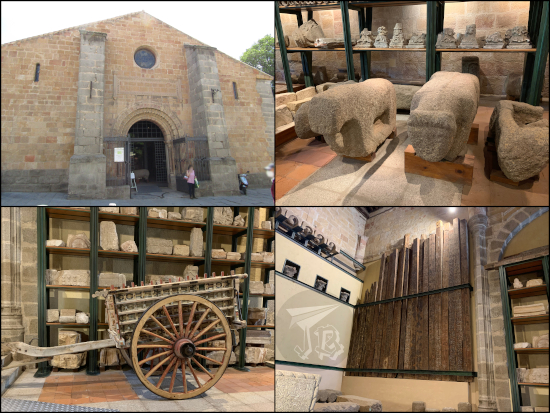
We headed off towards the Museum of Ávila. First we stopped at the former church Iglesia de Santo Tomé, which today is a warehouse for the museum, but can be visited anyway. When I was young, I studied the statues / sculptures called verracos, built around the 5th century BCE by the Vettones, a Celtic pre-Roman civilisation that faded upon the arrival of the Romans. The verracos are crude statues that represent four-legged animals – bulls, boars or pigs. At the time, I had only heard about a number of them, and was somehow under the impression that there were two or three around. I was quite wrong, apparently they pop up from the snow like daisies or something. In the church-turned-warehouse there were like twenty, one outside, there was one at the hotel garden… so no, apparently they are quite common. Other artefacts in the building include some carriages, Roman sculptures and mosaic, Muslim funerary artefacts and roof boards…

Iglesia de Santo Tomé

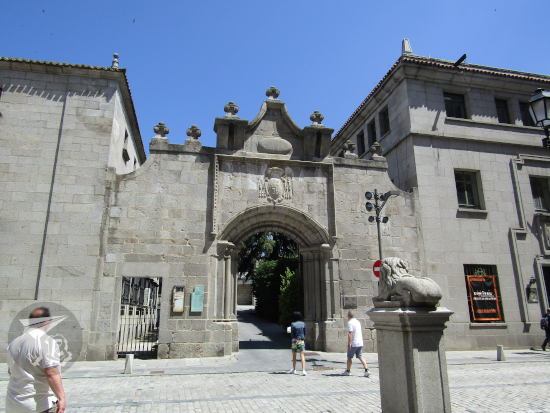
Then we moved onto the museum itself, Museo de Ávila, with a beautiful patio and a number of archaeological and ethnological items which represent the history and folklore of the town.

Museo de Ávila

It was almost time for lunch, so we headed off towards the restaurant where we had booked. Before, we made a small stop at an old palace Palacio del Rey Niño, built in the 12th century, today turned into the Post office and the public library, with a patio closed off by the Walls themselves.

Palacio del Rey Niño

Then we walked by the modern marketplace.

mercado

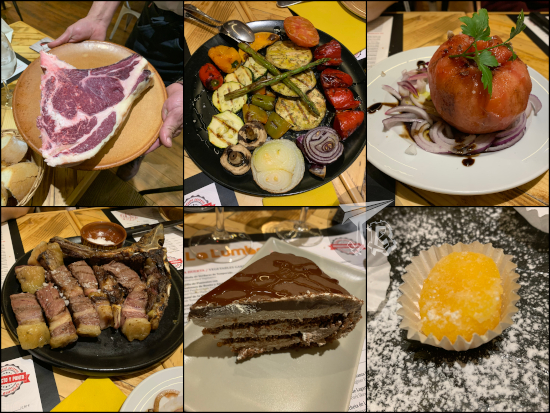
Which happened to be right in front of the restaurant, named La Lumbre. Aside from its walls, Ávila is famous for its cattle, a particular breed called Raza Avileña – Negra Ibérica, and of course the meat the animals produce, especially the matured and grilled meat from older oxen. After the animal has been sacrificed, the meat is matured in a traditional process called “dry maturation” for six weeks before it is grilled. We ordered the rib steak, chuletón to share, along with some grilled vegetables, a “tomato salad” that was a… one-tomato with dressing. And then there were desserts, aside from chocolate cake, we ordered yemas de Ávila – a typical confectionery made with egg yolks, lemon juice, cinnamon, and caster sugar. Lots of typical stuff, as you can see!

lunch

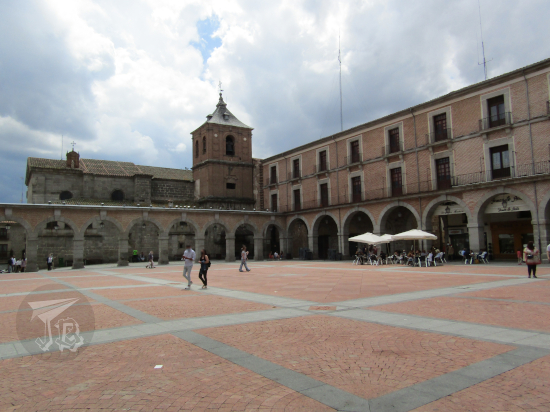
Our next stop was the main square, called “little market square”, Plaza del Mercado Chico, along with the town hall or Ayuntamiento. The square was rebuilt in the 19th century and is flanked by arcades. The town hall was built in 1862.

Plaza del Mercado Chico

Plaza del Mercado Chico: Ayuntamiento

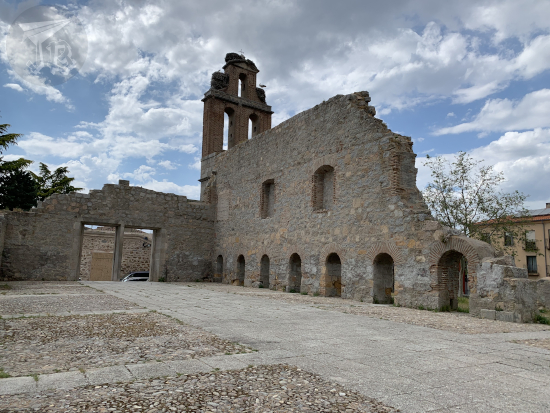
After a brief stop at the Parador for some rest, we headed off to find a convent / monastery on the other side of town. On the way we came across some ruins that I assume are the church Iglesia de San Jerónimo, as they sit in the square of the same name.

Ruinas de San Jerónimo

We reached the convent Convento de San José, a reconstruction of a previous monastery and church, the first founded by Santa Teresa de Jesús (Saint Teresa of Ávila), a Christian “doctor of the church” and mystic Carmelite nun, known for her ‘raptures’, her reforms, and her literature work. More on her later though. The convent and church were a little… underwhelming, even if is a World Heritage building.

Contento de San José

Then we walked back towards the historical centre, and walked past the church Iglesia de San Pedro, a 13th-century building with a great rose window, but which was closed (reforms).

Iglesia de San Pedro

On the other side of the square, Plaza del Mercado Grande (Big Market Square) stands another of the wall gates, Puerta del Alcázar, and a monument to Saint Teresa Monumento a Santa Teresa: La Palomilla.

Puerta del Alcázar

Next we separated and I went off to climb the walls Murallas de Ávila. Well, to walk on the parapet. Due to Covid, there is only one access, next to the Cathedral and its gate Puerta de la Catedral. The walkable area is around 1.4 km, including walking over some of the gates and up and down more than a few turrets. It allows for some amazing views of the town and its outskirts…

Views from the walls

… but also of the wall itself, both the original walls and the add-ons from later eras (and a magpie).

When I reached the end of the walk, I went down and crossed the bridge gate Puerta del Puente, named that way because it overlooks the bridge over the Adaja river. I could not take a picture of it because the traffic police was checking cars at the roundabout in front of the gate. Thus, I headed off to the pedestrian bridge to cross over towards the tiny hermit popularly known as “the four posts”, Los Cuatro Postes, which yield to an impressive view of the town and its walls.

Cuatro Postes

Views on the wall

Avila and View

I walked back to see the walls from the base. Then I crossed the gate we had driven through in the morning, Puerta del Carmen, and I headed back to the hotel for a drink.

At the feet of the walls

Puerta del Carmen

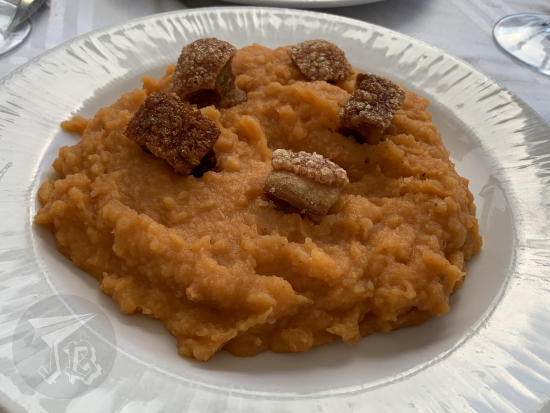
After a while we headed off for dinner and tried another of the typical dishes in Ávila, patatas revolconas – mashed potatoes with paprika and pork rashers, and waited for the sun to go down so the city lit up.

Patatas revolconas

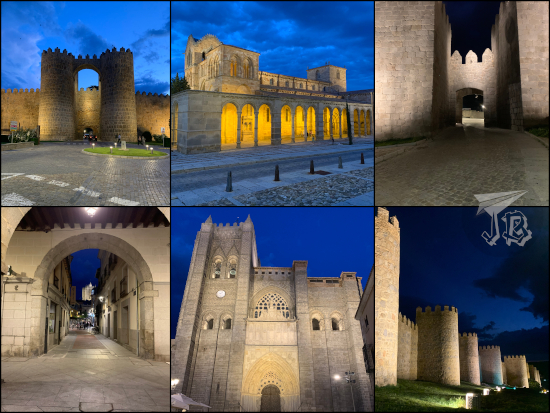
A walk around the town yielded to views of the Iglesia de San Vicente and Puerta de San Vicente, some of the inner streets leading to the town hall Ayuntamiento, the longer area of the Muralla and the Puerta del Carmen.

Night view

And then I had a very, very long shower and went to bed.

In the morning, breakfast was had – not a fan of the “we can’t have a buffet so we prepared this and this is what you get” plate, but whatever. I mentioned Santa Teresa before, let’s get into that a bit further. She was a 16th-century nun born near Ávila, canonized in the 17th century, and elevated to doctor of the church in the 20th century. She is conisdered one of the great mystics and religious women in the Roman Catholic church, author of a number of spiritual classics, and the reformer of the Carmelite nun order into the Discalced Carmelites. She founded convents all over Spain and was known for her mystics raptures which may have been messages from God or epileptic attacks. She is one of Ávila’s most important historical figures and wherever you go there are traces of her. In the place where her house stood now there is a convent, a church, a reliquary room and an interpretation museum, with really strange hours on Sundays. We could see the convent / church Convento de Santa Teresa de Jesús / Iglesia de la Santa and the reliquary room where no pictures were allowed Sala de Reliquias between services.

Iglesia de la Santa

On the way, however, I found some interesting ruins – the gate to the former hospital Hospital de Santa Escolástica, and we walked past a bunch of palaces.

Portada de Santa Eulalia

Then we moved onto a long walk to the 16th- century Gothic monastery Real Monasterio de Santo Tomás, which we could see due to lucky timing as there was a First Holy Communion Mass happening and the local little old ladies were not to keen on cultural visits of the church.

The monastery has a church, three cloisters and two adjacent museums. The church has an impressive Gothic altarpiece (by Pedro Berrugete, one of the key painters riding the wave between Gothic and Renaissance arts), and hosts the grave to the Catholic Monarch’s only male son.

Santo Tomás

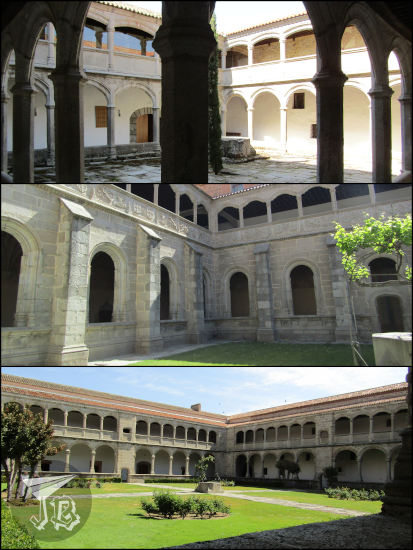
The three cloisters: Claustro del Noviciado, Claustro del Silencio, and Claustro de los Reyes Católicos (Novitiate, Silence and Catholic Monarchs).

Santo Tomás Cloisters

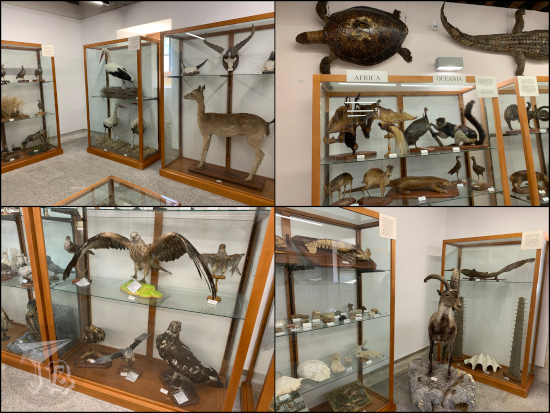
The Museum of Natural Sciences Museo de Ciencias Naturales, an occupational therapy project could… be better, and sets the expectation bar rather low for the next one.

Museo de Ciencias Naturales

However, the Museum of Eastern Arts Museo de Arte Oriental is pretty impressive. It contains pieces and artefacts that the Dominican missioners brought from China, Japan, Vietnam and the Philippines.

Museo de Arte Oriental

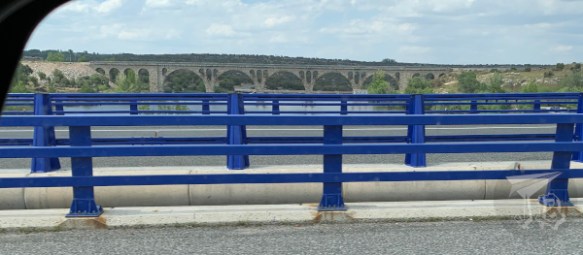
And in the end, that was it for the weekend. We walked back, decided to give the museum of Saint Teresa a miss, had a drink, had lunch and went back on our merry way – with a a view of the train tracks over the dam of the reservoir Embalse de Fuentes Claras.

Train tracks over Embalse de Fuentes Claras

Walked distance (Saturday): around 12.5 km
Walked distance (Sunday): around 6 km
Total distance driven (both days): around 340 km
8th & 9th January 2021: Guadalajara & Filomena (Spain)

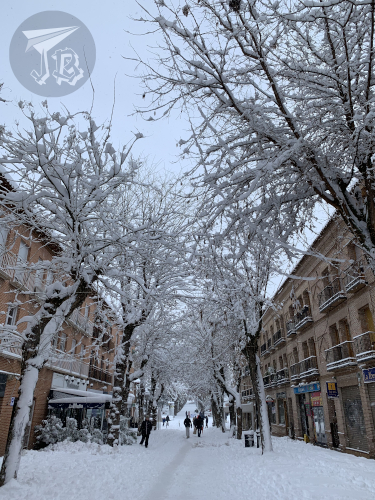
Since 2017, Spain (alongside Portugal and France) has taken up the custom of naming bad storms, and this season we are up to ‘F’, the 6th bad storm. In this case, the storm, named Filomena, entered Spain from the south west and collided with a polar air mass that happened to be coming from the north. The result – snow. Lot’s of it, with low temperatures and snow-heights not seen in a very long time. Some call it “the snowfall of a lifetime”.

As Covid-19 has made travelling impossible – or at least pretty unsafe / irresponsible (choose your pick), plans have been pushed back again, and plain cancelled. While truth be told I still hold tickets for the Saint Seiya event in Paris in late May, I have no hope I will be able to attend. Even if the Covid crisis fades away, there’s the extra issue of the economic blow 2020 caused.

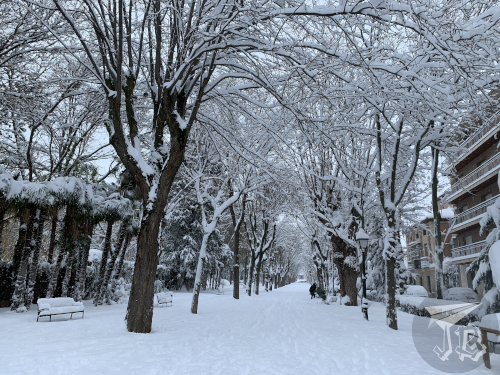
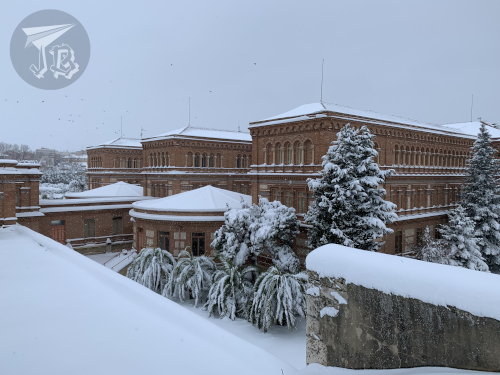
Anyway, back to Filomena – it brought something that is rarely seen in these parts. Snow. Lots of it. So before everything went to hell, I just decided to ignore the stay at home recommendation and took a couple of walks around Guadalajara for a rare sight – the monuments covered with snow. Furthermore, as the snow is expected to freeze into ice plates, I had to go out when the snow was still fresh.

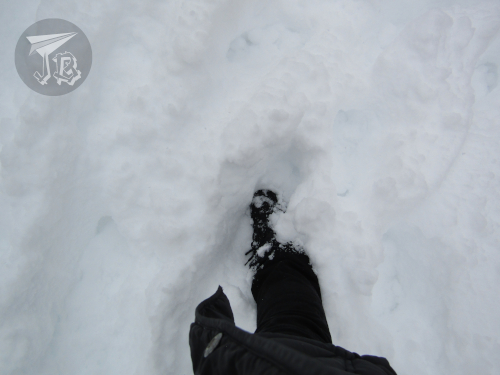
I took two different walks. On the eight of January, Friday, as soon as I got out of wok I put on my snow boots (perks from the time living in Scotland) and winter coat, then threw my raincoat over it – it was a tricky movement, but I managed not to dislocate my shoulder doing so. By this time there was a coverage of a few centimetres, and I decided to head out to the outer area of town where I could sneakily take my mask off if my glasses fogged too much, which I had to do when I crossed the road, because there’s no actual crossing.

There was a surprising amount of people around! Fortunately I was able to keep my distance, especially at the times when I tried to breathe – even if I went out with the smaller glasses, at points I had to take them and the mask off to be able to breathe and see anything.

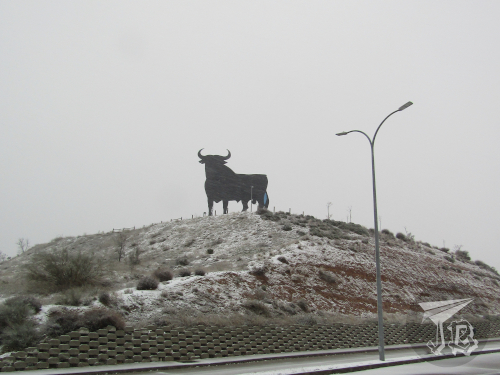
I walked up to the Toro de Osborne a winery-billboard-turned-item-of-cultural-and-visual-interest which as you can see is shaped as a bull – representing the species used in bred for bullfighting, because the Osborne winery is located in an area also famous for the livestock. It is made of metal and measures around 14 metres high, one of the 91 that remain around Spain. It stands in an area that was supposed to become urbanised but never did, so it has several unfinished alleys and corners. There has been a statue there since 1975, called El Abrazo, (The Hug), which has always reminded me of a decomposing DNA strand. It was erected by Francisco Sobrino, the most famous sculptor from the town.

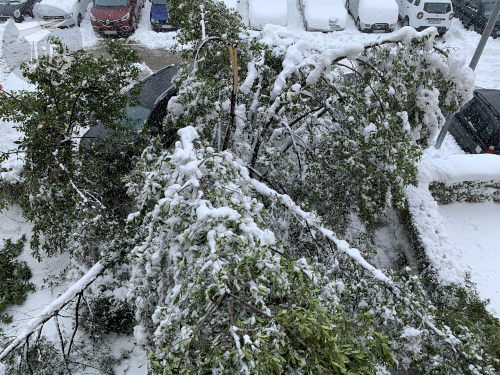
I went back right before sundown, and the roads were already difficult. It continued snowing throughout the night, and when I woke up on Saturday morning, no cars could run, there were no buses, trains had been stopped and some trees had collapsed under the weight of the strongest snowfall in decades. But… temptation won. I only wanted to peek around the corner a little, but then I decided that as there was a good chance I would run into people, I could not cheat on mask policy – so I put my contacts on. That warranted for a longer walk as those are disposable, and… not cheap (≧▽≦).

First I walked down the Avenida del Ejército, one of the main arteries in town, which had already been somewhat cleaned of snow, which was good, because… well, there was a bit more of a cover than the day before

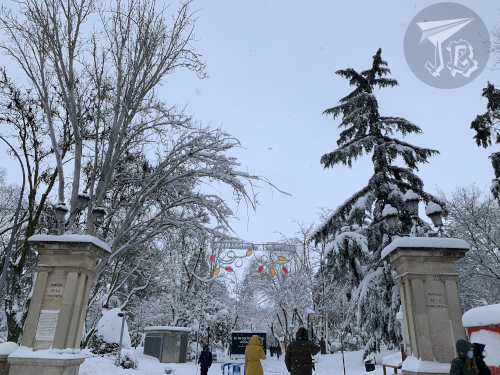
I reached the park built after the ancient Arab structure, Parque de la Huerta de San Antonio. To the left stands one of the towers of the old walls, Torreón de Alvar Fáñez.

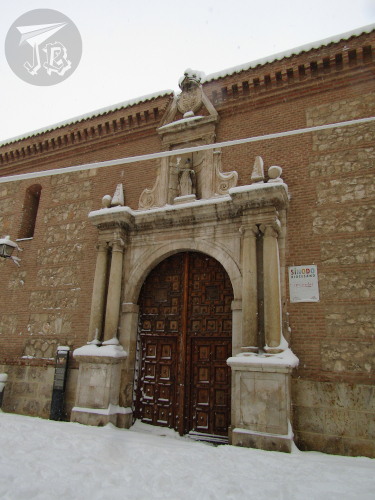
I saw the snowed Palacio del Infantado. This palace was built in the late Renaissance style, designed by Juan Guas and commissioned by the Marquis of Santillana. Although the main construction happened between 1480 and 1497 but has been reformed in several occasions, even recently as it was turned from public library into monument and museum. Infantado is a name related to the concepts of infante or infanta, which are the Spanish terms that designate the children of monarchs who are not the direct heirs (so no the crown prince or princess). The most important feature is the main façade built with sand-coloured rocks and diamond protuberances as decoration. It was suspected to have suffered from aluminosis concrete a couple of years back, but after a small political struggle, it the palace was deemed healthy again. Magic, I guess.

Up the central street of the old town, I took a small detour to check the Iglesia de Santiago Apóstol to the left. The church, built in bricks, used to belong to a now-gone convent.

In front of the church stands the convent-turned-palace-turned-high-school Convento de la Piedad / Palacio de Antonio de Mendoza. The convent-palace represents the start of the Renaissance influence in Spain, especially the former grand entrance.

At the end of the street stands the main square and Ayuntamiento, the town hall, and main square, where the street turns into the main street, Calle Mayor. The town hall, built at the beginning of the 20th century, sports an interesting bell tower in iron.

The square Plaza del Jardinillo (square of the little garden) where the Baroque church Iglesia de San Nicolás el Real stands. You can’t really recognise him under all the snow, but there is a Neptune standing in the middle of the fountain in the square.

Main Street continues until the square Plaza de Santo Domingo. The square is half park-like, half built, and one of the trees that died in the park area was carved into a book-stash sculpture.

On the other side of the road stands another church, Iglesia de San Ginés, built in the 17th century with two towers and a Romanesque-looking entrance.

The police tape around the main town park, Parque de la Concordia, had been partially taken down and I interpreted (wrongly) by the sheer number of people inside that it was allowed to walk in. Only when I reached the other side I realised that the park was considered unsafe, and of course I did not risk any other trespassing. The park dates to mid-19th century, and hosts a gazebo-like structure built in brick and iron by Francisco Checa in 1915.

I went on to the Paseo de San Roque, only on the street area, as the more park-like one was taped off. This is one of the most diverse parks in town, and some say that it could / should have been considered a botanical garden.

I walked alongside, peeked into the park Parque de las Adoratrices, but it was packed, so I continued on. Although this park is rather recent, opened in 2009, the walls and fences were built a century earlier. The town festival used to be celebrated here, but it was moved away to the outskirts as the town grew.

At the end of the street stands the chapel Ermita de San Roque , which originally was outside the town when it was built in the 17th century, in the typical brick of the area.

I walked around the walled area of the Colegio de las Adoratrices, with some really cool views of the pantheon that stands there, Panteón de la Duquesa de Sevillano, the school building and the church Iglesia de Santa María Micaela. This whole area used to belong to the Duchess, who commissioned the architectural complex in the 19th century. The pantheon is a particular example of the eclectic architecture, with a purple dome. The church is a mixture of different styles, out of which maybe neo-Gothic would be the most prominent one.

The street I wanted to go along next was a) taped off and b) waaaay too steep for a safe climb-up, so I decided to turn towards another of the important squares in town, Plaza de Bejanque. You can guess the old fortress Fuerte de San Francisco behind it, but it was also full of people, so I walked fast.

One of the features of the square is the old gate from the walls, Puerta de Bejanque, one of the access gates through the 14th century wall. This used to be part of a house that was built around it, and it was unearthed, so to speak, in the 90s.

I went down towards the co-cathedral Concatedral de Santa María. Originally built in the 13th century, this catholic church has been redesigned and rebuilt in several styles. It is best characterised by the horse-shoe arches in the main façade.

And sneaked up towards the chapel Capilla de Luis de Lucena, a small and compact chapel built like a tiny fortress that used to be an oratory part of a larger church.

I walked past the old palatial house Palacio de la Cotilla, a palatial house from the 15th century.

The convent Convento de las Carmelitas de San José. This convent, where cloistered nuns still live (tradition says that couples that are going to marry should bring them eggs for sun on the day of the wedding) was built in 1625, and the inside is decorated in the Baroque style.

And finally reached the lookout over the park built within the old torrent, Parque del Barranco del Alamín.

I finally saw the former church Iglesia de los Remedios. Today it is used as the grand hall for the nearby university, but it was originally a Renaissance temple, with three characteristic arches guarding the entrance.

And turned back towards the Palacio del Infantado from the square Plaza de España.

It had started snowing more heavily by then and my legs were getting tired. The sloshy snow on the roads had become frozen so it was slippery, and when I was walking on the actual snow, it was up to my mid-shins, so I was feeling the strain in my legs and my back. Thus, I decided to go back home and not to return in the afternoon again because the trees had lost more and more branches under the weight of the snow. The temperature going down also meant that the snow was going to freeze and it would be more slippery as it became ice…

I mean, this is the tree that used to stand in front of my balcony… So better safe than sorry. But all in all, the snowfall of a lifetime in these latitudes!

12th September 2020: Sigüenza (Spain)

We took a drive to Sigüenza, in Spain. This medieval town? big village? had a big relevance through the Middle Ages, and the historical centre reflects that. The most prominent point is the castle on top of a hill. The Castillo de los Obispos is a fortress that can be traced to Roman times. However, the actual castle was a Moorish alcazaba. After the Christians took it over in the 12th century, it was remodelled and enlarged. Due to its vantage point, the castle was a key element in different wars and strife, including the Napoleonic invasion and the Civil War, thus resulting pretty damaged. In the late 20th century it was decided to restore it turn it into a Parador with around 50 rooms.

During our planning stage we called and tried to book a restaurant for lunch, and we were told they were not taking them, we had to call on the same day. Of course, when we got there, it was impossible to book – there was a course and the celebration of a communion (seriously, people, learn to say no so others can get organised). Unfortunately, you could not see the interior or even the yard if you had no reservations, so I can only share a picture from the parking lot, where we left the car.

We walked down the main street Calle Mayor, a clobbered slope that ends (well, technically begins) at the town’s main square.

Main Square or Plaza Mayor is home to the Town Hall or Ayuntamiento de Sigüenza, an old palace with a typical Castillian inner yard or patio.

Opposite the town hall stands the cathedral Catedral de Santa María La Mayor de Sigüenza. The Gothic building was built upon a previous Romanesque one and it had some Neoclassical and Baroque additions. Thus, the façade sports Romanesque doors and rose window, and the main body is Gothic. The altar and the choir are awfully Baroque too, and some of the chapels sport Cisneros, Plateresque and Renaissance decorations. All in all, an interesting pout-pourri of architectural and decoration styles.

The most important piece of art of the cathedral, however, is a funerary piece to the right of the altar. It is the sepulchre of Martín Vázquez de Arce “El Doncel” (“The Young Man”). The chapel holds him, his parents and grandparents, but the sculpture on his sepulchre is the most impressive one. The Vázquez de Arce family were vassals of the Mendoza family, the most important family in the area during the Middle Ages. During the war to conquer Al-Andalus, the Vázquez de Arce males followed the Mendoza to the war in Granada, where Martín died in a trap set by the Arabs, which consisted on damming the River Genil to a creek, and then releasing the dam so the water took over the enemies crossing (which… kinda sounds like something out of the Lord of the Rings, doesn’t it? At least, it makes me think of Arwen and Treebeard). The sepulchre, commissioned by Martín’s brother, presents him taking a break during training and reading a book. He even has pupils, so if you could climb up, you’d see what he’s reading!

The cloister is also Gothic, as the previous Romanesque one was torn down. It holds a central garden and a number of side rooms where there is a collection of mythology-themed tapestries. In one of the chapels, there is also a painting by El Greco, a Greek painter rooted in Spain who was one of the key artists during the Spanish Renaissance.

The cathedral ticket also allows a visit to the Diocesan Museum Museo Diocesano, which holds many pieces of religious art, along with a few models of the cathedral in its different construction stages. These days I’m trying to learn some hagiography, which means how to identify religious figures by how they’re presented. Getting there, three out of ten times or so, because half the time they cheat.

After the cathedral we climbed up towards the castle, and we stopped at the former church Iglesia de Santiago, now transformed into a mini-introduction centre for all the “hidden” or “unknown” Romanesque in the area. The church itself had some beautiful paintings, but it was destroyed during the Civil War.

Continuing our way up, we turned a little to see the house where the Vázquez de Arce family used to live, now turned in a museum, Museo Casa del Doncel. There is a little paintings exhibition and a guitar museum, along with some ancient artefacts such as vases or looms. The most interesting part are the Moorish “Mozárabe” decoration. Here is a bit of historic trolling: when the Christian “conquerors” hired Arab craftsmen to do decoration, one of the things the Arabs did was decorate using Quran verses.

Then we saw the outside of the church Iglesia de San Vicente Mártir, Romanesque to boot.

Afterwards, we ended up at the square Plazuela de la Cárcel, where the old gaol jail stood.

Finally, we headed over to the restaurant where we had booked a lunch table, a traditional grill called La Taberna Seguntina where I chose to have a “summer menu” with salmorejo (a thick soup or purée made with tomato, oil, and bread and sprinkled with boiled egg and cured ham) and roasted cochinillo (suckling pig, roasted whole) with potatoes and herbs. For dessert I had a pudding!

And that was it, really – Medieval Sigüenza has nothing else to see. As the façade of the castle was being restored, we did not even take pictures of it as we drove away.

4th September 2020: Alcalá de Henares (Spain)

After looking for a place to park the car for 12 minutes, I left the car and I went off on foot towards the centre with a relative who is living in Alcalá de Henares. The town centre has been a Unesco World Heritage Site since 1998.

Our first stop, at 10:30 almost sharp was the Palacete Laredo, a small palace built in the Neo-Mudéjar style, a type of Moorish Revival architecture. It was designed and built between 1880 and 1884 by the Spanish artist Manuel José de Laredo y Ordoño. After a century in private hands, it passed to the town hall, which allows the university to use it as a museum, showing a collection of ancient documents.

The palace is built in brick, it has two floors and a minaret-like tower. The inside is decorated with coloured-glass window, tiles and paintings. The visible ceilings on the first floor are wooden artesonado (decorative beams joined together). There is also a garden, but it was closed.

Afterwards, we headed off towards the centre. We walked by the church Parroquia de Santa María la Mayor and is inhabitant the stork on photo duty.

We had tickets to see the Corral de Comedias, a theatre built in the site of an ancient “theatrical courtyard”. These were open-air theatres that were common during the late middle ages and exploded in popularity in the 16th century. The Corral in Alcalá de Henares was built in 1601 by Francisco Sánchez, member of the Carpenters Guild. It suffered several changes – the ceiling was built in the 18th century, then it became a cinema, and eventually was “lost” in the 1970s. In the 1980s, it was rediscovered, restored, and finally opened as working theatre in 2003.

Alas, we were too late for the 12:00 visit to the university, so we wandered around the town’s main square Plaza de Cervantes – Alcalá de Henares was Cervantes’ birthplace. Miguel de Cervantes was a 16th century Spanish writer, most renown for his novel “The Ingenious Gentleman Don Quixote of La Mancha”, which many authors consider “the first modern novel” and “the best literary work ever written” (though… I disagree). The square features a bandstand, the statue of Cervantes, and is surrounded by several buildings of importance – the ruins of the church Iglesia de Santa María, the Town Hall and the Círculo de Contribuyentes, former casino, and the Corral de Comedias.

Then we walked down Main Street Calle Mayor, until we got down to the Obispado de Alcalá de Henares, the bishopric, with two towers from the former wall at their sides. That reminds me – we did not visit the cathedral or any religious buildings because they were all closed to tourism.

At 13:00 we took the guided visit to one of the university buildings, the Colegio Mayor de San Ildefonso. The university was established in 1499 by Cardinal Cisneros, an influential Spanish religious and statesman in the time of the Catholic Monarchs. A colegio mayor is basically a dignified “classic” dormitory. The façade was built between 1537 and 1559 in the Plateresque style, an architectural style that developed in Spain between the late Gothic and the early Renaissance. The architect was Rodrigo Gil de Hontañón.

Inside, we saw the cloisters and yards, the gate of honour (from where the successful students left the university), the classroom where the students defended their final thesis, and the chapel, with the tomb of the founding Cardinal (but not his body, which is in the cathedral).

We had a reservation to have lunch at the Parador de Alcalá de Henares, which is a rather modern building and not a historical one, but a stamp was needed (≧▽≦). Lunch was a looong affair because our waiter might not have been the… most efficient. We tried the combos with a little bit of everything to share (entrées and desserts), and some bull tail. Oh and coffee. Yay coffee. (Also, kudos to me for cutting that nut in half.)

After lunch, we walked down the Calle Mayor again and we made a stop at what is supposed to be the house where Cervantes was born, or at least a reconstruction, with a bunch of ancient objects thrown in – the Museo Casa Natal de Cervantes. There was also a photography exhibition. To be honest, it had a great quality-price relation. It was free, and the quality was… lacking. Or maybe I’m old and I have seen most of the stuff they showed in action, and used a few.

We continued on to the regional archaeological museum Museo Arqueológico Regional, located in the old Archiepiscopal palace. That was unexpectedly good, with the fossil record and the old Roman mosaics.

Pending for a future visit to Alcalá de Henares: Roman and Medieval areas, and the religious buildings, as the day finished up doing some necessary and work-related shopping before I drove back home.

Driven distance: Around an hour? I dumped the car as soon as I could and we walked the hell out of the town (≧▽≦)
Walked distance: 14.61 km

5th August 2020: Monforte de Lemos {Spain, summer 2020}

After so many curves, we deserved a calm day, which included some art in Monforte de Lemos . We started off at the river Cabe, crossing the bridge Ponte Vella and the newer iron one.
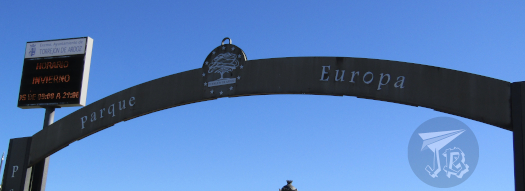
We had booked to visit the Christian Art Museum in the Clares’ convent Museo de Arte Sacro / Convento de las Clarisas, which features some interesting pieces of art, among them a dead Christ by Gregorio Fernández, and hundreds of reliquaries with supposed remains of Saints.

Then we moved to the Piarists School, the church, and their painting collection Colegiata de Nuestra Señora de la Antigua / Pinacoteca de los Escolapios . The school is built in a Renaissance Herrerian style and the guide constantly tried to one-up San Lorenzo del Escorial.

Then we found a good meat restaurant, Mesón JM for some local beef T-bone that we could prepare ourselves, although I get the nagging feeling they actually short-served us as they never showed us the meat piece. Please excuse the reddish tint of the pictures. It was the parasol and at the time I did not notice (≧▽≦).

After lunch and a break, we took a climb into the old castle keep Torre del Homenaje, and walked around for a little.

We ended the day at the tapas bar La Fábrica for some seafood.

And finished the day with some in-accomodation exploration at the Parador de Monforte de Lemos.

Walked distance: 9.03 km

4th August 2020: Meanders and Curves {Spain, summer 2020}

The area we were visiting that day, called Ribeira Sacra, is sprinkled with Christian monasteries [mosteiros] and churches [Igrexas] in the Romanesque and Gothic styles. These religious sites became commonplace during the Medieval times, along the way that leads up to Santiago de Compostela, an important Christian pilgrimage site. The route is called Camino de Santiago (St. James’ Way).

We started off with a fierce battle against the car’s sat-nav as it refused to take us to our first stop, the church of St. Michael in a tiny hamlet. I managed to trick the navigator and we arrived at the Iglesia de San Miguel de Eiré only a little later than expected. The church is small and it was built in the Romanesque style, which is common the Ribeira Sacra. The church was built in the second half of the 12th century, and has a remarkable archway. Back in the day, it belonged to a monastery.

Afterwards we backtracked to what is probably its successor – another monastery, the Monasterio Cisterciense del Divino Salvador in Ferreira, which was built in three styles – the church is Romanesque (12th century), the main building and the walls are Baroque (18th century) and the inner cloister is Renaissance (16th century). There are also two Romanesque wooden sculptures.

Then we set off towards a salad of curves the heart of the Ribeira Sacra, the area of the River Sil where the water has excavated a deep canyon – well, ish. There was a lot of tectonic activity going on in the area a long time ago that helped the development of the river canyon, the Canón do Sil. It is dammed at the moment, which has made the river depth increase.

We had booked a “cruise” in a “catamaran” that turned out to be a plain-old boat and way too packed for my peace of mind. Fortunately everybody wore masks, we had the N-95 that protect both ways ones, and used a lot of hand sanitiser – my nails are really, really off due to the use and abuse of hand sanitiser. We sailed off the wharf Embarcadoiro do Santo Estevo and the views were pretty nice. Both the narrator and narration not so much, though the bit about the “special” vineyards perched on the canyon walls was interesting.

After a ninety-minute sail, we disembarked and took the car again to drive to the Parador de Santo Estevo to have lunch (cue stamp number three), where I tried the local beef with foie, while the rest went for the octopus.

Then we took a stroll down the Parador, which is an old monastery that has not one but three cloisters, as the Monasterio de Santo Estevo de Ribas de Sil has existed since the tenth century and buildings have been added. Two of the cloisters are Renaissance and the third is Baroque / Gothic.

Finally we stopped over at the church, whose interior is late Romanesque but with a later façade (and a very Baroque altar).

And then we went back to the curves. Lots and lots of curves. The road ran along the canyon, so we stopped over at a couple of viewpoints to observe the canyons – Miradoiro de Cabezoás:

Miradoiro Balcones de Madrid:

Then we continued onto the ruins of another Romanesque Monastery, Mosteiro de Santa Cristina de Ribas de Sil, with some very nice paintings and a very pretty cloister.

Afterwards we drove back up the road and we found another viewpoint Miradoriro Xariñas de Castro (a.k.a. Miradorio A Mirada Maxica) for more views of the canyon.

We continued to the monastery Mosteiro de Santa María de Montederramo, where we had booked at 19:00 but could join the 18:00 visit instead. Shifty, I know, but we were there at 18:04 and… yeah. Not really worth the wait, even though the Gothic church and cloister were neat, even if a bit unkempt.

And as we were finally driving back towards Monforte de Lemos, we came across the castle Castelo de Castro Caldelas, which was actually on the planning for the next day but we thought we would… how to put this… avoid some curve-driving if we took the stop.

All in all: 135 km driving; 6.96 km walking; around 20 km sailing; hundreds of curves.
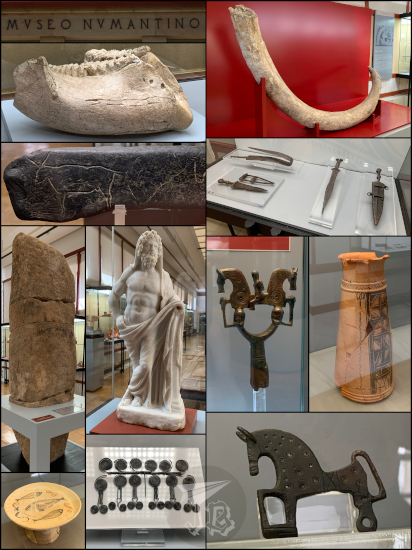
23rd & 24th April 2019: El Escorial, Vizmalo & Lerma (Spain)

23 April 2019: El Escorial

The Royal Site of San Lorenzo de El Escorial aka Monasterio y Sitio de El Escorial is located a shy hour away from Madrid. It is most known for the Monastery that used to be an official residence of the King of Spain. The Monastery was built between 1563 and 1584. It is the masterpiece of the Spanish architect Juan de Herrera, after whom the Herrerian style, a sub-style in the Spanish Renaissance, was named. The building is a sober building made of a granite, and it is the burial place of most of the Spanish kings and queens. Some urban legends say that it was based off the descriptions of the Temple of Solomon.

We drove in around 9:00, dropped off the luggage, and went out, as we had tickets for 10:00 – although the hotel did not want to let us in. Contrary to the nice weather that we had been enjoying, it was cold as hell. The whole town felt grey and sober, and the cloudiness helped the mood – we had breakfast at a nearby bar (the only one open) and headed off to the monastery. The building hosts many artworks, along with a chapel, the royal pantheon and the most amazing library ever. Pictures in the inner areas are forbidden, unfortunately. The Monastery is a Unesco World Heritage site.

At lunchtime we walked out of the Monastery and headed off to the Royal Carriage House / Cocheras del Rey, a museum / restaurant. We had lunch, then visited the museum as the entry was free with lunch. It was raining like mad by then so we headed to the hotel to finalise the check in.

After an hour or so the rain had stopped so we decided to walk to the Prince’s House and Parks / Parque y jardines de la Casita del Príncipe. By the time we arrived it had started raining again – pictures were not allowed inside of the house either, but OMG was the inside Baroque, with flashy wallpapers.

On the way back, we could catch a glimpse of the monastery through the park. By now it was raining like crazy, so we spent the rest of the evening indoors.

24 April 2019: Vizmalo & Lerma

We left El Escorial early in the morning and we headed north for lunch. Yeah, well, let me explain. We had a reservation for lunch some two-and-a-half hours away, in Vizmalo (Burgos). This was a bit of a silly whim, but we were going to visit an estate / farm and have lunch there – the St. Rosalia Estate / Finca Santa Rosalía breeds wagyu for meat, and holy are they yummy. We had a booking to see the estate first.

While it was still cold, the weather was slowly improving, and in evening we had some sun. We saw the orchards, the grapevines, the cattle, the trees and so on. Then we moved into the wine cellars and saw the barrels, before we tried the wine and some of the meat-dishes that they prepare and sell. The selling point of Finca Santa Rosalía are the wagyu, cattle of Japanese origin. Wagyu meat is completely different from any other beef because it is soft and tender, and in general delicious.

Lunch was brilliant, based, of course on the wagyu meat. The T-bone was scrumptious and even if it was on the “a lot of money” side, it did not feel too expensive for a once-in-a-lifetime experience considering the amazing quality.

After lunch we drove off towards Lerma, a city which was revamped by the Duke of Lerma back in the 17th century. After finding our hotel and dropping our stuff off, we walked to the Duke’s Palace turned luxury hotel: Palacio Ducal & Parador de Lerma.

We walked around and came across the Mirador de los Arcos / Archway Viewpoint.

Then we saw Colegiata de San Pedro / St. Peter’s Collegiate church, where there was a religious exhibition being held (“Las Edades del Hombre”), with the topic of angels. Pictures were not allowed, or we would have shown you a few… interesting representation.

Sunset crawled upon us and it was nice view. We had dinner somewhere around the town centre, and called it a night before we drove home the following day.

30th December 2013 – 1st January 2014: New Year’s in Toledo (Spain)

30th December 2013: Arrival in Toledo

We took an early train to get to Madrid, and transferred to the high-speed line (AVE) to get to Toledo – the ride from Madrid was barely half an hour. Toledo is known as “the city of the three cultures” as during the Middle Ages, Christians, Muslims and Jews managed to live in peace there, and make it prosper. Today it is a tourist hub in the centre of Spain.

The first thing that we did was head off to the Alcázar (Muslim castle) – although it was originally built by Romans in the third century, its current look is owed to the restoration carried out in the 1540s. However, it had to be restored after the Spanish Civil War. The Siege of the Alcázar was one of the most symbolic victories on the Nationalist band. The Alcázar was under siege during the whole summer by Republicans trying to take it over, but in the end, Nationalist reinforcements arrived, chasing the Republicans away. Today, the Alcázar is an important cultural building (where the bullet holes can still be found) and hosts the Museum of the Army, Museo del Ejército.

From the vantage point of the Alcázar, we could see the Academia de Infantería (Toledo Infantry Academy), built in the 20th century in imitation of the Renaissance and Herrerian style.

We also saw the Castillo de San Servando, the Castle of San Servando, a fortified Knights Templar enclave. Fine, it started off as a regular monastery, but it was later given to the Knights Templar in order to protect the city.

Both buildings are on the other side of the Río Tajo, the Tagus river, the longest river in Spain.

After having lunch and checking into the hotel, we visited the cathedral Catedral Primada Santa María de Toledo (Primate Cathedral of Saint Mary of Toledo). The cathedral, built in Gothic Style, was erected mainly throughout the 13th century, even if it was only finished in the 15th century. It sports two asymmetric towers, well, one tower and a small Mozarabic chapel in place of the other one.

By the time we came out of the cathedral, night had fallen – truth is that we missed a little on the pretty windows due to it being darkish outside already. Nevertheless, this treated us to some nice night views. First of all, of course, the cathedral itself…

The Alcázar once again…

… and the Castle of San Servando.

We then walked through the Plaza de Zocodover, one of the city squares, where the old Muslim for cattle and horses was. The current layout was set in the 16th century after it burnt down in a fire.

We walked around the old town for a while until we found a place to have dinner, a Middle-East restaurant called La Casa de Damasco, one of the few times I’ve had real food from this area. I have to say I really enjoyed it.

31st December 2013: Churches and Birds

We started off the day at the Monasterio de San Juan de los Reyes (Monastery of Saint John of the Monarchs) is an Isabelline style Franciscan monastery. It was founded by the Catholic Monarchs to celebrate the birth of their son along with their victory in the Battle of Toro, in the late 15th century. It has a beautiful Gothic cloister.

Our next stop was one of those things that breaks my brain, a Christian Mosque, Mezquita del Cristo de la Luz. It was built in the year 999 as Bab-al-Mardum mosque, but it was turned into a Christian Church in 1085. I’m torn between rolling my eyes at Religions needing to assert dominance and being grateful the Mosque was preserved for us to visit.

Close to the Mosque stands one of the gates of the old walls, the Puerta del Sol, the Sun Gate, of the city walls.

Our next stop the Iglesia Jesuita de San Ildefonso, a church dedicated to Saint Ildefonsus, the patron saint of the city. Construction started in the early 17th century and ended in the mid 18th century, in the Baroque style.

From the upper towers of the church, there was a great view of Toledo.

We decided to walk down towards the river, Río Tajo, where we met a flock of geese (which I’m happy to report had not lost their heads to any kind of stupid animal-hurting tradition).

As we continued, we walked past a sculpture to Miguel de Cervantes, Estatua de Miguel de Cervantes, the author of the acclaimed “Don Quijote” book. The statue is placed beyond the Arco de la Sangre , the Blood Archway, that leads into the Zocodover Square.

As darkness rose, we had dinner in a Chinese restaurant. While we did, the lights turned on, and the city got ready to welcome the New Year with fireworks.

1st January 2014: Views of Toledo

We slept in, and after an early lunch (Chinese, again, as we were feeling decadent), we booked a ride in the “tourist train” that took us to see some of the most amazing views of the Medieval Town from the vantage points on the other side of the Río Tajo.

On the way back we saw the Puente de Alcántara, a Roman arch bridge built upon the foundation of the city after the Celtic settlement was taken over.

The ride ended up on the other side of the city than the one we had been favouring, so we just walked round the walls that fortify the city, the Murallas de Toledo, which are of Muslim origin over Roman foundations. King Alfonso VI is credited with finishing off the walls, and he named one of the gates after him: Puerta de Alfonso VI.

Another of the gates is the Puerta de Bisagra, the last of the monuments we visited before we headed back home the following morning.

One of the creepiest moments in this trip was realising that our key could open a room which was not ours – we got off on the wrong floor and we went down the corridor to the room door, and opened it. It was not our room. We were very quite put off by this, and it turns out that we had a master key. Finding this was a little freaky, and we tried to complain to the hotel. Furthermore, they wanted to charge us for keeping our luggage for a few hours.

Oh, and I caught a cold during our 31st at night escapade. Because of course I did.

22nd December 2013: Derelict Monastery in Tendilla (Spain)

Here are the ruins of the church of a long-forsaken monastery dedicated to Saint Anne, the Monasterio de Santa Ana, a Hieronymite convent built in the 15th Century in Tendilla. Originally, it was built half-way between the Gothic and the Renaissance styles. The monastery was abandoned in the 19th century due to the The ecclesiastical confiscations of Mendizábal, a of laws and strategies that resulted in the expropriation and privatisation of religious and monastic properties. The building was later “sold” for stone, and the tombs it contained were sent to other churches.

I used to be terrified from it when I was a child, but I had an hour or two free in the village so I decided to climb up the mount to have a look.