
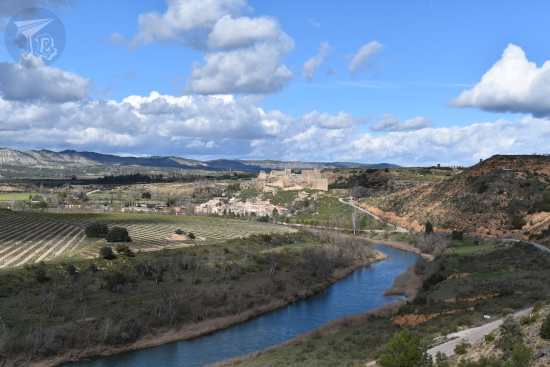
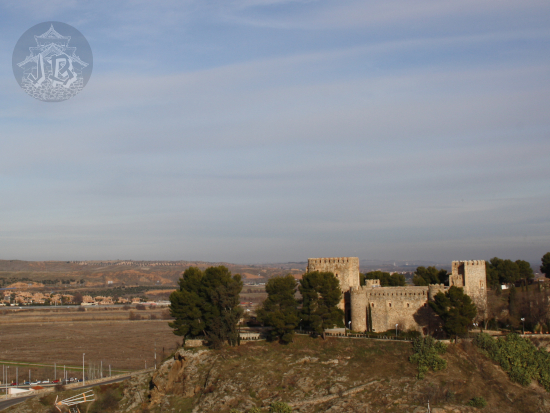
Zorita de los Canes is a hamlet at the bank of River Tagus, in the middle of nowhere in the Spanish Central Plateau. It was founded as an Almoravid dynasty fortress (alcazaba), however the stones that erected the castle are much, much older. The fortress was built around the 12th – 13th centuries, and although ruined, it used to be visitable – not at the moment though. The stones to build the castle were quarried from an even older settlement, which today is known as the archaeological site of Recópolis.
During the Middle Ages, Zorita was extremely disputed. After the Moors built the alcazaba, the town was taken over by the Christians, then recovered by the Almoravid dynasty, until it was conquered by Christian king Alfonso VII. The village was entrusted to the Order of Calatrava, the first military order to be founded in the Kingdom of Castile, who were to defend it against the Almohad Caliphate.
I’d been wanting to go to Recópolis for a while, and I found out that the archaeological sites in the area are free until the end of the year, so I thought it would make a nice mini-trip. I booked the ticket a few days in advance as it seemed that the weather would be cold but dry, albeit windy. I thought it could be a good chance before fuel prices go up again.
I had an early lunch and drove off with the idea to get to the archaeological site around quarter to three, as I was booked for three o’clock and the ticket said to arrive ten minutes in advance. The drive was a bit faster than I thought, but the Sat-Nav sent me on a completely different route than Google had, which made me a bit insecure about timings. That’s why, even if I saw a couple of villages that looked interesting, I decided not to stop and explore them, I could do it on my way back. Suddenly, the ruined castle came into view. I pulled over in a safe place to admire it and checked the time – I was good. Thus, I drove into Zorita de Los Canes and stopped at a small parking lot at the entrance of the village. I parked next to the river Tagus Río Tajo, which gave me a couple of nice views.

Part of the Medieval wall still stands, and access to hamlet’s core is done through an ancient gate, which I was happy to cross on foot. There was a small church, and at the summit of the peak stands the derelict castle Castillo de Zorita de los Canes. I decided not to climb as I knew it was closed, and after a few minutes, I got back into the car and drove off.

All in all, I was in town for about a quarter of an hour, and did not drive for longer than three or four minutes before I parked at the entrance of the archaeological site Parque Arqueológico de Recópolis. The interpretation centre was empty and locked, and I was the only car in the parking lot. The time was around 14:30 at that point and I decided to wander around for a bit, as there was what looked like a hiking trail amongst the fields. I found a nice lookout of the castle, but not the ruins themselves.
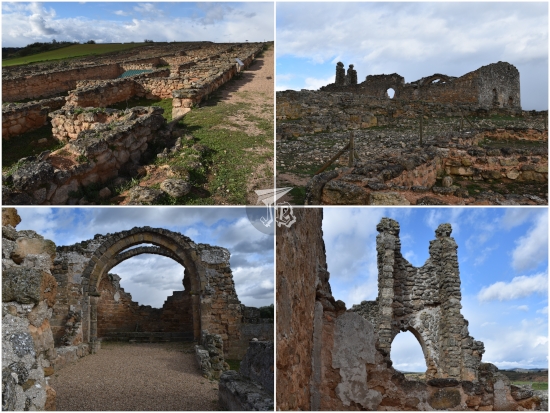
The discovery of Recópolis is credited to Juan Catalina García López in 1893. Juan Cabré Aguiló started the excavation in 1945, and found a “little treasure” (tesorillo) of coins from looting (one of them fake). Of Visigoth origin, it predates the Moorish town by a few centuries. It was erected around the year 578 by king Leovigildo in honour of his son Recaredo, who would go on to become the first of the Christian kings of Spain.
The city followed the byzantine pattern. There were two perpendicular streets, one of which lead to the palatial area, with shops to the side. Recópolis became important enough to mint its own coins, but the crisis of the Visigoth state lead to it conquest by the Moors in the 8th century. The city was slowly abandoned and became a quarry for the nearby settlement of Zorita. Later, in the 11th century, Christian settlers built a church and a small village, which had been abandoned by the 15th century.
The whole archaeological area spreads 30 hectares, out of which eight have been excavated. The interpretation centre has a few replicas of artefacts that have been found – due to security concerns, no originals are kept on site. To be honest, I was not surprised – I could have walked into the site and left without anyone stopping or even seeing me. When I arrived, it was me and the vultures, and I had a bit of a flashback to that time at the cave Cueva de los Casares, and even fantasised a little about being alone to explore the site. The guide arrived on time and opened the centre, and I was still the only one there, which was weird – I know for a fact that there were a bunch of reservations for 15:00, but only I showed up. Maybe the others became discouraged because of the weather?
The nice tour guide suggested waiting for a few minutes to give time for others to arrive, and offered me the VR experience. I accepted, of course – I’m not going to turn down such a thing. It was really fun, because you could pick up objects as the local goddess and a little child showed you around a reconstruction of the town, the palace and a glass workshop.
Afterwards, we headed off towards the ruins – nobody else had shown up. The guide offered to let me stay after the tour to take all my pictures so I decided to just listen to him as he explained and pointed to some very interesting details – a bit giddy inside. Would I really be alone eventually? He showed me the church, the palace and the grain silos in the ground, where grain was stored. He also took me to the palace and pointed out the main streets, and taught me how to differentiate the Moorish construction (criss-crossed materials) from the original Visigoth one (parallel architectural stones).
We also chatted a little and I mentioned I hoped it did not rain – he said that it had been threatening rain all week, but it would be all right. I eyed the black cloud approaching and hoped he was right.
Spoiler alert: he was not.
After finishing the guided visit, I was left alone indeed. I went around the main area of the archaeological site, and when I was in the church, the storm broke out. I had an umbrella, but I still got drenched. Interestingly though, even if it was raining and windy, it was suddenly not as cold as before. However, I had to give up eventually, since taking pictures was too difficult. As I decided to return to the visitor centre, the cloud finally moved through, and rain slowed down. I was heading down the hill towards the visitors’ centre when it finally cleared completely. I stopped, wondering whether to leave or come back, and when I looked up I saw a rainbow, sprouting right out of the castle. There were even vultures flying against the retreating cloud. It was really cool.

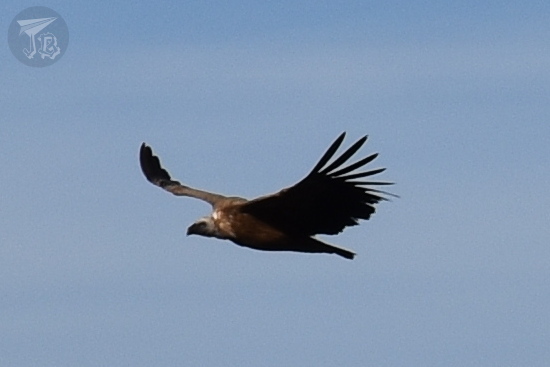
I felt motivated again, so I went back to the ruins of the city to take a few more pictures – after all, it was really cool to be all alone in the archaeological site. I wandered among the houses where it was allowed, and went to the edge of the site to take it all in, then I walked back. As I was in the middle of the street, a griffon vulture circled me a couple of times, maybe wondering if I was food – I think staying where I was taking pictures did not help? It eventually left, and I headed back to the centre, where I arrived just in time to watch the little video documentary about the Visigoth town.

I left afterwards, and I got caught in the storm again – thus I did not stop in any village on the way. The first half of the drive was miserable in the rain, but then it cleared out, and the rest of it was all right. Fortunately, I did not run into too many other cars either. I got home around sunset and went to bed early since I had to wake up early the following day.
Nevertheless, now I’ve got a VIP (VOP? Very only person?) experience, alone in an archaeological site, which is added value to the whole thing and I loved every second of it, even with the rain.







 JBinnacle – A Travel Logbook