10th October 2025: Too early for autumn: Bosque de Valdenazar (Yebes, Spain)

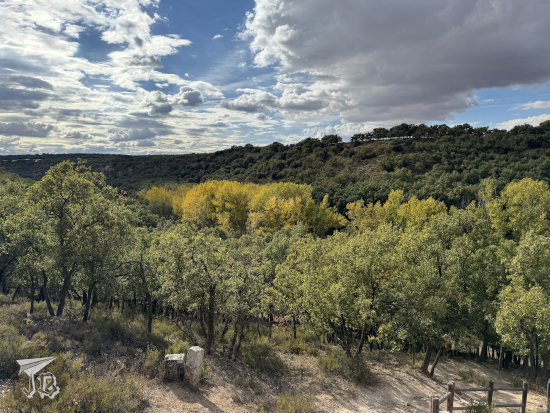
A friend phoned me for a day out, and I gladly agreed. Their idea was to check out the small forest Bosque de Valdenazar, in Yebes. We were hopeful for some nice autumn colours, but as it turned out, we were a tad bit too early for them.

We both had done the route before, myself back in May. The forest is supposed to be astonishing in fall, with plenty of gold and red leaves. Unfortunately, weather in 2025 has been crazy, with summer-like temperatures right up to late October, so most trees were still green, and they would probably just lose their leaves before they could turn gold. I am not a fan of autumn weather, but the colours are pretty – I ended up taking another go later, even.

The route Ruta SPG-24 has recently gained traction as a pretty spot since the town hall fitted it around the neighbourhood called Ciudad Valdeluz. The population of the area has been steadily growing lately due to lower housing prices and an increase of services offered. But maybe, the biggest impulse that the Route had might have been that the local park has been quarantined due to an avian flu outbreak – everything was cordoned off.

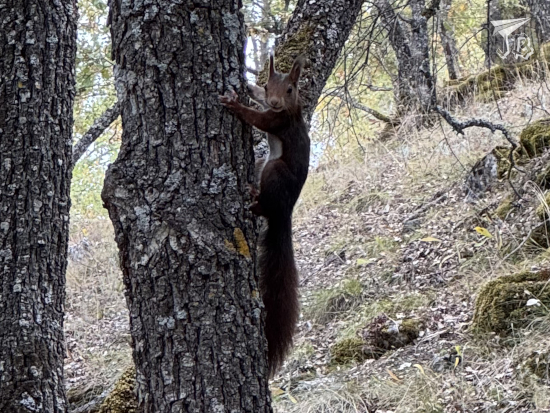
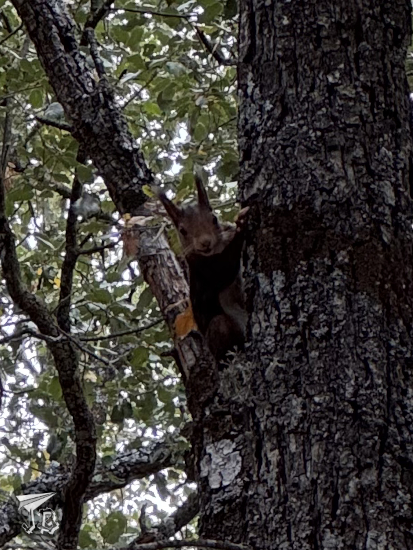
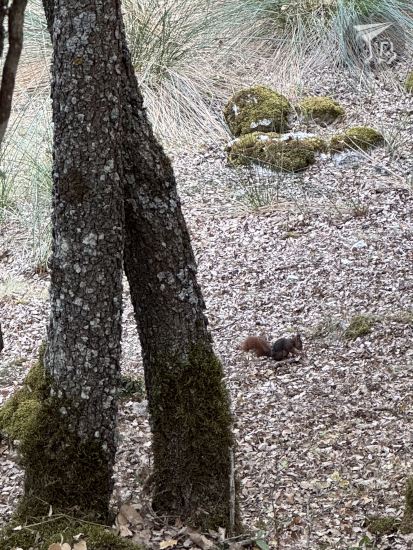
During the walk, which takes less than an hour, we spotted some red squirrels (Sciurus vulgaris). These rodents live on trees and enjoy nuts. In Spain, it is said that they love acorns – or at least, hoard them in autumn so they can feed through the winter. As a good part of the forest is composed of oaks, these two have a good chance to survive. We thought they might be a couple, but it turns out that squirrels just mate sporadically when they’re in season, so they were just neighbours, as red squirrels are not territorial.

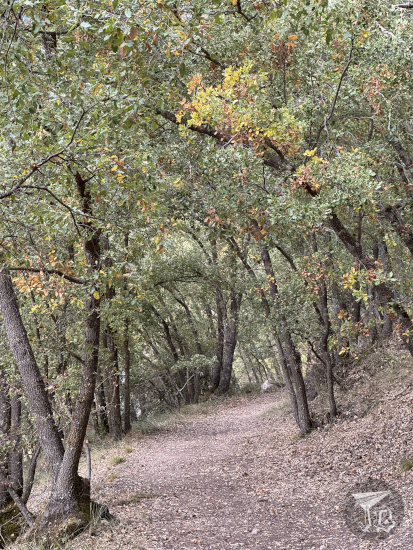
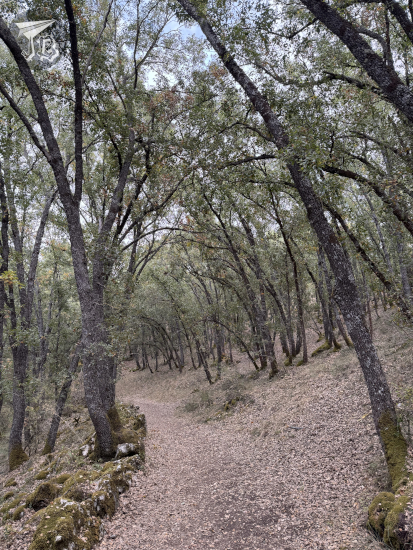
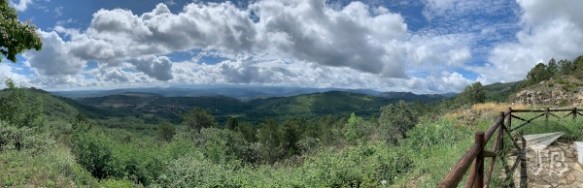
A view of an oak forest. Most of the trees are greyish green, but osme of them have started turning a bit yellow with autumn.

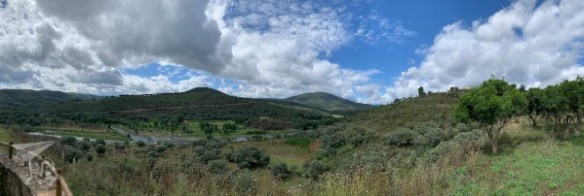
A path in an oak forest. The trees seem to arch over it. Some have started losing their leaves, which has carpeted the path with them. The trees have started showing yellow, brown and reddish colours, but the leaves on the ground are all brown-grey.

A red squirrel looks at the camera from a tree trunk.

A red squirrel peeks at the camera from behind a tree trunk, only its upper body is visible, but it seems to be smiling.

A red squirrel gathering acorns from a leaf-covered ground.

A path in an oak forest. The trees seem to arch over it. Some have started losing their leaves, which has carpeted the path with them.

We did not let the lack of autumn disappoint us, and grabbed the car to go back to town and enjoy some pancakes in a local café.

20th August 2024: The VIP treatment in Tendilla (Spain)

The catholic church in Tendilla is dedicated to the Assumption of Mary, thus the name Iglesia de la Asunción. It was designed in the 14th century CE, financed with money from the Mendoza family, one of the most important clans at the moment. It was projected as a great work, possibly the biggest church in the area – though Tendilla is a tiny hamlet now, it was an important villa during the Middle Ages, and the counts that ruled the enclave were very invested in it.

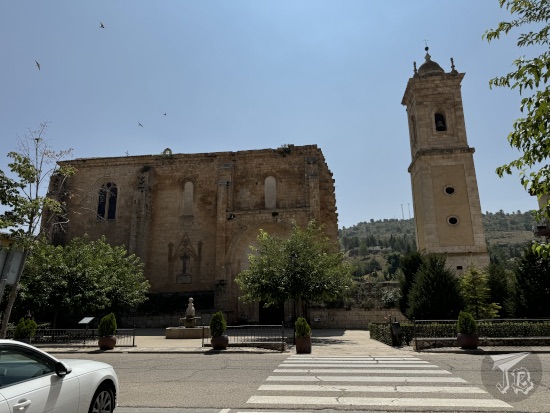
Church of the Assumption of Mary in Tendilla

The church was never finished – construction went on and off until the 19th century, when it was finally given up. Only one tower was erected, though two were projected, and this bell tower is separated from the building by a patio. The open area is actually a part of the nave that was not built in the end. The interior was decorated with a Baroque altarpiece, which still stands today.

Though still in use, the church has been gravely affected by time. The façade has greatly deteriorated in the last thirty years or so. The false floors have started collapsing and the roof is in dire need of repairs. The village is working on raising funds for a renovation.

A couple of relatives are very involved in the process, and at some point they offered to show me the inner areas of the church. I accepted, and was given the real VIP tour – they opened the church just for me too!

The temple is mostly Romanesque in style, aside from the Baroque altarpiece. The modern altar has been refurbished in marble. The altarpiece is golden wood, Baroque with columns, paintings and sculptures. To both sides of the altar, there are small rooms, connected to each other underneath the altar stairs. One of them has been transformed into the sacristy, the other one used to be an office, but now it is not in use because the floor is collapsing. Behind the altar, these two rooms give way to spiral staircases that ascend to the upper spaces, called La Gloria – Glory – and El Infierno – Hell – both of them unfortunately very abandoned and covered with pigeon excrement, feathers, rest of nests, and even dead pigeons. We climbed up to the Glory, but the Hell staircase is a bit unstable and crumbly, so we did not get far on that one. I scared the hell out of a pigeon though – it was mutual.

Church of the Assumption of Mary in Tendilla

Church of the Assumption of Mary in Tendilla

I climbed to the choir for a couple of pictures, and then we went up the bell tower together. It was a bit thrilling to do so, because I’ve seen that tower very often, but never gone up. It was all in all really cool – especially being alone and allowed complete freedom of pictures, including lightning and flash.

Afterwards, we went to the family home and had lunch. Later, in the yard, we “hunted” for the local fauna, including wasps, damselflies and wall lizards.

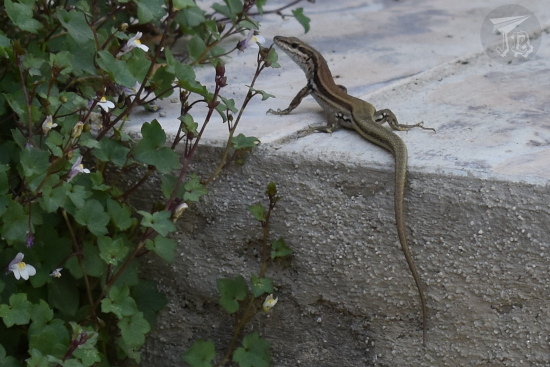
Wall lizard

Damselfly

16th September 2023: Archaeological Site of “Los Casares” (Spain)

I took an almost two-hour drive to the municipality of Riba de Saelices, which involved having to fill up the tank in the middle of nowhere – ouch. It was early in the morning, and once I got off the motorway I saw a bunch of roe deer grazing dawn away. A couple of them got spooked by the noise of the engine and jumped towards the road, and another was uncomfortably close to the asphalt, but I was careful not to run any of them over – of course!

I went past the village and took a turn at an unpaved road, and reached the parking spot of the site, 3.5 km later, around 9:10, which was great for my free 9:30 visit. . My main interest in the archaeological site Conjunto Arqueológico de Los Casares was the cave Cueva de los Casares, which can only be visited by appointment and in small groups. Post Covid recovery plans have made some archaeological sites free until the end of the year, and I wanted to visit before the end of good weather. The cave holds important carvings from the Upper or Median Palaeolithic period. However, the site also comprises the remains of a Muslim village, a defensive tower, and an ancient oven, with the latest findings dating from the 14th century.

I found the parking spot – a clearing at the foothill of the area. The whole place was empty except for a kettle of griffon vultures (Gyps fulvus) circling up above. It was a bit creepy, I’ll be honest, and I joked with myself that maybe the webpage for the archaeological site was just the way the vultures ordered food. From the parking lot I saw a small clearing with tables, and up the hill, a small tower, which I thought was the tower from an old Muslim castle. Since I had some time I decided to climb up and I found the entrance to the cave, with a notice that visits started there. By then it was already 9:30 so I thought maybe my ticket was wrong and the winter timetable had already started so the visit was at 10:00. A bit before 9:40 I saw two cars approaching – yay.

Vultures flying

Archaeological site Los Casares: cave, ruins, and tower

Finally, the guide arrived and she told me that the visitors in the other car had lost their way, so she had had to guide them down the track. We started late as the group also took a while to come up. We stayed at the entrance of the cave for a little as the guide explained about the civilisation that inhabited the area in the Palaeolithic, and a bit about the cave bears that used it as a lair before them.

The cave Cueva de los Casares was inhabited by Neanderthals some 60,000 to 40,000 years ago. The stonework and industry have been classified as the European Mousterian; among objects found inside the cave there are flint points, arrow tips, scrapers, and even pottery. Animal remains, both from predatory events and human consumption have also been recovered. The most important archaeological items found in the cave are the carvings on the walls. Though there are carvings from later periods, some experts think that the cave holds the oldest anthropomorphic carvings in the Iberian peninsula – not carved by Homo sapiens (modern humans) but the previous Homo neandertalensis.

Entrance to the cave Cueva de los Casares

Only the first third of the cave can be visited, and we got to see horses, cattle and the human-like figures. Once you know what you’re looking for, it gets easier to identify the shapes. One characteristic about the human depictions of the period is that humans are represented to have weird heads, though nobody really knows why – possibly animal attributes to represent their qualities. The humanoids are represented alone and in groups, and sometimes they are one above another. There are families, activities – such as diving – and copulation (apparently this is important because the carving in question might be the first ever recorded). It is an interesting experience, though no pictures are allowed inside, there are some on the official page – you don’t get to see half of them anyway. I’m disappointed we were not shown any mammoth carvings either, those are restricted to the expert-only area, but at least I saw something, and it was original.

After the cave, I climbed up the gully to the hilltop and the Berber tower – called Torre atalaya (“Watchtower tower”) – which hangs above the entrance to the cave to look at it. On the way up I also had a good view of the Muslim settlement underneath, Poblado Hispano-musulman. I also looked down the gorge and the valley called Valle de los Milagros, which I may or may not hike in the near future in search for fossils. However, I really did not feel like staying at that point, so I just drove back.

Watchtower Los Casares

Muslim village of Los Casares

Valley Valle de los Milagros from above

10th June 2023: La Alberca & Plasencia {WNW Spain, with a splash of Portugal, June 2023}

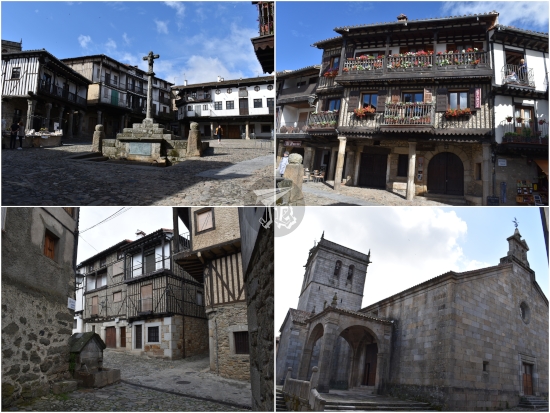
We left off the castle to have breakfast at the village of La Alberca, a municipality known for two things. The first one is the timber framing of its houses. The buildings have a stony ground floor and a lime-white second floor with the post-and-beam style in dark wood.

La Alberca

The second one is the tradition of the whole village raising a piglet together. The swine is freed mid-June (we missed it by a couple of days) and everybody in the village keeps track of it – feeding and sheltering the animal – until it is auctioned for charity when the time for slaughter draws near, in January. There is a sculpture as homage to the animal in the middle of the church square, yielding to what I’d say is the most iconic sight. However, the amount of butcher and delicatessen shops makes the whole thing a little… weird.

Monument La Alberca pig

We drove through the natural area of Sierra de Francia, and stopped over at the viewpoint Mirador del Madroñal. From there we could see the abundant vegetation – oaks, chestnuts, and vine-fields. A bit further, we reached a second viewpoint Mirador Las Juntas.

Viewpoint Mirador del Madroño

Viewpoint Mirador de las Juntas

Our road was closed, so we had to take a detour, but we eventually reached Plasencia with a lot of big plans. Unfortunately, when we arrived at the Parador de Plasencia, built in the former convent Convento de Santo Domingo, we learnt that the town was in the middle of the local festival. Such thing meant outdoor bars and music – almost rave-like, and most monuments being closed. It had never even crossed our minds that we might run into such a thing, and it was a bit of a bummer that not even the cathedral Catedral de Plasencia was open.

Former convent turned Parador in Plasencia

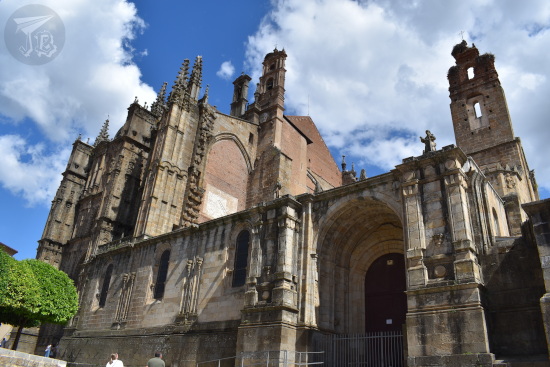
Cathedral in Plasencia

We walked around for a while, and eventually we found the walls and their mini-museum Centro de Interpretación de la Ciudad Medieval de Plasencia. They reminded me of the wall in Ávila, but in a much-smaller scale.

Buildings in Plasencia

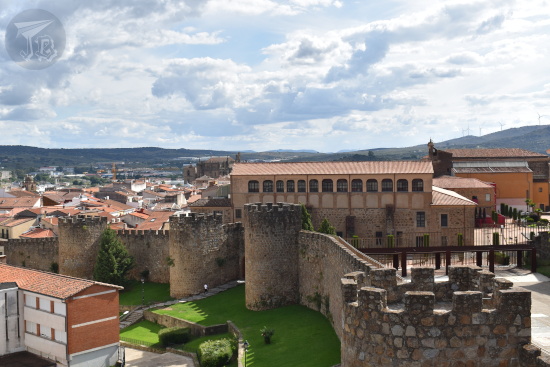
Wall in Plasencia

Plasencia

Plasencia is also a bird-protection area and nestling zone of the lesser kestrel (Falco naumanni), so that is what I guess we got to see (but it could totally have been an eagle…). We had lunch and dinner at the Parador as it was the least busy place, and they took forever both times. We did not feel like going out to check out the town in the evening considering how busy everything was even in the afternoon. Probably it was the first full-blown post-COVID festival, but it was a tad disappointing for me.

Krestel

9th June 2023: Arribes del Duero & Ciudad Rodrigo {WNW Spain, with a splash of Portugal, June 2023}

We set off from Zamora in order to drive up towards the Portuguese town of Miranda do Douro, though we were not due to reach the town itself. We were heading to the International Biological Station, which organises environmentally-friendly cruises up River Douro.

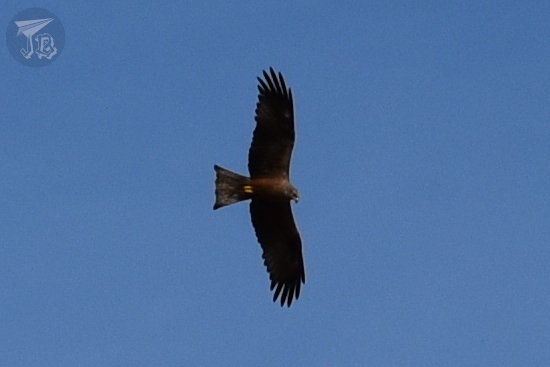
The drive was to take around one hour, and we stopped at the reservoir Embalse de Ricobayo, which has a dam and a hydroelectric central. We stumbled upon a nice little outlook above the reservoir to see both the dam and the meandering river. It was not long before we noticed the vultures – a kettle of Eurasian griffon vultures (Gyps fulvus), and even some solitary birds that showed off (or were trying to find breakfast, who knows?).

Meander and Dam of Ricobayo

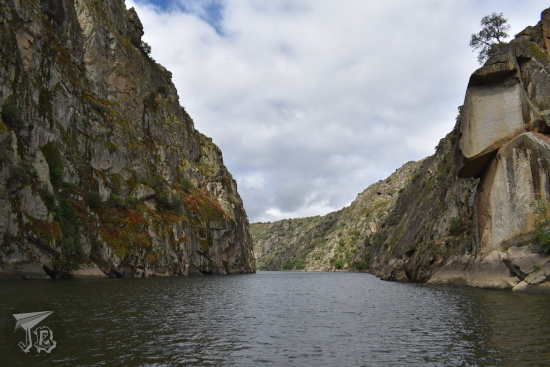
We reached the International Biological Station Estación Biológica Internacional | Estação Biológica Internacional (EBI) in time to swap our 12:00 tickets for 11:00 tickets, and the little boat took off. The cruise runs up the area of River Douro Río Duero called Arribes del Duero, a gorge nor dissimilar to the Galician gorge of River Sil. It was an hour-long course where we got to see some more birds of prey, a few nests, lychens and local flora, but none of the wild otters that are supposed to swim on the river. The guide collected some water to observe under the microscope and show us copepods and water fleas. At the end of the boat ride, we saw the “emotional therapy otters” (Lutra lutra) that the EBI keeps at the entrance. Oh, and had a sip of Porto wine. I was not too keen on the whole thing though, despite the pretty landscapes.

Arribes del Duero

Otter playing in the water

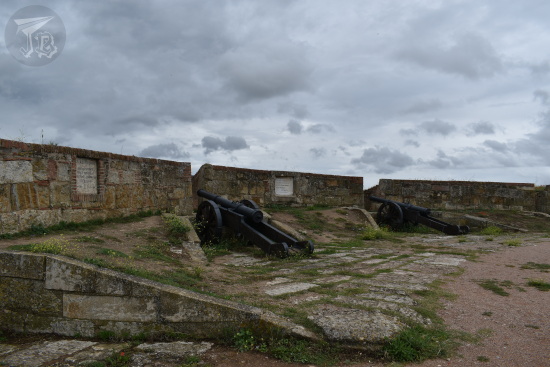
We “boycotted” Miranda do Douro as the ascent road from the river to the town looked horrible and full of curves. Thus, we headed off to Ciudad Rodrigo, in the Spanish region of Salamanca. We had booked at the local Parador Parador de Ciudad Rodrigo, Castillo de Enrique II de Trastámara. It is a really cool building – a castle from the 14th century, commissioned by the King . The main feature of the building is the keep, which you cannot climb (technically you can, but you have to know that you need to ask beforehand), but you can walk around the walls to have a look at the skyline. In front of the Parador stands a pre-Roman sculpture of a verraco – a granite animal, maybe a pig or a boar, dating back from the Vettones (3rd century BCE – 1st century CE).

Parador of Ciudad Rodrigo

There was a mishap with our reservation, so instead of getting a three-person room, we got the doggy-friendly room. I’ve been long-supporting of pet-friendly travel, but this made me rethink my stance. The room did have a pull-out sofa bed, but the layout made it awkward to share it among three people. Furthermore, it smelt and there were a bunch of flies and fruit-flies at the windows. That was a bit of a bummer.

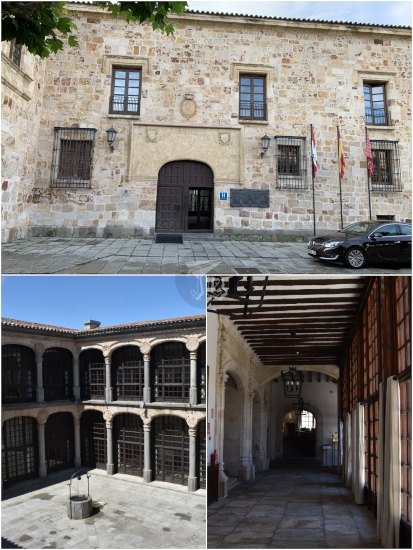
We went to walk around town and found the tourist office in the mansion called Palacio de los Águilas, a 16th century Renaissance building erected by the family in charge of the castle upkeep. It has two patios with arches, and an exhibition area about the role that the town had in the war against Napoleon’s armies in the 19th century.

Palacio de los Aguila

We wandered around the town for a little, but then it started pouring. Thus, we hurried towards the cathedral Catedral de Santa María de Ciudad Rodrigo. The original building dates back from the early 12th century, and it was in construction and reconstruction until the 18th century. The main building was finished in the 14th century, but the tower collapsed after the Lisbon Earthquake in 1755. One of the most important features of the cathedral is the Romanesque portico Pórtico del Perdón, similar to the one in the cathedral in Santiago de Compostela. The gothic cloister is really nice, and it holds frescoes from the Romanesque period.

Cathedral of Ciudad Rodrigo

Cloister in the Cathedral at Ciudad Rodrigo

By the time we finished, the storm was over. I climbed up the remains of the town’s defensive walls Adarve Juan Martín Zermeño.

Ciudad Rodrigo: wall

We ditched the chamberpot museum (yes, it is really a thing) and to end the day we walked around the town for a little to find the traditional buildings – the manors Casa de la Marquesa de Cartago and Palacio de los Miranda, the square Plaza del Buen Alcalde, the old army HQ Antiguo Cuartel de Artillería,–the churches Iglesia de Cerralbo and Capilla de la Venerable Orden Tercera, and the main square Plaza Mayor.

Ciudad Rodrigo typical buildings

8th June 2023: Tordesillas & Zamora {WNW Spain, with a splash of Portugal, June 2023}

Tordesillas used to be one of the Spanish Crown’s strongholds throughout the Middle Ages, starting around 1340 when Alfonso XI ordered the construction of a palace. In 1494, the Spanish and Portuguese monarchs signed a Treaty which divided the lands “discovered” by Columbus among them – of course, this Treaty was largely ignored by any other European powers which wanted to explore America, and never acknowledged by any indigenous people. In 1519, the town was part of the rebellion against Carlos I, naming his mother – and daughter of the Catholic Monarchs – Juana as queen, despite the rumours that she was insane. After the defeat of the revolts – and beheading of the instigators – the town lost importance.

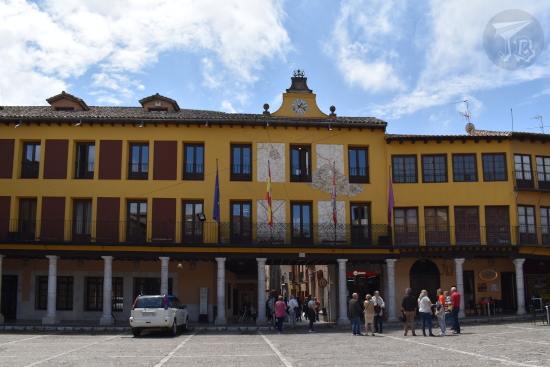
We left early in the morning to try and ditch the traffic, but we were not successful – driving around Madrid, we ran into a couple of jams traffic caused only in part by the intermittent storms, which made the beginning of the road trip stressful. Thankfully, we parked at the outskirts of Tordesillas and the sun was shining again, as we had to cross the village on foot. Our first stopover was the Main Square Plaza Mayor. In the Castilian Main Square fashion, it is actually square in shape, with the main buildings supported by columns, where cafés and shops stand today. The current plaza dates back from the 16th century, and has been painted in a questionable bright mustard colour.

Main Square in Tordesillas

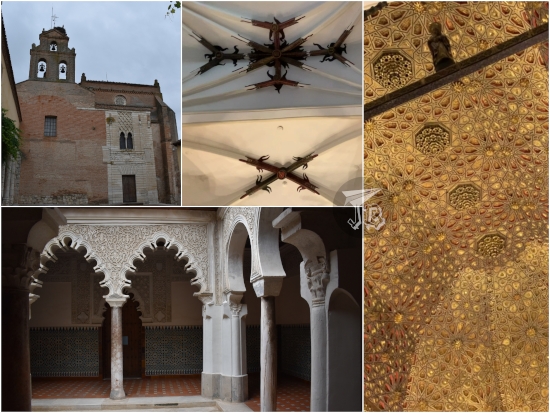
In the end, most of the history in Tordesillas is linked to Alfonso XI’s palace, known today as the Convent of Saint Clare Convento de Santa Clara, which stands a few minutes’ walk from the square. It was home, and later prison, to royal women, both loved and unwanted ones. It became a convent of the Order of Saint Clare in 1363, and the nuns living there were tasked with praying for the health and salvation of the Royal Family. Today, it is managed by the Spanish National Heritage Foundation Patrimonio Nacional. It can only be visited under supervision – seriously, aside from the guide, you get a security guard following you around – and photography is forbidden in all the interior areas.

The castle-convent was built throughout the 13th to 18th centuries. The oldest part of the building is a chapel dating from the 11th century, and the bulk of the construction was carried out in the 14th century. The monarchs employed Mudejar builders, a fact that yielded to multifoil arches, ceramic decorations, and Quran verses (officially “decorative nonsense”) in some of the chapels and the façade of the building.

Inside the palace there is a Baroque cloister and the gothic church, with a wooden ceiling painted gold and the emblem dragons of Carlos I’s shield. Truth be told, the church had been pretty much hyped up on me, so I found it a bit underwhelming.

Santa Clara convenent in Tordesillas

The party separated for a bit so I could explore on my own for a while. I got to the stone bridge over the River Douro Río Duero, just called “the bridge” el Puente, right at whose ends stands a monument to the fighting bull Toro de Tordesillas. The associated bullfighting festivity was one of the oldest in Spain until it was vetoed by the regional government – the fighting bull was set loose in the meadow, chased by horsemen and lanced to death. Today, the festivity is controversial and it’s trying to find its place in the midst of new sensitivities.

Tordesillas

I climbed up the medieval wall Muralla de Tordesillas to the park where the monument to Queen Juana Monumento a la Reina Juana I de Castilla stands, in front of the museum dedicated to the Treaty Casas del Tratado, and the church Iglesia de San Antolín.

Monuments in Tordesillas

We walked back to the car to drive off to the next spot in the route, and Tordesillas became the first spot where we spotted birds of prey during this trip, maybe a golden eagle Aquila chresaetos. Or, you know. Anything else.

Eagle

We drove off towards the municipality of Zamora, a Medieval town and villa by the Douro, known for its Romanesque churches. We reached the Parador de Zamora in the middle of a horrible downpour that was over as quickly as it had started. The Parador hotel is a former noble family’s Renaissance palace, with a military style and a middle patio with a glass-window gallery

Parador in Zamora

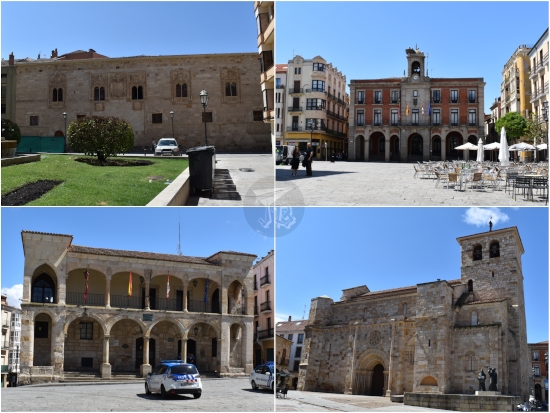
We had a late lunch and walked to the manor Palacio de los Momos, near the Main Square Plaza Mayor, home to a church Iglesia de San Juan de Puerta Nueva which has a sculpture representing two figures of the local Holy Week celebrations Monumento al Merlú. Other buildings include the old and new town halls Ayuntamiento Viejo and Nueva Casa Consistorial, and blocks of colonnaded buildings.

Buildings in Zamora

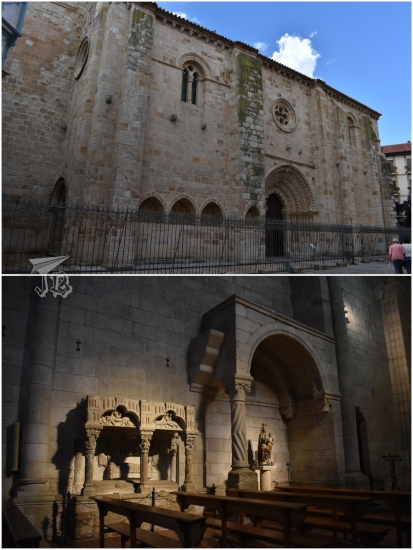
The first Romanesque building we came across was the church Iglesia de Santa María Magdalena, which contrary to many other places has got rid of the Baroque add-ons, and stands severe and naked in its stony glory. It is considered one of the most important and pure Romanesque constructions in Europe, sparsely decorated save for the tomb to the side.

Church of Saint Mary

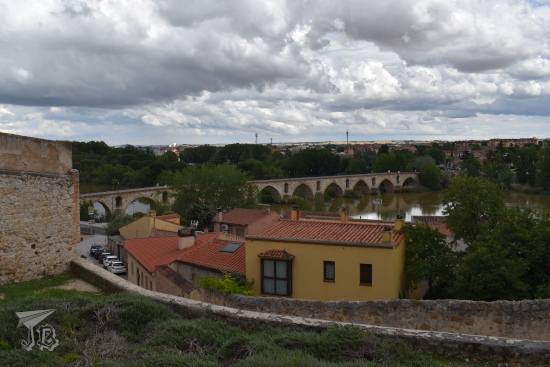
From a side stop I overlooked the river Río Duero and the medieval bridge Puente de Piedra.

Zamora Medieval Bridge

We continued off to the cathedral Catedral del Salvador de Zamora. It is considered the first cathedral in the “Douro Romanesque” style. After the original cathedral was destroyed during the Muslim conquest of Spain, the reconstruction began around 1151. It must have been finished towards the beginning of the 13th century. The building has two particularities – the thick tower, and the umbrella dome, in a style that travelled from Byzantium to the Islamic architecture and reached Spain with the Nasrid artists. The inside holds a cloister and two small museum – one of religious art and the other of archaeology.

Zamora Cathedral

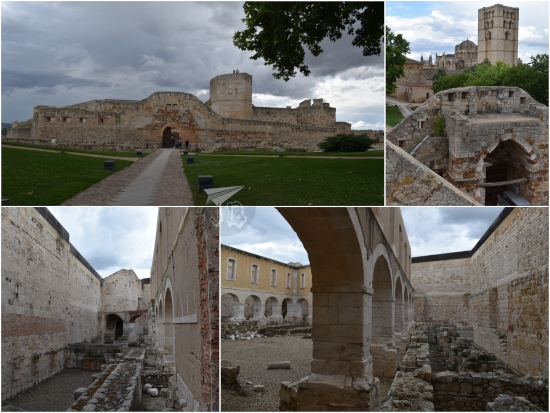
Afterwards, we visited the ruined castle Castillo de Zamora – a purely-defensive Romanesque fortress built around the 11th century. The castle has a moat, and you can wander up the walls and defensive towers. The interior is ruined, but the ancient structure can be guessed by the arches and different walls that would have separated the fortress’ halls.

Castle in Zamora

Finally, we explored a few more religious Romanesque buildings: Iglesia de San Pedro y San Ildefonso, Convento de Clarisas El Tránsito and Iglesia de San Cipriano. From the viewpoint next to this last church, we got to see a stork nest with a baby chick in it.

Zamora churches

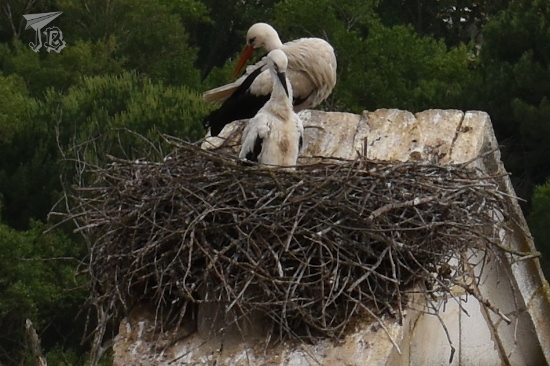
Stork nest

We had dinner at a restaurant called El Horno, a traditional places that offers tablas – wooden trays full of treats to share. We shared a serving of tabla de fiambres – Iberian sausages (ham, loin, chorizo…) and cheese on a bed of crisps.

Zamora at night

3rd & 4th February 2023: Final Fantasy Distant Worlds 35th Anniversary – Coral – in Barcelona (Spain)

3rd February 2023: Mummies, fish, and music

Though I would not have minded to become a gamer back in the day, my joint issues discouraged this. Thus, my relation with the Final Fantasy saga is tangential. However, my sibling is a big fan of one of the instalments, and last year I accompanied them to Final Fantasy VII Remake Orchestra World Tour in Barcelona in 2021. Having had more time to prepare for this one, we got VIP tickets, and I planned a two-day outing.

Our arrival in Barcelona happened right on schedule, and we walked from the station to Caixa Forum Barcelona to see the exhibit Momias de Egipto. Redescubriendo seis vidasEgyptian mummies; Rediscovering six lives, in collaboration with the British Museum. I am not sure whether the items are part of the actual collection over there or are in the archives, because I don’t really remember seeing any of the mummies. The Barcelona exhibits focus around six mummies and how they lives could have been before their deaths. Aside from the actual mummies and their sarcophagi or coffins, there are objects that they may have used in life, and images of what the bodies look like inside the wrappings.

It was at the very same time interesting and creepy, everything we can get to know through technology about these poor souls who passed away millennia ago. There was information about their age, illnesses, and objects they had been buried with – god statuettes, jewellery, funerary miniatures… One of the mummies in display was that of a small child with his face painted on the wrapping, that was more than a bit creepy, to be honest.

A collage showing a a mummy and a turquoise wrapping; a sarcophagus; four canope jars; three statuettes: Horus, an ibis, Thoth; close-up of a sarcophagus, with bright colours; a mummy and a plain wooden casket.

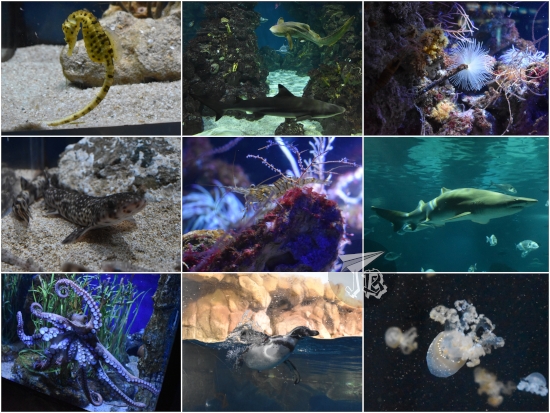
We took the underground towards the waterfront to visit L’Aquàrium de Barcelona, located in the harbour. With more than 11,000 animals and 450 species, it is the largest aquarium dedicated to the Mediterranean Sea. It was inaugurated in 1995 and it holds 35 aquariums, including an oceanarium with capacity for almost four million litres of water (36 metres diameter, five metres high) with two tunnels at the bottom. Species-wise, the aquarium does not have anything out of the ordinary, but the size of the tiger sand sharks is impressive. There are a few sharks, some tropical fish, axolotls, frogs… and a very fun sperm-whale room to keep the jellyfish in darkness.

A collage of the aquarium. Seahorse; swimming sharks; anaemone; baby dogfish shark; tiny crustacean similar to a prawn; sand tiger shark; octopus trying to eat the viewers; penguin showing off; fabulous tiny jellyfish

We grabbed an expensive-but-convenient bite to eat at the aquarium itself during some of the feeding events to make sure the cafeteria was empty. AFter we had finished viewing all the exhibits, we went on towards the hotel, which was well-placed between the auditorium and the shopping centre. Since check in had been so bad when we went to the previous Final Fantasy concert, this time we had booked different accommodation, and it was a total 180 – everyone in the hotel was super friendly, and we had zero issues. We procured some sandwiches for dinner, then got ready for the concert.

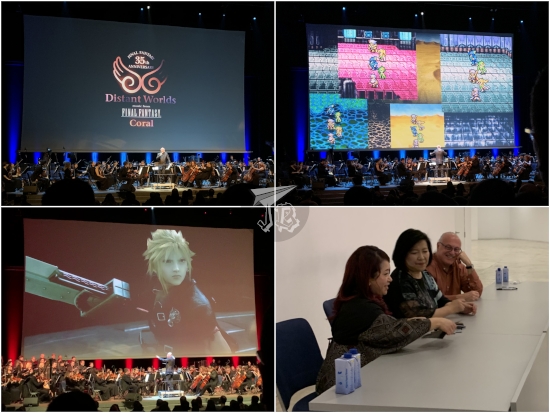
The Final Fantasy Distant Worlds 35th Anniversary – Coral – directed by Arnie Roth is a compilation of the background pieces from all the Final Fantasy games, from the first (1987) to the latest to date not counting the remakes (Final Fantasy XV, 2016). The concert was held at the CCIB – Centre de Convencions Internacional de Barcelona. We had no idea what time doors would open, but I calculated that an hour should be good for queuing for merch and then get to our seats.

By the time we got to the queue, the concert booklet had already been sold out. When we reached the front, my favourite plush toys were also gone. I decided to get the previous year’s CD in order to get it signed later at the meet & greet event that was included in the ticket we had bought. Looking back, maybe I should have asked for the autographs on the tote bag we got for the spending.

The concert had two halves and an encore, and was… strangely not very coral, for something called so. The choir was placed over to one side, and only did three or four songs – they actually did not show up for the whole first half. The set list was accompanied by projected images on the screen and it was super-impessive to see the first 8-bit games at first compared to what the technology of the latest Advent Children (movie from Final Fantasy VII) managed to create.

    First half

  1. Final Fantasy I~III: Medley 2002
  2. Final Fantasy III: Eternal Wind
  3. Final Fantasy IV: The Red Wings ~ Kingdom of Baron
  4. Final Fantasy IV: Main Theme of Final Fantasy IV
  5. Final Fantasy V: Home, Sweet Home ~ Music Box
  6. Final Fantasy V: A New World
  7. Final Fantasy VI: Phantom Forest ~ Phantom Train ~ The Veldt
  8. Final Fantasy VI: Kids Run Through the City
  9. Final Fantasy I~VI: Battle Medley 2022

    Second half

  10. Final Fantasy VIII: Liberi Fatali
  11. Final Fantasy XI: Ragnarok
  12. Final Fantasy XII: Flash of Steel
  13. Final Fantasy VII: Aerith’s Theme
  14. Final Fantasy XIV: Torn from the Heavens
  15. Final Fantasy XV: Apocalypsis Noctis
  16. Final Fantasy IX: Not Alone
  17. Final Fantasy X: 素敵だね [Suteki da ne] (Isn’t it wonderful?)
  18. Final Fantasy Main Theme with Choir ~ The Definitive Orchestral Arrangement ~

    Encore

  19. Final Fantasy X: Zanarkand
  20. Final Fantasy VII: One-Winged Angel

The concert was all right. I did not feel the general chill I had through the previous one. I really liked Liberi Fatali and One-Winged Angel, but I guess I don’t have enough of an emotional connection with most of the games. Aside from the conductor Arnie Roth, we had composer Yoko Shimomura present, and vocalist RIKKI, who is the original singer of 素敵だね in Japanese, and did the live version.

Collage. Three pictures show a classical orchestra with different things projected on the screen behind them - the logo of Distant worlds, several 8-bit screenshots of games, a very realistic depiction of a blond man with a very unrealistic sword. The last picture shows singer RIKKI, composer Yoko Shimomura and conductor Arnie Roth

The M&G was fun, and I got to tell Roth that when I grow up I want to have as much fun as he does at work. They signed autographs and took pictures with people – it was much less stiff than the usual, too. We headed off afterwards for a sandwich, a shower and a good night’s sleep. In general though, not much value for money considering how much more expensive the VIP tickets were, even though the seats were good. Also, the fact that most merchandising sold out showed poor planning.

Collage. The ticket reading the name of the concert, the autographs of the three main artists, and a plush of a Final Fantasy imaginary being, it looks like a white teddy bear with a huge pink nose, a red ball on top of it and cute wings

4th February 2023: Ramen with Friends

We had bed and breakfast at the hotel, and the latter was fantastic. The buffet had both a juice bar and a milk bar – both of which I sampled, of course. I overdid it with the fried egg, I fear, but they were just cooked and it looked just too appetizing not to fall for one. After breakfast, we packed up, vacated the room, and asked the hotel to keep our bags for a couple of hours. We went to the science museum Museu de Ciències Naturals NAT, where we spent a couple of hours. This is the only place where they refused to speak Spanish to us.

The museum is divided in several areas. The first one is “history of the Earth”, where you can see a few interactive exhibits, fossils and reproductions. The second one is the collection of living animals, most of the stuffed, some of them just skeletons. There was another one about fungi – with the edible ones exhibited in tins. Then there was one on plants, and finally rocks and minerals. Not a bad place to spend a couple of hours, but it is just one of those places that takes itself much more seriously than it should, to the point that it felt pretentious. Some items were exhibited over and over again, as if they just wanted to use up the room – I counted at least eight elbaite specimens in different locations, and there were a bunch of reproductions taking up important spaces, you would believe they were originals if not paying lots of attention to the writing, and the blue light made for horrid photographs.

Collage. Four pictures show prehistoric animals in blue light, stuffed animals, a tin of mushrooms along real specimens, a red algae and some shiny rocks.

We transited to Sants train station to drop off my sibling’s bag at the cloakroom there and went on to meet my Barcelona friends E**** and P***o who had offered to take us to eat really-real Japanese ramen. Since I had a feeling that the restaurant would be on the small-ish side, and my sibling’s luggage was a bit oversized since they had cosplayed for the concert, I decided on the Sants detour for convenience.

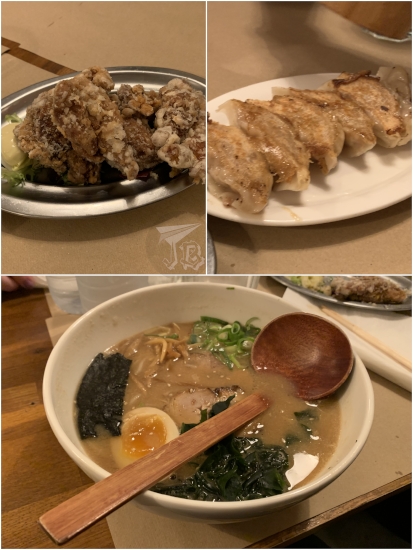
The restaurant is called KOBUTA ramen i més (Kobuta Ramen and More) and I was amused when all of us made the same choice – tonkotsu miso ramen with an extra of half an egg, and water; then we shared some gyoza (dumplings) and karaage (fried chicken). The restaurant is not cheap, but the food makes up for that, it is very authentic Japanese food.

Collage. A dish of breaded fried chicken, some dumplings, and a bowl of ramen, with the ingredients floating - algae, half an egg, noodles, pork meat and spring onion

Though P***o had to leave early, the rest of us headed off towards the bullfighting-ring-turned shopping centre Arenas de Barcelona. There, we climbed up the terrace for views, then sat down for drinks and a long chat. We also popped into the local comic store, since it was convenient, and eventually we headed off to the station.

Collage. Shopping centre las Arenas, a round building that used to be a bullfighting ring, there are two pictures, one by daylight and another one at night, lit up. There's a picture of the views- two clock towers leading to a palace; finally three glasses together showing brightly coloured drinks - yellow, orange and dark pink

The train ride home was surreal. People playing music on their phones, yelling, talking loudly and making the footrests squeak – apparently there had been some kind of sporting event for kids and a lot of families were coming back home. All in all, not a bad couple of days, lots of laughs, I got to see dear friends and eat nice food, and listen to cool music – in the CCIB, not on the train.

29th December 2022: Abu Simbel and Nubia {Egypt, Winter 2022-2023}

Modern eras have brought lots of different needs and technologies, and both become one when we think about harnessing nature. The Aswan dam is one of such examples. There are actually two of them. The Old Aswan Dam was built in the wake of the 20th century (1899 – 1902), and the newer, Aswan High Dam was completed in 1970, creating Lake Nasser. The rationale was securing fresh water for Egypt and stopping the dependence on the Nile floodings; however there have been associated problems – not only environmental such as the habitat of the Nile crocodile and the loss of fertility in the delta; thousands of people were displaced from the to-be-flooded area, and houses and whole villages were swallowed by water. A lot of these villages had their own cultural heritage, which was to disappear forever. Thus started Unesco’s International Campaign to Save the Monuments of Nubia between 1960 and 1980. This effort relocated as many as 24 monuments (one of them, the Temple of Debod, ended up in Madrid, Spain) to safer grounds. The temples of Abu Simbel are probably the star of the rescue efforts.

The Abu Simbel [أبو سمبل] Complex is part of the Unesco World Heritage Site Nubian Monuments from Abu Simbel to Philae. It comprises two buildings – the Great Temple of Ramesses II and the Small Temple of Hathor and Nefertari. Both of them were carved out and into a sandstone cliff on the West Bank of the Nile during the reign of Ramesses II or Ramesses the Great (14th-13th Century BCE, Nineteenth Dynasty of the New Kingdom), considered one of the most powerful Pharaohs in the New Kingdom, who reigned for many years. It was lost to time, and only rediscovered in 1813 and excavated in 1817. The Complex was relocated to higher ground between 1964 and 1968 to prevent its sinking in Lake Nasser. In order to do so, the mountain and the temples were cut into huge blocks and built 65 m higher and 200 m back from the river. The relocation managed to keep the relative position to the sun, but shifted it by one day – the temple was designed so the first ray of sun hit Ramesses’ face in the sanctuary on the 21st of October and February, and now that happens on the 22nd.

At some point one has to wonder what was more impressive – building the complex, or relocating it so you can’t really tell. The mountain itself is hollow in order to reduce the stress on the temple after the move, but wow. Just, wow.

As far as I understand, buses are not supposed to stay longer than a couple of hours in the complex. Our disembark time was 2:30, and even if I went to bed ridiculously early, I did not get much sleep because my cabin was above the motorboat rotors, and my cabin vibrated like hell. Before we left, we had a choice of coffee or tea, and we were given a “picnic” consisting on some sweet bread with… buffet leftovers, a piece of fruit and a small juice – that was traded often.

The trip each way was 3.5 hours, so we wanted more than the 30 minutes the tour guide wanted to give us, and we were there between 6:30 (though we did not enter the site until a bit later) and 9:00. Fine, I own up – I was late coming back and only made it to the bus at 9:08. The tour guide was so not amused by that.

Arriving at the Abu Simbel site, you approach from behind the mountain, and as you surround it, you’re greeted by Lake Nasser [بحيرة ناصر], the reservoir created by the dam. The sun was climbing up slowly when we arrived, still with sunrise colour.

Sunrise over a lake. There is a lonely palm tree on the left

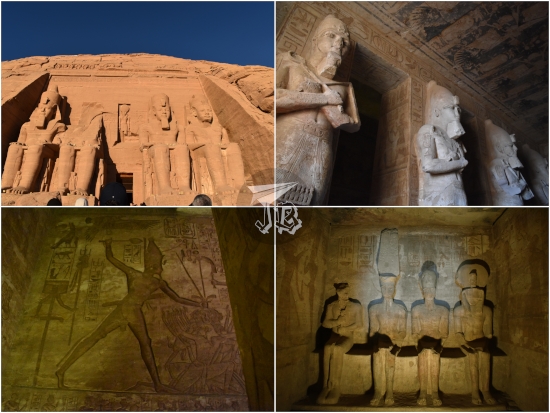
You keep turning and you are greeted by the four colossi that flank the entrance to the Great Temple of Ramesses II. The colossi represent deified Ramesses II, to whom the temple was dedicated along the gods Amun, Ra (in his Ra-Horakhty advocation) and Ptah (creator of the world and patron of craftsmen). The inside features a hypostyle hall with columns carved in the shape of Ramesses colossi, a colonnade hall and the inner sanctuary, where the venerated gods were revered.

Panorama of both Abu Simbel temples: Ramesses II to the left, Nefertari and Hathor to the right. The sky is blue, the monuments are orange-gold, and a lot of people gather at the entrances.

Collage of the Great Temple of Ramesses II: façade with four sitting colossi; inner hall, with colossi against the columns; an carving of Ramesses in a war position; inner sanctuary with the gods and Ramesses sitting, the light hitting their faces.

To the right stands the Temple of Hathor and Nefertari. Here, Queen Nefertari is represented as big as Ramesses and shown with the horns of the goddess Hathor, both signs of her importance (consorts were usually represented knee-high of their kings). The inner area has a hall with rectangular columns carved and painted, and the sanctuary features Hathor as a cow emerging from the mountain rock.

Small Temple of Abu Simbel colllage: Entryway with the colossi; inner hall with the face of Hathor carved into the columns; carving of Nefertari with the goddess' crown; inner sanctuary with the image of a woman with a cow head coming out from the wall, the light hitting her face

Despite really, really not wanting to leave, I made my way back and ran into two other people from the group. We had to leave through the tourist bazaar and were just slightly late. On the way back, slightly more awake than when we had left, we did not get to see any mirages, but we crossed the old Aswan Low Dam [خزان أسوان]. We had a view of the power plant on one side, and on the other side the First Cataract of the Nile, a series of rapids that have been slowed down by the building of the dam. In ancient times, it was believed that the Nile sprouted here and flowed both north and south. The main part of the cataract is now under the dam, and the remaining rapids have been turned into a nature reserve. There are Ancient Egypt remains and engravings in some ruins on the islands.
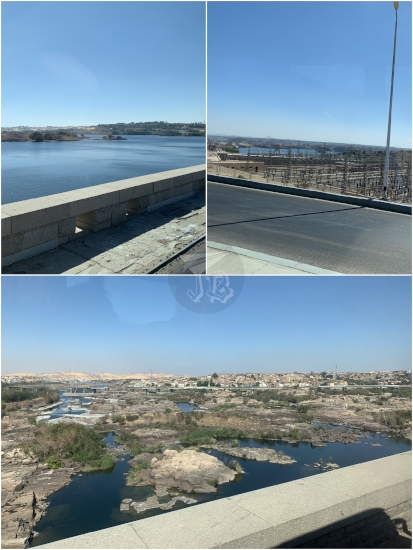
Views from the low Aswan Dam: southern side calm waters and power plant; northern side rapids

We were back on board the motorboat at 12:35 for lunch, and met again around 16:15 for a felucca sail on the Nile [نهر النيل] around the Aswan [أسوان] area. Before leaving, I decided to exchange 20 € into Egyptian pounds in order to have some change for the couple of meals we had outside, just in case I needed pounds to buy drinks. For convenience I chose the reception of the motorboat. They short-changed me, twice. First, they used a 23 EGP / 1 € exchange rate, while the official rate is 25 EGP / 1 €. Then, the guy at reception calculated 460 EGP and gave me 450, smirking “I owe you 10 pounds.” Stay tuned for the conclusion of the story.

The felucca sailing had been rescheduled from the following day so it could be tied to the trip through the Nature reserve and the Nubian village (and possibly to accomodate the charter flight times). A felucca [فلوكة ] is a traditional sailing boat, usually with one sail. Feluccas are still used for transportation through and across the Nile, and from ours, we caught some interesting views.

A sailboat docked with a precariously narrow plank to board it

A view of a sailboat on the Nile from another sailboat. The knots and ropes of the boarded felucca are visible in the foreground.

We got to see the Tombs of the Nobles | Qubbet el-Hawa [قبة الهوا] (Dome of the Wind), which I wish we could have visited. The tombs date back from the Old and Middle Kingdom with dignitaries and governors from the Fourth Dynasty to the Roman period buried here. The site is still being excavated, and also part of the Unesco World Heritage Site Nubian Monuments from Abu Simbel to Philae, even if it is neither Nubian nor between them.

A ruined structure perched on a bare mountain or dune. On the left there is a building, and on the right some open façades in stone.

We also sailed by the Mausoleum of Aga Khan [قبر اغاخان] and the family house beneath it. Sultan Muhammad Shah, Aga Khan III, was a religious leader among the Nizari Isma’ilism, a branch of Islam, and he was buried in Aswan after his death in 1957.

A building perched on the top of a mountain. It has a dome and several towers. A similar building stands at its feet, painted white, in the middle of a garden

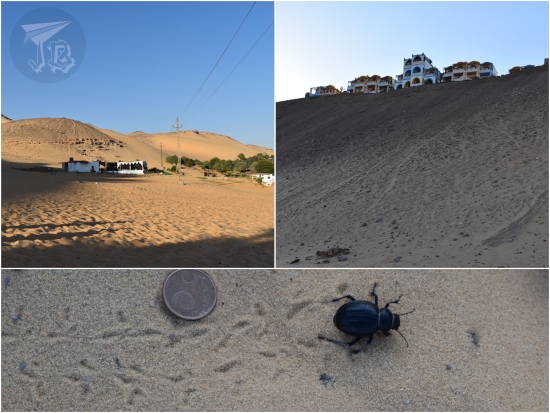
Apparently I missed some dancing as I was taking pictures of the site. Then, the people from the felucca sold us some trinkets, and finally we transferred to a different kind of engine boat, from where we sailed off towards Salouga and Ghazal Nature Reserve [محمية سالوجا وغزال الطبيعية] (the rapids formed by the First Cataract), around Seheyl Island [جزيرة سهيل], and a great sand dune. The Aswan area is famous among birdwatchers for its diversity. We got to see some glossy ibises (Plegadis falcinellus), little egrets (Egretta garzetta), reed cormorant (Microcarbo africanus), maybe an osprey or two (Pandion haliaetus), some corvids and stilts… Up the dune we made port at, we also caught sight of a couple of Egyptian beetles (Scarabaeus sacer).
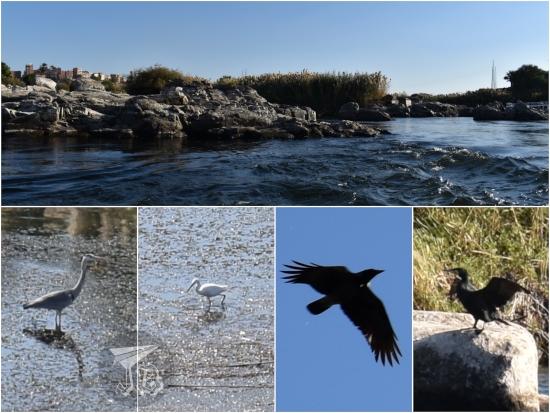
Collage: a rocky island surrounded by rapidly-running water, and several birds wadding and mid-flight

Collage. Two views of a huge sand dune: the buildings look tiny against it. A picture of a scarab walking on sand and leaving its print. It is a bit biger than a 5cent coin

The Nubian village, Gharb Seheyl [غرب سهيل], which is little more than a big bazaar. We were invited to the house of a man who claimed to have been a dancer for the Spanish Teatro Real. We hung out there for an hour or so, and eventually were let off to walk around the village, a succession of shops selling the same trinkets as everywhere else, plus women trying to sell “Nubian dolls”. The house we were at kept live Nile crocodiles (Crocodylus niloticus), and at a lot of places we saw some mounted ones, I guess for tourist’s entertainment, but that did not feel quite right.
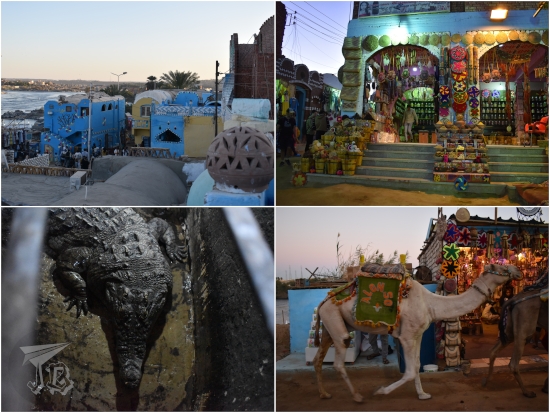
Collage of the Nubian village: a view from a rooftop, showing the houses painted in sand and blue colours; a shop with colourful trinkets, flowers, and statuetes; a Nile crocodile staring up; a dromedary passing by a souvenir shop.

After sunset, we sailed off back to the motorboat, without stopping anywhere, even if the whole city was lit. The boats were also shiny with neons and bright colours.

Collage: boats at night, docking and navigating the Nile. Two views of Aswan: lit ruins of the tombs of the Nobles, a mosque and a hotel

At the motorboat, we just had dinner and I went to bed early to catch some sleep. When I arrived at the cabin, I discovered that the staff had taken one of my beds away. I guess they got tired of making both of them as I used both bed covers? I was amused, just like I had been by all the figures they made out of towels (I got swans, a crocodile, and a monkey) though I wish the cleaning had been a bit more… thorough.

25th September 2022: Ruta de las Caras (Buendía, Spain)

As I had a visitor, I proposed a hiking route I had heard about as a silly adventure. The area around the reservoir Pantano de Buendía is home to an… interesting hiking route.

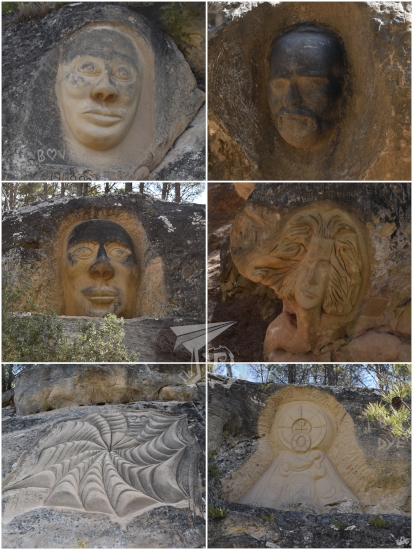
In the early 1990s, a couple of friends called Eulogio Reguillo and Jorge Juan Maldonado, a builder and a pottery maker, got the idea to create a sculpture on the rock. That, which in other circumstances could have be just been considered “defiling nature” became a Land art project – the two “artists” have carved gigantic faces into the sandstone, and the route has become a tourist spot – the Route of the Faces or Ruta de las Caras.

The route has been on my radar for a while (but I’d been feeling lazy about the drive) and I thought it would be a fun bizarre thing we could do together. It did not disappoint. You can do the complete route from the nearby village of Buendía, which is around 9 km, or drive up to the beginning of the route at the edge of the reservoir and hike around 2 km. We decided to do this, as the complete route did not offer much else to do / see.

The route features a lot of official and unofficial sculptures, along with graffiti on the rocks. It is circular and runs through a pine forest which makes it suitable for both warm and cold weather – as long as the roads to get to the village are not frozen. Though temperature had plopped down compared to the previous day, it was still mostly over 20 ºC, so nice enough to be out in a sweatshirt.

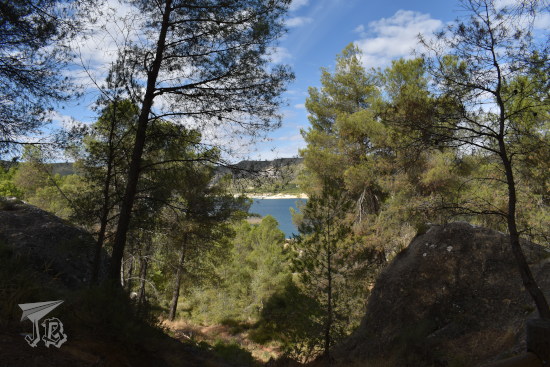
Pine trees with a bit of water in the background - the reservoir

The rock carvings vary in size, style and elaboration. There are some religious motives, such a couple of Christian Virgin Marys, and some figures from Indian (Hindu and Buddhist) inspiration, but the ideas are so all over the place that they probably just let the artists do whatever they felt like. While the first carvings date from the 1990s, the route is still being carved, and we missed one of the faces as it is in a “new” area which is still not signalled. Some of the sculptures we did see include:

  • Moneda de Vida – The Coin of Life
  • Cruz Templaria – Templar Cross
  • Krishna (Hindu deity)
  • Maitreya (future Buddha in Buddhist eschatology)
  • Arjuna (a character in one of the Hindu epics)
  • Espiral del brujo – The Male Witch’s Spiral
  • Chemary (short for the name “José María”, Joseph Mary)
  • Sin nombre – Unnamed (and unfinished)
  • La monja – The nun
  • Chamán – Shamman
  • Beethoven (the composer, yes)
  • Duende de la grieta – Goblin in the Crack
  • Dama del pantano – Lady of the Reservoir
  • Virgen de la flor de Lis – Virgin of the Fleur-de-lis
  • Virgen de las caras – Virgin of the Faces

Different faces and shapes carved in sandstone

Different faces and shapes carved in sandstone

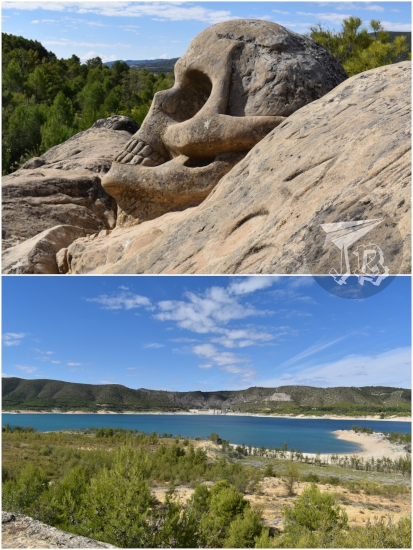
Our favourite was the skull overlooking the reservoir, called De muerte – Deadly – which one could actually climb – noooot absolutely sure it was “legal”, but the rules only said “do not carve or alter the rocks” and the sculptures are coated in a protective liquid. And after all, this started as a random art-vandalism thing.

Large skull carving (top) + the look from the viewpoint - the reservoir is pretty depleted, there is a lot of sand, but also some green trees (bottom)

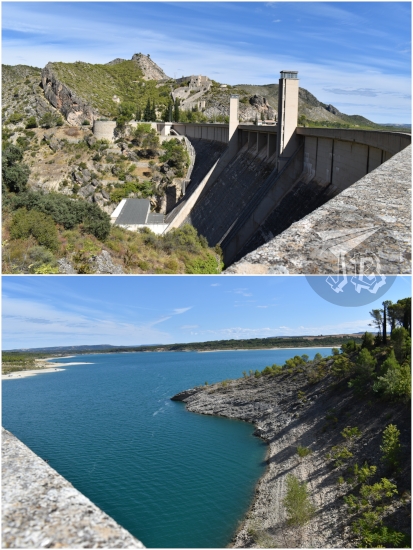
On the way back we stopped at the dam that closes off the Reservoir Presa del Pantano de Buendía, where we played with the echo.

Massive concrete dam, and the water behind it, a rich azure. The water looks cool.

Then, we moved on and once again stopped at the dam in the Entrepeñas reservoir Presa del Pantano de Entrepeñas – and I got the exit wrong again afterwards, exactly like the previous time. We saw a flock of vultures, and as they were circling in search for prey, they were a ‘kettle’.

The silhouette of two vultures circling

To end the day with befor my friend was off to the airport, we headed back and stopped to have lunch at a tiny Mexican place in the shopping centre on our way. And there I discovered that yes, there is such a thing as too much cheese on nachos. In the end, we walked around 4.11 km (6464 steps), so I think we were allowed to deal with the junk-y food.

Nachos + tacos. Everything looks a bit greasy.

13th September 2022: Wadi Rum (and the bus) {Jordan, September 2022}

I had a boiled egg, potato hash-browns and coffee breakfast because my body was craving salt, I guess. Then we set off on the bus, where we ended up spending around seven hours (the 412 km are supposed to be done in 5 hours and a half, but that does not take into account bad traffic). Urgh. Our first stop was a viewpoint over the whole canyon area.

Wadi Musa valley panorama, showing the deep gorge from above

The second stop was a souvenir shop that had probably somehow bribed our guide or driver for it. None of us even bought anything, but we were forced to be there for about half an hour before we could continue to the only organised activity for the day – a two-hour jeep tour throughout the Natural Reserve and Unesco World Heritage Site of Wadi Rum | Wādī Ramm [وادي رم]. It is the largest wadi “valley”, created by alluvial fans and wind deposits, rather than the idea of a river bed. They are often found in deserts.

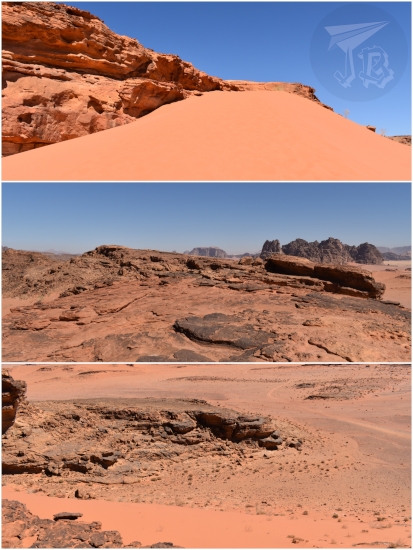
During the tour in Wadi Rum Reserve [محمية وادي رم] we drove through the desert and stopped at some rock formations that had built a gigantic dune. Wadi Rum used to be a granite and sandstone rocky formation. Thousands of years worth of wind eroded the sandstone back to sand, forming and shaping the desert dunes. Huge granite structures still stand, such as the Seven Pillars of Wisdom [عمدة الحكمة السبعة], just at the beginning of the route. One of the stops is the tourist-named Big Red Sand Dune, which you can climb for kicks, giggles and some nice views of the landscape.

Driving into Wadi Rum. The roof of the jeep is visible, along with a rock formation in the background. Between us and the rock formation there is the other jeep, causing a dust cloud

Back of a dune we had to climb, and the rock + sand landscape that could be seen from the top. Wind erosion marks have created soft ridges. The rocks are red-grey and the sand is rose-gold

Then we drove off to see some petroglyphs, and were offered dromedary rides. These petroglyphs, depicting early humans and their cattle – bovines and dromedaries – are the reason for the Heritage status.

A rock wall with some dromedaries in the foreground + a close up of the petroglyphs engraved in the rock, also showing dromedaries (by JBinnacle)

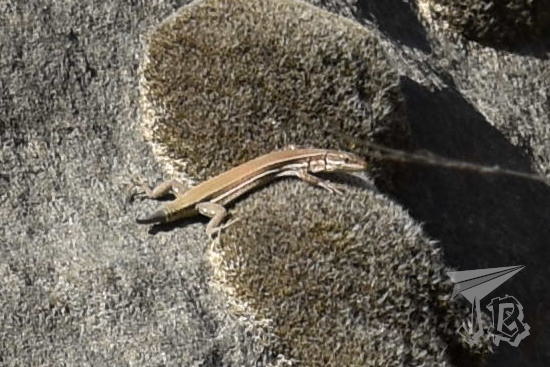
Finally we were shown a Bedouin tent at the feet of the Lawrence Canyon, a beautiful rock formation with faces of Jordan monarchs. Unfortunately, we did not get to see any onyx or fennec foxes, but I did see a small lizard. The Bedouins treated us to a cup of tea, but then we had to tip the driver about 10€…

Lawrence Canyon, a deep cut in the rock filled with sand at the bottom + details of engraved faces and Arab script, a lizard and a bit of tea, along with a traditional Bedouin coffee maker

Afterwards, we started off our trip back northwards back to Amman | ʻAmmān [عَمَّان]. Though the trip is supposed to take about 4 hours, it was way more than that, and we did not arrive at the hotel until way past 18:00. We went through the security checks and ended up learning that we could not travel between floors, so we could not go to the others’ rooms using the lifts, and the stairs were blocked… Well, at least we had… views?

A view of Amman skyline in the dark

After we managed to regroup, we had dinner and decided to try to check in online for the flight next day’s flight – and I was successful. Apparently, the airline only cared about us filling in our Covid certificate to enter Jordan, we were on our own for the way back.

10th July 2022: Reservoirs (Buendía & Entrepeñas, Spain)

I tried going for a hike because I was feeling cooped up, and tried to make the most out of the draught Spain is going through. The centre of Spain is sprinkled with large reservoirs, a lot of them built during Franco’s dictatorship as part of the efforts to get the country to recover from the war. The reservoir Embalse de Buendía is fed by the river Guadiela and it was finished in the year 1958. Before that, there used to be a bathing complex used by the royals, along with a village there. I have wanted to get there for a while, but it is tricky because the trail is reported to be in bad condition. So I decided to walk down the trail Camino de La Isabela to gauge whether my small city car would make it. Thus, think about this as a recognisance mission.

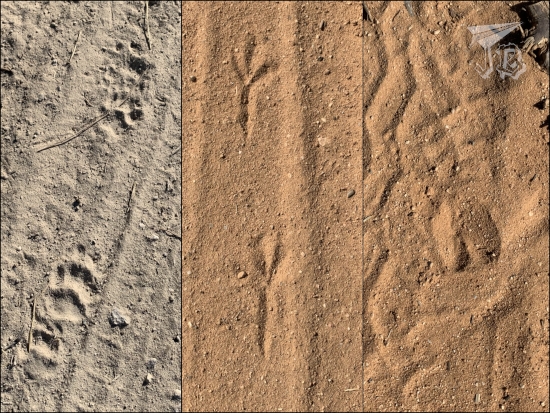
I parked the car at the beginning of the trail around 8:10 in the morning and started walking. I saw a small lizard which had shed off its tail, and some footprints – birds, canid, and I’m pretty sure a deer.

Close-up of a brown lizard which is growing its tail back.

Collage of animal footprints: paws, tallons and hooves

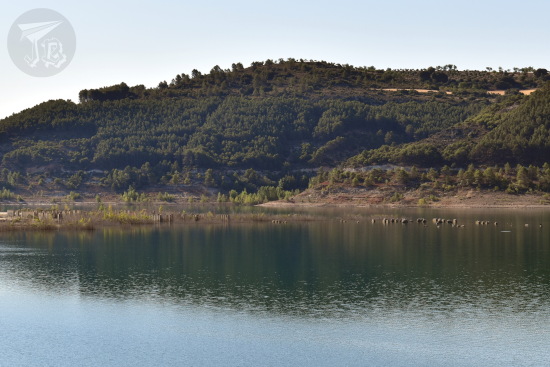
The temperature was nice at that time and I walked for about an hour until I got to the shore of the reservoir, then another 20 minutes or so until I got to see the derelict settlement. The water was still too high so I decided not to walk there.

A view of the reservoir. The sun is shining and there are some green / yellow plants ashore.

The reservoir. On one of the inlets you can guess the ruins, along with some columns that peek over the water.

I just hung out at the shore and found a bunch of dragonflies (I think Trithemis annulata, violet-marked darter (female and male), from a helpful comment on social media). Then I started walking back, because the temperature was rising fast.

A yellow and a red dragonfly.

I made it back to the car around 11:00 and drove off towards a second reservoir in the area, Embalse de Entrepeñas. I have driven by more than a few times, and I would always be drawn to a little side road that seemed to overlook the reservoir. It is actually the beginning of a hiking trail, but it was already too hot to keep going. Instead, I peered around the actual dam and hydroelectric station.

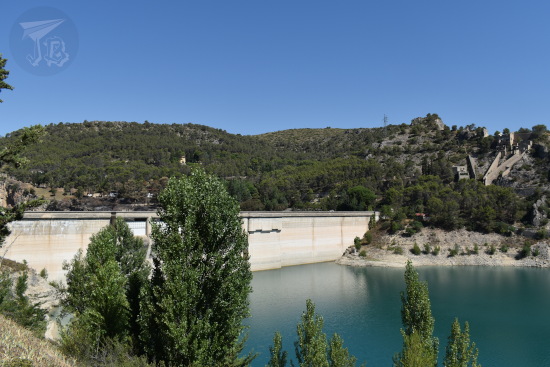
A white-grey dam closes the reservoir. There are trees in the foregrond and the water looks almost turquoise.

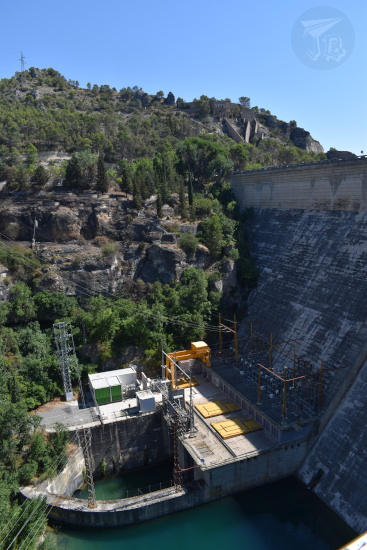
The electricity power-plant that is fed by the water behind the dam. There are a lot of wires coming out at different heights.

It was too hot to do anything, the beginning of the heat wave, so I just drove off and made a stop to see some friends on the way. I’ll keep an eye on the water level of the reservoir Embalse de Buendía in case I can come back to the area, now that I’ve figured out how far I can reach with the car.

Walking distance: 16846 steps / 11.76 km

31st May 2022: Anaga {Tenerife, birthday 2022}

I got up on the early side as I had booked breakfast at 8:00. I was surprisingly not hungry, even if I had not finished dinner the previous evening. My plane was a little before 17:00 and I had to return the car at 13:30 (I must have messed up the time, because I was convinced I had chosen 14:30). however, there was still one spot in the island I wanted to check out – the Nature Reserve Parque Rural de Anaga, in the north of the island and about half an hour’s drive away from the airport. This is a mountain area covered in primitive subtropical moist broadleaf forests, called laurisilva canaria. The mountain range is the oldest part of the island of Tenerife.

During the Tertiary Period, the whole Mediterranean area was covered in forests which had wide, dark leaves. They disappeared with the glacial era that started with the Quaternary. The forest has not changed nor evolved with time, so it has remained as it was 40 million years ago. It was preserved in several humid areas due to the wind patterns while the continents dried out and deserts opened. Sometimes, these forests are called laurel forests, as laurel (Laurus novocanariensis) is one of the typical plants. There are other trees as tils (Ocotea foetens), bushes, vines, ferns and mosses.

I drove around two hours to get from the Parador to Anaga, and was lucky to snatch one of the last parking spots. I asked at the visitor’s centre about a route that was not too long and I was recommended a two-hour one, called Bosque de los Enigmas, the Enigma Forest.

The beginning of it was really cool. The tils and the laurels twisted almost magically and I was alone on the path. I saw some birds, though capturing them on camera was hard, possibly a grey wagtail (Motacilla cinerea) and a female blackbird (Turdus merula; which is not really black). Aside from being a nature reserve, Anaga is also a bird protection area.
A path into the primitive forest. The trees curve over and around the trail, and everything is dark

A shot up a tree, the trunk is covered in moss

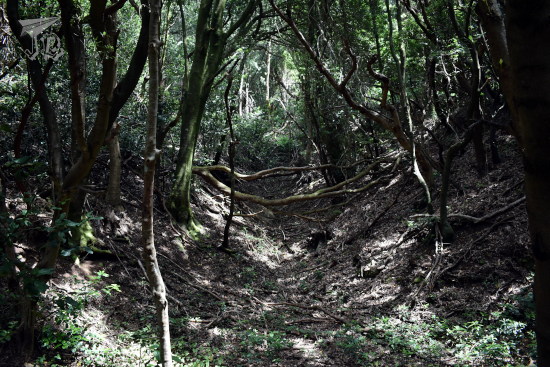
An old waterway or river bed turned into a path. There are walls of dirt to the side, and the roots of the trees are showing
Collage: a grey fluffy bird looking at the camera, and a black one with its back turned, completely ignoring it.

At some point, unfortunately, I lost the trail. I reached the viewpoint Mirador de Zapata going in the wrong direction. Though the weather was very appropriate for an evergreen subtropical forest, this meant that I could either backtrack, or go along the road for a while. I decided on the side of the road as that way I knew how long I would take to reach the parking lot.

A view of the tree tops from above. In the backgrond, partially obscured by the thick fog, there is a village, and the sea is beyond it.

I eventually reached the beginning of the trail again and I had not been run over a car, which was a plus, and before leaving I could look over a second viewpoint Mirador de la Cruz del Carmen, which offers a peek onto the whole massif.

Traces of water runoff paths, which have eroded the soil and torn some trees down

A view of the tree tops from above. In the backgrond, partially obscured by the thick fog, there is a village, and volcanic mountains beyond it.

After this, I drove back to the airport to turn back the car and have some lunch. I had hoped that the smaller airport would be less strict than one of the big hubs, but it turned out they were even more vigilant. So off with the shoes again. We took off at the brink of time, landed at the expected hour… and on the way back home got caught in an hour-long double traffic jam. Ho boy!

All in all, nothing really went according to plan, even if the plans were just a draft. But all in all I had a good time and got to spend some time with myself, which I desperately needed. So yay luckiest unlucky trip ever!

29th May 2022: La Orotava, Icod de los Vinos & Parque Nacional del Teide {Tenerife, birthday 2022}

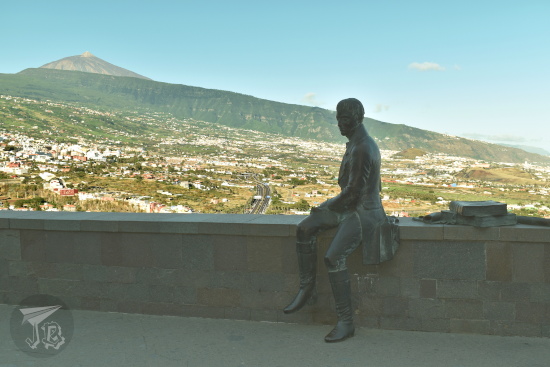
I got up rather early in the morning (especially considering that the Canary Islands are an hour behind my usual time zone) and I was surprised at how many people there were already on the streets of Santa Cruz de Tenerife before 8:30 on a Sunday morning. I drove out of the town and headed north-west, where I came across my first stop – a viewpoint of Mount Teide called Mirador de Humboldt honouring the German explorer from the late 18th century (though I kept thinking that there was a missing penguin opportunity there). The viewpoint overlooks the ocean and Mount Teide, which Humboldt climbed in 1799.

Mount Teide, a volcano, looms in the background. The top is bare and barren, but the slopes look green and fertile, with plantations and some villages. In the foreground, there is a bronze sculpture of Alexander Humbolt, sitting on the low wall of the lookout, and looking to the side.

I continued driving towards La Orotava, the municipality which Mount Teide actually belongs to. After parking the car, I walked towards the historical centre and ended up at the square Plaza de la Constitución, which stands next to the church Iglesia de San Agustín. Mount Teide loomed over the streets, ready to celebrate Pentecost Sunday. And guess what? The main church is called… Parroquia Matriz de Nuestra Señora de la Concepción. The initial hermit church was built in the 15th century, and it was completely rebuilt in the Baroque style throughout the 18th century, though the interior was remade in the 19th century and there was yet another renovation in the 20th century. It is considered the most important building of the Canarian Baroque.

A collage of La Orotava. The buildings are built with white plaster and black volcanic rock. Mount Teide peeks from the background.

The most representative construction in La Orotava is the “house of balconies” Casa de los Balcones. The house was built in the 17th century. The façade shows a front-long balcony on the third floor, and five smaller balconies on the second, all of them made from dark teak wood. The interior holds a museum, but I decided to give that a miss because I reached there at the same time as a very disorganised group of forty or fifty people who were going in at the time.

A colonial house. It is built in white brink. It has three floors. On the ground, there are brown windows. On the first floor, five balconies, with decorated ironwork. On the second floor, a long balcony or gallery in dark wood.

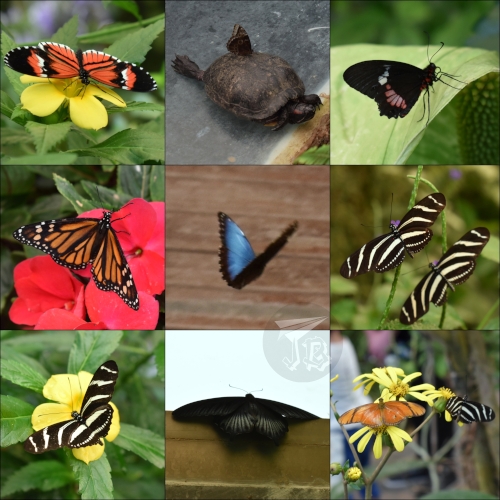
Instead, I went back to the car and drove towards Icod de los Vinos. There, my first stop was the butterfly house Mariposario del Drago, since the ethnographical museum Museo del Guanche is closed.

A collage showing colourful butterflies - red, orange, blue, black, black and white. One of them is chilling on the shell of a turtle, and another one is caught mid-flight. Most are on flowers and plants.

The butterfly house stands next to a botanical park Parque del Drago built around the symbol of the town – and maybe the whole island – the Drago Milenario. This is the largest and oldest specimen of Canary Islands dragon tree or drago (Dracaena draco). Folklore says that it is a thousand years old, hence the name “the thousand-year-old dragon tree”, though in reality, it is probably around 600 years.

The dragon-blood tree. It has a knotted grey trunk and bony branches. Around it there are bright-green palm and laurel trees

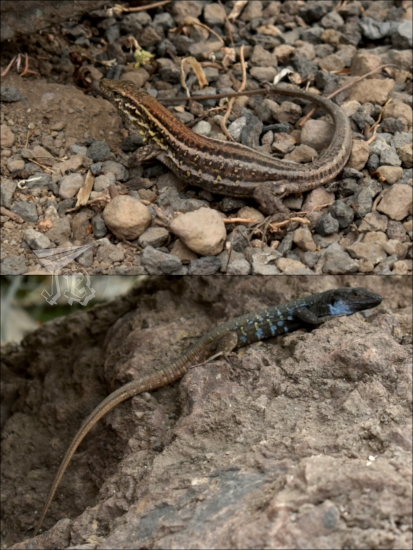
The park, built around the drago, holds local species trying to reproduce the local biotopes with height, there is also a small volcanic cave. It was here where where I managed to catch my first glance at the local fauna – two of the endemic lizards (though not as big as the one I had seen in the museum): lagarto tizón (Gallotia galloti) or tizon lizard, a blue-spotted male and a brown-striped female.

Two lizards. One camouflages on the grey and brown ground. The other on has a brown tail, but the body is black and bright blue

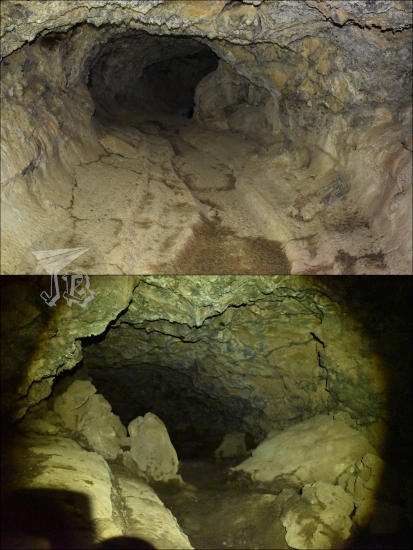
Then I went back to the car to climb up a crazy slope until I reached the visitors’ centre of the lava tube Cueva del viento. A lava tube is a “cave” formed the flowing lava of a volcano. As the outer part solidifies, the inner core continues flowing until it empties the tube. The guided visit is the only way you can enter the tube, so I had reserved that a few weeks earlier.

The visit started with a small introduction in the visitor’s centre, with a lot of “gotcha” questions on the guide’s part. I tried really, really hard not to be a smartarse, but I did sit down on the floor at a point because I did not feel like standing around for twenty minutes. The important information we received was that there were two types of lava that had formed the island of Tenerife: pahoehoe and block lava.

Then we took the centre’s vehicles to the outer area of the cave, where we could see the solidified lava, now turned into stone. Pahoehoe lava is basaltic, it flows slowly, and it is the responsible for creating the tubes. As it flows and solidifies, it creates undulations and wrinkles. On top of it, only small trees and bushes can grow.

Old Pahoehoe lava trails. The rock looks wrinkled or similar to pillows.

Block lava is more acidic, with a higher silica contents, it flows less and creates “blocks” as it solidifies. Pines can be found growing on top.

Pines around an old colada, which seems rocky and broken.

The cave itself was very cool. Unfortunately, there were a couple of families with kids and grandparents, all trying to be braver than the next – and thus acted loud and boisterous. More interesting information – mummified guanche aboriginals had been found in the cave, along with remains of a giant rat and lizard that were the ones reproduced in the Museo de Ciencia y Antropología de Tenerife. It is one of the biggest lava tubes in the world, with up to three levels and maybe 18 km of tunnels, though only a short walk can be had.

Inside the lava tube. It looks alien, like the rock is going to start dripping any second

Back in the parking lot, I had a snack and headed off towards the Parador de las Cañadas del Teide, where I had booked my next couple of nights. On the way, I went through several amazing volcanic landscapes that I could not photograph as I was driving. However, I did stop at several lookouts throughout the Parque Nacional del Teide.

Mirador de Samara.

Pines growing up on the dusty remains of a lava flow. In the background, there are three mountains - three craters of the same volcano

Mirador de las Narices del Teide, which shows the collapse on the mountain during the last known eruption.

A view of the black collapse of lava from the last eruption. Everything is barren, brown and grey, except for a black spillage coming down ominously. The sky is blue in the background, which makes the whole thing look even more bizarre.

Mirador Zapato de la Reina.

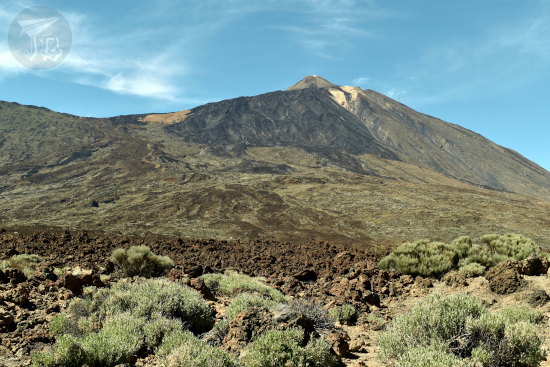
The top of Teide. This is the point where vegetation has become scarce, with low bushes, that creep up the slope. The summit looks naked.

Finally, I arrived in the area of Las Cañadas del Teide or Las Siete Cañadas where the Parador de las Cañadas del Teide stands. I was lucky that the season was good to see the flowering bugloss Echium wildpretii (tajinaste in Spanish), an endemic flora species mostly found on the Teide slopes. After checking in I wandered around the different tracks and paths – Cañada Blanca, Roques de García and Mirador de la Ruleta, which show the different stages of various volcanic eruptions.

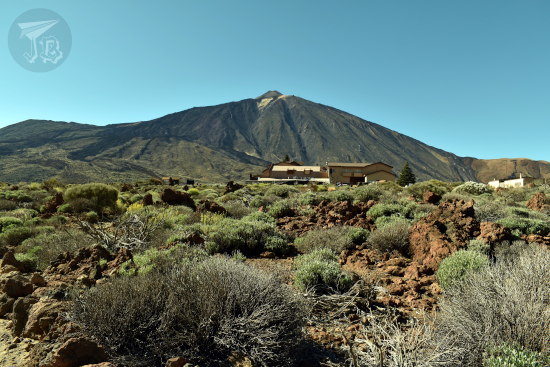
Mount Teide rises in the background. It looks wrinkled due to the different eruptions. At its foot, a low building, looking completely out of place. In the foreground, small bushes in grey and green.

Collage: Different rocks and structures created by lava and erosion, the rocks are reddish or grey, and they have weird shapes. The tajinaste is a tall bush, with tiny red flowers, it stands about 1m above the rest of the plants.

I turned in early, and I had booked my dinner in the Parador both nights I’d be sleeping there, so that was an easy one. The staff made it a little awkward though, even if I was not the only solo traveller around. After dinner, I tried to get some pictures of the night sky, but I was unsuccessful.