11th April 2025: Extant, extinct and extrastormy (Madrid, Spain)

Since March was extremely rainy, I hoped that April would not be so. No such luck. However, there was a dinosaur exhibit in Madrid that I was keen on seeing, and I wanted to do it before Easter, because it would be packed during the holidays and I could not get there in May due to personal stuff. And since getting to the Casa de Campo area takes so long by train, I looked at combining it with something else around (it’s a four-hour roundtrip from where I am). What other thing was close? Somewhere else I never go because it’s far away by public transport and a nightmare to park around – the local zoo Zoo Aquarium de Madrid. There was after all only a 10% chance of rain…

Spoiler alert: while I was getting drenched (I’m being dramatic, of course. I had an umbrella) in the zoo, and later in the exhibit, the weather app said “partly cloudy” and there was no mention of storms nor rain. But the skies opened. Ask the peafowl…

I took the train and changed to the underground until I got to the Casa de Campo stop. There were not many people around since it was a weekday. There’s a bus that takes you to the zoo, but I found it more efficient to walk, since there is a pedestrian way alongside the road. I reached the zoo a bit after it opened at 11:00, and just as my ticket was getting scanned the first few raindrops fell. At first, it seemed like a small drizzle, but soon it started to rain in earnest. By that time, I had managed to get to the pandas, about 40 metres into the zoo.

I’d been to the Zoo Aquarium de Madrid twice in my life before. The first one I was very small. I have no memory of it, but there is a home video of three-year-old me chasing a peacock and a voice warning “come back, it’s going to bite you!”. The second time I was in third grade, and had my first camera. I remember that I was devastated because the pandas were very far away and I could only take a picture of a distant, tiny, black-and-white blur. That was decades ago, and I had never been back, though I had a recurring dream for years that involved one of the pools there.

The zoo opened in 1972 as an alternative to the “Beast House” or Casa de Fieras that used to be hosted in the Retiro Park, a few sad and crammed-looking cages that must have been horrible for the animals. As every animal park, Zoo Aquarium de Madrid is not free of controversy, especially related to the ethics of keeping great apes and cetaceans in captivity. They used to have dolphins, but those were surrendered and sent away earlier in 2025. Conversely, the zoo participates in over 60 conservation and breeding programs for endangered animals – they have breeding couples of owls, whose chicks are routinely released into the wild, and have succeeded in breeding pandas (they claim to be the most successful institution at breeding panda outside China) and white rhinos. They have non-breeding animals as ambassadors, such as a family of Iberian lynx.

The zoo is vaguely organised per continent – Europe, Australia, Asia, Africa and the Americas, and the home of actual wild animals such as storks and rabbits.

As I went into the zoo, the first thing I spotted was a small lake with flamingoes, pelicans and (squatting) storks. The storks are free to come and go, but they like to be in the zoo because they get free food, I guess. My idea had been to walk a spiral and try to see everything, but I got distracted by “Panda Land”, signalled by a big red gate – after all, they are the main attraction. I thought the pandas might be visible, and they were – much closer than I remembered indeed. I did get to see both the male and the female, who live apart within the same installation. I had time to take a few pictures before it started to rain in earnest. And no, they were not distant, tiny black-and-white blobs this time, and not only because I had borrowed a really good lens for the day. I had to put the camera away when the rain became too heavy.
Zoo Madrid - stork, flamingoes, panda

It rained for a couple of hours, and that impacted me a little. I ended up sharing shelter with a band of peafowl, and had to go from covered exhibit to covered exhibit at first. I found the orang-utan territory very sad, and I did not catch a glimpse of any gorilla. In the aquarium, I got stuck with all the school visits, but there were quite a few sharks and big fish in the ocean tank.

Zoo Madrid: peacocks and peahens sheltering from the rain

Zoo Madrid: Sea lion, small blue jellyfish, sharks

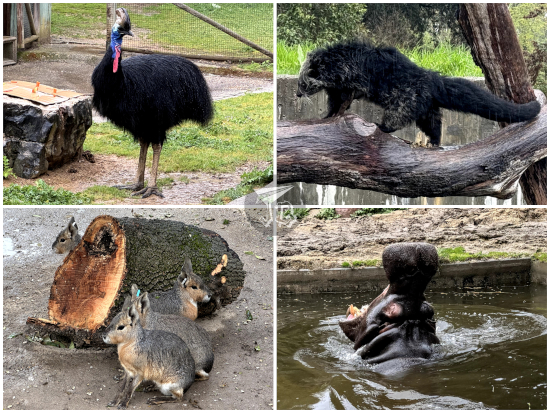
I ambled around the Australian area, where most of the animals were unfazed – especially the cassowary, which by the way is apparently the most dangerous bird in existence, even if I’m way more crept out (and fascinated) by emus. I did not see the koalas, and I walked past a tree which seemed fenced off just because. As rain cleared out, some of the animals started playing around, such as the binturong (Arctictis binturong), a distant relative of civets. At around 13:20, I had reached Africa, and I was in front of the hippos when it stopped raining. Awesome!

Zoo Madrid: Cassowari, binturong, Patagonian mara, and hippo yawning

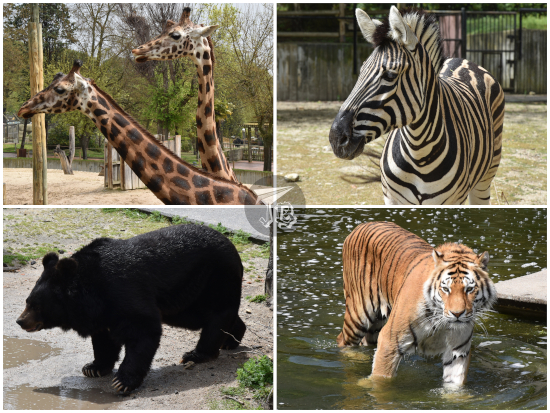
Since I had borrowed a camera lens which is better – but heavier – than mine, I really wanted to try it out. Carrying it around without being able to use the camera due to the rain, at all, would have been a bummer. After the rain stopped, I was able to take quite a few good pictures though. Those included the Siberian tiger (Panthera tigris tigris), and its relative the domestic cat (Felis catus), whom I’m not sure is a resident or a squatter in the “farm” section of the zoo alongside the sheep, goats, and a very large pig.

Zoo Madrid: Jiraffes, zebra, black bear and Siberian tiger

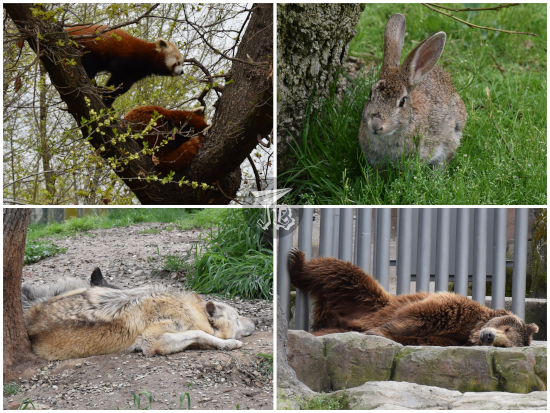
Since I’d been to Emociones al Vuelo a few days earlier, I did not mind the lack of Raptor Flight exhibit due to rain. I did miss the Exotic Birds one, but I caught the Sea Lion exercise (hello, swimming pool from years of recurring dreams). Around 14:30, it had stopped raining, the animals had eaten, and I caught many of them. Unfortunately, most – especially the carnivores – were napping. I did however saw a very active red panda (Ailurus fulgens) around the tree that I previously thought was fenced off for no reason.

Zoo Madrid: Red panda, common rabbit, grey wolves, brown bear

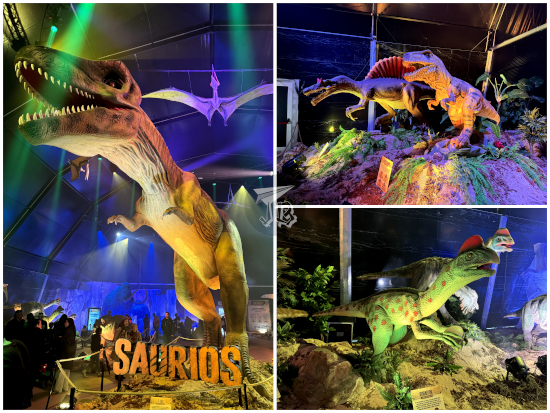
By the time I left, the workers had also dropped off a few Easter Eggs throughout the zoo as the holidays were about to start. At 17:00 I had to be at Escenario Puerta de Ángel to see Saurios, a dinosaur exhibit, which turned out to be a bit of a disappointment. Most of the animatronics I had already seen as “Dino Expo XXL” – I recognised it because of the broken neck on one of the brachiosaurus. The exhibit had a first part with a few skeleton replicas – the coolest thing, as I had never managed to see a complete cast of a Spinosaurus before. Then there was an open area with some life-sized replicas and photo-ops, but it was completely made for kids. There were actors and activities for them, which I guess were extremely fun if you’re younger than five. Yet another “dinosaurs are for kids” activity.
Saurios Madrid - skeleton replicas

Saurios Madrid - models

And then it started storming again. A black cloud, a clap of thunder, and the skies opened. Thus, we all had to hurry to the last section, which was most of what I’d seen in “Dino Expo XXL”. I was really not impressed by the whole thing – remember folks, “for all the family” means “designed for kids”. I guess I would be more gracious had the weather been nice, but… having seen most of the exhibit before for half the price, I was not impressed. Fortunately or unfortunately, there is a Jurassic World Exhibition coming up soon…

Saurios Madrid - models

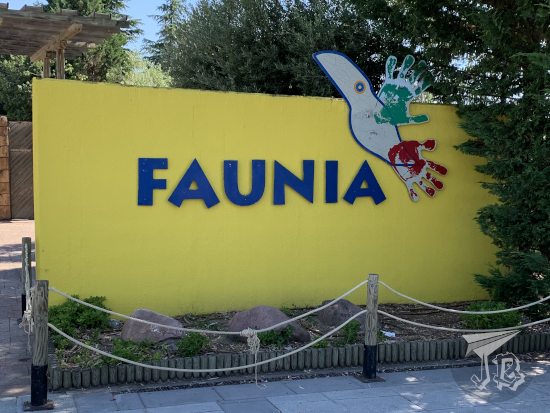
1st July 2021: Manatees are Zen (Faunia, Madrid, Spain)

Madrid has two zoos, the traditional one which can be traced back to 1770, and a second one which opened in 2001. They actually belong to the same business group anyway so probably the whole point is just to charge more – and to expand the installations. They operate as independent entities. On the first of July, due to a number of circumstances coming together, I visited Faunia, the newer installation. The standard price for a ticket is around 28€ – but there are plenty of different discounts. I paid 18.90€ for a random Thursday discount that they’ve got.

Though it promotes itself as a “Nature Theme park”, Faunia is little more than a modern standard zoo. Of course, it is much better than the old zoos, and the animals are well-kept, an organisation in ecosystems or areas is not that much of a novelty any more. There are different areas: farm / petting zoo, night, lake, jungle, temperate forest, African forest, Australia…

Komodo dragon (Varanus komodoensis), the largest lizard in the world, endemic to some Indonesian islands. They are venomous.
Tufted capuchin (Sapajus apella), an omnivorous primate from South America.
Red panda (Ailurus fulgens), an animal that is so different from everything else that it has its own family name all by itself. It is native to the Himalayas and the south west of China.
American flamingoes (Phoenicopterus ruber), long-legged wading birds famous for their pink colour that tend to live in flocks.
Ring-tailed lemurs (Lemur catta), a group-forming species endemic to Madagascar. They are attitude-laden and fear-lacking little fellas who love to sunbathe.

Fennec fox (Vulpes zerda): a small fox with large ears which lives in the Sahara and the Sinai Peninsula.
Southern tamandua or lesser anteater (Tamandua tetradactyla), a species of anteater from the forests of South America and the Caribbean, which feeds on ants, termites and bees.
Kangaroo Rat (genus Dipodomys), tiny nocturnal rodents from North America that can jump over two metres
Butterflies – don’t expect me to be able to ID them, but my money is on Antiochus Longwing, a south American small butterfly
Nile crocodile (Crocodylus niloticus), a found in marshes, rivers and lakes in throughout sub-Saharan Africa. They are opportunistic and aggressive predators which ambush their prey in or near the water. And they can gallop. Look that up.

Arapaima (Sudis gigas), a giant fish native to the Amazon. They eat smaller fish, crustaceans, fruits, seeds, insects and any small land animal that they can catch on shore. Furthermore, this is an air-breather. It is a top predator that can become invasive if placed somewhere else.
Redtail catfish (Phractocephalus hemioliopterus), another carnivorous fish from the Amazon. Never trust a catfish, they can literally eat you by accident (or on purpose).
Caiman (family Alligatoridae), reptile predators originating in South America. They are large and aggressive, but they tend to hut fish. Did you know that
Penguins (family Spheniscidae) are a group of aquatic flightless birds. Most live in the Southern Hemisphere, and they feed on krill, fish, squid and so on that they catch underwater. Contrary to the myth, not all penguins live in the cold, a lot of them live in temperate climates.
Coral reef, with clownfish (family Pomacentridae) and sea anemones (order Actiniaria) living in symbiosis.

Meerkat (Suricata suricatta) aka Timon from the Lion King.
Red-necked wallaby (Macropus rufogriseus), similar to but smaller than a kangaroo, and also friendlier. They, of course, originate from Australia. The Faunia webpage says that you can go into the pen and walk among them, but I didn’t try.
Yellow-banded poison dart frog (Dendrobates leucomelas). It is an amphibian which lives in the humid areas in the north of South American. They secrete toxins from their skin. Do not pet, much less lick.
Blue viper of the white-lipped island pit viper (Trimeresurus insularis). Beautiful, venomous, aggressive and feisty, this snake is originary from Indonesian islands.
Gaboon viper (Bitis gabonica), it is really there. It is another venomous snake, and it has the longest fangs among snakes. And yes, it is really there.

White-cheeked turaco (Menelikornis leucotis), originary from forest in the highland regions of Eastern Africa.
Grey crowned crane (Balearica regulorum), a large bird from Sub-Saharan Africa.
Roseate spoonbill (Platalea ajaja), a wading bird from South America, with a very characteristic beak, hence the name
Macaws (genus Ara), endemic to Central and South America. They are “seed predators” which means they destroy the seeds to eat them
Scarlet ibises (Eudocimus ruber), another colourful bird whose original habitat is the coastal areas of South America. They use their long beaks to prove for food in mud or under plants – they eat a lot of small crustaceans, which gives them their particular colour

I guess it is worth a visit, but that’s just about it, if you consider it from a shallow point of view – because when you start getting deep into things, everything gets ridiculously expensive. Because the thing that does differentiate Faunia from other zoos is the fact that it offers “hands-on experiences.” Some of these are about 5 or 6€ and include a short talk inside one of the pens – such as “meeting” the pelicans or the penguins.

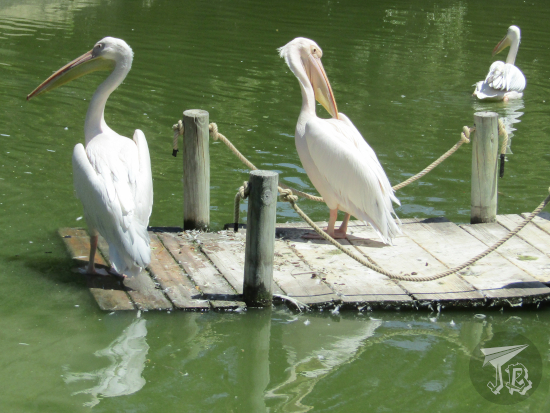
For example, the Pelican interaction consists in walking into the pen and seeing the birds from afar sitting on a bench while one caretaker explains basic biology facts and the other tries to get a pelican to eat trouts for a bit of a close-up “feeling”. Pelicans are large water birds spread all through the world but Antarctica. Their most important characteristic is the large throat pouch under their long beak, that they use to “fish” – they fill their pouch with a billful of water and keep whatever they can digest. Faunia has pink-backed pelicans (Pelecanus rufescens) great white pelicans (Pelecanus onocrotalus)

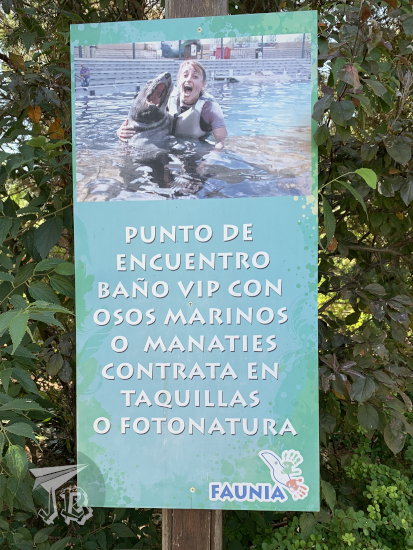
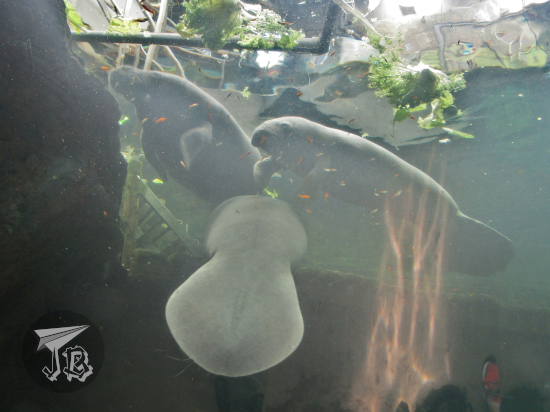
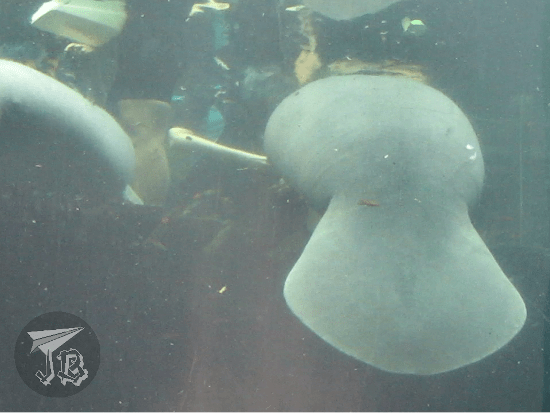
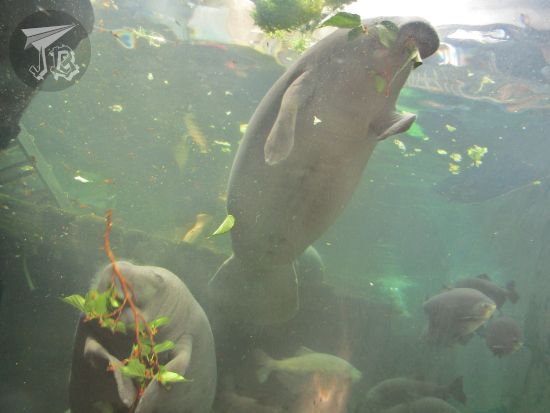
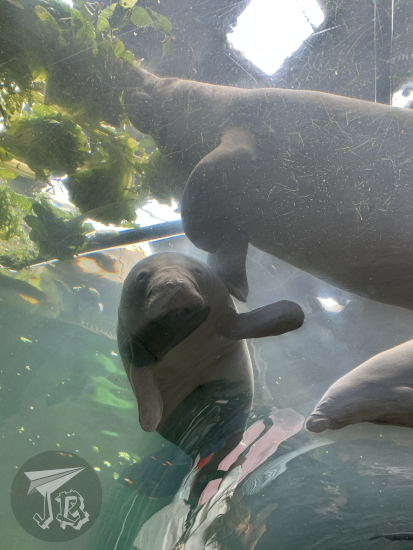
There are however other more expensive interactions, on the range of 40 to 50€, and one of them is the one I did – the interaction with the Manatees. Faunia has three West Indian manatees of the Antillean subspecies (Trichechus manatus manatus). Manatees are aquatic mammals – they breathe air and they spend all of their lives in the water, either salt or freshwater in South America. They don’t have natural predators, so they lack predator-avoidance responses, which makes them very tame and friendly. Unfortunately, they are critically endangered in the wild, mostly due to human-related deaths: hunting, habitat destruction and collision with ships. As they are herbivorous, they eat fresh and saltwater algae and plants, they are sometimes called “sea cows”, and eat plants and algae – males are called bulls, females cows and babies calves. They are sturdy and they can weigh between 400 and 550 kg, measuring up to 3 m in length. They have a long spine with pectoral flippers that have five fingers, but no rear flippers. Their body ends in a paddle-shaped tail. The neck is not visible and the head is stocky. They don’t have ears, their eyes are small and their snout is short, with nostrils that can be closed when they are underwater. They have a prehensile lip that they use to gather food and for social communication and interaction.

And they are adorable.

The manatees in Faunia are named Bruno, Fiona and Pelusa (“Dustbunny”), with the latter being the two-year-old daughter of the other two, born in the park. They live in the tank located in “The Jungle” area (La Jungla), sharing their space with catfish, arapaima and pirapitinga (the good-rep fish in the piranha family). For the interaction, you are asked to bring your bathing suit, towel and pool flip-flops. I arrived at the meeting point early and waited eagerly for the staff to come pick me up. Then I was guided into the inner area of the Jungle building, up a metal staircase and I changed into the neoprene suit.

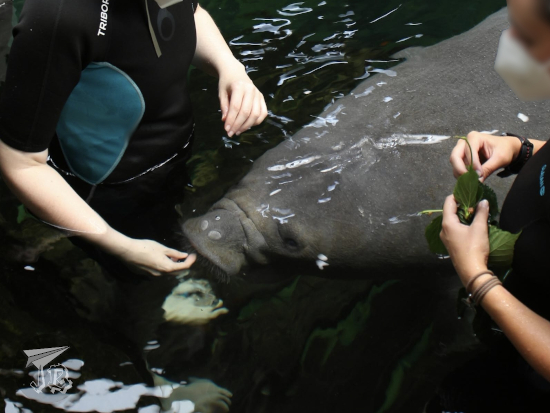
As we waited for the other people to be collected, I saw the manatees swimming around, already anticipating the food. They had mulberry leaves, endives, and banana pieces for treats, and lettuce of different kinds as their main meals. The interaction itself is a kind of training for the animals. The trainers go in with an acoustic signal, and the animals recognise their own names, and each goes to the trainer assigned to them – you also get assigned a trainer so you don’t mess up.

There are two parts of the interaction. First, you get to feed “your” manatee whatever you are given. Normally, there are two people per manatee, but as this was in the middle of the week, even if in summer, we were lucky enough to only be three visitors – which meant your own personal manatee. Mine was Pelusa, the baby, and she was way more interested in the mulberry than the endives. During this part you keep your FFP mask on.

For the second part you “go down” with a snorkelling mask and even if you’re still on the platform you get to feed “whomever comes to you”, seeing the interaction from within the water. To finish up, you give your manatee a small branch for them to eat and play with, and they are released, you change back into your clothes and leave. My interaction took about one hour, and I was lucky enough that I had an “infiltrate” who took pictures from the “underwater tunnel” that crosses the tank. I also bought myself one of the official pictures that the resident photographer takes, because I really, really wanted a good picture.

All in all, it was awesome, and it even felt that the manatees came to wave bye-bye as I left through the tunnel.

As a zoo, as I mentioned, Faunia is a very standard one, with very few things that would make it special if not for the interactions. It could do with some more shades, because just after lunchtime it became really hot. Most food kiosk were closed due to COVID measures, and there were several vending machines. There were a lot of kids doing “urban camp” activities, and I got ran over twice – one of them pretty painfully to be honest.

Aside from the animals, there is a roller-coaster, also down due to COVID and a “dinosaur canyon” with dummies and animatronics that have really seen better days.

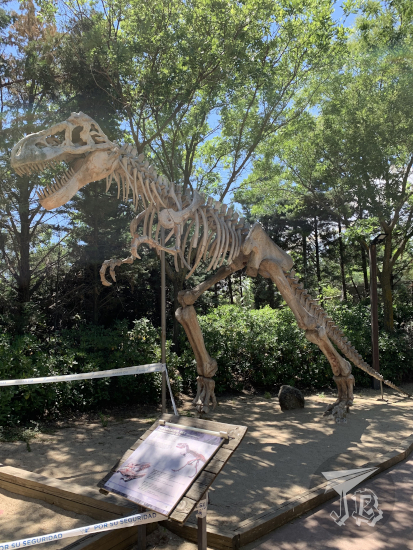
T-rex skeleton reconstruction

Furthermore, queuing to go in because the VIP entrance is blocked for… no really VIPs as there were none, and waiting forever at the entrance kiosk to get the Experience passes and then for the photos, were a drag. As a conclusion, going once in your lifetime, getting to do an interaction or two might be a good idea, but this is not somewhere I’m dying to come back to – though I am open to explore other parks from the same owner, such as the traditional zoo or the aquarium.

I mean, some of animals, such as this goose, had a very clear opinion about the park, too.

Goose attacking one of the Faunia signs

Walked distance: 12954 steps / 8.06 km

Pricing: Ticket: 18.90€ + Manatee experience 38.90€ + Pelican experience 5€ + Professional picture 11.90€ + digital upgrade (three-month access) 1€ = 75.70€. Way too much to plan another expedition any time soon.
Saved: We parked outside so we saved up the 5.50 € for the parking lot, and we took our own food.

15th – 17th June 2019: Cologne (Germany) for the Gazette

Getting from Madrid to Cologne [Köln] was stupidly difficult and expensive so in the end I took an early Saturday-morning flight to Frankfurt and then I booked train tickets (an ICE and a suburban train) to the hotel area in Cologne. My plane took off at dawn (literally) and landed at 9:40, so I thought about booking the train at 10:30.

Sunrise from the still-grounded plane

On a whim of distrustfulness, I decided to book the train for 11:00, which was lucky. While we did land on time, it tookan eternity to reach the terminal, and in the end I arrived in the station just past 10:30. Since I had a bit of time, I grabbed a coffee and a bagel for some ridiculous price, but that kept me going until the evening.

Bagel and coffee

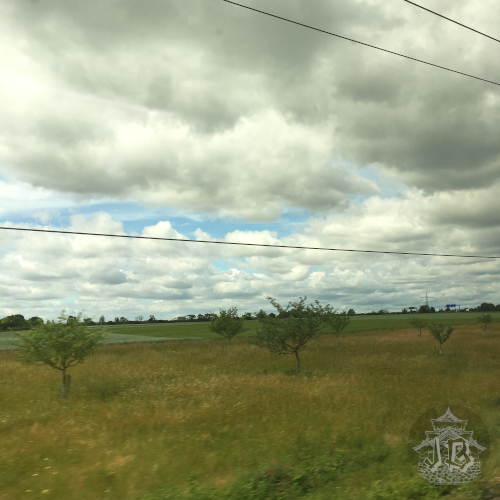
The European plain from the train window

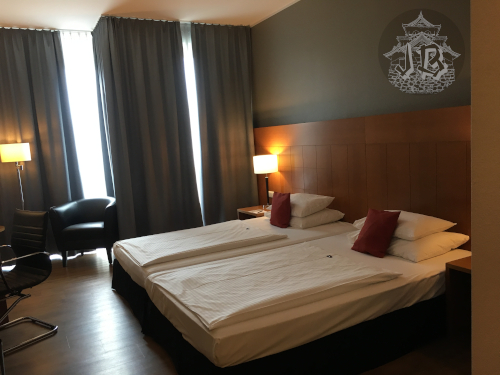
I reached Cologne and went on to the commuter to the venue area, where my hotel was, a short walk away from the station. After checking in, I dropped my things off in an amazing room, and had to do a double take – for a second I was not sure they had given me the right room, because it was way too nice for the price I was paying.

Huge bedroom at the hotel

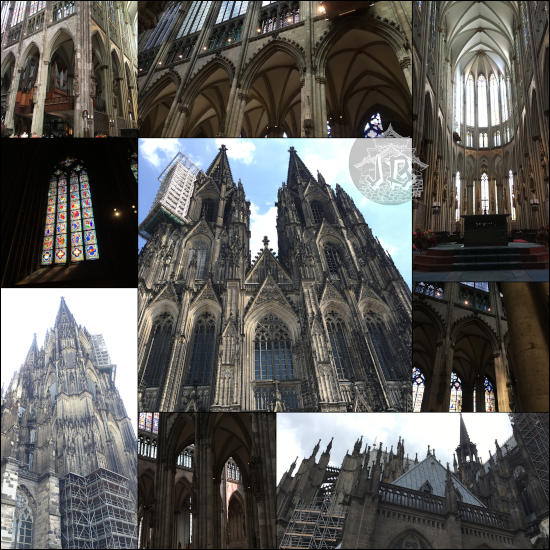
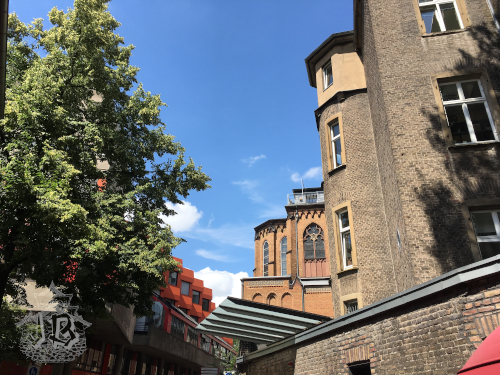
After changing clothes, I grabbed my bottle of water and off I took a train towards the city centre to visit the Cologne Cathedral Kölner Dom –it took a bit to figure out how to validate the train tickets, but I think I did everything legally. The cathedral has been a World Heritage site since 1996. Its construction started in 1248, but was halted in 1473. The building remained unfinished until the 1840s, when work was picked up again, following the original Medieval plans, and the church was finally completed in 1880. While it was badly damaged in WWII, it withstood the bombings and ever since then, it has been in a constant state of small and not-so-small restorations and repairs.

Cologne Dome

From the Cathedral I walked towards Cologne Zoo or Kölner Zoo. Although it had been drizzling before, at that point it was sunny again, and the walk was nice.

A typical Cologne Street

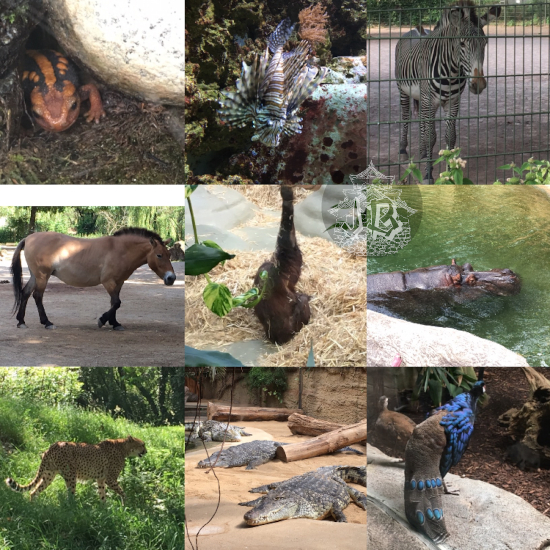
I decided to go to the zoo because it was the only thing that seemed to be open for long enough to mean value for money. The weather had warmed up and the bunnies were roasted coughs. I got to see some animals I had never seen before, such as Przewalski’s horses, snipes, or a grizzly bear. The zoo has a huge enclosure area, a petting zoo with domestic animals (and cheeky cows), an aquarium and a terrarium with both reptiles and creepy-crawlers shudders.

Some of the animals in the zoo

Then, I walked back to the hotel, stopping by the supermarket on my way – and here I discovered my undoing. The triple chocolate cookies which wrecked my trying to eat healthy stroll. I shall try to find them again in my next Germany trip though. However, I have to say that I had learnt from my being stupid for MIYAVI in London and not eating well through the weekend, so I bought snacks to have the following day.

Cookies

I was exhausted, so I think I was out at 22:00, which helped being awake at 7:00 the next morning. Thus, I just headed off for the venue E-Werk, and settled to queue for the concert. Japanese Visual kei (V系) rock band the GazettE [ガゼット (Gazetto)] was formed in 2002 and achieved its current configuration in 2003. It is formed by members: Ruki (ルキ) on lead vocals; Uruha (麗) on lead guitar; Aoi (葵) on an insane amount of support guitars (two on the same song, almost at the same time); Reita (れいた) on bass, keyboards / piano; and Kai (戒) on drums. Though they are signed with Sony Records, they claim to be completely self-produced.

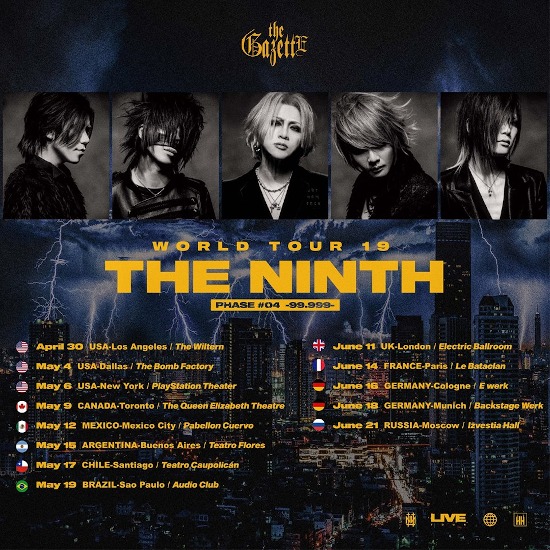
In December 2018, the Gazette announced that they would continue their Japanese Tour abroad as Live Tour 19 THE NINTH: PHASE #04 -99.999-. It originally spanned North and South America, and Europe, and later in April some Asian dates were added. I originally planned to go to Munich (travelling was easier and cheaper), but I could not get VIP tickets, so switched to Cologne instead. General Admission was reasonably priced (45€) with crazy shipping costs (+4.50€, since they were all printed out and pretty). VIP Tickets (300 per concert), included early entry (one hour before GA and two hours before the show), a VIP present, and a handshake with the band for 170€ (+4.50€ in shipping costs), exclusively distributed through ME-shop, which was a pain and not easy at all.

The Gazette World Tour dates

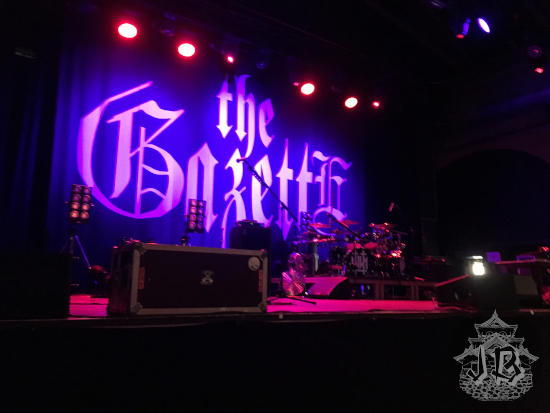
The Cologne concert at E-Werk would be held at 20:00, which placed entry at 19:00 and VIP entry at 18:00. I reached the queue around 8:00. The venue is a repurposed industrial building with a capacity for 2,000 people in a lower-floor arena and a sort of balcony around it which also allows for visibility. There were already staff walking around, and the venue even had portable toilets outside for queuing fans. At that time, there were maybe 60-70 people waiting in three queues – VIP, GA, and something called “regulars” who went in last.

Everything ran smoothly, with the three lines in front of the doors, up until 16:00 when security arrived. They decided to rearrange the queues, and created chaos. Fortunately, since most of the fans were German, and they enjoy order, at least the VIP queue was reorganised neatly and quickly – respecting the arrival numbers. Around 16:30, the VIP tickets were checked and switched for bracelets, and the holders ushered to a secondary waiting area where we were not even allowed to sit down until doors opened around 18:15. Due to this, I had to stand for two hours straight without leaning on anything, my back was killing me. I decided that I either made it to the barrier, or I would head upstairs for a good view. When I came in, I received the VIP present – a banner with the band logo on it– and I was find a first-row spot to the left of the stage, in front of Aoi (guitar). The concert ran about 15 minutes late due to a technical problem with a wire / monitor. Good thing I found a barrier spot indeed.

The concert was very high energy. The music was so loud my ears were still ringing three days later. Most of the setlist was from The Ninth album, which makes sense. My personal favourite live song was The Suicide Circus .

Setlist:

  1. 99.999
  2. Falling
  3. Ninth Odd Smell
  4. Gush
  5. Agony
  6. The Suicide Circus
  7. 虚 蜩 [Utsu Semi]
  8. その声は脆く [Sono Koe wa Moroku]
  9. Babylon’s Taboo
  10. Dogma
  11. Incubus
  12. Ugly
  13. Abhor God
  14. Filth in the Beauty
  15. Inside Beast
  16. Cockroach
  17. Tomorrow Never Dies

I was very impressed by Reita’s stage persona / antics, how he stood on stage and moved. I almost caught a pick that he threw, but by that time my right arm was completely useless as the person behind me kept trying to push me away from the barrier to take my spot. My wrist brace is actually broken due to having to hang on from her shoving. But she was not successful

Aoi was muchbetter than I expected, and at some point he was playing two guitars for the same song, the acoustic and the electric, without any apparent effort – he hung both from his neck and played whichever one he needed. I could not see much of Kai, and Uruha was most of the time too far away. And unfortunately Ruki favoured going to the right, but he has a very powerful body language.

After the concert, the VIPs were pushed– literally – to an area in the back of the venue to wait for the meet and greet in a different room. I got handshake with both hands from all of them, if memory serves me correctly the order was Kai, Uruha, Ruki, Reita and finally Aoi. I told them that it had been very fun, that they had done a good job and none of them batted an eye at my Japanese. They were really nice though, in a high contrast from stage personas.

Afterwards, I just headed off back to the hotel, and directly into the shower, because I was sore all over. Good thing I still had snacks from my supermarket run. I think this was the first time I have actually though “I’m getting too old for this”.

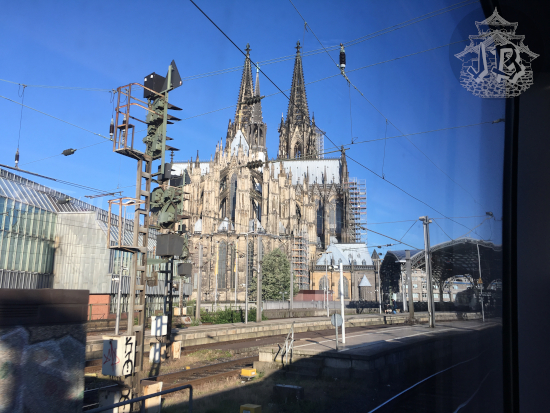
On Monday morning, my paranoia had me early at the station, and that was good because apparently my suburban had been cancelled. Being early, I was lucky enough to be able to catch a completely different one – not sure if legally. I did not get caught if it wasn’t, but I made it to Cologne central station and caught my ICE without any further stress. As the station is located next to the Dome, I was able to say good-bye.

Cologne Dome from the train

As I had a window seat again, I also had quite a few nice views from the plane, and made it home without any issue.

An aerial view of a reservoir with turquoise water

21st January 2018: Zoology at the Zoo (Guadalajara, Spain)

This was just a stroll down the Zoológico Municipal de Guadalajara, the local town zoo. I just thought I could look up some of the animals I came across and see if I learn any interesting facts. It was not as easy as I thought!

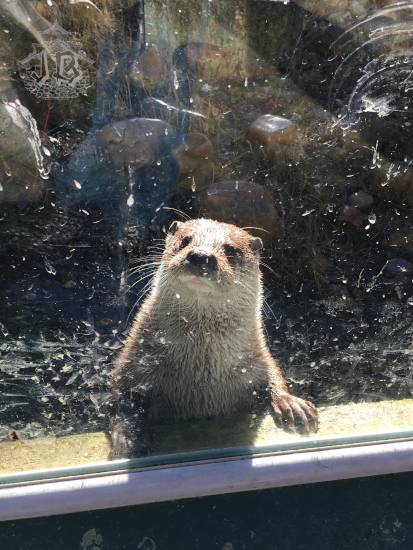
Eurasian otter (Lutra lutra): it is a semiaquatic mamal that is fortunately not threatened. It lives near rivers and coasts in Europe and Asia. It mainly eats fish. They are pretty smart and playful, but they are also very territorial, so they usually live alone. They have webbed claws for swimming and catching fish. Mother otters teach the kits to fish by a game of “catch and release” the fish.

Peafowl (Pavo cristatus ): technically “peacock” is the male (colourful) and “peahen” is the female (brown). The male has long tail feathers that he displays when he wants to impress a female or another male. In India, it was used as ‘guardian animal’ as it screams when tigers approach and it can eat young cobra snakes. Now, that’s pretty cool, and here I thought he was just a pretty tail!

Fallow deer (Dama dama): Fallow deer are native to Europe, and have been introduced to many other places. The bucks (males) are very aggressive and competitive during mating season, and they use their horns to fight. The does (females) do not have horns.

Iberian red deer (Cervus elaphus): The imagery of the red deer has been so powerful in the human psyche that some it can be found in paintings dating 40,000 years back. Normally the males and the young create big family groups. Males create smaller groups that cooperate.

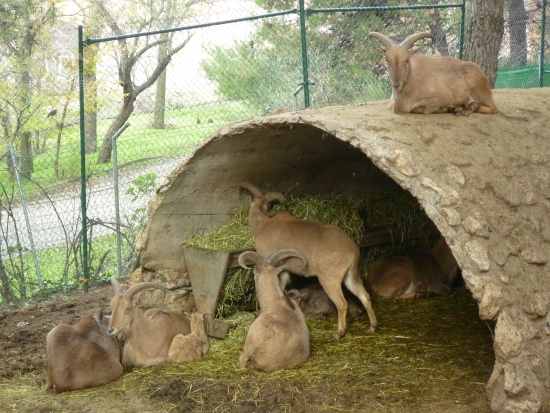
Barbary sheep (Ammotragus lervia). Also called arrui, it is an African mountain goat which lives in arid mountains and canyons and graze grass, bushes and lichens. They were artificially introduced in Southern Europe and became a bit of an invasive species. However, the truth is that they look super chill and zen.

European mouflon (Ovis orientalis musimon): It was originally a mountain creature but it moved to the forest when humans started bothering them. They thrive in rocky areas, though. They tend to live in herds with a lead female.

Wild boar (Sus scrofa): This is the omnivore animal by its own right. It can and will eat anything – from fruit to berries to even baby deer (O_O)!. Many old Indo-European cultures considered the boar a symbol of warrior virtues. In Greek mythology, the hero Herakles had to capture a boar as one of his Labours. In the east, it is considered a symbol of determination and even recklessness.

Iberian wolf (Canis lupus signatus): Unfortunately, the Iberian wolf is a vulnerable species and culling is still legal in Spain (•̀ω•́ ). The Iberian wolf is brown-grey and had a characteristic white area around its mouth. They also have black vertical lines along the front legs, and other dark marks on the leg and the tail. They are predators and prefer hunting big animals, especially deer. Wolves are social creatures, they live and hunt in groups.

Something really cool about wolves in general is that when they run, they place their hind legs on the footprint created by the front paw. Talk about coordination. Wolves have a very bad reputation in Spain, but there have not been confirmed attacks on cattle, much less on people, in recent years. Pictograms of the Iberian wolf have been found in archaeological artefacts from the tribes that lived in Spain before the Romans.

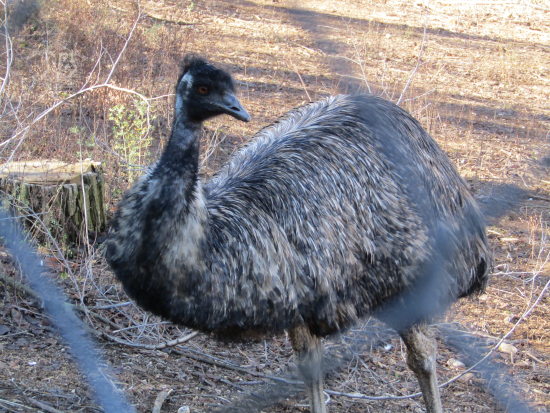
Emu (Dromaius novaehollandiae): Yay for another non-threatened animal. Emu originated in Australia, and are the second-biggest bird in existence after the ostrich. They are flightless, and they eat plants, grasses, insect and arthropods, depending the seasonal availability. Because females can lay several clutches of egg in one season after mating with different males, the male takes care of the incubation, and the chick-rearing. According the mythology of some aboriginal tribes of what now is called New South Wales, the sun had been created by throwing an emu egg into the sky.

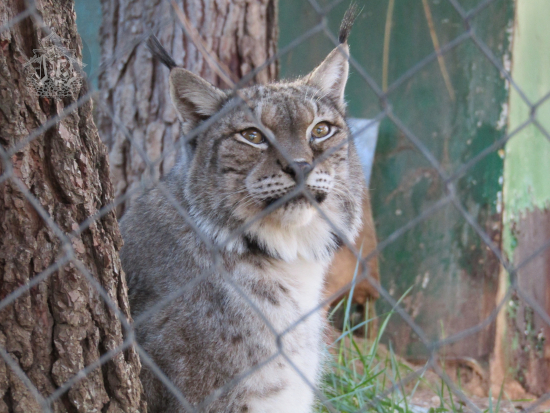
Eurasian lynx (Lynx lynx): Native of Europe and Asia, it is widely distributed, which lowers its conservation concerns. The Eurasian lynx is mainly a nocturnal predator, and tends to live solitarily as an adult, although hunting areas may overlap for several individuals. They can hunt small animals, but they are known to prefer bigger prey, such as roe deer and common deer. Conversely, they may be hunted by wolves.

Red fox (Vulpes vulpes): The red fox is one of the animals with the widest habitat range in the whole world. It can be found almost everywhere in the northern Hemisphere, including many cities in Europe. It is an invasive species in Australia, where it was introduced in the 19th century. In European mythology it’s considered symbol of deceit. In Asian mythology it has two-faces, some of them are messengers of the gods, some are tricksters and dangerous. Arab folklore considers the fox cowardly and weak. Native American mythology considers it a crafty creature that steals the coyote’s food – in all cultures however, it seems to be intellingent and able to trick other animals or people. Interesting.

Griffon vulture (Gyps fulvus): A scavenger bird of prey, it feeds mostly off the carcasses of dead animals. It tends to live in flocks or colonies and makes nests on rocky walls. Even if they have a bad rep, they are very cool animals.

White stork (Ciconia ciconia): Credited with bringing babies from Paris, storks used to be long-distance migrants, which lived in North Africa in winter and returned to Europe in summer to breed. For the last twenty years or so, the storks have stayed, at least in Spain. They are also famous for making nests on belfries and other man-made structures, and because they are considered a good omen they have rarely been chased away – until the weight of the nest has made belltowers collapse!

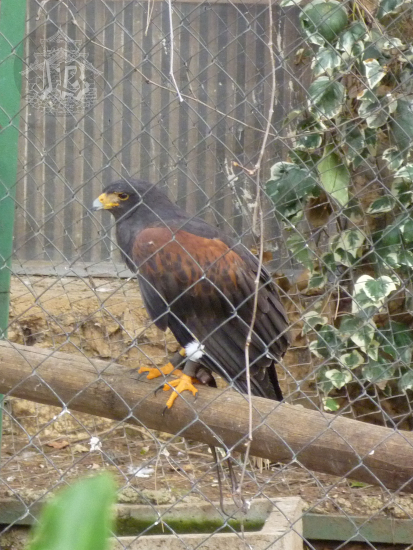
Common kestrel (Falco tinnunculus), I think. Feel free to correct me if I’m wrong. The best thing about the small zoo is the work they carry out recovering injured birds of prey. The birds are nursed back to health and if everything works out they are released into the wild. I really hope this little guy can leave soon! ⋛⋋( ‘◇’)⋌⋚

21st July 2017: Beppu – Hell day~ (in a good way) {Japan, summer 2017}

Beppu is, as I said before, known for having a lot of volcanic vents. It has decided to exploit this as a tourist resource. Beppu is still trying to open up to foreigners. It’s trying, at least partially. So cheers to the nice people.

The main attraction are the Jigoku [地獄] or hells, which are, depending on who you ask, seven, eight or nine. I visited eight of them. They are spectacular hot springs and vents which are too hot for bathing but really interesting to look at. The whole pack is called Beppu Jigoku Meguri [別府地獄めぐり]

I got myself a map, bought a ticket pack and a bus pass, and set off to the bus. Most of the jigoku are located in the Kannawa [鉄輪] District, but two of them are pretty far away, in Shibaseki [柴石] (2 km is far in the boiling summer, if the weather had been nicer, I would have walked back and forth).

I visited the Onishibozu Jigoku [鬼石坊主地獄] (Hell of the Demon-monk) which is a boiling mud puddle and a strong sulphur smell. I did not manage to get any bubble exploding, but the idea is that the bubbling mud looks like a monk’s shaved head.

Second I headed walked into the Umi Jigoku [海地獄] (Sea Hell), which is a turquoise pond of boiling water with a small shrine. It also has a smaller reddish pond to one of the sides.

After this I took a break to have a made-in-hot-spring-water pudding and have something to drink, just because I could. It was delicious.

And there was Onsen Jinja [温泉神社] (Hot Spring Shrine) to snoop around, too!

Third, I dropped by the Yama Jigoku [山地獄] (Mountain Hell), which comes off from the mountain slope and complements that it is not the most spectacular one with having a small petting zoo, where I somehow ended up feeding a capybara. Don’t ask me XD (This hell is independent, so you have to pay extra to come into it).

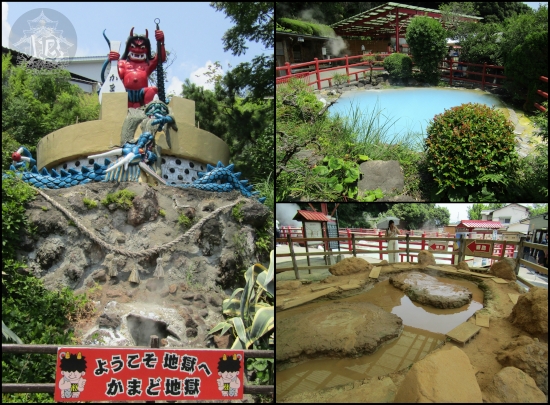
Fourth, I went to the Kamado Jigoku [かまど地獄] (Cooking Pot Hell) which has a big oni cook to greet you.

Fifth, I found the Oniyama Jigoku [鬼山地獄] (Devil Mountain Hell) which for some reason breeds crocodiles, and what the hell, that was scary for a second. Even if they were behind bards, the crocs would follow you under the water and snip at your shadow and some of them were enormous! Creepy! The hot-spring itself was not that impressive but basically because it was steaming too much to see any of it.

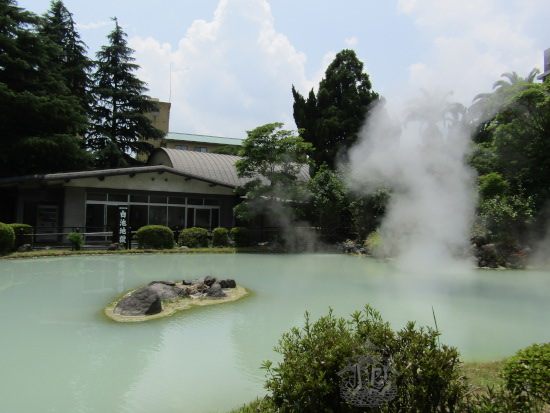
Sixth, I went to the Shiraike Jigoku [白池地獄] (White Pond Hell) where there was nobody to take my ticket. A nice old couple explained that I was to cut it myself and put it in a jar over there. We were talking a little and they asked where I was from. Then they continued on their way and I stayed petting a random cat who decided I was to scratch it right then and there. In this jigokku they also have a small aquarium with several tank of freshwater fish, among them “man-eating piranhas”…

I took the bus then to Shibaseki where the other two remaining hells were. Had the weather been more agreeable I would have walked, but I had the bus pass anyway and it was very hot. As I stepped out of the bus I came across the same couple from before. they explained that they had visited Spain before when they were younger and told me that they were from Osaka. We parted ways to go into the Chinoike Jigoku [血の池地獄] (Blood Pond Hell) which is a boiling red pond. Here I decided to take a foot bath as the area was empty and I was tired.

The final hell was Tatsumaki Jigoku [龍巻地獄] (Spout hell), a geyser you have to wait for, as it has its own timing. Here the old couple brought me a lemonade because they were adorable. And after the geyser it was over, or so I thought.

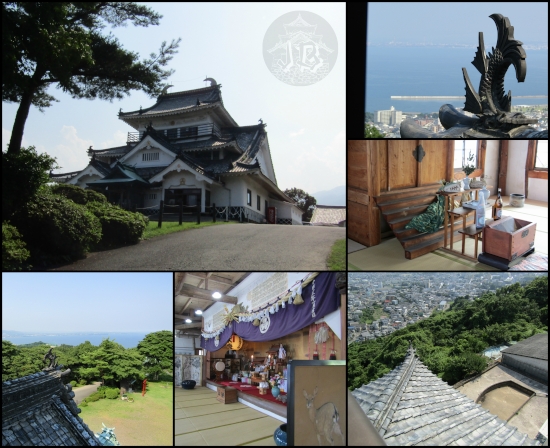
I had decided to give the aquarium a miss, because I was very tired but when I was taking pictures of the “castle” from afar I decided… I could not miss the chance, so I took the bus again towards Kifune-jo [貴船城] (which is quite new but pretty enough). Unfortunately the bus stopped right at the foot of the hill, so I had to go up and climb all the slope. I arrived just in time to pray to a snake which is supposed to bring happiness to whomever pats it.

After the castle I headed back downtown and took the train to backtrack to Kokura / Kitakyuushu [小倉 / 北九州]. While it is true that I had passed Kokura on my way from Fukuoka to Beppu, the idea was always to spend the minimum time on a train per day, but I wanted to combine Kokura with Okayama and make the following day a “castle day”.

Once in Kokura I checked in and went to see Kokura-jo [小倉城] by night.

11th July 2017: Ueno on the first full day is a thing {Japan, summer 2017}

I headed off to Ueno because I wanted to wander around the zoo. Don’t ask me why, but it was what I felt like doing. First I dropped by the Shinobazunoike Bentendo [不忍池弁天堂] where I got the shuuin and I entered Ueno Zoo through the new Benten gate. The zoo had not changed much, I think, but I saw things I did not remember seeing the first time around. They have moved the petting zoo to something closed, probably to fight off the heat.

I had lunch at the zoo around 1:30 pm, then continued my way towards the upper part of the zoo. There I was observed by a bird of prey and it made me feel like food XD. I stayed at the zoo until 16:30 I did not get to see the baby panda because it is too small to be up and about.

Then I headed off to Shinjuku [新宿] which was a convenient place to meet up with D****e for dinner and an hour of karaoke. I did some shopping as I waited – and for some once, that was not (only) fandom related. I was in Kinokuniya getting myself some Japanese books (because as I passed N4 I have to continue studying). Bummer. We also stopped by a random electronics shop which had a big Yoshiki poster. That’s always nice to see.

27th August 2015: Foxes everywhere {Japan, summer 2015}

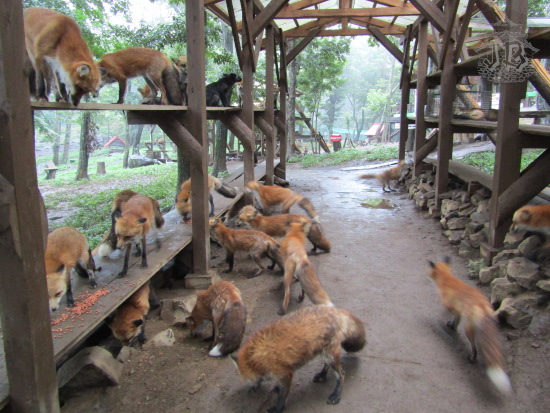
Zao Kitsune Mura [蔵王きつね], the Fox Village in Zao is as its name says, a fox village. There is about a hundred foxes running around, chewing your shoelaces and marking territory. It’s like the deer of Nara, in foxy form.

Zao is located close to the city of Sendai [仙台], up north of Tokyo, and here I ended after a couple of bumpy train rides to meet with D****e at Shiroishi station. We took a taxi to get there.

The Fox Village is located in the mountains, about 20 minutes away from the town. There is an outer part which consists on a sort of petting zoo, some baby foxes and the hospital. You’re not allowed to pet the foxes without permission though, because they have, you know… teeth. There is also a badger (for some reason), some rabbits and goats. In that area you can take pics holding and petting the foxes for a fee.

Once you go into the main area, you find yourself in a large yard where there are… 100? 200 foxes? There are different colours of foxes, even if all of them are “red foxes” they have different coats: standard red, white, black (technically called ‘blue foxes’ apparently?), mixed colour (called ‘ice and fire’ or something because why not?).

You’re allowed to feed the foxes from a platform / shed as long as you don’t touch them, and you’re supposed to stay still when they try to chew you cross your path.


The area is separated into a small zone for the cubs, an acclimation area for the ‘teens’ and the main freedom yard.

There the foxes have got… well, I’m not even sure of how to call them, so just have a few pictures. As long as you follow the rules and don’t freak the foxes out, you can get pretty close to them, which is amazing. We tried not to disturb them while they ate, either.

The weather was miserable though so you see some dry foxes and a lot of wet foxes. There was a very wet me in-between too. And well, the foxes were fascinated by D****e’s clothing and kept trying to eat her. However, my mission was to ‘take pictures first, rescue her later’.

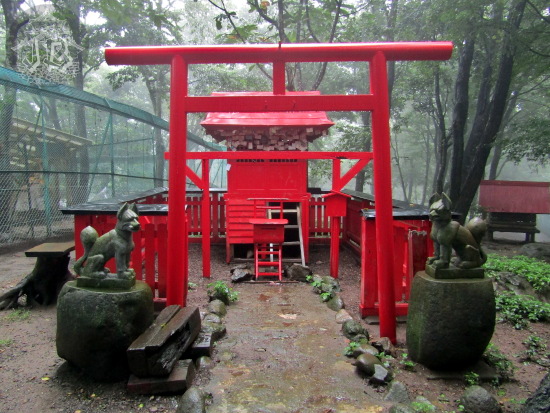
There is also a little shrine with space inside for the foxes to sleep.

At the end you’ve got a bittersweet feeling because you’re not allowed to take any home (T_T) I just wanted one or twenty…

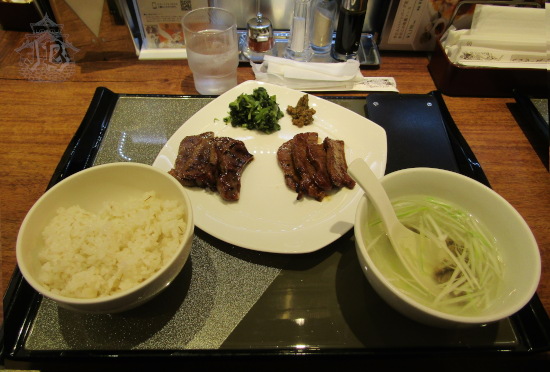
The day ended with yummy gyutan (grilled cow tongue), a walk throughout the covered Sunmall Ichibancho [サンモール一番町] commercial galleries and some Chupacabra hunting in an UFO machine downtown Sendai.

27th December 2014: A stroll in the cold (Guadalajara, Spain)

I had a couple of friends over for that silly blursday period between Christmas and New Year’s and we decided to get to Guadalajara for a walk or two. Not that there is much to see, but it has a small zoological park. The Zoológico Municipal de Guadalajara had a rocky start, with small cages and sad animals, but it seems to be trying to do better. The main activity that goes on in the zoo is the recovery of birds of prey, and there are some education programs too.

We had lunch in an all-you-can-eat Asian restaurant that I enjoy because it is one of the few places where I can get myself some sushi.

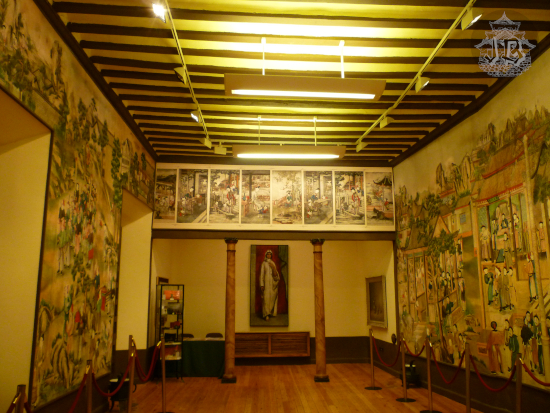
Afterwards, we visited the Palacio de la Cotilla, Cotilla Palace – whose name ‘palace’ is more than overrated. It is a 17th century is a downtown manor in Guadalajara, Spain, formerly owned by the Marquis of Villamejor. One of the rooms, named the “Chinese Room”, Salón Chino de la Cotilla, is decorated with hand-painted rice paper, brought from Beijing, and several Japanese Edo-period paintings which were probably purchased in France from Dutch sailors or merchants.

Finally we took a stroll towards a silly spot in the middle of nowhere that has a Japanes-like bridge over… nothing, really, but it is a cute bridge, in the Parque de las Esculturas, Sculpture Park.

After that we just headed back home because it was dark and cold and pizza could be ordered (≧▽≦).

2nd July 2013: Yet more Odaiba, and Ueno Zoo {Japan, summer 2013}

Once more I headed out to Odaiba [お台場], this time to try and get tickets to the VAMPS Tabata Event and buy the single. The whole idea was that if you bought a CD you got entered into a lottery for a ticket to attend the Tanabata Event the following day. If you bought the three versions of the CD, you also got a poster. They were expecting a huge crowd, but it turned out that crowds of fans on a weekday morning… It was all a bit chaotic because… there were two few people. One can expect staff to get overwhelmed, but this was totally… underwhelming for them, and they did not know what to do about it.

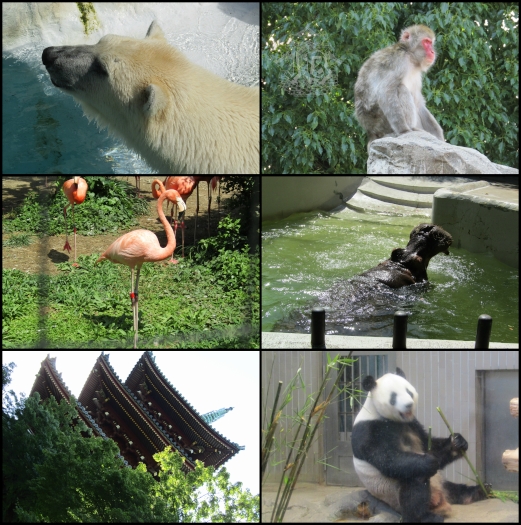
I finally managed to get tickets to ensure my and my friend D****e after the third or fourth round. Once that was successfully taken care of, I went to Fuji TV to get myself some Galileo merch, just because I could, and rode back downtown Tokyo to do one of those things I would ever like to do if I had some time to spare – Ueno Zoo, Ueno Dobutsu Koen [上野動物園].

The iconic image of Ueno Zoo is any of their Giant Pandas. Here’s one getting stuffed:

Panda play-eating bamboo

A secretary bird, which made me remember an old movie and greatly amused me:

Secretary bird, a bird similar to a stork with crazy feathers - like a Native American hairdress - on its head

And a friendly and bored Hokkaido bear which came to say hello at the glass:

A Hokkaido bear prowling its enclosure. It could use with some enrichment.

Aside from the animals (I’ll spare you more pics, though I have an amazing close-up of the polar bear), Ueno zoo holds the pagoda of the former Kan-eiji Temple:

Five-story pagoda in reddish-brown wood

After the zoo was closed, I headed for Shibuya [渋谷] where we had scheduled a meeting at the Hachiko Memorial Statue (one of those things you should do in Tokyo at least once), the Chūkenhachikō-zō [忠犬ハチ公像].

Statue of a sitting akita dog

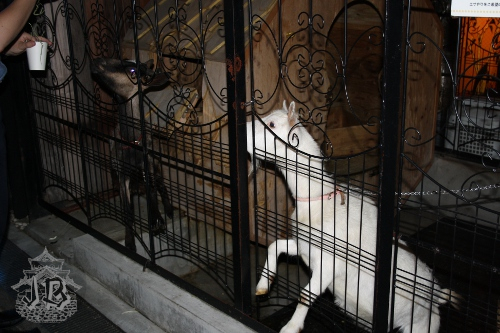
Meeting successfully achieved, dinner was acquired in a goats cafe, Sakuragaoka Cafe. Then the goats got dinner too.

Two goats, one white and one tan, behind a fence, being fed straw by a person with a cup in their hands